



Abstract
Now that the goal of universal primary education has been achieved in Ghana, the nation’s aim is to expand higher education as a key to development. We argue that this expansion will necessitate the gradual addition of Ghanaian languages as a medium of instruction. We innovatively explain why this is so by comparing the achievements of the Ghanaian education system with one of the best education systems in the world. We use the conceptual distinction between ‘discerned’ and ‘designed’ languages to discuss the problem of which languages to choose. We propose five scientific principles that could guide the introduction of Ghanaian languages and suggest concrete steps that could be taken over the coming years to make the transition practically possible. As such, we present a way of looking at using indigenous languages as a medium of instruction that has relevance for other African countries as well.
Introduction
Quality education is a key element contributing to the development of a nation. Thus, the President of Ghana has a vision ‘of an optimistic, self-confident and prosperous nation’. 1 Education plays a critical role here: it is ‘critical in the building of the cohesive and prosperous Ghana on which we have set our eyes. Our children, and young people, must be equipped with the knowledge, skills, and aptitudes that would enable them to compete with the best in the world. Every country that has made rapid, and significant progress has placed education at the heart of its development.’ 1
As this article will demonstrate, to make that vision a reality, Ghana must take further steps to increase participation in higher education (the enrolment ratio), building on the progress of the past. Both qualitatively and quantitatively, this education should be on a par with what exists in other countries, such as those of the global North, although the content can be different and adapted to local circumstances. What are the implications for the issue of the medium of instruction in education?
Our arguments have a threefold purpose:
(1) To show that a further increase in enrolment in higher education in Ghana will necessitate a gradual addition of Ghanaian languages as medium of instruction; (2) To outline principles that should guide a transition from a monolingual English medium system to the addition of Ghanaian languages as medium instruction in higher education; (3) To suggest several concrete steps that should be taken in the short to medium term to make such a transition a practical possibility.
We carry out our analysis by comparing the educational system of Ghana (in terms of enrolment and language policy) with educational systems of other countries on aspects that are relevant for this discussion. We begin with a short overview of Ghana’s language ecology and then present the argument as outlined above in the three sections that follow. The concluding section looks at some of the wider implications of the arguments presented in this paper.
The literature commonly characterises the linguistic situation of Ghana as one of diglossic multilingualism (Yevudey and Agbozo, 2019). Diglossia generally means that there is a marked difference in status and domains of use between the official language (English) and all other languages. Multilingualism means different things: it means that many languages are spoken in the country, but it also means that many people speak more than one language. Section two addresses the number of languages spoken in Ghana and their diversity. Here, we examine the issue of people speaking more than one language more closely, because that characterisation hides several important distinctions.
First, there is the issue of ‘speaking’ or ‘not speaking’ a language. As Stoffelsma and De Jong (2015) illustrate, this dichotomy is too coarse for Africa. Most Ghanaians know some English and can hold simple conversations in it, for example, with visiting tourists. The number of people able to read and understand English is lower; the number able to follow court proceedings, parliamentary debates or academic discourse is still lower; and the number able to produce such discourse in English is even lower. The same is true for Ghanaian languages. Because Akan is one of the dominant indigenous languages spoken in the country (Eberhard et al., 2021, Ethnologue), many Ghanaians whose L1 is not Akan do learn enough Akan to handle day-to-day situations; but more advanced knowledge of the language is restricted to a much lower number of people. The same can be said for Hausa, spoken as a lingua franca in the Northern and ‘Zongo’ communities across the country. Other widespread languages include Ewe, Fulfulde, Pidgin English and Ghanaian Sign Language.
Multilingualism is not the same all over Ghana or for all Ghanaians. This has two dimensions: a social dimension and a linguistic dimension. Socially, knowledge of English is strongly correlated to socio-economic position; the well-to-do have more possibilities to learn and use English and teach it to their children and can afford a higher standard of English education. Therefore, knowledge of English is unequally distributed along socioeconomic lines. There is also a linguistic dimension, having to do with both the unequal distribution of speaker numbers of Ghanaian languages and with the language ecology itself. The unequal distribution of speaker numbers means that speakers of smaller languages (such as Ewe) tend to learn the languages with larger numbers of speakers (such as Akan), but vice-versa is much less common. Language ecology refers to the proximity of languages, something we return to in section two. What it means is that for speakers of related languages, like the Potou-Tano languages, it is easier to learn to speak other languages from the same (sub)family of languages than to learn other languages.
What does this mean for the vision that the President has mapped out for Ghana as a prosperous nation, able to compete with the best of the world? There is a clear consensus in the scientific literature, going back at least to UNESCO (1953) that education in a language familiar to the learner works best. Therefore, a situation of diglossia that effectively forces part of the population to learn in a language they are not familiar with, will put a brake on a country’s development. It is not compatible with Ghana’s vision for the future. It is our position that whereas multilingualism can grow into a long-term resource for Ghana, diglossia cannot. This does not mean that children should not be given the opportunity to learn English or indeed other languages; it does mean that their possibilities for learning in familiar languages should be greatly expanded compared to the current situation. This is both necessary and practically possible.
Why the addition of Ghanaian languages will be needed?
Before us, many other authors have argued in favour of a transition to African languages (Djité 2008; Prah 2010; Wolff 2016), but they have mostly limited themselves to presenting ideological reasons (based, e.g., on cultural considerations or ideas on human rights). Their arguments are valid, but in addition, we propose a different approach, one based on a discussion of what we can hope that an education system will be able to achieve. To do that, we benchmark the Ghanaian educational system against that of a European country that has been well-researched and that has already reached the levels of participation in education that Ghana will need to achieve in the future. This country is Estonia. Even though in linguistic and other terms that country is quite different from Ghana, using Estonia as a benchmark allows us to show why the use of national languages is unavoidable in the North. To do that, we make use of the notions of ‘discerned’ and ‘designed’ languages.
Discerned and designed
Although there is no unanimity on the number of languages spoken in Ghana, there is no doubt that the number runs into the dozens. A commonly quoted source is the Ethnologue, which gives the number of living indigenous languages spoken in Ghana as 73. 2 The sheer number of Ghanaian languages itself is often used as an excuse for avoiding a debate on using Ghanaian languages as a medium of instruction. It is reasoned that any choice would lead to political nightmares (Anyidoho and Kropp-Dakubu, 2008: 146). There is some merit to this line of reasoning, but it should not stop the debate, because we believe that it would be entirely feasible (and advantageous to Ghana) to use scientific principles leading to the choice of a much more limited number of languages. To understand that, we make use of the distinction proposed by Chebanne and Van Pinxteren (2021: 391) between discerned and designed languages. They argue that languages can be standardised or intellectualised (designed) in such a way that they can easily be used by those that speak several related (discerned) languages. The term ‘designed’ languages is akin to the ‘íntellectualisation’ concept. Prah (2017: 216), quoting Sibayan (1999), describes an intellectualised language as a ‘language which can be used for educating a person in any field of knowledge from kindergarten to the university and beyond’. The word ‘designed’ purposely points to the underlying social processes that are relevant in this context. A good number of languages (such as Italian, Turkish, and Bahasa Indonesia) have, to a certain extent, been shaped or designed by different mechanisms.
Let us give an example to illustrate this point. For Italy, the Ethnologue database lists 18 living Italic languages. 3 Yet education does not use all of these languages in education. Speakers of these Italic languages make use of standard Italian. Thus, Italian is used in formal domains; Italian is used as a common designed language by speakers of 18 Italic discerned languages. Mastering this designed language requires formal learning. Still, it makes more sense in Italy to use standard Italian as a common designed language, as opposed to, for example, German. The situation is similar in the Arab countries, or in China, where Modern Standard Arabic and Mandarin Chinese, respectively, are used as designed languages that are relatively easily accessible for those that speak a large number of discerned languages.
For Ghana, this means that in principle, the problem of ‘too many languages’ as signalled above could be less severe than it seems at first sight. In Ghana, as in other countries, a limited number of designed or intellectualised languages could serve a larger number of discerned languages. But why and how should such a limited number be chosen?
On linguistic abilities
As we have seen, formal education always involves learning in a (slightly) different medium from what is spoken in the home; in the terms used above, it means learning a designed language, in many cases similar to but nevertheless different from the discerned language spoken in the home. For children who suffer from intellectual disability, it is not possible to learn reading or writing at all; some may manage to reach only a very low level. The number of children who can become ‘literate’, as opposed to ‘functionally illiterate’, is lower. (Schlechty 2004: 7) defines ‘functional illiterates’ as persons with such a limited skill level in reading and writing that they cannot ‘manage daily living and employment tasks that require reading skills beyond a basic level’. Data from the UK National Literacy Trust show that one in six (16.4%) of the adults in England are classified as functionally illiterate. 4 Not even a highly developed education system like that of England can give all children enough education so that they can understand anything beyond a very simple text.
We have to accept that not everybody has the same learning abilities; some children learn more easily than others. What is more: IQ can be broken down into different dimensions. These dimensions should be evaluated separately, even though they are related. Li (2016) has shown that talent for language bears some relationship to, but is still independent of general intelligence. Some children have a talent for language learning but are not so good at math. In other children, it may be the reverse. In addition, some children excel in both.
For a country like Ghana, these facts have tremendous consequences, although they are usually overlooked. In the colonial period, the language of instruction did not matter so much because there were so few places available that they could easily be filled with those who were talented in language. In a sense, this was not unique; Europe used to rely on Latin for the education of its elite. For India, Sanskrit has fulfilled the same function in the past.
However, when moving from education for the few to the Sustainable Development Goal of ‘quality education for all’ (SDG 4) and ‘reduced inequality’ (SDG 10), the medium of instruction becomes increasingly important. Learning a foreign language to such a level that a person can successfully partake in instruction in that language at an advanced level is time-consuming and requires an intellectual investment. Lower talent for language learning demands more effort. At what level of participation in education will it become unsustainable to use a foreign language?
The theoretical questions are as follows: (A) What proportion of the people can an education system give enough skills and knowledge so that learners can make effective use of an international language that is very different from their L1 as the medium of instruction? (B) What proportion of a population will need to get some form of tertiary education?
5
If and for as long as in Ghana the proportion of ‘A’ is greater than the proportion of ‘B’, then it will be possible to give tertiary education in English. Conversely, as soon as proportion ‘B’ exceeds proportion ‘A’, an English medium of instruction will no longer be feasible for all tertiary education. This theoretical insight deserves to be repeated in different words. Thus, if Ghanaian education is required to educate
To specify this, we need to clarify what we mean by ‘tertiary education’ and we need to examine the level of language proficiency needed for such education.
What language level is needed for tertiary education?
Education is not organised in the same way all over the world. In an attempt to bring some clarity, UNESCO has developed a commonly understood classification of the different levels of education: the International Standard Classification of Education (ISCED) 2011. This system has eight levels: Levels 5, 6, 7 and 8 are reserved for what UNESCO then calls ‘tertiary education’. This goes all the way from the highest level (8), the doctoral level, to what UNESCO calls ‘short-cycle tertiary education’ (level 5, different from level 4, ‘post-secondary non-tertiary education’). What is important about this is that ‘tertiary education’ in UNESCO terms is comprised of more than what in many countries is known as university education. Secondary education is made up of ISCED levels 2 and 3 – in Ghana, these levels refer to the division between junior and senior secondary school. Technical and vocational education and training (TVET) are generally at levels 3 and 4. Primary education is level 1.
To compare participation in education in different countries, we use the Gross Enrolment Ratio (GER) as our indicator. The GER is the total participation in a country ‘in a specific level of education, regardless of age, expressed as a percentage of the population in the official age group corresponding to this level of education’ (UNESCO, 2009: 9). In principle, the GER can rise above 100. This happens if many older (or younger) children participate in education compared to the official age group for that educational level. Another indicator is the completion rate for different levels of education. That indicaator refers to the proportion of the school-age population completing their education.
There are several systems for comparing language proficiency. A system that is often used is the six-level Common European Framework of Reference for Languages (CEFR). 6 To be able to profit from tertiary education, a proficiency level of at least CEFR B2 is required. In words, the level is called ‘upper intermediate’ – a level set as the minimum by most universities. For Ghana, the WASSCE credit pass (C6) is taken to be equivalent to the B2 level. 7
This specification of what we mean by ‘tertiary education’ and ‘required language level’ allows us to examine what Ghanaian education delivers in this area. What is more, we can compare it to another educational system – that of Estonia in Europe.
What educational systems can achieve
It is possible to estimate the proportion of the population that Ghana’s education system currently educates to a B2 proficiency in English at the end of secondary education. This is done by multiplying the completion rate for senior secondary education with the percentage of students that achieve a credit pass in English at the WASSCE. UNESCO has data on the senior secondary completion rate in 2018: it was 35.7%. This represents a sharp increase compared to 2003 when it stood at 4.5%. But it is still significantly lower than China (estimated at around 58%) or Estonia (83%). 8 According to information from the US Embassy in Ghana, 9 a credit pass in English is achieved by 54% of those who take the WASSCE exam. The conclusion can be that nowadays, the Ghanaian education system manages to give just under 20% of its learners a B2 level of English. How does that compare to what other education systems can manage to do? Let us now look at Estonia.
There are several reasons for the choice of Estonia. The country gained its independence from the Soviet Union in 1991; it was not a colonial power. When it became independent, it started a reform of its old Soviet-based education system, which used Russian as a medium of instruction. Estonia chose not to retain Russian as the medium of instruction – instead, it decided immediately to switch to the indigenous Estonian language. 10 In addition, English became the first foreign language that Estonians had to learn. Estonian is very different from English (this is relevant – we will revert to this point). Estonia was one of the participating countries in a study ordered by the European Commission into second-language proficiency of secondary students in the last year before their final exams (European Commission, 2012). 11 Data from the study are relevant in this context. It revealed significant differences in what 16 education systems achieved in 15 different countries in Europe 12 , ranging from Malta (60% of learners at B2 level) and Sweden (57%) to France (5% of learners achieving this level) and the UK (2%). The third place in this list was occupied by Estonia. In Estonia, 41% of secondary school students attained the B2 level in English. Estonian 13 is the medium of instruction in secondary education – English is not used as a medium of instruction, but instead, it is taught as a subject of study. The Estonian completion rate for senior secondary education in 2014 was 82.7%. As a consequence, Estonia can give nearly 34% of its children a B2 level in English, in contrast to under 20% for Ghana. This benchmarking yields two interesting insights: 1) English does not need to be used as a medium of instruction to teach learners a good level of English – such a result can also be obtained through teaching English as a subject; and 2) if Ghana were to emulate the Estonian education system, it could give many more children a good level of English than at present.
However, there is equally another important point we want to make here, for which we need to take one further step. We need to look at the level of enrolment in tertiary education, using statistics published by UNESCO. 14 In Ghana, this level has increased significantly over the years and in 2019 it stood at 17.2%; for Estonia, the level has increased as well and stood at 70.4% in 2018.
What this means is that Ghana can rely on English as the medium of instruction for its tertiary education. It can give more learners the minimum proficiency in English than there are places available (20% of students at the required level, but places available to only 17%). By contrast, even though Estonia succeeds in giving more learners a good level of English, it is not able to rely on English for its tertiary education. In Estonia, 34% of children have the minimum level of English that would be needed, but tertiary education is accorded to over 70%. Because the participation rate in tertiary education in Estonia is more than four times as high as that in Ghana, Estonia is forced to rely on Estonian in its tertiary education system.
Another conclusion imposes itself, which is that if participation in tertiary education in Ghana increases to approach levels of countries like Estonia, the addition of Ghanaian languages as a medium of instruction and examination in certain sectors of its tertiary education will become unavoidable. Perhaps it will be possible for Ghana in the future to match one of the best-performing educational systems in the world in terms of English teaching, like that of Estonia. One can even optimistically assume that Ghana would be able to do a bit better and to give even more students a good level of English than Estonia manages. But like in Estonia, also in Ghana even more learners will be intellectually capable of taking tertiary education. Thus, the answer to the question asked above is now clear. Currently, in Ghana, the proportion of ‘A’ is still above the proportion of ‘B’. It is possible to rely on English. In the future, this will change; it will no longer be possible to give the minimum level of English to all those gifted enough to profit from tertiary education. Instead, Ghana will increasingly have to depend on its indigenous languages.
But how could Ghana manage a transition towards using its indigenous languages as a medium of instruction? On what principles could necessary choices be made? That is the topic of the next section.
Choosing Ghanaian languages for use in tertiary education
Principles for rational language choices
The
The
As a necessary addition, the
Then, a
The
These principles are all related in some way to the idea that the use of a designed language always involves some degree of learning, but that if large groups of people are to be able to use such a designed language, it makes sense to minimize the required amount of effort. How can that be achieved? That is the topic of the next section.
Ease and difficulty of language learning
The matter of differences in ease of language learning and teaching has not received wide attention in the literature. Van Pinxteren (2020: 137) states: ‘the question of what ease or difficulty of language learning means for large groups of learners and for an education system has not been asked in the literature in that way. Yet, this is a question of key relevance for Africa, where populations are supposed to be taught in a language that most learners do not speak from birth.’
There is U.S. experience showing a considerable difference in learning languages to a B2 or equivalent level between easier and more difficult languages. For a talented American learner, the difference can vary between 10 weeks of full-time instruction for a ‘closely related’ language to more than 80 weeks for a ‘super hard’ language. 18 Van Pinxteren (2020) has benchmarked the U.S. scheme to scores of language distance (Levenshtein or Normalized Edit distances) by matching linguistic distances to the U.S. language categories. Linguistic distance scores are computed by the Automated Similarity Judgement Program (ASJP). 19 This yields a classification of ease of language learning relating Levenshtein distance scores to classes of ease or difficulty of language learning as follows (taken from Van Pinxteren 2020: 141):
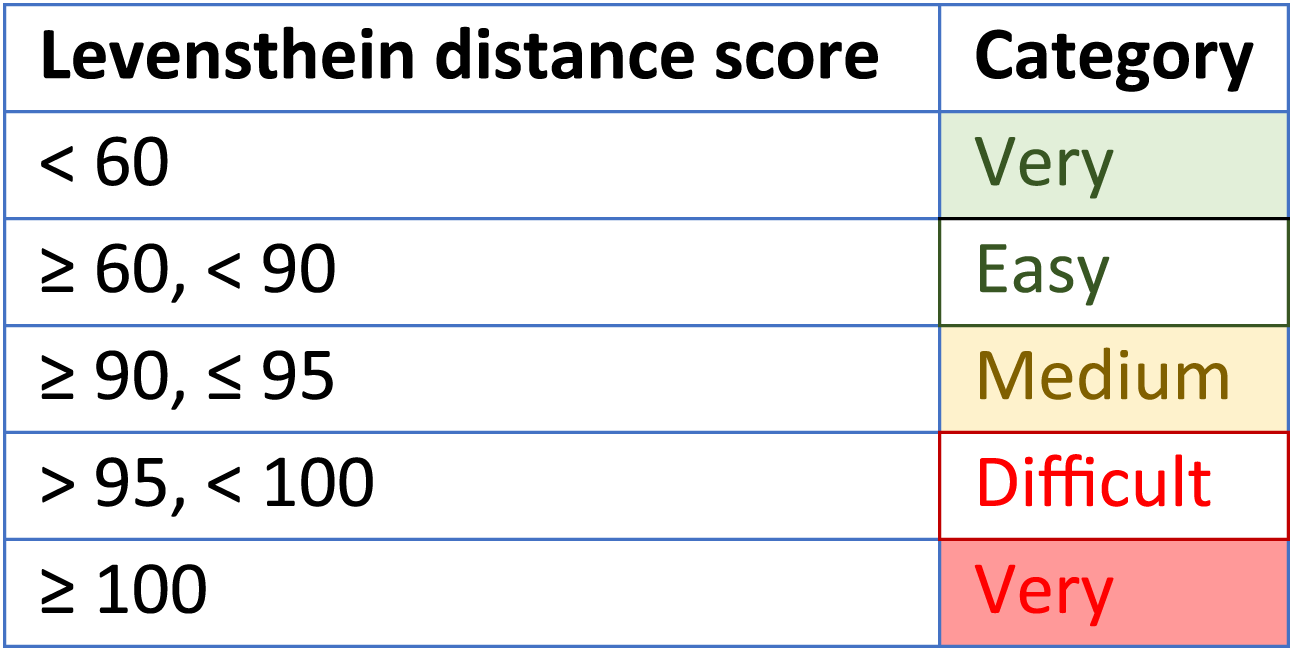
This categorisation has limitations because it takes account of only certain differences between languages. Therefore, suggestions for language choices based on these categorisations would need to be validated through expert linguistic knowledge. Another limitation of the ASJP scores is that the database includes 65 Ghanaian languages, whereas the Ethnologue discerns 73. 20
Speakers of any Ghanaian language will find both English and Ghanaian Pidgin English ‘difficult’ or ‘very difficult’ to acquire. However, the combination between English and a Ghanaian language is not the only difficult combination in Ghana; this is because the languages of Ghana belong to several language families. Thus, a speaker of Akan may find it difficult to learn, for instance, Dagbani (and vice-versa). Therefore, trying to introduce one single Ghanaian language as a national language (as was done with Swahili in Tanzania) is bound to meet resistance from speakers of unrelated languages; they would prefer to invest their time in acquiring English. Thus, the future of higher education in Ghana will be one that makes use of several languages. The question is: how many and which ones?
Potou-Tano languages.
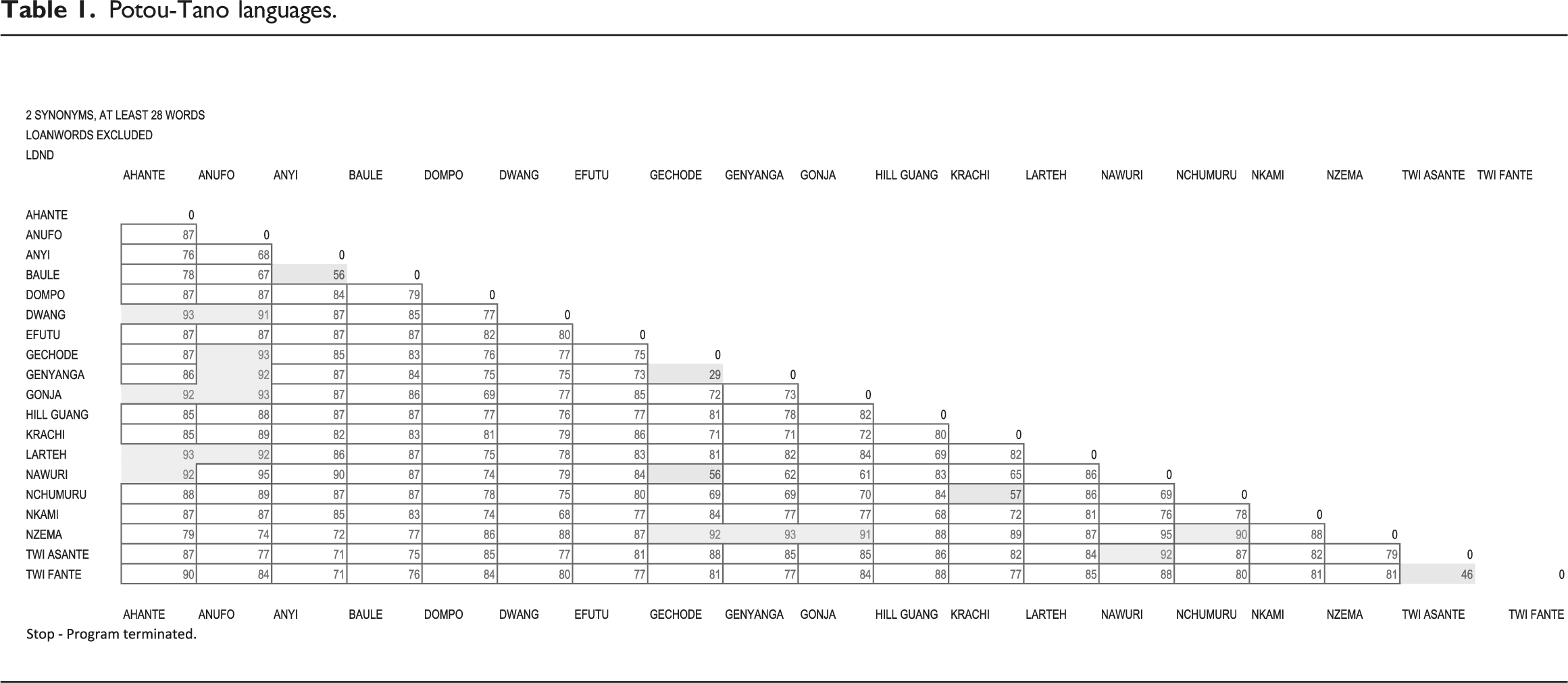
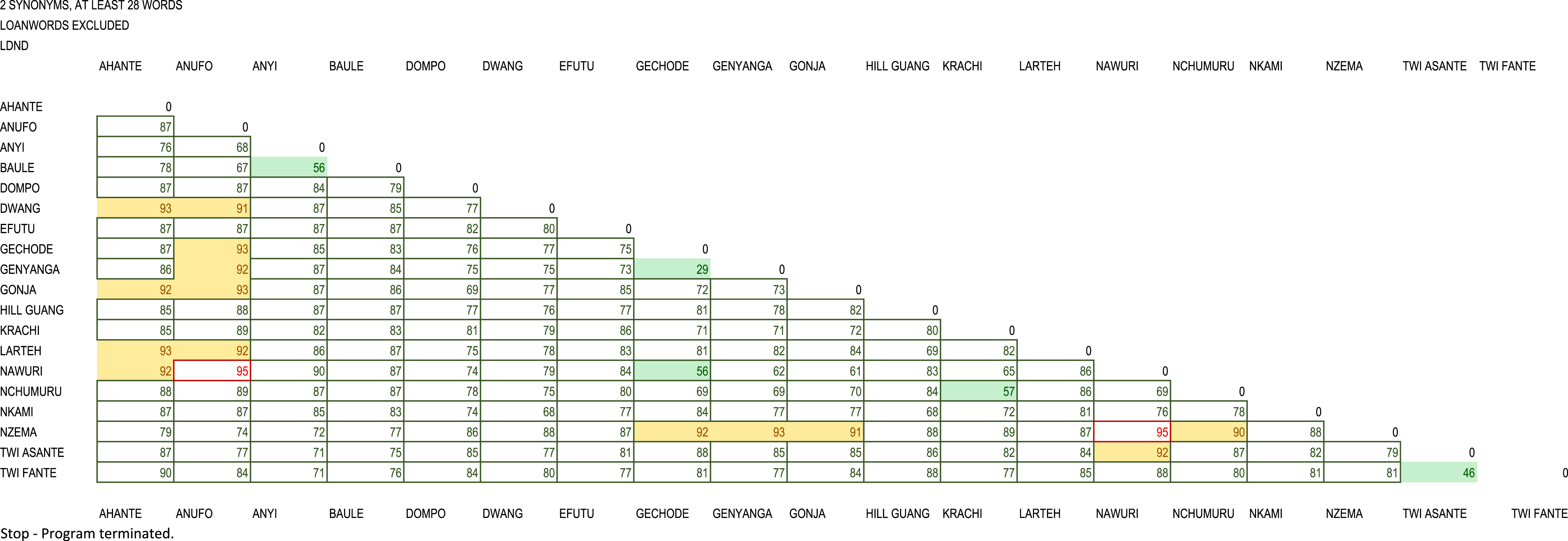
A different group of the Kwa languages is Ga-Dangme. This group is made up of two languages. They form a very easy language pair; either one of them could be developed for higher education. Ga/Twi, however, do not form an easy language pair, even though the communities live near one another. Ga and Dangme (or Dangbe) are both supported by the BGL. One could consider using both languages in primary school but just one as the medium of instruction at the higher levels.
The last group is the Gbe languages. In this group, Ewe dominates in Ghana. These languages form very easy language pairs. The BGL has fostered the development of Ewe.
Gur languages.
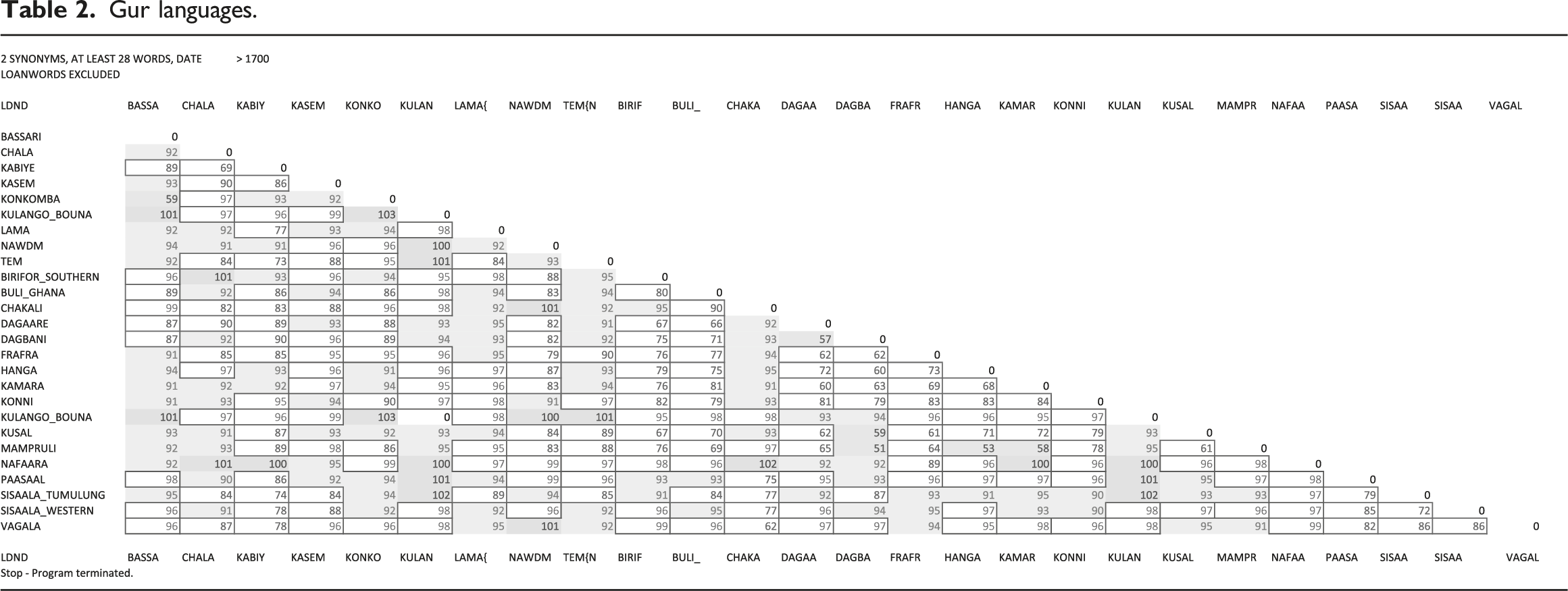
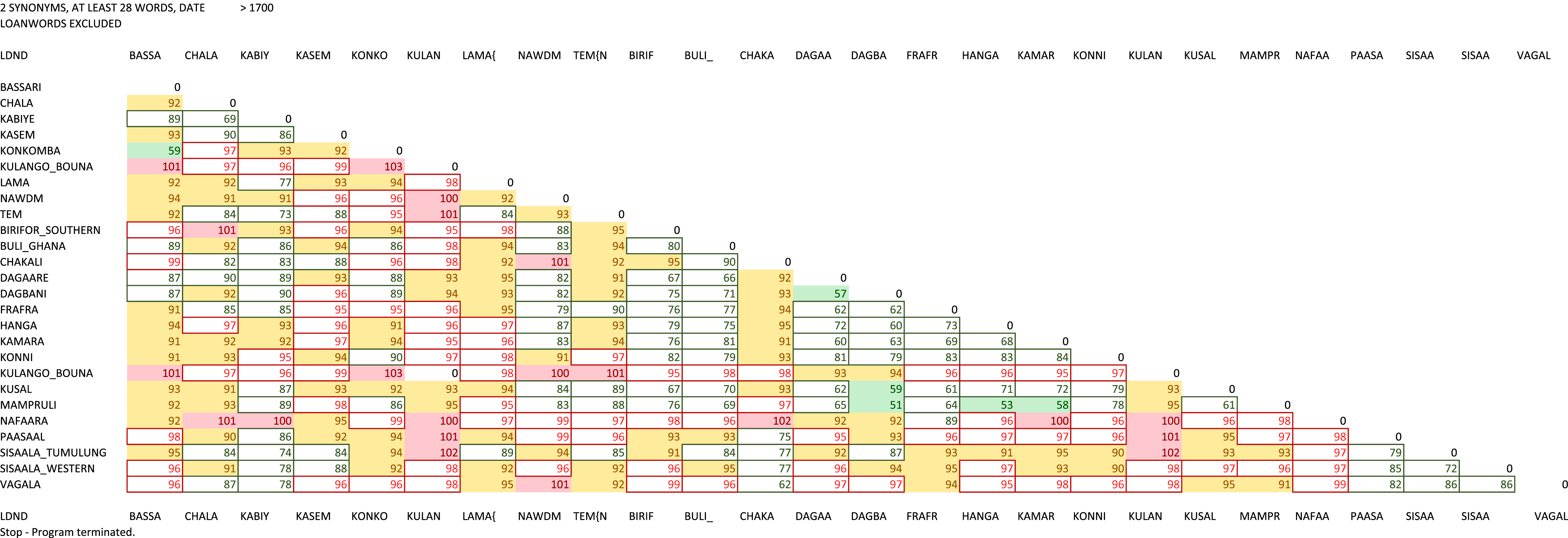
Ghana has small minority of speakers of languages from other families. Most of these speakers are probably bilingual and they could opt to school in another Ghanaian language.
In conclusion, for secondary and higher education, Ghana would need to turn to around six ‘easy-to-learn’ languages, together with English. This means that the development work of the BGL for primary education would have to be extended to higher levels of education as well. It might be possible to continue with the languages currently supported; however, the choice for these languages was made a long time ago, largely for pragmatic reasons. It might be wise to use modern sociolinguistic insights such as the principles presented above to re-evaluate both the number and the precise choice of officially supported languages. Such a change would make the Ghanaian education system more efficient and more readily accessible for a greater portion of its children. With the same amount of inputs, their average results would increase, benefiting the Ghanaian economy and Ghana in general. This is in line with what has been found in other parts of the world. Grin (2003), an economist, has looked at multilingualism in education in the West, especially in Switzerland and Canada. He concludes that ‘[t]he application of basic economic concepts then suggests that society is likely to be best off not when it tries to eliminate diversity, nor when it attempts to embrace limitless diversity’ (p.39).
If Ghana would be able to emulate the Estonian educational system and teach English as a subject in schools, the result would also be that national communication in English would become easier, because more learners, than is currently the case, would be able to achieve a good level in English. However, to increase national cohesion and to further facilitate national communication, another measure would be important; Ghanaians should start to learn one another’s languages. As pointed out above, currently many Ghanaians informally learn Akan to various degrees. However, it is much less common for Akan speakers to learn another Ghanaian language. Thus, at least one of the languages supported for secondary and higher education should in the future be taught as a second language subject. Those less gifted in language will find this difficult, but they would probably be able to learn enough to engage in basic but meaningful communication.
So far, we have shown that: (a) the gradual addition of Ghanaian languages in higher education will become unavoidable in the future (even though it might not yet be necessary now), and (b) it is possible to make such a transition by using a limited number of easy-to-learn indigenous languages in addition to English.
However, what would it take in practice to start such a transition? That is what we will briefly examine in the next section.
How could a transition be made?
Currently, the ‘Education Strategic Plan 2018–2030’ provides the policy framework for education. 21 The ambition of the plan is to transform Ghana into a ‘learning nation’. However, that is different from reaching GER levels in tertiary education that approach those of the global North. The ambition for 2029/30 is to reach the level of 40%, roughly a double compared to the current level (p. 101), but also roughly half the level currently reached by the global North. The medium of instruction is to be a local language during the initial 3 years of primary education, switching to English afterward. The plan does not specify what level of English-language proficiency students should have at which level of education. We think the Estonian example shows that teaching English as a subject will be more efficient than using English as the medium of instruction. As shown above, even if the Ghanaian education system can grow to be as efficient as the Estonian one, it will run into problems before 2030 if the plan is to maintain the English medium of instruction for the entire duration of the current plan.
A focus on higher education alone would run the risk of staying within the colonial model. In the colonial period, education was aimed at singling out students with linguistic skills and mental flexibility needed to fill the needs of the colony. Those who dropped out at some point could be dismissed as ‘collateral damage’ (needless to say the dropouts would have felt differently).
In a decolonial model, education is aimed at the masses. To become a ‘learning nation’, education should be relevant for all learners. Learners who leave the system without useful knowledge or skills represent a waste; this holds for the learners, for resources not well spent, and for lost economic potential. Thus, although it is not the principal aim of our paper, we propose to look at another area of education that will grow under the current policy framework, the area of Technical and Vocational Education and Training (TVET).
We submit that in TVET, the reliance on English will run into problems earlier than in higher education. The reason for this is that the average student choosing this option may not necessarily have the same language skills as the student taking a higher education option. The level of English required of learners who follow TVET education is lower than what is expected of students entering tertiary levels/routes. For this reason, relying on English for an expanding TVET sector will lead to an increased drop-out rate, teacher and student frustration, and represents a waste of limited resources. These problems can be mitigated for a while if teachers and students use Ghanaian languages in addition to English. This strategy is known as ’translanguaging’, as described by, for instance, Yevudey and Agbozo (2019) and Yevudey (2015). However, if English is kept as the language of examination, this will only offer temporary solace. A first step should be to heed the example of Malta; its College of Arts, Science, and Technology conducts some of its teachings in Maltese and offers students the option of being assessed in Maltese. 22 Space does not permit us to elaborate more; hence, we would like to focus instead on how to start preparing for the future of tertiary education in Ghana.
A start would be to evaluate the current list of languages officially supported for education in light of the principles outlined above. An expert committee should be established, perhaps led by the Department of Linguistics of the University of Ghana and other language departments in the country, which should be tasked with coming up with a set of recommendations for languages that are considered good candidates for use in (higher) education in such a way that almost all Ghanaians in future can gain access to education in a language to which they have easy access. This could also include a discussion of which languages should be added in which areas of the country – thus, the Gur languages could be added in the North but might not be offered in the South. These recommendations should probably be opened to public discussion and debate, resulting in a decision in Parliament. As such, we support the call for a Language Policy Act as made by Atintono and Nsoh (2018).
The next step is to start preparing for a transition that should take effect at the latest at the start of the next strategic plan. It will be necessary to educate interpreters and teachers, prepare teaching materials, etc. before a transition can be effective. The better this is understood and planned, the easier it will become. A lot will be needed, and many questions will need to be answered. Would it be better to start with adding indigenous languages as a medium of instruction in primary school and then introduce them in secondary and higher education only later? Or would it be better to introduce it first in TVET education? Would it be more efficient to introduce local languages to certain professions (such as primary school teachers) in a step-by-step manner and introduce them to other professions later? What would be required to teach Ghanaian languages as languages in addition to the L1 and English? Which institutions could begin using a Ghanaian language as a medium of instruction, with which subjects, and at what point in time? These questions may be difficult to answer – but it is not impossible to find good answers through proper planning and consultation. The return in terms of a more efficient system of education, leading to more innovation and higher rates of learner success, and, in general, a more prosperous Ghana able to develop in a way that is both sustainable and culturally appropriate will be immense.
Conclusion
We have argued that if Ghana aspires to reach education levels in the same league as countries in the global North, it will be forced to develop a medium of instruction policy similar to what has been developed in just about all countries of the global North. This means that Ghana will have to make use of Ghanaian languages as a medium of instruction, alongside English, as a minimum in important parts of its educational system. This line of reasoning may have relevance for other African countries.
The practical problem of which languages to use can be solved. We have made use of the difference between discerned and designed languages and the analogy with other parts of the world to show that one formalized (or designed) language can serve speakers of several related discerned languages for more formal purposes such as for education. However, a choice needs to be based on sound and objective criteria. We have suggested five principles that should guide the process of choosing designed languages for Ghana.
We have used benchmarked Net Edit Distance scores (Levenshtein scores) to show that, using these principles, one could arrive at a subset of Ghanaian languages that would be sufficient. We have therefore called for the establishment of a committee of experts that should study the linguistic situation in Ghana more deeply and come up with a set of recommendations. Those would certainly lead to public debate. After that, a decision should be taken by Parliament.
We have argued that even today, or in the near future, the gradual addition of Ghanaian languages will become a pressing issue, first of all in the area of TVET. Therefore, preparations should start now, in light of the potentially great impact such a shift might have. Ghana needs and deserves a more inclusive multilingual approach to the medium of instruction in education.
Adding Ghanaian languages as a medium of instruction might have wider implications in society. Agbozo (2015: 83) has recommended making knowledge of a Ghanaian language compulsory for employment in the public sector. This would be logical if these languages would also be introduced in courts or as languages of administration and debate in appropriate regional and national bodies. It is beyond us to predict where this might lead; however, we hope to have demonstrated that it is necessary, possible, and positive to use Ghana’s multilingualism to its future advantage.
Footnotes
Declaration of conflicting interests
The author(s) declared no potential conflicts of interest with respect to the research, authorship, and/or publication of this article.
Funding
The author(s) received no financial support for the research, authorship, and/or publication of this article.

Notes
Elvis ResCue (PhD) is a Lecturer at the Department of English, Kwame Nkrumah University of Science and Technology, Kumasi-Ghana. He holds a PhD and MA in Applied Linguistics from Aston University, Birmingham (UK) and a BA in Linguistics with English from the University of Ghana, Legon. His research interests lie in the area of Language Policy and Planning, Discourse Analysis (Language and Literary texts), African and General Linguistics, Language Contact/Sociolinguistics, and Language and New Media. His publications appeared in the Ghana Journal of Linguistics, Current Issues in Language Planning, Applied Linguistics Review, and Journal of Linguistics. He has also published a chapter in The Routledge Handbook of African Linguistics, and other chapters published by Multilingual Matters and John Benjamins.
Bert van Pinxteren has an MA in adult education from the University of Amsterdam and an MA in African Studies from the University of Leiden. He has had a career in international NGO work, mostly in the environment and development area, including Friends of the Earth International and ActionAid. He has lived in Kenya and worked with many African NGOs. His PhD is from Leiden (2021) on ‘Language, Education and Identity in Africa’. He has published several journal articles and book chapters. He is currently a guest researcher affiliated with the Leiden University Centre for Linguistics.