



Abstract
In light of the COVID-19 pandemic, universities around the world urgently suspended face-to-face classes halted practicum field experiences, mandated temporary closures of campuses, and directed faculty to convert face-to-face courses to a hybrid format, all with very little time to prepare. This crisis created unsettled feelings. Varied perceptions along with a narrative of uncertainty, panic, fear, doubt, and dread emerged. Faculty were expected to provide effective learning opportunities and continuous learning experiences with little to no disruption. However, the processes involved in making this happen are elusive and complex. Five faculty from a higher education institution in the United Arab Emirates explored challenges and mechanisms, especially through the process of reflective vignettes. In order to collect and analyze data, collaborative autoethnography was employed as it is a fitting and timely research design and methodology. Collaborative autoethnography is a self-reflection alternative research approach that researchers use during global pandemics. Each vignette offers a first-hand account and experience. The five vignettes highlight tangible solutions and offer salient recommendations that may make the end result of this process smoother and the outcomes more favorable for both faculty and students. Ultimately, the faculty implemented a mindset for the moment and reflexively transformed how they engaged in teaching and learning. Consequently, the faculty moved past negative rhetoric and perception of fear, panic, and chaos, and as such, they changed the narrative on COVID-19.
Keywords
Introduction
The United Arab Emirates (UAE), a country consisting of a federation of seven emirates, is situated in the Arabian Gulf peninsula. It is considered to be a part of the Middle East and North Africa (MENA) region, located in the global south. The MENA region is an economically diverse region of 14 countries, including the UAE. Commonalities among the MENA nations include common heritage, language, and a number of challenges; the countries differ vastly on levels of per capita income. The United Arab Emirates has emerged as a clear global south leader in the MENA region, rolling out initiatives to employ the use of technologies in teaching and learning; however, the COVID-19 global pandemic required universities across the nation to mobilize an array of many new resources (Chang et al., 2013; Roy and Uekusa, 2020).
Upending face-to-face courses and converting them to an online format abruptly and suddenly when the pandemic hit was an arduous and challenging process for many faculty around the world. At the university level, it required metamorphoses of faculty and implementation of innovative teaching and learning practices. Faculty were obliged to continue to cover the curriculum and support students in developing capacities for creativity and critical thinking from a distance. This significant pedagogical shift mid-semester evoked a sense of urgency as well as an array of concerns and feelings such as doubt, uncertainty, uneasiness, and fear. It prompted faculty to reflect, reconsider, and re-engage in teaching and learning processes. Faculty concerns turned to the implications of not meeting face-to-face and not having social interactions in a physical and typical learning environment. Other concerns included whether or not all students would have sufficient access to information technology (IT). Additionally, faculty pondered over effective instructional delivery through remote learning, isolation from colleagues, and distance from students. The nuances of shifting mindsets, innovative teaching approaches, and creative pedagogies in light of a global pandemic and systemic challenge were overwhelming and required further exploration and reflection.
This qualitative study explored the lived and shared experiences of five university faculty members. Through the use of autoethnography, that is, autobiographical stories (Humphreys, 2005), we shared our own narratives and experiences through reflective and evocative vignettes, moments in time that explore our responses to the immediate effects of COVID-19 on higher education.
Literature review
The COVID-19 Pandemic presented a global situation which the world had not experienced in decades. Upon reviewing current literature, it affected all sectors of all societies, including the education sector. It changed the way things are done at all levels, and across nations globally north and globally south. Subsequently, the task of educators became more complicated as the process of teaching and learning underwent drastic changes to meet the requirements of the times. Developing effective online instruction, learning activities, and assessment required a substantial amount of planning and scaffolding. Additionally, it required deep reflection and constant consideration of how to best implement innovative practices in order to provide students with ubiquitous learning opportunities.
Teaching through a pandemic: A mindset for this moment
Deep reflection on teaching and learning during strenuous and unprecedented times such as the pandemic required an unusual, yet informed, approach. In order to arrive at what approaches could provide students with ubiquitous learning experiences, those that could be provided through a variety of media and environments, during COVID-19, the authors explored their mindsets, habits of mind, and zones of thinking. The sudden shift from what was comfortable and known (teaching face to face in a physical classroom) to what may be uncomfortable and unknown (teaching completely online in various platforms) occurred for many. Therefore, a shift in mindset and developing a mindset for this moment was required (Lifeline Connections, 2020). While tools such as online platforms, software for curriculum design, communication strategies, and assessment options were prevalent in the literature, more research was needed to explain how the process unfolded for faculty.
While teachers endeavor to facilitate learning, in the online environment the student has to rely on all her/his mental resources to acquire the requisite knowledge and practice and master relevant skills mostly in a solitary fashion devoid of the usual face-to-face social interaction with faculty and peers. Such an approach to teaching and learning has been viewed by many as unusual and fraught with inherent pedagogical obstacles (Durden, 2020; Herman, 2020). These obstacles require faculty to move outside the “norm” and implement more digitalized pedagogical methods and approaches that are practical for online teaching and learning, as well as a variety of creative activities to stimulate student engagement and assess student learning. The literature notes there is disagreement on the effectiveness of online teaching on student learning; however, it is clear that appropriate faculty training and proficiency are paramount to success (Almahasees et al., 2021; Butnaru et al., 2021; Durden, 2020; and Herman, 2020), thinking outside “our own boxes” is critical.
Zones of thinking
Faculty often consider their zones of thinking through a dialogic interaction with the “self” and with the “other.” Through zones of thinking, we make statements to ourselves about what we think about ourselves (Lifeline Connections, 2020). Examples include “I am worried about using a new teaching software, so I better stick to what I know” versus “this is going to be a challenge; I will test out this new teaching software then I will find a way to use it.”
When faced with a catastrophe, people will use, operate and move through three zones of thinking: fear, learning, and growth (Lifeline Connections, 2020). Exploring these zones in this study helped us to understand why we did what we did, felt the way we felt and how we might ultimately progress in our experience. Zones of thinking can be a process of making sense of what one is doing in his or her teaching and learning. As a team, the faculty co-researchers decided to confront and reflect on who we were, how we thought, and what were we doing amidst COVID-19 by exploring the following:
In an effort to fully grasp how one moves through the zone, Lifeline Connections (2020) proposes two pertinent questions: who do I want to be during this crisis, COVID-19, and how do I want to respond in light of that question? In order to answer these questions, one must confront their mindset and explore their habits of mind.
Habits of mind
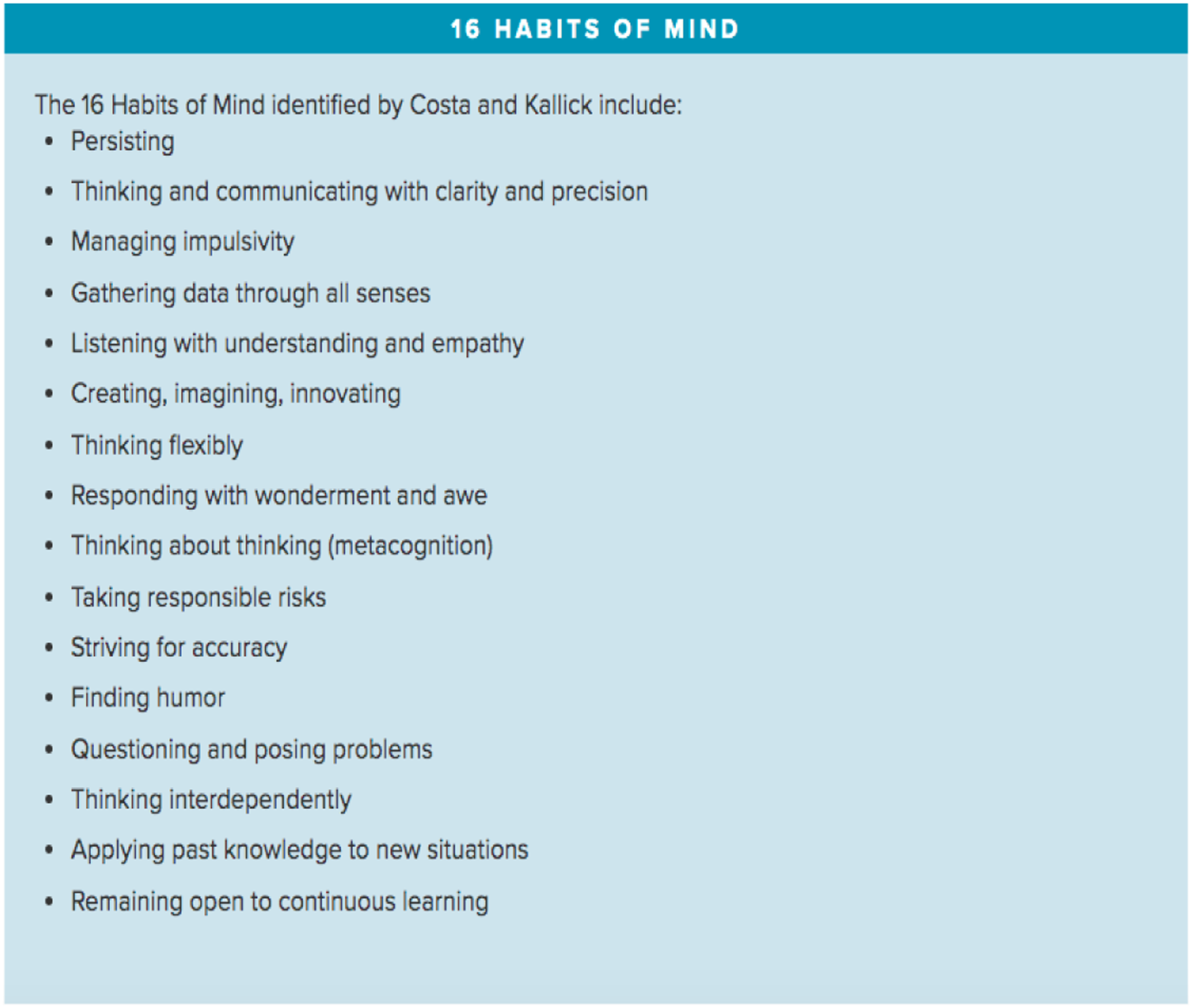
Next, our habits of mind were explored in response to questions and problems as we sought answers to pedagogical changes brought on by COVID-19. Costa and Kallick (2009) discuss how we use and implement our habits of mind when confronted with an issue or challenge. In this case, our issue and challenge was the COVID-19 pandemic.
Habits of mind are a repertoire of behaviors that students and teachers implement to navigate the various challenges and problems they encounter in the classroom and in everyday life. Exploring the habits of mind can help us to explore our dispositions when confronted with problems and dilemmas such as COVID-19. Framing and exploring habits of mind helped us consider how we might continue to grow in our teaching and learning practices, especially in a time of uncertainty (Costa and Kallick, 2009).
The use of vignettes and autoethnography
Vignettes are typically used to start a discussion and gain reactions from participants. In education, vignettes are teaching tools used for illustration, further exploration and reflection. Vignettes have been used to explore such topics as teacher education (Renta-Davids et al., 2020). The use of vignettes as stories and moments in time have been explored in several studies (Humphreys, 2005; Humphreys et al., 2015; Pitard, 2016).
Autoethnography is descriptive narrative writing which is demonstrative of one’s life experience, their thoughts, observations, and actions (Humphreys, 2005). When vignettes are used with autoethnography, the researcher is exploring his/her own experiences. The use of vignettes in autoethnography is helpful to describe and explain various phenomena. It is a way to show intersections between epiphanies, reforms, and changes to educational practice, as a result of teaching experiences and events (Humphreys et al., 2015).
Conceptual framework
This research adopted a collaborative and autoethnographical (CAE) approach to the study of teaching and learning narratives of five university professors during the COVID-19 world health crisis. CAE is often used to explore traumatic experiences and life changing events. Sughrua (2019) gave the clearest explanation of a process of CAE: each researcher creates and analyses their own story, and responds and analyses the stories of the others. The analysis is not a one stage process—there need to be some steps which make the process dynamic, evolving and collaborative.
This study focused on how these professors view themselves as professionals, their teaching experiences, their feelings, and their successes and failures in this time of change. Professors wrote about these aspects of their career-related lives in descriptive vignettes, and the narratives provided an aperture into how they recognized their new world of online teaching and learning during a pandemic. While each professor’s vignette highlights unique vicissitudes of their lived experiences, each account opens a window into one reality, that is, pedagogical practice in unusual times of a global pandemic. Doubtlessly, there are discipline-specific teaching and assessment requirements, yet, the professors’ descriptions as reflective accounts serve the purpose of making sense of and giving sense to the unique experience of teaching and learning during COVID-19.
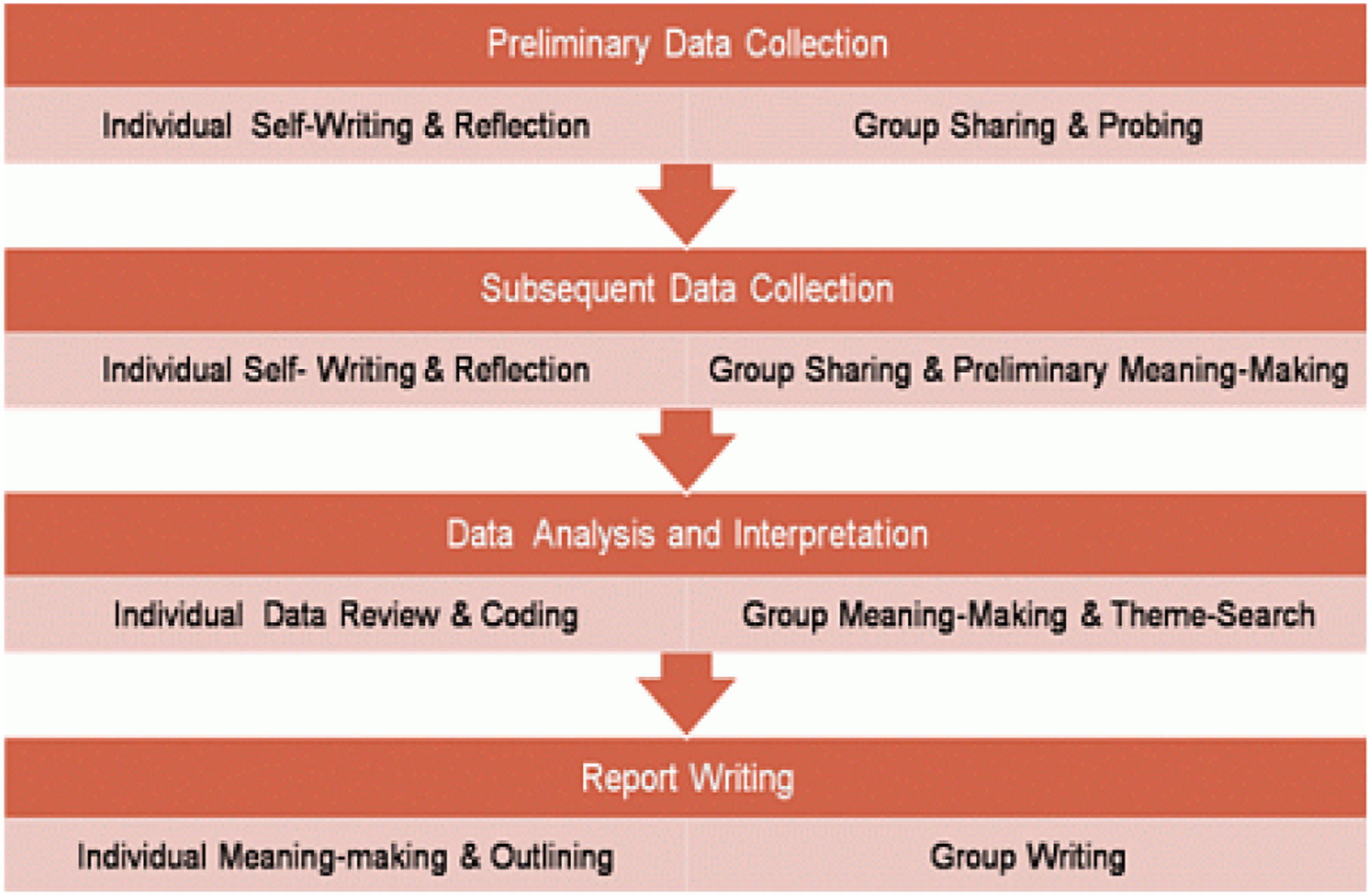
The co-authors have conceptualized and analyzed this research using a relevant conceptual framework. According to Ngunjiri et al., 2010, collaborative autoethnographers work cooperatively and usually adopt various models of collaboration. Collaboration may happen fully at all stages of the research process or partially at certain stages. It may involve working cooperatively and then individually in certain stages of research. In this instance, collaboration was both partial and dialogical as our independent self-exploration and collective exploration were interlaced. Figure 3 provides a visual representation of this model.
As noted in Figure 3, the study requires that each faculty member revisit their experiences of teaching during COVID-19, describe the experiences and the associated feelings, and share these with other members of the research group. Thus, experience is reflected on as lived, felt, and told. The process of sharing and discussing vignettes individually and then collectively, is bi-faceted, that is, primarily the faculty report on their own experiences, and then while learning about their fellow professors’ accounts, engage in further interpretation of their lived experiences. As such, narratives become participative, dialogical, and process focused. This qualitative individual and collective approach constituted the conceptual and methodological foundation for this study.
Design and methodology
A reflexive methodology was chosen for this research. It involved “…examining and consciously acknowledging the assumptions and preconceptions you bring into the research and that therefore shape the outcome” (Wilkie, 2015), and it comprised reflective analysis and autoethnography. Autoethnographic writing begins with a descriptive narrative of events and activities that unfold within a specific situation, (ex., a pandemic). Autoethnography is being used by scores of qualitative researchers during this unprecedented, methodologically challenging time, where not gathering face to face, and social distancing are the best strategies to prevent spread of the COVID-19 virus (Roy and Uekusa, 2020).
We began our journey with the work required and noted in Figures 1–3 in order to engage in an autoethnographic (AE) experience. AE is not story-telling or simply the retelling of personal narratives. To fully capture our experiences, we used vignettes and reflective analysis. AE involves crafting an organized research design along with collecting and analyzing data. “In autoethnography, your life is data” (Katz-Rothman, 2007: 14). Through our own experiences, our stories serve as rich data. While AE is a relatively new qualitative method of inquiry, autoethnographic elements have previously existed in qualitative research found across various disciplines (Chang et al., 2013). It can be completed individually and/or collectively and cooperatively. Exploring zones of thinking and confronting mindsets. Adapted from Lifeline Connections (2020). Sixteen habits of mind. Costa and Kallick (2009). Collaborative autoethnography (Ngunjiri et al., 2010).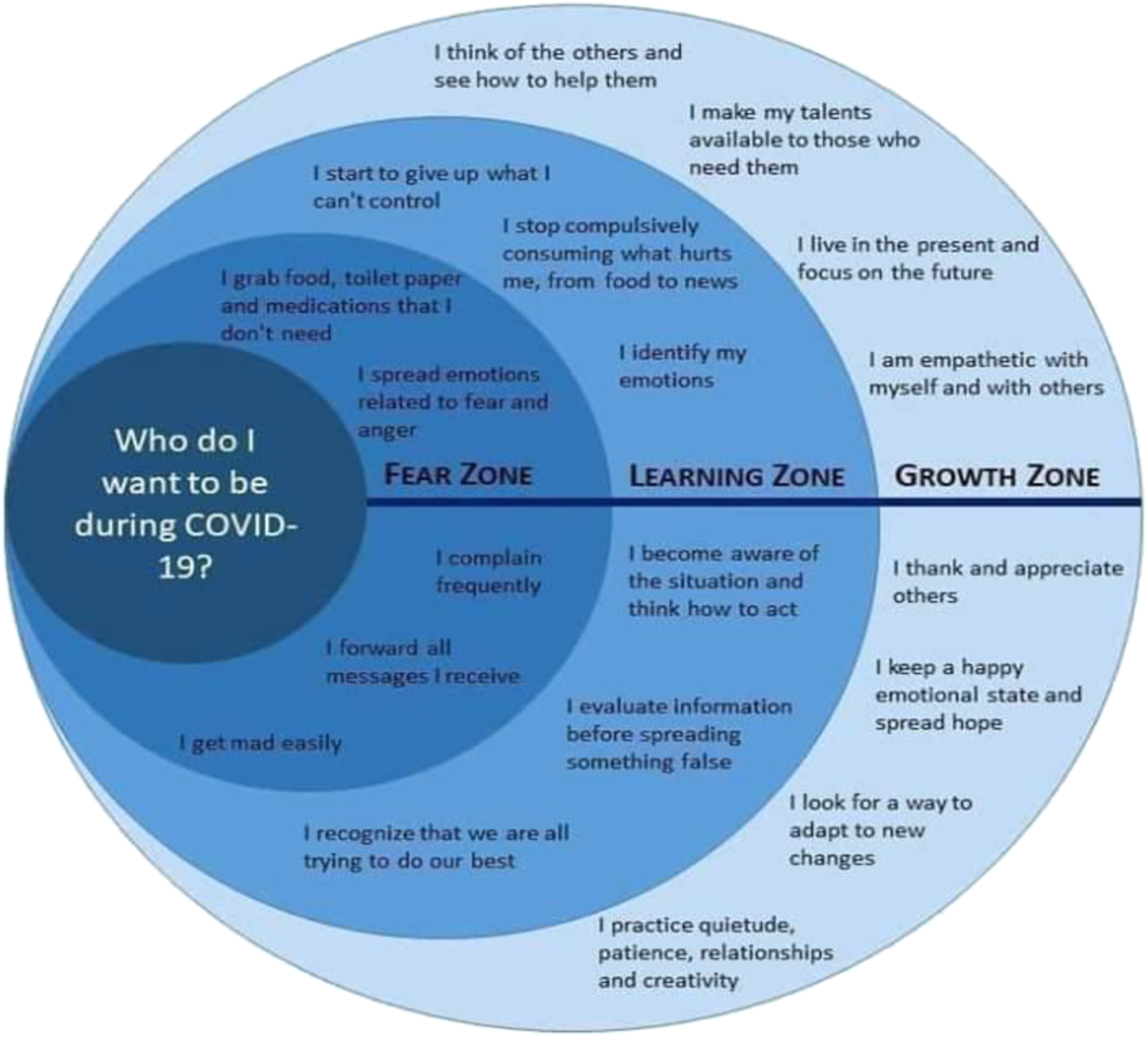
Because our work was collective, cooperative and collaborative in nature we took AE a step further. Chang et al. (2013) note that collaborative autoethnography (CAE) as a research tool can be used in meaningful and powerful ways as research is an extension of our lives, observations, and experiences. Sharing self-reflection and self-narratives through CAE is extremely timely and appropriate, given the current context and state of affairs (Hendrickson, 2020; Roy and Uekusa, 2020).
The process involved co-authors meeting several times over the span of 6 months. Meetings were held via Zoom online through the following processes: 1. Faculty co-researchers (individually) reflected on and shared their lived experiences, teasing out ideas from our experiences; 2. Faculty discussed each overarching issue and decided on a framework with a clear rationale that was also purposeful and timely; 3. Faculty begin writing their narratives/vignettes. They reflected on their experiences and gave focus to their preconceptions, zones of thinking, mindsets and habits of minds; 4. Faculty came back together as a research team, individually sharing findings and probing others about theirs; 5. Faculty engaged in collective exploration, interaction and critical reflection; 6. Faculty shared their final thoughts and offered key recommendations in light of their unique experiences; 7. The team convened one last time to consider, analyze, and discuss findings and patterns which have emerged.
Participants and context
Faculty who chose to participate in this research worked together at a large university in the United Arab Emirates, along the Arabian Peninsula. As faculty, they all faced challenges when required to move mid-semester in Spring, 2020 from traditional face-to-face teaching to an online format because of the COVID-19 global pandemic. Each co-researcher committed to documenting their reflective process and to communicating with each other at least monthly. They represent a microcosm of university faculty in their diversity of ages, gender, areas of expertise, and experience in higher education teaching. For this paper, they chose to use their real names. The five faculty members/co-researchers are: Jason - associate professor, field supervisor, and mathematics educator; Hasan - professor of practice, teacher educator, field supervisor, and social work; Fatima - assistant professor, teacher educator, field supervisor and educational leader; Amir - assistant professor, writing, and composition, teacher educator; and Jenny - assistant professor, educational technology specialist, and teacher educator.
Reliability and validity
The arguments concerning reliability and validity in qualitative research have been discussed by dozens of authors over the past 30+ years. Traditionally, reliability in research refers to the ability to provide proof of a concept or activity through tests or strategies that result in measurable data. Additionally, one must be able to replicate a study and its results to be considered reliable (Golafshani, 2003). In quantitative research, these are desirable results. Qualitative research, however, depends neither on replicability nor measurable outcomes. The purpose is to provide a truthful snapshot in time of a particular person or group, action, belief, or crisis. As such, the traditional definition of reliability is less relevant (Golafshani, 2003).
Validity is a little more complex. Qualitative research is not concerned with measuring, but is rather concerned with strategies like reflection, observation, and communication to ensure truthful results. One way to determine truthfulness is through triangulation—testing statements and ideas against others (Golafshani, 2003). Autoethnography (AE) is a qualitative research approach in which the researcher calls upon his or her own experiences and undertakes “an ethnographic analysis of the cultural context and implications of that experience” (Lapadat, 2017: 589). It does not ask the researchers to step-back from their position; rather, the researcher is clearly invested in the sense making process, though with a mindfulness of the risk of introspection. In this study, participants were in almost constant communication, sharing their fears, frustrations, beliefs, ideas, and actions to understand their own personal truths and those of their co-researchers. The result was growth and some generalizable truths.
Reflective vignettes of five faculty at a university in the United Arab Emirates
We present segments of our narratives as authentic and structured vignettes. We highlight the experiences of select faculty members who made the transition to online learning in response to the COVID-19 pandemic. As autoethnographers, we shared our writing and offered our narratives as data. Through participation in relating our stories, the faculty co-researchers engaged in a dialogue with themselves and with others. Through this dialogic interaction, the process of making sense of teaching and learning during COVID-19 times is further elucidated for each participant.
Throughout each vignette, an evocative experience unfolds. A story and narrative were manifested and told through the eyes of each perceiver (faculty). We used these vignettes to place ourselves within context and to explore our position as researchers. We used our vignettes to self-monitor our thinking, emotional impact, shifting beliefs and mindsets, and to share our overall personal experiences. We used reflexivity to explore our described and lived experience. We then identified strategies that we individually developed and shared further recommendations yielded from, and as a result of, our experiences. Portions of vignettes were organized according to specific aspects of the study; however, each participant shared their thoughts, feelings, and experiences in accordance with their personal process of organizing data. Thus, some organized their responses by discussing specific aspects of Zones of Thinking, Confronting Mindsets (Adapted from Lifeline Connections, 2020), or Habits of Mind (Costa and Kallick, 2009), while others reflected broadly on the total experience. Each participant’s reflections were presented here exactly as submitted.
Exploring zones of thinking and confronting mindsets
Jason
When the university initiated the shift from face-to-face to online instruction, I remember my first thought—my students would not be able to finish their Outdoor Learning Center Project (my students were working on an outdoor learning project for the children in our Early Childhood Learning Center). My students had been working so hard to complete this project and the looks on their faces were [SIC] extremely heart-breaking, knowing that all work on this project was to stop.
Initially, I had no internal reservations for teaching online since I have experience teaching online and one of my research areas is in technology. I did, however, have external reservations about teaching online. I experienced a little fear of teaching online. I did, however, have more learning experiences and growth than I expected. And while I had many concerns, I was determined to find a solution. I wanted to learn how to effectively use the online platform that the university provided in Spring 2020. I did not want to just do the status quo—I needed to go above and beyond. Moving forward to Fall 2020, my mission was to go even further than I had in Spring 2020. For instance, I was comfortable with adapting to new challenges; however, my solutions were more effective, helped students learn, and increased student engagement.
Hasan
The thought of changing my thinking, my mindset, and my approach to teaching was daunting and overwhelming. A number of not so flattering comments from my previous semester’s student evaluations motivated me to reflect hard (reflective practice) on where I was falling short with my students. I had to face the reality that some serious changes needed to happen in order for me to improve my teaching, student engagement, student learning, and to more effectively assess student learning. Having a growth mindset involves viewing talents and abilities as things that can be developed—as unrealized potentials that come about through effort, practice, and instruction (Dweck, 2009).
Initially I was reluctant to change, but I knew I had to make changes if I wanted better teaching and learning results. So, I had decided to make a deliberate change in the way I taught and engaged my students in the upcoming Spring 2020 semester. It all started with my embracing a growth mindset. It took me acknowledging that I needed new knowledge, new skills and a deeper understanding of how teaching and learning could be more effective in the educational and cultural context of the UAE.
I took the feedback my students offered to me in the Fall 2019 semester seriously.
During the winter break, prior to the start of the Spring 2020 semester, I spent a lot of time researching ways to more effectively engage and teach college students. I purchased a few books from Amazon, dove into a number of online articles and blogs and slowly started shifting away from a traditional, lecture laden teaching approach to a more student centered, engaging, deliberately dynamic approach. My goal was to transform my classroom into a space that was fully centered around the students.
Fatima
I have two decades of experience working in the field of education, however over the past year, I struggled with tech-immersion. Using new devices, applications and platforms has always been tough for me due to mental blocks. These blocks were self-created due to prior negative IT experiences and roadblocks that I encountered in the past. I had to create a realistic space for teaching and learning. It requires a composite of skills, dispositions, past experiences and proclivities. I had to draw upon my mental resources. This brought me to think about what I was thinking.
A creative and innovative learning environment was something that had to be modeled and practiced by teacher educators like myself. I felt very nervous about what I had to do remotely. My mind was all over the place. I sat at my desk puzzled. My initial question to myself was: “how is ‘this’ really going to happen?” I thought about a proverbial snowball rolling down the mountain of an active volcano.
Amir
Teaching fully online sounded like a foreign concept, one that would deprive me of the chance to see my students’ reactions to my lectures, to class tasks, and to course assessments. Teaching online seemed foreign because I felt I was not able to engage in meaningful face-to-face communication with my students, to have that human connection. I kept re-visiting the information provided by the Dean of our College regarding classes going fully online due to the Coronavirus Pandemic. It all seemed like a sci-fi movie. Going fully online? What is that supposed to mean for university professors who have taught for many years on campus, face-to-face in actual classrooms?
Jenny
I am one of several educational technology specialists in my department who is a bit of a closet introvert. I enjoy working from home. When I learned that we were moving classes to an online format, in all honesty, I was thrilled (pandemic aside). I immediately started preparing by having a class on WhatsApp. My mind went into overdrive. I created interactive Google Slides, Google Docs, and prepared my students for uploading their work on Google Sites, all activities I was already incorporating into my classes anyway but now I could transition it to a complete online experience. So was it different from my face-to-face classes? Not really.
I often thought about students with different learning preferences and personalities similar to my own. Do they learn better in such an environment as well? I do not think online classrooms are for all students, but perhaps because of the remote learning required during the pandemic, in the future students will be given greater flexibility when it comes to where and how they learn. Many of the online tools have built in highlighting mechanisms, the ability to record so that students can re-watch, the ability to transcribe the sessions, and record conversations in the chat feature. These features could be helpful when incorporating multiple modalities and for students with various learning preferences and/or differences.
Habits of mind
Jason
I understood the rush for faculty to get their class ready for online. Even though we had little time, this did not deter me from attempting to try something new. I see failure as a learning opportunity. Another concern was providing my students the same face-to-face course. Not having enough time to prepare, the experience was not the same. I wanted to ensure that my students were conducting integrated math and science experiments. So, I required students to use their cameras to show evidence for doing the science experiments while in class. While I was determined a solution; sometimes the solution was effective and sometimes it was not. When a solution was not effective, I searched for other possibilities. I was extremely honest with my students, informing them that a solution may or may not work. If the solution did not work, it would be fine; we would find another solution.
Hasan
For some time, I had been immersed in the traditional way professors in the academy engaged and taught students. My lecture-heavy, conductor approach with my students had gotten me by just enough to inspire those already highly motivated, self-starter students to think I was engaging them in some innovative, cutting edge learning experience, while utterly boring their classmates to sleep. To spice things up a bit, I’d occasionally throw in a critical thinking activity, some group work, an essential question, and a video or two to reduce the likelihood that my instructional approach could be blamed for the complete lack of student engagement and deeper learning. To this end I started with a simple question: “What can I change about my thinking, preparation, teaching and follow up that will result in more student engagement and more student learning?” If I wasn’t going to lecture my students for most of class, what would I be doing with them and what would I expect them to do in class with me?
Fatima
This experience humbled me. It provided a lens to view how we can shift and pivot in our mindset and habits of mind. Lecturing during a crisis just did not make sense to me—so I abandoned that. This experience forced me to be adaptive and flexible. It was the catalyst for me to rethink what I did, how I did it and where to begin with my students. Fox (2013) stresses an important concept of “starting where the student is at.” After this experience, I feel that perhaps this is where the focus should have been from the onset.
Amir
Teaching online for me, as a university professor who has more than two decades of teaching experience and with little or no familiarity with teaching online classes, on this large scale, seemed like a formidable task. There was no time to waste! We had to start! Plan ahead, think about the resources, how you can use them, what can you do to provide your students with the best learning and teaching experiences! Yes, we had to go to work, for this is what we do! Every day as educators; we plan lessons, adapt our lessons, meet new learners with new needs, but we do not give up.
The first week of online teaching started, and I started my first lecture using Adobe Connect. Distinctive sounds, notifications, etc., of students seeking permission to enter the online classroom. It was different, it felt different! How can technology help set assignments and exams that reveal student progress and their mastery of the subjects taught? I found the response in more rigorous planning of assessments, to the extent that I was able to, that is, planning assessments that required students to discuss their work with everyone during class, and to talk about the relevant theories and apply them in their discussion (Kaviani et al., 2020). The more students had to complete tasks individually and report them to me and to their peers, the better I was able to assess how they were learning, and how I was able to help them achieve the course learning outcomes. Once again, things began to become less daunting, but still, this aspect of online classes is atypically out of character and requires re-structuring courses and re-designing assessments.
Jenny
I didn’t have concerns with regards to my own approach to online learning. This is my professional gimmick. It is what I do. However, I realize that other colleagues prefer face-to-face or at least a hybrid version of classrooms. They thrive teaching face-to-face and therefore they are better able to engage students and develop strategies which are better suited for this type of classroom. However, if face-to-face instruction is not an option, then educators should be aware and trained in best practice, based on the local context and research provided by other practitioners.
Reflection in action and reflection on action
Jason
In spring 2020, faculty were thrown into online instruction. Most did not take advantage of the resources available to assist students with engagement. I am one of them! In a face-to-face environment, I typically meet with student groups to discuss their process on various group projects. However, in an online environment, it was not possible to meet with all groups.
So, I decided to take one day to introduce new course content and the second day to meet with various groups. For instance, one week I would meet with five groups. The next week, I would meet with the remaining five groups. This allowed me time to discuss and meet with all groups without being rushed. Still, students refused to turn-on their cameras and microphones.
Nevertheless, in Fall 2020, I had the entire summer to get ready for online instruction knowing that my university was planning for the Zoom platform. I took drastic measures to seek help from a colleague, who is an educational technology expert. In Fall 2020, students applauded the use of videos, Padlets, and the iPad Pro to support learning. This whole process was a learning experience for me and my students.
Hasan
I started with a simple question: “What can I change about my thinking, preparation, teaching and follow up that will result in more student engagement and more student learning?”
My transition to better teaching and more meaningful face-to-face learning started with the following action steps I committed myself to learning and implementing in class: 1. Acknowledging the fact that I needed to replace lecture with other strategies and activities that would meaningfully engage my students for 80 minutes. 2. Dividing the 80-minutes block of teaching and learning time into smaller blocks of time that would be used for various learning and engagement activities. 3. Asking students to review previously covered content in ways that utilized their multiple intelligences like posters, mnemonic devices, and presentations, and by calling on them to summarize previously covered content. 4. Starting each class session with an overview of what was planned for class time and using “Backwards Design,” starting with the end in mind. 5. Relying less on technology (powerpoint) and focusing more on class-based space and resources. 6. Randomly calling on students from my “Grab Bag” of names as an ongoing part of class to increase student engagement and check for learning and understanding. 7. Limiting lecture to 20—30 minutes maximum for each class.
The learning and preparation I engaged in over winter break had resulted in my mindset completely shifting from a traditionalist view of teaching and learning to a more engaging, student centered view of teaching and learning. It also resulted in my being better prepared, organized and clear about how my classes would be structured, and what expectations would be communicated to students regarding their roles and responsibilities in actively learning, and a variety of multifaceted, engaging ways on how to cover class.
When the decision to go fully online was made, students went on break and most faculty used their break time to prepare for the transition to online teaching and learning. As the transition process got underway, the need to address the following unanticipated challenges became more pressing: (1) Technology: Knowing how to effectively use the technology/digital tools; Bandwidth and hardware issues (for students and faculty). (2) Teaching: Teaching course content online in a rigorous, flexible, and engaging way while not falling back into the trap of lecturing students for 80 minutes. (3) Engagement: How to capture and keep students’ interest during online class time. (4) Assessment: Deciding which assessment methods and strategies would be best. (5) Burnout: Self-care and managing fatigue, stress, anxiety and the implications from increased screen time (for students and faculty).
Rather than reinvent the wheel, I reflected often and revisited action steps that helped me with my offline face-to-face teaching and modified them in ways that informed my online teaching approach. It took me some time to figure out ways in which I could reproduce some of the things I was able to do with my class offline in an online environment. I relied a lot on trial-and-error and student feedback to gauge what their experiences and perspectives were regarding online teaching and learning, and whether the online strategies I started to use were actually working. I was able to set up my classes using the above essential action steps and saw an immediate difference in the way the class flowed and how students participated and learned. Revising the class format and making students more responsible for their learning was key. I realized that student participation and engagement activities had to be built into each class regardless of where the teaching and learning was to take place.
Fatima
Essentially, I became the learner who would experience a learning curve. My learning happened alongside students and through my own mistakes. I relied on self-help skills, university ready-made produced videos, and frantic calls to my tech savvy colleague. I moved from fear, to learning and then growth zone, in gradual tiny “baby steps.” I pondered and asked myself, “what is holding you back?” Was this the experience that my own students were having? I realized that I could not do it all. I needed support. I needed affirmation and confirmation. At times, I felt unsure about how to roll out regular supervision tasks such as observations. Tools are what was needed so I reached out. I leaned on my personal resources, family, friends and colleagues for support and guidance.
As a practitioner, I’m constantly reflecting on my own practice. Learning from mistakes, professional growth and development support me in my roles. I solicited constructive feedback from my students. It was not what I expected, yet it was what I needed. As a teacher educator, part of my work as faculty involves engaging in reflection. I also prompt my students to reflect on their practice in two ways. Reflection in action is the first way. It refers to what professional practitioners consider while something is happening and taking place during an action. Reflection on action is a second way. It helps one consider retrospectively how what they do impacts others. Enacting both of these processes can provide a practitioner with a chance to redesign what is being done while it is being done and is therefore associated with experienced practitioners (Schon, 1983). It served as a point of reference for how we managed unprecedented events that our college as a unit faced and how we as faculty-individually had to still “stand and deliver.” Redesigning and remodeling pedagogical practices in light of the pandemic forced educators like myself to move towards pioneering new and improved methods to teaching, scaffolding, and supporting students. It provided a vehicle for substantial and substantiated change. Faculty must remodel new pedagogical practices that incorporate socio-emotional needs that place the students at the center and support them in ways which are meaningful for them. Lastly, I think that faculty should reflect on the duality of their roles so as to be authentic and genuine as both a learner and a teacher. Integrating IT, self-help skills and other internal resources must be a part of one’s pedagogy, as it can be a mechanism of support for field supervisors.
Amir
As I was envisioning myself teaching from home, I was also pondering how tasks could be designed in such a way that they would encourage the same level of interaction and collaboration among the students. During the first week, I discovered that online teaching required a different kind of lesson planning, a different approach to using technological affordances through which proper scaffolding was created for each lecture and the relevant tasks. To encourage interaction among the students in an online environment, I needed to be much more creative in designing online tasks and more resourceful in using technology. A time-consuming and demanding task, indeed!
I planned lectures with regular breaks, and routine tasks and activities following each break. The use of breakout rooms began to become more meaningful and significant in ensuring students were interacting with each other and completing the tasks. Moving from one breakout room to another, asking questions, and interacting with smaller groups of students, helped find out the level of engagement of each group and its members. So, gradually, I was able to use the affordances offered by the online environment and incorporate them into planning and implementing lessons (Wang et al., 2020). After a few weeks of teaching, my students and I became au fait with the rules of the game! With more rigorous lesson planning and effective scaffolding using the technological affordances, things began to make sense!
It is now almost a year, and looking back, I see that the global pandemic has taught each one of us lessons of value in our personal and professional lives. Personally, the seemingly cliché expressions such as “carpe diem,” “grab the chance,” “stop and smell the roses” have regained their significance. Professionally, however, I feel, as if I have come full circle. When I started to train as a young teacher, when we used chalk and blackboard as the only available teaching paraphernalia, I became familiar with Jerome Bruner’s judicious observation that it is important “…that the teacher can become a part of the student’s internal dialogue—somebody whose respect he wants, someone whose standards he wishes to make his own” (Bruner, 1966: p. 124). It is only through creating a consistently meaningful dialogue with each individual student, either in online or face-to-face classes, that the process of education becomes relevant, meaningful and purposeful. So, to me, for all teaching, there is one main axiom to observe, and that is to borrow Bruner’s words, to “… become part of the student’s internal dialogue …” (Bruner, 1996, p. 124).
Results and discussion
Essentially, through collaborative autoethnography, we found that trial-and-error, a shift in mindset which involved growth, and higher forms of thinking were paramount to not being stuck in the moment and moving forward. The current crisis thrusted faculty in universities such as ourselves into uncertain circumstances that continued to evolve. As the faculty co-researchers wrote their vignettes, they reflected on their circumstances, examined their preconceptions, and confronted their zones of thinking, mindsets, and habits of mind.
Generally speaking, most moved out of fear or comfort zones toward growth zones as we reflected, questioned our own mindsets and embraced habits of mind such as persistence, striving for accuracy, metacognition, questioning and problem solving. It was determined that 100% of the faculty participants were mediating a situation that had never been experienced before. Faculty had to be creative in providing solutions as fast as the obstacles appeared. It was determined that 80% of faculty participants were searching for solutions, employing metacognition and adapting by thinking flexibly, all of which are important habits of mind. Throughout this experience, 60% of the participant co-researchers were striving for accuracy. Four out of five, 80% of the participant, co-researchers had to employ the use of innovative IT platforms. Interestingly only 40% of the faculty participants took responsible risks and exercised a level of interdependence with their students. Regarding persistence 80% of the faculty participants remodeled pedagogical structures and strategies. They were determined to make things work!
The transition from face-to-face learning to online learning posed many challenges. Moving from a real-world community to online was difficult to manage. The transition resulted in faculty and students having to move out of their comfort zones into uncharted areas of teaching and learning. The data yielded not only showed the diversity among the participants in terms of growth and reflection, but that is the beauty of the process—to discover and share individual differences as authentic truths rather than determine a list of ideas or actions that can be applied to everyone uniformly.
Whether we use technological affordances, teach during a pandemic, or otherwise, this should serve as our guiding principle as it helps us see ourselves and our students as human beings in need of interaction with one another to learn, to continue to stay on the path of growth and development, and not to give up, irrespective of how challenging and difficult our times might be. Oftentimes we hear about how bad Covid-19 was in terms of academics. However we contend that a “negative narrative” can be turned around, through habits of minds, and a progression of mindsets.
Implications and recommendations for future policies in higher education
Unusual challenges and circumstances brought about by Covid-19 have called for adjustments and responses that are key to quality teaching and learning. Teaching and learning during the current global pandemic have certainly brought to light the importance of how and why we must better prepare to provide student affordances and teaching provisions, in order for learning to be disrupted as little as possible. Those working in academia should all learn from this experience.
Exploring the implications for future policy making is critical. Future policies in higher education must take into account what we have learned from the current situation. Policies that are to be created or that will be created in higher education should consider what are the factors that play a critical role in making abrupt yet necessary transitions, for example, from face-to-face offline learning to online teaching.
Future policies in higher education should be made where all stakeholders enter “dialogue.” Higher education institutions should give enormous consideration as to what are the mechanisms needed in order to yield positive student outcomes and in ways to make learning successful. As policies are being drafted, developed and created, it is critical for higher education institutions to consider what tangible support, and resources are readily accessible and available to faculty to support the teaching and learning processes.
We offer the following recommendations for higher education institutions: 1. Recreating, re-conceptualizing, and re-imagining the teaching and learning processes is a salient way forward, especially in post COVID-19 planning and preparation. We recommend that higher education institutions use the pandemic as a learning tool and as a blue-print for the future. Faculty alone cannot do the work that is necessary. Institutional support, visionary work, and transparency are imperative and critical. 2. When faced with a catastrophe, institutions should consider how faculty might use, operate, and move through three zones of thinking: fear, learning, and growth. The zones helped us to understand why we do what we do, feel the way we feel and how we might ultimately progress in our experience. Therefore we recommend that faculty be encouraged to shift in their mindsets and operate differently in their zones of thinking. 3. We recommend that faculty reflect on the duality of their roles so as to be authentic and genuine as both a learner and a teacher. Sometimes faculty have to “unlearn and relearn.” Integrating IT, self-help skills, and other internal resources must be a part of one’s remodeled pedagogy as it can be a mechanism of support for faculty. Institutions should consider how faculty can become pedagogical pioneers. In the same capacity, we recommend that faculty become reflective in their remodeled practices and leverage collegial resources to give them further insights or ideas to support the teaching and learning processes.
Conclusion
We are in unison that the pandemic altered our experiences of teaching and learning in higher education. It presented challenges, as well as opportunities for the co-researchers of this study. Despite these and other challenges, what has become clear throughout this crisis is that the fundamentals of quality teaching and learning are important regardless of format. This paper outlined a number of key factors that played a critical role in making the transition from face-to-face offline learning to online teaching and learning successful. Effective responses to this crisis have required adaptive, visionary, and resourceful measures and strategies that enable educators to become familiar with their online students and build meaningful relationships with them; identify and strengthen their online instructional knowledge and skills; adapt offline best practices and teaching techniques for online use; become familiar with the versatile and flexible use of digital teaching tools; encourage and embrace a growth mindset in all aspects of their teaching and learning; provide flexible, culturally appropriate but yet rigorous ways of assessing student learning; actively engage students in meaningful ways that promote learning on and offline; and be fair, have fun, and be flexible with students. The co-authors expect that the key experiences provided throughout the vignettes along with recommendations will serve as guiding points for pathways aimed at achieving positive student-outcomes and positive results.
Footnotes
Declaration of conflicting interests
The author(s) declared no potential conflicts of interest with respect to the research, authorship, and/or publication of this article.
Funding
The author(s) received no financial support for the research, authorship, and/or publication of this article.
