




Abstract
In response to the COVID-19 crisis, governments all around are producing new policy provisions to mitigate the learning gap. Based on the new policy provision, universities switched to online education because social distancing was necessary to stop community transmission of the virus (Crawford et al., 2020). This study aims to explore how faculties perceive the effect of higher education policy response on Bangladeshi students. The paper identifies cost-sharing approach, disregard of policy context, encouragement of global job market competition, decentralisation of management, digitization of education, and individual responsibility as neoliberal features of emergency response. The data were critically analysed to understand the effect of neoliberal features of the emergency response on the university students of Bangladesh from the faculty perspective. The paper argues that the policy response is failing to address the learning gap of the students. Moreover, the implementation of this policy is generating more challenges for students by strengthening the root of social inequality and hindering social mobility.
Introduction
In 2020 the outbreak of COVID-19 disrupted every aspect of human life. After this virus was detected in Wuhan city, Hubei Province of China in December 2019 for the first time, the number of the COVID-19 confirmed cases increased exponentially (World Health Organization, 2020). According to the United Nations Development Program (2020), since World War II COVID-19 is the biggest challenge that is affecting almost every aspect of human life. The scientists informed that COVID-19 virus spreads through interpersonal contact therefore a nationwide lockdown was the only way to stop the proliferation of the disease (Weeden and Cornwell, 2020). The gruesomeness of the virus forced the governments around the world to take quick measures to face the challenges occurring in the health, economic as well as education sectors. However, it is also imperative to understand how the policy response for COVID-19 is influencing these sectors in the long run.
Many published studies were found regarding the impact of COVID-19 in higher education. A research on students’ perception of online education during COVID-19 showed that the university students of 62 different countries were satisfied with online education as they were receiving support from their institutions (Aristovnik et al., 2020). However, research from South-Asian countries showed students’ discontentment of online education due to lack of support (Adnan and Anwar, 2020; Dutta and Smita, 2020). The findings of these researches differ based on the context as the first study have huge data-set from the developed countries which may have overshadowed the developing countries. These papers indicated that based on the preparedness of the country the experience of online education can be different. Another study was found that is associated with the policy response in the higher education sector but it merely represents policy responses of 20 countries (Crawford et al., 2020). This study focuses on how neoliberal policy response looks like in Bangladesh higher education context and how it is affecting the society in the long run.
The study aims to explore how faculties perceive the effect of Bangladesh higher education policy response on students. Faculties hold a unique position as they determine the teaching-learning method based on the regulations, resources, and policies; as well as are directly connected to the students on a regular basis. The faculties can help uncover any existing pattern of the effect of the policy response on students from a bird-eye-view. The findings of this study will point out how the policy response addresses social challenges. The voice of the faculties may influence the policymakers to determine measures that influence positive social change. This paper will review the policy context and the neoliberal features of the response. Then it will discuss the methodology of the study. Finally, it will examine the faculty’s perception of policy implementation to understand its effect on students.
Policy context
Ball (2008) claimed that context plays a vital role in developing and deploying national policies. In this section, I will discuss the intrusion of neoliberalism in Bangladeshi policies, socio-economic situation of the country during COVID-19 and preparedness of online education. These discussions will help to understand the resources the country offers for implementing the policy response to mitigate the learning gap. This discussion will also help to identify the opportunities and challenges of the policy response.
Political context
The global north has been imposing the neoliberal discourse on the global south through International Financial Institutions (IFIs) (i.e. IMF, WB, OECD etc.) by exploiting economic power for several decades (Giroux, 2020; Saad-Filho, 2020). New policy reforms funded by IFIs only confirm the hegemony of neoliberalism in the social aspects of a country due to the unequal distribution of wealth, income, and power (Giroux, 2020). As a highly populated country, Bangladesh is still struggling with poverty. Bhattacharya and Khan (2018) clarified that Bangladesh being a lower-middle-income country means the credibility of borrowing more from external sources (i.e. IFIs). So, instead of eliminating the structural deficit, Bangladesh is falling more and more into the ‘neoliberal trap’ by accepting more funding from IFIs. Accepting economic support is forcing Bangladesh to reproduce neoliberal policies in the local context (Ball, 2018). Kabir (2020) argued IFIs are infiltrating into the policy development process in the higher education sector of Bangladesh and pushing neoliberal agendas through network governance. In favour of economic development, Bangladesh is endorsing privatization of universities, utilization of cost-effective methods, decentralization of management, and development of a knowledge-based economy by disregarding social issues (Ball, 2008; Kabir, 2020).
Kabir (2013) claimed that most people in Bangladesh want to gain access to higher education because of better employment opportunities. To meet the increasing demand for higher education, the Bangladeshi government decided to establish private universities in the 1990s (Kabir and Webb, 2018). Currently the number of public universities in Bangladesh is lower than that of private universities, but the former caters to almost 63% of the student population (Sarkar and Hossain, 2019). Most of the students prefer to study in a public university over a private university, as the latter is less accessible to the students due its cost sharing model (Rahman et al., 2019). However, a number of students from underprivileged backgrounds choose to go to private universities in the hope of better employment to ensure social mobility (Ball, 2006).
Socio-economic situation during COVID-19
Apart from health, an outbreak of any pandemic always leaves a long-term impact on business, education, and society in general (Paget, 2009). According to the International Labour Organization (2020), the USA household income statistics showed an upsurge that does not reflect the low-paying jobs. In the USA 43% of adults from lower-income households informed about the loss of wage and in some cases job while 23% say their emergency fund is not enough to survive the pandemic period (Parker et al., 2020). According to the Bureau of Statistics, Bangladesh household income declined 20% when the expenditure dropped only by 6.14% (UNB, 2020). Unexpected unemployment of the daily wage earners like mason, public transport drivers (rickshaw pullers, auto drivers, etc.), construction workers lost their ability to pay for food and accommodations (Bhuiyan, 2020). The vulnerable groups are suffering more due to the economic and labour market crisis, which threatens to amplify inequity and drives many families into poverty (International Labour Organization, 2020). One of the major findings of the Government of Bangladesh (2020) reports is that due to lockdown the humanitarian vulnerabilities are increasing, which is resulting in economic implications for the lower-middle-income population of Bangladesh. The report also claimed that ‘loss of income will keep on having broader implications on areas such as food security, WASH (water, sanitation, and hygiene) protection, health, and education.’ (Government of Bangladesh, 2020: 5). People from the lower economic background are suffering badly because the public protection placed by the state has been reduced. Saad-Filho (2020) argued that neoliberalism has been exhausting the state’s ability for the past few decades and its vulnerability was revealed during this pandemic.
Preparedness of online education
Effective online education has become a critical element in renowned universities even before the pandemic (Natalier and Clarke, 2015). There are some prerequisites for effective online education (Chowdhury et al., 2018; Kebritchi et al., 2017). Natalier and Clarke (2015) claimed that context plays an important role in educator’s academic choices in regards to online education. …Educators organize their teaching to respond to the demands of their institution and in so doing, are unable to implement online education in ways that build the kinds of relationships with students that are necessary to pursue meaningful and challenging education. (Natalier and Clarke 2015: 62)
Chowdhury et al. (2018) argued that for effective online education proper pedagogy, effective social interaction, and appropriate technology are necessary. Kebritchi et al. (2017) claimed that there are three major components of an online education environment: learners, content, and instructors, and these components will be affected by transitions from face to face to online. Various researches showed that apart from faculties, content, and students, institutional context is important for effective online education (Chowdhury et al., 2018; Kebritchi et al., 2017; Natalier and Clarke, 2015).
Few research that were found regarding online education of Bangladesh, showed that online education was never tried on a large scale and was nearly non-existent before the pandemic. However, Bangladesh Open University (BOU) has a history of offering distance learning and is active in offering various academic program through online modality by using cell phones, text-based tools, and videos through a learning management system (Sarker et al., 2019). However, apart from BOU, there are not many examples of online education in Bangladesh especially regarding public universities of the country. Sarker et al. (2019) claimed that most of the students and faculties (of private universities) are well prepared with devices and connectivity for online classes. Nevertheless, no data was found regarding public university students and faculties regarding their preparedness. Hossain et al. (2012) argued that faculties and students do not have a transparent idea about online education. The absence of an existing online education structure is notable through existing research before the pandemic in Bangladesh.
Neoliberal features of the policy response
The world has been facing a ‘learning crisis’ even before the pandemic outbreak (Jaramillo, 2020; World Bank Group, 2020). Many countries implement school closure during epidemics to stop virus transmission (Dutta and Smita, 2020; Earn et al., 2012). Due to the profound modification in the process of social interaction and mobility (national and international) the economy world-wide is suffering while exposing the limitations of the ‘superior efficiency’ of the free-market economy and by extension the competency of the states (McCloskey, 2020; Saad-Filho, 2020). World Bank Group (2020) claimed that lockdown due to the COVID outbreak will have a lasting effect on students’ learning. To minimize the impairments of the education sector caused by the pandemic, most countries around the world are responding with policies that support neoliberal agendas (Aristovnik et al., 2020).
The global pandemic forced all the states to take immediate actions to counter the challenges in education due to lockdown. International organizations like OECD, World Bank published various policy response proposals and reports to guide the authorities and leaders of education (national, state, or local) to address the learning crisis. All these reports suggested that online education is the only way to address the learning crisis while maintaining social distancing (Jaramillo, 2020; OECD, 2020, World Bank Group, 2020). Jaramillo (2020) claimed that online learning will help to eradicate the inequalities and assist students to reach their full potential. Although the statement contradicts with OECD (2020) and World Bank Group (2020) as they acknowledged that not everyone will get the equal opportunity based on their existing socio-economic and infrastructural condition. Student’s financial ability will determine their choice of continuing education with this new approach. Bangladeshi universities are tempting students to choose to continue their education by providing loans and scholarships (Kamruzzaman, 2020). Education loan was introduced in early 1990s mainly for private university students to share the cost for their education (Kabir and Chowdhury, 2021). However, for the public university students this cost sharing strategy was introduced for online education during COVID-19 by providing smartphone loans (Kamruzzaman, 2020). Interestingly, information regarding government or bank loans to support the private university students due to the pandemic was not found, but some private university websites informed that they are offering financial aid to the students (StudyBarta.com, 2021). Ball (2008) argued that under the guise of ‘power of choice’, the institutions are influencing consumers’ choice of continuing education even with the implication of going into more financial debt in this pandemic situation.
School closure will harm the future labour force of the countries which will leave a visible mark on the national GDP in the long run (OECD, 2020). This implies that the policy makers are worried that schools will produce lower numbers of workers for the job market and will have a direct effect on the economy. The clear indication of developing a knowledge-based economy that satisfies the labour-market is quite prominent in the policy proposals. According to Ball (2008), in the knowledge economy, knowledge and education are perceived as products and the knowledge workers ‘generate and articulate ideas, knowledge and information’ (p.19). Pons (2010) claimed that the knowledge economy is shaping the objectives of higher education for the economic benefits of society. He also argued that social demands directed higher education to incorporate technologies in education that influenced the change of the teaching models. To mitigate the effect of school closure OECD (2020) and World Bank Group (2020) proposed that the digitization of education should be based on the country’s existing ICT infrastructure and socio-economic situation. This means the IFIs are proposing more decentralized management by giving flexibility in choosing cost-effective alternatives for education. Without any investment or equitable support to people in need, the leaders are expecting to get more and more reproduction of knowledge workers by asking to share the cost of the education (Kabir, 2013). Crawford et al. (2020) argued that the digital pedagogy response is very diversified and developed countries like Australia, Germany, South Korea, UK, USA have relatively well-developed ICT infrastructure, resources, and experience of conducting online classes even before the pandemic. On the other hand, largely populated countries that belong to the global south (i.e. Brazil, China, India, Indonesia) are struggling to cope with the situation and are unable to provide equal opportunity to all the students of higher education (Crawford et al., 2020). However, because of the global competition of higher education, institutions all over the world are responding to the pandemic by starting online classes with the existing resources of the country and institutions (Ball, 2008; Kabir, 2013). International Financial Institutions proposed a ‘one-size-fit-all’ model for social ‘transformation’ and ‘modernization’ (Ball, 2008). The top-down performance management through policy response in undermining education by disregarding the context to transforming the society (Ball, 2008). The neoliberal policies are dehumanizing the students and representing them as products for future economic benefits. The neoliberal policy focuses on ‘cost-effective policy outcomes’ and ‘productivity targets’, rather than social support and justice (Ball, 2008; Giroux, 2020; Kabir, 2013).
Bangladesh being part of the global south is following the IFIs’ proposed policy response to keep pace with Sustainable Development goals (World Bank Group, 2020). Kabir (2013) argued that the IFIs (i.e. world bank, OECD etc.) compelled the Bangladeshi government to undertake market-friendly policy reform since the 1970s. Because of COVID-19, the government of Bangladesh declared educational institution closure of the country from 18 March 2020 (University Grants Commission Bangladesh, 2020). To ensure social distancing the University Grants Commission Bangladesh (UGC) (2020) permitted the private universities to continue their classes online. However, UGC started to discuss the possibility of online classes with the vice-chancellors of public universities much later (The Business Standard, 2020). This means the government also knew that there are challenges with the new shifts to implement it right away. As Ball (2008) argued that the possibility and complexity of the new provision might affect the students adversely by the new teaching-learning process. Conceptualizing neoliberal features of policy response.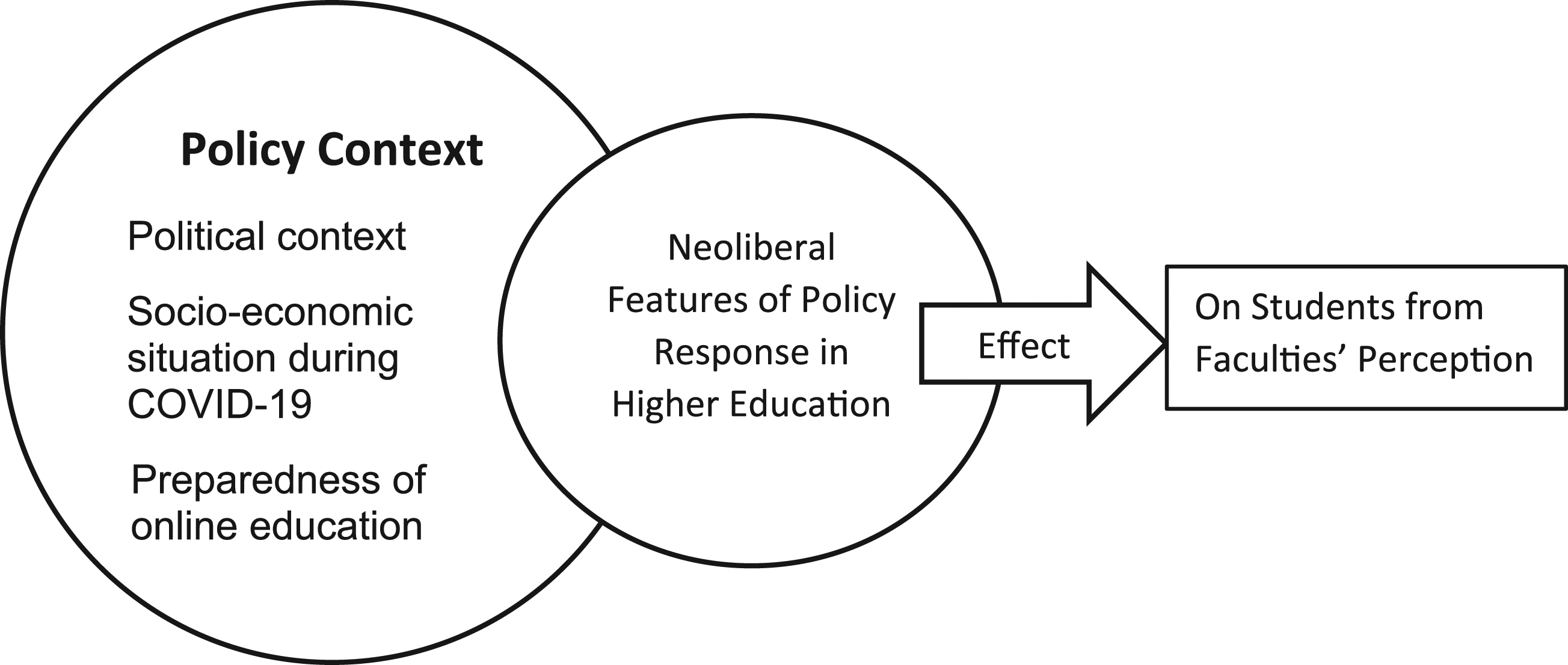
The paper delineates policy context and neoliberal features of policy response in higher education of Bangladesh and how they are interconnected (Figure 1). The paper illustrates the political context to explain how neoliberalism penetrated Bangladeshi policies, socio-economic situation during COVID-19 to understand the situation of the country, and the preparedness of online education of the country to identify existing practice and resources. The identification of the neoliberal agendas and features of the policy response based on the policy context will help analysing faculties’ experience to understand how the policy response is being implemented in the socio-economic situation with the help of existing resources for online education. By reflecting on faculty perception, the paper will explore how the new shift in higher education is affecting students of higher education
Methodology
The study followed qualitative approach. According to Creswell (2012), the qualitative approach provides data that include the context and experience behind that data. The researcher selected the top 11 Bangladeshi universities from the QS Quacquarelli Symonds (2021) of Asian region as study samples, because they are well equipped with expert faculties, staff, well developed infrastructures and usually maintain a reasonable teacher-student ratio. However, after communicating through several channels, faculties from only six universities agreed to be interviewed. Malterud et al. (2015) argued that with a good quality of data, the sample size of a study could only be six. The data were collected through a semi-structured interview schedule to understand faculties’ experience by asking necessary probing questions (Creswell, 2012). Each interview lasted around 30–50 min. In some cases, some participants were interviewed more than once. Malterud et al. (2015), claimed that in-depth interviews of faculties with diversified experience and expertise could provide a clear understanding of some situations. For credibility and conformability of the data member checking strategy was followed and five participants were able to check the accuracy of their account (Creswell, 2012). Then the themes were developed systematically by transcribing, coding, searching themes, reviewing themes, naming themes, and then reporting (Braun and Clarke, 2006). Participants’ identity was coded as Pu1, Pu2, Pu3, Pr1, Pr2, and Pr3 for three public and three private universities.
Policy implementation
This section will investigate faculty perspectives of how the policy is being implemented and analyse the effect of the implementation process on the students. 1. Preparing students for global competitive market
The data showed clear implications of following the global trend. Out of six participants, five claimed that online education is necessary in this situation because all the “renowned” universities around the world are using online education to mitigate their student’s learning gap. Pu2 stated, ‘if we see the developed countries the top-ranked universities switched to online platforms even before the nationwide lockdown was implemented’. The data showed a tendency of following the developed countries footsteps through various examples. According to the faculties, following world trends is important because of the competition of the job market. They believe that the students must prepare for the competition of the global job market. Pr3 strongly argued that,
Online education should be promoted in this day and age. Initially, many students and their parents were reluctant to continue education online. However, as the pandemic period was drawn-out, they realized that they have already missed a semester and are lagging in comparison to their colleagues.
This showed that the global market competition is so ingrained within the discourse of higher education that the context was disregarded in favour of succeeding in the global job market. 2. Government and institutional support emerged from ‘cost-sharing’ approach
The UGC provided all the faculties of universities with a paid version of a widely used webinar platform for conducting uninterrupted online classes. Faculties who registered for this software were provided with a unique ID. Pu1 stated that ‘I would like to thank UGC for providing us with a platform which enables us to replicate a virtual classroom environment.’ This platform was offered to both public and private universities and most of the faculties utilized this opportunity.
The government offered smartphone loans only for public university students as well as faculties who do not have any devices for conducting/joining online classes. On top of that, some public universities are supporting students to pay for internet data. Alternatively, the faculties of public universities believe it is a necessary step to ensure students’ attendance in online classes. The faculties of private universities believe that all the faculties have at least a smartphone and/or a laptop. Although, they informed that a good number of their students come from a lower-middle-income family who struggle financially and may not afford a device and/or data cost to join a class on top of paying the tuition fees. Pr3 said, ‘We have some students who borrow smartphones from their neighbours or relatives or rent from a shop for online classes.’ Also, the private university faculties stated that due to the economic crisis in the pandemic many students are unable to pay their tuition fees for the new semester. To help these types of cases some private universities are providing partial scholarships for continuing student’s education. So even though the private university students in Bangladesh who are usually assumed to come from solvent families, may also lack access to online education due to their financial condition. Pr2 believes, ‘Because of the scholarships students are enrolling to online semesters in the hope of finishing their degree with less tuition fee.’ The data above indicates that the government is providing financial support only to the students and faculties of public universities whereas private university students are solely dependent on self-funding and institutional support. And due to reduced tuition fees students at private universities are choosing to continue their education online despite additional financial burden. 3. Infrastructural issues of Bangladesh
All the faculties agreed that it is not enough to have only one form of modality (asynchronous or synchronous) for online classes. Due to unstable connectivity and irregular power supply in rural and urban areas of the country, many students cannot always access online classes. Having said that, the students who live in the urban areas have more access to connectivity and power supply. Because of the connectivity, online class attendance is not mandatory for the students. The mixed modality of class conduction is impacting negatively on the pedagogy and communication between faculties and students as well as among the students. All the faculties agreed that shortage of power supply and the inconsistent network altered the interaction pattern and students’ engagement in class. Pr2 stated that,
Some of my students live in areas where there is no network tower to provide any type of connection. Even most areas of Dhaka city do not have a stable internet connection. Without proper connection, it is illogical to expect their attendance and engagement in class.
Similarly, this situation is more challenging for the online assessment. All the faculties agreed that it is unfair to assess students given the unstable connection and power supply. However, the faculties stated that the students are eager to sit for the exam to finish their courses for joining the job market. 4. Financial pressure on students
Due to online classes, the students are now required to have at least one device to join classes. Public university faculties noted that in this economic crisis students are forced to buy a digital device. These devices are expensive as they need some specific configurations for joining online classes. Pu2 affirmed,
Having a digital device was not a requirement to enrol into the university, so we cannot expect them all to have a laptop or smartphone. Also, these devices are electrically rechargeable, and in rural areas irregular power supply is a very common phenomenon.
Apart from the device cost the regular data cost is also quite high. Some faculties are mindful of the high data cost while designing their instruction method and try to compensate by putting more emphasis on asynchronous modality. However, all the faculties acknowledge that most of the time these designs are not efficient from the learning perspective.
The data also showed that many students who do not have network coverage at home, travel to the nearby place where they can get connectivity to join the class and/or participate in the online assessment for their degree. Pu1 stated that ‘few of my students travelled thrice a week to the nearby town to attend the online class.’ Pr3 reported that ‘one of my students travelled to the mainland to participate in the final assessment, even though he was worried about exposing his family members to the virus.’ So, the students are taking health risks for themselves and their families, while being forced to spend extra money for traveling. The pandemic is making the students mentally and emotionally vulnerable because they are worried about their family’s health, financial situation, and their future job prospects. Faculties all agreed that these sudden expenses are causing both financial and mental pressure which is interfering with student’s learning. 5. Preparedness for digitization of Education
To mitigate the learning gap all the faculties believe that preparedness of digital education for both teachers and students is important. From the data, various pedagogical aspects have emerged that are discussed below.
Training for faculties and students: As online education was introduced on a mass scale; faculty training is necessary to conduct online classes. All the faculties acknowledged that they need to develop both pedagogical and technical skills with the new shift. The public university faculties claimed that they were provided with various technical training sessions, but they did not receive any pedagogical training from the universities. Pu3 stated that, ‘because of faculties’ lack of both technical and pedagogical skill we are unable to provide the students with the same learning experience as we can in the face-to-face classes’. Alternatively, all the private university faculties stated they received technical and pedagogical support from the universities. Two private university faculties emphasized that they received various pedagogical training even before the pandemic started.
The universities worked rigorously to train and support all the faculties, but they did not train the students. Some faculties believe that most of the students are better versed with technology than faculties. However, Pu3 said that,
Many public university students do not have a laptop or in some cases even a smartphone. So, they have a fear of using technology. It is imperative to develop a system to provide some technical support to them.
The private universities created various visual tutorials for navigating online classes even though they did not provide any direct training to the students. Data showed that students from economically affluent families have access to technologies and are digitally skilled as opposed to the ones from a less affluent background. From this discussion due to the varied level of pedagogical and technical skills among faculties and students, the online education experience is not equal for all students.
Flexibility in Online Learning: Due to the decentralized management of online classes, various departments of the universities are conducting classes at their convenience by aligning with the university policies as much as possible. For private universities, the online classes and support vary from faculty to faculty, while in public universities most of the faculties follow a similar way of conducting classes. The private university faculties use various pre-existing learning management systems to engage, communicate and provide resources alongside using a synchronized online platform such as Zoom and Google Meet. Various modalities and platforms are sometimes confusing for the students especially for those who lack technical skills. Pr2 firmly believes that UGC should provide a centralized guideline for conducting online classes and all the provisions should be the same for all the universities. Almost all the faculties claimed that decentralized management of online education is unable to ensure student engagement thus failing to provide similar learning experience to the students.
Change of teaching learning style: The new shift brought more individual responsibility to the faculties and students. Faculties who are not pedagogically skilled to take online classes had to change their teaching style to cope with the new teaching-learning process. Pu3 stated that ‘it turns out to be more difficult than it sounds, especially for the elderly faculties who have been taking face-to-face classes for more than 20 years.’ Students’ interest in joining online classes is also an important prerequisite for effective online education. Also, all the faculties unanimously believe that for effective online education students need to be self-motivated and self-directed. Pu2 stated that ‘our students are still faculty dependent and for effective online education they need to be self-directed learners.’ Similarly, Pr3 said ‘Self-motivation and regulation both are very important for online education. But unfortunately, we failed to guide the students to be self-learners.’ So, evidently online education requires the teachers and students to adapt new styles of teaching and learning, which they have not been prepared for.
Inappropriate learning environment: Along with being responsible for arranging a device, data cost, and travel cost, the students also must create a proper learning environment for themselves. All the faculty showed concerns that many students do not even have space from where they can participate in the class. Pr1 said, ‘some of the students live in a small space with their family where they do not have a proper environment to concentrate in the class. Also, some students live in noisy areas which hinders their class participation.’ Similarly, Pu1 revealed that due to lack of network, one of the students sat in a crop field nearby a network tower to join in the class.’ This does not ensure safety or a proper learning environment for the students. Faculties believe that in this difficult situation, students are unable to ensure the learning environment for online education which may not be efficient for addressing the learning gap.
Effect of policy response
The neoliberal policy response and the implementation caused some major shifts in the higher education of Bangladesh. From analysing the policy implementation process the findings showed that it is creating various social challenges for the students. In this part the major findings will be discussed in light of literature.
The pandemic affected the household economy all over the world. Especially people from lower economic backgrounds are suffering more (Parker et al., 2020). In Bangladesh due to the financial crisis many students are failing to pay their semester fees (Dutta and Smita, 2020). However, the government and institutions are coercing students by supporting them to continue their education. Ball (2018) claimed the new educational solution provided by the market is exponentially increasing the students’ financial burden. The enrolment in the new semester is forcing them to bear the burden of buying a device, internet data, and travel costs. The government providing loans for smartphones is encouraging the students to add debt even before they start earning. For social mobility, the working class usually chooses to increase their debt to educate their children (Ball, 2006). Ball (2006) argued that the cost-sharing formula of the business model in higher education institutions intensifies the hegemony of private education instead of social mobility and pushes the working class (students’/students’ family) into (more) debt. Supporting the students through smartphone loans or any other loans is also putting them under stress about their future loan repayment. Kanade and Curtis (2019) argued that student debt is forcing students to become neoliberal subjects and increasing inequality in society.
Giroux (2020) argued that neoliberalism is destroying our democratic values by forcing us to ignore the social context. Instead of addressing challenges during the pandemic as a national crisis, the government of Bangladesh introduced a policy that compels the students to think about entering the job market as soon as possible. This competition is forcing the students to risk their health (traveling to an area nearby that has connectivity) to participate in the online classes and examinations. Even though the public universities are not taking examinations, the students are eager to sit for the examinations to join the job market as soon as possible. The current competition is focusing more on the value of the degree rather than their learning. Moreover, instead of captivity, traveling to the nearby area with network access negates the reasoning for educational institutions closer or lockdown. By traveling to participate in online sessions some of the students are physically risking themselves and their family members’ health while suffering from anxiety of exposing their family members to the virus. Stress has an undesirable effect on students’ learning and mental health (Dutta and Smita, 2020; Jaramillo, 2020). According to Earn et al. (2012) and Ball (2006) it is imperative to take every aspect including students’ social-economical context into account while responding to a pandemic situation, because these affect the students and their learning ability directly.
Bangladesh has some infrastructural issues like insufficient power supply and network connectivity throughout the country. Because of these issues, the participation in online classes is often disrupted which hinders spontaneous discussions on the course topics (Al-Masum and Chowdhury, 2013). Yet the faculties have to follow the institutional rules and regulations rather than concentrating on the pedagogy for effective online education (Natalier and Clarke, 2015). Bangladeshi students, faculties, and institutions lack preparedness which is necessary for effective online education (Kebritchi et al., 2017). Even though Sarker et al. (2019) argued that private university students and faculties are well equipped with devices and have minimum technical skills for online education. But findings from this study showed that regardless of public or private universities it is not universal that all the faculties and students will have sufficient technical skills for online education. Lack of knowledge, skills, preparation, insufficient equipment, and unstable connectivity is challenging for delivering effective online education to all the students equally (Chowdhury et al., 2018).
Giroux (2020) claimed that individual responsibility is the central principle of neoliberal pedagogy, which is believed to solve a social issue. Due to individual responsibility of arranging necessary resources for receiving online education, three types of the digital divide were found. The first is the unequal access to suitable devices for online classes (Dutta and Smita, 2020). The second is unequal access of network connection between urban and rural students to participate in the class for effective education (Crawford et al., 2020). The third divider is between users (both faculties and students) who have digital skills and those who do not (Waycott et al., 2010). Lack of proper technical and pedagogical training is gradually widening this divide. Due to new learning platforms the way educational experience is also changing (Grimaldi and Ball, 2020). The finding showed that all the students and faculties are not fluent in digital technologies which interfere with online classes conduction. The faculties provide a differentiated learning experience to the students because all of them are not equally skilled in digital pedagogy. Moreover, students from different economic backgrounds with varied levels of skills and resources (i.e. proper learning environment) will experience online education differently (OECD, 2020, World Bank Group, 2020).
Apart from the digital skills, the teaching style, and learning style matter in online education. Due to new modality the faculties and students are forced to modify their teaching-learning style. According to Kebritchi et al. (2017) faculties and students’ readiness (in terms of interest, motivation, and skill) is crucial for effective online education. Self-motivation and self-regulation are important components of online education that came up from data analysis. Both faculties and students’ interest and motivation in online education plays an important role in effective online education (Hossain et al., 2012). Motivation and self-regulation are important characteristics for effective online education (Saunders, 2007). However, from the data analysis, it is evident that the sudden shift in the education system on top of pandemic shock did not give the students or the teachers any chance to prepare for this new way of teaching-learning. On top of this, failing to manage a proper learning environment during the class time also affects students’ learning. This lack of sufficient skills and learning places students’ learning and learning experience negatively.
COVID-19 outbreak has profoundly affected students’ education worldwide. To overcome the learning crisis IFIs suggested digitization of education without considering the context. However, the policy is failing miserably to address the objective of the emergency response for mitigating learning gaps due to the lack of preparedness and resources. However, the IFIs are influencing the local policy to push neoliberal agendas by using strategies like network governance and economic support (Kabir, 2020). The policy response is actively contributing to increasing inequality in society. Unequal distribution of resources and differentiated experience of online education due to challenges such as network connectivity, digital divide, financial debt, and lack of preparedness will only reinforce the disadvantaged groups to be more marginalized. A mere reproduction of knowledge rather than focusing on learning experience that enhances a student’s depth of critical thinking will hinder social transformation and undermine the role of education (Giroux, 2020). The infrastructural difference between rural and urban areas, lack of preparedness for online education, anxiety about financial debt and concern about health risks are not providing the students with a healthy learning environment. Education for the sake of a degree certificate, that solely addresses market requirements will only demean the role of education for social transformation. The current system is emphasizing the commercial value of education rather than the social value (Giroux, 2020). Education that focuses only on the economic aspect will fail to overcome the current economic recession or the learning gap caused by the pandemic.
This study focuses on the faculty perspective of the top ranked universities of Bangladesh. The findings showed that even the universities who are relatively well equipped with infrastructure and expert staff are failing to ensure quality education for all due to students’ economic situation. The faculties recognize the challenges of the policy response and understand the injustice. However, they are heavily influenced by various neoliberal concepts like global market competition, cost-sharing approach, digitization of education, decentralised management, and individual responsibility. Under the influence of policy response, the faculties are also endorsing the neoliberal agendas in the higher education sector. It is important to recognize the ‘social diversity and difference’ to understand the social forces involved in change while reforming policies for a positive change in society (Ball, 2006). As faculties of universities are policy actors in policy reforms it is imperative to be aware of the negative effect of neoliberalism. Saunders (2007) argued that if the impact of neoliberal features of the response are not addressed right away the implementation of this policy will only worsen the situation rather than solving the social issues. This paper is not rejecting online education outright but critiquing the new shift based on contextual challenges and preparedness of the stakeholders. The paper emphasizes that this new shift in higher education is not lessening students’ learning gap, instead reinforcing structural inequality and hindering social mobility. The emergency response should mitigate new challenges without worsening the existing social issues. New policies become extraneous if the existing unequal relationship is reproduced in every sphere of life, and which will affect every individual of the society unfavourably (Ball, 2006).
Footnotes
Declaration of conflicting interests
The author(s) declared no potential conflicts of interest with respect to the research, authorship, and/or publication of this article.
Funding
The author(s) received no financial support for the research, authorship, and/or publication of this article.
