



Abstract
A key component of the functioning of a market system of education is the provision of information to consumers. While marketing may be used by schools to provide information to consumers. The marketing information may appeal to some consumers and not others. This study examines independent schools marketing on their websites and how it appeals to consumers in need of special support. The findings show that these schools market their goals and values, studentship, methods and programmes, services as well as facilities. The marketing by these schools may not appeal to students in need of special support in the failure to provide relevant and adequate information to them and framing of their studentship that does not include students in need of special support as well as the focus on academic performance.
Introduction
The implementation of market solutions in public education in Sweden is one of the main hallmarks of policy changes in Sweden in the last decades (Lundström and Holm, 2011). The beginning of the 1990s saw Sweden implement a number of market-based reforms in the education sector that established a market system of education where parents and students seen as consumers are given the freedom of school choice and schools are to compete for students. A central aspect of the functioning of a market system of education is the provision of information to consumers (Chubb and Moe, 1990; DiMartino and Jessen, 2016; Schneider et al., 2000). The availability of information is essential for consumers to make informed school choices (Weidner and Herrington, 2006). One way in which information is provided to consumers in the marketplace is through marketing by schools. Studies have shown that schools are increasingly using marketing to respond to competition pressures and attract consumers (Lubienski 2005, 2007; Dovemark, 2017; Alexiadou et al., 2016). While marketing can be a useful source of information for consumers, it may also be problematic in that it contains certain values and interest which providers want to promote. As such, marketing by schools has therefore been questioned, if it targets some consumers and not others (Jabbar, 2016). This concern relates specifically to the marketing information schools produce and provide and how the information appeal to some group of consumers in the education marketplace and not to other groups such as students in need of special support. In the Swedish market system of education where independent schools are allowed to make profit, these schools may seek to attract the value-added consumers. Moreover, in the comprehensive school level where schools are not allowed to select students marketing may be a strategic instrument for schools to appeal to desirable groups of consumers. Students in need of special support who may cost more to educate and perform less than the typical student may not be seen as suitable consumers. Consumers in need of special support are an integral part of the market system of education and will need information to make informed school choice decisions. By consumers in need of special support, this study refers to a diverse group of consumers identified by their need for special educational support. This includes students with disabilities as well as students facing difficulties such that they would require special educational support.
International studies have demonstrated schools in their marketing may not appeal to some groups of consumers. According to DiMartino and Jessen (2016), the marketing materials schools use to attract some consumers may also be used to deter the not so desirable consumers. Similarly, Lubienski (2007) and Jennings (2010) have shown that schools use marketing to convey information that target some consumers and exclude others. Regarding consumers in need of special support, Welner (2013) notes that schools use different strategies in their marketing to not target special education students. Not much is known about this in the context of the Swedish market system of education.
The aim of this study is thus to examine marketing information by schools and how it appeals to students in need of special support. This study looks at independent schools at the comprehensive school level in the Stockholm local education market. Independent schools are examined because of their probable greater dependence on marketing as a managerial strategy to attract consumers in a competitive market system and the profit-making motive may increase the likelihood for them to seek value-added consumers. Worthy to mention that independent schools in Sweden though publicly financed are allowed to make profit. The focus on school websites is motivated by the consideration that they are important marketing channels to reach prospective students (McDonald et al., 2012; Wilson and Carlsen, 2016) and are the public face of schools through which they market their activities (Anderson et al., 2019). More so, school websites contain significantly more marketing information compared to other marketing materials such as brochures, leaflets and flyers. Websites are therefore vital sources of information when consumers make school choice decisions (Wilson and Carlsen, 2016; Erixon Arreman and Holm, 2011). Moreover, a recent decision by the Swedish public education authorities to cease the publication of statistics on schools (Skolverket, 2020) which provided information to facilitate school choice may give more importance to marketing online by schools to present themselves to consumers but also for consumers to gather information about schools. Several studies have used school websites singularly or together with other sources in investigating marketing by schools (see, Lubienski, 2007; Dovemark, 2017; Wilson and Carlsen, 2016).
Based on the aforementioned aim, this study addresses the following question.
How does marketing by independent schools on their website appeal to students in need of special support?
The analysis will therefore create an understanding on what aspects of the school are articulated in the marketing information and if the information appeals to consumers in need of special support or not and how.
The Stockholm local education market is demarcated based on administrative definition of the Stockholm municipality. The Stockholm local education market comprises more schools and students than any of the other 290 municipalities in Sweden at the compulsory school level. Figures from the Swedish National Agency for Education (SNAE, 2019), demonstrate that in 2017 Stockholm Municipality comprised 93, 382 students of the 1, 049,490 students at the compulsory school level in Sweden. This represented 8. 9% of the supply-side of the compulsory school education market in Sweden. Furthermore, the Stockholm local education market accounted for 262 schools of the 4, 832 schools at the same level in Sweden, standing at 5. 3% of the demand-side of the compulsory school market in Sweden. A total of 28,150 students attended independent schools and 135 independent schools were registered in the Stockholm local education market.
Marketing information and consumer choice
Marketing has been broadly defined by Kotler and Fox (1995), as anything a supplier or a provider does to gain market share. This involves such things as product development, information production and distribution as well as promotional activities; for example, exhibitions and fairs. This study focusses on the informational component of marketing. That is, marketing as the production and distribution of information by suppliers or providers to consumers. Lubienski (2005:478) notes that the practice of marketing ‘is one of the primary ways in our society that consumers get information on different options’. It is therefore important in influencing consumer´s choice decision. However, marketing may also be used by providers to create an effective image (Oplatka, 2002) and to communicate information to a targeted audience (Sensiper, 1999) and not to all prospective consumers. Marketing is not just a neutral practice where schools provide information to students (Dovemark, 2017). Marketing information provided by schools to consumers is strategically controlled by the schools. This information is produced by schools with certain intentions which may go beyond the provision of information to facilitate parental school choice. A market system of education gives schools the autonomy to develop their product and services (Chubb and Moe, 1990). Hence, schools decide the kind of information to produce, how it is produced and communicated and to whom.
Prominent market theorists Chubb and Moe (1990) have suggested the kind of information consumers will require to make informed school choices. They propose that schools should provide information about their missions, staff and course offerings, parents and student satisfaction, staff opinions, standardized test scores and any kind of information that would support informed choices by parents and students. Similarly, Schneider et al. (2000) suggest information to consumers should appertain the school´s programmes and effectiveness as well as school values and practice. This kind of information will be useful in providing comparative data about the schools assisting consumers to choose the school that will leverage the kind of education they want.
Moreover, a core theoretical assumption in the market system of education is that consumers have access to accurate, objective, relevant and complete information (Stewart and Good, 2016). While et al. (2000) emphasise that the information provided to consumers should be accurate and relevant. For consumers to effectively assess the schools and make informed choices, it is crucial that they get accurate and relevant information about the schools. In the same vein, Bartlett and Le Grand (1993) further theorise that the information produced and provided by producers to consumers should be complete and cheap to access. In this regard, marketing information ought to be relevant, adequate or complete and reliable or accurate.
Marketing information and students in need of special support
The education market like most other markets is characterized by a diversity of consumers whose needs and expectations are diverse; schools may therefore choose to serve some consumers than others. Moreover, in a market system where schools are allowed to make profit, cost and performance may become important determinants of learners’ desirability to these schools (Barton, 1997; Ball 1993). Schools may therefore use marketing to not only compete but to also target specific consumers. Lubienski (2005) points out that marketing by schools may be a less risky and more effective way to compete and marketing may be more effective if it targets a specific group of students. He writes that: schools might recognize that marketing can “increase” achievement by appealing to families of higher-achieving students, or by focusing on particular groups that would support a specific mission… while marketing can aid a school’s efforts to increase achievement, it may do so not by developing better educational processes—it may actually draw resources away from those efforts— but instead by attracting “better” students (Lubienski, 2005: pp 480).
Schools marketing may be inclined to target and attract the effective consumer and ‘the value-added client’ (Ball, 1993: p 8). This suggests that students with disabilities or students in need of special support, who generally, will likely cost more and perform less will be sorted and excluded by schools in their marketing (Ball, 1993; Barton, 1997). According to Welner (2013), the problem of schools using market to select some groups of students and not others may be even more evident in market contexts where the regulatory framework prohibits schools to deny admissions on the grounds of disability, race and class. The Swedish education market system at the compulsory school level does not permit schools to select students. This reinforces the concern that marketing may be used to target and select specific consumers and not others especially consumers in need of special support.
Studies have demonstrated many ways in which school marketing do not appeal to some groups of consumers, such as consumers in need of special support. Marketing has been used to send signals and subtle messages targeting particular families and learners and signalling which consumers may be suitable fit the school (Drew, 2013; Gewirtz et al., 1995; Jennings, 2010; Maguire et al., 1999). Studies in the UK and Australia by Maguire et al. (1999) and Drew (2013) found that marketing materials are noted as containing images, themes and values that contribute to the development of a school that targets the upper classes. While, Jennings’ (2010) study of charter schools in the US demonstrated that the schools created logos to emphasise high expectations and they used school application forms as signals to prospective consumer on which students could be the suitable fit for the school. More so, Gewirtz et al. (1995) demonstrates subtle messaging buried in marketing material about what and who is valued in schools. They describe how these materials targeted desirable students who would ‘enhance school performance with minimal investment’ (Gewirtz et al., 1995: p. 139). Welner (2013) have demonstrated some ways in how marketing information may carry signals and subtle messages that exclude students in need of special support. He writes that: Similar decisions can be made regarding special needs populations and lower-income populations. And if it wants students with higher incoming test scores and a drive to excel academically, it can advertise as “college prep” and highlight the rigor of its curriculum. Even the visual images used in marketing materials can send distinct messages about who is welcome and who is not. (Welner, 2013: p. 2, p. 2)
Furthermore, the lack of certain information or the failure to include certain information in marketing communication could be viewed as a way to exclude a certain group of students (Gerwitz et al., 1995; Lubienski, 2007; Welner, 2013). Lubienski (2007) in his analysis of marketing materials of schools operating in a local education market in Michigan, found that charter schools did not produce marketing materials in Spanish and these schools had an underrepresentation of Latinos in comparison to their population. Welner (2013) highlights that in market environments where schools are not permitted to select students, charter schools might use strategies which as producing and distributing marketing materials in English as a way to exclude non-English speaking families. Regarding students in need of special support, Gerwitz et al. (1995) point that marketing materials that describe desirable learners do not usually include information that would attract ‘undesirable’ students like students in need of special support.
Finally, studies have also identified what kind of information consumers in need of special support seek when they make school choice decisions. Weidner and Herrington (2006), in an extensive study looking at Florida McKay voucher programme for students with disabilities identified and in order of importance class size, academic quality, special education programmes, curriculum taught, quality of teachers and different facilities. In a Swedish study, Tah (2019) has shown parents of students in need of special support seek information about eligibility, the special educational support system in the schools and the school environment. These parents were especially interested in information about the quantity and quality of resources for special support available at schools, methods and approaches to support students with different disabilities. The study also indicated parents seek information about consumer satisfaction about things such as materials and personnel and more affective issues like student happiness and safety.
Most of the studies included here are primarily from abroad and the Swedish education market is different in its organisation and functioning, it is necessary to understand the results of these studies within their specific market contexts. They, however, provide some basis within which the Swedish results may be discussed.
School marketing in the context of the Swedish education market
One of the goals of the introduction of the market forces in education was to establish competition between schools for students (Björklund et al., 2005) and the Swedish education is a highly competitive market system (Lundahl et al., 2013). In the Swedish education market system, the compulsory schools are not obligated by law to inform consumers about their services and activities whereas the municipalities are required to collect and provide information to consumers to facilitate school choice (Johnsson and Lindgren, 2010). This system of information provision is oriented towards ensuring all consumers have equal access to information about schools (Bunar and Ambrose, 2016). However, due to the competitive pressures and to attract students, both independent and municipal schools are using marketing to provide information to consumers (Alexiadou et al., 2016; Dovemark, 2017; Holm, 2013; Holm and Lundström, 2011; Johnsson and Lindgren, 2010). According to Vlachos (2011), marketing is therefore an important existential strategy for schools due to the competition between schools and the financial organisation of the Swedish market system based on student voucher. Schools are therefore spending significant amount of resources on marketing themselves (Lundahl and Olson, 2013). Marketing has become a whole school agenda mobilising diverse actors within the school in their marketing efforts according to Holm and Lundström (2011). They document that the role of marketing in the school extends from school leadership, down to teachers, students and other school staff (Holm and Lundström, 2011). Moreover, regarding the nature of marketing by schools, a study by Dovemark (2017) that examines marketing in some municipalities demonstrates that schools use marketing to showcase the different things there are good at and their uniqueness when it comes to their programmes, facilities, assistive devices and staff. Importantly, the same study also indicates that schools in their marketing information emphasise differentiation; targeting different kinds of consumers. For example, if they are targeting university preparation, they will profile themselves as successful and high status.
Erixon Arreman and Holm (2011) have demonstrated different kinds of marketing strategies schools use in Sweden focussing on the upper secondary schools. They actively use brochures, leaflets, advertising on the media and open fairs. Schools also use different objects to attract students to their schools like laptops, Ipads, trips abroad and using celebrities to advertise themselves. Schools also tend to differentiate by offering a range of incentives such as shorter school days, knowledge development and strict rules. Schools may also use different pedagogical profiles branded in their names to market themselves to consumers.
Several of the studies presented above involved the upper secondary school level, which may be a more competitive market landscape and schools are likely more engaged in marketing compared to the comprehensive school level. The studies, however, signify marketing is a commonplace practice by schools in the Swedish market system of education as a means to attract students. The studies also show school marketing literature has not paid attention on different groups of consumers, for example, students in need of special support as well as marketing at the compulsory school level.
Methodology
School websites as qualitative data
Websites play an increasingly important marketing function in how schools put together a message and positive image for prospective consumers (McDonald et al., 2012) and ‘websites offer a window into how school want to be understood by an external audience’ (Wilson and Carlsen 2016: 29). Therefore, schools’ websites are platforms schools use to market themselves and were thus chosen for analysis. The use of schools’ websites to analyse the education market is not new. Prior studies, for example, Wilson and Carlsen (2016), Lubienski (2007), Dovemark (2017), Drew (2013) and Johnsson and Lindgren (2010) have used websites independently or alongside other data sources to study the education market. All information in the chosen websites like text, images and attached documents was considered as qualitative data. Images according to Maguire et al. (1999) are important as they seek to address or represent meaning imbedded in the ‘school culture’. Images thus carry important marketing information. The amount of data in the chosen websites varied across the different schools. Some of the websites were very well developed and comprised more than 40 pages while a few websites had fewer than 15 pages.
Selection of schools
Twenty independent schools in the compulsory school level were selected for analysis in 2018. A total of 135 schools were identified via the database of the Swedish National Agency of Education (SNAE). These 135 schools excluded independent schools that provided education exclusively or partially to students in need of special support since these schools marketing would apparently target these consumers. Through a purposeful scanning of all the school’s websites, four were excluded from the selection since their websites were under-developed, that is, these websites had very limited amount of texts and images. Of the remaining 131 schools, 20 were selected using a systematic random sampling procedure, described in Levy & Lemeshow (2011). Despite using a systematic random sampling to select schools for analysis, the intention of this study is not to make any generalisation of results which is consistent with the use of this procedure. Rather, the selection method sought to avoid selection bias and give all schools an equal opportunity to be selected since all of them had websites that were assessed to contain information that would permit qualitative analysis. The 20 schools selected were at the compulsory school level (grades 1–9). Sixteen schools were run by private companies, three by foundations and one by a charity organisation. Fifteen of the schools had their websites in Swedish and five in English. Two of the schools had clearly stated religious profiles. The inclusion of these two religious schools in selection of schools, did not have any significant consequences on the results, since the analysis did not find any observable associations between religious ideologies and/or beliefs and their marketing to consumers in need of special support.
Data analysis
Qualitative content analysis was used in the analysis of data in this study. All data were seen from a customer perspective and a manifest analysis was performed. The analysis described the marketing information on the school’s websites with a focus on identifying and describing the different aspects of the school that were marketed with focus on aspects relating to or pertaining to students in need of special support. According to Elo and Kyngås (2008), there are no simple set of procedures of qualitative data analysis. However, the analysis in this study was performed according to the stages described in Bengtsson (2016); namely, decontextualisation, recontextualisation, categorisation and compilation. First, the websites were read and re-read to create a better understanding of the information on the websites since all information on the websites was considered as qualitative data. The analysis then proceeded with the extraction of the marketing information on the websites, referred to as units of meanings. A unit of meaning was considered to be any information about the school directed to an external audience such as the school mottos, study programmes school buildings, school personal, school performance, school logos, missions, etc. This produced a significant number of units of meaning as a greater majority of the information on the websites, were directed towards an external audience. The units of meanings extracted ranged from a couple of words to several sentence(s). Moreover, all pictures in the websites were transformed into texts for analysis, by describing them. When this was completed, units of meanings were also extracted from these textual descriptions of the pictures. The analysis then proceeded with the recontextualisation stage which mainly involved two-pronged process that reviewed the schools’ websites to ensure that all relevant marketing information was extracted and then all the extracted units of meaning were reviewed to ascertain they targeted an external audience. When the researchers were satisfied that all marketing information have been extracted from the websites and that all the units of meanings were relevant, the units of meanings were then condensed and coded. The process of condensing the units of meanings involved two things. First, it described the units of meetings, identifying the important information, second and importantly identifying if there was any specific contain relating to special education or students in need of special support. The condensed units of meanings were then coded. The codes were enlarged to say something about special education.
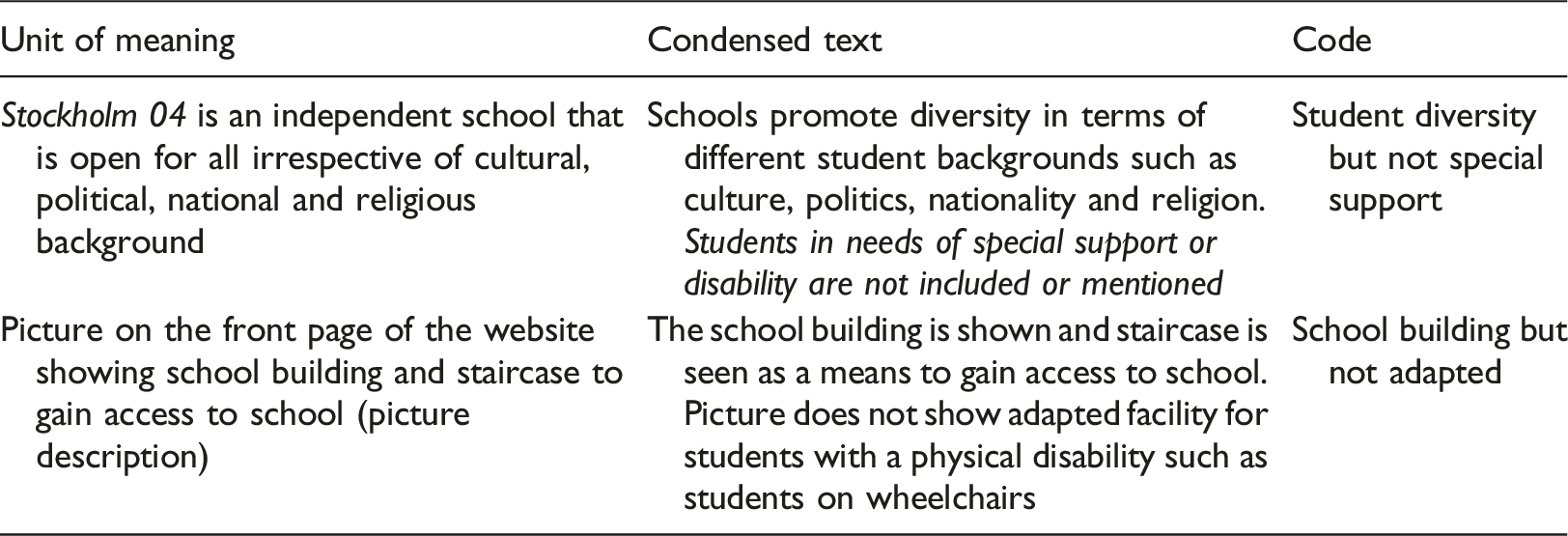
This next stage in the analysis involved the constructions of categorise based on the condensed and the coded information. A category was seen as a broad but specific theme that provides insight into the schools marketing information and describes its appeal to consumers in need of special education or not. Therefore, a category describes what the schools market, including information that pertains to special education or students in need of special support and if it appeals to them or not. The appeal to students was informed primarily by theory; if the information was relevant, useful and adequate vis-à-vis students in need of special support. In constructing categories, it was thought to be useful for rigour and management of the significant amount of condensed information and codes that the process is done systematically, by constructing sub-categories first. A sub-category represented a collation of related codes providing insight into what the school is marketing, for example, the following codes were grouped to form a sub-category named ‘Academic goals’. The codes are ‘Preparation for future studies’, ‘Student performance’, ‘Academic success’, ‘Best school-performance’.
Categories were constructed through an iterative process where sub-categories providing a specific insight into a broader aspect of the school was marketed and providing insights into the research question were merged. For example, sub-categories like ‘academic goals’, ‘social goals’, ‘School climate’, ‘religious beliefs’, were considered to be related to and providing information about the schools’ goals and values and were thus put together to form the category articulated goals and values. This stage went a step further after categories were identified, which were by and large descriptive of the manifest content, to ascertain their appeal or not to consumers in need of special support. Each category was further described in relation to consumers in need of special education; if the was relevant, adequate or complete. The discussion on relevance was influenced by previous research on what consumers in need of special support consider to be relevant and useful when they make school choice decision. Meanwhile, adequacy relates to presence or lack of information about special education or students in need of special support in the different aspects of the school marketed.
Findings
The categories below present and discuss what key aspects of the schools were marketed and how they appeal or not to consumers in need of special support. Citations from the schools’ websites are used to strengthen the elaborated categories. Schools are referred to as Stockholm and a number, for example, Stockholm02, and all the translations of the citations from Swedish to English were done by the first author.
Articulated goals and values
The results of the analysis of the marketing information on the schools’ websites indicate that these schools in their marketing provided information about their goals and values, in framing themselves to prospective students. Goals were mainly presented in terms of academics and a conducive school climate. Academic goals generally oscillated around students’ performance and preparation for future studies but also in terms of high academic expectations. Some schools wrote Our goal is that all students will reach high school requirements in the theoretical studies and have good chances to choose the school they will want to continue at during the important high school time. (Stockholm 19) At our school you work towards your own personal goals with the ambition to get higher final grades at the ninth grade. Stockholm 10 vision is to be Sweden´s best school. Our overarching goal is to get the best study result, the happiest students and parents and the best and most satisfied teachers (Stockholm 10)
These schools also emphasised student safety and well-being as goals they thrive for. They highlighted the importance of providing students with a safe learning environment and caring about student’s well-being. We want our school to be a place where all are safe and comfortable, have the desire to learn, feels happy to work and develop. (Stockholm16) …safety, happiness and development. To feel safe is an important condition for development and success in your learning (Stockholm 01)
In tandem with these goals, certain values are communicated by the schools; for example, respect, empathy and responsibility. Moreover, values connected to religious beliefs were actively promoted primarily by the two schools in this study that had a religious profile. These schools expressed the values of promoting their specific religious ideals in their pupils and their work. Some of the schools also explicitly articulated inclusive values in their marketing. Values communicated in terms of being an inclusive learning environment, but also as creating an inclusive school community with democratic values and the promotion of parental involvement.
The provision of information by schools in terms of goals and values conforms to the theoretical literature on the nature of information schools should produce and provide about their goals and values (Chubb and Moe, 1990; Schneider et al., 2000). The articulated goals and values in the marketing information such as the goal to create a positive social climate expressed through safety and well-being do have a general appeal to all consumers including consumers in need of special support. Studies examining students in need of special support have found these factors to be important in the school choice decision by parents of students with disabilities (Glenn-Applegate et al., 2016; Tah, 2019). However, regarding academic goals despite being important in education, they may not necessarily appeal to consumers in need of special support when they choose schools. A study by Tah (2019) demonstrates that academic considerations do not seem to play an important role when consumers in need of special support choose schools in the context of the Swedish education. Friendship and special support services were found to be more important. Moreover, Welner (2013) notes that schools to exclude students in need of special support may use subtle messages like the focus on academic performance.
Moreover, the inclusive values some of these schools clearly articulated is more or less appealing to a broad range of consumers like those with different cultural, ethnic and religious backgrounds. Several of schools fail to clearly articulate inclusive values in terms of disability and special support needs. This failure to explicitly include disability or special needs in inclusive values contained in the marketing information may not be appealing to consumers in need of special support.
A diverse studentship
Schools in their marketing also provided information framing their studentship, through different references to current and prospective students. The websites are populated with a variety of text and images depicting a diversity of students in terms of cultures, ethnicities and religious backgrounds. Several schools have pictures showing students from different ethnic and religious background (e.g. Stockholm 15, 17, 18 and 19), while others, clearly articulated their multi-cultural character and that they are open to admitting students from diverse backgrounds. We can really talk about diversity when it comes to our school. We have about 40 nationalities and a mother tongue teaching in ten different languages. It contributes to variations in different areas, not least the cultural plan. (Stockholm 16) Stockholm07 admits students regardless of religion, ethnic or national origin and gender to all the rights and privileges, programs and activities available to students at the school. (Stockholm 07)
The framing of their studentship mostly presented the schools as diverse in terms of culture, ethnicity, religion, languages and nationality. A few schools depicted students in a more homogenous manner; for example, one school had pictures showing primarily only Caucasian looking students. The framing of their studentship by the schools in this study is indicative of the schools’ appeal in their marketing to a diverse consumer-base relating to ethnicity, religion, language and nationality. However, all but one of the schools clearly provided information through text of images showing any students in need of special support. This schools provided specific information that students in need of special support are eligible for enrolment.
The framing of their studentship in the marketing may not appeal to students in need of special support as it fails to include information about them. Studies such as Lubienski (2007) has shown that schools may lack certain information in their marketing as a way to exclude certain groups of consumers. The framing of studentship implicitly or explicitly communicates the kind of students attending the schools and the kind of students that these schools want to appeal to or attract. Previous studies have shown schools to send signals and subtle messaging targeting particular groups of students (Gewirtz et al., 1995; Drew, 2013). These schools in their marketing may be seen as targeting a diversity of students primarily on the basis of culture, religion, nationality and ethnicity but not special educational needs. Such a marketing information which fails to include students in need of special support in describing its studentship, may not appeal to them.
Student services, for whom?
The schools marketing information mentioned different services these schools offer to support their mission. Almost all the schools provided information about the student welfare team, which is responsible for supporting students including students in need of special education support. Most schools had a similar text that described the work of these teams. The student welfare students is a part of the schools combined resources and offers psychological, medical, psychosocial and special educational support. (Stockholm 01).
Schools also specify the composition of these teams which included special education teacher or special educator in all the teams. Two schools clearly indicated offering school transport services to some of its students. One of the schools specified transport services for pupils between the grades 0 to grade 3. Another school offered this service to students based on age and distance from school. Regarding specific services for students in need of special support, one school mentioned having a Special Support Department, whose work focusses primarily on supporting students in need of special support. There was, however, a lack of adequate and easily organized information that were particular to students in need of special educational support; for example, information about how the student welfare teams work with coordinating and organizing special educational support, amount of special education personnel. Information about special educational support services is important for consumers in need of special support when it comes to school choice. A Swedish study (Tah, 2019) and another from the United States (Weidner and Herrington,2006) have demonstrated that consumers in need of special support do have an explicit need to get information about school´s special support system to make decisions about school choice. Therefore, inadequate and unorganized information about student services specifically for students in need of special support in the marketing information provided by these schools on their websites, makes it not particularly appealing to these students.
Methods and programmes
Schools market their methods and programmes, which is an important part in their educational profile. They provide information about their pedagogical methods or approaches and strategies, organisational strategies and also information about mandatory programmes. Some schools briefly mentioned the pedagogical methods at the school, while a few of the schools provided some basic description of the methods or strategies, or pedagogical focus. Almost all the schools included in their marketing, information about different mandatory programmes such as anti-bully plans, anti-discrimination plans, equality and equal treatment plans. Concerning, students in need of special support, two of the schools provided some information about specific approaches on working with students in need of special support. Apart from these two schools, the marketing information by several of the schools lacked relevant and adequate information regarding pedagogical methods, approaches or strategies specifically to support students in need of special support. The importance of relevant and adequate information has been underscored as an essential attribute of information to be provided to consumers to facilitate school choice (Bartlett and Le Grand, 1993; Chubb and Moe, 1990; Schneider et al., 2000). This is even more so when it comes to students in need of special support who will likely require special methods and strategies to support their learning. Studies from Sweden and abroad have shown this very specific information about methods, strategies and programmes to be useful to these consumers when they make school choice (Tah, 2019; Weidner and Herrington, 2006). The lack of appeal of the marketing information to consumers in need of special support reposes on the lack of relevant and adequate information about specific methods, strategies, programmes, etc. to support students in need of special support.
Facilities, for all?
One major feature which the schools in this study marketed was their facilities. These school showcased their buildings and other spaces in the school´s premises. Pictures portrayed the outer school building, classrooms and other rooms, spaces for leisure-time and play, etc. Schools described their facilities to show the quality and sometimes quantity. The facilities were described as conducive to support learning and student well-being but also modern, clean, beautiful, etc. The Stockholm 17 has 16 full size classrooms, and approximately 12 smaller rooms that we use for a variety of subjects including EAL, Swedish, Music Practice Rooms and Learning Support (Stockholm 07) Our facilities are designed to give you a safe and study-focused environment. This means we have different types of rooms for different kinds of teaching forms. Moreover, the interior is very colourful and have glass walls to create an environment that promotes learning. (Stockholm 10)
Pertaining to facilities specifically for students in need of special support, one school had a photo of a door with a text that read, ‘Room for special educator’. This could be understood as a space earmarked to support students in need of special support. Another school described having some rooms for the learning support for students in need of special support. Despite taking an important place in the marketing of schools, most schools provide almost no information about specific facilities and very limited information about the accessibility, adaptability and friendliness of the school-facilities for students in need of special support. Schools facilities that are adapted or friendly to consumers in need of special support is an important part of the information these consumers seek when they make school choice (Bajwa-Patel and Devecchi, 2014; Lange and Lehr, 2000; Tah, 2019; Weidner and Herrington, 2006). The marketing information failure to inform about the adaptability and friendliness of the schools’ facilities lacks specific appeal to students in need of special support.
Discussion
The findings of this study show that marketing by the independent schools examined does not generally appeal to students in need of special educational support. This is seen through primarily the lack of relevant and adequate information about key aspects of the school that are useful to consumers in need of special support. This includes information about the schools’ special education system; in terms of the available specific services and resources, ways of working and facilities for students with disabilities. More so, the framing of their studentship in the school marketing fails to clearly include students in need of special support and the focus on academic goals which is not particularly relevant to consumers in need of special support when it comes to school choice decisions.
These findings have implications for consumers in need of special support and the functioning of the marketing system. There is an apparent information asymmetry when it comes to sourcing the marketplace with information for consumers in need of special support from marketing by schools. This suggests consumers in need of special support may be less informed in the process of choosing a school. This does not only affect consumer empowerment to use choice to leverage the kind of education they want, but also and generally speaking the anticipated positive outcome of the market system of education in terms of school improvement predicted by market proponents. This also suggests, more constraint possibly in cost and time for consumers in need of special support to gather relevant and adequate information about schools to facilitate school choice. Considering the difficulties these parents may already encountering providing care and support their children with special educational needs, it thus adds another layer of difficulty and complexity in their life situation when it comes to choosing schools. The failure to provide relevant and adequate information also implies that these consumers may not find these schools as suitable options, thereby reducing the choice set of schools available to them in the marketplace. Finally, the findings of this study have policy implications, specifically in relation to the goal of inclusion and equity in the Swedish market system of education. The lack of relevant and adequate information suggests an uneven playground when it comes to making informed school choices for consumers in need of special support and by extension the use of choice to leverage the kind of education these consumers want. It is imperative that the public authorities responsible for the education market system find ways to require these schools to provide relevant and adequate information for these consumers, especially more so when public authorities can no longer produce information about schools that could facilitate school choice. The information to be produced and provided should include information about eligibility to attend the school, clear inclusive goals and values and the special educational support system including methods, strategies, services, organisation of support, facilities, etc. After all, the market is publicly financed through taxation and it is incumbent on public policy that all members of the school system are offered the conditions that favour equal access and participation in the education marketplace.
Footnotes
Declaration of conflicting interests
The author(s) declared no potential conflicts of interest with respect to the research, authorship, and/or publication of this article.
Funding
The author(s) received no financial support for the research, authorship, and/or publication of this article.
