



Abstract
Information technology and computer science represent one area of science, technology, engineering, and mathematics (STEM) that have experienced significant growth in recent years. As such, federal policy has urged schools to embed new types of STEM courses into the curriculum. As one very prominent example, computer science (CS)-focused courses are a growing branch of career and technical education (CTE)—that is, CS-CTE. While previous research has examined coursetaking patterns and subsequent outcomes of CS-CTE courses for the general student population, little is known about how participation in these courses may benefit students with learning disabilities (SWLDs). From a pedagogical perspective, CS-CTE courses, and CTE courses in general, may be uniquely positioned to improve schooling outcomes for SWLDs. Using data from the nationally representative High School Longitudinal Study of 2009, we explored characteristics of CS-CTE participants, how CS-CTE may promote the development of key STEM attitudes (e.g., identity, self-efficacy, and utility), and how any relationships may differ by learning disability status. Using a double propensity score matching estimations, we found CS-CTE participation related to positive development of STEM identity and STEM self-efficacy for students without learning disabilities. For the SWLD population, CS-CTE participation was associated with growth in STEM self-efficacy and STEM utility. Policy implications discuss the gap in computer science employment between SWLDs and non-SWLDs, the prevalence of state-related computer science policies, and how to continue to promote STEM identity growth.
Keywords
Introduction
The economic landscape of the United States is ever in flux, and as such, there is constant demand for highly skilled workers (Carter, 2006; Nager and Atkinson, 2017). This is especially true in the science, technology, engineering, and mathematics (STEM)-related industries which represent the fastest growing sector of the U.S. labor force (National Science Foundation, 2011). Yet, there remains a shortage of graduating students to fill these jobs, made worse by a leaky STEM pipeline (i.e., high school to college to career)—this is evidenced by low rates of STEM degree completion in the United States (National Academy of Sciences, 2007, 2010). While the supply shortage among rising cohorts of college graduates across all STEM fields is worrisome, this situation is particularly salient in the field of computer science (CS) (Nager and Atkinson, 2017).
CS has experienced rapid employment growth in recent years (U.S. Bureau of Labor Statistics, 2019; Milfort, 2012; Nager and Atkinson, 2017), but there are not enough students in the pipeline to keep up with the rapidly growing demand. For instance, in 2018, the number of bachelor’s degrees awarded in CS constituted 20% of all degrees conferred in STEM fields (National Center for Education Statistics, 2020; Nager and Atkinson, 2017). Yet, jobs in CS account for two-thirds of all new occupations in STEM fields over the next decade (U.S. Bureau of Labor Statistics, 2021). Because the demand for CS skills is not purely confined to CS professions, the concern about the lack of CS students in the pipeline may in fact be under-stated when considering that CS training might be useful in other areas of the STEM as well.
While national statistics raise general concerns about the lack of students in CS fields, there are also very-specific concerns about the underrepresentation of special populations in CS areas. As one key example, students with learning disabilities (SWLDs) are historically underrepresented throughout all nodes of the STEM pipeline (National Science Foundation, 2015; Sargent, 2014; Snyder et al., 2016). For instance, SWLDs take fewer STEM courses in high school (Blackorby and Wagner, 1996; Shifrer et al., 2013) and accrue fewer credits in CS classes (Sublett and Gottfried, 2017) when compared to the general population. This lack of SWLDs pursuing high school CS courses may largely influence the limited involvement of SWLDs in CS fields in college and career (Eriksson et al., 2007).
Taken together, these data points seem to provide evidence of a “leaky” educational CS pipeline both for students in the general population as well as those from special populations, like SWLDs. This may occur because, for most students, the decision to pursue CS fields over the long-term occurs during high school rather than later in young adulthood (Kim et al., 2018). Therefore, high school experiences play a critical role in positioning students to persist in the CS pipeline. In this vein, evidence suggests that high school CS coursetaking can be one central way to help stimulate interest and persistence in CS fields—work has suggested that high school exposure to CS coursework increases the likelihood of enrolling in and succeeding in CS coursework in college (Brown and Brown, 2020; Campbell, 1992; Taylor and Luegina, 1991). Thus, looking for policy solutions that encourage students in high school to engage with CS coursework may be one way to address how to attract students into CS areas.
The Carl D. Perkins Career and Technical Education Act (and its reauthorizations) has brought a policy focus on promoting persistence along the CS pipeline. Under the Perkins Act, high school career and technical education (CTE) courses have been developed as a way to provide “competency-based applied learning that contributes to the academic knowledge, higher-order reasoning and problem-solving skills, technical skills and occupation-specific skills” (Carl D. Perkins Career and Technical Education Act, p. 4). In other words, a primary goal of the Act is to align applicable career-related skills with academically challenging coursework in high school. The two most recent reauthorizations of the Perkins Act (in 2006 and 2018) (CarlPerkins, 2006) include two relevant calls to action: (1) equalizing access to CTE, specifically for special populations of students such as SWLDs, and (2) increasing STEM learning through a CTE framework of technical skill accumulation, into which computer science CTE (CS-CTE) coursework as described below is a component. The emphasis on increasing access and participation over time does appear to have taken some hold as there is evidence that coursetaking in STEM-focused CTE has increased over the past decade and a half (Plasman et al., 2020; Theobald et al., 2021). This is critical given CS-related occupations represent some of the highest demand professions in the country and also offer high wages (U.S. Bureau of Labor Statistics, 2021). Considering the benefits from participation in STEM-related CTE coursework (e.g., increased advanced STEM coursetaking, increased declaration of STEM major, increased graduation rates, and labor market outcomes) for the general population (Dougherty et al., 2019; Gottfried and Bozick, 2016; Gottfried et al., 2014; Shifrer and Callahan, 2010; Sublett, 2016), and comparable benefits for SWLDs (Dougherty et al., 2018; Plasman and Gottfried, 2018; Theobald et al., 2017), increasing participation in such coursework appears to be a worthwhile focus for both policy and practice.
In addition to CS-CTE imparting technical skills in CS fields, the two most recent reauthorizations of the Perkins Act, in conjunction with numerous local and state policies (Office of the Press Secretary, 2016), represent a concerted effort to foster the connection between high school, college, and career opportunities (Brand et al., 2013). In other words, these recent policy efforts also have attempted to increase engagement (Plasman et al., 2020), and the development of STEM-related attitudes such as STEM identity, self-efficacy, and utility. It is becoming clearer that these psychosocial factors are as important to develop as academic cognitive skills, as attitudes influence high school course selection, college major selection, and career goals (Correll, 2001). However, little is known about whether CS-CTE high school courses may influence the development of STEM-related attitudes, with no evidence for SWLDs. Yet, in order to encourage persistence along the STEM pipeline for all groups of students, it is critical to understand which experiences in high school STEM coursework can bolster students’ positive attitudes toward STEM.
Science, technology, engineering, and mathematics attitudes
STEM identity
While there are several definitions of identity, this study focuses on STEM identity as an example of a social identity, theorized as the extent to which individuals see themselves and are recognized and accepted as members of a STEM community or discipline (Glassner and Tajfel, 1985; Tajfel and Turner, 1979) and occurs as a result of interactions with others (Kim et al., 2018). When actors in the STEM community recognize, support, and accept an individual’s membership, they develop a psychological sense of belonging and begin to see themselves as a member of the STEM community (Cheryan et al., 2015). For example, Wenger (1998) found that students’ perceptions of their own mathematics identity are impacted by others’ perceptions and evaluations in the community, in turn influencing their mathematics engagement and participation. Likewise, a common explanation for the lack of persistence in STEM fields is that students do not view themselves as a “STEM person” (Carlone and Johnson, 2007).
STEM self-efficacy
Self-efficacy is the belief in one’s ability to succeed in a given task related to a specific subject or act (Bandura, 1994; Pajares, 1996). Although knowledge and skills are crucial for academic success, self-efficacy is needed to access the skills and resources necessary to learn (Bandura, 1994). Self-efficacy theory recognizes four factors that contribute to a students’ sense of self-efficacy: mastering experiences, vicarious experiences, social persuasion, and physiological reaction (Bandura, 1994). When individuals are faced with a challenge and subsequently master the experience, they may feel a sense of success through accomplishing the task, thereby reinforcing feelings of resilience and perseverance (Bandura, 1997; Schunk and Pajares, 2009). Learning that occurs by observing others accomplish a task—vicarious experiences—may also lead to beliefs in one’s own ability to accomplish a similar task (Bandura, 1997; Schunk and Pajares, 2009). Support and encouragement from influential people (e.g., parents, teachers, and peers) serves as social persuasion that can affect an individual’s confidence and belief in their capabilities. Physiological reactions can affect confidence, thereby impacting performance on academic tasks (Bandura, 1997; Schunk and Pajares, 2009). Development of STEM self-efficacy through educational environments that foster applied learning and enhance confidence in science and math is crucial as it is associated with achievement and persistence in STEM (Betz, 2004; Betz and Hackett, 1983; Lent et al., 1986; Lewis, 2003; Taylor and Betz, 1983).
STEM utility
A myriad of psychological factors contribute to an individual’s motivation to make achievement-related decisions (Eccles et al., 1983). Under expectancy-value theory, STEM utility suggests that students are motivated to complete a task because they believe it will be useful for current or future pursuits in STEM. Students are also motivated to complete tasks that have intrinsic value, meaning they are engaging or enjoyable, and attainment value, meaning they are related to their identity. While the three concepts of expectancy-value theory aim to understand the intersection between the perceived value of a task and the motivation to complete that task, researchers use STEM utility as a mechanism to understand future STEM pursuit and persistence because it is malleable to outside forces (Maltese and Tai, 2011; Simpkins et al., 2006). Students' STEM utility positively predicts their belief in the importance of STEM education (Ball et al., 2017), in addition to subsequent mathematics and science coursetaking and STEM major enrollment (Lazowski and Hulleman, 2016; Simpkins et al., 2006; Updegraff, Eccles, Barber and O’brien, 1996).
This study
Despite the well-documented under supply of individuals who pursue and persist in CS fields, it is surprising that scant research has focused on the potential for CS-CTE coursework to improve the CS and STEM pipelines, and for key subgroups like SWLDs. This is a particular oversight given that these CS-CTE courses are intended to improve STEM attitudes, which have been linked to stronger high school, college, and career outcomes in STEM fields. To respond to this gap, we ask the following research questions: 1. What are the characteristics of students who participate in CS-CTE in high school? 2. Does CS-CTE participation tie to the development of positive STEM attitudes (e.g., identity, self-efficacy, and utility)? 3. Is there differential relationship for SWLDs?
Initially, it is important to understand the characteristics of CS-CTE coursetakers in order to identify key populations that may be lacking access to CS-CTE coursework. This is a necessary undertaking as it allows for the identification of potential gaps in coursetaking, which imply gaps along the pipeline. This knowledge can help guide policy decisions with respect to understanding whether to take steps to improve access to CS-CTE programming for all student subgroups. Second, as noted above, STEM attitudes such as identity, self-efficacy, and utility are necessary precursors to success and persistence along the STEM pipeline. Our final research question is motivated by the recent Perkins legislation that highlights the need to increase CTE participation for students with disabilities, specifically in STEM disciplines.
Background
CS-CTE coursework
As encouraged by the Perkins Act, STEM-related CTE (also known as “applied STEM CTE”) courses were designed to focus on applying STEM skills in more relevant ways in order to equip students with the academic and technical skills needed to continue through the STEM pipeline. Applied STEM courses fall into 2 of the 16 CTE clusters: engineering technology and CS (Bozick and Dalton, 2013; Shifrer and Callahan, 2010). These courses are intended to build upon the material taught in traditional STEM courses (e.g., biological sciences, mathematics, and physical sciences), emphasize skill acquisition, and focus on specific challenges to real-world STEM problems. Participation in applied STEM CTE courses in high school is associated with a wide range of positive STEM outcomes, including subsequent enrollment in advanced math and science courses, enhanced STEM self-efficacy, higher chances of high school completion, and increased odds of declaring a STEM major in college (Gottfried, 2015; Plasman and Gottfried, 2018; Sublett and Plasman, 2017).
Within the applied STEM CTE category, CS-specific courses include those that fall in the areas of computer information science and IT (e.g., data processing, C++ programming, artificial intelligence, and systems analysis). CS-CTE courses challenge students to approach real-life STEM problems in creative and rigorous ways (Nager and Atkinson, 2017). Through inquiry-based assignments focusing on model building, running algorithms, and writing code, students are taught to recognize problems and identify potential solutions (Nager and Atkinson, 2017). The applied nature of CS-CTE courses provides students with broadly transferrable skills in computational literacy, critical thinking, and logical reasoning that can be applied to a myriad of STEM fields, highlighting the potential of CS-CTE coursetaking to have long-term STEM pipeline outcomes. While previous studies have explored the relationship between high school applied STEM CTE coursetaking and various STEM-related outcomes, CS-CTE courses have not been examined as a cluster on its own. Considering the rapidly growing demand for students trained in STEM—especially in CS and IT sectors—CS-CTE research represents one area that could fill this gap.
A small body of work has explored CS-CTE coursework in high school and later outcomes. Brown and Brown (2020) found that CS-CTE courses had a positive and significant effect on increasing the likelihood of enrolling in college. Similarly, Taylor and Luegina (1991), found a positive relationship between pre-college computer science experiences and computer science coursetaking and success in college. Other work has examined the attitudes concerning the utility of computers and perceived computer proficiency in college coursetaking (Campbell, 1992), finding them to be the strongest predictors of future enrollment in computer courses. However, prior research has not examined how CS-CTE coursework in high school may influence the formation of STEM-related attitudes.
SWLDs and CS-CTE
While the vast majority of SWLDs have been educated along with the general student population over the past few decades (Cawley et al., 2002), evidence suggests traditional STEM courses may not provide optimal learning opportunities for this group of students. Traditional approaches to STEM teaching rely heavily on text-based instruction and lecture. This creates an emphasis on language-based learning and consequently places SWLDs at a disadvantage (Parmar et al., 1994).
Therefore, there are two key pathways by which CS-CTE courses might support stronger outcomes for SWLDs. First, recommended accommodations for SWLDs include using multiple senses, participating in hands-on and lab experiences, and employing more demonstrations by the instructor (Scruggs and Mastropieri, 1993; Steele, 2010). Second, the abstract nature of traditional math and science courses in particular can be a significant struggle for SWLDs (Jenson et al., 2011). However, beyond potential benefits related to STEM pipeline persistence, the applied nature of CS-CTE courses may be particularly suited to support SWLDs’ learning (Witzel, 2005). CS-CTE courses might be one way to not only engage SWLDs in STEM material, but also as a more general method to keep them engaged in school itself. Not only have SWLDs expressed a preference toward hands-on approaches to learning (Jenson et al., 2011; Scruggs and Mastropieri, 1993), but they also performed better when learning through this applied approach over a specific textbook-based style of learning (Brigham et al., 2011; Moon et al., 2012).
Connecting CS-CTE to STEM attitudes
Prior work by Milesi et al. (2017) focusing on CS at the postsecondary level identified psychosocial factors such as engagement, self-efficacy, and intrinsic interest all contributed to persistence in CS degree programs. Specific to computer science identity, Kong and Wang (2020) found evidence that students in primary school who participated in computational thinking activities linked to the formation of computational identity, a subset of STEM identity. Considering the malleable nature of such factors (Milesi et al., 2017), the formation of positive STEM identity, self-efficacy, and utility within the context CS-CTE may be a key to motivating students to pursue and persist in CS fields and STEM fields more broadly.
To aid in the development of STEM identity, it is recommended to provide hands-on STEM lessons that encourage relevance and engagement, allowing students to explore STEM topics at their own pace (Carlone and Johnson, 2007). Through CS-CTE courses, students engage in inquiry-based assignments and practical learning, (Nager and Atkinson, 2017), thereby promoting engagement in the scientific process and allowing students to self-identify as members of the STEM community. Students taking CS-CTE courses have opportunities to reinforce academic knowledge from traditional STEM courses, and this extra amount of time spent on math and science courses via applied learning can boost students’ ability to succeed in all types of STEM courses (Stone et al., 2008), thereby boosting STEM self-efficacy. Finally, CS-CTE courses focus on integrated “real-world” applications and overtly foster STEM skills and knowledge that have direct relevance and utility to address numerous challenges in STEM fields that students might face in college and their careers (Gottfried et al., 2014; National Research Council, 2011). For malleable factors such as STEM identity, self-efficacy, and utility, student-centered learning opportunities that emphasize applied learning through inquiry-based experiences may provide pathways to foster growth across these attitudes (Carlone and Johnson, 2007; Harackiewicz et al., 2016; Lazowski and Hulleman, 2016; Lewis, 2003). CS-CTE courses are designed specifically to align with just such an approach to learning (Brand et al., 2013), and they may be particularly suited to do so for SWLDs (Plasman and Gottfried, 2018).
Methodology
Dataset overview
To respond to our research questions, we rely on information from a nationally representative, longitudinal dataset: the High School Longitudinal Study of 2009 (HSLS). This dataset was compiled by the National Center for Education Statistics (NCES) at the U.S. Department of Education (Ingels et al., 2015). This dataset represents the most recent data collection effort to focus on a nationally representative sample of high school student. HSLS continues to follow a cohort of students who were enrolled in the ninth grade in 2009 when the base year survey was administered. During that time, students, parents, administrators, teachers, and school counselors each completed questionnaires in order to provide a robust snapshot of each member of the study at that time. In the spring of 2012, NCES conducted a full follow-up survey when students were expected to have been finishing the 11th grade. Across the 2013–14 school year (a year after students’ original expected graduation date), NCES conducted a brief recontact survey in addition to compiling full high school transcripts for study participants.
Our analyses drew on information from the student, parent, and administrator baseline surveys; the student follow-up surveys; and the high school transcripts. As our study places a major focus on high school coursetaking, a more detailed description of the transcript data is warranted. The transcript data included the official school records of each course taken by each student, the grades received in each course, the number of credits earned, and the timing of course enrollment (i.e., first semester of the ninth grade year and second semester of the senior year). In order to ensure interpretability across schools that may have different academic calendars or may implement different systems identifying the number of credits per course, NCES standardized the credit measure to Carnegie Units such that one unit is equivalent to a course taken for a one-hour period every day during the academic year. Additionally, NCES employed a course classification system based on the school courses for the exchange of data (SCED) codes as developed by the National Forum on Education Statistics (National Forum on Education Statistics, 2014). Using these codes, we identified each course that fell into the CS-CTE category.
To account for missing data, we relied on the recommendation of Graham et al. (2007) whose methodological research identifies 20 additional imputed datasets as a sufficient number. We imputed all our variables to ensure the imputed values were as accurate as possible. However, when performing our analyses, we relied on the observed values of the outcome variables as some of them asked students to identify attitudes about current STEM coursework, in which some students were not participating. The final analytic sample included students with complete coursetaking data and non-missing outcome data. Our full sample included 20,040 student observations. Note that we round our sample to the nearest 10 as per NCES guidelines. Additionally, we include student-level weights to maintain sample representativeness.
Population of interest
We focus our analyses on the comparison between SWLDs and students from the general education population. We then limit our analyses to explore only SWLDs. We identify learning disability status using an item from the baseline parent survey that asks whether the parent had ever been told by a doctor or other professional that the child has a specific learning disability. It is important to note that we did not limit this sample to students who had individualized education plans. We chose to operationalize learning disability in this way because of the high percentage of missing responses regarding whether a student had an IEP. Ultimately, this resulted in a SWLD sample of 1230 students and a general education sample of 18,810 students.
Outcomes
We identified a number of key outcomes related to computer science coursetaking. The first outcome is a descriptive in nature: CS-CTE participation. We defined this outcome as a binary variable indicating whether or not an individual ever took a CS-CTE course. This variable was created using the NCES transcript data that identified the number of credits and courses in every subject.
The next set of outcomes contains a group of composite variables defining a variety of STEM measures, each of which links with STEM achievement and pursuit. The first is STEM identity, which includes items defining whether the individual views him or herself as a math/science person and whether the individual thinks others view him or her as a math/science person. The second variable is STEM utility, which includes items identifying whether and individual believes math/science will be of us in college, career, and life in general. The final variable is STEM self-efficacy, which includes items identifying whether a student believes he or she can: succeed on math/science tests; understand the information in the math/science textbook; master math/science skills; and do an excellent job on math assignments. Each of these outcomes was created using a principal component analysis for each item identified by NCES as pertaining to the unique STEM measures individually for math and science. For example, NCES performed a principal component analysis to define math identity using the two unique items specific to math (view self as a math person, and others view self as a math person). We performed this same principal component analysis but included items for both math and science. The variables were each standardized to have a mean of 0 and a standard deviation of 1. For each of these STEM measures, a higher value indicates a more desirable attitude. A final note is that these measures were collected both during the baseline survey in the ninth grade and during the follow-up in the 11th grade. Therefore, we were able to control for the baseline measurement in each analysis.
CS-CTE coursetaking
Our key predictor variable was related to our first outcome: CS-CTE participation. However, while our outcome was a binary variable indicating whether a student ever participated in CS-CTE, our predictor variable is a continuous variable defining the number of CS-CTE credits earned. As mentioned above, the NCES transcript data includes course codes for every course a student participated in during high school along with the number of credits earned and the year in high school those credits were earned. The codes allow us to identify the number of credits a student earned in CS-CTE based on the high school course taxonomy (Bradby and Hudson, 2007). Courses that fall into the CS-CTE category include introduction to computer science, C++ programming, and data processing.
As mentioned above, we define CS-CTE coursetaking here as the number of credits completed, which we identify as the number of Carnegie units completed. Based on prior research on STEM-related CTE coursetaking, there is evidence that Considering STEM-related outcome measures were collected during the junior year, we only take into account the number of credits earned during the first 2 years of high school. Throughout this study, references to CS-CTE coursetaking or participation as the predictor variable refer to this number of units earned during the 2009-10 and 2010-11 academic school years.
Control variables
Summary Statistics.
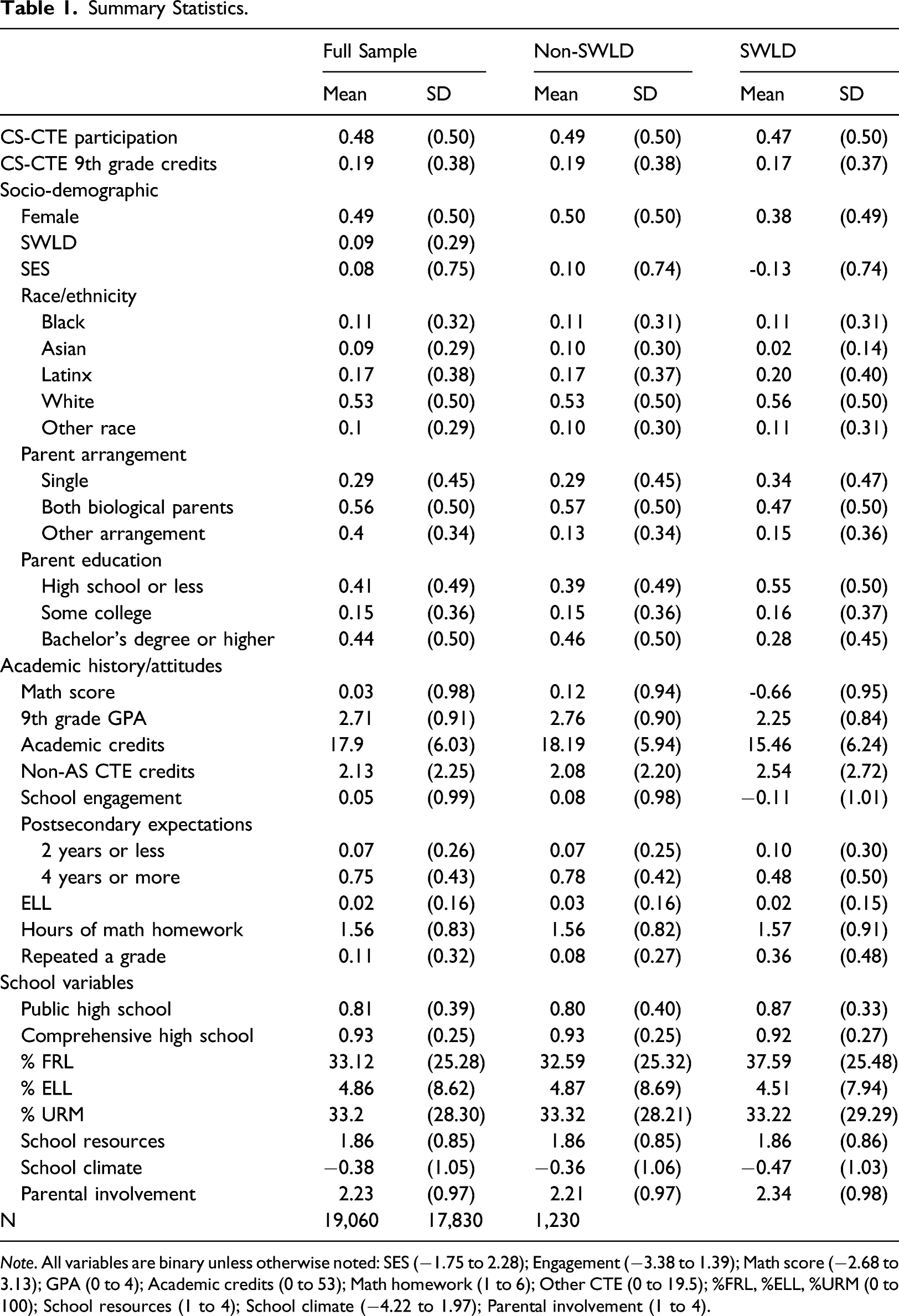
Note. All variables are binary unless otherwise noted: SES (−1.75 to 2.28); Engagement (−3.38 to 1.39); Math score (−2.68 to 3.13); GPA (0 to 4); Academic credits (0 to 53); Math homework (1 to 6); Other CTE (0 to 19.5); %FRL, %ELL, %URM (0 to 100); School resources (1 to 4); School climate (−4.22 to 1.97); Parental involvement (1 to 4).
Within our set of control variables, we included three unique categories: socio-demographics, academic history and attitudes, and school variables. The socio-demographic variable category included key variables such as gender, socioeconomic status, race/ethnicity, family arrangement, and parent education. Within the academic history and attitudes category, we included a standardized math score, ninth grade GPA, academic credits, CTE credits in other clusters, English language learner status, a measure of school engagement, postsecondary expectations, ever repeated a grade, and hours of math homework per week. The school engagement measure is a composite variable created by NCES related to various school behaviors (Ingels et al., 2015). In understanding this engagement measure, a lower score indicates a lower level of overall engagement with the school.
The third category of control variables, school-level variables, includes a variety of demographic indicators, such as percent of student body eligible for free or reduced-price lunch, percent of student body designated as English language learners, and percent of student body identifying as underrepresented minority. The underrepresented minority designation we use mirrors that defined by the National Science Foundation (National Science Foundation, 2011). Additionally, we include indicators of whether the school is public or private, and whether it is a comprehensive high school. Finally, we include measures of lack of school resources, school climate, and whether lack of parental involvement is a problem at the school. With respect to school resources and parental involvement, it is worth noting that a higher score on this measure indicates that school resources and parental involvement are more serious issues.
Analytic approach
Research question 1: Predictors of CS-CTE participation
To respond to our first research question, we employed a logistic regression model to estimate predictors of participation in CS-CTE. This model was specified as follows
In model (1), the term CS ij represents a binary variable indicating whether or not student i in school j ever participated in CS-CTE coursework in high school. The term X i represents a vector containing all the student-level covariates as identified above, while the term S j represents a vector of the school-level variables identified above. Finally, ε ij is a placeholder for the error term clustered at the school level to account for students nested within schools. By including our full set of control variables as predictors of CS-CTE participation, we are able to determine whether there are key observable differences between students who do and do not enroll in CS-CTE courses.
Research question 2: Relationship between CS-CTE and STEM attitudes
Our second research question asked whether CS-CTE participation was significantly predictive of growth across three key STEM attitudes: STEM identity, STEM utility, and STEM self-efficacy. Our baseline model for this estimation is represented by the following equation
In model (2), the three terms CS, X, and S are defined the same as they are in model (1) above. The term Y ijF is a placeholder for our STEM attitude outcome of interest—identity, utility, and self-efficacy—measured during the follow-up survey, F. We also included a measure of the outcome as measured during the baseline survey as indicated by the term Y ijB . The inclusion of this term allowed us to control for any initial differences in STEM attitude such that we were better able to observe changes in STEM attitudes. In this instance, we employed an ordinary least squares (OLS) regression as the outcomes were all continuous measures.
Research question 3: Differences between SWLD and non-SWLD students
Our final research question asked whether there were different relationships between CS-CTE participation and STEM attitudes dependent on learning disability status. Based on our hypothesis that CTE coursework in STEM-related fields (e.g., CS-CTE) may be particularly beneficial for SWLDs, this was an important question to answer. We responded to this research question by rerunning the model identified above in research question 2 for each outcome on two unique samples: those students identified as having a learning disability and those who were not identified as having a learning disability. Differentiating across these two groups allowed us to better understand the mechanisms by which different student populations may benefit from CS-CTE participation.
Sensitivity test: Propensity score matching
Though our models above included a robust set of control variables, our estimates may still be biased by unobserved factors that also impact the outcomes. By accounting for a robust set of observed covariates, propensity score matching (PSM) techniques are designed to help reduce these biases (Rosenbaum and Rubin, 1983). Under nearest neighbor matching as we employ in this study, students’ propensities of membership in a group are calculated using observed characteristics. Students in the treatment group are matched with observations from the control group that most closely resemble a treated observation based on the predicted propensity for experiencing treatment. By comparing students with similar propensities, this methodology attempts to replicate a random experiment by looking at students who are similar in as many ways as possible. Based on research indicating multiple matches per treated observation can increase precision, we matched each treated student with four control students (Rassen et al., 2012).
In the context of our study, there were two potential sources of bias: classification as SWLD and the decision to participate in CS-CTE. To account for this, we first calculated propensities for receiving a learning disability classification using our set of above covariates and identified the appropriate matches. Prior research has used similar multi-level matching to account for multiple levels of treatment (Hong and Raudenbush, 2006; McCormick et al., 2013; Stuart and Rubin, 2008). From this match, we created two subgroups: (1) students who were classified as having a learning disability and their identified matches and (2) students without learning disabilities who were not matched. We included this first match as it is likely that there are a substantial number of students who are undiagnosed with a learning disability even though they may benefit from the services that come along with such a diagnosis (Schechter, 2018). When we ran our full population estimates, this new indicator variable was included as a covariate.
We next matched students based on their propensities to participate in CS-CTE, again using nearest neighbor matching. For this match, we used a binary indicator of whether a student participated in CS-CTE as opposed to the number of credits earned. We chose to focus on this binary indicator as we were most interested in the observed differences between those who did and did not choose to participate in CS-CTE as opposed to how much CS-CTE they were exposed. We performed this match separately for the full student population, the SWLD population, and the non-SWLD population. These propensities were then included in the estimation of the relationship between CS-CTE participation and STEM attitudes. Ultimately, through employing these matches, we expected to reduce potential observed biases related to learning disability status and CS-CTE participation, thereby increasing the accuracy of our estimates.
Results
CS-CTE participation
Predictors of CS-CTE Participation.
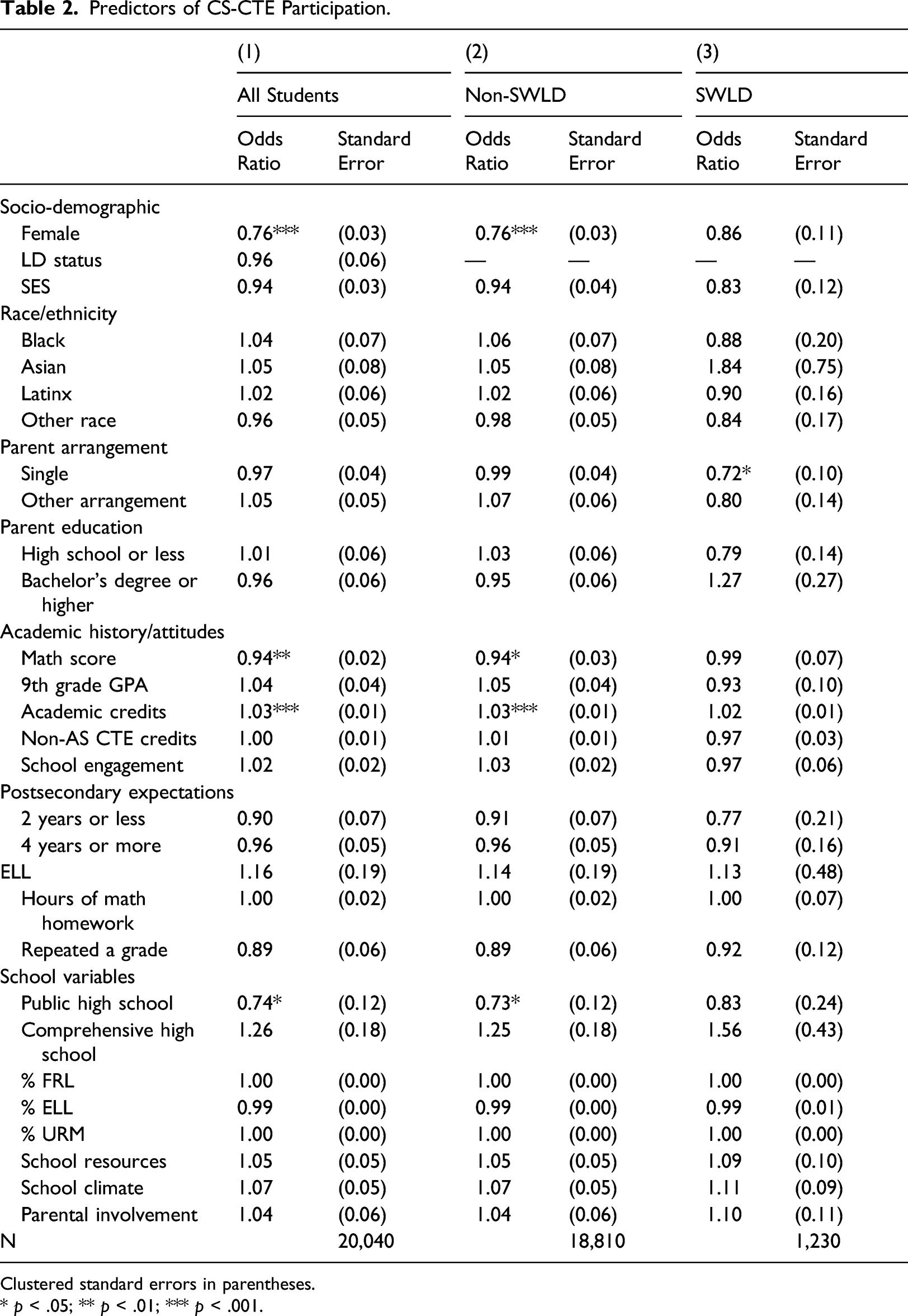
Clustered standard errors in parentheses.
* p < .05; ** p < .01; *** p < .001.
Model 1 identifies the results for the full population. First, Female students are underrepresented (0.76, p < .001) in CS-CTE coursework in high school, indicating that the gap between male and female participation in computer science occupations is already evident in high school. Interestingly, students who exhibited higher math scores were also significantly less likely to participate in CS-CTE (0.94, p < .01), though students who earned more academic credits were more likely to have participated in CS-CTE (1.03, p < .001). A final significant predictor of CS-CTE participation was whether a student was enrolled in a public school, in that those enrolled in public schools had significantly lower odds of participation (0.74, p < .001). Interestingly, learning disability status was not significantly predictive of participation, indicating that SWLDs may not be underrepresented in CS coursework in high school. Model 2 identifies the predictors of CS-CTE participation for the non-SWLD population, which are nearly identical to those of the full population. This is to be expected since the non-SWLD population makes up a vast majority of the full population.
Finally, model 3 identifies the predictors of CS-CTE participation for SWLDs. Within this sample, the only predictor was related to parental arrangement. SWLDs living in single parent households were significantly less likely (0.72, p < .05) to take CS-CTE courses in high school than were students who came from families with both biological parents. This is an interesting finding as there was no relationship in this regard for non-SWLD students. Another noteworthy point is that female SWLDs were not significantly underrepresented in CS coursework.
STEM attitudes
The Relationship between CS-CTE Participation and STEM Attitudes.
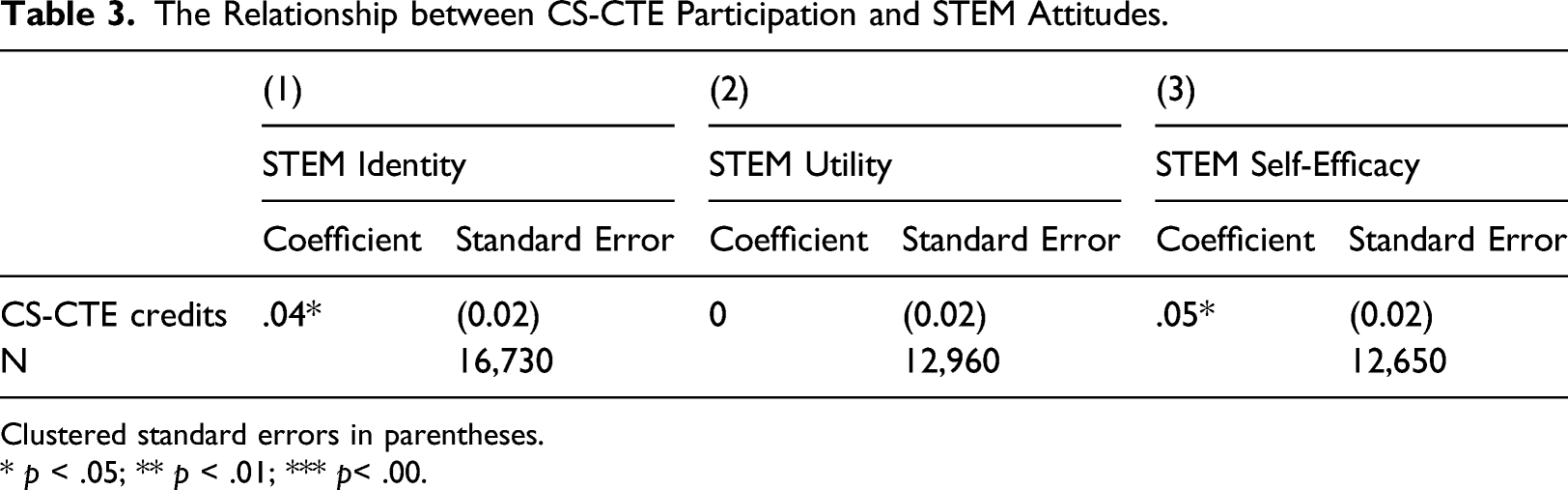
Clustered standard errors in parentheses.
* p < .05; ** p < .01; *** p< .00.
Model 1 presents the results with respect to STEM identity. Here, we found a positive, significant relationship between CS-CTE and STEM identity (0.04, p < .05), such that for every additional credit of CS-CTE earned, a student was expected to see an increase of 0.04 standard deviations in STEM identity. With respect to STEM utility presented in model 2, we found no significant relationship. Finally, for STEM self-efficacy (model 3) we found that CS-CTE participation was a significant predictor of increased attitudes of STEM self-efficacy (0.05, p < .05). Note that the sample sizes differ in each of these analyses. This was due to the fact that students were asked to respond to the questions about utility and self-efficacy as related to their feelings toward the course in which they were enrolled during junior year, and some students did not take both math/science at that time. The differences in the sample sizes between utility and self-efficacy were related to the handful of students who did not respond to the self-efficacy items either in the baseline or follow-up survey, preventing us from being able to determine changes in attitudes.
Differences between SWLDs and Non-SWLDs
The Relationship between CS-CTE Participation and STEM Attitudes by SWLD Status.
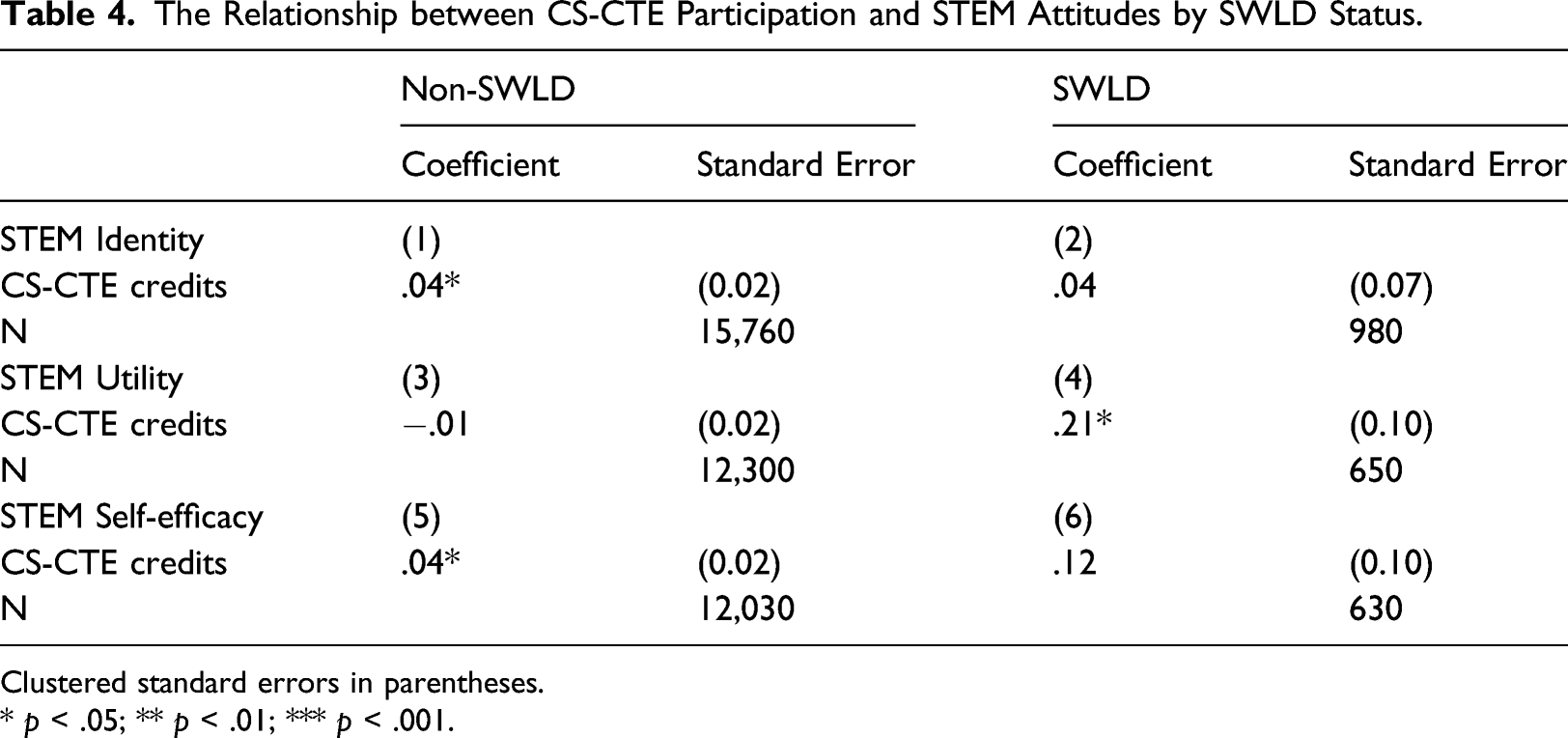
Clustered standard errors in parentheses.
* p < .05; ** p < .01; *** p < .001.
The exact opposite was the case for the SWLD sample. For SWLDs, participation in CS-CTE was significantly related to increased attitudes of STEM utility (model 4: 0.21, p < .05), while there was no significant relationship between CS-CTE participation and STEM identity (model 2) and STEM self-efficacy (model 6) for the SWLD sample. It is worth noting, however, that though the STEM self-efficacy coefficient was not significant, it was positive and had a relatively large magnitude of 0.12.
Sensitivity test: PSM
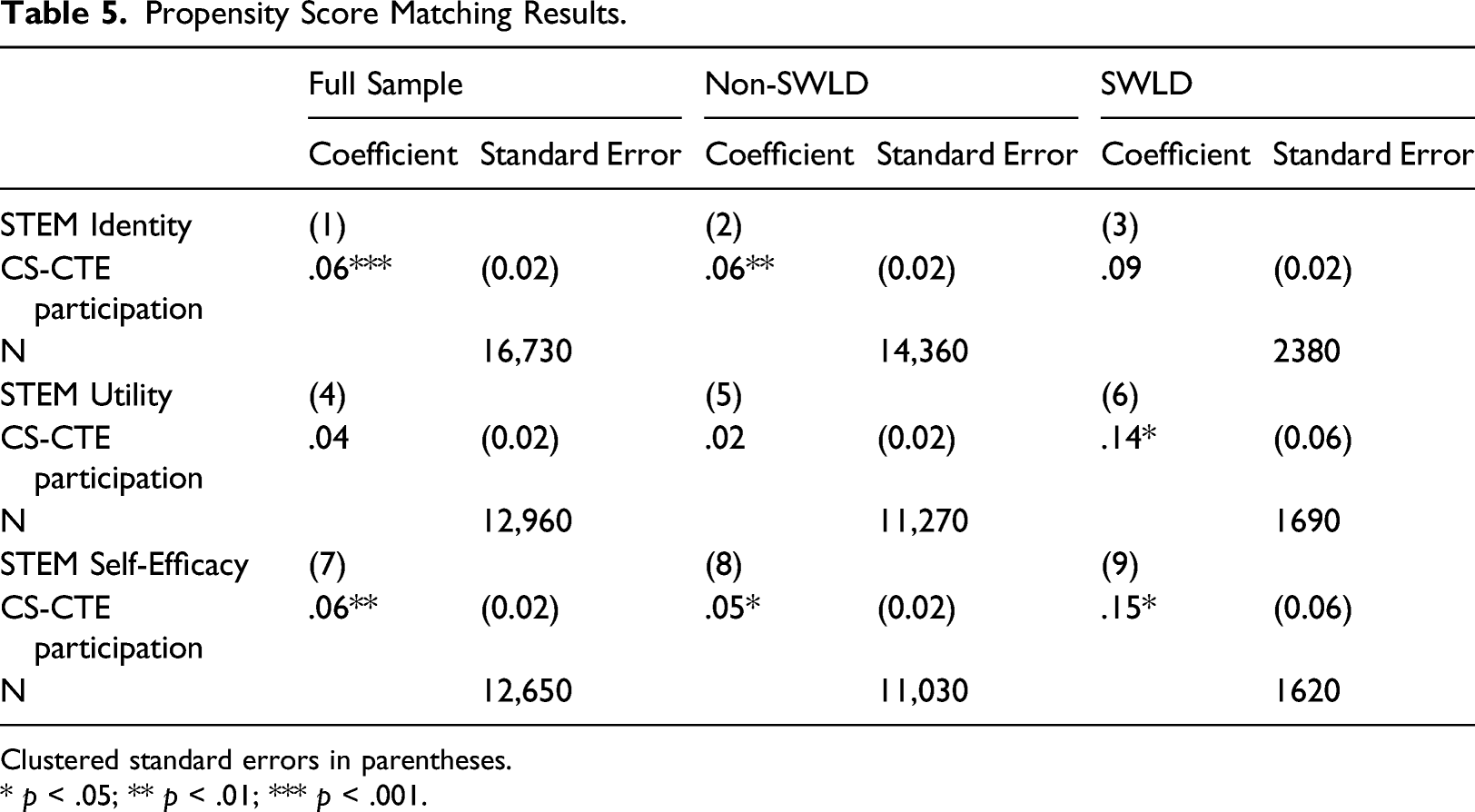
Propensity Score Matching Results.
Clustered standard errors in parentheses.
* p < .05; ** p < .01; *** p < .001.
For both the full population and the non-SWLD population, our PSM results were very similar to our baseline estimates. In the full population, we again found significant relationships between CS-CTE participation and by STEM identity (model 1: 0.06, p < .001) and STEM self-efficacy (model 7: 0.06, p < .001). Again, the non-SWLD results mirrored those of the full population with significant relationships between CS-CTE participation STEM identity (model 2: 0.06, p < .01) and STEM self-efficacy (model 8: 0.05, p < .05).
The results for our matched sample of SWLD students also had some similarities with our baseline models. As with our baseline model, we found evidence that participation in CS-CTE coursework was associated with increased attitudes of STEM utility (model 6: 0.14, p < .05). However, using our PSM technique, we also observed a significant relationship between CS-CTE participation and STEM self-efficacy (model 9: 0.15, p < .05) for our SWLD sample. Recall that this relationship was not significant in our baseline estimates. Despite this change in significance, it should be noted that our baseline estimates of STEM self-efficacy development for SWLDs were in the same direction and of similar magnitude. With a now significant result, we can assume that our matching technique is operating to improve precision, as we had hoped. Ultimately, the results of our PSM analyses across all three sample populations helps provide confidence that we are observing accurately estimated relationships between CS-CTE participation and our set of STEM attitudes.
Discussion
Understanding general participation patterns in CS-CTE, as well as potential attitudinal benefits of such participation, by students with and without learning disabilities is an important step in identifying means to improve the CS-CTE pipeline for high school students. Considering the call in the most recent authorization of the federal Perkins Act to increase participation in CTE by special populations (i.e., students with disabilities), with a specific focus on STEM-related career education, the results of our study provide some promising findings with respect to SWLDs. Our finding that SWLDs were not significantly less likely to participate in CS-CTE is worth highlighting in this regard. While SWLDs are less likely to be employed in CS-CTE fields later in life (Eriksson et al., 2007), it appears this gap is not due to underrepresentation in high school CS coursework. Or, it may be that current trends in high school CS-CTE participation differ from those in the past and may provide a more hopeful leading indicator of future employment in computer science related occupations.
In an effort to provide high school students with the opportunity to persist along the STEM pipeline, developing positive STEM-related attitudes may support this pursuit (Harackiewicz et al., 2016; Lazowski and Hulleman, 2016). Specific to the CS pipeline, STEM identity, STEM self-efficacy, and STEM utility each link to CS persistence and success (Milesi et al., 2017). For instance, across our analyses, we found positive associations with each of these attitudes through CS-CTE participation. Specifically, for the full population of students, CS-CTE participation predicted higher development of STEM identity and STEM self-efficacy, on average.
When focusing in on students with identified learning disabilities, it was evident that CS-CTE participation also influenced the development of these STEM attitudes, albeit differently. The non-SWLD student population paralleled the full sample in that CS-CTE participation positively linked to the development of STEM identity and STEM self-efficacy, likely because this set of students made up a vast majority of the full sample. Within the SWLD population, through our propensity score matching analyses, CS-CTE participation was associated with higher levels of STEM self-efficacy as well as improved attitudes related to STEM utility.
Based on these differences, it appears that there may be different mechanisms by which CS-CTE influences the development of STEM-related attitudes. For the non-SWLD group, participation in CS-CTE seems to help the students see themselves more as “STEM people.” This sense of belonging within the STEM community likely encourages these students to persist along the STEM/CS pipeline (Carlone and Johnson, 2007). Additionally, through participation in CS-CTE, non-SWLD students may be provided the opportunity to approach challenges and identify solutions to these challenges using STEM-related processes, thereby encouraging self-efficacy development. For the SWLD group, the process of developing STEM self-efficacy is likely similar, given our analogous estimates. However, this subset of students may view CS-CTE in high school in a more functional manner as manifest through attitudes of utility, as opposed to viewing CS-CTE participation as gaining membership into the STEM community.
There are a number of lingering questions that could be answered through further research. First, we are unable to determine students’ precise motivations for choosing to enroll in CS-CTE courses. Exploring potential differences as to why students with or without learning disabilities enroll in these classes would provide a great deal of insight as far as understanding further how CS-CTE may promote STEM attitude growth and STEM pathway persistence. Second, using the available data, we are unable to observe exactly what takes place in each course. Our analyses would be greatly complemented by additional qualitative work employing classroom observations in conjunction with student and teacher interviews would help to shed light on the mechanisms by which these courses relate to positive student outcomes. Finally, our work could also be complemented through an analysis exploring more closely the heterogeneity within the subpopulation of SWLDs. We may be smoothing over potential differences within this population given different ways in which learning disabilities present in different students. Unfortunately, our dataset did not allow for such a nuanced exploration.
Implications
The results of our study indicate that there is a positive relationship between CS-CTE participation in high school and the development of STEM-related attitudes. Further, our findings suggest three policy implications concerning persistence along the STEM/CS pipeline, with a particular emphasis on reducing the underrepresentation of SWLDs in CS fields. First, the CS participation gap between SWLD and non-SWLD individuals that exists in the labor market does not appear to be evident in high school CS-CTE courses. One possible explanation is that more non-SWLD students who do not participate in CS-CTE in high school are pursuing CS beyond high school. Therefore, it may be necessary to encourage SWLD students to persist in CS through increased participation in CS-CTE in high school. As such, while the Perkins Act does outline the need increase participation by students with disabilities, it may be necessary to explore further policy measures to make this a reality.
Second, CS-CTE appears to be beneficial with respect to the development of STEM self-efficacy for all student participants as well as STEM identity for a majority of students (i.e., non-SWLD). Considering the link between STEM self-efficacy and STEM achievement in addition to STEM identity and STEM persistence, a focus on these attitudes appears to be a useful undertaking. Numerous states have implemented policies addressing computer science standards, the inclusion of CS courses as graduation requirements, and requirements for all schools to offer CS courses. While these policies may not have been designed purposefully to address these key STEM attitudes, these policies appear to be well-guided in so doing.
Finally, STEM identity appears to be a key attitude as far as promoting persistence along the STEM pipeline as this is one area in which we observed key differences between SWLD and non-SWLD students. Therefore, understanding why STEM identity development differs for SWLDs and those not identified with LD should continue to be explored. As computer use becomes even more ubiquitous, attitudes may shift further. For instance, local school districts are implementing bring-your-own-device and one-to-one laptop policies for schools at all age levels. This continued expansion of high-intensity use of computers, tablets, and related skills may be one way to help SWLD students better view themselves as belonging to a wider “computer science community” and ultimately increase persistence in CS fields in the long run.
Despite this optimistic evidence of a link between STEM exposure and STEM attitudes, the current data on STEM attainment and employment continue to suggest that secondary schools have more work to do to address a leaky STEM pipeline for all students that is particularly prevalent in the CS field. Particularly given the gap in STEM employment between students with and without LDs, these CS-CTE courses may be particularly beneficial for encouraging SWLDs to persist and eventually succeed in STEM or STEM-related careers. Therefore, policies and investments that increase CS-CTE offerings at schools, embed these practices and skills across the curriculum, provide early and repeated exposure to STEM principles, and opening access to all students may be one way increase the potential of CS labor market supply. As districts and schools further innovate and respond to workforce demand, future research must capitalize on these innovations to learn what is most effective for improving STEM persistence and completion.
Footnotes
Declaration of conflicting interests
The author(s) declared no potential conflicts of interest with respect to the research, authorship, and/or publication of this article.
Funding
The author(s) disclosed receipt of the following financial support for the research, authorship, and/or publication of this article: Funding for this project was provided by the Institute of Education Sciences (award number: R324A200233).
