



Abstract
This empirical article problematises student engagement in today’s higher education system. The objective of this research is to stimulate a student’s behavioural, emotional and cognitive engagement. I employed an inclusive, inductive and reflexive approach and used mixed methods for collecting data from 948 volunteer participants. The preliminary findings illustrate that playing soft or lively music for a few minutes before a class as well as contextualising and delivering course content combined with enrolled students’ background, hobbies and preferences can go a long way in stimulating emotional and cognitive engagements. The findings also reveal that offering chair yoga during mid-term and/or final exam periods as well as encouraging students to hydrate can lead to increasing behavioural adjustments and then in attention and engagement. The results are encapsulated in a novel teaching framework, MAJA (meaning fun in Sanskrit) that stands for: (a) music, (b) anonymous class survey, (c) jest, and (d) aliment. The framework illuminates that when students tangibly sense a connection between a safe and comfortable class environment and course content, their participation increases and absenteeism decreases. They also promote student aspirations and accountability that facilitate critical thinking, an imperative learning outcome in higher education.
Keywords
Introduction
A like-minded social anthropologist recently remarked, ‘one of the problems with being an anthropologist is that our penchant for complexity and specificity tends to militate against programmatic political contributions’ (DuBois, 2020: 201). Her statement helps to articulate how I intend to problematise the culture of the neoliberal higher education system. Within that, I realise the world of teaching and learning can be a complicated space without even adding the Covid-19-related intricacies to the equation. The student issues I address include food insecurity, mental well-being and debt, each of which precedes the emergence of the recent pandemic. Essentially, as science and technology advances and universities function like profit-making businesses, arguably, the simple lives of well-intentioned, hardworking and amiable students as well as their committed instructors appear to have become more complicated. In particular, professors face an increasing level of bureaucratic demand that couple with an ever-increasing competition for grant writing, conducting quality research and publishing in high-impact journals. However, at the same time, the traditional demand for quality, interactive and engaging teaching and learning is of no less significance. This latter is the central focus of this article.
I argue the culture of higher education appears to immerse into a functionalism that facilitates students to spend more time on mobile gadgets or online rather than encouraging them to socially interact with classmates, co-learners and learning collaborators. That now being a ‘normalised’ and ‘mainstream’ classroom culture, when a professor walks into a learning space, regardless if the course is scheduled at eight in the morning or at two in the afternoon, it is common to find most students staring at the screens of their gadgets instead of making conversation with each other. Overall, in a neoliberal academy that is seduced by economic globalisation, a commitment to the pursuit of social justice appears to be at risk of being replaced by a scholarship or system that rewards the values of capital (Osei-Kofi et al., 2010). Within this gloom, the objective of this article is to offer an optimistic view in order to cheer up instructors and students. My investigation pursues two interrelated inquiries vis-à-vis classroom culture in neoliberal academy: (a) is it okay for a committed professor to find their students paying more attention to Facebook, Snapchat, Instagram and Reddit than to the class lecture? and (b) can we do anything to make our classroom more interactive with conversation and discussion?
Clifford Geertz and Antonio Gramsci are of interest to anthropologists and interdisciplinary scholars due to the fact that culture is at the centre of their concerns as well as their keen observation to the specific and nuances. I use their interpretations to contextualise several outcomes of neoliberal academy mentioned above. In particular, in Prison Notebooks, as anthropologist Kate Creehan explains, Gramsci problematises how common sense of people can be shaped, re-shaped and mobilised through an interconnected relationship ‘between the experience of inequality and the political narratives that emerge from it’ (Crehan, 2016: 59). Building upon Gramsci’s insight, I argue in the theoretical section that a neoliberal academy can produce subaltern students and such an outcome to undermine the ability of students to critique the neoliberal system in the long run.
Assuming that we will be going back to the classroom again someday, in the section that follows, based on experimenting within the centre of neoliberal academy that materialised before the wake of the Covid-19 catastrophe, I demonstrate the outcomes of pursuing students’ emotional, cognitive and behavioural engagement in a classroom. The findings illustrate how an interactive approach to classroom teaching and learning can help anthropologists and non-anthropologists, in particular inter-disciplinary scholars intellectually and philosophically wrestling with undergraduates, particularly first- and second-year students.
Theoretical influence
Critical scholars in higher education, including Dana‐Ain Davis (2011), Carlo Fanelli and James Meades (2011), and Carlos Alberto Torres (2011), argue public universities these days immerse into a corporate milieu, where maximising profits and enforcing austerity measures emerged as the new form of standard managerialism. Here, austerity measures can include downsizing the number of seasoned professors in favour of sessional instructors as well as omitting courses or programmes that are counter to the institution’s profit-driven business model (Rhoads and Rhoades, 2005; Olssen and Peters, 2005). Interestingly, Preston and Aslett (2014: 502) highlight that ‘concurrently, the autonomy and creativity of faculty are undermined by new managerial measurements of productivity and the promotion of standardised epistemologies over those considered transformative or critical.’ At the same time, in the words of Laura Servage (2009: 25), ‘an increased focus on viewing students as “entrepreneurial learners” rather than critical thinkers devalues their potential contributions to the greater public good and supports market commitments to benefit capital.’ In fact, Servage’s remarks help to tie my observation on the neoliberal academic culture to how Gramsci articulated the definition of subalterns.
As a Gramsci scholar, Crehan (2016) unpacks the complexity of the subaltern category and in doing so she challenges interpretations and representations made by scholars on the topic, including Gayatri Spivak, Edward Said and Edward Palmer Thompson. ‘Subaltern’, in Gramsci’s usage, is anyone that remains outside of the hegemonic block. This category can include women and individuals from working class, ethnic and regional minorities (Crehan, 2016; Gramsci, 2011 [1975]). Crehan explains the subjectivities of political subalterns vis-à-vis how people’s political views are constructed by forming their common senses: ‘comforting sense of certainties in which we feel at home, and that we absorb, often unconsciously, from the world we inhibit. These are the basic realities we use to explain the world’ (Crehan, 2020: 118). Building upon that, I argue undergraduate students in North American institutions, in particular in Canada and the United States, can also be added in this category as neoliberal subalterns. I base my remark on the fact that neoliberal academy employs an overabundance of technology to shape, re-shape and mobilise the academic common sense and subjectivities of these students.
I acknowledge that my arguments are neither against the overabundance of technology nor against smartphones and apps, nor do I believe in moving back to the past. Rather, I build upon an engaged and activist pedagogy as well as call for clarity and a certain degree of simplicity in teaching and learning. Since a neoliberalism based on ‘common sense’ underwrites our higher education industry and the subjectivities of its pupils, it is imperative to remain cognisant of the system’s boundaries within which they influence student subjectivities. For example, according to Henry Giroux, ‘central to the hegemony of neoliberal ideology is a particular view of education in which market-driven identities and values are both produced and legitimated’ (Giroux, 2004: 494). Similarly, other examples of this hegemonic project can include a preoccupation with market-related efficiency and outputs as well as consumerisation of students, e.g., expensive gadgets, consumption of processed food and over a trillion-dollar (and counting) student debt (UFCW Canada, 2020). Such a culture is driven by such market rationale, where the private sector frequently functions as a benchmarking beacon for the academy (Bay, 2011). As a result, universities subtly force academic departments, even social science, to increase efficiency and productivity, often at the cost of critical thinking (Olssen and Peters, 2005).
I confer with Nicole Moulding (2010) that such a model is counter‐productive in various disciplines, such as in social science, because it traditionally values a holistic, problem-posing pedagogy model of learning in order to unpack complex and inter-connected core and intricate issues of economic globalisation, world systems and post-colonisation. Moreover, the discipline also covers issues, among others, including gender equality, racial marginalisation and economic oppressions. Preston and Aslett (2014: 505) further add that a quintessential neoliberal classroom contains a large number of students that are taught by a faculty member with few or no resources, such as teaching assistants (TAs). In such a setting, faculty can not necessarily afford the time to critically engage with students in or outside the classroom. While faculty and students manage their own workload, an embedded impersonal setting can make students feel isolated, who in return may remain less likely to collaborate with each other. The outcomes may include an increase in competitive and individualistic behaviour as well as risk, restricting the required fear-free classroom that is necessary for critical engagement and perspectives, such as anti-oppressive practice.
The outcomes of a too-technology-driven, isolated learning space can lead to various issues. For example, according to Hamilton et al. (2020: 15), ‘females, students living on campus, those with a diversability (developmental, physical, or other disability), individuals self-reporting as belonging to a visible minority, and international students were more likely to experience food insecurity than comparator groups.’ The authors base their empirical study on a systematic review of 59 studies (Bruening et al., 2017) that conclusively highlights that university students suffer from higher rates of food insecurity compared with the general population. Moreover, Farahbakhsh et al. (2017) and Silva et al. (2017) add that students that live with food insecurity can also suffer from poor physical and emotional well-being and the outcomes can negatively impact academic performance.
These arguments, findings and debates bring us to the topic of student classroom engagement, which is one of the crucial indicators of their learning and development (Pike et al., 2012). Scholars, such as Fletcher (2005), define ‘classroom engagement’ as the time and energy that students devote on classroom activities from which they can learn. In addition, Christenson et al. (2012) define student engagement as: multidimensional, involving aspects of students’ emotion, behavior and cognition. The emotional engagement includes the student’s reaction to teachers, friends, academic task and etc. The behavior engagement refers to how students put in effort, persistence, concentration, attention, asking questions, and so on. And the cognitive engagement indicates how likely the student is to put in effort to solve difficult problems and to understand complex contexts. (Christenson et al., 2012: 3)
Several studies, including Bond (2003) and Martin (2000), acknowledge it is excruciating to achieve higher quality of classroom engagement. These scholars list several challenges that can impede efforts, such as lack of authenticity and failure to develop a stimulating learning environment in conjunction with a respective academic discipline and learning outcomes of a specific course. A study conducted by Christenson et al. (2012) sheds some light to overcome this obstacle. These scholars report that student engagement can be measured by the three factors: (a) emotional engagement, (b) behavioural engagement, and (c) cognitive engagement. They compare emotional events employees can have at a workplace with the emotion of students in a classroom. The authors argue that both occasions generate similar effects. In regard to behavioural engagement, these authors suggest that behavioural engagement signifies a result of physical and psychological energy investment, and therefore is considered to be a contributor in student engagement, which in turn leads to higher levels of learning outcomes. Finally, the link between cognitive engagement and learning could possibly go without stating. Classroom activities that increase cognitive engagement are accepted to result in increased learning outcomes. This most likely occurs when the students who invest cognitive energies in the classroom will achieve higher learning outcomes than the ones who invest less cognitive energy in class.
That said, below I share the methodology and findings employing the MAJA framework in classroom teaching as well as describe the substantive and pedagogical details of how students responded to it.
Methodology
In this section I discuss the empirical observational changes that I witnessed and experienced with each iteration of various anthropology and sociology courses I taught over the years. Using an inductive approach, I consider what pedagogical practices might have been influential in stimulating emotional, behavioural and cognitive engagement among students that can eventually enhance critical thinking through classroom engagements. I began teaching a respective course in its first iteration, and reflected on the feedback, energy points as well as reproduced the verbal and non-verbal shifts in student behaviour and their classroom engagement in redesigning the courses. Following this, I further reflected on why those shifts occurred and wondered what substantive and pedagogical alterations can be employed to make the course more engaging and interesting for students. A limitation of this approach is that I was not able to definitively demonstrate that these course changes caused the shifts that I consequently observed. Regardless, employing an inductive and reflective approach was appropriate to generate discussions about teaching and learning in social science, in particular anthropology.
At the same time, other methodological approaches informed my choice of methods for data collection, with pragmatism providing the philosophical foundation. I employed pragmatism research for learning because there are many various ways to learn about the world and to undertake educational research (Author). Moreover, as Saunders et al. (2012: 3) put it, ‘no single point of view can ever give the entire picture and that there may be multiple realities.’ Pragmatism integrates multiple research approaches within the same study, including mixed methods approaches that combine qualitative and quantitative data collection (Collis and Hussey, 2014; Morgan 2014; Dewey, 2008[1920], 2008[1925]). Building upon that and inspired by Crehan’s (2016) insight on the importance of history, I chose pragmatism for the philosophical foundation of my methodology. In particular, I found that the subjective personal lives of my students were positively co-related to their learning experiences. The outcomes directly impacted their mental well-being and ability to reach their academic objectives.
My data collection took place long before the realities of Covid-19. From January 2014 until May 2020, I spoke to approximately 800 student volunteers, who were between 18 and 60 years of age. These students represented various departments, including Anthropology, Critical and Creative Studies, History, Indigenous Studies, Kinesiology, Philosophy, Political Science, Psychology and Sociology. In order to better understand ways to increase student interaction and engagement in a classroom setting, I designed an observational study based on quantitative and qualitative methods. Since this research was undertaken with an aim to improve my own teaching in the classroom, I did not have to receive an ethics approval. However, I made certain that every observation and data collection was guided by ethical checklists that are underpinned by data protection policies, to ensure the security and dignity of students who voluntarily participated in this research. For quantitative data collection, I relied on a basic, structured and optional demographic survey that usually took a few minutes to fill in (Table 1).
Demographic survey.
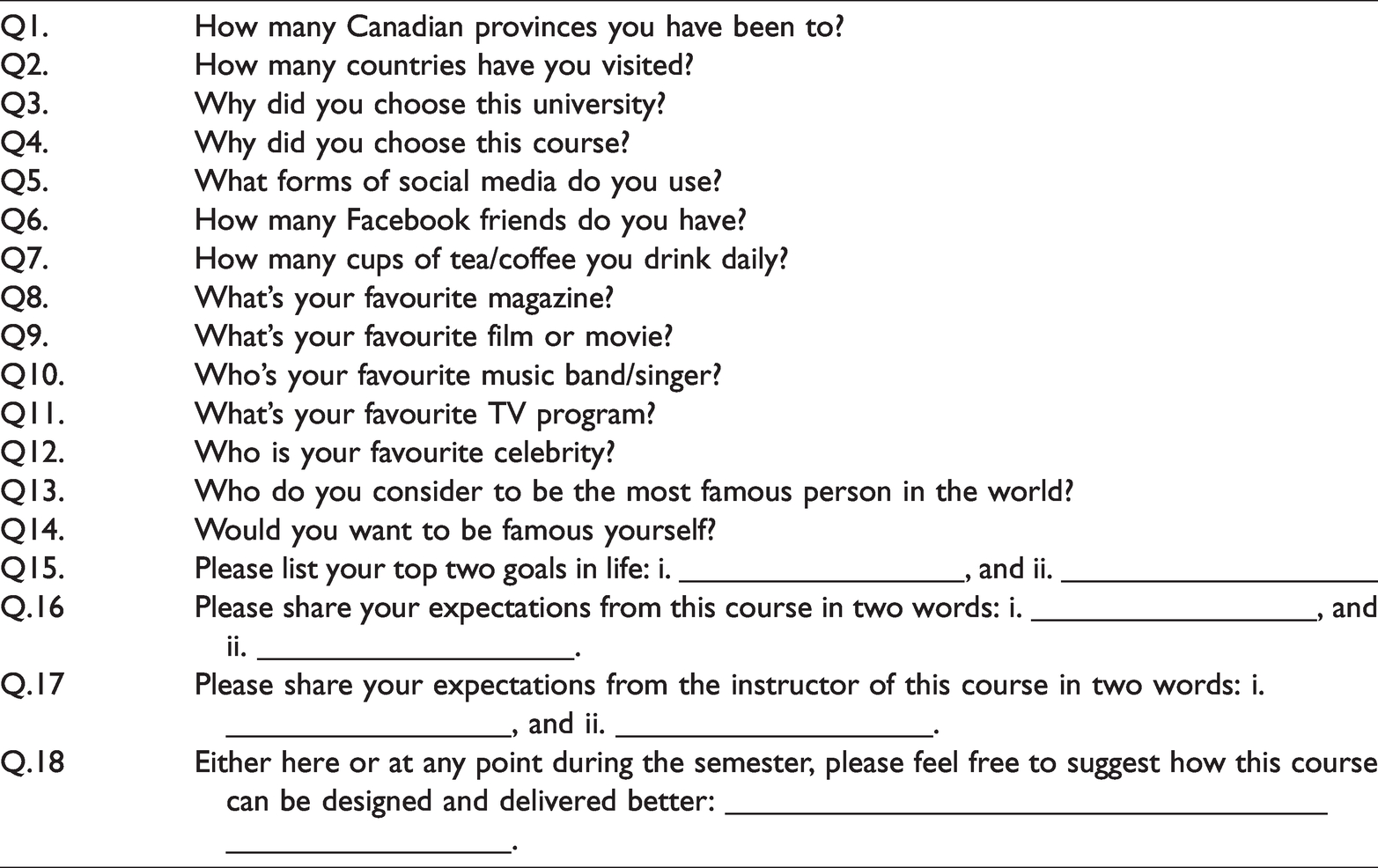
I handed out the survey questionnaires on the first day of class inquiring about students’ preferences, including their favourite celebrity, music band/singer, and TV programmes, as well as requesting information on reading and food consumption practices. I analysed the collected data on an Excel spreadsheet and used my findings to prepare lecture notes, slides and talking points, being especially mindful to explain critical theory. At the same time, frequently speaking to students about their courses and preferences helped me to better understand issues that prevail in classrooms and identify where issues can be improved or resolved.
In order to collect qualitative data, I arranged student feedback sessions during office hours when students dropped by individually or in small groups as they preferred. These optional interviews were semi-structured, non-directive and open-ended – student experiences and expectations on the taught course as well as new ideas to make the class a more engaging, better learning environment. I found using semi-structured interviews appropriate for qualitative data collection because this method allowed all parties involved to have a script to conduct questions as well as to keep the conversation with participants on topic while freely explaining and elaborating narratives based on subjective experiences and perspectives as covered in the classroom (Bryman, 2008; Fife. 2005: 94–96). As the informal discussions progressed, I asked shorter questions and listened more than I spoke because it was important to listen to the students’ narratives and gather as much information as possible without interruption (Robson, 2011: 282).
During the qualitative data collection sessions that took place during office hours, as our conversations progressed, students generally expressed their curiosity about other cultures and various aspects of professional life (e.g., work–life balance). Typically, they inquired about preparing for ‘real life’. During qualitative data collection, I also reached out to seasoned academics and consulted experts at the Teaching and Learning Centre on campus. Being able to learn from various teaching styles, methods and measures helped to effectively cater class content to the student audiences in respective classes. I collected additional qualitative data exploring observed effect through informal class observation and frequently reaching out to students for teaching feedback. During my teaching, I relied on a reverse banking model of pedagogy, encouraging students not to memorise content and other information, such as dates and often names that were deemed insignificant to the learning outcomes for a specific course. Rather, I encouraged students to use simple, familiar words to explain theoretical content and other text-based narratives so that they are able to retain the information that mattered.
Building upon the methods discussed above, I present the MAJA (fun in Sanskrit) approach or framework to teaching. It stands for: (a) music, (b) anonymous class survey, (c) jest, and (d) aliment. The following section elucidates this teaching framework.
MAJA teaching framework
Music
I played a new, usually soft song at the beginning of every class. Each of these songs usually represented various countries or cultures. In most cases, these songs were sung by singers listed as favourite on the anonymous survey filled in by the enrolled students in the course. I never played the same music twice and observed that playing music provided an instrumental, intangible catalyst in stimulating emotional engagement that resulted in class discussions and engagements. For example, I began the introductory courses in anthropology and sociology with entertaining, melodious Bollywood movie songs that were shot in the United Kingdom or somewhere in Europe and North America with distinguishable landmarks or features as backdrops. For example, the song, ‘Tenu Leke’ from the movie Salaam-E-Ishq, starring Prianka Chopra and Salman Khan, was emblematic to illuminate how the world moved on from colonial periods. Moreover, visual illustrations such as white supporting dancers wearing Indian outfits and dancing behind the lead, brown-skinned actors provided optics to recognise new shifts in race and economic relations. In addition, analysing the presence of the Polish and Russian background dancers revealed that the new changes continue to exploit cheaper labour. These examples stimulated and increased cognitive engagements, which was reflected tangibly in the critical essays the students submitted as part of their assignments.
I also observed that randomly playing a song by a singer listed as the favourite on the anonymous survey positively surprised and consequently inspired students to be present, active and engaged. For example, the beamed up faces usually revealed the student that originally listed the singer as his or her favourite. I felt such a gesture provided the student with a feeling of belonging in the classroom. Overall, I interpreted these examples as tangible expressions of enriched emotional engagement.
Anonymous class survey
The findings from the anonymous class survey significantly helped as ice breakers and in drawing student attention at the outset of a class discussion. For example, in my Globalisation and Poverty course, which was a fourth-year course in anthropology, approximately 50 per cent of students mentioned Beyoncé as their favourite celebrity. I designed class discussions and presentation slides on socio-economic inequality encompassing facts: Beyoncé and her partner Jay-Z are worth USD400 million and counting. Such an example facilitated discussions on trickle-down wealth as well as the limitations of neoliberal, free-market policies. Moreover, over 40 per cent of students in the Ethnography of Development course listed Nikki Minaj as their favourite singer. Learning that, I Googled the singer’s name and discovered that her birth name was Nikita Maharaj. Such a discovery helped to design discussion pointers on identity and belongingness in the globalising world as well as cultural frictions caused by the undesired outcomes of globalisation. The transfer of this information generated a positive, engaging, and interactive class environment. This also made class time go by fast, especially for those who had arrived with a bias towards anthropology. The anonymous class survey also gave me an opportunity to make room for innovative initiatives to energise students. Offering chair yoga was one such initiative.
During the mid-term, when stress levels begin to peak, I invited student yoga instructors to offer a ten-minute chair yoga session to breathe and relax. Such instructors were senior undergraduate students, who volunteered their time and leveraged such sessions to share information about their practice with the students. In courses on globalisation and migration, we discussed the origins of yoga to learn about rich civilisations, including India and China, and the West’s value addition to yoga – Lululemon Athletica. These findings were instrumental in contextualising the importance of learning history only to appreciate our present and the present.
Jest
With an aim to increase the quality of writing among students vis-à-vis grammar, spelling and articulation, the instructor offered an incentive – a book prize for the best essay. The instructor utilised parts of his professional development fund allowance to initially fund this incentive project and picked Scotiabank Giller prize winner books for the best paper in a class. The winner of each competition along with the short-listed authors were recognised in the class. With written permission obtained from each of these students, the instructor uploaded their essays on the course site so that the rest of the enrolled students could take a look at the essays as they pleased.
Based on a random, quick class survey, I came of learn that approximately more than two-thirds of students responded positively to such a jovial incentive that essentially made them try harder to write with clarity. I provided essay questions and the grading rubric with each of the writing assignments. Having transparency with questions and grading further motivated the students. Many students stated that a book award incentive was a great resume-building opportunity. I later discovered that each of the book awardees and short-listed ones included their achievements on their respective CVs. I interpreted these expressions as signs of enhanced behavioural engagement.
Aliment
Coffee vs food, snacks and hydration
Among my courses that started either at 8 am or 12:30 pm, based on show of hands I learned that most of the students usually attended without having breakfast or lunch. Many such students perhaps interpreted gulping coffee as a ‘meal’ and to stay awake. Once the author offered fruit bars from his personal snack supply at the beginning of a class for a week, and observed that students became engaging as a result. Interestingly, the preliminary observations revealed that while nutrition among infants is important, young adults also need to remain conscious about daily intake of nutrition. Overall, these findings are in sync with the evidence collected by other scholars that food insecurity is an emerging problem among postsecondary students (Hamilton et al., 2020: 16).
Based on the students’ appreciation, the following morning, I wrote a thank you note to a local fruit bar manufacturer and requested donations. The company replied the same day and pledged 400 boxes of fruit bars as a one-time donation. As a recognition for its support, the company asked that students provide feedback on social media. The class acknowledged having a healthy snack readily available in class increased the need for hydration, which consequently decreased the need for consuming coffee during the lecture period. I interpreted these examples as signs of enhanced behavioural engagement.
Outcomes
My investigation contained two inter-related questions: (a) is it okay for a committed professor to find their students paying more attention to Facebook, Snapchat, Instagram and Reddit than to the class lecture? and (b) can a professor do anything to make a classroom more interactive with conversation and discussion?
In retrospect, I acknowledge the former inquiry was more like a subjective inquiry. I state that because while I am somewhat bothered by such constructed isolation with technology, other professors may well interpret their classroom environment differently. However, in regard to the second inquiry, I am of the opinion that a professor can do many things to make a classroom more interactive with conversations and discussions, and in this article I shared some of that. Overall, employing the MAJA teaching framework, I enjoyed high attendance and almost zero absenteeism in my courses. Moreover, I observed that students frequently engaged with the material and the assignments, and there were plenty of class debates and discussions amongst students. I also felt that having a solid connection between course content, pedagogical approach and a passionate commitment to teaching produced a significant amount of critical analysis of social structures and systems. Moreover, I witnessed greater engagement by students from marginalised social backgrounds. Over two-thirds of students provided anecdotes from personal endeavours within community and family members as well as expressed willingness to alter personal behaviour through consuming materials that mattered deeply and directly. Such inclusive learning methods facilitated student performance in my classes much better than their usual grade point average (GPA) may have indicated.
Limitations
This article shared the outcomes of the innovative MAJA framework in a regular classroom and acknowledges employing this framework in the online form of teaching remains to be tested. I also acknowledge conducting my observations mainly with students in social science. I remain confident that with careful consideration and preparation, the MAJA framework can be replicated in other faculties across campus. However, employing this teaching framework appears to be conducive for classrooms with 40 students or fewer. Piloting or replicating this framework in larger lecture halls and/or science laboratories can be limiting and challenging. Finally, I acknowledge the exercises shared in this article in no way can be used as substitutes for teaching excellence.
Conclusion
In this article, I illustrated the MAJA framework for an interactive and engaging classroom teaching and learning experience that can enhance students’ emotional, cognitive and behavioural engagement in a classroom. I do so to start a conversation, and instigate discussion to generate meaningful classroom interactions and learning. I intend to evolve this framework further in future. That shared, I believe this framework can help any instructor to master unfamiliar pedagogical teaching tools as well as potentially reinvent the delivery of teaching.
Finally, I believe encouraging a social change begins in the classroom and, arguably, professors are the frontline soldiers to materialise that change. However, when the pandemic is over, the universities within neoliberal academy may not start to collaborate with other universities or community groups to resolve key societal challenges, such as health and income inequalities, poverty, and unemployment. More likely, these institutions will continue to look at student numbers in relation to their credibility and revenue. However, these institutions will always need excellent educators, whether the teaching format is online or offline. Therefore, a professor that complements a healthy and happy learning experience and critical thinking will be in demand. Making a conscious effort to learn about the students in classrooms can start that demand and the outcomes can thus go a long way in empowering today’s subaltern undergraduates.
Footnotes
Declaration of conflicting interests
The author(s) declared no potential conflicts of interest with respect to the research, authorship, and/or publication of this article.
Funding
The author(s) received no financial support for the research, authorship, and/or publication of this article.
