



Abstract
Over the past seven years, we have offered a psychology book club to undergraduate and graduate students in our department. We suggest the book club provides an informal opportunity for student-to-student and student-to-faculty interaction, and offers a way to engage students in critical thinking about popular psychological issues. In this article, we describe the book club, provide names of books read and sample discussion questions, and offer data on the book club's effectiveness. Our data suggest that students read and enjoyed the books, and that they had a positive experience in the book club. We offer additional considerations and suggestions for those interested in offering such an opportunity to their students.
Introduction
Writing for the Huffington Post, freelance writer Delia Lloyd (2010) suggested five reasons for joining a book club:
You meet interesting people; You read things that you wouldn't otherwise read; Some books need to be discussed; You eat good food; Sometimes it's just fun to chat.
Although we agree with Lloyd's praise of book clubs, we would add that a psychology book club involving undergraduate students, graduate students, and instructors offers additional advantages. In this article we present a rationale for developing a psychology book club, student response data from our book club, and some practical suggestions for how to implement and run a psychology book club.
The aims of our psychology book club are consistent with some of the goals of the current APA Guidelines for the Undergraduate Major (APA, 2013). Given the potential range of books discussed and the open dialogue characteristic of book club meetings, a psychology book club clearly targets goals 1—Knowledge base in psychology, and 2—Scientific inquiry and critical thinking. In our view, the primary benefits of a psychology book club include increasing students' exposure to and reading of psychological literature, engaging critical reading and thinking skills, providing an atmosphere for intellectual curiosity and civil debate, and fostering relationships with professors and fellow students.
Barber points out that “psychology graduates are much more likely to become research users than research producers” (Barber, 2002, p. 95). Long after they complete their psychology curricula, graduate, and leave behind the halls of academia, our students will continue to be consumers of information. Not surprisingly, the professoriate has consistently emphasized the central importance of building and nurturing students' critical thinking skills (Greene & Yu, 2016; Halonen & Gray, 2001; Halpern, 1999, 2010; Landrum & McCarthy, 2015). Specifically stressing the essential role of psychological literacy in educating psychology students, McGovern et al. assert that “a well-defined vocabulary and basic knowledge of the critical subject matter of psychology, being competent in … evaluating information …, communicating effectively in different modes and with many different audiences” (McGovern et al., 2010, p. 11) are all integral to this literacy. Dunn recommends that, “To best use the knowledge base of psychology, students need to learn skills based in scientific inquiry and critical thinking” (Dunn, 2015, p. 884). Additionally, one of Dunn's recommendations is for faculty to “Create formal and informal learning opportunities that promote the acquisition of various communication and presentation skills” (Dunn, 2015, p. 884). A psychology book club is one tool for fostering critical thinking skills and providing an informal atmosphere for informed discussion about psychology and research.
Students are often encouraged to participate in activities that occur outside the classroom; involvement in these extracurricular activities can benefit psychology students in a number of ways (Kuther & Morgan, 2013; Landrum & Davis, 2003; O'Hara, 2005; Silvia, Delaney, & Marcovitch, 2009). Stoloff, Curtis, Rodgers, Brewster and McCarthy (2012) examined what attributes of undergraduate psychology programs were related to student success as well as student satisfaction with their program. The frequency of student–faculty interactions was a significant, positive predictor of both the number of students pursuing graduate education and students' satisfaction with the program. For example, Pascarelli and Terenzini (2005) indicate that interactions with faculty outside the classroom are associated with increased persistence, educational goals, and degree completion among students.
We began our psychology book club in the 2010 Fall semester primarily as an additional tool for engaging students' critical thinking skills and a venue for interacting with faculty outside of the classroom.
The Book Club
Each semester we, as the faculty advisors for the club, select a trade book written by a psychological scientist. We target books that discuss research findings or make reference to research to substantiate the book's claims. All undergraduate and graduate students enrolled in psychology courses are invited to participate in the semester's book club via a departmental listserv announcement as well as in-class announcements. Free copies of the book are typically made available to students who join early. During the semester we send participating students occasional emails with “thought questions” about the book. Our intention with these questions is to encourage students to critically examine an author's arguments and evidence. For example, while reading Lyubomirsky's The How of Happiness (2008), we asked students: One interpretation of this book could be that everyone can increase his/her happiness; they just need to find the right strategy for doing so. Do you believe this to be true? Why or why not? The anecdotes presented in this book may scare you. Which of the anecdotes presented here do you find most persuasive (regarding the ways in which we fail to detect the unexpected)? Are there any that you believe lack merit, or that can be explained in other ways? What do you think of the author's use of “The Imaginary Feminist” in making his arguments? What is your reaction to the author's claim that he is “arguing not with actual feminists, but with feminists as they are perceived by men” (p. 10)? Baumeister refers to research indicating that fewer women than men pursue science careers and that this gender difference is largely due to differences in motivation not ability. What do you think of this claim? Are there possible alternative interpretations of these data? Are you convinced that animal research yields results that are vital to our understanding of human behavior and mental processes? Why or why not? The data collection methods used for work of this type are unobtrusive. Gosling also calls them “behavioral residue.” What do you think the benefits of using this type of data are for studying personality? Do you have any concerns about these methods? Do you think they're more or less accurate measures of personality than traditional surveys? Book selections to date, focus of the book and book club discussion.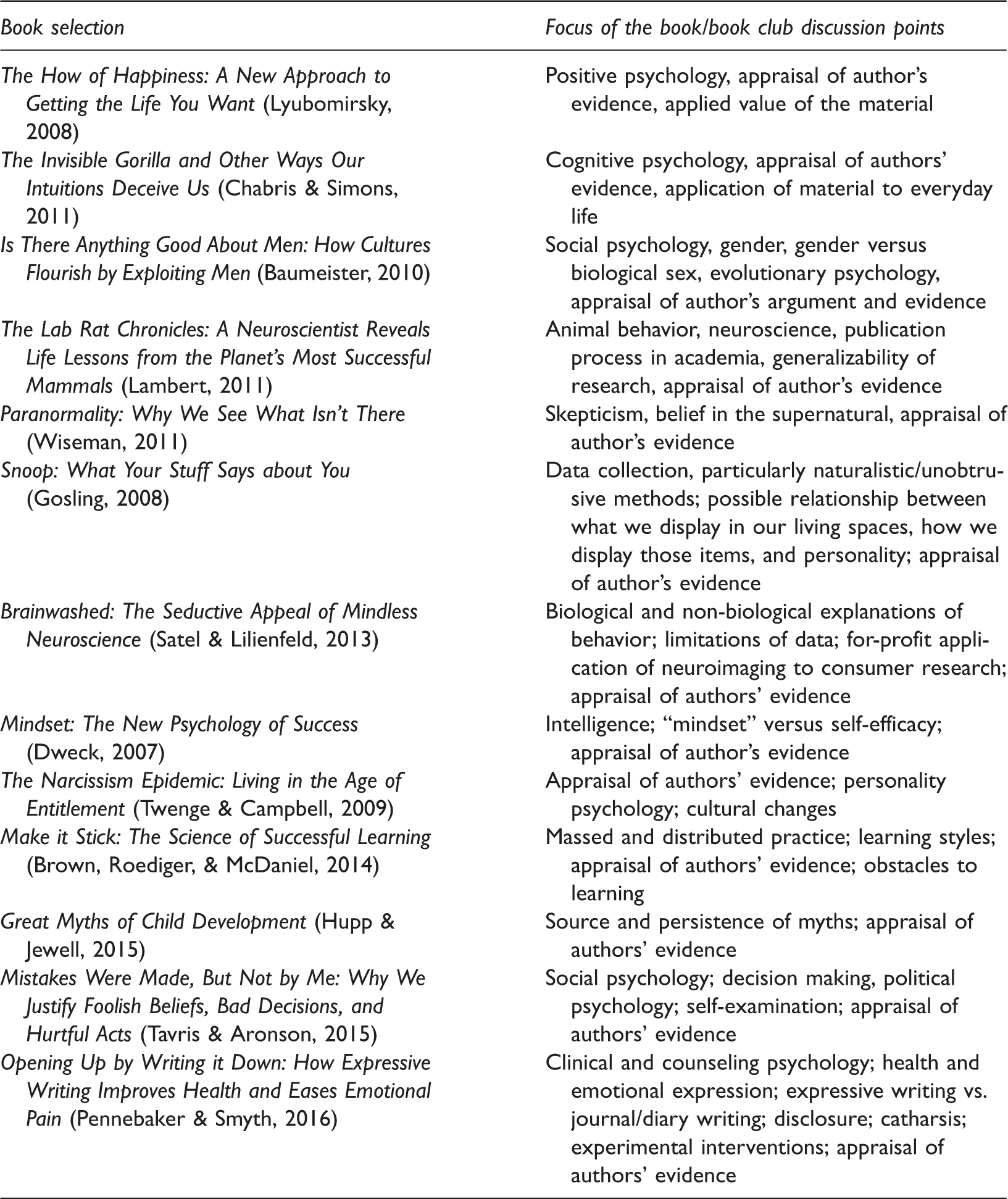
Method
Participants
Across 13 semesters, 271 students signed up for the book club. All students who signed up for the book club each semester, including those who did not attend the book club meeting, received an email invitation with a link to an anonymous online survey following the book club meeting. Respondents to the book club surveys across 13 semesters were 122 students (85.2% psychology majors; 86.1% female) at a medium-sized, public, Midwestern university. The majority of survey respondents (73%) had attended the book club meeting for the semester they signed up for book club. Respondents were primarily juniors (35.2%), seniors (41.8%), and graduate students (12.3%). Age of respondents ranged from 19 to 57 years with a mean of 25.59 (SD = 8.49) years. Survey respondents' grade point average (GPA) ranged from 2.1 to 4.0 with a mean of 3.47 (SD = .45).
Survey Materials
The brief survey begins with Informed Consent and includes demographic questions (e.g., age, gender, year in school), and questions about participants' reading activities, including how much of the book they read (i.e., 25%, 50%, 75%, 100%), how closely they read the book (i.e., not completely or carefully, partially but carefully, completely but not carefully, completely and carefully), as well as five-point (1 = Strongly disagree… 5 = Strongly agree) Likert-scale ratings of the book (i.e., Enhanced my learning of psychology, Enhanced my appreciation for the science of psychology, Made me think critically about scientific research, Enjoyed reading). Participants also rated their experience in the book club using a five-point (1 = Strongly disagree… 5 = Strongly agree) Likert scale (i.e., I enjoyed the meeting, I am glad I participated in book club, I will definitely participate in book club again). Lastly, the survey provided space for participants to comment freely on their experience in the book club and provide book recommendations. Because students could participate in book club for as many semesters as they wished, some may have completed the online survey more than once. The survey was approved by the university's Institutional Review Board.
Results and Discussion
The majority of respondents in our book club reported reading 75% (29.5%), or 100% (43.4%) of the selected book, with the majority of respondents also reporting that they read carefully (73.7%). Psychology students may spend relatively little time reading their textbooks (e.g., Clump, Bauer, & Bradley, 2004) and tend not to give that reading the requisite attention (see Gurung & Martin, 2011). Discussions in our book club meetings, as well as self-report data we have collected from book club participants each semester, not only suggest that participants are reading all or most of the selected books, but also that they are reading carefully. Obviously reading a mass-market book cannot replace the content or the learning that takes place from reading textbooks and journal articles. However, both the thoughtful selection of books and the subsequent book club discussions should increase students' exposure to psychological content.
Survey respondents' ratings of each book.
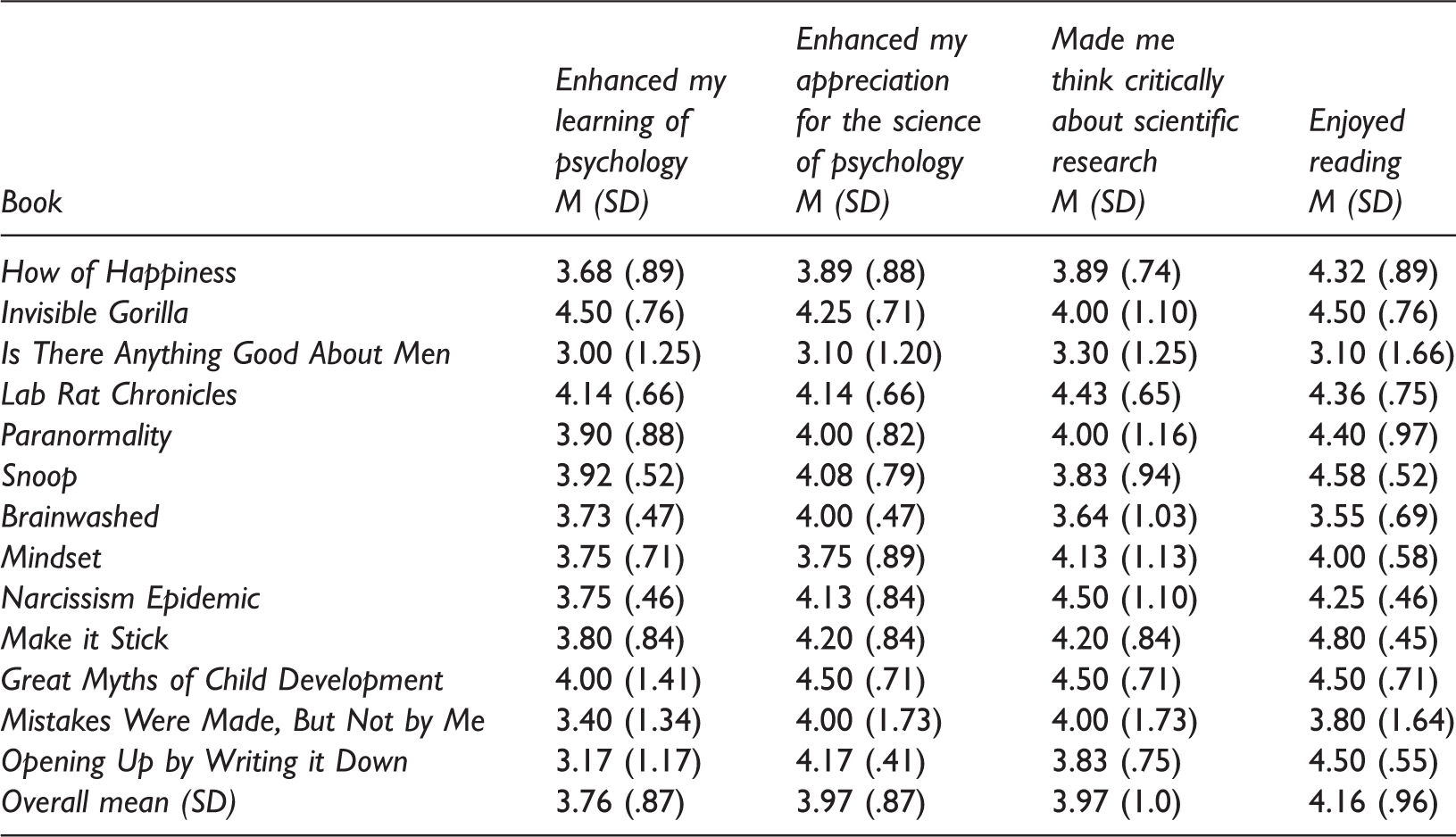
Note. Items rated on a Likert scale ranging from 1 (Strongly disagree) to 5 (Strongly agree). The number of survey respondents each semester ranged from 2 to 19 with a mean of 9.
There were small correlations between students' GPA and the degree to which students thought the selected book enhanced their appreciation for the science of psychology (r = .24, p < .05) as well as the degree to which they felt the book made them think critically about scientific research (r = .24, p < .05). There were no correlations between GPA and enjoyment of the book or the book club experience. Although there is a wide range of GPAs among our book club survey respondents (i.e., 2.1 to 4.0), the mean GPA was 3.47. One possible modification to our current book club model is to consider ways to make the book club attractive to students who are not performing as strongly academically. Whether this might be achieved through more targeted marketing of the book club, a different selection of books, and/or a different format for the book club meetings is an open question. Ideally, however, the book club would serve as a means to engage and bolster these students' confidence in their critical thinking skills.
Sampling of survey respondents' qualitative feedback about their book club experience.*
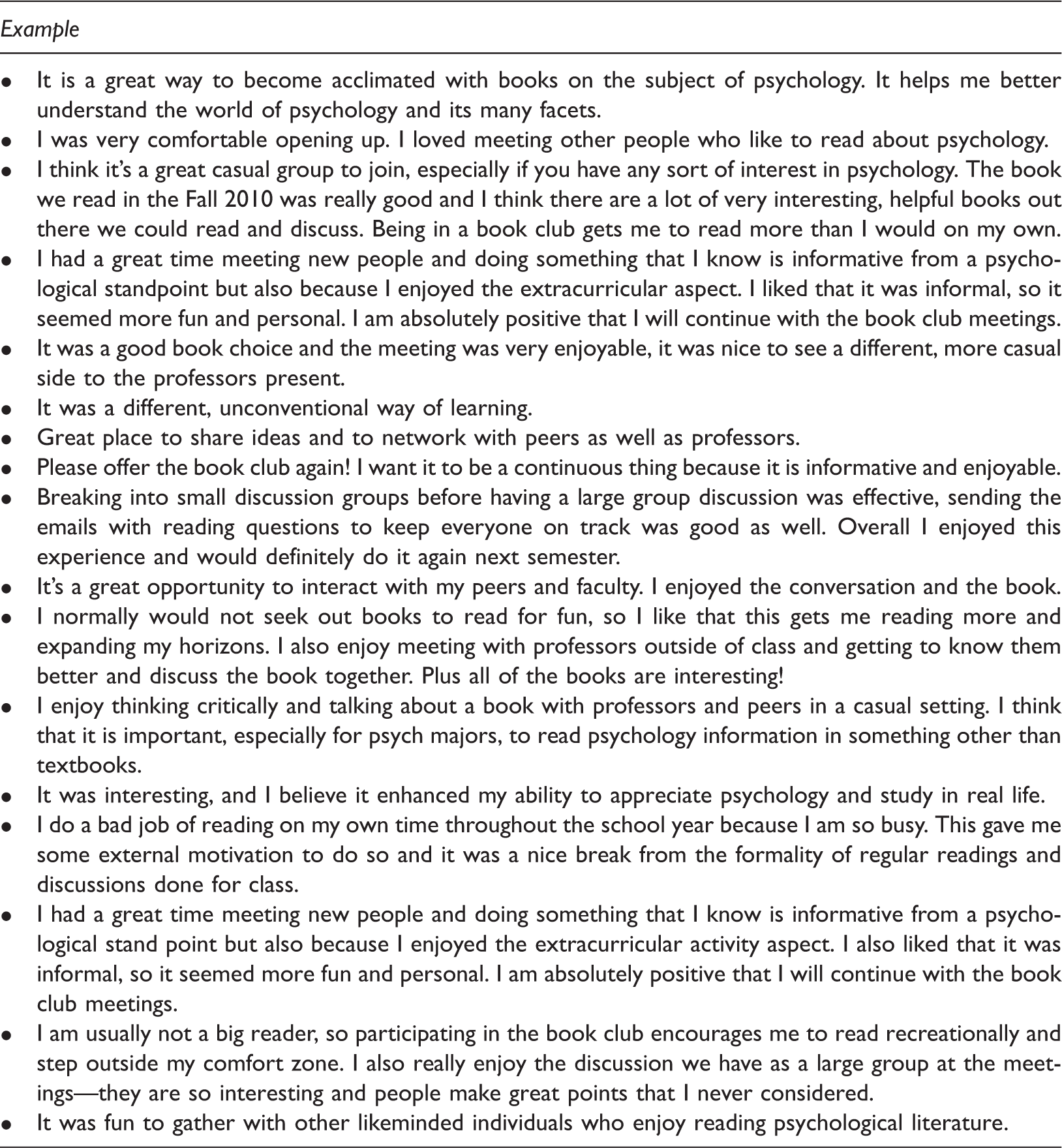
Comments that represented frequent themes in the feedback from respondents were selected for inclusion in this table.
There are a couple of key limitations to the data we present here. First, our survey data rely on self-report, and thus we have no objective evidence that students read carefully or that participation enhanced their appreciation of psychological science and caused them to think critically. Objective assessments would determine whether these assertions were accurate. Secondly, individual book ratings should be interpreted with caution given the small sample sizes.
The book club model we present in this article represents one of many forms that a psychology book club can take. Although our book choices are limited to books authored by psychologists, another option is to expand potential book choices by considering psychology-related books that are not necessarily written by psychologists (e.g., The Man Who Mistook His Wife for a Hat, Sachs, 1998). Similarly, other alternatives include choosing books that are especially primed to encourage critical thinking and/or allude to the scientific method (e.g., Outliers, Gladwell, 2008, Freakonomics, Levitt & Dubner, 2009, The Ghost Map, Johnson, 2007) or selecting “classic” psychology books authored by renowned psychologists (e.g., Beyond Freedom and Dignity, Skinner, 1971).
Although we stress the value of student–student and student–faculty interactions inherent in a book club it is important to note that our model currently involves only one face-to-face meeting per semester to discuss the book (near the end of the semester). We did this in order to accommodate a variety of reading paces and to keep book club as a relatively low-level commitment. However, in the interest of increasing interactions another option would be to meet more than once (e.g., halfway through the semester and at the end of the semester). In fact, a few students have suggested this. Another possible modification is to develop a psychology book club website, Blackboard shell (Blackboard Inc., Washington, DC, United States), or wiki on which students and faculty could post comments about the current book selection. Such a resource could also include a feature such as, “What your professors are reading…”
Consistent and overwhelmingly positive response we have received from students about the book club support the benefits we emphasized at the outset of this article. Our data and experience through 13 semesters of coordinating a psychology book club suggest that a psychology book club can engage students' critical thinking skills, facilitate meaningful discussions, and foster a sense of connectedness by providing an informal milieu in which students interact with other students and faculty outside of the classroom.
Footnotes
Declaration of Conflicting Interests
The author(s) declared no potential conflicts of interest with respect to the research, authorship, and/or publication of this article.
Funding
The author(s) received no financial support for the research, authorship, and/or publication of this article.