



Abstract
Educational leaders and policymakers are reconsidering the role of competency-based education (CBE) to meet the needs of all students, address issues of equity and enduring achievement gaps, and demonstrate college and career readiness outcomes for PK-12 students. This study sought to understand the policy conditions where CBE policies were adopted in two neighboring states as well as describe the two states’ implementation plans for policy diffusion. The study used a comparative case study design to study Idaho and Utah due to their geographic proximity, socioeconomic status, and state legislative structures. We argue that although the policies in both states have many similarities and were passed under similar political conditions within each state’s policy arena, the planned implementation and diffusion of those policies was very different and influenced a divergent population of local education agencies (LEA) in each state. We also explore the role intermediary organizations played in the development and diffusion of policy in both states.
Introduction
Under the U.S. federal policy Every Student Succeeds Act (ESSA) plan, states appear to have more flexibility in decision-making to determine how to best serve students. In conjunction with and as part of ESSA, many states have enacted state laws, policies, or regulations to encourage districts to innovate and/or move to a more student-centered instructional system. Personalized, competency, and mastery-based education are all terms used across the globe to define and explain changes happening in classrooms, schools, and districts striving to improve the traditional educational system. Systems leaders (both in policy and practice) are reconsidering the role of competency-based education (CBE) as a structure flexible enough to meet the needs of all students, address issues of equity and enduring achievement gaps, and demonstrate college- and career-readiness outcomes for PK-12 students.
Although the concept of CBE has been around for quite some time and can be traced back to Comenius (Bloom, 1976), today’s applications typically stem from the work of Benjamin Bloom. His research recognized that students vary widely in their learning rates, and that many students will learn well when provided with enough time and the appropriate learning conditions (Guskey, 2001; Bloom, 1988, 1977). Current interest in CBE continues to ask for the re-examination of the notion that learning happens at a specific pace and place for all students (Dewey, 1938; Brown, 1994; Le et al., 2014). Most states have passed policies encouraging CBE, or at least allowing flexibility and moving away from the Carnegie unit and seat time requirements for earning credit or advancement to the next grade level (Ryan and Cox, 2017). However, there is a great deal of research (Hess, 2013; Gurría, 2015) suggesting that there is a difference between passing a policy and having it become a daily practice for school systems—therefore, policy implementation is crucial to understand and investigate.
The theory of change central to CBE reforms is the notion that more students will reach proficiency in a given subject if they are able to advance at their own pace and if the learning experiences are tailored to their interests and needs (Lewis et al., 2014; Sturgis and Patrick, 2010; Ryan and Cox, 2017; U.S. Department of Education, 2011; Alliance for Excellent Education, 2012). However, there is a gap in current research related to the relationship between CBE policies and educational equity. Is it in how the policies get implemented? Is it in the policies themselves? There are few examples in the literature of states, districts, or schools that have made progress in showing how CBE state policy is related to more equitable student outcomes. In addition, previous research has identified there is a “dearth” of research on how CBE is being implemented as state-level policy and more information is needed on what implementation processes and policy components are used in CBE (Ryan and Cox, 2017; Scheopner Torres et al., 2018). Furthermore, there is a gap in the literature related to how CBE state policies are defined, diffused, and how policy components may relate to improved district, school, teacher, or student outcomes. In response to this gap in the literature, the purpose of this study was to understand the policy conditions and context where CBE policies were adopted in two neighboring states and describe the two states’ implementation plans for policy diffusion. Specifically, we wanted to explore state policies regarding CBE; the policy contexts and conditions; how these policies are being diffused and implemented from the state policy arena to the local level; and how states are supporting implementation of CBE policies and their potential impacts that may improve equity for students.
Building on previous research on CBE, policy diffusion, and the role of intermediaries, as well as the role of “street level bureaucrats” (Lipsky, 2010; Stokes Berry and Berry, 1999), we sought to understand the complex conditions of two states that adopted and implemented CBE state policies for school improvement. Our overarching research question was: What are different state policy approaches and frameworks to CBE in two states in the Intermountain West? In addition, we sought to specifically explore what are the components of state policies regarding CBE?
Employing a case study design, we included state agency employees who are responsible for implementing the policies in semi-structured interviews to understand the characteristics of state-level plans to support the implementation of CBE policies. In addition, we sought to understand practices states use for helping policy diffusion at the LEA level.
Literature review and theoretical underpinning
Regardless of the framework or components states used to form their policy, we sought to uncover the interaction between policy design, implementation, and local context for improved outcomes. We start by summarizing literature regarding challenges in implementing policies and the role of street-level bureaucrats in the process of implementation. Next, we discuss the role of policy diffusion and how policy adaptations occur from the adoption to the implementation phase. Finally, we examine the roles of intermediaries in policy spread.
Challenges of policy implementation: Sensemaking by street-level bureaucrats
Often policy implementation gets left to teachers and administrators to figure out how to do it and the policy may not end up as planned by policymakers (Hess, 2013; Wagstaff, 2013; OECD, 2017). Lipsky’s early work (1969) defined “street-level bureaucrats” as those front-line administrators and officials responsible for carrying out policies. Weatherly and Lipsky (1977) informed our current understanding by noting the central role these street-level bureaucrats, most notably school leaders, play in shaping the implementation of education policies. Honig (2003) revisited the noticeable role of front-line policy implementers in school district offices across the nation. Policy design and implementation goes through multiple layers of governance (state and local LEAs) that can result either in many layers in the implementation channels, in different reforms, or policy adaptations. The complexity of education system governance affects a system’s disposition for implementation. According to Honig (2006), this crowded policy space may create reform fatigue and confusion in those that must implement it.
Policy diffusion and adaptations
The role of the 21st-century administrator has changed from previous decades. There has been a call for school superintendents, principals, and other “front-line policy-implementers” to be involved with policymakers to reform and implement policy with knowledge of policy diffusion to successfully carry out the program. A common definition of policy diffusion is the process by which innovation is communicated through certain channels over time among the members of a social system (Rogers, 1995). An example of policy diffusion is when one government’s decision to adopt is influenced by another government’s decision. Also, when a policy spreads, the definition of the policy can change based on those making sense of the policy in their own context. It is imperative to incorporate policy diffusion research with policy implementation to better understand the process by which policy spreads.
A study conducted by Grossback et al. (2004) provides evidence that state “ideology” significantly impacts whether or not a state will adopt a policy innovation. Success and implementation of a policy in one location doesn’t mean that it will be implemented and be as successful in another. Policymakers make decisions based on the assumptions and thoughts of others within their community, along with the success and failure of the policy in other locations. Stakeholders rely on previous experiences of others who have implemented the policy to support decision-making. Policymakers take into account the political effects of policy implementation and their personal philosophy or ideological stance.
A cornerstone of the diffusion literature is the distinction between learning, competition, coercion, and emulation (Braun and Gilardi, 2006; Simmons et al., 2006; Shipan and Volden, 2008; Gilardi, 2016). AQ5 These mechanisms summarize the main forces of diffusion as policymakers are influenced (a) by the success or failure of policies elsewhere (learning), (b) by policies of other units with which they compete for resources (competition), (c) by the pressure from international organizations or powerful countries (coercion), and (d) by the perceived appropriateness of policies (emulation) (Gilardi and Wasserfallen, 2018). Furthermore, the four main mechanisms that explain how policies diffuse are: learning means that policymakers pay attention to the consequences of policies in other units; competition highlights that policymakers adjust their policies to those of other units aiming to attract the same resources; emulation (sometimes called imitation) focuses on the socially constructed aspects of policies, whereby their legitimacy, and therefore the likelihood of adoption, increases with their spread; and coercion emphasizes various forms of top–down influences, such as conditionality procedures set by international organizations (Volden, 2006; Gilardi, 2010).
Stokes Berry and Berry (1999) studied government innovation and determined that there are two principal forms of explanation for the adoption of a new program by a state: internal determinants and diffusion models. Internal determinants are internal stakeholders that have a role in shaping policy. Stokes Berry and Berry (1999) determined that most diffusion models incorporate at least one of the following reasons underlying emulation: (a) states learn from each other, (b) states compete with each other, and (c) states respond to persuasion either from the general public or from the national government. Understanding policy diffusion is crucial to understanding policy advocacy and policy change.
Intermediaries and the spread of CBE
Implementation of CBE is very different from traditional teaching strategies, and school districts require comprehensive support to make that transition. School leaders and policymakers alike have demanding workloads and implementing CBE policies seems to be a laborious task. Intermediaries can play a large role in the policy design and implementation. Honig (2004) defines intermediaries as those groups, organizations, or individuals that operate between policymakers and policy-implementers to enable changes in roles and practices for both parties. Examples of intermediaries in the CBE space might be iNACOL, state school board associations, professional development providers, philanthropy groups, foundations, and others. Datnow and Stringfield (2000) and Finnigan and O’Day (2003) determined that intermediary organizations have become progressively more prevalent and important participants in education policy implementation.
Methods
In this study, we explored state policies and related conditions for CBE using a comparative case study design. The case study approach allowed for a “thick, rich description” of information based on the particular contexts (Merriam, 2009). Merriam’s approach to the case study design was chosen by the researchers primarily due to her epistemological perspective that qualitative case studies are constructivist by nature, and the research process involves sensemaking by both the researchers and the individuals involved with interpreting their social worlds. In addition, we relied on Merriam’s (2002) definition to define our case “as a thing, a single unit around which there are boundaries” (p. 27). Our case was bound by the state policies related to competency-based education; this was the phenomenon of interest that we used to “fence in” our study. In-depth descriptions of the states’ policy contexts related to CBE follow. We collected data from policy documents, state web pages that contained information related to each policy, implementation plans related to CBE in each state, and state legislature information. To triangulate our findings based on the information in the document analysis, we interviewed participants from the state agencies directed in the policies to be responsible for implementation. We describe our research processes in the following sections.
Data collection and participants
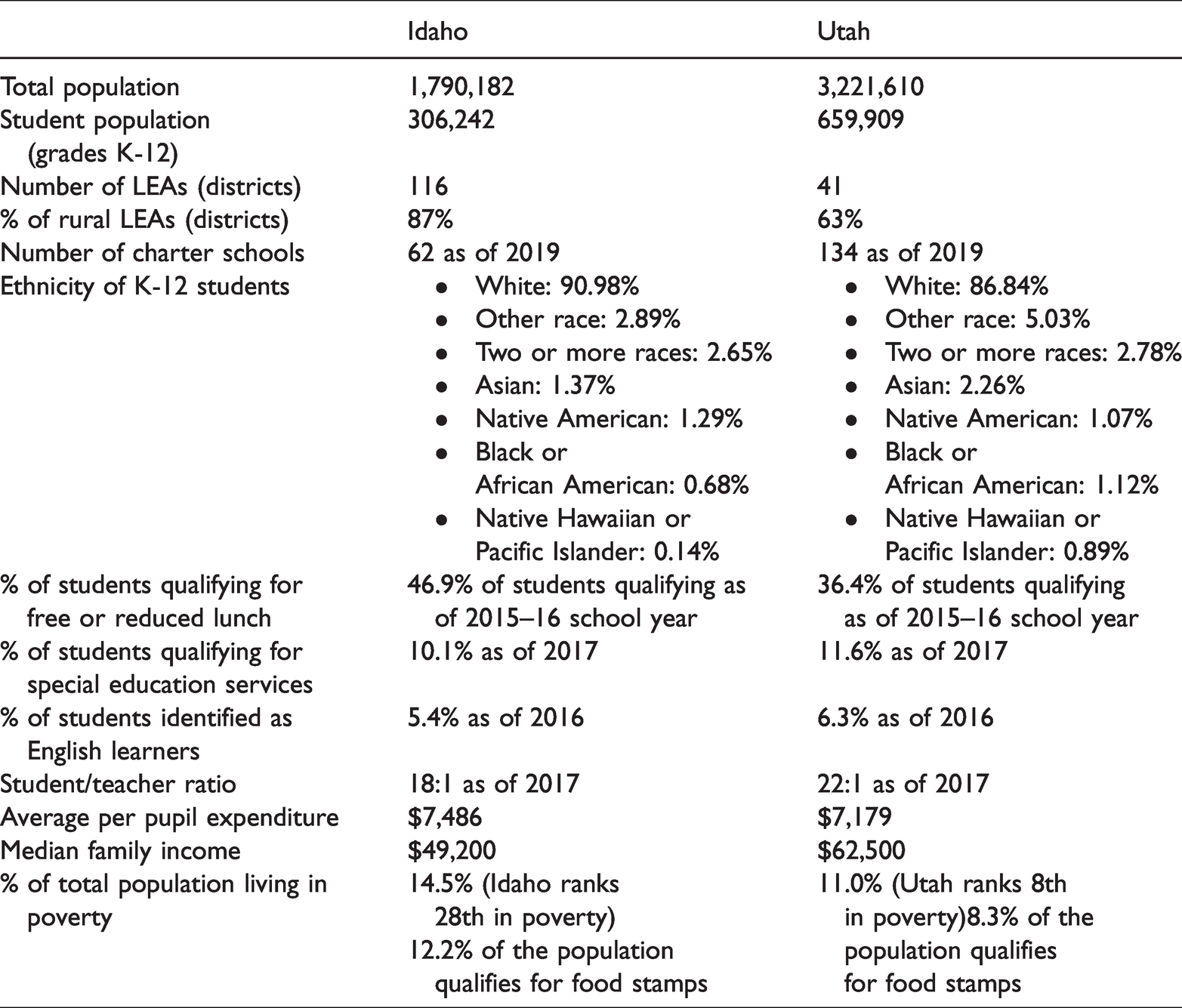
Purposeful sampling was used to discover, understand, and gain insight into a situation and, therefore, we selected a sample from which the most could be learned (Merriam, 2002). The two cases compared for this study were CBE state policies in Idaho and Utah. We selected Idaho and Utah for our study due to their geographic location, cultural context, socioeconomic status, and state legislative structures. The information presented in Table 1 is an overview of the demographic data for the two states based on U.S. Census data and state accountability reporting.
Demographic data for Idaho and Utah.
The two states share many commonalities in terms of their state legislatures; however, they do differ in how their K-12 school systems are governed. Table 2 illustrates that both states are primarily Republican. The political makeup of the two state legislatures put them in the top three nationally for single-party strength. The Idaho Senate is tied with South Dakota for the third most Republican-controlled senate in the nation behind Wyoming (27–3) and Utah (24–5). The Idaho House is tied with Utah as the second most Republican-controlled lower house in the nation, trailing only Wyoming (52–8).
Political comparison of Idaho and Utah.
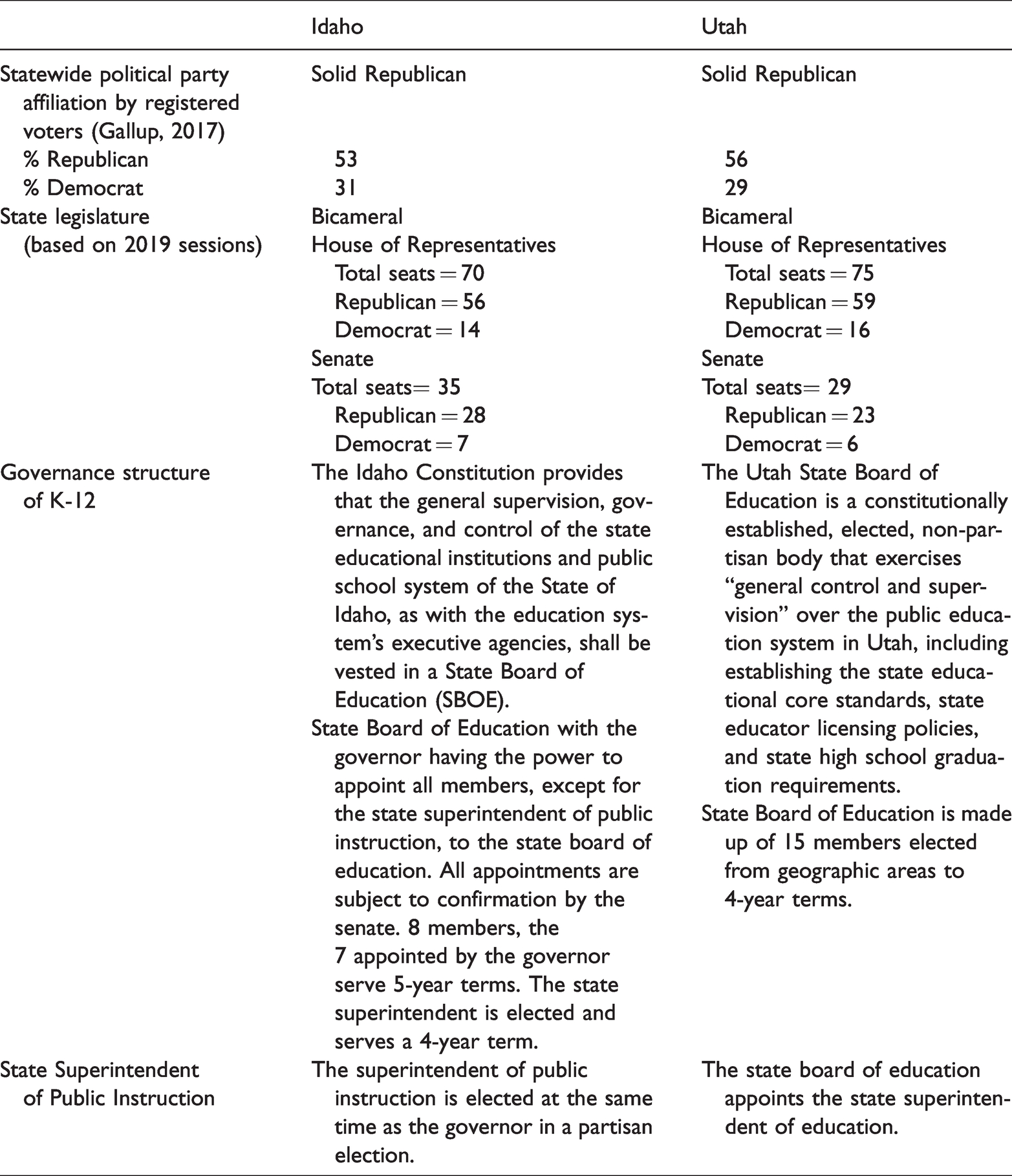
Utah appoints the state superintendent to oversee K-12 education, while Idaho elects the position. In addition, Utah elects their state board of education, while Idaho allows for the governor to appoint all members except for the State Superintendent of Public Instruction.
The research team collected artifacts and documents related to CBE and other complementary policies from the two case states using web searches, public records requests, and document analysis. Follow-up interviews were conducted with those responsible for implementation of the policies at the state level to better understand how the policies were implemented, including funding for the implementation, and how well the policy was being diffused across the state from their lived experiences. We sought to understand the successes and barriers to their statewide implementation of competency-based education policies with open-ended interviews. In Idaho, this included two individuals from the State Department of Education who had served as directors of the Idaho Mastery Education Network. These two individuals also became co-authors in this study. In Utah, we interviewed two individuals in similar roles employed by the Utah State Board of Education and responsible for their Personalized Competency-Based Learning program. Multiple interview sessions were held with each state’s team and explored the primary areas of: policy development, policy adoption, planned policy implementation—including funding and resources, policy diffusion, and policy barriers.
Interview participants were sent the analysis of their interviews to review, revise, and resubmit to the research team in an effort to ensure accuracy of the information gathered.
Data analysis
The artifacts and data were coded using a template that includes the following: state educational governance structure and system characteristics; components of the policy related to CBE; intended outcomes of policymakers; components of implementation plan in policy; sources of information; key contacts for the state related to CBE; state demographics; student populations of state; state data collection system for CBE practices and outcomes; intermediary groups that worked with the state; conditions of CBE (only PK-6 or only CTE); state guidelines for CBE; funding for CBE; and curriculum materials for CBE. Completed profiles for each state were entered into Excel and coded by the research team members for patterns. Content analysis provided the following descriptive data about CBE policies and the themes that emerged about predominant CBE frameworks.
A cross-case analysis (Miles et al., 2014) was used to compare commonalities and differences in state policies, implementation plans, and processes used by the two states implementing CBE policies. The use of this type of analysis improved the research team’s capacity to understand how relationships may exist between the cases, as well as develop and/or refine concepts about CBE implementation. To validate the accuracy of the findings, member checks (Creswell, 2005) were conducted with those interviewed.
Findings
To review, our overarching research question was: What are different state policy approaches and frameworks to CBE in two states in the Intermountain West? In addition, we set out to explore the components of state policies regarding CBE. What are the characteristics of state-level plans to support the implementation of CBE policies? What practices do states use for helping policy diffusion at the LEA (local education association) level? We present our findings by first comparing and contrasting the two states’ policy development and their approaches to CBE. We examine the frameworks they used to define CBE in their states, as well as their implementation plans to support policy diffusion. Finally, we examine each state’s impact to diffuse the policy to the LEA level.
Policy development
Both states worked towards passage of CBE policies beginning in 2013 and share many of the same components in their definitions of CBE. They both use almost identical language as to how they define CBE, or as they call it in Idaho, “mastery education”—with both states relying heavily on an older version (2011) of Sturgis’s (2016) framework and components: (a) students advance upon demonstrating mastery based on explicit and measurable learning objectives aligned with important competencies; (b) personalized instruction with customized student supports; (c) assessment that allows students to apply their learning; and (d) development of specific skills and dispositions critical for success in a student-centered learning environment.
In 2012, CBE emerged as a policy issue for school system improvement in Idaho in the form of “mastery based” education. Specifically, in December 2012, after two years of contentious education reform debates and a grassroots-led initiative in which voters ultimately overturned three education laws, Idaho Governor C.L. “Butch” Otter commissioned a task force under the direction of the State Board of Education to “shepherd a discussion about how to improve Idaho’s education system to better prepare students for success” (Idaho OSBE, 2013). A task force of 31 individuals representing broad and diverse groups of stakeholders from across the state gathered in January 2013 to begin discussions and identify areas of focus. The group included representatives from school districts, school boards, the state teachers association, the state superintendents association, the Governor’s office, the business community, parent groups, the state school boards association, and higher education institutions—among others. For the next eight months, the “Task Force for Improving Education K-12” convened over 15 times and held a series of statewide community forums. In September 2013, the Task Force finalized its recommendations. Of the 20 recommendations put forth, the very first was to shift Idaho’s K-12 system to a “mastery based” system: We recommend the state shift to a system where students advance based upon content mastery, rather than seat time requirements. This may require a structural change to Idaho’s funding formula and/or some financial incentive to school districts. We also recommend that mastery be measured against high academic standards (Idaho OSBE, 2013: 7).
In our interviews, Utah’s team told us that there were 14 local education agencies and state agency personnel engaging in early conversations around the CBE recommendation to implementation process. This created a vision for the state. The exploratory pilot program came out of the conversations. “The exploratory pilot program was a precursor to the grant program and was a one-time program.” The 14 local education agencies and the state agency visited implementation sites in other states, which shaped the vision and trajectory of CBE for Utah. The local education agencies and state agency explored CBE and pulled from what they saw in other schools and in other states.
Policy adoption
A mastery education system was proposed in Idaho House Bill 110 (HB110), which passed both legislative chambers unanimously and was signed into law by Governor Otter on March 19, 2015. The law directed the Idaho State Department of Education to move Idaho towards a mastery-based education model to allow for more personalized and differentiated learning experiences (Idaho Code 33-1632). The legislation also created the Idaho Mastery Education Network (IMEN) that allowed LEAs to apply to this improvement network focused on the implementation of mastery education in their local school systems.
The passage of HB110 allowed for IMEN to provide up to 20 LEAs to work through an incubator process creating mastery-based education models that would serve their unique communities. Further, the law directed the Idaho State Department of Education (SDE) to move Idaho towards a mastery-based education model. Idaho’s interviewees told us, “This model was intended to move students and their school systems away from the traditional time-based Carnegie system to a CBE system.” The law outlines that mastery education requires “focus on explicit, measurable, transferable learning objectives that will empower students and prepare them for the 21st Century” (Idaho Code §33-1632).
Utah did not pass any state policies regarding CBE until the following year. Effective May 1, 2016, Utah Board Rule R277-705-3 required an LEA governing board to “establish a policy, in an open meeting, explaining the process and standards for acceptance and reciprocity of credits earned by a student in accordance with state law.” The Utah State Board of Education also passed Rule 277-419, effective June 1, 2016. Acknowledging that it is only the first step toward a long-term, non-time-based funding solution, the rule defines a “non-traditional program” as one that includes distance learning, blended learning, online learning, and competency-based learning.
Utah Senator Howard Stephenson was identified as a key driver in the development of the CBE pilot program. A Joint Education Conference on CBE in 2015 resulted in the passage of SB143 in 2016, authorizing the Competency-Based Education Grants Program. On March 29, 2016, Utah Governor Gary Herbert signed SB14332 into law, which established the Competency-Based Education Grants Program. SB143 establishes planning, implementation, and expansion grants, and appropriated $369,000 for the first year for up to three planning grants. The bill also stipulates that higher education institutions must cooperate with the LEA “to recognize and accept on equal footing” the diploma of graduates from pilot high schools as traditional high school diploma recipients. The USBE began implementation in June 2016 with the passage of Rule 277-712.34 This package established the Review Committee authorized in SB143 to establish metrics to determine the quality of grant applications, review applications, and make selection recommendations to the superintendent and the board. The Utah rules also established pre-grant approval requirements, procedures, and requirements for awards, and stipulated that LEAs shall include outcome-based measurements as part of their application and that must include at least one measurement of student growth and proficiency.
Policy approaches and implementation plans
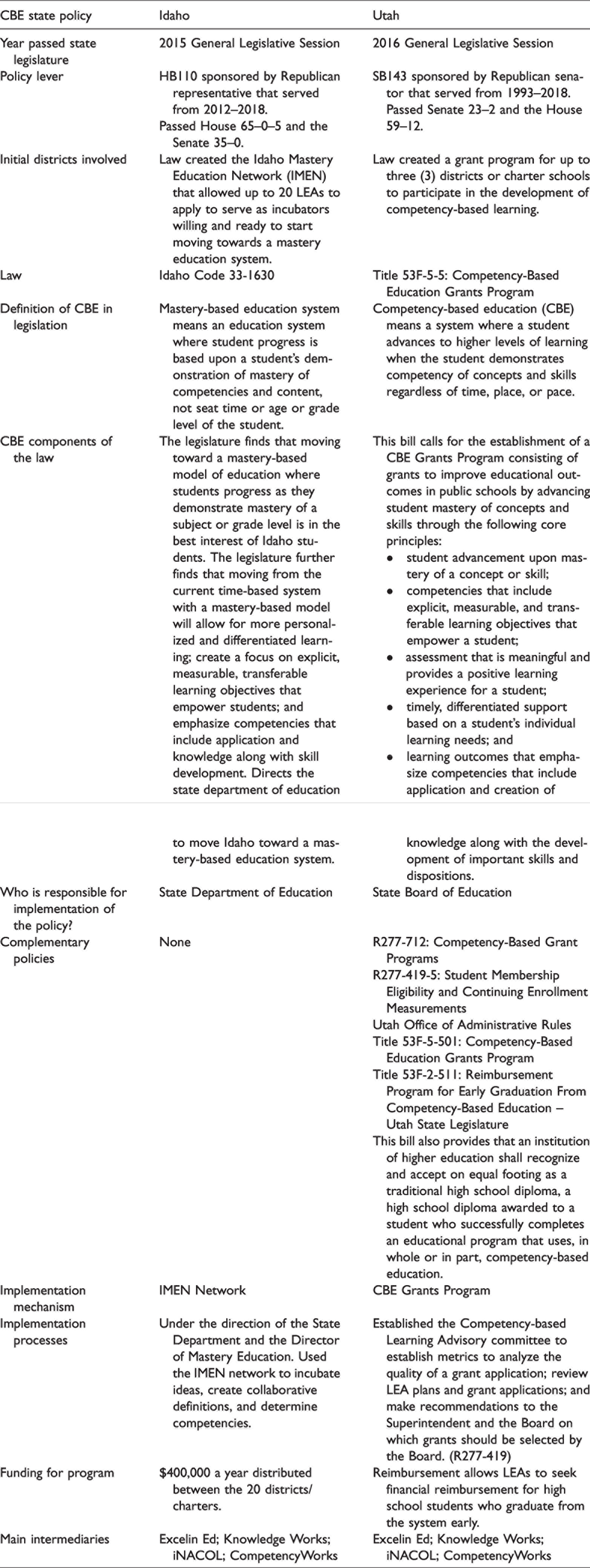
Idaho and Utah took approaches to policy adoption and policy implementation. The components of the CBE policies, as well as the implementation plans, are explained in Table 3.
Components of state policies related to CBE.
In our interviews, Idaho’s team told us that in response to HB110, the Idaho State Department of Education planned and carried out the following activities for the initial move to a mastery education system: Conduct a statewide awareness campaign to promote understanding and interest in mastery education for teachers, administrators, parents, students, business leaders, and policymakers. Establish a committee of educators to identify roadblocks and possible solutions in implementing mastery education and develop recommendations for the incubator process. Facilitate the planning and development of an incubator process and assessments of local education agencies (LEAs) to identify the initial cohort of up to 20 LEAs that make up the Idaho Mastery Education Network (IMEN) to serve as incubators.
Utah contributed a voice for CBE along with a movement for launching the state’s CBE framework, which was adapted from the LEAP personalized learning framework, and CBE competitive grant application processes. The exploratory pilot funding covered travel, resources, and site visits. It is interesting to note that not all 14 local education agencies that contributed to conversations applied for the grant program. Utah’s team stated: The current grant has three phases and currently has one cohort (Cohort A). The cohort members were awarded grants in 2018. The first phase is a one-year planning grant. The second phase is a two-year implementation grant. Phase three is a three- to five-year expansion grant. The competitive grant process is all written to legislative code and the first two phases are currently funded. Work is being done to request funding for the expansion phase of the grant. The planning grants are awarded annually.
SEA plans to support policy diffusion at the LEA level
In Idaho, the SEA interviewees describe the IMEN school and district teams spending the first year of planning and design in collaboration with each other, along with other schools and districts around the nation. Interviewees stated, “They shared exemplars of mastery learning in action, asking questions, and then choosing some features or ideas to take back to their school or district for implementation.” The Idaho Mastery Education Network provides the following overarching narrative on the Idaho State Department of Education website, which they stated in our interview “was developed as a result of the collaborative work of the network”: Mastery Education ensures all students have access to a learner-centered experience where student success is the only option. Mastery-based education gives students the chance to use meaningful content in ways that encourage deeper levels of learning so they acquire the knowledge, skills, and dispositions essential for success in the 21st century. When students demonstrate that they are proficient under rigorous expectations, they take greater ownership and responsibility for learning. This helps educators and students eliminate false assumptions about learning that is associated with points, percentages, and grades.
Logan School District, Davis School District, Juab School District, and Iron School District were part of the original exploratory pilot program and received a planning grant. SEA interviewees stated, “The remaining schools that participated in the exploratory pilot program who did not receive the grant may not have met the criteria, may not require the grant to do the work, may not be ready for the transformation, did not have the capacity to currently implement CBE, or may have been excluded due to other variables.” Further in our interview they stated, “Juab School District has been implementing personalized learning for several years and is a leader in the state and nationally. Juab School District is recognized in the Innovative League of Schools.” The next step identified by the Utah team is to work towards obtaining funding for the expansion grant and starting Cohort B.
Utah’s team made it clear they are working in a way that allows them to establish a common language and streamline CBE practices. “The state’s goal is to share resources, adjust teaching and learning, and provide best practices.” Local Education Agencies speak at state board meetings to inform legislators and formed a committee to have conversations around CBE policies and practices. Interviewees stated, “CBE removes the barriers of traditional educational requirements to better meet the needs of students. Ultimately, CBE could provide an equitable and individualized education for students.” In addition, Utah has created a portrait of a graduate for CBE. The portrait of a graduate was created by a task force with input from all stakeholders to describe a holistic view of what is expected of Utah’s students.
LEA contexts for improvement under the new policies
Idaho had the following types of districts and charters participate in the first cohort of the Idaho Mastery Education Network (2016): 20 total districts or charters with 35% of those being charter schools, and 30% being rural districts. There are 116 traditional school districts in Idaho, with 88% categorized as rural, and 62 charter schools.
Utah had the following types of districts and charters participate in Cohort A: 7 total districts or charters, with 14% of those being charter schools and 42% being rural districts. There are 41 traditional school districts in Utah, with 63% categorized as rural, and 134 charter schools.
Discussion
This article reports on how two Intermountain West U.S. states engaged in setting CBE state policy and implementing that policy to improve educational equity and outcomes for students. We argue that although the policies have many similarities and were developed under similar political conditions within each state’s policy arena, the planned implementation and diffusion of those policies was very different and influenced a divergent population of local LEAs in each state.
First, we noticed quite different plans for implementing the CBE policies in Idaho and Utah. Next, the policies also diffused differently in each state; however, there is a somewhat common theme of the types of LEAs that had capacity or chose to continue implementation of CBE state policies. Finally, we argue that the role of intermediaries in the development and spread of CBE policies to both states in the study can be observed in the findings of this study.
Policy development, adoption, and planning for implementation
Both states had a key actor who initiated and built capacity for the policy lever of CBE. In Idaho, Governor Otter and his taskforce in the last year of his long political career laid the foundation for CBE policies. In Utah, this visionary role was filled by a longtime legislator, Senator Stephenson. Idaho and Utah have different organizational structures that support the implementation of their CBE policies. Idaho’s plan is under the direction of the State Department of Education, while Utah’s plan rests with their State Board of Education. Idaho uses a network approach with LEAs working with each other, as well as the SDE. Utah relies on one-to-one support from the SBOE to specific LEAs awarded CBE grants and an advisory committee to make recommendations and decisions related to CBE.
Policy diffusion
Utah is supporting the diffusion of competency-based education (CBE) by looking at policy barriers and through grant funding. Utah appears to be seeking ways to increase flexibility with CBE to encourage local innovation.
Idaho is supporting the diffusion of their CBE policy through a networked community of practice called Idaho Mastery Education Network (IMEN). The network established common definitions, competencies, and is now working on alignment with assessments. In interviews, Idaho acknowledges the need to support LEAs in creating local policy language that allows for the five principles of mastery to be realized. Much like Utah, Idaho believes that CBE provides a more equitable education for students; however, neither state has been at implementation long enough to examine student outcomes.
The data suggests that rural systems and charter schools may not have the capacity needed to implement state CBE policies at the local level: Both states saw fewer rural systems than are consistent with the state demographics opting into the CBE pilot or incubator. The study did not explore why fewer charters and rural systems are represented in the CBE initiatives, but the data does suggest this is an area for future study.
Role of intermediaries
Both states have passed CBE policies in state legislation and were reported by iNACOL as being “advanced” states in terms of state policy supporting CBE. The maps (Figures 1 and 2) from iNACOL show their portrayal of CBE and its growth across the national landscape.
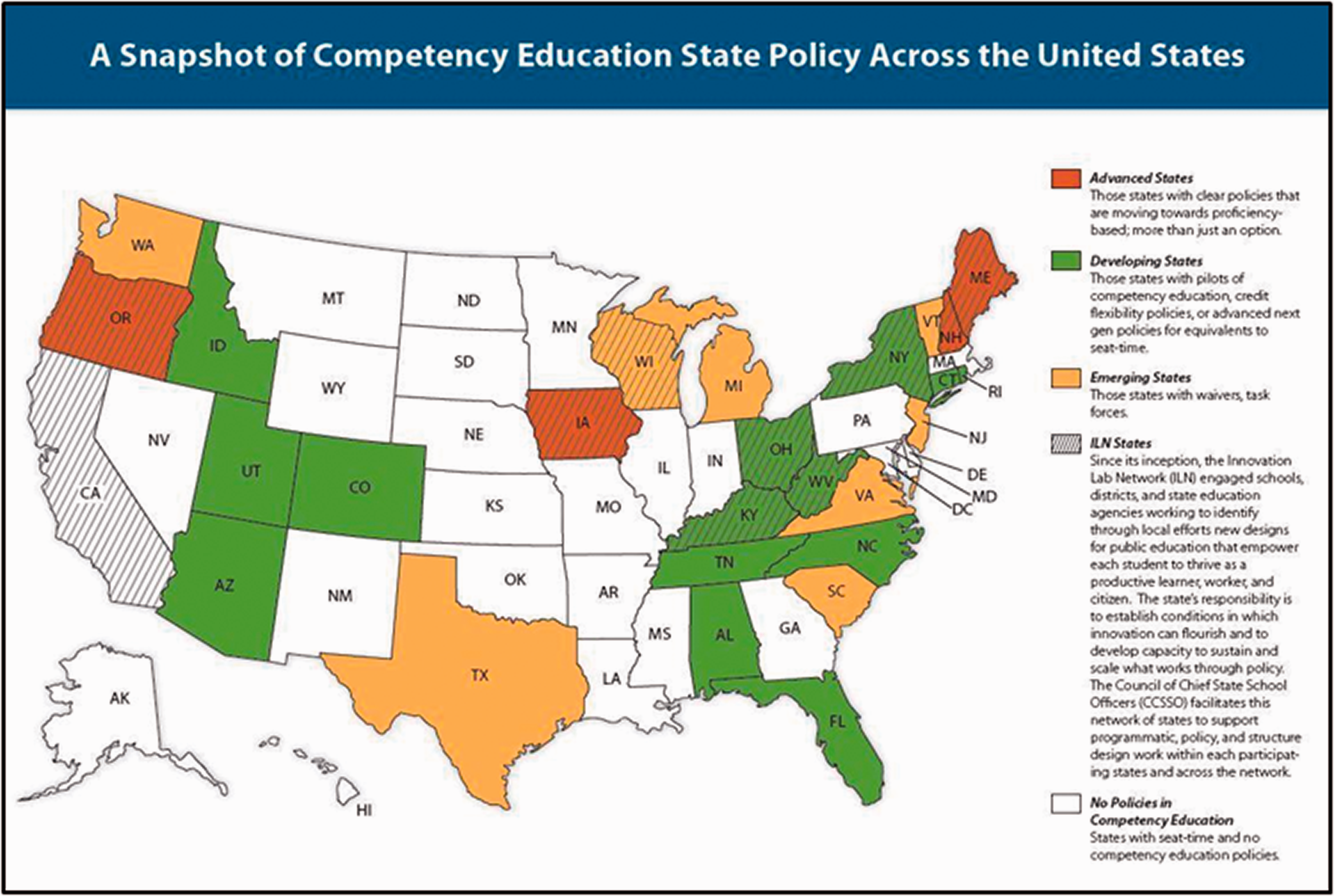
Aligning K-12 State Policy with Competency Education. Image from CompetencyWorks, iNACOL (2014).
According to iNACOL, in 2014 (see Figure 1), 14 states, including Idaho and Utah, were providing pilots of CBE policies to allow flexibility for awarding credit in ways other than seat time. By 2017 (see Figure 2), Idaho and Utah both moved into the “Advanced States” category along with eight other states that are working on a “comprehensive policy alignment and/or an active state role to build capacity in local schools systems for competency education.” Advocacy and intermediary groups such as CompetencyWorks and the International Association for K-12 Online Learning (iNACOL), now the Aurora Institute, have created a national and global collaborative that has been instrumental in supporting states, districts, and schools in the transformation to CBE as well as other related student-centered practices, including personalized learning and performance-based assessments (e.g., Patrick et al., 2018).
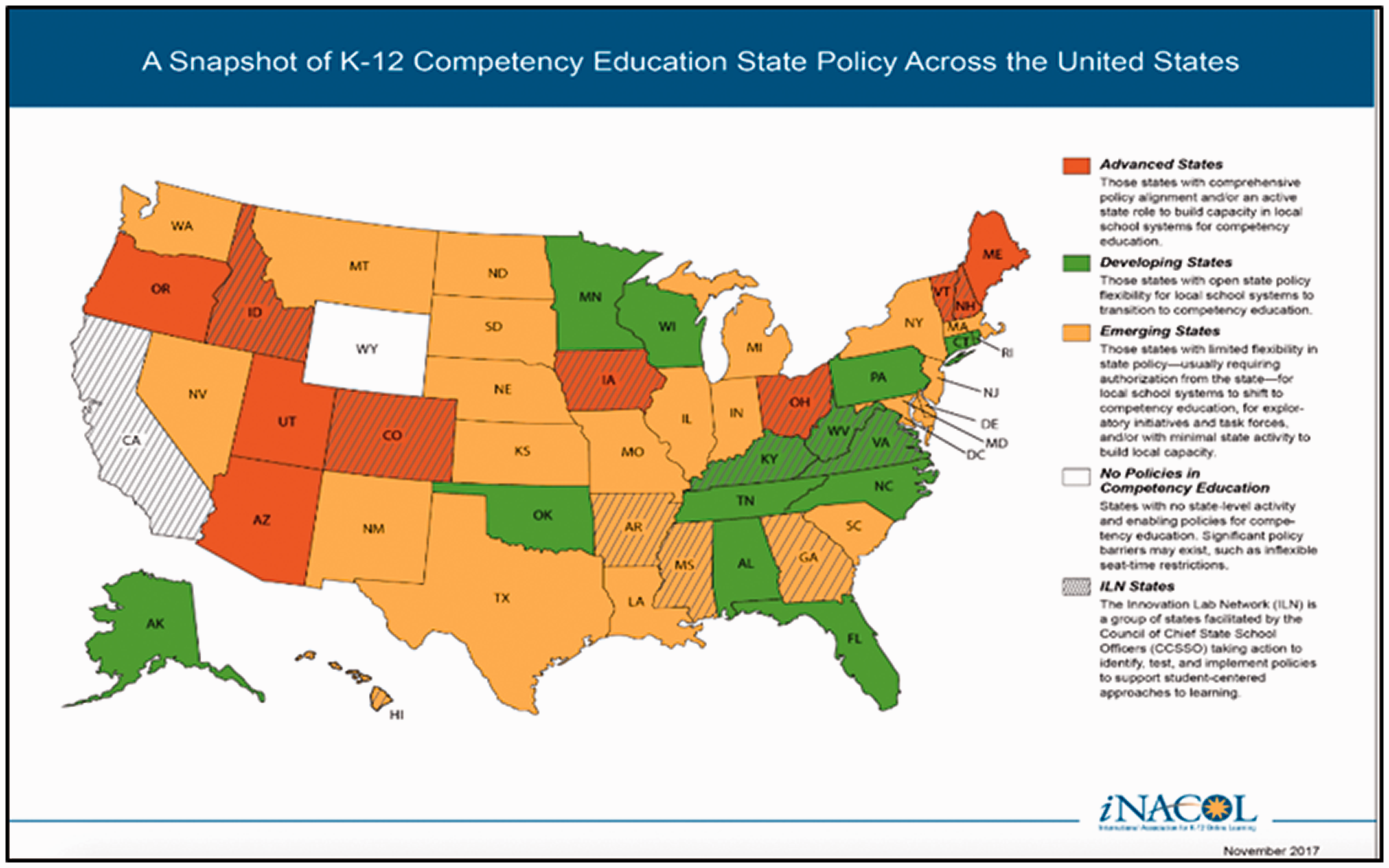
Map: A Snapshot of K-12 Competency Education Policy. Image from iNACOL (2017).
Both Idaho and Utah relied heavily on policy recommendations and capacity building from national intermediaries such as Excelin Ed, Knowledge Works, iNACOL, and CompetencyWorks. All of these organizations, nonprofits, or foundations are considered intermediary organizations (IOs) that provide a translating function between different policy actors with different values and perspectives. IOs may include think tanks, philanthropic foundations, advocacy groups, and even the news media. Scott and Jabbar (2014) argue that the IO sector, and the foundations that often fiscally support them, have a significant impact on the evidence-based decision-making by local, state, and federal policymakers. In this study, intermediaries were important actors and sources of information during the CBE policy development and planning for implementation in both states. They played a significant role in shaping not only the policies, but also in supporting those individuals at the state level implementing the policies. Participants we interviewed pointed to publications, conferences, newsletters, and other outreach from these intermediary organizations as “drivers” in their work that was their decision-making as practitioners.
Implications
Our findings have several implications for policymakers and those responsible for implementation of policies as they make their way into practice, ultimately with the aim of improving student outcomes.
Implications for policymakers
As the education system has become more complex, the barriers to implementing changes have also advanced. Often overlooked is the influence of factors such as capacity for instruction and leadership, understanding of policy change, perception/perceived value and durability of policy change, resource allocation and distribution, and community support. Policymakers should consider ways to design articulation policies or complementary policies that support implementation, instead of relying upon school administrators and street-level bureaucrats to make difficult decisions about which parts of the policy should take priority, or which students should benefit.
Making sense of and implementing policy requires individuals to draw on prior knowledge and experience (Spillane et al., 2006). Individuals make sense of policy individually; therefore there are multiple interpretations of the meaning of the policy. Spillane (2006) focused on “sensemaking” behaviors in understanding how educators think about the implementation of policy in their work. Thus, policymakers might consider the sensemaking behaviors of LEAs and their leaders as they think about policy barriers. Rurality and scarce resources for implementation of education policy may further compound the issues for these two states with many rural communities. Further, CBE requires students to take ownership for their learning. Do marginalized students have adequate support to take ownership for their learning? Do LEAs with high populations of underrepresented minorities, students living in poverty, students with disabilities, and high concentrations of English learners have the resources to support all learners?
Implications for those leading policy implementation
Competency-based education focuses on mastery of subjects, while providing students the time to learn. However, there are challenges to understanding competency-based education and understanding the policy recommendation to implementation process with regard to state policies. The passing of policy is not enough for change within the field of education. Policies can absolutely support or block transformation in schools. There has been much debate at the local, state, and federal level about improving education systems, and despite the fact that people tend to point at the “feds,” states, local districts, and charters actually play the lead role in our nation’s public education system and improving outcomes for students. The responsibility for providing public education services is established at the state level in individual state constitutions, and state revenues fund the lion’s share of the cost of operating most public schools. As a result, state policy drives much of the structure and function of our public education system—with direct influence over programs and priorities for human capital, school and system performance and accountability, financing, and governance. With that said, this study points to how states often rely on the same experts, intermediaries, resources, and processes when implementing educational policies. Therefore, it is important to consider the larger political landscape to avoid working on an “innovative” implementation plan with the help of an intermediary group that in the end may look much the same as a neighboring state, or even a state across the country.
Another important finding from this study is the adjustment of policies to fit different contexts and needs. As each state works through implementation and policy barriers, how should they decide when to adjust policies to better fit the needs of local LEAs? In turn, when should the LEA leaders decide to adapt policies to better fit the needs of various groups of students? It is important that those implementing the policy are mindful of how and why they engage in policy adaptation, as well as understand how those decisions impact students.
Implications for research
To date, much of the literature about CBE as a state policy issue has been generated from advocacy groups, philanthropy groups, or other intermediary groups and not from peer-reviewed research, signaling a need for systemic study by academia. For example, CompetencyWorks and the International Association for K-12 Online Learning (iNACOL) joined together to create a national and global collaborative that supports states, districts, and schools in the transformation to competency/personalized/mastery education (Patrick et al., 2018). Much work is being done by these intermediary groups like iNACOL, CCSSO, and others to diffuse CBE policies across states, but again peer-reviewed research examining this system-level education policy, as well as policy implementation processes and related improvement, is scant. Further, the body of knowledge has not consistently defined CBE and what it is or is not, and much of the field is relying on definitions and frameworks put forth from intermediary organizations. There is also a lack of evidence of what and how state and LEA policies have developed because of these efforts.
Findings from this study also have important implications for further research. Our interviews and document analysis made us wonder if policy collision was happening at the local level. Grote et al. (2020) describes the process when street-level bureaucrats (school leaders) must decide between competing policies or limited resources—one policy often does not advance and may even detract from other initiatives. Future research is needed to examine the intended/unintended relationship between CBE policies and other system improvement policies such as school turnaround, teacher accountability, early education, high school graduation, postsecondary readiness, advanced opportunities, etc. Was CBE seen as including/aligned to/supporting/replacing other policy efforts?
Conclusions
By examining CBE state policies in two neighboring states, the study created a narrative description and comparative analysis of various components of CBE policies and their interpretation in a statewide initiative under conditions related to the context of the Intermountain West. Second, this study adds to the current literature and may be a resource to guide policymakers and practitioners working to implement CBE policies, by investigating the factors that influence how and why CBE state policies are adopted by a variety of actors in the policymaking and decision-making arena, and how they are then implemented and diffused by practitioners.
Footnotes
Authors’ Note
Kelly Brady was an employee of the Idaho State Department of Education from 2015-2019. Marita Diffenbaugh was an employee of the Idaho State Department of Education from 2018-2019.
Declaration of conflicting interests
The author(s) declared no potential conflicts of interest with respect to the research, authorship, and/or publicationof this article.
Funding
The author(s) received no financial support for the research, authorship, and/or publication of this article.

