




Abstract
As the world is changing and transforming at a fast pace, students today are expected to face more challenges in the future. For example, they need to prepare for jobs that do not yet exist, use technologies that have not been invented yet, or even solve problems that have not been discovered yet.The current study proposes that futures imagination is the key to better prepare students to face unknown challenges and an implementable education policy in Taiwan. This article introduces the development process and results of a futures imagination education program in compulsory education in Taiwan. In 2011, the Ministry of Education (MOE) in Taiwan started promoting the futures imagination program at all levels of education through different action plans for four consecutive years. The current study examines the ‘Grades 1–9 Action Plan’ and its teacher education workshops throughout this period. The Grades 1–9 Action Plan was implemented in compulsory education. The subjects of this study are teachers who participated in the action plan; they learned how to implement futures imaginative approaches in their classrooms. Through their cycle of planning, action, observation, and reflection from 2011 to 2015, they reported their findings through written reports, and then we collected their results through interviews and surveys. The results showed that students show higher learning interests and will have a more in-depth view of the future, which is expected to prepare students to adapt to their futures, and this contributes to their learning interests.
Introduction
In recent years we have witnessed rapid transformations in technology and society. Students today need to prepare for jobs that do not yet exist, use technologies that have not been invented yet, or even solve problems that have not yet been discovered (Gunderson et al., 2004). According to the US National Center on Education and the Economy, the same education that is being delivered today will no longer be sufficient for young people for their living, learning and earning futures. Individuals or groups who are creative and forward-looking are able to cope with the insecurity and uncertainty that future entails, while pedagogy may be the answer to influencing a young individual’s future social, economic and civic participation (McWilliam, 2009).Therefore, scholars have noted that almost all Asian countries have embarked on curriculum reform in order to develop ‘21st-century skills’ which broadly include critical, creative and inventive thinking; information, interactive and communication skills; civic literacy, global awareness and cross-cultural skills (Kennedy, 2008; Lee, 2012), as innovations in education become crucial.
This research aims to study pedagogical innovation in Taiwan, and how a new educational program was introduced and improved through time. Since 2009, the Ministry of Education (MOE) and the National Science Council of Taiwan have begun proposing the Futures Imagination Education (FIE) program with different research and education projects. The project covers different levels of education including years 1–9 compulsory education, high schools, university and colleges, and the adult learning system respectively. The goals and focus of the FIE program in Taiwan is to facilitate students to develop a positive attitude towards the future, and prepare students with the ability to imagine future scenarios.
Traditionally, schools often take test results or academic achievement as an important indicator of students’ learning outcomes; however, as academic achievement does not entirely account for a student’s future performance or life achievements, a student’s wellbeing has become a more important aim in education (Robinson and Aronica, 2009). To prevent students from future shocks or negative impacts (Toffler, 1970), the FIE program is expected to improve the quality of education, assist students to recognize past experiences and apply them to current situations, and incorporate this into their attitudes and ability to face future challenges, and is expected to contribute to their wellbeing later in their life.
Consequently, building on the success of futures in education and imaginative education, as well as valuable experience from the Creative Education Program implemented in Taiwan, the MOE followed this logic in developing frameworks for the FIE, and urged more teachers to engage in curriculum development, and conducted action research in participation with scholars and educators for the current research. To demonstrate how the program is developed and put into practice in Taiwan, the current research is built upon action research conducted by those currently participating in the FIE program at the elementary school and junior high school level. Through their cycle of planning, action, observation and reflection from 2011 to 2015, they reported their findings through written reports, and then we collected their results through interviews and surveys.
In the following sections, we will explain how FIE is developed and integrated into the new curriculum introduced in 2019, and, by analysing the reported findings by educators and researchers in Taiwan, we assert that FIE is more beneficial to students than creativity or imaginative education alone. In addition, the difficulties of curriculum design and implementation from various perspectives will be discussed.
What is futures imagination?
Thinking about the future is a common human activity and an important ability (Pereira and Funtowicz, 2013). Being able to imagine the future is key to raising awareness, developing a better understanding of a possible event in order to fulfill needs in the present (Phan, 2009). Therefore, imagining the future has gained increasing attention among different disciplines including pedagogy, business and policy-making, as people are eager to develop better abilities in order to face unknown future challenges (Chen et al., 2012a). As a result, promoting futures imagination and futures thinking in education has begun to emerge in many countries and organizations. For example, the United Nations Decade of Education for Sustainable Development (UNDSED), the Creativity, Culture and Education (CCE) organization in the UK, the Microsoft ‘Partner in Learning’ (PiL) program and the Organisation for Economic Co-operation and Development (OECD) Schooling for Tomorrow project, etc. and are all advocates of imaginative and futures education.
Futures imagination can be seen as imagination directed towards the future, and the future scenarios can be different situations that assist a person to consider different alternatives in order to make current decisions (Chen et al, 2012a; Zimbardo and Boyd, 2009). Currently, in the field of education, there are advocates for ‘imagination education’ and ‘futures education’. Futures education basically focuses on an innovative approach to equip young people to construct and face their futures positively (Gidley and Inayatullah, 2002), whereas imaginative education emphasizes developing the distinctive nature of human cognition (Egan, 1992). Since images of the future play a crucial role in social and cultural change (Hicks and Holden, 1995), scholars and educators around the world have been interested and promoting futures and imagination in education.
For over 40 years, various programs have been dedicated to carrying out teaching and learning explicitly about futures in education (e.g. Gidley, 2004; Ramos, 2005). Also, the usage of the word ‘futures’ as a plural term implies multiple possibilities, different from one single ‘future’ that we use in common discourse (Gidley et al., 2004; Masini, 1993). Researchers in futures studies have proposed different typologies for conducting research and approaching the future. For example, Gidley (1998)demonstrated four types of future orientations and their associated underpinning paradigms, namely probable, possible, preferred and prospective futures; other scholars used only three categories: probable, possible and preferable (Fitch and Svengalis, 1979; Pike and Selby, 1999); or a more parsimonious two types of futures: probable and preferable (Hicks, 2001); indicating that each can take different perspectives and actions towards the future, based on his or her own values.
In imagination education, or imaginative education, on the other hand, scholars and educators alike are working on how to engage teachers’ and students’ imagination in a variety of subject domains, and integrate theory and practice (e.g. Blenkinsop, 2009). As a result, the MOE in Taiwan began promoting the FIE program, aiming to enhance the cultivation of imagination, creativity and futures thinking at all levels of education.
Craft (2002) stressed that imagination is in no way to be separated from past memories and experiences, implying that memory and knowledge are critical fuels in the students’ learning process, and also justifying the necessity of FIE. Schultz (1995) also argued that ‘there are no future facts’; thus, imagination is by necessity a foundation of futures research. It suggests that combining futures studies and imaginative education together becomes a logical and rational pedagogy in order to make youngsters think ahead for their own futures with abundant imagination.
FIE in Taiwan
At the beginning, the FIE program was introduced as the continuation of the Creative Education Program, which was carried out for six consecutive years, and has enjoyed success (Wu, 2009). According to the MOE (2003), the aim of the Creative Education Program was to liberalize and enrich the educational environment in Taiwan. To do so, different projects were implemented to enable the promotion of creativity from the central government to local education practitioners (Chen et al., 2012b). After successfully promoting and implementing creative education from 2002 to 2008 in Taiwan, however, researchers and teachers began to wonder what should be done next (Chen et al., 2012a).
Through the Creative Education Program, some teachers came to realize that creativity alone seems unable to help students deal with future uncertainties (Chen et al., 2012a). Since the future is something that has not happened yet, it only exists as a form of imagination; therefore, imagination plays a much more significant role than creativity in this sense (Gidley, 1998). Accordingly, the ability to adapt to future changes or to face future challenges appears to be the missing part in the Creative Education Program (Wu, 2009; Wu and Albanese, 2013).
Overview of the Grades 1–9 Action Plan
The FIE program implemented in compulsory education is called the Grades 1–9 Action Plan. The program commenced in September 2011, and 25 schools were invited to participate in a trial round for one semester until January 2012. The Action Plan continued to sponsor schools to implement FIE programs in the following three years from February 2012 to January 2015; schools participated in the action plan voluntarily and received grants based on their proposals from the MOE on a yearly basis (two semesters). There were 133, 174 and 150 schools participating in each of these years. To promote FIE in schools and to advance researchers’ and teachers’ knowledge of futures imagination, a total of nine teacher training and development workshops were held during this program period, enabling teachers to form networks and share their teaching experiences with each other. Also, at the end of each year, participants of the action plan handed in written reports about their curriculum design, teaching plans, how they integrate futures imagination into their teachings, and their reflections on and feedback to the program.
Overview of studies
The current research is built upon action research conducted by those who participated in the FIE program. Action research includes conducting research to understand the situation and a process to change a specific situation (Finch, 1986), by involving those who are affected by the practice; it is expected to improve the practice of practitioners (Carr and Kemmis, 1986; McFarland and Stansell, 1993). We conducted four studies during the implementation of the Grades 1–9 Action Plan to investigate the outcomes of this action plan. Data for these four studies were collected primarily from teachers’ training and development workshops during the program. In Study 1, we sent out surveys in January 2012 to conduct an examination of the trial round of the initial framework: imagining futures – considering futures – choosing a future – changing the present. This initial framework was designed based on Lin and Chen’s (2012) four stages of futures imagination. In July 2012, another study was conducted after the training workshop to investigate participating teachers’ understanding of the new three-stage framework which was developed after the trial round of this action plan. The three-stage process of futures imagination was developed and inspired by the study of Morosini’s (2010), Hicks’(2012) and Bateman et al.’s (2011) framework and also took into consideration the implementation experience derived from the trial round. Studies 3 and 4 were conducted to investigate participating teachers’ perceptions of applying the three-stage process of the futures imagination framework in their courses. Besides surveys, more in-depth interviews with class-teaching teachers were also conducted in Study 4 to examine the learning attitude and effectiveness of students in the FIE program through participating teachers’ observations.
Study 1
As in the trial round of the action plan, the framework was premature. The purpose of this study is to seek feedback from participating teachers regarding their experience and opinions in applying the imagining futures – considering futures – choosing a future – changing the present framework in their curriculum design and courses.
Method
Participants and procedure. The participants were 106 teachers who participated in the trial round of the action plan. Participants completed the survey during the teacher development and training workshop in January 2012. Participants were asked to report: (a) whether the framework was reasonable; and (b) which stage was the most difficult one to implement in the curriculum.
Results and discussion
Table 1 presents the results of the frequency analysis. When participants were asked to report whether the framework was reasonable, most of them found it reasonable (63.2%) or acceptable (25.5%). No respondents reported that it was unreasonable or very unreasonable. In addition, when we asked participants to report which stage was the most difficult stage at which to implement it in the curriculum, most of them indicated changing the present (56%) and imagining futures (22%). Most of the participating teachers indicated that the reason they found changing the present was the most difficult stage was because it involves taking actions that are more likely to be hindered by reality. Those respondents who rated imagining futures as the most difficult one indicated that it needs some prior knowledge and experience to be able to imagine futures, and it also takes time to guide students, which is not viable under academic pressure in Taiwan.
The results of frequency analysis.
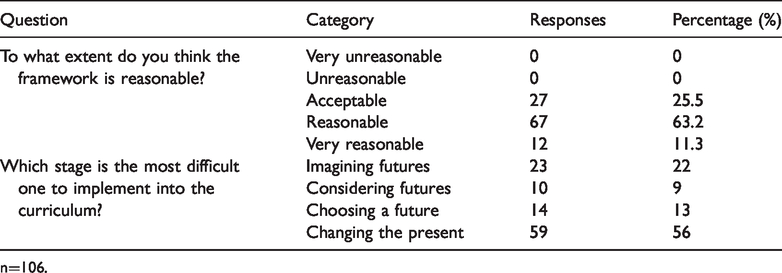
n=106.
While most participating teachers perceived that the above framework is reasonable, they also indicated that they would encounter difficulties in implementing some stages. Since the future may have a number of different possibilities in the imagination, the linear process of ‘imagining futures – considering futures – choosing a future – changing the present’ would have its limitations. To build a more viable framework, a three-stage process of designing and guiding a futures imagination curriculum, as depicted in Figure 1, was developed after the trial round of the action plan. In addition to being inspired by the feedback from participating teachers, this new framework was developed based on the studies by Morosini (2010) and Hicks (2012), in which they argued that individuals will go through several cognitive procedures when imagining or performing imaginative thinking. When thinking about futures, imagination plays the most critical role in this stage. Therefore, the first stage of futures imagination is named ‘imagining’, followed by ‘nurturing’ and the last stage, ‘transforming’.
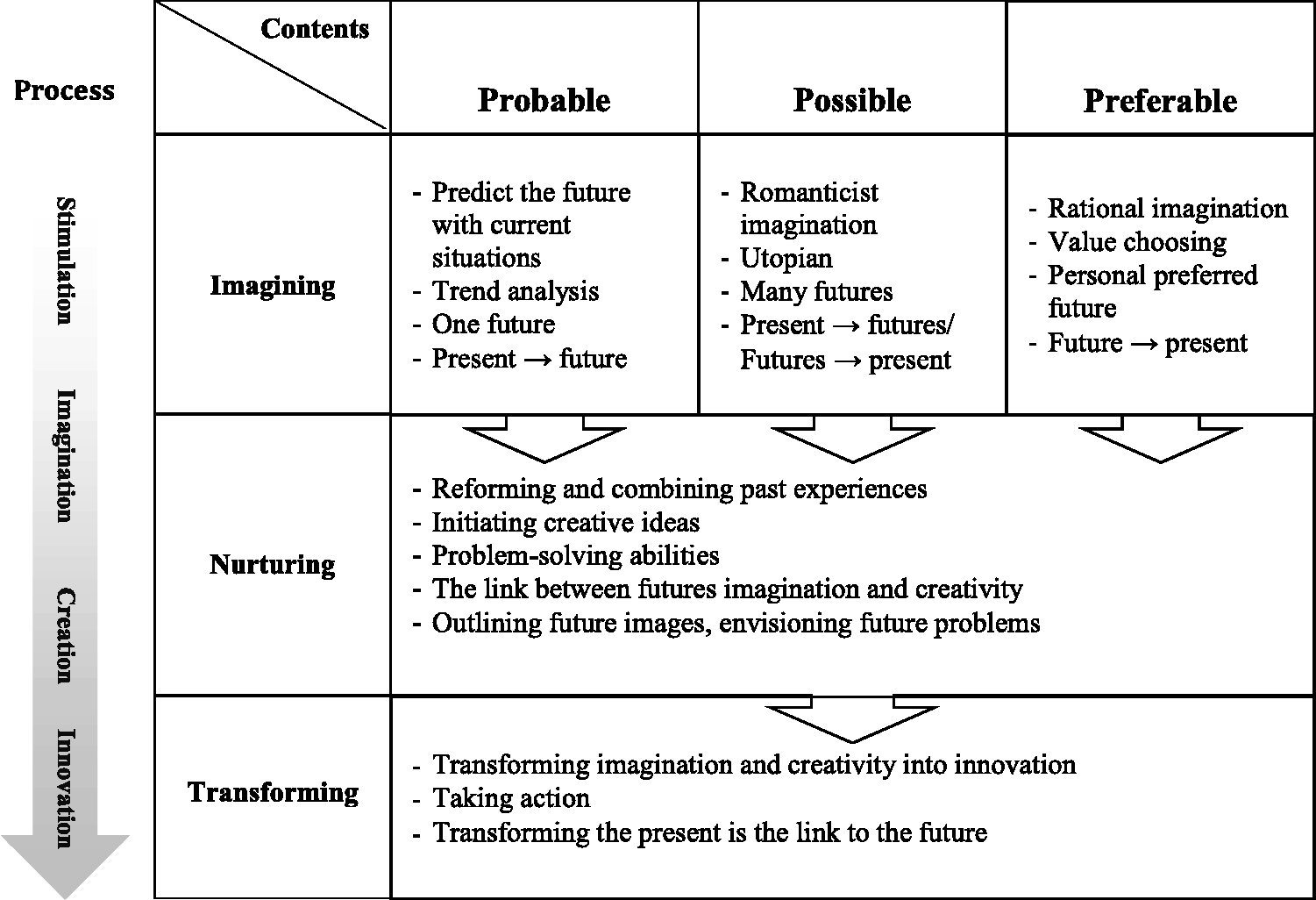
The framework for futures imagination curriculum.
We integrated the content of explicit futures education to explain different directions to guide students’ futures thinking, namely probable, possible and preferable futures. A probable future is predicted by current situations; it can be seen as a simulation or projection, and it implies that there will be only one future. Possible futures can be seen as romanticist, utopian thinking. Directions of thinking can be based on using the present to think about the future, or the other way around. Therefore, there can be more than one future through imagination. Preferable future is a rational imagination that involves personal values and preference; different individuals may construct different futures, then deliberate what one should act on now to reach the future state. The three contents do not eliminate one another; teachers can choose from the three concepts and encourage students to imagine the futures.
Moving forward to the second stage, ‘nurturing’ is the process of utilizing imagination into creativity. This includes reforming and combining past experiences, initiating creative ideas and developing problem-solving skills. During this stage, teachers can direct students with correct values; as Egan (2007) pointed out, imagination should link to social virtues in order to bring a positive impact to society. Turning now to the third stage, ‘transforming’; this part involves taking action. Through innovation, students are empowered to make current changes in order to reach the desired future. Teachers can encourage them to implement the problem-solving plans developed from the previous stage. It is expected that by possessing the ability to transform, students are able to face future challenges, and this holds the key to the future.
Study 2
As a new framework was developed, participating teachers in the trial round of action plan were invited to participate in the teacher development and training workshop in July 2012. In this workshop, the three-stage process of designing and guiding a futures imagination curriculum was introduced and explained to those teachers, and curriculum design and implementation activities in accordance with the new framework were carried out. Surveys were sent out before the end of the workshop. The purpose of this survey was to seek feedback from participating teachers regarding their opinions in applying this new framework in their curriculum design and courses.
Method
Participants and procedure. The participants were 82 teachers who participated in the teacher development and training workshop in July 2012, of whom 33% had administrative positions (e.g. school principal, supervisor or team leader). Participants were asked to assess to what extent they thought the following were reasonable and comprehensible, respectively: (a) three different approaches to guiding futures imagination (i.e. probable, possible and preferable futures); and (b) the three-stage process of designing and guiding futures imagination curriculum (i.e. imagining – nurturing –transforming).
Results and discussion
Table 2 illustrates the results of frequency analysis. Regarding the content of explicit futures education – that is, three different approaches to guiding futures imagination: probable, possible and preferable futures – while few of the participants felt it was unreasonable (9.9%), most participants felt it was reasonable (67.9%) or very reasonable (18%). As for whether it was comprehensible, while few of the participants felt it was not easy to comprehend (3.7%), most participants indicated that it was easy to comprehend (57.3%) or very easy to comprehend (35%).
The results of frequency analysis.
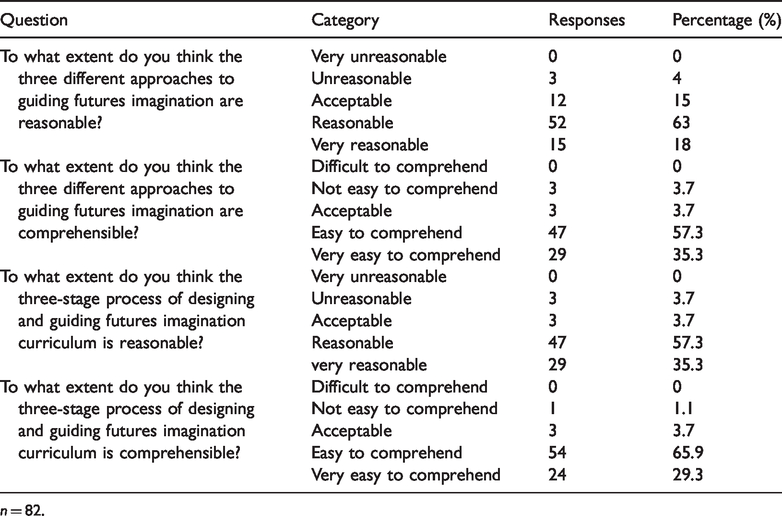
n = 82.
In terms of the participants’ perceptions of the three-stage process of designing and guiding the futures imagination curriculum, imagining – nurturing – transforming, similarly, while few of the participants felt it was unreasonable (3.7%), most participants felt it was reasonable (57.3%) or very reasonable (35.3%). As for its comprehensiveness, only one participant felt it was not easy to comprehend; most participants indicated that it was easy to comprehend (57.3%) or very easy to comprehend (35%).
Based on the above results, we can state that most participating teachers felt that the new framework was reasonable and easy to comprehend. We also found that those who perceived it as unreasonable and not easy to comprehend were new participating teachers. This also implies that more related development and training workshops are needed to further explain and promote this new framework. Consequently, in addition to a development and training workshop held in March 2013, in June 2013, 20 participating teachers were invited on an international visit to Australia. During this visit, teachers were able to experience and observe how futures education is implemented in primary schools in Melbourne. They also attended lectures at Deakin University to learn about futures education. In July 2013, another workshop was held, and the teachers who visited Australia were able to share their experience with other project participants.
Study 3
After the three-stage process of the futures imagination framework was introduced to participating teachers in 2012 and, subsequently, two development and training workshops were held in March and July 2013, participating teachers started to apply the new framework to their courses. The main purpose of Study 3 was to investigate participating teachers’ feedback on implementing the new framework in their courses.
Method
Participants and procedure
In March 2014, 98 teachers who participated in the Grades 1–9 Action Plan and carried out the three-stage process of the futures imagination framework in their courses in 2013 were invited to complete the survey. Participants were asked to report: (a) the level of difficulty in applying the framework in their courses; and (b) to what extent students’ interests in learning the subject were raised after the three-stage process of futures imagination was applied to the curriculum.
Results and discussion
Table 3 illustrates the results of frequency analysis. Regarding the level of difficulty in applying the framework in courses, while only a few of the participants felt it was difficult (2%), most participants felt that the level of difficulty was acceptable (32.0%) or easy (42.0%). As for participating teachers’ perception of students’ interests in learning the subject after the three-stage process of futures imagination was applied to their course, most participants indicated that the learning interests of students were slightly raised (71.2%) or significantly raised (21.2%). In general, these positive responses from participating teachers are encouraging and suggest that the new framework is viable and can facilitate students’ interests in learning.
The results of frequency analysis.
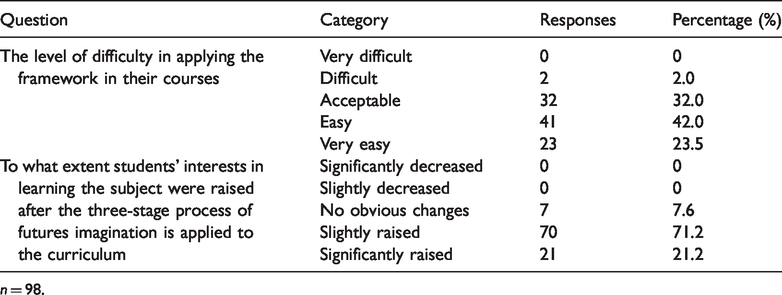
n = 98.
Study 4
Since the Grades 1–9 Action Plan is about to conclude in the fourth year, we conducted Study 4 with both quantitative and qualitative approaches.The primary purpose of this study was to go beyond quantitative reports and have more in-depth insights into participating teachers’ perceptions of students’ learning effectiveness after the implementation of the three-stage process of the futures imagination framework in their course designs.
Method
Participants and procedure
Firstly, questionnaires were sent out to those teachers who participated in the Grades 1–9 Action Plan and carried out the three-stage process of the futures imagination framework in their courses in 2014. Similar to Study 3, participants were asked to report: (a) the level of difficulty in applying the framework in their courses; and (b) to what extent students’ interests in learning the subject were raised after the three-stage process of the futures imagination framework was applied to the curriculum. In addition, in-depth interviews were conducted with participating teachers to have a better understanding of the effectiveness of the three-stage process of the futures imagination framework. To ensure the sample is diverse and representative, the teachers who were invited to participate were varied in the subjects taught, school location (city and county) and teaching experience. Finally, a total of nine teachers agreed to participate in this phase. The participants specialized in a variety of subjects including mathematics, social studies, Mandarin, and science and technology; they teach in different cities and counties in Taiwan; further, they all had at least two years of experience in adopting the FIE curriculum in their courses.
Results and discussion
Table 4 illustrates the results of frequency analysis. Regarding the level of difficulty in applying the framework to courses, similar to previous results only a few participants felt it was difficult (1.6%, one participant); most participants felt it was easy (57.4.0%) or very easy (27.9%). As for participating teachers’ perception of students’ interests in learning the subject after adopting the FIE curriculum in their taught subjects, most participants indicated that the learning interests of students were slightly raised (63.2%) or significantly raised (36.8%). Consistent with the findings of Study 3, the results of Study 4 also illustrated positive responses from the participants in terms of raising students’ learning interests. Moreover, in order to get a more in-depth understanding of participating teachers’ perceptions of implementing the FIE curriculum in their courses, interviews were conducted. The results of interviews with nine participating teachers are summarized as follows.
The results of frequency analysis.
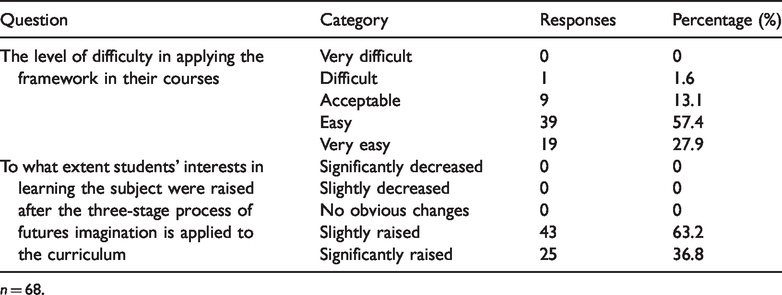
n = 68.
First, in general, most interviewees said that they found adopting the FIE curriculum had positive effects on students’ learning motivations and interests. For instance: Students show greater interest in learning whatever I take into the class, and they are willing to join the discussion or activities in class more often. And what really surprises me is that, not only in the course of futures imagination, the positive and active attitude of studying is also observed in other courses, such as Math, Science, or History class. (Taipei city/Mandarin teacher) After adopting (the) FIE curriculum in my class, I found that students have greater interest in learning and become active in learning. For instance, I found that they actively explore and search information about the course topics after school which means their learning motivations and interests have been stimulated. (Changhua city/science and technology teacher) This is my second-year teaching for the futures imagination course, applying the futures imagination framework. I teach in grade 4 with two different classes. One has been enrolled in futures imagination course in grade 3 and the other has not. With the process of the course, I found out that with those have already attended the futures imagination course for one year, they seem to be more actively and aggressively willing to perform in class. In addition, the overall performance of them appeared to be better (i.e. the academic performance is better, and the participation and involvement of the course are more obvious) from my point of view. (Nantou county/social studies teacher) Compared with the classes where I have not implemented (the) FIE curriculum, students are more willing to speak up and come up with more creative idea(s) in my classes (in) which the FIE curriculum is implemented. In addition, I also found that my students who took courses that integrated futures imagination which (were) taught by the other teacher, are also more interested in topics that are related to the future, what they wanted to do and what can they achieve. I think through this continuous learning path, the students will be better when they grow up. (Taitung county/social studies teacher) My colleagues (i.e. other teachers in school) and I all found that these teaching activities really can inspire students’ imagination and allows students to develop creative thinking skills. Compared with previous classes, we are more likely to cultivate students’ independent thinking and encourage them to express their ideas by adopting (the) FIE curriculum. (Chiayi city/maths teacher) The students who took courses designed with a futures imagination curriculum who graduated from our school are more independent and are able to make their own plans on what they want to do. For example, most of the students from my class went to be volunteers during the summer vacation; some even went abroad and joined international volunteer programs. Compared to other students who did not receive futures imagination courses, their plans for summer vacations were unusual. (Hsinchu city/science and technology teacher)
General discussion
‘The future cannot be predicted, but futures can be invented’ (Gabor, 1963). Time can be seen as a continuous line; both ends are infinite. We have our knowledge and memories from the past, but imagination and creativity for the future. FIE is a reorientation process that redirects students to create a possible better future, bringing a positive attitude to face the future, and enables or empowers the younger generation to adapt to the changing futures.
The results of the Grades 1–9 Action Plan have several implications. First, the findings of the above studies revealed that by implementing futures imagination in the curriculum, teachers can more easily raise students’ learning motivation and interests, and students’ ability to think independently are likely to be nurtured, which will significantly help their personal planning in the future. Contrary to previous curricula in Taiwan, which mostly focus on teaching about the past, by adding a futures-oriented perspective students can be more empowered and confident to face their futures, to cope with future challenges. Previous studies also have shown that future-oriented courses benefit students’ studying ability and attitude (Parker 1989). Zimbardo and Boyd (2009) also emphasized the positive effects of futures thinking on people’s own lives, suggesting that it is possible to make students more confident about their futures in terms of their attitude, thinking and behaviour through education. When combined with imaginative education, it enables students to exercise their imagination, creativity, flexibility and adaptiveness in the face of the future (Schultz, 1995). It is believed that with the appropriate design, the futures imagination curriculum should be able to prepare students for their chosen futures (Bateman, 2014; Hicks, 2008). Thus, FIE could contribute to students’ wellbeing by not only improving their school achievement, but also strengthening their egos and self-esteem and preparing themselves well for the unknown futures.
In addition, as mentioned above, the learning results of FIE courses are inherently less likely to be quantified by traditional paper-and-pencil tests, which leads teachers to decreasingly adopt written tests but increasingly work on more hands-on projects to investigate students’ learning outcomes. Given that traditional examinations are likely to be demanding and to negatively impact students’ wellbeing (Hodge et al., 1997; Mcgraw et al., 2008; Robinson et al., 2009; Smith, 2004), we expect that students will benefit from the current program. With the change of teaching approach in futures imagination courses, the school climate, especially the school value system and teachers’ attitudes, is expected to be altered as well, which in turn has proved to influence students’ psychological wellbeing and academic success (Ruus et al., 2007).
Finally, and most importantly, the results of the above studies show that most participating teachers felt it was easy to implement the FIE curriculum in various subjects. This means that this framework is implementable, and its concepts can be further promoted to other teachers and schools. In effect, while this action plan ended in 2015, not only have the participating teachers continued to implement futures imagination in their curriculum until now, but also the MOE in Taiwan has continued to promote FIE in rural elementary schools from 2019, and, to date, 111 rural elementary school teachers have participated and over 42 courses have been implemented by adopting the futures imagination curriculum (Research Center for Creativity and Innovation, 2020). This also suggests that the positive effects of FIE have been recognized by the participating teachers and the MOE in Taiwan. In effect, the influence of the Grades 1–9 Action Plan can also be seen in the ‘Curriculum Guidelines of 12-Year Basic Education of Academic Year 108’ (also referred to as ‘the 108 curriculum’) announced by the MOE (2019) in Taiwan. In accordance with the proposition of FIE, the 108 curriculum also explicitly focuses on developing students’ core competency for dealing with future challenges (MOE, 2019) This suggests that the concept and principle of FIE continue to disseminate and deepen in education in Taiwan. With the best use of the skills and tools of teaching, futures imagination would, in the end, lead to a better future for the next generations in Taiwan.
