



Abstract
This paper empirically examines differences in how 50-year-olds imagine their future. It draws on answers to an open-ended survey question in a large British cohort study—the National Child Development Study. Over 6,700 written responses about respondents’ imagined future are examined using text mining methods. Results from a relative frequency analysis and a topic model reveal differences according to gender, occupational class, and educational qualification. The cohort members’ written texts reflect different lifestyles. Men are more likely to mention sport, like golf and football, whereas women are more prone to use words related to family and friends. Respondents with a degree are more likely to write about cultural activities, such as museum or theater visits. Overall, the findings reveal gendered and socially stratified patterns in individual future perceptions, contextualized in relation to leisure, health, and family.
Introduction
Differences in all spheres of life can be observed for individuals due to their different positions in society. Based on these positions, some behavior, actions, and preferences are more likely to be observed than others (Bourdieu, 1984). For example, differences in gendered and classed practices are found in the field of cultural preferences, sport, health status, and labor market participation (e.g., Gershuny, 2011; Le Roux et al., 2008; Savage et al., 2013; Warde, 2006). Over the life course, experiences inscribe themselves into the individual and differences in everyday life in various domains can be observed (Elder et al., 2003). We know that actual behavior, preferences, and action are related to social characteristics such as socio-economic status and gender. However, little is known on how individuals imagine their future in relation to those social markers.
This study aims to examine how middle aged respondents imagine their future. Since previous studies have shown that current behavior and preferences differ by social markers, it is very likely that such patterns can also be found in beliefs about one’s future. However, earlier inequalities or differences may dissipate in middle age, before the transition to the third age, where individuals are freed from possible child-rearing responsibilities and participation in the labor market. In addition, when people imagine their future with a different lifestyle, this idea may become a self-fulfilling prophecy (Merton, 1948). Therefore, it is interesting to examine individuals’ self-perception about the future. This empirical article focuses on such perceptions by examining how ideas about one’s own future in middle age differ according to socio-demographic characteristics.
Sociological research uses different theoretical, methodological, and operational approaches to analyze how social markers are related to distinct practices, behaviors, and attitudes (Gayo-Cal et al., 2006, p. 214). In large-scale studies, people are often asked whether and how frequently they engage in specific activities and if they have distinct preferences. In such studies, respondents normally describe how often they did or do a specific activity by selecting from predefined categories (e.g., Bennett et al., 2009; Le Roux et al., 2008). This paper instead focuses on answers to an open-ended survey question, the analysis captures the importance of different aspects, based on their relative frequency in respondents’ written texts. For a long time, closed questions were considered more advantageous than open-ended questions because the latter require human coding and are thus more difficult to analyze (Roberts et al., 2014). This likely makes open-ended questions rare in today’s sociologically motivated large-scale surveys. With the developments in computational text analysis, however, this type of data has become much easier to analyze from a social science perspective and is hence collected more often today (DiMaggio, 2015; Roose et al., 2018).
Using the National Child Development Study (NCDS), a large British cohort study beginning in 1958, this article examines differences in over 6,700 answers to an open-ended survey question. At the age of 50, participants were asked to imagine their life at age 60. In their answers, most respondents tell a short story, usually in a few sentences. These individual narratives are available in textual form. A machine learning approach is used to analyze this unstructured data source. In combination with socio-demographic characteristics such as occupational social class, education, and gender, I am able to observe distinct ways in which people write about their future lives. This paper contributes to the literature on classed and gendered practices by analyzing answers to an open-ended question and by examining how the future is imagined in middle age.
This study goes behind a previous preliminary analysis of a subsample of the data, which analyzed whether a specific category was mentioned. Elliott (2012b) shows that the answers cover different topics. This approach, while insightful, provides a rather broad overview of some defined categories. In contrast to the dichotomous analysis of whether a text addresses a topic, which could mask in topic heterogeneity, this study uses text mining methods to explore how the texts discuss the addressed themes with particular focus on the relative frequency.
After a brief review of the literature on differences in all spheres of life by gender, social class, and education, the previous research using the NCDS data is discussed. The second part of the paper describes the method and its application.
Gender and Lifestyles
The concept of doing gender describes how gender is constructed in interactions (West & Zimmerman, 1987). West and Zimmerman (1987) view “gender as a routine, methodical and recurring accomplishment” (p. 126). In social interactions, doing gender means behavior and perception. Certain activities, behavior, and attitudes are more common in everyday life among individuals who describe themselves as women than among self-described men, or vice versa. From the social constructivist perspective, gendered behaviors are not determined by nature, but are the result of repeatedly iterated action (Lorber, 1994). Thus, gender-related differences can be observed in everyday life, including the fields of sport (Warde, 2006), domestic labor (Breen & Jonsson, 2005; Esping-Andersen et al., 2013), and leisure (Bennett et al., 2009; Gershuny & Fisher, 1999).
Time-use studies report that women spent more time on housework and child-rearing (Esping-Andersen et al., 2013; Vagni, 2020). Women’s participation in the labor market is also more often part-time (Devine & Foley, 2020). Devine and Foley (2020) describe gendered occupations: Women are more likely to work in health and social work, sales, and education. Even though the traditional division of labor is no longer seen as the preferred model (Attar Taylor & Scott, 2018), researchers still observe gendered practice in occupational working hours and household labor, especially in couples with children (Esping-Andersen et al., 2013; Vagni, 2020).
Leisure activities are also patterned by gender; women tend to do high-status leisure activities more often than men (Lizardo, 2006; Purhonen et al., 2011). For the British case, Bennett et al. (2009) find that some activities are more related to masculinity, for example, outdoor pursuits, while preferences for soap operas and romances are more related to femininity.
Gendered choices also appear in the field of sport (Warde, 2006). Men are more likely to participate in team sports, which can be traced back to the large share of men playing football (Gershuny & Fisher, 1999; Warde, 2006). Golf is another sport more often done by men. Women are more inclined to exercise, favoring yoga and aerobics (Warde, 2006).
Based on the previous theoretical and empirical work, I assume that gender patterns emerge in individual visions of the future.
Social Stratification and Lifestyles
Differences in various domains of everyday life can be identified not only by gender but also by socio-economic status. This section elaborates upon differences in leisure activities in particular. Research on leisure activities often focuses on cultural activities. Studies that posit the existence of a correspondence between social position and cultural preferences frequently follow the assumption of homology. This homology thesis is theoretically informed by Bourdieu, who shows that action is linked to a person’s social status. His concept of habitus, a system of dispositions to certain practices, aims to explain social differences in behavior (Bourdieu, 1990a, p. 77). The long and ongoing process of socialization forms one’s habitus and the conditions under which an individual’s habitus emerges greatly impact later actions (Bourdieu, 1990b, p. 55). These conditions are related to the availability of economic, cultural, and social resources. Bourdieu (1984) elaborates on the connection between habitus and lifestyle in his famous oeuvre Distinction, in which he describes French society in the 1960s and 1970s. He analyzes differences in many aspects of life, including sport, eating habits, socializing, and other leisure activities. Dispositions are acquired and can be observed in the different possibility of specific activities carried out by individuals.
Two other prominent theses belong to the debate about social stratification and cultural consumption. In addition to the homology thesis, these are the individualization and omnivore-univore approaches. The former thesis claims that classed behavior is dissolving and choices in lifestyle instead reflect individual decisions, rather than being a reflection of correspondence between class and lifestyle (Bauman, 1988; Beck, 1992). The latter thesis describes cultural consumption rather than lifestyle in general (Chan & Goldthorpe, 2007). Cultural omnivores are described as having broadly varied taste including both highbrow and lowbrow taste, which separates them from univores (Peterson, 1992). In other words, omnivores cross traditional cultural genre boundaries. Studies describe those two patterns for music, art, film, theater, and dance (Chan & Goldthorpe, 2005, 2007). These so-called omnivores are more often found in the higher social strata (Chan & Goldthorpe, 2007).
Studies using data from the Cultural Capital and Social Exclusion project find socially differentiated patterns of taste (Bennett et al., 2009; Gayo-Cal, 2006; Gayo-Cal et al., 2006; Le Roux et al., 2008; Li et al., 2015). Differences in everyday and cultural life by social markers are manifest in numerous situations, and research finds evidence for social stratification in the areas of music, reading, film, arts, and leisure. For example, opera and art galleries are more favored by respondents with more formal education and those in professional occupations (Gayo-Cal, 2006), who are also more likely “to watch less than an hour’s television on a weekday, own books, and like rock music and modern jazz” (Gayo-Cal et al., 2006, p. 230). Analyses on data from the Great British Class Study also depict class differences. A new measure for class is constructed, and those from the higher social strata are more likely to engage in highbrow cultural activities, but are also described as omnivores (Savage et al., 2013).
Since this study focuses on how the future is imagined, other topics related to social stratification are also relevant. First, however, it looks more closely at other leisure activities. Some sport activities are associated with social class and education (Warde, 2006). In Britain, bowling and dancing are more common among the working class, while squash, cycling, and golf are more prevalent in the middle class. Some activities do not show a class pattern, for example, walking, swimming, and football. For educational qualification, Warde (2006) finds no strong differences in the preferred sport; however, doing sport, in general, is strongly related to the highest qualification.
Varying levels of participation in sport is one driver that can describe unequal health status between socioeconomic classes. Socially better off individuals have, on average, a higher life expectancy and spend more years in good health compared to those worse off socio-economically (Marmot, 2020). Aside from sport activities, differences in behavior and knowledge, peer influence, etc. account for the different health outcomes (Phelan et al., 2010).
Differences in working time can also be observed by social class. Professional occupations are related to longer working hours (Gershuny, 2011; Vagni, 2020). Those in other jobs are more likely to face non-standard work schedules. This can impact leisure enjoyment if, for example, payed work is conducted on the weekend (Vagni, 2020).
In summary, previous research identifies the relationship between socio-economic position and different practices, behaviors, and preferences in many spheres of life. However, those studies focus primarily on actual or current action. Since differences occur in so many domains, I expect that socio-economic patterns can be found in individual future perceptions. Individualization theory could also lead to an opposite hypothesis, however. Due to increasing individualization (Beck, 1992), it may be impossible to identify patterns according to socio-economic situation in the individual life conceptions.
Hypotheses
This study tests the following hypotheses:
Hypothesis 1: Gender-based patterns emerge in how individuals imagine their future.
Hypothesis 2: Patterns emerge in how individuals imagine their future based on social class and education.
Previous Research on Individuals’ Perceptions of the Future
To the best of the author’s knowledge, there are no large-scale studies on how people imagine their future. Thus far, research on the answers given at age 50 in the NCDS has only used sub-samples of the data (Elliott, 2012b). The same is true for the answers from the same cohort members at the age of 11 (Elliott, 2010; Morrow & Elliott, 2021), but were examined for differences in language skills with a larger sample (Weber, 2021).
Gender-based differences are especially apparent in childhood. In 1969, the 11-year-old cohort members described how they imagined their life at the age of 25. The subset of 495 answers used in the analysis centered on possible jobs, domestic work, and family life. A clear pattern by gender emerged in the answers, whereas social class differences did not emerge so prominently (Elliott, 2010). For the answers given at age 50, Elliot notes in a preliminary analysis of 370 answers that “aspirations for life at 60 are remarkably un-gendered” (Elliott, 2012b, p. 19). However, she finds evidence for a pattern based on social class. Cohort members in managerial and professional occupations are more likely to write about work, leisure, and money than those cohort members in intermediate and routine occupations. In general, the sub-sample analysis reveals that work, health, family, leisure, and travel are the most prevalent topics in the answers of how the cohort members imagine their life at age 60. However, the dichotomous coding of the answers into predefined categories could obscure internal variation. For example, when respondents write about leisure, they might address different activities. In addition, Elliott (2012b) does not address the relative frequency of different themes in the answers.
Since the previous analysis only distinguishes whether a respondent mentions a certain topic or not, it is interesting to analyze how respondents refer to specific topics. For example, are different leisure activities mentioned according to social characteristics? Therefore, this study expands on the previous analysis of the data subsample by analyzing all answers given at age 50 and the topics that they address with a relative frequency approach. This paper uses text mining to depict differences in the content of the answers given in the NCDS.
In summary, previous theoretical and empirical approaches reveal social differences for all spheres of life. In contrast to previous analysis of actual lifestyles, this study analyzes how people imagine their future lives. To do so, this study relies on a rich data source—responses that members of a cohort wrote to an open-ended question. These texts can reveal further differences in all spheres of life, since individuals are not forced to choose from predefined categories like they normally do in large-scale surveys. The analysis uses text mining methods to uncover differences in the content of individual’s perceptions of the future.
Data and Methods
This study uses data from the National Child Development Study (NCDS), a large British cohort study. Every birth in England, Scotland, and Wales from one week in March 1958 was registered and is included in the survey. Initially, the sample included over 17,000 babies. After the initial interview with the parents, the study participants were interviewed repeatedly after they turned 7 years old. In 2008, 8,844 cohort members answered a questionnaire that they received in advance of a face-to-face interview. At the end of the questionnaire, respondents were asked to imagine their lives one decade later: “Imagine that you are now 60 years old. . .please write a few lines about the life you are leading (your interests, your home life, your health and wellbeing and any work you may be doing)” (Elliott, 2012a). This open-ended question was answered by 7,383 cohort members. The answers were transcribed and anonymized before being archived and the data is available from the UK Data Archive (University of London, Institute of Education, Centre for Longitudinal Studies, 2012). Of those 7,383 answers, this study examines the 6,771 answers that were left after undergoing pre-processing for the quantitative analysis, which is described in the following.
The first step of data preparation reduces the words in the answers to their lemma. A lemma is the dictionary form of a word. For example, plurals and conjugations are mapped to one lemma in the process of lemmatization. I lemmatized the answers with the Java Stanford NLP Toolkit (Manning et al., 2014). Second, common words that carry little meaning are removed. These words are called stop words and normally occur very frequently in texts, for example, articles and auxiliary verbs. I use two stop-word lists provided by the R package quanteda (Benoit et al., 2018) and Terrier (Ounis et al., 2005) in addition to a stop-word list that I created to capture insignificant words. This list removes unspecific words, for example, “year,” “e.g,” and “60-year-old.” I also remove numbers, punctuation, and symbols with a function provided by quanteda. Next, all remaining words are stemmed. A stem is the reduced form of a word. I use stemming to map the same meanings with one word and reduce lexical diversity. For example, the adjective happy and the noun happiness are reduced to the stem happi. In this case, the stem is not a correctly spelled word per se. Another step to reduce the vocabulary removes all words that occur less than five times in total; this step removed 4,722 stems. Since the topic modeling algorithm works better without very short answers, I remove answers consisting of less than five terms after the pre-processing steps. This step removed answers such as: “same as now,” “stupid question” and “can’t imagine.” After pre-processing, 6,671 answers with 1,863 stems remained for examination. A document-term matrix (DTM), which counts all the occurrence of a word stem for each answer, was built for the statistical analysis. Figure A1 in the Appendix plots the most frequent stems left for examination in the DTM.
In addition to the textual answers, this study uses variables from the dataset that measure education, gender, and social class (Table 1). A categorical variable measures respondents’ highest educational qualification. The categories are aggregated to differentiate between respondents with and without a degree to demonstrate the impact of higher education and make the results easier to interpret. Social class is captured with an occupationally-based measure, the National Statistics Socio-Economic Classification (NS-SEC) of Great Britain. The NS-SEC groups occupations to conditions and employment relations (Rose et al., 2005). I collapse the eight-category version to a four-class version, similar to the three-class version, but with a further distinction between lower managerial or professional occupation and higher managerial or professional occupation. The variable uses the occupation at age 50, or the last occupation in the 5 years prior. Furthermore, this study includes the categories missing, sick, retired, and home/family to avoid excluding cohort members who belonged to these categories. Gender is also included in the analysis.
Descriptive Statistics Concerning the Analyzed Sample.

I apply two text analysis methods with the statistical computing software R: Relative frequency analysis and topic modeling. The first method identifies words that occur relatively more frequently in one group than in another group. These terms are extracted with the quanteda package (Benoit et al., 2018). A chi-squared value, named keyness, is calculated for the words in the corpus (Bondi & Scott, 2010; Stubbs, 2010). I only do this for words that appear at least 25 times in the corpus, so rare words are not considered. High chi-square values indicate that a word is relatively more frequent in the group of interest than in the reference group. For example, the contrast for education shows terms that are relatively more frequent among respondents with a degree compared to those without a degree and vice versa.
To analyze latent topics by social markers, I estimate a structural topic model using the package stm (Roberts et al., 2019). A topic model clusters terms from a corpus to topics. Words that co-occur often share a latent theme (Blei, 2012). The algorithmic approach aims to find those latent topics. However, the number of latent topics must be specified ahead of time. Then, the algorithm iteratively finds two probability distributions, one for the terms and the other for the topics. For all of the answers, the topic probabilities sum up to 1, where each topic is found with a probability from 0 to 1 in each answer. Each topic is a distribution of terms, which means that terms in a topic have their own probability for belonging to the topic. This algorithm works with a so-called bag-of-words approach, because the fitting process does not take the positions of the terms in a document into account. However, additional information can be passed in the estimation process. The structural topic model enables the use of topical prevalence covariates (Roberts et al., 2019). I use gender, social class, and education as covariates in the fitting process. Another algorithm sets the number of topics; Lee and Mimno (2014) introduced an approach to automatically set the number of topics. In this analysis, the obtained value is used to estimate a topic model with 56 latent topics. For each cohort member the probabilities for all of the 56 topics sum up to 1. If an answer uses many terms from a certain topic, that topic has a high topic probability for this answer. Texts with a high topic probability for a particular topic provide insights into the latent theme of the regarded topic.
Results
Overall, the respondents address work, family, health, and leisure activities in their answers, as the question demanded. Figure A1 presents a word cloud with the terms (stemmed words) that occurred most frequently in the answers.
Table 2 reports keywords for the categories of educational qualification, occupational class, and gender. Education separates the cohort into two groups—respondents with and without a degree. For respondents without a degree the most discriminating words are “grandchild” and “love,” while they are “teach” and “ski” for respondents with a degree. In the former group, the keywords with the highest chi-square values are related to family. This group is also more likely to mention the terms “health” and “money.” Highly educated respondents, in contrast, are more likely to talk about activities (“ski,” “travel,” “tennis,” and “paint”) and teaching, which mostly refers to teachers, who are writing about their work.
Relative Frequency Analysis.
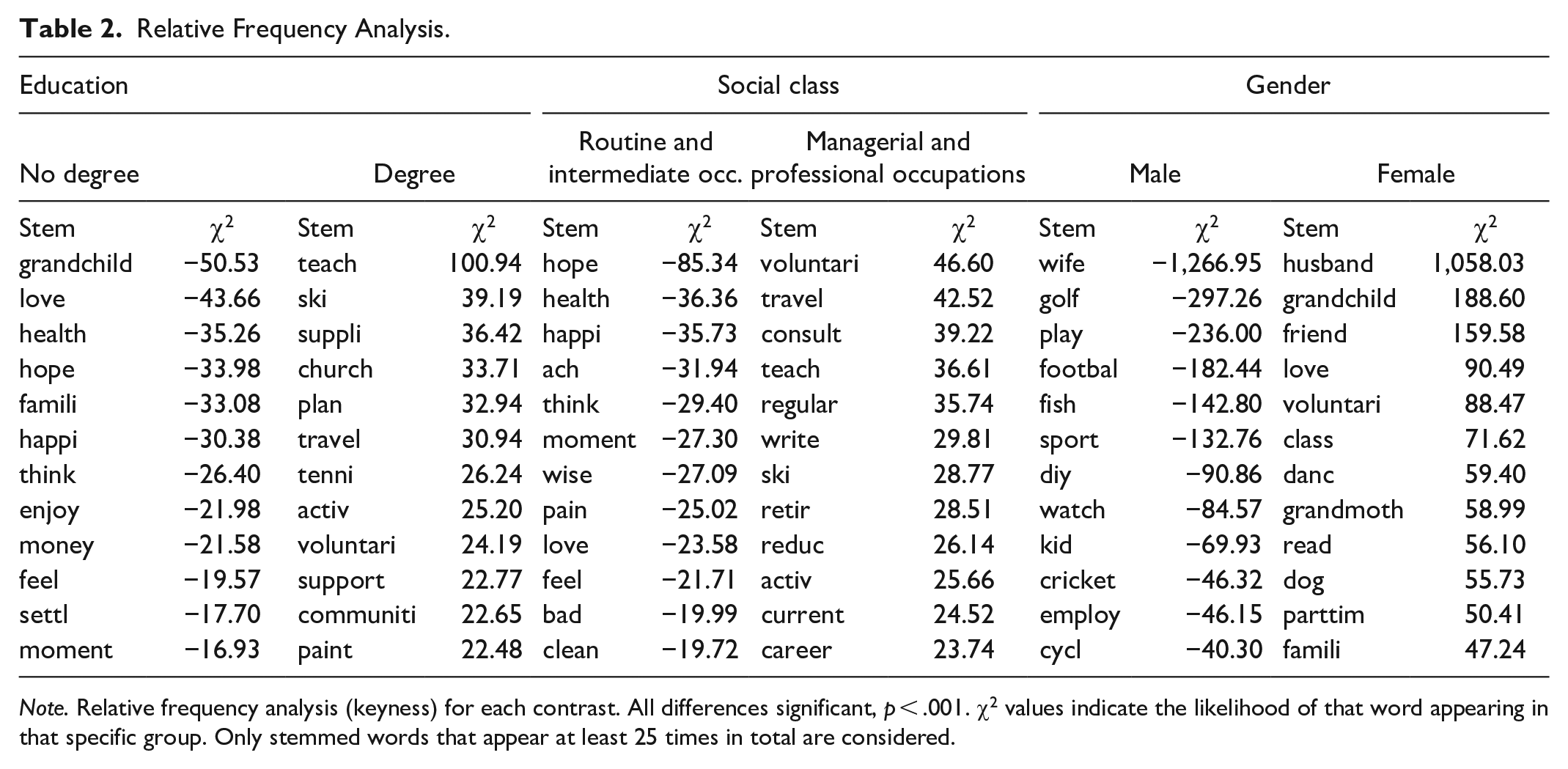
Note. Relative frequency analysis (keyness) for each contrast. All differences significant, p < .001. χ2 values indicate the likelihood of that word appearing in that specific group. Only stemmed words that appear at least 25 times in total are considered.
Similar results come from the differentiation between managerial or professional occupations (lower and higher) and routine or intermediate occupations. Respondents from the latter group are more likely to mention the words “pain,” “aches,” and “health.” They use these words relatively more often in their narratives than respondents with a managerial or professional occupation. In contrast, they are more likely to talk about retirement and travel plans.
The highest chi-squared values emerge for the differentiation between male and female respondents. Cohort members with partners write about them, so heterosexual female respondents tend to write about their “husband,” while male respondents mention their “wife.” Besides this obvious split, men are more likely to mention specific activities like “golf,” “football,” “fishing,” “cricket,” and “cycling,” whereas women are more likely to talk about family with the words “grandchildren,” “grandmother,” and “family.” In addition, women tend to imagine their future with volunteering, dancing, and reading more than men do.
Of these three factors, the highest chi-squared values can be found for gender, indicating that there is a gendered imagination of their future. Even disregarding when respondents name their partner, high chi-squared values are found for male respondents for sport and for female respondents for “friends” and “grandchildren.” Weaker chi-squared values can be observed for the other contrasting factors, social class, and education. However, differences are observable between managerial and professional occupations and those in routine and intermediate occupations: the latter are more concerned with internal matters, while the former are more likely to imagine retiring and traveling.
The relative frequency analysis shows differences in how 50-year-olds imagine their future. In addition to sole differentiation in used (stemmed) words, a topic approach analyzes how often specific topics are addressed. The algorithm was initialized to find the number of topics automatically, resulting in a model with 56 topics. I selected 11 topics for closer examination, based on their clarity and relevance. I labeled those topics, after inspecting the most probable terms and reading the answers with the highest topic probability for each topic. Table 3 gives an overview of the topics.
Topic Model.

The most probable terms for the topic expenses are “forward, pay, pension, mortgag, free, afford, save, bill, debt, extra.” The answer with the highest topic probability consists of terms from this topic several times. Table 3 shows an excerpt of an answer with a high topic probability for this topic. In addition to the excerpts in the table, some full answers are provided to demonstrate that most respondents’ answers address several different topics. A short answer that has a high topic probability for the expenses topic also addresses health, work and leisure. However, words for the topic expenses are more frequent:
“Same work paying mortgage & bill & taxes hobbies - same health - same” (no degree, routine occupation, male)
Two topics address health issues. A sample answer reports back problems and high blood pressure:
“I don’t work due to illness I had 2 mini stroke I am on Incapacity and DLA. I have high blood presure. I also have very bad legs and a very bad back. I cannot work due to illnesses.” (no degree, routine occupation, female)
Other topics include sport, such as football, golf, cricket, and exercise. Respondents plan to go to the gym and hiking, for example, which is covered by the topic exercise. A female respondent occupied in the lower managerial/professional field writes about diverse topics:
“Although I am sixty, I am still fit & healthy. I attend the gym regularly & go hill walking as often as possible. Family remains very important, spending time with children & grandchildren. My husband & I enjoy travelling to exotic locations. We recycle everything we possibly can & we have moved to a smaller house in a more rural location.” (no degree, lower managerial/professional occupation, female)
Football and sport, in general, is covered by the topic sport/football. A sample answer also describes the favored sport club:
“I AM STILL INTERESTED IN MOST SPORT ESPECIALLY FOOTBALL & MANCHESTER UNITED. I AM STILL MARRIED TO MY WIFE BUT MY THREE SONS HAVE ALL MOVED AWAY FROM HOME. MY HEALTH IS STILL GOOD ALTHOUGH I GET A FEW ACHES & PAINS NOW. I AM STILL WORKING IN A GARAGE & STEWARDING AT {TEAM}” (no degree, routine occupation, male).
Another topic captures playing golf or tennis, which also includes some music words. However, most of the answers with a high topic share include golf or tennis, such as this one: I will be retired, possibly working just a couple of days to keep myself active, looking after our grandchildren. She will probably still have me decorating the place 24/7, Changing Colour Schemes and Knocking down walls then putting them back up. Hopefully I will still be playing golf with my sons and still going to football. This all really can only be possible if the ole ticker plays along and doesn’t throw another wobbler. (no degree, lower managerial/professional occupation, male)
The cultural entertainment topic relates to visits to theaters and cinemas but also seeing friends. An answer from a respondent with a degree, which scores high on the entertainment topic, also describes retirement plans:
Retired - spend time travelling - walking & cycling. Spend time in the garden. Regular visits to the Theatre Cinema & Concerts. (degree, lower managerial/professional occupation, male)
Other topics deal with gardening, driving, socializing, and other diverse activities. The gardening topic includes words that refer directly to gardening, like “garden,” “grow,” “vegetables,” however, some health-related words are also in the topic’s most probable words, for example “pain.” A sample answer that scores high on this topic shows a possible connection:
“I’m still working part time. Gardening with a few more aches and pains. Hope I’m not lonely.” (no degree, routine occupation, female).
The driving topic is related to the use of cars or (motor) bikes.
STILL WORKING! STILL RIDING MOTORBIKES & CARS (FOR FUN)! ALL THE DIY DONE! DEAF AS A POST! JOINTS IN THE BODY CLICKING! (no degree, intermediate occupation, male)
The topic socializing is about meeting (new) people and friends, but also covers learning new skills. Which can, for example, be seen in the first sentence of this answer:
“My interests are reading, travelling, gardening, meeting people, learning new skills and languages. [. . .]” (no degree, intermediate occupation, female)
The diverse activity topic includes words related to home activities, like reading or watching TV.
“I am leading a fairly happy life enjoy listening to music watching TV going out socialising enjoy a glass of wine when relaxing I am very healthy” (no degree, routine occupation, female)
These sample answers show that respondents’ ideas about their own futures usually address several issues. The topic model assigns all answers a topic probability between 0 and 1 for each topic. To analyze group differences, Figure 1 shows the topic prevalence according to social class, education, and gender. If a coefficient’s 95% confidence interval bar does not overlap with the dotted line, there is a significant difference in topic prevalence in the two groups. The coefficients for social class contrast the respondents who are employed in routine and manual jobs with those in higher managerial or professional jobs. Respondents from the lower social strata are prone to mention the topics gardening, diverse activities, and health problems more often. In contrast, the topics sports, cultural entertainment, exercise, and play golf are more likely to be mentioned by cohort members from the higher social strata. Accordingly, sport and exercise, together with cultural entertainment activities, are of greater importance for respondents in professional occupations when imagining their future.

Differences in topic prevalence by social class, education, and gender.
Mostly smaller coefficients are found for educational qualification, where all study participants are contrasted. Some of the topic coefficients have a similar position to the first subgraph, like the coefficients for the topics cultural entertainment and exercise. Answers from respondents with a degree cover those topics to a higher extent. There are no significant differences for the other sport-related topics. The topics socializing and cultural entertainment are more prominent in the answers from respondents with a degree.
For gender, the highest difference in topic prevalence is found for the play golf topic. Male respondents are more likely to write about playing golf or tennis. In addition, they are prone to capture the topics football, driving, and expenses. Female cohort members imagine gardening, socializing, exercising, and cultural entertainment activities more often. Thus, there is a clear gendered imagination of the future.
Discussion
Summary
In the empirical analysis of 6,771 narratives about how the surveyed people imagine their future, this paper reveals that cohort members with different social characteristics address different issues. In other words, gender, social class, and educational level all affect how people imagine their own future. In middle age, experiences from the course of life inscribe themselves into people’s identities, so that certain behaviors, actions, tastes, and preferences are more probable for some social groups than for others.
Differences tend to be higher for gender than for social class and education. This finding contrasts a previous analysis of a subset of the answers from the 50-year-old respondents. Unlike the preliminary analysis from Elliott (2012b), this article analyzes a larger sample and delves further into the topics by using different methods to analyze the content. By analyzing 370 answers, Elliott (2012b) finds that gender does not affect the answers to a large extent, which may imply that traditional gender roles are dissolving. The percentage of people who hold traditional gender roles is falling continuously. The British Social Attitudes Study reports that less than 10% agreed with the statement that men should earn money and women should look after the home (Attar Taylor & Scott, 2018). However, this study reveals that this cohort indeed shows distinct gender differences in how the future is imagined. The analysis reveals that women are more likely to mention words related to family. Men also write about family, but women do so more often in the analyzed answers. A further difference is in sport activities: men are more likely to write about football, golf, and cricket. On the other hand, women are more likely to mention exercising in their answers. This is in line with previous research on sport preferences (Gershuny & Fisher, 1999; Warde, 2006). Men are also more likely to talk about driving a car and riding a bike or motorbike, while women tend to write more about cultural activities, which confirms previous research (Bennett et al., 2009; Lizardo, 2006). Overall, masculinity emerges through the dominance of sports in the answers, while femininity is constructed through a focus on family.
Social class differences in how the future is imagined emerge in managerial and professionally occupied people’s writing about retirement and travel plans, while those in other occupations are more likely to mention health problems. Respondents from the higher social strata indeed address health in their answers, but they do so relatively less frequent and with other words, like “staying fit”; the topic exercise from the topic model also reveals this difference. Other topics that are more prevalent in answers from higher managerial and professionally occupied cohort members are cultural entertainment activities and playing golf. Respondents from the lower social strata are more likely to write about gardening and other entertainment activities, such as watching TV and listing to music. This is in line with previous research in the cultural field (Gayo-Cal, 2006; Gayo-Cal et al., 2006). For education, where respondents are grouped into either having a degree or not, differences are smaller for the examined topics. However, cultural entertainment activities and exercising tend to be more prevalent in the answers from respondents with a degree.
The results support both hypotheses. Based on this study, a far-reaching individualization as described by Beck (1992) cannot be assumed. Differences in the imagination of the individual future can be observed by socio-economic status and gender. Thus, not only current practices and preferences are structured according to social markers (Bourdieu, 1984), but also those relating to the future.
Limitations
The most serious limitation of this study is that it excludes answers with very few words after pre-processing the texts. Excluded answers mostly mentioned that cohort members imagined their life being “the same as now,” or in other words, that the respondents imagine no changes in their life 10 years later. Another limitation concerns the textual answers; respondents with higher education or who write a lot in their work or leisure time are more used to writing. The average length of the answers differs by educational level and social class. The analysis takes this into account by focusing on relative measures, but respondents with shorter answers may have skipped some issues.
Using categorical variables to depict how class, education, and gender are related to an imagined identity does not reflect the complexity of the theoretical assumptions that describe fluid or multidimensional concepts. However, in order to analyze this rich source of data, simple differentiations are used to empirically investigate how social characteristics are associated with different ideas about the imagined future.
Conclusion
The empirical analysis reveals that there are gendered and socio-economic status patterns in how 50-year-olds imagine their life at 60. Previous findings on lifestyle preferences support the results of this study. However, this article uses different methods on a rich data source: cohort members’ written answers to an open-ended question in a large-scale survey. The frequency analysis and topic model show effects on how social markers translate into imagined life concepts. These methods are valuable for analyzing large samples of text, as they reveal that individuals, in their own words, address similar issues which are captured in traditional large-scale analyses. This paper contributes to the field by showing that differences in how the future is imagined in middle age is related to gender, social class, and educational qualification.
Footnotes
Appendix
Acknowledgements
I would like to thank the participants of the ECSR Conference 2017 for their helpful comments and suggestions.
Declaration of Conflicting Interests
The author declared no potential conflicts of interest with respect to the research, authorship, and/or publication of this article.
Funding
The author received no financial support for the research, authorship, and/or publication of this article.
