




Abstract
Enabling educators to meet new and challenging times requires fundamental shifts to ways of imagining and enacting their practice. A central yet often understated aspect of this educational change are the various ways in which educators receive training and development. From initial teacher training through to continuing professional development, cultures which underpin policy change in educational institutions emerge from the practices of educators. In this paper we examine educators’ experiences of a Wild Pedagogies gathering which took place over three days in central Devon in late spring 2019. Part workshop, part informal social gathering and mutual exchange, this continuing professional development event enabled conversations, sharing (and shaping) of practice, and imagination of the future of personal and institutional educational priorities. This paper positions itself as an account of a gathering of wild pedagogues – captured as reflection, discussion and activities – and brings the participants’ reflections into conversation with wider themes emerging from previous Wild Pedagogies gatherings. It makes the assertion that such dialogic continuing professional development, constructed on foundations of relational and place-responsive pedagogies, can underpin future practitioner development in the event of a policy shift toward greater availability of outdoor learning and nature connection in the UK. The paper ends with four principles for infusing new or existing environmental education continuing professional development with place-responsive and wild pedagogical approaches.
Keywords
Introduction
At the time of writing this paper the UK is engaged in a systemic response to the 2020 coronavirus pandemic. Our schools, businesses, institutions and places of work have closed, with much of the population in ‘lockdown’ – working from home or furloughed from employment. While the implications of such a radical departure from the normal routines of life are forcing us to look again at how we have come to organise society, many thoughts and conversations are turning to the outdoors and our connection to the natural world. Newspapers are running articles extolling the virtues of slowing down, noticing the dawn chorus and taking time to witness the seasons (e.g. Moss, 2020; Stoppard, 2020). Gaby Hinsliff noted in one such article that ‘our relationship with the natural world is changing as this crisis strips away the layers between humans and the surroundings we used to be too busy to take in’ (Hinsliff, 2020). Meanwhile, serious policy discussions are being had about how outdoor education might be one approach to bring children back into schools safely (e.g. Brooks, 2020; CLOtC, 2020; UNICEF, 2020). For those working in the outdoor and environmental education worlds, this is an important shift in the public narrative.
Of course, the evidence for the benefits of outdoor learning is not just in the pages of the press, but in the many recent studies conducted into dual strands of intersecting outcomes of nature connection: improved mental health and wellbeing (Pritchard et al., 2019; Wolsko and Lindberg, 2013), and the development of pro-environmental behaviours (Defra, 2018; Lumber et al., 2017). While a steady decline of connection to nature has been observed for some time across all age groups (Richardson et al., 2019; Soga and Gaston, 2016), the current crisis has thrown into stark contrast the importance of natural connection and relationship within the outdoors. For some the Covid19 pandemic has provided benefits – indeed a chance to slow down and appreciate outdoor spaces; yet for many others this has been a time of captivity and restriction. Some have been quick to highlight the limits to rights of access on land which is privately owned, the injustices demonstrated by vastly different abilities to access green spaces, and the issues this causes for many looking to mitigate the health and wellbeing implications of the pandemic (Gray and Kellas, 2020; Monbiot, 2020; Shrubsole, 2020).
For an environmental education movement trying to find its feet at a time of looming climate crisis, these conversations provide an opportunity to reimagine initial teacher training (ITT) and continuing professional development (CPD) approaches appropriate to the current time (Collins et al., 2020). Evidence suggests that we desperately need to move beyond the well-rehearsed focus on knowledge acquisition toward relational approaches which build connection (Heimlich et al., 2013; Lumber et al., 2017). Increasingly it is argued that nature connection needs to encompass emotions, deeper understandings and moments of reflection (Carmi et al., 2015; Conradson, 2005). While the upheaval felt by a world in flux might give educators reason to challenge their personal practice, equipping the system and those who work within it with the skills and confidence to undertake such a rethink is another step that must also be taken. Mannion et al. (2013) suggest that time in nature with learners demands from educators a deeper set of interactions based on the particularities of the locale, which they term ‘place-responsive pedagogies’. The authors suggest that such an approach might involve ‘interactions in outdoor natural places that are flexible, contingent, open-ended, yet purposeful tasks through being for the aim of understanding and improving human–environment relations’ (Mannion et al., 2013: 803).
While some teacher educators will be drawn to consider issues such as access and implications for the delivery of curricula in out-of-classroom settings (Castle et al., 2010; Fuller et al., 2003), others will ask how we might begin to develop the necessary competencies of teaching staff (Beames et al., 2012; Mannion et al., 2013). In particular, the ways in which educators step outside the classroom and the school grounds, into the surrounding community and beyond, is governed by the ways in which they see themselves, their roles and their own connection to the outdoors; and this in turn is systematically shaped by policy – setting the cultural agenda for education. We can look to the experiences of the policy shifts enacted by the Scottish Government when they unveiled the Curriculum for Excellence; weaving together citizenship, sustainable development and outdoor learning, to Connect children and young people with the natural world, with our built heritage and our culture and society … [and to] … encourage staff and students to see each other in a different light, building positive relationships and improving self-awareness and understanding of others (Scottish Government, 2014).
This paper details a gathering of educational practitioners under the theme of ‘wild pedagogies’, and provides discussion on its value and purpose, alongside opportunities held in such events for CPD and teacher training. The gathering was inspired by the historical nature connection movement including Earth Education and Deep Ecology (Devall and Sessions, 1985; Van Matre, 1990), but particularly more recent relational conceptions of outdoor education, including Wild Pedagogies (Jickling et al., 2018). As such, the paper critically engages with emergent themes and commonalities found between these forms of gathering and previous explorations of Wild Pedagogies. The convenors of the gathering (the authors of this paper) invited a group of educators to reflect on the purpose and potential of wilderness and pedagogies, and the possible directions for wilding education policy – particularly the role of teacher development and training, in a setting which supports open-ended interactions and purposeful tasks. What follows is an overview of the organisation, delivery and reflections on this programme; a discussion of the value and outcomes of the gathering; and a critical engagement with the opportunities present for educators. We have organised our discussion into four principles which find commonality with the six wild pedagogies touchstones found in Jickling et al. (2018). These principles seek a nuanced and practical grounding and are offered as a catalyst for thinking at a time of great crisis, where the opportunity for deep reflection about what comes next for education has never been more pressing.
An emerging wild policy and teacher training context
Given the extent of the global environmental and climate crisis, many educators are now looking to new ways of equipping themselves for educating younger generations growing up in an increasingly turbulent and uncertain future. Recent global educational initiatives are seeking to help meet this ITT and CPD need. For example, in the face of under-developed curricula engagement with the climate crisis, the UN Climate Change Teachers programme has developed a CPD course (UN, 2020). In the UK alone, this CPD opportunity has reached over 30,000 educators and includes establishing a national benchmark for primary and secondary teachers (UN, 2020). Similarly, a lack of explicit sustainability curricula links with marine issues has seen an upsurge of interest in Ocean Literacy education in Europe resulting in pan-continental training programmes (Fauville, 2019; Parr, 2018). Engagements with sustainability education on various scales are occurring despite relatively little incentive or resourcing from governmental bodies, and educators themselves are realising the need to build capacity, understanding and resources to better equip themselves to prepare their students for a sustainable future (Huggins and Evans, 2017). Although in the UK we are yet to see policy guidance for educators emerging from the 2019 declaration of a climate and ecological emergency, it is clear that ITT and CPD opportunities will continue to play a crucial role in enhancing and informing educational practices as society orientates itself to face the challenges ahead.
Within the current frameworks underpinning ITT and CPD in the UK, there is reason to be hopeful that such relational and place-responsive approaches might find purchase. The UK standards for teachers’ professional development focus on improving pupil outcomes (DfE, 2016). They aim to achieve this through both direct and indirect approaches to improving teacher practice. In particular, indirect professional development provides an opportunity to consider the development of educator competencies and expertise in new settings – with opportunities to improve both educational practice and student outcomes.
The difficulty here however is the seeming emphasis on outcomes. Instrumental learning is the mainstay of UK educational policy, and little room is made for developing the competencies for ‘complexity, the unknown and spontaneity’ (Jickling et al., 2018: 84) within such a prescribed framework. How then should we proceed, in order to rewild education at a time of such crisis? Achieving a blended approach to CPD which strikes a complementary balance between instrumental and emancipatory pathways seems one plausible approach. Such a blended approach lends itself to the paradigm teachers are currently having to work within, while developing opportunities for exploratory and emergent learning outcomes too (Wals, 2010). Indeed, the enmeshed position of teachers taking part in outdoor activity with groups places them in the most opportune situation to develop these two strands of professional development. Mannion et al. (2013: 805) comment on this by suggesting that ‘place-responsive curricula as lived are brought about by a co-authoring or intermingling of the human and non-human via teachers’ (and pupils’) responsiveness to a changing and contingent environment’. Such intermingling is arguably inevitable for outdoor education; thus, it is the development of competencies and experience in facilitating this which wild pedagogies CPD might focus on. Here, then, the wild place of gathering provides something that other instrumentally focused provisions do not: they give educators an opportunity to develop aspects of their practice which resist plans and outcomes. In so doing, open space is created for ‘the possibility for the unexpected connection to be made, the unplanned event to occur, and the simple explanation to become more complex’ (Jickling et al., 2018: 84).
Further, such wild pedagogies CPD approaches develop experiences which give space for relational encounters with other ecologies and the emergent aspects of place – for ‘locating the wild’ as the Crex Crex collective put it. If then, as this paper is implying, such a wild and responsive approach to learning in outdoor places can be positioned as a complementary rather than competing approach to teacher CPD, what have we learnt from our own attempts at developing such training and working with educators which might signpost educational policy development?
Jickling et al. (2018) provide six touchstones for developing wild pedagogies in practice, while Mannion et al. (2013) have made assertions regarding teacher education and professional development for preparing teachers to become place-responsive. Bringing these previous observations together with the reflective discussions that have emerged from our own wild pedagogies work, a particular need surfaces – that of community and mutual support. As one educator we have worked with puts it, how do we find ‘connection and fellowship held in a landscape of acceptance and nourishment which allows us to let go, embrace change, and draw collective strength?’
A Devon Wild Pedagogies gathering
A year after the publication of Wild Pedagogies – charting the travels and musings of the ‘Crex Crex collective’ as they ventured by sail through the islands of the Inner Hebrides on the west coast of Scotland (Jickling et al., 2018) – a small group of educators in the south-west of the UK began to consider what such a gathering would look like if undertaken in the rolling pastures and uplands of Devon.
Previous symposiums and gatherings shared important common ground in that they took place on foot or boat, far away from cities and towns. 1 Yet, somehow, with its deep cultural and natural histories, a past mottled with industry, and its changeable weather, significant similarities could be found on the escarpments of Devon. Farmland in the UK (such as Oxen Park shown in Figure 1) is often rich in wildlife, and bursting with interest and intrigue. Thick, uncut hedgerows, woodland borders, uncut meadows, ponds, orchards and mixed field-scale market gardening approaches all do their bit to diversify life and add tapestry to the landscape.
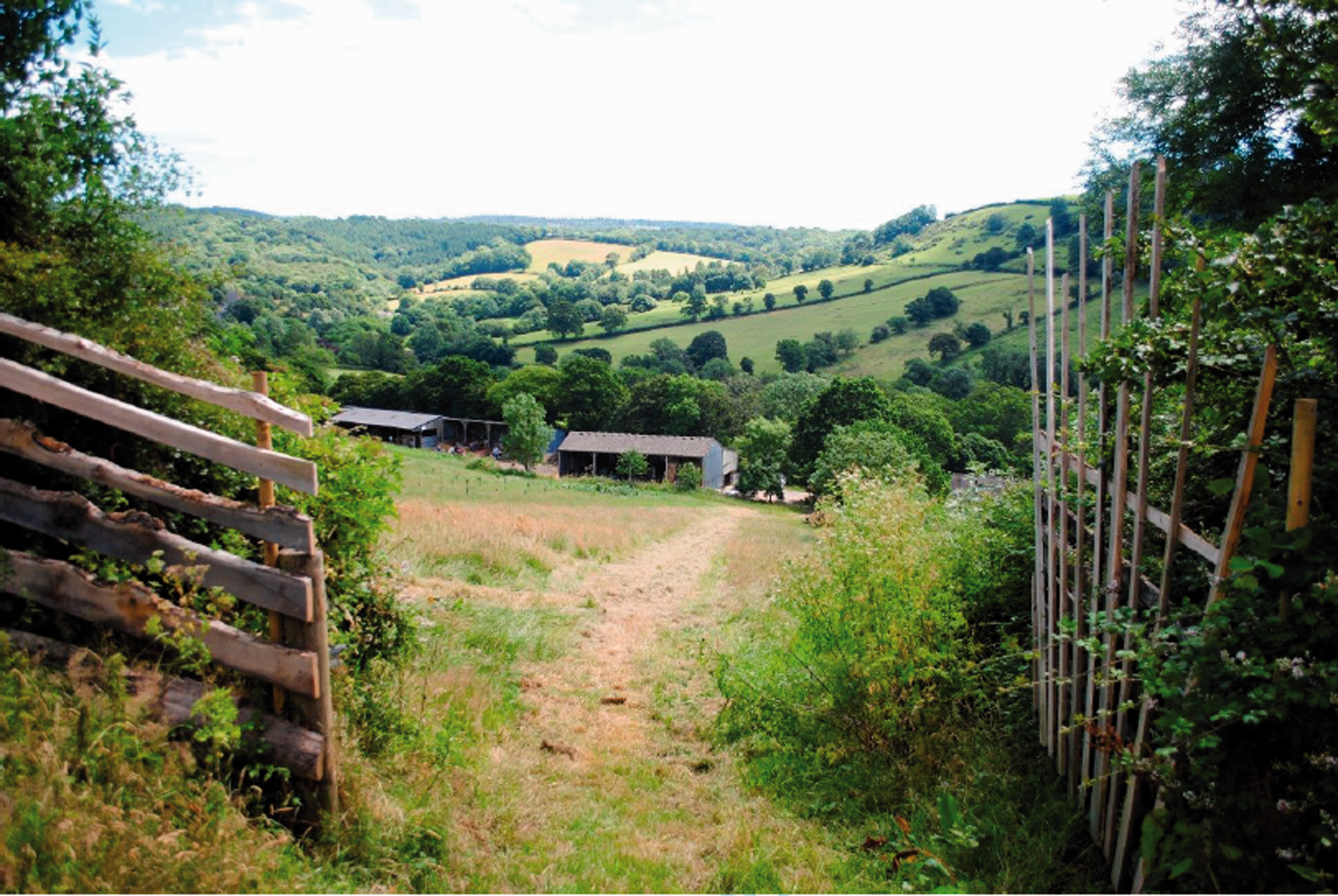
Oxen Park is a mixed working farm which welcomes groups of all ages on residential visits.
Such is the setting which was chosen for the three-day Devon Wild Pedagogies gathering in late spring 2019. Oxen Park Farm is home to the environmental education and land-based learning organisation ‘On The Hill’. It is well set up for welcoming groups to the land, with a field kitchen, polytunnel and camping space. The farm itself is mixed arable and pasture and provides a range of service-learning opportunities for visiting groups. The nature of experiential learning and being in a community with responsibility toward the running of the farm (from cooking meals, to planting crops and looking after the animals) was a facet of Wild Pedagogies that as facilitators we were interested in participants exploring, in line with place-responsive pedagogical approaches outlined by Mannion et al. (2013). In essence, we asked ourselves, what would it be like to connect deeply with place, and history, while participating in a working farmed environment? Resisting the typical notions of wild as distinct and inaccessible, participants would be encouraged to focus on how natural connection with its co-benefits of wellbeing and behavioural manifestations, could be developed in a farmed environment. This provided a recognisable, yet wholly distinct approach to the original wild pedagogies gathering as experienced by the Crex Crex Collective. Our intention was not to create a group or community beyond the gathering – but to enable the space for that to emerge if it was desirable. Our focus was wholly on the bringing together of people for the exploration of themes related to Wild Pedagogies.
The invitation was sent to 15 educators (from within schools, as well as higher education and independent practitioners) who had previously expressed interest in exploring these themes. We specifically wanted to consider how this type of gathering might work for CPD purposes, and if this could be something which was beneficial to a wider audience of educators. We entered into the gathering in the spirit of experiment and openness. The invitation stated: The purpose of the weekend will be to come together as a small group of practitioners and researchers, to connect, celebrate our work, share space and time, and explore questions such as – ‘How do we deepen our relationship with place, land and culture in our education work, while contributing to the renewal of sustainable citizenship and a societal shift in light of the environmental/social justice crises we now face?’ While we hope to delve deeply into discussion and our ideas, we would also wish for the gathering to be restorative and nurturing for participants – offering much needed time to be in nature and reconnect with purpose.
Reflections
The Devon Wild Pedagogies gathering offered a space for open-ended practice, free from predetermined outcomes, as well as of peace and relaxation – recharge and rest. We closed the three day gathering with a walk up the chert escarpment to the north of the farm, taking in the view of the valley as the morning sun warmed the land. Three reflective questions were posed, seeking exploration rather than answers, as we wandered in slow and intentional paired discourse across the farm, through orchard, pasture and woodland:
What has been the most valuable aspect of our time together? How has your time here and with each other helped you to continue being a changeleader? What do you need, or would like, from this group going forwards?
The responses to the questions were recorded by each pair before changing partners. 2 Considering key findings from each question in turn:
Participants commented that there was a clear importance attached to the pace of the gathering – and balance between organisation and openness. ‘[There was] a slowness of being for authenticity to emerge and give voice to what is important out of the mundane … reconnection to unnurtured beliefs and aspirations through a shared simplicity of self’. Another pair commented that the gathering presented an opportunity for ‘authentic connection held in a regenerative place’ where the land, the work and conversation consisted of ‘embodied reminders of reciprocal aspects of being and becoming that need to be balanced – mind, heart, body and earth’.
Some considered that there was a ‘permission for space and time to slow and simplify, feeling welcomed, as we are’ without pressure for performance, or to produce an outcome. Speaking more bluntly, one conversation elicited reflections on the community facets which produced a comfort of ‘being in a held space that feels like love – and being able to engage with the land and others as a participant’.
By coalescing as practitioners who often work at the margins and push norms of acceptance in their own practice and places of work, a form of renewal was experienced by some: [We found] connection and fellowship held in a landscape of acceptance and nourishment [which allowed us to let go, embrace change, and draw collective strength … This has provided a nurturing space to continue sailing; not with the prevailing wind but still with a sense of being in the midst of a fleet, rather than as a lone sailor.
A final moment of reflection saw consensus emerge for the group ‘to be part of a collective journey toward growing an ever wider movement towards hubs of good landed practice. Coming home to the land and self…’
While the gathering itself did not explicitly attempt to explore wider dimensions of educator training, the reflections shared here hold significance for educational development processes and practices. It is pertinent for us to now turn to these broader issues of concern and apply the experiences and reflections emerging from the Devon Wild Pedagogies gathering to key principles for wilding educator development on a larger scale.
Principles for wilding educator development
The principles which follow are offered in order to guide CPD opportunities for educators who are attempting to find a balance in their practice, between instrumental curriculum delivery and emergent and emancipatory aspects of being and learning outdoors. Wilding educator development is essential if we are to find meaningful ways of infusing education with place-based and relational approaches to working within communities and more-than-human nature. Undertaking such a radical shift toward attentive and wild approaches to education sits far outside the mainstream experience. The contention behind the principles that follow is that the cultural conditions for educational practice can be set (and challenged) in multiple ways: through national and school-based policy, as well as individual teachers who enact on a daily basis the educational approaches which make up the systemic approach. While the hope is that by signposting these principles, it might be better understood how such changes could occur on a national or school scale, the conviction is that individual educators with enough support can begin to set cultural precedents in their own contexts. We hope that the principles that follow offer both structure and inspiration for wilding educator development at a variety of scales.
1. Co-creating within an open structure
The Devon Wild Pedagogies gathering was intended to be an experiment, both in structure as well as purpose. Participants took part in a three day and two night gathering which was purposefully not outcome driven, and was not overly planned in terms of pre-determined content. Instead, participants were invited to co-create the schedule and agenda for the time spent at the farm. Regular breaks and open spaces were included within the schedule, and participants were asked ahead of the gathering if they wanted to contribute anything by way of session leadership or discussion foci. Some offered to lead walks, hold a reflection session, read a passage from a book and so on. Crucially this co-creative approach was maintained within the running of the gathering itself with the schedule shifting and bending in response to the needs and requests of the participants as our experience together unfolded. Such an approach in itself was an experiment in organising which enabled reflection on the role of education and the limitations of the systems of which we are a part.
Looking to Jickling et al. (2018), educators are prompted to consider co-curation as more than a task of organising, but of becoming receptive to the environment and its inhabitants – enabling both facilitators and learners to see ‘nature as co-teacher’ (touchstone 1). The principle of co-creating within an open structure reminds us of the Crex Crex’s assertion that coming into such ways of being and relating with each other requires both time and practice, and is not ‘automatic’ (Touchstone 4). Learning together in such a way ‘in a world that is on the move’ (Mannion et al., 2013: 805) requires a shift in CPD perspective toward a subjective and flexible positionality, which deliberates at every turn and takes cues from the needs and insights of others (both human and more-than-human) within a community. Additionally, it requires a fundamental stepping out of the fast-paced stream of educational norms and into a slower knowledge process and more responsive frame of mind (Payne and Wattchow, 2008). The Wild Pedagogies gathering at Oxen Park required a facilitatory competency where participants struck the balance between the personal agency of leadership with a responsiveness to the needs and perspectives of others.
For those involved in mainstream school-based education, co-creating within an open structure may seem like the antithesis of the current system, yet there are a number of possible starting points for beginning to bring such an approach into current practice. For example, a small number of UK-based schools work with democratic principles, and offer training and expertise on democratic schooling (Phoenix Education Trust, 2020). Open structures do not need to permeate through the entire school day. It might be possible to arrange aspects of the day around democratic and open principles, such as form or year group time, STEM (science, technology, engineering and mathematics) clubs, sports or specific lessons which call for group work. Additionally, particular practices may help to cement new social and cultural norms into school routines. During research at the land-based education charity, Embercombe, Winks (2018) found that some school groups found the transition from this CPD open structure to the more rigid routines of school difficult. In response, some of the more enterprising teachers adopted practices such as group check-ins, and listening partnerships to bring ‘part of Embercombe back to school’.
2. Learning through service and shared responsibility
A key element to realising such balance at Oxen Park was through participation in service to the land activities. Taking cue from service learning and experiential traditions it is understood that meaningful engagement with place begins with a lived experience, including routines and requirements of that place in line with place-based education (Beard and Wilson, 2002; Furco, 1996; Moon, 2004; Woodhouse and Knapp, 2001). Rather than becoming passive recipients of learning, the Devon gathering prompted participants to engage with processes of creativity and care, as a friction to the norms of extraction and subjugation. It partly achieved this through working within the routines of the farm, in line with Jickling et al.’s (2018: 102) sixth touchstone: to purposefully ‘seek alliances and build community’ through these efforts. Furco (1996) suggests that service learning should balance goals and outcomes with the service enhancing the learning and the learning contributing to the service. This reciprocal conception of experiential learning helps to ground it in meaning. Rather than learning for the sake of knowledge, learning is directed toward use and purpose. On the farm this took the shape of work in the garden, growing food for groups which would follow in four months’ time, or cooking for the rest of the group, or building a part of a cob wall in a barn, adding another layer on top of those built by hundreds of hands before us.
Jickling et al. (2018) suggest that, in practice, a community-based approach might mean examining the direction and constitution of community for individual educators. For schools, this most conveniently extends to the locale and communities closely associated with the school, as discussed across a spectrum of place-based learning literature (for example, see:Smith and Sobel, 2014; Sobel, 2004). Increasingly, schools in the UK are looking to project-based learning and problem-based learning – the hallmarks of which include outcomes which are actionable and needed (Ertmer, 2015). While problem- and project-based learning are able to act as vehicles for curriculum delivery (rather than eclipsing content), the competency of staff, and the level of comfort associated with working in this way is arguably the biggest barrier to learning with work and shared responsibility (Doring et al., 1995). Developing a community-minded, purposeful way of working in schools must therefore include elements of CPD to develop the necessary competencies in staff responsible for delivery of this vitally important experiential and place-based learning.
3. Creating intimacy without obligation
As one participant noted, the Devon gathering offered those who attended a ‘supportive space for collective restoration, regenerative interdisciplinary, and an inter-relational culture’. This speaks to the sincere and heartfelt regard with which the participants approached the gathering. It is also telling of the atmosphere of intimacy which was intentionally facilitated; from the invitation, to the farm space itself, the concept of closeness without obligation was cultivated. The gathering was noticeable for the emerging sense of solidarity among the participants (although only some participants knew each other beforehand). The result was a quickly established sense of trust which enabled the participants to access aspects of emotional connection between each other, including entering into relationships of sharing and reflection. Additionally, the balance sought between closeness and openness resulted in time and space to ‘sink into place’, and explore the ecology, culture and stories of the landscape – stepping toward a reciprocal and interwoven relationship with the more-than-human participants on the farm.
Turning to the preceding observations of the Crex Crex Collective, clear links with calls for cultural transformation can be seen – as well as practices as political acts. Making space for new relationships with each other and with the more-than-human world to emerge was a central tenet of both gatherings. Touchstone 5 explored ‘telling a new geostory of a world in which all beings can flourish’: achieving this through a disruption of the current trends of which we are all part. Connecting such a bold assertion with the role of educators and teachers working with and within mainstream education is perhaps difficult to grapple with, yet some avenues for practical exploration are available. For educators within schools, the ‘prevailing norms’ of the institution of which they are a part will be the defining aspect of their practice.
Disrupting these norms alone can be exhausting, although often inspirational for colleagues and learners. Seeking allegiances and finding common ground within and between institutions can aid this process of educational change (Fullan, 2005). The Devon Wild Pedagogies gathering sought to achieve this for a limited period – to combine energies and spark inspiration for individuals’ future practice, many of whom felt isolated in their ‘home’ workplaces. Finding such common ground more regularly will be a key component to culture and systemic change within education going forwards. Supporting educators to form groups, mutual partnerships, communities of practice and shared inter-institutional spaces could be a key policy development for wilding education.
4. Learning about and learning from place
Central to both place-responsive and wild pedagogies approaches is the development of a relational engagement with place – prompting participants to produce co-curated and ‘shared atmospheres of placemaking’ (Kraftl, 2013). Placemaking based on relational foundations requires an attentiveness to ecology and context, infused with both natural and cultural histories, and interwoven with stories which permeate into the land. The Crex Crex collective established a strong basis of placemaking on their journey into the Hebrides, invoking a deep time perspective which grounded participants both in the history of the landscape, as well as firmly placing them in the present, often enabling new ways of seeing. Choosing to learn about the history of a place, experiencing nature and the rhythms of other life and making time for reflection, were experienced first-hand as key aspects of effective environmental education (Burgess and Johannessen, 2010; Lumber et al., 2017; Mackay and Schmitt, 2019). Examining this further in touchstone 3: ‘locating the wild’, Jickling et al. (2018) prompt educators to consider how to bring their students on a journey of connection to the nature world – and in doing so to recognise the human-centredness and privilege of their own positions.
For environmental educators working with school groups – especially those who work with deep experiential encounters with nature, often termed ‘transformational’, the opportunity is often ample to invoke such narratives. For teachers working within schools, making space for these opportunities is perhaps more difficult. While our principle is termed ‘learning about and from place’, the place-responsiveness component of teaching practice is a competency which requires developing. Yet by moving away from an absolute focus on nature connection in ‘wild’ places, we can see many opportunities for place-responsive pedagogies to develop in school grounds and (especially for urban schools) in local parks. Helping educators to find the shared agenda between the emancipatory focus of wild pedagogies and the instrumental necessities of curriculum-based schooling is central to this being implementable within the current school system.
Closing
One year later, reflecting on the Devon Wild Pedagogies gathering at Oxen Park at a time of true upheaval, it is hard not to revisit the manifested importance of such occasions in connecting educators with the essence of their practice. Yet, the social and cultural context we now find ourselves in provides opportunities to consider what a wilding of education might look like in practice – and to be bold in our aspirations for relational education. Reflected in much of the participant feedback, the gathering was an opportunity for educators to ‘nurture’ themselves and each other, ‘draw collective strength’ and be included in a group which was able to openly share and commune. The gathering was intentionally set on relational foundations, and followed the cues and touchstones of Wild Pedagogies in its planning (Jickling et al., 2018). It also beckoned its participants to become open to one another, to new forms of practice and to the surrounding environment in line with considerations of place-responsive pedagogies (Mannion et al., 2013). Connection to the natural world was intentionally heightened through service learning as was companionship and closeness to community, with outcomes for personal practice, natural connection and wellbeing noted by participants.
The gathering in Devon has become a temporally distinct waymark for many of its participants and their professional development journeys, exploring a revitalised and rewilded education (although many of us have remained in touch, and when the current lockdown restrictions allow we intend to meet again). To make it more so would require a larger commitment from the policy and governance structures of which we are a part. As Scotland has succeeded in doing, making the policy decision to deliver curricula (partly) through outdoor learning is indeed achievable. The ITT and CPD needed to achieve this can follow the blended approach modelled here, which enables place-responsive and wild approaches to education to take place. This needn’t presume a radically different direction in terms of policy development as student outcomes can be improved through both direct and indirect CPD, and through both instrumental and emancipatory approaches (Ardoin et al., 2018). Achieving such a balance is not without its challenges as there are clear points of tension, conflict and contradiction between the different paradigms of wild education and mainstream schooling. It is clear that the emergence of such blended approaches will require facilitatory support and training, much of which will need to focus on development of skills and approaches for educators unfamiliar with outdoor learning. However, allied to this, educators will also need support for deploying these skills in new environments, for becoming responsive to place and culture – and not least, for challenging the institutional and community structures of which they are a part. For these less objective aspects of outdoor learning, wild and place-responsive pedagogies have much to offer.
Attempting new CPD practices that deeply question prevailing norms, seems an ever increasingly important ‘learning space’ to support if we hope to sustain educators in processes of change ‘with an imagination adequate to the possibilities and the strangeness and the dangers on this earth in this moment’ (Solnit, 2010: 5). While the Wild Pedagogies gathering offered a degree of respite from the patterns and routines which shape mainstream education, it was by no means simply a retreat (by which we mean a deliberate distancing and removal of ourselves from the prevailing conditions). Moreover, it provided the means to connect with meaning and purpose, and to recharge those who felt isolated and alone while trying to innovate new ways of practising their profession. Looking back at this through the lens of the current crisis it seems all the more important to offer spaces of openness, dialogue, emergence and opportunity. If we are to respond to the popular calls for more outdoor education practice in the UK, and the growing body of research demonstrating multiple benefits of nature connection we need to rethink how we offer spaces of connection and sharing for practitioners at the forefront of delivering such educational opportunities. Such a response can happen at a variety of scales – from systemic policy at a national and institutional level, to the focus and resourcing of individual educators. Moving collectively toward a wilder vision for education requires the building of competencies through CPD and training, but perhaps more important are the networks and structures of mutual support; so that educators might begin to feel, as one Wild Pedagogue put it, ‘as part of a fleet, rather than a lone sailor’.
Footnotes
Acknowledgements
The author would like to thank the participants on the 2019 Devon Wild Pedagogies gathering for their co-delivery of the programme, as well as Jo and Tina at Oxen Park Farm for hosting the gathering. Finally, we are thankful to the more-than-human companionship of ecology and landscape of Oxen Park for shaping our thoughts and wanderings.
Declaration of conflicting interests
The author(s) declared no potential conflicts of interest with respect to the research, authorship, and/or publication of this article.
Funding
The author(s) received no financial support for the research, authorship, and/or publication of this article.
