




Abstract
This paper takes as its central concern the concept of wilding education policy and explores implications for systemic change in education. It starts from shared premises with wild pedagogies, namely, that current human operations are unsustainable and require deep transformation, and that education is (or should be) a partner in this transformation. The arguments herein focus on the relationship of the institution of formal schooling to the ‘wild,’ and posits that, because of the inherent tensions between the two, interstitial policy tactics are required. This paper proposes five working principles of interstitial tactics and examines these against a meta-synthesis of recent research on transformative environmental and sustainability practices in schools.
Keywords
Introduction
This paper takes as its central concern the concept of wilding education policy and explores implications for mainstream schooling. The arguments herein focus on the relationship of the institution to the wild, positing that, because of the inherent tensions between the two, ‘interstitial’ policy tactics are required. This paper is organised into two parts: the first is conceptual and focuses on elaborating a model of change focused on interstitial tactics. The second is empirical, or rather, meta-empirical; it employs a meta-ethnographic approach to recent research literature in environmental and sustainability education (ESE).
This paper starts from shared premises with wild pedagogies (Jickling et al., 2018a), namely, that current human operations are unsustainable and require widespread transformation, and that education is/should be a partner in this transformation. It also recognises that current educational systems are embedded in structures – colonial, extractivist, liberal-humanist, and differentially benevolent – that resist transformation. Education policy, to date, has largely served in support of these conditions.
Wild pedagogies is a deliberately plural term, recognising the diversity of teaching and learning practices that might find resonance. Briefly, wild pedagogies are about reengaging and reclaiming wilderness, not only as a generative concept but also as real places, and as ways of being-in-relation to these places, and to other self-willed beings (Jickling et al., 2018a, 2018b). Jickling and colleagues (2018a, 2018b) describe six touchstones for wild pedagogies. These include: nature as co-teacher (collaborating with specific, living beings); complexity, the unknown, and spontaneity (challenging ideas of control); locating the wild (understanding the wild can be found anywhere); time and practice (developing new relationships and skills takes time); socio-cultural change (embracing thoughtful activism); building alliances and the human community (recognising interdependence, intersections, and the collective). These touchstones are intended as practical guidelines to support educators in enacting wild pedagogies.
The relationship between wild pedagogies and policy is not necessarily obvious, and there is certainly a question of whether policy is relevant in enacting wilder pedagogies. There is a cogent argument to be made that transformation within the system is impossible (or impossibly slow), and therefore current policy attempts should be abandoned. While acknowledging its salience, this paper will not attempt to make this argument. Neither will I attempt to make a pitch for incrementalism within dominant institutional norms, as it is clear that multiple planetary boundaries have been pushed into dangerous territory (Rockström et al., 2009; Steffen et al., 2015).
The following statements are intended to clarify the normative stance adopted in this paper:
We (both humans and other living beings occupying planet earth) are facing socio-ecological crises. While human systems are responsible for the majority of the devastation, the responsibility and the effects of these crises are differentially and disproportionately distributed. Education systems have a moral obligation to respond to this crisis, to support both mitigation and adaptation, and to effectively prepare students cognitively, emotionally, and behaviourally for both present and future challenges. Mainstream schooling is largely hostile towards whole-scale change.
This first part of this paper introduces a simple conceptual model with three domains: (a) first, the conceptual space of ‘wild’ and, relatedly, risk and uncertainty; (b) the ‘arena of action’ as the institution, specifically mainstream schooling; and (c) the methods as interstitial tactics (Buenfil, 2003, cited and translated in González-Gaudiano, 2005). Interstitial tactics can be understood as intermediary practices which recognise the limits of working in formal schooling structures as they presently exist. These tactics therefore take place within the ‘interstices’ of the institutional setting to bring about the desired institutional conditions and supports.
Conceptual space: The relationship between wild and risk
Wild is not usually a concept associated with policy; in fact, policy often serves to contain and constrain wild as both a risky place and a risky practice. A deeper focus on the relationship between wild and risk, and the implications for educational policy, is needed. This section attempts to pull apart some of the entangled threads through the presentation of three articulations between wild and risk. Here, the word ‘articulation’ is used in the sense of a conceptual hinge-point (Featherstone, 2011; Hall, 1996). These articulations provide orientation as to how wild and risk fit together and what kinds of worldviews and practices are enabled through these interconnections. The first articulation is the statement ‘The wild is at risk’; the second is ‘The wild is risk’; and the third is ‘The risk in wild’ (alluding to the challenging histories of wilderness, conservation, and settler-colonialism). It is important to note that at this point in the paper, I have deliberately chosen not to attach the word risk to a particular theoretical orientation, and instead use it more in the colloquial sense.
The overall argument presented here is that education systems are not equipped to recognise the risks implicated in large-scale socio-environmental crisis. In fact, there is a fundamental misalignment between scales in risk assessment and action in education policy: the systems are constructed to identify and contain risk at the small scale, but utterly unprepared for tackling the risks of climate change in which the physical and temporal scales are in direct contradiction with the dominant paradigms of education. Furthermore, the small-scale policy procedures of risk identification which are intended to protect students within the system actually accelerate the large-scale risks. To clearly articulate the normative dimension of this work up front: I am arguing that institutional work focused on wild pedagogies must involve strategic engagement with risk, and effectively appropriate the risk discourses and mechanisms available within policy structures.
The wild is at risk
In 2018, the IPCC released a landmark report, which made two major contributions to the public discourse on the risks of climate change. First, by identifying 2030 as earliest projected date for reaching 1.5°C warming, it provided an urgent timeline for averting catastrophic warming. Second, the report compared expected effects of 1.5°C versus 2°C of warming, outlining tangible impacts for human and non-human systems. Some of these projections were devastating: under a 2°C warming scenario, coral reefs were estimated to reach near or total extinction (a total loss of more than 99%). This loss represents not only a loss of non-human kin, but also a break-down in small-scale fishing livelihoods. Overall, the IPCC report outlined projected loss across ecological, social, and economic systems.
In the face of both certain loss and projected devastation, the lives and livelihoods of both humans and non-humans are at risk. We are also jeopardising our relationships with one another. There is increasing evidence that the earth is experiencing a mass extinction event which encompasses a loss of not only biological diversity (genetic, phenotypical, functional) but also of abundance or biomass (Ceballos et al., 2015; Young et al., 2016). There are fewer non-human bodies on earth with which to interact, as told through scientific evidence and oral histories. Invertebrate biomass is decreasing at an alarming rate for many taxa (Sánchez-Bayo and Wyckhuys, 2019). Both localised, experiential knowledges and scientific knowledges (and these are not intended as separate binaries) confirm specific, knowable, ‘mournable’ losses (Tschakert et al., 2019). The wild at risk is not an abstract concept; bumblebees are fewer in both number and kind for my children born within the last decade than they were during my childhood (Colla and Packer, 2008). Some late spring and summer days I have walked past bushes that I previously knew to vibrate with activity and they were silent.
The relationship between risk and wild is complicated by the temporal nature of human cognition. By the time the effects are acutely felt by a majority, it will be too late to effect meaningful change. This failure to recognise the wild at risk may be exacerbated by shifting baseline effects. Conservation biologists define shifting baseline syndrome as ‘changing human perceptions of biological systems due to loss of experience about past conditions’ (Papworth et al., 2009: 93). This affects risk perception of, for example, the effects of habitat loss on species biodiversity and abundance. The public policy effect is that if loss is perceived as less acute, it is less likely to be an issue of policy concern.
Another temporal challenge to evaluating risk is proposed by behavioural economics. Here, the relation between present and future decision-making is mediated by an effect termed hyperbolic discounting, or the tendency to disproportionately discount future impacts (Laibson, 1997; Karp and Tsur, 2011). The tendency to discount climate change risks, including for future generations, is a particular risk for public policy supporting protection of, and learning in, wild places.
The role of formal schooling in the face of such loss is critical, yet complex. Often, educational approaches are invoked as simple behaviour change. For example, the IPCC states that ‘[e]ducation, information, and community approaches, including those that are informed by Indigenous knowledge and local knowledge, can accelerate the wide-scale behaviour changes consistent with adapting to and limiting global warming to 1.5°C.’ While large-scale behavioural changes are important, they do not (necessarily) force systems change. An instrumentalist view of education as behaviour change curtails multiple opportunities for re-imagining education systems. In the case of the schools, instrumentalist approaches misrecognise schooling as a means to an end, rather than a potentially vibrant interspecies community in and of itself.
It is important to clarify here: it is education systems, rather than students within them, that are accountable here, and the policy-making bodies in education systems need to make careful, principled decisions in the face of enormous risk. Though it is unjust for the students who have contributed little to the current crisis to shoulder this responsibility, coordinated pushes for large-scale change are emanating from students, rather than from teachers, principals, or policy-making bodies, such as ministries of education (Global Climate Strike; Thunberg, 2019). Through climate strike actions, students are articulating another sort of risk for education systems: that students are judging current school-based learning as irrelevant to their anticipated future needs.
The wild is risk
In education policy, risk has been variously conceptualised, including through crisis-level discourses of education systems at risk, or students at risk (Bialostok, 2015; Goodson, 1990; Rodwell, 2019). Risk is an intensely political concept: the question of who or what is at risk is often mobilised in order to construct particular forms of crisis requiring particular forms of intervention.
Bialostok argues that risk discourses are ‘produced by and woven into the fabric of schools. Risk lives in and through educators, students, and the policies that govern them at local and national levels, independent of political ideology or party affiliation’ (Bialostok, 2015: 561, emphasis in original). Referencing the American education system, Moran (2015) notes a paradox of risk discourses: that education policies are increasingly encouraging risk-adversity and standardisation, while also discursively celebrating risk-taking innovative and creative behaviour.
Procedural forms of policy often serve to limit riskier educational practices, such as outdoor excursions. When the bureaucratic procedures for taking children outside become too onerous, educators are more likely to keep students indoors (Anderson and Jacobson, 2018). Dedicating time to wilder, more unstructured pursuits also risks loss of classroom time devoted to traditional subject pursuits, including preparation for standardised tests. There is compelling evidence, however, that physical and emotional wellbeing of children are dependent on contact with outdoor living spaces (Chawla, 2015; Hartig et al., 2014; Tillmann et al., 2018).
Here, I am not intending to discount the risks of enacting wilder pedagogies with students outdoors. Risk management and ensuring student safety are important skills for outdoor learning and are often absent within mainstream teacher educator programmes (Blenkinsop et al., 2016). Environmental crises may create riskier outdoor conditions, complicating wild pedagogies. In Australia, the 2019–2020 bushfire season was prolonged and catastrophic. Thousands of residents, including students, were under evacuation orders from September through February. For those outside immediate danger zones, air quality was often so poor that any outdoor activities would have put student health at risk (The Guardian, 2020). At the other end of the planet, disruption of sea ice patterns in the Arctic regions due to climate change has threatened traditional land-based learning in Inuit territories (Inuit Tapriit Kanatami, 2019; Willox et al., 2013).
The risk in wild
In their edited collection, Jickling and colleagues (2018a) devote multiple chapters to unpacking the meanings and implications of wild pedagogies and wilderness. Though William Cronon (1996) was one of the more influential critics of the concept of wilderness, Indigenous activists and scholars have been challenging settler-state and neocolonial enactments of ‘wilderness’ for decades (Friedel, 2011; Tuck et al., 2014). Nehiyaw-Métis scholar Tracey Friedel (2011) provides an account of urban Indigenous youth’s encounters with colonial forms of outdoor and place-based education. She emphasises how Eurocentric notions of nature experience were intensely problematic, from assumptions about traditional ecological practices to failure to recognise how traditional territories intersect with urban space and identities.
In North and South America, Australia, New Zealand/Aoterea, and many other places, wilderness and settler colonialism are deeply entangled. Environmental education has an overall poor track record when it comes to tackling colonialism. While there is increasing conceptual engagement in this arena, environmental education practices in schools are inadequate to address this challenge (Korteweg and Russell, 2012; McCoy et al., 2017; McLean, 2013). Furthermore, though many of the risk discourses of climate change present the challenge as unprecedented (including the previous discussion in ‘the wild is at risk’), Potawatomi scholar Kyle Whyte (2017) points out that climate change ‘is an intensification of environmental change imposed on Indigenous peoples by colonialism’ (153). Therefore, wild pedagogies must also contend with the histories of colonialism, and alongside touchstones 5 and 6, which focus on socio-cultural change and alliance-building, support reparations, including land return to Indigenous nations.
The arena of action: The institution
Despite its limitations, I have opted to focus on mainstream K-12 (Kindergarten–Grade 12 or primary/secondary) schooling contexts for the following reasons: (a) mainstream schooling reaches a majority of children in most nation-state contexts; and (b) alternative ‘wilder’ educational programmes may encourage ‘white flight’ from mainstream schooling systems. White flight in education is a phenomenon in which white parents choose alternative schooling options for their children, contributing to increased racial segregation (Li, 2009; Perzigian et al., 2017; Renzulli and Evans, 2005). Researchers in early childhood education, for example, have pointed out the whiteness of Forest Schools (Nxumalo and Ross, 2019; Taylor, 2013). This paper therefore adopts a normative position that mainstream schooling is a critical site of intervention.
This paper considers mainstream schooling and its accompanying policyscapes (Carney, 2009), as an institution operating according to particular logics. These logics may operate differently depending on the institutional scale: local school, district or regional organisation, state or provincial education authorities, then national, or even international educational systems ( Thornton et al., 2008 ). Institutional logics can be understood as the ‘socially constructed, historical patterns of cultural symbols and material practices, including assumptions, values, and beliefs, by which individuals and organizations provide meaning to their daily activity, organize time and space, and reproduce their lives and experiences’ (Thornton and Occasio, 1999, cited in Thornton and W and Lounsbury M, 2012: 2).
The institution is in a constant relation to the dominant imaginary of education, and this is one of the central challenges of achieving whole-system change. Historically, mainstream K-12 schooling has focused on inculcating dominant norms of industrial society (Anyon, 1990; Giroux, 1983; Stevenson, 2007). In Wild Pedagogies, the Crex Crex Collective (Jickling et al., 2018a) describe ‘the dominant educational paradigm as a powerful force capable of absorbing and bending new ideas back towards the status quo’ (66, emphasis in original). Here, the wording indicates active work on the part of the institution: a capacity to reinforce path-dependency.
Schools are institutions of contradictions and complexities, with individual school practices that are brought to life in localised, relational manners. An increasing focus on inquiry and experiential forms of learning has opened up possibilities for more exploratory and risky educational practices in mainstream schools. For example, several Canadian provinces have undertaken curriculum redesigns to focus on broad learning areas linked to creativity, place-based learning, and Indigenous knowledges (e.g. British Columbia Ministry of Education, nd; Saskatchewan Ministry of Education, 2010).
At the same time, many education systems internationally are under increasing pressure from standardised testing programmes, administered at the subnational, national, or international level. The Organisation for Economic Cooperation and Development (OECD) Programme for International Student Assessment (PISA) shapes governance of education systems through comparative rankings in literacy, numeracy, and science (Sellar and Lingard 2014; Meyer and Benavot, 2013; Pons, 2017). Crisis discourses of an education system at risk, failing teachers, and failed students follow releases of test results (Sellar, 2015). These ‘PISA shocks’ are often used to link performance data to economic competitiveness, as well as to equate high-calibre learning with individual attainment (Sellar, 2015; Sellar et al., 2017). This has also accelerated a ‘back to basics’ focus on literacy, numeracy, and science at the expense of other curricular areas (Sellar et al., 2017).
A return to traditional curricular domains may limit opportunities to enact wild pedagogies. A recent review of barriers to environmental education practice in schools identified 48 unique challenges across 32 studies (Anderson and Jacobson, 2018). Most of these barriers pertained to institutional factors, with the lack of teaching and preparation time documented as the most consistent barriers. Conceptual and attitudinal barriers, such as lack of perceived relevance of environmental education, or lack of interest, were identified as less common barriers (Anderson and Jacobson, 2018). Similarly, a review of four decades of ESE policy research indicated a continued trend of environmental education as an adjectival subject, addressed if time permits, and with educator involvement limited to enthusiastic environmental champions (Aikens et al., 2016). This evidence from recent systematic literature reviews, along with decades of research in environmental and sustainability education, suggests that mainstream schooling structures are deeply challenging towards ESE integration, and resistant toward the whole-system transformation required to enact wild pedagogies.
Mode of action: Interstitial tactics
After laying out much of the conceptual terrain of this paper, this section focuses on how to achieve wild pedagogies within the current institutional system through the concept of ‘interstitial tactics’ (Buenfil, 2003, cited in González-Gaudiano, 2005). This term is particularly compelling for its recognition of an uncertain relationship between present and future; the ‘interstices’ represent the spaces in between. It is in this sense that this term is most appropriate to represent working the interstices of the current institutional setting to bring about the desired institutional conditions and supports. Interstitial tactics are critical to understanding the relationship between incrementalism and transformation: they help us undo the conceptual and practical binary separating these terms.
I attribute the term ‘interstitial tactics’ to a translation of the work of Buenfil (2003) by González-Gaudiano (2005). According to González-Gaudiano, interstitial tactics ‘open the way, create a new space, a name, reaffirm their existence, push themselves to the limit, challenge those who reject the field and form alliances with those who support it from opposing positions to us, seeking academic-political articulations that strengthen it’ (Buenfil, 2003: 84; free translation, cited in González-Gaudiano, 2005: 248). Interstitial tactics also ‘involve dispersed, fragmented methods, sometimes for survival and other times ingenious, outstanding improvisations’ (Buenfil, 2003: 85; free translation, cited in González-Gaudiano, 2005: 248).
There are resonances here with the recent work of Ulrich Beck (2015) on metamorphosis and emancipatory catastrophe. Beck argues that there are hidden emancipatory side effects of global risk (e.g. climate change, collapse of global financial institutions); we are forced to reckon with dangers we previously ‘repressed as side effects’ (79). These sorts of catastrophic risks are so disruptive that they open up pathways for new ways of thinking and doing, through anthropological shock and subsequent ‘social catharsis’. Where this work departs from the conceptualisation of interstitial tactics presented here, is in the role of social change and revolution versus metamorphosis. The ‘metamorphosis of the world’ presented by Beck, though compelling through its evocation of the holometabolic transformation processes of insects, is not an intentional or directed process.
A more robust understanding of interstitial tactics might also be sourced in institutional theory, through the concept of micropolitical literacy (Hoyle, 1982; Keltchermans and Vanassche, 2017; see also (Ball, 1987) ). Micropolitical literacy is defined as the skill of reading situations and responding strategically to the small-scale politics of everyday interactions in schools (Kelchtermans and Ballet, 2002). While macropolitical approaches to policy research tend to overemphasise structure at the expense of agency, research focused on school-level actors often fails to attend to the socio-political elements of institutional dynamics (März et al., 2016). Kelchtermans and Vanassche (2017) note that micropolitical interactions tend to increase in intensity and visibility when institutional norms and structures are disrupted. They also emphasise that micropolitical tactics (and associated power and influence) are not ‘exclusively … associated with conflict, struggle, and rivalry, but also encompass collaboration, coalition building and common action for what are seen as valuable goals’ (Kelchtermans and Vanassche, 2017: 443). Micropolitical literacy, and the strategic deployment of micropolitical tactics, provides a stronger conceptualisation of how interstitial tactics might be enacted in school systems.
Defining interstitial tactics: Five ‘working principles’
Bringing together all of the conceptual work to this point, I propose five working principles of interstitial tactics. The first two principles establish the premise and vision, while the three remaining principles focus on methods. This model is intended to be action-oriented, as a means of engaging with change-resistant policy structures and institutions of mainstream schooling. Therefore, interstitial tactics:
Operate within institutions that are largely unsustainable (Premise). Seek to undermine from within the unsustainable institutional infrastructures and practices, but undertake these practices with a vision toward a more sustainable future (Vision). Exploit windows of affordance or ruptures within (partially) hegemonic institutions (Methods). Work with risk, uncertainty, imagination (Methods). Involve recruiting and developing co-conspirators (Methods). In the analysis that follows, these five working principles are examined empirically, through a meta-ethnography of recent research of transformative school-based practices.
Meta-ethnography of transformative practice
The meta-ethnographic synthesis reported here is part of a larger project focusing on ‘what sustains environmental and sustainability education (ESE) practices in schools’. It was chosen in recognition that prior empirical work might yield significant insight into how systemic change takes place in formal school systems.
Meta-ethnography is a form of systematic review, following transparent data collection and assessment techniques (Noblit and Hare, 1988). The purpose is to undertake considered, intensive engagement with a small body of literature, akin to field-based ethnographic methods which rely on observation, documentation, and interpretation. Noblit and Hare (1988), who developed the method, argued that meta-ethnography should focus on ‘[re]ciprocal translations of studies into one another [which] enable[s] holistic accounts that … are comparative, emic, and historical’ (Noblit and Hare, 1988: 26).
In this particular meta-ethnography, the analytic processes involved reading and translating the included studies not only against one another, but also with/against/into the proposed model of interstitial tactics. The research questions informing the meta-ethnography are as follows:
How does this body of literature describe transformational or disruptive change? What forms of wild, risky, and/or disruptive school practices are reported? What tactics did school stakeholders (staff, students, parents, community members, etc.) undertake to achieve these practices?
This meta-ethnography was limited to English-language peer-review articles published within the last ten years (2010–19). I performed an initial keyword search within the ProQuest database collection with the following keyword combinations: ‘environmental education’, ‘education for sustainable development’, ‘ecological education’, ‘education for sustainability’, ‘sustainability education’, school(s), and practice(s).
Though wild pedagogical practices require sustained interaction with the outdoors, nature, or ‘the wild’, I opted to include all literature that fell under the umbrella concept of ESE as potentially relevant. Depending on context and strategy, some researchers and educators might choose to align their work with particular terminologies of environmental education, ecological education, education for sustainability, or education for sustainable development (ESD). Critics of ESD note its instrumentalist and resourcist approaches (Jickling, 1992; Sauvé et al., 2007) which are antithetical to wild pedagogies. However, because of the international salience of the term and its diverse deployments, I decided to consider ESD-aligned research as having potential insight into transformative practices. In the findings section, the original terminology is reported where appropriate.
A total of 821 articles were imported into the systematic review platform, Rayyan (Ouzzani et al., 2016) for initial review of article abstracts, with the following review steps:
Studies were first excluded if they were not based in schools. Studies were then excluded if they did not focus on some element of environmental and sustainability education. Studies were excluded if they were not based on empirical data (i.e. excluding theoretical work). Studies were excluded if they did not focus on school practices, through a lens of transforming, challenging, or embedding ESE work into school structures. For example, research reporting on the development of knowledge, skills, and attitudes of students, although useful work, did not fall within the scope of this review.
A subset of 92 articles were determined to be potentially relevant and retained for full-text review. Each of these papers was read to determine the extent to which they engaged with transformation or disruption of school-based practices. Studies that focused on integrating or embedding ESE practices into existing school structures were not included, although it was admittedly challenging to determine what was a disruptive or transformative programme, versus an ambitious project which did not challenge institutional structures. The final set of studies included only seven papers, which is in line with expectations for meta-ethnographic synthesis (Noblit and Hare, 1988; Lee et al., 2015). In the final step of literature collection, I searched the reference lists of articles, as well as undertook a cited reference search in Google scholar to track down potentially relevant citing articles. This did not yield additional articles.
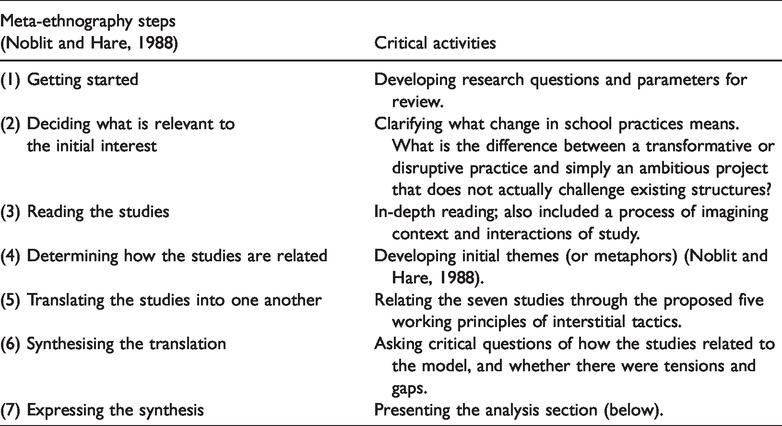
The analytic process involved iterative processes of reading and re-reading (Table 1), with the first cycle including the documentation of field notes and first impressions. During the second cycle of reading, I documented more formal themes, then attempted to relate these to the overall model and principles of interstitial tactics. Finally, I considered what tensions or gaps might be present and re-read the studies to make sure I had not inadvertently missed important content.
Steps of the meta-ethnography analysing ESE practices in schools
Findings
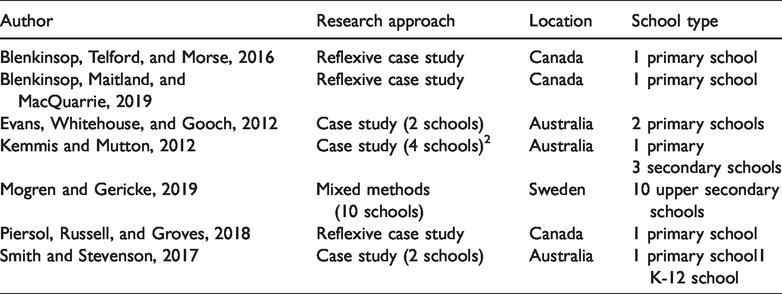
Of the seven papers included in this analysis, all employ in-depth case study or reflexive 1 case study methods, with the exception of Mogren and Gericke (2019), who use a mixed-methods approach with a larger number of schools (Table 2). Despite the departure from ethnographic methods in Mogren and Gericke’s work, their analysis yielded in-depth insights into the workings of transformational leadership in schools, and so it was retained in this analysis. There is perhaps a surprising lack of diversity in geographic range across the seven papers, one is from Sweden (Mogren and Gericke, 2019), three are from Australia (Evans et al., 2012; Kemmis and Mutton, 2012; Smith and Stevenson, 2017), and three are from a single Canadian province, British Columbia (Blenkinsop et al., 2016, 2019; Piersol et al., 2018). The two papers by Blenkinsop and colleagues deal with the same school (Maple Ridge Environmental School Project) and thus are treated as a single research case, where appropriate.
Summary of seven studies included in the meta-ethnographic analysis
The following sections present a meta-ethnographic analysis organised by the working principles for interstitial tactics. Working principle 1, Operating within institutions that are largely unsustainable, has been addressed as a research premise, and within the individual papers was often presented in conversation with visioning statements toward transformative change. For this reason, the analyses of Working principles 1 and 2 are presented together.
Working principle 1: Operate within institutions that are largely unsustainable; and Working principle 2: Seek to undermine from within … with a vision toward a more sustainable future
All of the seven papers included in this analysis expressed a conceptualisation of the institution of mainstream schooling as unsustainable, and/or requiring whole-scale transformation towards sustainability. In fact, the papers included in this analysis were selected via prerequisite conditions of (a) conceptualising current conditions as unsuitable for ESE and (b) envisioning transformative change as enacted throughout the school.
Smith and Stevenson (2017) characterise the relationship between ESE and the institutions as one of overall hostility, challenged by changing and competing educational priorities: One of the dilemmas faced by educators concerned about sustainability in its multiple dimensions is finding ways to operate within a policy environment that (1) is hostile to Education for Sustainable Development (ESD) or Sustainability (EfS) (by omitting or not supporting internationally recognized ESD/EfS policies); (2) is in a constant state of flux because of frequent changes in governments with different ideologies and agendas regarding the role of education in fostering sustainability; or (3) places EfS/ESD policies in competition with other educational policies that (overtly or covertly) receive greater priority. (79) Often, industrialised, hierarchical, competitive and individualised structures at the heart of public schooling are antithetical to the work of ecological education … Given this, our work as teachers and as a researcher is to disrupt the established school system in many ways and work toward building a new culture in schooling through nature-based education. In doing so, we have found that there is a rippling effect to the disruption that must be met with courage, grit and resilience so that we do not slide back into conventional approaches. (97–98)
Mogren and Gericke conceptualise a somewhat different relationship between accommodative and transformative visions for ESE in their examination of ESD implementation in schools. Their work explores how transmissive elements of ESD can serve a critical function for ‘anchoring’ and sustaining ESD in schools. Mogren and Gericke found that ‘highly transformative school organisations’ have different ESD anchors involved in initiating, then sustaining school-based practices. According to the authors (2019), there is a risk that relying only on transformative modes may fail to achieve long-term change: Often these schools are dependent on single individuals for their commitment to ESD … ESD is not then anchored within the routines and structures of the school organization, so its implementation is vulnerable if those ‘driving souls’ leave the organization. A lack of political and mandatory support, as well as networks of likeminded people, have been highlighted as possible reasons for failure to realize long-term intentions, such as prolonged commitment to ESD and preparation of future citizens for sustainability. (5)
Working principle 3: Exploit windows of affordance or opportunity within institutional structures
This section discusses institutional work that deals directly with policy structures, such as policy and administrative procedures, curriculum, and assessment. A distinct pattern of strategic engagement emerged across the papers, of tactical engagement with, and avoidance of, institutional structures.
Blenkinsop and colleagues (2019) discussed the process of creating an innovative environmental school in the Canadian province of British Columbia. They outlined a conscious strategy of overcoming challenges through recognising and engaging with both explicit and implicit policy structures. Explicit policy work included developing a formal proposal that provided logistical and curricular parameters. Implicit institutional work involved building relationships with district administrators as well as recognising that the teacher’s union was a powerful implicit policy actor, whose relationship to the new school project would be through the process of hiring new teachers. Blenkinsop and colleagues (2019) described policy as ‘provid[ing] us with a starting point that often became the minimum standard against which we had to push. And the relationships we built provided us with the connections and experience necessary to find the solutions to particularly thorny challenges we encountered when faced with explicit policy’ (493).
Another example of direct engagement with policy structures comes from a case study school in Queensland, Australia (Evans et al., 2012), where school leadership decided to ‘strategically incorporate sustainability education as “core business on par with literacy and numeracy”’ (132). The school provided a designated yearly budget allocation, with the school sustainability committee writing an Annual Operating Plan.
Strategic disengagement with policy structures, or policy avoidance, was documented by other researchers. Smith and Stevenson (2017) provided a case study analysis of two schools, also in Queensland, Australia. Though this research was formulated with the intent to investigate supportive policy structures, the researchers found that the national curriculum and testing program had significantly shifted the policy terrain and undermined ESE efforts in schools. In one case study school, they documented specific policy aversion tactics on the part of the school principal, who encouraged a variety of creative ESE practices in the school, despite the lack of support from the curriculum. The principal’s work was sustained by a commitment to practices he viewed as ‘more educationally successful’ as well as a willingness to personally absorb risk or, verbatim, ‘let[ting] his ass hang out to dry’ (89).
These studies illustrate strategic policy tactics, involving recognition of when compliance with the institutional structures is required, and when riskier tactics of noncompliance can be undertaken in order to support ESE practices.
Working principle 4: Creative and imaginary work
Two themes emerged in relation to the principle of creative and imaginary work. The first discussed is creative approaches to time (‘creative temporality’) and the second is the need for professional learning to support imagination.
In their comparative case study of barriers and facilitators of ESE practices in schools in Queensland, Evans, Whitehouse, and Gooch (2012) documented creative temporal practices undertaken by one school principal. While the principal was allowed two days of school administration per week, she overturned assumptions about how that time must be used and instead allocated one of these days to another staff member to support coordination of the school’s sustainability programmes. While this kind of thinking outside of the box with respect to time allocation demonstrates creative practices, it may also be untenable in some situations. As Evans and colleagues quoted directly from the principal, ‘I pay for it at 11 o’clock at night’ (132).
Other forms of creative temporality focused on rethinking the school timetable and questioning taken-for-granted barriers around staff preparation and break times (Blenkinsop et al., 2016, 2019; Piersol et al., 2018). As Piersol, Russell, and Groves (2018) noted, ‘we often forget that the infrastructure of school is pedagogical in itself … The structures, signs, and symbols of school life teach and communicate their own messages’ (109). They documented how wilder, outdoor pedagogical practices involve a balancing act between (sometimes) ignoring conventional structuring mechanisms such as school bells, but ensuring school-wide attendance as part of fostering a sense of belonging to, and goodwill within, the overall school community: If we don’t go out, we feel like we are not attending to the learning and places that embody the integrity of our program (e.g., the salmon may not be running tomorrow as they are in this moment). This is a constant struggle in defining ourselves as a unique program and maintaining positive relationships with those involved in the traditional program also offered out of our school. (109)
Working principle 5: Recruiting co-conspirators
The final working principle of interstitial tactics focuses on recruiting co-conspirators. Two themes emerged in this category: first, the overarching theme of developing affective relations, particularly trust; and second, moving beyond teachers as experts and understanding knowledge as distributed.
It is perhaps an obvious finding that collaborative projects focused on innovation and disruption require trust amongst collaborators (Blenkinsop et al., 2019; Evans et al, 2012; Kemmis and Mutton, 2012; Piersol et al., 2018; Smith and Stevenson, 2017). The more pertinent question to ask across these studies might be, what evidence exists for how trust is developed and maintained? Recognising the affective components of change, including anxiety in the face of uncertainty and change, appears to be critical, particularly for formal leadership. Smith and Stevenson (2017) documented two divergent approaches to school leadership when faced with a tightening of curricular and assessment structures. In one case, the school principal acted as an enforcer and overseer with respect to the new requirements, while in the other, the principal adopted the role of co-conspirator, seeking pathways for ESE activities to persist under the radar. Despite existing under similarly narrowing conditions, the two schools experienced markedly different pathways, which Smith and Stevenson attributed in large part to the school principals’ affective mediation activities between staff and curriculum.
Trust is also a critical component of relations with students (Piersol et al., 2018; Smith and Stevenson, 2017). Enacting trusting relations with students can take place through recognition that schooling is one of many interconnected worlds that students inhabit. Piersol and colleagues (2018) discussed how a focus on integrating families into their school supported student empowerment and ‘help[ed] students and their families realize and validate the learning/teaching that comes from all the different directions in their lives, including the more than human’ (106). Smith and Stevenson (2017) documented how an overall school climate of trust was extended to students, with students entrusted with the responsibility of overseeing major school projects.
Several papers discussed the de-centring of teacher as (sole) expert as a critical part of transforming relations in schools (Kemmis and Mutton, 2012; Piersol et al., 2018; Smith and Stevenson, 2017). These practices involved active recruitment of parents and community members as expert knowledge holders (Kemmis and Mutton, 2012; Piersol et al., 2018). In their work on practice architectures, Kemmis and Mutton (2012) described education for sustainability practices as a ‘collective achievement’ (205), in which knowledge, activities, and relations (practice architectures) are distributed across networks of actors. For example, knowledge relevant to a re-vegetation project was not contained within any one participant, nor were activities carried out by one teacher or classroom. Instead, seed collection, germination care, and planting were carried out by multiple actors (teacher, students, farmer) over ten years. At different points in time, and across different stages, some relations became more important than others. Kemmis and Mutton described how ‘participants meet one another in an ecology of practices, carrying the baton of the overall purpose of the activity for a stretch of its conduct then handing the baton over to another participant or participants’ (200, emphasis added).
Kemmis and Mutton argued that practice architectures – the sayings, doings, and relatings of practice – offer a generative framework for understanding system transformation. Practice architectures provide an understanding of ‘social practices as living entities that relate to one another in ecologies of practice’ (205). The analysis offered by Kemmis and Mutton has not been widely taken up within school-based ESE research (but see Green and Somerville, 2015).
This analysis concludes by briefly discussing gaps across the seven papers, as well as some limitations of this analysis. It should be noted that this discussion is not intended as critique of any individual paper, and that given the breadth of concepts discussed, seven papers from only three countries cannot hope to represent all relevant domains.
Perhaps the largest absence from the set of papers was the discussion of how land and place-based education articulates with Indigenous knowledges, practices, and, most importantly, Indigenous land claims. The role of wild pedagogies and the wider field of ESE in facilitating land return, including developing forms of citizenship focused on settler–Indigenous relations with respect to land claims, is not a widely explored area of research and practice (but see Greenwood, 2019; Lowan-Trudeau, 2015, 2017; Scully, 2018). Most of the heavy lifting has been undertaken by Indigenous scholars (e.g. Bang et al., 2014; Friedel, 2011; Tuck et al., 2014). The question of how policy and institutional work can address this challenge persists. Policy is a project of government institutions whose very existence is tied to the refusal to acknowledge Indigenous lands. These refusals are incomplete, however, and openings exist within policy and practice to explore more ethical relationships.
There are several obvious limitations to the analysis presented in the current paper. Searches limited to English-language research exclude knowledges/worldviews present in other language streams (e.g. Latin American literature). This likely reinforces Eurocentric understandings of both problems and solutions and has certainly influenced conceptualisation and analysis throughout this paper. There is also a methodological limitation to examining in-depth case studies. This speaks to the tendency of researchers to look for successful cases, then rewrite the observations into the analysis as causal explanations. This challenge is difficult to avoid but would perhaps be mitigated by more in-depth, practice-oriented research that attempts to understand the mechanism and relations underpinning daily practices in schools.
Implications and recommendations
Interstitial tactics are conceptualised in this paper as a method of disrupting institutional structures through undermining unsustainable systems and practices with a vision towards a wilder policy that supports a sustainable future. The conceptual portion of this paper put forward five working principles of interstitial tactics. Based on the analysis undertaken here, I make the following recommendations for engaging with education systems, in relation to the proposed principles of interstitial tactics:
Working principle 1: Operate within institutions that are largely unsustainable; and Working principle 2: Seek to undermine from within … with a vision toward a more sustainable future
It is clear that vision-building around ‘transformation’ requires a clear, shared understanding of what is in need of transforming. Otherwise, transformative risks remain at the metaphorical, rather than actionable, level. Defining and delimiting the problem can help negotiate system-level constraints. Collective participation in both the problem definition and visioning also encourage development of shared ownership and stronger affective ties among those involved (e.g. Blenkinsop et al., 2019; Piersol et al., 2018).
Working principle 3: Exploit windows of affordance or opportunity within institutional structures
For educators, and all those agitating for change within the system, this appears to require a balance of strategic engagement with, and avoidance of, formal policy structures. Here, the ability to ‘read situations’ becomes important, not only in terms of micropolitical interactions (Kelchtermans and Vanassche, 2017), but also mesopolitical policy structures, such as district policy or state-/provincial-level curriculum and assessment requirements (e.g. Blenkinsop et al., 2019 in discussion above). Support networks and solidarity coalitions could help provide the necessary capacity-building work, as well as groups within teachers’ unions.
As institutional theorists have noted, purposeful, incremental change is not necessarily non-transformational (Termeer et al., 2017; Weick and Quinn, 1999). Often, smaller, experimental pilots are necessary to successfully transition through transformative change (Coughlan et al., 2007). This evidence supports continued applied research documenting successes, challenges, and, most of all, learning from such pilot projects employing riskier and wilder pedagogies in schools.
Working principle 4: Creative and imaginary work
Perhaps the most compelling and actionable finding of this analysis is the need for professional learning or scaffolding to support imagining. This would involve both anticipatory professional learning, focused on the ability to create and work within structures that do not yet exist, as well as support for navigating current projects and programmes. Pilot programmes can be considered as prototypes that enable us to imagine ourselves into wilder practices and encourage greater experimentation and risk-taking (Grocott et al., 2019; Kimbell and Bailey, 2017).
Creative and riskier forms of leadership are also needed here, as well as the recognition that different contexts and stages require different forms of leadership. Working with the concept of ‘systemic innovation’ in change theory, Leadbeater and Mulgan (2013) argue that some situations call for ‘a leader who can be more like a pirate leading a crew, [attacking] the status quo from the margins’ (50). Other times, leadership focused on coalition-building and community organising is necessary. Advocating creative leadership tactics, however, should not fall into the trap of assuming that change in schools happens mainly through inspired leadership. Recent conceptual work in organisational theory challenges notions of creativity as individually-held, instead emphasising its distributed and relational properties (Thompson, 2018).
Working principle 5: Recruiting co-conspirators
The critical question here is, ‘how do we create more resilient webs of actors within schools that are committed to undermining the status quo and initiating more creative, wilder practices?’ The papers included in this analysis point to the critical role of trust, and the need to recognise transformative practices as enacted through distributed activity. The recruitment of co-conspirators into a web of school-based practices could borrow wisdom from social change praxis. The theory of the spectrum of allies proposes differing levels of commitment to change, from active allies to active opponents. Recruitment of co-conspirators focuses on shifting the commitment of a particular ally by one segment: from passive to active ally or from neutral to passive (Mitchell and Boyd, 2013). The strategies involved in this recruitment process would differ depending on ally stage, as well as role within the school system, for example, teacher, principal, parent committee member, district policy-maker.
Overall, this analysis points to a need for more in-depth research practices that attend to whole-system transformation, transgression, or disruption (Boström et al., 2018; Huckle and Wals, 2015; Lotz-Sisitka et al., 2015). Given the urgent timelines that we are working within, as well as the pitfalls of enacting panicked forms of urgency (Sauvé et al., 2007), this work must be overwhelmingly (participatory) action research-focused. Interstitial tactics offer an approach for envisioning and enacting change that attempts to work within institutions and bridge the binary between incrementalism and revolution.
Footnotes
Declaration of conflicting interests
The author(s) declared no potential conflicts of interest with respect to the research, authorship and/or publication of this article.
Funding
The author(s) received no financial support for the research, authorship and/or publication of this article.
