




Abstract
Teacher research has been promoted as a context-relevant approach to improving children’s learning experiences in early childhood settings. In this article, we focus on social-emotional learning (SEL), a crucial domain of the early childhood curriculum, to illustrate the role of teacher research in changing early childhood teachers’ everyday practices. We present an informative project on facilitating toddlers’ conflict resolution to exemplify the process of early childhood teacher research for supporting SEL. Evidence of the teacher research project revealed that integrating the child-focused approach into the existing curriculum was beneficial for promoting children’s conflict resolution skills and self-regulation. As situated in the particular context of Singapore, this case of teacher research presents how to successfully innovate early childhood curriculum practices within sociocultural realities, which include the hierarchical management culture, the imbalance between pressure upon and support for teachers, and limited time and resources. Suggestions and implications for early childhood practitioners and policymakers are also discussed.
Keywords
Introduction
Teacher research, or teacher’s action research, is a pragmatic and intentional approach to inquiring teaching within the classroom by mixing theory and practice from an insider’s perspective (Baumann and Duffy, 2001). Different from action research which is generally applied in various fields of social sciences, teacher research (sometimes called ‘practitioner inquiry’) is more specific to the field of education as the intentional, systematic inquiry by teachers with the aim of improving their own practices. A typical teacher-researcher is portrayed as a reflective classroom teacher who identifies a teaching problem and decides to solve it through classroom inquiry (Baumann and Duffy, 2001). In this paper, ‘teacher’ refers to an early childhood educator/educarer who works with children in early childhood education and care (ECEC) settings. And we used ‘teacher’ and ‘early childhood educator’ interchangeably.
Singapore’s educational authorities have been actively promoting teacher research to innovate school-based curriculum (Soh, 2006; Tan, 2014). For instance, annual funding support (i.e. the Practitioner Inquiry Grant) has been provided to promote teacher research in the early childhood sector, with necessary training guiding teachers through the process of inquiries (Early Childhood Development Agency, 2020). However, there is a lack of literature discussing the value and possibilities of advocating and conducting teacher research in innovating and reforming early childhood practices in the sociocultural context of Singapore. Accordingly, in this article, we will examine and discuss the role of teacher research in early childhood curriculum innovation by presenting an informative case of the early childhood teacher’s research on facilitating toddlers’ conflict resolution and self-regulation in Singapore. We will describe and discuss what challenges were presented, as well as the roles of teachers and children throughout the process.
Teacher research and early childhood curriculum
Teacher research (or practitioner inquiry) has been promoted to encourage teachers in conducting research on or inquiry into their own practices since the 1950s (Richardson, 2001). According to Bromme (2001), there are three paradigms emerging from the historical evolution of teacher research: (1) the ‘Teacher Traits’ paradigm, which aims to accurately figure out teachers’ personal characteristics that would explain differences in terms of educational impact, primarily through the use of psychometric instruments; (2) the ‘Teacher Skills’ paradigm, which shifts to search for effective teaching strategies by measuring the effect of teacher skills on learning outcomes in the classroom, following the behaviourism or process-product logic; and (3) the ‘Teacher Expertise’ paradigm, which believes in teacher’s agency and decision-making in selecting appropriate actions for each situation and improve the teaching and learning activities according to the type of learners, teaching content, teaching process and the teaching aims. The ‘Teacher Expertise’ paradigm has gradually become the most popular foundation of teacher research (Alterator et al., 2018; Flake et al., 1995; Sorensen, 2017), which is also the orientation we adopt in this article. Although there are a variety of teacher research approaches, they share the goal and action of generating new practices for optimising students’ learning experiences through practice-based inquiries (Somekh and Zeichner, 2009; Tan, 2014).
Differing from other types of research, teacher research is contextualised and can be applied in the classrooms as a teacher-initiated, practice-based approach to early childhood curriculum innovation. It encourages teachers to focus on a particular part of the curriculum (usually implemented curriculum), identify how to improve it, and test the action plans in a substantial period of time, so as to benefit children’s learning and development (Castle, 2012). Teachers who make ideal decisions about curriculum are expectedly involved in the process of action research continuously, which is rooted in classroom practice (Flake et al., 1995). Early childhood curriculum innovation aims to promote teacher autonomy, full participation, decentralisation and professionalism in making decision about early childhood teaching and learning (Yang and Li, 2019a). In the context of early childhood curriculum innovation, the cycle of teacher research provides clear guidance for teachers in reflecting, designing, implementing and evaluating action plans for issues related to young children’s learning.
A cyclical process of inquiry is usually followed to conduct teacher research for innovating curriculum (Lewin, 1946). First, teacher research is started from identifying issues for inquiry and decide on related research questions. Second, an action plan is developed through searching for existing knowledge or discussing with colleagues. Third, the action plan is implemented in classroom, while relevant data is collected to evaluate the impacts of action. Fourth, refine the action plan if outcomes are not satisfactory. Fifth, commence a new round of inquiry or conclude inquiry. However, how the inquiry process can be applied in innovating early childhood curriculum requires further investigation and discussion. This article focuses on exemplifying teacher research in ECEC settings by presenting a case of using teacher research to enhance toddlers’ learning from peer conflict experiences.
The role of children in teacher research in ECEC
Literature that discussed the role of children in teacher research are few and far between, possibly due to little understanding of children’s involvement in curriculum decision-making. However, in the ECEC field, it is important for us to know how children may play a role in teacher research which would shape their learning experiences. Falk and Blumenreich (2005) argued that teacher research in ECEC should be emanated from children’s interests and strengths during their exploration of personal questions. This means the topic of teacher research should be related to children’s real-life needs, which would then boost their level of engagement in the inquiry process. Although teacher research is usually intended to improve teachers’ own professional practices, it is worth noting that the professionalism of teachers’ practices is associated with children’s adaptation to the learning environment as well as their learning outcomes. Therefore, it is crucial to engage children in the process of changing the learning environment or solving a real problem related to their learning experiences in the early childhood setting.
To facilitate the inquiry process with children, Falk and Margolin (2005) proposed a series of strategies, including: Inviting children to collectively discuss topics of interest, identifying the problem, reviewing others’ understanding of the problem, conducting inquiry through cycles of problem solving, sharing their findings and consolidating solutions. Teacher-researchers can tap on issues encountered by children as a starting point for inquiry and change. Supporting children in the process of teacher research thus would redefine the role of the teacher, shifting it ‘from a giver of information and a provider of answers to an observer of children and a facilitator of the learning environment’ (Falk and Blumenreich, 2005: 171). Children are the main participants in generating data for teacher research, while teacher-researchers document children’s learning progress and products. This kind of child-centric data can be generated from children’s drawings, pictures or videos of children’s other learning products, child assessment scores and anecdotes about children’s activities (Castle, 2012).
Teacher’s role in facilitating young children’s conflict resolution
Children could be guided to think and regulate their emotions and behaviours appropriately to minimise negative physical or emotional reactions (Arnott, 2018). According to the sociocultural theory, children learn through the facilitation of the more knowledgeable other (MKO) via scaffolding to achieve a higher level of mastery (Vygotsky, 1978). Adults, including teachers and family members, play a significant role in children’s learning of conflict resolution skills (Goncu and Cannella, 1996; Ndijuye, 2019). Therefore, it is imperative for teachers to facilitate children to better socialise and learn through communicating and interacting appropriately in early childhood settings (Santrock, 2014; Yang et al., 2019).
Teachers typically adopt three types of responses to children’s conflict resolution, including avoidance, competition and cooperation (Jenkins et al., 2008). These can also be classified into two main approaches, the instructivist and constructivist approaches (Huang et al., 2019; Yin et al., 2020), with the former ending conflict quickly with direct instruction from teacher using high power strategies (Doppler-Bourassa et al., 2008; Singer and Hännikäinen, 2002) and the latter guiding children to problem-solve and come to an agreement that is mutually beneficial for both parties using mediating strategies (Arcaro-McPhee et al., 2002; Singer and Hännikäinen, 2002). Early childhood educators have been recommended to adopt the child-focused approach encompassing cooperative strategies (Jenkins et al., 2008; Vestal and Jones, 2004), which respects children’s thoughts and embraces empathy and perspective-taking leading to solution for parties involved in conflicts (Arcaro-McPhee et al., 2002). This requires early childhood educators to take on the role of facilitator through modelling and demonstrating communication skills, as well as to help children express their thoughts and recognise others’ emotions (Wheeler, 2004).
Various methods have been identified to facilitate children’s learning from conflict resolution. For instance, Marion (2008) suggested the use of thinking puppets, books and discussions to facilitate children’s expression of emotions when conflicts arise. Studies have also demonstrated that mindfulness-based intervention such as introducing yoga and social-emotional learning (SEL) curricula aids children in enhancing their self-regulation and other social-emotional competencies, thereby fostering their conflict resolution skills (e.g. Razza et al., 2015; Wood, 2018; Yang et al., 2019).
Conflict resolution skills and self-regulation as the core competencies in early childhood social-emotional learning
Social-emotional learning (SEL) refers to ‘the processes through which children and adults acquire and effectively apply the knowledge, attitudes, and skills necessary to understand and manage emotions, set and achieve positive goals, feel and show empathy for others, establish and maintain positive relationships, and make responsible decisions’ (CASEL, 2013: 4). In a recent meta-analysis of SEL programmes conducted by Yang et al. (2019), emotional understanding and expression, positive coping behaviours and self-regulation are identified as positive social-emotional competencies that young children should be equipped with. There is a large body of research demonstrating the effects of SEL on young children’s development of prosocial behaviour and school readiness, and reduction in aggression, behaviour problems and mental health problems (see meta-analytic reviews in Murano et al., 2020; Yang et al., 2019).
In terms of the SEL outcomes, the Collaborative for Academic, Social, and Emotional Learning (CASEL, 2013) identified relationship skills and self-management as two of the five core competencies for preschool and elementary school students. Specifically, relationship skills include clear communication, active listening, constructive conflict negotiation, help-seeking, and more (CASEL, 2013). Self-management is the ability to effectively regulate emotions and behaviours in different situations (CASEL, 2013). They are aligned with the enhancement of conflict resolution skills and self-regulation as focused on in the teacher inquiry presented in the following sections.
Self-regulation is the conscious control of thoughts, emotions and behaviours, as well as a complex and multi-dimensional process that involves the skills to plan, focus, maintain attention and control emotions and thoughts so as to internalise social norms and coordinate multiple skills across domains (Montroy et al., 2016; Santrock, 2014). Children develop the theory of mind and gain increasing interests in people around them during the early years of life (Evans, 2002; Santrock, 2014; Wheeler, 2004). As children learn to differentiate and understand that others may have different perspectives and feelings, they gain empathy and enhanced self-regulation skills.
In the school context, self-regulation involves children in modulating their emotions and behaviours appropriately, which would contribute to better concentration and engagement in daily routines and activities (Denham and Brown, 2010). It can predict children’s cognitive ability, classroom behaviour and social competence, both concurrently and prospectively (Blair and Raver, 2015; Donegani and Séguin, 2018; Garner and Waajid, 2012; Montroy et al., 2016). Facilitating children’s emotional expression, impulse control, conflict resolution and anger management is the key to fostering self-regulation in the early years (Marion, 2008). With self-regulated learners, it further creates a supportive and positive emotional climate and classroom environment that is safe and friendly (Butler et al., 2017; Stevahn et al., 2000).
Previous studies revealed that conflicts tended to arise among children and their peers during sharing and turn-taking (Wheeler, 2004). The causes of conflict are usually related to the use of materials, playground or rules set particularly when children are unable to achieve common goals. Stevahn et al. (2000) highlighted the abilities to think in others’ perspectives and to consider both parties’ interests in order for conflict resolution to take place. Other studies have reported positive associations between conflict resolution skills and emotional and behavioural self-regulation (e.g. Jenkins et al., 2008; Vestal and Jones, 2004). Garner and Waajid (2012) also showed that appropriate emotion-related knowledge and self-regulation would lead to better cognitive and social competence as well as fewer negative classroom behaviour issues. When children can calm themselves from being angry or upset, they are in a better position to think and resolve conflicts peacefully.
Children’s behaviours and strategies adopted to deal with conflicts have been identified in prior studies, though not necessarily resolving them independently. For example, Stevahn et al. (2000) observed four different children’s behaviours in response to conflicts, namely, using objection, reporting to teacher, withdrawing from conflict, and scaring or intimidating their peers. Similarly, Arcaro-McPhee et al. (2002) revealed power assertion, disengagement, simple negotiation and sophisticated negotiation as children’s conflict resolution strategies. Vestal and Jones (2004) added that learning conflict resolution skills helps children to control their actions and to reduce negative behaviours towards managing conflicts, such as withdrawing or displaying violent behaviours. Although children have shown attempts of conflict resolution, they needed facilitation, practice and time to come up with solutions and in turn, settle conflicts peacefully. Integrating conflict resolution training into school curriculum was reported to be effective in enhancing children’s self-regulation and prosocial behaviours (Arcaro-McPhee et al., 2002; Stevahn et al., 2000), as well as reducing bullying and violence in later years (Blair and Raver, 2015; Stevahn et al., 2000). To enhance the development of conflict resolution skills and self-regulation, the following teacher inquiry attempted to integrate a constructivist model of responding to children’s conflict resolution into the everyday childcare curriculum.
A case of teacher research on toddlers’ conflict resolution
Within the daily classrooms, teachers often find children who struggle to identify, understand and express their feelings, thoughts and behaviours. Instead, children throw tantrums or experience meltdown such as crying, screaming, biting and hitting to meet their needs. Observational studies and parental reports have confirmed higher rates of challenging behaviours and lapses in self-control such as temper tantrums among toddlers, as compared to older children (e.g. Santrock, 2014; Wheeler, 2004). While still learning language and developing communication skills, toddlers tend to express themselves through actions and gestures. This teacher research project aimed to equip a group of toddlers with communication and conflict resolution skills, so as to better organise and manage their thoughts, needs, emotions and behaviours.
To achieve this goal, the teacher-researcher adopted a six-step model of conflict resolution, the HighScope approach, as the action plan for empowering children to conjure solutions for parties involved in conflicts (Doppler-Bourassa et al., 2008; Evans, 2002). These six steps in resolving conflicts can be found in the following section of ‘The Action Plan for Inquiry’. With the HighScope model of conflict resolution, teachers and children work collaboratively to suggest possible solutions to resolve conflicts. This approach, that encompasses support from adults, active learning and hands-on experiences, is in line with Vygotsky’s sociocultural theory through respecting each child as an individual and acknowledging their feelings while facilitating children to brainstorm ideas. Based on children’s experiences, teachers ask questions to extend children’s thinking and put themselves in others’ shoes. It uses an open framework and calls for joint effort to reach mutually agreeable solutions and achieve peaceful conflict resolution (Schweinhart and Weikart, 1999).
Prior studies have shown that the HighScope approach can cultivate competent and problem-solving students (Schweinhart and Weikart, 1999). Toddlers can be facilitated to communicate effectively (Marion, 2008), learn problem-solving skills as well as flexibility needed to work in groups as they progressed from solitary to social play (Santrock, 2014; Evans, 2002). This teacher inquiry thus focused on facilitating toddlers’ learning of conflict resolution skills, with the use of HighScope model of conflict resolution, to express emotions and to exhibit appropriate behaviours particularly when conflicts arise in the classrooms. The following questions guided the inquiry:
How did teachers’ facilitation, with the use of a six-step model, support toddlers’ SEL in resolving conflicts? What were the challenges that the teacher-researcher had encountered in conducting the classroom inquiry to support toddlers’ SEL?
The teacher-researcher
The teacher, Jaslene, was working full-time in a full-day child care centre in Singapore. The students in her class were predominately children aged two to three years old. At the time of this inquiry project, she was a part-time bachelor’s student working on a graduation project. Jaslene had found children’s peer conflicts quite common and persistent and decided to address this problem in her class. She wanted to initiate a classroom inquiry for addressing this problem through an applied project. She then took on her supervisor’s suggestion to adopt a child-focused model for facilitating her children’s conflict resolution.
Under the supervisor’s guidance, Jaslene read theoretical and applied educational literature about social-emotional development in early childhood and decided to collaborate with her colleague in the same class during the inquiry process. She designed the inquiry procedure and prepared qualitatively dominant methods, with two quantitative tools added in.
To ensure ethical guidelines were followed, Jaslene carefully reviewed teacher research ethical codes as well as AECES (Association for Early Childhood Educator in Singapore) Code of Ethics prior to the research. Consent forms were issued to gain approval from parents for their children’s participation in this study. During the inquiry process, Jaslene also obtained assent from each child participant before engaging him/her in assessment tasks and interviews. To address the issue of coercion and ensure that there is no physical or emotional harm to the child participants, this research took place in a naturalistic setting and was conducted during the existing programme that children participated in. Confidentiality and anonymity of participants were ensured throughout the research to respect participants’ dignity, privacy and welfare.
Setting and participants
The study site was a privately-run childcare centre located in the West Region of Singapore. The centre had five classes catering to children of different age ranges placed in the Playgroup, Nursery, Kindergarten One and Kindergarten Two classes. Within each classroom, there was an English as well as a Mandarin teacher who work as co-partners to discuss and create lesson plans, observe and document children’s learning and growth as well as setting up and organising learning environment. All the children in Jaslene’s class participated in this teacher research, after obtaining the informed consent of the parents and the assent from each child. Participants were eight children (two girls and six boys) in the full-day playgroup class. In this article, to protect child participants’ privacy, we use initials to represent them individually, ranging from A to H. Child participants’ age ranged from 30 months to 37 months, with an average of 34 months. Both class teachers, trained in Early Childhood Education with the minimum qualification of diploma certification, used the HighScope model to facilitate children’s learning of conflict resolution in this teacher inquiry.
The action plan for inquiry
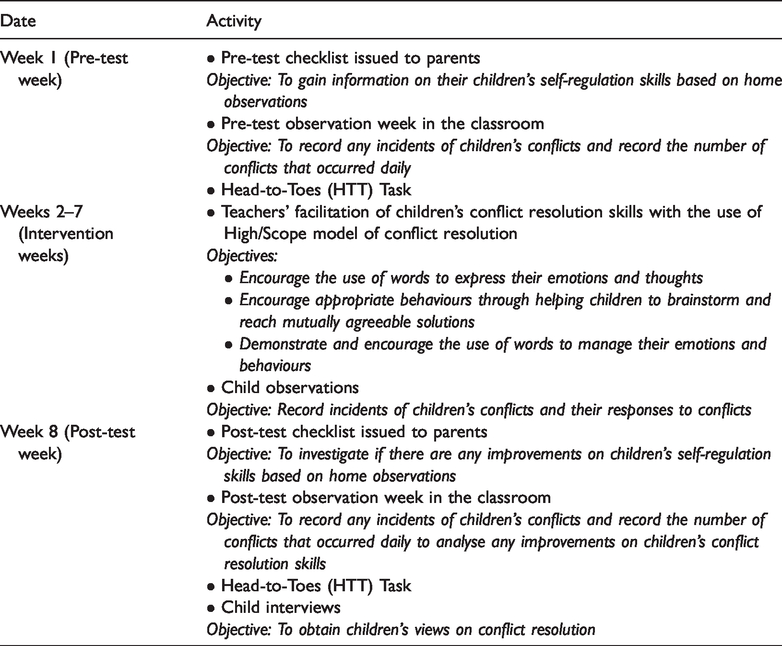
The HighScope model involves six steps for facilitating young children’s conflict resolution (Brickman, 2001). Firstly, approach the children calmly using gentle touch and calm voice. Secondly, acknowledge and help children to name their feelings. Thirdly, gather information regarding the conflicts and understand from both parties’ perspectives. Forth, restate the issue with language that children can understand. Fifth, ask for ideas and solutions to resolve the issue; offer workable solutions if children cannot think of any. Lastly, observe and be ready to offer support and facilitation should the solution fail.
During the 6-week intervention, children were guided to recognise their feelings, express their thoughts and demonstrate appropriate behaviours. Teachers and children also worked cooperatively to think and select a solution to resolve the conflicts peacefully. Towards the end of the intervention, more time were spent on observing children’s conflict resolution strategies and teachers only intervened when children displayed challenging behaviours that may be harmful to their peers.
Table 1 shows the procedure of this teacher research, including 6-week intervention and data collection.
Schedule and description of the teacher research procedure.
Data sources
This teacher research employed both quantitative and qualitative methods. Mixed-methods data analysis established rigor and trustworthiness of this research through allowing triangulation and presenting a more comprehensive and balanced picture of the research data (Castle, 2012; Gravetter and Forzano, 2016).
Conflict frequency record form
To analyse children’s conflict resolution skills, event-sampling observation was conducted. It provides quantitative details on the frequency of children’s conflicts. A conflict frequency record form was created to record the number of conflicts that occurred on each day during the pre-test and post-test weeks.
Observational form
During the 6-week-long intervention, teachers observed children and recorded relevant details in the form of anecdotal records. Relevant observations, such as incidents of any conflicts, source of children’s conflicts as well as children’s responses to conflict and solutions suggested, were documented for qualitative analysis of children’s conflict resolution skills as well as the effectiveness of teachers’ facilitation with the use of the action plan. Additionally, it provides in-depth understanding of children’s current development and aids teachers’ planning to facilitate their learning.
Self-regulation checklist
This checklist was created with reference to Butler et al. (2017). The checklist contains twelve statements where one of the four options, almost always, often, sometimes, and almost never, that best reflect children’s behaviours was being checked. The statements are related to children’s self-regulation development such as their abilities to accept ‘no’, understand emotions and manage their behaviours. The checklist was completed by teachers and parents based on observations in school and at home respectively during the pre-test and post-test observation weeks.
Head-to-Toes (HTT) task and record sheet
Before and after the intervention, the HTT task was implemented to assess children’s behavioural self-regulation. This task is demonstrated to be a valid measure of children’s behavioural regulation (Ponitz et al., 2008). This task involves children’s participation in a game-like activity in which children should do the opposite of what is instructed. For example, with the command ‘touch your head’, children should touch their toes. Data collected from HTT tasks was recorded in the Record Sheet. This instrument is easy to administer and appropriate for playgroup children. Furthermore, the HTT task provides consistent longitudinal information, has good construct and reliability and more importantly, there is no evidence of practice effects (Montroy et al., 2016; Ponitz et al., 2008).
Child interview protocol
After the intervention, semi-structured child interview was implemented in group to gain insights of children’s understanding and learning of conflict resolution skills. Age-appropriate questions, related to children’s self-regulation and conflict resolutions skills, were posed during the interview to listen to children’s voices in this research. The interview session, serving as another form of post-test, was tape recorded and transcribed; thereafter, analysed to determine if the objectives of the action plan were met. Two pictures were shown to aid the interview session and prompt children to engage in picture talk and share their thoughts regarding the topic. Picture 1 showed children snatching a bear while Picture 2 showed a child crying.
Data analysis
With pre- and post-tests through the HTT task, observational checklist and event sampling, it brings about meaningful comparison as well as test-retest and data triangulation (Gravetter and Forzano, 2016; Yin, 2014). Based on children’s responses during child interview and their daily behaviours recorded through classroom observations, comparison of data and analysis on children’s thinking and understanding as well as their ability to self-regulate and resolve conflicts were conducted to answer the research questions. Throughout this study, ongoing reflections were done and recorded with constant questioning on the use of HighScope model as well as possible causes or solutions for children’s conflicts or behaviours. Triangulation of various data sources helped to ensure the credibility of the study.
Results of and reflections on the teacher research
Following the 6-week intervention in a naturalistic setting, children have developed their conflict resolution skills and behavioural self-regulation, as found in the comparison of results from the observation, self-regulation checklist and HTT task between pre-test week and post-test week. Challenges were also reported by the teacher-researcher, Jaslene, in her teacher research process.
SEL outcomes among children
Teachers’ facilitation with the use of six-step model helped children to think of ideas to resolve conflicts. Children were observed trying to express themselves and finding ways to resolve conflicts. Children also demonstrated growth in self-regulation in the HTT task.
Conflict resolution skills
After facilitating children to express what they want and understand their friends’ perspectives, children’s learning of conflict resolution skills was evident through observations of children using communication and negotiation skills to express themselves and come up with mutually agreeable solutions. As observed, for example, child C had suggested playing the rocking horse for ten seconds each, when child A and child C were fighting over the rocking horse. When solutions suggested work well, children were more motivated to discuss and resolve conflicts peacefully.
Furthermore, based on children’s responses during the interview and discussion, they were able to relate and share their experiences of snatching incidents while providing possible solutions to resolve the conflicts, as evident in the following dialogue.
Jaslene: What can you do when your friend snatches your toys?
Child A: Tell teacher.
Child H: Take another toy, okay?
Child G: Later spoil, cannot snatch.
Conflicts observed in classroom
Event-sampling observations were conducted during the pre-test and post-test weeks. Frequency of conflicts in both weeks is showed in Figure 1. Comparing pre-test and post-test observations, an increase in the frequency of conflicts resolved without teachers’ facilitation and a decrease in the total number of conflicts were observed. This demonstrated that children attempted to resolve conflicts independently. Additionally, the accumulated experience allowed children to understand and display increasing awareness of their and others’ wants and needs through expressing themselves with words and using similar methods suggested when conflicts arose. For instance, children were able to ask their friends ‘Can you share with me?’ instead of snatching from their friends.
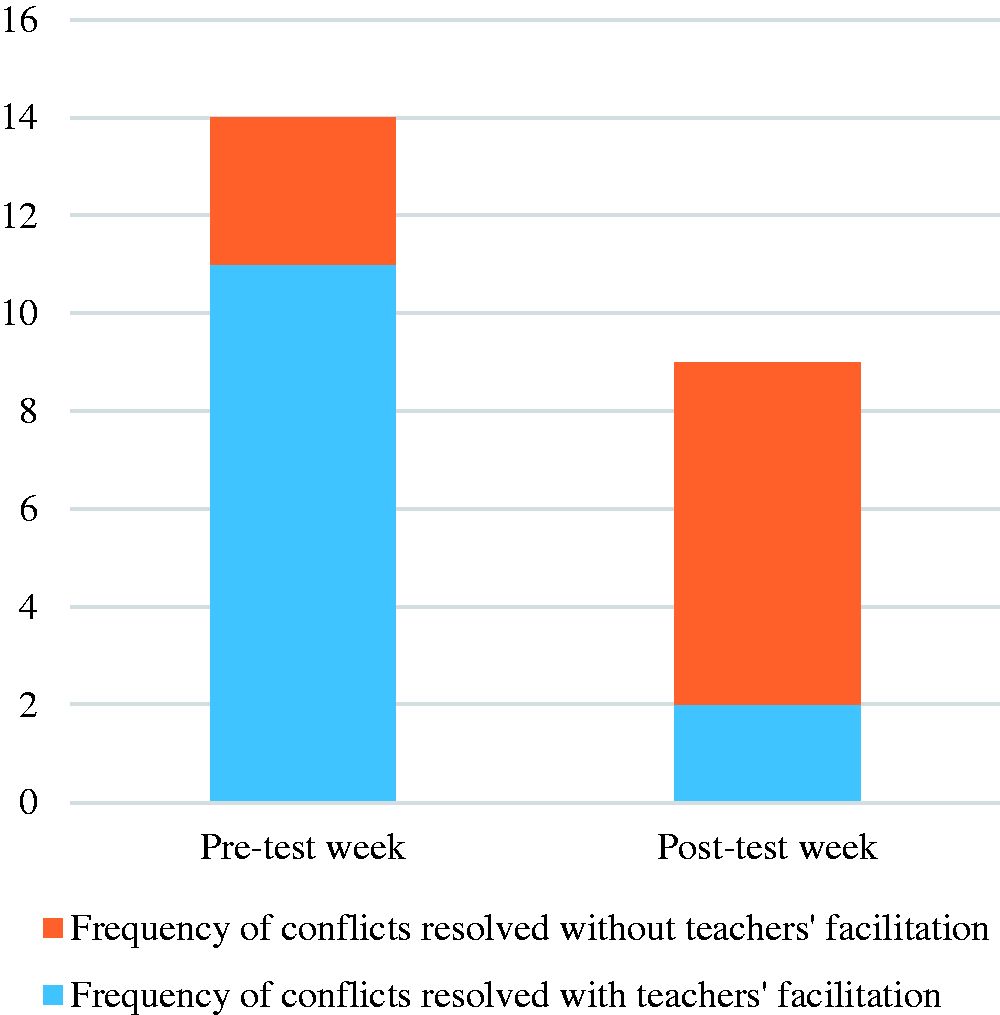
Frequency of conflicts in pre-test and post-test weeks.
Recognition of emotions
It was observed that children displayed better emotional self-regulation in school, through responding to others’ emotions and accepting limits more readily without getting upset or angry. Towards the end of the intervention, children had shown better awareness of others’ feelings through empathising their friends and offering tissue paper to their friends who cried. Children could also be heard asking ‘What happened?’ and commenting on their friends’ emotions as ‘sad’ or ‘angry’ when there are any conflicts or emotional breakdown.
During the group interview and discussion after the intervention, children were able to think of logical consequences from their actions and displayed understanding of their and others’ emotions. The following dialogue was recorded when children were presented with Picture 1 showing children snatching a bear.
Child C: They snatching.
Child B: Cannot snatch.
Jaslene: What will happen if you snatch like them?
Child H: Later the bear spoil. No more.
When Picture 2 of a child crying was shown, children demonstrated empathy and tried understanding from others’ perspectives, as evident in the following dialogue.
Child F: You see, crying, sad.
Jaslene: What should you do when you see someone crying?
Child G: Tissue, take tissue.
Child C: What happened?
Jaslene: Why do you think the girl is crying?
Child H: She wants mummy.
Child A: She wants to go home.
Child C: Yes, go home.
Behavioural self-regulation
Children were observed to demonstrate self-regulation in acceptable ways, display better control of their impulses and behaviours, and settle disputes peacefully during conflicts. Improvement in children’s behavioural self-regulation was also observed from children resisting to let go of the items that they were fighting over, to being willing to pass it over to the teacher as they discussed and came up with solutions to resolve the conflicts. As shown in the HTT task, during the pre-test, all children, except for child A and child B, could not grasp the concept and continued to do what was instructed even though demonstrations and directions were introduced and shown beforehand. In the post-test, improvements were evident with more than half of the children understanding the concepts and doing the opposite of what is required during post-test, indicating better behavioural self-regulation among the children.
Challenges in supporting children’s SEL through teacher research
As reflected by Jaslene, there were three challenges encountered in the process of her teacher inquiry, which might have an impact on children’s SEL. These three challenges are sibling rivalry, varying parenting practices, and some children’s delayed developmental needs. These issues urge us to reflect on how a home–school partnership can be forged to support children’s SEL.
Sibling rivalry at home
Conflicts due to sibling rivalry was a common issue parents faced at home, as reflected in their self-regulation checklist. Among the eight participants, child A, C, D, E and G have siblings at home, with child E being the oldest and the others being the youngest at home. Child B, F and H are the only child at home. Child D’s parents shared that he behaved better when away from home but tend to fight with his brother at home over toys. Child A’s parents also commented that he has the tendency to be aggressive with his brother at home. Conflicts arise when children could not reach mutual consensus when interacting with their sibling at home.
Varying parenting practices
Parents brought up the issue that their children displayed behaviours and expression of emotions, depending on the adult they interact with. For example, Child H’s parents indicated ‘often’ against the statement on ‘Accepts limits and follow rules and expectation without becoming upset/angry’ but left a remark that ‘behaviour is dependent on the adult. If daddy ok. If mummy, not ok’ in the self-regulation checklist. Child D’s parents also indicated that their child is better able in exhibiting appropriate behaviours and emotions with the presence of teachers in school and at enrichment classes, compared with parents at home.
An inconsistency of parenting practice at home between the two parents, may be the reason for child H’s different responses and behaviours towards his mother and father. Prinzie et al. (2003) emphasised parenting practices as one of the top factors that influence children’s behaviours. This brings forth the importance of consistency in practice, not just from school to home, but also among adults interacting with children.
Delayed developmental needs
Parents also shared that children with special needs may need additional assistance and reinforcement to build their self-regulation. In one case, Child E has slight speech delays and had been attending early intervention classes on Monday, Wednesday and Friday afternoons since the beginning of the year. Child E’s parents reported that these affected his verbal communication with others and hence, at times, he may communicate more with his cries and actions. In another case, Child G’s parents shared that Child G had a history of partial hearing loss due to otitis media which affected his listening and speech and that he may require more time to understand and regulate his behaviours. For example, it had been observed that child G tended to cry during transition and refused to clean up. However, Child G showed cooperation after he had calmed down, underscoring the first few steps of the HighScope model in approaching children calmly and acknowledging children’s feelings, in order to encourage children to control and regulate their emotions and behaviours. Frequent communication and understanding of children’s developmental needs between parents and teachers would foster home–school partnership, which also advance children’s social-emotional skills both in school and at home.
Conclusion, limitations and implications
As exemplified in this case, Jaslene’s support via the HighScope, child-focused model assisted the children in her classroom to express themselves and to settle disputes, although findings should not be generalised to other contexts (situations and settings) due to the small and highly specific sample of child participants. Throughout the intervention, children in her class gradually demonstrated attempts of using the strategy to resolve conflicts, as well as to express their emotions, wants and needs through their words independently.
We share the example of teacher research with the intent to build up awareness of early childhood teachers on the benefits and the process of action research. Jaslene’s children and their parents were positively influenced by her investigation on ways to facilitate children’s conflict resolution and self-regulation. She had also found herself a more reflective practitioner after going through the inquiry project. Applied research empowers the children, teachers and parents directly involved in the process of inquiry, which consequently enables the results to be more relevant to the improvement of their teaching and learning practices in a particular sociocultural context.
Early childhood teacher research: The possibilities and limitations
Teacher research is closely related to professional development and school reform (Cochran-Smith and Lytle, 1999). As unfolded in the above case of teacher research on children’s SEL, it supports teachers’ agency in making curriculum decisions and applying new approaches in early childhood settings. Our example portrays how teachers can adapt their role to become ‘researchers’ in the classroom as a form of continuous reflection and actions to seek improvements in teaching and learning in early childhood settings. Therefore, teacher research also has the potential to promote a culture of reflective practice and research in early childhood practices (Salleh, 2006).
However, teacher research movement is not without limitations. It is being argued that once teacher research is promoted nationwide, it may be initiated top-down by senior management in schools, which would lead to another kind of centralisation in curriculum decision-making (Day and Hadfield, 2004). Second, teacher research projects are criticised to be less rigorous than university research (Hammersley, 2004; Salleh, 2006). These internal limitations embedded in teacher research may be caused by a relatively small sample size, shorter duration for intervention, less reliance on quantitative measurements and uncontrollable naturalistic environment. The research rigor is also related to teachers’ capabilities as well as research training that they have received prior to their inquiries. Furthermore, Salleh (2006) summarised structural constraints to teacher research in Singapore, including ‘the culture of taking directive and initiative from the top’ (p. 517), the imbalance between pressure upon and support for teachers, and limited time and resources. Having to adhere to a tight schedule was a difficulty encountered by Jaslene in her teacher inquiry process. The tight schedule in Singapore’s ECEC centres were also reported in other studies (e.g. Ng, 2014; Yin et al., 2020) thus resulting in minimal time for children to resolve conflicts independently, which would restrict the advantage of integrating the new SEL approach in the original curriculum. Therefore, the implications that can be drawn from teachers’ inquiries should be carefully considered by responding to the cultural context.
Early childhood social-emotional learning: Suggestions for developing a balanced curriculum
With development proceeding on multiple, reciprocally interacting levels, children have varying capabilities in self-regulating their emotions and behaviours. Our case of teacher research brings about the important role of teachers as observers and facilitator to provide differentiated SEL opportunities for children. With conflicts being unavoidable in young children’s daily life (Sims et al., 1996), facilitating children to learn from conflict resolution is a cornerstone of children’s social-emotional development and other school readiness skills.
Effective facilitation and consistency within children’s immediate environment are important to enhance children’s learning. This brings about our reflection that the HighScope model of conflict resolution can be shared with parents as a strategy for them to implement at home setting to minimise conflicts among siblings. Howe et al. (2016) emphasised that sibling relationship could provide a rich context for interactions and collaborative learning. An ecology of support from families and communities helps to maximise children’s learning and experiences (Degol and Bachman, 2015), underlining the importance of extending children’s learning of conflict resolution from school to home.
De Haan and Singer (2003) emphasised that teachers, as facilitators and mediators of children’s conflicts, should seek to understand and respect children’s points of view. The HighScope model of conflict resolution enables such understanding and respect through a child-focused approach. Aside from the model introduced through the teacher-research example, early childhood educators should adopt some other effective strategies to support children’s SEL, particularly when an increase of children with emotional or behavioural disorders has been reported in preschools (Lastrapes, 2014).
In addition, teachers, parents and policymakers should recognise the role of core SEL competencies such as self-regulation and negotiation skills in young children’s learning, development and life functioning (CASEL, 2013). Effective SEL approaches, models and programmes should be promoted and integrated into the existing early childhood curricula to equip children with these skills (Durlak et al., 2011; Yang et al., 2019). Those SEL approaches with a specific curricular component should also promote a caring, engaging and participatory learning environment rather than a highly controlled, authoritarian one (Singer and Hännikäinen, 2002; Zins et al., 2004).
Policy implications for promoting culturally sensitive curriculum reform in ECEC
Early childhood curriculum reform has become a state-sponsored focus of prioritising ECEC all around the world (OECD, 2006). Different curricula such as the Project Approach, Reggio Emilia and the Montessori Method, have been widely borrowed and localised in many East-Asian countries or regions (Yang and Li, 2019b). However, there is a lack of attention given to connecting teacher research to culturally sensitive curriculum reform, which is a promising direction as there is a great emphasis on teachers’ autonomy, empowerment and contextualised knowledge in the teacher research movement (Cochran-Smith and Lytle, 1999).
In fact, teacher research is a context-relevant, bottom-up approach to innovating and reforming curriculum (Somekh and Zeichner 2009; Tan, 2014). Meanwhile, it is a self-directed strategy for teacher professional development (Salleh, 2006; Zeichner, 2003). Policymakers should encourage early childhood teachers to identify and solve problems in their everyday curricular and instructional practices, so as to produce school-based improvements and more culturally sensitive practices.
In terms of reforming early childhood curriculum in the cultural context of Singapore, there is an urgent need to bring in the SEL component, which is valuable for preparing them to meet the challenges they will inevitably face in daily activities and lifelong pursuits. As the image of Singapore child is always characterised as being passive and incapable of expressing opinions on matters (Ebbeck and Warrier, 2008), more SEL opportunities will enable them to build relationships, practice social skills and become active and responsible citizens. Furthermore, the academic-focused culture has been evident in Singapore’s early childhood sector, with teachers and parents prioritising academic areas in young children’s learning (Bautista et al., 2016; Clarke and Sharpe, 2003). As SEL is demonstrated to be effective in promoting children’s school readiness and well-being (CASEL, 2013), more attention should be given to strengthen the socialising aspect of children’s early learning. This demand is also confirmed by the result of Bautista and colleagues’ (2016) investigation indicating that Singapore’s early childhood teachers ranked the Social and Emotional Development as the most important learning area for children.
As shown in the case of teacher research on facilitating children’s conflict resolution, early childhood teachers are able to involve children in SEL using the active approach of teacher research. Policymakers should consider providing more guidance and resources to help teachers conduct SEL programmes that fit their cultural and preschool contexts. Alternatively, specific SEL components can be integrated into the core and day-to-day curriculum to create classroom environment that benefits children’s social-emotional competence (Ng and Bull, 2018; Yang et al., 2019). Teacher research can be one of the primary solutions to advance evidence-based and culturally sensitive SEL practices in the continual reforms of early childhood curriculum, and eventually maximise the positive impact of ECEC on children’s holistic development.
Supplemental Material
sj-pdf-1-pfe-10.1177_1478210320983499 - Supplemental material for Early childhood teacher research and social-emotional learning: Implications for the development of culturally sensitive curriculum in Singapore
Supplemental material, sj-pdf-1-pfe-10.1177_1478210320983499 for Early childhood teacher research and social-emotional learning: Implications for the development of culturally sensitive curriculum in Singapore by Weipeng Yang, Jaslene Peh and Siew Chin Ng in Policy Futures in Education
Footnotes
Declaration of conflicting Interests
The author(s) declared no potential conflicts of interest with respect to the research, authorship and/or publication of this article.
Funding
The author(s) received no financial support for the research, authorship and/or publication of this article.

Supplemental Material
Supplemental material for this article is available online.
References
Supplementary Material
Please find the following supplemental material available below.
For Open Access articles published under a Creative Commons License, all supplemental material carries the same license as the article it is associated with.
For non-Open Access articles published, all supplemental material carries a non-exclusive license, and permission requests for re-use of supplemental material or any part of supplemental material shall be sent directly to the copyright owner as specified in the copyright notice associated with the article.
