




Abstract
Singapore has launched a bilingual education policy nationwide, which leads to three main home language environments amongst Chinese families, namely, Chinese dominant, Chinese-English bilingual families and English dominant families. However, little is known about the development of early reading abilities among Singapore children from these family backgrounds. Moreover, against the backdrop of technological advances in the digital age, how the use of digital technology may affect the development of early reading abilities remains understudied. In this study, 225 7-year-old Chinese Singaporean children with different home language environments were recruited from mainstream primary schools in Singapore to complete the Progress in International Reading Literacy Study reading comprehension tests and questionnaires. Evidence revealed that children’s reading ability and digital technology use in Chinese varied across home language environments. Also, the use of digital technology in both English and Chinese positively predicted the reading abilities in both languages respectively for children from English dominant families. The results provide interesting insights into the role of bilingualism and digital technology use in the development of early reading abilities. In view of the results, we also discuss and put forward suggestions on online reading education policy.
Keywords
Introduction
One of Singapore’s education policy cornerstones has been its bilingual education, which requires Singaporean children to be educated in both English and their respective ethnic mother tongues in schools (Dixon, 2005). There are three main home language environments (HLEs) amongst Chinese families in Singapore. The first family type is the Chinese dominant (CD) families which speak mostly Mandarin at home, while the second family type is known as having a bilingual home environment (CE) where the families speak both English and Mandarin at home. The third family type is the English dominant (ED) families which speak mostly English at home. According to a major survey by the Ministry of Education in 2010, the percentage of ethnic-Chinese primary 6 students who only (or most of the time) speak Mandarin at home is 37%, the percentage of speaking both Chinese and English frequently at home is 25%, while the proportion of those who only (or most of the time) speak English at home is 38% (Hu, 2017; Hu et al., 2019; Ministry of Education (MOE), 2011). However, little is known about the development of early reading abilities among Singapore children from these family backgrounds. Moreover, against the backdrop of technological advances in the digital age, how children’s use of digital technology may affect the development of their early reading abilities remains understudied. Accordingly, this preliminary study primarily aims to explore whether the use of digital technology in English and Chinese is related to different levels of reading abilities in both English and Chinese among Singaporean children with different HLEs (i.e. CD, CE and ED).
Bilingual education policy in Singapore early childhood education
Singapore is a bilingual society with a majority ethnic-Chinese population (74.3%), with English as the common language (Singapore Department of Statistics, 2016). The bilingual policy has long been regarded as a unique feature and cornerstone of the Singapore education system (MOE, 2013a). Starting from preschool, children are required to study both English and a mother tongue language. English language is used as a common language of communication to interact across the different ethnic groups and as a common language of instruction for most of the subjects taught in school (MOE, 2011, 2013a). In this study, the two main languages investigated are English and Chinese for the Chinese Singaporeans.
Children are also required to study their ethnic language in either Chinese, Malay or Tamil. This ethnic language is known as their mother tongue language in schools, which helps link children to their heritage backgrounds (Bokhorst-Heng, 1999; MOE, 2011). The learning of the mother tongue language helps to affirm a sense of cultural identity amongst Singaporean children and to support the transmission of values across generations (MOE, 2013a). Therefore, it is important to recognize that the bilingual education policy is based on pragmatism where both the cultural needs of the multi-racial society and the economic needs of nation building are met (MOE, 2013b).
The Mother Tongue Languages Review Committee (MTLRC) was formed in January 2010 to review the policy and to ensure that it remained relevant and effective. Prior studies found that the HLE had evolved throughout the years, which would have an impact on children’s language proficiency levels (Goh, 2017; Li et al., 2016; MOE, 2011). However, there is a lack of research on the association between different HLEs and children’s early reading ability in Singapore.
There are three stages of early reading ability: ‘pre-reading’ stage aged six months to six years, ‘initial reading and decoding’ stage aged six to seven years old, and ‘confirmation and fluency’ stage aged seven to eight years old (Chall, 1983). Seven years old is an important connection period from early childhood to primary education. Testing the reading ability of seven-year-old children can evaluate the achievements of early childhood education in reading.
Literature review
Progress in International Reading Literacy Study (PIRLS)
The International Association for Evaluation of Education Achievement (IEA) has conducted the Progress in International Reading Literacy Study (PIRLS) since 2001. The aim of PIRLS is to study the reading literacy achievement of primary school children, and children’s reading experience in the home and school environment to find out the factors that affect children’s reading ability. The study has tracked the children’s reading ability development every five years since 2001 (Campbell et al., 2001; Hu, 2017; IEA, 2016; Mullis et al., 2012; Tse et al., 2005). Fifty countries have participated in this international study. The PIRLS 2016 assessment instruments were translated into 40 different languages (including Chinese) and used across 50 participating countries (Ebbs and Wry, 2017).
In this study, early reading ability refers to an individual’s reading literacy between the ages of 0 and 8 years. PIRLS defines ‘reading literacy as the ability to understand and use those written language forms required by society and/or valued by the individual’ (Elley, 1992: 3). Readers are expected to construct meaning from different types of text. They ‘read to learn, to participate in communities of readers in school and everyday life, and for enjoyment’ (Mullis and Martin, 2019: 2). There are six developmental stages of reading ability, with the stage before the age of eight years belonging to the ‘learning to read’ period (Chall, 1983; Hu et al., 2019; Tse and Lam, 2013).
PIRLS – reading comprehension
Reading comprehension was divided into four processes in PIRLS. The four different processes of comprehension are: (a) focusing on and retrieving explicitly the stated information; (b) making straightforward inferences; (c) interpreting and integrating ideas and information; and (d) evaluating and critiquing content and textual elements (Mullis et al., 2012; Tse et al., 2005; Tse and Lam, 2013). PIRLS defines reading ability as the ability of readers to understand and use the language, which is of both societal and personal importance. Young readers construct meaning from various literature, participate in social activities and enjoy reading (Campbell et al., 2001; Mullis et al., 2012; Tse et al., 2005).
PIRLS-Literacy
PIRLS-Literacy has the same assessment structure as PIRLS but with shorter reading paragraphs, simpler language used and participants being required to retrieve more direct and obvious information (Mullis and Martin, 2013). Both PIRLS and PIRLS-Literacy have the same background information questionnaire, assessment methodology, test components and scoring system (Mullis et al., 2011). The reading paragraphs in PIRLS-Literacy are between 300 and 500 words while those in PIRLS are between 500 and 900 words (Mullis et al., 2011; Sandoval-Hernández, 2014). The emphasis of the assessment scale in PIRLS-Literacy is placed on basic reading comprehension (50% weightage) which focuses on the student’s ability to search and retrieve explicitly stated information (Hu, 2017; Mullis and Martin, 2013). As we can see, PIRLS provides a solid stage for investigating the reading abilities of children. In this study, we used instruments developed in the PIRLS project for surveying Singaporean children’s reading abilities and their use of digital technology for the acquisition of Chinese and English literacy skills.
The impact of the HLE on children’s early reading abilities
PIRLS has placed a great emphasis on the family’s role in the development of a student’s reading ability. An extensive body of previous research on child language, language acquisition and bilingualism has shown the relation between the HLE and language competence (Goh, 2017; Sun, 2019). For instance, it has been found that children’s early language experience and reading habits at home have a direct impact on their reading ability and achievement (Tse and Lam, 2013). Family language and communication have the greatest impact on children’s reading ability (Britto and Brooks-Gunn, 2001; Zhang, 2009). The bilingual home environment also contributes greatly to children’s vocabulary skills (Ellis and Hennelly, 1980; Scheele et al., 2010), with parental involvement having a crucial role (Sun et al., 2020). Therefore, it is important to study the impact of the HLE on bilingual children’s early reading ability in two different languages.
Previous studies show that the amount of language input can predict bilingual children’s proficiency in the particular language (e.g. De Houwer, 2007, 2011; Hoff et al., 2012; Scheele et al., 2010). With regard to reading abilities, it has been found that the bilingual child can perform better in vocabulary and reading tests in the specific language for which they have received more input (De Houwer, 2007; Duursma et al., 2007; Patterson, 2002; Patterson and Pearson, 2004). However, not much is known about the relationship between the HLE as the main language input and young children’s reading performance in the context of Singapore, a multilingual society.
As mentioned, HLEs of Chinese Singaporeans can be grouped into three main categories, namely, the CD, the CE and the ED, based on the frequency of Mandarin Chinese spoken at home. However, there is not much literature focusing on the role of the HLE in children’s reading abilities in Singapore. Based on the bilingual reading ability test used in PIRLS, we are able to assess children’s English and Chinese reading comprehension, using English and Chinese literary stories and information expository texts (more details can be found in the ‘Data collection’ section).
Association between digital technology use and reading abilities
Advances in digital technology have greatly changed the learning resources and materials available to teachers and students. These technological advances have created potential in many educational areas and can be used as the media for promoting children’s literacy skills (Biancarosa and Griffiths, 2012). In this study, digital technology in reading English and Chinese refers to a combination of digital hardware and software used to display and interface with text in English and/or Chinese. It includes English and Chinese electronic resources, electronic platforms and the Internet that are commonly used in children’s everyday lives at home or in the school. For example, children may read electronic books using mobile devices and visit English or Chinese websites.
Liu (2005) reported that there is a change of reading behaviour from a traditional, print-based pattern to an emerging screen-based pattern. The use of digital technology seems to produce such a change of reading behaviour among people. Thiessen and Dianne Looker (2007) found that there is a curvilinear relationship between Canadian adolescents’ use of digital technology and their reading achievements, suggesting that the optimal use of digital technology matters in enhancing reading abilities. Larson’s (2015) study also revealed that the digital reading experience would support 6th-grade students’ vocabulary development and interests in reading. However, these studies were not conducted with young children aged 0–8, which is the vital period for cultivating reading habits and fostering related skills (Chall, 1983).
In a 2005 large-scale survey of parents of children aged 0–6 in the US, Vandewater et al. (2007) found that, on average, 75% of children watched television and 32% of children watched videos/DVDs for approximately 1 hour and 20 minutes every day, and 27% of children between the ages of 5 and 6 used computers for 50 minutes on average every day (Vandewater et al., 2007). It is highly possible that the frequency of digital technology use among young children may have been increasing in the past 15 years. In terms of the influence that may be caused by the considerable use of digital technology among young children, Levy (2009) conducted an in-depth multiple-case study of 12 young children, and found that the use of digital technology would encourage young children to develop print awareness as well as a general confidence in early reading. Yuan (2014) also discussed about the impact of reading using electronic storybooks on children’s phonological awareness, letter knowledge and story comprehension. The study has found that reading using an electronic storybook alone has a larger positive impact on children’s phonological awareness and letter knowledge than daily lessons (Yuan, 2014). The impact is also similar when adults accompany children when they read using an electronic storybook (Yuan, 2014). Moreover, adult-shared reading experiences using physical books have a larger positive impact on children’s story comprehension than using electronic books (Yuan, 2014). Recently, Sun et al. (2019) found that, as compared to static eBooks and no e-reading experiences, reading animated eBooks with motion and sound would significantly promote Singaporean children’s word production and storytelling abilities within a short period of time (two weeks).
PIRLS has also focused on how the use of digital technology may affect the reading ability of children aged nine years old and has studied how school resources, use of digital technology in lessons and computer-aided instruction would affect the reading ability of children (Hu, 2017). Tse et al. (2008) found that digital culture had a significant impact on children’s English and Chinese reading ability. Yi (2017) further found that the way teachers use electronic books to teach affects student’s learning outcomes; therefore, it is important to support teachers in improving their teaching methods. Singaporean children have been placed first (average score of 588) in the ePIRLS assessment which assesses how children extract information online (IEA, 2016). However, there is a knowledge gap in terms of relating Singaporean children’s digital technology use to their reading abilities in a bilingual context.
Therefore, this study focuses on the use of digital technology and aims to find out how different HLEs affect reading ability in English and Chinese for Singaporean children aged seven years and how the use of digital technology may play a role in affecting the development of their Chinese-English bilingual reading abilities. The three following research questions guided this study:
Are there any differences in the English and Chinese reading abilities of 7-year-old Chinese Singaporeans from different HLEs (CD, CE and ED)? Are there any differences in the frequency of digital technology use among 7-year-old Chinese Singaporeans from different HLEs (CD, CE and ED)? Does the frequency of digital technology use predict these Chinese Singaporeans’ reading abilities in English and Chinese?
Methods
The study is based on the reading assessment framework of PIRLS, which conceptualizes reading ability as a mean of ‘reading for the pleasure it provides in allowing us to experience different worlds, other cultures, and a host of new ideas’ (Mullis and Martin, 2019: 5). A sociocultural perspective is used to examine reading as mediated by various forms (e.g. books, newspapers, websites, documents, multimedia, etc.) and situated in different cultural contexts. Due to the changing society and culture, an updated set of reading abilities such as digital literacy is required to deal with new challenges to find and comprehend information via the Internet and digital devices. As informed by the sociocultural theory (Vygotsky, 1978), in this survey of Chinese Singaporean children’s reading ability, we focused on the HLE and digital technology use as the two contextual factors that may underpin the development of reading ability.
Participants
A total of 225 Chinese Singaporean children (97 girls and 128 boys) from 5 mainstream primary schools participated in this study. The participants were seven years old at the time of the study. There are 56 children from CD families, 102 children from CE families and 67 children from ED families. Their English and Chinese teachers (nine English and nine Chinese) also participated in the survey. The present study had been approved by the Human Research Ethics Committee (HREC) at the University of Hong Kong prior to data collection. The survey was conducted after obtaining the participants’ informed consent.
It is worth noting that, at age seven, children are still in the early stage of their reading literacy development (age 0–8). In the context of Singapore, the student participants had been at primary school for at least one semester. As all Singapore primary schools are following the national curriculum, students at age seven are expected to receive similar levels of instruction in school, and the effect of schooling upon their reading ability is assumed to be identical across individual students.
Data collection
The participants took part in the PIRLS reading assessment in both English and Chinese. As the PIRLS reading test is designed for 4th-graders’ reading comprehension, while the study targeted 7-year-old children, we additionally used the PIRLS-Literacy test which is more age-appropriate. The children were provided with: (a) a selected written story; and (b) information expository texts in English and Chinese, which focus on the two overarching purposes for reading that account for most reading activities in which students get involved both in and out of school: (a) literary experience; and (b) information search and use (Hu et al., 2019; Mullis and Martin, 2015). It was observed that the seven-year-old children were able to complete the assessments on time during data collection. The reading test scores of the children were calculated based on a composite of PIRLS (50% of the weight) and PIRLS-Literacy (50%) tests (Hu et al., 2019), reflecting their reading abilities in English and Chinese respectively.
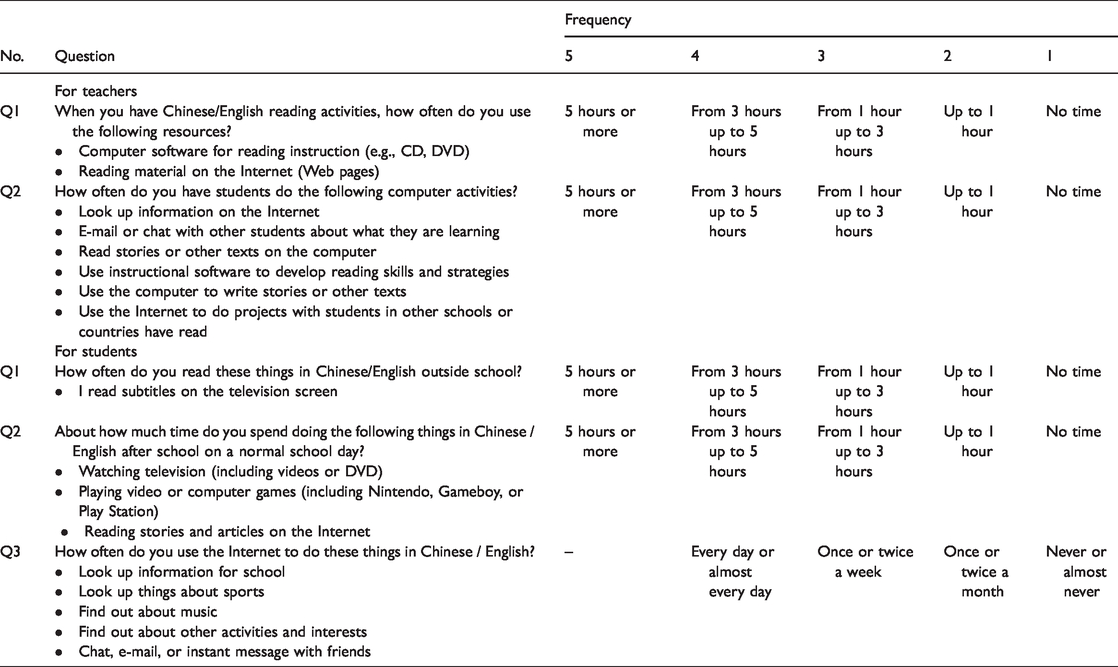
The PIRLS questionnaires were filled in by both students and teachers to investigate digital technology use in and outside the classroom (see Table 1). Digital technology use is comprised of the use of computers and electronic sources during English and Chinese classroom activities, watching English and Chinese television programmes and watching on other electronic platforms outside the classrooms, and the frequency of using English and Chinese on the Internet.
A sample of the items on digital technology use in the PIRLS questionnaires for teachers and students.
Procedure
First of all, the seven-year-old children from different HLEs were invited to take the reading comprehension tests, PIRLS and PIRLS-Literacy, in both Chinese and English. They were given enough time (approximately 60 to 70 minutes) to complete the reading tests. After that, research assistants marked the test papers and entered the scores for further analysis.
After testing, the PIRLS questionnaire survey was then conducted to investigate the children’s use of digital technology in English and/or Chinese at home and in school. Another survey was also conducted with their teachers regarding digital resources used and online activities conducted in the classroom.
Finally, statistical analyses were conducted based on the reading test scores and questionnaire data, so as to address the research questions.
Data analysis
We used the PIRLS questionnaire items about digital technology use to calculate the overall statistical value in terms of children’s frequency of digital technology use. The HLEs (CD, CE and ED) and the ages of the children were used as controlled variables when analysing the relationship between children’s digital technology use and their reading abilities.
To address the first research question, the reading test scores in English and Chinese were compared across different HLEs of the children using univariate analysis of variance (ANOVA) to examine the differences in scores. Next, the frequency of digital technology use in English and Chinese was compared across the different HLEs of the children via ANOVA to answer the second research question. A linear regression analysis was done to explore the relationship between the frequency of digital technology use and reading abilities in English and Chinese. SPSS 19.0 was used for the statistical analyses.
Results
Early reading and digital technology use
There were significant differences in reading test scores amongst the three different HLEs, p < 0.05. As shown in Table 2, the English reading scores for CD, CE and ED children were 57, 62 and 53 respectively, while the Chinese reading scores were 44, 41 and 31 for the children from different HLEs, with the differences between English and Chinese being 13 (30%), 21 (51%) and 22 (71%) respectively. The scores for the use of digital technology in English for CD, CE and ED families were 50, 49 and 39 respectively, while the scores for the use of digital technology in Chinese were 41, 32 and 22, with the differences between English and Chinese being 9 (22%), 17 (53%) and 17 (77%) respectively. It is notable that there seems to be a direct correlation between the difference in English and Chinese reading scores and the difference in the frequency of digital technology use for the two languages.
English and Chinese reading assessment scores and the use of digital technology.

It can be seen that the English scores and the frequency of digital technology use were much higher than that of Chinese. Also, the difference between English and Chinese in terms of reading test scores and the frequency of digital technology use was smallest for CD families, followed by CE and ED.
Figure 1 shows that the reading test scores in English were higher for all children, with the children from CE families performing the best. The CD children performed best in Chinese reading followed by CE and then ED children. Furthermore, the children from ED families had the lowest reading test scores in both English and Chinese.
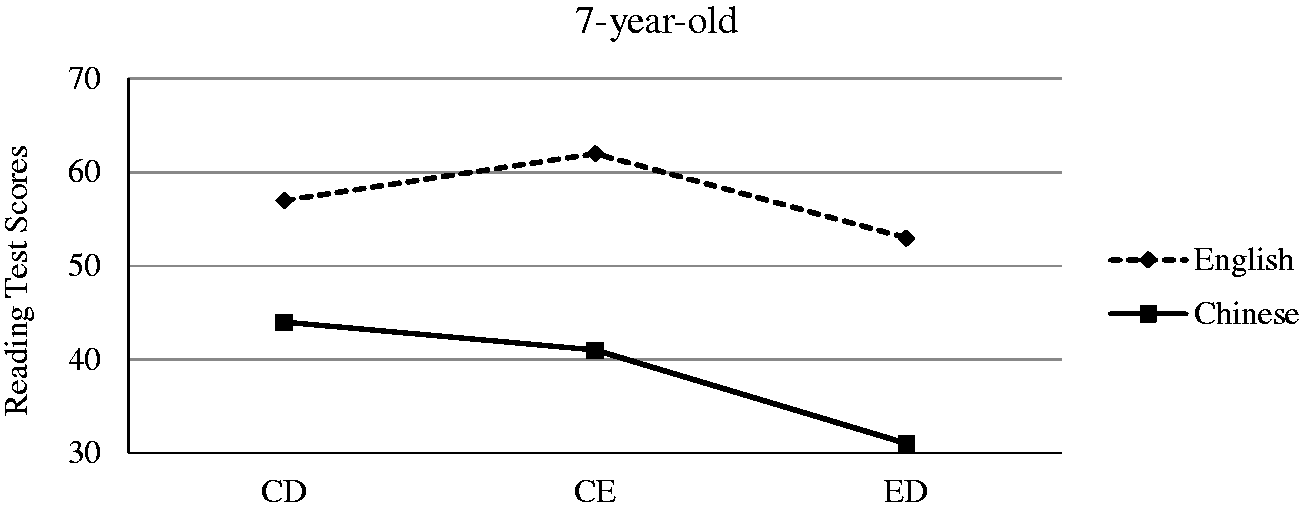
Comparison of English and Chinese reading scores of students aged 7 years from different home language environments.
Figure 2 shows that the frequency of digital technology use in English was higher than that in Chinese for all children. The children from CD families had the highest scores for both English and Chinese while the children from ED families had the lowest scores amongst the three HLEs. The results from Figure 2 suggest that the children from CD and CE performed similarly regarding the use of digital technology in English while the use of digital technology in Chinese was affected by the HLE.
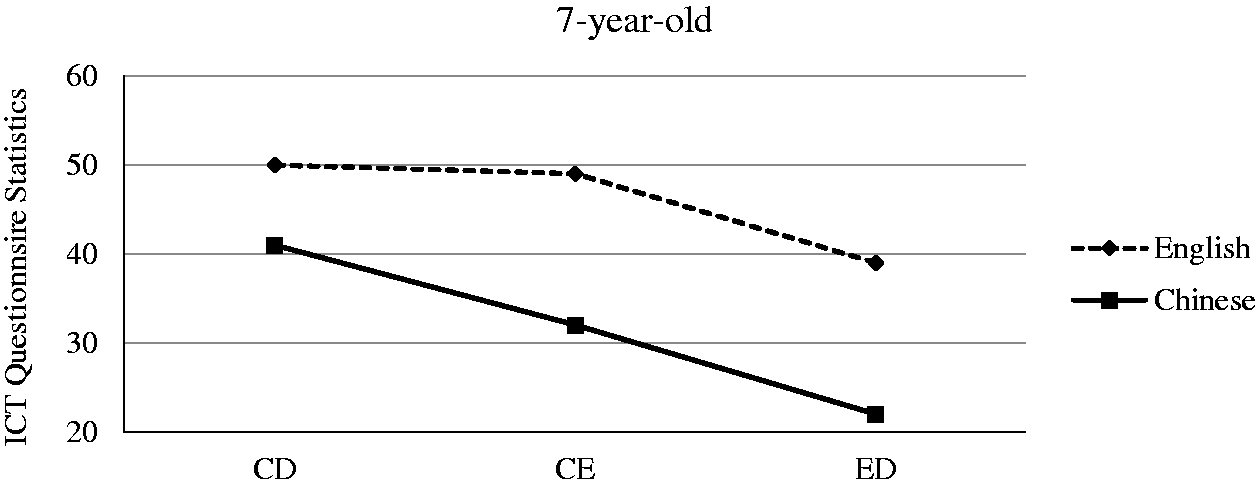
Comparison of the frequency of digital technology use among students aged 7 years from different home language environments.
The results also indicated that the HLE did not significantly affect children’s reading test scores and the use of digital technology in their first language, English. However, the HLE significantly affected students’ reading scores and the use of digital technology in Chinese. Therefore, the frequency of speak Chinese at home might have affected students’ use of digital technology in Chinese, and thus their Chinese reading test scores.
Relationship between digital technology use and early reading abilities
The data was standardized to conduct a linear regression analysis of the relationship between the reading test scores and the frequency of digital technology use. The dependent variable was set as reading test score (y), while the independent variable was set as the frequency of digital technology use (x).
Table 3 shows the β values between the reading test scores and frequency of digital technology use for children from the different HLEs. The β values were higher for English across the three different HLEs, which led to a higher English reading test score. The β values for English were all positive, which indicated that the use of digital technology in English positively predicted reading abilities in English of children from CD, CE and ED families by 65%, 56% and 85% respectively. Meanwhile, the use of digital technology in Chinese could predict the Chinese reading abilities of children from CD, CE and ED families by 11%, -36% and 20% respectively. The β values for children from ED families were higher than those of children from CD and CE families. This suggested that an increased use of digital technology in both English and Chinese would lead to an increase in the reading test scores for both languages for children from ED families.
Linear regression results of English and Chinese reading test scores and the frequency of the use of digital technology.

As shown in Figure 2, the β value for children from CE families is -0.36, which indicated that there was a negative relationship between digital technology use and early reading abilities in Chinese for children from the Chinese-English bilingual HLE.
Discussion
Against the background of bilingual education policy, this preliminary study revealed the positive links between Chinese speaking at home, the use of Chinese-medium digital technology, and Chinese reading ability among ethnic-Chinese seven-year-olds in Singapore. It also showed that the frequency of English-medium digital technology use and English reading test scores were higher than those of Chinese among the seven-year-olds with various HLEs. It thus can be inferred that the development of English reading literacy for these children is ahead of that of Chinese, which may be caused by the higher frequency of English-medium digital technology use.
However, the use of digital technology did not directly predict the English reading ability of children, although it did significantly predict the children’s Chinese reading ability. With an increased amount of Chinese speaking at home, the frequency in using digital technology in Chinese would be increased and further lead to an improvement in children’s Chinese reading ability.
One interesting finding from the present study is the lack of digital technology use in children with ED HLE, which is significantly lower than that of CD and CE (see Table 2). A possible explanation is that the average socioeconomic status (SES) of ED households is relatively higher as compared to CE and CD households in Singapore. Also, the SES could be related to the use of digital technology. In a study conducted in Australia, it was found that children in higher SES families counter-intuitively used less digital media, due to parents having better understanding and management of children’s non-academic computer, phone or general digital media usage (Harris et al., 2017). This is a possible explanation for the reduced use of digital technologies by children in ED families, which could be explored in a future study on the relationship between SES and the development of reading abilities in children.
As supported by the current study as well as previous studies showing that the increase in language input would lead to children’s improvement in reading performance (e.g. De Houwer, 2007, 2011; Hoff et al., 2012; Patterson, 2002; Patterson and Pearson, 2004; Scheele et al., 2010) with enhanced print awareness as well as higher confidence in early reading (Levy, 2009), we argue that there is a need to encourage the use of Chinese at home in Singapore, especially for Chinese Singaporean children from ED families. Also, it is important to guide children from CE families to allocate time for use of digital technology in both English and Chinese.
The seemingly negative relationship between digital technology use and the early Chinese reading ability of children from CE families requires a more focused discussion. The performance in Chinese reading ability in CE children despite lower digital technology use could be explained by the better holistic development of reading ability in a bilingual home environment. These children might have developed reading literacy in both languages through sufficient exposure in the bilingual language environment, which disconnected the relationship between Chinese digital technology use and Chinese reading ability. Moreover, there were probably other factors influencing the development of reading ability for children with a CE background which trumped the exposure to language in digital technology use. However, this finding does not suggest that Chinese-medium digital technology use has a negative impact on Chinese reading ability. More evidence is needed to shed light on the relationship between digital technology use and early Chinese reading ability.
In light of previous studies, reading using electronic storybooks alone or accompanied by adults has a larger positive impact on children’s Chinese phonological awareness and letter knowledge than daily lessons (Yuan, 2014). Incorporating the use of digital technology into preschool and home learning environments can help parents and educators guide Singaporean children’s learning of the Chinese language in a more fun-based and engaging way and increase children’s opportunities to use the languages. The use of digital technology to support the acquisition of language can help children to gain information through its interactive capacity (Biancarosa and Griffiths, 2012). Children will be able to learn the language through interacting and learning through fun games, reading tasks and watching videos, if with an optimal use of these digital technologies and multimedia (Thiessen and Dianne Looker, 2007). However, more research is still needed to examine how to promote the optimal use of digital technology for reading-related activities among young children.
Implications for policy and practice
Bilingualism is found to be beneficial in fostering individuals’ lexical development (Oller et al., 2007; Pearson et al., 1993), conceptual knowledge in language (Kroll and Tokowicz, 2005; Verhoeven, 2007) and meta-cognitive development such as executive control (Bialystok and Feng, 2009; Bialystok et al., 2004). However, as the time for language learning is restricted, how to maximize the time available for learning different languages is an important issue. Meanwhile, as the quality of language input also matters, how to support the language-minority children who grow up in lower-income families requires innovative solutions. Our study provides a potentially promising solution to these problems in advocating bilingualism through the positive use of digital technology among children.
As argued by Biancarosa and Griffiths (2012), technology can be used as an effective tool that can promote young readers’ acquisition of literacy in today’s information-based society. Our study provides evidence supporting the benefits of digital technology use in early reading, or e-reading for young children, for creating more language input and fostering reading abilities. This implication is supported by Ball’s (2010) findings that digital technology plays a critical role in promoting effective mother-tongue-based bilingual or multilingual education. Both preschools and families need to seek for effective strategies that can capitalize on the use of digital technology, so as to promote young readers’ abilities and interests in reading (Levy, 2009). For example, children can allocate three hours or more for reading in English on electronic platforms and watching videos that are interesting to them in Chinese. Teachers and parents can also encourage children to listen to Chinese music and read online in Chinese. Online reading can involve picture books, comics, storybooks and audiobooks. Young children can also read English and Chinese subtitles on videos to prepare for the balanced development of reading abilities in both languages.
Furthermore, policymakers should provide more investment in and guidance on e-reading for young children, teachers and parents, especially in a multilingual society like Singapore. Digital culture has a significant impact on children’s English and Chinese reading ability (Tse et al., 2008). The way teachers use electronic books to teach affects students’ learning outcomes; therefore, it is important to support teachers in improving their teaching methods (Yi, 2017). The Singapore government should provide teacher education and professional development to enhance early childhood teachers’ capabilities in incorporating the use of digital technology in effective and culturally sensitive pedagogy in terms of promoting children’s literacy acquisition. In a survey conducted by Choy et al. (2009), Singaporean student teachers were found to be more likely to use technology as a supporting tool rather than using technology to promote student-focused learning. Biancarosa and Griffiths (2012) also showed that teachers learned to use technology through independent learning rather than professional training. It is thus urgent to provide sufficient teacher training in order to address how the use of digital technology can be integrated in supporting young children’s authentic learning. Otherwise, teachers may have to struggle with incorporating digital technologies into their teaching (Hutchison and Woodward, 2014). The Technology Integration Planning Cycle proposed by Hutchison and Woodward (2014) can be used or adapted as the framework to guide teachers through integrating digital technology into literacy instruction.
Moreover, it is important for both educators and parents to keep in mind the three guiding principles indicated in Teaching and learning guidelines on the use of information and communication technology in pre-school centres by the MOE (2017) to ensure that children’s e-learning experiences are being provided in a meaningful way. Parents and educators need to be able to facilitate children’s learning through discussion, questioning and support and ensure that the experiences are developmentally and culturally appropriate.
Limitations
There are several limitations in this study. First and foremost, there was a lack of information about child participants’ SES; therefore, we were unable to control the possible effect of the varying family backgrounds aside from the HLEs. As there may exist gaps in the literacy skills and digital accessibility of children from different SES backgrounds, future research should examine whether the predictive role of digital technology use in children’s reading abilities is affected by the digital divide and SES. Second, we used the reading tests and questionnaires about children’s exposure to digital technologies created by the PIRLS researchers, which are not intentionally designed for the present study. More specific instruments would be of value to expand the current preliminary research. Last but not least, due to a relatively small sample size of children and teachers, we were unable to employ more advanced statistical analysis techniques for addressing the research questions. Therefore, the generalization of the findings of this study requires caution and further inquiries.
Conclusion
Both English and Chinese results of the reading tests and the related questionnaires were combined to find out the role of the use of digital technology in affecting the early reading ability of bilingual children in Singapore. Our study also examined the relationship between different HLEs and the children’s reading abilities. The results showed that the use of digital technology would predict the development of Chinese reading ability. This effect was the greatest for children from CD families. Also, the use of digital technology in both English and Chinese would positively predict reading abilities in both languages for children from ED families. Our preliminary study and recent technological advances call for an important research agenda and further studies to help educators effectively support and expand young children’s digital reading experiences (Larson, 2015).
Footnotes
Declaration of conflicting interests
The author(s) declared no potential conflicts of interest with respect to the research, authorship, and/or publication of this article.
Funding
The author(s) received no financial support for the research, authorship, and/or publication of this article.
