




Abstract
Early childhood scholars in New Zealand have long lamented a rising dominance of neoliberalism. Correspondingly they suggest that there has been a lessening of socialist ideals and principles of Te Ao Māori after years of a right-wing government. With the ‘refresh’ of New Zealand’s national early childhood curriculum, Te Whāriki under the Fifth National Government we sought to investigate the location of these discourses in Te Whāriki. Borrowing from Tolkien this paper draws on the metaphor of a ruling, in this case neoliberal, discourse as ‘one ring to rule them all’. We investigate the governmentality of the Fifth National Government through their Four Year Plan 2016–2020 and its permeation of the revised curriculum. Seeking to better understand the location and dominance of neoliberalism within the updated Te Whāriki, the paper analyses both the 1996 curriculum and the 2017 revision for socialist, neoliberal and Te Ao Māori discourses, and their status within the document. A post-structuralist conceptual framework is employed for this study, bringing to bear Michel Foucault and Julia Kristeva in conversation. Analysis across both Te Whāriki and the Four Year Plan found that while neoliberalism was certainly a pervasive discourse, it was, in fact, accompanied by discourses of socialism, neoliberalism and Te Ao Māori. The paper concludes by suggesting that, while neoliberalism may appear to dominate texts, there are complex interanimations between a number of discourses. This multitude potentially ameliorates any one discourse’s domination or, conversely, compromises others. With these findings come important implications concerning the pervasive discourse of neoliberalism and its shaping potential. However, there are also concerns for a new form of colonisation within early childhood curriculum and policy reform.
Discourses in New Zealand early childhood education and care
Early childhood scholars in New Zealand have long lamented a mastery of neoliberalism (Duhn, 2010; Farqhuar, 2008; Tesar, 2015), and the inversely related lessening of socialism (Smith and May, 2018) and Te Ao Māori (Te One, 2003) after years of a right-wing government (Alexander, 2016). Borrowing from Tolkien (2001), this paper draws on the metaphor of a ruling, in this case neoliberal, discourse as ‘one ring to rule them all’. We selected this metaphor due to its relation to the lands of Aotearoa and as expressing the doomed and oppressive feeling neoliberalism appears to cast, paralleling Sauron’s dominance. With the ‘refresh’ of New Zealand’s national early childhood curriculum, Te Whariki: He Whariki Matauranga Mo Nga Mokopuna o Aotearoa: Early Childhood Curriculum. (Ministry of Education, 2017) under the Fifth National Government, we sought to investigate the location of these discourses in Te Whāriki. In the paper that follows, we first introduce these discourses and their location within New Zealand early childhood education and care (ECEC). Then we explore our conceptual framework that employs Michel Foucault’s notion of discourse as shaping social and material practices (Sidhu, 2003), governmentality as government apparatuses that attempt to form conduct (Dean, 2010), and power/knowledge that establishes ‘officially sanctioned truths’ (MacNaughton, 2005: 5). Julia Kristeva’s concept of intertextuality is also utilised as a means of exploring ‘pluralised driving forces in texts’ (Westbrook, 2018: 42). This conceptual framework was conceived as a means of analysing the discourses and their location. In tandem, these concepts were called on in a bid to gain deeper meanings from the texts and to better understand the location of various discourses. The paper then presents our findings concerning these discourses and governmentalities present within the Fifth National Government’s Ambitions for New Zealand. Four Year Plan 2016–2020 (Ministry of Education, 2016) as well as the original 1996 and revised 2017 Te Whāriki. Analysing neoliberalism, socialism and Te Ao Māori across these texts highlighted how these discourses interanimate one another. Also it displays the pervasive forces that arise as a consequence which may lead to new forms of colonisation if passed by.
Neoliberal discourse
In New Zealand, there have been increasing concerns that the previous Fifth National right-wing political party, who governed for nine years, encouraged the country’s early childhood sector toward an all-seeing neoliberal mastery (Duhn, 2010; Smith et al., 2016; Tesar, 2015). Neoliberalism advocates for an extensive economic liberalisation that transfers the rights of the public sector over to the private sector, with a heightened emphasis on the mastery of the economy (Harvey, 2011). Within education, neoliberalism has been described as commodifying and commanding the field to fit individualistic, economic, competitive and privatised ideals (Peters and Marshall, 1996). The discourse also calls into battle the theory of human capital, where human beings are observed as entrepreneurial investors in stocks of knowledge (Westbrook, 2018). For early childhood, this locating includes a neoliberal positioning of children in terms of their potential and the associated returns on investing early to reduce future public spending (Lightfoot-Rueda and Peach, 2015). Discussing neoliberalism’s presence in New Zealand curriculum and policy, Smith et al. (2016) emphasise that economic productivity and human capital are clearly evident in key New Zealand policy texts. The especially strong application in the education sector has been recognised by Kašcák and Pupala (2011) who have proclaimed neoliberalism to be a totalising metanarrative that has universally implanted itself into modernity. As a discourse, it is also claimed to have ‘irreconcilable differences’ with other discourses (Ang, 2010), such as the other two pivotal discourses within New Zealand’s early childhood sector, socialism and Te Ao Māori (Rata, 2008).
Socialist discourse
Within New Zealand, socialism’s presence in ECEC has been characterised by notions of equality (Macartney et al., 2003), community value, the rights and autonomy of children (May, 1985), as well as a connectedness to feminism (May, 2009). This discourse is woven into the battles, activism and advancements of the country’s ECEC sector such as the marches to establish kindergartens in 1889, and women’s groups who led ECEC funding campaigns in the 1960s (Te Ara, 2019). According to May, the socialist discourse is a significant facet of New Zealand ECEC culture that is still ‘instrumentally’ shaping the sector (May, 2009: 136). As a discourse, socialism is said to further the rights and advocacy of women and children, establishing an overall concern regarding equality and social justice (May, 1985, 2009). Socialism’s presence in New Zealand policy and curriculum is reflective of these values. The country’s policy initiatives have continued to ‘enhance children’s participation and develop collaborative relationships with families’ (Mitchell, 2019: 125). Such initiatives reflect socialism’s community values and children’s rights to an education.
Te Ao Māori discourse
As a colonised country with a treaty between tangata whenua (Māori/people of the land before colonisation) and Pākehā (non-Māori), New Zealand considers itself a bicultural society. Te Ao Māori is complex in its own right with deep connections concerning holistic notions of whakapapa (to place in layers, genealogy) and te taha wairua (spirit, attitude, soul, two waters, feeling), enshrined within the broader concept of mātauranga or knowledge (Heaton, 2018; for a fuller discussion of these concepts, see Mika and Stewart, 2017). Te Ao Māori establishes collectivist values that are entrenched within whanaungatanga (building family-like relationships) (Macfarlane et al., 2008), as well as the primary beliefs of Papatūānuku (Earth Mother and land) that exhibits strong connections to the spiritual realm and sacred relations of land, places and people (Henry and Pene, 2001). Te Ao Māori is acknowledged as being woven into the fabric of New Zealand’s curriculum and commitments to traditional ways of being fostered into policy and assessment frameworks (Rau and Ritchie, 2011). Additionally, Te Ao Māori is frequently mentioned as an active feature of New Zealand ECEC; however, it is also recognised as susceptible to ‘neo-colonialism’, a continuation of colonial approaches through economic and cultural means (Durokifa and Ijeoma, 2018), and neoliberalism (Te One, 2003).
The prevailing optimism for Te Ao Māori and socialism in New Zealand ECEC frequently cites the national 1996 ECEC curriculum, Te Whāriki, as a source of inspiration and action (Rau and Ritchie, 2011). For Te Ao Māori, this text was a cultural promise that raised the status of Māori pedagogy and culture (Te One, 2003). Exemplifying this literature, Farquhar (2015: 60) states that after Te Whāriki was published ‘the importance of Māori culture was reified and emphasised in official documents and legislation. The Māori child, seen as a social misfit in the colonialist settler tradition, now had a legitimate identity within Aotearoa New Zealand.’ Te Whāriki was also praised within the literature as a holistic socio-cultural document that amplified socialism's presence in New Zealand’s ECEC sector (May, 2009; OECD, 2004). The curriculum is claimed to have achieved this by embracing families as collectives, establishing equality for race, gender and class, as well as promoting the rights of women and children (Farquhar, 2015; May, 2009; Tesar, 2015). Consequently, the original Te Whāriki and documents, as well as the policies that were developed from it, are asserted to be grounded within differing forms of socialist and Te Ao Māori discourses (Macartney et al., 2003; Rau and Ritchie, 2011). However, there were also readings that considered the model child illustrated in the 1996 Te Whāriki as a neoliberal subject with an entrepreneurial spirit and positioned as a global citizen (Duhn, 2006).
After 21 years, Te Whāriki was considered out of date and, in 2017, was substantially updated. The right-wing government of the time organised the update. Instead of inviting the original authors, who won the 1996 curriculum’s tender, the government appointed writers (Early Childhood Council, 2017). The sector involvement, which was a key feature of the original document, was also minimised with little sector feedback in the short re-development process (Westbrook and Hunkin, 2020). Apprehension grew that the rewrite, controlled by a right-wing government, would emphasise an ‘institutionalisation of children’ that reduced their right to quality education (Alexander, 2016: 25). There was also concern that Te Whāriki, a celebrated bicultural and socio-cultural artefact, had been infiltrated by the all-seeing neoliberal discourse (Westbrook, 2018). This concern was positioned against the marked disadvantage Te Ao Māori and socialism discussed, in the sense that they are seen to be at the mastery of neoliberalism, commanded by it as a dominating discourse that diminishes their own worldviews (Rau and Ritchie, 2011). Seeking to better understand these discourses’ potential presence within the Fifth National Government’s governmentality and how they traversed the original to updated Te Whāriki, this paper turns to an analysis of neoliberalism, socialism and Te Ao Māori through a post-structuralist analysis.
A post-structural route to understanding
Seeking to investigate the location of these three discourses led to our construction of a post-structural conceptual framework. Our framework summoned the thinkers Julia Kristeva and Michel Foucault. Julia Kristeva is said to have significantly contributed to Michel Foucault’s thoughts (Lechte, 1990) supporting us to pursue a deeper post-structuralist analysis. The concepts employed from these thinkers are intertextuality, discourse, governmentality and power/knowledge. Kristeva’s (1980) intertextuality explores how texts have pluralised driving forces that traverse one another. These pluralised forces are multiple world views that co-exist within and across texts. They are called upon from one text to the next by the writer, driving the messages and meanings that are situated within documents.
Exploring intertextuality accounts for the ‘mosaic of attitudes displayed by the speaking subject toward signs and meanings’ (Kristeva and Guberman, 1996: 182). Investigating how texts relate and draw from one another through intertextuality has enabled an exploration of how neoliberalism, socialism and Te Ao Māori were positioned within and across each text. The investigation, therefore, included a comparative analysis between texts and an analysis of how the updated Te Whāriki called on signs and meanings to establish discursive worldviews.
Adding to a Kristevan understanding of discourse, Foucault (1972) conceived of discourses as constitutive social entities and practices that have the ability to shape practice (Sidhu, 2003). Foucauldian discourse, thus, provided us with a means of analysing and understanding the three discourses of neoliberalism, socialism and Te Ao Māori in texts as active, situated and significant composites that affect what people can think, do and say in the sector. Foucault’s concept of governmentality, which refers to apparatuses that power governments, captivating the population (Dean, 2010), enabled for an exploration of the right-wing political party’s application of discourse within the text. Additionally, the Four Year Plan served as a government artefact that revealed the Fifth National Government's governmentality, enabling us to appreciate whether their discursive worldviews had infiltrated the updated Te Whāriki. The concepts of discourse and governmentality were additionally located alongside power/knowledges. Power/knowledge is each discourse’s ‘officially sanctioned truths’ and worldviews that govern desirable and normal ways to feel, think and act (MacNaughton, 2005). These concepts provided a framework for interrogating the growth and reduction of discourses across the selected texts. We did, however, not set out to suggest any one dominance. This is because discourses are ‘manifold relations of power which permeate, characterise and constitute the social body’; they are continually shifting based on their economy of truth (Foucault and Gordon, 2010: 93). Foucault’s approach, therefore, supports a view that discourses are not fixed in their location or their depiction.
Engaging with policy texts: from method to mastery
Seeking to appreciate whether neoliberalism had gained mastery over socialism and Te Ao Māori, we analysed the original and recently updated New Zealand early childhood education curriculum – Te Whāriki11(Ministry of Education, 1996; 2017). New Zealand’s right wing National government’s Ambitions for New Zealand. The Four Year Plan 2016–2020 (Ministry of Education, 2016) was also analysed to further appreciate the Fifth National Government’s governmentality toward education. Each document was recognised as a governmentality that attempts to influence conduct, in ‘more or less’ calculated activities, establishing predictable outcomes (Dean, 2010). In service with Kristeva’s intertextuality, we explored how texts relate and call upon one another, leading to an investigation of how the discourses of neoliberalism, socialism and Te Ao Māori traversed these texts through a discourse analysis.
Discourse analysis makes the familiar strange again, and in doing so it unveils underlying meanings that position particular worldviews (Gee, 2014). Thus, it was an advantageous method for this research, which sought to appreciate whether a neoliberal governmentality had overthrown socialism and Te Ao Māori within New Zealand’s ECEC curriculum. Operating as a heuristic guide, we utilised Kristeva’s intertextuality to perceive intersections between the texts (Kristeva, 1980). To better understand these intersections we conducted keyword searches, outlined in Table 1, based on each discourses’ characteristics, grasping their naturalised subtleties.
Discursive Keywords.
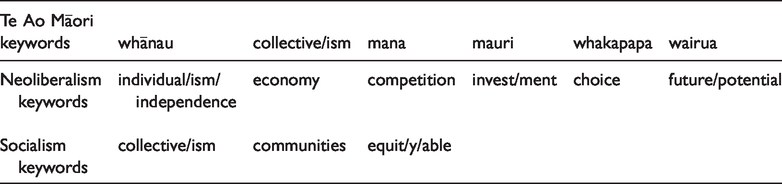
Drawing on themes within the literature, we also interrogated each text for the characteristics of each discourse. For Te Ao Māori, characteristics included the use of te reo, the inference of families and peoples as a collective (Rau and Ritchie, 2011), the recognition of Māori as culturally and regionally specific family groups or hapū and iwi, as well as the inclusion of Māori notions of Papatūānuku, whakapapa and whanaungatanga (Te One, 2003). Recognised socialism characteristics included equality (Macartney et al., 2003), feminism (May, 2009) and children’s autonomy, as well as community values (May, 1985). Neoliberalism’s recognised characteristics were business language (Holborow, 2013), human capital theory that stresses an investment approach (Duhn, 2006), and the support of competition and market values to further quality and individualism (Harvey, 2011). Each of these features were analysed and interpreted within the selected texts.
Findings
The ‘War of the Rings’
The Four Year Plan 2016–2020 was a rich textual source of the Fifth National Government’s governmentality, where neoliberal power/knowledges were discovered. An example of this is the following quote: ‘we all know that a great education is one of the strongest foundations for a prosperous life, a flourishing society and a strong economy’ (Ministry of Education, 2016: vi). This excerpt, with the neoliberal keyword ‘economy’, claims that there is a need for investment in education, an assertion that appears to internalise a human capital theory, supporting neoliberalism’s ‘truths’. Similar ideologies are present in persistent presupposition statements, characterising neoliberalism, such as those that define how ‘well-educated people tend to be better off, healthier and play a more active role in society. They are also more likely to contribute to economic prosperity and growth’ (Ministry of Education, 2016: 11). Passages of this nature appeared at repeated times throughout the document, suggesting the government’s attempt to position readers toward a neoliberal value of economics and returns. Within this text, the governmentality or ‘the art of exercising power in the form of the economy’ (Foucault and Senellart, 2010: 95) was most strongly observed. Associated worldviews in the Four Year Plan described the need for the neoliberal keyword competition, stating (emphasis added) ‘the system needs to offer competitive, responsive education that is of value to the learner’ (Ministry of Education, 2016: 24).
However, neoliberalism’s power/knowledge in this text were never discovered as one ruling discourse; rather, they were always displayed in seemingly complementary combinations with socialist and Te Ao Māori discourses. Such combinations were exemplified in the following quote: ‘an important focus for us is to work more closely with parents, family and whānau, communities and employers, and connect them to efforts in raising student achievement’ (Ministry of Education, 2016: vi). The combination of discourses in this excerpt appears to embody the characteristics of socialism, neoliberalism and Te Ao Māori; this is reflected in the importance of families as collectives and learners whilst simultaneously addressing discursively neoliberal market values in parallel texts referring to business language and investment characteristics of ‘employers’ and ‘achievements’. The interplay of these discourses suggests that although the governmentality of the Fifth National Government was applying neoliberal truths onto the educational sector, this application appeared moderated and influenced by the socialist and Te Ao Māori discourses. Thus, the one forged ring did not seem to dominate or overthrow the other rings of socialism and Te Ao Māori in the Four Year Plan, rather, these discourses were discovered in combination, with their spheres’ of influence cohabiting within the same passages. The extent to which this was a deliberate tactic to ameliorate the neoliberal messages or not remains a question that lies beyond the scope of this analysis.
Neoliberal, socialist and Te Ao Māori discourses combinations in Te Whāriki
With a better appreciation of the Fifth National governmentality, we turned our analysis to the original and the updated Te Whāriki. Analysing both texts enabled an investigation of the movement of neoliberalism, socialism and Te Ao Māori across the original to updated curriculum. Again, these discourses that we might expect to be increasingly dominated by the all-seeing neoliberalism were discovered in complex combinations. In comparisons between the 1996 original and the 2017 updated Te Whāriki, they became even further interanimated, with each exhibiting powerful spheres of influence that were integral aspects of the texts. An example of this combination was recognised in strand three’s contribution goal within the original 1996 Te Whāriki which states (emphasis added): children experience an environment where: there are equitable opportunities for learning, irrespective of gender, ability, age, ethnicity, or background; they are affirmed as individuals; they are encouraged to learn with and alongside others (Ministry of Education, 1996: 64).
Seeking a comparison of discursive truths across the original and the updated Te Whāriki, we discovered a melding of socialist and neoliberal discourses, often through neoliberalism’s rights of the individual and socialisms rights and autonomy of the child. Exemplifying these conjoined rings of discourses, the following quote includes the neoliberal keyword ‘individual’ and the socialist keyword ‘equitable’. It (emphasis added) states: ‘to learn and develop to their potential, children must be respected and valued as individuals. Their rights to personal dignity, to equitable opportunities for participation… must be safeguarded’ (Ministry of Education, 1996: 40). This quote exhibits how the socialist discourse that values ‘equitable opportunities’ and a children’s rights perspective (May, 1985) has merged with neoliberalism’s values of individualism and human capital, which focus on children’s future ‘potential’. The accommodated melding of these discourses continued in the updated curriculum. This document asked teachers to reflect on (emphasis added), ‘how does the curriculum provide genuine opportunities for children to make choices and develop independence?’ (Ministry of Education, 1996, 2017: 30). This quote exemplifies ‘independence’ and ‘choice’, discursively neoliberal characteristics and keywords that are based on free markets and power/knowledge of individualism as well the socialist characteristics that assert the rights of children who deserve equal ‘opportunities’. Although this could be interpreted as a mastery of neoliberalism into New Zealand ECEC, there is some indication that it is more of a melded forging than a subjugation. We interpret this due to both the socialist and neoliberal discourses’ power/knowledges being equally ruling in these excerpts. Such duality highlights the equal roles these seemingly oppositional discourses are exhibiting. Our analysis, therefore, does not show the neoliberal as ‘one ring to rule them all’. Although neoliberalism appears supported by a Fifth National governmentality, it does not seem to cast an all-seeing, oppressive power that grows in dominance from the original to the updated Te Whāriki. Rather, what were implicated were surprising collective masteries of discourse that appear to further meld themselves within the updated curriculum.
Neoliberal battles for discursive control: from Te Whāriki of 1996 to Te Whāriki of 2017
Although the analysed discourses appeared to meld with one another in the original and the updated Te Whāriki, they also appeared to battle for discursive control. Analysing neoliberal keywords revealed surprising campaign movements between the curricula documents, insinuating an establishing and dislodgement of spheres of influence across the texts instead of ‘one ring to rule them all’. The original Te Whāriki included the keyword ‘individual’ 54 times. However, this usage drops to only 25 times in the updated curriculum. The significant decrease of ‘individual’, which comprises neoliberalism’s most formative value of individualism, could indicate a loss of its power/knowledges and thus its presence in the updated text. However, there are also gains to the neoliberal discourse between the original and updated curriculum. These findings were highlighted in the expansion of the keyword ‘future’, with a power/knowledge of investment, which the original Te Whāriki only included three times, but the updated curriculum incorporated 16 times. These movements of neoliberalism, in conjunction with its melding, imply that a discourse does not permeate or progress in a linear fashion, but rather moves side to side, and up and down in multifaceted and multidimensional ways. Once more these findings do not indicate neoliberalism domination within Te Whāriki, but rather neoliberalism’s surprising interconnection and ‘war of the rings’ with socialism and Te Ao Māori.
Neoliberalism’s modification of Te Ao Māori discourse
There also appeared to be some subjugation of Te Ao Māori discourse from neoliberalism in the updated (English only) version of Te Whāriki. Explaining the essential elements of Māori human development is Grace’s (2005) He Māpuna te Tamaiti (Children are Precious, Unique, Treasures) model outlined in Table 2. This model summons te reo Māori language in terms of mana (prestige, status, authority, spiritual power, influence), mauri (life principle, vital essence, source of emotions), and wairua (spirit, soul, two waters, attitude, feeling), that have each been passed down through whakapapa (to place in layers, genealogy) (Heaton, 2018). However, the updated Te Whāriki does not address all these essential concepts. Instead, it incorporates mana 128 times, mauri only once in the glossary terms, and completely excludes wairua. The use of wairua and mana are significantly lowered compared to the original text which mentioned wairua 31 times and mauri six times. The heavily included use of the term ‘mana’ in the updated curriculum appears to be summoned in a way that encapsulates children’s future potential allegiance to the truths of neoliberalism through human capital theory. However, mauri and wairua, those that deal with life essence and spirituality and are described as the ‘most basic and essential’ of Te Ao Māori health and wellbeing dimensions’ (Durie, 1985), do not fit neoliberalism’s power/knowledges. Their exclusion, yet the high inclusion of mana, indicates the subjugated war waged against essential elements that comprise the Māori worldview. These findings imply that Te Ao Māori was susceptible to neoliberalism’s all-seeing domination from the original to the updated Te Whāriki. As mentioned earlier, we do not presume to speak for the Māori version of the text but suggest that this sideways colonisation of discourse is deeply worrying and needs to be further investigated.
Grace's (2005) Model

Implications for Middle Earth and beyond
The movements of discourse across the original and the updated Te Whāriki did not implicate neoliberalism as an all-seeing eye across the text’s entirety. Foucault (1972) describes discourses as non-linear and discontinuous, a pattern reflected in our findings. Neoliberalism was most clearly present within the Four Year Plan, highlighting the Fifth National Government’s governmentality. Nevertheless, even this text had complex power/knowledges of all three spheres of discourse. These findings indicate that a governmentality, which through its very nature seeks to propel and systematise its own truths (Dean, 2010), is not as simplistic as may be expected. Neither does the governmentality appear to have the necessary power to bind all other discourses within New Zealand’s early childhood sector. This understanding is based on the more apparent power/knowledges of socialism and Te Ao Māori in Te Whāriki (Ministry of Education, 1996, 2017), suggesting a diminished governmentality in these texts in favour of ECEC’s discursive worldviews. Such findings may inspire hope for New Zealand’s early years sector that has discussed the increasing growth of neoliberalism as an all-seeing powerful gaze and led to concerns of its permeation into the field (Westbrook, 2018).
An unexpected finding of our analysis was the ability of Te Ao Māori, socialism and neoliberalism to meld into intellectual forges. In describing texts, Kristeva (1997) outlines the relational practices and processes whereby singular or multiple sign systems ‘traverse’ one another. Through replicating this stance, our findings suggested forges in which Te Ao Māori, socialism and neoliberalism traversed and supported one another’s power/knowledges. They, therefore, contradicted notions that discourses are oil and water with oppositional knowledges and truths. Instead, these discourses appear able to meld intertextual partnerships that hinder any one discourse’s ability to rule all truths and policy. Such findings turn the discussion away from a simplistic appreciation of a singular discourse, such as neoliberalism, that could rule them all. However, a consequence of these melded forges is the support that it establishes for seemingly oppositional truths. The challenges this poses for teachers is to acknowledge the likelihood that in their support of one discourse, multiple other discourses are also likely reinforced. For politicians and policy makers, this implies that neoliberalism is accompanied by other discourses, which seek to establish their own truths through a likely complex governmentality.
The socialist sphere of influence was most capable of melding its power/knowledges with neoliberalism’s own. Historically, Aotearoa was a progressive social and political reputation, referred to as the ‘social laboratory’ (Sherborne, 2008: 41) and suggesting there may still be strong support for socialist regimes of truth. This may imply that discourses, such as socialism within New Zealand, may have larger armies to wage wars, making it more likely to win or reach treaties when campaigning against opposing forces. However, consideration for such battles requires an understanding for their intricacies with some being waged in more insidious ways.
The interpreted complexities of the relationship between neoliberalism, Te Ao Māori and socialist discourses highlights challenges, including the ability for them to battle, overpower and corrupt other discursive truths to better suit their own. A Kristevan approach acknowledges the complex mosaic of attitudes and relationships established by the text through the subjectivity of the writer (Kristeva and Guberman, 1996). Within the analysed texts, this mosaic of attitudes, meanings and knowledges appears to be establishing Westernised, neoliberal truths through disestablishing the holism of Te Ao Māori and jarring its knowledges to the point of exploitation. Te Ao Māori was, therefore, potentially not always able to establish a mutual forging of support with neoliberalism in the analysed texts. Discourses that construct their own spheres of power/knowledge in this way are equally involved in a process of denying other discursive truths. Our findings highlight the neoliberal discourse’s potential ability to lessen the holistic intent of Te Ao Māori through its exploitation.
The danger of Te Ao Māori being discursively corrupted by neoliberal power/knowledges is the seeming support of, and acknowledgement for, indigenous knowledges. Instead of support for, these truths are sucked into a hidden presence or ‘vortex’ that pulls in foreign concepts and produces from them agreeable and hegemonic substitutes (Heaton, 2018; Mika and Stewart, 2017). Highlighting these power struggles, Foucault (1982) describes how discursive knowledges which become lesser or dominant do so because they are the most desired and advantageous. In this way, ‘indigenous knowledge’ is extracted for its ‘useful facts’ and is removed from its traditional culture, meanings and contexts (Mika and Stewart, 2017). Through this intertextual extraction and commodification of knowledge, the neoliberal discourse could potentially gain mastery through a more subversive, and thus problematic, form of colonisation if not carefully guarded.
Conclusion
Key findings from this research suggest that a governmentality does not have absolute power to dominate discursive truths. Rather, truths and power/knowledges are constantly shifting in their relationships with one another and their discursive battle of the rings. Thus, no one discourse ever gains absolute power, instead creating a combination of equal masteries, forges and corruptions. This research, therefore, has the ability to inspire hope and raise concerns from the findings that highlighted the potentially diminished and yet corrupting power of the perceived ‘ruling ring’. The discoveries within this study have highlighted this by exploring theoretical glimpses of Te Ao Māori, socialism and neoliberalism spheres of influence within Te Whāriki (Ministry of Education, 1996, 2017) and the Four Year Plan (Ministry of Education, 2016). Although socialism and Te Ao Māori are thought to be at the mercy of neoliberalism as an all-seeing power, there appeared to be some forges and treaties between the discourses, suggesting more complex intertextual and interanimated combinations of these spheres of discourse. Through these constant battles, the ‘war of the rings’ has the ability to dwindle the defences of neoliberalism, which is less of an all-seeing discourse than an existing ring of power, amongst others. Although these qualitative findings are bound to the selected New Zealand ECEC texts analysed, they could be indicative of the complexities of discourses in the sector. These relationships also urge those within early childhood to engage with wider discussion on multidimensional power/knowledges and discourses that do not always appear to be in direct opposition to one another. Nor are discourses forged with the power to bind all others. Rather they appear able to meld some equal accommodations to support their own power/knowledges, whilst simultaneously supporting other discourses’ truths that have been considered oppositional forces. There is additionally a need to further recognise how indigenous knowledges are discursively corrupted from their truths to fit Westernised worldviews such as neoliberalism. Processes such as these have the potential to result in a new form of colonisation if a fellowship quest is not consistently embarked upon to dwindle the discursive forces of those who may seek to corrupt.
Footnotes
Declaration of conflicting interests
The author(s) declared no potential conflicts of interest with respect to the research, authorship, and/or publication of this article.
Funding
The author(s) received no financial support for the research, authorship, and/or publication of this article.
