



Abstract
Over the last few decades, both New Zealand and the intergovernmental organisation of UNESCO have widely spread the rhetoric of safety through a broad range of educational issues. This notion, in vogue since the neoliberal turn, has raised little opposition in educational debates. In this article, we use a Foucauldian lens to analyse the assumptions that underlie the discourses of safety of UNESCO and the New Zealand’s education policy, and to what extent they align or differ. The findings show a general alignment between the safety discourses of UNESCO and the New Zealand Ministry of Education, and three main assumptions were identified that frame the problem, the solution and those responsible for solving safety issues in education. In the texts analysed, safety operates as a neoliberal mechanism to manage student behaviour and individualise social risk in the guise of altruism.
Introduction
Over recent decades, increased attention has been given to the need to safeguard children and young people from harm in educational contexts. As a result, the word ‘safety’ has become increasingly pervasive in educational policies and debates worldwide (Bennett et al., 2021; Flensner and Von Der Lippe, 2019; Powell et al., 2021). Expressions such as ‘safe learning environments’, ‘child safety’, ‘cultural safety’ and ‘cybersafety’ have become common in our everyday educational vocabularies. In the literature, a safe educational space has usually been described as a school/classroom climate that allows students to feel secure, supportive and risk-free so that they can express their ideas, feelings, identities and behaviours (e.g. Domalewska et al., 2021; Holley and Steiner, 2005) or, more broadly, as a space ‘free of violence’ (e.g. Hernández et al., 2010). This well-intentioned notion has generated little opposition, being advocated by educational scholars and practitioners from very different conceptual and ideological standpoints (Barrett, 2010; Boostrom, 1998; Flensner and Von Der Lippe, 2019). Indeed, the legitimacy of this term has rarely been questioned. As Smith (2014) has pointed out, ideas of ‘child safety’ appear to take on an almost sacred quality nowadays, operating as a ‘regime of truth’ (Foucault, 1980) that normalises certain protectionist regulations and disciplinary practices.
Although it is a social construction, safety has arguably become a recognisable ‘truth’ in the education debates and policies of several Anglo-Saxon countries (e.g. Boostrom, 1998; Walton, 2011; Warrington and Larkins, 2019). In New Zealand, children’s safety has been at the core of several educational policies and debates over the last decades. To mention an illustrative example, the recently passed Statement of National Education and Learning Priorities (2020) has established that New Zealand’s main educational priority is to ‘ensure [that] places of learning are safe, inclusive and free from racism, discrimination and bullying’ (p. 1). As this quote points out, safety has not only permeated discussions about health and physical education (Sullivan, 2014) but also bullying (Boyd and Barwick, 2011), child abuse (Keddell, 2018) and civic debates related to the inclusion of students from minority groups (e.g. Cavanagh et al., 2012). The intergovernmental organisation of UNESCO has also widely spread the rhetoric of safety through a broad range of educational issues, from education in situations of armed conflict through to sexuality education (e.g. UNESCO, 2014a, UNESCO, 2014). The pervasiveness and unquestioned nature of this term was the catalyst of this research.
In this paper, we analyse UNESCO and New Zealand’s educational policies promoting ‘safe’ learning environments over the last decade. In particular, we use a Foucauldian lens to explore the assumptions that underlie the discourses of safety of UNESCO and the New Zealand Ministry of Education (NZMoE), and to what extent they align or differ. The aim of this analysis is not to examine the influence of UNESCO on the national educational policies of New Zealand. We would like, instead, to explore the ‘truths’ (re)constituted by the discourses of safety in policy texts and the extent to which UNESCO reflects the discourses of countries such as New Zealand that are at the forefront of neoliberal education policies (Gordon and Whitty, 1997; McMaster, 2013; O’Neill, 2011; Robertson and Dale, 2002; Thrupp et al., 2021).
Safety in education as a neoliberal discursive practice
Safety, as a floating signifier, has not always been understood in the same way, nor has it always been a problem of educational concern. The genealogical study conducted by Sullivan, (2014) has shown how the educational uses of safety have considerably expanded in meaning over the past century in Anglo-Saxon countries. Echoing the claims occurring in the labour world, the first calls for safety in education started in the twilight of the 19th century and were mostly aimed at preventing accidents and hazards in schools (Sullivan, 2014). Until the 1980s, educational concerns about safety remained mostly confined to physical integrity issues, although these concerns were increasingly present in more areas of the school curriculum, such as health education, physical education and technology education (Sullivan, 2009, 2014; Bennett et al., 2021). In countries like New Zealand and the UK, the neoliberal turn of the 80s triggered a move in the focus of childhood policies from child welfare to child protection/safeguarding (Rogowski, 2015; Hyslop, 2022). This move brought the over-arching terms of ‘child abuse’ and ‘child safety’ to the forefront (Rogowski, 2015; Hyslop, 2022). In education, this move was not only reflected in the increasing ‘safety checkings’ of teachers promoted by legislation such as the New Zealand ‘Vulnerable Children Act’ (Keddell, 2018) but also in the pervasive use of the term ‘safety’ in education debates. Over the last few decades, this term has been used to frame education policy issues as diverse as school-based violence, sexual abuse, multiculturalism, inclusion of learners from minority groups and (mis)use of digital technologies. To mention a few examples, the Safe Schools report (Education Review Office, 2007) ‘identifies the range of strategies schools are using to prevent bullying and support the physical and emotional safety of students’; the Action Plan for Pacific Education 2020–2030 (Ministry of Education, 2020a) is aimed at ‘help[ing] Pacific learners and their families feel safe, valued and equipped to achieve their education aspirations’; and the current NetSafe Schools programme aims to help ‘schools and kura establish, develop and promote online safety, citizenship and wellbeing in their school community’. A similar trend of moving away from physical integrity issues towards much broader social and emotional concerns can also be observed in UNESCO’s use of the term with just a brief look at this organisation’s publications related to safety and education over the past century (e.g. Ohsako, 1997; Southworth, 1971; UNESCO, 1961).
To understand the increasing presence of the safety discourse in education, this discourse needs to be positioned in the neoliberal context in which it operates. As Tikly (2003) and others (e.g. Vandenbeld Giles, 2012) following Ulrich Beck (1992) explain, neoliberalism has involved a modified conception of social risk, ‘which shifts the emphasis from collective indemnification to individuals taking responsibility for moderating their burden of risk’ (p. 164). The neoliberal turn towards children’s safety put an emphasis on changing behaviours and lifestyles of children and those that surround them (Rogowski, 2015). Rather than seeing issues of child protection as broader social problems, these started to be framed as behavioural issues of individual responsibility and/or problems that could be solved through risk management, surveillance and control (Rogowski, 2015). In education, for example, Walton (2011) has analysed how the discourses of wellbeing and safety have failed to identify and address forms of violence in schools. As this scholar argues, these discourses have usually presented ‘the individual as the source of both the cause and the solution’ (p. 113), ignoring broader forms of sociocultural and systemic discrimination (e.g. homophobia, sexism and racism). The discourses of safety portray the problems of school violence and bullying as the result of a lack of discipline or empathy from the bully, offering a solution centred on regulating behaviour that ignores the ways through which bullying reinforces social norms (Walton, 2011). Other scholars such as Freebody et al. (2018) and Epp and Watkinson (1997) have also argued that this behavioural focus to wellbeing in education does not consider the systemic violence fostered by school cultures and wider socio-economic structures.
In addition to a shift in neoliberal countries from collective to individual responsibility, other scholars have critiqued portrayals of children as vulnerable beings in need of saving and protection that underlie the discourses of safety (e.g. Keddell, 2018; Warrington and Larkins, 2019). Warrington and Larkins (2019), for example, argue that safety discourses tend to create a false juxtaposition between children’s protection and participatory rights, which privileges educational measures aimed at controlling and policing their behaviour. For Keddell (2018), these discourses not only serve to justify paternalistic interventions in the detriment to children’s participatory rights but also construct an external threat/danger (strangers, parents, teachers, ‘other’ students, etc.), ‘who are solely responsible for their own behaviour’ (p. 99). This neoliberal trend of individualising educational problems that poses the responsibility of solving those problems onto individuals (whether parents, teachers or students) has been strongly critiqued by several scholars (e.g. Estellés and Fischman, 2020; Freebody et al., 2018). Yet, how educational policy contributes to the promotion of such a trend through the discourses of safety is still under-studied.
As explained by Scheurich (1994), through discourse, problems – including educational problems (see Fejes et al., 2018; Romero and Estellés, 2019) – are shaped in particular ways, as are the responses to these problems and those responsible to solve them. From a Foucauldian perspective, discourses are not mere texts, they are a form of power, as the statements embedded in discursive formations have a tangible, concrete effect in structuring practices (Doherty, 2007). For Foucault (1991), the practice of government – governmentality – refers to the multiple techniques, structures, schemes and ideas deliberately directed towards influencing the conduct of others. Governmentality as an analytical tool focuses on the connection between the forms of government and the modes of thoughts or rationalities (about governing) which ‘justify, legitimise and make the exercise of government deem rational’ (Fimyar, 2008: p. 4). Foucault’s understanding of governmentality provides a critical lens through which to view safety as a discursive concept that not only legitimises increased regulation but also changes a rationality of government from the State to the individual. This change has been termed a shift from policymaking by the ‘government’ of the nation-state to ‘governance’ reliant on ‘the interplay of both formal and informal institutions’ (Hill and Varone, 2021: p. 274). In this ‘modern’ form of governance, the policy process involves complex inter-organisational interactions.
Education policy texts, as fibred by discourses or being discourses themselves (Ball, 1994), are one of the sites where the operation of government is to be found (Deuel, 2022; Doherty, 2007). Indeed, several education policy scholars have used Foucault’s notion of governmentality to examine the neoliberal paradigm of education policy (e.g. Ball, 2013; Deuel, 2022; Peters, 2001; Tikly, 2003). As Tikly, (2003) explains, ‘education policies take the form of political programmes of government and attempt to use technologies of government to implement these programmes in a way that is consistent with the underlying rationality of government’ (p. 166). Over the last few decades, education policies designed to curb violence and promote safety in schools have proliferated in light of widespread concern – perhaps even moral panic and hysteria (Ohman and Quennerstedt, 2017; Walton, 2011) – about child protection in the context of neoliberalism. There are, however, limited studies on how the safety discourse has infiltrated education systems in terms of policy formation and how these policies in turn change rationalities of government.
UNESCO, New Zealand and a neoliberal education policy agenda
The tendency of intergovernmental organisations to follow a neoliberal agenda in education has been highlighted by several studies over the last decades (e.g. Deuel 2022; Peters, 2001; Rutkowski, 2007; VanderDussen Toukan, 2018; Wickens and Sandlin, 2007). Although UNESCO has often taken a back seat in the discussion about economic globalisation and its impact on education, it has followed, to a great extent, the same policy prescriptions as the World Bank and the OECD (Jones, 1999; Mundy, 1999; Rutkowski, 2007; VanderDussen Toukan, 2018). Through ‘soft laws’, these intergovernmental organisations have been able to promote neoliberal agendas in education policy at a national level (Rutkowski, 2007). This does not imply, however, an understanding of global forces as necessarily or exclusively top-down powers. Indeed, these organisations have often presented national/local cases as role models, such as the ‘New Zealand neoliberal experiment’ (see Fergusson, 1998; Kelsey, 1997; Peters, 2001; Robertson and Dale, 2002; Thrupp et al., 2021). In Robertson and Dale’s, (2002) words: For proponents like the World Bank, deeply committed to neo-liberalism as a basis for restructuring economic and social life, New Zealand had engaged in an ‘experiment’ that should and could be modelled by the rest of the world (p. 465).
The ‘New Zealand experiment’ refers to the radical neoliberal programme that begun with the fourth Labour government in 1984 as an attempt to address the perceived ‘crisis of the welfare state’ (Peters and Marshall, 1996). At that time, the OECD reported that the country’s economy was uncompetitive and inefficient (Kelsey, 1997: p. 5). Labour, a party that traditionally championed social democracy, promoted a structural adjustment programme of liberalisation of the economy based upon the so-called ‘Washington consensus’. This ‘consensus’ was a prescribed set of neoliberal policies designed in the US and supported by key players on the world policy stage (e.g. the International Monetary Fund, the World Bank, the OECD and the World Trade Organization) to ‘restructure’ national economies in order to adapt them to the ‘new global economy’ (Peters, 2001: p. 210). These policies included fiscal discipline, public expenditure priorities, tax reforms, deregulation, foreign direct investment, trade liberalisation and privatisation, among others (Kelsey, 1997: p. 18). While ‘developing’ countries undertook these policies to secure credit from international financial institutions, New Zealand – with an advanced capitalist economy – voluntarily implemented them by a democratically elected government (Kelsey, 1997) that gained legitimacy and momentum under conditions of crisis management (Peters, 2001). The reforms affected all sectors of society, including education. In this sector, the reforms were driven by principles such as free parental choice, individual school autonomy, accountability, new managerialism and privatisation (e.g. Gordon and Whitty, 1997; Peters, 2001; Robertson and Dale, 2002; Thrupp et al., 2021).
Neoliberal principles continue to shape education policy in New Zealand today, although sometimes through more subtle forms (Cunliffe, 2021; Easton, 2021; McMasters, 2013; O’Neill, 2011; Thrupp et al., 2021). As Foucault has persistently argued, power is rarely exercised in obvious, overt observable ways. More frequently, as Peters et al., (2000) explain, this power is ‘unobstrusive and embedded in the work process itself or in the language through which it is defined’ (p. 125). Neoliberal discursive practices of government adapt and change over time and are often hidden under seemingly benevolent values and principles, such as inclusion (Dunne, 2009), wellbeing (Freebody et al., 2018), diversity and safety (Walton, 2011).
The study
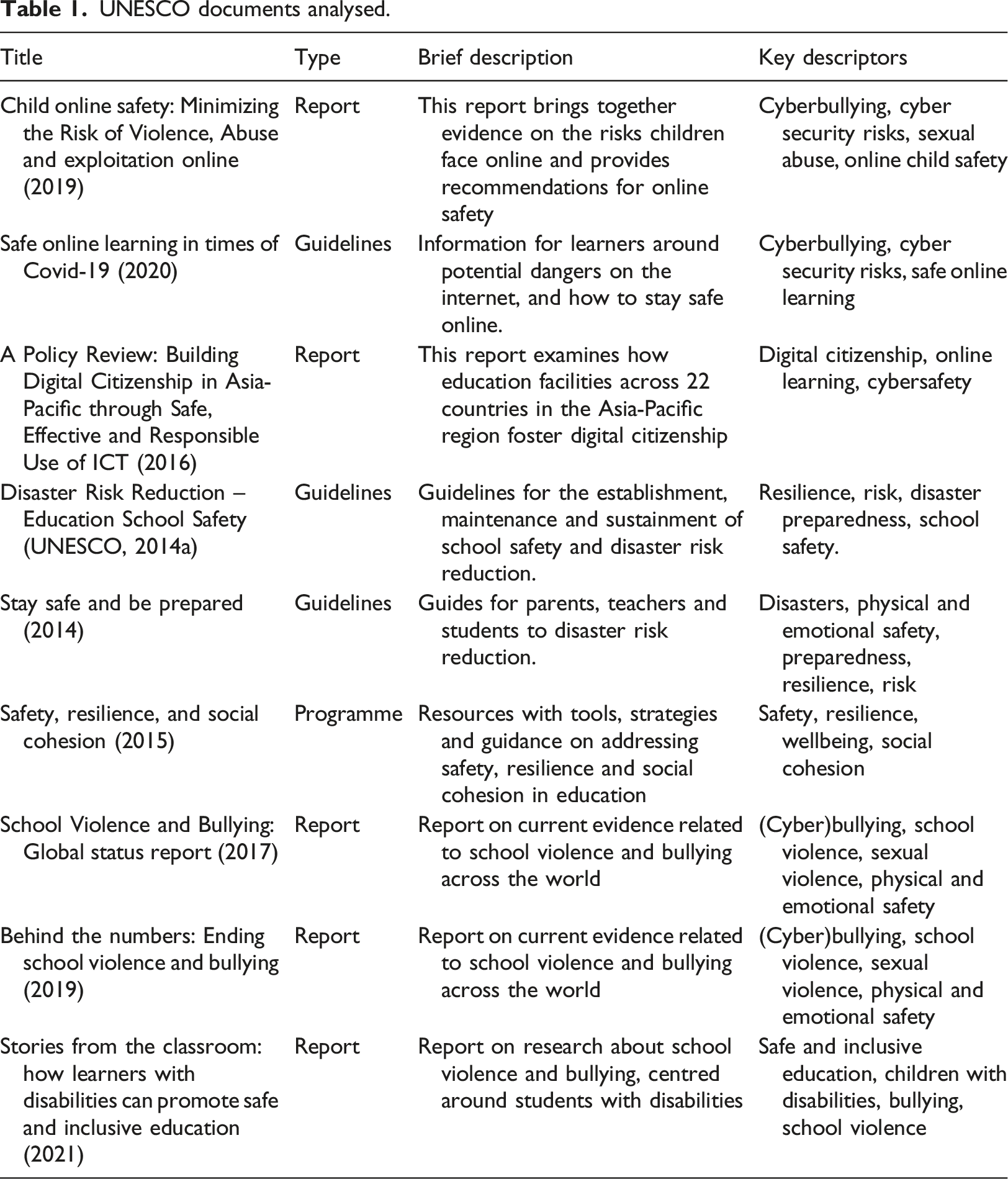
UNESCO documents analysed.
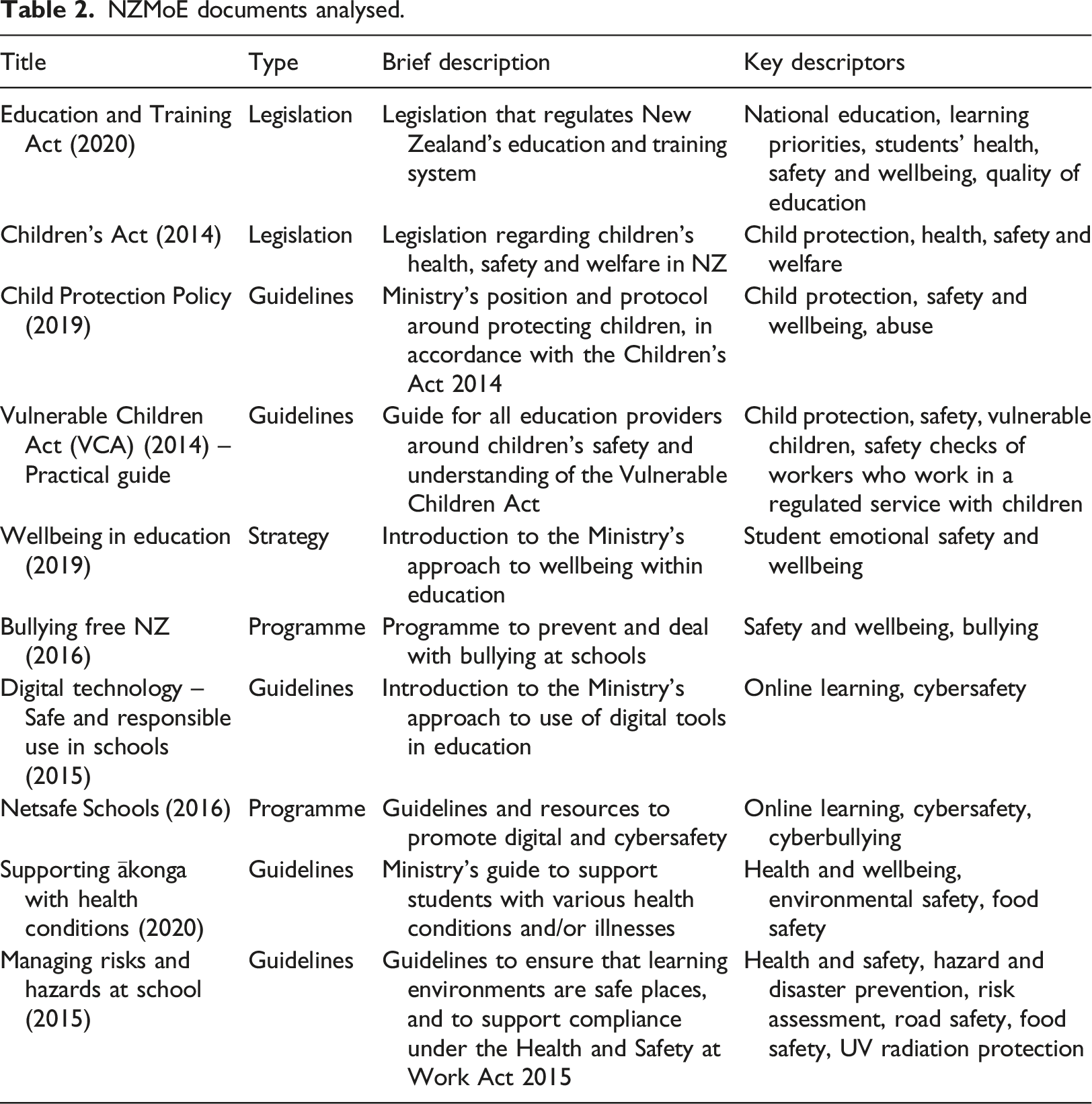
NZMoE documents analysed.
The analysis of these policies was undertaken through the lens of the work of Foucault (1980) and education scholars who have further developed his ideas (e.g. Fejes et al., 2018; Nicoll et al., 2013). As such, discourse is understood as ‘the group of statements that belong to a single system of formation’ (Foucault 1972: p. 107) and analysis of discourse for this study has focused on identifying patterns or regularities of statements in the data (Nicoll et al., 2013; Fejes et al., 2018). The policy documents, whether they were reports, guidelines or programs, have been treated equally as texts that illuminate the object of interest (i.e. the assumptions that underlie the inclusion of safety in education policy). In the reading of the texts, attention has been directed at ‘recurrent concepts, meanings, and relationships formed through regularities both within and between descriptions’ (Fejes et al., 2018: p. 465). The analysis, however, has not only focused on what is explicitly stated but also on what is constituted through such statements (Fejes, 2010). In order to do so, we conducted keyword searches of relevant terms (safe*, risk*, harm*, danger*, abus*, violen*) in each document and then examined the surrounding text to gauge what was being constituted. We particularly focused on recurring words, language patterns, phrases deployed and statements that reappeared across the selected texts when talking about safety. Following the work of other education scholars (e.g. Dunne, 2009; Fejes, 2010), we used the following questions to guide the analysis and organise the coding of the excerpts: How are safety statements framed/constructed? What is presented as problematic through these statements? What or who is presented as dangerous, risky, unsafe or in danger and what/who is not? What interventions are justified/legitimised through these statements? Who is held responsible for such interventions? These questions allowed us to identify the assumptions in the policy documents analysed that defined a) the problem of safety and the subjects in danger, b) the proposed solution to the problem of safety and c) those positioned as responsible for the safety of the subjects at risk.
Findings
As can be seen in Tables 1 and 2, UNESCO and the NZMoE’s policy texts aimed at promoting safe learning environments address a similar range of issues: online safety, wellbeing, school violence, inclusion of children with disabilities and disaster risk reduction (DRR), of which only the latter is primarily related to physical integrity issues. Given the different function of each organisation, the texts also differ in nature: UNESCO’s texts mostly consist of reports and guidelines – what Rutkowski (2007) describes as ‘soft laws’, while New Zealand’s documents also include legislation, strategies and programmes. New Zealand’s legislation is mostly related to prevention of child abuse, a topic less popular for UNESCO (only partially covered in the online safety policies), as widely addressed by this organisation in the previous decade with programmes such as Bouba & Zaza learn to say no (UNESCO, 2011) and other publications (e.g. Arnaldo, 2001).
The findings show a general alignment between the safety discourses of UNESCO and the NZMoE. Across all the texts analysed, three main assumptions were identified that frame the problem, the solution and those responsible for solving safety issues in education. These assumptions are a) children, and particularly ‘vulnerable’ children, are at risk of danger, b) safety issues (whether they are school violence, bullying, sexual abuse or digital participation) can be solved through behavioural-attitudinal change and/or control measures and c) the responsibility of promoting safe learning environments relies on individuals (often teachers and/or school leaders).
The problem: Dangers and children at risk
The first assumption refers to the more or less obvious portrayal of children as a particularly vulnerable group at risk of harm and abuse, which also underpins a good deal of education policy (Kelly, 2000; Powell et al., 2021; Tait, 1995; te Riele, 2006). The presence of the children-at-risk image in the documents analysed is extensive but particularly evident in the policies aimed at providing online safety. The introductory sections of these policies often describe the internet in competing ways as both a learning site and a potentially dangerous space for children. This description is usually accompanied by a detailed list of the risks that children are exposed to in the digital world, which invites the reader to imagine the harmful consequences of these risks. The following quote of the UNESCO’s Child online safety report (2019) is particularly illustrative of this:
Children around the world are regularly exposed to risks and harms online, including: • Sexual abuse, exploitation, and trafficking – ranging from grooming to rape, recorded or streamed by abusers. • Online harassment, victimization, and cyberbullying. • Radicalization and recruitment by extremist organizations. • Exposure to misinformation and age-inappropriate content, such as pornography or violence. • Apps and games that are designed to encourage unhealthy habits and behaviors. • Falling victim to illegal or unethical data harvesting and theft. • The normalization of gender-based violence through exposure to online abuse materials (p. 9).
Similarly, the NZMoE’s guide (2015a) to support schools in ‘the management of safe and responsible use of technology for learning’ states that: The many benefits of learning with digital technologies are accompanied by some challenges and potential risks for students and schools. […] Digital challenges can be broadly categorised as: Cybersafety […] Examples include cyberbullying, smear campaigns, accessing inappropriate content, creating spoof websites or sexting. Cybercrime: Involves illegal activity. […] Cybersecurity: Involves unauthorised access or attacks on a computer system (p. 1)
These portrayals assume that all children could potentially be victims of the dangers resulting from the use of digital technologies. Some policies, rather than conceiving all children at risk of harm, are focused on a particular group of children considered particularly vulnerable. This is the case in those policies that advocate for the safety and inclusion of children with disabilities and/or health conditions (Ministry of Education, 2020d; UNESCO, 2021). Again, it is in the introductory sections where these portrayals of potential harm are made explicit and the risks listed. As the foreword of UNESCO’s report Stories from the classroom: how learners with disabilities can promote safe and inclusive education (2021) states: …global evidence reminds us that children and young people with disabilities […] are more vulnerable to violence and bullying, with most reporting that they have experienced it in some form at some time in their lives. We should not underestimate that school violence and bullying can be devastating for the victims. The consequences include missing classes, avoiding school activities, dropping out of school. This, in turn, negatively impacts academic achievement and future employment prospects (p. 4).
In the policies mentioned above and others such as those aimed at reducing/managing disaster risks, the dangers generally come from outside of the school and are not personified (i.e. sexual abuse is talked about, for example, rather than sexual abusers). In other cases, however, those subjects embodying the threats and dangers are made explicit. For instance, in the New Zealand Children’s Act (Oranga Tamariki—Ministry for Children and the Ministry of Education, 2014) and subsequent guidelines (Ministry of Education, 2014; Ministry of Education, 2020b), the danger is embodied by those people working closely with children (teachers and other staff): ‘Sometimes we fail to keep children safe and sometimes children are abused or neglected by the very people we trust to keep them safe’ (Ministry of Education, 2014). In the bullying prevention documents of both organisations, a personification of the dangers can also be identified: the bully or perpetrator. For UNESCO (2019), ‘Bullying is characterized by aggressive behaviour that involves unwanted, negative actions, is repeated over time, and an imbalance of power or strength between the perpetrator or perpetrators and the victim’ (p. 14), and this report adds that ‘most school violence and bullying is perpetrated by other students’ (p. 8). Similarly, for the Bullying Free NZ program, ‘bullying is deliberate, harmful, involves a power imbalance, and has an element of repetition’ and ‘kids who bully use their power — such as physical strength, knowing something embarrassing, or popularity — to control or harm others’ (Ministry of Education, 2016a). Despite both anti-bullying policies including a reference to power imbalance, such power inequity is portrayed as an individual’s misuse of power over other students. In Walton’s (2011) words, bullying is conceptualised as an ‘individual pathology rather than an outcome of a complex construction of power relations’ (p. 65).
The rationale behind all the policies mentioned above is that the risks that children (and, particularly, vulnerable children) are exposed to, which are external to them, can be mitigated, managed and controlled through educational interventions and/or disciplinary measures (i.e. solutions).
The solution: A ‘pro-active’ approach towards safety
The solutions to the problems of safety (whether they are school violence, bullying, sexual abuse or threats posed by digital participation) suggested by the policy documents of both UNESCO and the NZMoE could be broadly categorised into two groups: a) the development of student competences to ‘keep themselves safe’ and b) control measures to ‘make sure children are safe’. An illustrative example of policies that promote the first type of interventions are those aimed at fostering student wellbeing. The Wellbeing strategy in education of the NZMoE (2019), for instance, provides a broad range of teaching resources for mental health education, suicide prevention and bullying, among others, to ‘develop the social, emotional and communication skills they [students] need as they progress through life’. Also, the Bullying Free NZ programme claims to adopt a ‘whole-school’ approach to creating safe learning environments, which involves building ‘the skills and capabilities of everyone involved’ (students, teachers and families) and a particular emphasis on ‘the development of ākonga [students’] social and emotional skills and competencies’ (Ministry of Education, 2016a). UNESCO’s Safety, resilience, and social cohesion programme (2015) provides guidelines for ministries of education to incorporate safety, resilience and social cohesion into the curriculum and ‘include content supportive of learning to live together (LTLT) and disaster risk reduction (DRR)’ based on the premise that: A good-quality, relevant education helps children and young people develop the skills, attitudes, and values that will keep them safe, develop their resilience, and help them to grow into responsible citizens who contribute to building a more peaceful, prosperous, and cohesive society (p. 7)
For the ‘victims’ of violence and/or abuse, most of these policies also advocate for improving reporting and monitoring mechanisms in schools – although are vague at providing specific examples on what such monitoring involves – and a therapeutical approach providing counselling services. As the UNESCO report Behind the numbers: Ending school violence and bullying (2019) recommends, there is a need to ‘[promote] effective systems for reporting and monitoring school violence and bullying’ (p. 56) and ‘establish child-sensitive reporting, complaint and counselling mechanisms and restorative approaches’ (p. 57).
‘Discipline approaches, including escalation processes,’ are not disregarded as part of ‘a more comprehensive response’ (Ministry of Education, 2016a) to school violence and bullying, but the policies mentioned above are more focused on the development of ‘pro-social’ skills. Policies on online safety are more explicit at adopting disciplinary procedures, although they usually recommend focusing first on educational actions. As the digital technology guidelines written by the NZMoE (2015a) state: In general, preventative approaches that rely on technical or other protections simply do not work. These methods have a role but must be balanced with strategies that promote: development of skills and knowledge for safe and responsible use of digital technology; opportunities for students to be involved in decisions about the management of digital technology at the school; development of a pro-social culture of digital technology use; and cooperation of the whole community in preventing and responding to incidents (p. 1).
Despite this initial intention, the children-at-risk framing outlined in the previous section often leads to the advocacy of measures not only aimed at learning about digital risks and strategies for online safety or creating collaborative mechanisms for management and communication but also at restricting and monitoring children’s use of technology. These measures include ‘removing problematic digital information’ (Ministry of Education, 2016b), ‘parental controls to monitor and supervise the use of gaming devices’ (UNESCO, 2019: p. 57), ‘using filtering software to minimise access to inappropriate online content’ and ‘providing technology that oversees students’ use of the school’s digital devices and platforms’ (Ministry of Education, 2016b), among others. As Kelly (2000) warns, discourses of children-at-risk have often been used to justify paternalistic approaches and control measures, while framing them in positive ways.
Other policies are clearly orientated towards the second type of interventions: control measures. This is particularly the case of New Zealand’s Children’s Act (Oranga Tamariki—Ministry for Children and the Ministry of Education, 2014) and the Education and Training Act (Ministry of Education, 2020c). The main purpose of the former is ‘to reduce the risk of harm to children by requiring people employed or engaged in work that involves regular or overnight contact with children to be safety checked’ (p. 21) and ensuring the implementation of child protection policies for all agencies working with children. This Act establishes periodic safety checks of children’s workers, which include a police check, a referee, an interview and identity check. It also compels agencies working with children, including schools, to have child protection policies that inform staff as to what to do in case they are in contact with an abused child. As Keddell (2018) has pointed out, this Act ‘constructed the problem of child abuse as one of a failure of surveillance, identification and referral problems’ (p. 96). One of the main purposes of the Education and Training Act (Ministry of Education, 2020c) is to support the students’ health, safety and wellbeing. As part of this purpose, the Act regulates the use of physical restraint (p. 111), surrender and retention of property (p. 113) and searches of clothing, bags and other containers (p. 114) by teachers or an authorised staff member when there is ‘immediate threat to the physical or emotional safety of any person’ (p. 112).
The protectors: Teachers and school leaders
The discourses of safety in the policy texts analysed also defined those positioned as responsible for the safety of the subjects at risk and, therefore, taking over the solutions explained above. The problem of safety as framed in individual terms (whether a matter of vulnerability or lack of competences/control) involves a solution that is also individualised. Schools – particularly, teachers and school leaders – in the policies analysed take an essential role in the safety of the students. In New Zealand, for example, schools are the ones responsible for the ‘safety checks’ of the staff members (e.g. Ministry of Education, 2019), for developing clear incident response plans involving misuse of digital technology (Ministry of Education, 2015a), for creating a programme of training for staff, students and the community training to build whole school digital capability (Ministry of Education, 2015a), for ‘provid[ing] appropriate protective equipment for all work environments’ (Ministry of Education, 2015b) and for ‘ensur[ing] a positive, safe and inclusive school environment for all staff and students’ (Ministry of Education, 2016a) in what are often called ‘whole-school’ approaches. The New Zealand Bullying Free programme, for example, claims to adopt a ‘whole-school’ approach that ‘brings everyone together — the Board, school staff, students, parents and whānau, and the broader community — to work on creating a safe, inclusive and accepting school environment where everyone feels a sense of belonging’. Similarly, UNESCO’s work on school violence and bullying encourages ‘comprehensive responses’ to this problem, which ‘encompass strong leadership; a safe and inclusive school environment; developing knowledge, attitudes and skills; effective partnerships; implementing mechanisms for reporting and providing appropriate support and services; and collecting and using evidence’ (2017, p. 10). These responses not only ignore the role of States in creating such learning environments but also, if examined in detail, are a responsibility that mostly rests with teachers and school leaders. The Bullying Free NZ programme, for example, establishes five steps to ‘effectively prevent and respond to bullying behaviour at school’ (Ministry of Education, 2016a). Step 1 ‘starts with a strong commitment from school leaders, with a team led by a senior leader set up to work on the plan’; Step 2 involves ‘gathering data from a range of sources and people to get a full picture of bullying behaviour at your school’ by the team; Step 3 involves approving an action plan based on the evidence collected in Step 2; Step 4 is the implementation of the plan, which involves professional development, working with families, and implementing teaching and learning activities for the development of students’ social and emotional skills; and Step 5 is to review actions and outcomes. The UNESCO’s policy counterpart on school violence and bullying (UNESCO, 2017) suggests similar procedures with a particular emphasis on ‘increasing teachers’ understanding of school violence and bullying and ensuring that they have the skills required to prevent, identify and respond to incidents’ (p. 49). As other scholars have previously highlighted, this emphasis on teacher education not only increases the risk of blaming educators for not achieving the lofty goals attributed to them but also ‘performs as a technology of subjection that minimises the responsibilities of government and the public sphere’ (Estellés and Fischman, 2020, p.10).
In terms of physical safety, the New Zealand guidelines for managing risks and hazards at school (2015b) considers schools as business that need to guarantee the safety of their staff. As stated in the website, ‘Risk management will reduce the likelihood and severity of serious and adverse health and safety outcomes. Schools and early learning services need to understand what is going on in the business so risks are known, assessed and managed’. The recommendations outlined by UNESCO in this field highlight the role of the curriculum (and, therefore, teachers) by encouraging policymakers to ‘ensure mainstreaming of DRR [Disaster Risk Reduction] within the education system’ (UNESCO, 2014a p. 5), which is described as following: DRR in education equips people with knowledge and skills so that hazards cause the least possible loss of human life, inflict as little damage and destruction as possible, and cause only minimum disruption to economic, social and cultural activities. What people know is more important than what they have when it comes to saving lives and reducing loss (p. 4).
Discussion
The increasing prominence of global policy networks has blurred the line between policymaking by institutions of the state and groups outside of it, with policies ‘developed in negotiation between government agencies and pressure groups organised into “policy communities”’ (Hill and Varone, 2021: p. 65). The alignment of NZMoE documents and UNESCO documents represents a consolidation of neoliberal ideas about the purpose of school. The educational policies promoted by international organisations like UNESCO seem to reflect, once again, the discourses of countries such as New Zealand that are at the forefront of neoliberal educational policies (Peters, 2001; Thrupp et al., 2021) and the export of educational models and services (Ball, 1994; Verger and van Paassen, 2013) as a form of neocolonialism (Wickens and Sandlin, 2007). This alignment shows the complex, non-unilateral interaction between global and national powers in the production/distribution of educational discourses.
The safety discourse has infiltrated education systems in New Zealand through policy texts created by the Ministry of Education. Similar discourses are seen in UNESCO documents, reflecting a shift away from physical integrity issues to social and emotional safety. The wide-ranging topics included in these policy documents – from bullying to sexual abuse to threats of online arenas – serve to heighten the sense of danger. Some of the perceived threats to children’s safety encompass all students, while others are threats to specific subgroups, such as students with disabilities. Some of these threats are embodied by adults (e.g. online predators), while others by other students. The threats have associated competences as well as control measures, and the policies identify school leaders and teachers as equipped to provide comprehensive responses as needed.
The proliferation of cautionary tales about all of the ways in which schools need to take measures to be ‘safe’ learning environments in policy documents put forth by the NZMoE and UNESCO in the past decade denote a coupling of state and external policy actor organisations that exert power over the public – especially families with school-aged children – in a series of ‘taken-for-granted discourses’ (Hill and Varone, 2021: p. 31) about the risk of harm outside of the home setting and schools’ role in averting harm. Placing vivid depictions of possible harm at the forefront of these policies exerts ‘the supreme and most insidious exercise of power to prevent people…from having grievances’ (Lukes, 2005: p. 24). The prevailing preoccupation with safety sets the policy agenda for the government and limits alternative policy issues from attracting the ‘scarce attention’ of politicians (Hill and Varone, 2021: p. 157). The findings of this study show how agenda-setting power is exercised in education policy through discourses of safety.
The discourses of safety analysed frame child protection pressures as narrow educational matters of skill development and/or behavioural management. This is not the first time that social policy evokes fear of harm to children to justify certain educational interventions (e.g. Hyslop, 2022; Keddell, 2018; Rogowski, 2015). In the past, these fears have been articulated in discourses of the ‘dangerous youth’ and, more recently, the ‘at-risk youth’ (Castel, 1991; Kelly, 2000; Tait, 1995; Wood, 2016; Wyn and Harris, 2004). The move ‘from dangerousness to risk’ facilitated the deployment of a new form of government, as it was no longer necessary to show symptoms of dangerousness to display the interventions, but any ‘objective’ risk factor (Castel, 1991; Tait, 1995). The current semantic emphasis on ‘safety’ (over ‘danger’ or ‘risk’) manifested in the policies analysed implies a further expansion in the possibilities of government as understood from a Foucauldian perspective. Under the rationality that ‘any child has the right to a safe education’, the possibilities for surveillance and regulation are multiplied. What is also novel about the current emphasis on safety is the shift in responsibility from the collective to the individual. The role of the State is reduced to the emission of policy that attributes responsibility to students (that need to learn how to keep themselves safe) and educators (that need to make sure that students are kept safe), ignoring the wider sociocultural and economic structures that contribute to the creation of a sense of safety. The attribution of responsibility to students and educators signals forms of behaviour management (government) through the doxa of (self-)care, which operates through fears of danger or, in the case of educators, of being accused of child abuse (Öhman and Quennerstedt, 2017). These notions of individual responsibility align with the neoliberal agendas of both the NZMoE and UNESCO.
Discourses sustain patterns of power, but they are by no means static or immutable. Rather, the agency to renegotiate the prevailing order may be especially rife in the current moment, as New Zealand – and the world – renegotiates the way we work and learn and the power of collective action to disrupt the discourses used to support the dominant sources of power. As such, we would like to conclude with a call to problematise safety as a discursive practice in education policy. In the education policies of both UNESCO and the NZMoE, safety operates as a neoliberal mechanism to manage student behaviour and individualise social risk in the guise of altruism. The emotional, physical and mental distress from the ongoing Covid-19 pandemic should not be minimised, but we suggest that ‘safety’ as constructed in the policies reviewed here does little to alleviate student (or teacher) distress, and instead may heighten it. Policy transfer is rife (Hill and Varone, 2021); as other countries look to UNESCO for guiding principles and look to New Zealand as an exemplar in Covid response, we urge policymakers to consider the model of safety best suited to their context.
Footnotes
Declaration of conflicting interests
The author(s) declared no potential conflicts of interest with respect to the research, authorship, and/or publication of this article.
Funding
The author(s) disclosed receipt of the following financial support for the research, authorship, and/or publication of this article: This work was supported by Spencer Foundation (202200161).
