




Abstract
Underpinned by neoliberalism and spurred by growing international student mobility (ISM), global trends and policymaking on internationalisation are geared towards the maximisation of efforts by countries and institutions to recruit fee-paying international students. For international students, previous studies on their decision-making processes and motivations for studying abroad emphasise the benefit of acquiring a quality education and employability, tending to human capital development. The dominant framing of internationalisation around economic imperatives, which has been criticised by several scholars, limits our understanding of non-economic dimensions of ISM. A review of Sen’s capability approach encompassing both intrinsic and instrumental values supports the framework presented in this article. The framework, illustrated by qualitative data, captures how international students’ rationales for studying abroad include the following four dimensions: educational; experiential; aspirational; and economic. This article raises a critical question about how an internationalisation policy that does not represent a broad range of students’ rationales for studying abroad can be expected to provide a transformative experience for students. The concluding section details recommendations for a re-imagining of policy towards enhancing the international student experience. It briefly points to the timeliness of the proposed framework in the light the possible impact of Covid-19 on the future of ISM.
Keywords
Introduction
The numbers of internationally mobile students have more than doubled from 2 million in 2000 to 5.3 million in 2017 (UNESCO Institute of Statistics, 2019). International student mobility (ISM) thus remains the most visible aspect of the internationalisation of higher education, and it continues to attract the interest of policy makers and scholars (Bohm et al., 2004; Brooks and Waters, 2013; Ilieva et al., 2017; King and Sondhi, 2018; Lomer, 2018). Underscoring this interest, a British Council sponsored report by Ilieva et al. (2017) highlighted findings from a comparative research on internationalisation across different countries (in Europe, the Americas, Australia, China and India) which found that ISM is the most well-developed category of national policy frameworks in all the 11 European countries studied (including the UK). All the countries with a published policy document include international student recruitment targets (Ilieva et al., 2017). Similarly, institutions across the UK provide details of international student recruitment targets as a major feature in their policy documents (Fakunle, 2019). The importance of ISM in international higher education policy was summed up in another report sponsored by Australian and British education organisations, namely, the British Council, IDP Education Australia and Universities UK (Bohm et al., 2004). The report, intended as a guide to international student mobility, stated that: International education is an economic sector that is extremely attractive to a country: it is knowledge-intensive, high value-added and offers long-term benefits. When compared with other activities in the services sector of the economy, growth (both achieved and projected) is extremely impressive… For example, the total value of education exports to the UK is estimated at over £10 billion p.a. and has been growing significantly and consistently… New destination countries for students…increasingly realise the strong relationship between international education, prosperity and economic and political advantage. (pp. 66–67)
However, as Tesar and Arndt, (2017) remind us, there is a need to interrogate policy underlying ‘the dominant push for an increasingly globalised cultural logic and outcomes-driven productiveness in the neoliberal agenda’ (p. 667) underpinning the global trend to internationalise education. In other words, they stress the importance of developing an education policy that takes account of the impact of the diversities of cultural knowledges that internationalisation can afford and the need to probe the neoliberal agenda. They further raise an important point that ‘resisting dominant ideologies and marginalising practices calls for diverse theoretical and conceptual underpinnings and orientations towards various possible confluences’ (p. 667). To this end, this article problematises the dominant conceptualisation of internationalisation based on economic factors. The article draws on interview data collected from international students to develop an expanded and integrated framework that illustrates different factors underpinning their decision to study abroad, and offers possibilities for re-imagining policy in relation to internationalisation.
As a starting point, this article highlights the framing of internationalisation from macro and micro perspectives, underpinned by economic factors. Second, the article discusses how the capability approach offers an expanded theoretical lens to reframe international students’ rationales to study abroad. Third, drawing on findings from the empirical study reported below, the article presents a conceptual framework of international students’ rationales for study abroad that integrates both instrumental and intrinsic values. Fourth, informed by this research and conceptual framework, it puts forward recommendations to support the development of internationalisation strategies in higher education policy.
Internationalisation: Macro and micro perspectives
The last three decades have seen a growing volume of research and publications on different dimensions of the internationalisation of higher education, including staff and student mobilities, cross-border research and knowledge exchange, internationalising the curriculum, and transnational education (Altbach, 2016; Bohm et al., 2004; Brooks and Waters, 2013; de Wit et al., 2015; Fakunle et al., 2016; Findlay, 2011; Ilieva et al., 2017; Kehm and Teichler, 2007; Knight, 2004, 2012; Leask and Carroll, 2011; Qiang, 2003; Tesar and Arndt, 2017).
The multifaceted discourses around internationalisation are conceptually framed from macro and micro perspectives. Underpinned by a dominant neoliberal agenda in educational policy, economic factors can be considered as a common aspect of internationalisation in both macro and micro frameworks. On the one hand, the macro economic rationale is widely viewed as serving the interests of host institutions and countries who benefit from recruiting high fee-paying international students (de Wit, 2020). On the other hand, at the micro level, students are positioned as consumers seeking education to enhance their labour market opportunities and economic contribution to society (Lomer, 2018).
The macro framework for conceptualising rationales for internationalisation portrays policy development and strategic approaches to internationalisation by host countries/institutions (Bohm et al, 2004; Ilieva et al., 2017; Knight, 2004; Qiang, 2003; Tarc, 2019). As Kondakci (2011) has noted, the rationales framework at the macro level is useful in depicting the issue from a ‘destination’ perspective (p. 576). This alludes to the dominant flow of students from the global south to the global north (King and Sondhi, 2018). In this regard, successful internationalisation is measured in terms of research funding, international staff and student recruitment, and international research collaborations that improve the position of higher education institutions in influential global rankings, such as QS and Times Higher Education (Wihlborg and Robson, 2018). However, a macro analysis of internationalisation rationales provides less insight about why a student chooses to study abroad in a particular host country (Kondakci, 2011).
Micro level conceptualisation of rationales for internationalisation focus on international student motivations to study abroad (Bohm et al., 2004; Cebolla-Boado et al., 2018; Cubillo et al., 2006; Kondakci, 2011; Maringe and Carter, 2007; Mazzarol and Soutar, 2002). Within this body of work, the ‘Push and Pull’ model is the most widely used framework for analysing student decision-making processes and motivations for study abroad (Lomer, 2018; Wilkins et al., 2012). Key push factors include a lack of study opportunity at home and perceptions of a higher quality of education in the host destination. Key pull factors include quality of education, the reputation of the institution, high-quality staff, and future employment opportunities. However, the limitation of the push/pull as an analytical framework has been highlighted by several researchers (Lomer, 2018; Wilkins et al., 2012). For example, Wilkins et al. (2012) argued that push and pull factors are external forces that impact on students’ behaviours and choices, but the individual preferences and personal characteristics of students are largely unaccounted for. Furthermore, the model alludes to a ‘push’ towards Western countries. This one-directional framing of internationally mobile students’ motivation to study abroad (King and Sondhi, 2018) fails to account for mobilities between students from Western countries (Brooks and Waters, 2013) and regional hubs in non-Western countries, including China, India and South Africa (Altbach, 2016; Majee and Ress, 2020). In addition, the push/pull model does not fully account for the distinction between motivations to study abroad at undergraduate and postgraduate levels. By contrast, as will be discussed later, my research highlights student rationales to study abroad for further education after obtaining a first degree in their home country.
In sum, existing conceptual frameworks for ISM (e.g. see Cubillo et al., 2006) can be viewed as reflecting the dominance of marketisation of higher education in the internationalisation agenda (Lomer, 2018). This suggests that student recruitment is seen as an end in itself, as advancing marketisation, rather than focusing on the overall student experience. The implication is that less attention is accorded to the agentic capabilities of students (Marginson, 2014; Tran and Vu, 2018), and other aspects of the education experience such as cultivating criticality and intercultural understanding (Kreber, 2009). In addition, questions are being raised about the dominant conceptual framing of internationalisation as an activity and policy driven by an institution’s rationales without ‘reaching down’ to explore individual actions and motivations (Willis and Taylor, 2014). This suggests that there is a need to question what counts, or should be included in policy development. In view of recent critique of the dominant framing of ISM from an economic rationality approach and calls for an ethical, inclusive and humanistic approach to internationalisation (Buckner and Stein, 2019; de Wit, 2020; Tran and Vu, 2018), ‘and making space for multiple experiences of diverse cultural knowledges and lived educational experiences’ (Tesar and Arndt, 2017: 665), the aptness of the capability approach (Lo, 2019; Saito, 2003; Sen, 1997) in understanding ISM is considered next.
Examining ISM using the capability approach
To the best of my knowledge, this article presents the first examination of empirical research on ISM from the theoretical framework of Sen’s capability approach. Perhaps, this can be attributed to the observation by Saito (2003) that while ‘Sen’s capability approach has received substantial attention from philosophers, ethicists, economists and other social scientists, it has not yet been critically examined from an educational perspective’ (p. 17). He then contended that ‘issues therefore remain to be explored concerning the relationship between the capability approach and education’ (p. 17). His argument is premised on the idea that Sen’s capability approach illustrates how ‘humanity in economics’ deserves exploration from an educational point of view (p. 17). This refers to how Amartya Sen ‘relocates the centrality of human capital from economic growth to the improvement of well-being’ (Sen, 1999: 262). In other words, Sen focuses on the well-being and freedom ‘of people to lead the lives they have reason to value and to enhance the real choices they have’ (Sen, 1999: 293). The value of the human capability approach is emphasised by many scholars including Nussbaum (2011), who asserts that ‘capabilities…as spheres of freedom…have intrinsic value’ (p. 25).
Gale and Molla (2015) assert the significance of Sen’s capability approach as a valuable tool for understanding and evaluating educational policies from the perspectives of individuals. This underpins the relevance of the capability approach as ‘an alternative to narrow measures of well-being such as utility and resources’ (Gale and Molla, 2015: 810). This fits with the aims of this article that proposes an expanded framework for understanding student rationales for studying abroad, beyond dominant economic narratives.
One could also consider the aptness of the capability approach in higher education from the perspective of Marginson (2014), who proposes that higher education can be constructed as self-formation. Drawing on Sen’s notion of agency freedom (the active human will, that drives self-directed conscious action), Marginson (2014) postulated that ‘higher education as self-formation extends beyond the notion of …investment in the self as human capital’ but also involves ‘self-cultivation, self-improvement and individual capabilities’ (p. 12). Tarc (2019) and Marginson (2014) have acknowledged the tensions evident in different visions of higher education. Tarc (2019) sums up the contestation as ‘siloed internationalisation of education discourses’ that posits differently the ‘educative dimension’ within the structuring conditions of instrumental agendas (p. 742) and calls for a conceptual re-imagining of these currently dichotomous discourses. Marginson (2014) also questioned why ‘higher education for investment in personal earning power is counter-posed to education for knowledge as if the two aspects cannot coexist’ (p. 12).
In a similar vein, Sen (1997) has argued that for the integration of both human capital and human capability, the broadening that is needed is additional and cumulative, rather than being an alternative to the human capital perspective. He also noted ‘a crucial difference between the two approaches…the acknowledgement of the role of human qualities in promoting and sustaining economic growth – momentous as it is – tells us nothing about why economic growth is sought in the first place’ (p. 1960).
In relation to ISM, the human capital aspect relates to how studying abroad can enhance the ability to gain skills and an international qualification that yields economic benefits to the students. This is consistent with the instrumentalist and economist approach that defines education as an investment (Robeyns, 2006). However, Sen’s capability approach that embodies both human capital (economic growth) and human capability (well-being and agency freedom) offers a holistic understanding of why students study abroad. This aligns with the argument by Lo (2019) that the capability approach offers a conceptual reframing of ISM in a way that acknowledges ‘that education plays both intrinsic and instrumental roles in economic and non-economic terms’ (p. 270). Drawing on Robeyns (2006), Lo (2019) comes to this conclusion by categorising the existing ISM literature into two conceptual approaches: an instrumentalist approach that focuses on economic rationality; and a critical approach that highlights questions of human rights in ISM. The two approaches are conceptually different, as the former focuses on a human capital model of education that stresses economic productivity, while the later prioritises the intrinsic importance of education from a justice-as-rights perspective (Robeyns, 2006). Hence, these two categories do not provide a framework that embodies both the instrumental aspect of ISM and non-instrumental values. To this end, Lo (2019) argued that the capability approach provides a meaningful conceptual framework to understanding student mobility as it demonstrates how education involves both human capital and human capability. Lo further suggested that ‘future research need to develop an operational, integrated framework of human capital and human capabilities’ (p. 270). This call is taken forward in this article.
Thus, the research reported below relates Sen’s notion of the interconnectedness of human capital and human capabilities in its depiction of students’ accounts of both instrumental and intrinsic rationales for studying abroad. Student rationales for mobility are thereby presented as active and intentional agentic actions in pursuit of individuals’ aims and goals, which as Tran and Vu (2018) rightly argued have not been the explicit focus of theoretical and empirical investigation.
A framework for conceptualising student rationales for internationalisation
The framework presented in this paper derives from a qualitative study that set out to explore rationales for ISM from the students’ perspectives. This article is centred on the research question:
What are the rationales for international students to study on a one-year Masters-level programme at a UK university?
Research design and analysis
An exploratory qualitative research design was deemed appropriate to elicit rich and in-depth data (Silverman, 2016) that accords with Maxwell’s (1992) description of validity in qualitative research as the ‘correctness or credibility, conclusion, explanation, interpretation, or other sort of account (data sources)’ (p. 122). In addition to data sourced from an extensive review of existing literature and strategic documents relating to internationalisation published by the university spanning eight years (2009 to 2016), the systematic and purposive sampling strategy adopted for the study involved: (a) a detailed examination of a national data source, that is, Higher Education Statistics Agency data over a five-year period (2011/12 to 2014/15) and the selection of the university which attracts the highest numbers of non-EU international students in Scotland; (b) using an institutional data source to inform the selection of four programmes (letters are used to represent the programmes in Table 1) across four schools in the university with the highest representation of international students. The selected programmes are not identified to protect the anonymity of the participants; (c) after ethics approval, email invitations to participate in the research were sent through the Gatekeepers (Programme Directors) to all the international students on the selected programmes and interested participants were asked to contact the researcher directly. The participants recruited for the study, 19 Masters-level students from 11 countries studying across four schools (Table 1), provided breadth and depth to the study as they were a varied group from different countries.
Profile of participants across four Masters-level programmes.
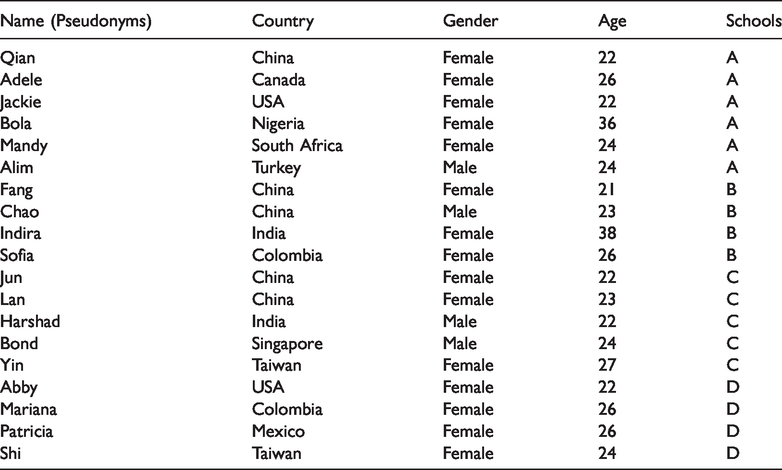
A pilot study involving semi-structured interviews with three international Masters students in the target programmes helped to sharpen the focus of the study. For the main study one-to-one semi-structured interviews were conducted with students at two time-spots, the end of first and second semesters, during a one-year Masters programme. Despite repeated email requests two interviewees (Adele and Mandy) did not participate in the second round of interviews. All 36 interviews lasted around one hour. The interview data were audio recorded and transcribed verbatim to maintain closeness to the data.
Thematic analysis was used to identify, analyse, organise and categorise the themes in the data (Braun and Clarke, 2012). NVivo software was used for the management of multiple data sources and easy retrieval of coded and original text. The codes derived from the transcribed interviews were generated inductively without pre-conceived categories. The themes that emerged from the coding process captured the constructs emerging from the data to develop the framework (Figure 1). Codes were developed in four sequential stages to capture the individuality and variability underlying the complexities within and across the dataset. The first interview with Indira was coded first due to the interviewee’s distinctiveness in terms of: age (oldest student), educational qualification (only interviewee with an MBA) and a having studied a different discipline (BSc in Zoology) prior to starting the Masters (in Education). The second coded interview (Abby) provided the most contrast to Indira. At the third stage, two interviews (Alim and Lan) increased the variability of the coded data (gender, country of origin and programme). Fewer new nodes emerged from the data after stages 1–3. At stage four, all the remaining interviews (n = 32) were coded until there were no new themes emerging from the data. The close reading of the data and systematic analytical approach generated the themes and categories embedded in individual accounts and comparatively across the data. Five coded and anonymised transcripts were sent to three experienced qualitative researchers (member checking) to check the credibility and the reliability of the research design.
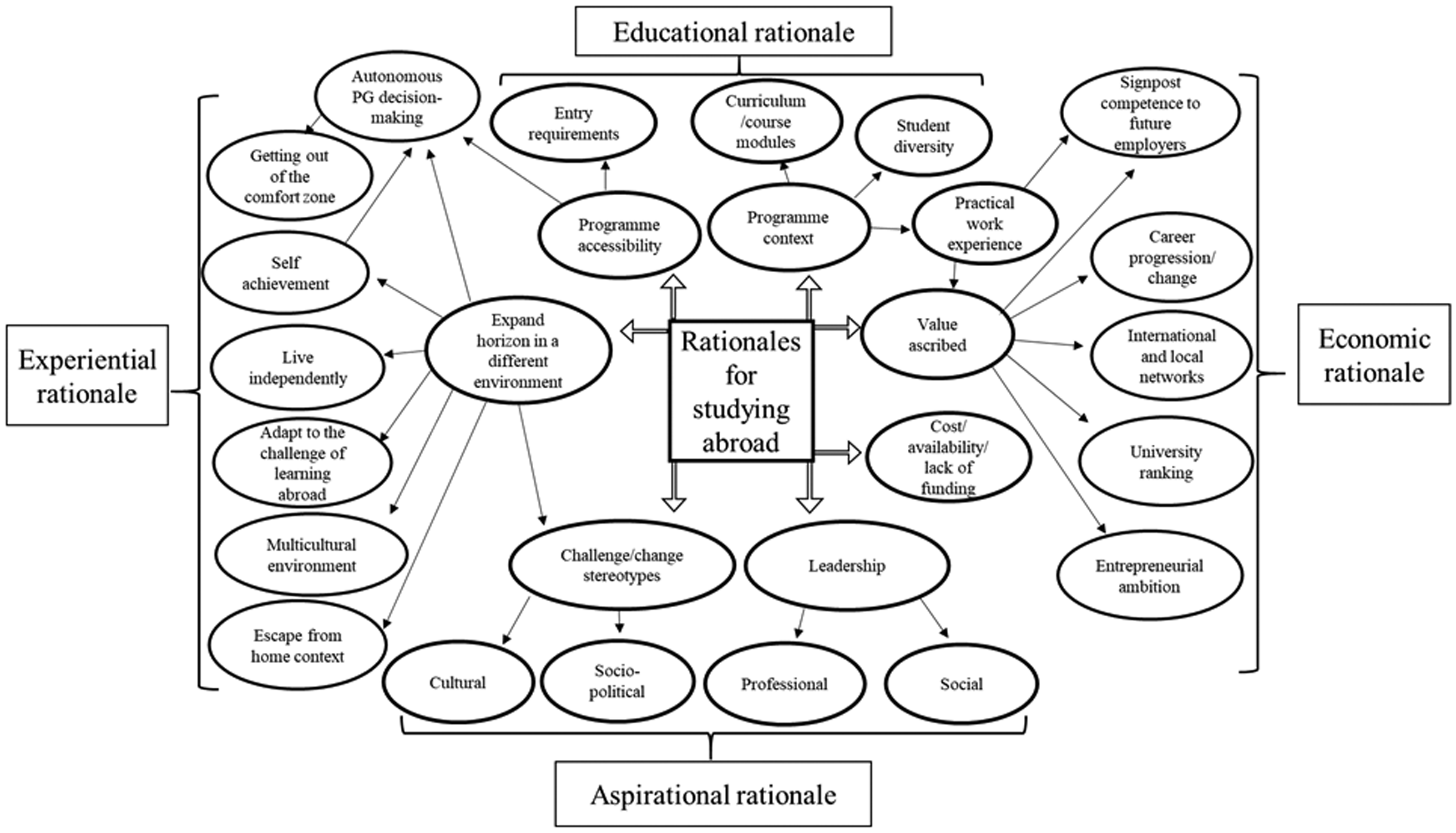
International students’ rationales for studying abroad.
As an illustration of the inductive process, ‘key influencers’ emerged as a theme (derived from 16 out of 19 interviewees) as students talked about how parents, friends, and mentors motivated and supported their desire to study abroad. However, the students were keen to stress how they were motivated to study abroad to gain access to an educational experience informed by their own ‘strong’ interest and ambitions. By contrast, some of the students shared their past educational experiences with regards to how parental influence had made them enrol in undergraduate courses that they were not interested in. For example, Indira talked about how her parents had persuaded her to study a science subject because they believed she was too ‘brilliant’ to be studying an arts-related subject that ‘will not provide her with a good job’. This example shows how parental influence could reinforce a mainly economic rationale for education. However, similar to other accounts across the interviews, Indira emphasised how her intent to pursue her ‘dream’ course informed her decision to study abroad. Thus, rather than using the theme ‘key influencers’, the theme ‘autonomous PG decision making’ (see Figure 1) captured an interpretation of the coded data that provided a credible explanation (Maxwell, 1992) of the students’ rationales for studying abroad. Across the interviews, there was a sense that the students believed that studying abroad would allow them to achieve their goals and satisfy their intrinsic interests. Congruent with the capability theoretical approach, the emergent framework (Figure 1) thus encapsulates the themes that are directly related to students’ instrumental and intrinsic values.
Findings
The main themes which formed the basis for developing the conceptual framework are displayed in Figure 1 under four main categories: (a) Educational, (b) Aspirational, (c) Experiential, and (d) Economic rationales for study abroad. In this section, quotes from the students are used to elaborate the components of each of the four rationales. This is followed by a brief overview that illustrates how the rationales are interconnected.
Educational rationale
As shown in Figure 1 the educational rationale includes two main themes: Programme context (curriculum/course modules, student diversity and practical work experience) and Programme accessibility (entry requirements).
Programme context
All the students described a careful ‘sifting process’ before selecting a programme – checking institutional websites and eliminating programmes if the course modules did not align with their interests and future career plans. They also found the presence of an international student cohort appealing, seeing this as enhancing their experience. The one-year length of a UK Masters was a key consideration; for example, Adele (Canada) said such options were limited in her home country. Crucially, the practical work experience was a major draw for students: Ultimately what drew me to this programme was the emphasis on applied practice. In addition to, of course, reading widely and writing, we get to do a number of related projects. Abby (USA)
Programme accessibility
Proficiency in the English language was important for programme accessibility for monolingual students who talked about their inability to study in non-English-speaking countries, while bilingual [and trilingual] speakers were seeking to improve their language proficiency during their study abroad.
Flexible entry requirements allowed students to enrol on programmes unrelated to their undergraduate programme, as was the case with some interviewees such as Jun (China) who said, ‘it is very difficult to change your discipline…at postgraduate level in China, and that was one of the reasons I came to study in the UK’. As already discussed, Indira’s (India) ‘autonomous PG decision making’ prompted her to seek to study abroad.
Related to programme accessibility, international students needed to apply for a study visa. Mirroring the experience of other participants, Abby (USA) described student visa application to the UK as ‘scary’. This points up the structural constraints on ISM, that disempower students’ agency as students are constrained to select only one programme from several offers from different institutions before they can apply for a visa.
Experiential rationale
Students’ decisions to study abroad were underpinned by a strong sense of expectation to experience ‘something different’ from the norm in their country. The experiential rationale interwove the academic experience, the physical environment, and wider multicultural environment. The quotes below resonate with the observations of all the students: I could do the Masters degree in China because there are very good universities but I just wanted to go abroad to experience a different life, some fresh ideas and a totally different view – to see the world… Sometimes an experience in a country you are not familiar with will influence your whole life because only when you live away from what you are familiar with, you can see what you really want. Qian (China) It is very good in that you have different cultures and people from all over the world that you meet in one city… It is very multicultural. Today is a globalised world. If you want to work at a global level you need to understand different cultures, different perspectives… if you want work for an organisation at the global level you need to understand how the process works.
Aspirational rationale
While the experiential rationale captures students’ desire to study abroad for personal and professional development, the aspirational rationale points outwards to how they could contribute to others. All the students connected their study abroad experience with their aspiration to contribute to society in both national (home) and international (including host country) contexts. Student aspirations included leadership opportunities; for example, Yin (Taiwan) ‘relished the opportunity to be a group leader of an international student group’. Other students, such as Jackie (USA), shared intrinsic goals related to giving back to society at the global level: I chose to come here as part of my growth process because I wanted to be in a new place and learn new things. The reverse side of that is being able to give back to other people. The two is linked because my goal to be able to do what I can do for the world is not necessarily separate from my self-growth. I want to be able to bring all of those things together. No one in the government is telling you to think this way and be part of this so it has to be us. There are other cinemas being made, Asian cinema, African cinema, Latin America cinema. Let’s show all the visions of the world and it is important that people see that because it’s not only the two sides of the world that is Europe and the United States. There are other countries and other people that are also expressing themselves. Before I met the students from Mexico and Colombia, I had an impression of South America only from films and textbooks. I think when you know them you can have a feel of how the country really is like and not just the impression given you by Hollywood.
Economic rationale
The economic rationale resonated with students across all four programmes. This fell into two categories: ‘being able to cover costs’ and the ‘value ascribed’ to studying abroad. The students were mostly self-funded. They talked about using their life savings and securing loans and financial help from family and friends. Unsurprisingly, the students talked extensively about the economic rationale based on living costs associated with the location of the university and tuition fees. For example, Indira selected a university located in the city where her sister is resident. She lived with her sister throughout her studies. Two students Abby (USA) and Bond (Singapore) had partial funding and full funding, respectively. They both stressed that they would not have been able to pay the tuition fees without their scholarships. Patricia (Mexico) got a loan from her government to fund her study. She reiterated the point made by Bond that funding was tied to the ranking of the university. It was interesting to note that some students expressed cynicism about the ranking system. At the same time, they asserted that they needed to consider the ranking ‘system’ which is recognised by funders and employers in their home country.
Once they were in the UK, however, some individuals found it difficult to cover their costs. For example, Mandy (South Africa) said her currency was ‘spiralling out of control’ and talked about the added pressure of dealing with unanticipated financial difficulties while studying abroad. This affected her student experience, and she talked about her fears of ‘dropping out’. The precariousness of Mandy’s situation was apparent, as she cited financial reasons for moving out of paid student accommodation and she was living with a family friend when the first interview was conducted. She did not respond to email invitations to attend the second interview. It was not possible to determine the reason why.
Indirect personal costs, for example family separation, were also linked to economic costs. A quick snapshot of Bola (Nigeria) seems warranted here. A medical doctor with 10 years’ experience, she talked about her frustration with the public health system in her country and wanted to make a change in it (linking the economic rationale to the aspirational rationale) by studying abroad. As a single parent she talked about the strain of leaving her two young children with her parents for the duration of her studies. While this source of stress was experienced by only a small proportion of the participants, Bola’s experience points up the ‘absence’ (Alderson, 2013) in discourses concerning internationalisation of the voices of women with children and of the agonising choices they may face in a marketised system of higher education.
All the students talked at length about the economic return they expected on their investment in the Masters. For example, Bola (Nigeria) emphasised how an international degree is a signal of competence to employers: I think studying abroad can give me the kind of things I have been missing out. By the time I go to the field of public health, I should match with the people that have been on the field. I should not be lagging behind, by virtue of where I have come to study.
While it has to be acknowledged that disciplines vary in the extent to which they can offer work-related experience, it is unclear why WIL experience was wholly lacking in some programmes. Students in programmes which did not offer work experience were quite vocal about the need for the school to provide a ‘rounded experience’ which should be a combination of both theoretical and practical aspects of learning.
The interconnectedness of student rationales for studying
A few quotes are presented below to briefly underline the interconnectedness of the four rationales in the framework proposed (Figure 1). This underscores how instrumental rationality (e.g. career development) and intrinsic values (e.g. self-fulfilment, aspirations to contribute to society) are interwoven in students’ rationales for studying abroad.
During the first interview, early during his educational sojourn in the UK, Chao (China), a male student, describes his main reason for studying abroad as being driven by his childhood dream to ‘see another culture…just to fulfil myself’ (experiential rationale). He also wanted to study abroad to ‘get the certificate (educational rationale) as an important facilitator to get a better job back home’ (economic rationale). At the time the interview was conducted, Chao had undertaken a number of courses for his Education degree. Without prompting, he stated that one of his lecturers had asked the students to write an assignment discussing how ‘lifelong learning nowadays pay too much attention to learning for earning (employability) rather than learning for living (self-fulfilment)’. He, however, questioned the idea that the two propositions are mutually exclusive. His reasoning was as follows: ‘I understand that learning is for self-fulfilment. But if I can’t get employment, how can I live? That is important too!’ Discussions with Chao and the other interviewees illustrate how they interweave their different rationales to study abroad to achieve their instrumental and intrinsic goals. The interconnectedness in rationales is also depicted by the example of Bola (Nigeria), and the quote from Jackie (USA), in which she states how studying abroad allowed her to ‘be in a new place [experiential], learn new things [educational and economic] and give back to other people [aspirational]’. As has been discussed, ‘autonomous PG decisional making’ underscores the interconnectedness of Indira’s educational and experiential rationales for studying abroad. The next section discusses how an expanded understanding of a range of students’ rationales for study abroad can support institutional internationalisation policy development.
Discussion and recommendations
The first aim in this article was to provide an empirically informed exploration of rationales for study abroad from the perspectives of mobile students. By so doing, the article captures the intersectionality of human capital and human well-being embedded in Sen’s capability approach (Sen, 1997, 1999) to develop a conceptual framework that is generally absent in studies in education (Saito, 2003), and underexplored in ISM literature (Lo, 2019). The framework offers a comprehensive understanding of ISM that illustrates how intrinsic and instrumental values are interdependent and embedded in students’ four rationales for internationalisation: Educational, Experiential, Aspirational, and Economic. This accords with the two core claims of the capability approach: first, the freedom to achieve well-being is of primary moral importance, and second, that freedom to achieve well-being is to be understood in terms of people’s capabilities, that is, their real opportunities to do and be what they have reason to value. (Robeyns, 2012: 456).
As stated at the beginning of this article, the second aim was to examine the extent to which macro-level internationalisation-related policies at the institutional level align with international students’ rationales for studying abroad, and to point up disparities which may impact the student experience. As previous studies have revealed how institutions prioritise international student recruitment in university policy documents (Fakunle, 2019; Forbes-Mewett and Nyland, 2013; Lantz-Deaton, 2017), attention is drawn to specific issues raised by the findings in this article. First, the findings subsumed under the category educational rationale bring attention to issues that have not gained traction in internationalisation studies. The issue of visa as a determinant of programme accessibility, which Abby (USA) described as ‘scary’ is discussed first. Ilieva et al. (2017) measured the strength of the national policy support for international students ‘by the ease of obtaining student visas, post-study work, opportunities and scholarships’ which they linked to greater inbound student mobility flows (p. 5). At the national level, visa policies in the UK since 2012 have been widely considered to be unwelcoming to international students, and the attendant impact on universities in the UK is well documented. A 2018 report from Universities UK analysed the impact of changes to UK student migration policy in 2012, and it estimated that the UK may have lost more than £8 billion in the period 2013–17 (Universities UK, 2018). The cost of visa policy measured in monetary losses buttresses the point that policy documents highlight economic factors. As a result, the human cost of the ‘scary’ experience that international students may undergo or the lack of access to an international education are neglected. In agreement with Artess et al. (2014), this article reiterates the need for the gap in this human aspect of internationalisation to be explored in research in ISM.
Second, congruent with research on international undergraduate students (Gribble et al., 2015), the findings from the study reported here suggest that the embeddedness of WIL into educational programmes is uneven and underdeveloped for Masters students. This remains a mismatch between students’ rationales and their experience. There exists a suite of recommendations on how access to WIL opportunities for international students can be improved; for example, developing clear policies and integrated systems involving institutional and external stakeholders to facilitate the creation of WIL learning opportunities for international students (see Tran and Soejatminah, 2017) who, as Gribble et al. (2015) found, are unfamiliar with the work environment in the host country. Studies in this area normally focus on undergraduate students. Apparently, the one-year length of a UK Masters programme further limits the opportunity for WIL. To this end, the recommendations for institutions are: develop innovative ways of integrating both practical and theoretical content into the delivery of Masters education. The WBD seems like a feasible avenue to explore this possibility; continuously review whether the promises of WIL on the university website match the educational delivery.
The experiential rationale highlights the importance the students placed on studying in a multicultural environment to widen their horizons – educationally, socially and culturally. This echoes the institutional narratives about cultural diversity as enrichment. Numerous studies have explored the complex and multifaceted dimensions of internationalisation and the development of students’ intercultural competence (Kudo et al., 2019; Lantz-Deaton, 2017). However, there is a consensus in several studies that the presence of international students on campus does not in itself ensure that multicultural encounters will take place (Lantz-Deaton, 2017). Lantz-Deaton, (2017) has suggested that ‘university policy and practice may need to be enhanced if producing graduates with higher levels of intercultural competence is to become a realised outcome of internationalisation’ (p. 532). Similarly, drawing on Gibson’s (1979) notion of affordances (described as perceived or actual opportunities for action that exist in a given environment), Kudo et al. (2019) stressed the importance of experiential interface between environmental affordances and students’ agency in creating opportunities for the development of intercultural relationships. Interestingly, the majority of studies on developing intercultural competence focus on relationship between home students and international students (e.g. Lantz-Deaton, 2017). Thus, possibilities from drawing on cultural knowledges in internationalised campuses (Tesar and Arndt, 2017) are underrepresented in extant studies, and the possible impact on policy development is yet unknown. As Lee (2010) reminds us, ‘international students offer cultural knowledge and many skills that can certainly improve learning and scholarship in an increasingly global society’ (p. 78). In addition, (Fakunle, 2019) has noted that international staff and students are important intercultural and inclusive learning ‘resources’ that are largely untapped within institutions. Reflected in the proposed framework, the experiential and aspirational rationales (Figure 1) show that international students seek to ‘challenge/change stereotypes’ about their countries and their cultures. Beyond the desire for recognition of their cultures and, perhaps, their humanity, some interviewees talked about collaborative experiences facilitated by shared social, cultural or research interests. For example, one of the interviewees, Mariana (Columbia), talked enthusiastically about a cross-national project she was developing with another international student (not one of the interviewees). The project was entirely student led, thus demonstrating students’ agency. It was not apparent from the interviews that the students were aware of any institutional policy to support their ambitions. This underscores the need for a re-imagining of policy that makes apparent environmental affordances that can foster such an opportunity for students. It seems ironic that the positive aspects of internationalisation driven by students’ rationales for studying abroad happen serendipitously. Yet, these are missing from policy. By contrast, many universities detail the numbers of countries their international students are from, as a measure of internationalisation. However, as studies have found out, diversity on campus represent the possibility of cultural encounters, not the reality of developing students’ intercultural competence. The recommendation here is that: policy development can include a measure of internationalisation that can capture meaningfully students’ multicultural experiences. This can help institutions to highlight the cultural possibilities inherent in their internationalised campus environment. Such a policy can articulate a strategic approach towards the implementation of creating spaces for cultural collaboration. This would necessarily entail a recognition of previous knowledge that international students bring to their host institution.
Student aspirational rationales rarely feature in internationalisation studies. This is a critical gap. For example, Jackie (USA) aspired to study abroad to become a ‘changemaker’ in an international context. She, however, said that ‘no one in the government is telling you to think this way and be part of this, so it has to be us’. This could be interpreted as students seeing the potential transformative effect of international higher education towards the attainment of their aspirations. Yet, although the findings reveal serendipitous opportunities for some students to achieve their aspirations during their study, it is unclear whether university structures are systematically set up to support the achievement of students’ aspirations. Reflecting the interrelatedness of the rationales, the recommendations here are also relevant to the experiential rationales: universities could review to what extent students are able to access opportunities to realise their aspirations, such as, leadership opportunities, and facilitate such opportunities as much as possible; students value opportunities to act as ambassadors for their countries. The laudable ‘buddy’ initiative which is practised widely across Western universities is designed to support adjustment into the culture of the host environment. Institutions could consider creating an ‘international buddy system’ that will provide reciprocal exchange of knowledge about different cultures.
While research has revealed the difficulties international students faced during their study abroad (Lee, 2010), economic support to enable ISM is largely missing in internationalisation discourses, and this is problematic when students’ needs are considered. Citing concerns about international student safety and well-being, Forbes-Mewett and Nyland (2013) argued that ‘policy would necessarily entail each university determining what share of the revenue generated by international students would be allocated to assuring student security’ (p. 191). However, institutional policy detailing economic support for international students as part of an internationalisation strategy is yet to emerge. The framework reveals that access to funding, and support for students during financial difficulty are key economic factors. This suggests the following two key recommendations for higher education policy makers: a one-directional economic rationality that focuses on international student recruitment targets does not represent student economic rationales related to ‘costs’ and ‘value’ of study abroad. An equity-focused approach could be adopted – to assess if and how a predetermined proportion of the income from international student recruitment could be allocated to widen accessibility to international education for talented students who are less able to pay high tuition fees; clear guidelines could be provided regarding the type of financial support available to international students and where they may find such support. Such financial support could take the form of short-time emergency loans which can alleviate unexpected financial challenges.
The economic rationale for internationalisation has been even more critical in view of recent and ongoing Covid-19 situation. This is discussed briefly in conclusion.
The study reported in this article was conducted pre-Covid-19 pandemic that occurred in 2020. Despite the uncertainty around the impact of Covid-19 on ISM, at the time of writing this article the focus on student rationales for studying abroad is very relevant for two key reasons. The first reason is that globally, the pandemic has exposed the lack of sustainability of neoliberal policy. Uncertainty around international student recruitment raises serious concerns with regards to the high dependency of universities’ income on international students’ fees. It is perhaps timely to present a framework for understanding student rationales for studying abroad that can underpin a re-imagining of policy development. Second, the lack of policy on supporting international students has led to countries and universities being caught unprepared on how to support international students during a catastrophic and unexpected situation. This has devastating effect on the student experience and institutional reputation, especially in the case of institutions where the students perceive they did not receive adequate support and reassurance during the period of the upheaval. It is unclear to what extent Covid-19 may change the landscape of international higher education (Tesar, 2020). What is clear is that institutions need to re-examine the salience of the neoliberal economic rationale for internationalisation.
The research reported in this paper examining the experiences of Masters-level international students studying at a single UK institution has limitations, recognised in small-scale qualitative studies, in terms of the generalisability of its findings. However, by focusing on Masters-level students the research provides a framework to address what has been recognised as a lack in the extant literature of clear models for understanding why people in general, and international students in particular, undertake Masters-level study (Mellors-Bourne et al., 2014). The framework does not purport to include all possible rationales for students to study abroad. It does, however, provide a useful basis for future projects that will examine a wider range of student populations and adopt a comparative perspective, for example examining commonalities and differences between students’ rationales for studying in highly ranked universities versus other universities, and such an investigation could be conducted in different countries.
Consistent with a capability approach that illustrates the interconnectedness of human capital and human capability (Sen, 1997), Garson (2016) pointed out the need to reframe internationalisation to reach its full potential ‘in a way that would acknowledge the economic rationales, yet balance them with the social and academic outcomes necessary for all students…for effective participation…in increasingly multicultural and global contexts’ (p. 19). The framework presented in this article that captures the range of students’ rationales for studying abroad contributes to such an expansion of our understanding of internationalisation. Grounded in this framework, the recommendations outlined in this paper provide international educators and policy makers with points to consider in the development of internationalisation strategies and initiatives for a truly international, transformational, and ‘rounded student experience’.
Footnotes
Declaration of conflicting interests
The author(s) declared no potential conflicts of interest with respect to the research, authorship, and/orpublication of this article.
Funding
The author(s) received no financial support for the research, authorship, and/or publication of thisarticle.
