




Abstract
The field of early childhood and its teacher education programs, globally, have experienced intensified policy reforms to “professionalize” the workforce. This has had (un)intended consequences of standardizing how Latinx preservice educators in the United States have learned about engaging in early years education and care. To discuss the impact of these (un)intended consequences, we first describe the historical context around standardized testing and the policies that support their use for teacher licensure in the United States and New Mexico, where our teacher education program resides. We then problematize these policies and provide examples of approaches used to counter the (un)intended consequences of such reforms. Finally, we make recommendations for future policy reforms that rethink teacher education and licensure programs, so that they value and centralize the often-marginalized knowledge of Latinx early childhood educators and teacher educators.
Keywords
Introduction
Across the globe, the field of early childhood and its teacher education programs have experienced intensified localized and national efforts to “professionalize” the workforce. Much has been written about how this has had (un)intended consequences of standardizing how preservice educators have learned about engaging in early years education and care (Miller et al., 2012), and importantly, how “whitestreaming” what is constituted as a professionalized workforce disregards and strips away the rich cultural connections that early childhood educators of color often share with the children and families they serve (Souto-Manning, 2019).
As Latinx professors of early childhood and elementary teacher education at New Mexico State University (MMSU), a Hispanic Serving Institution 1 , we regularly encounter brilliant Latinx students who struggle to meet the standards set forth by national and state policies to become a licensed teacher. One such example is Velia (pseudonym), a former student of Blanca's (Author 2), who has been struggling to pass the National Evaluation Series (NES) examinations, which are required to become a licensed teacher in New Mexico. We surmise that like other students in our program, this has been attributed to Velia being an English learner, with her first language being Spanish. According to Grodsky et al.(2008), Labov (2004), and others, although English learners in the United States can often speak English fluently, throughout their educational experiences, they are often unfairly placed at a disadvantage to pass standardized examinations known to be culturally and linguistically biased. According to Hones et al., for bilingual students whose native language is not English, these tests pose problems, such as “keeping many non-native English speakers out of the teaching profession, just as Jim Crow laws once kept non-Whites out of the voting booths” (Hones et al., 2009: 2)
Although Velia graduated from our university with a bachelor’s degree in Elementary Education 2 in 2015, because she has since struggled to pass the required NES examinations to become licensed, she is employed as an educational assistant rather than a lead teacher at a local elementary school. Now in her fourth year as an educational assistant, Velia recently reached out to Blanca, expressing her frustration and sadness about not being able to become a licensed teacher, even after taking the NES examinations eight times. Velia is now thinking about moving to another state so she can teach in her own classroom—an unfortunate and all too common circumstance in New Mexico, where we are facing a dire teacher shortage (Perea, 2018; Ulloa, 2020). In the 2019 Vacancy Report for New Mexico, there were 644 teacher vacancies in the state (Boren, 2019). Latinx educators represent less than 8 percent of all teachers nationally. In New Mexico, they make up 36.6 percent of all teachers.
During Velia’s time in Blanca’s field-based practicum course, she was considered the strongest student academically and was also exemplary pedagogically. Velia’s gift for teaching led Blanca to nominate her for a Hispanic Caucus stole, a university honor that speaks highly of a student’s accomplishments. Despite these accolades, not passing the NES examinations has had detrimental consequences for Velia, affecting both her personal and professional life. This is a familiar story with many of our students at our university. In analyzing the passing rate for NES examinations, our college determined that between May 2015 and February 2020, 76.8% of students of color majoring in Early Childhood or Elementary Education failed at least one NES essential academic skills examination on their first attempt. NES examinations are part of a New Mexico policy initiative directed by national reforms seeking to ensure educators are “highly qualified,” “effective” and “day one ready.” Clearly, however, NES has acted as a gatekeeper for countless students such as Velia and others in the United States who are racially and linguistically minoritized. The supposed aims of NES to “professionalize” and raise the standards of teacher credentialing has created (un)intended consequences.
By using the phrasing of (un)intended consequences, in this article, we have attempted to capture how policy can be intentionally reformed to bring about systemic shifts (for instance when academic curriculum standards were developed and mandated in our state) and also how policies can result in consequences that were not anticipated. An example from our local context is how standardized testing has devalued cultural knowledges, such as the cultural intuition Latinx teachers possess that connects them with students from similar backgrounds. In relation to epistemic discussions about research, Delgado Bernal has explained that “cultural intuition is a complex process that is experiential, intuitive, historical, personal, collective, and dynamic” (Delgado Bernal, 2016: 1). Applied to teacher credentialing, instruments such as the NES fail to account for Latinx pre-service teachers’ cultural intuition and gifts such attributes can bring to the profession. Instead, policies for credential requirements have had an (un)intended consequence of acting as a gatekeeper to becoming a teacher—eliminating possibilities for our students passionate about becoming educators from being able to teach in their own communities.
To discuss the impact of these and other (un)intended consequences, we have worked collectively to critically examine New Mexico licensure policies. As directors of teacher education at our university (Leanna and Blanca, Authors 1 and 2) and as an early childhood teacher educator (Michelle, Author 3), our examination of these policies was driven by a deep concern for how teacher licensure requirements have affected our students, programs, and the local workforce. Inspired by bell hooks, who has engaged in critically oriented dialogues with Cornell West (hooks and West, 2017) and Amelia Mesa-Bains (hooks and Mesa-Bains, 2006) to confront every day and systemic oppressions and contemplate actionable possibilities for change, to inform our dialogues, we drew from our lived experiences as Latinx peoples, former early childhood and elementary educators, and teacher educators. While we did not formally transcribe our dialogues, based on our conversations, in the forthcoming, we provide analysis of our context by historically situating policies, examining them with a critical lens, and exploring how we might rethink future reforms.
As such, we first describe the historical context of standardized testing in the United States (nationally) and at the local level in New Mexico, and the policies that support their use for licensure. Applying a critical lens, informed by early childhood and educational scholars (Bloch, 2013; Darder, 2012; Kantor and Lowe, 2006; Paris and Alim, 2017; Ravitch, 2002; Soto, 2001), we then problematize these policies and provide examples of approaches we have used to counter the (un)intended consequences of such reforms. Finally, we share our recommendations for future policy reforms that rethink teacher education and licensure programs so that they value and centralize often-marginalized knowledges of Latinx early childhood educators and teacher educators. This has implications for connecting our local context to global issues that are similarly impacting university programs and the early childhood workforce (Campbell-Barr and Bogatić, 2017).
Historical context of standardized testing and its use in educational policies
In 1908, E.L. Thorndike and his students at Columbia University in the United States were among the first to produce standardized tests to measure educational achievement. As a result, two hundred standardized tests of achievement were in circulation by 1917. In 1929, E.F. Lindquist developed the Iowa Test of Educational Development to diagnose and monitor educational progress. This test was the impetus to develop large scale statewide testing programs (Grodsky et al., 2008). By the 1980s, testing became part of the public-school accountability movement in which state mandated high stakes tests were used to hold schools, administrators, teachers and students accountable for meeting specific standards of academic performance (Valencia and Pearl, 2010). Since the 2000s, standardized testing has taken over kindergarten to 12th grade (K-12) public education, with teachers spending considerable amounts of time preparing children to pass high stakes tests (Colegrove and Zuñiga, 2018). Notably, profiteering is a major driving force behind the standardized testing movement. Darder explains: Educational officials, government agencies, and corporate leaders alike hold the process of schooling hostage, through their demands for accountability measures in exchange for federal funding and corporate contributions to schools, tax initiatives in support of education and state educational budget increases. (Darder, 2012: 68)
Standardized testing has continued to have a prominent role in education in the United States, including teacher education. Since the mid-19th century, the United States has focused efforts to control entry into the teaching profession through a licensure process, and standardized testing as part of this process has been common practice (Angus, 2001; Ravitch, 2002). Currently, 49 out of 50 states require prospective school teachers to pass basic skills tests as a prerequisite for initial licensure (csc.edu, 2019). To become a teacher, graduating from a teacher preparation program does not suffice; one must also pass a series of standardized examinations. Unfortunately, research shows that more than half of aspiring elementary teachers fail the licensing examination the first time they take it (Will, 2019). This has serious consequences for the teaching profession but especially for a diverse teaching workforce since these tests especially disenfranchise people of color. According to Grodsky and colleagues (2008), standardized tests are biased against historically disadvantaged groups. As such, they reinforce social inequities.
The No Child Left Behind Act and the “highly qualified teacher”
Educational policies and reforms that have driven high stakes testing for children in public schools and to license teachers in similar ways include the 2001 No Child Left Behind (NCLB) Act and the 2015 Every Students Succeeds Act (ESSA), which were developed with the supposed aim to improve education through teacher quality and effectiveness. There have been numerous studies that have illustrated the flaws in such policies, with critics renaming NCLB “many children left behind” (Kohn, 2004; Meier and Wood, 2004). Instead of “closing the achievement gap,” NCLB has in fact exacerbated race and class educational inequities (Kantor and Lowe, 2006).
In addition to driving accountability measures for children attending public schools, the 2001 NCLB Act required each state to recruit and retain “highly qualified” teachers for every classroom by the 2005–2006 school year. Under Title II of this act, the term “highly qualified” was broadly defined as a teacher who: (a) earned a bachelor’s degree; (b) held state licensure; and (c) demonstrated content knowledge. States were given the liberty to determine how teachers demonstrated their content knowledge. As a result, many states moved towards using standardized testing, such as NES examinations, as a way to measure the content knowledge about prospective teachers and provide evidence that teachers were “highly qualified”.
ESSA and the “effective teacher”
In 2015, under the Obama administration, ESSA replaced NCLB. The signing of ESSA into law came with promises to end federal government involvement in teacher licensure and forgo the “highly qualified” teacher requirement beginning the 2016–2017 school year. However, section 2102(d)(2)(B) of ESSA (2015) requires states to describe their system of licensing teachers and school administrators, and as such, the law continues to require states to uphold licensing requirements for those entering into the field of education and who will work in a Title I school 3 . The general licensing of teachers in all states has remained much the same since the transition from NCLB to ESSA. Therefore, those seeking teacher licensure must have: (a) earned a bachelor’s degree; and (b) demonstrated content knowledge.
Additionally, under ESSA states must now determine the definition of an effective and ineffective teacher rather than a highly qualified or under qualified teacher. Specifically, ESSA (2015) requires that each state must describe: how low- income and minority children enrolled in schools assisted under this part are not served at disproportionate rates by ineffective, out-of-field, or inexperienced teachers, and the measures the State educational agency will use to evaluate and publicly report the progress of the State educational agency with respect to such description. (20 U.S.C. §6311(g)(1)(B) of Title I)
New Mexico teacher licensure and teacher education at NMSU
Individuals seeking teacher licensure in the state of New Mexico must meet a number of requirements. They must complete an accredited teacher preparation program in New Mexico, earn a bachelor’s degree, and also pass the required content and specialization area examinations. For those seeking to be certified in Early Childhood (birth to grade 3), they must pass the following NES examinations: Essential Academic Skills (Subtests I, II, and III); Early Childhood Education (birth–prekindergarten); or Early Childhood Education (age 3–age 8). Those seeking to be certified in Early Childhood/Elementary (kindergarten to grade 8) must pass the same Essential Academic Skills NES examination in addition to the Assessment of Professional Knowledge Elementary, Elementary Education (Subtests I and II), and Essential Components of Elementary Reading Instruction. See Table 1 for detailed information about Subtests I, II, and III (examinations required of all students seeking licensure in birth–grade 8) including the competencies assessed, question format, time allotted, and cost of exam. Individuals who already have a bachelor’s degree but did not complete a teacher preparation program can seek alternative licensure, which is closely aligned with the undergraduate program and requires passing the same examinations.
National Evaluation Series (NES) subtests: competencies tested; question format; time allotted, and cost.
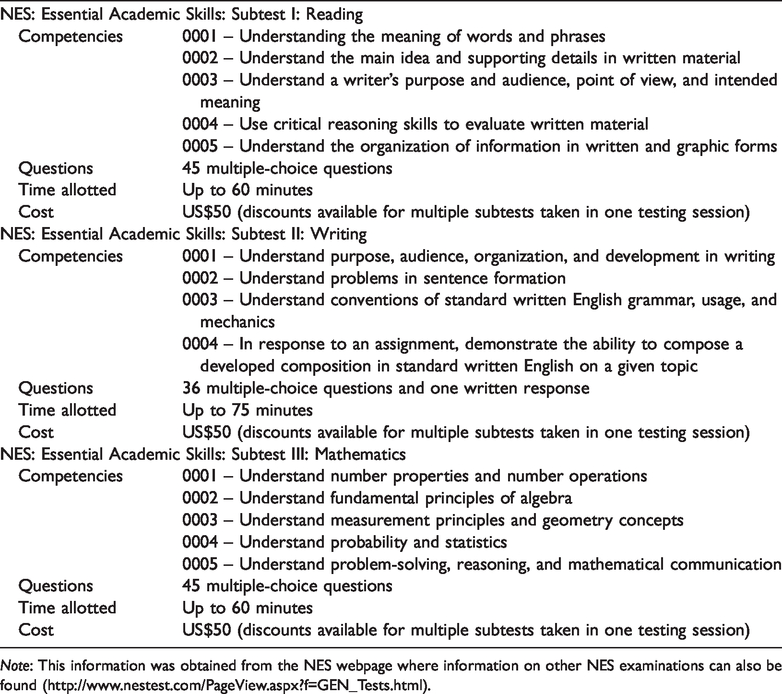
Note: This information was obtained from the NES webpage where information on other NES examinations can also be found (http://www.nestest.com/PageView.aspx?f=GEN_Tests.html).
Once a teacher applies for and is granted licensure in New Mexico, they can begin employment in a public school as a level I provisional teacher. After three years of successful evaluations in the classroom, they can apply for level II professional licensure. Teacher effectiveness/ineffectiveness is evaluated using the NMTEACH Educator Effectiveness System. According to the information found in the NMTEACH Technical Guide, the system is designed to “promote student success” (NMTEACH Technical Guide, 2018: 3) and measure how teachers: (a) “support student’s opportunity to learn;” (b) “impact student achievement”; (c) “provide quality instruction in the classroom;” and (d) “demonstrate professionalism in the workplace” (NMTEACH Technical Guide, 2018: 3). In the area of student achievement, the evaluation is dependent on, “to what extent … the teacher enable[s] students to exceed expectations of achievement on standardized tests” (NMTEACH Technical Guide, 2018: 3).
The theory of action that drives the NMTEACH evaluation system “reflects the belief that if teacher effectiveness improves, then instructional practice will improve, which will then improve student achievement” (NMTEACH Technical Guide, 2018: 4). Historically, student achievement has been measured through high stakes standardized testing. However, the recent change in Governors in 2019 resulted in eliminating our state standardized test for students in public schools. While this points towards the value placed on high stakes testing to measure student achievement being problematized, it remains unclear if what will be substituted (as required by ESSA) mirrors more authentic forms of assessment for children attending public schools. It is also unclear how this will impact how teacher effectiveness is measured.
NMSU and its teacher education program
The main campus of NMSU, is located in Las Cruces, a city where 57% of the population is Latinx. The university is a comprehensive research institution serving over 13,000 students throughout New Mexico. With a 47% Latinx student body, NMSU is recognized as a Hispanic Serving Institution and has received honors from various national agencies for serving the needs of our diverse population. Hispanic Outlook on Education 4 continually includes NMSU in the top 50 Hispanic bachelor’s and master’s degree-granting schools. According to US News (2019), 67% of full-time undergraduates at NMSU receive some kind of need-based financial aid. The College of Education at NMSU offers undergraduate and graduate degrees in early childhood, elementary and secondary education, counseling and educational psychology, special education, communication disorders, educational leadership, kinesiology, dance and athletic training. Students can also pursue Teaching English as a Second Language and bilingual endorsements in early childhood, elementary, secondary and special education.
The early childhood Teacher Education Program (TEP) at our Hispanic Serving Institution requires that students complete their basic coursework with a 2.75 grade point average out of 4.0, and that they pass the NES basic skills tests in order to begin their advanced coursework and engage in further field experiences. Prior to student teaching, which occurs in the final semester of the program, the state requires that students pass additional NES tests. As a university program, we also require that students submit a portfolio for evaluation the semester before their student teaching internship. This portfolio includes: a letter of introduction written by the student; a self-evaluation of student teaching preparedness survey; a lesson plan from a practicum placement; and confidential faculty recommendations. We have found that the portfolio provides a holistic overview of the students and their preparedness to begin student teaching, whereas NES test scores fail to do so. As an (un)intended consequence, policies requiring the use of test scores for admission to teacher education programs places students in situations in which they are not allowed to enroll in courses leading to licensure; due to this, some eventually change majors (Angrist and Guryan, 2008).
Upon initial entry to our university, there have been upwards of two hundred students interested in pursuing an early childhood degree for birth to third grade licensure. However, due to difficulty in meeting testing requirements, especially for English learners, less than 10 percent of these students have met the requirements to be admitted into the TEP. As shared in the introduction of this article, students who are English learners and who are accepted into the TEP still struggle later to pass the additional NES examinations required for licensure. Although students who are English learners can request additional time for the examination, this does not help them understand the questions nor the content that is not culturally relevant. As a result, these students leave education as a major or drop out of the university all together. While research on Latinx pre-service teachers’ experiences in teacher preparation programs remains largely underexplored, some studies have pointed to the failure of teacher education programs to retain Latinx students, sharing narratives of Latinx students who were marginalized, discriminated against, or excluded through systemic silencing (Darling-Hammond, 2010; Hones et al., 2009; Irizarry, 2011). Moreover, with the exorbitant costs placed on students who are already economically underserved, and there being no limit to how many times they can take the NES tests, the system has become a neoliberal apparatus that further feeds the billion dollar testing industry (Miner, 2004/2005), while demoralizing students and contributing to the dire teacher shortage in our state. These are all (un)intended consequences of such educational policy reforms and teacher quality/effectiveness accountability measures.
Navigating the testing system: Re/shaping teacher education
The circumstance described within our local context illustrates the (un)intended consequences of national policy agendas and how these translate into the practice of teacher education at local levels. As an example, much like how public schools in the United States have shifted their curriculum to focus on teaching to the test, in our region, in order to best support students to matriculate, faculty have obtained state supported grants to pay for an instructor to teach courses in content areas assessed by the NES test. This grant funding has helped to prepare students to take the NES test in addition to providing student scholarships that cover the cost of test registration. Through grant funding we have also purchased study guides for students housed at a campus tutoring center and for students to check out. Additionally, the TEP faculty have collaborated with faculty in the mathematics department in an attempt to better determine how to provide students with instructional support for mathematics content that is covered on the NES examination. An unintended consequence of NES testing, then, is that our local university program is dramatically re/shaping how we allocate already scarce fiscal and human resources, in addition to how we engage in teacher education in order to help students meet testing requirements. Instructional time and resources could be better spent expanding how we prepare teachers to foster culturally sustaining praxis (Paris and Alim, 2017).
In addition to curricular changes, our university has also developed a non-licensure program to support students who have struggled to pass the test but wish to work at early childhood agencies (outside of public education) that do not require licensure and so they can complete their degree. Moreover, in our college of education, we have been purposeful about hiring faculty of color who are culturally connected to our students and can provide culturally relevant instructional support as well as emotional support to our students—an intentional approach that is not typical of many university programs. These localized strategic initiatives have been instrumental in purposefully creating solutions (albeit not always the most desirable) to navigate the (un)intended consequences of policy reform aimed at professionalizing the workforce.
At the state level, the previous Governor required a higher NES passing score than the national standard, claiming that this translated to higher expectations for those entering the field of education. However, it resulted in an increase in TEP dropout rates and a decrease in the licensure completion rates at our university. With our newly elected Governor, the required NES minimum test scores have been adjusted to reflect the national standard. We are hopeful that future policy reforms may occur to address the previous administration’s missteps in de-valuing our local students and university programs that serve them.
Rethinking future policy reforms
As discussed, a major (un)intended consequence of “professionalizing” the field of early childhood education in the United States is the use of high stakes testing to standardize the workforce, which within our context, has demoralized dedicated prospective teachers who share the cultural background of the communities they serve. Future policy reforms must rethink teacher licensure requirements so that they value Latinx and other minoritized knowledges and resist serving as gatekeepers that exacerbate inequities. We propose several points of entry for new approaches to policy reform, offering both contemplations and provocations.
How can we move away from high stakes testing and instead take a more holistic, meaningful, and authentic approach to ascertaining teacher qualifications? Considering this question, we propose that teachers in the field, early childhood programs, and university faculty could help develop innovative approaches to teacher licensure. This could provide important insights while re-instilling the trust of cooperating/mentor teachers, principals, university supervisors, and faculty who work closely with student interns to know if candidates are qualified to teach.
Imposing standardized testing in an attempt to define and measure teacher quality or preparedness is not a culturally sustaining practice. Instead, an alternative definition of quality could take a holistic approach, which may include giving new teachers more authentic feedback through home grown models (Valenzuela, 2016), using culture circles to incite praxis that fosters equity and democracy (Souto-Manning, 2010), and using multiple and meaningful forms of assessment for both children and teachers (Arndt and Tesar, 2015). A dynamic approach such as this could foster culturally sustaining praxis as a centralized goal of being “highly qualified.”
Another example of an alternative to standardized testing is the Performance Assessment for California Teachers. This assessment, according to Darling-Hammond: requires student teachers or interns to plan and teach a week-long unit of instruction mapped to the state standards; reflect daily on the lesson they’ve just taught and revise plans for the next day; analyze and provide commentaries of videotapes of themselves teaching; collect and analyze evidence of student learning; reflect on what worked, what didn’t, and why; and project what they would do differently in a future set of lessons. Candidates must show how they take into account students’ prior knowledge and experiences in their planning. Adaptations for English language learners and for special education students must be incorporated into plans and instruction. (Darling-Hammond, 2010: 44)
If states refuse to adopt more contextualized and authentic forms of assessment required for students to enter teacher education programs or to become licensed, we suggest that examinations could be better geared towards English language learners and those with minoritized backgrounds, in addition to making them free to take or at reduced rates for educators working in high need areas. Moreover, policy-makers must challenge corporate motivations to be involved in “professionalizing the workforce.” Troubling, is how access to the actual examinations is heavily guarded by corporations and the proctors who monitor them. As teacher educators, we are legally not permitted to take our state’s required examinations, and students who take them must sign an oath that they will not discuss their content. This form of gatekeeping ensures that students (and university programs seeking to support them) are not given adequate tools to prepare students for licensure examinations, which leads us to our next contemplation.
How can we resist corporatized licensure systems that reify curricular focus on test taking? We have received countless comments in course evaluations that students want more class time spent on preparation for the NES examinations. Not surprisingly, many of our students currently in higher education went through K-12 education during the wake of the standardized testing and accountability movement facilitated by the NCLB Act. As a result, we have noticed a shift in how our students perceive how one should implement educational curriculum, with a desire for it to mirror K-12 education that has focused heavily on teaching to the test. This has had major consequences for recreating a problematic and corporatized approach to higher education, while reducing the time to develop a knowledge-base and love for emergent pedagogies that foster culturally sustaining praxis. One way we can start to rethink the use of high stakes testing is to educate the public about the deficiencies in this approach, the dangerous consequences of how testing has changed curriculum in teacher education programs (to teach to the test), and how testing is tied to corporate profiteering. According to Kohn, “few parents have ever been invited to consider the weaknesses of these tests or the fact that alternatives exist” (Kohn, 2000: 44). There is power in numbers, and as such, the more who know about the underlying purposes and (un)intended consequences behind current teacher qualification and licensure policies—and that there are many alternatives to consider—the greater the possibilities for inciting grassroots, systemic, non-corporatized policy reform.
Finally, we contemplate how educators can be supported to engage in local and global political action and advocacy. Michelle (Author 3), over the years in her teacher education courses, has shared stories of grassroots resistance by activist educators, such as in Mexico, where teachers have long protested against neoliberal federal policies that have attempted to privatize education, adversely impacting teachers and the children and families they serve (Freidberg, 2005). Whitebook and colleagues (McLean et al., 2019) have also written extensively about the injustices that women and women of color early childhood educators have experienced in the United States, struggling economically with low pay and often no benefits. We contemplate how we can incite students in our teacher education programs to be (or continue to be) politically active in pushing back against inequitable and neoliberal teacher licensure requirements. Examples include participating with in-service and pre-service teachers in protests, partnering with unions, and showing students how to make public comments at local school board and city council meetings. In addition to supporting and cultivating teacher advocacy, we contemplate how we can better advocate from our positions as university faculty to make impactful changes to policy. This form of advocacy could influence who is given a seat at the table to make reform decisions on teacher licensure and how the state conceptualizes the purpose of teacher education.
Each of these provocations, we believe, can help to guide our program, state, and global policies towards facilitating more authentic approaches to determining teacher qualifications. With (un)intended consequences of teacher shortages and the need to employ teachers who understand the cultural backgrounds of local communities, we find hope and solace in problematizing the historical and contemporary practices of teacher licensure and continuing to advocate for change while helping students navigate the current system.
Footnotes
Declaration of conflicting interests
The author(s) declared no potential conflicts of interest with respect to the research, authorship, and/or publication of this article.
Funding
The author(s) received no financial support for the research, authorship, and/or publication of this article.
