




Abstract
Results of international achievement surveys such as the Programme in International Student Assessment have consistently reported an achievement gap between immigrant and non-immigrant student populations around the world. This paper unpacks this persistent achievement gap by examining key characteristics that influence the performance of first- and second-generation immigrant students as well as the policies and practices that are associated with enhanced educational outcomes. A multi-layered framework is proposed to help policymakers juxtapose key characteristics of their immigrant students’ achievement against individual, family, school, community, and host society characteristics and policies. The discussion also underscores the importance of connecting this multi-layered framework with other important sectors within governments such as those responsible for the economy, health, social protection, and immigration. This paper also examines limitations with current large-scale data sets and the implications for research and policy analysis.
Keywords
Introduction
International migration continues to be a pressing concern for governments around the world as evidenced by the hundreds of millions of people that migrate every year across international borders. The majority of migrants (approximately 60%) are found in developed countries and are themselves from developed and developing countries (United Nations Department of Economic and Social Affairs, 2016). Thus, it is not surprising that the challenges posed by international migration are particularly acute for popular Western destination countries such as the USA, Germany, the UK, Canada, France, Australia, Spain, and Italy (United Nations Department of Economic and Social Affairs, 2015). These challenges extend to public education systems that are responsible for providing schooling to the children of immigrants and refugees. Although achievement levels vary across countries, immigrant students – both those who were born in another country (first-generation) and those who were born in their host country, but whose parents were born abroad (second-generation) – tend to underperform relative to their non-immigrant peers. This performance disadvantage is consistently evidenced from cross-national results on international achievement surveys such as the Programme for International Student Assessment (PISA) (Organisation for Economic Cooperation and Development, 2016). PISA has quickly become the standard metric upon which national governments judge the quality and equity of their education system (Volante, 2015). In terms of equity, PISA triennial survey results show a persistent, and often significant, achievement gap between broad analyses of first- and/or second-generation immigrant versus non-immigrant student populations in the areas of reading, mathematics and science literacy. In some cases, first-generation immigrant students in Western destination nations are more than two grade levels behind their same age non-immigrant peers when one considers their standard scores (Volante et al., 2018).
Persistent achievement gaps are also noted in the literacy and numeracy skills of adult immigrants, as suggested in the results of the Programme for the International Assessment of Adult Competencies (PIAAC). Not surprisingly, lower academic performance in immigrant youth often result in challenges attending upper secondary and higher education settings, which in turn often translates into lower paying job prospects for adult immigrants (Baum and Flores, 2011; Jonsson and Rudolphi, 2011; Portes et al., 2009; Schnell and Azzolini, 2015). Hence poor achievement results in compulsory school settings are essentially a problem for higher education and adult work settings – which is routinely associated with deficits in human capital (Kogan, 2016; Volante et al., 2017a). Collectively, the existing literature suggests that ameliorating the immigrant performance disadvantage is critical for nation states around the world.
The ensuing analysis provides a systematic review of the empirical literature on this topic with the aim of identifying key characteristics of immigrant student achievement, and proposes a multi-layered policy framework to support enhanced student outcomes for immigrant populations. Despite the fact that immigrant student achievement results are situated within nations that possess distinct political, economic, cultural and social characteristics, researchers have been able to identify a cadre of broad cross-cultural factors that appear to ease the transition of immigrants and by extension, their children (Migrant Integration Policy Index, 2015). Our work builds on the research resulting from these international large-scale studies by providing a comprehensive and more nuanced examination of immigrant student achievement and corresponding policy considerations across international jurisdictions. In doing so, we seek to inform the discourse on this important topic, so that efforts to ameliorate the immigrant student performance disadvantage are based on sound evidence rather than opinion or politically expedient rhetoric. Ultimately, policymakers around the world must find ways to understand why immigrant students who share a common country of origin, and therefore many cultural similarities, underperform in particular international contexts (Organisation for Economic Cooperation and Development (OECD), 2013a, 2015a, 2015b).
Systematic literature review: Constraints and opportunities
The ensuing analysis was largely based on the empirical literature on this topic and supplemented through the examination of achievement trends by international testing organisations such as the OECD and the International Association for the Evaluation of Educational Achievement (IEA). Commonly used keywords in this field such as immigrant, first-generation, second-generation, refugee, student, children, youth, achievement, outcomes and education policy were used in various combinations to identify relevant studies since the inception of cross-national achievement testing in 1995 by IEA and later in 2000 by the OECD. Although the literature review did not discount qualitative studies, it focused primarily on those studies that were able to make significant distinctions in the outcomes of different student populations within or across countries.
It is important to acknowledge that our analysis is somewhat constrained by the lack of more fine-grained distinctions in cross-national achievement data sets. For example, although educators and policymakers acknowledge differences between voluntary and non-voluntary migrants or immigrant students who experience interrupted or circular migration patterns, international tests such as PISA have yet to distinguish amongst these groups in disaggregated achievement profiles. Similarly, few would dispute that refugees, who may have experienced significant psychological trauma, may demonstrate achievement profiles that are different from their voluntary first-generation counterparts. These types of considerations do make it more difficult to examine achievement trajectories and the robustness of policy options for sub-groups of first- or second-generation students within and across countries.
Our analysis is largely, although not exclusively, drawn from a vast body of research from predominantly Western and industrialised Asian educational jurisdictions. Although other parts of the world, such as South America, Africa, the Middle East and less developed nations within Asia, undoubtedly face the challenge of integrating migrant students within their school systems, the literature does not seem to be as extensive or widely accessible in those contexts. This may be partly due to the fact that many developing nations do not participate in PISA or other IEA tests such as the Trends in Mathematics Study (TIMSS) or the Progress in International Literacy Study (PIRLS) and, as result, the availability of cross-cultural measures of achievement is sparse or non-existent in particular jurisdictions. Similarly, Western educational contexts tend to possess the highest percentages of immigrant students as a share of their entire student population. For example, in popular destination countries such as Australia, Canada, New Zealand and the USA, first- and second-generation students make up approximately 25% of the overall student population (OECD, 2016). In Europe, particularly the western portions of this continent, these numbers are somewhat lower but still significant enough to provoke a great deal of research and policy analysis that is widely disseminated and accessible to researchers.
Overall, we have completed an exhaustive analysis of the available literature in relation to broad classifications of first- and second-generation immigrant students in industrialised national contexts. Our proposed analysis provides conceptual clarity for researchers engaging in studies that account for more nuanced distinctions and may also help add to the growing impetus for future refinements to international achievement data collection and reporting structures. Thus, while we freely acknowledge the constraints associated with these types of analyses, we also recognise that this type of work is essential for the promotion of evidence-based policies – which appear to be increasingly coming under threat globally (Volante, 2016).
Characteristics associated with immigrant student achievement
The complexity and range of factors associated with student achievement is extremely difficult to summarise, particularly for immigrant student populations who, as a collective, often possess a diverse array of background characteristics and are situated within unique national contexts. Nevertheless, there are some robust trends that appear to be immune to cross-cultural idiosyncrasies that can be categorised as individual/family characteristics related to the importance of first- versus second-generation status, socioeconomic status (SES), gender, country of origin, age on arrival and language background. Similarly, school system/community characteristics such as school tracking policies and segregation issues, language supports and school resources, teacher quality, as well as community demographics and programmes are also associated with immigrant student achievement results. Lastly, host society characteristics related to immigration and integration policies, social protection and welfare policies, levels of income inequality and social stratification features within the broader society, which figure less prominently in discussions of student achievement, are also particularly relevant for the success (or lack thereof) of immigrant student populations.
Of course, many of the previously noted factors are also relevant to all students and not confined solely to immigrant student populations. Similarly, there are other issues associated with immigrant student achievement that have not been explicitly cited in the previous paragraph or discussed in detail in this paper. However, the characteristics that we have focused on in the ensuing review are the most salient for immigrant student populations across a range of contexts. Our proposed framework is particularly important for policymakers interested in ameliorating immigrant performance disadvantages. Hence we propose that it should logically form the basis for policy development and refinement efforts – an issue we return to later in this paper.
Individual/family characteristics
With few exceptions, first-generation students tend to have lower academic achievement than second-generation students, who in turn tend to possess lower levels of achievement than their non-immigrant counterparts (Buchmann and Parrado, 2006; Driessen and Merry, 2011; Duong et al., 2016; Meunier, 2011; Potochnick and Mooney, 2015; Rangvid, 2007; Schnepf, 2008). This general relationship between first-generation, second-generation and non-immigrant student groups varies considerably across countries, particularly when one accounts for the SES of families. Not surprisingly, immigrant students from low SES groups tend to underperform relative to immigrants from higher SES groups, both within and across countries (Marques et al., 2007; OECD, 2011; Volante, 2016). However, as with first- and second-generation trends, the impact of SES is not uniform across countries, suggesting that host society characteristics or immigration policies play an important role in moderating the impact of SES on student outcomes (e.g. Entorf and Minoiu, 2005). Indeed, in traditional countries of immigration such as Australia, Canada and the USA, students with similar SES levels tend to perform equally well, regardless of whether or not they are immigrants (OECD, 2016; Schnepf, 2007; Volante et al., 2017b).
Overall, the relationship between SES and immigrant student achievement suggests that socioeconomic disadvantage is particularly troublesome for immigrant student groups – a situation that often results in a double disadvantage (Crosnoe, 2005; OECD, 2012). Immigrant students are faced with the daunting challenge of adjusting to their new host society school system – often from a disadvantaged economic position within society. Sadly, research also suggests that immigrant students are more susceptible to bullying and school safety issues in their host society (Garver and Noguera, 2015; Hong et al., 2016; Katschnig and Hastedt, 2017; OECD, 2017). Further, refugee students, who face additional challenges in comparison to their first-generation immigrant counterparts such as gaps in their education due to missed school and/or trauma resulting from exposure to war, are in many ways at a triple disadvantage. It is not surprising that the educational and psychological supports needed for refugee students are particularly acute across systems (Patel et al., 2017; Pottie et al., 2015). Given the previous findings, it would be useful to identify refugee students groups in international achievement data sets for both research and policy purposes.
One of the most robust relationships in the international literature is the gender differences that occur in student achievement around the world. Male students consistently underperform relative to their female counterparts on measures of literacy, with reading and writing scores being particularly illustrative of this main effect. Given the relative importance of literacy skills for recent immigrants who speak a different language, it is not surprising that studies have suggested the gaps between male and female students are larger in immigrant versus non-immigrant populations (Dronkers and Kornder, 2014). Coupled with additional research that suggests immigrant girls tend to be better socially integrated at school than immigrant boys (Makarova and Herzog, 2011), it appears that immigrant boys are particularly at risk for poorer educational outcomes. Given such findings, policies and practices likely need to extend beyond those traditionally offered based on gender specific differences in reading achievement measures in order to effectively support literacy outcomes for immigrant boys.
It is worth noting that gender achievement trends also vary considerably across countries in relation to reading, mathematics and science performance. Some have suggested that gender equity across societies, derived from the gender empowerment measures and macro level indicators of large regions, may partially explain different achievement outcomes for male versus female immigrants – albeit, primarily in relation to reading achievement (Dronkers and Kornder, 2015). Interestingly, Sweden, which is widely recognised as having one of the highest levels of gender equality in the Western world, also has one of the narrowest gaps between boys and girls in mathematics performance – a literacy domain in which female students tend to have somewhat poorer achievement outcomes (see OECD, 2015d). Despite these international trends, it is worth noting that the characterisation of gender equality and the measures used to determine this construct are open for debate and far from universally accepted. Nevertheless, virtually all vested stakeholders in education agree that addressing the lower school enrollment rates of girls in certain countries in Asia, Eastern Europe, the Middle East and North Africa is vitally important to ensure gender equity for basic education and better societal outcomes as a whole (e.g. Chavatzia et al., 2016).
Another key factor associated with immigrant student achievement relates to the country of origin (Dronkers and De Heus, 2013; Glick and Hohmann-Marriott, 2007; Parasnis and Swan, 2017; Rothon et al., 2009; Simms, 2012). In general, immigrants coming from high achieving educational jurisdictions, such as those from industrialised Asian countries, tend to perform equally well in their new host nation. Thus, it is not surprising that educational jurisdictions which are the preferred destination of these high-achieving immigrant student populations tend to fare better in international achievement test rankings. In some cases, immigrant students may even perform better than their non-immigrant counterparts as found in select parts of Canada and the USA, as well as parts of Europe and the Middle East (Cheema, 2014; European Commission, 2016; Feliciano and Lanuza, 2017; Hsin and Xie, 2014; Jerrim, 2015; Lee and Zhou, 2014; Volante et al., 2017b).
Although it is important to consider country of origin analyses, they may lead to skewed perceptions of students’ academic achievement based on cultural and ethnic distinctions. It is always important to consider country of origin differences in relation to other education systems and host society characteristics that influence student achievement across national contexts. Indeed, PISA results strongly suggest that where immigrant students go to school is more important than where they come from (The Economist, 2016) – underscoring the central role of national and regional education policies, programmes and supports. Once again, host society characteristics are shown to be critical moderators of immigrant student achievement and should figure more prominently in both research and policy spheres.
Lastly, immigrant students tend to perform better when they arrive in their host nation at a younger age. According to the OECD (2015c), immigrants who arrive at the age of 12 or older and have spent less than 4 years in their new country are farther behind students in the same grade than their immigrant counterparts who arrived at a younger age. Although this ‘late arrival’ penalty varies across international jurisdictions, this trend is well documented in the literature and is not confined to reading achievement alone, albeit the size of the gaps tends to be larger than those observed in mathematics and/or science (Hastedt, 2016; Pasztor, 2008). In addition to lower achievement, late arriving immigrants are also more likely to repeat grades – a result that is often attributed to their language skills (Ammermueller, 2007). Indeed, the relative importance of the congruence between home language and the language of instruction in schools is perhaps the most widely discussed and cited reason for the poor performance of immigrant student groups around the world (Christensen et al., 2011; Cummins, 2014; Kim and Suárez-Orozco, 2015; OECD, 2013b; Rangvid, 2010). These findings underscore the important role of language supports, a topic we return to when discussing school system characteristics in the next section.
School system/community characteristics
There is a need to consider both institutional features and school effect findings when discussing the importance of school systems. This distinction is important to understand since the former includes structures and policies that are primarily determined by government officials, while the latter involves teaching and learning conditions within schools that are often within the purview of administrators and school-based practitioners. In terms of institutional features, the most notable finding relates to stratification and tracking (e.g. academic versus vocational; university versus college versus apprenticeship programmes) of students that occurs within education systems. In general, systems that track students into different schools and/or programmes tend to have increased inequities in student outcomes – particularly when tracking occurs at a younger age (OECD, 2014). Not surprisingly, it is those students from disadvantaged and immigrant backgrounds who are often placed into these vocational schools and/or lower academic tracks around the world (Alba and Silberman, 2009; Azzolini et al., 2012; Entorf and Lauk, 2008; Oppedisano and Turati, 2015; Verma et al., 2017). It is easy to envision schools possessing both characteristics – low SES and high concentrations of immigrant students – creating a condition that exacerbates educational inequities over time. Indeed, the OECD (2015c: 8) is quick to point out how ‘PISA reveals it is not the concentration of immigrant students in a school but, rather, the concentration of socioeconomic disadvantage in a school that hinders student achievement’. Thus, while tracking is detrimental to all students, the outcomes and achievement results indicate that these structures are particularly problematic for immigrant student groups (Volante et al., 2018).
Given the concentration of immigrants within particular schools, the provision of appropriate curriculum and pedagogy tailored to the specific needs of immigrant student groups has been found to be instrumental to their academic success. Understandably, language supports are very important for immigrant students, particularly since two-thirds of students born outside their host country use another language at home (The Economist, 2016). The language of instruction and associated policies are the most frequently cited issues associated with immigrant student outcomes (Cummins, 2012; Gibson and Carrasco, 2009; Jensen and Rasmussen, 2011; Marx and Stanat, 2012; Padilla and Gonzalez, 2001; Potochnick and Mooney, 2015; Suárez-Orozco et al., 2010). Lower teacher expectations, inadequate understanding of immigrant groups and inaccurate teacher evaluations further negatively impact immigrant student achievement and self-concept (Hachfield et al., 2010; Moosung et al., 2017; Stromquist, 2012). Collectively, the existing literature underscores the added importance of targeted resources and teacher quality as significant influences on immigrant student achievement, beyond those linked to students from lower SES backgrounds (Lai et al., 2014; Marschall et al., 2012; Schleicher and Zoido, 2016).
The segregation that is often associated with immigrant student groups is not confined to schools. That is, many immigrant students experience residential and social segregation by virtue of living in areas that often reflect less affluent communities (Alegre and Ferrer-Esteban, 2010; Brunelo and Rocco, 2013; Crul and Holdaway, 2009). In general, visible and ethnic minority groups tend to be particularly at-risk for being housed within marginalised communities. Although there are significant differences across countries with respect to this issue, these patterns underscore the importance of community supports for recent immigrants and refugees, and is evidenced by a substantive body of research on this topic. In particular, communities that provide pre-school and after-school programmes for children, parental education programmes, and those that possess broader social network opportunities are important (particularly in tracked education systems) for promoting academic skills, higher expectations and cultural capital (Alba et al., 2011; Lahaie, 2008; Lai et al., 2017). Hence the connections between schools and communities are important considerations when discussing the academic achievement of immigrant students.
Host Society Characteristics
A useful starting point when discussing the broader contextual features of host societies and immigrant integration is the large-scale cross-cultural findings addressed within the Migrant Integration Policy Index (MIPEX). MIPEX is described as a unique tool that measures policies to integrate migrants in all European Union member states, Australia, Canada, Iceland, Japan, South Korea, New Zealand, Norway, Switzerland, Turkey and the USA. In total, 167 policy indicators were developed to create a multi-dimensional picture of migrants’ opportunities to participate in society in 8 areas: access to nationality; anti-discrimination; education; family reunion; health; labour market mobility; permanent residence; and political participation (MIPEX, 2015). Interestingly, Sweden obtained the highest composite score across the eight categories and registered the highest scores in education and labour market mobility. Overall, MIPEX (2015) findings suggest that immigrants usually benefit from more equal rights and opportunities in wealthier, older and larger countries of immigration, for example in Western Europe and traditional countries of immigration such as Australia, Canada, New Zealand and the USA – a result that also converges with educational equity expressed in cross-national PISA results.
The findings reported in MIPEX (2015) underscore the important role that host societies play in easing the transition of immigrant families and by extension their school-aged children. The importance of national context is also supported by more specific analyses of PISA results in relation to particular cultural groups. For example, the science scores of Turkish-born students in Germany are nearly two years lower than those in the Netherlands, after adjusting for different economic backgrounds (The Economist, 2016). Similar results are also found in Finland, which ironically has been amongst the top achieving nations in the world since the inception of PISA in 2000 (European Commission, 2016). Collectively, these types of result, which are not confined to one cultural group or host society, underscore the important role that national characteristics play in facilitating enhanced student outcomes.
Collectively, the broader literature suggests that critical features of host societies such as income inequality (Bilgili et al., 2015; Schlicht-Schmalzle and Moller, 2012), inclusion in social welfare provisions (Filindra et al., 2011; Shapira, 2012), gender equality (Dronkers and Kornder, 2015), settlement policies (Martin et al., 2012), as well as immigration and multicultural policies (Behtoui, 2013; Conrick and Donovan, 2010; Pong, 2009; Schachner et al., 2017; Shah and Cavanagh, 2012; Veerman, 2015) influence immigrant student outcomes. It seems reasonable to assert that the promotion of enhanced immigrant student outcomes requires policy coordination across multiple levels and sectors of host societies. Indeed, the interrelationships amongst individual, family, school, community and host society characteristics suggest that a multi-layered framework is required when contemplating policy options and alternatives. Certainly, our multi-layered framework is similar to other nested models that emphasise the importance of interconnected personal and environmental factors, for example, Bronfenbrenner’s (1994) socioecological framework. However, a distinct aspect of our framework is its attempt to isolate specific factors that are more salient for immigrant student groups and its attention to host society and geopolitical features that are somewhat neglected within national policy spheres.
Multi-layered framework
Our proposed multilevel framework (see Figure 1) highlights that immigrant student outcomes are influenced by the interrelationships between individual students, family, school, community and the host society. We also assert that broader geopolitical contextual issues – which have recently emerged as an important issue – play an important role in shaping the expression and reception of particular education policies at all of these levels. Our proposed multi-layered framework adds an additional layer/level of factors to consider beyond those envisioned in traditional socioecological models. Although geopolitical issues are likely more difficult to ‘measure’ or operationally define versus our other factors (i.e. first-generation status, gender, tracking, etc.), the current zeitgeist suggests researchers will need to find ways to consider how particular national political features positively or negatively affect immigrant student outcomes.
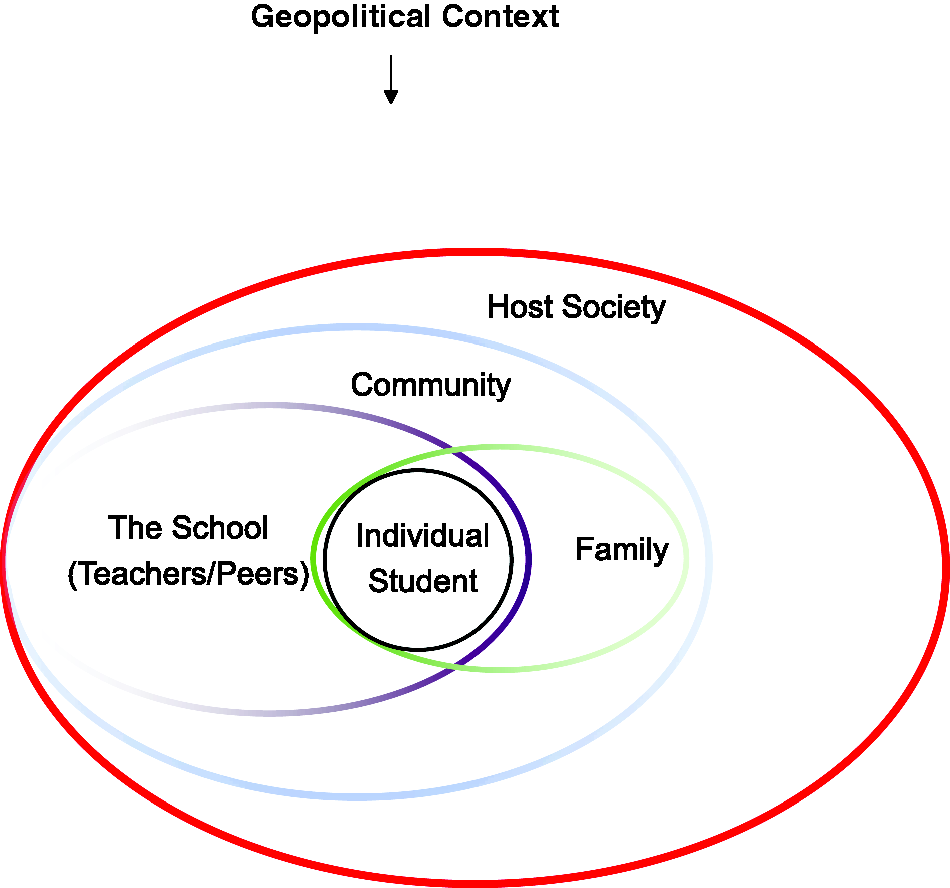
Multi-Layered Framework
We acknowledge there are a number of other researchers who have identified many of the same features of our proposed framework and have discussed various relationships amongst the key characteristics (see Drake, 2014; Edele and Stanat, 2011; Luthra and Soehl, 2015; Mustafa, 2010; Suárez-Orozco et al., 2010; Sulkowski, 2017). However, our framework is distinct in emphasising the complexity of these nested interrelationships and the diffusion of direct interaction with students at each subsequent level. While previous researchers have identified a set of general patterns to describe immigrant student achievement, these patterns are far from universal. The inherent complexity within the interrelationships identified in our framework is critical to furthering our understanding of the ‘exceptions’ that abound in the explanation of immigrant student achievement. Further, these interrelationships should provide an important caveat to simplistic, unconnected efforts to support immigrant students – which also consider the central importance of geopolitical issues previously noted.
Specifically, the underlying framework illustrated by Figure 1 first highlights the very direct influence of teachers/schools and families on individual student outcomes, in this case on immigrant students. We have included teachers and peers to represent the school. We acknowledge that peers can also be found outside of the school environment; however, the primary interaction between peers and the educational outcomes of individual students would occur within the school context. The positioning of the ovals representing each level highlights the level of direct influence on other levels – the closer the outlines with another level, the greater the influence. Not surprisingly, as indicated by the closeness of the ovals to individual students, families and the larger unit of schools have the most influence on individual students. This influence is also likely to be bidirectional as individual students will also influence the actions of families, teachers and peers. The positioning of the outline representing community is intended to acknowledge the relatively close interrelationships between community, families and schools. Further, the gradation within the outlines for schools and families illustrates that the influence of communities on individual students is primarily mediated through parents and schools, and that this influence is much more diffuse. Lastly, the ‘sphere of influence’ represented by the host society reflects the broad domain represented by this level; however, it also illustrates that this influence is primarily through communities and schools rather than through families.
The host society represents the broader universe of educational and social policy intended to influence and support communities, schools, families and ultimately, the educational outcomes of individual students. As noted earlier, these policies and their implementation are impacted by the geopolitical contexts in which they operate. Overall, the underlying framework represented in Figure 1 demonstrates the paths of influence and the interactions between and amongst each of these levels. To date, the complexity of these interactions has not been illustrated in previously reported research. As we have previously suggested, a significant amount of research has tended to emphasise rather simplistic and direct associations that lack important contextual considerations.
It is worth reiterating that the rationale and justification for the various interrelationships proposed in our multi-layered framework are grounded in the empirical literature – and identify the relative importance of specific factors beyond those for other student populations such as low SES student groups. Consider the previously noted association between gender equality within particular Western nations (i.e. Sweden) and the narrow gap between boys’ and girls’ achievement (see OECD, 2015d). These types of finding suggest that individual and host-society characteristics influence one another in interesting ways that cannot be fully explained by family, school, or community characteristics. Similarly, consider Alba et al.’s (2011) research that indicated children from low-status immigrant families lagged behind the children of native families, but that the reasons differed from one school system to the other. In particular, they asserted, based on analysis of PISA results, that features such as delayed tracking, school resources and community programmes all ameliorate immigrant student performance deficits, albeit in different ways. Collectively, the available literature underscores the important role that host society characteristics play in mediating the influence of characteristics associated with immigrant student achievement.
The PISA results have international impact and educational policies and policy discussions continue to use PISA as a foundation for their decisions. While these PISA results may provide sufficient information to inform broad comparisons or analyses, the current data obtained through PISA are clearly insufficient to inform the nuances of immigrant experiences. Yet neither PISA nor the policymakers who use PISA data seem to fully acknowledge these limitations. Admittedly, the intention of our work is not to serve as a critical examination of PISA and how it is used. Nevertheless, the framework we have developed has the potential to guide the subsequent efforts of those with educational influence, such as the OECD and PISA, to provide greater depth of analysis on key topic areas. At the same time, policymakers can now better situate their own contexts and recognise the current limitations of the data they currently obtain from broad international measures such as PISA.
As a result, policymakers must consider how their efforts to ameliorate immigrant student performance disadvantages are afforded and/or constrained by the larger geopolitical context in which they are currently situated. For example, few would dispute that there has been a marked rise in anti-immigrant sentiments, particularly for refugee populations seeking a new home in their host society. Indeed, the word ‘migrant’ is increasingly taking on ‘toxic’ connotations and is often reserved for groups of individuals who are considered a ‘threat’ to our way of life (Marsh, 2015; Volante et al., 2017c). Couple this with the fact that most Western nations appear to have adopted a neoliberal approach to education reform and social protection. Developing and refining policies that may require additional financial supports for immigrant and refugee populations would appear to be low priority in such a challenging, and at times hostile, environment. In some ways, the current geopolitical zeitgeist seems to be increasingly skewed against the promotion of integration policies and favourable immigrant student outcomes in some nations around the world. Policymakers in such contexts would be wise to emphasise ‘value-added’ analyses when proposing specific integration programmes and policies. This type of pragmatic approach recognises how economic benefits often supersede other considerations when education policies are debated in the broader society.
Lastly, we caution against international policymakers focusing an undue amount of their attention on ‘resilient’ immigrant student groups who manage to achieve high standards, despite facing a range of challenges. Although there is indeed value in this type of research in that it informs the utilisation of best practices and policies (see Agasisti and Longobardi, 2017), there is also a danger in minimising the persistent obstacles that are faced by the majority of immigrant student populations around the world. Education policies based on a constellation of ‘outlier’ characteristics serve the risk of becoming a politically expedient way to deny or reduce supports and provisions that are essential for the majority of immigrant student groups. It would be a mistake to minimise the importance of the interactions noted in our multi-layered framework by focusing on select challenges that have been seemingly overcome by these resilient students.
Limitations and suggestions for future research
‘Migration is not a single unique event in time and space but can repeat itself over the lifetime of an individual’ (Skeldon, 2013: 1). Unfortunately, as previously noted, many national and international large-scale data sets that provide comparative achievement results have not accounted for return or circular migration patterns, which may affect the outcomes of particular immigrant student groups. Perhaps certain backward and forward movements of migrant families may contribute or detract from a students’ academic achievement. Understanding how these complex movements impact immigrant student groups within contemporary school systems has important implications for the development and refinement of existing integration and education policies. Indeed, qualitative research is beginning to address the unique challenges faced by immigrant student populations who experience temporary stays in host societies (see Bokus, 2016).
We see the need for better quantitative data in order to systematically study ‘hidden’ populations and other important subgroups such as voluntary versus non-voluntary migrants, so that targeted evidence-based policies can be developed and promoted within and across national education systems. The expanding participation of nations in international achievement measures may also broaden the range of empirical studies in this topic area so that the suitability of our framework can be judged in developing nations. Therefore, we recommend that policymakers across contexts exercise a degree of caution when extrapolating from our findings and proposed multi-layered framework. It may be possible to subsequently refine our proposed multi-layered framework in the future with the incorporation of these types of analyses as we endeavour to refine and broaden the applications of this framework.
It also seems imperative for researchers, working across sectorial boundaries, to examine critical issues that impact immigrant student outcomes. For example, researchers have used international achievement results to draw direct causal links between literacy and public health outcomes (Feinberg et al., 2015) or the complex associations between achievement and social protection policies and economic outcomes (Schnell and Azzolini, 2015; Suárez-Orozco, 2007; Vandenbrouke, 2017). Our multi-layered framework highlights the need for additional research examining these interrelationships between educational, social protection, health and economic supports, which intersect with national immigration and integration policies. These types of study will undoubtedly help promote a more enriched discourse that will allow policymakers to consider the complex array of factors that influence immigrant student outcomes within and across national contexts.
Our findings and proposed multi-layered framework should be interpreted with the previously noted limitations in mind, particularly when one tries to make sense of the complex relationships that shape immigrant student outcomes within national contexts. As an example, the expression of different components within our proposed framework is undoubtedly situated within a Western lens and derived from research largely conducted by Western scholars. Therefore, our findings and policy suggestions may be less applicable to diverse cultural contexts that share different perspectives on the characterisation of key correlates of student achievement. Notions of family, teacher, peers, community, or gender equity, for example, undoubtedly take on different meanings in different cultural contexts. The manner in which one operationally defines key constructs undoubtedly influences the interpretation of large-scale studies and their associated implications.
This further highlights the growing need for research that seeks to understand how policy networks working across education, social protection, health, economic and immigration departments are coordinating their services. Namely, what are the key sectorial factors that impact the success (or lack thereof) of policy implementation efforts designed to improve the educational outcomes of immigrant student populations? How do different stakeholder groups within various sectors influence the expression and uptake of evidence-based policies? What are the most prominent models of exemplary policy coordination from around the world? Collectively, these types of question require cross-disciplinary research which is essential when one considers the multiple and overlapping challenges underscored by our multi-layered framework.
We were recently asked the question: Is this framework only relevant to immigrant students? We acknowledge that it is highly likely that the layers related to individual students and family are quite universal, and that there are certain aspects that would be consistent across the layers of school and community. However, as one moves across the layers, it becomes apparent that the nature of the interactions will change across these populations of students. Host societies interact very differently towards members of that society in comparison to ‘new arrivals’. Similarly, schools and communities may have the resources and skills to address many of the educational needs of immigrant children, but as we have argued, these are insufficient to address the breadth of challenges faced by many immigrant and refugee children. It is in the realm of these ‘unique’ interactions across the levels that both research and policy must focus. Subsequent research needs to focus specifically on both successful and less successful educational outcomes and the characteristics of the layers in our framework that seem to either ameliorate or exacerbate challenges for immigrants. More importantly, such research needs to continue across different immigrant populations to better identify important commonalities or ‘differences that matter’.
Conclusion
We have proposed a multi-layered framework that recognises the complexity of characteristics and factors that influence immigrant student outcomes across nation states. Although our framework is largely, although not exclusively, based on research drawn from Western and industrialised Asian nations, we believe it serves as a useful starting point for education policymakers who are faced with the unenviable challenge of improving the achievement outcomes of immigrant student populations within their country. We have asserted that this framework is distinct in emphasising the emergence of geopolitical considerations, the complexity of nested interrelationships, and the diffusion of direct interaction with students at each subsequent level. We acknowledge that there will be many examples and cases that cannot be explained by our proposed framework. However, we caution against an undue amount of attention on these ‘exceptions’, particularly as a politically expedient justification to reduce empirically validated supports for at-risk immigrant student populations. Clearly, we see the need to guard against prevailing discourses that skew policy options in relation to a constellation of outlier characteristics, particularly those associated with resilient student populations.
Given the rapidly changing geopolitical context in which many nations are currently situated, favourable educational and by extension economic and social outcomes for immigrant student groups is particularly challenging. This challenge is particularly acute when one considers the rise of anti-immigrant sentiment within various traditional immigrant destinations. As we have previously argued, the success (or lack thereof) of immigrant student populations has profound implications for the economic prosperity and social cohesion of countries around the world (Volante et al., 2017c). Ultimately, we do not encourage a ‘one size fits all approach’ – rather we urge policymakers and researchers to use our multi-layered framework as a starting point when juxtaposing the characteristics and features of their immigrant student population and host society against the available and emerging research literature.
Footnotes
Declaration of conflicting interests
The author(s) declare no potential conflicts of interest with respect to the research, authorship and/or publication of this article.
Funding
The author(s) disclosed receipt of the following financial support for the research, authorship, and/or publication of this article: This work was supported by the Social Sciences and Humanities Research Council of Canada (SSHRC grant number: 435-2017-0081).