




Abstract
This study explores the association between sanctuary policies and the high school completion and college enrollment of Hispanic undocumented youth. Sanctuary policies, which city, county, and/or state governments implement, prohibit local political leaders and police officials from cooperating with federal immigration enforcement officers regarding the questioning, detention, and deportation of undocumented immigrants. This study uses data from the American Community Survey and applies a difference-in-differences design. On average, my preferred specification detected no association with high school completion or college enrollment. These findings suggest that although these policies may help counteract immigration enforcement, they may not reduce uncertainty enough to have a significant relationship with educational outcomes.
Keywords
Undocumented 1 or unauthorized immigration to the United States has increased significantly from an estimated 3.5 million in 1990 to an estimated 12 million in 2019 (Krogstad et al., 2019). These immigrants have mostly come from Latin America over the past two decades (Passel & Cohn, 2018). The federal government has responded to this increase in unauthorized immigration through different enforcement efforts, such as deploying more patrol officers at the southern border, implementing employment verification systems, and creating the U.S. Immigration and Customs Enforcement (ICE) agency (Meissner et al., 2013). Although the federal government has used enforcement strategies to address perceived issues of crime related to undocumented migration, previous research has noted that immigration enforcement has a negative association with the educational outcomes of Hispanic students (Amuedo-Dorantes & Lopez, 2017; Bellows, 2019; Dee & Murphy, 2019; Kirksey et al., 2020).
Existing scholarship underscores the mediating effects of the receiving society’s immigration policies and labor market on an immigrant’s educational, economic, and social opportunities (Portes & Rumbaut, 2014; Zhou, 1997). Menjívar’s (2006) notion of liminal legality calls attention to the conceptual limitations of using the traditional documented and undocumented binary to accurately capture the effects of immigration policies. She suggests that certain immigration laws lead to instances of temporary or conditional legal status, which enables or restricts opportunities and decision making for immigrants.
This exploratory study focuses on the association between sanctuary policies that counteract federal immigration enforcement and the educational outcomes of immigrants. Informed by Menjívar’s (2006) notion of liminal legality, I speculate that sanctuary policies may mediate the established negative relationship between immigration enforcement and education, potentially mitigating the effects of undocumented status and the uncertainty it produces for students’ educational outcomes. Although commonly referred to as “sanctuary cities,” city, county, and/or state governments implement sanctuary policies. Depending on the specific policy design, which varies by geographic location, most sanctuary policies prohibit federal immigration officers from requesting information about an individual’s citizenship or immigration status. Sanctuary policies may also prohibit local law enforcement from disclosing information to federal officers (O’Brien et al., 2017). For instance, on one hand, Chicago, Illinois, has its sanctuary policy inscribed through a city ordinance that explicitly prohibits local law enforcement from cooperating with federal immigration officials. On the other hand, several counties in the state of Oregon have their policies enforced through their respective county’s sheriff’s office, which restricts local officers from honoring ICE detainers. Additionally, most sanctuary policies prohibit federal immigration enforcement officers from detaining or deporting immigrants based on a minor or civil offense (O’Brien et al., 2017). By prohibiting cooperation with federal enforcement agencies (e.g., ICE), sanctuary policies may ostensibly reduce uncertainty through a variety of mechanisms. For example, sanctuary policies may reduce deportation rates and minimize family separations. Families play a crucial role in shaping educational expectations and supporting students through high school and into college. By keeping families together, sanctuary policies could be linked to the educational attainment of undocumented immigrant youth.
To what extent are sanctuary policies associated with the educational outcomes—high school completion and college enrollment—of Hispanic 2 undocumented youth? To answer this question, I use a difference-in-differences (DD) research design that measures to what extent these educational outcomes changed after counties adopted sanctuary policies. On average, my preferred specification detects no average change in high school degree completion or college enrollment after controlling for relevant state- and federal-level policies.
This study contributes to ongoing research and policy conversations about immigration enforcement and education in several ways. It adds to the nascent literature exploring the association between policies that limit immigration enforcement and educational outcomes for students completing high school and attending college. From local and federal policymaking perspectives, this study begins to provide an evidence base behind the potential associations these policies have with educational outcomes. This is important as research on increased immigration enforcement shows harmful effects on various important social and psychological outcomes (Amuedo-Dorantes & Arenas-Arroyo, 2017; Rojas-Flores et al., 2017; Yoshikawa et al., 2017). From a theoretical perspective, the findings suggest that sanctuary policies may not reduce uncertainty enough to encourage students to invest in education, over and above the effects of other, more enduring policies like in-state postsecondary tuition laws and DACA (Deferred Action for Childhood Arrivals).
Background of Sanctuary Policies
Sanctuary policies have their roots dating back to the 1980s, as San Francisco, California, was one of the first major cities to pass a formal sanctuary policy in 1985 (Villazor, 2008, 2010). Religious groups initially advocated for and designed sanctuary policies to assist thousands of Central American immigrants seeking refuge from political conflict and persecution, because Immigration and Naturalization Services (INS) 3 denied many of them asylum at the time (Martínez et al., 2018). Villazor (2008) notes that between 20,000 and 30,000 church members representing more than 100 churches were part of the sanctuary movement across the United States in the 1980s. Ultimately, these religious groups pressured local leaders to enact ordinances encouraging cities to take in immigrants from Guatemala and El Salvador while also limiting cooperation with federal immigration enforcement officials (Martínez et al., 2018).
Like the original incarnation of these policies, the “new sanctuary movement” emerged in the 2000s. In the wake of the September 11, 2001, U.S. terrorist attacks, federal legislators enacted sweeping immigration laws, such as the Patriot Act, the Clear Law Enforcement for Criminal Alien Removal Act, and the Homeland Security and Enhancement Act. These policies aggressively increased immigration enforcement across the United States to address concerns about public safety related to immigration (O’Brien et al., 2017). Although these policies aimed to increase safety after 9/11, the subsequent federal legislation created a hostile environment for many immigrants and increased individual civil rights violations (O’Brien et al., 2017; Ridgley, 2008; Villazor, 2008). For example, through the Patriot Act, ICE requested local law enforcement to assist federal officials in the questioning, detaining, and deporting of undocumented immigrants (Ridgley, 2008). Critics of the federal legislation saw these requests leading to racial profiling due to the conflation of race/ethnicity with undocumented status (Aranda & Vaquera, 2015; Martínez et al., 2018; Villazor, 2008). To combat these civil rights inequities, local sanctuary policies emerged once again with religious leaders’ help (Ridgley, 2008).
These new sanctuary policies prohibit local law enforcement from cooperating with federal officials (Villazor, 2008). While the initial sanctuary policies primarily sought to protect those seeking asylum, current sanctuary policies aim to protect all undocumented immigrants from immigration enforcement (O’Brien et al., 2017). With the growing undocumented population in the 2000s, the number of immigration enforcement activities and policies has increased significantly. These policies include Omnibus Immigration Laws, 287(g) and Secure Communities agreements, and E-Verify employment systems (Amuedo-Dorantes & Lopez, 2017). For example, as of March 2020, there were 77 local law enforcement agencies in 21 states with 287(g) partnerships (ICE, 2020), which are agreements between ICE and local law enforcement that allow local agencies to enforce immigration-related functions, such as removing and detaining undocumented immigrants (ICE, 2020; Meissner et al., 2013). Concurrently, the number of sanctuary policies has risen dramatically in the past three decades (Passel & Cohn, 2019).
According to a document published by ICE (2017), 128 jurisdictions, including two states, have enacted policies that limit or prohibit cooperation with ICE since 2008, with the majority (n = 80) implemented since 2014. Figure 1 shows a map of counties with sanctuary policies in 2017. Most of the sanctuary policies are in the western United States, as the entire state of California has a sanctuary policy and several counties in Oregon and Washington. Several counties scattered through the Midwest and a handful in the Northeast have sanctuary policies, with Connecticut enacting a state-level sanctuary policy.

Map of sanctuary counties and counties observed in the data.
Educational Trends for Undocumented Youth
The educational rights and protections of undocumented students have been under scrutiny since the 1970s, when several K–12 schools in Texas began denying them enrollment (Gonzales et al., 2015). Yet in the ruling of the 1982 Supreme Court case Plyler v. Doe, the court held that undocumented students have a right to K–12 education based on Texas schools violating the equal protection clause of the Fourteenth Amendment (Gonzales et al., 2015; López & López, 2010). The decision increased undocumented students’ inclusion in American schools, which serve as crucial integrators of students in society, while also gesturing toward the larger notion of increased educational, social, and political opportunity. However, as Gándara and Contreras (2009) point out, this vulnerable population continues to be at the confluence of flawed educational and immigration systems that persistently disadvantage them (cited in Gonzales et al., 2015). For instance, undocumented students continue to attend underfunded and segregated schools while also living in a wavering policy context without permanent policy solutions for undocumented immigration.
Despite the obstacles posed by the education and immigration systems, undocumented students continue to attend and graduate from K–12 schools and enroll in postsecondary education. The Migration Policy Institute (n.d.) estimates that more than 1 million undocumented students attend K–12 schools. Of this roughly 1 million pool of undocumented students, about 98,000 graduate from high schools every year and consider going to college, with approximately 10,000 ultimately choosing to enroll (Zong & Batalova, 2019).
Attending college also continues to be a formidable challenge given the variety of steps and choices needed to enroll. For example, enrolling in college often requires receiving information about the institution, like costs, proximity, and academic resources (Perna, 2006). Previous research has demonstrated that undocumented students have less access to resources that promote college attendance; for instance, they have limited financial, social, and cultural capital to navigate the college-going process (Abrego & Gonzales, 2010; Gonzales, 2016; Nienhusser, 2013). However, several states and university systems have responded to financial inequities by passing tuition discount policies that treat these students as in-state, and some even provide state financial aid (Amuedo-Dorantes & Sparber, 2014; Flores, 2010; Kaushal, 2008). Although these policies make college more affordable for students, their unauthorized status significantly limits their opportunities.
Literature Review
Immigration Enforcement and Educational Outcomes
The role of sanctuary policies role is to limit cooperation between local law enforcement and federal immigration agents due to increased undocumented immigration. Knowledge about sanctuary policies varies across locales (Davis, 2020). Whereas knowledge about sanctuary policies is important, simply witnessing or experiencing the policies’ effects in the local community (i.e., reduced immigration enforcement) could also lead to positive outcomes for undocumented immigrants. For example, research shows that sanctuary policies reduce deportations overall (Hausman, 2020). The emergence of several immigration laws post-9/11 has led to the undocumented population’s criminalization through political rhetoric and media accounts that often suggest that sanctuary policies induce crime (Martínez-Schuldt & Martínez, 2019). However, research demonstrates that increases in undocumented immigration, and the introduction of sanctuary policies more specifically, are not associated with increases in crime (Hausman, 2020; Kubrin & Bartos, 2020; Light & Miller, 2018; Martínez-Schuldt & Martínez, 2019; Rumbaut, 2009). Nevertheless, increased immigration enforcement has led to mostly adverse impacts on several individual and family outcomes, such as mental health (Wang & Kaushal, 2018), access to health care (Rhodes et al., 2015; Vargas, 2015), food insecurity (Potochnick et al., 2017), and poverty (Ameudo-Dorantes et al., 2018).
Other scholarship links immigration enforcement increases to negative educational outcomes (Amuedo-Dorantes & Lopez, 2017; Bellows, 2019; Dee & Murphy, 2019; Kirksey et al., 2020). Amuedo-Dorantes and Lopez (2017) studied how increased interior immigration enforcement affected undocumented immigrants’ school progression. They specifically focused on the effect of Omnibus Immigration Laws, state and local 287(g) partnerships, Secure Community agreements, and E-Verify mandates, all of which intensify immigration enforcement (Amuedo-Dorantes & Lopez, 2017). Using a DD approach, they found that increased enforcement is associated with a 14% increase in the probability of repeating a grade for youths 6 to 13 years old. They also found that areas with increased enforcement are associated with an 18% increase in youth between the ages of 14 and 17 years dropping out of high school. Although this research highlights to what extent immigration enforcement has a negative impact, it does not consider the effect of policies that reduce immigration enforcement.
Other research has also examined 287(g) partnerships, the Secure Communities program, and deportation activities near school districts. The 287(g) policies are agreements between federal immigration officials and local law enforcement to assist with unauthorized immigrant removal. Dee and Murphy (2019) used data from the National Center for Education Statistics’ annual Common Core of Data and a DD research design to study 287(g) policies. They found that 2 years after counties created 287(g) partnerships, schools located within those counties saw a reduction in their Hispanic student population by 10%, ultimately displacing more than 300,000 Hispanic students. A limitation of this study was that the researchers used aggregate county-level data and focused on Hispanic students, which may overestimate the effect these policies have on undocumented families.
Similarly, Bellows (2019) evaluated the Secure Communities program and its effect on student achievement. Using data from the Stanford Education Data Archive (SEDA) and a fixed-effects regression model, the study found the Secure Communities program to be associated with a decrease in Black and Hispanic students’ English and language arts achievement. Bellows also found that the number of deportations tied to the program was also associated with declines in student achievement. Given that 287(g) policies increase student displacement, sanctuary policies, which disrupt the partnerships between local law enforcement and federal agents, may help provide students with more stable learning environments.
And most recently, Kirksey and colleagues (2020) examined how deportation activity near school districts was associated with achievement gaps among Latina/o students. Using similar SEDA data and methods, they found that deportation activity within 25 miles of a school district was associated with increases in the White–Latina/o math achievement gap and in chronic absenteeism. Like Dee and Murphy (2019), these two studies use aggregate county and school district measures and focus on Hispanic/Latina/o students, which again may not accurately capture the effect these policies have on undocumented students.
Although these studies point to the importance of recognizing the effect immigration enforcement has on educational outcomes (absenteeism, repeating a grade, and dropping out), none of these studies evaluated whether policies that reduce immigration enforcement are associated with changes in the probability of completing high school and enrolling in college. Undocumented youth exposed to increased immigration enforcement may not only be less likely to graduate from high school but also are less likely to enroll in college, which severely limits their economic and social opportunities. Evaluating the sanctuary policies can provide evidence for whether these policies alter students’ outcomes at crucial moments in their educational trajectory: high school completion and college enrollment. While completing a high school diploma is a near-requirement to participate in the labor market, enrolling in college and ultimately earning a college degree make individuals even more competitive in the labor market and are strongly associated with increased earnings over the life course (Oreopoulos & Petronijevic, 2013).
Theoretical Framework: Liminal Legality
Legal status is a key axis of stratification and a driver of inequality (Gonzales, 2016; Portes & Rumbaut, 2014). In addition to immigrants’ legal status, the laws governing their context of reception profoundly influence their lives. This context of reception includes the broader receiving society’s immigration laws, labor market, and educational resources, which produce an immigrant’s larger opportunity structure (Menjívar, 2006; Portes & Rumbaut, 2014; Zhou, 1997). In sum, the specific immigration laws governing the context where an immigrant lives shape their processes of inclusion (“legality”) and exclusion (“illegality”) and dictate to what extent they can leverage resources and opportunities. Favorable contexts may lead to upward social mobility, while restrictive contexts can produce adverse effects like downward assimilation.
I draw on Menjívar’s (2006) concept of liminal legality to understand the potential relationship between sanctuary policies and undocumented students’ high school completion and college enrollment. Sanctuary policies grant protection against possible deportation by limiting cooperation between local law enforcement and federal immigration officials. Menjívar proposed the concept of liminal legality in response to the widespread use of undocumented/documented as the only experiences to study the effects of immigration laws. Liminal legality claims that the documented/undocumented binary is too simplistic to explain undocumented youths’ realities in relation to education. For instance, undocumented youth have the right to attend public school from kindergarten to Grade 12 nationally since the ruling of Plyler v. Doe (1982). However, once they graduate from high school, they transition to a state of “illegality” where the educational rights they once enjoyed no longer exist (Gonzales, 2011, 2016). Menjívar (2006) posits that most undocumented immigrants occupy a legal gray space whereby immigration policies in their context of reception immediately shape their incorporation into society and larger opportunity structure.
Sanctuary policies provide limited legal protections that might affect undocumented youths’ educational decision making. Villazor (2010) describes sanctuary policies as bestowing “local citizenship,” which directly reduces undocumented persons’ uncertainty about their and their family’s chances of deportation, shaping their academic and professional prospects. The gray space that sanctuary policies introduce comes with both benefits and burdens. First, sanctuary policies can promote membership inclusion by limiting the negative consequences of immigration enforcement, like reducing family separations through deportation. Research shows that decreasing the chances of deportation affects several facets of children’s health and development (Chaudry et al., 2010; Dreby, 2012; Gonzales et al., 2013) and their educational outcomes (Ameudo-Dorantes & Antman, 2017). Moreover, sanctuary policies provide undocumented persons more confidence to access and leverage resources within the county, like academic and professional opportunities (Villazor, 2010). However, given that sanctuary policies do not bestow or change an individual’s legal status, they do not entirely assuage the unfavorable outcomes of immigration enforcement.
Consequently, liminal legality complexifies the documented/undocumented binary by considering policies that grant undocumented students conditional access to services like education and other opportunities. In the case of immigration/education policies relevant to youth with liminal legal status, like DACA, reducing uncertainty can lead to immediate responses related to short-term decision making (Ameudo-Dorantes & Antman, 2017; Pope, 2016). As a result, if there is a relationship between sanctuary policies and educational outcomes, it is likely to affect students at the threshold of graduating or choosing to enroll in college in the short term. I hypothesize that sanctuary policies, like other relevant education/immigration laws, may affect educational decisions by reducing uncertainty. Overall, this framework provides an interpretive lens to understand sanctuary policies’ role in affecting undocumented youths’ academic decisions while also complicating current understandings of the immigrant experience in the United States.
Data
This study explores the relationship between sanctuary policies and educational attainment, using repeated cross-sectional data from the 2005–2017 ACS 1-year estimates (Ruggles et al., 2019). ACS is a 1% representative sample of the entire United States. ACS data are collected using the U.S. Census Bureau’s (2014) master address files to select housing units to sample from for all counties and equivalents in the United States. As previous research has noted, ACS collects information on households regardless of citizenship status (Pope, 2016). It also makes several efforts to survey Hispanics and immigrants, such as ensuring that personal information is de-identified, not sharing the data with government agencies, and providing the survey in Spanish (Pope, 2016).
Previous researchers have used ACS to study undocumented populations since it includes two variables that identify likely unauthorized individuals: (1) foreign born and (2) noncitizen (Amuedo-Dorantes & Antman, 2017; Amuedo-Dorantes et al., 2018; Ameudo-Dorantes & Lopez, 2017; Pope, 2016). Nevertheless, this proxy identifier is measured with error since it includes visa holders and those with legal permanent residency, which would bias my estimates toward zero. Previous research suggests that authorized immigrants make up approximately 38.9% of this proxy measure (Amuedo-Dorantes et al., 2020; Pope, 2016). To increase the precision of the population in my sample, I restricted my focus to individuals from Mexico, El Salvador, Guatemala, and Honduras. The restrictions are consistent with previous research since more than 75% of undocumented immigrants came from Latin America and 56% of undocumented immigrants came specifically from Mexico, between 2009 and 2013 (Rosenblum & Ruiz Soto, 2015).
To identify which counties instituted sanctuary policies, I relied on a list compiled by ICE (2017). The list is part of a weekly outcome report 4 noting immigration enforcement and removal operations. ICE no longer releases the weekly detainer report after 2017. This caused me to limit my years of analysis up to 2017 since I could not observe changes in county-level sanctuary laws after that year. The report also includes the date when the county adopted the policy and how the federal government codified the policy. Of the 128 counties with sanctuary policies, I observed 29 over the 13 years of my data (shown in Figure 1 and listed in Appendix Table A1). I focused on 29 counties because not every county is identifiable in the public-use version of the IPUMS (Integrated Public Use Microdata Series) ACS data set. Additionally, not every identified county had a sufficient sample of undocumented individuals.
Research Design
I use a DD research design to estimate the relationship between these policies and the high school completion and college enrollment of Hispanic undocumented students. Researchers often employ DD to evaluate the causal effects of policies by leveraging plausibly exogenous sources of variation, such as the passage of a policy. Although I do not aim to make causal claims in this exploratory study (described more in the Limitations section), this design allows me to explore whether the treated group experienced any change in the outcomes of interest following the adoption of sanctuary policies.
The choice of a comparison group in a DD design is not straightforward; it should be as similar as possible to the treated group (St. Clair & Cook, 2015; Wing et al., 2018). I compare changes in the outcomes of interest between Hispanic undocumented students and a comparison group of U.S.-born Hispanics in those same counties. U.S.-born Hispanics are the most appropriate comparison group because they are likely to experience similar educational, economic, cultural, and social conditions compared with other racial/ethnic groups that could serve as comparison groups (Chin & Juhn, 2011; Flores, 2010; Villarraga-Orjuela & Kerr, 2017). I implement this design using the following linear probability model:

In Equation 1,
Summary Statistics
Table 1 shows summary statistics disaggregated by undocumented status. The documented group includes U.S.-born Hispanics. The table includes means for the dependent and independent variables for individuals between the ages of 17 and 22 years pre– and post–sanctuary policies. Documented youth were more likely than their undocumented counterparts to complete a high school diploma and be enrolled in college in both time periods. There was, however, an increase in high school degree completion in the postpolicy period. Undocumented young people also had about $18,000 less total family income when compared with the documented group. Within the undocumented group, around 70% are eligible for DACA. Finally, both groups are similar with respect to race and ethnicity as they both mostly identify as White rather than some other race.
Descriptive Statistics (Mean) of Dependent and Independent Variables Disaggregated by Legal Status Pre– and Post–Sanctuary Policy for Young Adults Between 17 and 22 Years Old

Note. DACA = Deferred Action for Childhood Arrivals.
Main Results
Table 2 presents findings from linear probability models estimating the relationship between sanctuary policies and high school completion and college enrollment while controlling for the individual and county characteristics mentioned previously—group (undocumented), county, and year fixed effects, and a county-by-year time trend. I include the full regression output in Appendix Table A2. Models 1 through 4 predict high school completion, while Models 5 through 8 predict enrollment in college. I enter the covariates in blocks to examine the changes in my treatment indicator as groups of variables enter the equation. These blocks are labeled in column (1) of Table 2.
Linear Probability Model Results

Note.Robust standard errors, clustered at the county level, are in parentheses.
p < .05. **p < .01. ***p < .001.
Models 1 and 5 are naive models where the outcomes are predicted based on the treatment indicator and control for fixed effects described previously. Sanctuary policies are associated with about a 2–percentage point (nonsignificant) increase in high school degree completion, while undocumented students experience about a 6–percentage point advantage in college enrollment, give or take a point. After adjusting for the individual- and county-level covariates, undocumented students were about 5 percentage points more likely to earn a high school diploma, all else equal. There was, however, a decrease of about 1 percentage point in the overall magnitude predicting college enrollment, leaving about a 5–percentage point increase. Models 3 and 7 consider whether an undocumented student resides in a state that offers in-state tuition for undocumented students or is eligible for DACA after 2012. After controlling for these policies, I can account for almost all of the difference in high school degree completion and college enrollment as both estimates become statistically indistinguishable from zero. Further controlling for county-specific time trends does not affect these estimates in Models 4 and 8 as they remain essentially zero.
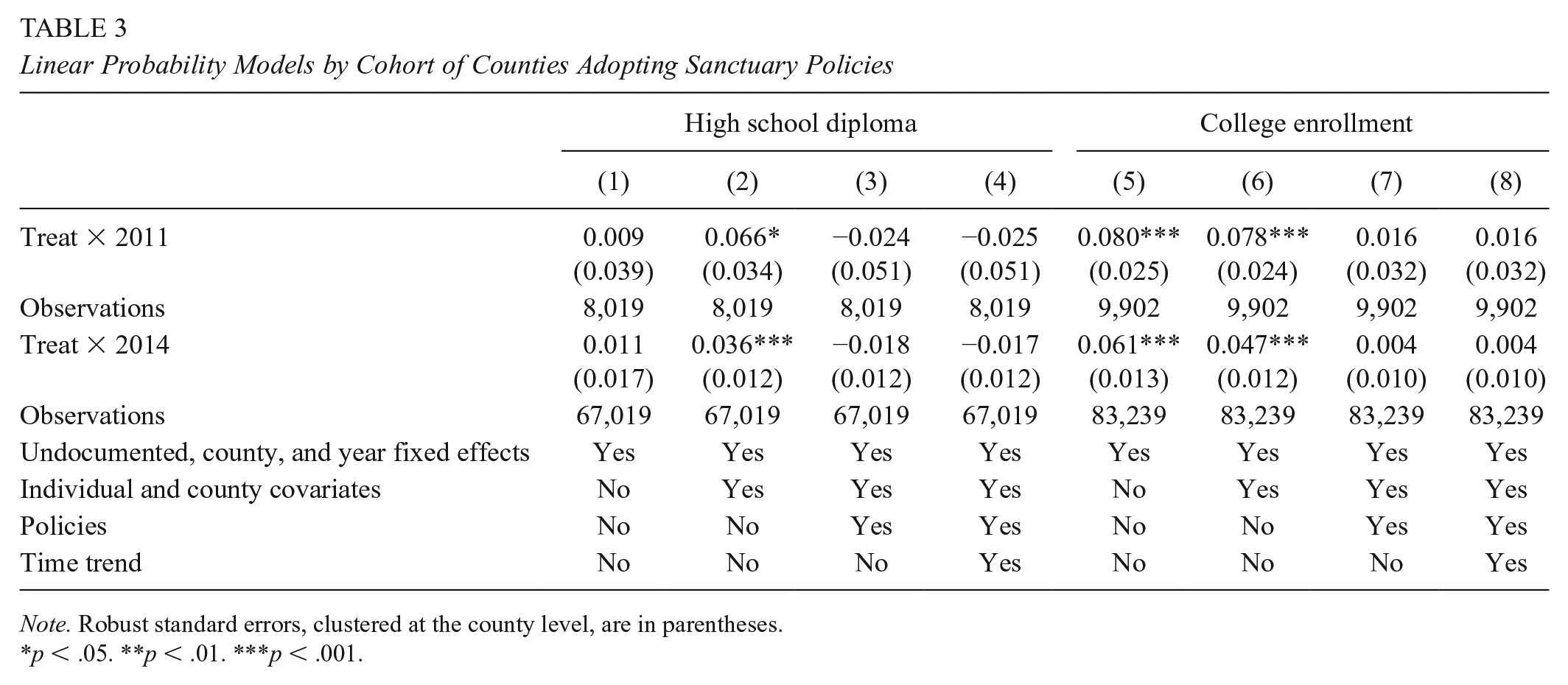
Recent advances in DD methodology suggest that the two-way fixed-effects model might produce biased estimates due to heterogeneity in the treatment effects between groups at different times (Goodman-Bacon, 2018). Given that nearly all the counties in my study adopted a sanctuary policy in 2014, this is unlikely to be a concern since the two-way fixed-effects model is robust when treatment is not staggered (which is essentially the case here) and when treatment effects are dynamic (Baker et al., 2021). Nevertheless, I estimate separate models of Equation 1 for individuals in the cohort of counties that adopted policies in 2011 and 2014. The results are given in Table 3, and I find similar results as reported above. These models suggest no significant association of sanctuary policies with high school completion and college enrollment after controlling for individual, county, and relevant policy factors.
Linear Probability Models by Cohort of Counties Adopting Sanctuary Policies
Note. Robust standard errors, clustered at the county level, are in parentheses.
p < .05. **p < .01. ***p < .001.
Sensitivity Checks
To assess how sensitive my results were to different comparison groups and model specifications, whether compositional changes in my sample could be a concern, and whether there was potential bias, I ran a series of sensitivity analyses. First, although I argue that U.S.-born Hispanics offer the most appropriate comparison group for this analysis, there is a concern that immigration enforcement could also affect Hispanic documented students who are part of mixed-status families (Dreby, 2012). Simply comparing with U.S.-born Hispanics might present an unclear picture since young adults in mixed-status families might experience the effects of immigration policy like their undocumented peers. To address this concern, I estimate Equation 1 comparing Hispanic undocumented students with U.S.-born Hispanics in non-mixed-status families—that is, families where both parents are either U.S.-born or naturalized citizens. Table 4 presents the results from this analysis, and the results confirm my main findings.
Linear Probability Model Results Comparing Hispanic Undocumented Students With Hispanic Students Who Are U.S.-Born or Naturalized Citizens

Note. Robust standard errors, clustered at the county level, are in parentheses.
p < .05. **p < .01. ***p < .001.
Next, the use of a DD design comes at a conceptual cost since the treatment indicator yields and assumes a single constant effect over time (Furquim et al., 2020). As a result, I tested whether the association between these policies and my outcomes vary over time by using an event study model, specified in Equation 2:

Here, many of the terms are the same as in Equation 1. The noticeable change is the inclusion of a vector of indicators in the summation term representing the binary lags and leads of the sanctuary policy. This strategy allows me to estimate annual differences between the treated and comparison groups relative to the differences between the two groups in the base year (1 year prior to policy adoption). The end points, ≤−6 and ≥+3 years, are binned so that they capture noise and fewer observations from the start and end of the policies. Figure 2 includes the point estimates and 95% confidence intervals, with the top and bottom panels representing high school completion and college enrollment, respectively. Appendix Table A3 includes the full regression results of this model. The top panel shows zero and insignificant associations after the counties adopted this policy relative to the base year. These estimates remained steady for 3 years after adoption of the policy. In the bottom panel, I find that the policy had relatively little effect soon after it was implemented. Yet the policy did seem to produce positive and significant relationships 2 and 3 years after its adoption. However, several years before adoption, the policy had associations, making it unclear whether the policy produced this outcome.

Event study estimates.
Another concern related to this analysis is the repeated cross-sectional nature of the data. Compositional changes of the sample can occur from year to year. To address this concern, I also interact each covariate with each year indicator to control for these changes (Duflo, 2004, cited in Lee et al., 2020). Table 5 reports these results. The point estimates are consistent with my main findings as they suggest no statistically significant change in my outcomes of interest following the adoption of these policies.
Linear Probability Model Controlling for Compositional Changes

Note. Robust standard errors, clustered at the county level, are in parentheses.
p < .05. **p < .01. ***p < .001.
Finally, I ran a sensitivity test to understand how much bias there must be in my analysis to invalidate my claim that sanctuary policies have relatively no association with my outcomes. In other words, I examined the number of treated cases that would need to be switched from zero to invalidate my results. To do this, I applied Frank et al.’s (2013) robustness check on the treatment effects in columns (4) and (8) of Table 2. Using statistical significance as my threshold, I found that 73% of the estimated effect would have to be due to bias to sustain an inference on my high school completion outcome. When examining the impact on college enrollment, I found that 49% of the cases would have to be due to bias. To understand the magnitude of these estimates, I put them in perspective with other educational studies highlighted by Frank and colleagues. Accordingly, these magnitudes are near the higher end compared with the studies they reviewed, suggesting it would take a significant amount of bias to invalidate these estimates.
Limitations
Readers must consider three limitations when interpreting these results. First, sanctuary policies vary in their policy design features and potentially in their relationship to educational outcomes. For example, the two types of policies I referenced earlier in this article, from Chicago and counties in Oregon, vary not only in the way they are implemented but also in how governments enforce them. This article aimed to provide a baseline understanding of the relationship between these policies and two educational outcomes. It was not designed to examine the differential impacts of policies and as a result considered these policies as the same “treatment.” Future research can address this limitation by examining the differential effects by policy design and enforcement, for instance, by refining and building on existing typologies of sanctuary policies (Kittrie, 2006; Sullivan, 2009).
Second, although I controlled for confounding policies, there could still likely be other factors at play influencing my results. For instance, one unconsidered factor could be the intensity of immigration enforcement in the county where the respondent lives (or the nearby county). Additionally, statewide sanctuary policies that limit ICE activity might be more impactful for students living in areas with infrequent ICE activity. 5 Given the lack of reliable and specific ICE activity data and the inability to observe individuals in all counties given the sampling structure of the ACS, future research can leverage other data to consider whether immigration enforcement nearby shapes educational outcomes. A final limitation relates to whether there might be interactive effects between in-state tuition policies and DACA that might be difficult to assess given the relatively close timing of their adoption. Since this study was designed to be exploratory, the estimates should not be interpreted as causal. Nonetheless, they serve as a useful baseline for future studies wishing to undertake causal examinations of sanctuary policies.
Discussion
Sanctuary policies have received heightened attention and scrutiny from policymakers, primarily driven by concerns over public safety related to increased undocumented immigration. Apart from the empirical research not supporting a link between sanctuary policy adoption and crime, other research has found negative effects of increased immigration enforcement on education more broadly (Amuedo-Dorantes & Lopez, 2017; Bellows, 2019; Dee & Murphy, 2019). Immigrant youth, who already face uncertain futures due the intersection of their undocumented status and federal law, may also bear some of the biggest burden of immigration enforcement, leading them to miss school or transfer school districts (Dee & Murphy, 2019). Yet there is little definitive evidence suggesting that sanctuary policies have the potential to attenuate the negative effects of immigration enforcement.
As of 2017, 128 counties, including two states (California and Connecticut), operate with some version of a sanctuary policy. This study found that sanctuary policies had no relationship to completing a high school diploma and college enrollment, on average. These findings show that although sanctuary policies counteract immigration enforcement, for the most part, they have minimal associations with educational attainment and are robust to a variety of sensitivity checks.
When there is a decrease in immigration enforcement, the likelihood of separating families decreases, which research has shown to have positive effects on mental health and employment (Rhodes et al., 2015; Vargas, 2015; Wang & Kaushal, 2018). Also, when governments institute these types of policies, they are doing so to include members into society. The fear, anxiety, and uncertainty tied to undocumented status may lessen, which could improve the prospects and possibilities of investing in college for undocumented young adults. Additionally, increasing educational opportunities can increase integration into society and lead to upward mobility for immigrant families. For example, as people earn degrees, they are more likely to obtain jobs that will pay higher salaries. Of course, these possibilities are all within a larger uncertain policy context that is unequal along race and class despite the presence of pockets of sanctuary for immigrants. Yet my results show that these potential mechanisms do not play a role in increasing educational attainment substantively.
My high school completion findings found no association to the policies. Given the federal legal protections for undocumented young people at the K–12 level, sanctuary policies may not have a positive or negative association with high school completion because students are already protected by policies that provide them access to at least a high school diploma. I also found no relationship with college enrollment, which may highlight that sanctuary policies might do little to reduce the burden of making the difficult transition from the legal protections undocumented students enjoy in K–12 into young adulthood.
The theory of liminal legality highlights that most undocumented immigrants occupy a legal gray space whereby immigration policies in their context of reception shape their incorporation and opportunity structure. By applying this theoretical framework, these results highlight that sanctuary policies may not reduce uncertainty enough, over and above other concurrent policies, to encourage undocumented young adults to invest in education. Undocumented immigrants live with uncertainty, and policies can either increase or decrease that precarity. For example, research shows that DACA decreases uncertainty for those eligible by providing relief from deportation and work permits (Amuedo-Dorantes & Antman, 2017; Pope, 2016). Sanctuary policies may not reduce uncertainty since it only provides an intergovernmental buffer between local and federal agents. After all, sanctuary policies do not provide federal legal protections like DACA or lead states to subsidize tuition at public colleges and universities. Ultimately, this shows the limitation of relying on county-level policy to protect some of the most disadvantaged youth, compared with federal or state-level policies that ostensibly provide more tangible benefits. Therefore, sanctuary policies alone may not have a strong association to education in the same way they are associated with deportation outcomes (Hausman, 2020). This highlights the importance of policies that are consistent across geographic boundaries and levels of government.
The findings from my study can help inform policy while also encouraging future research on the topic. As immigration policy continues to be crafted and debated, policymakers must recognize that immigration enforcement harms undocumented youth and has implications for their academic outcomes. The study also highlights that education policy is in a unique position to address and respond to the educational consequences of immigration enforcement. For instance, schools might have to invest more in mental health resources to support students and families that may be affected by enforcement activities (Kirksey et al., 2020).
Future Research and Conclusion
The results from this study point to at least two future areas of research. First, in addition to recognizing what kinds of effects different policy designs and enforcement have on educational outcomes, it is useful to know what leads to the adoption of these policies in the first place. Theories such as group threat within the sociology of immigration begin to explain the increases in nativism and racism toward immigrants, particularly in the context of anti-immigration policies (Blalock, 1967; Wilson, 2001). Yet there is limited research to support why city, county, or state governments adopt sanctuary policies and what their intended goals are. There could be large political forces at play, such as political party affiliations, that predict adoption. The guiding theoretical framework of the current study posits that sanctuary policies potentially reduce uncertainty and ostensibly increase inclusion within society. However, this framework centers the individual who is benefited or burdened by the policy and may be better explained by a more macrolevel theory. Perhaps the adoption of sanctuary policies is a case of interest convergence where providing limited civil protections for immigrants aligns with the interests of the majority (White) group (Bell, 2004; Milner, 2008). But these protections are just that—limited. And any future civil and more permanent policy solutions are at the mercy of majority interests. Those interests may also be tied to how undocumented immigrants and other marginalized groups are socially constructed as deserving or not (Schneider et al., 2014).
Another strand of research should consider how individuals and families make sense of uncertainty in sanctuary locations. Previous research has drawn on Portes and Rumbaut’s (2014) theory of the context of reception to explain how government policies, local demographics, and labor market opportunities shape incorporation and integration for immigrants. However, this theory may not consider how individuals interact and make sense of the context they reside in. Thus, taking an ecological perspective, as others have done in studying undocumented college students, one can focus more on how the larger context shapes decisions and uncertainty (Suárez-Orozco et al., 2011; Suárez-Orozco et al., 2015). Qualitative research in particular can better understand how immigrant families make sense of uncertainty within the context of a sanctuary and what other factors are at play.
Sanctuary policies prohibit cooperation between local and federal officials to decrease immigration enforcement. Although this study found that these policies, on average, had minimal impacts on high school completion and college enrollment, the results from this study add to the literature on immigration enforcement and educational outcomes.
Footnotes
Appendix
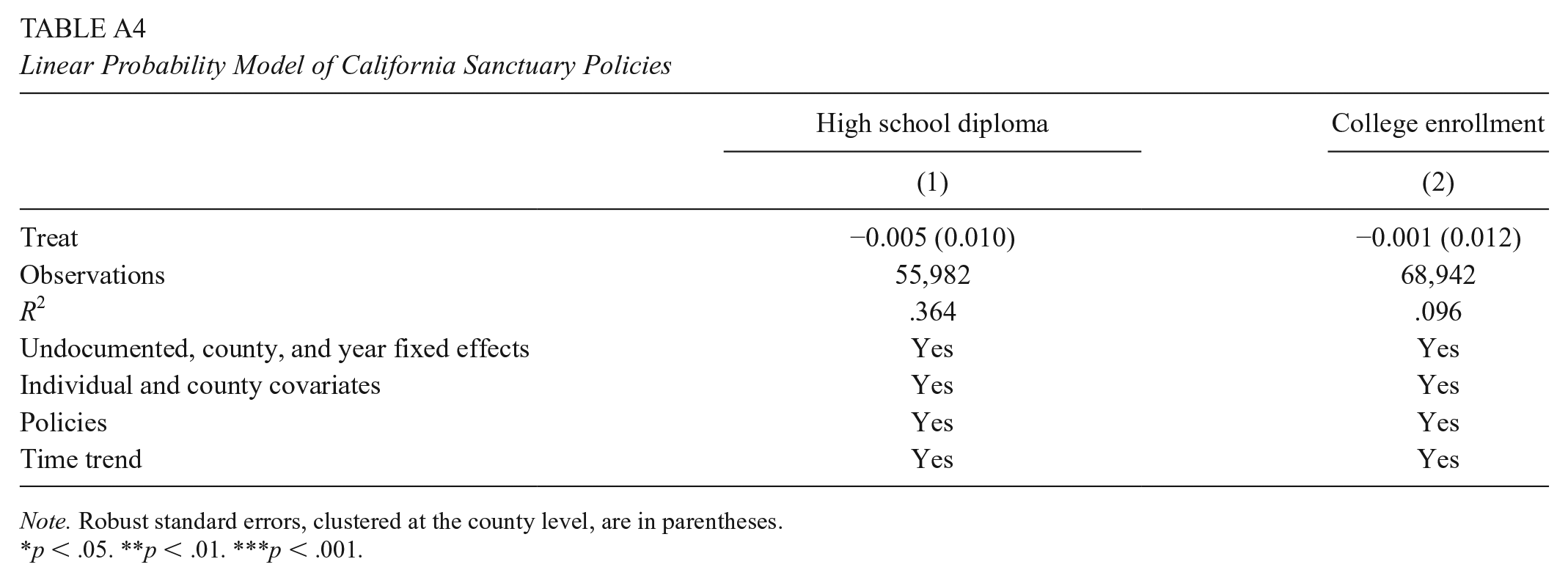
Linear Probability Model of California Sanctuary Policies
| High school diploma | College enrollment | |
|---|---|---|
| (1) | (2) | |
| Treat | −0.005 (0.010) | −0.001 (0.012) |
| Observations | 55,982 | 68,942 |
| R 2 | .364 | .096 |
| Undocumented, county, and year fixed effects | Yes | Yes |
| Individual and county covariates | Yes | Yes |
| Policies | Yes | Yes |
| Time trend | Yes | Yes |
Note. Robust standard errors, clustered at the county level, are in parentheses.
p < .05. **p < .01. ***p < .001.
Acknowledgements
I am grateful for comments on previous versions of this study from Rachelle Winkle-Wagner, Nick Hillman, Xueli Wang, Eric Grodsky, and Antia Gonzalez Ben. I also thank the four anonymous reviewers for their feedback.
Funding
The author disclosed receipt of the following financial support for the research, authorship, and/or publication of this article: The research reported here was supported by the Institute of Education Sciences, U.S. Department of Education through Award #R305B150003 to the University of Wisconsin-Madison. The opinions expressed are those of the author and do not represent the views of the U.S. Department of Education.

Notes
Author
DANIEL CORRAL is an assistant professor in the Department of Leadership, Higher and Adult Education at the University of Toronto. His research investigates environments and policies affecting postsecondary access and success for underrepresented students.