




Abstract
For years, policy implementation scholars have recognized the trend of school improvement policies converging on public schools in such a way that these policies create a paradox – policies aimed at school improvement have often been represented as in such a state of incoherence, that they have been unmanageable. This convergence of reforms asks educators to manage multiple demands – learning and implementing new reforms and ways of teaching, while also leveraging current resources and capabilities. The concept of organizational ambidexterity captures this tension and complexity, giving a name to an organization’s ability to effectively balance conflicting pressures and to simultaneously take advantage of existing capabilities and explore possible innovative practices to increase both efficiency and efficacy. We argue that drawing on the research on organizational ambidexterity and conceptualizing new ways for schools to develop ambidextrous practices may be a critical step toward answering how schools manage environmental pressures and toward educational change.
Introduction
Policy coherence is one of a handful of policy issues in K–12 (kindergarten to 12th grade) public education that is perceived to be both necessary and elusive. As a pure ideal, policy coherence is defined by the Organization for Economic Cooperation and Development as ‘the systematic production of mutually reinforcing policy actions across government departments and agencies creating synergies towards achieving the same objectives’ (Policy Coherence, 2010, paragraph 1). The study of policy coherence is based on the premise that wherever possible, and in the face of multiple alternatives, policy-makers should select policies with the greatest coherence or that are most consistent with agreed-upon reform objectives. Although the study of policy coherence is interesting and important in and of itself (see Furhman, 1993; Honig and Hatch, 2004), the empirical research inspired by this reform objective points to a theoretical issue of broader significance – the re-examination of the concept of policy pluralism in education.
Policy pluralism is the condition or idea that the state is only one of many groups and institutions that define their purposes in terms of policy development (Dahl, 1978, 1982). In US education, for example, in addition to the state and federal government, there are many other stakeholders involved in and affected by policies designed to improve the access and quality of public education for students. Indeed, “street-level bureaucrats” have been discussed as mediators in policy implementation for decades (e.g. Weatherley and Lipsky, 1977). Political scientists and policy analysts in education have used this idea of street-level bureaucracy to explain much of what happens and does not happen in education reform (e.g. Stone, 2002; Weatherley and Lipsky, 1977). Much of this work has focused on the idea that government policy objectives will always shape and be shaped by different combinations of groups – district leaders, school administrators, teachers, parents, students, and even special interest groups who can (if they view their interests as threatened) organize to shape the outcome of whether a bill is passed or a policy is implemented (or not, as the case may be). Compounding this complexity is also the influence of diverse cultural knowledges and experiences that come to bear on how educational policy is developed and interpreted by stakeholders both in the US and globally (Tesar and Arndt, 2017). Additionally, in recent decades, there has been an emphasis on (though not necessarily actual implementation of) evidence-based policy-making. The confluence of information sources and intermediaries further complicates the design and implementation of policies and the connection of policy and research (Lubienski, 2018; Lubienski et al., 2011, 2014).
This idea of policy pluralism illustrates a world in which complexity is the norm and not something that can – or even necessarily should – be eradicated. Like any form of social policy, education policy emerges from the bargaining and renegotiation of a plurality of actors outside of the formal constitutional and legal apparatus of government. According to this view, good policy emerges in one of two interrelated ways. First, if you leave the groups alone, the modern democratic system of checks and balances will assure that no one branch of government or group of stakeholders will have a monopoly on policy design. Second, if you leave the implementers alone, you may not get what you mandated.
There is a world of truth and decades of empirical research (e.g. Kingdon, 2003; Stone, 2002; Weatherley and Lipsky, 1977) supporting this approach to thinking about policy (greatly simplified here for the purposes of our central argument). Policy coherence is an expected extension of the policy pluralism discussion. In a political system of scarce resources, wise policy requires making tough choices. The good choices are ones that are integrative, building on consensus of multiple constituents. The weakness of the research to date is that it somewhat ignores the basic question posed by a normative theory of policy coherence: in a complex reform environment, in which so many different actors influence the policy process, is policy coherence really possible, and if it is not, or at least if it is elusive, then how are those implementing policy expected to manage? In this paper, we argue that organizational ambidexterity – conceived of here as an organizational state and as a theoretical framework borrowed from organizational studies – can help educational researchers make sense of how schools as organizations implement policies and reforms, and can offer guidance on how educational institutions could better manage policy complexity and incoherence.
Organizational ambidexterity (coined by Duncan, 1976) – which has been percolating in the organizational literature for decades – is an organization’s ability to effectively balance conflicting pressures and allow the actors within it to take advantage of existing capabilities, work within existing constraints, and explore innovative practices to increase efficiency and efficacy. We argue that organizational ambidexterity – as an organizational goal for schools and as a theoretical frame to investigate educational reform more generally – captures the complexity inherent in education at both the macro-level (policy development and implementation), and at the micro-level (in how schools and educators have to navigate reform). Our central contention is that future empirical and theoretical work on policy implementation, educational reform, and school change can be strengthened by organizational ambidexterity as an integrative lens. Our argument rests on the idea that organizational ambidexterity supports researchers in looking both inward (at the strategic actions of school level staff) while also adopting a more outward orientation that recognizes the complexity of educational reform that often requires schools and educators to simultaneously innovate and draw on existing resources. To illustrate, we bring a concept often used in organizational and management studies into the arena of educational research in hopes that this organizational theory may shed additional light on the internal processes of schools as organizations. In the remainder of this paper, we first discuss policy complexity and the nature of educational reform. We then discuss the application of organizational ambidexterity as a theoretical lens, after which we draw on recent research we have conducted to demonstrate the use of organizational ambidexterity as a lens for policy research.
Policy complexity in educational reform
Policy analysts and scholars have advocated for policy coherence – policy that is logically consistent and free of contradiction (Fuhrman, 1993) – but its existence in the real world of education has been rare (Cohen et al., 2018). For years, policy implementation scholars have recognized the trend of school improvement policies converging on public schools in such a way that these policies create a paradox – policies aimed at school improvement have often been represented as in such a state of incoherence, that they have been unmanageable (Fuhrman, 1993). It is also evident in existing research on policy implementation that despite efforts to standardize education, policy design and implementation are inherently complex (e.g. Cohen, 1990; Stone, 2002). Efforts to simplify or vertically integrate policy pressures and reform initiatives have not coalesced in the manner that policy-makers and scholars had hoped. Efforts to bridge the gap between research and policy design and implementation have been similarly difficult to enact in practice (Lubienski, 2018). For these reasons, it becomes useful for policy researchers and policy-makers to embrace complexity and begin reframing our analyses of schools as organizations in light of a reform climate that requires schools to be ambidextrous – able to manage conflicting pressures to simultaneously innovate and hone existing practices with existing resources.
As Cohen et al. (2018) describe it, the lack of policy coherence in education originally stemmed from: environmental pressures to better serve diverse students; a disconnect between the needs of schools and the vendors providing tests and curricula; and limited incentive to improve instructional methods. Toward resolving some of these issues, there was a corresponding increase in accountability-driven, market-based, and standards-based reforms. However, rather than improving coherence, this simply added another layer of complexity with which schools and educators had to contend. In response, scholars offered suggestions for achieving policy coherence (e.g. Honig and Hatch, 2004; Schneider and Ingram, 1997) and education policy-makers followed suit, inundating schools with initiatives and reforms designed to standardize educational goals and outcomes and hold schools (and teachers) accountable for those outcomes (e.g. No Child Left Behind, Common Core State Standards, etc.). Nevertheless, after several decades of standards-based initiatives and systemic reform, policy pluralism is still the reality for schools, and schools and teachers are still subject to policy incoherence – conflicting pressures and goals (Hatch, 2002).
As Arndt and Tesar note, “Educational policies are undoubtedly complex and diverse, and continue to be designed and implemented in different ways around the globe” (Arndt and Tesar, 2018: 233). One of the primary drivers of this policy complexity in education (and other arenas, of course) is the multitude of stakeholders involved in designing, interpreting, and implementing any reform. School administrators, for example, help to interpret policies and design professional development aligned to reform goals. They can also be the key mediators in communicating accountability policies to teachers, becoming critical determinants in the amount of tension or coherence teachers experience as they make sense of reforms (Stillman, 2011). Teachers, of course, are the actors on the ground who translate any policies or reforms to the classroom. Decades of research on policy interpretation and implementation have focused on the role of teachers in translating policy to the classroom from the implementation of new math curricula (e.g. Cohen, 1990) to technology integration (e.g. Windschitl and Sahl, 2002). Researchers have also shown that how these actors on the ground construct the particular policy problems that they are trying to address can have implications for how those actors respond and implement any reforms (Coburn, 2006). Beyond those school-based stakeholders, parents also have a key role in school reform. For example, the entire concept of “school choice” – allowing parents and students to choose charter schools or schools outside of their districts – is predicated on the idea that parents will choose the best school for their children and that this will press schools that lose enrollment to improve their practices. As another example, in some states in the USA, “parent trigger” laws allow parents to organize with other parents and petition for specific reforms (Smith and Rowland, 2014). If the parents of students in a specific school deem that the school is not serving their children, they can organize to convert the school to a charter, remove the principal, replace the staff, or dissolve the school entirely. In the midst of all of this is often a scarcity of resources that can also have implications for organizational or individual change.
The current convergence of reforms, the paucity of resources, and the myriad stakeholders involved in the development and implementation of policies and reforms create a complex policy climate in which schools and educators are asked to manage multiple demands – learning and implementing new reforms and initiatives and navigating a variety of stakeholder interpretations, while also leveraging current resources and capabilities. For example, the use of educational technology and digital resources, which many consider to be the best way to individualize and differentiate instruction and increase the achievement of traditionally-underserved students (see Banister et al., 2014; US Department of Education, 2013a, 2013b), requires some innovation and instructional change on the part of schools and teachers (see Bingham et al., 2018). At the same time, budgetary and knowledge constraints require schools and teachers to make better (or new) use of what they already have. These differences create concrete complexities in the organizational and policy environments as well as in individuals’ sensemaking processes (Spillane et al., 2006).
All of this is to say that the day-to-day realities of schools and teachers is complex and that confronting and leveraging that complexity is critical to “building the kind of instructive knowledge base that educational decisions-makers demand” (Honig, 2006: 3). As educational reform initiatives and policies have multiplied and layered, policy-makers have struggled to develop policies and initiatives that can survive the ideological bombardment to which schools are often subject, as well as the subjective interpretations of the individuals who translate policy to action. Examples include accountability measures designed to identify and standardize intended outcomes and metrics, or canned curricula designed to standardize what is taught in classrooms. However, attempts to stem policy incoherence tax policy-makers’ and/or researchers’ time and energy and do not necessarily reflect the inherent messiness of the school context. Put simply, while policy coherence is a kind of holy grail in education research, policy complexity is the reality that practitioners (and researchers) face (Hatch, 2002). Instead of focusing on schools’ plight, researchers can productively turn their gaze toward helping schools thrive rather than survive in this atmosphere. We propose reconstructing analyses of how policy is designed and implemented as less of a problem of “managing chaos” and more of a challenge of leveraging complexity. In other words, rather than seeing reform complexity as a problem to be navigated, we support the idea that researchers and policy-makers should treat it as a given – a strength even – that can be effectively managed and even leveraged. To do that, “strong theoretical and empirical guides are needed to help researchers and practitioners navigate this inherently messy terrain” (Honig, 2006: 3). To this end, we argue that the concept of organizational ambidexterity, which deals specifically with how organizations manage incoherence and conflicting goals and ideals, is highly relevant and transferable to educational organizations.
Organizational ambidexterity: useful concepts for educational research
Organizational ambidexterity can be broadly defined as an organization’s ability to simultaneously perform “competing, strategic acts” (Simsek et al., 2009: 865). More specifically, ambidexterity refers to an organization’s capacity to innovate – to move forward and explore new opportunities for improvement – while also exploiting its existing capacities to maintain effective practices and efficiency (Levinthal and March, 1993; March, 1991; Raisch et al., 2009). In organizational studies research, scholars have argued that an organization’s long-term success and viability are reliant on its capacity for ambidexterity (Levinthal and March, 1993; March, 1991). Refining current knowledge and competencies (described as “exploitation”) and experimenting with new knowledge and practices (described as “exploration”) have long been discussed in the organizational studies literature as two fundamentally different processes that can lead to organizational tensions (March, 1991). Still, an organization needs to do both to perform well over time. Experimentation and exploration of new practices can be time-consuming, with uncertain results, but without it, an organization becomes stagnant. Thus, the pursuit of both exploitation of current competencies and the exploration of new practices – ambidexterity – is necessary and beneficial to organizational performance (Papachroni et al., 2015). But, what processes or practices make an organization ambidextrous?
Some organizational scholars have argued that developing separate structures within an organization – one concerned with innovation and one concerned with refining current practices – can improve ambidexterity (Benner and Tushman, 2003; Tushman and O’Reilly, 1996). More specifically, one group within the organization is tasked with innovation and is smaller, decentralized, and more loosely structured. The other, larger group in the organization is tasked with refining and maintaining current practices. This group is more highly-structured, and based in a top-down model of management, which helps to manage tensions between exploitation of current resources and the needs of innovation (O’Reilly and Tushman, 2004).
Other research on ambidextrous organizations indicates that ambidexterity is best achieved by creating an environment in which there are a set of practices or processes that “encourage individuals to make their own judgments about how to divide their time” between exploitation and exploration (Gibson and Birkinshaw, 2004: 210). Specifically, providing a combination of discipline, support, and trust in organizational actors can improve ambidexterity in individuals (Gibson and Birkinshaw, 2004) and thus in the organization as a whole (O’Reilly and Tushman, 2004). This view relies on trust in the professional judgment of the individuals within the organization.
Organizational culture and community structure are also integrally connected to an organization’s ability to be ambidextrous (e.g. Gibson and Birkinshaw, 2004). How the organization is structured and the types of community it develops and nurtures (Adler et al., 2015), the interdependence of its actors (Raisch et al., 2009), and the extent of an organization’s shared vision, social support, and trust (e.g. Ghoshal and Bartlett, 1997) can support or hinder ambidexterity. In organizational studies, different types of community have been linked with how an organization can manage conflicting pressures. For example, Adler et al., (2015) discuss collaborative community, which prioritizes collegial contribution and cooperation, instead of hierarchical leadership structures, as being ideal for ambidexterity. Others identify strong, clan-like bonds of community as being an important mechanism of ambidexterity (e.g. Raisch and Birkinshaw, 2008), assuming that a strong internal community with high levels of trust can better make decisions needed to increase ambidexterity.
Organizational ambidexterity is critical to an organization’s ability to improve performance and survive in shifting institutional and policy climates (Simsek et al., 2009). Organizations that are ambidextrous can adapt to changing institutional climates, and can manage, and indeed thrive, in a climate requiring both efficiency and exploration (O’Reilly and Tushman, 2004; Tushman and O’Reilly, 1996). However, pursuing one goal (efficient use of existing capabilities) at the expense of the other goal (exploring innovative ideas and practices) can lead to a host of complications (March, 1991; Simsek et al., 2009). Focusing too much on efficiency and the exploitation of current capabilities can lead to obsolescence; however, pursuing innovation at the expense of efficiency can mean underdeveloped ideas and low return on any investment in new knowledge or new ways of doing things.
The foundation of organizational ambidexterity reflects a paradox that is all too familiar to those educators and educational researchers concerned with educational policy or reform. Sticking to the traditional way of doing things has left us with a growing achievement gap, but attempts to innovate have often resulted in regression to the norm (Tyack and Cuban, 1995 ) – low return on investment in new strategies. Further, decades of emphasis on policy coherence as a critical lever in substantive improvements and bringing reforms to scale did not ultimately yield much return relative to investment as a primary reform strategy, leading to more interest in and acceptance of complexity as a given (Honig, 2006). These struggles coupled with increasing accountability pressures aimed at solving these issues substantiate the need for ambidexterity in schools as organizations.
In conceiving of schools as organizations that need to become ambidextrous in order to survive and thrive in complex institutional climates, we can draw on research from the organizational studies literature. This literature allows us to attend to policy complexity at a theoretical level and to identify school-level mediators and particular organizational practices that can help schools and teachers manage conflicting pressures. In the next section, we translate this research to the educational context in order to identify generative areas of focus in managing policy incoherence and helping schools become more ambidextrous.
Applying organizational ambidexterity to educational research and schools as organizations
Our argument here is twofold. First, we contend that organizational ambidexterity is a useful descriptive theoretical lens through which to analyze schools as organizations while attending to larger trends in educational reform and policy implementation. Second, we argue that organizational ambidexterity, when conceived of as an organizational state, has the potential to provide an orienting prescriptive 1 lens that offers suggestions for how schools as organizations can manage and respond to policy pressures.
Organizational ambidexterity as a theoretical framework
Drawing on organizational ambidexterity as a research paradigm in educational policy research refocuses attention on the inherent complexity of policy design and implementation. In addition, what is novel about the concept of organizational ambidexterity as a theoretical lens is that it can help researchers to identify when and how complexity leads to conditions (when properly managed) that can create an opportunity for change that would otherwise not be possible if everything were tightly categorized and ordered. In their discussion of the dilemmas inherent in educational reform, Cohen et al. pose the question “How do school systems manage environmental pressures to rebuild themselves as more coherent and instructionally effective organizations while managing their inherited differentiated organizations and the environmental pressures that support them?” (Cohen et al., 2018: 208 ). We argue that drawing on the research on ambidexterity and conceptualizing new ways for schools to develop ambidextrous practices may then be a critical step toward answering this question and toward educational change.
Of course, other theoretical frames focus on similar issues and aspects of organizations. Activity theory, for example, provides a lens through which to examine the many interacting components of an organization and how they mediate and influence learning and change (Engeström et al., 1999). Institutional theory provides a lens that explores the isomorphic characteristics of organizations and institutions, and how they come to resemble each other in a way that can stymie experimentation and large-scale change (DiMaggio and Powell, 1983). Sensemaking theory supports analyses of how individual and collective interpretations of reforms can hinder or support change (Spillane et al., 2006; Weick, 1995). What differentiates organizational ambidexterity from other organizational theories is that it provides an integrative lens that can help researchers to identify and make sense of strategic actions at the school-level while also focusing on larger issues of policy complexity. Organizational ambidexterity also reflects the larger trends in educational policy research that we described in previous sections, allowing for researchers to attend to and describe how schools work within a climate of policy pluralism, rather than assuming policy coherence. In other words, organizational ambidexterity provides a bifurcated lens that gives a name to the tension between exploration of new practices and the exploitation of current resources, and situates that tension in the larger reform environment.
As an example, consider the larger trend of technology implementation and integration into schools and classrooms. There is no doubt that this particular reform is subject to the kind of policy complexity we have outlined thus far. At the federal policy level, the US Department of Education’s Office of Educational Technology is the entity that “develops national educational technology policy and establishes the vision for how technology can be used to transform teaching and learning and how to make everywhere, all-the-time learning possible for early learners through K-12, higher education, and adult education” (US Department of Education, 2018). Through initiatives such as Race to the Top and ConnectED, the Office of Educational Technology aims to encourage the use of technology in all classrooms, particularly as a mechanism to support more personalized learning experiences for students (US Department of Education 2013a, 2013b). This is easier said than done, of course. Policies at the state-, district-, and school-levels also mediate how and to what extent technology can be integrated into classrooms (Bingham et al., 2018). Previous research on educational technology implementation has indicated that it is also subject to the same kinds of implementation issues and policy complexities as any other reform, including the mediating effects of individual sensemaking and organizational messaging (e.g. Bingham, 2017). For example, over and over again, we have seen in the research that even when technology is given to every teacher or implemented in every classroom, it may be used differently by each teacher, often in ways that support traditional teaching practices rather than revolutionizing them (Hew and Brush, 2007; Author, 2016). Further, there may be differing levels of support, professional development, and bandwidth, which can also influence levels of technology integration (Bingham et al., 2018).
Applying the lens of organizational ambidexterity, the complexity inherent in this kind of reform is reframed to identify potential levers of change that are more manageable than say, getting every stakeholder to interpret and implement an initiative with full fidelity of implementation. Beyond that, organizational ambidexterity as a lens can account for the idea that full fidelity of implementation may not be the appropriate goal anyway – for teachers to use technology meaningfully, they need to draw on existing good teaching practices, and use technology to enhance those practices and provide additional resources (Bingham, 2017). More specifically, innovation is a key part of technology integration – schools and teachers have to identify and build on existing successful practices, while also changing their practice to draw on the strengths of technology and integrate it in a meaningful way.
As an example, in 2013, the Los Angeles Unified School District (LAUSD) in California attempted to revolutionize teacher practice and increase student learning through a district iPad initiative. The district spent upwards of a billion dollars providing iPads to 650,000 students (Blume, 2017). By 2014, the program had collapsed and teachers were either not using the technology, or using it as part of existing practices. In an American Institutes for Research study on the initiative, researchers commented that “leveraging technology for transformational change in schools and classrooms requires more than a commitment to purchase and disseminate the equipment” (Penuel, 2006; Valiente, 2010, as cited in Margolin et al., 2015: 12). Indeed, some experimentation with using technology to expand teacher capability, deliver content, and personalize learning objectives is necessary to meaningful technology implementation (Bingham, 2017). At the same time, there are complex pressures at play that require schools and teachers to demonstrate positive results for students, and indeed, hold teachers and schools responsible for less-than-desirable results. To experiment in this environment is tricky. It would be easy to dismiss the LAUSD iPad failure as a breakdown of implementation fidelity, or a consequence of existing teacher schemas, individual and collective sensemaking processes, or organizational messaging. Framing an examination of this initiative with organizational ambidexterity, however, refocuses attention on the larger reform context, and on how the district and the individual schools managed the conflicting goals of experimentation and exploitation of existing practices and resources within that context. While other organizational theories might focus on the communication of technology integration and how individuals interpret it (i.e. sensemaking), the resilience of current organizational practices in the face of institutional pressures to innovate (i.e. institutional theory), or technological tools as mediating artifacts in the existing system of individual and organizational factors (i.e. activity theory), organizational ambidexterity theory weaves this all together, emphasizing the interrelation of two components necessary to organizational change in a complex policy climate: exploration of how teachers and other school staff utilizing new technologies can build into and onto what they are already doing in classrooms (exploitation) while simultaneously innovating around those practices to support technology integration (exploration).
In the example above, organizational ambidexterity provides a framework that helps researchers shift between examining specific practices related to managing accountability pressures, promoting efficiency, and maintaining existing “good” practices, while also exploring how schools are supporting innovation and experimentation. This framework supports this kind of analysis in two ways: by pushing researchers to develop research questions that can get at the interaction between exploitation and exploration; and by facilitating the categorization and examination of individual and organizational practices related to ambidexterity. In the LAUSD iPad example above, researchers could develop research questions based on concepts of ambidexterity that could help focus the analysis on the processes and practices related to experimentation, and those related to maintaining existing practices to meet accountability requirements (e.g. How are teachers using technology to develop existing best practices? What processes were in place to support ambidexterity? How did schools and teachers react to the initiative in relation to a complex, accountability-driven policy climate?). This could allow researchers to tease apart specific places where schools failed to be ambidextrous, and where they may have succeeded. In other words, research questions based in an organizational ambidexterity lens refocus attention on the interaction between competing goals at the school-level (experimentation, using current resources, and maintaining effective practices) and the interaction of those competing goals and the overall reform context.
Organizational ambidexterity can also provide a categorization scheme or matrix within which to situate school-level organizational practices and individual practices that support or hinder ambidexterity (see Figure 1). Continuing with technology integration as a broad example of a reform, researchers could examine how and to what extent technology was being integrated into classrooms in a particular school. With organizational ambidexterity as a theoretical frame, teacher-level and school-level actions could be categorized according to how they support or constrain experimentation with technology and exploitation of current practices and resources. Indeed, school-level and teacher-level actions could be situated on a matrix indicating where these practices fall: in the bottom left quadrant, minimal levels of experimentation and minimal levels of exploitation; in the bottom right quadrant, maximal levels of experimentation, with minimal levels of exploitation; in the top left quadrant, maximal levels of exploitation with minimal levels of experimentation; or finally, in the top right quadrant, maximal levels of both experimentation and exploitation, indicating ambidexterity. Using a matrix of ambidexterity in this way could help researchers pinpoint areas of action for schools and to specify recommendations to both practitioners and policy-makers in how technology can be integrated.
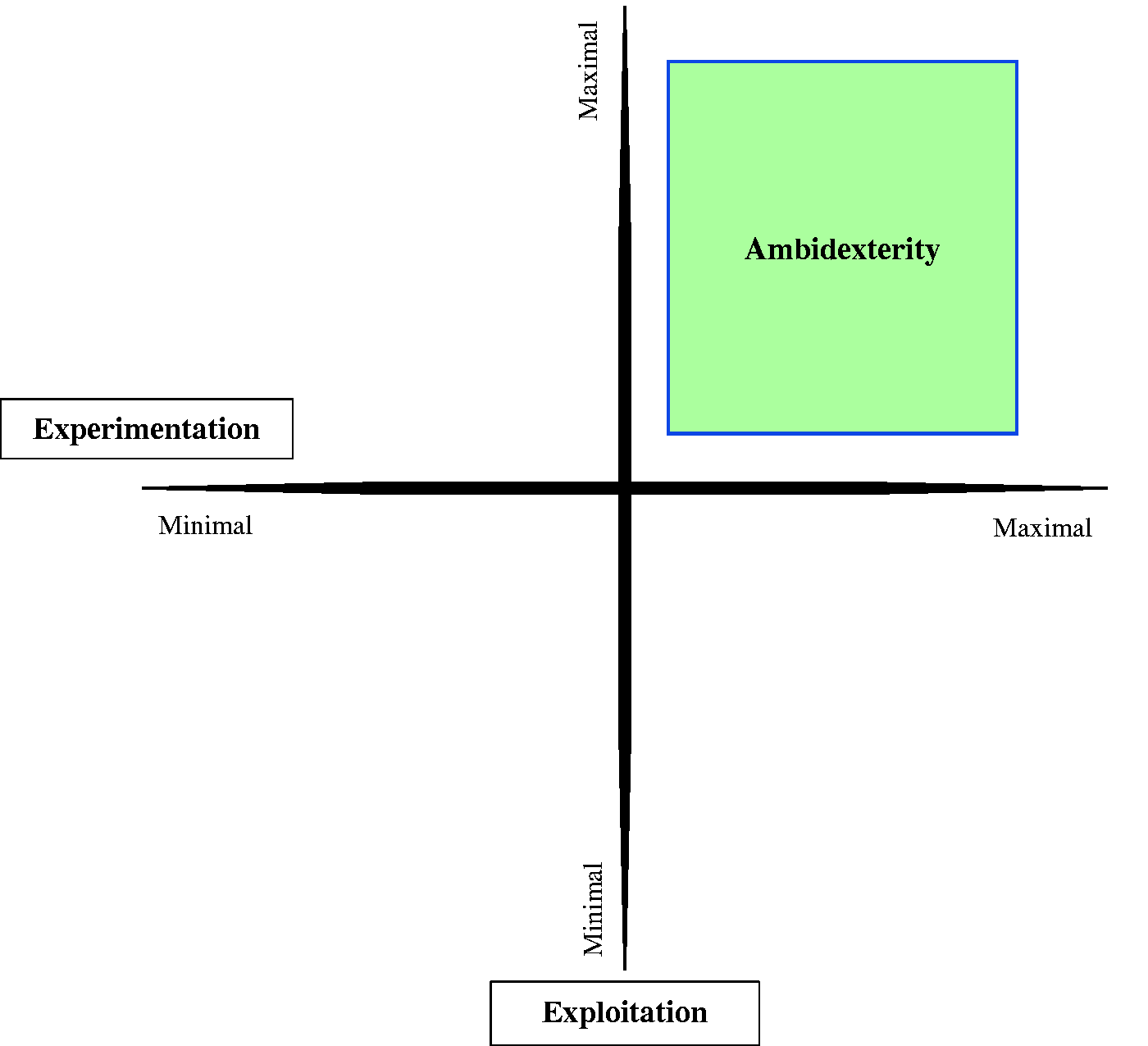
Organizational ambidexterity matrix.
In these and other ways, organizational ambidexterity is a useful addition to researchers’ and educational theorists’ toolboxes. In drawing on organizational ambidexterity, researchers studying change in a complex institutional environment are pressed to acknowledge this tension between experimentation and efficiency, examine how educators navigate this tension, and develop recommendations for ambidexterity – the successful navigation of this tension.
Ultimately, using organizational ambidexterity as a lens to investigate educational policy implementation and reform can help researchers to ask the right questions that acknowledge the elusiveness of policy coherence, to meet schools where they are and try to help them manage reform complexity rather than solve it, ignore it, or measure it. What can schools and educators learn from complexity so that they can better manage it? What do ambidextrous schools look like? If ambidexterity helps schools manage conflicting pressures and improve over time, how can schools be supported in achieving that goal? Is the school or district focusing too much on exploration or experimentation at the cost of student learning (i.e. students as guinea pigs)? Or is there too much emphasis on maintaining current structures, at the expense of innovation and improving student learning/closing achievement gaps? In short, in attempting to manage policy incoherence or conflicting pressures, what helps schools to be ambidextrous and how can ambidexterity in schools best be supported? Organizational ambidexterity can offer a lens that not only helps researchers to make sense of organizational behavior and change at a theoretical level, but also provides possible “prescriptive” actions – organizational designs and behaviors that can support ambidexterity, and thus, can be used to study and advise schools and practitioners on how to manage policy complexity and reform implementation.
Organizational ambidexterity in schools as organizations
The second part of our argument is that existing research on organizational ambidexterity can be prescriptively applied to schools as organizations and may offer some solutions to policy implementation and interpretation problems that schools and educators often face. To offer a concrete example of this, we draw on some of our previous work on educational technology initiatives in schools. We have conducted several studies on schools’ interpretation and implementation of blended learning (some combination of face-to-face and online instruction) and personalized learning (a classroom model aimed at using digital resources to personalize students’ learning experiences) (see Bingham, 2016; Bingham, 2017; Bingham and Burche, 2017). In each case, we have seen schools struggle with policy incoherence – specifically, with attempting to develop and implement innovative, technology-based practices within the confines of traditional school structures and policy environments (see Bingham and Burche, 2017). In our original analyses, we focused on how teachers implemented high-tech practices and on how interacting factors within the school stimulated or hindered change. Yet, it felt like there was something missing from the analysis. What conditions supported or hindered change and innovation? How did teachers and administrators deal with conflicting pressures in a way that resulted in change? And what was the role of community in this process? How did teachers and administrators work together and how was leadership distributed to manage pressures and enact change? In retroactively applying the lens of organizational ambidexterity where we have seen successful implementation of new practices, there is clear alignment with organizational studies research identifying how ambidexterity can be supported.
The problem
The following vignette represents a composite of the schools that we have examined as part of our research over the past several years. In a lot of ways, Blended High School is like many other charter schools. Students are primarily students of color and there is a high rate of eligibility for free and reduced-price lunch. Students wear uniforms, and while walking through the halls, you can almost always spot a teacher giving a demerit to a student whose shirt is untucked or who is wearing the wrong kind of shoes. The primary difference between this school and many other schools is that there is a high degree of reliance on online learning within the context of a traditional classroom. Though most of the teachers would describe themselves as tech-savvy, none of them have experience with a model quite like this – a school model that blends face-to-face and online learning in the traditional classroom. At Blended High School, teachers are expected to use online learning as a support for personalizing students’ learning experiences. Teachers, students, and administrators are learning what personalization means as they go, but they are still subject to the pressure to produce outcomes. There is an expectation to maintain highly-regimented classrooms, while also exploring new practices and experimenting with online learning and personalization. The teachers are also subject to high levels of accountability throughout the exploration process. Data analysis occurs every single week during staff meetings – teachers whose students are doing well on metrics such as attendance, community service, progression through the online curricula, and interim assessments are celebrated, while those whose students are not doing well are asked to troubleshoot with the group. It can be stressful for those teachers whose students are not performing as well as others. In an afternoon staff meeting, the teachers discuss their struggles with the blended model. One teacher mentions that she is having a difficult time relinquishing control of her students’ attention so that they can focus on their online work. Another teacher complains about having trouble finding the right online resources. Several teachers are concerned with the amount of work they are having to do to create a blended experience for students. The administrators lead the teachers in analyzing the student data from the week and highlight the work of a few teachers whose students are doing particularly well. Those teachers are part of a small group who have been experimenting with new instructional methods incorporating teacher-designed online modules, immediate feedback, and small-group instruction. While the other teachers (those not in the pilot group) found these practices to be intriguing, there was also a fair amount of anxiety evident in their questions and on their faces. Many questioned when they would have time to develop online modules in advance, and what kind of support would be available. Other teachers worried about what they called ‘Guinea Pig’ syndrome. How could they experiment and pilot new practices and curricula when there was such an emphasis on data and accountability? However, all of the teachers recognized problems with the ‘sage on the stage’ form of teaching as well as with the canned curricula that they had previously used – they knew something had to change. Over the course of several months, teachers and administrators shared their concerns in staff meetings and worked together to enact change at the school and the classroom level. They did this by sharing goals, concerns, and challenges, and working together to find mutually agreeable solutions. For example, after much discussion in subsequent staff meetings, increased funding for technology purchases and shifts in the school schedule to allow for planning were introduced to help teachers manage the demands of a blended classroom. Administrators pushed teachers – and indeed, teachers pushed themselves and each other – to work past the conflicting pressures of structure/accountability and experimentation/personalization. The collaborative community between administration and teachers helped calibrate classroom changes to manage the conflict between existing practices and new practices.
Organizational ambidexterity as a supplemental lens
As discussed earlier, organizational studies scholars have found that forming separate groups within an organization – one dedicated to innovation and one dedicated to refining current practices – can improve the ambidexterity of the organization (Benner and Tushman, 2003; Tushman and O’Reilly, 1996). Translating this to the school context may initially seem counterintuitive, but we saw a version of this practice in our studies of implementing blended learning. For example, in one school we studied (as discussed in the vignette), a group of teachers piloted new practices each semester before those practices were implemented schoolwide. This practice emerged out of a year where student progress was stagnant and where many teachers felt underprepared and overwhelmed in the blended model. This, coupled with an emphasis on data, student outcomes, and teacher accountability made teachers skittish about experimenting with new practices in their classrooms. What if the experiment did not work? How would new practices fit within the confines of an accountability-heavy and standards-driven climate? Indeed, many teachers at the school had reverted to reliance on more traditional practices and highly-structured classrooms because of these concerns, and to try to stimulate student progress and keep them on track (see Author, 2016). However, using the pilot teacher model, more experienced teachers were able to experiment with innovative digital practices, while it was “business as usual” in other classrooms. Then, the pilot teachers would examine data, and share successful (and unsuccessful) practices in staff meetings and professional development. Once a practice or classroom change was deemed successful, the pilot teachers would train the other teachers and the practice would be implemented schoolwide. In that school, this was how innovation happened, while maintaining existing best practices.
Translating the concept of organizational ambidexterity to education can open up a conversation on how to support teachers in a complex institutional and policy climate. Research on organizational ambidexterity, for example, has indicated that giving individuals the time and space to experiment can support change and encourage innovation (Gibson and Birkinshaw, 2004). In the context of education, this can be likened to allowing for experimentation and localization within the context of standardization – encouraging individual teacher innovation and learning from it, while operating under certain larger environmental pressures. As an example, in one of our research sites, there was an initial push for every teacher to use the same canned online curriculum, aligned to the Common Core State Standards. However, substantial classroom change only came when teachers were given the opportunity to find or develop their own digital curricula versus being forced to use a standardized curriculum schoolwide. The curriculum they developed still had to be standards-aligned, but there was much more leeway in terms of what was used. Teachers were trusted to develop or find their own curricula, and were supported in that endeavor financially (they were given the funds to do this) and through professional development and planning time built into the school schedule. However, teachers also had to demonstrate standards-alignment and provide data that supported improved student outcomes. This directly influenced classroom changes toward integrating innovative practices and technology, while also maintaining accountability and standardization. In other words, there was room for innovation, and teachers were encouraged to experiment, but this was very tightly coupled with having to demonstrate effectiveness and student learning.
In exploring how organizations can manage multiple pressures and seemingly incommensurable objectives, researchers have also shown how organizational communities enable organizations to pursue different task-goals (e.g. Adler et al., 2015). Previous educational research indicates that this is also true for schools; the bonds of community in a school are particularly important to whether and how teachers change their practice in response to policies or reforms (e.g. Coburn, 2004; Coburn and Stein, 2006). Thus, how communities are structured and supported in schools could also have implications for a school’s ability to be ambidextrous. To support ambidexterity, this might mean collaboratively-developed (not top-down) school-wide changes to curriculum or instruction. In our previous work, we found that educators operated within several different types of community, each of which supported different types of change (Bingham and Burch, 2017). However, when innovative practices and changes were collaboratively developed, those changes were sustained and implemented schoolwide, with less resistance from teachers. For example, as shown in the vignette, teachers and administrators worked together to figure out what blended learning looked like and how it could be implemented successfully. Teacher-leaders acted as pilot teachers, experimenting and sharing successful practices with the administration and with the other teachers. In staff meetings, administrators facilitated discussion around supports and hindrances to blended learning, and together, the administration and teachers came up with solutions, including a new school schedule and funding for curriculum development. In other words, the school community was collaborative, not a traditional top-down model, which helped facilitate innovation and change.
Conclusion
Schools and teachers operate in a complex policy environment. This complexity is inherent in the messiness of educational policy and change (Hatch, 2002; Honig, 2006). This is not necessarily a new idea – for the past decade or so, researchers have recognized that coherence may not be possible because of the pluralistic nature of policy-making and implementation (e.g. Honig, 2006; Honig and Hatch, 2004). Others have argued that this will be a continued challenge, as policy researchers need to make “space for multiple experiences of diverse cultural knowledges and lived educational experiences” (Tesar and Arndt, 2017: 665). In light of this complexity, researchers have drawn on specific theoretical frameworks that help to identify and analyze the many moving parts of organizational change and individual sensemaking. For example, activity theory, sensemaking theory, and institutional theory have all been used to examine how schools and teachers change (or do not change) and to identify and explain what makes change so complex. Yet, there is less theoretically-informed work focused on how schools as organizations navigate and leverage complexity where they are required to simultaneously explore new practices and draw on existing resources.
In this paper, we argue that organizational ambidexterity has great potential as a theoretical lens for educational policy research. In and of itself, organizational ambidexterity can be construed as a goal for schools in a complex policy environment. The capacity to be ambidextrous, and participating in actions that have been shown to promote ambidexterity, may support instructional improvement and sustained changes in instruction and school organizations. As a theoretical lens, organizational ambidexterity can press researchers to ask the right questions, and to identify practices that support ambidexterity, or to identify gaps in school organizational practices that could hinder ambidexterity. The concept of organizational ambidexterity can also be supportive in accounting for the complexity and agency involved in the transmission of policy ideas and the development and implementation of evidence-based reform. Finally, we see organizational ambidexterity as a framework that can help researchers and organizational communities to understand and embrace complexity beyond conflicting policy goals. For example, Tesar and Arndt outline a kind of policy complexity that does not assume “any particular stability or ongoing singular status quo” (Tesar and Arndt, 2017: 665). In their article, they ask, “What possibilities exist in this space for policy research and decision-making to openly embrace and respond to diverse cultural knowledges or ways of being in education?” (Tesar and Arndt, 2017: 666). Because organizational ambidexterity presents a framework that embraces complexity, and offers prescriptive practices for how certain types of organizational communities can draw on the multiple perspectives and knowledges of its participants, we argue that the concept of organizational ambidexterity can push an organization to distribute power and value the knowledge of its actors. That being said, there are limitations to an organizational ambidexterity framework. It has not been extensively used in education, and it can certainly be argued that the school context is fundamentally different from a more typical for-profit organization – the context in which organizational ambidexterity is primarily applied. Yet, we maintain that there are many parallels between schools and more traditional organizations, particularly as these pertain to ambidexterity as a goal – schools, just like other organizations, have to innovate, work within constraints, and manage conflicting pressures.
We are not saying that organizational ambidexterity should supplant other theoretical lenses. Rather, we argue that through the organizational ambidexterity approach, researchers can help schools on the bridge between innovating and burning out. Further, organizational ambidexterity can help bridge any gaps between research, policy-making, and practice, by providing both a descriptive and a prescriptive analytical lens. In other words, we see organizational ambidexterity as supplemental to other lenses and as part of a category of policy responses that is rooted in teachers’ realities and not in a rational choice model. After all, the reality that schools and educators face is a complex one. We are not arguing that a lot of conflicting pressures are good, in and of themselves, but that policy pluralism, and not coherence, is the reality with which most schools must cope. Organizational ambidexterity is a frame that can help researchers measure and understand policy complexity as a potentially supportive condition in school change rather than something that fragments and works against sustainability of reforms. Future empirical and theoretical work on educational policy can be strengthened by organizational ambidexterity as an integrative lens because it can be applied in micro-level analyses of the strategic actions of school level staff as well as more macro-level analyses of how schools and educators operate within a climate of complexity. For example, as a framework, organizational ambidexterity presses researchers to reframe their analyses of schools to focus on the idea that any organization’s long-term success is reliant on its capacity to be ambidextrous – to maintain effective practices and experiment at the same time. By framing research on schools in this way, researchers can focus on what practices thwart that goal, what practices support it, and how schools can effectively manage complexity. The organizational ambidexterity matrix that we presented earlier in this paper can facilitate this. Organizational ambidexterity also provides a framework for focusing the research and developing research questions. Given the many different facets of organizational ambidexterity outlined in this paper, as a framework, it can support researchers in developing a focus on one or more of those facets – for example, how individuals in the school interact to support or constrain ambidexterity, the kind of community in the school, how time is divided between exploitation and exploration, how power is divided and what knowledge is valued, or the organizational practices or structures involved in innovation or in maintaining current practices. Focusing specifically on the processes and practices involved in ambidexterity can help researchers pinpoint areas for analysis and, subsequently, for recommendations. In sum, conceiving of schools as potentially ambidextrous and examining how we can support schools as ambidextrous organizations could help schools in managing complex policy pressures and in making significant and sustained changes.
Footnotes
Declaration of conflicting interests
The author(s) declared no potential conflicts of interest with respect to the research, authorship, and/or publication ofthis article.
Funding
The author(s) received no financial support for the research, authorship, and/or publication of this article.