



Abstract
Teacher readiness for parental engagement is a vital competence in the context of increased emphasis on engaging parents in K–12 schools. The rise in the standards movement in education led to the inclusion of parental engagement in teacher standards. Here, critical policy analysis of teacher standards shows how teachers’ and school leaders’ readiness for parental engagement is addressed in Canadian policy documents. Teacher readiness is conceptualized as the ability to establish relationships, support communication, and build partnerships with parents and families. Current policy provisions support teachers’ capacity for parental engagement by introducing the asset-based approach to engagement and acknowledging the diversity among parents. Nevertheless, teacher standards fail to distinguish between parental involvement in schooling and parental engagement in education/learning and remain silent on the role of social inequality in parental engagement. Implications for new teacher standards include centering parental engagement on parents and families and tackling inequality in parental engagement.
Introduction
As far as children spend 80% of their time at home and 20% in school (Wherry, 2004), parents and family members play a crucial role in children’s learning, education, and schooling (Goodall, 2018; Stitt & Brooks, 2014). Parental engagement at home, in school, and in the community (Antony-Newman, 2019a, 2020; Epstein, 2010) is consequential for the academic achievement and well-being of students (Boonk et al., 2018; Jeynes, 2012; Wilder, 2014). Parental engagement can be a source of social inequality when the engagement of privileged parents secures better academic returns for their children (Calarco, 2018; Lareau, 2015; Warikoo, 2022). Alternatively, it can also increase equity in schools when the “funds of knowledge” of traditionally marginalized families are brought into the classroom (Rios-Aguilar et al., 2011). As a result, policymakers began to view parents as important actors in schools, whose engagement can help to increase academic excellence (Antony-Newman, 2019b; Mapp, 2012) and boost equity (Baquedano-López et al., 2013).
Despite the primary role of parents in shaping learning opportunities for their children and home and in the community (Goodall & Montgomery, 2014), parents and families do not act alone in the educational landscape but interact with teachers, school leaders, and staff when it comes to formal education and schooling (Bæck, 2010; Pushor & Amendt, 2018). Educators play a key role in creating affordances for parental involvement in schools and connecting parental engagement activities at home and in the community with the school domain (Hoover-Dempsey et al., 2002; Hornby & Blackwell, 2018). There is a growing body of evidence focusing on the complex nature of teachers’ work related to parental engagement due to the increased demands for engaging parents in neoliberal education systems with an emphasis on school improvement and accountability (Lawson, 2003; Leithwood, & McElheron-Hopkins, 2004). While educators who work in culturally and socio-economically diverse areas are expected to increase parental involvement of parents from traditionally marginalized communities (racial minorities, newly-arrived immigrants, families experiencing poverty; Crozier & Davies, 2007), teachers in affluent school districts have to manage the active involvement of middle-class parents, who often require concessions from schools that benefit their own children rather than the entire school population (Calarco, 2020; Cucchiara & Horvat, 2009). Such often conflicting demands can make it challenging for teachers to understand their role in parental engagement, especially at the start of their careers.
In this context, there is an urgent need to ensure that teachers are well-prepared and supported to engage with parents. Unfortunately, prior research shows that many teachers report lack of preparation for parental engagement during their initial teacher education (ITE; E. de Bruïne et al., 2018; Jones, 2020; Mutton et al., 2018; Patte, 2011; Uludag, 2008; Unal & Unal, 2014; Willemse et al., 2016), whereas practicing teachers are not adequately supported to manage stress related to family-school communication (Stelmach et al., 2021). Teacher education programs often lack explicit emphasis on parental engagement due to (a) “crowded” curriculum mostly dedicated to curriculum and instruction topics (E. de Bruïne et al., 2018; Mutton et al., 2018); (b) the haphazard inclusion of parental engagement content based on instructors’ interests rather than any systemic approach (Antony-Newman, 2022), or (c) insufficient understanding of parental engagement with the narrow focus on communicating with parents at the expense of holistic conceptualization of parental engagement at home, school, and the community (Mehlig & Shumow, 2013; Saltmarsh et al., 2015). As a result, many teachers are caught between the increased expectations to engage parents (Fernandez & Lopez, 2017; Smith, 2021) and the piecemeal approach to preparing teachers for efficient and meaningful parental engagement (Antony-Newman, 2022; Baquedano-López et al., 2013). To ensure that teachers are well-supported in their work with parents, it is critical to have a clear idea about the existing expectations for teachers’ knowledge and skills in parental engagement at the policy level. Mapping such expectations against the empirical evidence from the literature of what teachers need to know about parental engagement will help to identify the gaps in current ITE and continuous professional development provision and develop a more comprehensive approach to teacher readiness for parental engagement. Currently, there is a lack of research on teacher professional practice standards for parental engagement, and this study will fill this gap by reporting the results of critical policy analysis of professional standards that address parental engagement for Canadian teachers and school leaders. The study is guided by the following research questions:
Teacher Professional Standards and Parental Engagement in Education
International Movement for Standards
Teacher professional standards were introduced across multiple international jurisdictions in 1980s to 1990s during a period of reconceptualization of teaching as a professional activity (Hargreaves, 2000; Popkewitz, 1994). On the one hand, changes were introduced to make teaching a professional occupation with increased educational requirements, certification, and professional standards (Ingersoll et al., 1997). At the same time, this increase in professional standing was limited due to the emergence of standardized curricula, high-stakes testing, and accountability in education through a focus on continuous school improvement (Heffernan, 2018; Milner, 2013).
Sachs (2003) provides at least three conceptualizations of teacher standards: (a) standards as benchmark of “what teachers should be able to do and what they should know” (p. 177); (b) standards as quality assurance and accountability; and (c) standards as quality improvement. Teacher professional standards provide new opportunities for professional learning (Campbell et al., 2017), but this promise can only be realized if members of the teaching profession have the autonomy to develop such standards without the imposition from governmental officials far removed from educational practice. Salton et al. (2022) define the complex notion of professional standards for teachers in the following way: professional standards produce a dual effect of framing what counts as professional practice in teaching, which can potentially be productive and supportive, while also having a reductive effect by closing down the possibilities of what counts as effective and “good” teaching to a narrowly defined set of parameters. (p. 53)
Despite their contested nature, teacher professional standards have been adopted in multiple jurisdictions and guide teacher certification processes and teacher education programs internationally (Australian Institute for Teaching and School Leadership, 2020; B.C. Teachers’ Council, 2019; National Board for Professional Teaching Standards [NBPTS], 2022). Regardless of the progressive or regressive role of teacher standards, they are significant for teachers’ work. They help to construct what is considered “good” teaching in the eyes of policymakers, define the “battle lines” in the discussions on the nature of teaching and learning, and shape a set of constraints and affordances that are consequential for teachers’ work in the classroom and collaboration with parents, families, and community members.
Parental Engagement: What Teachers Need to Know?
What do we know about the expectations for parental engagement as a component of teacher professional standards? What teachers are supposed to know and be able to do to engage parents in their children’s education and learning as conceptualized in teacher standards?
Literature on parental involvement and engagement that emerged over the last two decades makes it clear that teachers (a) need to adopt an asset-based approach to parents and families (Leo et al., 2019); (b) have to have a clear understanding of differentiation between parental involvement in schools and parental engagement in learning (Goodall, 2018); (c) be aware of the role of parents and families in the reproduction of social inequality with significant consequences for social justice (Calarco, 2018); and (d) have to be prepared to practice family-centered engagement and sustain democratic 1 family–school partnerships for all students (Baquedano-López et al., 2013).
Traditionally, parents from marginalized communities have been seen as “hard to reach” (Crozier & Davies, 2007) and in need of support when compared with middle-class parents who occupy privileged positions in schools where their culture is represented (Lareau, 2015), values shared by teachers (Calarco, 2018), and opinions taken into consideration by educators (Crozier et al., 2011). Contrary to stereotypes, educational researchers have shown that parents from non-dominant backgrounds have high hopes for their children’s education, they are actively involved in the home domain (Thomas-Duckwitz et al., 2013), and deserve for their “funds of knowledge” to be valued in the school system (Rios-Aguilar et al., 2011). It is the role of educators to learn more about their students’ families (Pushor, 2015), bring their cultures into their classroom (Pushor & Amendt, 2018), and ensure the inclusion of all students in the education process (Baquedano-López et al., 2013).
It is crucial for teachers to know that parents are engaged in their children’s education in different ways across their educational lifespan. It is useful to make a distinction between parental involvement in school (attending events, volunteering, fundraising, communicating with teachers; Jeynes, 2018) and parental engagement in education and learning, which apart from the above-mentioned school-based activities includes things that parents do at home and in the community (having high aspirations for children’s education and discussing it, providing academic socialization through reading for pleasure and attending cultural events, providing additional instruction via tutoring; Goodall, 2022; Goodall & Montgomery, 2014).
All parents want the best education for their children (Vincent, 2017), but teachers have to be aware that parental engagement is shaped by social inequality where the efforts of White, middle-class, non-immigrant parents produce better outcomes for their children compared with parents from non-dominant groups (Lareau, 2015). Privileged parents usually have high levels of economic, social, and cultural capital (Bourdieu, 1986), which allows them to reside in areas with better-funded schools (Yoon et al., 2022), pay for tutors, if necessary (Bray, 2017), use their social networks to solve school problems when they arise (Horvat et al., 2003), and share mutual understanding with teachers (Lareau, 2015). Not all parents have such resources at their disposal (Baquedano-López et al., 2013). It is crucial for teachers to know that some parents from non-dominant groups may be engaged in their children’s education differently (Lareau, 2011) due to economic, social, or cultural constraints (precarious employment with long/inflexible hours, discrimination in the school system, lack of educational resources) and not because they are “hard to reach” or are not interested in their children’s education (Crozier & Davies, 2007).
Finally, teachers should have an orientation toward engaging with all parents in a way that is meaningful for families, and they have to be trained to practice democratic family-school engagement. Prior research shows that teachers often feel not prepared to engage with parents, especially from non-dominant backgrounds (E. J. de Bruïne et al., 2014; Jones, 2020; Patte, 2011; Unal & Unal, 2014). More work needs to be done in pre-service teacher education programs to ensure that teachers do not view parental engagement in narrow terms only as communication with parents (Saltmarsh et al., 2015) and acquire practical skills of meaningfully engaging all parents rather than promoting partnerships that only serve school interests (Antony-Newman, 2019b).
Method
This study uses critical policy analysis, first, to understand the conceptualization of teacher readiness for parental engagement in policy documents that shape teacher standards and teacher education requirements in Canada, and second, to understand how current policy provisions support teachers’ capacity for parental engagement.
Critical policy analysis (a) puts emphasis on the disjuncture between policy narratives and social practice, (b) examines the origins of policy development, (c) highlights the power distribution between policy actors, and (d) centers inequality produced by policies and possible resistance (Young & Diem, 2017) with the overarching goal of achieving social justice (Winton, 2020). In this article, the focus is predominantly on the first and fourth goals of critical policy analysis. Policy documents analyzed in this study are produced by provincial and territorial actors that regulate the teaching profession in their respective jurisdictions across Canada by setting certification standards, establishing expectations for professional practice, and introducing requirements for teacher education programs (Alberta Education, 2020c; Ministry of Education, 2021; Ontario College of Teachers, 2016). Subsequently, these documents are powerful tools that generate dominant discourses around teacher standards, competencies, and field requirements (Sachs, 2003). The critical analysis of such documents is crucial to understanding policy requirements for teacher readiness for parental engagement and the role of current policy provisions in supporting teachers’ capacity for parental engagement.
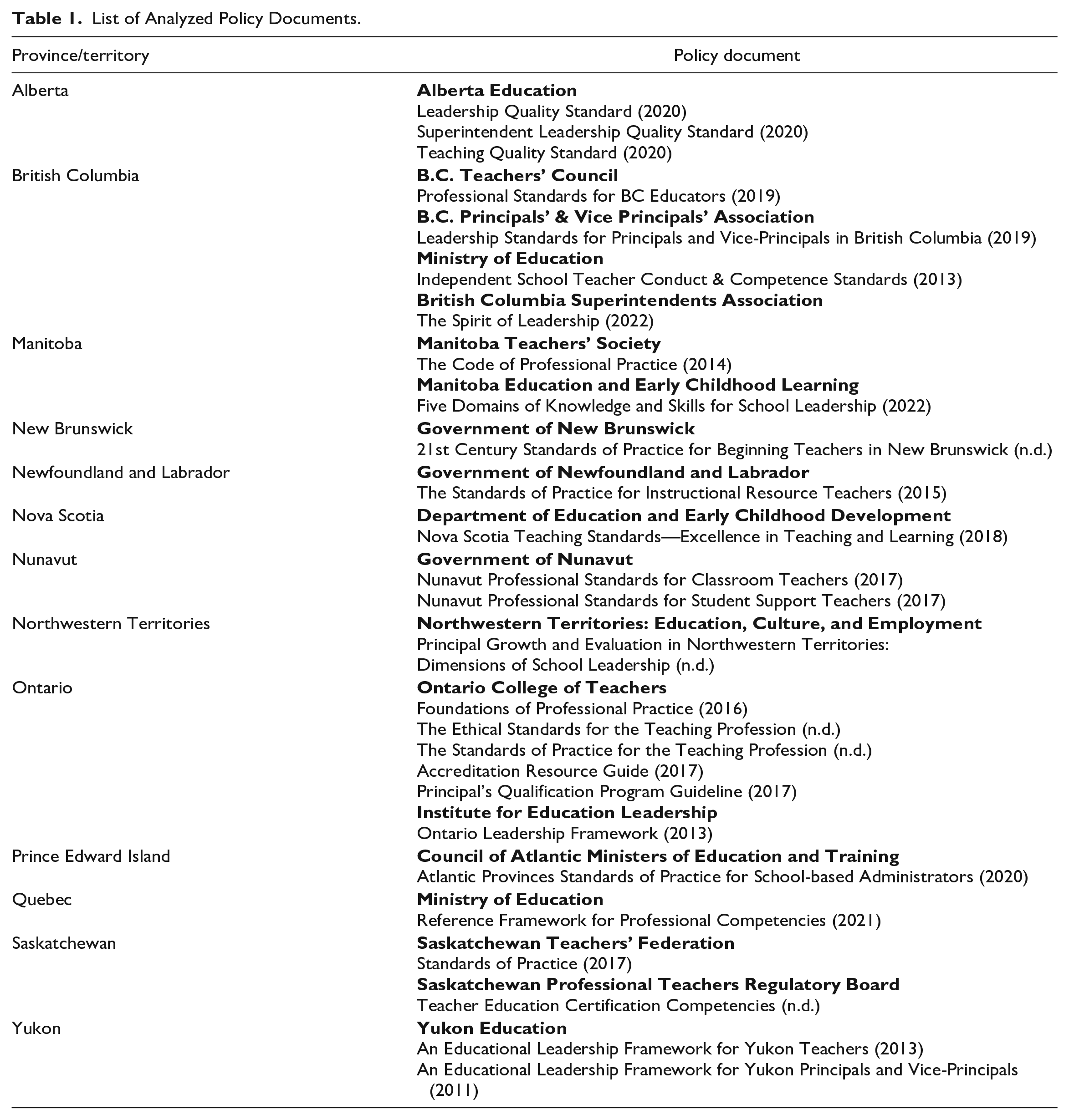
Table 1 provides an overview of 27 policy documents from 13 Canadian provinces and territories selected for the analysis.
List of Analyzed Policy Documents.
I studied policy documents and applied thematic coding with a combination of pre-set and emergent codes (Saldaña, 2021). Pre-set codes were generated with the help of the literature on teacher standards (Ingersoll et al., 1997; Sachs, 2003), parental engagement (Goodall, 2022; Lareau, 2015), and teacher readiness for parental engagement (E. J. de Bruïne et al., 2014; Saltmarsh et al., 2015). Examples of pre-set codes include parental involvement, parental engagement, partnerships, school improvement, teacher standards, leadership standards. During the initial coding, additional codes emerged from the data, for example, valuing diversity, school-centric involvement, engaging indigenous parents, and professional communication. Codes were refined to generate themes, which were used to answer the research questions of this study. For example, first-level descriptive codes creating meaningful opportunities for parents, inviting parents into schools, developing trust were refined into a category “establishing relationships” (second-level coding). Subsequently, the category “establishing relationships,” was combined with two more categories “supporting communication,” and “building partnerships” to form a theme “teacher readiness for parental engagement”.
Findings
Before providing the analysis of policy requirements toward teachers’ readiness for parental engagement, I will present a brief description of the analyzed policy documents, their stated goals, and the actors responsible for their development. For this project, I analyzed 27 policy documents that represent all 13 Canadian provinces and territories and were developed by a range of policy actors. The highest number of policy documents (N=12) was created by teacher councils (e.g., Alberta Education, 2020a, 2020b, 2020c; Ontario College of Teachers, 2017a, 2017b), closely followed by policies developed by ministries or departments of education (N = 8; e.g., Manitoba Education and Early Childhood Learning, 2022; Ministry of Education, 2021). Provincial and territorial governments developed four (N = 4) documents (e.g., Government of Nunavut, 2017a, 2017b), while associations of school leaders were authors of three (N = 3) policies (e.g., British Columbia School Superintendents Association, 2022; Institute for Educational Leadership, 2013). The vast majority of policies under analysis was represented by comprehensive standards that guide teaching (N=10; e.g., Alberta Education, 2020c; B.C. Teachers’ Council, 2019; Government of New Brunswick, n.d.; Government of Nunavut, 2017a, 2017b) and leadership (N=6; e.g., Alberta Education, 2020a; Yukon Education, 2011). Several documents (N=4) were labeled as codes of professional practice and mainly address ethical issues faced by teachers and describe expectations for teachers’ professional behavior (e.g., Ontario College of Teachers, n.d.-b). Three (N=3) policies set out requirements for teacher education programs (e.g., Ministry of Education, 2021) and four (N=4) address leadership frameworks in general (e.g., British Columbia School Superintendents Association, 2022). The representation of parental engagement in the analyzed documents ranges from mentioning parents in passing (Government of New Brunswick, n.d.; Ontario College of Teachers, 2016; Saskatchewan Teachers’ Federation, 2017) to explicit focus on parents and families in standards related to establishing relationships with all stakeholders, students’ learning, communication, and professionalism (B.C. Teachers’ Council, 2019; Department of Education and Early Childhood Development, 2018; Government of Nunavut, 2017a). Several policies have separate standards or competencies with an emphasis on parental engagement (B.C. Teachers’ Council, 2019; Ministry of Education, 2021).
Teacher readiness for parental engagement is conceptualized in three interrelated domains: teacher standards, leadership standards, and teacher education standards. I will talk about standards for teachers, school leaders, and teacher education programs separately.
Teachers
Expectations for teacher readiness for parental engagement are centered around three key themes: establishing relationships, supporting communication, and building partnerships with parents and families.
Teachers are expected to build positive, respectful, and productive relationships with parents to support student learning (Alberta Education, 2020c; Government of Newfoundland and Labrador, 2015), address behavioral challenges, mental health, and special needs concerns (Department of Education and Early Childhood Development, 2018). There is also an emphasis on trust in relationships between teachers and parents, which is understood as fairness, openness, and honesty (Ontario College of Teachers, n.d.-a). Citing the increasingly diverse family structures, social, and cultural changes, Quebec’s Reference Framework for Professional Competencies (Ministry of Education, 2021) acknowledges that “This complex evolution makes it necessary to rethink the relationships between families and schools and between teachers and parents, whose identities, cultures and educational roles are diverse” (p. 5).
An important component of establishing relationships with parents is the engagement of indigenous parents, families, and community members as part of the reconciliation process in Canada (Truth and Reconciliation Commission of Canada, 2015; Wotherspoon & Milne, 2020). As a result of intergenerational trauma caused by residential schools (Bombay et al., 2014), long-standing assimilationist policies (White & Peters, 2009), and persistent educational inequalities (Milne, 2016a), many indigenous parents face additional barriers in Canadian schools due to discrimination and mutual disengagement (Milne, 2016b). Taking this historical and contemporary educational context into account, teacher standards documents in Alberta, British Columbia, Nunavut, Quebec, and Yukon highlight the particular importance of relationships with indigenous parents and families (Alberta Education, 2020c; B.C. Teachers’ Council, 2019; Government of Nunavut, 2017a, 2017b; Ministry of Education, 2021; Yukon Education, 2013).
Alberta’s Teaching Quality Standard (Alberta Education, 2020c) expects teachers to be “inviting First Nations, Métis and Inuit parents/guardians, Elders/knowledge keepers, cultural advisors and local community members into the school and classroom” (p. 3) as part of its Fostering Effective Relationships competence. Nunavut Professional Standards for Classroom Teachers document developed by the Government of Nunavut (2017) has a stronger requirement where teachers have to “develop teaching programs that support equitable and ongoing participation of Inuit students by engaging in collaborative relationships with community representatives and parents/Caregivers” (p. 7) to meet the Know the Nunavut Context standard. Authors of the Educational Leadership Framework for Yukon Teachers (Yukon Education, 2013) encourage teachers to build trusting relationships with First Nations families and communities and invite teachers to ask a question: “How do you build trust with First Nations parents and families so that they feel safe and comfortable coming into the classroom and the school?” (p. 22).
Establishing relationships with parents and families is impossible without communication, and many teacher standards mention effective communication as an important competence (B.C. Teachers’ Council, 2019; Government of New Brunswick, n.d.; Government of Newfoundland and Labrador, 2015). Educators are expected to communicate with parents in a timely fashion (B.C. Teachers’ Council, 2019) and ensure that such communication is respectful, honest, and equitable (Government of New Brunswick, n.d.). Nova Scotia Teaching Standards—Excellence in Teaching and Learning (Department of Education and Early Childhood Development, 2018) is one of the few policy documents providing examples as to the content of communication in its requirement to “regularly communicate students’ progress to parents and guardians” (p. 11). Educational Leadership Framework for Yukon Teachers (Yukon Education, 2013) offers teachers a reflective question to ponder on: “What are some examples of ways that you communicate with parents, families and the community?” (p. 21).
Relationships and communication with parents are combined in building partnerships, which is another prominent area of teacher readiness for parental engagement. It is aligned with a widely popular discourse of “parents as partners” (Antony-Newman, 2019b; Baquedano-López et al., 2013). Alberta’s Teaching Quality Standard (Alberta Education, 2020c) requires teachers to provide “culturally appropriate and meaningful opportunities for students and for parents/guardians, as partners in education, to support student learning” (p. 3). Similarly, The Standards of Practice for Instructional Resource Teachers (Government of Newfoundland and Labrador, 2015) mention “the importance of building collaborative partnerships to enhance student learning” (p. 9), where a teacher “encourages and supports parents/guardians in becoming active participants in the Program Planning Team” (p. 9)
The idea of partnership often assumes a broader meaning that includes not only parents but other educational stakeholders so that teachers need to “build strong partnerships between school and parents, families and community, organizations, community agencies, and businesses to promote student learning and well-being, family support, school improvement and community development” (Yukon Education, 2013, p. 13).
School Leaders
School leaders (principals and vice-principals) are crucial in supporting teachers in their parental engagement efforts by setting the tone for teachers’ parental engagement work and developing and enacting local parental engagement policies (Jeynes, 2018; Pushor & Amendt, 2018). What do leadership standards and requirements across Canadian jurisdictions say about school leaders’ readiness to foster parental engagement in their schools? Similar to teacher standards, leadership standards pay a lot of attention to partnerships and communication with parents (B.C. Principals’ & Vice Principals’ Association, 2019; Council of Atlantic Ministers of Education and Training, 2020; Institute for Education Leadership, 2013), with the goal of “creating opportunities for parents/guardians, as partners in education, to take an active role in their children’s education” (Alberta Education, 2020a, p. 3). Principals and vice-principals are also required to be working with indigenous parents, establishing relationships and developing partnerships with First Nations, Métis, and Inuit parents/guardians, and Elders/knowledge keepers in order to create culturally responsive schools (Alberta Education, 2020a; Yukon Education, 2011).
Unlike teacher standards, school leadership expectations also include “promoting the engagement of parents in school council(s) and facilitating the constructive involvement of school council(s) in school life” (Alberta Education, 2020a, p. 4) and involving parents in decision-making at the school level (Council of Atlantic Ministers of Education and Training, 2020). School leaders are expected to be aware of the latest research in school improvement and the role parents play in this process (Manitoba Education and Early Childhood Learning, 2022). Principals are encouraged to lead “the school in efforts to build a variety of partnerships with parents, community groups and groups outside of the community to enrich school programs and increase student learning” (Northwestern Territories: Education, Culture, and Employment, n.d., p. 16).
Teacher Education Programs
Initial teacher education is a domain where future teachers are first socialized into their profession, but very few documents developed at the provincial and territorial levels address the parental engagement requirements for teacher preparation programs (Ministry of Education, 2021; Ontario College of Teachers, 2017a, 2017b). Ontario’s Accreditation Resource Guide (Ontario College of Teachers, 2017a) was developed “to clarify the intent, through additional information and examples, of the core content that should be included in Ontario teacher education programs” (p. 5). It requires teacher education programs to support teachers in (a) creating and maintaining professional relationships with students, parents, the community, and school staff and (b) developing capacities to work with families and use an “asset-based approach for all students and their families” (Ontario College of Teachers, 2017a, p. 28). Most crucially, in its separate section on parent engagement and communication, the authors of the Guide state that: The inclusion of parent engagement and communication is intended to ensure that candidates recognize the importance of parents and guardians as partners and that candidates develop strategies for working effectively with families to support and facilitate student learning and well-being. The intention is that candidates will develop skills in building respectful, productive relationships and in communicating with parents and families regarding student learning, conduct and development. Candidates will understand and use the diverse strengths and backgrounds of students, families and communities in planning, instruction and assessment (p. 37)
Principal’s Qualification Program Guideline (Ontario College of Teachers, 2017b) sets out the requirements for programs that prepare future principals in Ontario. However, the document only mentions parents and families as a distinct group when describing the need to communicate with families and caregivers and promises to prepare principals to use strategies to foster family engagement without giving much detail. Mostly, families and caregivers are mentioned in passing alongside teachers, students, and community members when discussing the ability of principals to build relationships, establish partnerships, and ensure accountability (Ontario College of Teachers, 2017b).
In Quebec, the Ministry of Education introduced Reference Framework for Professional Competencies for Teachers that both guides teacher education programs and supports continuous professional development of teachers in the province (Ministry of Education, 2021). Competency 10: Co-operate with the family and education partners in the community is explicitly dedicated to parental engagement with the goal to “Promote and encourage parental involvement in their children’s learning and school life, and contribute to sustainable partnerships between the school and its community” (Ministry of Education, 2021, p. 70). The focus of this competency is on communication with families and teachers providing “family with the appropriate means to participate in their children’s learning as well as in school and extracurricular activities” (Ministry of Education, 2021, p. 70). Throughout the rest of the document parents and families are also heavily mentioned in a nuanced way with an emphasis on social and cultural diversity and inclusion of all families in schools: The nature of the family and the educational role played by parents can also vary from one culture to another. For example, in Indigenous communities, it is customary for many people, including Elders, community members and the extended family, to contribute to a child’s education (Ministry of Education, 2021, p. 15).
The document also mentions the changing organization of schools including the greater role of parents and openness to surrounding communities and the importance for teachers to be aware of such changes (Ministry of Education, 2021): Teachers are now expected to take on new responsibilities and demonstrate new competencies with regard to relationships with parents, whose full participation in their children’s schooling is absolutely essential to the latter’s well-being and educational success (Ministry of Education, 2021, p. 15).
Discussion
As seen from the findings, teacher readiness for parental engagement in Canadian provinces and territories is addressed in standards for teachers, school leaders, and teacher education programs to varying degrees. Some policies mention readiness to engage with parents in passing (Government of New Brunswick, n.d.; Ontario College of Teachers, 2016; Saskatchewan Teachers’ Federation, 2017), while others include separate standards or competencies to parental engagement (B.C. Teachers’ Council, 2019; Government of Nunavut, 2017a, 2017b; Ministry of Education, 2021). Prior research shows that teachers often feel unprepared to work with parents (E. de Bruïne et al., 2018; Jones, 2020; Mutton et al., 2018; Patte, 2011; Stelmach et al., 2021; Unal & Unal, 2014). There is an even bigger body of literature that focuses on the multifaceted role of parents in children’s learning, education, and schooling (Goodall, 2018; Jeynes, 2012; Rios-Aguilar et al., 2011) and the complexities in family–school relationships (Antony-Newman, 2019a; Calarco, 2018; Warikoo, 2022). Against this backdrop, we need to ask: How do current policy provisions support teachers’ capacity for parental engagement? What is missing?
As mentioned in the literature review section of the paper, teacher readiness for parental engagement includes an ability to adopt asset-based approach to parents and families (Leo et al., 2019), a clear understanding of differences between parental involvement in schools and parental engagement in learning (Goodall, 2018), awareness of the role of parents and families in the reproduction of social inequality in education (Calarco, 2018), and practical skills in family-centered engagement and democratic family-school partnerships for all students (Baquedano-López et al., 2013).
First, Canadian policymakers and authors of policy documents analyzed for the study made some attempts to focus on the asset-based approach to parental engagement in teacher education standards, competencies, and teacher education requirements. Ontario’s Accreditation Resource Guide (Ontario College of Teachers, 2017a) is the only document that mentions the concept of “asset” in relation to parental engagement when it requires teacher education programs in the province to ensure that teacher candidates have knowledge of the parental engagement and are familiar with teaching in the Ontario context: It is intended to facilitate commitment and capacities to facilitate learning for students with multiple, diverse identities and build on the strengths, interests, and
Other policy documents do not use the concepts of “assets” or “funds of knowledge” (Rios-Aguilar et al., 2011), but acknowledge cultural diversity among students, parents, and families (Ministry of Education, 2021). Teachers are expected to develop teaching practices to “recognize and accommodate diversity within the classroom, the school and the community” (Saskatchewan Teachers’ Federation, 2017, p. 1) and “develop relational trust and skills to work with diverse families and communities to promote effective interaction” (Yukon Education, 2013). A more explicit focus on families’ home cultures is evident in policies, which find space for indigenous parents and families (Alberta Education, 2020c; B.C. Teachers’ Council, 2019; Government of Nunavut, 2017a, 2017b; Ministry of Education, 2021; Yukon Education, 2013). Teachers are expected to value the culture of indigenous peoples (B.C. Teachers’ Council, 2019), build trust with First Nations parents and families (Yukon Education, 2013), involve Elders in students’ education (Government of Nunavut, 2017a), and invite parents of First Nations students into the classroom (Alberta Education, 2020c).
Second, policies do not make a clear distinction between the broader notion of parental engagement in education and learning and more narrow parental involvement in schooling (Goodall, 2018, 2022). The terms are often used interchangeably or in a very general sense, which makes it difficult to distinguish between the family-centered concept of engagement and the school-centered notion of involvement. For example, teachers need to have a competency to “promote and encourage parental involvement in their children’s learning and school life” (Ministry of Education, 2021, p. 70). Only Educational Leadership Framework for Yukon Teachers clearly encourages teachers to “involve families and the community in educational processes with children at home and in the school” (Yukon Education, 2013, p. 21). In other instances, the notion of parental engagement is completely misused to describe a very school-centric agenda, for example, Alberta’s Leadership Quality Standard asks school leaders to encourage “the engagement of parents in school council(s) and facilitating the constructive involvement of school council(s) in school life” (Alberta Education, 2020a, p. 4). Similarly, Educational Leadership Framework for Yukon Principals and Vice-Principals requires school leaders to “engage with students, parents, families, the community and the School Council as partners in developing, and monitoring the School Growth Plan” (Yukon Education, 2011, p. 30). Overall, there is an overreliance on parental involvement in schools (B.C. Teachers’ Council, 2019; Council of Atlantic Ministers of Education and Training, 2020; Government of Nunavut, 2017a) as opposed to broader parental engagement in education and learning, which often take place at home and in the community.
Third, policy documents that address teacher readiness for parental engagement remain silent on the role of families in the reproduction of social inequality in education (Bourdieu, 1986; Calarco, 2018; Lareau, 2015). There is no mentioning that privileged parents have more economic, cultural, and social capital at their disposal (Bourdieu, 1986) that allows them to enhance academic achievement and improve the well-being of their children through such efforts as tutoring (Bray, 2017), extracurricular activities (Brantlinger, 2003), and access to better-funded schools (Yoon et al., 2022). Crucially, White, middle-class, non-immigrant parents follow the normative expectations for parental involvement (volunteering, fundraising, school council participation) and are seen by educators as involved (Stitt & Brooks, 2014), which allows them to receive more support when their children struggle in school (Calarco, 2018; Horvat et al., 2003). Similarly, policy documents ignore systemic barriers and discrimination faced by many minoritized, immigrant, and low-SES parents (Baquedano-López et al., 2013) who are seen as “hard to reach” (Crozier & Davies, 2007) and have additional barriers for parental involvement and engagement (Antony-Newman, 2019a; Hornby & Blackwell, 2018). For teachers who are expected to deliver both excellence and equity in education (Antony-Newman, 2023), the lack of focus on social inequality and its role in parental engagement is a glaring omission.
Finally, what do policies dedicated to teacher standards, competencies, and teacher education requirements say about the practical skills of engaging parents and families in democratic family-school partnerships? In line with prior research on partnerships between parents and schools (Antony-Newman, 2019b; Baquedano-López et al., 2013), the discourse of “parents as partners” is quite evident in teacher standards as well (Department of Education and Early Childhood Development, 2018; Ministry of Education, 2021). There is a stated goal to “build a variety of partnerships with parents, community groups and groups outside of the community to enrich school programs and increase student learning” (Northwestern Territories: Education, Culture, and Employment, n.d., p. 16). Sometimes the partnerships have a clear school-centric goal of school improvement (Yukon Education, 2011), but there is a growing emphasis on the holistic approach to partnerships with a focus on schools, families, and communities: “Teacher leaders build strong partnerships between school and parents, families and community, organizations, community agencies, and businesses to promote student learning and well-being, family support, school improvement and community development” (Yukon Education, 2013, p. 13). Ontario’s Accreditation Resource Guide (Ontario College of Teachers, 2017a) is one of the few policies that provides specific requirements for teachers’ skills in establishing and sustaining partnerships with parents: The inclusion of parent engagement and communication is intended to ensure that candidates recognize the importance of parents and guardians as candidates develop strategies for working effectively with families to support and facilitate student learning and well-being. The intention is that candidates will develop skills in building respectful, productive relationships and in communicating with parents and families regarding student learning, conduct and development. Candidates will understand and use the diverse strengths and backgrounds of students, families and communities in planning, instruction and assessment. (p. 37)
To sum up, Canadian policy requirements for teacher readiness for parental engagement as set out in standards, competencies, and teacher education requirements are making attempts to introduce an asset-based approach to parental engagement and acknowledge the cultural diversity of families, especially when it comes to indigenous parents and guardians (Government of Nunavut, 2017a, 2017b; Ministry of Education, 2021; Ontario College of Teachers, 2017a). There are also some attempts to move toward a holistic approach to partnerships where the interests of schools, families, and communities are intertwined (Yukon Education, 2013). These goals are undermined by a lack of distinction between parental engagement in education and learning (often centered around home and community) and parental involvement in schooling (Goodall, 2018, 2022). Teachers and school leaders have to be aware of such distinctions to ensure equitable parent-school collaboration because parents from dominant groups are traditionally seen as more actively involved in school (Lareau, 2015), while many racialized, immigrant, and low-SES parents feel more confident to be engaged in the home domain (Crozier & Davies, 2007). This leads to the most telling silence in policy requirements for teacher readiness for parental engagement: there is no acknowledgment that parental engagement is not a neutral practice, but is deeply shaped by the parents’ social class, gender, race, and immigration status (Baquedano-López et al., 2013; Stitt & Brooks, 2014).
Conclusion and Implications
In the context of increased emphasis on teachers engaging parents to improve educational achievement and enhance equity (Antony-Newman, 2023), it is crucial that teachers and school leaders are ready for effective and democratic family-school collaboration. Engaging with parents as key educational stakeholders is vital to ensure high-quality quality inclusive and equitable education for all learners (The United Nations Educational, Scientific and Cultural Organization [UNESCO], 2019). The goal of this study was to analyze policy requirements in Canadian jurisdictions aimed at teacher readiness for parental engagement. Such requirements are represented in teacher standards, competencies, and teacher education standards developed in all 13 provinces and territories and are used to establish the knowledge, skills, and dispositions that teachers and school leaders have to possess to engage parents and families. Teachers are required to establish relationships, support communication, and build partnerships with parents and families (Alberta Education, 2020c; Government of Newfoundland and Labrador, 2015; Yukon Education, 2013). School leaders are also expected to involve parents in decision-making through school councils, reach out to a wider local community, where their schools are located, and be aware of the role of parents in school improvement (Manitoba Education and Early Childhood Learning, 2022; Yukon Education, 2011). Despite attempts to acknowledge the cultural diversity of parents and families and the shift toward holistic partnerships between parents, schools, and communities (Yukon Education, 2013), teacher readiness for parental engagement lacks explicit emphasis on the role of social inequality in parental engagement, where the efforts of some parents are valued more than others due to differences in economic, social, and cultural capital (Bourdieu, 1986; Lareau, 2011) and systemic barriers shaped by class, race, and immigration status (Baquedano-López et al., 2013).
To bridge the gap between the current policy requirements for teacher readiness for parental engagement and the need to improve teacher capacity to engage parents in increasingly unequal communities, I suggest the following recommendations. All jurisdictions should develop a comprehensive parental engagement standard that would:
Place parents and families at the center of parental engagement practice;
Explain the difference between parental involvement (in schooling) and parental engagement (in education and learning);
Acknowledge the inequality in parental engagement;
Document the barriers for parental engagement shaped by social class, race, and immigration status;
Offer a set of specific suggestions and tools for teachers to foster democratic family-school collaboration (e.g., Freirean parent and community organizing Baquedano-López et al., 2013), home visits (McNinch, 2022), plurilingual pedagogy (Chen et al., 2022).
Such parental engagement standards could be included with necessary modifications to existing teacher standards, leadership standards, and teacher education requirements. Moreover, the parental engagement standard should be referenced in existing and future parental engagement policies at the provincial/territorial and school board levels that currently do not mention teachers and their role in parental engagement (Antony-Newman, 2019b).
Footnotes
Declaration of Conflicting Interests
The author(s) declared no potential conflicts of interest with respect to the research, authorship, and/or publication of this article.
Funding
The author(s) received no financial support for the research, authorship, and/or publication of this article.
