




Abstract
The article introduces a special issue of Policy Futures in Education on changes and challenges in educational policies and systems of Central and Eastern Europe (CEE). The countries in the region share some characteristics, such as their historical experience with the authoritarian–socialist or communist rule and its impact on education policies, as well as their long-lasting economic semi-peripherality. Differences within the region are also discussed in the article: from macro-level economic gaps to relative dissimilarities of education systems’ structures, as well as international assessment benchmarks. The articles in this issue present analyses of educational policies in Belarus, Croatia, Hungary, Poland, Russia and Ukraine. A theme that emerges most clearly across these texts is the complexity of East–West relationships. Read together, the contributions serve as a call for a more nuanced and contextualized look at CEE. Transformation of educational systems that entails the interplay of past legacies and borrowed policies can bring about troubling outcomes, exacerbated by the entanglement of education in a wider agenda.
The objective of this issue of Policy Futures in Education is to examine recent transformations within the field of education in former socialist countries in Central and Eastern Europe (CEE), almost three decades after the systemic transition. The CEE region’s specificity, marked by the histories of authoritarian state and central-command economy, the impact of neoliberal policies accompanying the transition processes, and the countries’ continuing semi-peripheral or peripheral condition, provide the context for the study of educational dynamics in terms of institutional policies and structural arrangements as well as micro-politics and manifestations of agency among educational actors. We invited our contributors to explore ways in which educational policies and practices are shaped in CEE countries, taking into account national and international challenges and developments, including the processes of internationalization, standardization and competitiveness, socio-economic conditions of systems and those operating within them, as well as other issues that occur as vital to educational researchers studying the region. While these themes have already been explored in Policy Futures in Education in relation to different countries throughout the world, the CEE region has so far attracted relatively little attention in the journal (but see Freeman, 2003; Kwiek, 2008; Luka and Sungsri, 2016; Peshkopia, 2014; Pupala et. al, 2016). This issue therefore aims at bringing the region more into the focus of the journal’s readers. In this opening article, we present some basic aspects of how CEE countries can be viewed comparatively in relation to the issue’s main theme and discuss certain common ideas that appear across contributions.
The year 1989, before and after
In the historiography of the former socialist or communist states of Europe, the period of the late 1980s and early 1990s is commonly identified as a turning point. While the overall significance of such a view remains reasonable, it is necessary to note that the post-1945/1948 era (and even post-1917 in Russia) should not be seen as some monolithic ‘age of communism’ but as a historical period spanning several generations, with changing international and national power dynamics, ideological tensions, or even rifts between official ideology and actual policies, as well as a contextualized range of social attitudes towards regimes. In other words, ‘communism’ meant not only a variety of approaches to state rule and economic policy across countries, but also changing power arrangements and social relations within particular states and societies.
1
Moreover, as a variant of modernization-oriented politics, communism or state socialism never existed in complete isolation from ‘the West’, but should rather be seen as ‘a complex historical process of mirroring, adoption and translation’ (Mincu, 2016: 332). The popularity of mass culture (especially music and film) and the presence of consumerist aspirations, enhanced by occasional contacts with the ‘capitalist world’ (most notably through family members living abroad), were part of this – typically imitative and often merely imaginary – connection.
2
While the outright rejection of ‘imperialist’ influence prevailed on the official level, it had declined since the end of the Stalinist period in the late 1950s, and, from as early as the 1970s onwards, a number of policies reflected Western inspirations, including those in education: most notably the tendency towards relative school autonomy in Hungary, culminating in the 1985 Education Act.
3
In her comparative study of Hungary, Poland and Romania, Mincu (2016: 329, 332–333) argues that although historical research typically points to the persistence of a Communist paradigm until 1989, and in late 1980s there were more similarities than differences in educational structures of those countries, still differences between countries became increasingly significant, as a result of long-standing legacies and the relationship of each education system with its economic and political context. Some Communist regimes allowed more innovation and knowledge circulation through increased contacts with Western Europe and the non-Communist world. … [T]he Soviet influence in education should be conceptualised both as an imperialist force and as a voluntary borrowing, followed by internationalisation with local adaptation in the Communist area. Nevertheless, as a result of transmission and translation processes, Communist education cannot be conceived of as a coherent model. Soviet education itself was transformed over time and incorporated Western and elitist elements.
The notion of post-socialist/post-communist ‘transition’ or ‘transformation’ rests on two primary features: formal political democratization (or retreat from the party-state bureaucratic dictatorship) and economic marketization (or the restoration of capitalism). Educational changes should then be seen as an effect, and part, of those systemic shifts, not merely having paralleled reforms in other fields, but also having been motivated by them (Cerych, 1995). They were a dimension of broader socio-cultural transformations that, on the one hand, had been triggered by the dynamics of political and economic rearrangements, and, on the other hand, manifested themselves already at different stages of the ‘real socialism’ and varied between countries. In this context, seen from a systemic perspective, the sphere of education can be perceived simultaneously as an object and as a vehicle of change: a field to be adjusted to fit post-transition realities (requirements of neoliberal policies, dynamics of public sphere, integration with European Union (EU) structures, etc.) as well as a promoter of societies’ readiness for their self-conversion: casting off the ‘old’ and taking up ‘new’ assumptions of what is proper, rational, and desirable in the collective, individual, public, and private lives of a country’s population. 4 While these systemic transformations have been pursued largely by national policy makers under the banners of educational reforms, and through national and local institutional settings, the impact of international developments should not be overlooked (e.g. Morgan and Volante, 2016). At the same time, activity of various educational actors (with organized teachers’ voices being especially prominent) in formulating critiques, constructing forms of resistance and proposing alternative ways of making education functional, nationally and locally sensitive, and empowering for the coming generations, deserve as much attention.
As in other sectors, also within education, the reforms were framed as modernization efforts, and entailed implementation, or perhaps rather imitation, of some variants of educational policy models developed originally in the West. The notion of imitation refers to borrowing or transplanting not merely general principles and ideas, but also particular solutions and institutional design from the systems of the West. Due to their perceived higher standards, the latter are looked to as trend setters who can salvage the lagging-behind societies (cf. Silova, 2012). However, critically analyzed, the borrowing appears to be motivated by a particular set of political and economic reasons originating in the local context, rather than by proven efficiency or value of policies, solutions, or ideas (Steiner-Khamsi, 2012). Furthermore, focusing on dominant paradigms creates the risk of overlooking alternatives (Silova, 2012). A specific example of this phenomenon can be found in Poland, where the increasingly popular free schools tend to identify with, and draw inspiration from, the international democratic education movement, rather than linking up with earlier local democratic developments (Uryga and Wiatr, 2015).
CEE countries in comparison: a very brief overview
The very definition of which countries count as CEE is not an unambiguous one. While geography does not necessarily overlap with (geo)politics, our intension was to invite contributions on educational policies in countries that share historical patterns of authoritarian rule as a variant of communism or party-state socialism and the transition out to some form of democratic government and capitalist economy. For this purpose, we adopted a broad understanding of the region as composed of the former socialist states, most of which are today members of the Council of Europe. 5 Differences within the region, however, should not be overlooked: divergent transition paths from the 1980s onwards, varying macroeconomic standing, different conditions of democratic systems, not to mention longue durée historical trajectories, both as specific national or regional experiences and as part of the larger dynamics of the modern world-system. While ‘cultural patterns’ may seem at times overestimated as explanatory factors, they too should be kept in mind as dynamic (changing and changeable) manifestations of differences, and, to some degree, commonalities resulting from entanglements of the past and present, of historical determinants and today’s aspirations in societies and among policy makers.
The entire region barely shares common macroeconomic traits. Eleven countries are members of the EU, and seven of them belong to the Organisation for Economic Co-operation and Development (OECD). This institutional affiliation of some with the ‘most developed’ economies is reflected in indicators such as gross domestic product (GDP) per capita: in 2016, the measure for Moldova (ca. 5300) 6 was about 16% of the leading Czech Republic (ca. 33,200), and Ukraine’s (ca. 8300) was just about one-fourth of the Czech index. Among the EU members representing the region, lowest-scoring Bulgaria (ca. 20,300) had the same measure reaching 61% of the Czech Republic, still less than the region’s mean (ca. 22,500). However, the region overall falls behind the OECD average, and this is true even of the best-performing CEE economies, which fall below top twenty among the 35 OECD members. For example, the Czech GDP per capita reached 78% of the OECD mean and 80% of its median, and less than half of Norway’s measure. Poland’s GDP per capita does not exceed the 40% of Ireland’s and reaches just below 58% of neighboring Germany. Similarly, Hungary’s indicator is about 57% of neighboring Austria’s (calculations based on International Monetary Fund 2017). Given these income measures and the CEE states structural positioning within the global economy (relative dependence in exchange, lower-wage competition, and ‘sub-contracting’ model of production combined with growth dynamics and expansion into less-developed zones) along with their international capacity (with the exception of Russia, as non-key players), even the best-performing of them still seem to fall under the category of semi-periphery rather than ‘core’ or highly-developed countries. 7
Despite the semi-peripheral status shared by the CEE states, deriving common patterns in their educational systems and policies would be a difficult and risky task. Comparison of the major features in structures of national education systems within Europe itself reveals significant differences between CEE countries. According to a recent report covering 43 systems in 38 states (European Commission/EACEA/Eurydice, 2017a, 2017b), the CEE systems, like those of other regions and countries, differ with regard to such basic characteristics as age and level range of compulsory education, the initial age of elementary schooling, or models and paths in secondary education. For some general comparative information see Table 1. It seems clear that no single trait sets the region apart, and groups of CEE States share structural commonalities with other systems, for example, single-structure organization, combining levels 1 and 2 of the International Standard Classification of Education (ISCED), is typical of systems in the Balkans and Estonia, and those of Nordic countries; the common core curriculum of level 2 appears in most of Western and Southern Europe on the one hand, and Latvia, Romania and the four ‘Visegrád Group’ states on the other; Lithuania, in turn, shares features of differentiated level 2 with Germanic states (cf. European Commission/EACEA/Eurydice, 2017b: 5). In the overwhelming majority of the systems, elementary education (level 1 of the ISCED) begins at the age of 6 years or earlier. Eight cases stand out, where elementary schooling age is 7 years, and most of them, interestingly, are the CEE countries (Bulgaria, Croatia, Estonia, Latvia, Lithuania, and Poland). The Polish case might be worth mentioning in this context as the debate around school age – namely, whether mandatory admission of 6-year-olds as first-graders, introduced by the previous government in 2014, should remain in place – was among issues that both triggered, and provided rationales for, the current restructuring of the schooling system, as well as stirring one of the most vibrant waves of parental activism in the past decades (Korolczuk, 2017).
Age in compulsory education and entry age for schooling in Europe, 2017/18 school year.
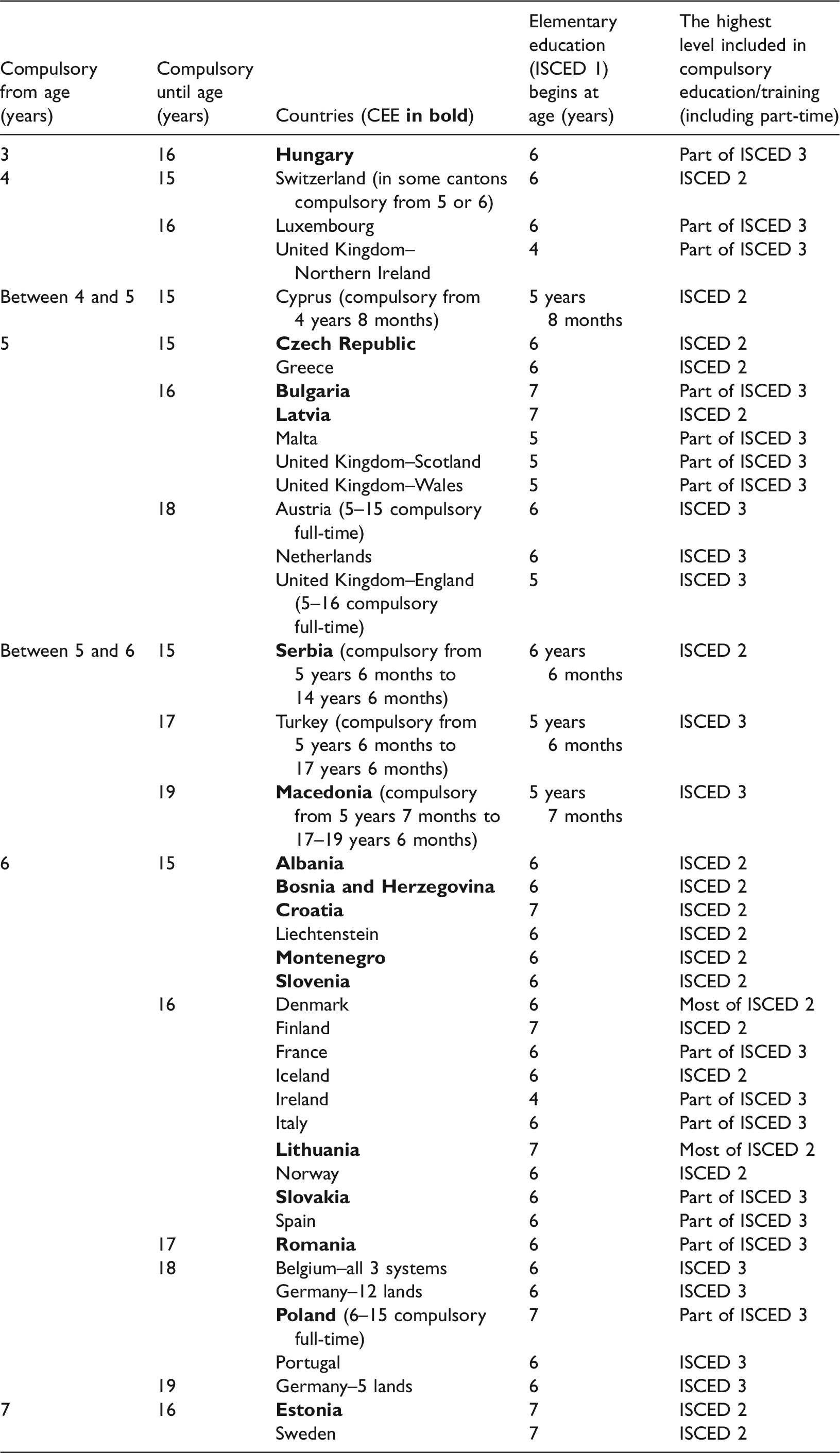
Source: Based on European Commission/EACEA/Eurydice, 2017a; 2017b.
The CEE countries stand out, however, in terms of the economics of education, a tendency that clearly reflects more general macroeconomic disparities highlighted above. Some indicators illustrate this observation. In 2014, annual expenditure by educational institutions per student throughout the region was lower than the OECD average, with the notable exception of Slovenia’s spending on elementary education being actually higher (107% of the OECD average). In other states, national expenditures in elementary education relative to the OECD average ranged from as low as 43% for Hungary to 80% for Poland. On the secondary level (overall), these proportions fell as low as around 50% in the Russian Federation and Lithuania (actually, non-OECD members) and reached as high as 81% and 87% in the Czech Republic and Slovenia, respectively. Expenditure per student in tertiary education ranged from Hungary’s and Russia’s 54% of the OECD average to Estonia’s 76% and Slovenia’s 75%. As a percentage GDP, these expenditures in all CEE countries fell below the OECD average of 5.2%, with Estonia reaching 5.0% and Russia as low as 3.3%. Estonia (1.9%) and Lithuania (1.7%) were exceptional across the region in exceeding the OECD average (1.4%) spending on tertiary education as percentage of GDP. Unlike most other top spenders, Estonia has an overwhelmingly high share of public expenditure on tertiary education (cf. OECD 2017: 168, 177, 180, 183, 187; Figures B1.1., B2.1., B2.2.; Tables B1.1. and B.2.1.).
One striking aspect of the CEE countries’ educational economics concerns teachers’ salaries. In terms of salary cost of teachers per student in public institutions, almost all countries of the region fell below the OECD average in 2015. In elementary education, national proportions relative to OECD average (US$2848 at purchasing power parity (PPP)) were as low as 26% in Latvia (US$753) and as high as 85% in Slovenia (US$2450). Slovenia was again unique in reaching above the OECD average (US$3514) in secondary education (US$4592 PPP or 130% of the average), while Latvia’s cost (US$1,136) was slightly less than one-third of the average (cf. OECD 2017: 244, Table B7.1.). Notably, it was salary that had the largest impact on the salary cost of teachers per student in elementary and secondary education in all but one of seven CEE countries. And, not surprisingly, the impact was negative, that is, relatively low salaries actually decreased costs in the Czech Republic, Estonia, Hungary, Latvia, Poland, and Slovakia. At the same time, in Slovenia, the teaching time factor had the largest impact on increasing the salary cost of teacher per student in elementary education, and estimated class size had similar positive impact in lower secondary education (OECD 2017: 240, Table B7.a.). In terms of teachers’ salaries, as a comparison for lower secondary education in 2015 shows (OECD 2017: 365, Fig. D3.2.), CEE educational systems fall visibly below the OECD average, and this is true for both the starting salary (minimum qualifications) and top of scale (maximum qualifications). The overall relatively poor condition of teachers in CEE states remains in place despite significant salary increases in recent years in some countries, most notably Hungary and the Slovak Republic (and to a lesser extent Poland), unlike in many countries that had undergone cuts following the 2008 crisis (cf. OECD 2017: 369, Fig. D3.4.). For comparison on starting salaries relative to the OECD average, see Table 2 below.
Teachers’ starting salaries (2015).
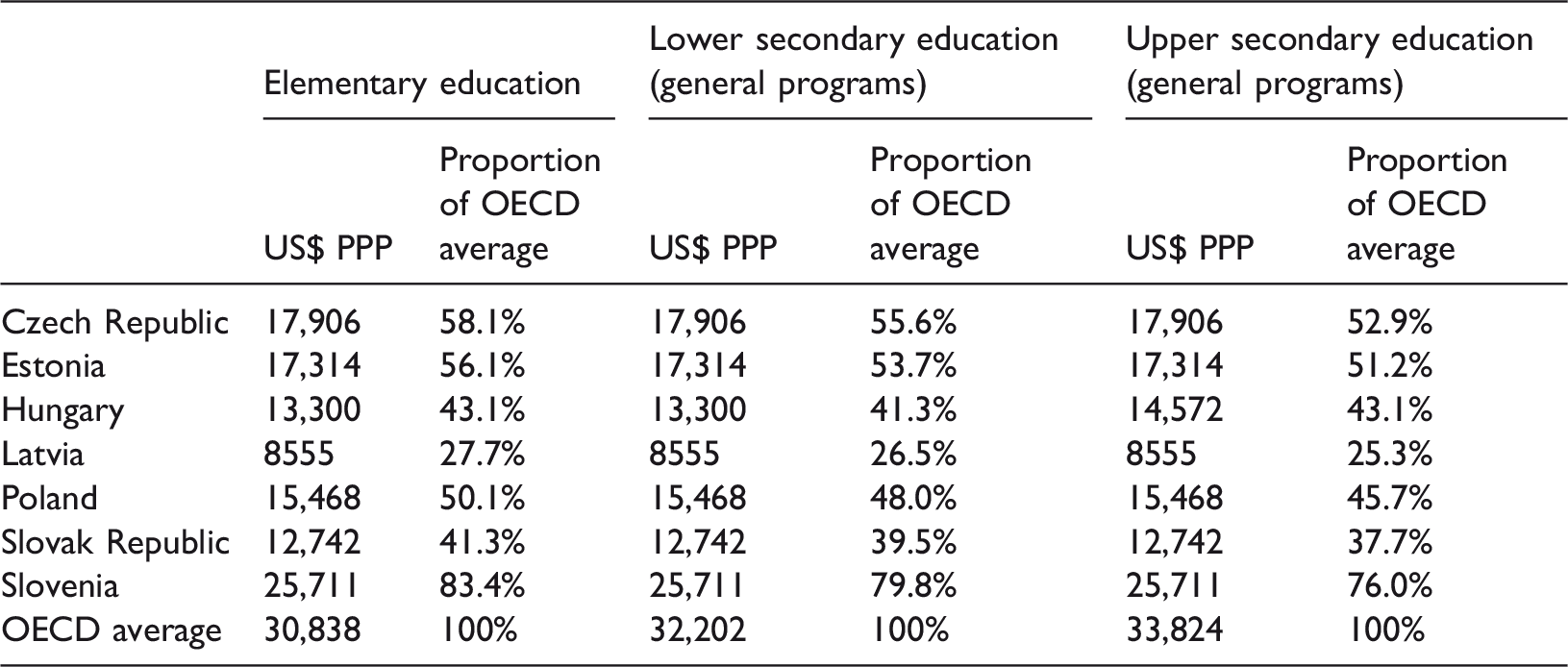
Source: OECD 2017: 374. PPP: Purchasing power parity; OECD: Organisation for Economic Co-operation and Development.
Given the relatively disadvantaged economic standing of the CEE states, there seems, however, to be no general or easy-to-interpret pattern characterizing them when it comes to educational benchmarks in cross-country comparisons. It must be noted here that such measures – in particular, the test-based OECD’s Program for International Student Assessment (PISA) along with educational structural adjustment strategies such as the Bologna Process and the European Qualifications Framework – received criticism for lacking democratic legitimization and pushing towards a model ‘which reduces education to a capitalist utilitarian logic in the strict sense’ (Liesner, 2012: 300). Given the common view of the PISA as a reference data source for comparative educational analyses, it might be interesting, however, to point to some features of its results with regard to our main topic. In 2015, the PISA included 18 states of the former Soviet Bloc and Yugoslavia.
8
Among them, 12 (including 2 OECD members) scored less favorably in all or most basic indicators than OECD average. Three states demonstrated average-to-low scores, with Russia and Latvia having significantly smaller proportions of low achievers in all three subjects (science, reading, and mathematics) than the OECD average. Only Poland, Slovenia, and Estonia scored significantly more favorably in most or all indicators, with Estonia being among the top 10 educational systems in terms of performance and demonstrating high level of equity (see: OECD 2016a: 4–5). While the ‘lagging-behind’ hypothesis might come to mind, linking the distribution of scores in the program with the more general pattern of development gaps (such as ‘West’ vs. ‘East’), one should note that among the relatively poorly performing students (below OECD average) were those from significantly wealthier economies and, supposedly, better-off educational systems, such as Luxemburg or Iceland. Some other Western states, such as the USA, Austria, France, and Sweden scored somewhat lower overall than the three top CEE countries. The OECD study explores this aspect, and the authors confirm, on the one hand, that: A first glance at PISA results gives the impression that students in high-income countries and economies – and countries/economies that can and do spend more on education – perform better. … On average, students in high-income countries and economies score 79 points higher in science than students in countries whose per capita is below the USD 20 000 benchmark (OECD 2016b: 42).
9
While the definition of ‘high income’ as per capita GDP exceeding US$20,000, given our earlier observation, seems somewhat too broad and arbitrary – lumping together some CEE countries with much wealthier economies – the study acknowledges that the strong positive association between expenditure on education and PISA science scores ‘is not the case among high-income countries and economies, which include most OECD countries. … Among these countries and economies, it is common to find some with substantially different levels of spending per student yet similar science scores’ (OECD 2016b: 42). The study provides examples of Poland and Denmark – the latter having its cumulative spending per student more than 50% higher than the former – as two countries whose students scored ‘501 and 502 points in science respectively.’ The study concludes: ‘Whatever the reason for the lack of a relationship between spending per student and learning outcomes … excellence in education requires more than money’ (OECD 2016b: 42). As for teachers’ salaries (relative to per capita national income), there was no statistical significance of the relationship between them and science performance ‘across PISA participating countries and economies’ (OECD 2016b: 195–196, Fig. II.6.7). While interesting in comparative terms, such results may lead to possibly false conclusions that as long as scores are high there is a reason to be satisfied with how the particular educational system functions – a view that, for instance, helps keeping the question of teachers’ salaries off the center of public debate on schooling. 10 And their vague status as international – and, indeed, national – tools of governance resulting from a ‘peer pressure’ among states rather than a top-down regulations (Liesner, 2012; Volante and Ritzen, 2016) begs further, both broader and more specific, questions on policy-borrowing, imitation and the instrumentalization of education in an attempt to modernize as much as to create an illusion of fitting a regime presented as neutral and inevitable.
Major themes in this issue
The contributions collected in this thematic issue present case studies of various aspects of educational policy and practice from six countries of the region: Belarus, Croatia, Hungary Poland, Russia, and Ukraine. Read together, they serve as a call for a more nuanced look at CEE that would take into account the complexities and diversity of the region, including its educational policies. As they demonstrate, different models that have been developed in specific countries should be identified, instead of promoting a unified view of the region. Simultaneously, however, the contributions reveal striking similarities between the different states that result both from their common legacy of the socialist past and the exposure to Western ideologies.
A theme that emerges most clearly from the articles is the complexity of the inevitable relationships between the East and the West following the systemic changes the countries of the region underwent in the 1990s. Several contributions challenge some of the popular beliefs we have discussed above: from the assumption that there exists a clear-cut West–East distinction, to the perception of the power dynamics between the East and the West, where the former is supposed to imitate the latter in the attempt to catch up with a supposedly more developed system, to the presumed homogeneity of the West (and of neoliberalism as its trait) as well. In her contribution delineating the development of Russian quality assurance and evaluation (QAE) policy, Galina Gurova warns against the dichotomous perception of ‘neoliberal’ and ‘socialist’ practices. She argues that both socialism and neoliberalism are complex and incoherent phenomena, and specific mechanisms of QAE cannot always be unambiguously attributed to either of them. While pointing to the role of transnational bodies, such as the World Bank or the OECD, in shaping current QAE policy in Russia, she makes it clear that the legacy of the socialist past is just as important. She observes, for instance, that: the economically-driven call for the applicability of knowledge does not appear only in market economies, but was also in place during the Soviet time, and that holding teachers accountable for the poor performance of their pupils while ignoring the socio-economic context is an understanding that can be found in very different political systems.
The past cannot be simply left behind following the transformation to a new political system, and the old and the new intertwine to produce sometimes incoherent entities. A similar conclusion can be drawn from Piotr Zamojski’s contribution, in which he develops a theoretical framework based on the notion of cultural codes to help understand typical educational phenomena in Poland, and demonstrates how historical legacies constantly shape current practices. For instance, centralization and unification tendencies, which Zamojski identifies with the real socialism period, are still present at the policy level and in everyday teaching practice decades after the systemic transformation.
The issue of the complexity of the transformation of educational systems is taken up in Tatiana Shchurko’s analysis of the development of gender education in Belarus. As she demonstrates, it has happened through the interplay of a set of factors, including complex legacies of the past, influences of external bodies (often international agencies with their own vested interests), and local actors at different levels, also having their own agendas. What she argues for Belarus, when claiming that its system of education is ‘a conglomerate of Soviet politics, neoliberal ideology, international institutions, authoritarian power, and national ideology,’ could as well be applicable to other countries in the region.
The transformation of educational systems that entails the interplay of past legacies and borrowed policies can bring about troubling outcomes, exacerbated by the entanglement of education in a wider agenda. The articles collected in this issue provide ample evidence on this. Ivana Cosic examines the ramifications of the introduction of standardized testing at key points of educational careers in Croatia, taking as an example state matura exams that replaced previous school-based examinations. Meant as a universal measure of upper-secondary school attainment at the exit point, it created, however, unequal conditions due to varying curricula between grammar and vocational schools. As the author argues, curricula in different types of secondary schools ‘celebrate the diversity of talent, whilst the matura test concentrates on one set of learning outcomes. … [O]n the surface the matura provides clinical and neutral test settings but the examination itself can be interpreted as unfair.’ Similarly, Tamás Tóth, György Mészáros, and András Marton, drawing on the world-systems theory and post-colonial perspectives to examine transformation processes in Hungary, trace the creation of an educational system characterized by vast vertical and horizontal selectivity and segregation. As they demonstrate through an analysis of teachers’ protests in Hungary, the legacy of the socialist past, combined with the impact of neoliberal ideology, serve as a force that effectively stifles bottom-up attempts to introduce real changes, or at least oppose detrimental reforms. In her contribution, Shchurko reveals another unintended consequence of entwining borrowed policies and ideologies and local circumstances. Through the discourse analysis of policy documents and textbooks in gender education, she shows how egalitarian and potentially subversive ideas of gender equality can be used to support traditional gender ideology, seen as constitutive of national identity. For instance, she notices how the emphasis on national security understood in demographic terms and linked with an ideal of a strong, traditional family, finds its reflection in gender education textbooks in Belarus, which set to prepare students for their future roles in traditional Slavic families. Finally, Gurova documents how the processes of imitation rather than implementation of Western QAE instruments increase bureaucracy in education without having an unquestionably positive impact on schooling practices.
The contributions serve as a reminder of a need for a more contextualized exploration of the education sector in CEE countries. The article by Abel Polese et al., problematizing the phenomenon of corruption in education in Ukraine, is a telling example here. The authors look for alternative interpretations of this practice, arguing for considering it in terms of informality, rather than corruption, as well as for placing it in a broader context of systemic failures (when the state does not perform its functions as required) and the social perception of qualifications (the presumed need for a university diploma to be competitive on the labor market). Ivana Cosic, in turn, building on previous research on borrowed policies, demonstrates that matura examinations serve a different purpose than standardized tests in the West, as well as that the phenomenon of cheating, which did not vanish with the introduction of high-stakes examinations, should be analyzed in a more nuanced manner than merely as an emanation of postsocialist mentality. By situating cheating in the context of learning theories, and drawing on Sen’s notion of transcendental and comparative justice, she contributes to efforts aimed at decolonizing knowledge production about the CEE region.
Finally, Karin Taylor and Caroline Hornstein-Tomić remind us that not only policies, but also people, travel. In their contribution, they look at the ramifications of young Croats’ migration and the resultant brain drain. They shed light on the entanglement of educational policies within wider societal processes, related to ideological divisions grounded in remnants of the past (identification of the left with socialism and Yugoslavism), labor market demands, and the influence of international bodies (both international testing programs and organizations such as the EU or the World Bank). Their contribution provokes fundamental questions concerning the role of education, as the results of the authors’ analysis of public discourse on education in Croatia reveal the significance attached to increasing the employability of graduates as a potential solution against further brain drain.
All these contributions provide insights into a number of questions that can be analyzed within historical-systemic frameworks positioning the CEE region as both specific and internally diverse. These questions are also the subject of political and civil-society debates in particular countries and their national contexts, and should therefore be carefully taken into account as to avoid unnecessary generalizations. Still, the studies presented in this issue may prove useful for a broader international comparative education perspective. By addressing problems present in other national contexts or related to the international dynamics of economy and governance, the authors contribute to a better understanding of contemporary policy design and educational concerns way beyond regional boundaries.
Footnotes
Declaration of conflicting interests
The author(s) declared no potential conflicts of interest with respect to the research, authorship, and/or publication of this article.
Funding
The author(s) received no financial support for the research, authorship, and/or publication of this article.