




Abstract
This article critiques the way the topic of meat and its consumption is addressed in geography education within the remit of education for sustainable development (ESD). We argue that current approaches perpetuate normative food discourse by: (a) framing participation in the food system solely in terms of consumption; (b) simplifying and moralizing food systems as ‘good’ or ‘bad’; and (c) largely omitting animals from a discussion of meat and agriculture. As a result, students learn that their role is to consume ‘good’ not ‘bad’ meat, but are ill-equipped to analyse the political–economic, cultural and affective dimensions of food. Meat and consumption topics, although rarely addressed, fall under the broader pedagogy of ESD. Although emancipatory approaches to ESD explore contradictions inherent in and personal aspects of sustainability, ESD in practice often leads to binary schemata of ‘right’ and ‘wrong’. Based on our qualitative review of geography curricula in Austria and Germany (Lower Saxony and Bremen), we find that they neglect meat production and consumption, but that these subjects can be addressed within broader topics about sustainability and agricultural land use. Interviews with secondary school teachers and students indicate that ESD ignores the interpersonal, relational and more-than-human elements of food systems. However, we show that students still rank animal welfare as an important component of sustainability. This indicates that they are influenced by education beyond institutional settings and, furthermore, highlights opportunities for making students aware of the visceral (dis)connections they make between taste and political economy. Finally, we suggest future directions for ESD in order that these links can be explored, probing students to develop their own ethics of the gut.
Introduction
This article has emerged from a discussion between two colleagues, one interested in education for sustainable development (ESD), the other in visceral geographies of food. Broadly, we asked how geography education has (and has not) put into practice moves towards the ‘corporeal’ and the ‘ethical’. Although some say geography education does not need to follow the ‘whims’ of the discipline, we argue that school geography should be ‘aware of contemporary thought in the discipline’ (Lambert and Morgan, 2010: xi). In reviewing geography curricula of German and Austrian secondary schools, along with qualitative data from students and teachers, this article questions how successfully education about meat and sustainability moves beyond simplistic moralizing. Instead of bombarding students with ‘right’ and ‘wrong’, how can they be prompted to critically reflect on their experiences, to feel their lives as inextricably linked with other bodies in the food system? Furthermore, we ask, how would a visceral, embodied education with regard to meat be different, and how might this be possible?
In the last two decades, the field of human geography has turned its attention to the body, in what can be called the ‘corporeal turn’. Influenced by other social sciences fields, notably feminist scholarship (see Longhurst, 1997), taking the body seriously directs our attention to the presumed separation between mind and body and between logic and emotion. As a result, geographers have begun to study the multiple ways in which rationality and emotion, and the personal and the political, become intertwined and imprinted on the body through daily experiences. The corporeal turn has had wide-reaching effects, but its impact on food studies has been particularly significant. Why food? Food as a material substance, imbued with cultural meaning, and metabolically working with/on the body, crosses borders between disciplinary sub-fields. Furthermore, the study of food has become central to geographical questions of health, sustainability and the environment (Goodman, 2016), and a corporeal approach to food asks how these ‘big’ questions are related to our embodied experiences. Bringing bodies into food has come about through ‘visceral’ geography or geographies of ‘food and feeling’ (Hayes-Conroy and Hayes-Conroy, 2013). A visceral geography of food pays attention to ‘the sensations, moods, and ways of being that emerge from our sensory engagement with the material and discursive environments in which we live’ (Longhurst et al., 2009: 334).
Visceral geography emerges from research on emotion and affect in geography. Emotion is often associated with subjective and individually recognized feelings, whereas affect implies trans-subjective precognitive moods or feelings, arising from interactions between various human and nonhuman bodies (Schurr and Strüver, 2016). Although the differences between emotion and affect are widely debated amongst geographers (see Ahmed, 2004; Thien, 2005; Tolia-Kelly, 2006), what is relevant here is their shared orientation towards ‘attuning to dimensions of life and living in the wake of a break with an emphasis on “signifying systems”’ (Anderson, 2013: 458, cited in Schurr and Strüver, 2016: 90). Instead of relying on systems of representation, rational knowledge and established paradigms, visceral geography emphasizes a dynamic connectivity between human and nonhuman bodies in relation to one another, and in relation to their socio-spatial context (Hayes-Conroy and Martin, 2010). In terms of food, the individual choice model for ethical decision-making falls away in favour of a hybridized ‘foodsensing’ (Evans and Miele, 2012). ‘Foodsensing’ highlights ‘the importance of embodiment and performativity in shaping and articulating both food experiences and food knowledges’, fusing together the rational and bodily ways of making sense of food (Evans and Miele, 2012: 311). A visceral ethics of food is part of the complicated and interconnected world in which the importance of balancing the political economy of food production at one end of the scale with the actual taste of food at the other is paramount.
Thus, what visceral geography promises is an ethics, but there is still no answer to the question as to how such an ethics can be cultivated. This remains a critique of visceral geographies, that they contribute little to the praxis of how to develop an ethics of the gut (Goodman, 2016). Although some critical geographers suggest visceral methods can lead to transformative ethics (Hayes-Conroy, 2017; Sexton et al., 2017), there has been little research as to how this can be accomplished. In this article, we address this gap by examining how or to what degree an ethical model of the ‘visceral’ can be put into practice in the setting of secondary school classrooms. Furthermore, we propose implementing posthumanist interventions (Pedersen, 2010a) such as affective relationships between human and nonhuman ‘others’ that destabilize purely anthropocentric notions of the food system. We argue that bringing these elements to ESD can counter the binary framing of ‘right’ versus ‘wrong’ notions of eating animals.
The ethical turn in geography was linked with a broader counter-cultural movement of the 1960s and 1970s. The outcome was nothing short of a wholesale revision of social norms and values and of the nature and role of education (Standish, 2009). The counter-cultural movement expressed itself in forms such as anti-capitalism, anti-establishment or anti-war. The ethical turn gave rise to social constructivist theories of knowledge, which argued that knowledge is rooted in social context, and relocated social change to individuals. In 1988, Fien and Gerber published a text, Teaching Geography for a Better World, that influenced geography education across the English-speaking world. In German-speaking countries, Geography’s ethical turn has been put into practice, but was less discussed and reflected in scientific works (see Uhlenwinkel, 2006). Kross (1991) advocated a geography education that no longer imparted only knowledge, but guided students to ‘emotional participation’ and to ‘appropriate action’ (Kross, 1991: 44). The ethical turn undermined the notion that teachers should be neutral in their approach. Thus, the ‘act of teaching has been recast as a political act’ (Standish, 2009: 39). This ‘transformative geography’ encouraged students to practise the discipline ‘for the well-being of people and the environment’ (Kirman, 2003: 93), which is intrinsically not undesirable. However, although it emphasizes personal transformation and participation, the new ethical geography also hinders students from developing their own moral compass; it approaches morality by giving it a universal quality (Standish, 2009). Thus, teaching for a ‘good cause’ often fails to engage students in an interrogation of global problems because solutions are presented as unquestionable truths. As a consequence, geography textbooks provide ‘merely simplified explanations, introduce a one-dimensional perspective, and tend to moralize’ (Kowasch, 2017: 73).
Within the context of ESD, teachers are encouraged to address lifestyle, consumption and sustainability topics with students, and aim to bridge the gap between conceptual topics and students’ everyday experience and to foster critical thinking and reflection. What better way to reach these goals than using the case study of meat, a complex topic that squarely confronts students in their daily lives? Relevant to issues of sustainability, meat consumption through the lens of geographies of food and feeling requires an examination of how the political–economic and the sensuous become entangled. How and what type of meat comes to taste ‘good’ or ‘bad’ when considering issues such as animal welfare or deforestation? We acknowledge that responsibility for the food system cannot and should not fall on the consumer individually (Abbots and Lavis, 2013: 2); instead, we are interested in how pedagogies of meat can form relationships between social and individual bodies in nonmoralizing ways.
In this article, we examine ESD in German and Austrian geography curricula for secondary schools through the lens of meat and sustainability. Our goal is to assess the degree to which ESD addresses meat (or not) in its curricula, and if it goes beyond moralizing towards a more relational, visceral approach. In addition to critiquing the curricula themselves, we ask students and teachers how they understand the links between meat and sustainability, seeking insight with regard to being able to formalize embodied approaches to meat and sustainability in ESD. We combine these results with the results from interviews with local farmers from educational farms to offer recommendations as to how ESD can use meat as a starting point for cultivating an ethics of the gut. In short, we tackle the questions of how pedagogies of meat and sustainability are being taught and what new approaches could contribute to this teaching.
Below, we provide an overview of ESD in Germany and Austria, as well as the importance (and challenges) of food pedagogies that include meat.
ESD and ‘mis-education’
The concept of sustainable development was introduced into formal education in the 1990s. Bagoly-Simó (2013: 57) notes that the United Nations Decade for Education for Sustainable Development, which was declared for the time period 2005–2014, stressed the significance of all forms of education in teaching and learning for a more sustainable future. The follow-up programme of the United Nations, the Global Actions Programme (GAP), further addresses specific actions with regard to ESD. One of the five priority action areas of GAP is to help ministries of education and other sectors design and implement policies on ESD to integrate it into curricula and national quality standards (UNESCO, 2014). Another priority action of UNESCO is to increase the capacity of educators and teachers to deliver ESD more effectively.
In the UK, sustainability has been identified as one of the key concepts in the 2008 national curriculum revised geography programme (QCA, 2008). Through the implementation of sustainable development into the curriculum, the British government aims to provide information and ‘hopefully influence public opinion’ (Lambert and Morgan, 2010: 134). In Germany, the Educational Standards in Geography for the Intermediate School Certificate (DGfG, 2014) promote ESD in different areas of competence. Within the area of competence ‘subject-specific knowledge’, students are expected, for example, to ‘transfer knowledge to other spaces … (e.g. global environmental problems, … capacity of the Earth and sustainable development)’ (DGfG, 2014: 15).
In considering the Austrian curriculum for the new secondary school exam in geography and economics (BMUKK, 2012), the key concept ‘life quality and sustainability’ represents a guiding principle for ecological changes in society (Hinsch et al., 2014). Thus, the aim of the curriculum is a change of mentality (De Haan, 2004: 40) and lifestyle (Lauströer, 2008).
Although recognizing the need to legitimize learning for sustainability, Sauvé et al. (2007) caution against rapid educational re-orientation towards sustainability, wherein focus on action discourages reflexivity and critical thinking. The drive for action and ethical consumption places the burden on students as responsible consumers. The responsibility of consumers can be found in the German Educational Standards in Geography: these state that students should be familiar with ‘environmentally and socially acceptable lifestyles, economic activities and products as well as solutions (e.g. use of public transport, organic farming, renewable energy sources)’ (DGfG, 2014: 25). Human culpability is also described by Kemp (2004: 406), who notes that ‘reversing environmental deterioration will depend on society’s willingness to face these challenges’. This seems to be a very loaded statement: we are all responsible for environmental deterioration, but it is society (and individuals) who are asked to make changes through consumption. However, do individuals alone have the capacity to effect global changes or do we overestimate their scope of influence? For some, the focus on consumers is emblematic of neoliberal environmentalism (Evans et al., 2017; Swaffield, 2016) insofar as it implies a market-based solution and a perverse turn to consumption to solve problems that are linked to it. This can, perhaps, explain why ESD often fails to challenge business in that it supports economic primacy, often allowing a neoliberal agenda to dominate educational policy (Aikens et al., 2016; Kopnina, 2012; McKenzie, 2012). An empirical study of German geography textbooks with regard to resource and consumption geographies found an ongoing paradigm of economic growth and wealth (Kowasch, 2017), whereas other noncapitalist paradigms were ignored.
Meanwhile, the desire for social change seems to have gained a foothold since the turn towards ‘ethical’ education. However, as opposed to lecturing students on predetermined sustainable ‘solutions’, some scholars offer a different approach to ESD. Vare and Scott (2007) define the traditional approach to ESD, in which students learn ‘for sustainable development’, as ESD 1. ESD 1 tries to facilitate changes in what students do by teaching a specific sustainable behaviour. In contrast to ESD 1, ESD 2 can be described as ‘learning as sustainable development’. This emancipatory approach to ESD builds the capacities of students to think critically about (and beyond) what experts say. It also explores the contradictions inherent in sustainable development (Vare and Scott, 2007). Encouraging students to question preconceived opinions and develop critical thinking are important because, referring to Jickling and Wals (2008), a hegemonic concept of sustainable development hinders the development of education (see also Sund and Lysgaard, 2013). ESD can even be considered ‘mis-educative’ because pre-determined actions for a specific future reduce possibilities for students to act on their own initiative and develop their own ideas and projects. According to Sund and Lysgaard (2013: 1609), a ‘strong normative bias and focus on behavior modification can often have the opposite effect’. Castree (2005) emphasizes that there is no one ‘correct’ set of things that students should know and there are no ‘self-evident’ goals of education.
Meat consumption provides a useful example for analysing these critiques of ESD by examining how the topic of meat and sustainability is addressed in the classroom. Moralizing intensive animal production as ‘bad’ is a common societal practice yet, for many, addressing intensive farming and animal suffering is far from ticking off a simple sustainability checklist. Furthermore, eating is not a ‘rational’ process, but an emotional, cultural and metabolic act. Thus, ‘critical thinking’ alone does not cause students to consider how food from various production systems ‘tastes’, ‘feels’ or becomes ‘sustainable’. However, although moving away from moralizations towards embodied education may be a noble goal, linking meat with education is a sensitive issue. Next, we briefly note the urgency and the difficulties of bringing meat into ESD.
The urgency (and challenges) of linking ESD with meat production and consumption
Intensive animal agriculture and its contributions to climate change, environmental destruction and loss of biodiversity are well documented. The effects have been addressed by numerous global organizations, including the United Nations and the Intergovernmental Panel on Climate Change. Livestock’s Long Shadow, published by the United Nations Food and Agriculture Organization (FAO) in 2006, demonstrates that animal agriculture is the largest driver of land degradation and water use, one of the highest contributors to greenhouse gas emissions and a leading cause of water pollution (FAO, 2006). Experts predict that the number of animals slaughtered annually, 75 billion, is expected to double by 2050 (Arcari, 2017). The negative impact of large-scale, intensive production of meat on environmental sustainability is beyond doubt, yet discussions of the driving factors behind intensive animal agriculture are rarely entered into.
Animal studies scholars contend that mass exploitation of animal life is made possible because animals have disappeared from public sight and consideration (Adams, 2010; Potts, 2016; Twine, 2012). Strategies commonly employed in sustainability discourse discourage individuals from thinking of animals as more than just a resource by: aggregating animals into ‘livestock’; normalizing current consumption patterns; and obstructing emotional concern for animals as part of the sustainability conversation (Arcari, 2017). However, for those who reduce their meat consumption or practise vegetarianism because of environmental concerns, motivation often does not spring from rational facts alone; instead, it is due to an empathetic awareness arising from the ‘head and the heart’ (Neo, 2015: 247).
How animals’ lives are (re)connected with meat in contemporary food systems is a topic addressed by animal geographers, with room for additional scholarship. The making/unmaking of animals into meat has been studied in relation to animal welfare standards (Buller and Roe, 2014; Miele, 2011), meat labelling (Miele, 2011) and consumption more broadly (Evans and Miele, 2012; Miele and Evans, 2010). With regard to knowledge-making practices, Latimer and Miele highlight the affective dimension of human–nonhuman relations (Latimer and Miele, 2013). They focus on the ways in which people and things are moved or transformed as a result of affective attachments, including those with animals, and how this produces certain forms of scientific knowledge. If we extend their notions from knowledge-making practices in science to knowledge-making practices in education, we can examine the extent to which space for becoming affectively or emotionally attuned to animals’ lives is fostered by ESD. A visceral geography of food (and animals as food) could bring sustainability into conversation with meat, but has, as yet, failed to do so.
Geographies of food and feeling have broached topics of food and education, although meat has been largely ignored. Instead, literature has discussed embodied approaches to food pedagogy focusing on school gardens (Hayes-Conroy and Hayes-Conroy, 2013), Slow Food (Hayes-Conroy and Martin, 2010) and anti-obesity campaigns (Evans et al., 2011). Primary reasons for omitting meat could include the normalization of meat culture (Potts, 2016), the humanist orientation of formal education (Pedersen, 2010a; Pedersen, 2010b) and the sensitivity that arises from linking animal life (and death) with meat (Bruckner, 2017). Another reason is the defensiveness that arises from the personal politics of consumption (Goodman, 2015). Instead of moralizing meat consumption as all ‘good’ or ‘bad’, this study asks how education can address complex links between personal lives, the food system and a broader field of ‘sustainability’ through a reflexive and interactive geography of food and feeling.
In pedagogical terms, sustainability is being increasingly incorporated into the curriculum through ESD, but it still faces critique about its failure to relate to students’ lives. Pedersen (2010a) argues that decentring the idea of a rational, all-knowing human subject could be a prime research area in ESD. In terms of addressing multispecies agency, biosocial identities and affective formations of the human with the nonhuman, she highlights the potential of a critical engagement between meat and environmental education (Pedersen, 2010a). Furthermore, although emotional and affective dimensions of ‘care’ about aspects of sustainability could address this disconnect between ESD and student realities, the question remains as to how successfully these connections are forged or disclosed in pedagogical practice. In the sections that follow, we detail how Austrian and German secondary schools include meat in sustainability curricula, and how they incorporate, or fail to incorporate, visceral approaches.
Methods
The article is based on an extensive literature review of visceral geography and the aims of ESD in school geography. We examined curricula in Germany and Austria, conducted a large-scale questionnaire and supplemented our data with qualitative interviews with students, teachers and farmers from educational farms. Germany and Austria have different education systems, although both have mandatory geography education. Whereas Austria has a national education policy and curriculum, in Germany education is the responsibility of the 16 federal states. Thus, Germany has 16 different education systems and curricula, whose quality and educational standards are tied together on the national level. Austria and Bremen both have a K-12 education system, whereas Lower Saxony changed back to a K-13 system, meaning that students have 13 years of schooling from primary school to secondary school graduation (called ‘Abitur’ in Germany and ‘Matura’ in Austria). Our research in Germany focuses on Lower Saxony and Bremen because one of the authors has teaching experience and classroom contacts in both states.
There are both differences and similarities in educational approaches to geography and sustainability in the three case studies. In Austria, geography is taught together with economics, whereas in Bremen, geography is grouped with history and politics to form ‘Society and Politics’ in most of the schools. In Lower Saxony, geography is a subject in its own right.
Using Mayring’s (2015) qualitative content analysis, we analysed geography curricula in the three case studies. The technique of inductive structuration served to analyse the sample by establishing four content categories: meat, food, agriculture and sustainability (linked to agricultural resources). In total, eight curricula were analysed. For Bremen, we consulted the curricula for the subject ‘Society and Politics’ in lower secondary schools (levels 5–10, ages 10–16), the curricula for the subject ‘Geography’ (or ‘World and Environmental Education’) in lower secondary schools (levels 5–6, ages 10–12) and the curricula for the subject ‘Geography’ in upper secondary schools (levels 11–12, ages 16–18). For Lower Saxony, we analysed two geography curricula for lower secondary schools and the one for upper secondary schools. In Austria, we consulted the geography/economics curricula for lower and upper secondary schools. The case studies were chosen because ESD plays an important role in school geography in both countries.
In addition, we conducted empirical studies in secondary schools in Bremen, Lower Saxony (both Germany) and Styria (Austria) and with farmers from educational farms in Styria. The study was carried out during 2015–2016 in rural Styria (interviews with farmers), and in 2017 in Styria, Bremen and Lower Saxony (interviews with teachers and questionnaires given to students).
Qualitative interviews with geography teachers were based on an interview guide. The interviews took place in schools after the school day had finished or during breaks and lasted between 30 and 45 minutes. All seven interviews with teachers (two in Austria, three in Lower Saxony and two in Bremen) were audio recorded. In addition to questions about the role of geography in the implementation of ESD, we asked teachers how they connect the concept of sustainability to the daily lives of students. This could be, for example, through field trips or role plays, during which sustainable development is discussed or emphasized, especially in relation to food production and consumption. Finally, we also asked about moralization and indoctrination in the frame of ESD. In what ways do teachers feel that their teaching promotes the notion of ‘good’ or ‘ethical’ consumption?
A quantitative survey was conducted with 481 students aged between 11 and 17 in three schools in Bremen and four schools in Lower Saxony. The surveys provided data from closed questions that focused on the concept of sustainability and on consumption patterns of students. Students were asked if consumption topics had been incorporated into school lessons and, specifically, if the topic of meat consumption had been dealt with. In the second part of the questionnaire, the consumption behaviour of students was addressed. Students were asked to rate the importance of different criteria when buying food products (price, taste, animal welfare, organic, local production). The questionnaire was supplemented with a group interview with two to three students from each class. Within a timeline of 15 minutes, the students were requested to draw their perception of ‘sustainability’. The drawings served to analyse the (nonnormative) character of sustainability and if students linked the concept to meat production and consumption or to other topics (energy, transportation, waste, etc.).
The interviews conducted with farmers from educational farms in Styria (Austria) centred on disconnections between producers and consumers, to put it another way, between the meat-consuming public and farm realities. Semi-structured interviews were conducted with seven meat producers who host students on their farms for educational day trips. These interviews were audio recorded and lasted between 90 to 120 minutes.
Empirical studies are still underway with more student surveys planned for Styria (Austria), Lausanne (Switzerland) and Nice (France). The aim of this article is not to compare the students’ perception of sustainability across different countries. Instead, what the survey data illustrate is how moralizing occurs as part of ESD in relation to meat production and consumption. The interviews with farmers and teachers give insight into how the ethical turn can influence future directions in ESD with regard to school geography.
Findings in ESD: Shadows of meat and animal agriculture
Most notably, in our analysis of geography curricula in Lower Saxony, Bremen and Austria, meat production and consumption are not mentioned explicitly. Whereas topics such as ‘agriculture’ and ‘consumer goods’ and ‘food security’ form part of the curricula, the absence of any specific curricula links to meat follows the tendency in sustainability discourse to not include animals (Arcari, 2017). Nevertheless, teachers have the flexibility within standard curricula to deal with the topic within the frame of several other relevant topics, for example, agriculture, sustainability, land use issues or global trade.
Table 1 provides some sample topics in geography curricula in which meat consumption or production in relation to ESD could be addressed.
Curricula analysis with regard to meat, food, agriculture and sustainability.
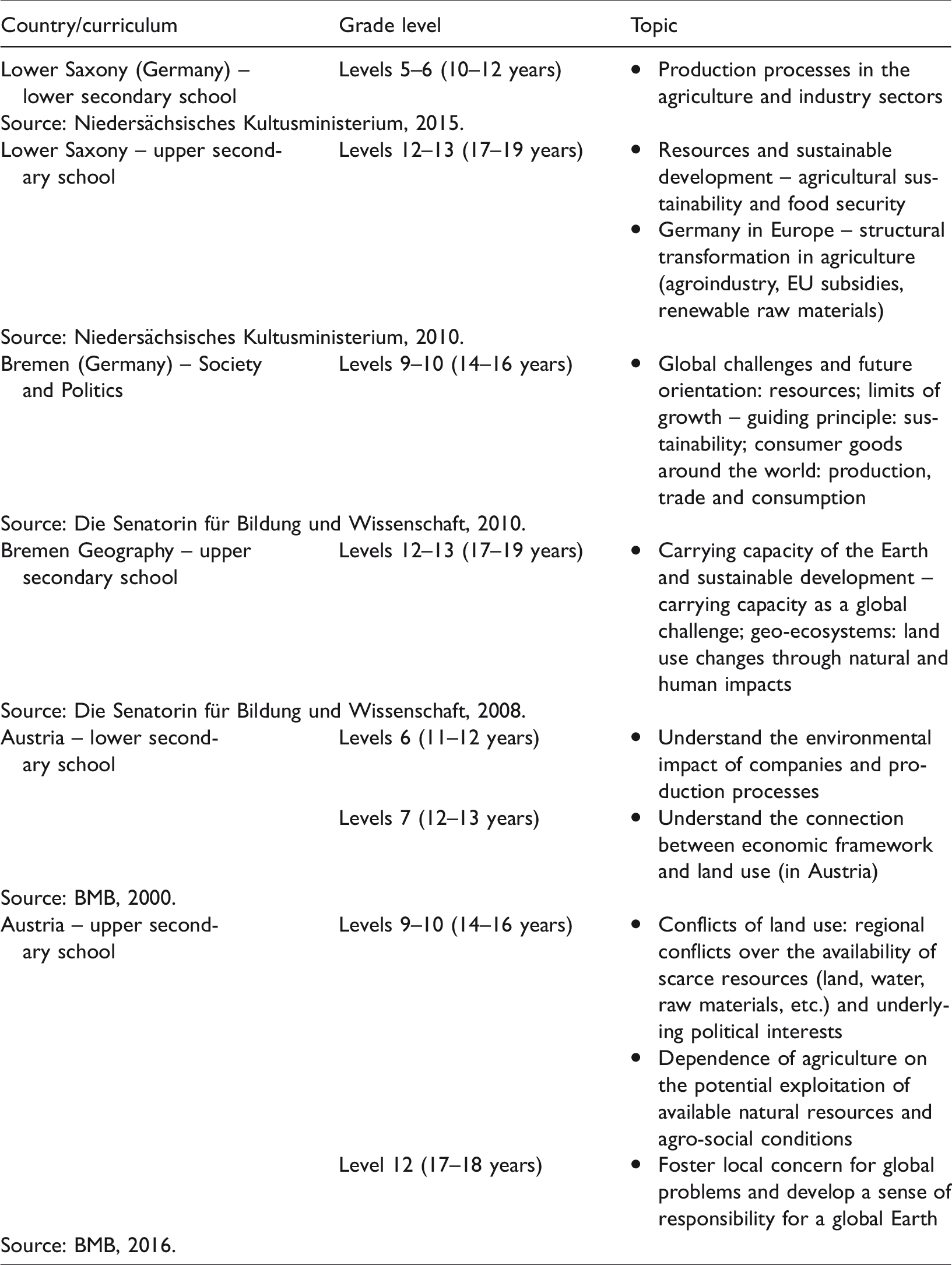
Compared to the curricula in Bremen and Lower Saxony, the Austrian geography/economics curriculum pays greater attention to the connection between production and consumption. This consumer focus stems from the fact that geography and economics form a subject group in the Austrian education system. Economic issues, such as consumption, development of market prices, trade and sustainable economic development, occupy an important place in the curriculum. The new geography/economics curriculum for upper secondary schools in Austria, to be introduced in 2017–2018 or 2018–2019, establishes key concepts for geography/economics teaching. One of a total of 13 key concepts is ‘life quality and sustainability’. Within this particular key concept, students are expected to reflect on their own consumption. The aim is societal change to promote a more sustainable way of living. The curriculum stipulates that students should learn ‘responsible use of the environment’ (BMB, 2016). However, meat is not mentioned. Still, in the Austrian curriculum, sustainability is linked with production and consumption of food items, with a focus on consumption for sustainable lifestyles. Following our criticism of the consumer focus in education, this consumer bias ignores the fact that students could be encouraged to reflect on different roles they might play in the food system (i.e. as producers, policy makers, animal activists, etc.). Unfortunately, it is planned to only incorporate the consumer role in the curriculum.
The empirical studies with students in Germany and Austria confirm that ESD is being implemented in school education, although indicating that meat is missing from formal curricula. Almost 63% of students interviewed in Germany replied that they had already talked about ‘sustainability’ in school. Although meat could be addressed in the geography curricula within such topics as scarce resources, globalization and agricultural production, there are currently no formal guidelines for teachers.
Nevertheless, our survey data indicate that meat is being talked about in the classroom. Of the students interviewed in Germany, 59% highlighted the fact that they had discussed meat consumption in school (see Figure 1). This disconnection between curricula and student survey responses could arise from the discrepancy between formal standards and the examples and activities that teachers themselves introduce and develop.
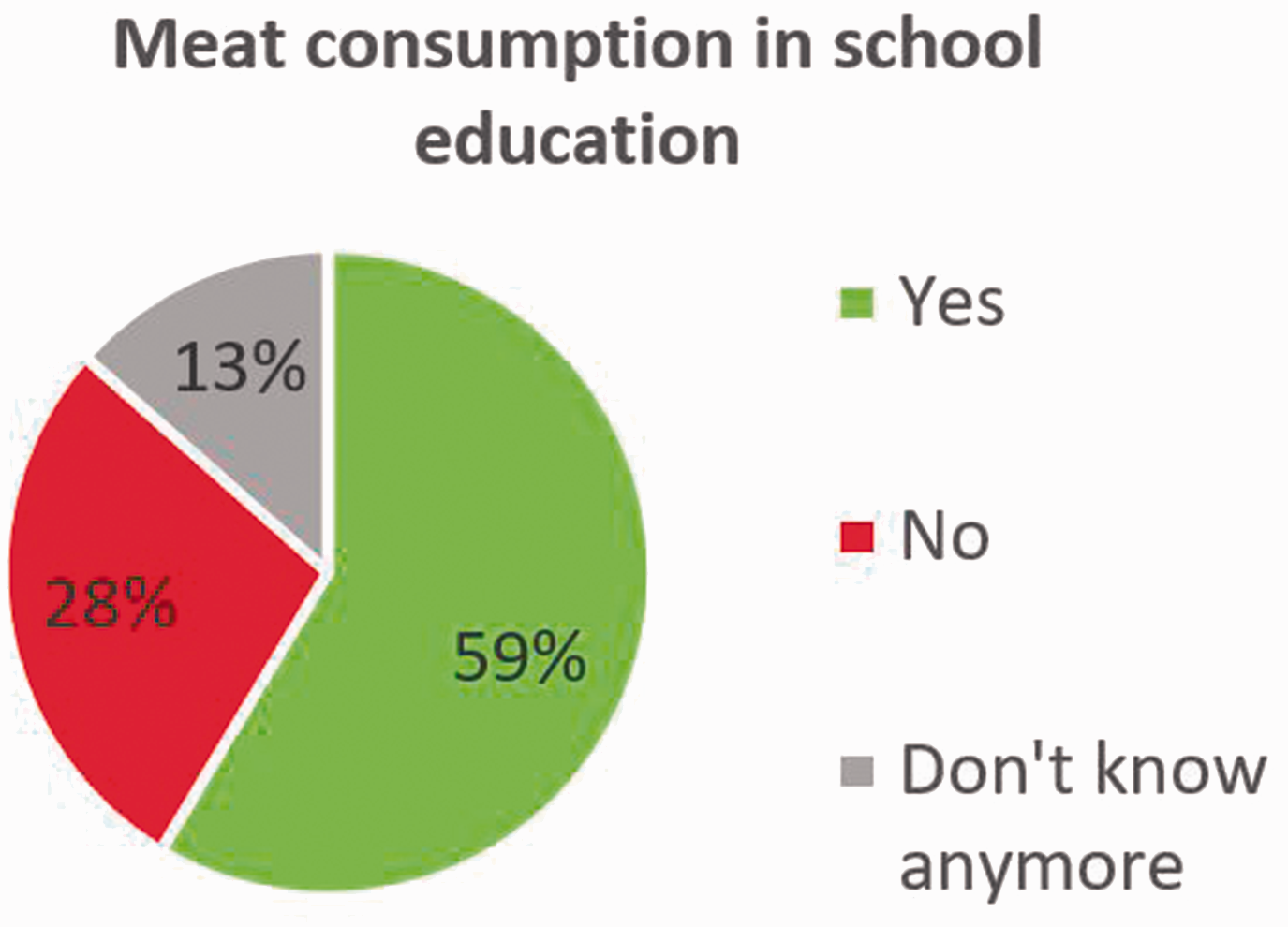
Students were asked ‘Have you discussed meat consumption in your lessons?’ (sample: 481 students).
So, how do students learn about ‘sustainability’? Are teachers promoting learning with ‘head, heart and hand’, as famously advocated by Swiss pedagogue Pestalozzi (Pestalozzi, 1894)? Occasionally, students are asked to bring items from home into the classroom as prompts for discussing issues such as consumption. In our survey, a minority of the students said that they had already been asked to bring in consumer products for school lessons (see Figure 2). It would appear that asking students to reflect on their lifestyles by touching, smelling and feeling products is not the norm, although it is occurring in some classrooms.
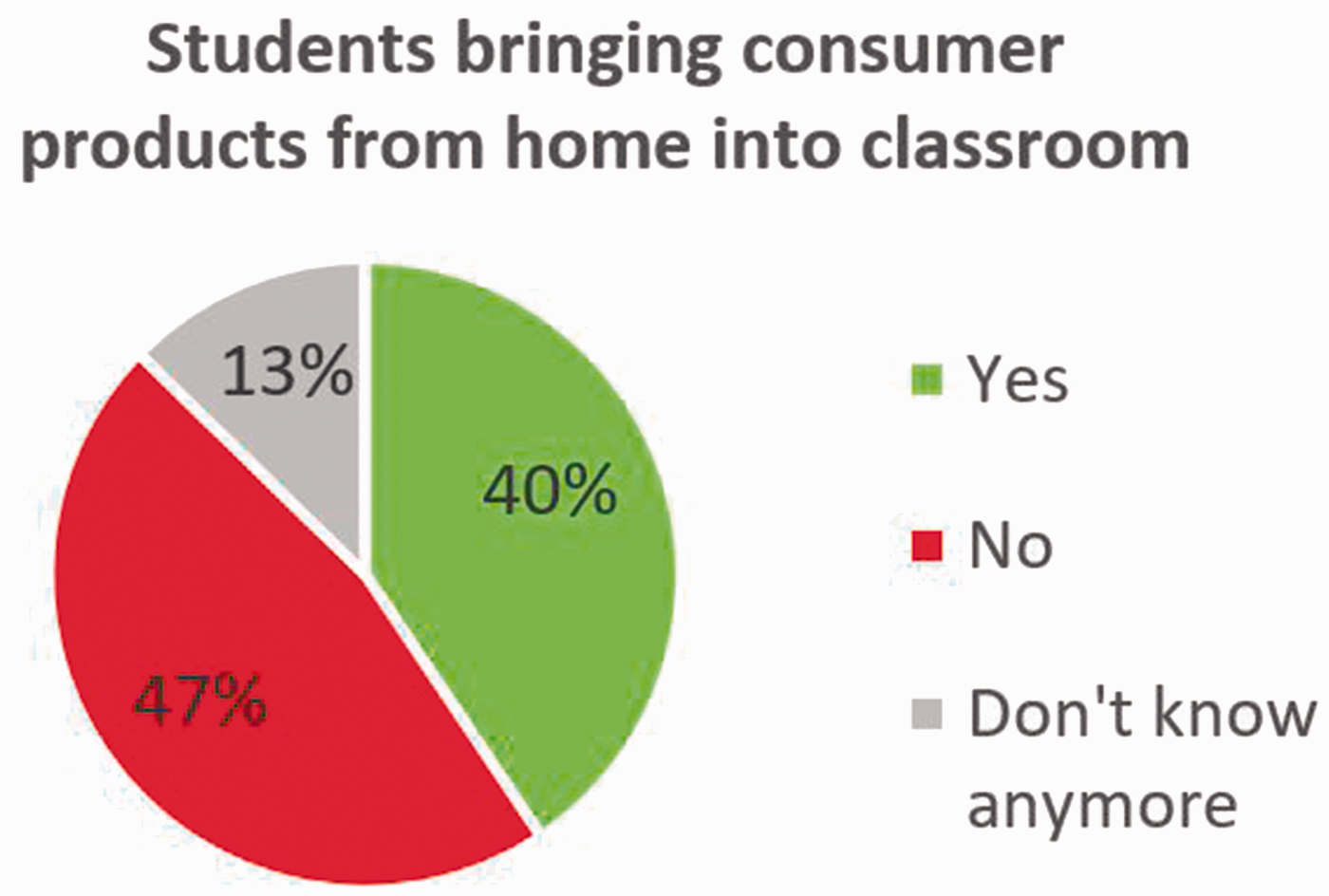
Students were asked ‘Have you been asked to bring consumer products to school to discuss them in lessons?’(sample: 481 students).
From the drawing activity, we were able to qualitatively gauge how students depict the relationships between meat consumption and sustainability. On being prompted to draw their understanding of ‘sustainability’, students tended to focus on socio-economic behaviour change. According to the students’ drawings, sustainability means organic food, renewable energy, waste reduction and reducing meat consumption (see Figure 3 and Figure 4).
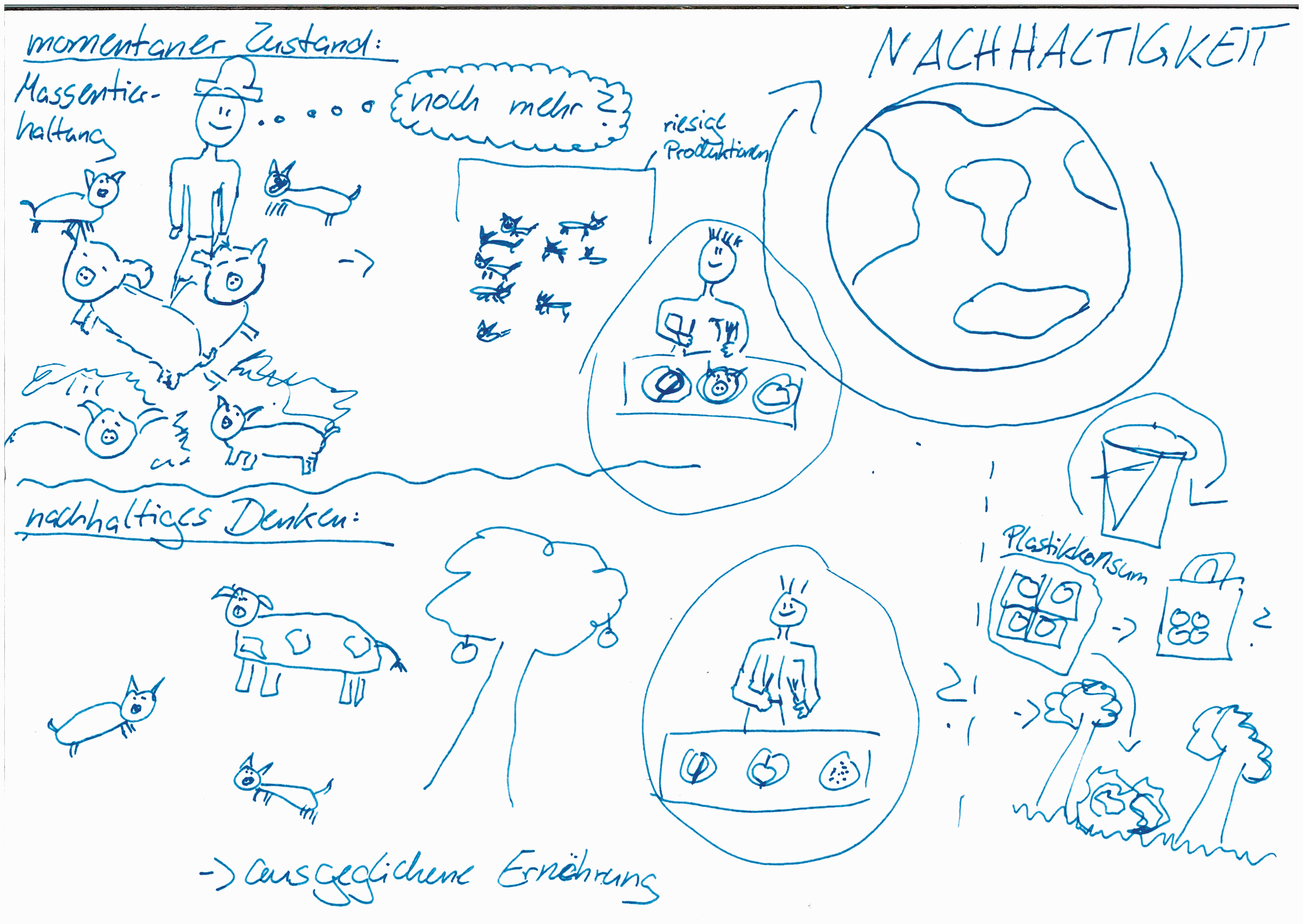
Student’s drawing depicting sustainability.
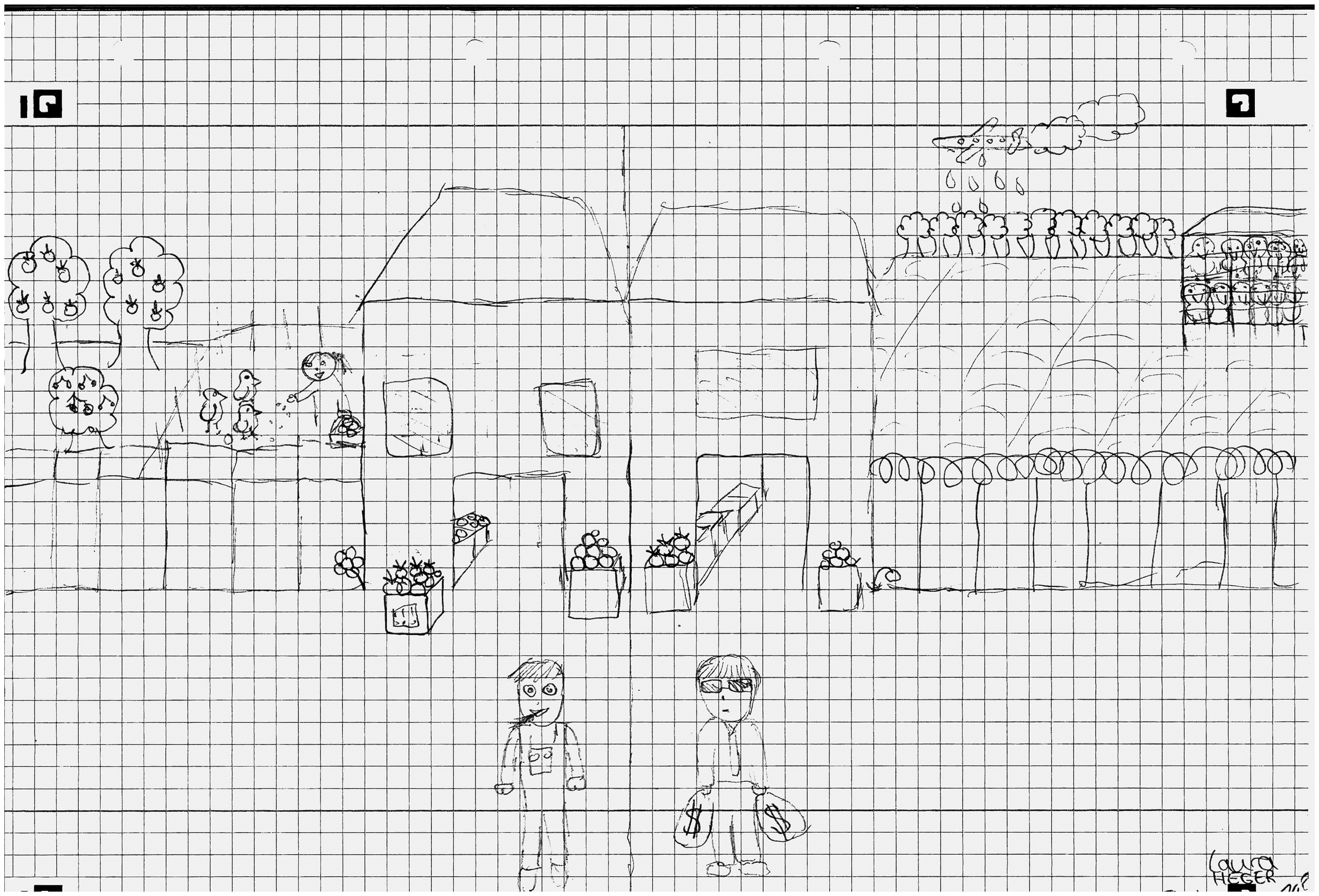
Student’s drawing depicting sustainability.
Nearly a third of the 39 drawings addressed food and agriculture (11 drawings). The way food and agriculture topics were represented as ‘sustainable’ versus ‘unsustainable’ showcases an either-or understanding of sustainability. This binary appears often: 20 out of 39 student drawings show a ‘correct’ and an ‘incorrect’ behaviour in opposition (see Figures 3 and 4). Figure 3, for example, describes ‘Massentierhaltung’ (factory farming) on the one hand, and happy animals with ‘ausgeglichene Ernährung’ (balanced nutrition) on the other.
In Figure 4, the drawing portrays factory and organic farming in opposition. In the drawing on the right, factory farming is characterized by keeping chickens in confined conditions. On the left, the student contrasts the cage-reared birds with free-range chicken farming. Whereas the farmer from the organic farm appears smiling in overalls, the other carries bags filled with money. Organic farming is represented as natural whereas factory farming is depicted as greed. The drawings show a binary of ‘good’ versus ‘bad’ animal agriculture, a black and white image of sustainability.
Even though students often show a simplified ‘good’ versus ‘bad’ understanding of animal agriculture, the fact that animals are drawn at all when the task is to represent ‘sustainability’ should give hope to animal studies scholars and farmers promoting animal welfare. The fact that animals appear to have disappeared from the consciousness of a meat-eating public (as noted previously) often leads consumers to wilfully ignore animals’ lives in the consideration of meat. Interviews with local farmers corroborate this, one of them saying ‘most meat eaters never even think about the fact that what’s on their plate, was once a living creature’ (Interview with cattle farmer, 2/16/2016). Another commented that ‘if a consumer is motivated to think about animal welfare, then it’s usually negative … but to consider a better life for the animal, like we aim for on our farm, few consumers understand that’ (Interview with pig farmer, 11/26/2015). These drawings, however, and others that depict animals, prove that some students do connect meat with animals’ lives and consider animal welfare as a key to more sustainable meat. Perhaps students lack a more nuanced understanding of the links between care, economy, the environment and animal welfare but, nonetheless, they do communicate an interrelation between animal life, meat and sustainability. The surveys in German secondary schools show that animal welfare is a very important criteria when students buy food in supermarkets or shops; it is the most important criteria after the taste, and more important than the price or products being organic (see Figure 5). For 71.2% of the students interviewed, animal welfare is ‘very important’ or ‘important’ when they go shopping. What the geography of food and feeling advocates is for us to be ‘feeling bodies’ in relation to ‘others’, whether those ‘others’ are farmers, animals or factory workers. The fact that animal bodies are, at the very least, represented by students, puts animal welfare on the mental map of sustainability.
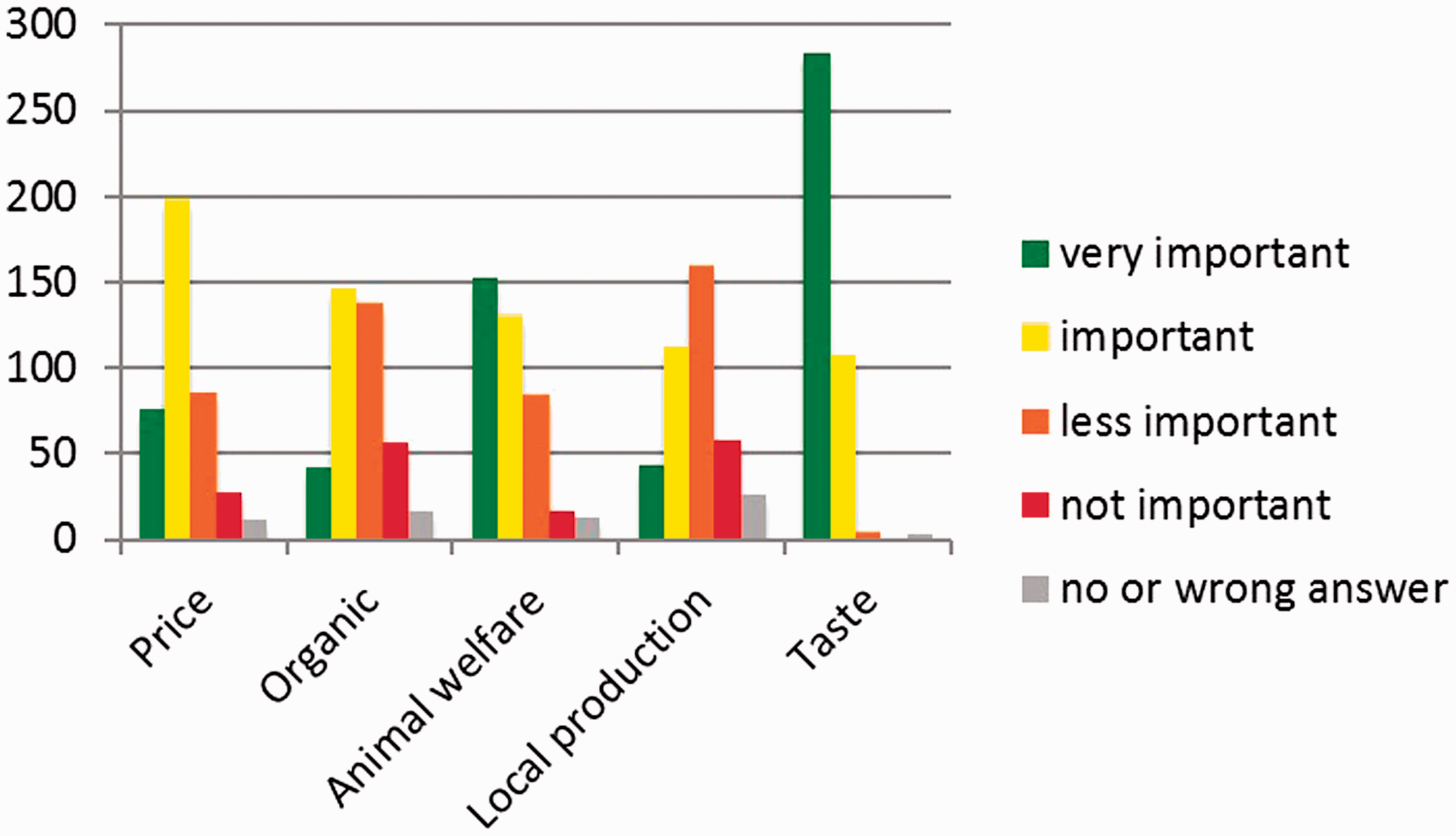
Importance of different criteria when students buy food (sample: 399 students).
The topic of moralizing in education was one quite familiar to teachers interviewed. As a young geography teacher from a secondary school in Lower Saxony highlights, I think our duty is simply to show the students what their possibilities are. You can’t moralize, you shouldn’t. It happens often that students already know what is going on and then say ‘Oh, what is it now again? What are we doing wrong this time?’ (Interview with teacher, 8/31/2017)
Similarly, a geography/economics teacher from Graz points out that students already come to school with a ‘right–wrong schema’. The difficulty for teachers is not to further simplistic thinking. She says: ‘It’s not always easy because sometimes, we also think like this. We have to show students that there is something in between’ (Interview, 6/26/2017). Moralizing provides black and white scenarios and promises easy solutions. The reality is more complex, however. The role of school education is – according to the teacher from Graz – to contextualize sustainability and to explain complex situations and problems (Interview, 6/26/2017). Thus, how can ESD help to develop a more nuanced vision of agriculture and sustainability? How can teachers contextualize meat production and consumption without falling into the trap of moralizing, that is, presenting the ‘ethical’ versus the ‘unethical’? The following section will discuss both questions and propose opportunities for a more visceral geography of food in ESD.
Recommended directions for a visceral geography of meat in ESD
Our primary critique of contemporary ESD in German and Austrian secondary schools and its limited inclusion of embodied approaches is threefold. First, we demonstrated that even though there are many obvious connections between meat and sustainability, school curricula do not explicitly include meat as a topic. We suggested subject areas that could easily incorporate meat as an example and, thereby, successfully link a conceptual topic of ‘sustainability’ with students’ lives. Second, we found that despite being excluded from formal curricula, meat is being discussed and brought into the classroom through examples. When that happens, however, it is through a producer or consumer focus (see also Figure 3 and Figure 4). Third, we established through students’ drawings and interviews with teachers that forms of animal agriculture are moralized as being ‘right’ or ‘wrong’, mostly promoting a simplified and binary version of sustainability. Although teachers are aware of the pitfalls of moralizing in education, they express the fact that it is hard to escape their own biases.
We find literature on emancipatory ESD hopeful and, in our concluding section, we advocate putting critical thinking, feeling and doing into practice. We recommend alternative educational approaches that put forward a reflective, nonmoralizing food praxis. To this end, we find inspiration in more-than-human interventions, which creatively prompt students to reflect on the emotional and affective relationships they have with animals and other aspects of their (food) environment. In calling for an overlap between posthumanist and animal studies, for example, Pedersen suggests reworking interspecies relationships by fostering multi-species ‘biosocial assemblages’ and by considering ‘human–animal, discursive–corporeal intersections’ (Pedersen, 2010a: 247). Latimer and Miele (2013) similarly ask scholars to explore how representational and lived experiences with animals affectively move participants to care (or not) about animals’ lives. Following are a few practical implementations of the abovementioned strategies for bringing students’ attention to the visceral, relational ethics of a food system that makes animals into meat.
One interesting proposal that arose out of an activity she led comes from a geography/economics teacher from a secondary school in Gleisdorf (Styria, Austria). She asked her students to analyse supermarket psychology and marketing gimmicks. Students described the arrangement of products in the shop, and considered sensory elements that stimulate shopping behaviour (e.g. music, bigger price labels, bigger shopping trolleys, etc.). After visiting supermarkets, students discussed their observations in the classroom. At the end of the project, they planned the ‘perfect supermarket’ according to their tastes and preferences. In the future, the teacher is hoping to incorporate blind tasting of food (organic products, animal welfare-certified products, etc.) into her teaching to challenge students to think about how taste is linked to labels and their own preconceptions of the food. Hence, students are encouraged to learn with all of their senses, developing critical thinking by questioning how taste, marketing and labels are interconnected. They are prompted to consider ‘human–animal, discursive–corporeal’ intersections (Pedersen, 2010a: 247) by examining how the representational animal, the affective shopping environment and their own experiences of taste overlap. Adopting a visceral approach, through the experience of corporeal and discursive analysis involving a supermarket, helps students to contextualize food and ‘ethical’ consumption.
Another suggestion is students actually seeing the different stages within a meat production system. Through field trips to a farm, a slaughterhouse, a butcher and a retailer, students could gain an insight into what makes an animal into meat. Direct exposure to farm animals promotes curiosity and also a type of sensory learning that can be difficult within the classroom. One farmer in Styria (Austria) talked about how shocking it was to him that the students knew so little about farm animals, but he also mentioned how well they responded: ‘even from rural areas, it’s amazing how many students have never held a chicken. Or how they think every steer is a cow. But they love it, meeting with the animals’ (Interview with cattle farmer, 11/26/2015). An ongoing relationship with a farm, or even a specific animal, would create biosocial assemblages different from those arising from a farm animal depicted in a textbook.
Finally, school gardens that include animals can represent an opportunity for students to link meat consumption with visceral geographies of food. By taking care of the animals, students would forge affective relationships with them and be encouraged to reflect on their own eating behaviours. In Germany, there is an increasing interest in establishing school gardens but, as yet, only one German federal state (Thuringia) includes gardening in its own right in the curriculum. Nevertheless, it is very rare to find animals in school gardens, which focus on fruits and vegetables. If schools do not have their own garden, urban or community gardening could be a possibility for enriching ESD in the context of geography education.
Of course, these types of human–animal assemblages run counter to mainstream food socialization, in which young people are conceptually distanced from the animals they eat (see Stewart and Cole, 2009). Affective relationships foster species intersections through which students are moved to consider animals’ lives in noninstrumental ways, and this requires sensitive supervision, guidance and emotional support from the educator. Nonetheless, ESD has the goal of encouraging students to consider themselves part of and in solidarity with an interconnected human–environmental ecosystem. Thus, shared care and vulnerability enter into such a framing of sustainability.
All three recommendations presented (supermarket activities, field trips and school gardens) fit within the framework of the Austrian curriculum for upper secondary schools in its aim of encouraging students to engage responsibly and actively in ESD (BMB, 2016). As far as Germany is concerned, students will better understand and explain the process of agricultural production, as required by the geography curriculum in Lower Saxony (Niedersächsisches Kultusministerium, 2014: 21), after visiting a farm or working in a school garden.
There are a few challenges that should be noted with regard to implementing our proposed activities. First, the geography curricula examined do not stipulate field trips and school gardens; thus, teachers would have to rework their lessons to include alternative educational activities. Second, the organization of field trips requires time and engagement (obtaining the permission of parents, booking transport, etc.) so, again, teacher commitment would be key. Third, administrative support is important, considering that timetables and internal school programmes would have to be adjusted. However, some of the activities suggested, such as grocery shopping or tasting, require less logistical planning and could be easily fitted into an hour or two. Furthermore, those teachers and administrators who are committed are already organizing additional activities in German and Austrian schools, such as field trips to farms (see Figure 6). We recommend a coordinated and more holistic implementation of these and other visceral approaches to deepen the experience of students in emancipatory ESD.
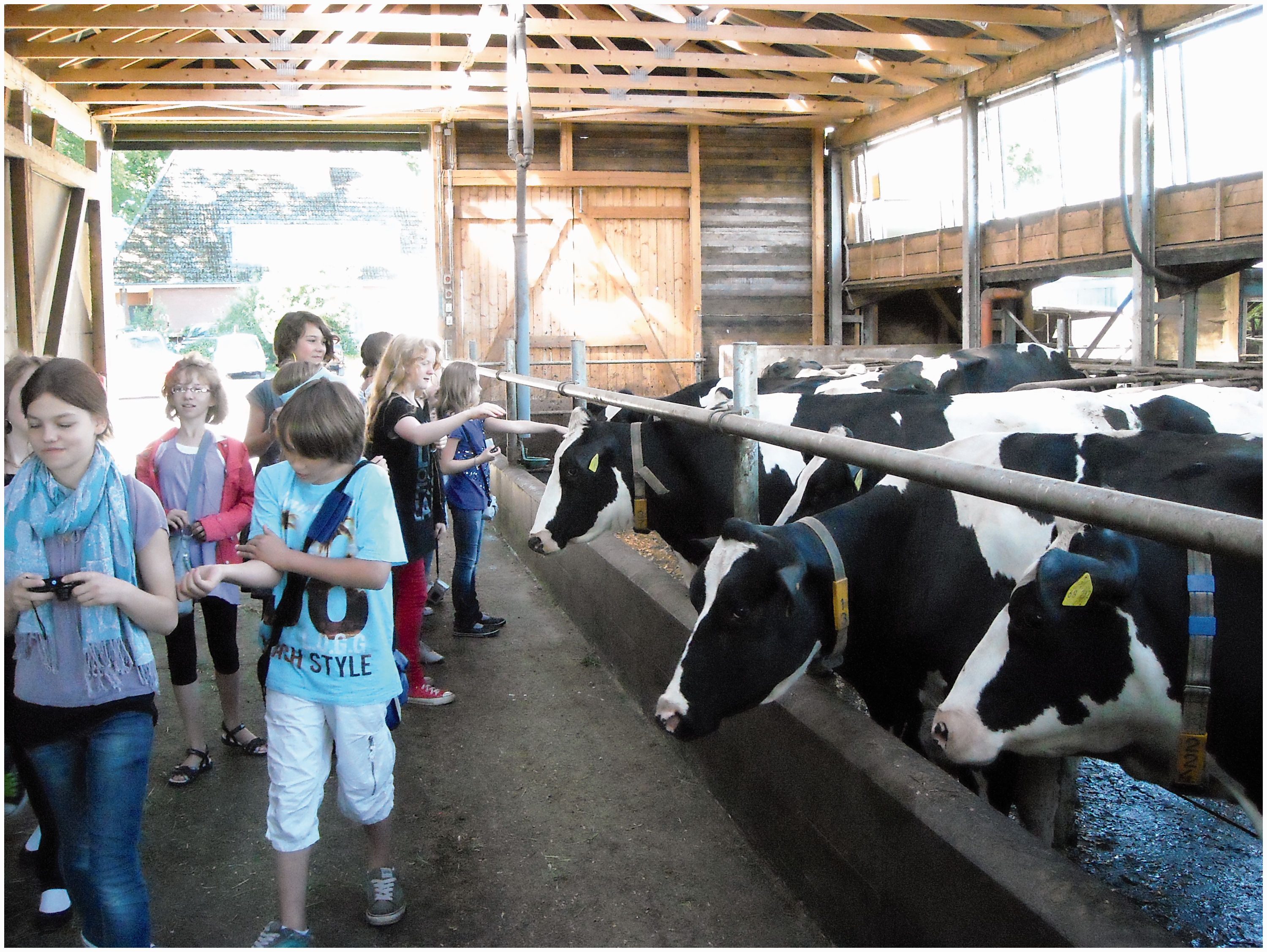
Students visiting an organic farm in Lilienthal (Lower Saxony) in connection with their geography lesson.
Meat is personal and sensitive, but simultaneously related to broader socio-spatial contexts beyond the individual body. In this way, meat pedagogies could be approached through the lens of material-affective ‘embodied collectives’ of production and consumption that lead to the current food environment (Evans et al., 2011). These collectives include not just students, but the animals, farm labourers, slaughterhouse employees, butchers, government agencies and other actors in the food system, who touch, shape and are shaped by animal agriculture. Adopting such a collective, more-than-human visceral approach through shared experiences, role play, etc., could help students and teachers move past the judgement and moralizing that otherwise stall an engagement with ESD concerned with meat and sustainability. Engaging students with issues arising from meat in a space between moralizing and avoidance could lead towards shared responsibility, instead of simplistic, targeted blame.
Footnotes
Declaration of conflicting interests
The author(s) declared no potential conflicts of interest with respect to the research, authorship and/or publication of this article.
Funding
The author(s) disclosed receipt of the following financial support for the research, authorship, and/or publication of this article: This research was partly supported through the ‘(Un)Knowing Food' project, funded by the Regional Government of Styria.