




Abstract
In December 2015 the Australian state and territory governments endorsed the ‘National STEM School Education Strategy 2016–2026’. Since then, the individual jurisdictions have released their own STEM education strategies that aim to improve student STEM capabilities and aspirations. This paper analyses the various Australian STEM education strategies in relation to six themes informed by research into effective STEM education: STEM capabilities; STEM dispositions; STEM educational practices; Equity; Trajectories; and Educator capacities. The analysis shows that Australia’s STEM education strategies focus on actions aimed at building student STEM capabilities, particularly through inquiry and problem-based learning, and enhancing educator capacity. The strategies recognise student STEM learning trajectories and pay particular attention to the importance of early childhood STEM education, as well as the ways in which students’ potential career pathways might be influenced. However, less emphasis is placed on supporting key transitions in STEM education, developing student STEM dispositions, and addressing equity issues in STEM.
Introduction
Building a Science, Technology, Engineering and Mathematics (STEM) skilled workforce and cultivating a STEM literate citizenry has been a focus of governments across the world for at least a decade (Gough, 2015). STEM education, a term that rose to prominence in the late 2000s referring to formal and informal education programmes from pre-school to tertiary level (Shanahan et al., 2016), is seen as the key strategy for achieving these goals. Governments look to STEM education to address an array of local, national and global issues (Gough, 2015). The Incheon Declaration for Education 2030 recommends the strengthening of STEM education as a key strategy for meeting its sustainable development goals (UNESCO, 2015). Fensham (2008), in his report to UNESCO, argues quality science and technology education is essential for socially and environmentally sustainable development by ensuring the supply of scientifically and technologically skilled professionals to drive it, and the preparation of a scientifically and technologically informed citizenry to guide it. STEM education is seen as a vehicle for improving a nation’s global competitiveness and ensuring its economic future (Breiner et al., 2012).
STEM education aims to grow in students the capability and inclination to identify questions and solve problems associated with STEM-related issues and the natural and designed world (Bybee, 2013). Informed by the work of Bybee, this paper takes the stance that effective STEM education explores significant 21st-century challenges in contexts such as health, environment, energy, technology and natural resources. It builds knowledge of the characteristics of the STEM disciplines, as well as an understanding of how these disciplines shape our physical and cultural worlds. Beyond disciplinary skills and knowledge, STEM education builds intra-disciplinary skills, such as complex problem solving, critical thinking and creativity.
While STEM education has been pursued internationally since the mid-2000s, Australia is a relative late adopter (Blackley and Howell, 2015). The Australian STEM education movement has gained significant momentum since 2013 with the publication of several key papers by the Australian Office of the Chief Scientist (2013, 2014) and the Australian Industry Group (2013, 2015). These papers suggest that improving Australia’s STEM education is vital for Australians to effectively manage the changing environment, their health and wellbeing, their food, water and energy, their security, and their economy. There is an accepted correlation between strong performing education systems and nations with thriving economies (Marginson et al., 2013). Given this, the urgency to improve STEM education in Australia is increased by sliding performance of Australian students, both relative to other nations and, in some cases, in absolute terms (Thomson et al., 2016; Thomson et al., 2016). Not only are Australian students underperforming in STEM testing, but fewer of them are choosing to study STEM subjects (Goodrum et al., 2012; McPhan et al., 2008; Morrison et al., 2015). These factors have caused STEM education to become a national priority.
The Australian focus on STEM education saw the state and territory governments 1 endorsing the ‘National STEM School Education Strategy 2016–2026’ in December of 2015 (Education Council, 2015). Since then, different states and territories have released their own STEM education strategies that aim to improve student STEM capabilities and aspirations. Ideally, these strategies would reflect the best evidence available about effective STEM education. This paper analyses the extent to which the various Australian STEM education strategies align to the STEM education research literature. It interrogates the ways in which the strategies conceptualise ‘STEM education’, the rationales provided by the strategies for the need to improve STEM education, and the types of actions that are recommended by the strategies to improve STEM education. In doing so, it provides insight into the degree to which the STEM education path being adopted by Australian jurisdictions is supported by the available research evidence.
Literature review
STEM education research is a relatively young field with limited but growing empirical research available to inform policy and practice (Brown, 2012). Given this, this literature review draws both on scholarly literature and reports from industry and governments. The literature on effective STEM education can be considered in relation to a number of themes. There is a body of literature exploring the impact of STEM education on students, particularly on the development of STEM capabilities, and on nurturing positive STEM dispositions. Other literature examines the delivery of STEM education and explores effective STEM education practices, equity issues in STEM education, or STEM trajectories. There is also a significant body of STEM education research examining the capacity of STEM educators. The following brief literature review brings together the pertinent findings related to these themes in order to offer a framework for analysing Australia’s STEM education strategies.
Capabilities
The literature discusses the need for students to develop STEM knowledge and skills to be adequately equipped for their futures and to meet the developing needs of Australia’s industries (Australian Industry Group, 2013). These capabilities include, but are more extensive than, the knowledge and skills associated with the individual STEM disciplines. In a rapidly changing world, STEM knowledge cannot be conceived as stable content; rather, STEM education needs to equip students to source, interpret and apply understandings as they evolve (Roth and Van Eijck, 2010). Similarly, the skill set required by students for life in the 21st century cannot be reduced to a definitive list; however, some skills are known and must be made explicit and included in each child’s education (Marzano and Heflebower, 2012). Bybee (2013) draws on the work of the Partnership for 21st Century Learning and the National Research Council of America to suggest a STEM skill set that includes adaptability, non-routine problem solving, and systems thinking, as well as complex communication skills and self-development. Australian employers seek to employ STEM graduates as they have skills such as active learning, complex problem-solving, creative problem solving, critical thinking, design thinking, programming, and systems analysis and evaluation (Prinsley and Baranyai, 2015). Commonly, the literature suggests that these capabilities are best developed through STEM education practices that use real world contexts and present learners with authentic problems or projects to work upon (e.g. Hefty, 2015; Kelley et al., 2010; Redmond et al., 2011).
Dispositions
STEM dispositions are the attitudes and states of mind that support students achieving success in STEM education and the pursuit of STEM career pathways. The research literature highlights the role of affect in effective STEM education and advocates for favourable dispositions to be cultivated in students. Students need to be interested in STEM, have a positive self-perception of themselves as STEM students, and to see STEM industries as personally relevant, if they are to engage in STEM learning and aspire to STEM careers (Goodrum et al., 2012; OECD Global Science Forum, 2006; Panizzon and Westwell, 2009). There is a significant body of research exploring motivational and academic emotion theory as it related to student STEM participation and performance. This research suggests that STEM self-concept, the value the learner places on STEM and STEM education, learner autonomy, and educator-learner and learner-learner relationships, are some of the most powerful influences on learner motivation in STEM education (e.g. Andersen and Chen, 2016; Petersen and Hyde, 2017; Robnett and Leaper, 2013; Wang and Degol, 2013). Moreover, children’s STEM dispositions can be influenced by educators from the early years onwards (Patrick et al., 2009). Given this, teacher practice, curriculum, and pedagogical choices impact significantly on student STEM dispositions (Panizzon and Westwell, 2009; McPhan et al., 2008).
Educational practices
STEM educational practices are intentional actions that schools and educators take to create STEM learning environments that build student STEM capabilities and nurture STEM dispositions. There is evidence that effective STEM education programmes view knowledge as interdisciplinary and present the curriculum in an integrated way (Becker and Park, 2011; Honey et al., 2014; Yildirim, 2016). There is, however, debate around the degree and form of integration of the disciplines in a STEM education programme for best impact on student learning (e.g. Bybee, 2013; Kelley, 2010; Moore and Smith, 2014). It is also clear in the literature that real world inquiry or problem-based learning (PBL) approaches have a positive impact on student learning in STEM education (Gee and Wong, 2012; MacLeod, 2013; McDonald, 2016; Ralph, 2015). At the core of an inquiry approach is the idea that approaches and methods used by STEM professionals should be reflected in the classroom (Gee and Wong, 2012). Such an approach requires that students exercise STEM capabilities (Capraro and Slough, 2013), while also presenting STEM as relevant to students, with the potential to cultivate STEM dispositions (Rennie et al., 2012). Research shows that there is significant variation in the impact of various inquiry approaches on students of different gender, ethnicity and socio-economic status (Gee and Wong, 2012; Von Secker, 2002). However, there is generally sound evidence to support a real-world inquiry or PBL approach to STEM education.
There is also a call for the increased use of computers and robotics in STEM education. Research shows that the use of these digital technologies expands available learning contexts (Starkey, 2012) and facilitates the development of problem solving and higher order thinking skills (McDonald, 2016). There is also evidence to suggest that digital learning has a positive impact on STEM dispositions, improving student interest and motivation in STEM (Lai Poh et al., 2016; McDonald, 2016; Starkey, 2012).
Equity
Research points to a need for STEM education to address significant equity issues for female, rural, Indigenous, and socio-economically disadvantaged students in Australia. Though girls are achieving as strongly in STEM as boys (Thomson et al., 2016), they are opting out of STEM subjects at a greater rate and are significantly under-represented in some STEM dominated industries (Australian Industry Group, 2013; Marginson, 2013). International and national testing suggests that metropolitan students are around 12–18 months ahead of rural students in both mathematical and scientific literacy, and that this gap is widening (Australian Curriculum Assessment and Reporting Authority, 2016; Connolly, 2017; Thomson et al., 2016; Thomson, et al., 2016). The same testing reveals an even wider gap between the achievement of an average Australian student and that of an Indigenous Australian student in STEM skill development. This testing also suggests a strong correlation between the income and education levels of a child’s family and their development of mathematical and scientific literacy. The literature also suggests that educator curricular and pedagogical choices can have a significant impact on the dispositions and academic success of these different groups (Gee and Wong, 2012; Marginson, 2013; Patrick et al., 2009, Stacey et al., 2015).
Trajectories
An education trajectory can be considered as a long-term view of a student’s educational course or movement through the education system (Elder, 1985; Pallas, 2003). Given this, a student’s STEM trajectory is taken to include their STEM learning journey from early childhood through to senior secondary school and beyond. A growing body of research demonstrates the importance of early STEM competencies for later outcomes in STEM subjects (Johnston, 2011; Watts et al., 2014). However, a number of factors may alter children’s long-term STEM achievement trajectories, including changes in motivation and classroom practices, and failure or success in attaining key skills during the schooling years (Watts et al., 2014). Indeed, a study of children’s early mathematical competencies and later mathematical achievement shows that, while early competencies assist children in ‘getting off to a good start’, the quality of mathematics education experienced in the schooling years is critical (MacDonald and Carmichael, 2017). Moreover, transitions from preschool to primary, and from primary to secondary, may impact children’s engagement with STEM education (Perry et al., 2015; Tytler et al., 2008). Researchers recommend that effective STEM education occur before secondary school (Tytler et al., 2008), and preferably from the preschool years (Moomaw and Davis, 2010; Milford and Tippett, 2015). Furthermore, effective STEM education throughout the schooling years positively influences students’ aspirations in relation to tertiary STEM study and STEM career pursuits (van Tuijl and van der Molen, 2016).
Educator capacities
In order to meet the demands for delivering integrated, inquiry-driven STEM education that develops in all children the necessary STEM capabilities and dispositions, highly skilled educators are required at all levels of the educational journey. Educators play a pivotal role in STEM education when they provide a safe and supportive learning environment, engagement in effective pedagogical practices, and adequate time to engage in the learning process (McDonald, 2016). However, a number of challenges exist across the STEM educational continuum. Australian secondary schools are struggling to staff Science and Mathematics classes with qualified teachers, with large proportions of these classes taught by teachers without teacher training in these disciplines (Marginson et al., 2013). Prinsley and Johnston (2015) identify that primary teachers, in particular, make a serious difference in STEM education. However, there is a shortage of primary school teachers that are confident and competent in teaching science and mathematics (Marginson et al., 2013). Similar challenges are found in the early childhood education sector, with many early childhood educators reluctant to engage in intentional teaching of mathematics, science, and technology (Lee and Ginsburg, 2009). On a positive note, research shows that professional development can deepen both the subject and pedagogical knowledge of educators, leading to changes in classroom practice and improved student achievement (Perry and MacDonald, 2015; McDonald, 2016; Reimers et al., 2015).
Method
STEM education strategies, where they existed, were acquired for each Australian jurisdiction. A jurisdiction’s STEM education strategy was regarded as a public document or documents comprising:
A description of STEM education; A rationale for planning to improve STEM education; and Recommended actions to improve STEM education.
A web search was used to locate STEM education strategy documents where possible, as this was felt to be the most likely strategy to be used by STEM education practitioners and other audiences for these strategies. Where a search did not yield an obvious STEM education strategy document, the jurisdiction’s education department was contacted directly, to ascertain if a document existed and to request a copy. All jurisdictions provided a response to the query. This resulted in the set of STEM education strategy documents presented in Table 1.
STEM education strategy documents by jurisdiction
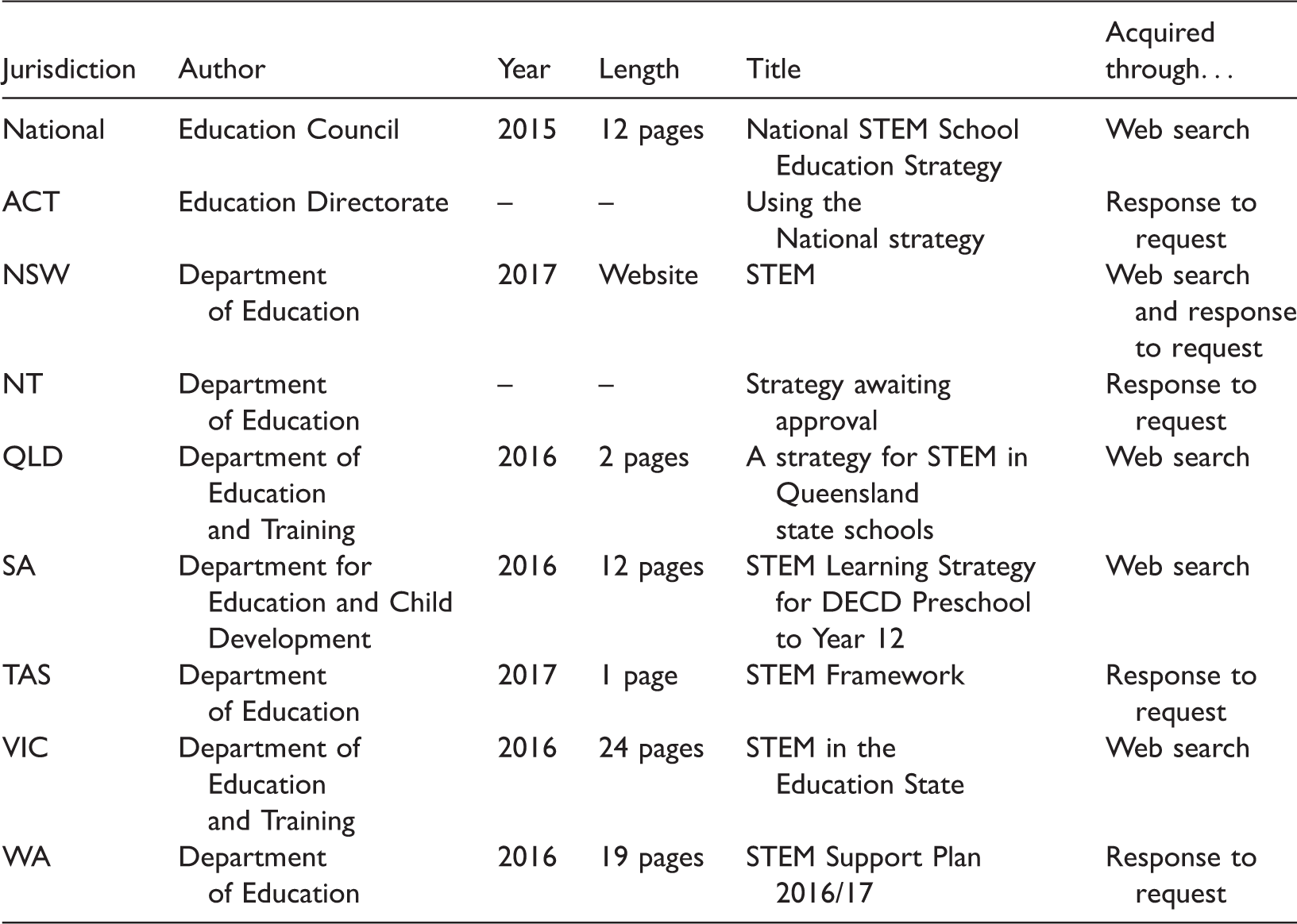
STEM: Science, Technology, Engineering, Mathematics; ACT: Australian Capital Territory; NSW: New South Wales; NT: Northern Territory; QLD: Queensland; SA: South Australia; TAS: Tasmania; VIC: Victoria; WA: Western Australia.
Analysis
This study utilised a thematic analysis approach (Joffe, 2011) to synthesise and analyse the content of the strategies. Each of the Australian STEM strategies were analysed according to their conceptualisation of ‘STEM education’, rationale for developing a STEM education strategy, and actions they articulated to enhance STEM education during the target period of each strategy. Relevant text from each of the strategies was extracted for thematic analysis. Each of the strategies provided a description of how they conceptualised STEM education in their jurisdiction. All strategies also included a section offering a rationale for focusing efforts and resources on improving STEM education. ‘Actions’ were taken to be the specific measures, initiatives, and programmes to be implemented by each jurisdiction that are designed to have positive impact upon learners, learning environments, and/or educators. The STEM conceptions, rationales and actions were interrogated in relation to the research questions using a coding scheme developed from the six themes associated with STEM education presented in the literature review. The key words coded to each of the themes are shown in Table 2.
Coding themes and associated key words a
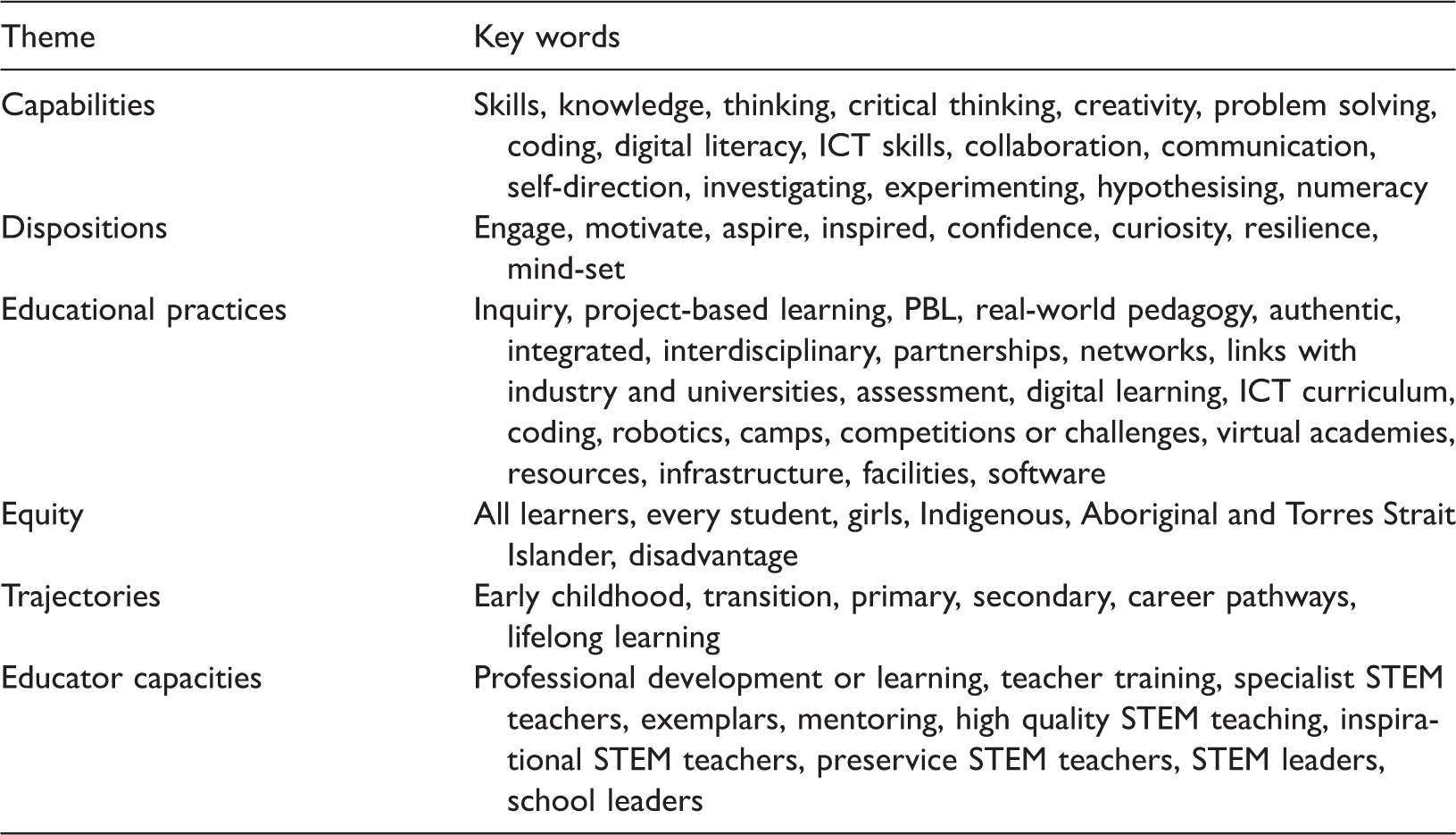
ICT: Information and communications technology; PBL: Problem-based learning; STEM: Science, Technology, Engineering, Mathematics.
The key words listed here were taken to include any words that may have the key word as their root (e.g. ‘motivate’ includes ‘motivating’, ‘motivated’, and ‘motivation’).
The first two authors independently coded the relevant sections of the strategy, then held a consensus meeting, discussing coding decisions and developing a consensus view of findings (Hunt and Walsh, 2011).
Results and discussion
The following discussion presents the result of the thematic analysis with respect to the six themes, reflecting on the alignment of the strategies to the STEM education literature, and the consistency between the way Australian STEM education is conceived (as presented in Table 3) and rationalised, and the actions proposed to advance it. It is important to note when reading this analysis that the various strategies varied greatly in style and length, ranging from Tasmania’s single page ‘STEM framework’, through to Victoria’s 24-page overview of STEM education in the State.
Analyses of the way each jurisdiction’s strategy conceives of STEM education
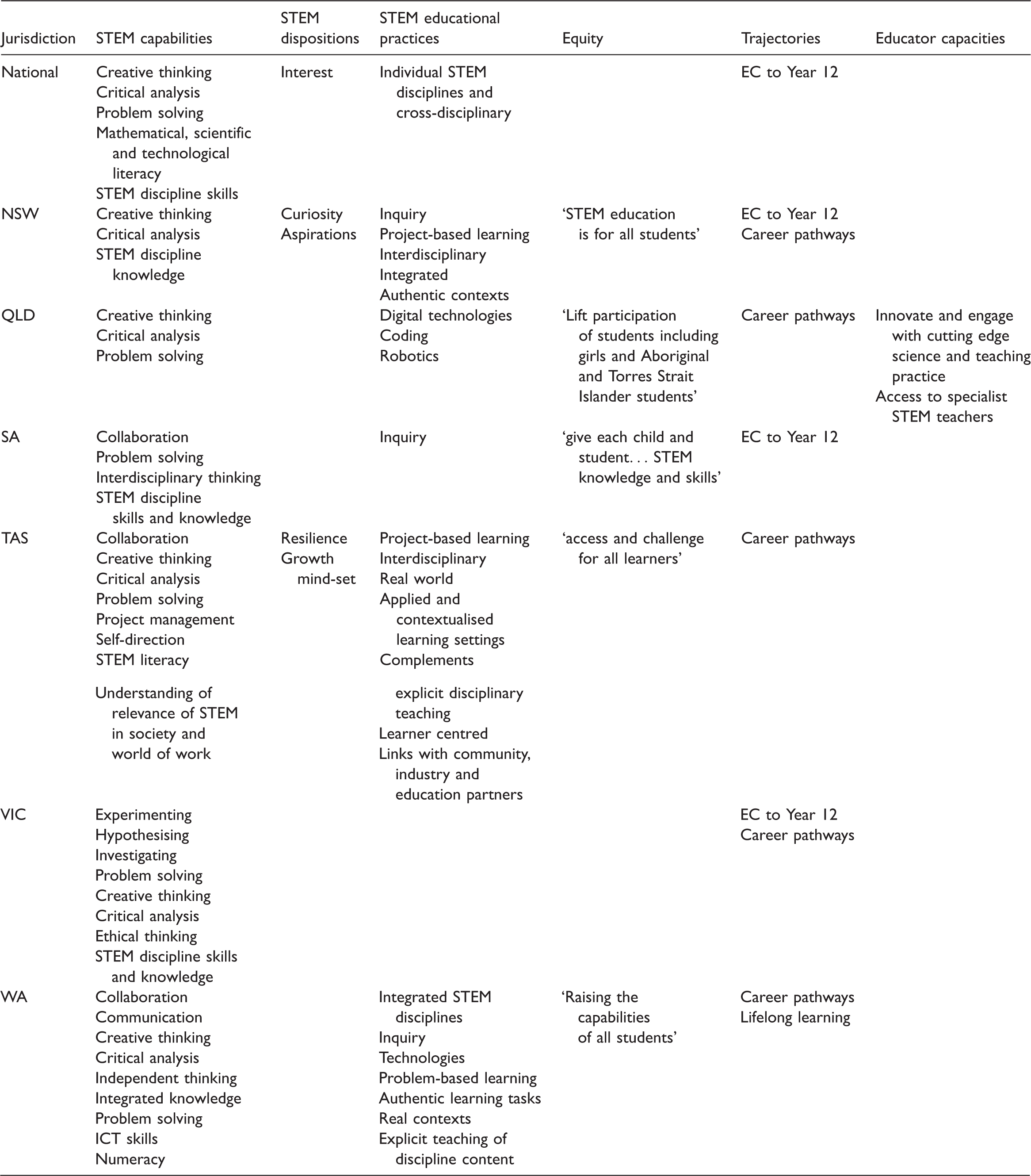
STEM: Science, Technology, Engineering, Mathematics; ACT: Australian Capital Territory; NSW: New South Wales; NT: Northern Territory; QLD: Queensland; SA: South Australia; TAS: Tasmania; VIC: Victoria; WA: Western Australia.
Capabilities
As shown in Table 3, student STEM capabilities is a key element of the way each of the Australian strategies conceive of STEM education. Understandably, STEM discipline knowledge and skills are prioritised among the strategies. However, the interdisciplinary capabilities of problem solving, critical analysis, and creative thinking are even more prominent. Capabilities associated with collaboration and digital technologies are also evident, though with less consistency across the strategies. Furthermore, individually the strategies present a range of other capabilities which are important for STEM, such as communication, interdisciplinary thinking, independent thinking, and inquiry skills.
The need to improve the STEM capabilities of Australians was a strong theme in the rationales of all the strategies. In all but the Tasmanian rationale, the emphasis on STEM capabilities is associated with the need to prepare STEM skilled workers to take up positions in the growing STEM sector, and to ensure a globally competitive economy. Some rationales also speak more generally of the need for improved STEM capabilities in response to a rapidly changing world (QLD, VIC). Less frequently mentioned is the role STEM capabilities play in ensuring individuals lead fulfilling lives as positive community members (TAS, WA). Several strategies cite Australian students’ slide in STEM enrolments and international testing of STEM skills and knowledge as a reason to address STEM education in Australia (National, SA, QLD, VIC).
The strategies adopt a range of actions to improve student STEM capabilities. Three strategies include actions to improve the tools to describe and track the development of STEM capabilities (National, TAS, WA). Despite creativity, critical thinking and problem solving being integral to each strategies description of STEM education few had explicit actions aimed at building these capabilities. Three strategies had actions for problem solving (National, QLD, VIC), three for creativity (National, QLD, WA) and three for critical thinking (QLD, VIC, WA). Similarly, though digital literacy was a common feature of the way strategies conceived of STEM education only three of the strategies have a strong emphasis on building student digital literacy, supported through resourcing and enrichment opportunities (National, QLD, VIC). This lack of consistency reflects the STEM education literature, where there is still a need to clearly articulate for educators how these capabilities are to be exercised in STEM learning environments.
Dispositions
Each of the strategies acknowledge the role of affect in effective STEM education in their conceptualisation (Table 3) and/or rationale; though, generally this element has only minor emphasis. Strategies tend to express their intent with vague phrases like ‘lift student engagement’ (National, p. 3) or ‘encourage greater interest…in STEM’ (WA, p. 2). While it is encouraging that dispositions such as interest, curiosity, aspiration, and confidence are cited within the strategies as being important for initiating and sustaining students’ motivation to pursue STEM learning and career paths, there is little attempt to operationalise these terms. Only the Tasmanian strategy flagged motivational constructs such as student self-direction and growth mindset that have been found to improve learner engagement in STEM.
Further, only three of the strategies include actions explicitly aiming to impact on student disposition (National, VIC, WA). These actions focus on building aspirations, curiosity and confidence. The actions explicitly identified are limited to building industry partnerships, a mathematics challenge, a research-based Early Childhood numeracy programme, and delivering STEM education professional learning. Given the strong evidence showing the role of affect on student success in STEM and engagement in STEM pathways, the limited consideration of ways to enhance STEM dispositions is a significant shortcoming across the Australian STEM strategies.
Educational practices
As shown in Table 3, all but the Victorian strategy include STEM educational practices in the conceptualisation of STEM education. The practices identified have a strong real-world and inquiry orientation; however, there is no consensus among the strategies as to whether STEM education should be delivered through the discrete disciplines, or as a learning experience where the disciplines are integrated, with the strategies variously describing ‘STEM’ as being four individual disciplines, cross-disciplinary, and/or inter-disciplinary.
To support building these STEM capabilities and dispositions, the strategies outline actions to transform educational practices. Encouragingly, given the evidence supporting inquiry learning in STEM education, the majority of strategies (National, NSW, SA, TAS, WA), have actions targeted at encouraging the adoption of inquiry or PBL pedagogies. Three strategies include actions aimed at ensuring STEM education is presented in an integrated way (NSW, TAS, WA). It is clear in the literature that the impact of both integrated curriculum and inquiry learning varies according to approach, context, and cohort; however, the strategies provide minimal description of how they conceived of these practices. All the strategies advocate building partnerships with industry, other educational institutions and the wider community, to improve the quality of STEM education (e.g. National, WA). While this has intuitive appeal, there is not yet conclusive evidence to support such actions (Gamse et al., 2017).
Three of the strategies (National, QLD, VIC) also place significant emphasis on digital learning practices. Each of these strategies establish a baseline action of implementing the set digital literacy curriculum. Victoria and Queensland have actions are focused on extra-curricular measures such as competitions. The remaining actions included the provision of software for secondary schools and the support of digital learning experiences for early childhood. These actions do not appear to be a strong match to those described in the literature expanding access to learning environments, or improving problem solving and motivation for all students.
Equity
As discussed in the literature review, the extant research identifies equity issues for key groups in STEM education in Australia. As Table 3 shows, five strategies (NSW, SA, TAS, QLD, WA) address equity in their conceptualisation of STEM education. Of these, all except Queensland used broad statements such as ‘STEM education is for all students’, implying the inclusion of groups that are known to be marginalised. Only Queensland explicitly identified girls and indigenous students as groups requiring particular support, consistent with the research literature.
Three of the STEM strategies (National, VIC, SA) made explicit reference to equity issues in their rationales. The National strategy nominated girls, indigenous students, students from low socio-economic backgrounds, and students from non-metropolitan areas, as groups that need to be considered. The South Australian rationale explicitly discussed the under-representations of women and Indigenous people in STEM, and the Victorian rationale had a strong focus on girls in STEM education, with some mention of the impact of student socio-economic background. Four strategies (QLD, SA, VIC, WA) included actions explicitly aiming to impact on equity in STEM education, and these were limited. However, the few actions articulated relied heavily on having impact through short term interventions such as camps for girls, mentoring programmes for Indigenous children, and online STEM enrichment programmes for non-metropolitan and disadvantaged communities.
Trajectories
As Table 3 shows, there is some acknowledgement of STEM education trajectories in the way STEM is conceived by each of the strategies; though, Tasmania and Queensland limit this to facilitating career pathways. Similarly, all rationales, implicitly or explicitly, give some consideration to STEM education trajectories. Universally, the rationales consider the role of STEM education in preparing students for future careers. Three of the rationales argue for the importance of STEM education to ensure senior secondary students continue on STEM learning pathways (National, QLD, VIC). Two of the rationales also acknowledge that STEM education begins in early childhood (National, VIC). Only the Victorian rationale makes explicit reference to stages of learning between early childhood and senior secondary, with a discussion of disengagement in STEM between Year 6 and Year 9.
Encouragingly, all strategies have actions focused on trajectories, with actions aiming at STEM education at the beginning and end of the formal learning journey. Aspiration building measures dominate, with all strategies including actions focused upon enhancing awareness of, and access to, career pathways and post-secondary opportunities throughout the schooling years. The literature argues that STEM education should begin well before children commence school; however, only three strategies have actions explicitly directed at STEM education in the early childhood years (National, SA, VIC). The research literature also makes it clear that each step of the learning journey is key to the development of a student’s STEM capabilities and dispositions. However, only Victoria and South Australia have explicit actions addressing STEM education for other stages of learning, and both only focus on Years 7 and 8.
Educator capacities
The research literature identifies a need for educators with sound STEM content knowledge, confidence to deliver STEM education programmes, and engaging STEM pedagogical approaches. Only one jurisdiction (QLD) explicitly describes the role of educators in their conceptualisation of STEM education; however, five of the rationales (National, NSW, QLD, SA, VIC) describe the importance of educator capacity for improving STEM education. These rationales highlight the importance of building teacher confidence and competence, both in terms of STEM expertise and engaging STEM pedagogy.
All jurisdiction strategies, with the exception of Tasmania, direct actions at raising the skills of educators. Each of these adopt actions to identifying and/or training of excellent STEM practitioners, and schools, to act as support and role models to others. There are several actions to improve the capacity and confidence of early childhood and primary teachers (National, SA, VIC), and other actions to provide mentoring to inspire secondary school STEM teachers (SA, VIC). Only two of the strategies (SA, WA) have actions directed at improving school leaders’ capacity to drive the implementation of STEM education.
Conclusion
As a group, Australia’s STEM education strategies align to the STEM education literature to some degree; however, no single strategy can be said to comprehensively address all the important themes arising in the STEM education literature. Several of the themes are addressed by the majority of the strategies. There is an emphasis in the strategies on developing STEM capabilities in students, and achieving this through research-supported educational practices such as inquiry and . Building educator capacity is seen as a key action for improving STEM education. The strategies strongly favour actions aimed at improving educator knowledge and confidence, and supporting the adoption of STEM education practices.
Other themes from the literature are less well addressed. While collectively the strategies acknowledge STEM education as a key part of a child’s entire learning journey, the strongest emphasis is on facilitating career pathways when exiting school. Less than half the strategies explicitly focus on STEM education in early childhood and even fewer consider maintaining student learning trajectories in between. Though most strategies allude to the importance of STEM dispositions and acknowledge various equity issues, these matters receive less explicit treatment in the articulated actions.
The recently released Australian STEM education strategies are designed to guide the actions of educational leaders and practitioners for up to a decade. While it is encouraging to see some of the themes from the literature into effective STEM education reflected in the strategies, it is concerning that issues regarding STEM dispositions, equity, and transitions within and between educational sectors, are not given significant attention. The implication of these deficits is that educators and leaders responding to the various strategies may miss addressing aspects crucial for improving STEM education for all children at all stages of learning.
Footnotes
Acknowledgement
The authors would like to acknowledge Paige Lee for her contribution to the development of this paper.
Declaration of conflicting interests
The author(s) declared no potential conflicts of interest with respect to the research, authorship, and/or publication of this article.
Funding
The author(s) received no financial support for the research, authorship, and/or publication of this article.