



Abstract
Central to improving the quality of education is developing a teacher evaluation system that promotes teachers’ professional growth, the improvement of student learning, and educational equality for all students regardless of social factors such as socio-economic status, educational environment, race, and gender. To address these issues in South Korea and to respond to pressure from parents, educators, and policymakers, a new national teacher evaluation system was implemented in 2011. This paper briefly describes the evolution of the teacher evaluation system in South Korea and analyzes the newly developed mechanism by which teachers are evaluated. The new evaluation system resulted in a backlash from teachers and debate among educational stakeholders, including parents, educators, and policymakers. Both the support of and opposition to the new policy are discussed. Although the new evaluation system has not been viewed as effective in all schools, several cases of schools that have had success under the new system are examined to determine the factors that led to their success. This article argues that the teacher evaluation system consisting of fair and reliable components that measure teachers’ performance and support professional development can be an effective means of ensuring high-quality teaching, which, in turn, can positively impact student achievement. However, based on an examination of the case studies presented and grounded in the theoretical perspective on accountability proposed by Thorn and Harris, this study asserts that for the evaluation system to be successful in each school, accountability, necessary modification, and mutual adaptation are required. Implications for policymakers, researchers, and politicians are provided.
Introduction
One of the central questions about improving the quality of education in South Korea concerns the effect of the new teacher evaluation system on teachers’ professional growth. This issue lies at the heart of normative concerns related to the improvement of student learning, educational equality, teachers’ professional development, and parents’ expectations of the quality of the educational system in South Korea (Seo, 2012).
Whereas the traditional system relied exclusively on the principal’s judgment of teacher performance, the new system involves multiple evaluations conducted by multiple evaluators (Seo, 2012). For example, in the required peer review, at least three teachers and the school principal assess their colleagues’ practices. The system also calls for student surveys as well as parent surveys, in which they evaluate the teachers. On the basis of his or her evaluation, a teacher might be required to follow an intensive program of professional development. Teachers who receive low scores on the principal and peer reviews and the student and parent surveys must take 60 h of professional training in designated teacher-training institutions. In contrast, teachers who receive the highest scores can take a 6- to 12-month sabbatical to concentrate on research (Seo, 2012).
The new teacher evaluation system, introduced by the South Korea government in 2011, has had a strong influence on policy change in South Korean education (Seo, 2012). It has transformed the roles and relationships among school leaders and teachers in order to respond to the new government policy. Despite the importance of the new evaluation policy, much remains unclear about the extent to which, and under what conditions, the new system influences teachers’ professional growth.
This paper examines the influence of the new teacher evaluation system on teacher quality and professional development from Thorn and Harris’ (2013) theoretical perspective on accountability. In The Infrastructure of Accountability, Thorn and Harris (2013) presented an overview of how test-based school accountability, originating from No Child Left Behind (NCLB), continues to be the most influential driver of policy change in US education. The authors explained how federal policies changed the roles of existing actors (e.g., administrators at district and school levels, principals, teachers, etc.) and how, in turn, these changes led to changes in how schools and districts operate to deal with the new policies. In other words, the authors focused on how new roles and relationships are reorganizing public education.
For the success of the new teacher evaluation system in South Korea, it is important to analyze the responses of the main actors, such as principals, colleagues, students, and parents, related to teacher evaluations. Thus, Thorn and Harris’ (2013) theoretical perspective was considered appropriate for this study.
First, this paper briefly describes the evolution of the teacher evaluation system and analyzes the mechanism by which teachers are evaluated. Using the case study method as the main analytic tool, several cases of schools that have had success under the new evaluation system are described, and their different approaches are examined. Furthermore, these schools’ cases will be discussed based on the theoretical perspective on accountability as proposed by Thorn and Harris. Finally, the paper discusses implications for policymakers, researchers, and politicians.
Evolution of the teacher evaluation system
South Korea has always recognized the right of education as an important prerequisite for the equality of opportunity. Despite this recognition of this relationship between education and equal opportunities, the disparities in educational opportunities have been neglected (Levin, 1982). Furthermore, attempts at developing an effective teacher evaluation system have failed due to various reasons that will be discussed in this section.
As evidence of the disparities in equal access to educational opportunities, students with little financial support have faced difficulty entering the best universities, including Seoul National University, Yonsei University, and Korea University. Students who have had the advantage of taking expensive after-school lessons in private institutions—a popular and common practice among families that can afford the tuition—have more possibilities of entering those prestigious schools. This disparity of financial resources results in inequalities in educational opportunities. According to the 2012 report released by the Ministry of Education, Science, and Technology (MEST), the university admission rate for students from high schools in high socioeconomic status (SES) areas is almost twice that of students from low-SES high schools (Seo, 2012).
According to the 2009 report released by the Organization for Economic Co-operation and Development (OECD), public school teachers in Korea are permanently employed. They obtain this permanent status upon earning their teaching certificate, passing the national teacher examination, and securing employment in a public school. Public school teachers are assigned to a different school every five years—a rotation system that aims to avoid corruption and other issues that can result from long-term employment at the same school. As Korean public school teachers have secure employment and do not need to be concerned about dismissal as a consequence of teacher evaluation, teacher evaluation has traditionally been used only for the purpose of promoting teachers to the few administrative positions (Kang, 2013).
Since 1995, the interest in addressing public demand for school accountability through a teacher evaluation system has grown considerably (Yoo, 2009). This interest and concern reached a critical point after a media report claimed that the public school education system was not functional and described this phenomenon as “school collapse” or “classroom collapse” (Whang et al., 2001). A heated public discourse on this issue in South Korea, as well as teachers’ strong criticism of the traditional teacher evaluation system, led to subsequent school reform efforts, including the development of the new teacher evaluation system by the South Korea government (Kang, 2013).
Various factors helped to shape the new evaluation system, including the legislative actions, policy directives, and various political influences in South Korea. Several scholars have discussed evaluation from a public-policy-analysis perspective (Shadish et al., 1991; Weiss, 1973). Weiss (1973) explained that every policy is the outcome of a political decision and considers that even evaluation research is political in that it addresses political questions concerning program goals, reform strategies, and the role that researchers play in shaping public policies. Shadish et al. (1991) asserted that the evaluator him/herself performs a strategic function to be influential in shaping policy.
As a result of the input from various influential actors and the many intense public debates and negotiations among interest groups, including parents, teacher organizations, and the government, pilot testing of the new teacher evaluation system began in 2006. Finally, in February 2011, a new national teacher evaluation system was fully established (Kang, 2013).
Prior to the new national teacher evaluation system, evaluation policies were centered on promotion, based on the “Educational Civil Servant Promotion Regulation” established in 1964 (Jeon, 2001; Kwon, 2000). The criteria for the promotion of teachers included performance appraisal, grades in professional development programs, and special accomplishments, all evaluated by the vice principal and principal of a school.
This promotion system had several problems (Han, 2007). First and foremost, the promotion system failed to provide incentives for professional development throughout a teacher’s career. In addition, no systematic arrangement of rewards was included to recognize excellence in teaching. Lack of validity was another issue in that the promotion system emphasized years of teaching, thereby excluding young and able teachers (Jeon, 2001). In other words, this evaluation system focused only on experienced teachers, with evaluation of academic instruction comprising only 16% of the performance scores (Kang, 2013). Furthermore, the evaluation results were not even open for review (Kang, 2013). Thus, this evaluation system lacked other essential assessment to ensure teacher accountability in classroom teaching and provide rewards for excellence in teaching.
A performance-based pay system for public education teachers was introduced in 2001. The financial crisis in South Korea in the late 1990s led to the Korean government developing a new evaluation system with the purpose of promoting a creative and performance-based work environment for public officials, including teachers (Choi and Park, 2016). This system was implemented to encourage constructive competition among teachers and reward high-quality teachers with merit pay (Ministry of Education, 2012). However, the monetary reward was not significant and, therefore, was an ineffective incentive to teachers. Furthermore, this system was ineffective, because teachers knew their jobs were secure, and they were generally already content with their high salaries. Consequently, this school performance-based pay system was abolished, and reform efforts were made to develop a new teacher evaluation system (Ministry of Education, 2012). It should be noted that although pay for performance failed to motivate teachers to improve their teaching in the context of the South Korean educational system, other possible benefits of pay for performance may have been overlooked. For example, a recent US study by Pham et al. (2017), based on a meta-analysis of the findings of 44 primary studies, found that having a merit pay program is associated with a modest, statistically significant, positive effect on student test scores.
In 2010, a new term was introduced in the discourse on education in South Korea— “classroom collapse” (Mok, 2002; Park, 2006). “Classroom collapse” was coined by the media to describe a social phenomenon in which a teacher is unable to manage student behaviors, such as various kinds of students’ disengagement, including sleeping, playing games, teasing peers, chatting, moving around, and ignoring teacher questions or directions in lessons. Also, disciplinary problems resulted from conflicts among the students who attended private institutions and, thus, did not need instruction in order to enter a university, those who needed instruction, because they could not afford private instruction, and those who perceived that they did not need further instruction, since they had no plans to enter a university. Many of these behaviors were caused by the fact that many students were bored with classroom instruction in their public school, since they had already received similar instruction in private institutions. The economic structural inequality in South Korea allowed wealthy parents to send their children to private after-school institutes, while preventing less-wealthy parents to give their children the same advantage. It should be noted that parents consider that the quality of education provided by such institutes is much higher than that provided by public schools. Therefore, both the economic inequality and poor quality of the public school system are partly responsible for the “classroom collapse.” This failure to control the classroom resulted in a situation where classroom lessons could not be delivered, the teacher’s authority was threatened, and the basic function of schooling was weakened (Kang, 2013). This situation caused the public to lose trust in the education system.
In addition, Park (2006) described the inappropriateness of the current educational system, arguing that the traditional exam-based education system was inflexible and irrelevant to students’ lives and simply focused on knowledge transmission rather than knowledge that is inseparable from students and their daily lives in a lifelong endeavor (Polanyi, 1958). Schools were criticized for not adapting to changes in the teenage culture and, therefore, this school experience did not engage students (Kang, 2013).
As classroom collapse represented the failure of public schools, it was clear that extensive change in all aspects of schooling was needed. A heated public discourse on the issue in South Korea gained the attention of political actors, including Congress and the administration, which led to subsequent school reform efforts, including the development of the new teacher evaluation system (Kang, 2013).
Due to strong criticism from teachers, the South Korea government introduced a new teacher evaluation system—Evaluation of Teacher Professional Development—which would be required for all teachers. The educational policy and the new teacher evaluation system created under such policy are both influenced by the political and economic context. As shown in Figure 1, unlike the previous evaluation system, the new system requires further professional development for teachers who receive low evaluation scores, thereby aiming to improve teacher quality, which in turn would improve student achievement.
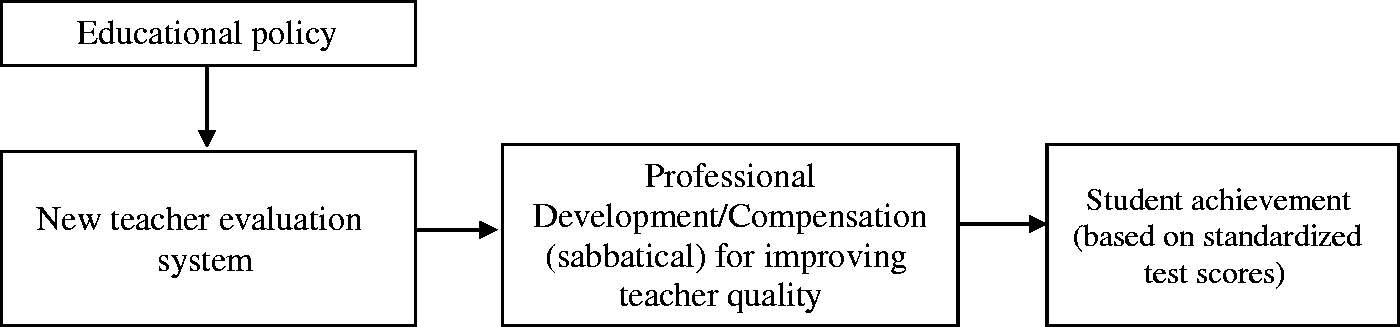
Overall model of the new teacher evaluation system in South Korea.
Also, as shown in Figure 2, unlike the traditional system, which was exclusively based on the vice-principal’s and principal’s assessment of teacher performance, the new system requires multiple evaluations conducted by multiple evaluators. For example, at least three teachers and the school principal perform the required peer review to evaluate their colleague’s teaching practice. In addition, students and parents participate in surveys to evaluate the teachers. Using a five-point Likert scale, the multiple evaluators rate the teacher on various competencies (Seo, 2012).
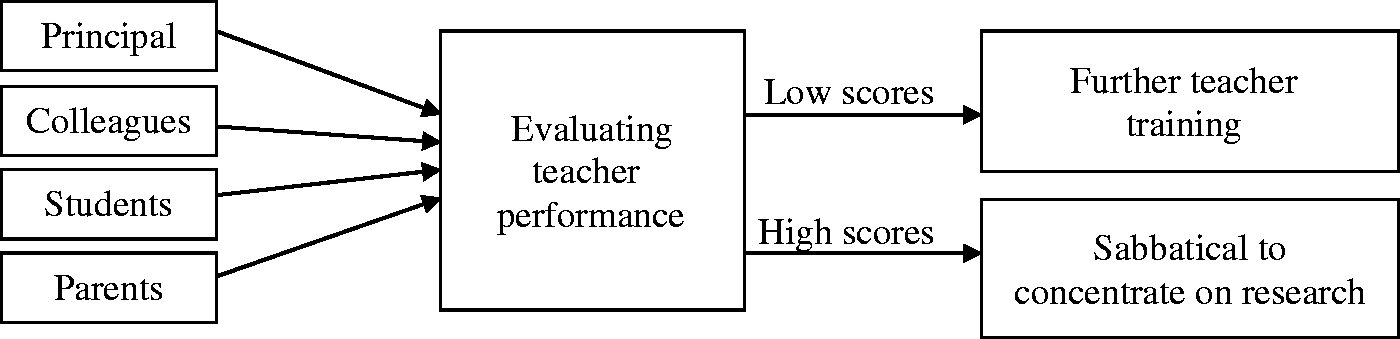
Conceptual model showing evaluators and consequences of the new teacher evaluation system in South Korea.
Teachers receive a score based on their evaluations by the different evaluators. The scores have significant consequences. For example, teachers who receive scores lower than 2.5 on the peer review and higher than 2.0 on the student survey are required to take 60 h of professional training in designated teacher-training institutions. Teachers who receive scores lower than 2.5 on the peer review and lower than 2.0 on the student survey are required to complete 210 h of professional training over a six-month period. Teachers who fail to improve their scores the following year are removed from their classrooms for six months, during which they must take 730 h of professional training at the National Training Institute of Education, Science, and Technology. In contrast, teachers who receive high scores are rewarded with a 6- to 12-month sabbatical to concentrate on research.
An assessment of the new teacher evaluation system
According to the 2011 interim report released by MEST, approximately 90% of teachers (343,725), 79% of students (4,191,548), and 46% of parents (3,045,765) participated in teacher evaluations in 2011. Approximately 2000 teachers received low scores and had to take either 60 or 210 h of professional training. On the other hand, about 700 teachers received high scores and, therefore, were allowed to take a sabbatical. In this section, the new teacher evaluation system is assessed in effectiveness, professional development, lack of consensus, and unreliable sources of evidence.
The political context influenced the teacher evaluation policy change; however, as argued by Hammersley (2013), evidence-based policy may neglect the reality of professional practice. At best, as Hammersley asserted, evidence-based evaluation policy can only reveal what does not work. For this reason, the new evaluation system received a strong backlash from teachers, who expressed their concern about the success of the new teacher evaluation system in South Korea. However, students and parents responded more positively (Kim and Kim, 2012; Seo, 2012). Whereas the majority of teachers believed that the new system had little effect on their professional growth, most students and parents reported that teachers had put more effort into teaching since the new system was adopted. More specifically, most teachers claimed that the new system failed to help them improve their teaching.
There are several reasons for explaining teachers’ negative opinions about the new system. First, teachers criticized that the new system was too focused on requirements rather than support. Although the new teacher evaluation system in South Korea emphasizes professional development, it actually focuses more on accountability. By rewarding effective teachers while punishing less skillful teachers by forcing them to take professional training, the new system is considered by teachers to be shameful and humiliating. If teachers perceive professional development as a punishment, the outcome may not be a positive one. Rather than a disciplinary measure, professional development, as noted by Huang (2016) in a Taiwanese study, should be ongoing, as it is a natural and expected activity of teachers throughout their career and is key to school improvement. Therefore, given that lower evaluation scores would have negative consequences—such as forced professional development—for their peers, it is not surprising that teachers in South Korea tend to give their colleagues high scores. Furthermore, most teachers do not want to openly discuss their weaknesses or hear what they need to improve (Kim et al., 2011).
A second criticism was the lack of consensus. The new evaluation system is based on a set of teacher professional responsibilities in five areas: instructional design and planning, instructional implementation, assessment of student learning, individual student guidance, and fostering students’ social competence. Teachers are evaluated on several elements, including “engaging students in learning.” To receive a high score, he or she must be evaluated as “effectively” engaging students. However, the question is what does “effectively” mean? This term, as well as other terms used in the evaluation, can be considered ambiguous. Without training or specific guidelines, evaluators may have differences in their understanding of such terms. Also, the evaluators never established consensus on the performance indicators, standards of performance, or evaluation criteria. This ambiguity and lack of consensus has resulted in teacher distrust of the evaluation system. Moreover, the student and parent evaluations are considered by teachers to be arbitrary and highly subjective (Kim et al., 2011). As a result, many teachers consider evaluations as popularity contests and place little value on their results.
Third, teachers criticized the new evaluation system for its unreliable sources of evidence. For example, despite the recommendations, peer reviewers make a single classroom observation and fewer than half of parents observed even one class and are reluctant to provide feedback (Kim and Kim, 2012). Both evaluators and evaluated teachers believed that a single observation is insufficient. Consequently, teachers consider the evaluations neither valid nor reliable.
Despite these criticisms and the ineffective implementation of the new teacher evaluation system in many schools, some schools have been successful under the new evaluation system due to their unique efforts, which are discussed in the following section.
Theoretical perspective on teachers’ accountability
Through Thorn and Harris’s (2013) examination of the role and function of measures of individual teacher performance, they revealed that “the pressure for individual accountability is, accidentally, leading to a major restructuring of the school system” (p.57). In The Infrastructure of Accountability, Thorn and Harris (2013) presented an overview of how test-based school accountability continues to be the most influential driver of policy change in US education. They explained that school accountability originated from NCLB, enacted in 2001. NCLB consisted of several provisions to address accountability; however, these provisions failed due to lack of funding and inability to motivate teachers, which, in turn, failed to improve student achievement and to address inequality in access to high-quality teachers (Jackson, 2015).
Furthermore, Thorn and Harris (2013) explained that accountability has transformed teachers’ roles and relationships. Additionally, accountability has influenced the allocation of resources. This restructuring has resulted in new organizations requiring districts to interact in complex ways. Thorn and Harris focused on building the infrastructure of accountability and its influence on the restructuring of the American school system. The theoretical perspective of Thorn and Harris is applied in this paper as the appropriate framework for the discussion of these case studies.
This paper reflects Hammersley’s (2013) notion that policy based on evidence may not consider the reality of teacher and school practices, and, therefore, can be misguided. New educational policies are interpreted and modified; however, policymakers and other actors involved in shaping policy often neglect to remedy the problems reflected in successful cases. In Thorn and Harris’s (2013) case study research, they examined 14 cases in three states (Minnesota, North Dakota, and South Dakota). They looked at how accountability has influenced what and how teachers teach, and how they think and feel about their teaching. To meet the NCLB requirement for test-based accountability, individual school leaders and teachers in a few school cases successfully responded to the pressures of meeting this requirement by utilizing analytic tools such as more advanced and interconnected data systems (Thorn and Harris, 2013).
Case studies: Successful approaches to the new teacher evaluation system
In light of criticisms of the new teacher evaluation system, schools in South Korea have demonstrated new approaches to the system, which have produced better results. This research employs the case study method.
Stake (1995) conceptualizes a case is “a specific, a complex, functioning thing,” more specifically “an integrated system,” which “has a boundary and working parts” and is purposive (in social sciences and human services) (p.2). Case study research was considered appropriate for this research based on Stake’s assertion that the case study method is more advantageous for studying programs and people than events and processes.
Moreover, case study research, as described by Stake (1995), is holistic. This characteristic accurately describes the case studies presented here in that it considers a bounded system in a non-comparative manner to understand the objective of the study. Also applicable to this research is Stake’s description that case studies are empirical, as they are field-oriented, focused on observables, and non-interventionistic. Furthermore, in line with the defining characteristics of qualitative research suggested by Stake (1995), case study research relies mainly on intuition and recognizes problem-relevant events.
For the current research, three school cases (elementary, middle, and high school) were selected from research presented by Seo (2012), based on her review of a 2012 report released by MEST. This report is considered a reliable source due to the comprehensive manner in which it was produced. As required by MEST, the teacher evaluation committee in each school must aggregate all teacher reports and produce a school report to turn into local educational agencies (LEAs). This final school report is open to the public for teachers and parents to review. Finally, after collating the final school reports sent by LEAs, MEST releases the interim report every year to the public. This report, as well as Seo’s (2012) research, highlights the following three cases as examples of individual schools that have successfully modified or adapted the new teacher evaluation system in South Korea. The failure of the new teacher evaluation system in South Korea is, in part, due to the fact that all schools are not the same and, therefore, what works in one school does not necessarily work in another school.
Case 1: Hangang Middle School
Hangang Middle School is located in Seoul’s Yongsan District (Yongsan-gu), one of the most ethnically diverse regions in South Korea (Seo, 2012: 77). The number of students in the three grades totals 538, and the school’s faculty includes 46 teachers. As described by Seo (2012), after implementing the new teacher evaluation system, teachers at Hangang Middle School in Seoul found that the standardized evaluation questions and rubrics were not useful for identifying teachers’ strengths and weaknesses or improving their practices. Therefore, to overcome the weaknesses of the new system, the teachers developed a school-level teacher evaluation system for use in combination with the national system. Keeping the framework of the national system, the teachers added three open-ended questions for the peer review and two additional questions using a five-point scale, for example, “Was the observed lesson effective in helping students learn key concepts in the subject matter?” This question and the other added questions were focused on student learning.
Post-observation meetings were held at Hangang Middle School to give peer reviewers and the teacher the opportunity to discuss what key concepts were presented in the observed lesson, whether students learned those concepts, and which evidence illustrated that learning. Furthermore, based on this information, the peer reviewers could discuss with the teacher how he or she might improve the lesson.
The teachers discussed the survey results with both students and parents and came to a consensus. All participants agreed that good teaching involved engaging all students in learning, helping students develop a deep understanding of the content, effectively communicating with students, caring for individual students, and helping all students succeed in school. This consensus clarified what was expected of teachers and what to assess in teacher evaluation. Therefore, teachers were given constructive feedback that was useful for improving their teaching. Furthermore, according to the teachers at Hangang Middle School, this new approach of the school-based teacher evaluation system was quite successful in promoting their professional development (MEST, 2012; Seo, 2012). This case study underscores Thorn and Harris’s theoretical view that new roles and relationships are reorganizing public education. According to their perspective, individual school leaders and teachers can work together to modify the new evaluation system for successful implementation in their school, to help them respond to the pressures of accountability required by the new system, and to improve their professional development (Seo, 2012).
Case 2: Namsan High School
Namsan High School is located in Gyeonggido in South Korea (Seo, 2012: 77). The number of students in the three grades totals 821, and the school’s faculty includes 88 teachers. To overcome problems with the new teacher evaluation system, as explained by Seo (2012), teachers at Namsan High School developed a school-level peer review system that fosters collaboration among teachers. Teachers in the same department form teams of four or five to collaboratively diagnose the needs of their individual students and to plan appropriate lessons together to address those needs. As most students take the college entrance exam in the 12th grade, teachers focus on promoting students’ academic achievement.
The teachers at Namsan High School developed a system by which each team member conducts a lesson at least twice each semester, while other team members observe. After the observation, the team meets and evaluates the lesson. The purpose of the evaluation is to identify the strengths and weaknesses in the teacher’s practice and suggest what the teacher might do to improve. At the end of the school year, the peer reviewers submit the final scores for each team member. According to Seo (2012), this collaborative approach resulted in significant improvements in student achievement, resulting in a high evaluation rating for the school, which led to receiving monetary incentives from the Gyeonggido Office of Education. The case of Namsan High School demonstrates Thorn and Harris’s (2013) view that collaboration is essential for success. By focusing on collaboration and the collective responsibility of all parties involved (teachers, parents, and the students themselves), teachers at Namsan High School were successful in modifying the new teacher evaluation system for their professional development and student achievement.
Case 3: Sejong Elementary School
Sejong Elementary School is located in a densely populated district on the north bank of the Han River, to the eastern end of Seoul (Seo, 2012: 78). The number of students in the six grades totals 365, and the school’s faculty includes 19 teachers. As reported by Seo (2012), after implementing the new teacher evaluation system, teachers at Sejong Elementary School in Seoul found that fewer than half of the parents participated in the teacher evaluation process. Furthermore, even when the parents participated in the teacher evaluation process, their evaluations tended to rely on what their children said about their teachers. Furthermore, teachers did not understand the reasons behind their scores and what those scores meant.
Therefore, teachers felt that the way parents participated should be changed. The teachers communicated regularly with parents through online message boards, e-mails, and text messages as well as bimonthly teacher–parent meetings. For example, teachers discussed their children’s learning styles and ways in which parents could more effectively help their child with homework. Consequently, teachers had a better understanding of individual students and provided appropriate support.
After implementing the necessary changes, approximately 70% of parents participated in the teacher evaluation process (MEST, 2012; Seo, 2012). Not only did parents do a better job of rating teacher performance, but they also provided more helpful feedback to the teachers. For example, some parents asked teachers to review questions that students answered incorrectly after an exam. Sejong Elementary School is another example of how teachers and parents can build a shared vision and shared values through collaboration to foster student learning and develop competencies for teacher evaluation (Seo, 2012).
The case of Sejong Elementary School reveals Thorn and Harris’s (2013) theoretical perspective on the importance of communicating regularly with parents. Focusing on improving parent participation and parent–teacher communication, teachers at Sejong Elementary School were successful in modifying the new teacher evaluation system for their professional development and student achievement. As emphasized by Thorn and Harris (2013), all actors must work together for successful implementation of the new evaluation system and to help teachers respond to the pressures of accountability.
Conclusions and implications
Revisions to the new teacher evaluation system have been debated by all the actors involved. It is clear that the government should provide a national framework for teacher evaluation and guidelines and templates to assist schools in developing a school-level teacher evaluation system. On the other hand, since local schools have their individual differences, they need to develop additional instruments, evaluation questions, or rubrics within the framework of the national system. Most importantly, schools need to build a consensus on understanding standards of performance and evaluation criteria among teachers, principals, students, and parents. As the primary purpose of teacher evaluation is to build an evaluation system that fosters professional learning and growth, which is a time-consuming project, it requires commitment and support from all involved, particularly teachers.
Furthermore, to address the issue of uneven distribution of high-quality teachers and the lack of equitable access to educational opportunities for all students, policymakers, and others who shape teacher evaluation reform may benefit from reviewing the standards proposed by Darling-Hammond (1994), consisting of instructional components designed to maximize learning. By adhering to such standards, teacher evaluation systems could help ensure educational equity and fairness.
This paper has several important implications. First and foremost, the validity of teacher evaluation should be addressed. Because the evaluation is conducted by the teachers and used for the teachers, for valid and effective evaluation, teachers should be knowledgeable of the system and skillful in performing evaluations, as well as educated to fully appreciate its value for helping their professional development. Kraft and Gilmour’s (2017) study found that the majority of teachers in 24 states in the USA received “above proficient” evaluation ratings; however, evaluators perceived more than three times as many teachers to be below proficient than they rated as such. In other words, although evaluators may be able to distinguish between low- and high-performing teachers (Harris and Sass, 2014; Jacob and Lefgren, 2008), they do not always do so on evaluation ratings that have high-stakes consequences (Grissom and Loeb, 2017). To ensure a more objective and reliable evaluation, teachers and other evaluators need to be trained to perform accurate evaluations and understand how evaluations can help teacher’s professional development.
A second implication concerns the measurement of teacher evaluation based on students’ standardized achievement test scores. Teachers have traditionally been evaluated based on standardized achievement test scores; however, one major concern is the lack of external validation. Brown et al. (2016), in their study on the Irish educational system, recommended that instead of focusing on test scores as a measure of quality, teacher evaluation systems should be “revised with more emphasis on the quality of school mechanisms and supports to facilitate and promote parental engagement in student learning” (p.823). More important than test scores is preparing students to cope with and perform in society successfully after graduation. Only focusing on students’ test scores for the evaluation of teachers can result in neglecting other important functions of education such as improving the quality of a student’s entire life. Moreover, improving literacy and problem-solving skills, and increasing familiarity with technologies, are positively associated with students’ well-being; for example, future employment, earnings, and health (OECD, 2009). Therefore, rather than focusing only on test scores, the evaluation of teacher’s performance should include various other components for a more accurate evaluation. Researchers can contribute by developing measurements based on preparing students to cope with and perform in society successfully after graduation.
Third, what may be appropriate for one school may be inappropriate for another school. Thus, each school and its teachers are encouraged to modify standard evaluation criteria and create appropriate evaluation items, which is a highly demanding job. Relying on current educational research findings, the Ministry of Education can offer more support and more suggestions to modify the evaluation system for each individual school in order to make it more effective and appropriate. In addition, scholars should find more effective ways to consider various local characteristics by examining the problems of the current evaluation system. An exemplary model demonstrating the practical application of this idea is the Scottish Inspectorate of Education, which is a government agency responsible for inspecting all schools at the local level. This agency requires that all schools in Scotland take a systematic approach to continuous improvement by focusing on self-evaluation (Audit Scotland, 2011).
Fourth, another implication of this study is that other countries can learn from South Korea’s development and implementation of the new teacher evaluation system, especially about ways schools can adapt and modify teacher evaluation policy for their success and to improve teacher quality. This idea of looking at other countries to understand what has been successful or has failed elsewhere was endorsed by the research of Akiba and LeTendre (2009), who conducted a comparative analysis of the policy contexts in the USA, Australia, and Japan to examine the relationships among improving teacher quality, workplace planning, and management, teachers’ working conditions, and teacher induction and professional learning. Based on their findings, they supported adopting and modifying policy to make it appropriate for each country’s own context.
This study also has implications for future research. First, a closer examination of the outcomes of the new teacher evaluation system is needed. For example, forcing the less skillful teachers to acquire additional professional training may not produce the intended positive outcomes. Second, researchers need to consider whether economic structural changes and better preservice training may also lead to the desired outcomes in a less bureaucratic manner.
It should be noted that modifying the current teacher evaluation system is only one part of the large reform efforts needed to improve public school education. Although the new evaluation system can improve individual teacher professional development, which might improve parents’ perceptions of their children’s schools, the ultimate goal is to reform the overall education system by considering the interactions among all parts of the system. Therefore, future research and policies should consider teacher evaluation systems in the context of entire school reform efforts.
Footnotes
Declaration of conflicting interests
The author(s) declared no potential conflicts of interest with respect to the research, authorship, and/or publication of this article.
Funding
The author(s) received no financial support for the research, authorship, and/or publication of this article.