




Abstract
This article conceptualizes the materialities of school governance council meetings. A concern for the material a/effects of spatial positioning emerged during a participatory action research project concerned with secondary school students’ sense of the benefits and challenges of student representation on school councils. Attending to affective, spatial and material dimensions of power with the conceptual resources of new materialisms, I question representational logics in policy, research and practice related to school councils. In particular, I interrogate whether the presence of human bodies representing interest groups necessarily promotes more democratic relations, and whether questions of power are best explored through discursive analysis alone. School council meetings are understood to be events where the political philosoph(ies) of a school materialize in concrete relations between bodies, and where subjects form, re-form (and de-form) in and through material-discursive practices.
School governance council meetings are zones where questions of political theory and subject formation in schools, and their embodied, affective, spatialized enactment may be productively explored. While a range of terms are used nationally and internationally to describe school governance bodies (for example, ‘school board’ in the USA), this article uses the Australian term ‘school council’ (Victoria State Government, 2015). School councils meet regularly (often once a month) to make collective decisions about matters impacting on the daily operations of a school. School governance councils comprise individual volunteers that may include teachers, parents, students and community members. In Western liberal democracies, the school council meeting has ‘the democratic potential’ to be ‘a space that is accessible to a broader, non-expert, non-technical audience’ and that nurtures citizens’ ‘political capacity […] to shape public institutions and public life’ (Wilkins, 2016: 18).
This article’s focus on the a/effects of spatial positioning if and when students are represented on school councils emerged during a participatory action research project in the state of Victoria, Australia (Mayes, 2016). This study aimed not only to investigate secondary school students’ sense of the benefits and challenges of student representation on school governance councils (see [identifying reference] for details), but also to intervene politically in current school council policy arrangements. This study’s interrogation of the methods that make a difference in and to the world is a productive extension of participatory action research’s historic focus on praxis. Change , however, was understood in this study as ‘complex, contradictory and uncertain’ as well as ‘everyday, routine and ongoing’ (Lury and Wakeford, 2014: 6). Six secondary school students were involved throughout the research as co-researchers (Research Interns), 21 students participated in regional student research workshops, and 218 students completed an online survey exploring the issues surrounding student representation on school councils. Ten principals were also interviewed about their experiences and perspectives on student representation on school councils. Student research activities (co-researcher work, student research workshops and online surveys) generated accounts of past experiences of students who had been student representatives on their school’s council, as well as speculations of students who had not directly experienced a school council meeting.
During collaborative research days and surveys with secondary school students, on a number of occasions students spoke and wrote about the significance of spatial positioning and the role of matter (for example, furniture) in school councils – both from their embodied past experiences, and in creating speculative configurations of materials. Students articulated these accounts and speculations on the potential impact of spatial positioning in school council meetings in verbal and written language, often in tandem with embodied movement and/or visual creations. I take up this particular concern for embodied, spatial positionality, working between students’ spoken words and visual creations, and theoretical concepts associated with feminist new materialisms.
This article conceptualizes the materialities of school council meetings and the coming-into-being of spaces, affects and subjectivities as these meetings happen. School council meetings are understood to be events where the political philosoph(ies) of a school materialize in concrete relations between bodies, and where subjects form in and through material-discursive practices. This article questions representational logics in policy, research and practice related to school governance councils: that the presence of human bodies representing interest groups necessarily promotes more democratic relations, that words ‘represent’ the thoughts of individuals, and that questions of power are best explored through discursive analysis. Rather than foregrounding human agents and agency, I work with insights from the affective and material ‘turns’ to de-centre the autonomous human subject, attending to variations in capacities to affect and to be affected. Affects are not only affections, or modes of feeling (Spinoza’s use of the Latin word affectio), but are also the passages or transitions from one state to another, happening between bodies (Spinoza’s affectus) (Deleuze, 1988: 49). I argue, that the forces contributing to the production of power relations in school council meetings are ‘not merely social’, and the bodies produced are ‘not merely human’ (Barad, 2007: 230). These material, spatial and affective dimensions of power at work in school council meetings matter.
Below, I interrogate the logics of stakeholder participation before introducing the potential of new materialist ontologies for this study of school councils. The study’s participatory methodology and methods are then outlined, followed by an analysis of three ‘material moments’ (Taylor, 2013: 689) where more-than-human spatial and affective arrangements of school council meetings produced particular embodied subject positions. I conclude with implications for reconceptualizing school governance practices and educational policy research.
The logics of stakeholder participation: Presence and power
This research study was commissioned by the VicSRC, who describe themselves as: ‘the peak body representing school aged students in Victoria’, working ‘to empower all student voices to be valued in every aspect of education’ (VicSRC, 2016: para. 1). In 2015, at the VicSRC’s annual congress meeting, students from across Victoria voted for a policy priority for 2016: School Leadership and Governance. VicSRC students advocating this policy-advocacy priority considered mandatory student representation on school councils to be a political tactic that could strengthen ‘student voice’ in school decision-making processes across Victorian schools. 1 I was commissioned as a researcher to facilitate a research study exploring students’ and principals’ perspectives on student representation on school governance councils. As a former teacher and research advocate for student participation in school governance practices, I interrogate the logics of stakeholder representation that undergird advocacy for students’ mandatory representation on school councils. I question these logics not to dismiss them, but to rather point to where their humanistic assumptions may undermine their hopes for social justice in schools.
The logic of ‘stakeholder’ participation is that the physical presence of diverse interest and demographic groups ‘at the table’ will foster capacities to affect decisions made around this table. According to liberal humanistic conceptions of participatory governance, school councils are to make decisions in the best interests of students at the school through democratic deliberation. The meeting situation is conceptualized as social and rational (86) – individual intellects, wills, intentions and interests come together to work towards ‘achieving, sustaining and reviewing consensus’ through ‘the intersubjective recognition of criticizable validity claims’ (Habermas, 1984: 17). This conception of a school council’s operations foregrounds human reason and agency.
Postcolonial, feminist and poststructural positions have critiqued this model of democratic deliberation for its abstracted distance from concrete situations where power, knowledge and desire circulate (Porter and Porter, 2003). For Edward Said (1989), neutrality and equality in the dialogical encounter are impossible; one party always needs to speak according to the categories and linguistic norms of the party with greater power. Democratic deliberation, far from a neutral zone of encounter, is a ‘political struggle’ (Alcoff, 1991: 15) deeply entwined with assumptions about communicative norms and rationality that privilege those from particular classed, gendered and racialized positions and invalidate, the speech and emotions of others. Committing to consensus through dialogue may ‘incline some or all to advocate removing difficult issues from discussion for the sake of agreement’ (Young, 2000: 44). Emotion, and those deemed to be excessively emotional, are marginalized by this focus on rational debate; members are impelled to contribute in a manner that approximates the norms of calm rationality associated with being white, middle class and male (Campbell, 1994).
These limits of democratic deliberation and the structural and discursive conditions that create and constrain subject positions in school councils have been eloquently explored with the resources of critical theory and Foucauldian discourse analysis. Helen Young has recently employed the critical feminist resources of Iris Marion Young to analyse the discursive processes shaping decisions made (or not made) in four school councils in the UK, particularly for parent representatives aligned with classed, gendered and racialized subject positions. Helen Young considers ‘who talked and on what subject’, speakers’ ‘authority claims’ and the ‘norms which limit who can speak and what can be said’ in these meetings (Young, 2016: 2, 11). Brasof (2015), similarly, from a North American context, has critiqued the structural arrangements of schooling and neoliberal school reform imperatives that undercut the potential for ‘authentic’ student participation in school governance processes.
Working with the resources of Foucauldian governmentality, Wilkins (2016) has recently examined the ‘techniques and practices through which the state legitimates the proper conduct of school governance’ (19). Exploring the ‘hidden politics of exclusion’ in alterations in governance requirements that appeal to ‘technical knowledge and expertise’, Wilkins tracks the ascendency of ‘professionals, experts, consultants and research people with decision-making skills’ in the composition of school councils (19). These manifestations of ‘market forces on the techniques and practices of school governance’ are demonstrated to have ‘direct implications for those who are included and excluded from the business of school governance’ (19).
These analyses demonstrate that the individual ‘representative’ (whether student, parent, teacher or community member) on a school council is entwined in, and constituted by, complex behavioural norms, interpersonal power relations and technologies of governance. The ideal conditions of democratic deliberation (Habermas, 1984) are not necessarily felt; to be present in a meeting does not necessarily equate with power; to speak in a meeting does not equate with being heard (Cook-Sather, 2006). As Wilkins (2016) puts it, ‘[w]hile attractive in theory, the representative function of school governance has in practice failed to properly materialize’ (16).
While these methodological tools have enabled cogent analyses of interpersonal dynamics of school council meetings and structural constraints on human agency, their focus has remained on the words and actions of human actors – who, variously, foster or block opportunities for particular individuals and groups in school council meetings to speak and to be heard, and whose individual human agency is constrained by broader political discourses, structures and technologies of power. Karen Barad argues that a politics of identity (that analyses the work of power among those in various standpoint positions) is in danger of ‘arrest[ing] and flatten[ing] important features of [power’s] dynamics’ (Barad, 2007: 246). In such analyses, there is a danger that school council meetings are understood as sites of combat between individuals’ intellects, wills and intentions in distinct social locations. In these analyses, space may be just a backdrop, and matter an accessory to the operation of human power plays. Further analysis is needed of the material micro-practices that contribute to these vacillating flows of power: how the more-than-human is implicated in these (apparently) human power plays, and how the more-than-human dynamically intra-acts with (what have been described as) macro-political forces (such as economic and political shifts associated with neoliberal governmentalities). Such analyses may extend the insights of discursive analyses of neoliberal governance practices, to examine the ‘mundane and practical changes in our everyday practices’ that incrementally work in a ‘slow burn’ to reconfigure institutions (Ball, 2016: 1050, 1046). An analytical turn to the more-than-human simultaneously enables ‘a politics of possibilities’ that ‘imagin[es] and interven[es] in the configurations of power’ (Barad, 2007: 246).
From presence and power to agencies: New materialisms
This article explores the materiality of school council meetings, as accounted for and as imagined by students, read through the insights of Karen Barad. Working philosophically and methodologically with insights from quantum physics, Barad’s agential realism extends and amends structural and discursive approaches to questions of power and subject formation, appropriated here to think of what is happening in school council meetings. Agential, for Barad, rethinks the central sociological concept of the autonomous, individual human agent. The ‘agential’ of agential realism extends analyses of social forces in subject formation, incorporating materiality as ‘an agentive and productive factor in its own right’ and enabling analysis of ‘material constraints and conditions and the material dimensions of agency’ (Barad, 2007: 225). Realism, in Barad’s agential realism, is a rethinking of representational models that mirror a ‘reality’ (and, indeed, representational models of democratic participation where a human body represents an interest or demographic group). Realism, in Barad’s account, refers to ‘the real consequences, interventions, creative possibilities, and responsibilities of intra-acting within and as part of the world’ (37). Materialism, for Barad, is distinct from Marxist economic materialism, as well as from post-Marxist discursive conceptions of the material (where discourses have material consequences) (226, 225). Barad’s materialism attends closely to what concrete entangled configurations of matter, bodies, discourses, capital, affects, spaces produce.
The materialism of agential realism is an amendment to Foucault and Butler’s discursive analyses of the ‘materialization of human bodies as constituted through social forces’, extending these analyses to the ‘materiality of nonhuman beings/bodies’ (Barad, 2007: 232). This extension draws attention to the ‘entanglement of material relations (including those that get named social, political, economic, natural, cultural, technological, and scientific […])’ (233). Agential realism has been argued to offer ‘a new ethical account of how different distinctions get made, materialize, and solidify’ (Taylor, 2016: 9). In consideration of school governance practices, where ‘distributed leadership’ models have often been advocated as having the potential to equalize power relations, agential realism further pluralizes and distributes knowledge, beyond a conception of knowledge as housed in individual minds . The conceptual resources of agential realism enable an articulation of the material dimensions of school political economies and the formation of the subjectivities of bodies who can (and cannot) contribute to decisions about what happens in schools. These concepts also form fresh ways of focusing on the fluctuating affective economies of school council meetings. I introduce the key concepts of intra-action, phenomena and apparatuses before considering their implications for researching space, objects, meetings, ideas and decisions, subject positions and structures of power.
Bodies (human and nonhuman), as well as space, objects, meetings, ideas and decisions, subject positions and structures, are understood after Barad to be phenomena that emerge in intra-action. Barad’s neologism intra-action undoes interaction’s presumption of the ‘prior existence of independent entities’ (Barad, 2007: 133). Rethinking the ‘dialogue’ in a school council meeting, these conversations are not interactions involving atomized individuals, but intra-actions where differences materialize. What is understood to be a distinct human subject position (for example, a chairperson or student representative), or a physical object (for example, a table or chair), or what we may think of as ephemeral and non-material (for example, an emotion or idea that a person ‘has’ or a decision that a group of people ‘make’), are each phenomena that emerge in intra-action and that are contingent on the cuts that apparatuses make.
Apparatuses, for Barad, are ‘not mere instruments serving as a system of lenses that magnify and focus our attention on the object world’ but are rather ‘an integral part of the phenomena being investigated’, contributing to the ‘production and reconfiguring of difference’ (Barad, 2007: 232). An apparatus does not simply detect pre-existing differences (for example, a machine that marks a test score paper) (232). Rather, for Barad, apparatuses are pivotal in the materialization of phenomena, producing boundaries through the ‘agential cut’ – cutting ‘“things” together and apart’ (179). The cut is a constitutive part of the phenomena. For example, the apparatus of the test paper enacts a ‘cut’ between human bodies doing a test. The machine that marks the test paper is a constitutive part of the phenomena produced, producing the phenomena of the ‘failing’ or ‘successful’ student subject position.
This approach to analysis thus explores the connectivities and boundaries that are made and re-made in each intra-action, considering movements of ‘spacetimematter’ (Barad, 2007: 182) that dynamically reconfigure power relations moment by moment. Yet, this is not an analysis of connectivities ‘among preexisting nested scales’ (for example, concentric circles expanding from individual bodies at a meeting, to the meeting group, the school, the local community, the national, the global). Rather, this topological approach analyses the ‘agential enfolding of different scales through one another’ (245).
This mode of analysis has implications for conceptualizing the intra-actions that co-produce spaces, objects, subject positions and structures of power. Space, for Barad, is ‘not a collection of preexisting points set out as a container for matter to inhabit’ (Barad, 2007: 234). Spaces are not containers populated with pre-existing bodies and objects, but bodies, objects and spaces are intra-actively generated. Taking up Barad’s insights, Taylor (2006) argues that ‘things act in a kaleidoscopic confederacy [to] create the texture, atmosphere, mood and affects' that generate the conditions for human understanding, feelings, and actions in educational spaces (5). Using the example of a student in a wheelchair attempting to find a place in a small room in a higher education setting ‘overstocked with too many large, heavy and unmovable tables’, Taylor notes that ‘the tables produced a cut: that is, they materially highlighted whose bodies “fitted” comfortably here (those positioned behind tables, in orderly if rather narrow rows) and whose bodies did not ([…] required to sit in relative isolation unable to fit behind a table)’ (Taylor, 2016: 10). The student ‘co-constitutively emerges as being disabled by the room’s materialities. In a different room this may not have happened’ (10). A subject position, then, is ‘a produced, contingent, and contested category that changes through time’ (Barad, 2007: 243), materializing ‘through iterative intra-actions’ (237). The subject position of, for example ‘disabled student’ (or ‘student representative’) ‘is not a fixed […] property of individual human beings, but an actively contested and disunified […] category that refers to particular material-discursive phenomena (not individuals)’ (243).
These analytical tools not only enable consideration of the minutiae that produce spaces, bodies, objects and subject positions, but also extend analyses of structures of power. Structures of power (for example, gender, class, or race relations, or school hierarchies, or neoliberalism), for Barad, are ‘apparatuses that contribute to the production of phenomena’ (for example, the ‘student representative’ or ‘school council Chairperson’) (Barad, 2007: 237). Structures of power are simultaneously themselves phenomena ‘produced through the intra-action of specific apparatuses of bodily production marked by exclusions’ (237). Structures (such as the composition of a school council) are not ‘transcendent, objective determinants’, but rather are shaped by the ‘modes of representation and meaning that social actors […] give to their positions and activities’ (Fernandez, 1997: 137, cited by Barad, 2007: 229). These indeterminacies render structures, then, able to be re-made through re-configurations of bodies, objects, discourses, affects. This constitutive contingency generates the potential for radical change in research that participates with (so-called) others.
The study
The participatory orientation of this study deliberately sought to involve students in design, enactment and analysis, listening to and acting on the views and insights of the ‘consequential stakeholders’ of schooling (Groundwater-Smith, 2007: 113). Student Research Interns and I worked in confederacy with other students, employing qualitative research methods (interviews, focus groups, surveys, visual and arts-based methods). Working, too, with the emerging materialities and concepts of the research, I formed an expanded view of who and what participates in school council meetings and in research – beyond the human agent alone.
Research methods and materials were not conceptualized as means by which to ‘collect’ data – as if ‘data’ are pre-existent in the minds of atomized individuals, simply needing a medium through which to be ‘expressed’. Rather than tools through which to usher forth the ‘authentic’ ‘inner’ ‘voice’ of students, I regard research methods and materials as apparatuses – ‘material-discursive practices that are inextricable from the bodies that are produced and through which power works its productive effects’ (Barad, 2007: 230). The dynamic role of matter – what phenomena like rubber erasers, fluorescent papers and cups of M&Ms could do – became part of an exploration of the unfolding of research methods as events.
One research method at regional student research workshops involved students working in pairs or groups to create a school council configuration in confederacy with a range of materials – including rubber erasers shaped to imitate fruit, fluorescent paper circles, stickers and pens. I use the word create rather than represent to mark a break with representational methodologies that work with the assumption that ‘data’ reflect inner thoughts, or that what is produced represents past events. To conceptualize research as creation is to ‘acknowledge potentiality as an ontological force – in everyone and everything’ (Wurth, 2017: 39). These materials were offered for creations of new configurations, as experimentations with what can be done when bodies are arranged differently.
A number of the groups generated visual creations where visual fruit erasers became stakeholder groups (for example, parents, principal, teachers, students, community members), accompanied by writing (see Figure 1 for an example).
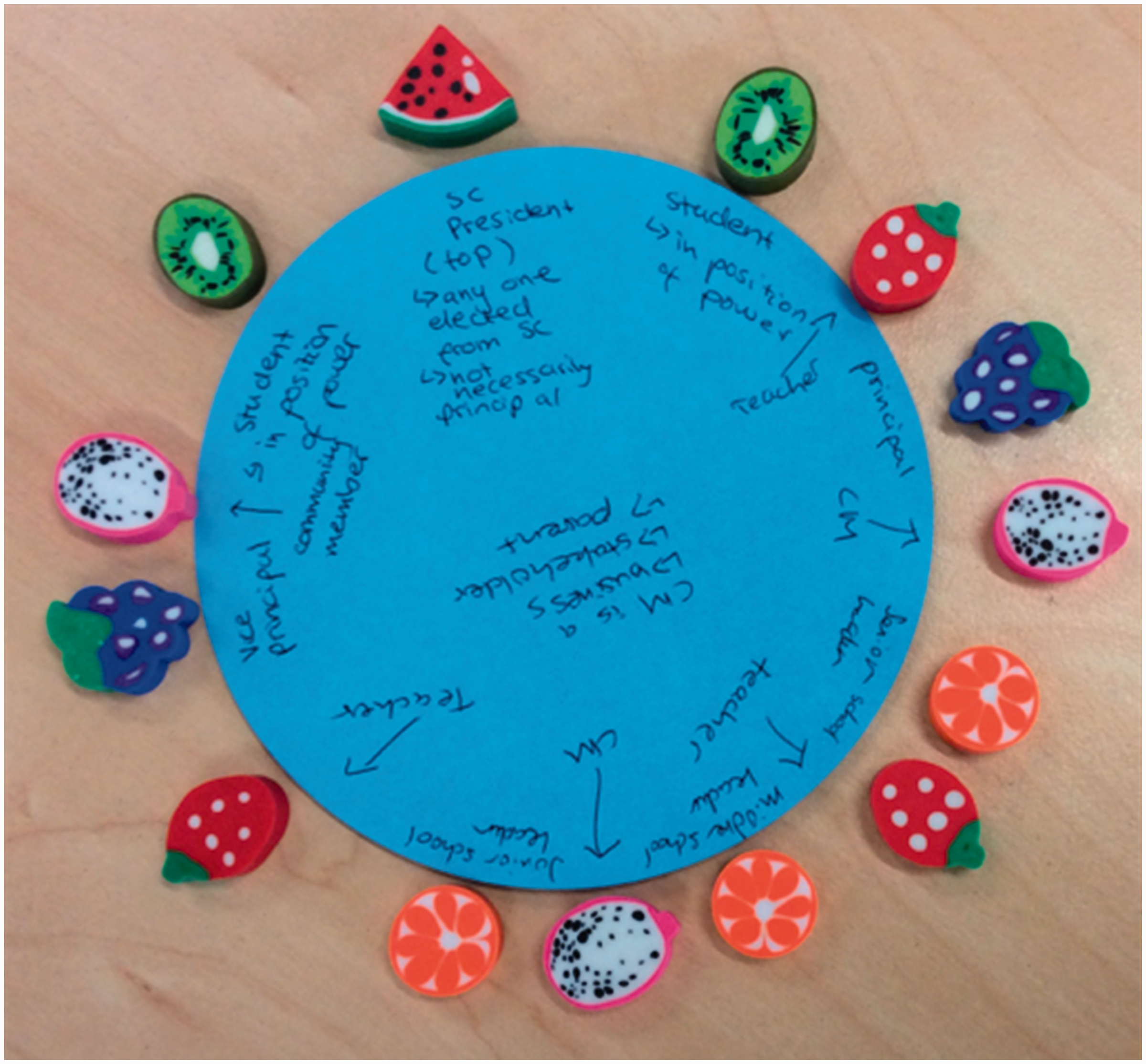
A visual creation.
Other students worked with the research materials in intra-action with memories of past events and their lingering affective intensities (see Figure 2 below).
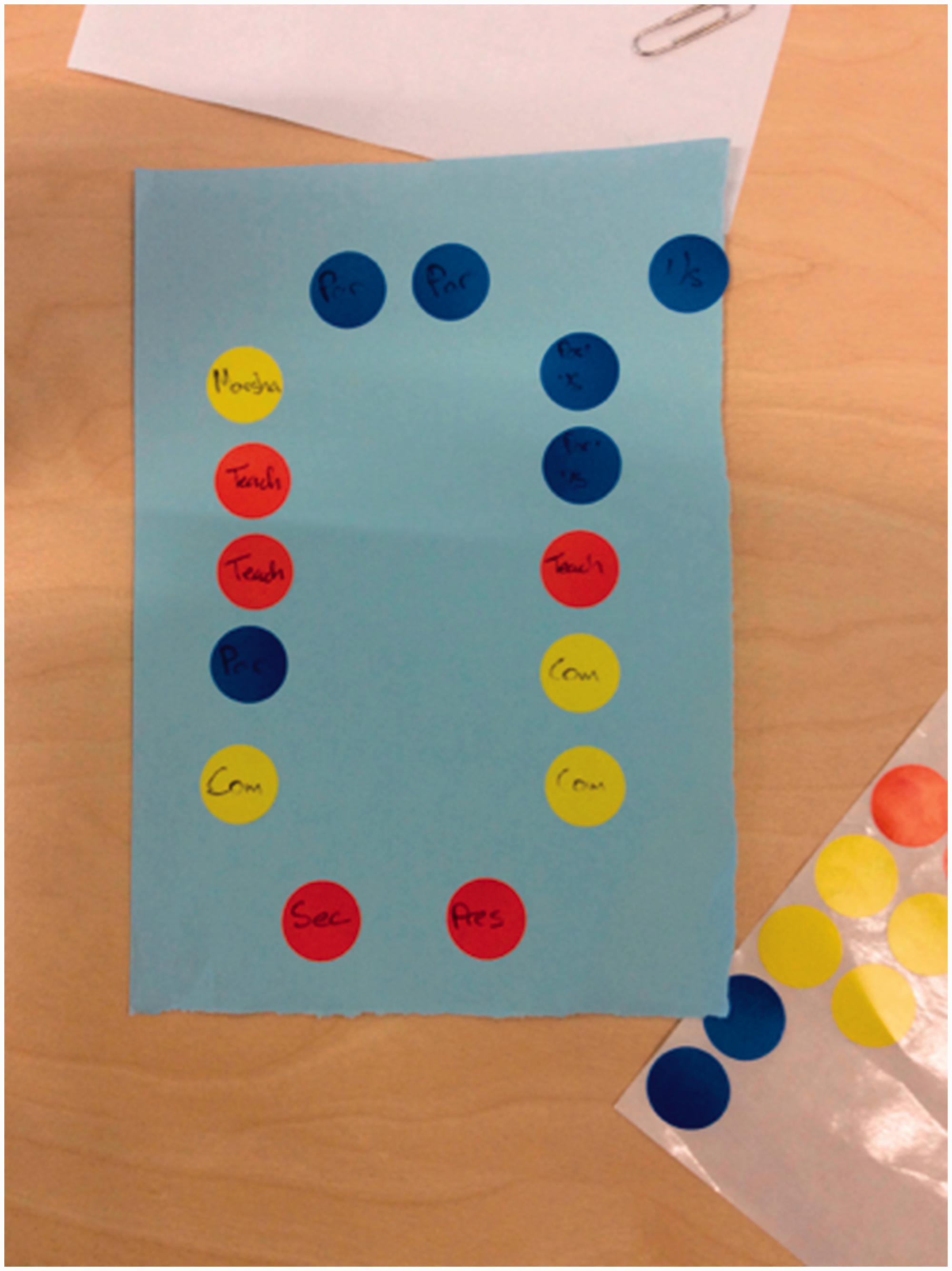
A visual creation - Samuel.
The ‘data’ creations generated are not a mirror of past events, as in logics of reflexivity, or a projection of future events, as if gazing into a crystal ball. Instead, the intra-actions of paper, rubbers, pens, memories, circulating affects and hopes-in-formation were productive of new ways of thinking about past, present and future events. These physical creations became apparatuses propelling collaborative theorizing of power dynamics in school council meetings in the research event.
Each creation, and its intra-active reconfiguring, was different, and contingent, given particular meaning by students as they experimented with the production of particular bodies and boundaries in schools (Barad, 2007: 230). In what follows, I attend to three ‘material moments’ in their ‘specificity and density’ (Taylor, 2013: 689). Taylor describes ‘material moments’ as enabling a ‘close empirical’ analysis of how human bodies, spaces and matter are lived, as well as surfacing ‘our ethical entanglement as researchers in enacting practices of knowledge production’ (689).
Creating school council spaces and positions
Materializing ‘nerves’
A material moment emerged in a student research workshop when a Year 12 student spoke to the workshop group and produced a visual creation. Samuel (a pseudonym) had been one of two student representatives on his school’s (a government co-educational school in an outer suburb of a major metropolitan city) council the previous year.
Samuel initially gave an account
2
of his experience of the conditions of speech in school council meetings:
A lot of conversations – while there was – you wanted to talk if you could, but they didn’t give you that opportunity. It’s hard for a young person to get the courage to speak up if they’re not given the opportunity first.
The visual creation that Samuel later formed, in this research workshop, was a seating plan of a school council meeting (see Figure 2). Samuel spoke to the group of students and researchers about the visual creation; his account materialized through the multiple apparatuses of paper, stickers and pens, and memories of a past intra-action: We [the other student representative and Samuel] were put separately from the rest of the school council. We weren’t sitting in the same position on the table. We were at the back, slightly off in the corner [the blue sticker in the top right corner]. We just kind of watched what happened. We went into a room like a restaurant. I often sat on the side a bit, from nerves.
What lingers with Samuel, materializing in this research event, is not (only) how he was explicitly discursively positioned by members of the school council. In his account, formed in intra-action with paper, stickers, pens and tables, the discursive positioning of Samuel is inextricably entangled with furniture arrangements and spatial positionings that materialize differences between human bodies. ‘[S]mall but consequential differences’ (Haraway, 1992, cited in Barad, 2007: 29) produce subject positions in this meeting space. The chair’s position, on the edge of the rectangular configuration of bodies around a table, is an apparatus that cuts him together and apart, producing a new subject position – student representative on the edge, excluded. Samuel is constitutively excluded from the decision-making-table-space-phenomena; differences materialize with the apparatus of the chair among ‘multiple apparatuses of bodily production’ (Barad, 2008: 135). The positioning of this chair and the entanglement of his body with it makes Samuel’s subject position intelligible; the chair and the space are implicated in the production of particular boundaries between school council members (cf. Barad, 2007: 243). The chair works in confederacy with the table, the meeting agenda, the other human bodies, sedimented discourses of who should speak and who should be silent, circulating affects, ticking clocks, to materialize a felt sense of exclusion. The chair, as in Taylor’s analysis of a male teacher’s classroom chair, ‘condition[s] the possibilities of mobility and stasis’ (Taylor, 2013: 693). These ‘bodies in the making [in this instance, Samuel’s body] are never separate from their apparatuses of bodily production’ (Barad, 2007: 159). Samuel’s visual creation undercuts the ‘stakeholder representation’ logic that representative presence will necessarily produce agentic capacities at the meeting table.
Samuel’s sense of agency (or lack of agency) in this particular school council meeting does not precede this intra-action (cf. Taylor, 2013: 694), but emerges (and is blocked) through it. Yet, Samuel is not a ‘pawn’ occupying a space ‘on the chessboard of an overarching static structure’ that we might name as neoliberal governance; the spatiality of neoliberal school council governance is ‘itself a contested and ever-changing topology that is iteratively (re)produced through the dynamics of intra-activity and enfolding’ (Barad, 2007: 243). Indeed, in this material moment, in this research configuration with other students and researchers, negative affects that Samuel has been entangled with are made visible. In this research intra-action, these negative affects are named, politicized, and resisted (as exclusionary); they become part of other phenomena (such as this article).
Materializing ‘sense’
At the same student research workshop, another student, Rebecca (a pseudonym), gave another account of being a student representative on a school council. Rebecca, a Year 12 student at the same school, sat on the school council in a different year to Samuel (when she was in Year 10), in a different configuration of bodies. Rebecca’s father was a long-standing parent representative on the school council. I was chosen because I was one of the more senior SRC [Student Representative Council] members and my Dad was on school council – it was convenient to go [in the car together]. He was there even before I was on council so we had discussions at home about it. It is a big commitment, and daunting, so you have to be interested in going. […] My sister was on it [school council] too – she got into the rhythm. […] She said, “the financial report is not going to make sense, but one day it will.”
Notwithstanding the multiple apparatuses that materialize Rebecca as (apparently) confident student representative, Rebecca simultaneously spoke of other affects materializing in and beyond the meeting space. When asked a question (an apparatus in the research intra-action) about any challenges that she experienced while on school council, Rebecca said: It’s worth saying that as a student, you walk in [and] you’ve got the principal and other teachers – principal and high up teachers – the people who volunteer are quite often head of faculties. We had a member of parliament. You have high important people –people from [a university]. You’re not walking into a relaxed setting. […] They want to move through quickly. Sometimes it’s hard to get a voice. […] You picture a meeting and everyone having a say – like this: It is everyone sitting around a table. You have the school council president [who says]: “Agenda 1, this is what we talked about last week, are we going to move this motion?” It’s open discussion that’s controlled – very formalized. If it’s too casual, you don’t get anything done. We’re here to get things done.
For Rebecca, there are other ambivalent affects between spaces: I was in an in-between place – I couldn’t make any changes to school council, but SRC wants you to do something. […] You’re the one taking back the info and often the students didn’t want to hear it. […] It [information from school council] didn’t serve their [SRC students’] purpose. Their purpose was changing uniform, and I had no news on uniform. I had news on maintenance, on grants to do this building, or fix our garden. Then students are complaining, “we’re making a garden, but we are not doing this.” But it’s explaining to them the grant has to be used for the garden. […] You then speak for students, but then students don’t like it.
Samuel and Rebecca’s accounts suggest the complexities of participating in school council spaces. What is produced discursively (what can be said), affectively (bodily intensities felt), and physically (the material consequences of decisions) depends on contingent apparatuses. Reading Samuel’s account through Rebecca’s, the iterative repetition of particular bodies ‘representing’ others becomes apparent; we glimpse how it comes to be that particular bodies are more likely to become and to remain ‘student representatives’ in school councils.
This analysis of the dynamic materializations of students on school councils challenges representational logics – particularly suggestions that representative presence enhances agentic capacity. We might question, then, what other agencies are at work, and what political interventions are possible that might move beyond the framework of representation (Barad, 2008: 124). The materiality of the visual creation research events suggests some possibilities.
Materializing potentiality
In these visual creation research events, students also created hypothetical configurations of bodies at school council meetings – speculative physical configurations of how a school council meeting might materialize differently. In these visual creations, rubber erasers intra-actively became students, teachers, parents and community members around paper tables (see Figure 1). Configurations emerged where student-rubber-erasers were positioned either side of the school council chairperson, in physical ‘positions of power’ (as written on paper in Figure 1). In another visual creation (see Figure 3), the number of student-rubber-erasers multiplied, proliferating in number to occupy the surface area around a paper-table.
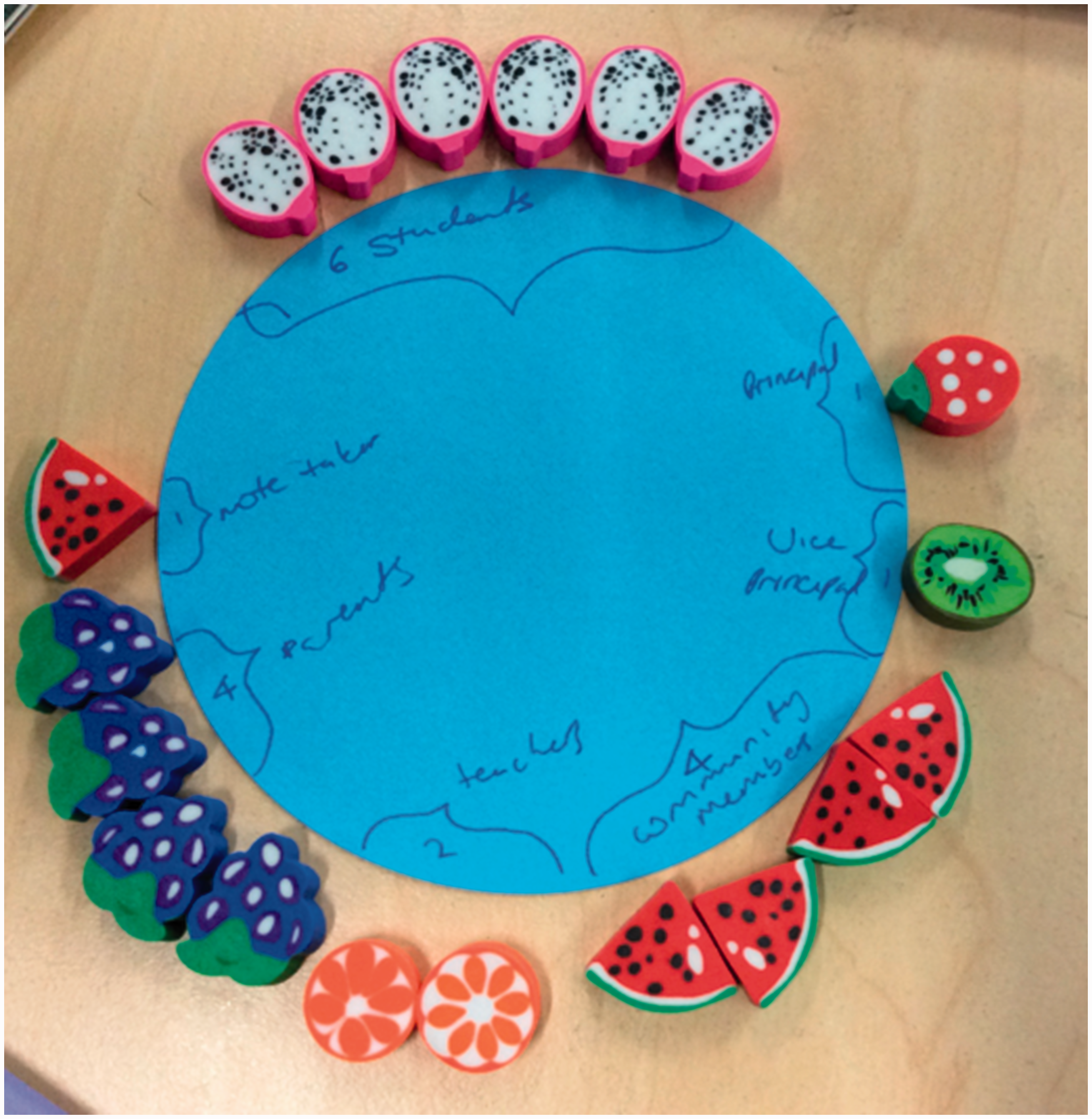
A visual creation.
In creating these configurations and sharing them with the broader group of students and researchers, there was laughter, smiling and marvelling at the variety of creative configurations generated. There were words spoken about what new political agencies might be enabled – resistances to present arrangements alongside the creation of alternative possibilities. For example, students spoke about the potential of school council members participating via Skype and a data projector – technological apparatuses extending human capacities even if the school council member is unable to be corporeally present. Some of the visual creations were, arguably, similar to present arrangements of school councils, while others were drastically different in the proportional numbers of representative groupings around the table. These configurations could be interpreted as, at times, utopian – imagined possibilities that just ‘play’ with the ‘serious’ spaces and configurations of school councils. However, after Barad, I do not interpret these configurations as fantastical. Rather, materializing new configurations of bodies (paper, rubber erasers and writing), these visual creations politically potentialize ‘possibilities for changing the configurations of spacetimematter relations’ (Barad, 2007: 230) – even the configurations of school council meetings. These research methods and materials, therefore, became political interventions that materialized new realities. There was a ‘productive potentiality’ in these rubber erasers – ‘generating ever new forms, images, and ideas in the collision with other things’ (Wurth, 2017: 41).
These intra-actions generated further phenomena, including a student Research Intern who went on to speak further with her schools’ executive about the (in her words) ‘tokenism’ of her school’s governance practices, and a student who approached his principal and subsequently became a member of his school’s council. To think politically about affect and materiality is to be attuned to these ‘seeds of change, connections in the making that might not be activated or obvious at the moment’ (Massumi, 2015: 15). The ‘real’ and the ‘imagined’ are less distinct than we might understand them to be (cf. Ringrose and Renold, 2011).
Rethinking presence, power and agencies in school council meetings
School council meetings are inescapably material, with material e/affects. A school council meeting is an emergent materialization of multiplicitous, mobile forces forming ‘complex choreographies’ (Taylor, 2013: 688). Even what are often considered immaterial – the ideas articulated and decisions made in these meeting spaces – are ‘materially entangled with the world’ (Taylor, 2016: 5). It is not only that in school council meetings, groups of humans make decisions about the operations of a school with concrete material consequences. Rather, these (apparently agentic) ‘decisions’ are entangled with more-than-human agencies. An ‘idea’ voiced at a school council meeting emerges (or does not emerge) in dynamic intra-action with, for example, the placement of a chair, the temperature of the room, the list on a paper agenda, the utterance of another human body, silence, the cushioning of a chair, an internet web browser, a data projector, and so on. The ‘consensus’ of decisions made, too, are phenomena emergent in intra-actions between bodies, discourses, spaces and matter that do not pre-exist their intra-actions. This analysis may prompt those involved in school governance to suspend liberal humanist certainties about precisely who and what participates in school council meetings, and disrupt advocacy for representation alone.
In school council meetings, it is not only decisions that are made; subjects (for example, the ‘student representative’) are made, and structures (of meetings, but also of schools) are iteratively re-made (Barad, 2007: 238). Human bodies ‘do not simply take their places in the world’ (or a school council meeting), ‘situated in, or located in, particular environments’ (such as a school council meeting) (Barad, 2007: 170). The subject position for example, of student, teacher, principal, parent, community member, chairperson, materialize through iterative intra-actions among human bodies, past and present experiences, policies, discourses about children, as well as among meeting agendas, budget spreadsheets, furniture, affects. The apparatus of a chair, for example, may work in ‘kaleidoscopic confederacy’ (Taylor, 2016: 5) with prior histories, discourses, associations, spaces and bodies to produce the phenomenon of the excluded ‘student representative’, in Samuel’s example. These spatial positions, material arrangements and affective intensities of school council meetings have differential material effects for differently positioned bodies, materializing moment by moment in intra-actions that produce new connections, new hierarchies, new boundaries, and new exclusions. The intra-actions of material-discursive apparatuses in school council meetings produce specific spaces where gender, class, race, age and school relations topologically enfold (cf. Barad, 2007: 237). The material moments analysed in this article suggest the micro-forces where differences materialize – how ‘some bodies (and some chairs!) [come to] matter more than others’ (Taylor, 2013: 695). Yet, these moments are singular, contingent, and likely to change.
This analysis has implications for considerations of change in school governance policy, practice and research. Continuous shifts in intra-actions counter a strict determinism (that might suggest that structures of power in school council meetings or schools inevitably reproduce ); intra-actions possible are ‘constrained but not fully determined’ (Barad, 2007: 234, 237). When agency is displaced from human will, change becomes possible through ‘reconfiguring material-discursive apparatuses of bodily production’ (Barad, 2007: 235), ‘tweaking the interference and resonation patterns between individuals’ (Massumi, 2015: 18). These reconfigurations and tweaking might involve, for example, shifts in furniture arrangements, time scheduling, the availability of Skype as a mode of attendance, discursive habits in meetings, intra-corporeal engagements (for example, physical affection), and surprising more-than-human eruptions. As an example of such surprises, Barad discusses Fernandez’s ethnographic analysis of the refusal of a machine to work on a shopfloor, and its consequences for particular human relations. Machines and humans can, at times, ‘help domestic[ate] each other, in other cases they help each other run wild’ (Barad, 2007: 239). Such material details and more-than-human agencies are no longer considered insignificant or banal, but are encountered as ‘material practices which bring into being subjects and objects’, with ‘visceral, emotional and ethical import’ (Taylor, 2013: 694, 697). This is a ‘pragmatic politics of the in-between’ that is always a ‘relational undertaking’ (Massumi, 2015: 18).
At the same time, it cannot be claimed that re-configuring furniture or attending to the surprising refusals of machines are solutions to historical power asymmetries in school governance council arrangements. Indeed, those who are enthusiastic about the potential of new materialisms for educational research (I include myself here) should take heed of recent critiques that new materialist analyses pay ‘minimal attention to systematically reproduced’ inequalities, questioning what ‘meaningful difference to politics’ new materialist analyses can offer (Washick and Wingrove, in Washick et al., 2015: 77, 64). Yet, after these critiques, it is precisely the specificity of new materialist analyses that enables a richer examination of how power relations and constraints become iteratively (re)inscribed. To maximize the political potential of this micro-political investigation, however, this article must be read diffractively through analyses that enfold (apparently broader, macro-political) historical, discursive, and economic forces (cf. Massumi, 2015: 15).
This study of the phenomena materializing in school council meeting events could be read, for example, through Wilkins’ analysis of the constitution of the ‘expert’ in school council meetings (Wilkins, 2016). Such a diffractive reading might suggest how neoliberal modes of governance (for example, Rebecca’s account of the need for meeting efficiency) are materially (re)produced moment by moment in and through each meeting, as well as where, potentially, modes of governance may be produced differently. Attending to the spatial positioning of students in (or outside of) school council meetings can thus be useful for further accounts of the ‘material marker[s]’ of ‘structural dimensions’ (Barad, 2007: 236) of school inequalities – as materialized political philosophies of how schools are governed and how they might be governed differently.
Footnotes
Declaration of conflicting interests
The author(s) declared no potential conflicts of interest with respect to the research, authorship, and/or publication of this article.
Funding
The author(s) disclosed receipt of the following financial support for the research, authorship, and/or publication of this article: The research that this article is based on was commissioned by the VicSRC, working with funding from the Victorian Department of Education and Training.
Acknowledgements
I acknowledge the work and enthusiasm of the research team: Vansh Grover, Roghayeh Sadaghi, Sarah Goh, William Wilson, Emma Gilbert, and Laura Cantwell (student Research Interns), Pinchy Breheny (Deakin University, Research Assistant) and Roger Holdsworth (University of Melbourne, critical friend), as well as the support of the VicSRC and the VicDET. I offer my thanks to the anonymous reviewers, the editors of this Special Issue, and to Helen Nixon for their advice, critical feedback and engagement, which have strengthened this article.