




Abstract
This article provides an analysis and discussion of the impacts of neoliberal, religiously conservative educational policies on early childhood education (ECE) in Turkey. After an introduction, the article is presented in four sections. The first section provides an overview of neoliberal, religiously conservative policies in the Turkish educational system since the 1980s. The second section presents a brief history of ECE. The third section reports on the impact of neoliberal, religiously conservative education policies on ECE, especially focusing on the last decade. The fourth section concludes with a discussion of the way in which ECE in Turkey is being approached as an economic and ideological education institution troubled by inequalities, rather than as one with a firm basis of equal rights in education.
Keywords
Introduction
Global neoliberalism is a multi-dimensional political-economic project aiming to transfer public resources to the private sector; to implement marketization and privatization of public goods and services; to cut back social expenses of the state in order to reorganize economic, cultural, and social life in favor of capital by emphasizing individual preferences, competition, and freedom of choice; and to diminish or abolish the regulatory role of the state with an aim to remove obstacles so that private capital can move freely in the market (Harvey, 2015; Hill, 1997, 2014).
Neoliberal ideology does not act mechanically or in isolation but in alliance with the conservative ideological alliances to achieve its goals (Apple, 2004b, 2006; Hill, 2014). The alliance or power bloc is separated into four groups: (a) the ruling economic and political neoliberals who are committed to modernize the economy and associated structures; (b) the economic and political neoconservatives who emphasize the strengthening of tradition, family, religion, property, morals, and ethnic identities; who frequently criticize child education and educational policies as well as the status of family and women, sexuality, and religious practices; and who aim to return higher standards, shared culture, discipline, and social Darwinist competitiveness; (c) the authoritarian populist religious conservatives who have deep concerns about secularism and protecting their traditions; and finally (d) the professionally oriented members who are a fraction of the new middle class and are committed to the widespread use of ideology and techniques such as accountability, efficiency, governance, effectiveness, and measurement, for their own professional interest and progress (Apple, 2004a, 2004b, 2006). The categories above have overlapping borders, interlocking interests, and motivation.
Despite the tension and conflicts between the neoliberal and neoconservative ideologies (Apple, 2004b), both support marketization and privatization aims to decrease the regulatory and control authority of the state based on different grounds. As with the other social spheres, education is a significant focal point for both ideologies. For the neoconservatives, the state assumes an important role in strengthening certain cultural, religious, national, and ethnic identities through education. For neoliberal ideology, free market rules should prevail in education, which would allow families and students to freely choose educational services (Tabrizi, 2014).
Many of the critics of neoliberalism (e.g. Apple et al., 2005; Connell, 2013; Hill and Kumar, 2009; Hursh, 2005; Spring, 2009; Stromquist and Monkman, 2000) have documented global neoliberalism and its destructive effects on the different elements of education such as politics, policies, pedagogies, process, students, and the teaching profession. Besides these studies, influences of neoliberal ideology on early childhood education and care (ECE) are well examined in numerous studies in different countries and regions of the world (see, for example, Dýrfjörð, 2012; Dýrfjörð and Magnúsdóttir, 2016; Gupta, 2012; Moss 2014; Penn, 2002, 2007; Rana, 2012; Simpson et al., 2015; Smith et al., 2016; Urban and Rubiano, 2014). All these studies show that, mainly with the discourses and influences of global actors such as the World Bank, the Organization for Economic Co-operation and Development (OECD), and the European Union (EU), ECE has been marketized, in different forms, and become a profitable sector in the wider world. Penn summarizes the prevalence of marketization in ECE as follows: The market model for childcare has been adopted without much—or any—public discussion in a number of mainly neo-liberal English speaking countries, and also in many east and south Asian countries. It has long been the accepted model of provision in the USA, adopted so widely that it is part of the fabric of thinking about childcare; it is rarely considered worthy of investigation concerning its format or impact even although that effect may be profound. (Penn, 2012: 1)
In Turkey, the educational organization and transformation has been implemented based on the neoliberal-conservative ideology since the 1980s. On the other hand, the leftist Education and Science Workers’ Union and critical educators in particular have continued to struggle against this transformation. Criticisms and studies on the neoliberal-conservative transformation of education either examine the education system as a whole or rather focus on vocational high schools, higher education, or adult education in general (e.g., Aksoy, 2012; Aksoy et al., 2014; Dinçer, 2007; Eğitimsen, 2012; Ercan, 1999; Gök, 2014; Gümüş and Gömleksiz, 2013; Kaya, 2014; Kurul, 2012; Okçabol, 2014; Önal, 2012; Sayılan, 2014; Yıldız, 2012). However, the impact of neoliberal-conservative education policies on ECE is not adequately discussed, most likely because compulsory education does not cover preschool education.
The aim of the present study is to make visible the influence of neoliberal, religiously conservative ideologies on the Turkish ECE system. To that end, the neoliberal and religiously conservative educational policies, which paved the way for marketization, commercialization, and religionization in education, will be briefly presented in their particular embodiment in Turkey. Furthermore, the historical background of ECE is provided to better understand the present. Subsequently, how neoliberal and religiously conservative educational policies have been implemented in ECE, especially within the past ten years, and how they have affected different social groups, are examined together with statistical data and examples reflected by the press.
Neoliberal and religiously conservative education policies after 1980
Naturally, the effects of neoliberalism and conservatism have not been the same for each individual country or for different social classes. The unique feature of the type of neoliberalism specific to Turkey is that it is intertwined with a heavy statist coercion mechanism and a strong authoritarian statist tradition, as reinterpreted by the military coup of September 12, 1980. Thus “market” and “coercion of state” are intertwined in very intricate ways. The new “right,” manifested as a Turkish-Islamic-market synthesis, established a strong alliance, albeit with internal tension among those three elements, against social, public, and democratic values (Özkazanç, 2011: 19). The process started with the Motherland Party (ANAP), which was in power after the military coup. ANAP took very important cultural and ideological steps to spread neoliberalism to all spheres of life and also became the representative of the new-right politics. Özkazanç (2011) suggested that the liberal ideas of ANAP’s new-right approach in the 1980s was shaped on two bases, namely the entrepreneur individual against the bureaucratic-bulky state and the “nation” against the state through an Islamist-conservative identity. Although the ANAP period was one of the important periods, its efforts failed to attain political hegemony. The hegemony crisis could not have been resolved until the Justice and Development Party (AKP) period (Akça, 2011; Tünay, 1993). Having been founded on August 14, 2001 and come into power alone in the November 3, 2002 elections, AKP still holds power and describes itself as a mass party with a “conservative democrat” identity. Their stated identity was described as follows: Even though it has characteristics that are consistent with the conservatism practices throughout the world, the conservative democrat political identity, which AKP tries to develop, has a content shaped by the socio-cultural attributes of Turkey and a way of politics shaped by the local dynamics. The conservative democrat approach substantially contributed in the development of democracy experience in a country, where the Muslims constituted the outright majority, and in the fact that it served as an example in its region. (AKP, 2012: 4)
The quality of education provided in public schools in Turkey was substantially affected by the economic restructuring policies dated January 24, 1980 (Gök, 2014; Sayılan, 2007). The education service was considered the state’s responsibility until the 1980s and was thereafter disregarded. The grave inequality of income distribution after 1980 and further alteration of the already unjust balance between capital and labor in favor of the former caused very significant changes in the education system (Gök, 2004: 6).
The global transformation that started with structural adjustment policies in education was given the opportunity to expand to the international market upon the signing of the General Agreement on Trade in Services (Aksoy, 2005). In that context, education started to be subject to commercialization/marketization as a result of neoliberal education policies and failed to remain as a public service. Many interrelated practices, including a decrease in the public resources allocated for education, proliferation of private education institutions, commodification and marketization of education and knowledge, and transfer of public resources to private sectors, were introduced as a result of the structural transformation in education. Due to the devastation caused to the field of public education inflicted by neoliberalism, schools were transformed into enterprises where market rules and principles were in force, aiming to produce in accordance with the market’s needs, and education transformed into a commodity that could be bought and sold (Aksoy, 2005; Dinçer, 2007; Sayılan, 2014).
Upon commercialization/marketization of education, schools started to differ depending on their environment and the assistance they were given. Having been actualized under the “beneficiary pays” logic, the poverty of families has become the most significant obstacle facing the schooling of children. In that context, the socioeconomic level of families has begun to determine the level of the school. Furthermore, the nature of access to education and the quality of accessed education in Turkey vary by the class position of families. The great variety of factors includes inequality, injustice, and discrimination. For instance, according to a report by Birleşik Kamu-İş Konfederasyonu (United Public Workers Confederation), and based on the Turkish Statistical Institute (TÜİK), the wealthiest 20% accounted for 69% of the total educational expenditures of TRY17.3 billion in 2015 by families in Turkey, where the expenditures of the poorest 20% were only 1.6%. Included in the wealthiest 20% were 4,365,000 families who were able to spend twice the remaining 80% of 17,460,000 families (Birleşik Kamu-İş Konfederasyonu, 2016; TÜİK, 2016). In addition, the recent incentives made available from the government budget to steer students towards private schools encourages those with the ability to pay to choose private schools, and thus paves the way for further discrimination and inequalities in public schools.
Apple (2004a) has provided a useful analysis connecting the forces of both religious and political-economic conservatism, in his terms the “great restoration.” Although he focuses on the U.S. during the Reagan “revolution,” there are many national contexts where inequality and middle-class stagnation have resulted in neoliberal restructuring wedded to the reinforcements of social and religious ideology. As he (Apple, 2004a) states, the advocates of new-conservatism claim that the current problems of education can be resolved by returning to traditional and religious ways, while neoliberals assert that the solution lies in market order.
In fact, the neoliberalism and the neoconservative approaches are themselves the problem. Inequalities have deepened and various sections of society have continued to suffer discrimination along with the dominance of the said approaches in education. At the same time, the scientific, secular, democratic, and public attributes of educational institutions have started to fade away as a result of the reforms implemented by current political power within their framework of a conservative, prohibitive, anti-secular, and market-oriented approach (Yılmaz, 2016).
The process of religionization of education began after the military coup in 1980 and gained momentum with the AKP government. After the military coup, the state had supported Quran schools to fight for leftist movements (Tuğal, 2011). “Law No. 6287 on Amending the Primary Education Law and Other Laws,” or “4 + 4+4” as it is called by the public, was passed on March 30, 2012 and crowned the process of the marketization of education and made it religiously conservative, despite the objections and criticisms of scientists, unions, and different sections of society. With this law, “elective” courses on the Holy Quran and Life of the Prophet were included in the program, along with obligatory religious lessons based on the Sunni Islam faith. Although the program claims that they are elective courses, families and students are forced to take these courses in practice.
Another troubled development that has shocked educators, child development specialists, and families is that the Ministry of National Education (MoNE) omitted physical education hours and imposed obligatory religion courses even for autistic children receiving special education (Eğitimsen, 2012; MoNE, 2013; Yılmaz, 2016). Furthermore, there have been efforts to turn all schools into de facto Imam Hatip schools (religious schools) on the one hand by means of changes in the curriculum based on “one religion, one sect,” and on the other, by increasing the number of Imam Hatip schools that offer religious education and the number of students attending such schools by resorting to various referrals and incentives with an aim of raising a “religious” and “obedient” generation and of opening Imam Hatip classes in other types of schools. An important of pillar of religionization as experienced in Turkey for many years is composed of the activities conducted under the title of education by religious foundations and institutions. The MoNE has assigned special tasks to religious foundations and communities in the process of religionization by signing various protocols with religious foundations (Aydoğanoğlu, 2015; Yılmaz, 2016) and ensuring that the foundations were provided with free-of-charge buildings and land by means of legal regulations. There has been a dramatic increase in the number of protocols entered into between MoNE and the Presidency of Religious Affairs and religious foundations. Before continuing it is useful to take a moment to further contextualize the issues presented here, because while tensions between political-economic and ideological forces have accelerated, there are also important historical roots where ECE is concerned.
A brief history of ECE
In Turkey, the terms “ECE” and “preschool education” are used interchangeably. The fact that the system accepted and practiced in Turkey is preschool education and that the data obtained during the investigation of ECE mostly belonged to preschool education is one of the main reasons for this interchangeable use (TÜSİAD, 2005). Despite the inclusivity of ECE, starting from birth and spanning to the obligatory education period (zero to six years), the two terms are considered to carry the same meaning for the purposes of this study because in official resources the “preschool education” term is used.
It has been reported that the foundations of the preschool institutions in Turkey were laid centuries ago, but these institutions provided partial, incomplete preschool education (Akyüz, 1997). The most prevalent and memorable of those schools is the “sıbyan mektepleri” or “neighborhood schools” of the Ottoman period. Because the governing party has attempted to restore those schools today in the framework of conservative new-right policies, it is necessary to briefly address them, especially the sıbyan mektepleri. Having existed during the empire period, the sıbyan mektepleri aimed to teach children aged three to six years to read the Quran, perform the namaz (Salaat), pray, and write, and they ensured discipline using physical violence. Occasionally, the parents sent their children to these schools to sit still or play around, not specifically to learn something, just so that the mother could be comfortable at home (Akyüz, 1997). Having been constructed generally adjacent to or within mosques, these co-education schools were founded by government officials or wealthy people through foundations that paid their expenses (Akyüz, 2006). The function of those institutions was to provide religious education and “edification.”
The first official preschool institutions in Turkey were opened after the Balkan Wars (1912–1913) (Akyüz, 1997). The preschool institutions did not show any progress during the first years of the Republic (proclaimed on October 29, 1923) because creating a new type of citizen was on the agenda and a substantial proportion of resources was allocated for the development of primary education; therefore, the responsibility for preschool education was left to families and local administrations (Oktay, 1999). Education based on religious references was rare in terms of raising the “ideal citizen” during the first years of the Republic (Öztan, 2009), where “nationalist” motives such as love of motherland and nation, national culture, national history, and the Turkish language were prioritized. The transformation during the first years of the Republic shaped the official education programs intended for children and directly influenced the popular publications based on the concerns of modernization, development, secularization, urbanization, and protection of the regime by engaging with western countries and ensuring that security was maintained (Öztan, 2009).
After 1960, significant developments in Turkey began in preschool education. The 7th National Education Council convened in 1962 and effectively emphasized the importance of preschool education, and the regulation on nursery schools and nursery classes was published that same year (Derman and Başar, 2010). The Basic Law of National Education dated 1973 considered preschool education as the education of children who were younger than the obligatory education age, and its aims and duties were clearly prescribed. The aims of preschool education, which were set forth by this law and are still in force, are to ensure that children develop physically, mentally, and emotionally; that they acquire good habits; that they are prepared for primary education; that a common environment of upbringing is provided for children who come from disadvantaged backgrounds; and that children speak Turkish properly. Currently, preschool education institutions are established as independent “kindergartens” or, where necessary, as “nursery classes” within a primary education school or as “practice classes” affiliated with other related education institutions within formal and non-formal education institutions with suitable physical capacity by the state or private sector.
The impact of neoliberal and religiously conservative education policies on ECE
A great number of scientific studies, including reports by national and international non-governmental organizations and finance organizations (Education Reform Initiative-ERG and AÇEV, 2013, 2016; Kağıtçıbaşı et al., 2001, 2009; Mother Child Education Foundation-AÇEV, 2007; OECD, 2006, 2013; Turkish Industry and Business Association (TÜSİAD), 2005; World Bank, 2013) have emphasized that the middle- and long-term positive gains of preschool education (namely, increased self-expression, creativity, self-confidence, and physical advancement and health of the children; more years of education; greater academic access; prevention of the reproduction of social inequalities; decreases in dropout rates; increase in social welfare, etc.) were higher compared to the other educational levels. Nevertheless, ECE in Turkey is still far from meeting the needs of society in both quantitative and qualitative terms despite various efforts, and it is far below the level attained by developed countries. For example, in the majority of OECD countries, over 80% of children aged three to five are enrolled in pre-primary education or primary school with an average OECD enrollment rate of 83.8%. However, less than half of all 3- to 5-year-olds are enrolled in pre-primary education or primary school services in Turkey (OECD, 2016). This low number is because preschool education is not compulsory in Turkey and because preschool students cannot make use of the support provided to students in the subsequent educational levels. Furthermore, the effect of the low coverage becomes further evident with a sharp distinction between children from different socioeconomic classes. Moreover, there is also serious inequality of access between different regions and provinces, parallel to the general status of human development within regions (World Bank, 2013).
New criticism has evolved, citing the problem of inadequate and comprehensive policies. While ECE has lacked due attention on the grounds that it is not compulsory, preschool education has become an educational level that has been increasingly emphasized over the last ten years within the discourse of “equal opportunity.” National capital organizations such as the TÜSİAD and ERG, and international organizations such as the OECD and IMF are increasingly paying more attention to preschool education, preparing reports, and making recommendations. The primary reason for this increase in attention is that the return on investment from ECE is much higher than that from other educational levels (Büyükcan and Biçer, 2016). In support thereof, the IMF’s report on preschool education in Turkey emphasized the aforementioned engagement of the capital organizations as follows: “Every dollar invested in ECE has a much higher return than a dollar invested at any other stage of the education system” (World Bank, 2013: 23).
Preschool education institutions providing education for children aged three to six years, which were included in obligatory education in 71 cities out of 81 under a pilot practice between 2010 and 2012, were afterward excluded from obligatory education and became optional education institutions after the 4 + 4+4 (4 years primary, 4 years secondary and 4 years high school) educational system, i.e., the “Law No. 6287 on Amending the Primary Education Law and Other Laws,” came into force in 2012. The fact that the 4 + 4+4 system was enforced by the 2012–2013 educational year decreased the primary school starting age and excluded preschool education from compulsory education, suggesting that preschool education was not prioritized and that starting primary school at earlier ages was deemed more useful (ERG and AÇEV, 2016). The concrete evidence of the above perception is the dramatic decrease in the number of children attending preschool education. Table 1 shows the schooling rate between 2011 and 2016. As shown by the table, the preschool schooling rate decreased by more than 25% in the 5-year-old age group, down from 66% before the enforcement of the 4 + 4+4 system, and consequently enrollment dropped to 55% as of the 2015–2016 educational year.
Schooling ratio of preschool age groups by educational year.
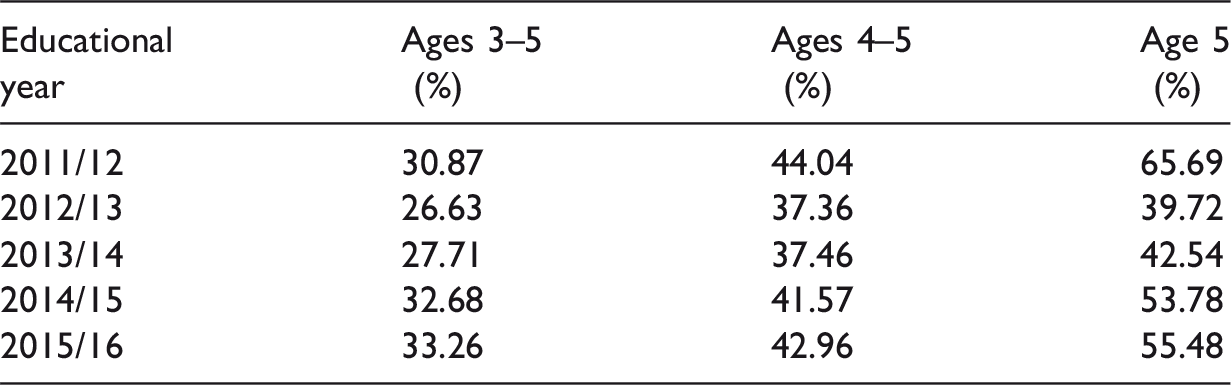
Source: MoNE (2016). National Education Statistics. Formal Education. 2015–2016.
Moreover, the fact that preschool education is paid education even in the public school system despite no legal basis is to the disadvantage of low-income children, and the beneficiaries are inevitably socioeconomically more advantageous groups. The official resources provide on the one hand that preschool education is free in public schools, but on the other, it is stated that fees might be charged for food and educational materials and that the said fee would be determined by the provincial fee determination commissions to be set within the provincial directorates of national education. For example, the fee as determined for the year 2015–2016 by the Ankara Provincial Fee Determination Commission regarding the Independent Nursery Schools and Practice Classes for part-time education is TRY85, and it only covers breakfast (MoNE, 2015a). For nursery classes inside the schools, the same fee was determined as TRY40. In addition to those officially determined fees, parents are required to pay extra fees under the titles of first registration, compulsory donation, materials (e.g., cleaning, stationery), social activities participation, and complementary books. The fees for participation in social activities or reference books are sometimes as high as TRY100 (Cinoğlu et al., 2012). Considering that the minimum wage is TRY1300 (approximately USD422), such fees collected from the parents in the public preschool institutions place a heavy burden on the family budget and thus low-income families cannot send their children to preschool education institutions. On the other hand, the government provides an education support of TRY2680 (approximately USD870) (as determined for the 2015–2016 educational year) for each child attending private school (MoNE, 2015b). The costliness of the state preschool institutions creates disadvantages for children of low-income families, while the government provides incentives for students attending private preschool institutions, thus providing the children of wealthier families with advantages. Table 2 shows the number of students in state and private preschool education in and after 2011. As shown by the table, the number of state schools and students decreased until 2016 after the introduction of the 4 + 4+4 system, while there were consistent increases in the number of private preschool institutions and students attending them.
Student numbers in public and private preschools by education year.
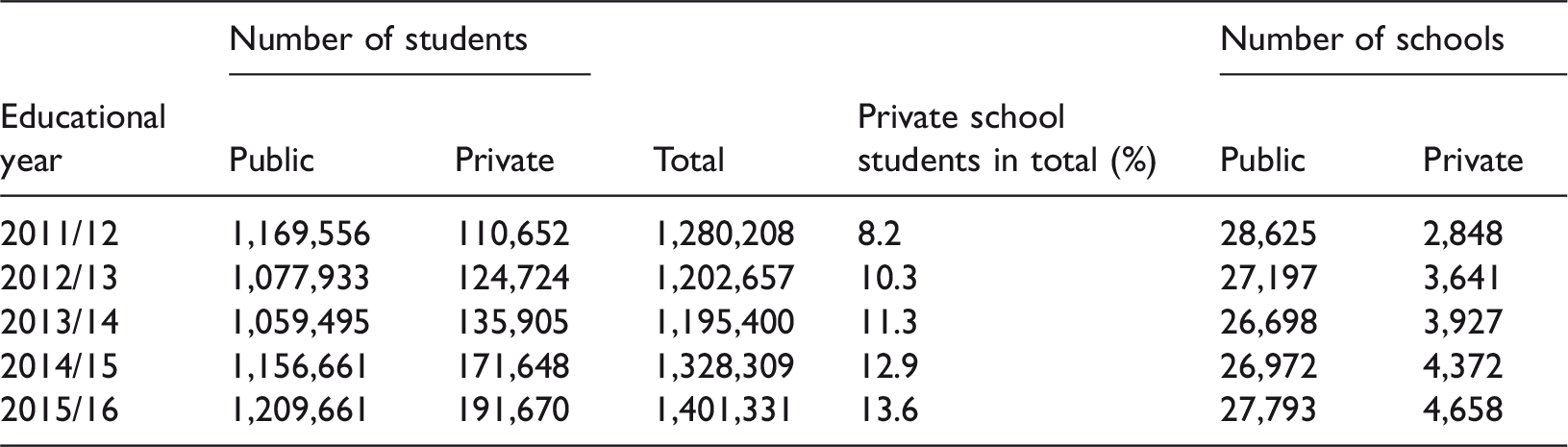
Source: MoNE (2016). National Education Statistics. Formal Education. 2015–2016.
While the public resources allocated for preschool education services are very limited and far below that of OECD countries, the classroom constructions are far from offsetting the increase in the student population, the inequalities regarding access to school by region and sex, the high ratio of number of students per teacher, and the fact that the per student minimum of required indoor and outdoor space is lower than the OECD (ERG and AÇEV, 2013). Transferring the public budget to the private sector rather than public schools is a clear indication of the neoliberal transformation that is deepening social inequality. Okçabol (2014) also asserted that the support for private schools means the transfer of tax income as collected from the poor to wealthy families, who could in any event send their children to private schools and that this practice reinforces existing educational inequalities.
During the 15 years of the Justice and Development Party (AKP) governments, not only a neoliberal transformation but also a Sunni Islam-based religious transformation has accelerated in Turkey regarding preschool education. The ambitions for creating a “religious generation” as occasionally expressed by the founders of AKP were accelerated in particular by means of the 4 + 4+4 system. First, the obstacles blocking a system similar to sıbyan mektepleri, which existed during the pre-Republican period and was abolished by the Law on Unity of Education in 1924, was removed by the 4 + 4+4 system. In addition to the aforementioned changes, the Regulation on Quran Courses and Student Dormitory and Guesthouses of the General Directorate of Religious Affairs as published in the Official Gazette No. 23982, dated March 3, 2000, which prescribed that students must have completed an eight-year primary education (age twelve) to attend Quran courses and must have completed 5th grade to attend summer Quran courses, was amended in the same year with the regulation as published in the Official Gazette No. 28257, dated April 7, 2004, effectively abolishing the above age limits (Official Gazette, 2012). This paved the way for children to be introduced to religious education at much earlier ages. Although there is no data regarding the number of students attending Quran courses in the scope of informal education, the total number of such courses has increased from 7230 in 2007–2008 to 13,021 in 2013 (TÜİK, 2014).
The void created by the 4 + 4+4 system, which annulled the obligation of preschool education, has immediately started to be filled by the Directorate of Religious Affairs (DRA) through its “Quran Courses Preschool Religious Education Project” intended for 4- to 6-year-olds. Having been launched during the 2013–2014 educational year in a maximum of ten classes each in pilot cities of Ankara, İstanbul, and İzmir, and a maximum of five classes each in Adana, Kayseri, Diyarbakır, Gaziantep, Samsun, Erzincan, and Rize, the project was expanded to the entire country by the 2014–2015 educational year (Çankaya, 2016; DRA, 2016). Underscoring that the interest in such courses, which replaced the preschool education institutions, increased due to poverty, Gökdemir (2016) outlined the current situation as follows: Families who were not able to send their children to preschool education institutions due to such expensive services as kindergarten, food, transportation, etc., preferred to send them to the sıbyan mektepleri in disguise of free courses, which provide transportation and food, and inexpensive kindergartens. Along with the Quran courses of the DRA, the private courses are disguised in kindergartens, which had organic relations with foundations that supported them, increased their attractiveness by resolving all the problems of the families stemming from the work life and economic difficulties. (n.p.)
Religion-based education and practices in preschool education are not only limited to the project by the DRA. Although the official figures are not available, Internet searches suggest that the number of kindergartens administering religious education to children aged between three and six years under the title of private sıbyan mektepleri is rapidly increasing. For example, the Sibyan Mektebi website provides information regarding the program and practices of those schools. The website describes their mission as follows: To post the advertisements of the kindergartens and nursery classes, which give both worldly and spiritual education in the light of the hadiths of our prophet (S.A.W.) and verses of Quran in order to ensure that all the children attending to Sibyan Mektebi would become individuals, who love their Motherland and Nation, raised by Islam morality and principles, understand humane values, assimilate the spiritual and cultural values in their essence, and increase the number of such places.
Conclusion
Historically, preschool education in Turkey has been an educational stage, which has lately been ignored due to cultural, religious, and economic reasons and has become inadequate to meet the needs of people despite the efforts made. Families residing in city centers and families of upper socioeconomic strata could meet the educational requirements of their children at private preschool education institutions. Nevertheless, the fact that state preschool institutions have been both fee-based and fewer in number constitutes the most important obstacles for children of families from rural regions and low-income strata to benefit from preschool education.
Beginning with the implementation of neoliberal-conservative economic policies in Turkey during the 1980s under the influence of global actors such as the WB and OECD, inequalities increased in ECE as in all educational stages. Collection of money from families at state schools for any kind of educational service and higher fees applied in private schools have led to a deepening gap between socioeconomically advantaged and disadvantaged groups in terms of access to education. The 4 + 4+4 education system enforced in 2012 in particular has led to a dramatic decrease in the number of students attending state schools. The new organization has resulted in more than half of 3- to 5-year-olds and the children of families from rural regions and low-income strata being deprived of the benefits of preschool education, including major future academic and social advantages. All of this has accordingly increased the likelihood of children being exposed to permanent inequalities.
In Turkey, the neoliberal transformation of education has been implemented in harmony with the religionization of education. Especially after the 2000s, Sunni Islam-based religious transformations have been accelerated in preschool education in Turkey, as has been the case with every level of education. The religionization of education provided by the state preschool education institutions through various methods has encouraged the families from upper- and middle-class socioeconomic groups to register their children with private preschool institutions, which are deemed to provide secular education. On the other hand, families who are not able to send their children to preschool institutions because state schools are fee-based and private schools are expensive rely on free Quran courses or low-fee, low-quality preschool institutions, which provide education based on religious principles. Therefore, the political powers have started implementing their aim of raising religious generations beginning with preschool education. In short, despite the need in larger sections of society, the fact that preschool education is fee-based even in state schools and expensive to many segments of society causes children to start experiencing inequalities from a very early age. In that respect, preschool education has become the first step in the reproduction and legitimization of social inequality. However, preschool education, which offers higher returns for a democratic social order compared to other stages of education, should be provided in the form of free and quality education on the basis of citizenship and human rights.
Footnotes
Declaration of conflicting interests
The author(s) declared no potential conflicts of interest with respect to the research, authorship, and/or publication of this article.
Funding
The author(s) received no financial support for the research, authorship, and/or publication of this article.