




Abstract
The purpose of this article was to investigate the conditions for identifying gifted children in their first encounter with the Swedish school system, the preschool. Interviews were conducted with 10 preschool teachers and 5 principals about their conceptions of giftedness and challenges in meeting the needs of gifted preschoolers in practice. The results explored a lack of knowledge on giftedness among the respondents. Thus, their conceptions of giftedness revealed several dilemmas they face when balancing preschool education between focusing on both the group and individual children, and naming someone as gifted in the strong discourse of egalitarian education in Sweden. The findings identified principals to have a key role in terms of if and how gifted children are supported in preschool settings and suggestions for future research are discussed.
This article focuses on Swedish preschool teachers and principals’ conceptions of giftedness and their views on how to support gifted children in preschool settings. In research on giftedness, there are different perspectives on positioning children as gifted. On one hand, researchers suggest refraining from naming an individual as gifted and instead focus on all children’s continued learning, adapted to individual circumstances and needs (e.g., Borland, 2005). On the other hand, researchers emphasize that such a broad focus risks gifted children remaining unnoticed and thus exposed to emotional vulnerability and exclusion (e.g., Persson, 2010). Research that the present study is based on has highlighted that children in need of educational challenges depend on early, accurate recognition of their abilities to remain motivated for future learning (Koshy & Robinson, 2006). Even though giftedness and gifted behaviors are argued to be noticeable in children at an early age (Silverman, 2016), researchers have shown that gifted preschool-aged children are often overlooked (Koshy & Robinson, 2006; Lie, 2017; Sankar-DeLeeuw, 2004). One reason why educators have been reluctant to identify these young children as gifted is described as a fear of incorrectly naming individuals as gifted and later be proven wrong (Koshy & Robinson, 2006). However, researchers suggest this fear to be exaggerated and urge teachers to continue to pay attention and support these children’s continued development at an early age.
Because teachers’ conceptions of teaching and learning affect what takes place in the classrooms, and their key role in deciding who is assumed to be gifted or not (Siegle et al., 2010), it becomes important to study their conceptions of giftedness and how gifted children can be supported in these educational settings. Further, teachers’ attitudes toward giftedness, and their ability to notice gifted children’s need for support, is suggested to affect both if and how gifted children are provided an adequate (i.e., well-planned, structured, and appropriate) education (Laine et al., 2016) and correspond with the amount of education they have acquired on giftedness and gifted education (Kunt & Tortop, 2017). For this study, the principals’ perceptions of giftedness also become important to investigate, as they are ultimately responsible for giving the preschool teachers sufficient conditions to conduct the preschool education and offer the teachers the competence development required to perform their tasks (Skolverket, 2018a).
The Swedish school system and its historical tradition of only considering children in need of support as children with learning difficulties has been accused of having shortcomings in dealing with gifted children in need of intellectual challenges (Persson, 2014). However, in the latest updated Swedish Education Act (SFS, 2010:800) and curriculum for the preschool (Skolverket, 2018a), teachers are urged to conduct teaching with a focus on children’s already acquired experiences and knowledge as a point of departure, in order for them to reach even further. These updates have contributed to increased Swedish research on giftedness and the Swedish preschool context (Ekesryd Nordström, 2021) and how teachers in early education best can meet these children’s needs in practice (Margrain, 2021). With these new updates in the preschool curriculum and limited Swedish research about the preschool context, it is both timely and important to create new knowledge about this area. The following research questions guided the study: • Research Question 1: What sources have been used in forming conceptions of giftedness among the preschool teachers and principals? • Research Question 2: How is giftedness perceived and discussed among preschool teachers and principals? • Research Question 3: How do preschool teachers and principals describe enabling and constraining factors to provide support for gifted children?
The Swedish School System and Gifted Education
The following sections offer an overview of the Swedish school system and how gifted education fits into that system at present. Thereafter, a more detailed description of the preschool context and the preschool teachers and principals’ areas of responsibility for the preschool education is presented, the focus of the study.
The Swedish School System
The Swedish education system includes noncompulsory (preschool) and compulsory education, based on the Swedish Education Act (SFS, 2010:800). Preschools are aimed at children from 1 to 5 years old, and although its noncompulsory part of the school system, the preschool has a curriculum of its own (Skolverket, 2018a). The curriculum for compulsory school (Skolverket, 2018b) promotes a 10-year education for all children, from the preschool class until ninth grade (6–16 years old). The children start preschool class the year they turn 6 years of age, and the semester always starts in August. After the children have finished ninth grade, the majority continue to upper secondary school for 3 years, where they can choose a self-selected program with a vocational, academic, or esthetical focus. The upper secondary school, in turn, gives university admission to basic courses and programs. Further, there is also a school form for children diagnosed with an intellectual disability, with a curriculum of its own (Skolverket, 2018c). Most Swedish preschools and schools are public, that is, run by the municipalities. However, an increasing number are also run by independent entities.
The Swedish School System and Gifted Education
The Swedish Education Act (SFS, 2010: 800) emphasizes all children’s right to an adequate education and does not use the terms gifted or gifted education. The Education Act presents the regulations for education in general terms, as opposed to precise descriptions, thus leaving it up to teachers and principals’ individual interpretation. This involves both a flexibility on how to conduct teaching that support all children’s individual needs, but also the risk of an increased segregation and an unequal education (Nilholm, 2019), depending on, for example, how gifted children are handled at a certain preschool. The Swedish National Agency for Education (SNAE) provides a support material on giftedness and gifted education, designed for teachers, on their website (Skolverket, 2015). The information relies on research that defines gifted individuals as those who “continuously astonish in terms of theoretical and practical knowledge through their unusual abilities in one or more behaviors” (Persson, 2015, p. 4) and estimates that about 5% of the children are gifted. In addition, the Swedish Association of Local Authorities and Regions (SKR) provides research on giftedness and gifted education, which includes an action plan for teachers to use in educational practices. Initially, the action plan was only aimed for compulsory school (SKR, 2014) but the updated content includes preschool education (SKR, 2016). This can be interpreted as a need to notice gifted children at an earlier age.
Currently, Swedish teacher education does not include compulsory courses on giftedness and gifted education, although there are self-selected courses available at a limited number of Swedish universities (e.g., Stockholm University, Linnaeus University, and Luleå University of Technology). Traditionally, the Swedish school system has focused on an education that strives for all children to reach the lowest knowledge requirements. However, increased attention on giftedness and highly able children in other countries have also affected the Swedish school system (Mellroth, 2021). For example, in a Swedish Government Official Report (SOU, 2008:27), it has been decided to introduce a test period offering a few excellence programs for gifted students in upper secondary school, although adaptations for all students are primarily seen as being sufficient when conducted within the regular class or group. The introduction of these excellence programs has since led to tensions between those who build their understandings from an inclusive, unitary school and those who recommend that schools allow special courses for the gifted (Dodillet, 2019). The conflict involves whether specific attention on giftedness and gifted education does or does not correlate with the Education Act’s intentions of an inclusive school system for all. Moreover, the importance of long-term planning for how giftedness and gifted children should be handled in the Swedish school system has been highlighted, which promotes involving teachers and principals in decision-making so that gifted children can achieve adequate progress in their education (Dodillet, 2019).
The Swedish Preschool Context
Although it is a noncompulsory part of the Swedish education system, about 85% of Swedish children from 1 to 5 years old attend preschool, and narrowing it down to only 4- and 5-year-olds, this number increases to 95% (SNAE, 2020). Furthermore, the average size of a Swedish preschool group is 15 children with approximately one teacher for every five children. The attending children are between 1 to 5 years old, and the group sizes are a complex issue. Group sizes should reflect the children’s age, the teachers’ level of education, and the number of teachers per group (more staffing is required if the children are 1–3 years old). Preschool personnel work in teams consisting of preschool teachers (with a bachelor’s degree), child minders (barnskötare), and other resource personnel. This means that preschool groupings look different around the country, depending on the existing groups’ composition. Moreover, the resource distribution of support looks different depending on what is needed for the activities on group and individual levels, to meet the aspirational goals of the preschool curriculum (Sandberg, 2014).
Preschool Teachers’ Responsibilities
The preschool curriculum focuses on fundamental values, democracy, and play as a point of departure for learning (Skolverket, 2018a). Unlike previous preschool guidelines, with a focus on nursing and development (Skolverket, 1998), the word education is added in the updated curriculum and specifically notes that the preschool teachers should oversee the preschool education. Moreover, preschool education should hold a holistic view and promote group activities via safe and caring environments. Accordingly, preschool teachers must plan activities and use teaching methods that include adaptations and support for individual children’s needs. Therefore, the content of the preschool activities may vary among preschool groupings and from one year to another.
Preschool Principals’ Responsibilities
The curriculum for preschool puts principals in charge of providing and developing suitable environments, including certified teachers and good learning conditions for all. The principal is in charge of the preschool’s quality of education and systematic development toward new goals (Skolverket, 2018a). In addition, being ultimately responsible for the entire preschool, the principal must make sure that the preschool’s education is targeted toward the policy documents (SFS, 2010.800; Skolverket, 2018a) and that all preschool personnel receive the conditions and competence development required to provide an education that is beneficial for all children (Skolverket, 2018a). Unlike the regulations for the principals of the compulsory school, who have access to different pupil health teams (elevhälsoteam) to turn to for support, the preschool principal has less access to special educational support. However, they are still responsible for individual preschool children’s needs.
Prior Research
This section presents research on early attention of giftedness including common characteristics of giftedness and difficulties in identifying gifted preschool-aged children. This is followed by research on the role of teachers, methods, and strategies for meeting the needs of gifted children in practice.
Research on Giftedness in Young Children
Identifying gifted children early is suggested to increase and maintain their motivation for future learning (Koshy & Robinson, 2006). For example, Sankar-DeLeeuw’s (2004, 2006) case studies of gifted preschool children show that early identification and access to an education that supports their special needs increased their opportunities of development. Further, paying attention to young, gifted children’s needs of intellectual challenges is suggested to prevent future boredom, frustration, and vulnerability in educational settings (Lie, 2017).
Conflicting ideologies and different explanatory models for how giftedness can or should be noticed have increased the number of worldwide definitions (Sims, 2021) and suggests that giftedness is a social construction with multiple meanings (Wong, 2018). The different constructions of the concept, in turn, have led to different handling of giftedness and gifted children in practice (Smedsrud, 2020). Therefore, to increase knowledge about the enabling and constraining factors that exist for gifted children to receive support in Swedish preschool practices, it is important to examine the preschool teachers and principals’ conceptions of giftedness.
Identifying gifted children can be difficult given that the characteristics of a gifted child can become visible in various ways for different individuals (Margrain, 2021). In addition, gifted children may choose to hide their abilities to adapt to the educational context (Lie, 2017). What makes it even more difficult is that gifted children’s behaviors can be mistaken for a neuropsychiatric disability, for example, Attention Deficit Hyperactivity Disorder (ADHD) (Beljan et al., 2006), or that the child, in fact, is gifted and diagnosed with a medical disability, referred to as twice-exceptional (Foley-Nicpon et al., 2013). Despite the described difficulties, researchers argue that it is both possible and important to identify giftedness and gifted children at an early age to provide a meaningful education based on their needs (Silverman, 2016).
Even though identifying gifted children early is possible, there are researchers such as Borland (2005) that suggests the naming of an individual as gifted opposes the idea of an inclusive school and, instead, promotes a focus on all children’s needs for an adequate education. This position is questioned by researchers who believe that a solid focus on all children put gifted children at risk of remaining unnoticed (Persson, 2010) and a possibility for gifted children to become overlooked due to the discussions of the Swedish school system having a “complex relationship to advantages and excellent abilities” (Sims, 2021, p. 30).
Based on teachers’ positions as key persons in the classrooms, Laine et al. (2016) examined Finnish school teachers’ conceptions of giftedness. The research showed that most of the teachers described giftedness as multidimensional, something that can occur in various areas and forms. This was presented as something positive, as multidimensional views of giftedness often coincides with gifted children being provided with differentiated learning strategies and materials. Further, the teachers’ descriptions of giftedness, as a malleable or fixed quality, were suggested to affect the provided educational strategies in the classrooms. In addition, Kunt and Tortop (2017) argue that the teacher’s levels of education about giftedness have an impact on the quality of the provided support. Therefore, because teachers have a key role in implementing teaching and learning strategies in the classrooms and preschool groupings (Lundqvist, 2018), their conceptions of giftedness and views on how to provide support for gifted children are important to study.
Preschool Gifted Education, Methods, and Strategies
Current trends are moving away from standard-based, test-driven education for gifted children toward more blended teaching, which is a form of teacher-and-child initiated education, where children are encouraged to think more critically and creatively through multiple activities and projects (Kaplan & Hertzog, 2016). This trend coincides with the goal of the Swedish preschool education (Skolverket, 2018a), which points out the importance of various activities for children in developing new skills, including using all their senses and play.
There is an ongoing discussion concerning the most effective educational strategies to stimulate gifted children through providing access to new challengers, referred to as enrichment (Walsh et al., 2012) and acceleration, which includes early access to more advanced teaching materials than their peers, and if needed, early entry, part- or full-time, to higher school levels (Sims, 2021). These pedagogical strategies have been found to support gifted children in their development; thus, they are also suggested as an approach to challenging all children in their educational progress. However, to be able to implement changes in the regular, inclusive classrooms, it is also important that principals support such work. Therefore, there must be a correspondence between principals and teachers’ conceptions of giftedness and perspectives on teaching methods for gifted children. As Cross et al. (2018) highlights, effective communication and joined training about giftedness is needed for principals to understand the teachers’ teaching conditions, and, thus, for gifted children to receive the most appropriate education in practice.
In sum, researchers have found that it is possible to identify giftedness in young children (Lie, 2017; Sankar-DeLeeuw, 2004, 2006) and that early support can have an impact on their future learning (Koshy & Robinson, 2006). There are expressed controversies and difficulties on how to identify and handle gifted children in practice, and teachers’ conceptions about giftedness are argued to affect both if and how gifted children are noticed and handled in practice (Laine et al., 2016). To date, little is known about giftedness and the Swedish preschool context. Therefore, research on how preschool teachers’ and principals perceive giftedness, and what the teacher’s conditions are (provided by the principals) to support gifted children in Swedish preschools, becomes interesting to explore.
Method
Demographic Data About the Participants (N = 15)
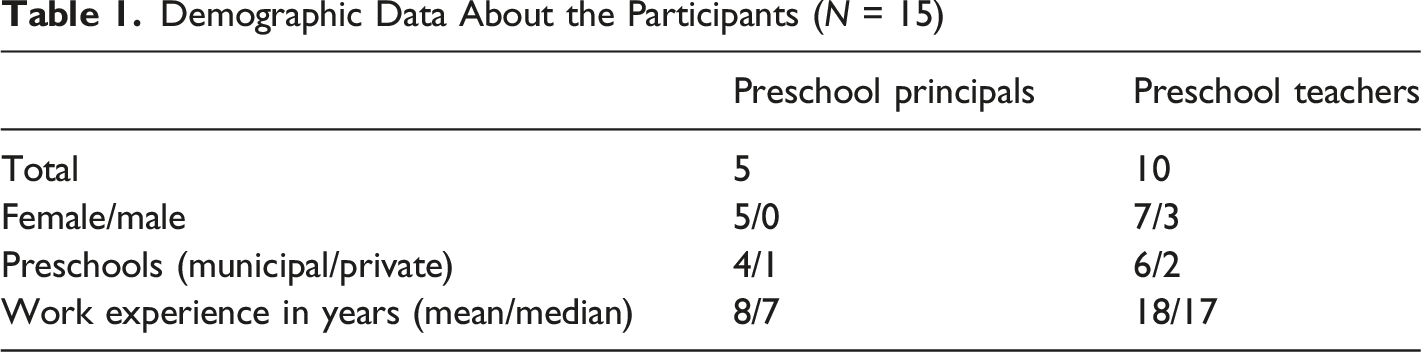
The majority of the participating principals (80%) worked in larger urban cities (population > 100,000) and 20% in rural towns (population < 15,000). The principals were all female because they were the ones who chose to participate in the study. Initially, both female and male principals were invited. Most of the preschool teachers (70%) also worked in larger urban cities (population > 100,000) and the remainder (30%) worked in rural towns (population < 15,000).
Procedure
In the selection of participants, I divided the 290 Swedish municipalities into six groups according to population, < 10,000, 10,001–50,000, 50,001–100,000, 100,001–150,000, 150,001–200,000, and >200,000, and randomly selected one municipality from each group. I then searched the municipalities’ websites to find out the number of existing preschools in the chosen municipality, so that all existing preschools were included in the selection. Based on this number, two preschools from each municipality were selected for participation in the study, using random number selection. This resulted in 12 selected preschools. In addition, four private preschools were randomly selected, using the same procedure, resulting in 16 selected preschools (12 municipal and 4 private preschools). The reason for this selection came from a previous study where this procedure provided a widespread, geographical distribution of participants (Ekesryd Nordström, 2021) and, thus, to get an indication of whether conceptions of giftedness varied in different parts of the country and between municipal and private owned preschools. The principals of the selected preschools were invited to participate in this study via email, and further, they were asked to forward an invitation to their preschool teachers to also participate in the study, as personal email addresses of the preschool teachers were not available online. This resulted in five participating principals and seven participating preschool teachers. The three remaining preschool teachers joined the study via recommendations from participating preschool teachers, called snowball selection (Bryman, 2018). Respondents who chose to participate contacted me personally via e-mail. Whether the participating principals and preschool teachers, in turn, belong to the same preschool units does not emerge from the study. The interviews took place between June and September 2020.
In accordance with the Swedish governmental regulations for avoiding the spread of COVID-19, I conducted all interviews as telephone interviews to comply with the recommendations for keeping social distance from others and avoid travel between different regions (Folkhalsomyndigheten.se).
The interviews were recorded via a telephone meeting function on Skype, and all meetings required a personal code to enter. In addition, all interviews were stored on a code-protected flash drive, inaccessible to anyone but me as the researcher, in accordance with the Data Protection Regulation (GDPR). The duration of each interview was 35–55 minutes, and the interviews were transcribed shortly after each interview. All procedures with the empirical data were conducted according to the Swedish Research Council (2017), and the respondents were informed that participation was voluntary and that they could choose to end their participation at any time.
Data Analysis
Participants’ Perspectives on Giftedness Presented in Four Themes (N = 15)
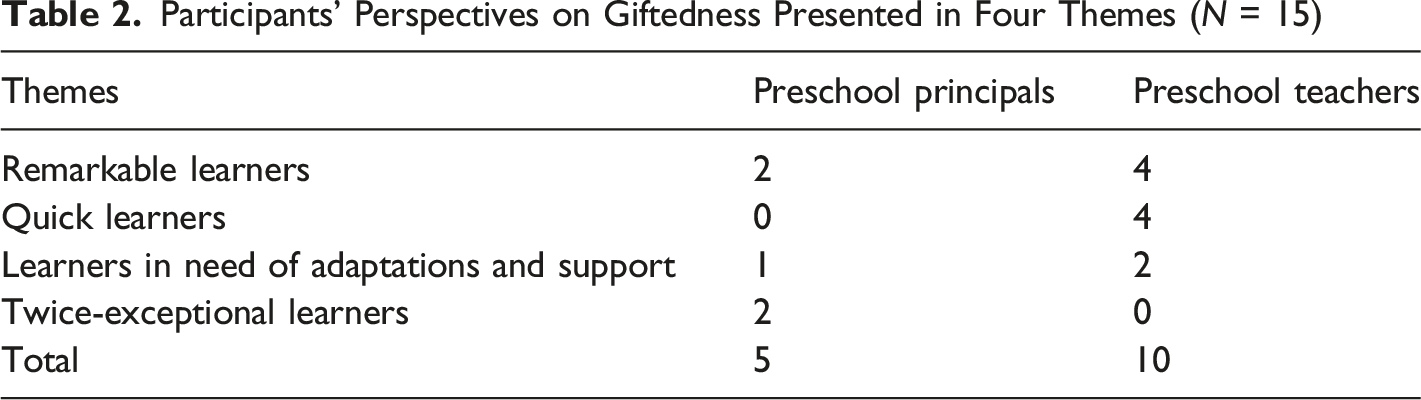
The respondents’ descriptions sometimes seemed to overlap among the different categories, but I placed the descriptions into a specific category based on what the respondents mainly chose to focus on in their descriptions.
As a second step, and due to the respondents’ described difficulties on how to provide support for gifted children in practice, I continued to analyze the collected data inspired by the dilemma perspectives put forward by Nilholm (2019). The dilemma perspectives are based on a special educational approach, focusing on providing an inclusive education for all. These perspectives, in turn, explore three underlying conflicts that can arise in teachers’ decision-making for individuals in need of support. The first dilemma deals with the recognition of individual needs for support and at the same time preventing them from being seen as permanently excluded. The second dilemma concerns identifying difficulties to improve the education situation, while at the same time focusing on individual diversity as something that enriches for all. The third dilemma involves the need for teachers to balance between providing children with compensatory support and at the same time allowing them to participate on equal conditions as their peers (Nilholm, 2019). This analytic tool was helpful for me in gaining a deeper understanding of the respondents’ concerns about enabling and constraining factors to support gifted children in practice.
This article draws on part of the findings from an ongoing doctoral study, and my interpretations of the collected data are based on an understanding that the results obtained by me as the researcher are not objective (Magnusson & Marecek, 2015). The advantages of conducting all the interviews myself are that questions, interpretations, and analysis are consistent. On the other hand, I am aware that additional interpretations made by other researchers may have increased more nuances and opinions.
Results
In the following sections, the teachers and principals’ sources of knowledge about giftedness are presented. This is followed by their conceptions of giftedness and expressed as enabling and constraining factors to provide support for gifted children in practice.
Sources of Knowledge About Giftedness
I began to ask the teachers and principals some basic questions about their knowledge on giftedness. None of the teachers, regardless of the geographical distribution, revealed having any formal education on giftedness, but a few mentioned that they had obtained information about giftedness via media, research articles, teachers’ magazines, and through online discussion forums. Nor did the principals express having any formal education on giftedness themselves. Therefore, a majority of the respondents in this study based their understandings of giftedness on personal notions of the behavioral characteristics of a gifted child, rather than scientific research. One principal mentioned a book about giftedness that was assigned for all preschool and compulsory school principals to read within the school region. Then, group discussions followed the book reading, which in turn, according to the respondent, led to nothing. The respondents’ lack of education on giftedness became visible due to their hesitations on how to describe giftedness and their expressed struggles to meet the needs of gifted children in practice. Most of the teachers and principals assumed that giftedness has to do with innate abilities, but a majority also believed that environmental and social factors have an important impact on opportunities for gifted children to develop their giftedness further. With limited knowledge and nonformal education on giftedness, the respondents reasoned their way to descriptions of giftedness.
Conceptions of Giftedness
The teachers and principals mainly described giftedness as characteristics of a gifted child as opposed to notions of giftedness as a phenomenon. They expressed experiences of high cognitive, creative, and motivational features of giftedness and gifted children showing off their measurable, remarkable abilities in different areas compared to peers. Through repeated readings of the respondents’ descriptions on giftedness, I grouped their responses into four categories of giftedness: remarkable learners, quick learners, learners in need of adaptations and support, and twice-exceptional learners.
Remarkable Learners
Within this category, four teachers and two principals all mentioned concrete, measurable examples of experienced giftedness in one or more children. The descriptions varied between children with exceptional mathematical abilities, advanced fine motor skills in building with toys, 2-year-olds reading books, and children with unusual, high knowledge within a specific area for their age. These children were both described to be confident in their own knowledge, but also somewhat blunt, or non-flexible in socializing with others.
Quick Learners
Four teachers described giftedness based on advanced cognitive skills and being quicker learners compared to peers. They did not mention a certain area of giftedness but pointed out gifted children to absorb instructions a lot quicker than peers and use advanced reasoning and abstract thinking at an early age. The quick learners were also mentioned to be somewhat precocious.
Learners in Need of Adaptations and Support
Descriptions of giftedness that were placed within this category included giftedness having to do with children in need of adaptations and support to make use of their potential. One principal and two teachers highlighted the importance of providing suitable learning environments for all children, including the gifted, and mentioned special educational needs coordinators (SENCOs) as important resources in providing the right support. This was the only category where the respondents shifted focus from giftedness solidly connected to individual needs towards focusing on more environmental and organizational aspects.
Twice-Exceptional Learners
Two principals described giftedness to be connected with a diagnosed disability, for example, gifted and diagnosed with autism or ADHD. In their descriptions, the dilemma of “what depends on what” emerged, but ended up with both respondents stating that giftedness and neuropsychiatric diagnoses often were related. The principals also expressed an awareness that diagnoses, with concrete descriptions of individual difficulties, were somewhat easier to handle in practice unlike giftedness. One of the principals assumed that this had to do with a lack of education about giftedness and that it could be one explanation to why the provided support for gifted children, at present, were more focused on the child’s difficulties as opposed to developing the gifted abilities.
Support for Gifted Children in Preschools
All the respondents were well informed about the Education Act (SFS, 2010:800) and the importance of an education that allows all children to develop as far as possible (Skolverket, 2018a). However, many expressed hesitations about finding the time to support children in learning difficulties as well as gifted children. A majority of the teachers and principals highlighted that working in teams was a great advantage in order to provide support for gifted children in preschools, compared to the compulsory school where teachers were assumed to have a more solitary work situation. Two teachers expressed this: If you are very observant as a teacher, I think, there are good opportunities for noticing gifted children in preschools … We have time to get to know the children here, since children often attend preschool for 3–4 years. Moreover, you are not alone—we have opportunities in preschools to help each other, since we work in teams. What I do not pay attention to, maybe my colleague does. (Preschool teacher, 50 years old) Preschool is an excellent context to notice gifted children. The vast majority who work in preschools have a large reference group so to speak, we have a lot to compare with. If you have worked for 20 years, you have met hundreds of 3-year-olds. Then you can think, Aha! Here we have something. (Preschool teacher, 64 years old)
The respondents in this study revealed a willingness to support gifted children in their preschool settings in the future. However, analyses of the interview responses suggest that meeting the needs of gifted children was not something that was done systematically at present. Although the principals argued that more education about giftedness was needed, the teachers largely expressed that a lack of support for gifted children was due to organizational shortcomings.
Despite an awareness that preschool children are allowed to accelerate to higher levels of education if advancing is considered to benefit the child’s continued learning, a majority of the teachers and principals opposed to this alternative. Their arguments highlighted the importance of the child’s social development together with peers, rather than focusing on their need for intellectual challenges.
Respondents that conceptualized giftedness as remarkable learners and quick learners also highlighted dilemmas accompanied the identification of a child as gifted. They seemed to struggle between the identification of these children’s needs, and, at the same time, prevent them from being seen as permanently different from others. I think this is a bit difficult … We must care about all children and educate them based on their needs and abilities. Therefore, to highlight a specific group of children as gifted becomes a bit strange for me. Even though I fully agree that we must gain more knowledge about giftedness. (Principal, 57 years old)
A preschool teacher addressed concerns for how the gifted behaviors could put the child in vulnerable situations and expressed this: One child was extremely interested in birds and learned all, and I mean all, about certain species. It was fun, but at the same time very excluding, as none of the other children had any idea of what this child was talking about. (Preschool teacher, 55 years old)
Furthermore, respondents’ expressions in these two categories (remarkable learners and quick learners) involved descriptions of the gifted child as a perfectionist and non-flexible toward other children’s actions and opinions, and pointed out that the gifted skills, at times, were connected with social difficulties. The respondents highlighted a need for supportive teachers near the gifted child because of misunderstandings that could occur in interaction with other children: This child’s way of building Lego was so advanced that no other child could keep up. If he felt that other children were not doing the right thing, that is, as he had intended, he became angry and threw things around in frustration. (Preschool teacher, 37 years old)
A second dilemma came forward when the respondents within the categories of learners in need of support and twice-exceptional learners tried to balance between identifying the gifted children’s special needs and how these children could be included and seen as an asset for the group at large. Their descriptions seemed to focus on identification of difficulties in order to provide the right support, and in a way—exclude in order to include. Further, while expressing the importance of how other children can learn from the gifted children, it was also expressed that the teachers had limited time and resources to provide special solutions for gifted individuals. Within this second dilemma, struggles seemed to involve both organizational deficiencies and a lack of education on giftedness.
While arguing that gifted children might need special support to develop their abilities further, few had any suggestions on how this could be conducted in practice. The respondents struggled with the focus of the preschool curriculum to keep a holistic view and, at the same time, provide special support for individual children. One principal expressed this dilemma: The biggest challenge for preschools I think is probably the conflict between focusing on both the individual and group at the same time. It is important for us to find the right material for stimulation without isolation. (Principal, 51 years old)
Overly large group sizes and a lack of time for planning were expressed by the teachers as limiting factors in meeting the needs of gifted children. One preschool teacher described the work situation as “putting out fires, and handle children with acute behavior problems first” (Preschool teacher, 37 years old). In contrast, another preschool teacher expressed great confidence in being able to satisfy any child, due to own knowledge and experiences. This teacher felt encouraged by the principal to continue developing the preschool education and that working in teams were contributing factors for finding the time to plan specific activities that meet all children’s needs. However, several of the teachers expressed that the opportunities for implementation of adaptations and special support for individual children was depending on the principal’s decision. Also, that the teachers await this decision before making any adjustments.
One principal from an independent preschool expressed how they use computer programs to improve all of the children’s mathematic and Swedish language skills, in order to stimulate all children to become readers at 5 years old. The participant explained this: We use systematic introductory exercise programs in Swedish and mathematics. For example, if we see that there are readers among the 3-year-olds, we notice these children and can support them to develop even further. However, it is more difficult when it comes to other areas where we do not have a complete program. Then it is up to the individual teachers’ abilities to stimulate the child to acquire new knowledge. (Principal, 51 years old)
Described difficulties regarding the respondents’ views on enabling and constraining factors to provide support for gifted children, included a third dilemma, on how to provide special support for gifted children and, at the same time, conducting teaching and learning that support all children without excluding anyone. According to the principals, to provide adequate support for gifted children in preschool practice, they continued to emphasize a need for more education on giftedness.
In addition, several preschool teachers and principals ended the interviews by expressing concerns about giving special support to gifted children in preschools, due to a suggested lack of continuity for gifted children in the transition process to the compulsory school. From their experience, they felt that there were shortcomings in these processes. During these transition meetings, the preschool teachers’ presentations of the conducted education and activities (on individual and group level) were perceived to receive little or no attention from the receiving schools. In addition, the individual transition documents describing children’s special needs (with the exception of food allergies) were assumed to be ignored. One participant expressed this: Of course, we can notice gifted children in preschools. However, if the receiving school does not take its responsibility and continue the education for the child that we have introduced—what is the point? (Preschool teacher, 47 years old)
Discussion
The purpose of this study was to explore Swedish preschool teachers and principals’ conceptions of giftedness and their notions of how to support gifted children in practice. Conducting telephone interviews was proved to be an effective method as the interviews were easily conducted and the geographical spread of participants increased. At times, the questions resulted in sensitive responses from the teachers, including criticism of a principal or the workplace organization. Here, I believe that the choice of method made it easier for the respondents to express their thoughts on questions asked, as opposed to if I had visited them at their workplace (cf. Sturges & Hanrahan, 2004).
The results of the interviews indicate that the respondents’ lack of formal education about giftedness and that their conceptions of giftedness focus on characteristics of a gifted child rather than notions of giftedness as a phenomenon (cf. Laine et al., 2016). The respondents’ views on enabling and constraining factors to provide support for gifted children in practice, in turn, involve several expressed dilemmas. In this last part of the article, several aspects that the study has highlighted are discussed.
The teachers and principals’ sources of information on giftedness varied among books, articles, and newspapers and some had no previous information about giftedness at all. None of the respondents had any formal education on giftedness and their descriptions of giftedness were based on personal notions rather than scientific research. According to Kunt and Tortop (2017), this will affect whether gifted children receive the right support or not. Further, a majority of the respondents in this study referred to giftedness as remarkable learners with exceptional, measurable abilities compared to peers. In comparison to research that suggests that gifted children might hide their abilities to avoid being seen as different, these results suggest that there are gifted children at the participating preschools who remain unnoticed (cf. Lie, 2017). Thus, the teachers and principals’ lack of knowledge about giftedness, as found in this study, affect the identification of gifted children and suggests shortcomings in providing gifted children with adequate support at the participating preschools.
The overall analysis of the results, concerning enabling and constraining factors to support gifted children in practice, indicates several dilemmas that appear for the teachers and principals (cf. Nilholm, 2019). First, the respondents seem to struggle with naming someone gifted and, at the same time, maintaining an egalitarian view on preschool education and avoiding the child being seen as different from others. Here, comparisons can be drawn to research that found a similar tension regarding the introduction of the Swedish top classes for upper secondary school (Dodillet, 2019). This tension regards how to balance an egalitarian education for all and provide special, top classes with a suggested elite ambition for gifted children. A second dilemma (Nilholm, 2019) occurred for the teachers and principals when they expressed the gifted children’s special needs and how these different behaviors could affect the child and their future learning. All the respondents expressed knowledge of the preschool curriculum content (Skolverket, 2018a) and, therefore, expressed individual variety as something positive. However, contradictory arguments occurred when most of the respondents added negative aspects and difficulties accompanying giftedness, as opposed to giftedness being seen as something valuable, useful or as an asset to the group at large. These contradictions were expressed, for example, in the descriptions of the child being gifted but lacking social skills, gifted but having difficulties in handling emotions, or gifted behaviors making the child stand out in negative ways, such as being non-flexible or a perfectionist. Why these additions only focused on negative aspects of giftedness does not emerge from this study. It can be a result of the respondents’ lack of education on giftedness, their work situation, prevailing cultures and norms at the preschools, or a combination of all these factors. The respondents expressed a third dilemma involving the need to provide special support for gifted children and, at the same time, having them participate on the same terms as their peers (cf. Nilholm, 2019). In addition, a difficulty put forward was finding the time to support gifted children, when finding time to support children in learning difficulties was an already existing struggle.
From a strong Swedish tradition of an egalitarian view on teaching (Persson, 2010), most respondents weighed their views “on the one hand and on the other hand” when talking about giftedness. Only one principal stood out by presenting a concrete example of how they conduct education that urges children to develop their reading and mathematical skills further through special computer programs. The outlined aspiration at that particular preschool was for all 5-year-olds to become readers. In the preschool curriculum (Skolverket, 2018a), this is not promoted for all, but at the same time, nothing hinders a preschool from setting these goals. From the enrichment and acceleration strategies, this could be one way of identifying and providing support for gifted children. However, without multidimensional identification procedures, children who are gifted in other areas than mathematics and the Swedish language may remain unidentified at the participating preschool (cf. Walsh et al., 2012).
Even though the teachers expressed a willingness to support gifted children in the future, they expressed that they await the principals to decide when and how to provide this support. The principals, on their part, suggested that more education on giftedness was needed to meet the needs of gifted children. Therefore, the teachers awaiting the principal’s decisions and the principals’ suggestions that more education on giftedness is needed (without mentioning a time plan), might explain the lack of attention that gifted children have received so far at the participating preschools and give an indication of the power the principal’s decision have for providing support for gifted children.
In line with previous research (Persson, 2015; Sims, 2021), this article highlights how the two groups, children in learning difficulties and gifted children, unfortunately, compete for teachers’ time. Therefore, an equal Swedish preschool education, as formulated in the governing documents (SFS, 2010, 800; Skolverket, 2018a), is put at risk.
Conclusions
This study reveals Swedish preschool teachers and principals’ conceptions of giftedness. The results show that different conceptions of giftedness can affect the handling and the provided support for gifted children in practice. Based on research that explores how noticing gifted children at an early age can maintain their motivation for future learning (Koshy & Robinson, 2006; Lie, 2017), this study explored that the Swedish school system is still in need of improvement in order to meet the needs of gifted children (cf. Persson, 2014; Sims, 2021). However, if the preschool teachers and principals become educated on giftedness and find suitable teaching methods for gifted children in practice, most respondents agreed that Swedish preschools could be appropriate contexts to support gifted children. According to the teachers, contributing factors that increases the opportunities to provide this support include that the children remain in preschool for several years (3–4 years) and that, in preschool education, the children and teachers all benefit from the teachers working in teams.
Due to limited Swedish research on giftedness and the preschool context, I have examined the current situation without being able to relate to comprehensive, previous research. In addition, the number of interviews that were conducted for this study indicate that more interviews could have further nuanced the categories on giftedness and contributed to more insights and knowledge on the subject. Other limitations include comparisons of this study with research in other countries because of their use of selection processes for children to be accepted for gifted education (Sankar-DeLeeuw, 2004, 2006; Walsh et al., 2012), whereas in the Swedish context, the needs of gifted children only include the handling of these children within the regular preschool groupings (Skolverket, 2015). However, the perspectives and knowledge that the respondents in this study have shared, in combination with years of work experience and geographical spread of the preschools they represent, explore interesting results that give an indication of Swedish preschool teachers and principals’ conceptions on giftedness and enabling and constraining factors to support gifted children in practice.
Implications for Practice
Understandings of how preschool practitioners express their conceptions of giftedness, given the prevailing norms, and address gifted children’s needs can improve and develop the preschool education. In addition, for preschool teachers to be able to support gifted children, the Government should provide compulsory courses on gifted education during teacher education to promote an egalitarian education for all children. This is to avoid exclusive or randomly provided support for gifted children at a limited number of Swedish preschools.
Implications for Future Research
Apart from the research questions, the preschool teachers and principals strongly criticized the transition processes from preschool to compulsory school. This emphasizes the importance for more research on how “to promote context, continuity and progression in the development and learning of children” (Skolverket, 2018a, p. 18) and how these transitions from preschool to compulsory school affect gifted children’s future learning and education.
Footnotes
Declaration of Conflicting Interests
The author(s) declared no potential conflicts of interest with respect to the research, authorship, and/or publication of this article.
Funding
The author(s) received no financial support for the research, authorship, and/or publication of this article.
