



Abstract
In 2016, the British Educational Research Association (BERA) Commission on Poverty and Policy Advocacy brought together several academics from across the four jurisdictions of the UK already engaged in work on poverty, education and schooling. The aim of this BERA Commission was to build a network of research-active practitioners across the UK and, internationally, to engage in knowledge building about poverty and multiple factors of deprivation as these find expression in education and schooling. The Commission also aimed to facilitate counter discourses to be voiced and articulated in contrast to the dominant pathologising discourses of poor people and their education. The Commission therefore addressed the question: what can research tell us about the ways that different devolved policy contexts impact on the learning and well-being of young people living in poverty? This article describes the methodology used by the Commission to bring together researchers, policymakers, practitioners and children and young people to learn about the price of poverty in education and to reflect on the implications for policy. In so doing, the article addresses some challenges, opportunities and outcomes in terms of knowledge production, as well as implications for critical scholarship, with a focus on poverty and education.
Introduction
The corrosive consequences of poverty on young peoples’ learning and attainment in the UK are well documented (e.g. Hills et al., 2010; McKinney, 2014; Raffo et al., 2007). Although recent government policy in the UK has consistently identified the pernicious effects of disadvantage, education remains unequal (Beckett, 2016; Smyth and Wrigley, 2013). Locating the problem of poverty as an issue of ‘social mobility’, as is the case in central UK government discourse and education policy in England, is very different to addressing the root causes of economic and social disadvantage (Thompson, 2017).
Much critical research has addressed the disparity between central UK government rhetoric on ‘closing the disadvantage gap’ and the social consequences of educational reforms (e.g. Ball, 2016; Thompson et al., 2016). However, Francis et al. (2017) have argued that research concerned with social justice has often failed to engage with education policymaking. As Apple (2003) pointed out some time ago, the dominance of right-wing ideologies and practices in education still need to be challenged.
In 2016, the British Educational Research Association (BERA) Commission on Poverty and Policy Advocacy (Ivinson et al., 2017) brought together several academics from across the four jurisdictions of the UK already engaged in work on poverty, education and schooling. The aim of this BERA Commission was to build a network of research-active practitioners and academics across the UK and, internationally, to engage in knowledge building about poverty and multiple factors of deprivation as these find expression in education and schooling. The Commission sought to find evidence on the ways that poverty is differentially experienced in schools within the four jurisdictions of the UK. The Commission also aimed to facilitate counter discourses to be voiced and articulated in contrast to the dominant pathologising discourses of poor people and their education (e.g. Ullucci and Howard, 2015). The Commission therefore addressed the question: what can research tell us about the ways that different devolved policy contexts impact on the learning and well-being of young people living in poverty?
Between January and July 2016, the Commission undertook its work by organising seminars in each of the four jurisdictions, respectively in Leeds, Cardiff, Belfast and Glasgow, that focused on the local and national picture. These were followed by a seminar in Oxford reflecting on educational research lessons from the past and a Community Forum in Manchester. The primary aim of the seminars was to open up a space for cross-nation, cross-partnership, cross-disciplinary and cross-cultural debate. The seminars also highlighted differences between the differing political contexts of the four UK jurisdictions in terms of their conceptualisations and policy enactment around child poverty and the implications for researchers working in these differing contexts.
This Special Issue raises the question: what can we learn from our experiences at the interface between critical research and policy? The intention of this article, therefore, is not just to illuminate some of the learning of the substantive issues from the Commission’s research (i.e. about the impact of child poverty), but what we have learned through the process about the possibilities and barriers for interaction between critical research and policy. In addressing these issues, we share two of the key concerns of critical policy research in education regarding: the divide between policy rhetoric and practiced reality; and the distribution of power, resources and knowledge (Diem et al., 2014).
We orient this article around the methodological approach taken by the Commission, including the three elements of: a network approach; the regional situatedness of the seminars; and the inclusive nature of evidence given. This article describes the methodology used by the Commission to bring together researchers, policymakers, practitioners and children and young people to learn about the price of poverty in education, and to reflect on the implications for policy. In so doing, the article addresses some challenges, opportunities and outcomes in terms of knowledge production, as well as implications for critical scholarship, with a focus on poverty and education.
Knowledge production and critical research
In a paper produced for the first Commission seminar in Leeds, Ruth Lupton (2016) made the point that educational researchers need to think pragmatically if they are to increase the possibility that research on poverty and education is used more effectively to inform policy and practice. She offered three ways forward. (1) We could work together to (2) We could be (3) We could be clearer about This opens up the rationales for positioning, where, for example, functionalism is about improvement with narratives focusing on targets, training, and plans, and this is in contrast with critical analyses that are concerned with the realism of everyday work using narratives about agency and power. (Gunter et al., 2013: 558)
Given that the BERA Commission sought to understand the effects of schooling on groups who live in poverty, this work is particularly pertinent. One of the key strengths of Bernstein’s work is that he sought to describe difference, and specifically differences between the lived worlds of marginal groups and the groups who are privileged by education systems. Central to his argument is which group’s knowledge is valued and why? School curricular organise knowledge that is supposed be highly valued by society and so is imagined to be worthy of being transmitted from generation to generation. However, underlying assumptions about valued knowledge are representations about what the ideal pupil should be. Schools persistently fail marginalised and poor young people, partly because they cannot live up to this ideal.
Young (2008) makes a distinction between ‘knowledge of the powerful’ and ‘powerful knowledge’, or the kind of symbolic knowledge that gives access to the well-paid occupations in society. As Moore (2013) argues, ‘The powerful are so not because they can arbitrarily impose their knowledge/culture as “powerful knowledge/culture”, but because they enjoy privileged access to the knowledge/culture that is powerful in its own right’ (p.350).
So what forms of knowledge production can challenge these power imbalances within schools? Oancea and Furlong (2007) turn to Aristotelian concepts in their argument that alongside episteme theoretike (knowledge demonstrable through valid reasoning) and techne (trained ability for rationale production), consideration should also be given by educational research to phronesis (practical wisdom). Similarly, Spicker (2011) argues against attempting to address complex research questions through finding causation and believes that phronesis provides an alternative method of generalising through developing principles experientially and testing them against empirical evidence. This raises questions of whose experiences matter when addressing issues of social injustice. Facer and Enright (2016) have coined the phrase ‘living knowledge’ as a means of addressing questions about how new ideas are created by academics and communities. They pose questions about: who has expertise and knowledge to really understand what is ‘going on’ in communities today: those people who are living and experiencing it as their day to day reality, or those who are able to draw on much wider historic, philosophical and geographical resources to make sense of community? (Facer and Enright, 2016: 10)
Similarly, for the BERA Commission, issues of knowledge production for social justice in education meant the creation of appropriate networks. The importance of networks for critical social science has been explored by Rasmussen (2014) in his analysis of the ways that the European Association for Education Research organises its annual conference. He argued for the necessity of developing methodologies for studying the new spaces of education and educational research emerging in Europe. He drew attention to a double agenda reflected in the two concepts in the name chosen for the network – ‘policy studies’ and ‘politics’: ‘In contrast to policy studies, the concept of politics represents a broader perspective on education, including issues of power, citizenship interests and values’ (Rasmussen, 2014: 422). The importance of critical networks that draw on living knowledge was key to the methodology described next.
Methodology
The BERA Commission on Poverty and Policy Advocacy was set up with the recognition of the political difficulties involved in advocating for a broader policy approach to social justice based on socially critical educational research. By addressing educational policy as processes of dynamic, lived and enfolding events, we wished to shift the focus from the past to what is emerging, including contingencies that have unforeseen effects. We asked the questions: what more could we do or what more might happen?
The method was to set up five seminars, and an inclusive community forum in six regions across the UK. The seminars were carefully planned and organised as critical networks to enable the views of people who are positioned differently with respect to issues of poverty and school curriculum to be made visible. In order to do this, we drew on the idea of living knowledge which became central to the way the seminars enabled us to investigate educational policies, not as texts so much as through the lived experiences of the people who participated and formed the network. Presenters in each jurisdiction and in each region provided accounts based on the living knowledge of the opportunities and struggles encountered in their everyday experiences of their work.
It was also recognised that the very nature of the events would create partial accounts of the effects as poverty from the experience of the various people involved. The seminars acted as places for a wide range of people to give partial ‘realities’ and that these sometimes resonated, and sometimes interfered, with each other and disturbed any coherent telling of how poverty interacts with education. The seminars were not designed to directly engage with national policymakers (although some did attend in Cardiff), but rather were designed to see policy through a range of different lenses (e.g. critically and socially engaged academic research, practitioners, non-government organisations (NGOs), local council officers, pupils, etc.). A small team of core academics hosted the seminar in each region in their university. They used their university to hold open a public space where they could invite participants from any area relating to education and poverty. We aimed to bring together local policymakers, academics, head teachers, teachers, classroom assistants, members of charities, NGOs, parents and young people. Table 1 shows the range and numbers of attendees at the seminars.
Seminars and participants.
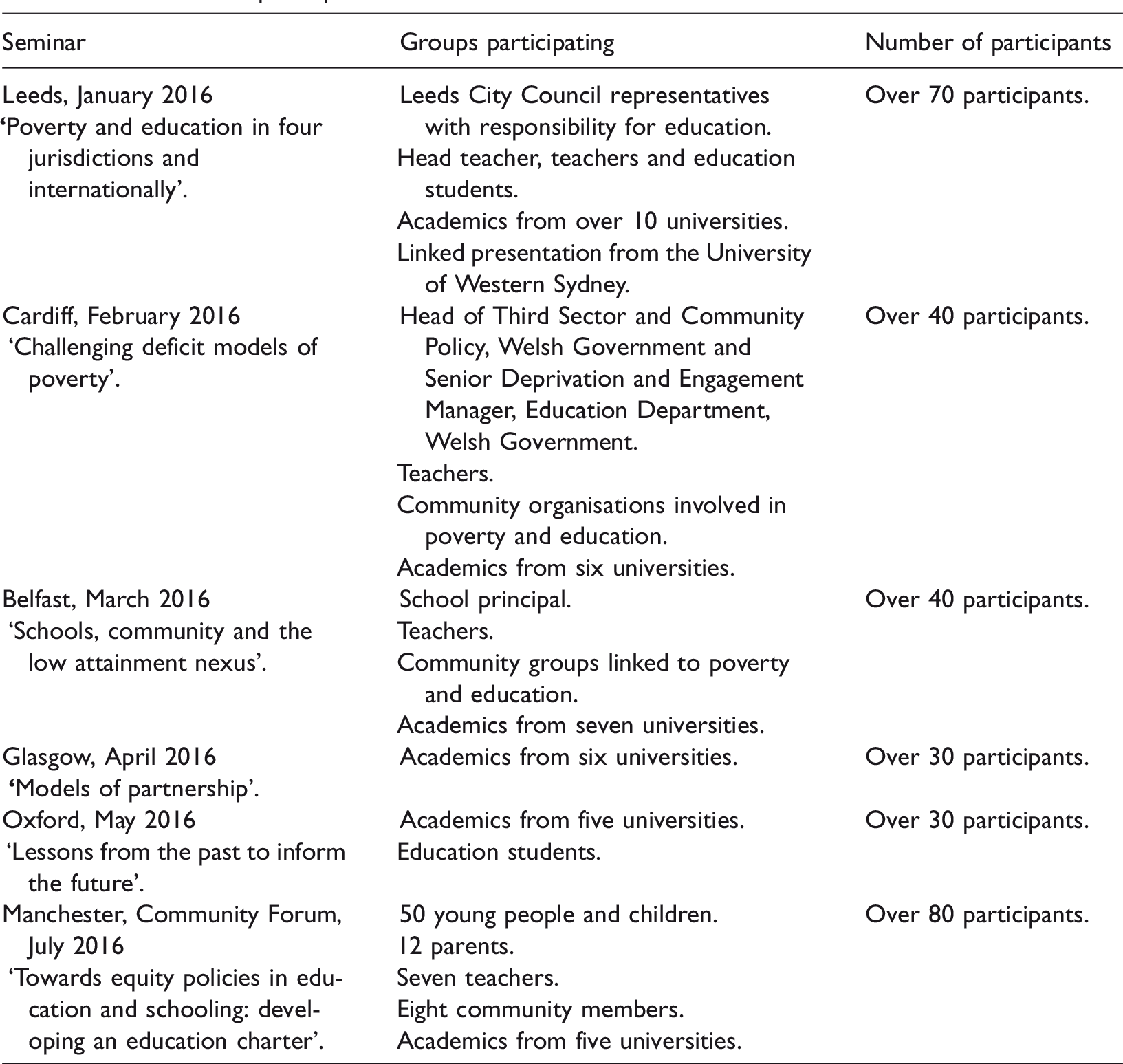
Each seminar brought together a different combination of representatives from these groups in order for the Commission as a whole to hear the views, perspectives and lived experiences of a wide spectrum of stakeholders. For example, in the first seminar held in Leeds at Leeds Beckett University, over 70 participants represented the local authority, head teachers and teachers, multi-disciplinary academics (from education and policy studies) as well as PhD students. In Glasgow and Oxford, the seminars included academics from sociology and education, who reflected both on lessons from current research and policy climates and lessons from the past. In Cardiff, we brought together artists and academics working with radical historians as well as with arts-based methods in order to think differently. Finally, the Community Forum in Manchester brought together teachers, young people, parents, members of local charities and religious groups along with academics in order to draw on the voices of those who experience poverty. We drew on our networks across the regions where we worked, calling on our deeply embedded engagement with education and poverty through work with communities, schools and youth centres. Academics working on poverty and education in north-east Australia connected their networks to ours via video presentations shown during the seminars. The inter-agency, inter-disciplinary and international participation led to rich debates.
Findings
Complexities of lived experience
In the process of moving from seminar to seminar and working with the young people and teachers for the community forum, we became increasingly aware of levels of complexity as we gathered ‘evidence’ about education and poverty. Through the people who come to the seminars we gained a sense of the multiple sources of reports, data, research studies as well as the personal accounts and second-hand accounts. In effect, the BERA Commission become a kind of mobile listening station for numerous partial accounts and snippets of the problem that people at each position expressed. These first- and second-hand accounts, based on lived experience, provided a different perspective on policy accounts that give strong accounts of the effects of poverty without the narratives of the realities of people’s lives.
Whilst hearing these partial accounts from different perspectives made coherence difficult at times, the layering of lived experience represented a critical narrative that has implications for policy. For example, we heard second-hand from an academic in the north of England, who has been working in an inner city for years, stories of the anguish of the teachers she has been working with as they try to manage their stress. They are working in schools with children and young people living with the complexities of poverty while trying to induct them into a curriculum that they know is totally unsuitable because the children and young people cannot relate any of it to their lives. We also heard second-hand from an academic who has been working in ex-mining valleys of south Wales. She related how one boy revealed his experience of the death of five close family members in one year. He suddenly blurted this out on seeing a line on a map that he had been using in a lesson. It started when his granddad and ex-miner threw himself under a train when his wife died. Teachers in the school said they had seen the deaths reported in the local newspaper but had not made the connections to the boy in the special needs class who constantly misbehaved, annoyed the other boys and ran out of the room spontaneously and often. They had not been able to ‘perceive’ that the boy was lost in a state of intolerable mourning.
Teachers working in a working-class estate in south Manchester revealed that while preparing for the Community Forum a father had come to the school seeking help because he had lost control of his three teenage children, who he said had ‘gone feral’ on the estate. The man had not been able to cope since his wife left him and the kids and he did not know how to look after them. He visited the school nearly every morning for support. Teachers, on top of heavy teaching timetables, took the time to talk to him and gradually try to help him with basics such as feeding and trying to regulate his children’s behaviour.
We also heard from head teachers in Manchester and Cardiff who have tried to free up a teaching assistant solely to listen out for children and young people’s deep distress as it emerges, to try to help them before the problems become even greater forms of mental distress. They call this ‘horse whispering’ and told of a unique member of staff who has the ability to win the trust of poor children to the extent that they occasionally speak of what is happening to them. Poverty is such a taboo issue that children go to great lengths to hide it and to protect their parents. Children go to lengths to make sure they do not ask for even the slightest extra money by absenting themselves from school trips, physical education and often not eating properly (see also Ridge, 2009). We heard from very innovative head teachers who are both strong leaders and create teams within schools that try to change the fortunes of poor children and young people. Yet these effective leaders talked about not knowing how they will find the energy to continue.
We heard from young people and children, while preparing for the community forum, who were so distressed by the homeless people sitting on the streets that they made time to go and feed them, to give them their breakfast. As we worked with them, drawing, mapping and creating poems, these same young people began to express the level of their frustration with a school curriculum that gives them no useful knowledge, such as how to budget, get a job and how to buy a house. They fear that they too will end up on the street.
We also heard about positive attempts to combat the effects of poverty. In Glasgow, mentoring schemes were set up to pair young people with successful professionals. The professionals, working as volunteers, dedicated many hours to the young people, giving support with CVs, application forms and interview preparation. They also took them to cultural events, out for dinner and sometimes even on their family holidays. They attempted to give them the cultural capital they felt was needed to gain entry to high-status university courses. In Glasgow, too, local academics talked about working in schools on government-funded initiatives to help schools to undertake the kind of research that will help them to reflect on how their school management functions. These innovative models of partnerships can enable schools to become aware of how they operate and sometimes how this can be made more sensitive to the needs of children and young people living with poverty, and to help them to achieve more academically.
In Cardiff, we learnt about sensitive and highly innovative ways for working with poverty though multi-agency initiatives that ask parents to opt into the scheme. Once parents have volunteers, the multi-agency team gradually begins to piece together support that suits the family and incrementally help them to be able to support their children’s education. We heard of the success and then immediately of the funding cuts that threaten the scheme’s ability to function even for one more year. Indeed, we learnt of many initiatives across the UK that are struggling to survive and that run the risk of becoming another wasted experiment based on the realities of the politics of austerity that has starved local councils of money.
It has been suggested that in many cases educational policies are created by those who are ignorant of the everyday practices required for schools to be inclusive institutions (e.g. Ball, 2006). This was evident in some of the responses at the Community Forum in Manchester in a neighbourhood that was racially mixed and with low-income families. Young people (aged 13–14) spoke of educational policies being made by elite groups who had no understanding of their daily lives. They disliked being labelled as ‘poor’ and questioned the relevance of an imposed curriculum. However, they also understood the pressures on their teachers in terms of time and workload. The Manchester Forum reinforced the need for curricula to address young people’s concerns as well as to enable them to access knowledge. The young people summarised that what they wanted from education was ‘knowledge and friendship’. However, in the Education Charter that they produced, they also had messages for policymakers:
Education policies should be made by people who understand our real lives. People who make education policy are from private schools and have not lived the kind of lives we live. Policymakers need to move with the times and understand the detail.
Manchester Forum Education Charter, 2016
While these young people who participated brought their ‘realities’ to the forum, we want to emphasise that participants in society and school represent different levels of analysis and different modes of functioning. Their voices do not carry equal weight in policy circles. Even more importantly, their realties may not be recognised or known by participants who come from within other agencies and organisations. So, while the curriculum determines how knowledge is reconfigured in schools, young people, for example, have no power over the official curriculum. We do not want to suggest or pretend that the community forum enabled them to have a ‘voice’ at a policy level. This was not quite the point. However, their narratives and lived experience did provide important detail for policy.
The value of critical research networks
The Commission’s comparative work across the jurisdictions (see Ivinson et al., 2017) was underpinned by the importance of setting up critical research networks in enabling ideas to circulate within and across societies. These networks brought us into contact with the different politics and values that underpin educational policy work and, specifically, how historical legacies, such as sectarian divides, continually resurface and have huge influences. By comparing education systems and their structures, critical researchers can discuss the gaps and possibilities for creating, maintaining or developing pedagogies that work for poor children and young people. These comparisons enabled us all to recognise the importance for viewing educational policies as the outcrops for deep historical legacies that mask some features and exaggerate others. The purpose of the brief comparative illustrations between the four UK jurisdictions in this section is to compare the ways that different critical research is conceptualised and the way researchers relate to policy in each jurisdiction.
The structuring of school systems across the jurisdictions range from: an almost exclusive provision of state education in Wales and, to a slightly lesser extent, in Scotland; to a highly segregated system (Catholic, Protestant, maintained, controlled) in Northern Ireland; and a more market- and competitive-oriented system in England. These structures, therefore, reflect historical concerns about what matters within a jurisdiction. They also affect to some degree the ways in which critical research engages with these concerns. Some of these differences are structural.
For example, Wales has a history of endemic poverty (Egan, 2017), and is the only UK administration to have a designated Minister for Communities and Tackling Poverty. There has been a strong pull since devolution to develop educational policies that are distinct to those of the Westminster Government. Indeed, some policies aim to mitigate the worst effects of the English policies that affect poor families and children. However, there exists enormous variation in how these initiatives work on the ground, and some places and communities remain relatively forgotten and untouched. Our comparative work found that the rhetoric of the central UK Conservative Government that pathologises families, children and young people living in poverty is not always reflected in different political arenas and values across the jurisdictions and within regions.
In the seminars, researchers from Wales argued that, potentially, policymakers can make a difference for young people living in poverty engage, but that this requires not only a radical curriculum but also radical pedagogies. For example, the Learning Country approaches and vision pioneered by Ruth Davidson when she became the Minister for Education in Wales straight after devolution was framed by an emancipatory opportunity to ‘create clear blue water’ between the Synod and Westminster. The Foundation Phase developed a new child-centred approach that was based on strong research and was well resourced by the government. This investment seems to have paid off as the Foundation Phase has survived across three new education ministers, and is an internationally recognised flagship progressive approach. In this way we can see how the new devolved powers enabled a different approach and how this interrupted the dominant neo-liberal approach to education that dominates in England. The Cardiff seminar also suggested the spaces that this approach suggests for critical research on poverty and policy in Wales, with possibilities for direct engagement with policymakers.
In Scotland, researchers talked about the national debate on Scottish independence, which reached its climax in the 2014 referendum and has since remerged with the Brexit vote of 2017. However, the country has a long history of self-determination in a number of policy areas including Education. Prior to the Scotland Act 1998, which opened the way for the setting up of the Scottish Parliament, the Scottish Office, COSLA, the Teaching Unions and the Scottish Universities were among the key influences in shaping and directing Scottish education policy. This influence means that academics engaged in critical research potentially have opportunities for direct engagement with policymakers. The seminar in Glasgow drew attention to a number of key issues regarding the development of partnership working, as well as some of implications from the project for the implementation of the Scottish Attainment Challenge, appointment of the Attainment Advisers and the use of improvement data more widely.
Robertson (2014) has argued that Scotland tends to hold on to social democratic policy objectives and tends to develop education policies in line with this. Education Scotland worked with a number of local authorities and researchers to broker and facilitate partnerships within and across schools and local authorities. The solution-focused approach is underpinned by systematic enquiry and the use of evidence to address Scotland’s attainment issues with a focus on tackling educational inequality. For example, the School Improvement Partnership Programme (SIPP) projects encourage staff to learn from each other, experiment with their practice and monitor and evaluate change. The initial eight projects are locally owned and led by teachers and school leaders working with like-minded professionals.
Other differences are cultural and political. In Northern Ireland, for example, poverty is inflected with a history of ‘the troubles’, and ‘it is relatively well-established that conflict has a strong socio-economic dimension’ (Ahearne, 2009). Reflecting political factionalism, the Northern Ireland education system remains segregated, where, for the most part, Catholic and Protestant pupils are educated separately. Government statistics show that 93% of children in primary (age 4–11) and post-primary (age 11–18) schools attend largely either Catholic schools (Maintained) or schools that in the majority are attended by Protestant children (Controlled). Less than 7% of Northern Ireland children are proactively educated together at integrated schools, with a small but increasing number attending Irish Medium Education schools. In Northern Ireland, poverty is inflected with a history of ‘the troubles’. The effect is that those who achieve least well are boys from socially disadvantaged backgrounds, and in particular from poor Protestant families, despite the country as a whole achieving results that are the highest across the jurisdictions (Burns et al., 2015).
Although academic researchers have important things to say about the effects of the sectarian divides in Northern Ireland on poverty, they told us that they have met with barriers from government about what they can publish specifically with respect to religion. While all researchers encounter limits to what they can publish when being critical of governments, we learned something about the specific nature of these limits depending on the political tensions in a jurisdiction. So, while academics living in Northern Ireland know that education policies are deeply inflected with the history of the troubles, this became even more apparent to them as they addressed participants from other jurisdictions. In a reciprocal process, their accounts helped others to recognise sectarian or other tribal conflicts that may have gone underground in other cultural contexts.
England is the only jurisdiction in which the government directly controls education, and arguably the one in which a strong neo-liberal commitment to the market dominates in education alongside neo-conservative curriculum reform (Ball, 2016; Burn and Childs, 2016). In each other jurisdiction, education policy is mediated through a devolved government or executive assembly. To some degree, the devolved contexts open up spaces for difference and contestation. So, while national politics and the specific values placed on education within Scotland, Wales and Northern Ireland have developed independently of those in England, it could be argued that the lack of a mediating space between government agencies and education in England has heightened the conditions for the accelerated pace of marketisation and the neo-liberal agenda (Ball, 2006). In the seminars in England, academics talked about the need for critical research to combat both the effects of poverty and the policies that help exacerbate these effects. However, some academics from England expressed frustration at the relative importance that the government places on supporting largely quantitative studies that demonstrate ‘what works’. It is very difficult for policymakers to accept complexity and mess as their function is to distribute scarce resources in the most effective ways possible. Presenting complexity remains a challenge for critical research when engaging with policymakers. As Lupton (2016: 2) argued in her challenge to the Commission: Can we demonstrate (from evidence here and in other countries) the effects of raising family income, of adopting different pedagogies, of building different school/community relationships, of increasing school funding? If we want to reject a narrow understanding of ‘what works’ in terms of test scores, can we demonstrate the longer term benefits to individuals or society of broader approaches?
Conclusion
In this article we have argued that the methodological approaches of the BERA Commission on Poverty and Policy Advocacy have suggested the importance for the knowledge production of networks of critical researchers and the gathering of accounts of the lived knowledge and experiences of both those young people who live in poverty and the professionals and researchers who work with them.
However, we do want to suggest that by setting up the seminars and a community forum we were not only inviting different ‘perspectives’ on school curriculum to be enabled, but that they facilitated different ‘realities’ to be made visible. Rather than suggesting that the groups who came together had time to genuinely debate difference and come to some new negotiated positions, we are more realistic and suggest that the seminars and community forum are testament to a multiplicity of curricular realities. We have also argued that critical research networks can help us to understand critical research orientations in different jurisdictions of the UK. Recognising these is only the first step in a longer process that needs to take place if academics are to be involved in policy transformation.
We have argued that our contribution to policy advocacy is in making difference explicit. We suggest that by setting up the seminars and a community forum we were not only inviting different ‘perspectives’ on school curriculum to be enabled, but were also facilitating different ‘realities’ to be made visible. What the Commission found out was that the different social policy responses by governments in the jurisdictions meant that critical researchers had adopted a range of different research responses to the situated spaces created or closed. In creating a critical research network, researchers were able to reflect on the meanings of difference and the role of living knowledge of those affected by poverty. The voices and narratives that we heard gave a different policy perspective because they were based on lived experience rather that analyses of what might work in school curricula.
Ultimately, our Commission by no means achieved the goals outlined by Lupton (2016) in the introduction to this article. What we did achieve was something that probably needed to be done before policy advocacy. We succeeded in bringing together (and apart) a very wide range of partial ‘realities’. These ‘partial realities’ and desperate accounts at times jostled uneasily against each other. They displayed a range of styles of expression, of languages and media. We cannot claim that we have found any solutions, or that we can advocate for any specific ‘way forward’. However, the network that was created enabled a circulation of ‘partial realities’ in a variety of ways. The challenge is, as Lupton suggests, to find ways to help policymakers imagine differently about learning the price of poverty for young people – ways that get us out of the narrow deficit discourses that blame families and teachers for low educational achievement. If there was one thing we achieved it was to bring together a very wide range of partial realities, and those that seem to create the greatest discordance are those of young people and the school curriculum.
Footnotes
Acknowledgements
We would like to thank BERA for funding the Commission on Poverty and Policy Advocacy.
Declaration of conflicting interests
The author(s) declared no potential conflicts of interest with respect to the research, authorship, and/or publication of this article.
Funding
The author(s) disclosed receipt of the following financial support for the research, authorship, and/or publication of this article: This work was supported by the British Educational Research Association.