



Abstract
Given limited investigation into the state and status of physical education policy research internationally, we suggest there is a need for a more comprehensive empirical review of physical education policy research internationally to inform a future research agenda. The purpose of this scoping review is to map the international peer-reviewed empirical literature detailing policy research in school-based physical education between 2010 and 2020 to understand and make recommendations for extension, where appropriate, of the conceptual boundaries of how to ‘do’ policy research in this field. We followed a three-phase approach to the scoping review: (i) identifying relevant sources; (ii) charting of sources; and (iii) reporting the findings from the charting of sources. Results were interpreted through two theoretical lenses: (a) Rizvi and Lingard's (2010) framework of policy issues and questions and (b) Diem et al.’s (2014) traditional and critical approaches to educational policy research. Findings are discussed in relation to the charting categories which included: journal; year; affiliations; country of work; funding acknowledgements; research question; policy definition; policy issues; and traditional and/or critical research. We hope this research can be useful to those looking to enter the physical education policy research space, as it introduces them to the research landscape, and to those already engaged in this space looking to fill gaps in the literature.
Keywords
Introduction
For educational stakeholders, including those within physical education, policy 1 plays an influential role in day-to-day practice, whether recognised or not. For example, a school physical education teacher is often mandated to deliver a formal curriculum policy, i.e. subject specification document. They are supported in their teaching by implicit curriculum policy, for example, resources, books and professional development. They also generate their own and interact with others’ prudential curriculum policy, i.e. practical wisdom and knowledge for adapting formal and implicit curriculum policy for their local context, and respond to national guidelines (Connelly and Connelly, 2013).
Although a few scholars within physical education have been conducting, and advocating for, research into the important topic of policy for several decades (e.g. Penney and Evans, 2005), policy is an area which has received relatively limited attention in the field. Alfrey et al. (2021: 353), however, recently argued the physical education research community is experiencing a ‘policy turn’. This growth can be seen in several recent publications (e.g. Aldous et al., 2022; Landi et al., 2021; Lorusso et al., 2022; Penney and Alfrey, 2022; Scanlon et al., 2022; Sutherland and Walton-Fisette, 2022; van der Mars et al., 2021). Only a few recent reviews exist to help educational stakeholders understand the nature of this existing physical education policy research. Most of the empirical reviews focus on the USA (e.g. Burson et al., 2021). The key findings of these reviews suggest there is limited policy research in the USA, and that what does exist is heavily focused on state policies, accountability and health-based outcomes (Landi et al., 2021). van der Mars et al. (2021) suggest this may be because much, although not all, physical education policy research in the USA is conducted by those who do not consider themselves physical educationists (e.g. public health researchers). USA scholars (i.e. Marttinen and Beighle, 2022; van der Mars et al., 2021) argue for more USA-specific policy research to be conducted collaboratively with other stakeholders, such as educational policy and public health scholars. In an internationally focused conceptual paper on policy, Penney and Alfrey (2022) called for the need to broaden horizons in physical education policy research and prompted the field to expand the intent of policy research, particularly in relation to social justice. They suggest the current physical education policy research ‘horizon’ is dominated by sociologically based considerations of policy enactment (Ball et al., 2012). This policy enactment research is focused on considering how situated (e.g. school locale and history), professional (e.g. teacher commitment and experiences), material (e.g. infrastructure) and external (e.g. pressures for broader policy) factors affect individuals as they enact policies.
When the few existing conceptual and empirical reviews of physical education policy research are considered together, questions remain about the state and status of this arguably growing line of inquiry internationally. Given this, we suggest there is a need for a more comprehensive empirical review of physical education policy research internationally to inform a future research agenda. The purpose of this scoping review is to map the international peer-reviewed empirical literature detailing policy research in school-based physical education between 2010 and 2020 to understand and recommend extending the conceptual boundaries of how to ‘do’ policy research in this field. Before delving into our methodology, we outline some key ways to categorise policy research, by drawing on existing frames in broader educational policy literature.
Types of policy research, questions and issues
The form a policy research project takes depends on many factors. A key factor is the type of analysis, particularly whether the research is an analysis of policy or an analysis for policy (Rizvi and Lingard, 2010). Analyses of policy are typically conducted by academic researchers for the purpose of understanding, for example, why a policy was constructed, what the taken-for-granted assumptions are in a policy, and what effects a policy might have. Analyses for policy are conducted for the development of policy which may be commissioned by policy makers for a specific purpose and are, therefore, constrained in many ways (e.g. time, theory, method). Rizvi and Lingard (2010: 45) argue: Analysis of policy sets its own research agenda; it does not take for granted the policy construction of the problem which a new policy seeks to address. Indeed, the first step in policy analysis might very well be a critical deconstruction of the problem as constructed by the policy, and of the context and history assumed by the policy. In contrast, analysis for policy takes as given the research problem as constructed by those framing policy, and this often lacks a critical orientation.
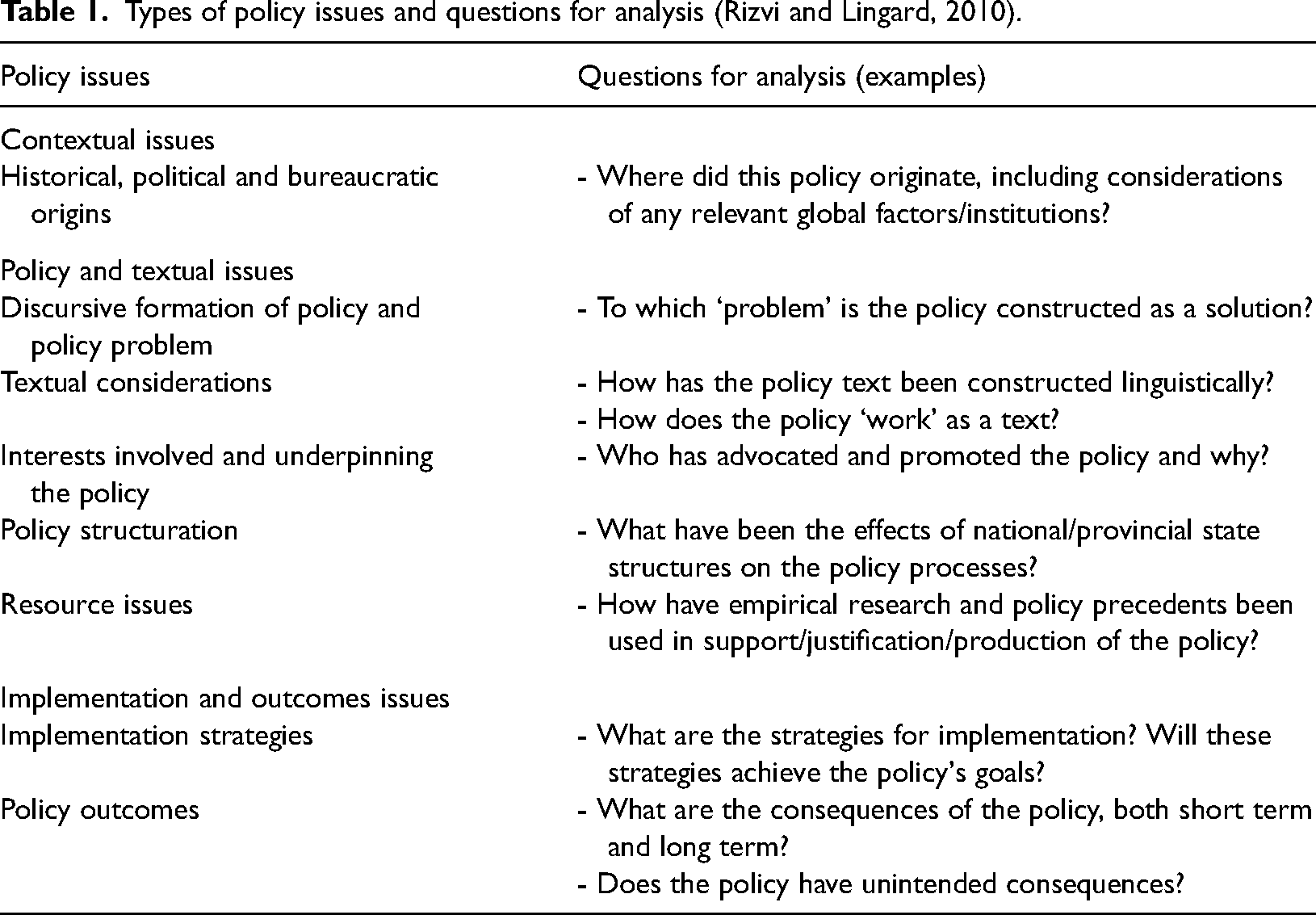
Focusing on analysis of policy, we turn to Rizvi and Lingard's (2010) much-used framework for the type of policy questions researchers might ask (Table 1), which we consider to be comprehensive. They suggest these questions fall into three major categories, each with subcategories: (i) contextual issues; (ii) policy and textual issues; and (iii) implementation and outcomes issues.
Types of policy issues and questions for analysis (Rizvi and Lingard, 2010).
Traditional and critical approaches to policy research
Each category of policy research issues/questions outlined (Table 1) can be approached from different paradigmatic positions. Originally, educational policy research operated in an exclusively traditionalistic (i.e. positivist) paradigm (Diem et al., 2014). Diem and Young (2015) outline how, in the 1980s, education policy studies saw a ‘critical turn’, with a growing number of researchers moving from traditional to critical approaches. Young (1999: 275) argues a chosen approach will influence ‘the way one identifies and describes policy problems, the way one researches the problem, the policy options one considers, the approach one takes to policy implementation, and the approach taken for policy evaluation’.
Diem and colleagues (2014) offer a detailed description of the key tenets of traditional and critical approaches to educational policy research that are useful to our understanding of policy research in physical education. Regarding traditional approaches, they describe:
‘A tendency to view policy change as a deliberate process that can be planned or managed’ (1070). Therefore, policy processes are considered a somewhat sequential series of steps, with policy implemented in a straightforward pattern. How policy follows a ‘goals drive action’ approach: ‘goal-driven behaviour is often viewed as the substance of rationality, wherein an individual rationally weighs the cost, benefits, and subsequent outcomes of a strategy’ (1071). In other words, humans act rationally within the policy process. An assumption that ‘the knowledge necessary for identifying and deciding between policy solutions and planning for implementation and evaluation is obtainable, cumulative, and capable of being expressed to others’ (1071). An assumption that policy can be effectively evaluated, and these evaluations will shed light on problems and outcomes.
Diem et al. (2014: 1071) summarise the assumptions of traditional approaches to policy research ‘as a neutral scientific approach, carried out by rational and expert researchers who use theory-supported models that facilitate responsive and effective change’.
In contrast, Diem et al. (2014) also outline five concerns which critical approaches to policy research tend to focus on. These include:
The difference between policy rhetoric and practised reality. The policy, its emergence, and developments – ‘understanding how it emerged, what problems it was intended to solve, how it changed and developed over time, and its role in reinforcing the dominant culture’ (1072). The distribution of power, resources and knowledge and ‘the creation of “winners” and “losers”’ (1072). Social stratification – ‘the broader effect a given policy has on relationships of inequality and privilege’ (1072). Interest in ‘members of non-dominant groups who resist processes of domination and oppression’ (1072).
Diem and colleagues further note that critical policy researchers tend to focus on the complex systems in which policy is constructed and enacted and are more likely to use qualitative approaches in their research.
We acknowledge that putting research into categories, particularly a dichotomy, can be reductive and that some research draws from both traditions. However, we share these commonly used categories here as heuristic devices. Also, it is important to note that these categories are sometimes referred to in other terms, for example, public policy scholars (Durnová and Weible, 2020) write about mainstream and interpretive perspectives.
Method
Scoping review
A scoping review was chosen over other forms of review (e.g. traditional systematic review) as we were interested in charting/categorising research rather than consolidating its findings or assessing/evaluating its quality. A scoping review provides a snapshot (Booth et al., 2012) of the research on a particular topic and allows the researchers to map or chart that work (Arksey and O’Malley, 2005). As scoping reviews examine the extent, nature and range of research in a particular area, they can be used to clarify conceptual boundaries, identify gaps and make recommendations for future research (Arksey and O’Malley, 2005; Peters et al., 2015).
We follow a three-phase approach to the scoping review: (i) identifying relevant sources; (ii) charting of sources; and (iii) reporting the findings from the charting of sources (Lorusso et al., 2021). Before discussing these phases, we share the lens through which each author views and approaches policy. Dylan, whose research is in the physical education policy space, views policy primarily through a sociological lens (e.g. Ball et al., 2012) and is beginning to complement this view with policy process approaches (e.g. Cairney, 2020). Jenna, whose research is also in the physical education policy space, takes an applied policy process research approach as she endeavour to draw upon the traditions of critical policy analysis and policy process research (e.g. Durnová and Weible, 2020). Melody, whose research is in the broader education policy research space, situates her work in the realm of critical policy studies drawing on critical approaches to discourse analysis (e.g. Bacchi, 2009) and socio-material interventions in policy (e.g. Mol, 2010).
Phase 1: identifying relevant sources
Eligibility criteria
Given that we were looking for an understanding of recent research and needed to limit the scope of the review, we delimited the search to research published between 2010 and 2020. We further delimited the language to English as this is the language of the authors. For access reasons, we delimited the search to sources available in full text. We also delimited the publication type to journal articles that were peer-reviewed (i.e. quality consideration) and consisted of empirical data (i.e. content consideration). We define empirical studies as research whereby a methodological design is described, and findings are reported.
This extends beyond human research, for example, document analyses reporting a method and findings were included. While we focus on empirical studies in this scoping review, we do not imply that theoretical/conceptual/position/commentary/review papers are not important. We value this type of research, but such a broad search goes beyond the scope of this review and the feasibility of this study. Future research should explore the theoretical articles on policy in physical education research as this is as important as the empirical research and needs to be investigated to provide a well-rounded understanding of policy in physical education research.
Only articles centrally focused on policy were included. For example, articles that used policy as a data source, but were not about policy, were excluded. Furthermore, articles where policy was simply the impetus for the research or which only report implications for policy were not included. We excluded curriculum research in which authors do not explicitly describe curriculum as policy or define their work as policy research, as we could not assume how authors understood ‘curriculum’ (which we consider to be policy). We included articles which focused on physical education within the K-12 school setting; however, we did not exclude a source based on references to higher education (e.g. if the policy under investigation related to K-12 but the participants included higher education-based individuals, we did not exclude). Extra-curricular physical education/sport was not included as we focused on school physical education. We considered ‘school physical education’ as what happens in the name of the subject area within the school curriculum and timetable. We also excluded articles in which physical education was only a narrow or secondary focus or the article focused on school physical activity rather than physical education.
Database searches
The following databases were selected through consultation with an academic librarian specialising in Education and Health Sciences: (i) EBSCO (including Education Resources Information Centre [ERIC]; SPORTDiscus; Education Source); (ii) Scopus; and (iii) Web of Science. The search string was: ‘physical education’ OR ‘physical health education’ OR ‘health physical education’ AND ‘curriculum policy’ OR ‘policy’. This was searched in ‘topic’ (i.e. title and abstract) with the applied limiters of ‘English’, ‘Full-Text’, ‘Journal Articles’ and year range. The search returned the following number of sources in each database: (i) EBSCO: 785; (ii) Scopus: 2797; and (iii) Web of Science: 767. After 911 duplicates were automatically removed, a total of 3438 articles were returned.
Screening
Articles were uploaded to an online review software programme (Rayyan) for a two-stage screening process. The first stage involved reviewing the abstracts of the collected articles with respect to the inclusion and exclusion criteria. Authors 1 and 2 each screened half of the collected articles (following a series of joint trials to ensure a consistent approach). From this process, 3063 articles were excluded, 163 were included, and 212 were marked as ‘maybe’. Authors 1 and 2 examined the ‘maybes’ together in a series of meetings which involved full-text review and discussion until reaching a consensus on inclusion or exclusion. These discussions were predominantly centred on interpreting whether policy was the central focus of an article or not, and whether the authors of a curriculum-focused article clearly expressed a view of curriculum as policy. There were some articles that positioned policy as central to the research but there was no empirical data and therefore they were excluded (e.g. Landi et al., 2021; Penney, 2013). There were also several articles which focused on ‘curriculum’ but did not explicitly define curriculum as ‘policy’ and therefore these articles were excluded as we could not presume the authors defined curriculum as policy (e.g. Enright and O'Sullivan, 2010). This process brought the total number of included articles to 198 and excluded articles to 3240.
In the second stage of screening, each of 198 studies underwent a full-text review by the first two authors to ensure they met all inclusion criteria. Any disagreements between the authors regarding study eligibility were resolved through discussion at several meetings. This phase resulted in another 80 articles being excluded, with 118 articles included. One further duplicate was found which resulted in a final total of 117 included articles.
Phase 2: charting of sources
Data charting and analysis
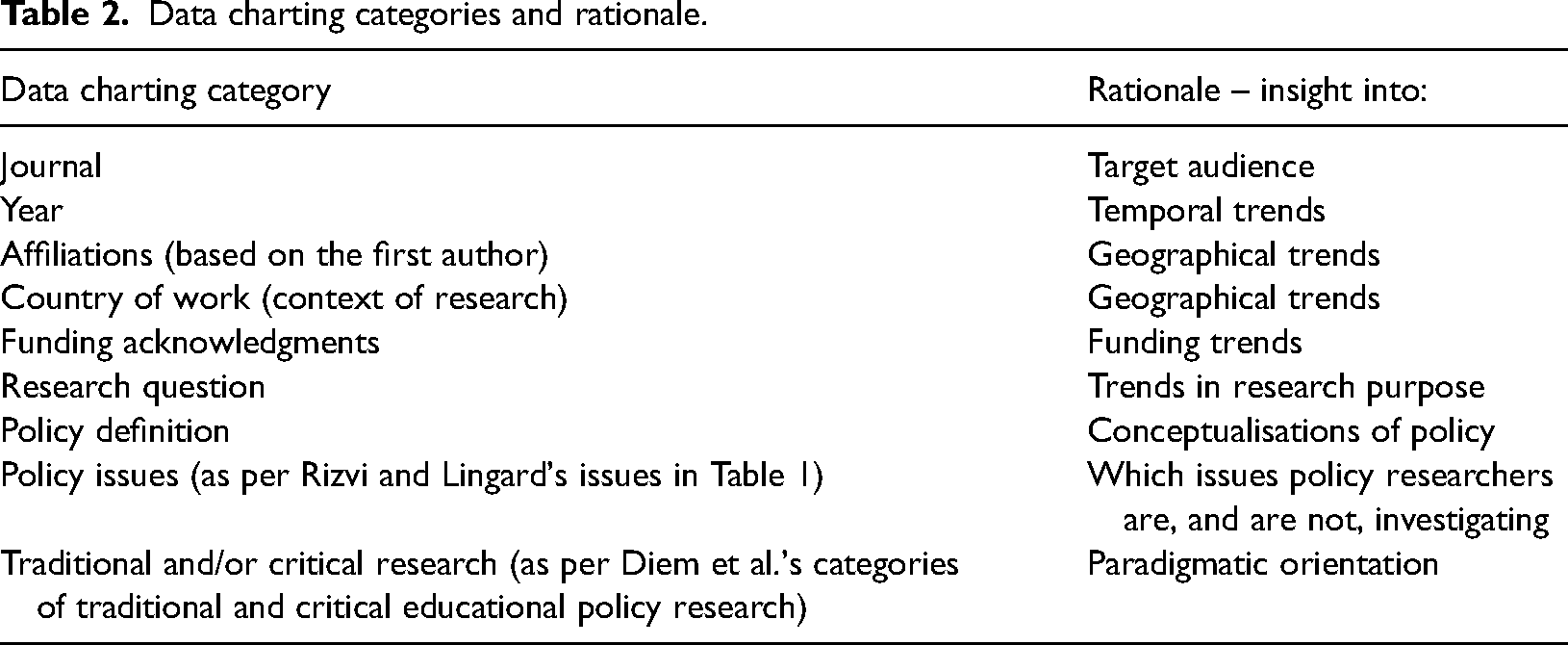
A data extraction form was developed in Excel to record relevant details from the included articles. The data extraction categories are listed and explained in Table 2. Although not reported in this paper, we also extracted information related to: (i) research approach (i.e. qualitative, quantitative or mixed); (ii) methodology; (iii) method/data gathering approaches; (iv) participants; and (v) policy theory and concepts. This information helped to determine if articles met certain criteria such as being empirical and focused on policy. We also attempted to analyse the ‘space’ which the policy in question related to (or originated from), for example, supra spaces like international organisation, macro spaces like national governments, meso spaces like district authorities, micro spaces like schools and nano spaces like classrooms. We note for others interested in similar reviews of policy that this was a difficult undertaking given this information was not always clear.
Data charting categories and rationale.
Basic quantitative descriptive analysis (i.e. frequency counts) and qualitative content analysis were conducted on the extraction categories and are reported in the following section. Specifically, Authors 1 and 2 each extracted details from half of the included articles and then reviewed and confirmed the extracted details from the other half of the articles compiled. Any questions or disagreements were resolved following the discussion process described previously. Melody, an education (rather than physical education) policy scholar, was instrumental in guiding the conceptualisation of the data extraction categories and navigating challenges related to the extraction via regular meetings.
Findings
Phase 3: findings from the charting of sources
Quantity of articles per year
The number of included articles published each year meeting our criteria ranged between 6 and 16, with an average of 10.6. Figure 1 displays the distribution of the included articles over the 2010–2020 timeframe and could be interpreted as indicating a slight increase in annual quantity (or focus on policy).
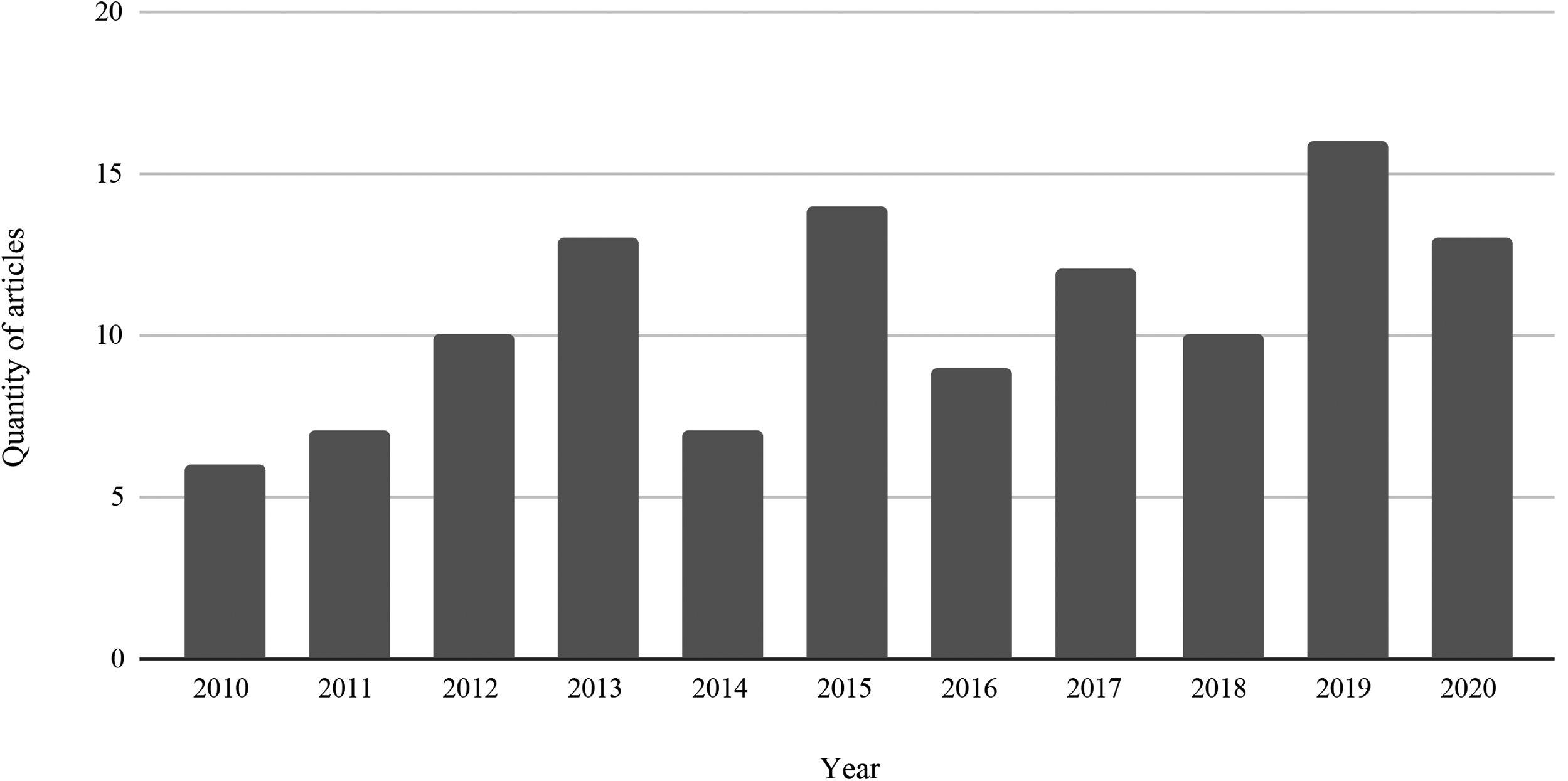
Articles per year.
Journals
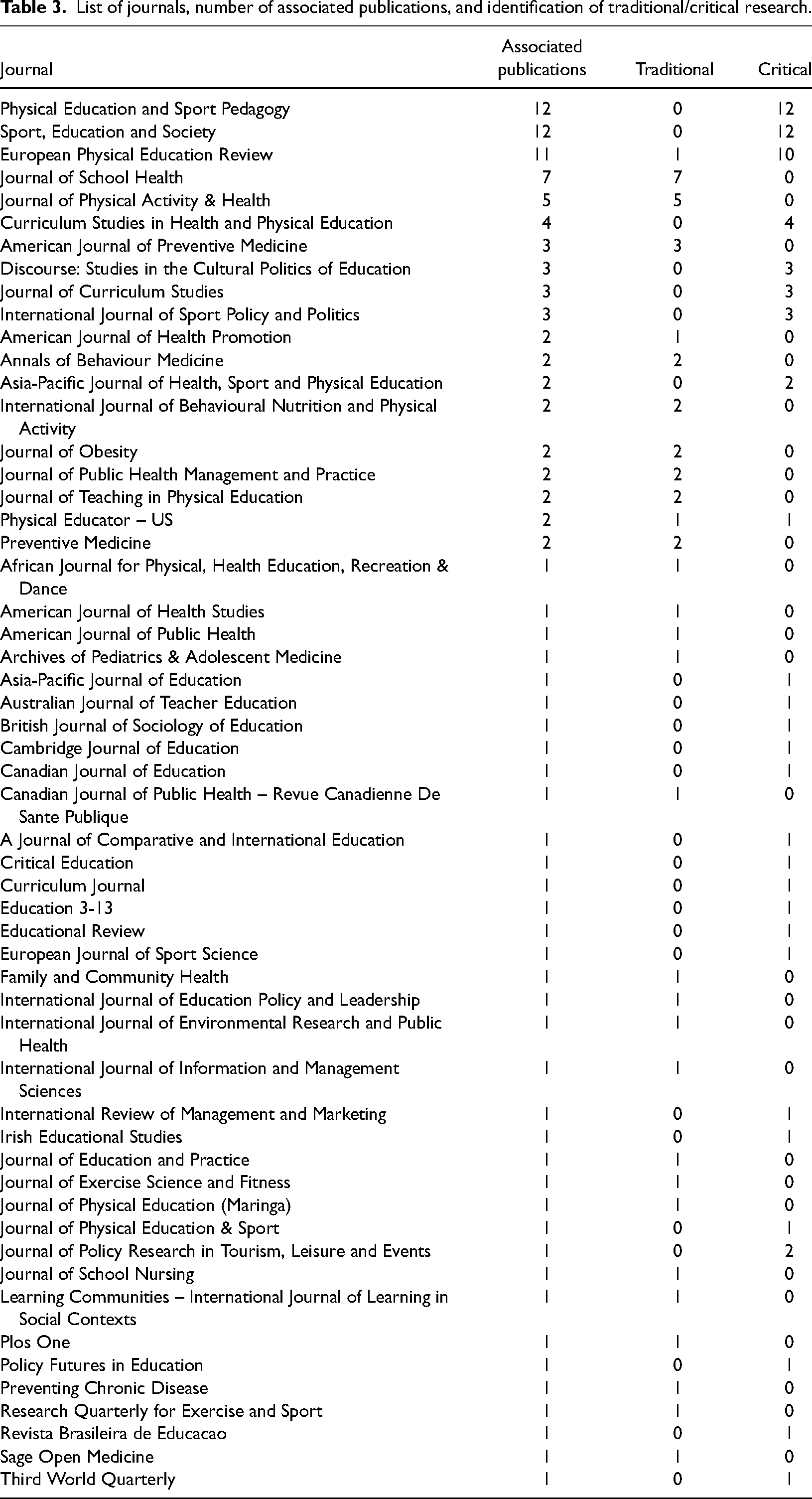
The 117 articles were published in 56 different journals. The journals where the articles most frequently appeared were Physical Education and Sport Pedagogy (n = 12), Sport, Education and Society (n = 12) and European Physical Education Review (n = 11). See Table 3 for a list of journals and corresponding number of articles and approach (i.e. traditional or critical). To categorise the journals (in terms of aim and scope/intended audience), Clarivate’s Journal Citation Reports (JCR) was referenced. Each journal was located within the JCR and its assigned category was noted. There were 12 journals which had multiple categories listed. In these cases, we used our professional judgement to assign the journal to the JCR category we considered to most represent the main thrust of the journal (the category in which the journal had the highest quartile ranking was also a supporting factor in our judgement). Eleven journals were not listed in the JCR. In these cases, we used our professional judgement to assign the journal to a JCR category we felt most representative of the main thrust of the journal (informed by visiting the journal webpage and reviewing collected articles published in that journal).
List of journals, number of associated publications, and identification of traditional/critical research.
The largest proportion of included articles were in journals categorised by JCR and the researchers as ‘Education & Educational Research’ (n = 23; 46%). This was followed by ‘Public, Environmental, and Occupational Health’ (n = 7; 14%), ‘Hospitality, Leisure, and Sport Tourism’ (n = 4, 8%), ‘Medicine – General & Internal’ (n = 3, 6%) and ‘Sport Science’, ‘Management’ and ‘Multidisciplinary Sciences’ which each had two journals categorised within them (4% each). In addition to this, ‘Endocrinology & Metabolism’, ‘Development Studies’, ‘Environmental Sciences’, ‘Nursing’, ‘Nutrition & Dietetics’, ‘Pediatrics’ and ‘Primary Health Care’ each had one journal categorised within them (2% each). While ‘Education’ was the largest single category, when the other categories are taken together, we see the majority of physical education policy articles published outside the education space.
Research funding
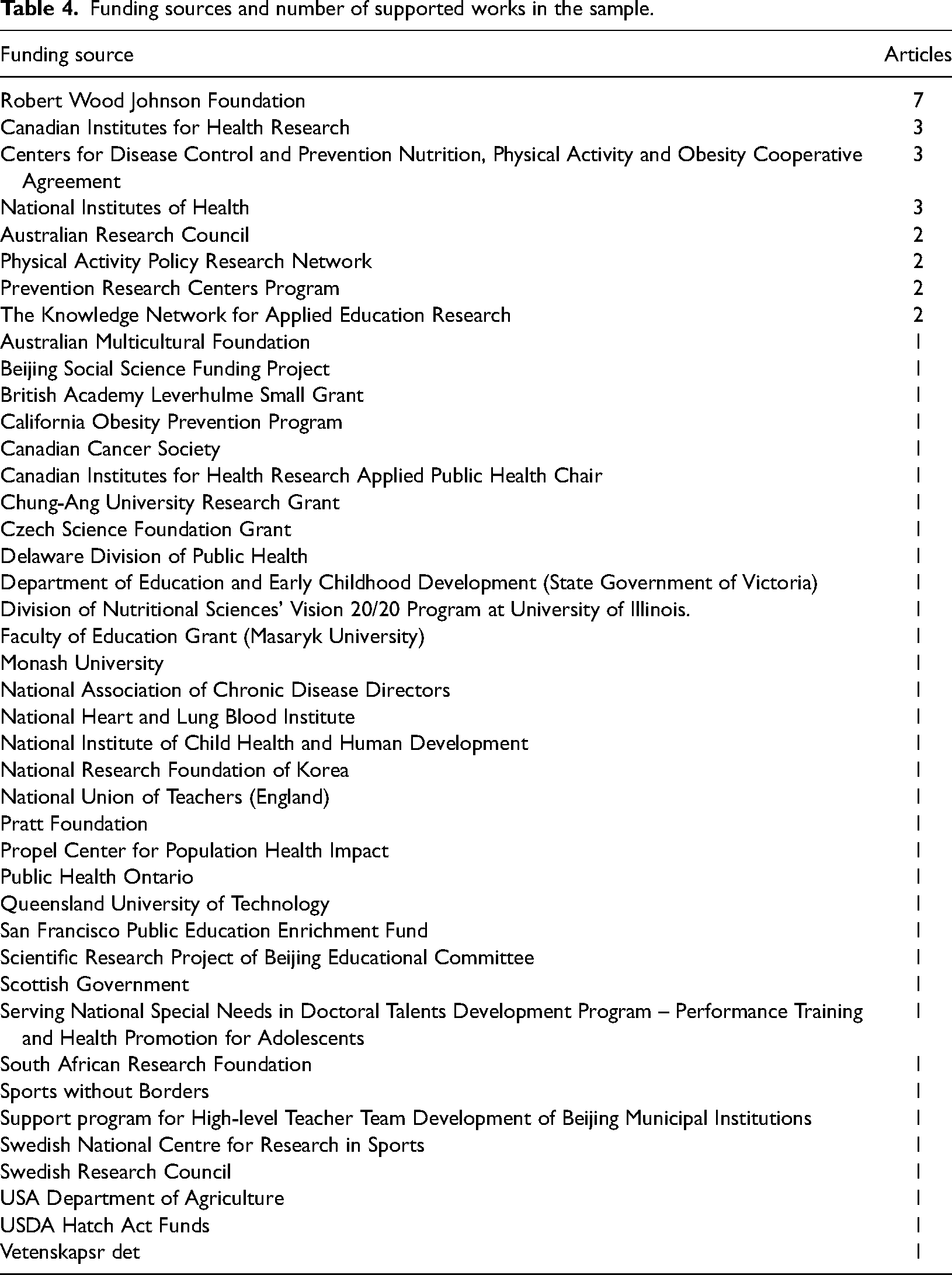
Of the 117 collected articles, 36 (31%) included acknowledgement of research funding, while the remaining 81 (69%) did not. Of the 36 articles reporting funding, 24 reported funding from a single source, while 12 reported funding from two or more sources (i.e. six reported funding from two sources, two reported funding from three sources, three reported funding from four sources, and one reported funding from five sources). In total, 42 different funding sources were identified. The most frequently reported funding source was the Robert Wood Johnson Foundation, which supported research in seven of the included articles, followed by the Canadian Institutes for Health Research, the Centers for Disease Control and Prevention and the National Institutes of Health, which respectively supported research in three of the included articles. The Australian Research Council, the Physical Activity Policy Research Network, Prevention Research Centres Program and the Knowledge Network for Applied Education Research each supported research in two of the included articles. All other funding sources identified in the sample each supported a single work and can be seen in Table 4. The largest proportion of funded articles fell under the ‘Education & Educational Research’ research category (n = 17, 47%), followed by ‘Public, Environmental, and Occupational Health’ (n = 11, 3.5%), ‘Multidisciplinary Sciences’ (n = 3, 8.3%) and ‘Medicine – General & Internal’ (n = 2, 5.5%), with ‘Nutrition & Dietetics’, ‘Pediatrics’ and ‘Environmental Studies’ each having one funded article (2.7% each). When these other categories are taken together, ‘Education’ is in the minority. With this in mind, we see 20, or 55.5%, of the funded articles were categorised as traditional in perspective, with the remaining 16, or 44.4%, categorised as critical.
Funding sources and number of supported works in the sample.
Topics of research
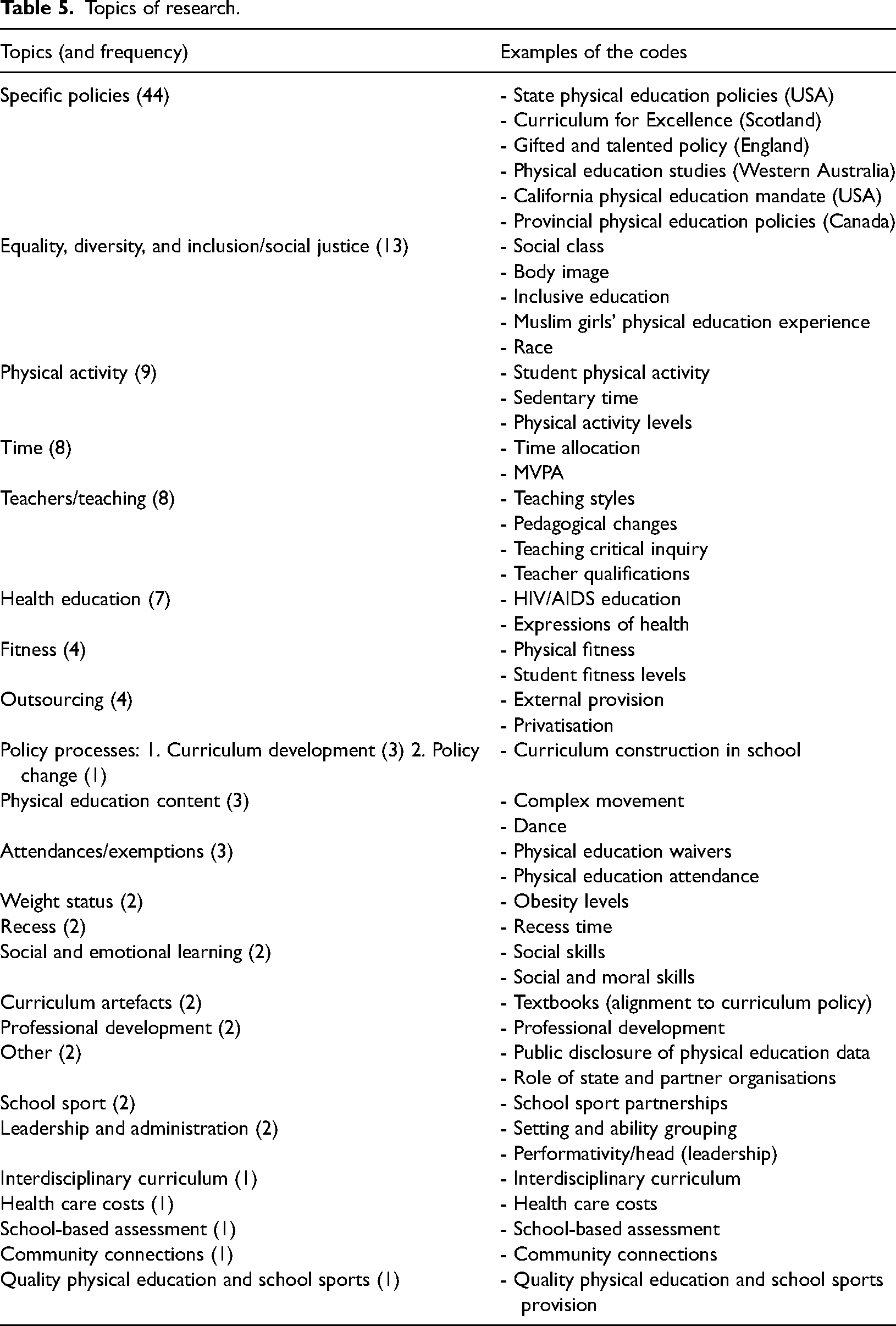
To map the topics of the included articles, the abstracts, research question(s), and purpose statement were inductively coded by Authors 1 and 2 by assigning a topic code to each article. The two authors then met to discuss and group the codes into categories. This resulted in 24 coded topics. These topics can be seen in Table 5 alongside the frequency of codes in each topic, and examples of such codes. Some articles were coded as relating to more than one ‘topic’; therefore, the frequency count was higher than the total number of included articles. The top three topics of published research were: (i) specific policies (44 codes); (ii) equality, diversity, and inclusion/social justice (13 codes); and (iii) physical activity (9 codes). To note, specific policies differ depending on the country of the policy; these can include curriculum policy (e.g. Curriculum for Excellence in Scotland), physical education mandates (e.g. California Physical Education mandate in the USA) or state/provisional policies (e.g. Provincial physical education policies in Canada).
Topics of research.
Methodological approach
Of the 117 articles meeting our criteria, 57 (49%) were qualitative in methodological approach, 45 (38%) were quantitative, and 15 (13%) were mixed methods. Note that 71 of the 117 included articles did not explicitly label their approach, rather the authors used their research training to interpret this. 47 articles with an unspecified approach were interpreted as quantitative in nature, 20 as qualitative, and 4 as mixed methods.
Policy definition
Of the 117 articles included in the sample, only a limited number (n = 9) offer an explicit definition (or explanation) of policy, albeit in varied depth. For example, Carlson et al. (2013: 151) explicitly and briefly define policy within a bracket: ‘Policies (i.e. requirements)….’ Other scholars offer an explanation for conceptualising policy, such as Dowling and Flintoff (2018) who describe drawing on Ball's (1993) work to suggest policy as text and discourse. More authors offer definitions not of policy itself but the way it was used within the context of their study. These include: Pate et al. (2011: 12) who outline ‘our definition of physical activity policy (i.e. a formal written document that provides guidelines to promote physical activity in the public)’; Hales et al. (2013: 2) who describe that ‘In the SHPPS [School Health Policies and Programs Study] survey, “policy” was defined as: “any law, rule, regulation, administrative order, or similar kind of mandate issued by the state board of education, state legislature, or other state agency with authority over schools in your state”; and Calvert et al. (2020: 315) who outline ‘“Wellness policy” was defined to include the board-adopted wellness policy; the associated administrative regulations, rules or procedures; and any other district, state or model policies that were incorporated by reference’. Finally, and relatedly, two authors describe how they consider the phenomena they study to be policy, although they do not offer a definition of policy itself. Specifically, Janemalm et al. (2019: 1150) describe that ‘curriculum documents are regarded as “authoritative educational policy documents” … (Englund and Quennerstedt, 2008: 714)’ and Walton-Fisette and Sutherland (2020: 277) describe that they ‘reviewed these policies as texts, that is, the written words of the document and not as policies as discourse’.
Traditional or critical policy perspective/orientation
Of the 117 included articles, 68 (58%) were categorised as reflecting a critical approach to policy research, while 49 (42%) were categorised as reflecting a traditional approach. An example of a paper categorised as critical in approach to policy research is Alfrey et al.'s (2017) paper which explored physical education teachers’ interpretation, translation and enactment of curriculum policy by drawing on the work of Stephen Ball. This research demonstrated the processes curriculum policy undergoes in interpretation and translation and how it is rarely enacted as intended. This paper can be considered critical as it explores the difference between policy rhetoric and practised reality (Diem et al., 2014). An example of a paper categorised as traditional in approach to policy research is Kahan and McKenzie's (2017) research, which intended to measure energy expenditure estimates during school physical education in order to address the high prevalence of obesity. This paper investigated policy prevalence and compliance, which suggests a traditional orientation as it appears to suggest that policy can be effectively evaluated through a measurement of outcome (Diem et al., 2014).
Policy issues
The majority of the 117 included articles were categorised by the researchers as focused on ‘implementation and outcomes issues’ (64.8%, n = 91), followed by ‘policy and textual issues’ (24.8%, n = 36), and then ‘contextual issues’ (10.3%, n = 15). Some articles were categorised as related to more than one ‘issue’ category (e.g. both ‘implementation and outcomes’ as well as ‘contextual’), thus the frequency count was higher than the total number of included articles. Table 6 outlines the number of articles categorised as investigating each issue type as well as how many in each category were coded as critical or traditional in their orientation.
Policy issues in critical/traditional research.

As seen in Table 6, there was no recorded article in the ‘contextual issues’ category from a traditional perspective. An example of a paper categorised as relating to ‘contextual issues’ and as critical in perspective is Penney et al.'s (2015) paper which investigated the Health and Physical Education (HPE) policy landscape in New Zealand in an ‘open market’ situation. This paper was categorised as focused on ‘contextual issues’ given its focus on policy emergence and developments (Diem et al., 2014) as well as the influence of contextual factors and institutions (e.g. government and non-governmental agencies and organisations).
An example of a paper categorised as relating to ‘policy and textual issues’ from a critical perspective was McEvilly et al.'s (2015) paper which explored practitioners’ understanding and meaning of physical education given the language changes associated with physical education in Scottish educational policy. This paper can be understood as exemplifying a policy and textual issue given the focus on discursive formation of policy and policy problems (Rizvi and Lingard, 2010) and as coming from a critical perspective as it focused on understanding how the policy emerged and its role in reinforcing dominant notions (or not) (Diem et al., 2014). An example of a paper categorised as relating to ‘policy and textual issues’ and as traditional in perspective is Dauenhauer et al.'s (2019) paper which investigated state physical education policy changes from 2001 to 2016 related to, for example, state mandates, time/credit requirements, and assessment and fitness testing requirements. This paper can be understood as focused on policy structuration (Rizvi and Lingard, 2010) from a traditional lens as it appears to assume policy can be effectively evaluated (Diem et al., 2014).
An example of a paper categorised as relating to ‘implementation and outcomes issues’ and as critical in perspective is Brown and Penney's (2017) paper which explored the expression of Arnold's three dimensions of education in, through, and about movement in teachers’ interpretation and enactment of a new curriculum policy in Australia. These categorisations were made because the paper explored implementation strategies (Rizvi and Lingard, 2010) and the difference between policy rhetoric and practised reality (Diem et al., 2014). An example of a paper categorised as investigating ‘implementation and outcomes issues’ from a traditional perspective is Chriqui et al.'s (2013) paper examining the influence of state laws and district policies on physical education practices (i.e. time and moderate-to-vigorous physical activity time). These categorisations were made as the paper focused on understanding implementation strategies in achieving the policy's goal (Rivizi and Lingard, 2010) and appeared to assume that policies can be effectively evaluated (Diem et al., 2014).
National context of research
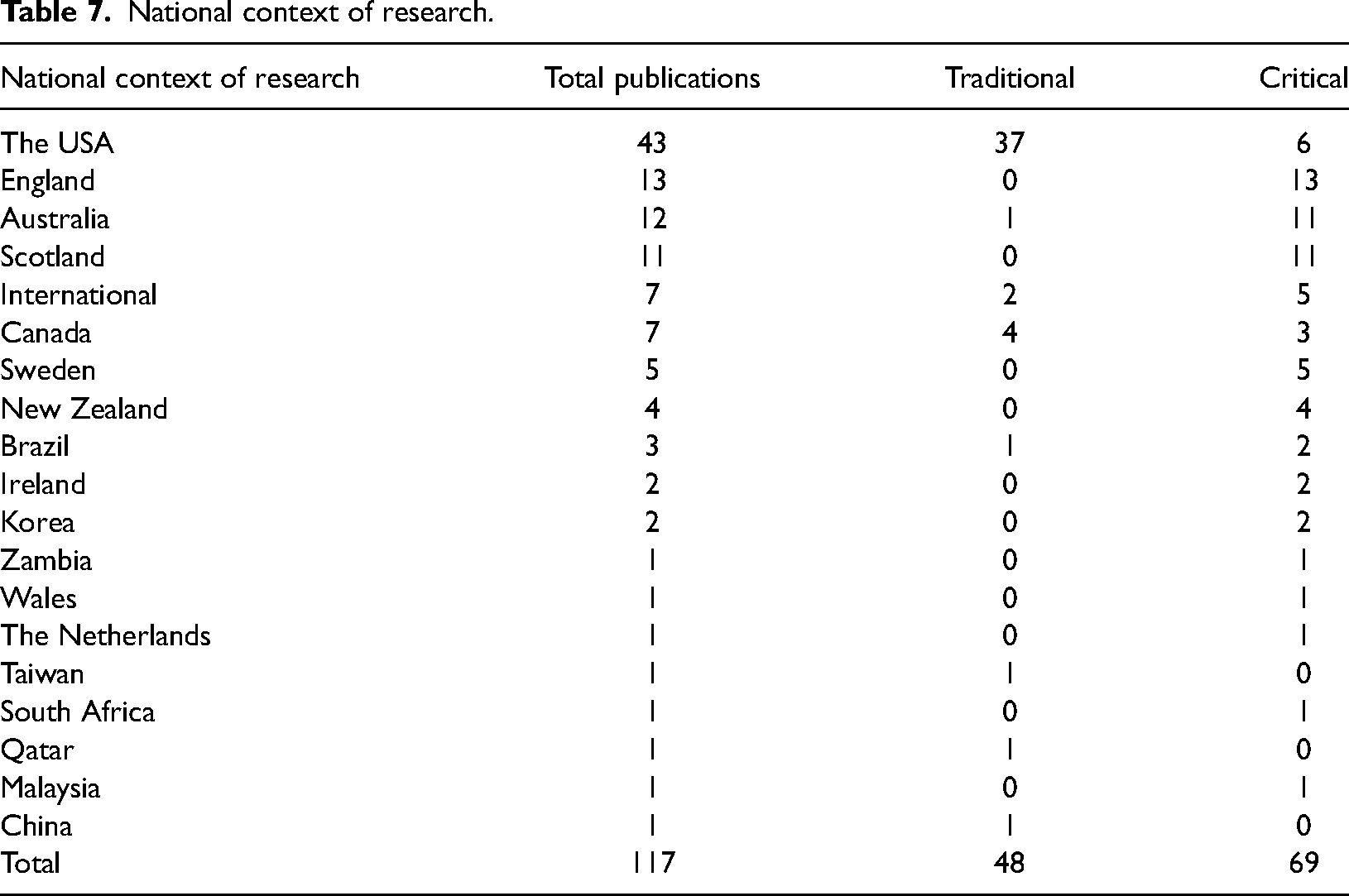
Of the 117 included articles, 19 different countries were the national focus of the research (see Table 7). Seven papers were categorised as ‘international’ (i.e. studies focused on multiple countries). The context most frequently focused on was the USA (36.8%, n = 43) with England (11.1%, n = 13) coming in second, and Australia in third (10.3%, n = 12). The proportion of articles categorised as traditional and critical within each national context was tallied. Most of the research being conducted in the American context was predominately traditional (86.1%, n = 37 [traditional]/13.9%, n = 6 [critical)) while all the research being conducted in England (100%, n = 13 [critical)), Scotland (100%, n = 11 [critical]) and most of Australia (91.6%, n = 11 [critical]/8.4%, n = 1 [traditional]) was categorised as critical in nature.
National context of research.
Country of authorship
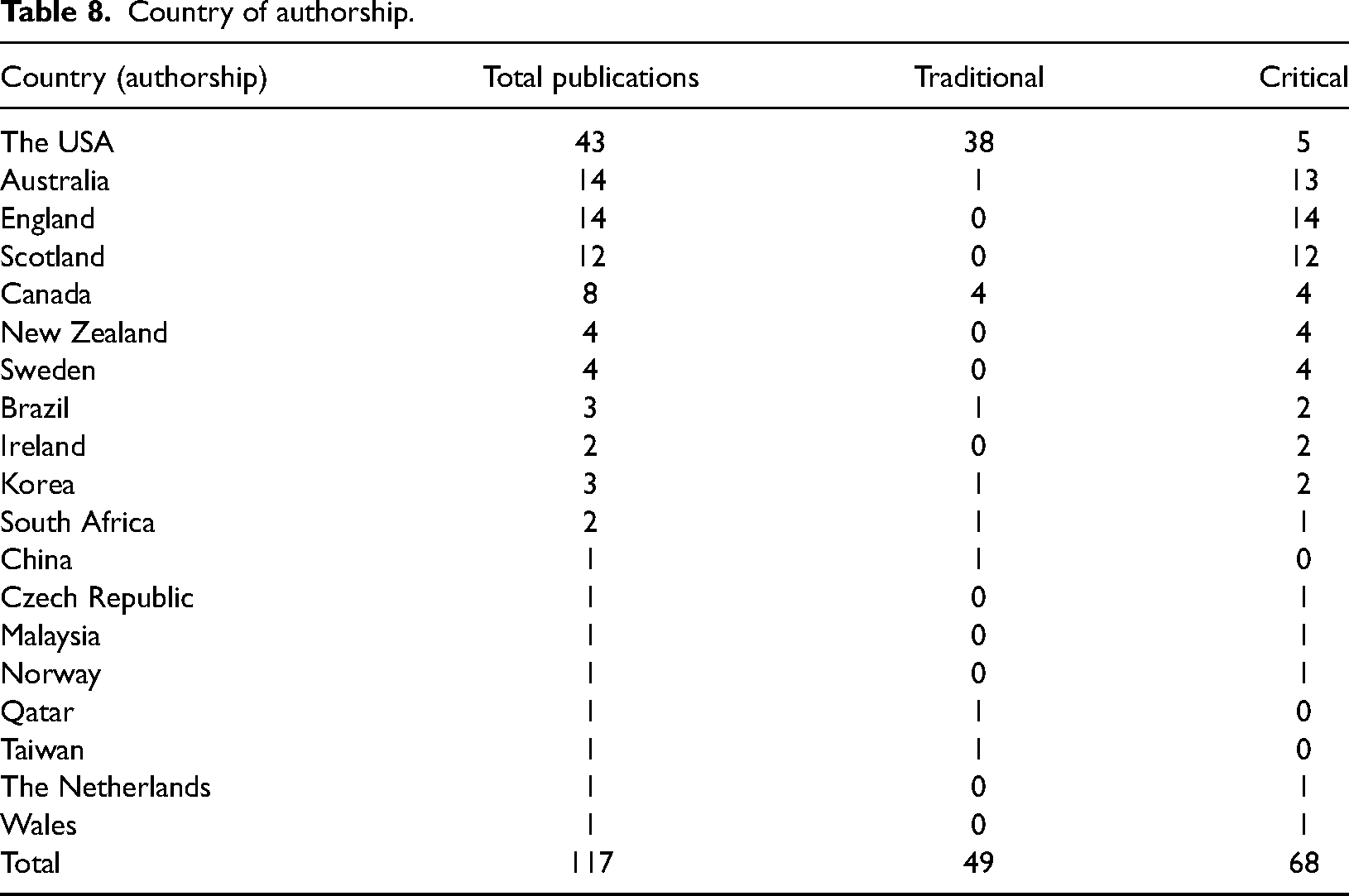
Of the 117 included articles, there were 19 different countries from which the lead author of the paper was affiliated (see Table 8). The largest proportion of lead authors were affiliated with the USA (n = 43, 37%), then Australia (n = 14, 12%), then England (n = 14 articles, 12%). In the USA, where 43 articles listed a leading author as located, 38 of those articles were from a traditional perspective and 5 from a critical perspective. In England (n = 14), publications (with leading authors’ affiliation) were from a critical perspective, while most publications in Australia were in the critical space (n = 13 [critical]/n = 1 [traditional]).
Country of authorship.
Discussion and considerations
The purpose of this scoping review was to understand and consider extensions to the conceptual boundaries of how to ‘do’ policy research in this field. For this discussion, we focus on four consideration points.
First, the findings highlight how there are slightly more critical approaches to policy research in physical education (68 [58%] critical to 49 [42%] traditional approaches). This is aligned with trends in the broader educational policy research field, which has also seen an increasing proportion of critical approaches, though certainly not dominant in the education policy field (Diem et al., 2014). Also aligned with broader education policy trends is that most of the research coming from a traditional orientation comes from a single national context, the USA, which is also the largest producer of physical education policy research, possibly related to its considerable dominance in relative size to most other countries (Durnová and Weible, 2020). The number of traditional studies coming from the USA skews the overall ratio of critical to traditional research. The predominance of traditional approaches in the USA may be due to: (i) the presence of state curriculum policy; (ii) political systems; (iii) historical research trends; and/or, as previously alluded to, (iv) majority of the research published in the USA on physical education policy is conducted for an audience outside of physical education and by authors who do not consider themselves physical education professionals (e.g. public health researchers) (van der Mars et al., 2021). The findings of this research highlight the impact other disciplines (e.g. health, medicine, etc.) are having on physical education policy and therefore there needs to be an awareness of this when reading such research. By this, we mean understanding these authors may come with disciplinary values and beliefs (e.g. medical model) which may or may not align with physical education best practice. We are suggesting this can be viewed as an opportunity for physical education researchers to collaborate across disciplines and to balance perspectives in this area of research.
Second, the findings reveal that over a quarter of the physical education policy research reviewed has garnered the attention of funding agencies (36 [31%] articles). This finding suggests that physical education policy is considered an important area of study to those concerned with the general population, i.e. funding bodies concerned with socially significant research. That is, it seems that research about physical education policy has the attention of both public and private funders that express an interest in improving social outcomes (e.g. Robert Wood Johnson Foundation in the USA, which funds initiatives related to increasing health equality). Given the large proportion of critically orientated research in this review (n = 68, 58%), this finding aligns with Diem et al.'s (2014) assertion that critical policy studies are often concerned with issues of social significance. Physical education policy research being fundable suggests, in part, that this may be a line of inquiry considered to be of practical and professional value.
Third, as the results of this research indicate, definitions of what is meant by policy are not offered regularly enough (nine articles included a definition), and policy can be understood in many ways. This can be confusing for readers, especially those new to policy, given that policy is a term/concept that is understood variably (Diem et al., 2014). We suggest if physical education researchers believe policy research to be important, we need to be more frequently offering definitions/explanations of what we consider policy to be in our research. It is important to share what is meant by policy so that others can engage in policy research and having a definition(s) can make such research more accessible to physical education researchers and other stakeholders.
Finally, using Rizvi and Lingard's (2010) typology, we determined that implementation studies feature strongly in physical education policy research (64.8%, n = 91). Implementation studies focus on what happens with policy once it has been taken up in organisational life, such as what practitioners do with policy. As physical education policy research continues to lean towards implementation, we suggest attention must also be given to contextual and textual issues. If we continue to primarily consider the enactment/implementation of policy, and not the historical, political and bureaucratic origins (contextual issues) or the discursive formation of policy and policy problems (policy and textual issues), the field will continue to create policies with similar flaws, for example, policies being produced without the deliberative processes involving a wide range of stakeholders which may reveal ‘solutions’ to common implementation issues. Our argument here supports Penney and Alfrey's (2022) plea to extend physical education policy research beyond enactment-based investigations. We emphasise the importance of contextual and policy and textual issues (alongside, not below or above, implementation and outcomes issues). We can draw on the methodological concept of triangulation of data here as an analogy. Roberts (2009: 114) comments, ‘triangulation means studying a situation using two or more different methods. The effect is said to be comparable to photographing a building from different angles, after which it is possible to make a better estimate of the overall shape of the structure’. We are advocating for a similar approach to physical education policy research. To understand a policy holistically (and to learn lessons from it), we – in the physical education policy research field – need to be researching from a contextual, textual, and implementation/enactment/outcomes angle.
Conclusion
While policy studies appear to be slightly increasing within the physical education research field, policy as a research focus has not taken a stronghold of how physical education is studied. While it may not be possible to firmly state that we are experiencing a ‘policy turn’ (Alfrey et al., 2021), this research does highlight opportunities and possibilities for physical education policy research. The results of this scoping review highlight the value of doing policy research, for example, it being considered fundable (i.e. one marker of social significance). We also hope that increasing research attention to policy in physical education can bridge connections between fields of research, such as health and education. There is also an opportunity for physical education scholars to consider how their engagements with policy may influence the broader field of policy studies itself. The complement of expertise may flow bi-laterally, strengthening both fields. If policy research continues to increase in prevalence among physical education and health scholars, that opportunity can develop both fields. While we advocate for this, we remind the reader that most of the reviewed research targeting public health journals is traditional in orientation and that scholars such as Durnová and Weible (2020) have outlined the various issues related to differences across traditional/critical approaches. As such, we wish to flag the challenges which exist, for example, different positionalities, different understandings of policy, different languages regarding policy, etc. Physical education researchers need to be prepared to encounter these differences when reading or collaborating on physical education policy research across disciplinary lines. Such collaboration may stimulate growth of critical perspectives in public health approaches to physical education policy research which may contribute to challenging the status quo. Consider the call from prominent education policy researcher Lingard (2013: 116), who suggests ‘my position is that any educational policy research of any type ought to have at the broadest level a desire to make things better in education … to improve education policy, including conceptualisation and enactment’.
If policy research is on the agendas of physical education researchers, this paper suggests being reflexive about the position the researcher may be coming from and which perspectives may be most beneficial to the experiences and outcomes of physical education teachers and students. We hope this research can be useful to those looking to enter the physical education policy research space, as it introduces them to the research landscape, and to those already engaged in this space looking to fill gaps in the literature.
Supplemental Material
sj-docx-1-epe-10.1177_1356336X231210393 - Supplemental material for Understanding (and extending) the conceptual boundaries of policy research in physical education: A scoping review
Supplemental material, sj-docx-1-epe-10.1177_1356336X231210393 for Understanding (and extending) the conceptual boundaries of policy research in physical education: A scoping review by Dylan Scanlon, Jenna Lorusso and Melody Viczko in European Physical Education Review
Footnotes
Declaration of conflicting interests
The author(s) declared no potential conflicts of interest with respect to the research, authorship, and/or publication of this article.
Funding
The author(s) received no financial support for the research, authorship, and/or publication of this article.

Supplemental material
Supplemental material for this article is available online.
1
Policy can be defined as ‘any course of action (or inaction) relating to the selection of goals, the definitions of values or the allocation of resources’ (Olssen et al., 2012: 17). This is only one understanding of policy and we acknowledge that many definitions/understandings of policy exist.
Notes
Author biographies
References
Supplementary Material
Please find the following supplemental material available below.
For Open Access articles published under a Creative Commons License, all supplemental material carries the same license as the article it is associated with.
For non-Open Access articles published, all supplemental material carries a non-exclusive license, and permission requests for re-use of supplemental material or any part of supplemental material shall be sent directly to the copyright owner as specified in the copyright notice associated with the article.
