




Abstract
This case study examines a Nordic on-line course on gender equality promotion in education, in which principals, teachers, school staff and gender equality activists engaged in dialogue regarding contents and practices. The on-line course was designed with reference to promising practices identified in a previous Nordic network project. The article considers challenges appearing across localities in relation to diversity, in gender equality promotion practices, policies and pedagogies. Digitalisation enables educational collaboration among teacher education institutions between the distant Nordic countries and facilitates the dissemination of Nordic education and the gender equality model, but this raises questions about whether these forms of education and equality are globally ‘branded’; and whether an intersectional gender equality promotion approach can be contextually and locally specific. This paper focuses on the contradictions of gender/sex binary concepts impairing understandings of diversity, sexuality and identity, the consequences of the emergence of scepticism toward practice standardisation, discrepancies between norms of equal treatment and critical reflection, and the development of citizen-based actions initiating policy changes. It is shown that the results of the project will benefit Nordic collaboration on teacher education development.
Keywords
Promotion of gender equality in the context of development of Nordic teacher education
For more than 30 years, Nordic collaboration has had the aim of improving equality between the sexes. The promotion of gender equality was adopted as an objective of education in the late 1970s and early1980s; and several cooperation and research networks on gender in education were created at the Nordic level. Teacher training was under the scope of the Nordic Nord-Lilia project (1992–1993) aimed at incorporating gender equality issues into teacher training curricula (Sunnari, 1997a, 1997b) and later – that is, the Finnish TASUKO 2008–2011 (Lehtonen, 2011). However currently, in the year 2017, sexuality and diversity are not comprehensively included in the contents and practices of initial teacher training. In-service training and courses offered by gender studies’ departments provide opportunities for some educational professionals to voluntarily develop the competences needed in the effort to construct equal opportunities for all.
The Nordic ministers of gender equality expressed the desire to stimulate Nordic cooperation in the area of gender equality within the framework of their cooperation programme and its priorities, as outlined in the report ‘Gender Equality Creates Sustainable Societies: Nordic Co-operation on Gender Equality 2011–2014’ (Norden, 2011). As part of this ambition, they have established a funding scheme administered by Nordic Information on Gender (NIKK). The scheme enables organisations to apply for funding of activities and collaborations in the field of gender equality in the Nordic region. The Nordic Council of Ministers’ gender equality fund finances projects where organisations from the Nordic region cooperate to work for Nordic gender equality. Since 2013, some 40 projects have been granted funds. The Nordic projects have resulted in everything from educational material to political suggestions and new Nordic networks. In 2014 and 2015, the subject of Women’s and Gender Studies at the University of Oulu, Finland received funding to carry out projects to meet the goals set for the fund. The first, Mapping Promising Nordic Practices (2014–2015), identified six new approaches that have recently been further developed and are already used in some Nordic locations to promote gender equality. On-line education (2016–2017) was developed based on the dissemination and further examination of these six reported practices and it was piloted with educational participants from the Nordic region. The projects resulted in awareness that significant similarities exist in how each Nordic nation approaches gender equality in education. These similarities may be fundamental to promoting gender equality in Nordic schools and, in an effort to be even more efficient, it is argued here that they should be incorporated into teacher education programmes as well. Common principles in forming a joint Nordic gender equality promotion in education are: (1) The Nordic welfare states as ‘gender-responsible states’; (2) Gendered citizenship in Nordic democratic societies; (3) Equality as a founding principle of ‘education for all’ for residents of Nordic countries (Heikkinen, 2016). In this article, we analyse the successes and challenges of the two projects and reflect on Nordic gender equality and its promotion on the local, national and Nordic levels, with further reflections on promoting increasing global influence.
The North, a specific geopolitical location for gender equality promotion
The Nordic countries’ collaboration on gender equality policy and practice has taken form substantively in the field of education due to the co-operative approach adopted by the countries to create sustainable societies (Norden, 2011). The guiding values of the Nordic Model in Education are democracy, equality, progressiveness and pragmatism (Antikainen, 2006: 240). Thus the Nordic educational model would be an ideal based on the aforementioned principles, values and contextual conditions. However, the lived relational phenomenon ‘challenges researchers and educators to recognize the contextual and situational realization of values [emphasis added]’ (Puroila et al., 2016: 154). In addition ‘[t]he Nordic welfare model’s core principle is that all citizens should enjoy equal opportunities to experience social solidarity and security for all’ (Norden, 2012). In practice, these terms mean social rights for all citizens in the form of equal division of power and equal treatment (Norden, 2014).
In our two Nordic network, gender equality promotion initiatives (‘Promising Nordic Practices’), digitalisation and on-line education emerged as practical solutions to the problem of connecting distant Nordic geographical locations, and reaching in-service teachers. However, differences in the cultural atmospheres and various ongoing political debates across localities made clear the necessity to consider culture-specific contexts further. Through our Nordic research and collaboration network we explored if and how the intersectional gender equality promotion approach could be contextually and locally specific. Intersectional gender equality promotion proposes that each individual, regardless of gender, race, class, age, sexual orientation, ethnic origin, ability, and other social classifications, should have access to rights and opportunities and be treated according to the same principles, norms and standards. The solution to inequality is therefore to seek the inclusion of difference and recognition of non-hegemonic, gendered identities (Heikkinen, 2016: 9); and this should also be possible locally, in each context.
The Nordic research network became interested in how the Nordic location has affected the development of particular kinds of gender equality promotion practices. The Nordic countries represent a periphery within the Global North, because of their welfare systems. The Nordic educational model has become something of a trademark, and it is relevant to analyse its foundations in an effort to understand better the successes and failures in gender equality promotion practices in the Nordic educational landscape, as well as to explore possibilities of how gender equality promotion practices could, or even should, be implemented elsewhere.
What is a Nordic model in education?
Following the Antikainen (2006) definition, we encountered the impossibility of defining a singular educational model; but revealed a plurality of definitions which contain many similarities because of the structures of the Nordic countries’ welfare state and educational systems. Similarly, an ideal Nordic gender equality model would include a comprehensive set of practices and policies that are compatible with the social justice climate of the region, where democratic participation would be practised in institutions and there would be continuity of organisational practice from educational institutions to states, including private companies. However, such a model is an ideal and it depends on grassroots-level activism, committed individuals and allocation of state resources. The outcome of the ‘Nordic gender equality model’ is, therefore, as diverse as each geographical location. In each region, local authors apply a model of gender equality relative to contextual issues. Initially, it may appear to be a singular Nordic model but in reality it emerges in different patterns. In particular, the notion of diffraction (Haraway, 1997) may help us to understand local variations as well as outcomes of the Nordic gender equality work: ‘Diffraction is the production of difference patterns in the world, not just of the same reflected – displaced – elsewhere’ (Haraway, 1997: 268). It helps us to understand dynamic processes of transformation in political and geographical locations across national projects by including the context of discovery, in this sense identifying the diffracted emerging patterns of Nordic gender equality by location depicted in our ‘Nordic regions map’. The Nordic educational model developed on historical structural similarities based on educational policies and commitment to the principle of education for all. The Nordic countries’ educational systems sought ‘to minimize organizational differentiation by avoiding streaming of student groups based on ability’ (Blossing et al., 2014: 232). However, the neoliberal discourse of choice and rights may affect the Nordic educational model. The Nordic regions map (Figure 1) locates some of the current debates presented by the Nordic network members; we acknowledge that there are many other important issues that are not mentioned in the map. However, these issues may lead us to identify some possible differences in the actual execution of Nordic promotion of gender equality not only country-by-country, but also according to local, special needs.
The Nordic region, showing location and details of some of the current debates presented by the Nordic network members.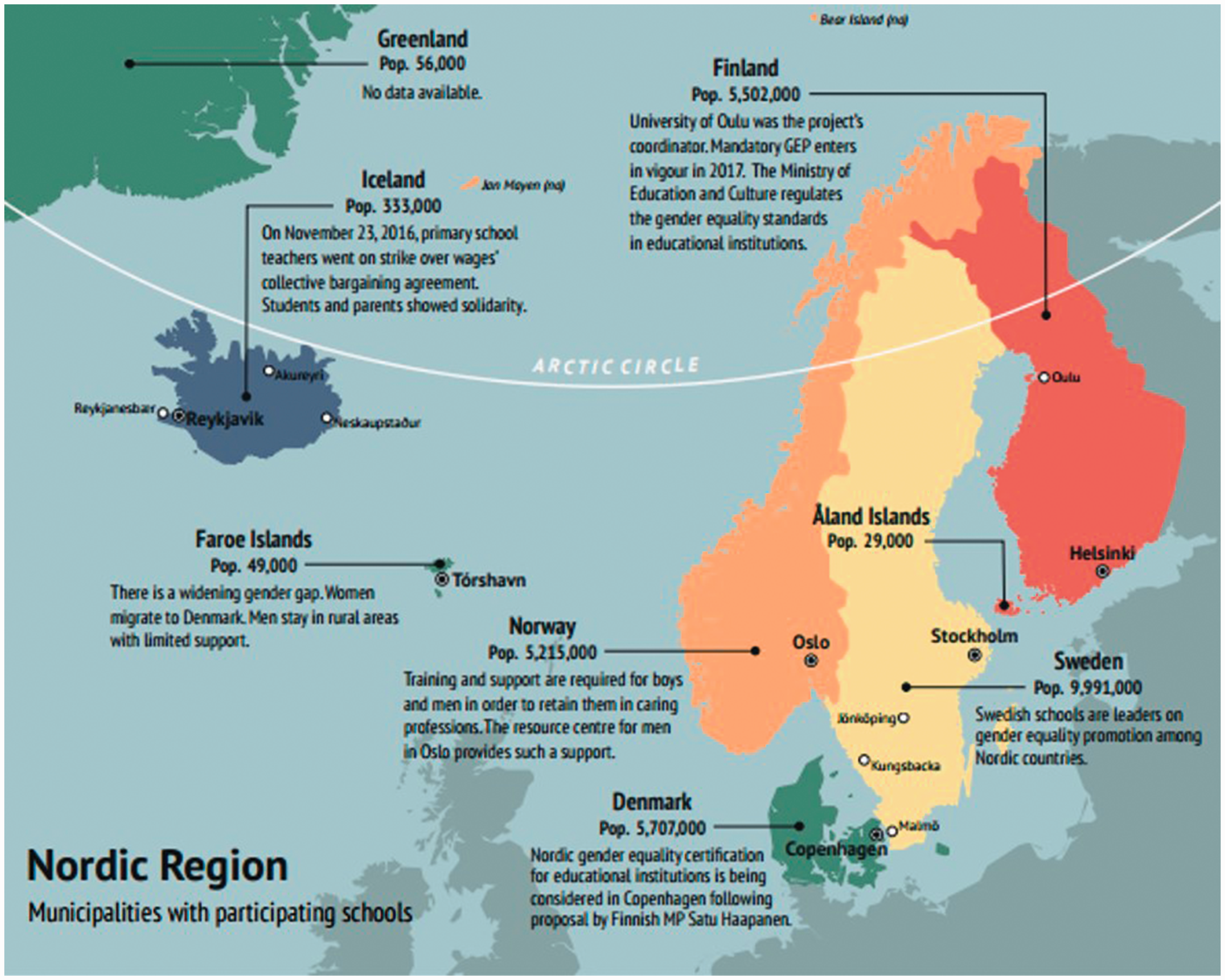
(Un)doing gendered structures, processes and resources through Nordic gender equality education?
Gender as a social category is constantly being invented and reinvented in organisations – starting with a national identification number given at birth for each born individual. Citizen’s rights and responsibilities are closely associated with gender identification and these rights are controlled by diverse organisations and various organisational practices – as well as within education. Gender equality is also produced and reproduced in organisations regulated by national and supranational policies, programmes, instructions, guidelines and gender equality plans and is based on those with gender equality education being provided.
In schools, organisational structures are basic curricula, institutional guides, equality, and equity plans, among others. The structuring documents consist of legislation, agreements, laws, information materials and publicly presented values. In addition, there are ‘gendered substructures’ reproducing and maintaining often-invisible processes in the ordinary lives of organisations in which ‘gendered assumptions about women and men, femininity, and masculinity are embedded and reproduced, and gender inequalities perpetuated’ (Acker, 2012: 216). These substructures consist of organising processes, organisation culture, interactions, and gendered identities. Organisational change is possible by ‘scrutinizing policies and practices that perpetuate discrimination and help identify inequality regimes’ (Acker, 2012: 221). The structural level is the policymaking in form of laws and documents, such as bills and plans. For instance, Finland’s gender equality plan for compulsory education, initiated with vigor in 2017, obliged schools to draft, annually, their own gender equality promotion policy based on data collection from pupils and jointly agreed goals. Therefore, a gap exists between policy and practice because, for example, Finnish teachers do not necessarily experience education on gender, sexuality and diversity issues in order to identify them appropriately and modify plausible policy goals.
The organisational processes (Acker, 1992) have four intertwined dimensions: divisions; interactions; images; and self-definitions. The organisational resources are economic, ideological and political, in addition to which are work load/time allocation and the human body. Embodiments arrange organisations by creating divisions (i.e., break facilities, toilets, sport locker-rooms), and interactions (all male or female-only classes or workspaces). Intersectionality considers and expands gender in close relation to class and ethnicity (Acker, 2012), identity subcategories such as sexual orientation, gender identity, gender expression (Köllen, 2016), and gender non-conforming children (Cardona-López and Heikkinen, 2015).
Research approach
A participatory approach was used which involved a network of Nordic researchers, activists and gender-equality experts in an effort to create, support and develop educational practice–policy cycles of gender equality promotion on-line, with multiple actors including teachers, staff, principals and parents. The case study data consist of diverse materials gathered during the two ‘Promising Nordic Practices’ – projects carried out during 2014–2016, as well as related policy documents and on-line materials. The Nordic research network members developed the materials and their own positionality in an effort to determine whether and how the intersectional gender equality promotion approach could be contextually and locally specific. Based on the team’s reflections the following presents the four emerging aspects of Nordic gender equality promotion.
Contradictions, consequences, discrepancies and developments in promising Nordic practices in gender equality promotion
The data analyses yielded the three identified aspects at the Promising Nordic Practices network discussions, namely contradictions, consequences, and discrepancies. The teachers’ narratives, descriptions of struggles or challenges regarding the content, were categorised according to the gendered organisational categories and subcategories. The development aspects deserve their own analysis, because organisational processes and structures both describe the policies and developments of citizen-based actions that initiate policy changes in the Nordic countries.
Contradictions of gender/sex binary concepts impairing understandings of diversity, sexuality, and identity
These contradictions were a source of discussion and caution. The organisational structures designated by national non-discrimination policies on gender-non-conforming children and their parents, as well as trans parents and their children, mandate teacher/pupil interaction. However, the participants’ discussions referred to the ‘matter’ as ‘a minority issue’. Diversity of identity markers, such as sexual orientation (lesbian, gay, bisexual) and gender identity (trans*/cis-gender) or biological sex ambivalence (intersex), is still treated according to a heteronormative lens, within a process of gender socialisation persisting in schools. Positive pedagogical practices emerge only in specific contexts i.e., ‘dress-up day’, when a boy dresses up as ‘Lucia’ or a girl wants to dress-up as the fictional character Jack Sparrow. In both cases, participants agreed to follow anti-discriminatory practices and acknowledge their own reflective learning. In addition, teacher–parent communication appeared to be limited to definite learning activities, academic outcomes, and the child’s pro-social behaviour at school; these unintendedly heteronormative interactions belonged to gendered substructures. Participants acknowledged the existence, lacks and limits of practices when addressing gender/sex segregation and gender/sex stereotyping present on school campuses, in school activities and parental communication. This type of data is an exemplification of heteronormative gender socialisation, where practices contradict policies and personal reflections – this while teachers neither challenge nor transform gendered identities and workplace interactions as part of the subcategories of Acker’s gendered organisational theory.
Policies ensuring freedom from discrimination at workspaces for transgender, intersex, homosexual and lesbian employees, and organisational processes, could be labelled as ‘positive/promising’ organisational structures supporting positive pedagogical practices for gender non-conforming children, same-sex parental units, and reconstituted families. Resource allocation remains based on the cost-effectiveness of protecting children’s rights, especially the necessity to ensure the future self-reliance of children (Nussbaum and Dixon, 2012: 549), based on children’s vulnerability regarding sex and agency, because children are not the ‘free, equal, and independent’ (Nussbaum and Dixon, 2012: 593) agents of the social contract model described by Locke (1689, [1960]). Sex, sexuality and the age of sexual consent become special concerns due to children’s economic dependency and power asymmetry in relation to adults. In order to move beyond binary conceptions of gender, sex and sexuality, dimensions of identity need to be considered as a diversity issue, while the expression of identity should be understood as a spectrum. Equally, transforming school cultures (Meyer, 2010) should involve teachers, school principals, school staff, administrators, and policy makers; this is the first step towards attaining social transformation. Thus principals, teachers and parents should lead by harmonious and consequent example as part of schools’ diversity management (Hearn and Louvrier, 2016) rather than just being merely prescriptive sex/gender role models.
Consequences of the emergence of scepticism toward practice standardisation: Faroe Islands’ culture, locality and men
The emerging scepticism towards practice standardisation detected in parts of the Nordic region, widely so in the Faroe Islands, for instance, mirrors local reaction to universal gender equality promotion programmes which, according to critical voices, tend to lack anchorage in local everyday life practices at school. The articulate scepticism, implicitly questioning the aim of suggested gender equality promotion initiatives, has in many cases taken the form of defiance of underlying premises shaping the dominant academic gender equality discourse (Beynon, 2002). It represents a variety of perspectives contesting external ‘professional’ promotion of standardisation of gender equality practice, first and foremost because of three facets of the gender conundrum.
First, as mentioned, it indicates an opposition to gender policies supposedly lacking ground-level expertise. This antagonism becomes crystallised in interesting urban/rural and tradition/modern oppositions through the lens of cultural discourse. In the case of the Faroe Islands, for example, teachers seem to be situated at different positions with different views on the value of gender equality promotion, yet the predominance of the culturally conservative segment of the population communicating general distrust in standardisation of practice is indisputable (Gaini, 2013). They support the idea of introducing more information on sex and gender in the Teacher Education curriculum, but they are not convinced it will change the status quo at school. The observed ambivalent thoughts on gender equality promotion are linked to questions of culture and power: who is to decide which school practices are to be promoted or discouraged? The opposition is fuelled by what some teachers perceive to be foreign agents’ enforcement of new gender equality values in the local community.
Second, it represents a critical response to the predominant Nordic gender equality model overlooking diversity in the context of local cultural values; hence, also, the risk of over-emphasising and misinterpreting the significance of gender as a point of identification in many different contexts of everyday life. ‘Remember’, a Faroese teacher said, ‘that at some institutions in Sweden you are not allowed to say he or she, but you must say “hen” for both genders…this is crazy…’ Such scenarios, often based as much on myth as on fact, foster moral panic and promote the image of a debate that could derail the ‘natural’ order of things (Bradley, 2013). Demonisation of gender equality promotion initiatives, associated with modern secular ‘indoctrination’, is rare, but reveals divisions in society when it occurs. The irony is that while many teachers and headmasters acknowledge their lack of knowledge on gender and gender differences in theory and practice, they still cling to the belief that there is no real need for standardisation of practice.
Third, it identifies the reawakened interest in boys and masculinities in public gender discussions focusing on educational practice in school and other contexts. The contemporary so-called ‘crisis of masculinity’ calls for policies rethinking gender equality and equity issues in education because, clearly, some groups of boys and young men feel misplaced in the arena of prevalent pedagogical practice (Horrocks, 1994). Critics, claiming that gender equality work in school has benefitted girls much more than boys, insist that the outcome is that boys are not allowed to be boys anymore, referring to restrictions in relation to practice and performance considered to be part of boys’ (‘natural’) styles and behaviour. Thus they also target the gender sameness premise – emphasising the non-existence of primordial gender contrasts – of the definition of boys and girls. Prescribed sameness, they maintain, suppresses diverse and mixed feminine and masculine qualities of individual children in the quest to shield accomplished gender equality practice.
To summarise, we need to address these complex issues underlying the hesitation to support standardisation of practice in order to reach a better solution for the implementation of gender equality promotion programmes in Teacher Education in the Nordic countries. The role of the teacher as a professional, with comprehensive knowledge of sex, gender and diversity, is indeed crucial for gender equality advancement at educational institutions, but this framework – the local school and community – might influence the process in different directions (Gaini, 2010).
Dual challenge of local and cultural contexts
The consequences of the scepticism towards practice standardisation are twofold: first, gender equality promotion in education has to be adapted to local conditions; and, second, gender equality promotion has to incorporate other essential equity and diversity subjects. Let us take a closer look at this double challenge. While the Nordic on-line course enables dialogue across national and cultural borders, inviting teachers and activists to share thoughts and experiences on gender equality practice in their own educational institutions, it also draws a curious map of similarities and differences between schools. In the Faroe Islands, for instance, a small-scale island community, many schools have a kind of unintentional laissez-faire attitude towards practice standardisation with regard to gender equality promotion, as well as many other issues. Staff members hesitate to move away from everyday routine and impromptu decisions, often without reasonable argument to support doubts about new standards. That which was unspoken was revealed in the on-line discussions, because teachers and other participants were confronted with questions that had not been discussed locally, at least not in the scientific jargon of gender research experts. They were, in effect, sceptical and curious at the same time: the question arose, ‘why haven’t we discussed this issue at our institution before?’ Only a fool would openly defy it, yet gender equality promotion needs a skilful and culturally sensitive ‘salesperson’ in order to succeed, because cultural and gender values must be congruent, or at least commensurate, before people feel comfortable about it. As the researcher Todorov stated: ‘Just as one needs not be ashamed to love one’s own family members more than others, without being thereby driven to practice injustice, one need not be ashamed of one’s attachment to a language, a landscape, a custom; this is what makes us human’ (Todorov, 1993: 387).
Teachers, generally speaking, call for a Teacher Education with more focus on gender questions, but they do not want to be humiliated because of their attachment to a custom or norm. The conclusion that gender equality promotion initiatives should be embedded in local contexts brings us to another essential and complementary question: can we discuss gender equality practice and policy without simultaneously looking at cultural, socio-economic, ethnic, and other aspects of people’s identities? The scepticism towards practice standardisation, one way or another, also represents a counterclaim requesting gender equality questions to be examined in association with other questions of equality, equity and diversity in contemporary globalising society. The introduction of the concept of intersectionality represents a step forward in aggregate efforts to secure a better understanding of a complex field; for instance, to the ways in which ‘multiple forms of subordination interlink and compound to result in a multiple burden’ (Kanyoro, 2001). Only through close collaboration and dialogue with local stakeholders can the scepticism towards practice standardisation be eclipsed. Instead of opening a Pandora’s Box of gender equality education, we need to find new ways of solving the problems of discrimination and marginalisation, as well as prejudice and harassment, at educational institutions.
Discrepancies between norms of equal treatment and critical reflection
Discrepancies in participants’ discussions revealed aspects for development. Norms of equal treatment – more specifically, the missing pedagogical practice promoting gender equality and diversity which, in an on-line learning environment, made it difficult to develop hands-on experiences. Explicitly, gender mainstreaming as a concept was controversial due to the difficulty of integrating it into everyday practices. The norms of equal treatment, embedded in Norway’s national identity, curriculum and practices, was seen as self-explanatory, including equal paternal leave, wages and employment possibilities for men and women. Its self-explanatory aspect requires elaboration when working in a multicultural environment. This arose in the case of a participant working in a childcare centre in the city of Oslo who referred to a foreign deputy, father of a child, being informed of the equal treatment norm allowing children’s freedom to choose activities in a non-gender-normative manner. Norwegian participants had many good and contextual examples, but these were not holistic in nature. In addition, equal treatment of teachers, staff and children should be a task and responsibility of all members of the institutional community, not a gender expert alone. In this regard, a gender certificate was regarded with caution; the idea of pedagogical guidance and critical reflection on the standardisation of promotion work for gender equality was regarded as a better option. Many scholars in pedagogy are against developing standards because they believe this runs counter to building knowledgeable and reflexive students and teachers, especially so when based on feminist thinking standing against a patriarchal mythos. ‘Dialogue’ and ‘openness’ are the terms used by a participant manager at a childcare centre describing how they have worked for diversity at her centre. An informational text prepared for the session on diversity was also discussed in the group. The text alleged that there is a danger that a patriarchal understanding becomes dominant or has a major influence on educational institutions. The text also warned against the understanding that more men are needed for the proper education of boys (Jóhannesson, 2006). The participants in the discussions dismissed this description as reflecting the situation in early childhood education centres in Norway. If there is a gender power which is dominating the centres, one manager said, it is the gender power that women have by virtue of their gender, and the strong association between women and motherhood. Some of the others in the group also supported this manager’s view. Furthermore, the Swedish researcher Margareta Havung (2000), during her PhD studies, found evidence of a dominating female gender power in early-childhood education centres, but also a corresponding, less dominant male gender power. A suggestion from the Norwegian experience is that it is important to customise the fact sheets and tasks to be even closer to the everyday life situation of the institutions. This can be used to commit managers to carry out concrete assessments and actions, if desirable.
Development of citizen-based actions initiating policy changes
In an effort to advance gender and sexual diversity and equality in Nordic educational institutions, it would be beneficial to frame gender equality and diversity promotion as a citizenship skill which would be learned and practised throughout compulsory education. As argued elsewhere, education offers the potential to counter inequalities in social institutions and organisations during the life-span (Heikkinen, 2012).
Olsen’s (2011) comparative analysis of Nordic countries (Norway, Sweden and Finland) and Anglo-Saxon nations (UK, USA and Canada) gave rise to important perspectives on equality promotion in the Global North. In Nordic countries, significant gains include redressing social inequalities, especially in groups, and effective collaboration and organisation amongst various other actors. In Anglo-Saxon nations, the emphasis has been on the protection of liberal individual rights. It is reasonable, therefore, to argue that approaches to effective promotion of gender equality vary significantly.
Nordic societies and their gender equality policies are structured around equal participation of men and women in all sectors of society. However, gender segregation in the labour market is strong and it already appears as a deep division in education, work sectors and decision making, as indicated in the gender equality index presented by the European Institution of Gender Equality (EIGE). 1 According to Magnusson et al. (2008), a more detailed and fuller understanding of the intertwined processes of gender equality in relation to abstract constructions of the nation and the state, to the regulations of political practices related to gender equality, and to the production of femininity and masculinity, remains a necessary requirement. Previously mentioned relationships would consist of, for instance, heterosexuality as a norm, discrimination as an abuse of power, and the politics of gender equality within organisations. This understanding is important with regard to achieving success in the implementation of equality policy, on complex issues, on organisational and individual levels (Magnusson et al., 2008). A strategy to deal with different forms of inequalities is the use of diversity mainstreaming or (in)equality mainstreaming because ‘inequalities are not independent, but deeply interconnected, maybe even interdependent’ (Verloo, 2006). This could be understood as the cumulative effect of discrimination or discrimination as a continuum; groups that are discriminated in one forum are likely to be discriminated against in other spheres of life as well. The solution is to adopt diversity politics, a process that implies the continuous questioning of established categories and meanings for the purpose of displacing them. The strategy for change should also involve empowerment as an expression of the ongoing feminist debates over the meaning of gender equality (Verloo, 2006; Verloo and Lombardo, 2007). The intersectionality debate, as a continuation of a diversity view, relates to how gender equality is framed in the context of the multiple differences and inequalities that exist because of race, class, age, sexual orientation, ethnic origin, ability, and other complex issues that maintain inequalities (Yuval-Davis, 2011). The political and theoretical debate acknowledges the relevance of intersectionality to gender equality policymaking, but is still in its earliest stages.
What can we learn from the Nordic ‘state feminism’?
Common and equal political rights during the past 110 years in Finland have provided for political citizenship for all. In order to ensure cohesive participation, Allison Woodward (2003) used the metaphor of a ‘velvet triangle’ to describe the interactions between policy makers and politicians, feminist academics and experts, and the women’s movement (Woodward, 2015). The velvet triangle is a way to represent the relations of various actors in gender equality policy-making who are also in the field of education. With regard to the recent gender equality promotion activities in kindergartens and compulsory schools in the Nordic region, there is a need for active renewal of citizenship concerning the younger generation’s involvement in ‘co-operative constellations’ (Holli, 2008) and their interactions with governmental, institutional and communitarian agencies. This area is underdeveloped and, if developed further, could open new opportunities to develop gender equality and its promotion as part of a Nordic citizenship skill.
Discussion and conclusion: how the results of the projects benefit Nordic collaboration on teacher education development
In this case study we have explored practices and analysed policies on promotion of gender equality in education in the Nordic countries, in order to continue dialogue in teacher education. By doing this, we acknowledge the plurality of the Nordic educational model despite the fact that it has been presented as ‘ [A]n attempt to construct a national education system on the foundation of specific local values and practices, but at the same time, subject to international conditions and influences, and even as an internationally influential example’ (Tjeldvoll, 1998, as cited in Antikainen, 2006: 230). We have discussed in detail the contradictions, consequences and discrepancies, and noted ideas for further cycles of development, both on-line and in classrooms. We have highlighted the value of the Nordic policy initiative – the funding scheme that supports a dialogue between practice developers, researchers, policymakers and the end-users: the educators. In doing so we have praised notions based on Nordic state feminism and the ‘velvet triangle’ concept as ways to include gender equality promotion in education – for example, to be learned as a citizenship skill. The velvet triangle aims to develop cycles of theory–practice–informed policymaking, by involving researchers as theory builders and critical knowledge producers, by enabling participation at the grassroots level, and involving femocrat policymakers in the process of formulating theory–practice–informed policy. We believe that developers of teacher education curricula will benefit from such pilots.
In spite of the multiple benefits, we have identified involvement, guidance, agency and resources as entangled challenges when working with multi-participants as a process that involves three agencies. First, there are the Nordic Council of Ministers and NIKK (Nordic Institution of Gender Knowledge) as policymakers and funding-coordinating agencies for promoting gender equality. Second, there is the pilot on-line course disseminating promising practices in gender equality promotion in education within a participatory approach that engages practitioners in a dialogue on gender equality matters. The intertwined aspects of coordinators’ guidance, professional agency and resource allocation affected this project. Coordinators contributed their expertise, making the most of resources, ‘going the extra mile’ to complete the project. The funding mechanisms were seen as a symbolic gesture that re-ignited activism and research. However small-scale project funding is essential for the development of gender equality networks and programmes in education. The involvement of academics and activists operates as a threefold effort: to develop teacher education, to bring visibility, and to generate impact through knowledge production on Nordic gender equality practices. Finally, third, there is development of the content of civic education in teacher education, to include gender equality and its promotion as a citizenship skill to be practised with children in schools.
We have identified some contradictions in the effects of the on-line course’s limitations as part of the digitalisation in education and digitalisation of contextual specificity (because participants faced unique circumstances that facilitated, restricted or impeded the on-line course interaction). These effects were inflated expectations with regard to the technology; and, subsequently, impeded on-line interaction owing to affected self-regulation, motivation and disillusionment. A solution in future cycles-on-line, is threefold: ‘… to build an engaging and ubiquitous learning environment’ [emphasis added] (Leviäkangas et al., 2016: 508); to include scaffolding learning tools (Laru, 2012); and to integrate a process to manage and coordinate technological resources in complex educational spaces, described as a ‘process of orchestration’ (Muñoz-Cristóbal et al., 2015). A caveat with regard to these processes is that they are influenced by teachers’ ability to apply their own learning in daily classroom activities. A series of solutions would combine aspects of gender equality and technology into future projects as part of the development of gender pedagogies as e-learning programs (Heikkinen et al., 2012), including positive systematic pedagogical practices in the on-line content; and, in addition, a consideration of the divisions, cultural context, equity and diversity practices. These considerations may help to overcome age, gender, location and context gaps regarding the use of technology.
Standardisation of gender equality practices could appear to be a regularising process threatening educators’ freedom to implement diverse positive pedagogical practices, because it seems to prescribe what to teach or what not to teach, and how to do it. We therefore recommend that contextualisation of a holistic approach should be conceptualised further in future practice–policy cycles of research. To conclude, the raising of public consciousness on the impact of policy and practice in education requires combined efforts. Kevin Kumashiro (2016) indicated that neoliberalist policies operate based on the dual process of de-regularisation of markets and strong regularisation of practices. An unjust ‘climate’ of asymmetrical resource allocations therefore produced a teacher-based protest which may have brought visibility; however, sadly, it did little to challenge regularisation processes. Being successful should be accompanied by political agency, and a policy development informed by research on empirical equality practices which makes visible the multiplicity of discriminations, inequalities and subordinations that are kept invisible or silent by such policies.
This study challenges its audience to elaborate further on issues such as the improvement of Nordic promotion of gender equality in education. We pose the following questions. What kind of support will educational professionals need to improve gender equality work in educational institutions? How does intersectional gender equality promotion inform pedagogical practices? In addition, how can we contextualise the findings of the Nordic education model globally?
Footnotes
Declaration of conflicting interests
The author(s) declared no potential conflicts of interest with respect to the research, authorship, and/or publication of this article.
Funding
The author(s) disclosed receipt of the following financial support for the research, authorship, and/or publication of this article: The author(s) acknowledge support and funding provided by the Nordic Council of Ministers. The project, on-line course and this research article itself were made possible by the provision of a grant made by the NIKK (Nordic Information on Gender) funding scheme. 2