




Abstract
Teacher education has gathered interest globally and nationally among teachers, educators, researchers and policy makers. Madalinska-Michalak, O ’Doherty and Assuno Flores (2018) observe that regional/ national, social, economic, political and historical factors impact upon teacher education and ‘it is also impacted by global problems and tendencies’ (pp. 567). This paper builds on these debates and examines the effects of global discourses of teacher education in the national contexts of developed and developing countries, for example, Guyana, Japan, South Africa, United States of America (USA) and the United Kingdom (UK). This includes consideration of teacher education and training before and during the current global Covid-19 pandemic (UNESCO, 2020). The paper concludes that teacher education continues to be under scrutiny due to global and national expectations, the demand of and how they are positioned in preparing teachers for the 21st century. Notwithstanding, as globalisation becomes more integrated in societies globally teacher education curricula not only has to retain its emphasis on standards, but equally its agility to ensure that the needs of all learners are met.
Introduction
Menter (2019:267) notes that ‘globalisation is a difficult term to define tightly’. In drawing our attention to a number of factors which should be borne in mind in discussions that seek to examine the impact of processes of globalisation worldwide, and how they influence teacher education, he warns that ‘an overemphasis on the concept [of globalization] may obscure the significance of distinctive national features’ (pg. 268). In particular, Menter notes that historical and political dimensions affect issues of power within nation states and access to resources in different ways. He reminds us that globalisation has not led to global convergence rather the concepts of ‘nation’ or ‘nation state’ should be continuously problematised in discussions of teacher education as neither are stable nor static. Rather, he suggests that ‘far from being a linear and unidimensional process…the term “globalization” may be seen as a “cipher” for some of the processes that are happening economically, politically, and culturally. In other words, we should not accept the idea of globalization unproblematically or uncritically’ (pg. 269–270).
Teacher educators are undoubtedly impacted by processes of globalisation and national level reform as well as the changes that it brings (Bates, 2010; Beauchamp et al., 2015; Tatto, 2006). Bates (2010:42), for example, argues that due to global scrutiny of teacher education, ‘most systems are preoccupied with pragmatic issues of enrolment and graduation; length of preparation; comparability of standards; mutual recognition; portability of qualifications and intercultural education’. Meanwhile, Tatto (2006:231) discusses the impact of globalisation as countries strive to compete in a ‘dynamically changing global economy’. One such impact is the response of countries to international comparisons of educational outcomes of pupils, and the policies and strategies that are subsequently implemented to improve results. As Brown (2003, cited in Bates, 2010:43) suggests, ‘competition between individuals and societies has brought a new emphasis on league tables and accountability through which success and failure may be judged and competitive and positional advantage organised’.
With the varying views and responses to globalisation as either positive (increased prosperity and progress) or negative (disaster, deprivation), Rizvi (2007: 23) suggests that ‘globalization is a thoroughly contested concept’. That being said, organisations such as the Organisation for Economic Development (OECD) provide reports on how member countries are performing and regularly publish updates data on performance. OECD reports in 2018 and 2019 have alluded to government reliance on international comparison tables as a means to developing policies for their citizens. Both reports focus on education and the future of education in a ‘complex changing world’ which requires reorganisation (OECD, 2019:9). As Simoes, Laurenco and Costa (2018:3) note, the complexity of a rapidly changing world leads to profound societal changes where increased migration and technological changes present as contributing factors to new challenges to education.
COVID-19 has added to the complexities and highlighted challenges of education related to societal problems such as poverty and the inequality that goes with it, such as ‘digital poverty’ due to poor or lack of access to technology, broadband and internet services, hardware and software equipment (Oyedotun, 2020, OfS, 2020). When lockdowns were introduced as a strategy of preventing the Coronavirus COVID-19 infection from spreading (Elfein, 2020), institutions of higher learning and schools were among organisations affected with closures and moved to online learning (UNESCO, 2020). As a result, there was a ‘surge in the use of online communication as a partial replacement to normal lessons’ (Filho et al., 2021:11257). As noted by Oyedotun, (2020) the pandemic forced transformation not only to education but other sectors and had ‘turned the world upside down’ (pg. 1). Further, she surmised that the pandemic had brought a ‘sudden transition to online pedagogy’ which ‘exposed some inequalities and challenges, as well as benefits’ in developing countries such as Guyana (Ibid:1). It must be acknowledged that similar inequalities were also highlighted in wealthy or developed countries such as the UK, USA and Japan (Filho et al., 2021) and existed before the demand for devices for home schooling, teaching and learning increased (OfS, 2020; UNESCO, 2020).
This paper seeks through an exploratory study, to examine global discourses in teacher education across a number of developed and developing countries and examines how the messiness of globalised discourses are shaping the planning and implementation of teacher education and training at a national level. In recognition of this complexity, we draw on Ling’s (2017) observation that research into teacher education is ‘an iterative process, rather than a linear one and needs to be backwards, forwards, inside-out and outside-in somewhat simultaneously, because it is complex, recursive and has multiple layers (pg 562). This study draws on the insight, knowledge and experience of teacher educators and their awareness of how globalisation influences decisions in education policy and practice. In doing so, we hope to illuminate the cumulative impact of globalisation on teacher educators’ practice within and across countries and to explore how teacher educators negotiate their roles and the evidence that they draw upon to do so. Whilst drawing attention to global trends, we aim to identify country specific factors which might normally remain obscured. Importantly, we are reminded of the need to be ‘context sensitive’ (Crossley and Watson, 2003), recognising that the work of teacher educators may be conceptualised and delivered in context specific ways. We aim to address two general questions: 1. What are the national educational priorities of developed and developing countries and how they relate to global discourses? 2. How have such global discourses shaped the planning and implementation of teacher education at a national level?
An attempt will be made to answer these questions through analysing the priorities for teacher education and training in countries such as Guyana, Japan, South Africa, The United Kingdom (UK) and the United States of America (USA) before and during the current pandemic.
Literature review
The literature review provides an overview of key debates on globalisation and teacher education. Whilst an in-depth discussion is not possible within the word limits of this paper, we aim to touch upon key factors in the debate of teacher education in the national contexts of Guyana, Japan, South Africa, the United Kingdom (UK) and the United States of America (USA). The review of literature is organised into education reform where we discuss teacher education as a ‘policy problem’ (Cochran-Smith, 2016). This is followed by a discussion of performativity, accountability and quality in teacher education. The review concludes with a focus on the impact of globalisation on teacher educator professionalisation and knowledge.
Educational reform and teacher education in the UK, USA, Japan, South Africa and Guyana – the changing context
Bates (2010:42) argues that ‘Globalisation is ubiquitous and indeed frames much contemporary discourse in education particularly, in teacher education’. He suggests that education reform has a direct consequence for teacher education as the views held by different countries ‘increased intervention’ as teachers were seen as the bureaucrats who implemented a ‘centrally determined curriculum’ and argued that traditional practices in education such as evaluation, pedagogy and curriculum are ‘contestable’, and change is needed to reflect the contemporary society (pg. 50). These issues are discussed and elaborated upon in the following country profiles below.
The United Kingdom
Writing in the UK (Ball, 2013), contends that education reform has been relentless. One reason for this is the emphasis placed upon performance and its focus on ‘measurement and comparison’ (Ball, 2013: 4). Here, performance incorporates an emphasis on raising attainment, increased spending and the economising of education. Ozga and Lingard (2007:70) refer to this as a ‘policy trajectory that is preoccupied with the construction of a “knowledge economy” and “learning society”.’ This trajectory has a direct impact on training, education and schooling which requires economic and social change. Likewise, Tatto et al. (2017:55) refer to the ‘considerable upheaval’ in England with regards to teacher education and training policy. Ball (2013:33) writing about education reform in the UK context proposed that education needed to be reconnected to democracy, to address the inequalities and intersectionality of race and class. He argued that the teaching profession needed teachers who were passionate and well-informed, confident in their professional roles and understood, ‘education, society and children and the different ways that they develop as well as their diverse needs and capabilities’.
The United States of America
Within the United States of America (USA), each state has its own Board of Education; hence, teacher education in the USA comprises a range of programmes at various graduate and undergraduate institutions. In the past two decades, teacher education has become diversified with an increase in regulatory teacher education policy due to concerns about the quality of teacher education programmes (Tatto et al., 2017). Similar to the UK, the USA has a history of education reforms commencing from the 1930s (Tatto et al., 2017). Bullough (2021), for example, argues that the historical meaning of the word reform means that education needs to be fixed. He asserts that ‘every social issue in America from poverty to teenage pregnancy has been tossed on the doorstep of the public school and so also onto teacher educators’ laps (p. 2). Bullough (2021:2) argues that the lack of resources in teacher education and the ‘severely limited time available for its accomplishment’ leads to criticism and the need for rapid change. He cites the work of the Education Research Centre which conducted a survey in 2017 and found that teachers were suffering from ‘reform fatigue’ (Bullough, 2021: 4). Aligning his discussion on the rapidity of change in policy to the UK’s White Paper where the ‘reforms’ identified were for the schools’ curriculum and teacher training.
Japan
Education reforms in Japan focus on 21st century education which includes teacher training, an emphasis on standards in the national curriculum and ‘reforms in university entry examinations and admissions policies, and improved coordination between schools and society’ (Yamanaka and Suzuki, 2020:81). Japanese reforms are intrinsic to the transition of the society whereby the expectation is for 21st century education to provide opportunities for students to develop an individualistic view of the world from a perspective which will improve local and international communities (Yamanaka and Suzuki, 2020). The revision of the Standards of the new national curriculum to be introduced in Japan for the 2020’s demonstrates that similar to the UK and USA, change in the curriculum focuses on ensuring that twenty-first century goals are met in Science and Technology. This development of National Curriculum Standards in education to meet the current education reforms commence in the 1990s (Yamanaka and Suzuki, 2020).
South Africa
In South Africa, education reforms are influenced by international assessments. In addition to the comparison tables already discussed, South Africa also uses Trends in International Mathematics and Science Study (TIMSS) and Progress in International Reading and Literacy Study (PIRLS). Spaull (2019:5) suggested South Africa’s performance in international tables is “fairly accurate” due to the many assessments the country participates in. As a result, priorities for education reform include expenditure and a focus on the foundation phase of education with a national assessment for primary education (Ibid). Teacher training post 1994 in South Africa is through universities (Wohuter, 2006). The Department for Higher Education and Training (DHET) is responsible for all teacher specialisations and continuing professional development. This is in line with the 2011 to 2025 strategic plan Teacher training in all phases (DHET, 2011). Teachers complete a 4-year BA in education and a 1 year Post Graduate Certificate in Education (PGCE), similar to the UK. However, with the implementation of the 2011 strategic plan, unqualified graduate teachers will complete the PGCE over 2 years, part-time. South African Education ministers recognised a shortfall of trained teachers and developed the strategic plan to address this. Annually, there is a need for between 12 and 16 thousand teachers. The country is not producing enough teachers to meet the schooling demands.
Guyana
Guyana’s education strategic plans (MoE, 2014–2018 and MoE, 2021–2025) identify strengthening teacher training and entrants into the profession, improved performance in Caribbean Examination Council (CXC) Science and student access to Information and Communication technology among its review of education priorities (MoE, 2014; MoE, 2021). Teacher training in Guyana may be completed up to a period of 9 years. A 3-year programme for secondary or vocational teachers and a 2-year programme for early childhood and primary teachers is offered at college level. Teachers must teach for 2 years after receiving the trained teachers’ certificate before embarking on the 4-year bachelor’s degree (MoE and World Bank, 2010).
According to the Ministry of Education, Guyana seeks, ‘To provide an education system that delivers quality education and training at all levels and in particular: eliminate illiteracy, modernise education and strengthen tolerance’ (MoE, 2014:1). While COVID-19 lockdowns provided opportunities to use modern online technologies, they exposed challenges for teaching and learning due to: ‘inconsistent power supply’, ‘unpreparedness of internet providers’ and the ‘minimal use’ of online sources prior to the pandemic (Oyedotun, 2020:2). The priorities to modernise education and raise standards of literacy are current for this developing country (MoE, 2021–2025).
Performativity, accountability and quality of teachers in education and training in teacher education
Teacher recruitment is part of the whole process of quality assurance and the need to ensure that the entrants into teaching are of a high standard (Ingvarson and Rowley, 2017). Ingvarson and Rowley (2017) state that part of the recruitment process entails making teaching into an attractive career, ensuring that high standards exist for entrants into teacher education programmes and that high academic achievement is a prerequisite. Similarly, Jacob (2011) found that academic achievement of teachers strongly predicted performance when teacher evaluations were conducted. For example, Darling-Hammond (2000:1) found that ‘policy investments in the quality of teachers may be related to improvements in student performance’. Likewise, Davies et al. (2016: 299) conclude that, ‘the quality of teachers dominates the effect of schools on students' achievements and the quality of the teaching force is shaped in part by who is recruited’. Thus, there is a thrust to shift recruitment responsibilities from institutions of Higher Education to schools (Davies et al., 2016). However, in South Africa, recruitment and training continue to be undertaken in higher education institutions (Pandor, 2007). Spaull (2019:7) argues, ‘No education system can move beyond the quality of its teachers’. There is a global emphasis on recruitment and training to ensure that teachers have the skills and pedagogical knowledge to teach effectively and improve the attainment and achievement of students (Madalinska-Michalak, 2018; Menter et al., 2010; Tatto et al., 2017). It has been acknowledged that good quality well trained teachers are needed to improve education and raise standards (Bates, 2010; Hattie, 2009; Menter et al., 2010). In the USA and England, for example, there is a drive to get the best graduates into the teaching profession (Tatto et al., 2017). The rapid change in teacher education in response to global demands, which includes migration, cultural interactions and economics, for example (Madalinska-Michalak, 2018), have led to a constant review on the recruitment process to ensure that the brightest and best teachers are trained (Tatto et al., 2017). Accountability on recruitment and retention is tracked by the government through the Department of Education and through Ofsted. However, it has been seen particularly in England, where teachers leave the profession after the first 3 to 5 years (DfE, 2019). This is regardless of recent initiatives to redress the shortage of teachers via the apprentice policy (DfE, 2017).
Tatto et al. (2017:55) note that new routes do not address the fact that teachers tend to leave the profession in the first 3 to 5 years of their career due to the ‘upheaval in teacher education policy for several decades’. This is a direct result of the impact of policy on practice which includes change in the curriculum and exhaustive teacher workload (Wyse et al., 2013; Menter et al., 2010). Whilst the DfE (2019) acknowledge that government should not dictate a strategy for retention and recruitment for teachers, it claims to have worked collaboratively with ‘teachers, headteachers, representative bodies, initial teacher training providers and leading experts’ to develop listening cultures and commence a conversation with the ‘profession’ (pg.6). In the England, it is hoped that this broader perspective, along with the introduction of the Early Career Framework, will hopefully address this issue of retention and recruitment. Recruitment in Japan similarly displays global trends in recruiting the best teachers (Simoes et al., 2018; Tatto et al., 2017). Developing countries such as Guyana are aware that teacher education and training has to be aligned to the world class education of the 21st century with the current trajectory of technological advancement and recognition that teachers have to be adaptable to change (Madalinska-Michalak, 2018). The drive for educational attainment and achievement is relentless as countries such as England, and the USA need to retain their dominance in economical growth and new technologies through national and international recruitment (Miller, 2018; Menter et al., 2010; Tatto et al., 2017) to ensure that the calibre of trained teachers is exemplary
Accountability has cascaded to trainee teachers and teacher practitioners across the globe. In the UK, Murray (2012) refers to ‘performativity cultures’ (also see Ball, 2013) and identifies a two-fold impact of performativity cultures on teacher educators increased workload in ‘government audits and inspections’ (Murray, 2012:21). Accountability in the form of inspections and audits affects the pedagogical approach for teacher educators and teachers in training. Performativity she asserts, reflects the policy demands in countries such as Japan, South Africa, England and America (Murray, 2012; Spaull, 2019). Teacher education, education reform and policy, prosperity of the nations and learning and teaching are therefore interconnected.
Impact of globalisation on teacher educator professionalisation and professional knowledge
Bates (2010) op cit discusses the scrutiny of teacher educators. His work includes analysis of education reform, curriculum, pedagogy and assessment and in-depth examination of globalisation and the impact of comparison tables pertinent to this study. The countries included in his research had a direct correlation to most of the countries from which the participants for this study were drawn. The discussion of glocalisation, which encompasses the historical perspective of diversity, political policies and movement by some countries to a centrally controlled curriculum, was relevant to the research on global discourses in teacher education. Similarly, (Tatto, 2006) focused on globalisation and education reform through policies, teacher training and effective teaching in countries located in Africa, Asia, Europe, North America and South America. Further, work by Tatto and others (2017) focused on England and the United States where teachers had to constantly adapt their learning both culturally and socially to accommodate the expectations of their various teacher training institutions. Whereas migration and the impact this has on European schools are explored by Simoes et al. (2018). Madalinksa – Michalak (2018:11) observes the changing’ role of teachers in education for the 21st century. Similarly, to Tatto and others, she identifies the social and cultural aspects of migration but also refers to the ‘unprecedented technological evolution’ and the complexity of the teacher’s role as the quality of teaching continues to be inextricably linked to student attainment. This, along with the international tables produced by the OECD (2015a, 2015b, 2018) demonstrates the inevitable competitiveness of education by results.
Method and methodology
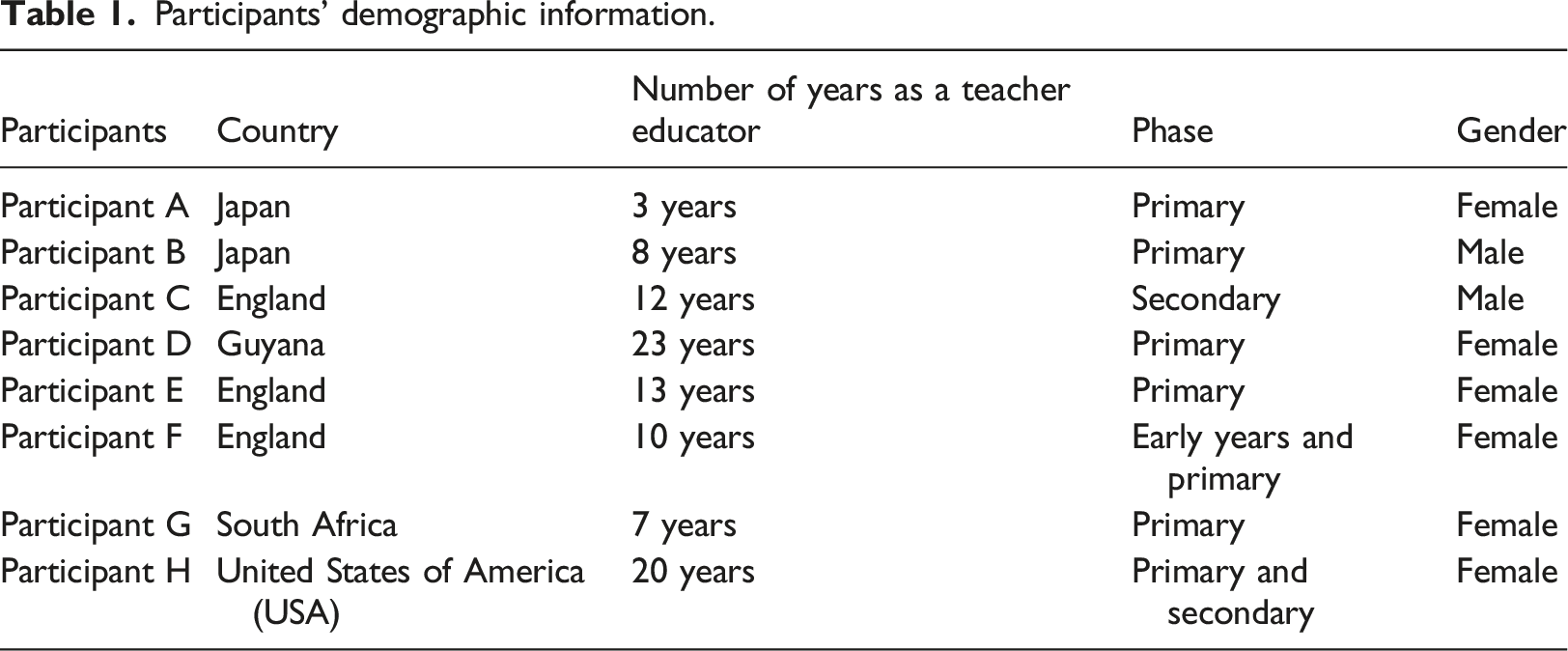
The methodology chosen was appropriate in gathering data for the research questions. Semi structured interviews were the main research tool for this study. This method was chosen firstly, to seek knowledge and understanding of global discourses in teacher education and training, and national educational priorities and secondly, semi structured interview questions could be adapted and responses probed through professional dialogue and discussion with participants (Creswell, 2015; Punch, 2013). To determine the impact of global discourses in national educational priorities on Africa, Asia, Europe, North America and South America, data were collected from eight participants who are current teacher educators in Guyana, Japan, South Africa, the UK and the USA.
Data collection
Participants were contacted through personal and professional education networks, locally and internationally. Initial contact with prospective participants was made through face-to-face dialogue, telephone conversations and email. The criteria for whom to contact followed an initial discussion of the continents to be covered for the research. We were keen to get representatives from Europe, North America, Asia, Africa and the Caribbean because we felt that it was important to gain the perspective of teacher educators across the globe. Next, it was to contact participants in our respective networks from countries where teacher educators were in practice. Following this, those who agreed to participate were contacted via email to agree on a mutually convenient time for an interview. This was a key consideration, particularly as five of the eight participants resided in different time zones to the United Kingdom where the researchers are based. Ethics approval for the research was obtained from the researchers’ respective universities and followed the British Education Research Association (BERA, 2018) guidelines.
Due to the geographical spread of the study, participants data collection was completed using online technology, including email, Skype (audio and video) and offline face-to-face interviews. All interviews were audio recorded. Except for two participants, all interviews were conducted on a one-on-one basis. The participants from Japan requested to be interviewed jointly to support each other in responding to the interview questions. Also, as one of the teacher educators had only 3 years of experience as a teacher educator at the time of interview, she was not confident that she had, ‘enough experience and English’ to complete the interview individually.
Study participants
Participants’ demographic information.
Data analysis
Coding strategy and identification of themes.
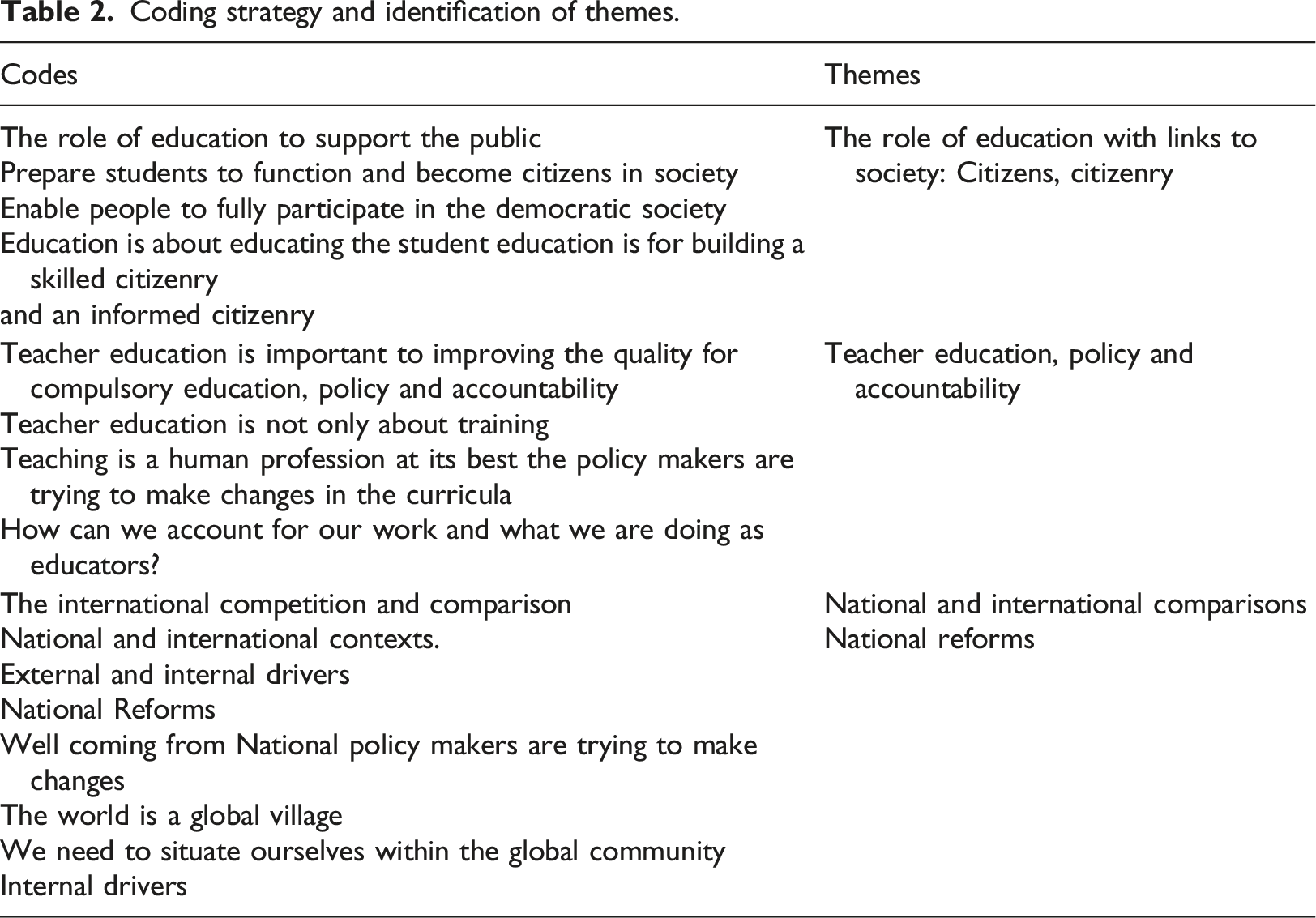
The themes were subsequently reviewed alongside the collated extracts from interviews to ensure that they were an accurate representation of the data set as a whole. Once this process had concluded, the themes were defined and given a descriptor.
Findings
Participants in the study conceptualised their roles as enactors of national policy whilst also positioning themselves as essential to the education of a well-educated citizenry. Context emerged as a key factor in how teacher educators understood the aims and purposes of their roles and how they were positioned within a wider discussion of education. Whilst teacher educators recognised the ongoing importance of high-quality teacher professional development, they felt that pressures within education systems were undermining this process and were constructing their roles in the context of the development of pre-service or beginner teachers. A level of turbulence was also observed, brought about by economic circumstances, educational reform and global trends. A discussion of these issues is presented below.
The role of education and teacher education: continuity, similarity and difference
Across the transcripts, similarities were observed in the ways in which participants identified the role of education, teacher education and its significance regarding citizenship and society. This broader conceptualisation of the teacher educator role was inextricably linked to altruistic and ethical concerns. For example, Participants A and B concluded that the role of education in Japan was ‘To support the public and improve public education’. This view was similarly echoed in the response of Participant D from Guyana, who suggested that the role of the teacher educator was to ‘prepare students to function and become citizens in society’. The two UK participants voiced the opinion that education has a key role in preparing and enabling citizens to actively participate in the societies in which they live. Participant E summed up the purpose of education as follows: ‘Well, I think ultimately that the role of education is to enable people to fully participate in the democratic society in which we live. I guess that means that people, as young people in schools as a starting point, are given the opportunities to develop knowledge, skills and aptitudes which enables them to be local, national, European, and global citizens’.
This view, however, was not evident across all the participants interviewed. Participant H, for instance, reported that the role of education was a ‘million-dollar question’ which ‘varies in the context of where you are’ [referring to the USA]. Participant H continues, ‘So in my mind, education is for building a skilled citizenry and an informed citizenry and to some degree for character development’. Concluding that, ‘in the US, we are in a capitalist society, so education or formal education in the classroom is essentially a product… education is tied to economics in the US’. Inasmuch as there was some similarity in terms of aims and purposes of education and teacher education participants also recognised how global discourses which are introduced to effect change, make an impact on the teacher educator role particularly in the realm of national priorities. Such priorities could be clustered into education policy, curriculum, diversity, inequality, migration, multilingualism and multiculturalism (particularly for UK and USA inner cities, London and New York). Participant G reflected that ‘Change is not easy, and not everybody is open to change’, she considered the demands by ‘government, students and politicians’ for change in the curriculum in South Africa which include calls for ‘decolonisation’. Similarly, in the UK, Participant C commented on ‘decolonisation of the curriculum from the Oxbridge group’ (see New Statesman, June 2020; The Guardian, January 2016) as he pondered on changes to the emphasis and content of the curriculum.
There was a sense in which teacher educators were enactors of education policy. Participant F, for example, considered teacher educators’ role as ‘particularly interesting’ as ‘on the one hand they are funded or given places as they deliver what is required by the government, so they are funded to train teachers. Yet, on the other hand, they want to broaden their thinking about education’. Participant F was also aware of the impact of government policy on practice, ‘They have to toe the party line if you like and show that these trainees can deliver what is required by the government’. Within the data, it was difficult at times to differentiate between the role of education per se and that of the role of the teacher educator. They were, and are, inextricably linked. In the section that follows, we consider the role of context and the ways in which national and international perspectives further illuminate the complexity and challenge of global discourses in teacher education.
Context: national and international perspectives
Participants in the study were cognisant of the national contexts within which they practised and of the social, historical and economic dimensions of teacher education within these. Participant F from the UK observed that the practice of teacher education was contingent to an understanding of context and described the role of a teacher educator as dependent on ‘gaining a good knowledge of how education is understood in different jurisdictions. Within the interview data, it was notable that the teacher educators conceptualised their roles in several ways and for different purposes, for example, delivering an appropriate education, ensuring the public good and building citizenry.
Participant G referred to a disconnect between what was taught in schools and its relevance to its recipients: Teacher educators are critical. One of the problems we often see is a disconnect between education and the role of education within the society. Often, we see some teacher education programmes still doing things the same way and not addressing the needs of the students we are trying to teach, and the long and short of that is that we are not addressing the needs of the community and the country as a whole (Participant G, South Africa).
A similar view was also reflected by Participant A, who commented that ‘the role of a teacher educator is to support the public and improve public education. Teacher education is important to improving the quality for compulsory education’. At times context, citizenry and democracy were seen as interconnected: The role of teacher education varies in context of where you are. In my mind education is for building a skilled citizenry and an informed citizenry and for some degree for character development (Participant H, USA). I think ultimately that the role of the teacher educator is to enable people to fully participate in the democratic society in which we live. I guess that means that people, as young people in schools as a starting point, are given the opportunities to develop knowledge, skills and aptitudes which enables them to be local, national, European, and global citizens (Participant E).
Some participants commented on the impact of international and/or regional comparisons and it was instructive to note that, even in high performing countries such as Japan, there existed a perception that teacher education in other parts of the world resulted in better qualified class teachers. In part, this view was formed due to the assumption that teacher education in the UK solely takes place in the university sector and that some newly qualified teachers graduate with master’s level qualifications. Participant A drew attention to the fact that whilst teacher education was a national priority in Japan, it was devolved to educational boards responsible for quality and standards. Participants A and B commented that ‘few teachers come to university, in service teachers train on the job’. The fact that training is the purview of educational boards was seen as problematic and leading to variability in the quality of teacher education. Despite this, there is a sense in which the Japanese teacher educators were keen to learn from others: We are interested in how people see our Japanese education from the global point of view. It is important to look globally at each other to take the positives.
Regional comparisons were also noted in the data from Participant D (Guyana), who reported that, unlike other developed nations who benchmarked against PISA, regionally, the Caribbean Exam Council (CXC) replaced this function. Participant D was conscious that Guyana was ‘a little below’ [other Caribbean countries] and that ‘standards were falling’ particularly in the areas of Mathematics and Science. Competition and competitive advantage were also found in the UK data where Participant F commented that it was important to be aware of: The international competition and comparisons. How they impact. There are two reasons. You in comparison and critically understanding what the UK is doing so as to use the best practices out of the U.K.
This theme was further evidenced in Participant F’s interview who commented that it was necessary to: Raise our game in international league tables so that we become a good competitor in terms of these outcomes in relation to other countries particularly. Let’s say for example, Singapore, Finland. Countries that have a good success. Success in terms of national data where they sit in relation to other countries. We are always trying to up our game against those measures, which means in some ways restricting what we offer.
Teacher educators’ made connections within their own local and regional context as well as to international dimensions of teacher educators’ work. They were particularly mindful of the external pressures brought about by comparisons – whether regional or international. The national context was integral to ensuring that the aims and purposes of teacher education were aligned to the needs of the wider society and community, and comments focussed on local needs and priorities. In some countries (notably those described as ‘developed’), teacher educators articulated their roles within the wider political dimension of international league tables and the significance of maintaining or improving one’s standing therein. Teacher educators’ contexts thus, transcended the immediate and were impacted both by comparison/competition and broader global shifts in the ways in which the ‘quality’ of teacher educators’ work was measured regarding the educational standards of society overall.
Professional development and professional identity
The themes of professionalism and professional identity highlighted a sense of dissonance and even frustration amongst teacher educators, with many drawing attention to the influence of contextual and environmental factors, as well as the increasingly problematic descriptor ‘teacher educator’ itself. In addition, they were acutely aware of the pressure of performativity and the effect that this may have on effective engagement with continuing professional development opportunities both for themselves and for practising teachers. Erm…teacher education…what’s the role?? Hmmm…I think that teacher education is an unstructured system which teachers choose to dip in and out of, depending on time and inclination, to ensure that they keep up to date with knowledge and skills to support learners to develop those citizenship skills I mentioned earlier. I think teacher education opportunities exist, but teachers are under so much pressure to perform and get the desired outcomes for their students that I can’t see how they really have the headroom to take those professional development opportunities these days. Is that really cynical? I expect that their appraisal or performance management activity sets what should be realistic goals for teacher development but as much as teachers, I think, have a willingness, finding time for their own development is getting harder and harder. I think that these pressures possibly lead to CPD, and teacher education being seen as an inconvenient add on to the extensive workload that they already have…but teachers do want to improve their practice…I’ve not come across a teacher who doesn’t. But we know that the lack of work-life balance and the level of pressure which now exists in the profession is having a terrible impact on recruitment and retention (Participant E).
The questioning of the role of a teacher educator here is illustrative of a context in England where the marketisation of teacher education per se, has led to a broader constituency of teacher educator providers as well as those now considered teacher educators. Participant E also makes a connection between the pressure of increased workload for practising teachers and arguments for ongoing professional development. Here, teacher education is positioned as having a pre-service function and its role post-qualification takes on an optional rather than an essential function. It would be fair to argue that its utility is eclipsed by the daily demands of the teacher role and is seen as the purview of beginner teachers only. This complexity and questioning continued further in the interview: I’m really interested in professional identities but as the job of being a teacher becomes more complicated and challenging, professional identities are being stretched so much that to answer the question, ‘What is a teacher?’ is so blurred and undefinable…. Perhaps it’s because ITE is so diluted now…by that I mean that there are so many choices about which training routes to take, whether or not you want to hit the ground running with classroom practice or prefer to take a route with a greater level of theoretical underpinning. And there are school level decisions about the which training route is preferred which trainees are not fully aware of…so, I’ll give you this story…in my teacher educator role, I spoke to a headteacher about the recruitment of staff, and she said that if the school are looking for someone to support into a more senior role, they would rather recruit someone who had done a PGCE or Education degree who have a broader theoretical underpinning to their practice, but if they are looking for someone to just fill a shortage in teacher gap…a quick fix, so to speak…the headteacher would prefer to recruit someone who had gone through an employment-based route, as they have more on-the-ground teaching experience. Do those entering the profession have any idea that these decisions exist behind the scenes?
The relationship between professional identity, the role of the teacher educator and that of the classroom teacher is bound up in a discourse of the nomenclature associated with the term ‘teacher’, the practicalities of gaining employment in schools and the judgements about a candidate’s readiness and suitability for classroom practice. Ultimately, one’s place of work may determine how one develops their practice as well as access to further professional development opportunities. It is noteworthy that the theme of dissonance and disconnect is seen as part of teacher educators’ existing landscape(s) and that these factors are subject to change. I guess when thinking about the identities of teacher educators…well, they experience the same sorts of dissonances…. the institution in which they operate and how that compares to similar or competing institutions locally and nationally, the ever- increasing competition for fewer numbers wishing to enter the profession…aren’t teacher educators constantly being judged too? Not just about what we do but where we do it. I’ve recently noticed that many teacher educator roles being advertised require the applicant to have strong recruitment experience to ensure that the institution has any chance to compete in the challenging landscape we are currently in – getting the numbers in seems to be a key strategic aim. Teacher educators are as much administrators as they are educators, whatever being an ‘educator’ means these days.
Professional development and professional identity of teacher educators are contingent on many factors, not least the context and organisation of teacher educator’s work. There is a hint here too that the focus on pedagogical learning and practice is expanding to include administrative aspects of the role, such as recruitment and retention of new entrants into teacher education. Recruitment and retention are key issues for the United Kingdom, the United States of America and South Africa. To address this, the DfE (2019) published a retention and recruitment strategy to illustrate the government's commitment to support teachers at the start of their career. The UK participants drew attention to different aspects of teacher training and recruitment stating that: Our biggest challenge is the apprenticeships, 4 days on the job 1 day at university” (Participant E).
Meanwhile another participant expressed views about: Changes in ITE through having a plethora of routes into teaching means that teachers come into the profession with different experiences of learning and teaching….” (Participant, F)
Interestingly, the data showed that Japan and Guyana do not have similar challenges with teacher recruitment. Nonetheless, the Guyanese participant acknowledged that in ‘2012/13 entry requirements were lowered to 4 subjects [to attract more student teachers as the uptake for teacher training was low] due to migration. However, it went back to 5 subjects’. Here, teacher migration was a challenge due to migration from the Caribbean to North America, leading to teacher shortages and brain drain. Miller (2018:160) observed the importance of ‘international migration’ and ‘nation building’ to developed countries such as England where teachers were recruited from the Caribbean, USA and India to address the shortage of teachers during the twentieth and twenty-first centuries. Overseas trained teachers (OTTs) as they were known completed their teacher training ‘outside of the European Economic Area and Switzerland’ (Miller, 2018:160) and regardless of experience, taught as unqualified teachers until they had completed the necessary training to be recognised as qualified teachers in the British system. Recruitment of OTTs is an example of one strand that has contributed to the various routes into teacher training mentioned elsewhere in this paper. There is a sense in which some teacher educators point towards a level of turbulence in their professional work. For example, in the USA the role of education is closely tied to the economic context and, as Participant H asserts: One acquires education like a thing rather than a process of growth and learning. So, it has become a credential. Education becomes a by-product in the US context.
In the UK, education reform with marketisation has combined to create a constant state of change, and to some degree increased levels of uncertainty. This is aptly captured by Participant E who commented that: There have been many times that I’ve wished that the education world just stops spinning so fast just to have time to consolidate what we are doing as professionals, be it as a teacher or a teacher educator. Education in my professional lifetime seems to be in a constant state of flux…whether that’s because of the flip-flopping of governments which brings in new expectations of what education should ‘be’ (whatever that is) or the extreme changes brought about under one government but under a range of Secretary of States.
Similarly, in Japan, it was felt that too much central interference had made the role and work of the teacher educator more challenging. What is clear is that teacher educators across the globe are reacting and responding to local, national and global shifts to position (or re-position) their work. Allied to this is the reformulation of the teacher educators role and its relationship to broader conversations about education more generally. In the next section, we draw the strands of the findings together in the discussion.
Discussion and conclusion
The impact of globalisation on national priorities and the shaping and implementation of teacher education and training was evident across the interview transcripts. A feature of this was the influence of comparison, which demonstrated that in both developed and developing countries, there was a need and commitment to produce teachers who could prepare future citizens for the demands of the 21st century. Within this 21st century was a recognition that factors such as migration, cultural and social diversity, multilingualism, multiculturalism, technological and economic change were to a larger or lesser degree a significant part of teacher educators’ work as they worked with novice or more experienced teachers. Hence, education policies are reviewed to reflect these global trajectories. Responses to positions on international, local and regional league tables either encouraged change to teacher training programmes (UK, South Africa Japan) or the content of the curriculum (Guyana, UK, USA). The data show that across all contexts there is a recognition of the importance of training teachers who are well qualified to teach a range of diverse learners (Hattie, 2009; Menter et al., 2010 and Simoes, Lourenco and Costa, 2017). Whilst there is an emphasis on university led initial teacher training in four out of the five countries studied, which supports the belief that graduate teachers are best trained to enhance teaching and learning (DfE, 2019; Tatto et al., 2017), there is some discussion as to the certification of new entrants to teaching. In the current study, apart from Guyana where teachers complete a trained teacher’s certificate before completing a first degree, recruitment continues to be a challenge for the profession. The role, therefore, of non-graduate and employment-based options for the teaching profession may grow in significance in the future. By implication, this will also influence and impact on the constituency of teacher educators and how their professional work is recognised and understood.
Global efforts in assessment, centred on discussions of raising standards and/or the quality of teachers as countries grapple with the effects of where they are placed on comparison tables, continue to present teacher educators with a moving and moveable target. Significant questions about benchmarking are important here as countries clamour to compete whilst not necessarily doing so on an equal footing. Ultimately, making like with like decisions in situations where comparisons are far more complex. Assessment and reforms have created tensions and disagreements among politicians, educators and policy makers (Alexander, 2009; Ball, 2013; Menter et al., 2010), and it seems that this is likely to continue.
From the study, it can be inferred that teacher educators are aware of their roles and the effects of global discourses on the national contexts in which they operate. They were aware of their contribution to the implementation and planning of programmes aligned to their respective localised teacher education policy and were confident in putting forward their views in the research process. However, it was also evident that they were cognisant that their respective countries were placing an emphasis on, well qualified teachers to raise standards. The economisation of education, as argued by Ozga and Lingard (2007) appeared to underpin the role of education in providing citizens who can make a positive contribution to the societies in which they live.
A limitation of this study was the number of participants interviewed from each country. However, from the data collected and analysed, there was some evidence to show that national educational priorities of developed and developing countries relate to global discourses. Globalisation, comparison tables and education to be global citizens encompassed the study. University led teacher training was emphasised to ensure quality provision within the schooling system. A reasonable conclusion that can be drawn however, from this study is that teacher education continues to be under scrutiny due to global and national expectations and the demand of societies, especially in regard to how they are positioned in preparing teachers for the 21st century (Bates, 2010; Schleicher, 2012; Simoes et al., 2018). The discourses in both developed and developing countries indicate that reforms in teacher training are a direct response to demands and expectations of comparison tables that shape national education priorities and policies and are reflected in the professional standards to be met by student teachers. Each country in the study has programmes to respond to the needs of its respective communities. These include changes to practices in Higher Education institutions because of the COVID-19 pandemic (WHO, 2020, Filho et al., 2021). However, as globalisation becomes more integrated into societies around the world, the curricula will have to be reviewed to ensure that as societies develop, the needs of all learners are met.
Footnotes
Declaration of Conflicting Interests
The author(s) declared no potential conflicts of interest with respect to the research, authorship, and/or publication of this article.
Funding
The author(s) received no financial support for the research, authorship, and/or publication of this article.
