



Abstract
In this paper, we provide a design–actuality gap-analysis of the internet infrastructure that exists in developing nations and nations in the global South with the deployed internet computer technologies (ICT)-assisted programs that are designed to use internet infrastructure to provide educational opportunities. Programs that specifically pinpoint females’ access to schooling are foregrounded in this paper. For our research, we aggregated data on internet infrastructure and data on where ICT-assisted educational endeavors were being deployed in order to create a technography – a series of maps – that would illustrate where there is internet infrastructure that might support ICT-assisted educational programs, where ICT-assisted educational programs are being deployed, and where there is a design–actuality gap. Our research highlights two types of design–actuality gaps: there are places where there is access to internet infrastructure, but very little access to ICT-assisted educational programs; and there are also places where ICT-assisted educational programs have been deployed, but there is very little access to the kind of internet infrastructure that is necessary to support these programs.
Introduction
Chandra Mohanty wrote, “It is possible to trace a coherence of effects resulting from the implicit assumption of ‘the West’ (in all its complexities and contradictions) as the primary referent in theory and in praxis” (Mohanty, 1988: 334). Mohanty is arguing that developed nations in the West become the referent – the ‘common sense’ notion of understanding and practice – for practices in all other nations. This form of soft colonialism often underpins outreach and change efforts by governments and international non-governmental organizations (INGOs) in developing nations and nations in the global South. The assumption is that education and schooling in developing nations should look like, could look like, will look like education and schooling in more developed nations. Thus, we have a history of using developed-nation fixes for less-developed-nation problems with lack of educational opportunity. There is a gap between intentions and assumptions, and the reality on the ground.
The Millennium Development Goals, laid out by the United Nations (UN), require that there is greater access to education for all citizens in less developed countries; and specifically, that there is more access to education for girls and women. According to a UN report (United Nations, 2015) most countries have not met those goals. Still, strides have been made to increase access to education, for all citizens, in less developed nations. One of the tools that has been deployed to create greater access is internet computer technologies (ICT)-assisted education. This entails programs, software, and teaching practices that rely on connectivity to the internet, and some access to digital devices, to create better access to education. ICT-assisted education has been deployed in numerous countries to try and narrow gaps of access. However, we wonder if this is a developed-country solution to a less-developed country problem. We wonder if the experiences of education-via-internet, that are common in more developed countries, are acting as an unreliable “referent” (to use Mohanty’s words) to the realities of less developed countries. Often, international development programs envision online education and ICT-assisted education that rely on the same sort of infrastructure that would be available in developed countries. However, less-developed nations do not have this same level of infrastructure.
In this paper, we provide a design–actuality gap-analysis of the internet infrastructure that exists in developing nations and nations in the global South with the deployed ICT-assisted programs that are designed to use internet infrastructure to provide educational opportunities. Programs that specifically pinpoint females’ access to schooling are foregrounded in this paper. For our research, we aggregated data on internet infrastructure and data on where ICT-assisted educational endeavors were being deployed in order to create a technography – a series of maps – that would illustrate where there is internet infrastructure that might support ICT-assisted educational programs, where ICT-assisted educational programs are being deployed, and where there is a design–actuality gap. Our research highlights two types of design–actuality gaps: there are places where there is access to internet infrastructure, but very little access to ICT-assisted educational programs; and there are also places where ICT-assisted educational programs have been deployed, but there is very little access to the kind of internet infrastructure that is necessary to support these programs.
These maps also show the low level of access to programs specifically aimed at girls’ and women’s education. We use this technography to argue for policy changes that could lead to greater access to ICT and education supported by ICT for girls and women in developing areas. By mapping out gaps in resources, we pinpoint areas where access for girls and women to education is particularly poor, and show whether there are programs in the area that are addressing these needs, and whether there is the infrastructure to develop such programs.
In this paper, we first provide some definitional context for our research; we provide definitions for “developing nations,” “developed nations,” and “nations in the global South.” These definitions are integral to our research because they provided the delimitation for which countries we analyzed as we gathered information on access to ICT-assisted educational programs. We provide background to the problem: the literature on developing nations and the use of ICT-assisted education to provide access to education in developing nations. We then provide a conceptual framework for our research: that of technography and design–actuality gap-analysis. These sections are then followed by methods, findings, and then a discussion section.
Definitions
The UN defines all countries as fitting into three basic categories: developed economies; economies in transition; and developing economies (United Nations, 2014). Developing nations encompass all nations with developing economies and may also include nations with economies that are labeled “in transition” (United Nations, 2012). According to the United Nations, “regions for developing countries are as follows: Africa, East Asia, South Asia, Western Asia, and Latin America and the Caribbean” (United Nations, 2012: 131). This definition also holds true within the literature on global development (Budhwar and Debrah, 2013; Gerber, 2008). While countries labeled “developing nations” are often the same as those labeled as part of the “global South,” the overlap is not complete.
For example, countries in the Caribbean are not necessarily in the global South, however, many of them are labeled as “developing nations.” On the other hand, countries in the “global South” may include nations such as Australia and New Zealand. While these nations are labeled “developed economies” by the UN, these countries also have unique infrastructural issues given the geography and first-nations heritage of these nations that may contribute to some of the same lack of resources for certain areas and certain populations. For this reason, there are several scholars (Parnell and Oldfield, 2014; Williams et al., 2014) who still analyze data from these countries as part of analysis of infrastructure in the global South. In this paper, our maps sometimes take in data that analyzes and reflects infrastructure in developing nations. At other times, our data analyzes and reflects data on countries in the global South. We have used these terms advisedly to reflect the countries from which the data are gathered.
The problem
There is a need to expand educational opportunities in the global South and in developing nations. Many INGOs, as well as national governments, have high hopes for ICT-assisted educational opportunities. ICT-assisted education is meant to bridge some of the educational gaps that exist between nations, and lead to higher levels of literacy, numeracy, innovation, job creation, and job stability. While ICT tools can create opportunities for education, often, the vision, or intentions, for ICT-assisted education demands robust technical infrastructure. Gulati notes that: Learning ‘using’ technologies has become a global phenomenon. The Internet is often seen as a value-neutral tool that potentially allows individuals to overcome the constraints of traditional elitist spaces and gain unhindered access to learning. It is widely suggested that online technologies can help address issues of educational equity and social exclusion, and open up democratic and accessible educational opportunities. The national governments and non-governmental agencies who fund educational endeavours in developing countries have advocated the use of new technologies to reduce the cost of reaching and educating large numbers of children and adults who are currently missing out on education. (Gulati, 2008: 1)
While there are many scholars that commend the use of ICT toward education in developing nations (Baliamoune-Lutz, 2003; Nye, 2015; Pouezevara et al., 2014; Robinson, 2008; Stromquist and Monkman, 2014) there are also many scholars (Bollou and Ngwenyama, 2008; Wims and Lawler, 2007) who are ambivalent or even skeptical about the ability of ICT to actually provide quality education and narrow education opportunity gaps. Importantly, in spite of arguments of scholars, national governments and INGOs have continued to argue for and pursue the use of ICT in order to create education and promote educational equality.
The design (intentions) of ICT-assisted education
The current vision for ICT-assisted education includes the development of computer skills for all adults, especially those of the working population. It includes the creation of educational networks where groups of computer-users in one country use cloud computing to share information and analysis with computer users in other countries. Various INGOs and national governments envision using multi-media platforms for education and schooling. They envision schools where students have access to interactive software and online collaborative tools. This vision includes the creation of online networks that connect people, schools, businesses, and institutions via video-conferencing and other online meeting or online education systems.
UNESCO provides a good example of this vision of an ICT-assisted education that will close gaps between nations. UNESCO argues that, “Information and Communication Technology (ICT) can contribute to universal access to education, equity in education, the delivery of quality learning and teaching, teachers’ professional development and more efficient education management, governance and administration” (UNESCO, 2015). UNESCO has given money and other support to projects that include “the use of tablets in schools in Niger, mobile phones as a tool to train primary school teachers in Madagascar and teacher capacity development activities in eight African countries (Congo, Côte d’Ivoire, Democratic Republic of Congo, Ethiopia, Liberia, Namibia, Tanzania and Uganda) as a result of a cooperation agreement between China and UNESCO (CFIT Project)” (UNESCO, 2015). According to UNESCO’s website, reports, and fact sheets, ICT-assisted education will narrow gaps in education by providing access to high-quality schooling delivered online.
UNESCO envisions that many students will be able to access this high quality online schooling via their mobile devices. UNESCO argues that “Learning can unfold in a variety of ways: people can use mobile devices to access educational resources, connect with others, or create content, both inside and outside classrooms. Mobile learning also encompasses efforts to support broad educational goals such as the effective administration of school systems and improved communication between schools and families” (UNESCO, 2015). Notice that this vision includes a mobile system where students can access online content, interact with that content, and communicate and collaborate with others. The goal is improved communication and the achievement of broad educational goals through the use of mobile technologies. As UNESCO argues, “mobile technology is changing the way we live and it is beginning to change the way we learn” (UNESCO, 2015). Furthermore, “UNESCO is working to help governments and individuals use mobile devices to advance Education for All Goals; respond to the challenges of particular educational contexts; supplement and enrich formal schooling; and, in general, make learning more accessible, equitable and flexible for students everywhere” (UNESCO, 2015).
UNESCO is not the only organization that supports the use of ICT-assisted education and envisions the development of digitally rich educational and schooling opportunities. The United Nations Public Administration Network (UNPAN) argues that digital technology “allows learning to take place 24 hours a day, 7 days a week. This contributes immensely to the inclusion of traditionally excluded populations such as girls and women, ethnic minorities, and persons with disabilities - groups previously marginalized due to cultural, social and geographical circumstances” (UNPAN, 2015). UNPAN contends that, with modern digital technology, “it is now possible that, irrespective of location, students can use these technologies to access educational resources from anywhere in the world” (UNPAN, 2015). UNPAN reports that there is an increased usage of multimedia presentation technologies to support interactive and engaging schooling experiences. “More educational institutions, including the schools are using multimedia presentation technologies for educational delivery, and the use of Web-enabled multimedia courseware to support teaching and learning is rapidly transforming the landscape of educational delivery at all levels in developing countries” (UNPAN, 2015). In this vision of ICT-assisted education, technology is ubiquitous, and access to digital technology is so robust as to support the use of multimedia platforms for learning. This vision also sees ICT-assisted education as specifically enabling for girls because – according to this vision – ICT-assisted education can be accessed from anywhere at any time so girls will be able to access schooling opportunities without leaving their homes and roles within the home and village.
Multiple think tanks, nonprofit organizations, and corporation conglomerates have articulated a vision of education in developing nations that relies on digital technologies and infrastructures to create education for all, stable nations, and robust economies. The UN’s “Youth and ICT” page argues that “For young people, access to information means better access to capital, markets and training needed to pursue a career or studies; increased participation in political processes, and recognition of youth as responsible citizens in today’s society. Youth entrepreneurship – which is facilitated by access to technology, the internet and information – is fast being positioned as a solution for youth employment” (UN, Youth and ICT, 2015). Global Education First, which is a conglomeration of ICT businesses acting toward increased development in the Global South, plans to build “a new platform using interactive technology, including a dedicated website and social media, to provide resources and a communication space for both teachers and students” (Globaleducationfirst.org, 2015). This group contends that using social media will enhance the learning experiences of students and lead to increased technology skills. Millennium@EDU, a multi-stakeholder initiative that includes multi-national companies such as Microsoft, Intel, and Pearson, plans to improve education “by using information, communication and scientific technologies. The companies will provide their high-value products and services at a significantly reduced price as part of this initiative and create low-cost but comprehensive ‘Education Solution Packs’ including computer devices, software, content and training programs addressing the requirements for education, learning and inclusion for 15 million children in at least 150 countries” (Millennium@EDU, 2015). As part of this plan, Pearson will then amass the data of how students are learning with these technologies, and then “will use the lessons learned to inform Pearson’s product and service development, while making the underlying data and conclusions freely and openly available” (Millennium@EDU, 2015). All of these organizations are looking to the use of digital technology to create equitable and engaging access to quality education in order to close gaps between developed and developing nations.
It is not only INGOs and corporate conglomerates that are looking to the use of ICT to create opportunities for schooling and enhanced education. There are also multiple countries that are touting ICT as one of the tools to close educational divides. Bangladesh’s project “Digital Bangladesh” is an excellent example of this. The Bangladesh Prime Minister’s office has listed multiple goals for the country that rely on digital technology, including the strengthening of e-services, expansion of ICT-assisted education, and the development of digital literacy for all citizens in the country. The Digital Bangladesh project includes the development of a National Portal Framework (NPF) that would unite the country and be accessible for all citizens in the country. The Office of the Prime Minister, in the report on the NPF and the Digital Bangladesh project, acknowledges that this vision will be difficult to achieve, but it lists as its main road block that its citizenry is not adequately trained in technology skills. For this reason, Bangladesh, as well as other nations, has started to become open to the idea of creating connections between Bangladesh and educational institutions in more developed nations such as the USA, Canada, and the UK. If Bangladeshi students want to take advantage of an education offered by institutions in more developed countries, it means that they will need to have access to the kind of digital infrastructure required by the online courses given by more developed nations.
In order to make the vision articulated by these INGOs, corporate conglomerates, and nations, a reality, citizens must have access to robust internet infrastructure, in addition to access to hardware and software. Often, these organizations are ready to provide free or greatly reduced access to hardware and software as part of educational initiatives that are funded by these INGOs, corporate conglomerates, and nations. However, less is being done to support and expand internet infrastructure. The vision for ICT-assisted education, as expressed by these INGOs, corporate conglomerates, and developing nations, requires robust access to high speed internet. According to the Global Internet Report (2014) ICT-assisted education programs would most likely require internet speeds of at least 5–10 Mbit/s in order to have basic functionality. We also note that part of the UN’s MDG (Millennium Development Goals, 2015) project was to close gaps between males and females, and rural and urban locations. This goal would require targeted access to both infrastructure and programs aimed at women, girls, and rural locations.
As we explored the vision for ICT-assisted education, we began to question whether there was the internet infrastructure to support this vision. We wondered if there was a gap between the designed intentions of ICT-assisted education and the actuality or reality on the ground. From this stance, we developed three research questions.
Can we map out where there is the type of internet access necessary to support ICT-assisted education? Can we map out where there are targeted programs to assist women, girls, and rural communities through the use of ICT-assisted education as a means of achieving UN’ MDGs? Can we show if there is a design–actuality gap between programs that rely on internet access, and actual access to the internet?
This research was framed by two methodological concepts: technography; and design–actuality gap-analysis.
Conceptual framework
Our research relied on both technography and design–actuality gap-analysis as a framework for answering our three research questions. These two methodological–conceptual stances provided us with the idea of mapping out the gaps in technology and programs.
Technography is a method of research and analysis that maps out the ways that technology intersects with other human factors. Technography can involve the mapping of technology and human skills (Jansen and Vellema, 2011) but can also target the interaction of technology and human access (Castro, 2013; Ruhi and Al-Mohsen, 2015). This method of analysis has been used to call out the ways that digital and new technologies are neither ubiquitous nor monolithic: they are variable and contextual (Adjei, 2014). Many scholars (Ndubi, 2015; Nuijten et al., 2013; Thomas-Sharma et al., 2016) have used technography as a method to foreground the ways that specific types of technology are used by specific groups of people (and not others) for specific ends. In this paper, we foreground the use of ICT by developing nations and nations in the global South in order to provide education and narrow educational gaps. We map out the contexts to illustrate the interactions between the access to technology and the deployed programs.
Our research is also framed by the concept of design–actuality gap-analysis. This is a methodological stance where the researcher investigates the intentions of a specific policy or program and the gap between those intentions and the reality or actuality ‘on the ground’. This method has been used by many scholars (Choi et al., 2016; Hewapathirana and Rodrigo, 2013) to explore the gaps between the ways that various programs and organizations would like for technology to function in a specific context, and the way it actually functions in that context. In fact, many scholars have particularly advocated for this research method when exploring the gaps between intentions and realities in developing nations. For example, Dasuki et al. (2015) advocate this type of gap-analysis research when exploring computing curricula at universities in Africa. Kanya and Good (2013) advocate a design–actuality gap-analysis for information and communication technologies for development research. Palvia et al. (2015) use a design–actuality gap-analysis to explore ICT policies in developing nations. Many other scholars (Dinz et al., 2013; Gunawardhana and Perera, 2015; Hasan, 2014; Ponelis et al., 2015) foreground the importance of pinpointing the mismatch or differences in digital technology and expectations as they explore design–reality or design–actuality gap-analyses in their own research. This paper also uses design–actuality gap-analysis in order to foreground the gaps or mismatches between the intentions of institutions for educational gains via ICT and the reality on the ground.
The specific methods used for our study reflect the desire to create a technography that illustrates the design–actuality gaps for ICT-assisted education in developing nations and nations in the global South.
Methods
There are many scholars who have foregrounded the mismatch or gap between the use of ICT and other digital technologies to address educational gaps in localities with a lack of digital infrastructure (Bhuasiri et al., 2012; Gunawardhana and Perera, 2015; Heeks, 2002; Soja and da Cunha, 2015). This paper adds to that literature by actually providing a map (or several maps) to illustrate those gaps.
In order to explore designed intentions of ICT-assisted education and the realities on the ground, we first created spreadsheets that aggregated data on access to internet, type of internet access, and speed of internet access. We then optimized this information to get the most specific and up-to-date data for each country and region. We created other spreadsheets that aggregated information about ICT-assisted educational programs, and we highlighted specific programs targeted at increasing access to education through ICT-assisted education programs for girls, women, and rural communities. We then used python mapping libraries to convert our spreadsheets into maps. This allowed us to create a technography – literally a graphing out of access to technology – that serves to answer our research questions. A more in-depth description of our methods follows.
Our first step was to create a spreadsheet that would aggregate all information on access to the internet, type of access, and speed of internet access. We took our information from INGO reports on internet coverage. Our primary sources of information include: The 2015 Akamai report; the 2014 UN Statistical Database; the UNESCO 2013 Database of Internet Use (UNESCO, 2013); the UNICEF 2012 Report on Education (UNICEF, 2012); the World Bank 2014 Report on Internet Access (World Bank, 2014); the Internet Society’s Global Internet Report (2014); the World Bank Development Indicators, 2012; and UNICEF’s State of the World’s Children (UNICEF, 2011). There were overlaps as well as unique information among all of these reports and databases. We optimized our spreadsheet so that the most specific and the most current information were recorded for each country. There were some countries for which there was no documented information that could speak to internet access or speed. This spreadsheet served as the information source that we loaded into our mapping program.
We also created spreadsheets that documented whether or not various regional non-governmental organizations, INGOs, corporate conglomerates and national governments created programs aimed at education for girls, women, or rural citizens that relied in ICT-assisted education. For these spreadsheets, we only gathered information on countries in the global South. The data sources that allowed us to graph out programs designed to create access for females and rural locations were gathered from organizations which were specifically enumerating ICT-assisted educational programs in the global South. We gathered data on ICT-assisted education broadly, as well as ICT-assisted educational programs targeted at women, girls, and rural locations, from: the 2014 UN Statistical Database; the UNICEF 2012 Report on Education (UNICEF, 2012); the World Bank Development Indicators (World Bank, 2012); the UN (2012) report on MDG goals, and UNICEF’s State of the World’s Children (UNICEF, 2011). These spreadsheets also served as data that we loaded into our mapping program.
We then created a mapping program, using python mapping libraries, which would load the spreadsheets and map our data onto global maps. The mapping program also allowed us to denote, through the use of colors and numbers, the types of internet access and coverage for multiple countries. We were able to create a visual depiction of where there is access, where there are ICT-based programs aimed at girls, women, and rural locations, and determine, from there, whether or not there are gaps between the designed intentions of ICT-assisted education programs, and the reality on the ground. We were also able to expose gaps where more programs should be developed that aim to increase access to education for girls, women, and rural citizens, and where there is enough ICT infrastructure where this could become a reality.
To the best of our knowledge, these are the most up to date and current maps that track this information. The maps are rendered below in our “Findings” section.
While using or creating a mapping program that takes in data on access and creates a visual representation of access is not very common, there are scholars who have done this as part of their own analysis on gaps in infrastructure and economic inequality. For example, Chagas et al. (2015) used this technique to map digital access and TV preferences in Brazil. Goodchild et al. (2012) used a technique similar to this to map the use of access and potential points for big data analysis. Vigdor et al. (2014) used a similar technique to map access to ICT infrastructure and educational achievement in the US context. Pearce and Rice (2013) used a mapping technique like this to compare use of mobile and personal computer internet users. Moellering (2013) advocates for the use of mapping programs as part of real-time cartography which allows users to generate and contribute to mapping data. Thus, while the use of computer programs to gather data and generate maps based on that data is not common, it is also not unheard of in the literature of fields that do research at the intersection of human interaction, geo-location, and digital technologies. In this paper, we use this technique to provide a visual fleshing out of the gaps between infrastructure and desire; the gaps between infrastructure and educational programs.
Findings
Figures 1–5 illustrate where there is access to internet infrastructure and the type of access that exists, and they also illustrate where there are programs specifically devoted to ICT-assisted educational programs for girls, ICT-assisted educational programs for women, and to ICT-assisted educational programs aimed at increasing access to education in rural locations. Note the gaps between countries that have access to internet infrastructure, and countries where there are programs targeted at bringing access to education to vulnerable populations.
Access to internet (of any type) as a percentage of population.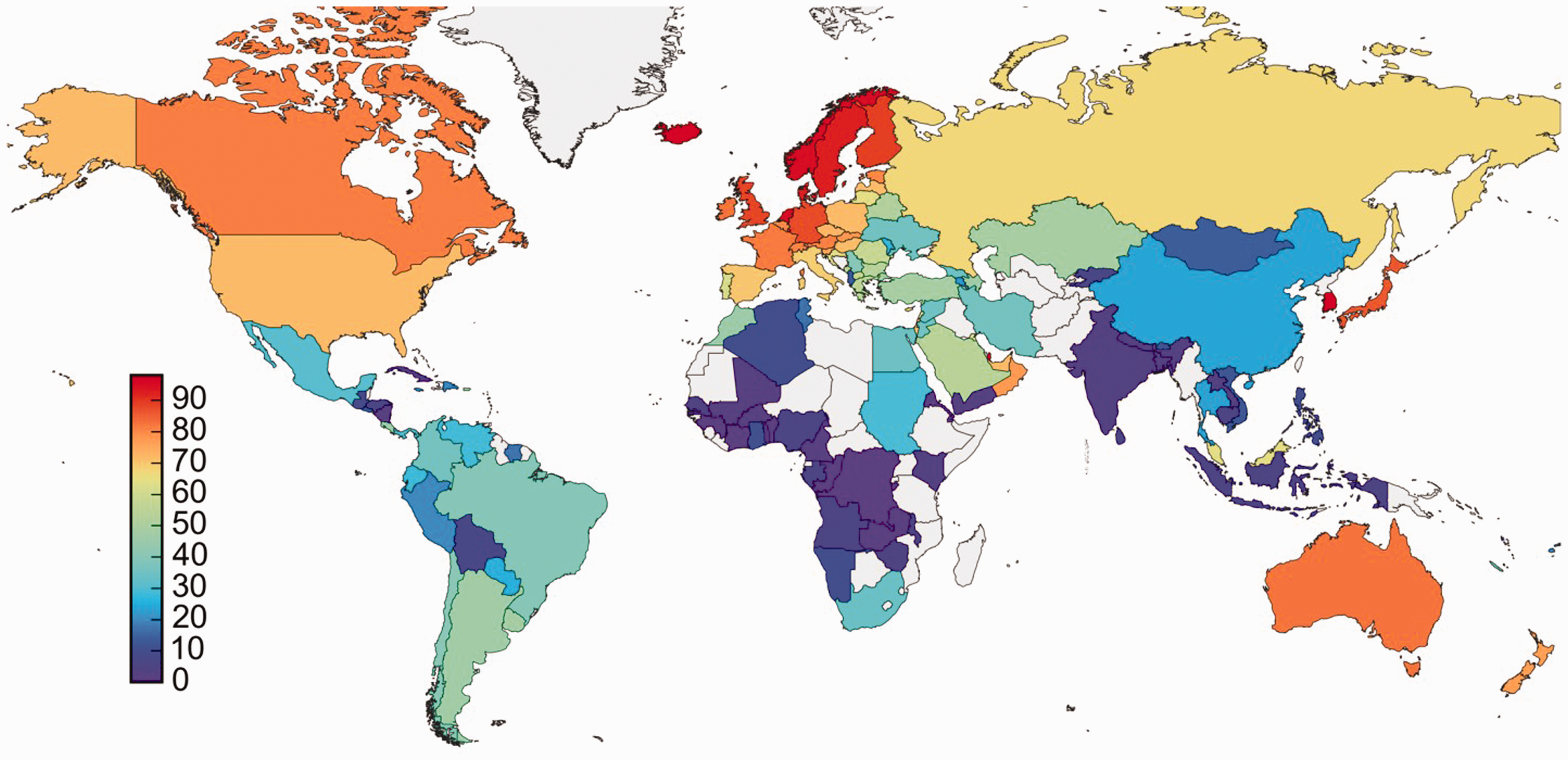
Figure 1, shows the access to the internet, of any type, by percentage of population. We have rendered the higher percentage numbers in the warmer colors, and the lower percentage numbers in the cooler colors. Thus, if close to 90% of the population has any access to the internet – including access found in schools and libraries, and including internet that is dial-up speed or internet via cellular phone – then the country is color coded toward red. If we could not find any documentation on access and coverage, the country has no color – it is rendered in white. It is also important to note that, for many of these countries, the information we could gather referenced an average for the whole country. This means that a country like Australia, for example, is represented by a warmer color because, on average, most citizens have access to the internet. However, as will be discussed below, Australia’s inner lands are quite undeveloped, and there is very little access to the internet in the heart of the country. Citizens who live outside of the main coastal population areas might have no access to the internet at all. We were not able to find access to documentation showing exactly which parts of Australia had access to the internet. So, for Figure 1, Australia is rendered in one color. However, we know from our research on countries that are working to bring internet access to rural citizens, that Australia has very bifurcated access to the internet; with high speed and coverage in the population centers, and very little internet infrastructure any place else.
Figure 2 shows access to a fixed broadband internet connection per 100 people. For Figure 2, we only rendered this information for less developed nations. The countries rendered in the color white are the countries that we did not include for the information in Figure 2. Again, the cooler colors show less access to fixed broadband, and the warmer colors show increased access to fixed broadband internet connections. Thus, Figure 2 makes clear that the majority of countries in Africa have almost no access to fixed broadband. This means that these countries do not have access to internet that is fast enough to provide the kind of ICT-assisted educational programs envisioned by many INGOs, corporations, and governments.
Access to fixed broadband per 100 people.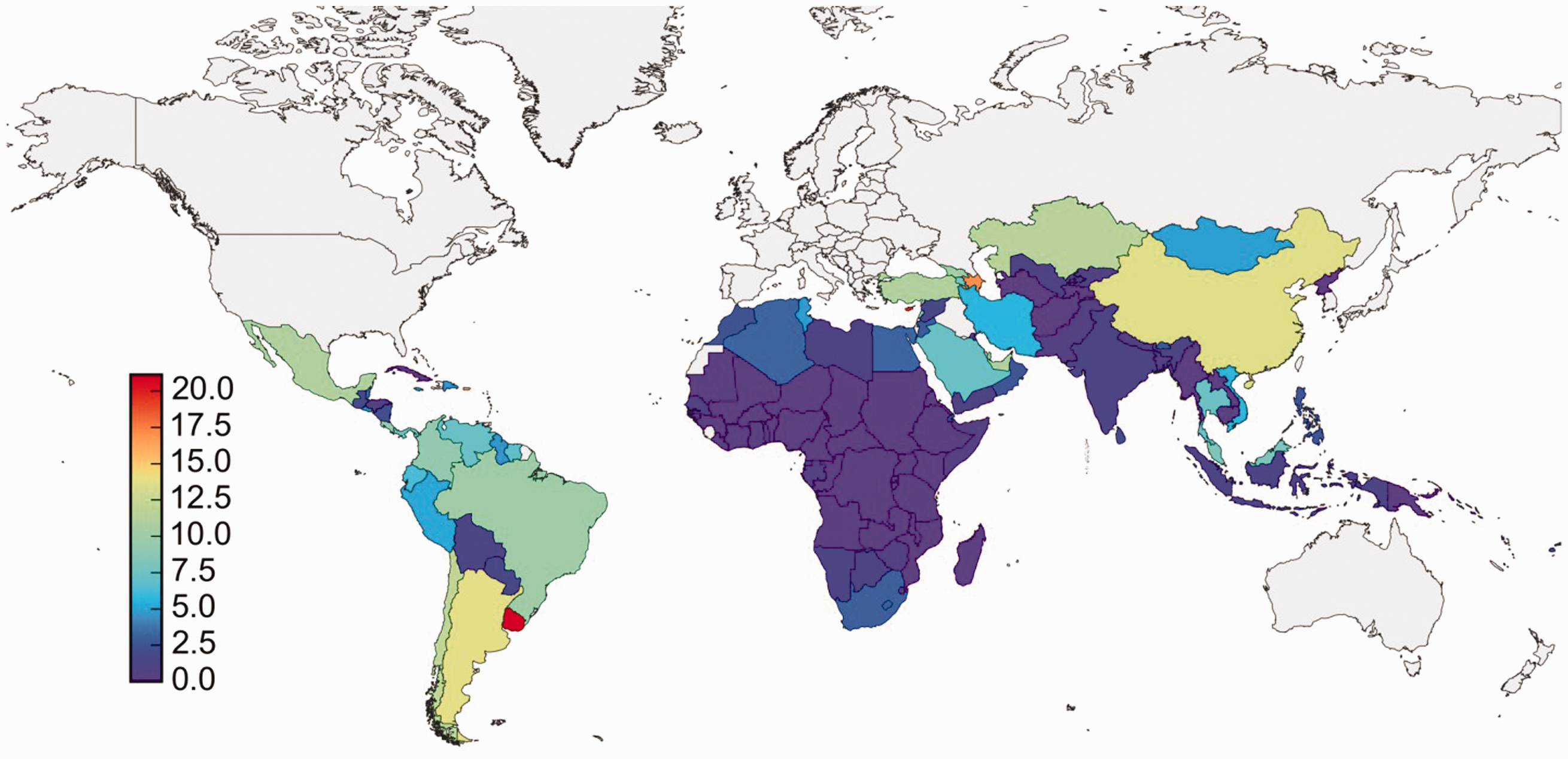
Where there is access to fixed broadband, the speeds are often very slow. The Global Internet Report (2014) has published maps on download speeds for most countries. We did not create a new map using our data on download speeds because most of our data on speeds came from either the Akamai Report or the Global Internet Report and both these reports already have published maps on internet speeds around the world. These maps show that, even when there is access to broadband, in many less developed nations the download speed is less than 5 Mbit/s. This speed is so slow that multimedia and interactive learning on computers in real time is made impossible. With this type of speed, students may be able to download a video, but they would have to watch it after downloading it and the download speed would take a much longer time. Students would not be able to do any sort of interaction that used video online at these speeds.
Many less developed nations do not use fixed broadband for access to the internet. Rather, they rely on cellular connections. This reliance on cellular towers for access to the internet is fitting because, even in less developed nations, mobile phone penetration is above 70% of the population according to the Global Internet Report (2014). Many people do not have a computer, but they do have access to mobile phones. However, even with access to cellular networks, this does not mean that mobile users have access to mobile/cellular broadband. The Global Internet Report (2014) shows that access to cellular broadband – where speeds are fast enough to support the ICT-assisted education envisioned by many – is extremely limited. For example, Latin America is shown, in the report, to have mobile penetration of above 110%. This means that there is more than one mobile phone for each adult citizen in this region. However, in Latin America, only about 25% of the citizens have access to mobile broadband. This means that, while citizens have access to mobile phones, these phones are often not ‘smart’ phones, and citizens are not able to use their phones in the ways that most people in developed countries take for granted. The Global Internet Report (2014) points out that, in the continent of Africa, only 5–10% of the population, on average, has access to cellular speeds of 3G or higher. The decreased access to the internet, and the slower speeds when there is access, means that developing nations and nations in the global South do not experience the internet in the same way as more developed nations. This reality also means that visions of cloud computing, online collaboration, and multimedia, interactive ICT-assisted education are a long way off.
Figure 3 shows the countries that have ICT-assisted educational projects aimed at girls’ education and schooling. The countries in white are the ones that we did not draw any information from for Figure 3. The countries in yellow are the countries we looked at to find if they had any programs using ICT-assisted education aimed at girls. The countries in green are the countries where there is documentation that ICT-assisted education programs exist that specifically aim at helping girls get access to education and schooling. For Figure 3, a girl is defined as a female under the age of 16. Most programs targeted literacy and numeracy. Also, for Figure 3, we looked at programs that, within their program descriptions, specifically focused on girls. In other words, if there was a program that focused on children’s literacy, for example, that program did not make it onto Figure 3. If, however, there was a program aimed at increased literacy for girls, then that did make it onto Figure 3.
Information and communication technology-assisted education targeting girls’ education.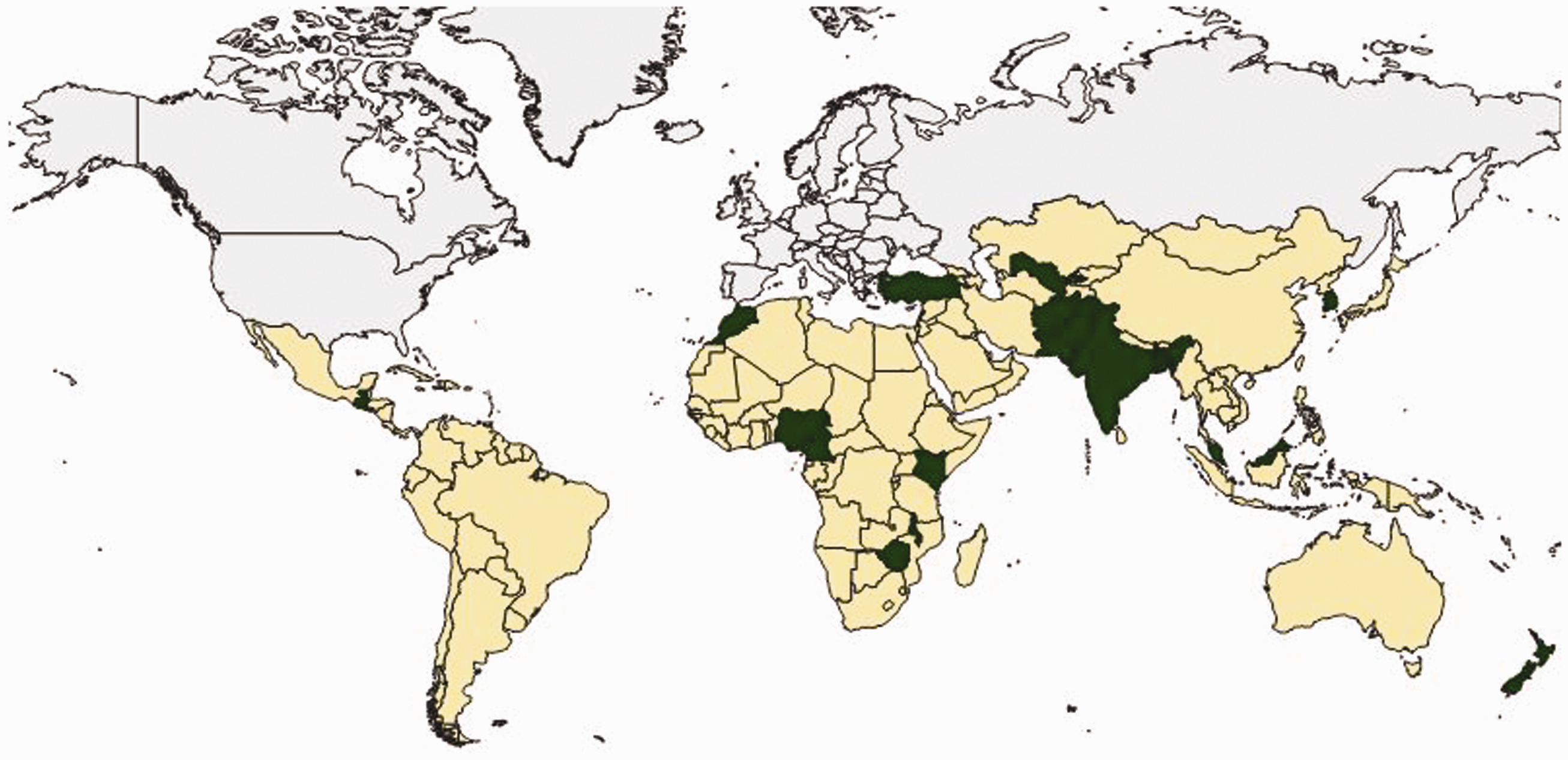
The UNICEF 2012 Report on Education (UNICEF, 2012) argues that girls face difficulties in access to education that arise due to their gender. In many less-developed nations, girls bear a great deal of responsibility for household chores. This means that they have less time for education and less time to go to a school. Furthermore, according to the UNICEF report, in many less-developed nations, girls are seen as less worthy of education than boys. In fact, girls can be targeted for harm if they leave their homes. This makes it particularly difficult for girls to get access to schooling. ICT-assisted education could, theoretically, make it possible for girls to have access to courses on-demand, at their own time. And, theoretically, it would mean that girls would not have to travel far from home and increase their exposure to physical harm. However, the idea of access to education in one’s own home and on one’s own schedule requires the development of internet infrastructure that is more robust.
It is also important to note that there are places where, according to our data, there is more robust internet infrastructure, and yet there are no programs specifically targeted at girls’ education. For example, our data show that there is a higher level of access to the internet in China and South America than in, for example, India. However, there are no programs specifically aimed at increasing educational access for girls in South America or China. This technography illustrates places that could benefit from ICT-assisted education for girls. We hope Figure 3 is useful as organizations chart out where their resources and goals for ICT-assisted education might match up with infrastructure that could support that type of education.
Figure 4 shows ICT-assisted education programs that are aimed at women in less-developed nations. Again, on Figure 4, the white represents countries for which we did not look at the data; the yellow represents countries that we did analyze for ICT-assisted education programs aimed at women; and the green represents countries where we found ICT-assisted education programs aimed at women. For the purposes of Figure 4, a woman is defined as a female of 16 years and older. Figure 4, also, focuses on programs specifically aimed at women. So, if there were programs aimed at increasing business skills, but not focused on women increasing their business skills, then that program did not make it onto Figure 4. ICT-assisted education programs aimed at women tended to try and develop employment skills for women. There were also some programs aimed at offering women a path toward tertiary education. However, most programs in our data sets were aimed at helping women to develop skills they needed to support their families. Thus, there was less a focus on literacy, and more a focus on how to take home-made goods and turn them into a business that would support the needs of the family.
Information and communication technology-assisted education targeting women’s education. Information and communication technology-assisted education for rural populations.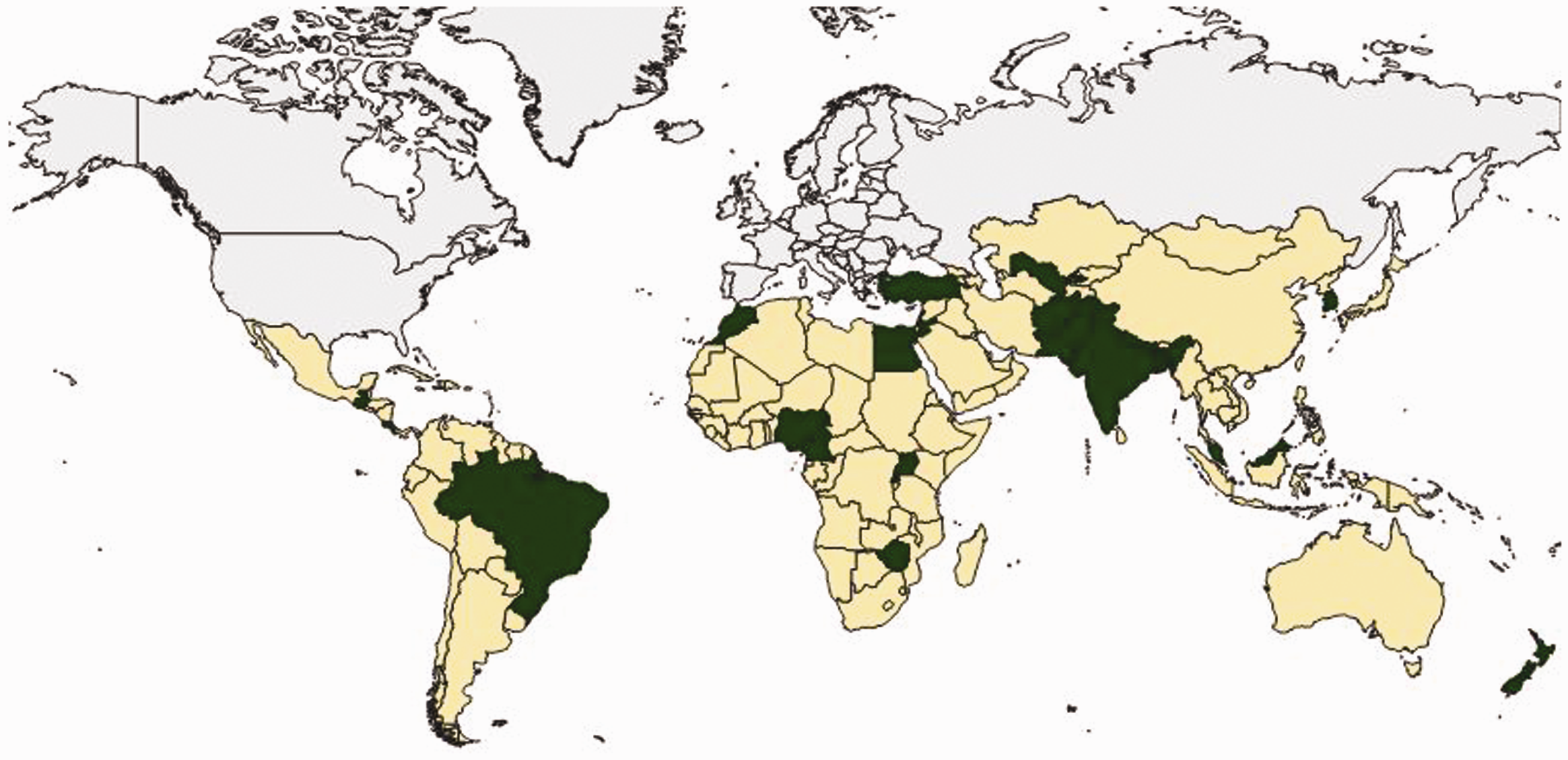
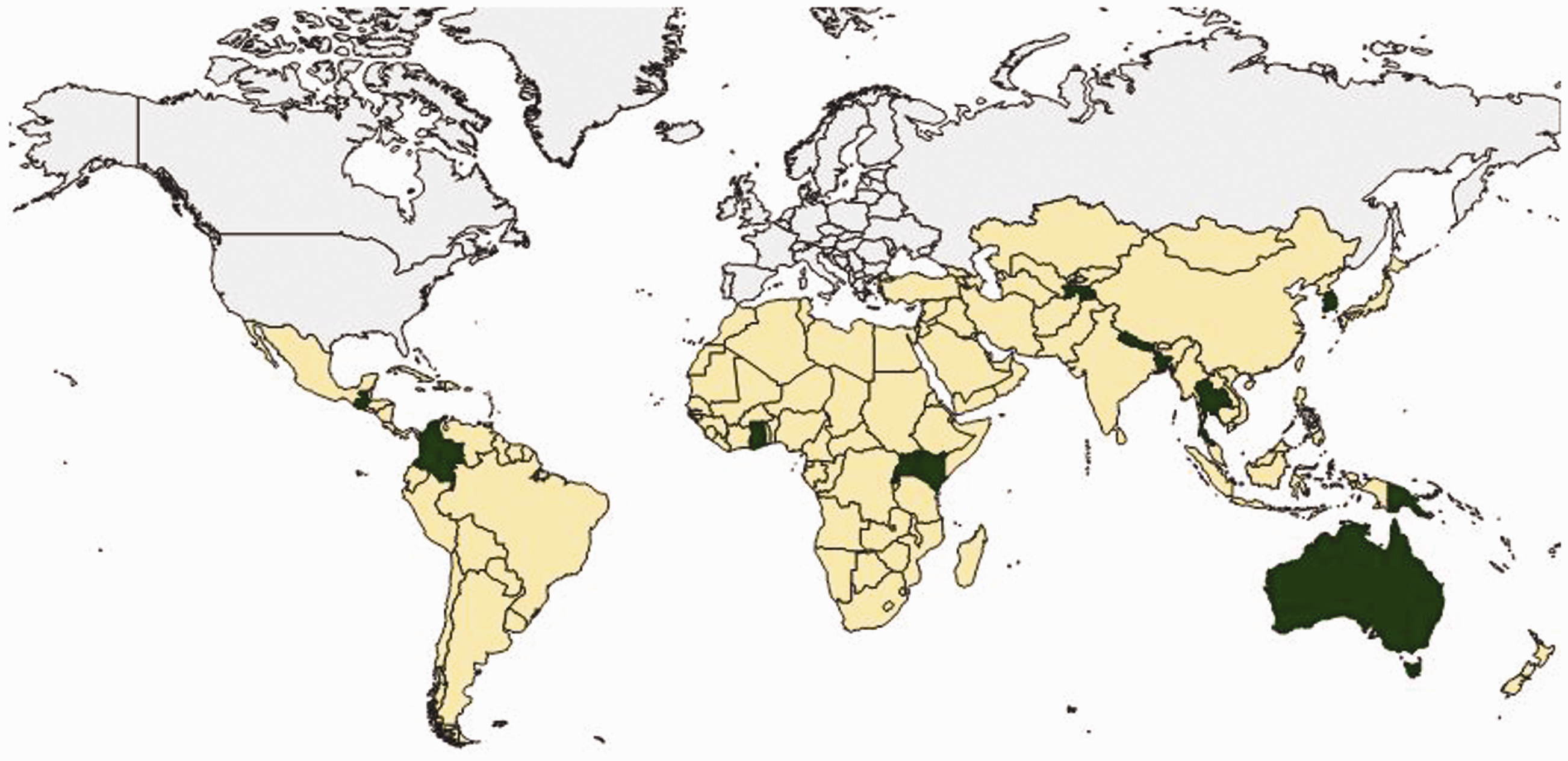
A UNU 2014 reportnotes that many women in less developed nations suffer a lack of access to education and employment opportunities. In many cultures in the global South, women are tasked with providing food, water, and shelter. Often, according to the UNU report, women are targeted for harm if they venture too far away from their communities. This makes it difficult for women to have access to education and employment. This is why programs aimed at bringing education and work-skills-development to the women in their own homes or villages are so meaningful.
The technography in Figure 4 also illustrates places that could benefit from ICT-assisted education for women. For example, our data shows that there is enough internet infrastructure to support meaningful ICT-assisted educational programs aimed at increasing access to education for women in China, Argentina, and Uruguay; yet there are no ICT-assisted education programs for women in these countries. Figure 4 is useful as organizations chart out where their resources and goals for ICT-assisted education might match up with infrastructure that could support that type of education.
Figure 5 shows ICT-assisted education programs aimed at rural locations. For Figure 5, we did not disaggregate data by gender or age. Any programs that were listed, in their program descriptions, as specifically aimed at increasing educational access for rural locations, and using ICT in order to create that educational access, were added into Figure 5. As with Figures 1–4, the white represents countries that we did not look at to create Figure 5; the yellow represents countries that we analyzed to see if there were any ICT-assisted education programs specifically aimed at rural locations; and the green represents countries where we found ICT-assisted education programs aimed at rural locations.
Australia is an intriguing example of a country that has mobilized to create increased access to ICT-assisted education in rural locations. Most of Australia, in the population centers, enjoys robust internet infrastructure with high coverage rates and high speeds. However, the internal part of the country is less developed. There is less internet infrastructure and less access to education. Many indigenous groups live in the inner part of Australia; and this leads to increased gaps in education not only between urban and rural populations, but – because of racial location patterns – also gaps between white and indigenous people. In order to narrow these gaps, Australia has created programs designed to use ICT-assisted education to bring schooling and skills development to rural citizens. Currently, there is a mismatch between ICT-assisted education in these locations and access in internet infrastructure that would allow these programs to function as intended. However, Australia is also mindful of this and is pushing toward expanding internet infrastructure in rural locations. As infrastructure is developed, ICT-assisted education programs are able to be more efficacious in narrowing gaps in access to education.
The technography in Figure 5 illustrates many places that could benefit from ICT-assisted education for rural locations. Figure 5 is useful as organizations chart out where their resources and goals for ICT-assisted education might match up with infrastructure that could support that type of education.
Figures 1–5 show access to internet infrastructure and the deployment of programs meant to take advantage of ICT infrastructure. There are both matches and mismatches, and design–reality gaps, illustrated by Figures 1–5. For example, India has one of least robust internet infrastructures. They have low access to any sort of internet, and even lower access to any broadband internet service. Yet India has programs aimed at using ICT-assisted education to decrease gaps in access to education for girls and women. This seems like a mismatch between the ICT-dependent types of programs that are being used to decrease gaps in access to education and the actual ICT infrastructure. On the other hand, both China and Argentina have more robust internet infrastructures. However, there are no ICT-dependent educational programs for girls or women in these countries. More should be done to create a match between educational programs that depend on ICT infrastructure and countries that offer more robust ICT infrastructure. Organizations that develop ICT-assisted education should be more cognizant of the material conditions that exist in the countries where they hope to deploy ICT-assisted educational programs.
Discussion
Many scholars have highlighted the soft colonialism that happens through the assumptions and practices that concretize Western norms as the proposed ideals for developing nations. Loomba (2015) notes that there is a (post)colonial privilege embedded in the assumption that the types of technologies – and the expectations of technologies – that exist in Western and developed nations should be used and applied in developing nations. Shin (2012) also foregrounds the propensity of Westernized ideas and expectations to be applied to developing countries in search of economic and educational growth; and further notes that this often brings a great deal of difficulty and mismatch of expectations. Wedel (2001) argues that Western expectations and practices, applied to nations that lack many of the resources and infrastructure of developed nations, often create economic hardship in the long run. Yousfi (2013) argues that applying Western solutions and expectations to places that lack the infrastructure to support those Westernized visions often creates dependency and a lack of further internal investment in developing nations. These scholars echo the findings of this study: that the dream may be that ICT assisted education will narrow educational opportunity gaps, but that is rarely the reality.
Internet computer technologies, deployed and developed by INGOs, corporate conglomerates, and nations can impact the development of economies and access; ICTs have the potential to narrow gaps in access to education and economic stability. However, there is not, currently, the internet infrastructure to make the Westernized vision of ICT-assisted education a reality. One of the great paradoxes of the information age is the persistence of lack and scarcity in an era where technology seems ubiquitous. The use of developed nations as the referent for the norm creates gaps between assumptions of what ICT-assisted education can do and look like, and the actual needs and realities of people who exist outside of or apart from – or in difference to – the developed nation norm. In order for ICT-assisted education to remain a relevant goal, it needs to be aligned with the infrastructural actualities of developing nations and nations in the global South.
Conclusion
This research project has yielded the following recommendations: more targeted programs for girls; more targeted programs for women; more targeted programs for rural locations; educational platforms or software packages that use cellular ICT (second-generation wireless telephone technology (2G) or less); educational programs that use hybrid combinations of radio, offline computer or TV, and ‘slow’ online resources; and a new vision of ICT-assisted education that takes into account specific material contexts.
This study both answered our three research questions, and provided some unexpected results. We expected that, given the international community’s focus on goals to decrease gaps in access to education and employment for females – these are specifically part of the MDG goals – that there would be more resources directed specifically at creating educational opportunities for girls and women. ICT educational programs aimed at rural citizens are more difficult to deploy. Rural locations often have no access to internet infrastructure, even in countries that, on average, have moderate or even robust access to the internet. However, ICT-assisted education programs aimed at girls and women could be thoroughly deployed. There are locations where there is at least moderate access to the internet, and yet there are no programs specifically aimed at closing the gaps in access to education between males and females. The dearth of programs for females was, for us as researchers, unexpected.
This research project also guides toward more in-depth conversations about the kinds of education programs that should be developed given the weak access to internet infrastructure in many less-developed nations. If organizations insist on using ICT-assisted educational programs, then those programs should be tailored to the material realities of the area. Perhaps organizations should, as part of their educational program, develop Worldwide Interoperability for Microwave Access hotspots that might increase access to the internet in more urban areas. Perhaps organizations should develop educational programs that rely on the 2G capabilities of many cellular networks in less-developed nations. Perhaps organizations should develop more educational programs that use technology, but that do not rely on internet connectivity. Regardless of the specific changes, organizations that aim to narrow gaps in education should intentionally consider the material and cultural infrastructures of specific locations. How schooling is done – how access to education is created – should be determined by: whether or not there is access to high-speed internet; whether or not there is access to the internet at all; whether or not there is access to hardware and software, and the tools necessary to fix hardware and software when it breaks; whether or not there are cultural taboos against women and girls traveling to school; and whether or not there are cultural taboos against females being educated at all. More work should be done to understand the specific conditions of any location, and then align programs aimed at closing educational gaps to specific locations, rather than using Western visions of ICT-assisted education as the expected norm.
Footnotes
Declaration of conflicting interests
The author(s) declared no potential conflicts of interest with respect to the research, authorship, and/or publication of this article.
Funding
The author(s) received no financial support for the research, authorship, and/or publication of this article.