



Abstract
This paper argues for a more complex literature around gender and math performance. In order to argue for this complexity, we present a small portion of data from a case study examining the performance of Kuwaiti students on the Trends in International Mathematics and Science Study and on Kuwait national math tests. Westernized discourses suggest that girls have a harder time in math classes; these discourses frame and are reified by prominent literature and practices within the field of math education research that suggest that women and girls need help in order to reach their potential in math. These Westernized discourses stand in contrast to the discourses in Kuwait that normalize women and girls as outperforming boys in all subjects – including all science, technology, engineering and mathematics subjects. As our study shows, the reality is more complex. And, while the reality is more complex, we yet lack the discourses to understand this complexity.
Introduction
This paper argues for a more complex literature around gender and math performance. In order to argue for this complexity, we present a small portion of data from a case study examining the performance of Kuwaiti students on the Trends in International Mathematics and Science Study (TIMSS) and on Kuwait national math tests. Westernized discourses suggest that girls have a harder time in math classes; these discourses frame and are reified by prominent literature and practices within the field of math education research that suggest that women and girls need help in order to reach their potential in math. These Westernized discourses stand in contrast to the discourses in Kuwait that normalize women and girls as outperforming boys in all subjects – including all science, technology, engineering and mathematics (STEM) subjects. As our study shows, the reality is more complex. And, while the reality is more complex, we yet lack the discourses to understand this complexity.
The paper proceeds by first exploring the Westernized literature around gender and mathematics. Then, we foreground the Kuwaiti context. We then present data on gender and math that comes from a larger study on the disparity between Kuwaiti student scores on national standardized math exams and TIMSS. The primary author is a Kuwaiti national and is invested in conducting research on the Kuwait context. The complexity we found – on gender and math – within our study has lead us to argue for the need for a less binary understanding of gender and math performance.
Western expectations around math achievement
Within the US, the UK and throughout much of Northern Europe and Australia, math is seen as a subject where boys often have an easier time at finding academic success and then tracking into math-oriented careers. According to Halpern et al. (2007), in the US and the UK, there are cultural stereotypes that produce girls and women as in need of help or special pathways to allow them to funnel into math-oriented education and careers. This research is corroborated by other scholars who have studied the US, UK, and Northern Europe (Betz and Sekaquaptewa, 2011; Gunderson et al., 2012; Hamamura, 2012; Wong, 2016). There are special organizations and professional groups (Society of Women Engineers, and National Science Foundation INCLUDES Program) designed to create interest in STEM subjects by women. They are considered an underrepresented group in math fields. Further studies—within this Western context—have shown that women and girls experience a stereotype threat: where they feel that they are examined more closely or are more easily expected to do poorly in math subjects.
In fact, many researchers suggest that stereotype threat is one of the primary reasons why girls tend to have lower achievement than boys in math pathways (Galdi et al., 2014; Shapiro and Williams, 2012; Smeding et al., 2013). Girls and women exist in a context where they are always/already the underdogs in math and any of the other STEM disciplines. The combination of extensive research, programs, professional organizations, cultural stereotypes, and normative discourses create a milieu where girls and women are seen as outsiders in math; and where research and cultural expectations are oriented around finding ways to help girls and women do better. Much of the research on math and education that comes out of Westernized countries is built on the ‘given’ that girls need extra support in order to succeed in math pathways. This ‘given’ of girls’ under-performance is also echoed in the expectations of teachers within a Westernized context.
Multiple studies have been conducted showing that teachers treat their male students differently than their female students, and that they have higher expectations of their male students in math and most STEM subjects. A study by Fennema et al. (1990), revealed that teachers viewed males as their highest achieving students. Furthermore, according to the same study, when male students did well in math the teachers attributed this to a natural ability. However, when female students did well in math, the teachers attributed this to the propensity of girls to work hard.
These findings have induced further research on difference in mathematical learning and abilities between boys and girls. Fennema (2000) suggested that, perhaps, girls do not do as well as boys on some complex math problems because math needs to be related to application contexts, and many of the application contexts in math exams are ‘masculine’.
Classroom structure also affects boys’ and girls’ achievements (Biklen and Pollard, 2001), and school organization and environment shapes gender differences. Researchers frequently discuss single-gender classrooms and single-gender schools (Hana et al., 1990; Tully and Jacobs, 2010; Vale and Bartholomew, 2008). Girls, for example, may fear jeopardizing their relationships with boys in mixed schools, which can influence their mathematical achievements. Having separate schools for boys and girls eliminates that factor (Hana et al., 1990). However, the Hana et al. (1990) study could not apply their research data to test this idea, as the countries in the study had mixed schools. Single-gender classrooms also allow teachers to apply special instructions targeted to boys or girls based on their needs (Vale and Bartholomew, 2008). On the other hand, Australia has a number of single-gender classrooms: an Australia case study (Tully and Jacobs, 2010) noted that having a high school curriculum based on a pedagogical approach that specifically addresses young women may help increase their mathematical performance and self-concept levels. The latter may lead to an increase of women in engineering careers.
This paper does not attempt to interrogate or justify the research, cited above, on the mathematical success or abilities of girls versus boys. However, we do draw attention to the fact that almost all of the research works form the hypothesis that girls need help; that girls need something in order to find success in math. In many ways, these cultural expectations, schoolroom realities, and classroom practices are in direct contrast to the cultural norms, expectations, and practices in Kuwait.
Kuwaiti school experience, math, and gender
In Kuwait, cultural and religious aspects of the country have shaped certain factors of its educational system. Starting from age four, Kuwaiti children can be enrolled in pre-kindergarten and kindergarten schools. Those schools are open to both genders, and boys and girls attend the same classroom together. The teachers and school administrators are all female. However, starting from first grade and continuing through twelfth grade, public schools are divided based on gender. Females go to all-female schools with an all-female staff, from teachers to administrators. Once the male students reach sixth grade and move to the middle school, they are taught by male teachers and have male administrators through twelfth grade. The female learning experience from pre-kindergarten through twelfth grade consists exclusively of female instruction. Males go to all-male schools but continue to have female teachers and administrators from first grade until fifth grade; from then on, they have exclusively male instructors and administrators.
Kuwait deploys a national curriculum, and the Kuwait Ministry of Education is responsible for issuing a textbook for every subject area for each grade level from the first through the twelfth grades. Students are provided with free textbooks in all subject areas. Teachers do not have freedom regarding what to teach or when to teach a certain topic. Public school teachers must follow the order of the textbooks issued by the Ministry of Education and cannot use outside textbooks or extra curricula. Teachers must follow the rules and regulations regarding the textbooks. Tests are standardized at the national level.
According to the Minister of Education, student achievement levels in the elementary and middle schools do not vary from district to district (Alajmi and Reys, 2010). It is important to note that in Kuwait, achievement levels are based on grade level, not on gender. That is to say, student test data are disaggregated based on grade-level and are not disaggregated by gander, or any other identity positionalities. Both male and female schools get similar recourses, and the expectations for achievements are set to be the same for both genders. For example, the twelfth-grade final results receive considerable attention in the media and in Kuwaiti society. After the twelfth-grade final standardized tests (standardized at the national level) are completed, and grades are reported, the names of all students who have passed, along with their grade point averages (GPAs), are published in the local newspapers. Additionally, every year the Minister of Education holds a press conference to announce the top three students in each track in the twelfth grade (science and mathematics or language and literature). During the press conference, the Minister of Education calls the students on live TV and congratulates them. The Ministry of Education recognizes the top achieving students based on their GPAs, and does not set aside a certain number of recognitions for top honors for girls-only or boys-only. In fact, in the recent past, most of the top honors have gone to girls.
Single-gender schools in Kuwait do not take a gender-specific pedagogical approach, nor are they designed to employ different curricula or instruction. In Kuwait, females can freely join math and science courses, and there are no high-content or lower-stage math classes designed for specific students. Due to the national curriculum, all students must take the same math lessons from the first grade to the tenth grade. After the tenth grade, the students choose to either join the math and science track, where more advanced math and science is taken, or the language and literacy track, where statistics and language courses are taught. Additionally, a transfer period is given to students at the beginning of the year in case they change their minds.
The scenarios of female students not getting the same attention as male students, and the case of teachers favoring boys over girls in math lessons, do not apply in Kuwait, because all the public schools are single gender. No research has been done on Kuwaiti students to compare male and female achievement.
It is important to mention that the Kuwait Constitution states that males and females should have equal opportunities for learning. While Kuwait does not disaggregate the data from their standardized tests according to gender, it is aware of the pressure to ensure that girls and boys have equal educational opportunities. As a member of UNESCO—and supporter of UNESCO’s “Education for All” goals—Kuwait has prepared reports for the UNESCO community demonstrating the ways the country has been working on achieving the program’s goals by 2015, including equal education opportunities for males and females. Again, these reports are written from the standpoint of a hypothesized need to advocate for girls’ education. While it is undoubtedly true that in much of the world girls do not get the same high quality of education as boys, and often, girls are tracked out of school in general and STEM-related subjects in particular, this is not the case in Kuwait. In fact, girls often outperform boys in top secondary education honors, and in achievement of higher education.
In fact, Kuwait University’s minimum percentage for accepting new undergraduate students varied for males and females in certain colleges, such as the College of Engineering and the College of Medical Sciences, where the required minimum GPA for females was higher than that for males. Women were held to higher standards of admittance—including within colleges of Engineering and Medicine, because women in the country tend to have higher GPAs than their male counterparts and this was creating a dearth of men in college. The universities responded to this gender imbalance by having higher expectations of female candidates. However, this practice was challenged in the national courts recently. A female student filed a law suit because she was not admitted to the College of Medical Sciences although her GPA was higher than that of some males admitted to the college. After several trials and appeals, the Kuwaiti Court ruled that the only criterion for comparison for admission is the GPA regardless of gender; and that all candidates should be reviewed for acceptance to university based on scholastic merit, and nothing more. The previous practice of admitting males with lower GPAs in order to create gender balance on university campuses was seen, by the court, to be in contradiction with the constitution (Al-Ain News, 2016). In light of the new rule, the Dean of the Office of Admissions at Kuwait University noted that 6669 students have been admitted to Kuwait University for the academic year 2016–2017 and that the competition between the applicants was based completely on their GPA, without discrimination between males and females (Kuwait News, 2016).
The reactions to this ruling varied, with many citizens believing that the admission criterion should have been retained in order to give males a chance to enter colleges that would otherwise be full of females because of their higher scores. Others noted that this is a sign of a problem in the education system, and suggested that more needed to be done to create spaces for all students who would like to attend university, in order to make way for males (and females) who may not have the qualifications to get into university currently (Kuwait University is the only public university in Kuwait).
To sum up, while within the Western context women are considered the underdogs and are seen as threatened, within the Kuwaiti context, women are seen as the natural high achievers, including in all STEM subjects. These contrasting—and binary—expectations create the backdrop for our study.
Background to the study
This paper presents data that are part of a larger research study on Kuwait’s scores on recent TIMSS tests and the way these scores contrast to performance on the national standardized math tests within Kuwait. While the majority of students do well on the nationally standardized math tests, Kuwait has the lowest score of participating nations on TIMSS. This contrast created the need for further studies analyzing the paradoxical achievement scores.
Various international tests have been developed to measure students’ achievements in mathematics and science, including the TIMSS. The TIMSS assesses fourth grade and eighth grade students in mathematics and science. For this study, our focus was on math data, and the comparison of national math scores compared with the math components of TIMSS. TIMSS assesses students’ achievements in four major mathematics content domains and three cognitive domains. The content domains are Number, Algebra, Geometry, and Data and Chance (Mullis et al., 2005). The cognitive domains include Knowing, Applying, and Reasoning (Mullis et al., 2005). The TIMSS reports detailed achievement results for each country, and one of the reported categories is the percentage of correct responses for girls and for boys for each question.
Kuwait has participated in different cycles of TIMSS for the eighth grade, including TIMSS 1995, TIMSS 2007, TIMSS 2015. The larger study examined current and previous national math exams with the TIMSS 2007 results because TIMSS 2015 will not be released until the end of 2016 or beginning of 2017. Kuwait results were significantly below the international average in all the TIMSS cycles in which Kuwait participated (Mullis et al., 2008). In TIMSS 2007, Kuwaiti student scores were particularly low on examination questions dealing with finding the term number n (nth term). Only 1.3% of Kuwaiti students answered this question correctly, in comparison to an international average of 15%.
While Kuwaiti students have done quite poorly on TIMSS, they do very well on the national tests. In fact, 92% of students pass the national exams and graduate (UNESCO, 2015). This paradox lead to the current—larger—study, and also to the discussion in this paper on gender and math. The TIMSS 2007 comprehensive report contained gender-related data. The percentage of correct responses to the questions was reported overall, and along with that, the percentage of girls who answered each question correctly and the percentage of boys who answered correctly. Interestingly, while females outperformed males overall on the TIMSS test (as well as on other national tests), they underperformed their male counterparts on questions regarding nth term. For TIMSS 2007, 0.8% of the girls answered nth term questions correctly, compared to 1.9% of boys who answered correctly (total number of Kuwaiti students participating in TIMSS 2007 was 568).
The low performance of Kuwaiti students in international assessments such as TIMSS has raised concern among Kuwaitis about the urgent need to re-evaluate and make changes to the education system. Kuwait was ranked lowest among the countries participating in the international assessments, resulting in the creation of reform policies for the education sector as part of a Kuwait development plan from 2010–2014 (UNESCO, 2015). As a consequence of TIMSS data, The Ministry of Education and Kuwait National Council for Educational Development (NCED) worked with the World Bank on a four-year project to develop a reform plan to target the following areas: curricula reformation; establishment of a national assessment model; refining of school leadership; and creation of rigorous national education standards (Kuwait Education Program Achievement Report, 2014).
A review of different local newspapers that reported on the TIMSS results showed that the focus of the news and media when reporting on Kuwait's TIMSS scores was on the overall low performance of Kuwaiti students. However, multiple government ministers pointed out that girls have scored better than boys on the four national tests (Mathematics, English, Science, and Arabic), and have also done better on TIMSS (Alrai, 2013).
The TIMSS 2007 International Mathematics report showed that for Kuwait, the average performance of girls in eighth grade was higher than that of boys in the same grade (Mullis et al., 2008). However, a detailed look at the TIMSS questions, and the percentage of correct responses of girls and boys to each question, shows that the boys surpassed the girls in some questions. The nth term problem discussed in this paper is an example of this: 1.9% of boys answered correctly compared with 0.8% of girls. According to the TIMSS 2007 results, the average performance of girls was higher than that of boys in mathematics, which aligns with the views in Kuwait that females perform better (overall, not only in mathematics) than males and that females record higher GPAs and enrolment numbers in Kuwaiti University than males. However, boys exceeded girls on problems that were considered to be more cognitively difficult, such as nth terms problems. This disparity and difference has been difficult to understand.
The larger study—from which data for this paper are drawn—examines student strategies on high-cognitive load questions such as nth term questions. The goal was to examine student strategies on answering these difficult questions in order to make recommendations about future directions for curricular and pedagogical development within Kuwait. For this study, the researchers presented students with multiple nth term questions, and parsed the ways that students attempted to answer these questions. While the overall goal was to analyze mathematical strategies, the researchers also noticed that boys and girls deployed different strategies when trying to answer nth term questions. Thus, while the goal of the study was to examine overall mathematical strategies, we were able to disaggregate the data based on gender. More will be said about the methodology of the study in the next section. However, we will note here that the strategies deployed by the boys resulted in higher achievement on these difficult math questions, and that there was a clear difference in the math strategies deployed based on gender.
Thus, in this paper, we call attention to the gender-based variance in math strategies when answering nth term questions. This case provides an important moment for reflection on the complexity of gendered performance and the play of gendered discourses within an international context.
Methods
Documents were the main data source for this qualitative case study. These presented eighth grade Kuwaiti student responses to an nth term problem, which was used in TIMSS 2007. The same pattern in the question was also present in the Kuwaiti fifth grade mathematics textbook. As Arabic is the primary language in Kuwait, the question was properly translated into Arabic and checked by other mathematics teachers in Kuwait.
The participants in this study were eighth grade students in Kuwait public schools. The mathematics coordinator who agreed to help with the study chose the sample at her convenience. The total sample consisted of 44 students: 24 male students from one school; and 20 female students from another school. Because schools in Kuwait are separated based on gender, the sample could not be taken from the same school; however, the schools were in the same school district. The assessment question (nth term problem) was attached with a regular mathematics assessment test conducted in the schools. When conducting assessments in Kuwait, teachers are not allowed to give detailed instructions or discuss the assessment problem with students. Usually, a teacher not specialized in math will observe the students during the mathematics assessment test. General instructions are provided, and any extra clarification is given only if needed, and only after it is authorized by the department chair. For this assessment test, students were encouraged to show their work and thinking and to write down all the steps they intend to follow. Students’ responses were de-identified and sent to the Kuwaiti researcher for any translation, and then further analysis was completed. During the analysis process, the Kuwaiti researcher translated student responses to English. Once again, a mathematics teacher checked the translation. The assessment items were coded M1–M24 for the male responses, and F1–F20 for the female responses.
An Excel spreadsheet was created to organize and record student responses. Color coding was utilized to help sort and filter the results. This was applied to cells to group similar responses as well as to the students’ codes to compare male and female responses. Data analysis techniques included the constant comparison method (Lincoln and Guba, 1985) and quantifying qualitative data (Rossman and Rallis, 2003). Excel sheets helped researchers record frequencies and numerical counts for the responses. Additionally, the sorting and filtering features eased and simplified the data comparison.
The students were given nth term problems that included information they had learned during the previous school year. The students did not know before the day of testing that they were going to be tested on these three problems. As the researchers examined the tests, and noted the student work where they tried to solve the problems, the researchers were able to develop three categories of response: no response to the question; the act of writing out a few additional completed terms as a method of trying to find a rule; and writing a rule for the nth term. As responses were coded into these three categories, the researchers noticed that there were similarities of response based on gender.
The different types of responses—or the different notations and strategies that were apparent in the students’ work—could show different levels of understanding. Completing many extra terms could mean that the students did not understand the problem or were unsure about the next step and, therefore, tended to complete the terms hoping to discover something, which was the case for the majority of girls. The nth term problem can be solved without completing any term. This is so because there are five given terms, and the nth term can be generated using those five terms. It also reflects the level of cognition and skills since completing the terms is simple and can be done even if the student does not know the general rule. The male students wrote fewer terms and moved to the next step, trying to find the nth term. Only two girls wrote a plus sign (+) as an expression of how the pattern proceeded. It is also important to note that the male students did not use the vocabulary “the nth term” in their response, which suggests that they did not know the exact meaning of the term. However, they used terms like “the rule,” demonstrating an increased understanding of nth terms problems and the associated vocabularies. The girls did not demonstrate any understanding of what the nth term, or other vocabularies equivalent to “the nth term,” meant.
Findings
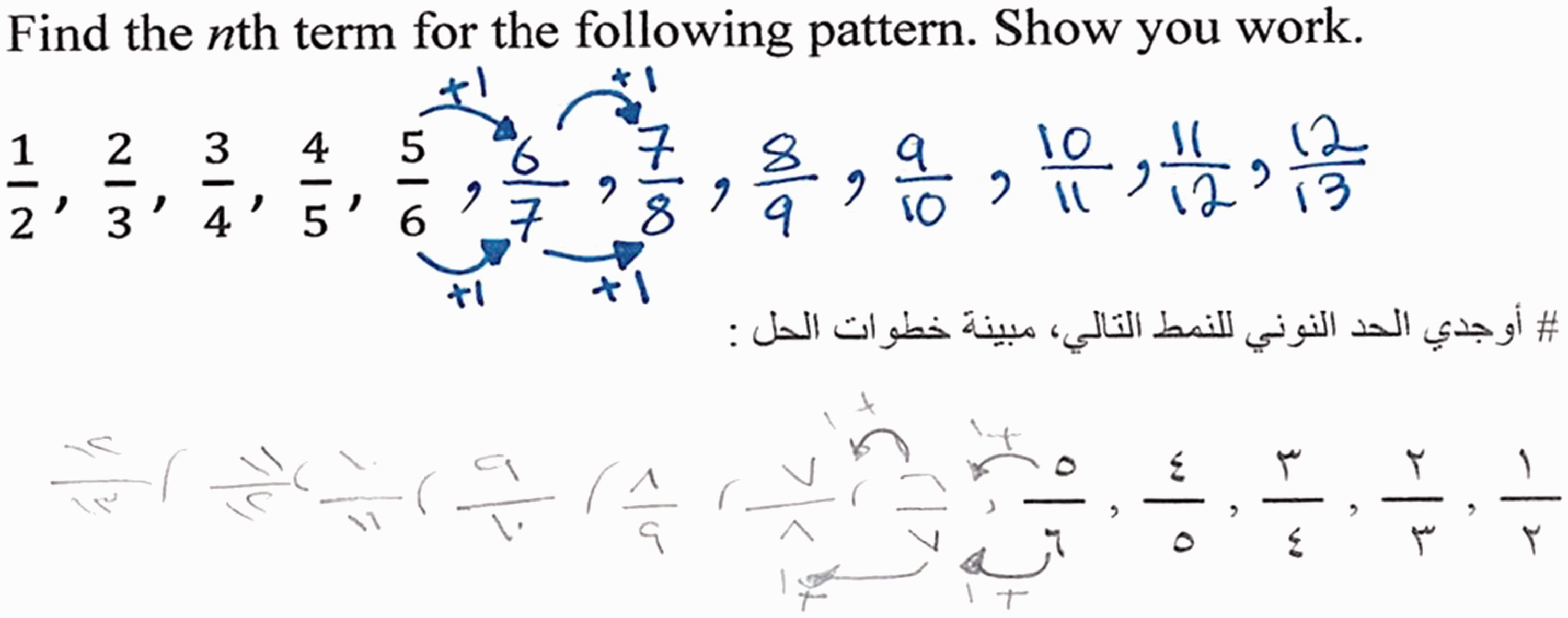
Kuwaiti eighth graders’ work on the following nth term problem was received and analyzed:
Find the nth term for the following pattern. Show your work
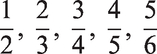
For students to solve the problem correctly, they are required to analyze the pattern, constantly compare the given terms, and make connections to determine a relationship between the given terms that can represent the nth term. Students can use other approaches for solving the question, such as trial and error; they would propose a rule for the nth term, then examine whether the rule can be valid for the given terms. In that approach, students would replace the value of n with the number 1 to generate the first term, then the number 2 to generate the second term, and so on. If all the generated terms match the given terms, this indicates that the proposed rule is correct. If not, students then make adjustments and start the examining procedures again. When generating a rule for the nth term, some students may use variables, and others may use language and words to describe the rule that represents the nth term. In the examined question, there were five given terms for the pattern. The question did not directly ask students to complete the following patterns; however, many students may have used this approach and completed the pattern by writing the following terms. Completing the terms allows students to connect more with the problem and become familiar with the pattern occurring in the question. That could have made it easier for students to generalize the pattern and provide the nth term.
Overview of the students’ responses
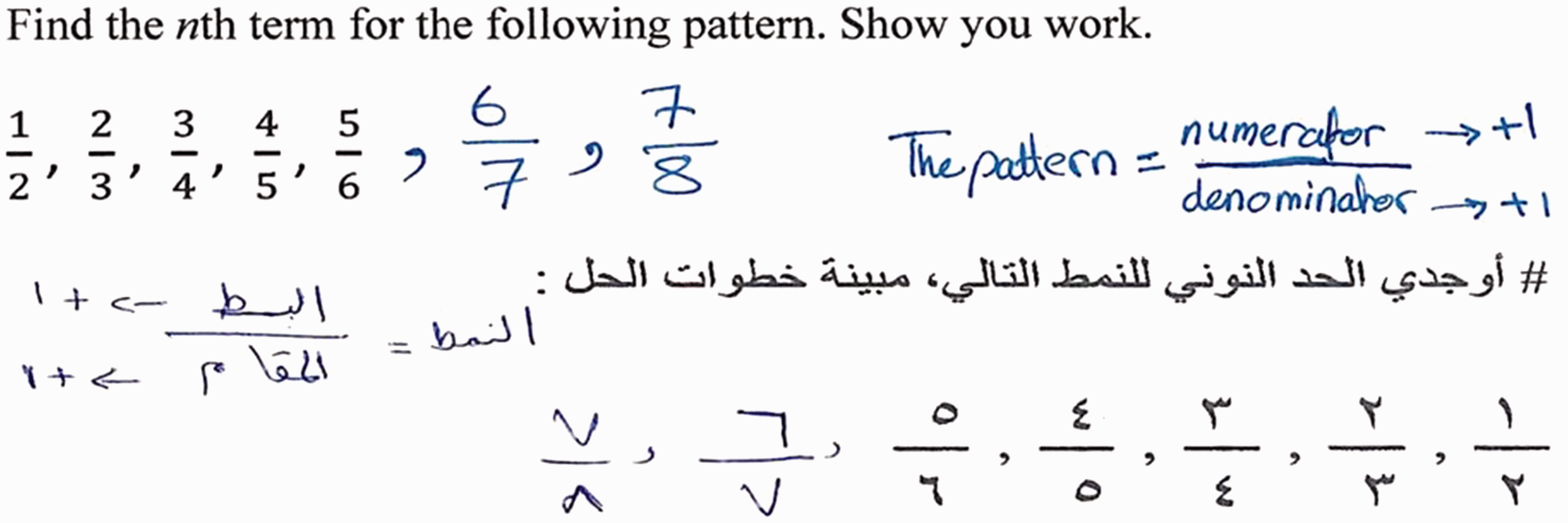
None of the students, male or female, were able to answer the question correctly by finding the nth term. However, 17 (70.8%) of the male students and 18 (90%) of the female students did show their working steps and wrote answers. Multiple differences between males and females were observed, and are reported in the following categories.
Category 1: No response to the question
While seven male students did not respond to the question, only two female students left the page blank. Students in this group did not show any signs of engaging with the problem, nor did they attempt to solve it. No writing, underlining, drawing, notes, or marks were present on the examined papers of this group.
Category 2: The number of completed terms
Writing a rule for the nth term.
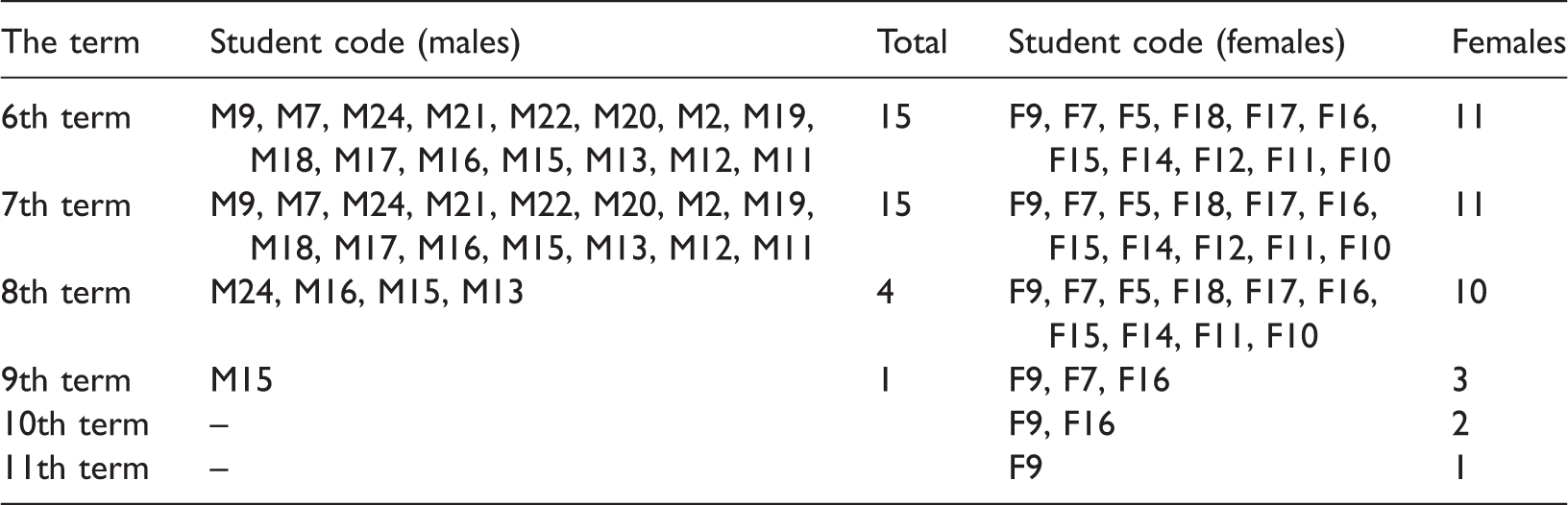
Even though all the students’ attempts to generate a rule for the pattern were mathematically incorrect, the male students outnumbered the female students in the group that attempted to develop a rule. These students, including ten males and two females, explained their work and tried to provide a rule for the nth term. However, the approaches students took for their explanations varied. M16 was the only student who used variables in explaining the rule; (x+1) was the rule he generated using the variable x.
Using language and words was another approach. Six male students relied on wording to explain the discovered rule. Figure 1 presents an example of that. Combining mathematical notations (=, /, and +) with fewer words was a third approach, which M2, M17, and M24 took. Figure 2 shows M2’s response to the question. Females F9, F10, and F18 used the last approach, placing a plus sign followed by a number next to the numbers in the pattern to indicate the increased value from one term to another (see Figure 3).
M20 response, an example of using words for explaining the rule. The response of M2 to the nth term question. Student F9 response to the question.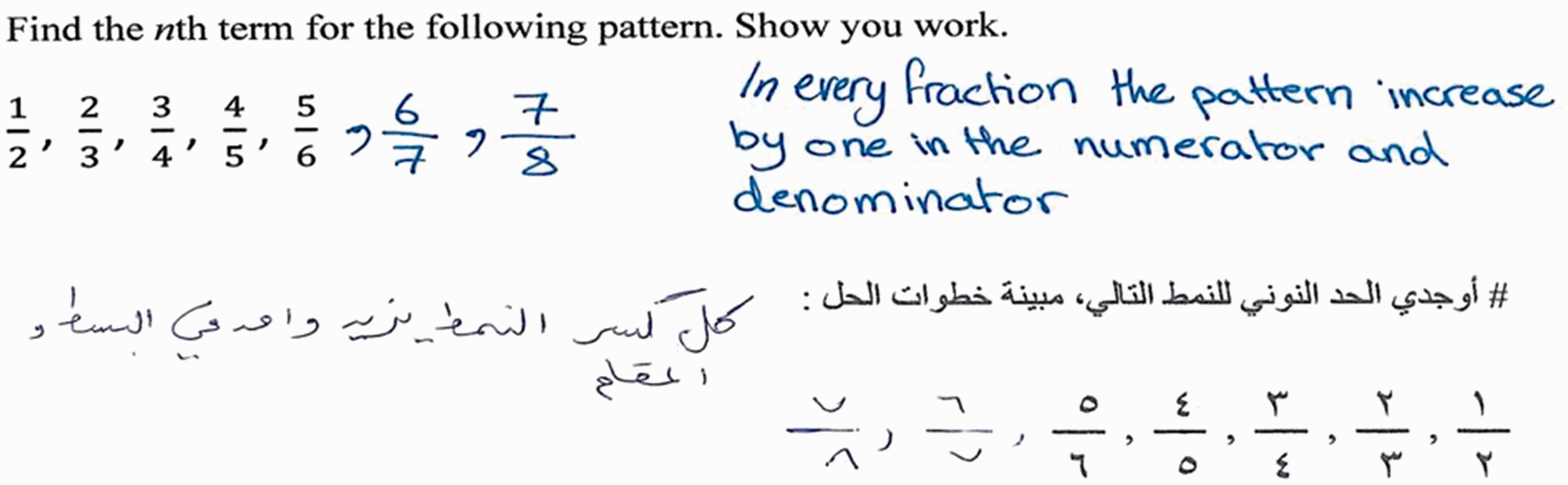
Discussion
This study revealed differences between male and female Kuwaiti student responses to the nth term problem. The findings clearly showed a variance between male and female answers. Where seven males (M1, M3, M4, M5, M10, M14, and M23) out of 24 male students left the question with no response, only two females (F1 and F3) out of 20 female students did not respond to the question. This indicates that more females than males engaged with the question even though they did not necessarily provide a correct answer.
The question instructions required that students show their work. Additionally, the students were highly encouraged by the test proctor to reveal their thinking by writing down the steps they planned to follow even if they were not sure of the answer. Students were encouraged to demonstrate their approach and thoughts on the paper. The fact that only two female students left the page blank shows that females in this study tend to follow instructions more than the males. Moreover, of the nine female students who did not take the ‘completing the terms’ approach to solve the question, only two left the page blank. Seven tried to demonstrate their thought processes.
For example, F4 and F8 wrote the decimal value of each term (1/2 = 0.5), which clearly indicates that they were looking at each term as a fraction. F6’s response is another indicator of trying to show work. She wrote “there is an increase” which signified the conclusion she reached. Of the nine male students who did not take the completing the terms approach, seven left the page blank. Only two tried to show their work.
However, 13 students provided an explanation or a rule for the given pattern and the terms they completed. Ten of these students were males. Moreover, the female students (see Figure 3) rarely provided any details or articulation of a relationship, whereas the males provided more details, such as using language to describe the rule (see Figures 1 and 2). The males tried to generate a rule for the pattern and write an explanation, which is equivalent to finding the nth term. Therefore, it is clear that the male students showed a greater understanding of the question.
Both genders had the exact same question: the nth term problem. Regarding the curriculum, as described earlier, Kuwait has a national curriculum, meaning all public schools follow the exact same mathematics textbook. In many ways, Kuwait is an ideal case study to examine gendered differences in math because of the gender-segregated schools and the equality of resources that are deployed at each school. Nevertheless, gender differences persist.
The data do not support a hypothesis around why these gender differences occur. Within the Kuwait context—where girls tend to outperform boys—it seems clear that boys had a more sophisticated understanding of this mathematical concept than girls. The boys had a more sophisticated understanding of this concept on both the test questions used for this study and on the TIMSS tests. Uniquely, while the boys demonstrated a higher level of understanding on high cognitive demand questions, the girls outperformed the boys overall on both TIMSS and national math exams.
This study shows a complexity around gender that is not reflected in either the Kuwait expectations or the Westernized expectations. While the study does not provide enough information to opine about why these differences exist, one thing to note is that the environments—where binary and opposing expectations exist—make it difficult to determine the ‘whys’ of this study’s results. If the researchers relied on the literature of the field—often embedded in a Westernized construct of reality—then there would be a language and multiple theories to explain why it is that boys were better at a particularly thorny mathematical concept. However, these Western theories and examples would be unable to explain the prevalent and culturally normalized over-achievement of girls on math exams in general. On the other hand, if the researchers relied on literature based within the Kuwait context, then there is a language and there are theories that would explain why it is that girls do better at math overall, but these theories would not explain why it is that boys tended to do much better than girls on more sophisticated questions.
The main thrust of this paper is to argue for a more complex literature around gender and math performance. Our study shows a complexity to math and gender that is not often reflected in the literature, and is certainly not reflected in the cultural discourses of either Western nations or the Kuwaiti context. More work should be done to examine how cultural discourses play differently across nations and contexts, and how these discourses do or do not reflect the experienced reality of the people.
Footnotes
Declaration of conflicting interests
The author(s) declared no potential conflicts of interest with respect to the research, authorship, and/or publication of this article.
Funding
The author(s) received no financial support for the research, authorship, and/or publication of this article.