




Abstract
This paper focuses on the process and mechanism of higher education policy change related to quality assurance in a globalized world. In particular, the purpose of the study was to identify the impact of globalization on domestic policy change in Taiwan, characterized as a peripheral country. Taiwan’s experience in terms of developing a national quality assurance system for higher education (1975–2013) was analyzed as a case study, based on the theories of new institutionalism. The analysis showed that in the whole process of policy change, the government retained significance through playing the role of policy entrepreneur. Regarding the mechanism of policy change, both bricolage and translation were identified in the process. However, translation tended to appear in the most recent period, which saw quality assurance schemes that spread from other places adopted in the local context, albeit with considerable modification. This would imply that, even in the global context, higher education policy change could come in different forms.
Introduction
Due to the impact of globalization and the spread of new public management, market mechanisms have received a lot of political support in the educational decision-making arena in recent decades. Against this backdrop, very many countries have undergone a substantial shift in their approach to regulating higher education. Governments have implemented certain policy practices (e.g. student exchange programs, internationalized curricula, quality assurance, etc.), aimed at enhancing the effectiveness of higher education institutions and making them more responsive to rapidly changing economic and social conditions. These governmental instruments have served as regulatory strategies for globalization and become popular worldwide (de Wit and Knight, 1999).
Asian higher education systems have witnessed similar reforms as governments have gone to great lengths to transform the mode of governance. Traditional bureaucratic governance is in decline, while self-governance is emerging as a new form of university management. Within the context of a highly competitive global environment, most Asian countries are intently focused on building world-class universities, corporatizing public universities and improving university quality (Mok, 2006, 2010).
Taiwan’s government, like most of its counterparts in the region, has adopted market strategies and attempted to devolve autonomy and responsibility to its higher education institutions. Mok (2003) conceptualized the reform process on the island as one of denationalization, decentralization and autonomization. However, Taiwan also represents a somewhat unique case, because of its position on the political periphery in Asia. That is, the Taiwanese government has repeatedly run into difficulty participating in most international and regional organizations without China’s interference. As Taiwan’s society becomes more and more politically liberal and democratic, the government is keen to make the nation, which has been isolated within the international community, more international. Significant emphasis has been placed on higher education reform in light of the trend toward globalization (Hou, 2011).
The aim of the paper is to identify the impact of globalization on domestic higher education policy in a peripheral country. In particular, this paper focuses on the policy changes related to quality assurance in Taiwan. Quality assurance has been perceived not only as a mechanism of improving university quality, but also as a governmental instrument by which to enhance a nation’s international position and recognition in the global higher education market (Jarvis, 2014; Marginson and van der Wende, 2007; Martin and Stella, 2007). In addition, policy change in the area of national quality assurance remains controversial (Hsieh and Huisman, 2013). Convergence regarding a ubiquitous model may be perceived as an outcome of global trade and cross-border competition (van Vught and Westerheijden, 1994); however, it is also arguable that national education policies can respond to globalization in different ways because local contexts will play a crucial role in the dynamic and complicated process (Mok, 2003). By depicting the changes in terms of quality assurance policies and arrangements at the national level, this paper takes Taiwan as an example, analyzing the course of policy adoption in the global higher education context.
The study uses a theoretical framework building on new institutionalism, and particularly on the work of Campbell (2004) and Ostrom (2005, 2007). The case study offers an example of policy translation as the mechanism of policy change. Based on the research findings, it would be difficult to claim that Taiwan’s experience reflects the concept of isomorphism, because the quality assurance elements that spread to the island from other places were not adopted or implemented in the local context without any modification.
The analytical framework
The analytical framework adopted here combines Campbell’s institutional theory (Campbell, 2004) with the institutional analysis and development framework developed by Ostrom (2005, 2007). These new-institutionalist theories provide an understanding of and explanations for policy change.
Concepts of policy change
While endorsing the general tenets of institutional theory, Campbell (2004) stressed that institutions are multidimensional. Recognition of multidimensionality is imperative for measuring policy change because the concept offers scope for detecting how many dimensions in a layered institution have been altered within a given time frame. Moreover, this concept provides a foundation for accounting for policy change. The diversity of and interaction among dimensions within an institution brings with it endogenous pressures on actors. Different speeds of change across different dimensions produce time lags, followed by internal tensions, forcing decision-makers either to facilitate or constrain institutional change in order to resolve those tensions. Also, inconsistency may emerge from conflicting institutional dimensions; and actors, particularly policy entrepreneurs, might seek new institutional arrangements and introduce innovations to the decision-making arena.
The choice of institutional dimensions in the analytical framework was driven primarily
by a focus on policy. The framework comprises a few regulative dimensions, which were
derived from Ostrom’s typology of rules (Ostrom, 2005, 2007), focusing on three categories of rules in
particular: Boundary rules that decide which participants can enter or leave the arena as
authorized appropriators (the sub-indexes of this dimension includes ownership and
standards determinants); Information rules that affect the level of information available to participants
concerning actions (the sub-indexes of this dimension includes nature of information
and reporting types); and Pay-off rules that delimit the potential outcomes that may, must, or must not be
achieved as a result of actions, and assign benefits/costs to participants in light
of the outcomes achieved (the sub-indexes of this dimension includes effects of QA
outcomes).
Mechanisms of policy change
In addition to the feature of multidimensionality, Campbell (2004: 8, 173) used the term ‘constrained innovation’ to explain policy change. This concept is twofold. On the one hand, institutions tend to lock in actors’ behavior and limit the range of options available; on the other, institutional constellations also provide opportunities that enable entrepreneurs to change by creating innovations in spite of the institutional constraints. Campbell (2004) devoted substantial attention to describing the process of path-dependent institutional change. To explain this kind of change process, two underlying mechanisms, bricolage and translation, come into play.
Bricolage is the mechanism of policy change through which policy entrepreneurs recombine local practices to create new policy alternatives. The forms of the innovations therefore tend to resemble those of their predecessors; for example, by virtue of the former inheriting a substantial number of elements from the latter. Unlike bricolage, translation, the other mechanism of policy change, involves the recombination of local policy elements with new ones originating from elsewhere. In the mechanism of translation, policy entrepreneurs will revise the foreign elements based on what is being experienced in the local context in order to ensure the suitability for the recipient entity.
The context of Taiwan’s higher education reform
The higher education sector on Taiwan has been expanding continually since the 1970s. In 1986, there were 29 higher education institutions, of which 15 were national; and the respective numbers of such institutions had become 176 and 64 as of 2012 (Department of Higher Education, 2013). With the rapid expansion of the number of institutions and an enormous increase in student enrollment, the Ministry of Education (MoE) launched a series of reform programs. New policy measures and alternatives were introduced to improve efficiency and effectiveness, particularly focusing on resource relocation, university self-autonomy, research excellence and quality assurance (Tai, 2000). For example, the 2002 ‘Enhancing Global Competitiveness Plan’ and the 2004 ‘Study Abroad Loan Program’ were implemented to strengthen the island’s international outlook and global competitiveness. In addition, the government also encouraged Taiwan’s higher education institutions to seek international recognition through the approach of pursuing international accreditation in order to enhance global competitiveness (Hou, 2011).
Because of the increasing preoccupation with quality, legislation referring to evaluation or quality assurance has undergone significant evolution in the course of higher education reform, especially after 2005 when the University Act was revised. This paper aims to analyze the process of policy change in relation to improving the quality of universities. The longitudinal analysis covers a period of around 40 years, starting with the first national university evaluation scheme which was introduced in 1975.
The policy change related to university quality assurance in Taiwan
This section describes the development of Taiwan’s university assessment system based on the analytical framework mentioned above. The analysis covers the years from 1975, when the first assessment program was launched, to 2013, and is divided into three periods according to defining features and key developments.
Period 1: 1975–1990
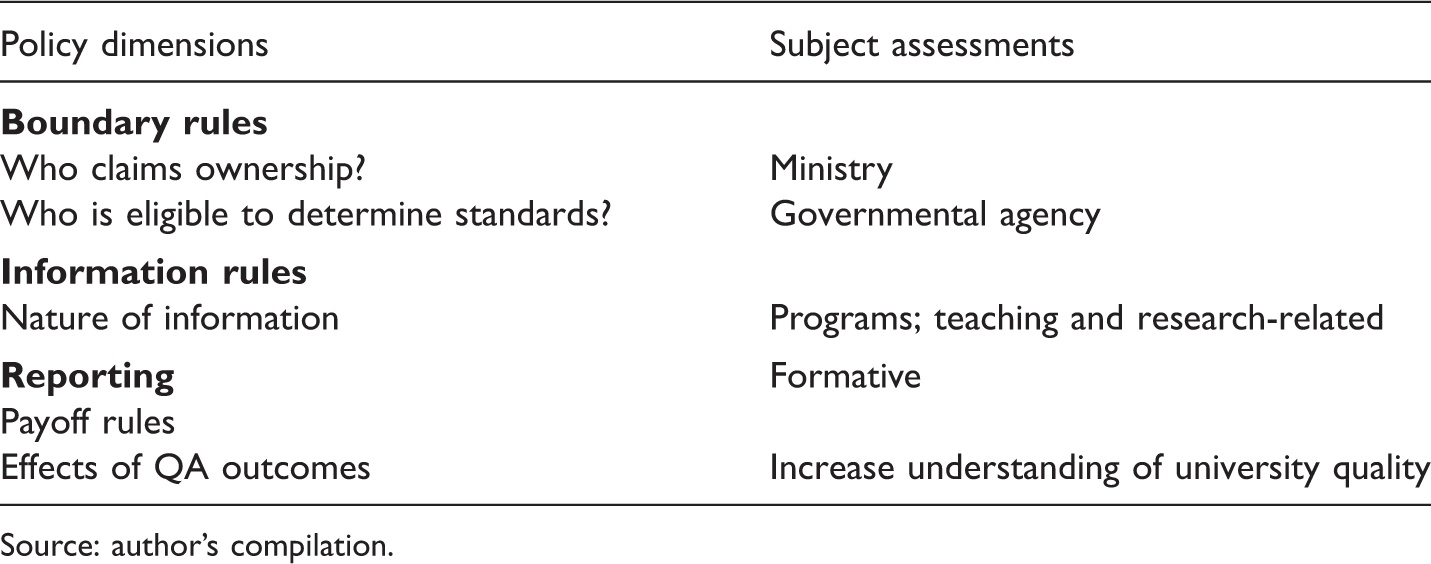
Due to the rapid expansion of Taiwan’s higher education system in the 1970s, the MoE launched a program of assessments in 1975, involving five disciplines: mathematics, physics, chemistry, medicine and dental medicine (Su, 1997; Yang, 2010). These assessments can be seen as representing the nascence of university quality control in Taiwan. A few more subjects were subsequently added and continued to be included in a similar evaluation framework until 1982.
Policy change regarding Taiwan’s university quality assurance systems 1975–1990.
Source: author’s compilation.
The Department of Higher Education, being responsible for scrutinizing the university arrangements, recruited teams to formulate and conduct the Subject Assessments. The assessment teams usually consisted of five to ten academics and experts from the given professional fields. Most of the assessors were professors and Deans of academic affairs from national universities. A governmental agency, the Department of Higher Education, was in an influential position to determine quality standards, because the MoE claimed the ownership of the quality assurance system.
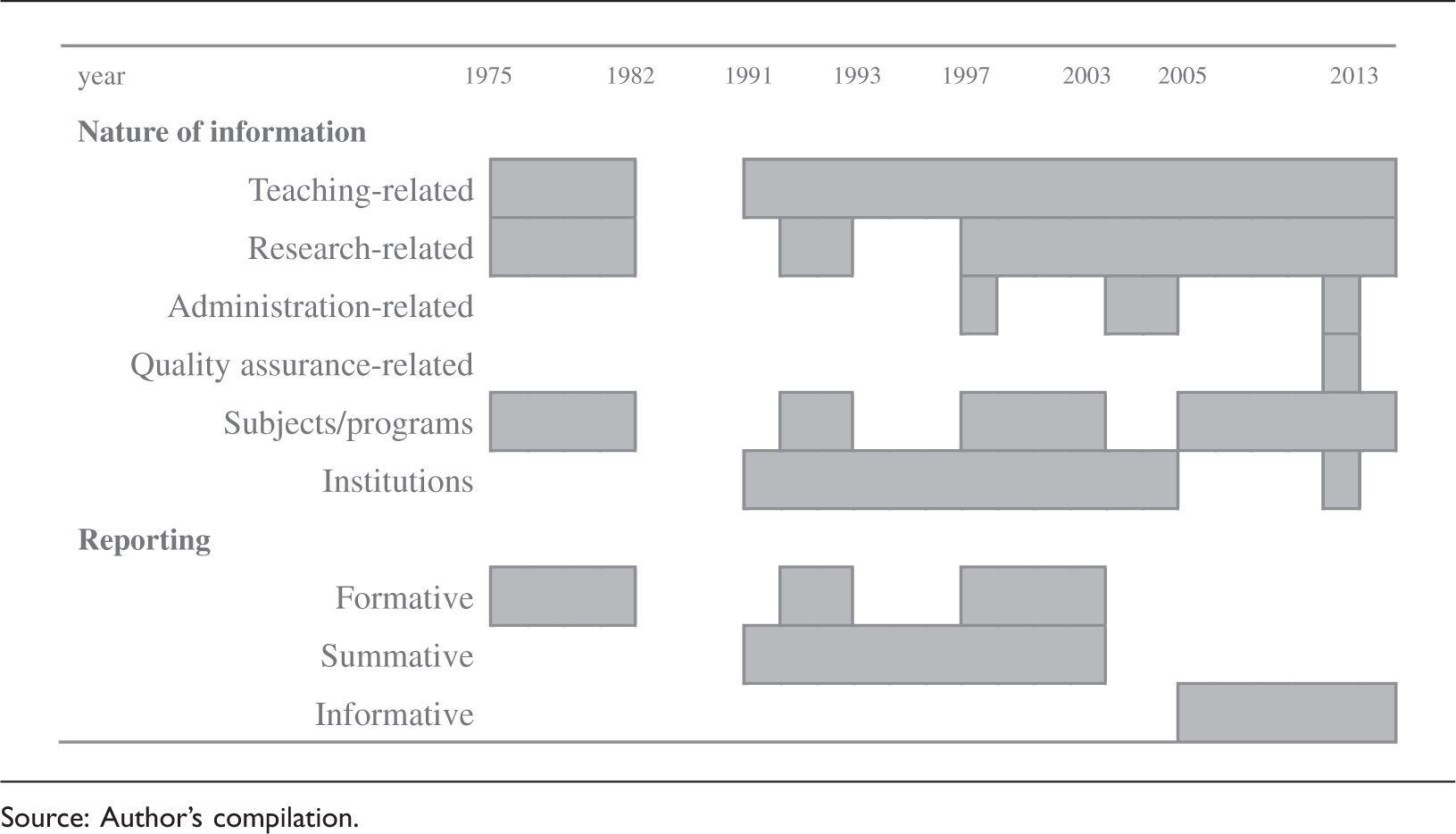
Regarding the information that was collected and adjudged in the process of assessments, the data were related to the quality of teaching and research. Because the original aim of implementing these assessments was to gain a better understanding of university quality, the results of the Subject Assessments did not attempt to make absolute quality judgments or comparisons between individual institutions. Thus the final reports mainly provided subjective and descriptive information. Follow-ups were also conducted by the MoE after the assessments during the years from 1979 to 1982.
Period 2: 1991–2003
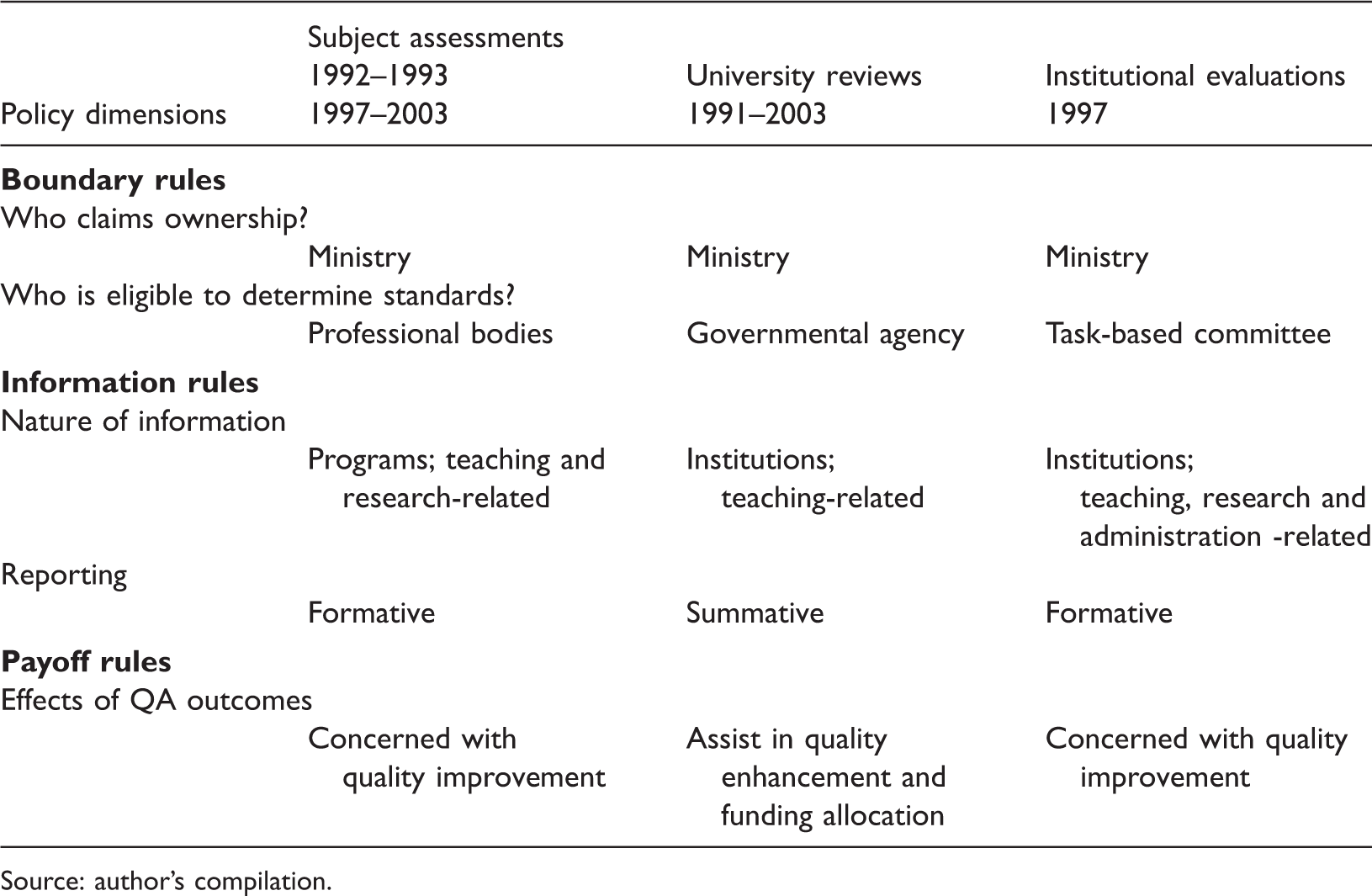
After the first round of Subject Assessments had been completed, the criticism that arose from within the higher education system itself led to a ten-year suspension of any university evaluations. The Subject Assessments resumed in 1992, but with significant modification. First, participation this time was not mandatory. The universities were allowed to choose whether or not to be involved in the assessment process. Second, the approach to determining assessment standards and procedures was completely different to what had been used previously. Professional bodies were placed in charge of these tasks. The MoE appointed a small number of professional and academic associations (e.g. the Chinese Electrical Engineering Society, the Management Science Society of the Republic of China, and the Chinese Mechanical Engineering Society) to formulate evaluation standards and conduct evaluations accordingly. Five subjects (viz. educational programs, liberal education, medicine, management, and chemistry) were assessed in this period (Su, 1997; Wu et al., 2012; Yang, 2010).
In addition to the Subject Assessments, the MoE launched another set of measures, the so-called University Reviews, in the early years of the 1990s, to include private universities in the assessment process. Because the aim of these arrangements was not only to foster quality improvement but also to provide a reference for the allocation of subsidies to private universities, the government played a much more hands-on role in formulating the quality procedures than it did in the second round of Subject Assessments. The visitation committees were chosen and assembled by the Department of Higher Education. The reviewers grouped for onsite visits were representatives from higher education institutions and related administrative agencies. They followed the evaluation indicators specified by the MoE and made their judgments against the backdrop of the medium-range development plans provided by the individual universities. Because of the University Reviews’ stated purpose, there was a link between the review results and governmental decision-making, particularly when it came to allocation of funding for private universities and control of total enrolment (Su, 1997; Yang, 2010).
Although the earliest implementation of formal evaluations in Taiwan’s higher education system can be traced back to the year 1975, such evaluation procedures were not enacted as law until 1994. The amended University Act, passed in 1994, codified the MoE’s responsibility for conducting university evaluations. Amplifying that legislation, Article 2 of the Enforcement Rules of the University Act mandated the MoE to set up evaluation committees for implementing relevant procedures. This policy change should be noted in particular because it marks the point of divergence in terms of the government’s role with respect to national quality assurance. The MoE traditionally held absolute power to determine assessment standards and procedures, but those conventional monitoring systems were lifted as a result of the amendment of the University Act. The detailed requirements and arrangements in relation to university quality would henceforth be collectively decided by the government, academics and higher education institutions.
Policy change regarding Taiwan’s university quality assurance systems 1991–2003.
Source: author’s compilation.
Period 3: 2004–2013
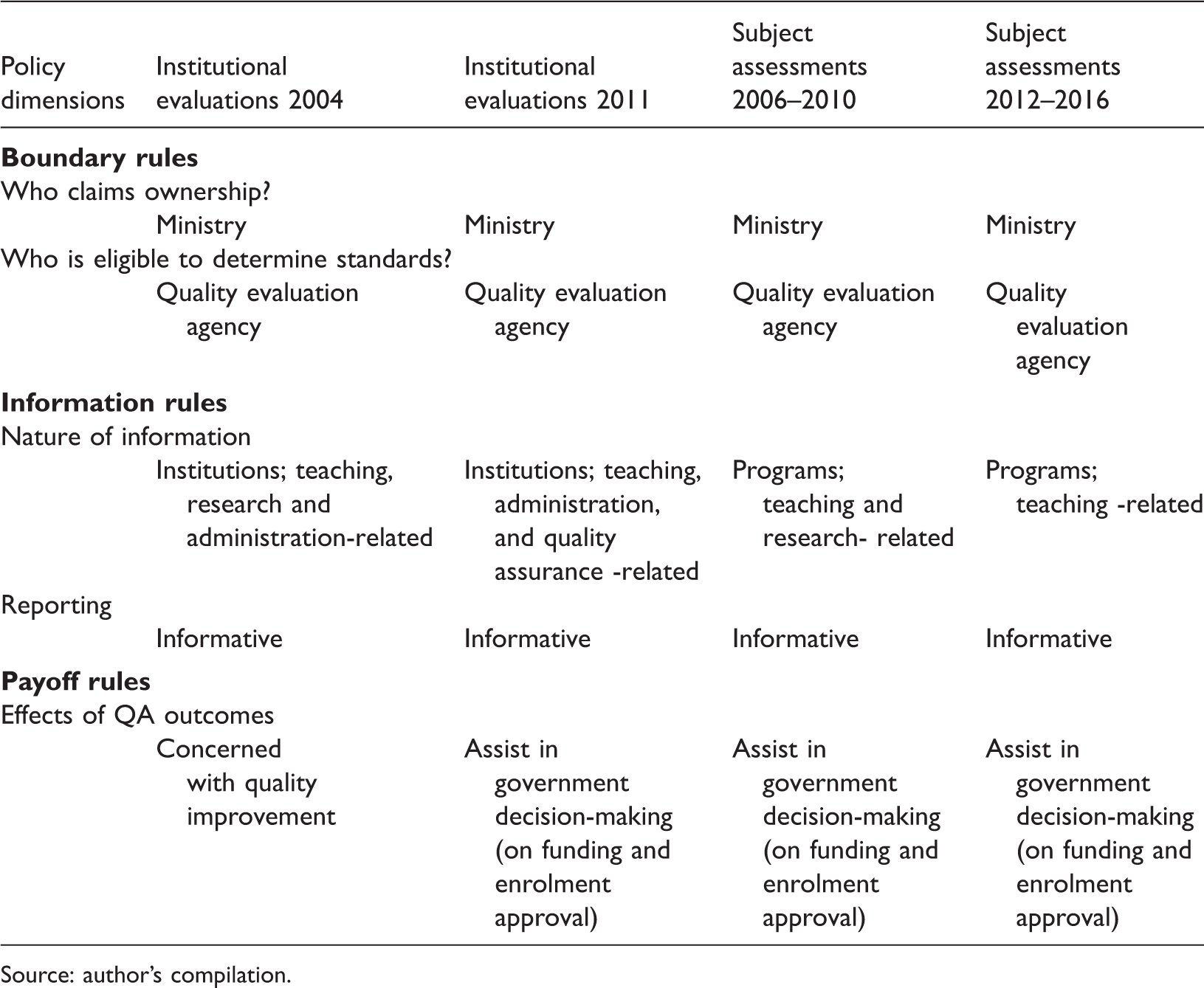
Policy change regarding Taiwan’s university quality assurance systems 2004–2013.
Source: author’s compilation.
Non-governmental evaluation agencies have started to play an increasingly significant role in the process of Taiwan’s university quality assurance. For instance, the Higher Education Evaluation and Accreditation Council (HEEACT), which was established in 2005, was placed in charge of the Institutional Evaluations held in 2011, in which 81 four-year national and private universities participated. The HEEACT mandate has remained the same both in the first cycle of the subject assessments that were implemented during the years 2006 and 2010 and in the second round of the subject assessments which were scheduled to be carried out starting in 2012 and completed by the end of 2016. In accordance with Article 2 of the Regulations for University Evaluation, this quality assurance agency was jointly established and endowed by the MoE and Taiwan’s higher education institutions.
Before the HEEACT came into being, the Taiwan Assessment and Evaluation Association (TWAEA) was established in 2003 as another non-profit, non-governmental professional evaluation agency. Differing from its more recent counterpart, the TWAEA was jointly founded by senior members of academia and various business sectors. In 2004, the agency offered its services to carry out another set of university evaluations (known as the Institutional Evaluations 2004). There were 38 science and technology universities involved and the scope of the evaluations was much narrower than the Institution Evaluations conducted in 2011. It seems fair to say that Taiwan’s national quality assurance system has become decentralized, since the government delegated its responsibility for university evaluation procedures to the aforementioned non-governmental agencies (Hou, 2011).
In addition to the appearance of a decentralized quality assurance system, this period
(2004–2013) also witnessed an increase of institutional autonomy. In 2007 the government
included exemption regulations in Taiwan’s national quality assurance system, aiming to
eliminate duplication among the internal and external QA schemes and also to reduce the
administrative burden on institutions. The exemption regulations give the universities
leeway to go through a set of national QA procedures held by the HEEACT. According to
Article 5 of the Regulations for University Evaluation, the higher
education institutions are allowed to exempt themselves from national university
evaluations, when meeting the following criteria: Having established completed self-evaluation procedures and the results of its
internal quality assurance have been accredited by the task force grouped by the
MoE; or Having passed an evaluation operated by a local or international quality assurance
agency which the MoE awarded accreditation.
The exemption regulations were further clarified in 2009. In accordance with the
Regulations for University Evaluation, an institution or program that
met one of the following requirements would be eligible to apply for self-evaluation
status: The recipients of the MoE grants of the Development Plan for World Class
Universities and Research Centers of Excellence; The recipients of the MoE grants of the Top University Project; and The recipients of the MoE grants of the Teaching Excellence Project with a value of
more than 0.2 billion TWD (approximately US$6.7 million) in four consecutive
years.
Furthermore, the applicant is required to prove their qualification by submitting evidence that can demonstrate the capacity to conduct a self-evaluation process. All the relevant documents are reviewed by a recognition committee assembled by the MoE. Based on the recognition results published by the MoE, there were 34 institutions which qualified for the exemption in 2012, when the total number of institutions in the higher education system was 176.
There are at least two obvious changes with respect to the information rules, when comparing the university assessment regulations in this period and previous ones. First, quality aspects regarding institutional administrative management (i.e. internal quality control procedures) have been included; and, second, the reporting approach has become informative, as opposed to the formative and/or summative, and is designed to provide information to stakeholders. With a view to informing and ensuring stakeholders that the higher education being provided is of sufficiently acceptable quality, the assessment outcomes are now depicted in the form of grading on a scale corresponding to a short descriptor. Taking the Institutional Evaluations 2011 and the second cycle of Subject Assessments run in 2012 and 2016 as examples, the three types of assessment outcomes are ‘pass’, ‘conditional pass’, and ‘fail’.
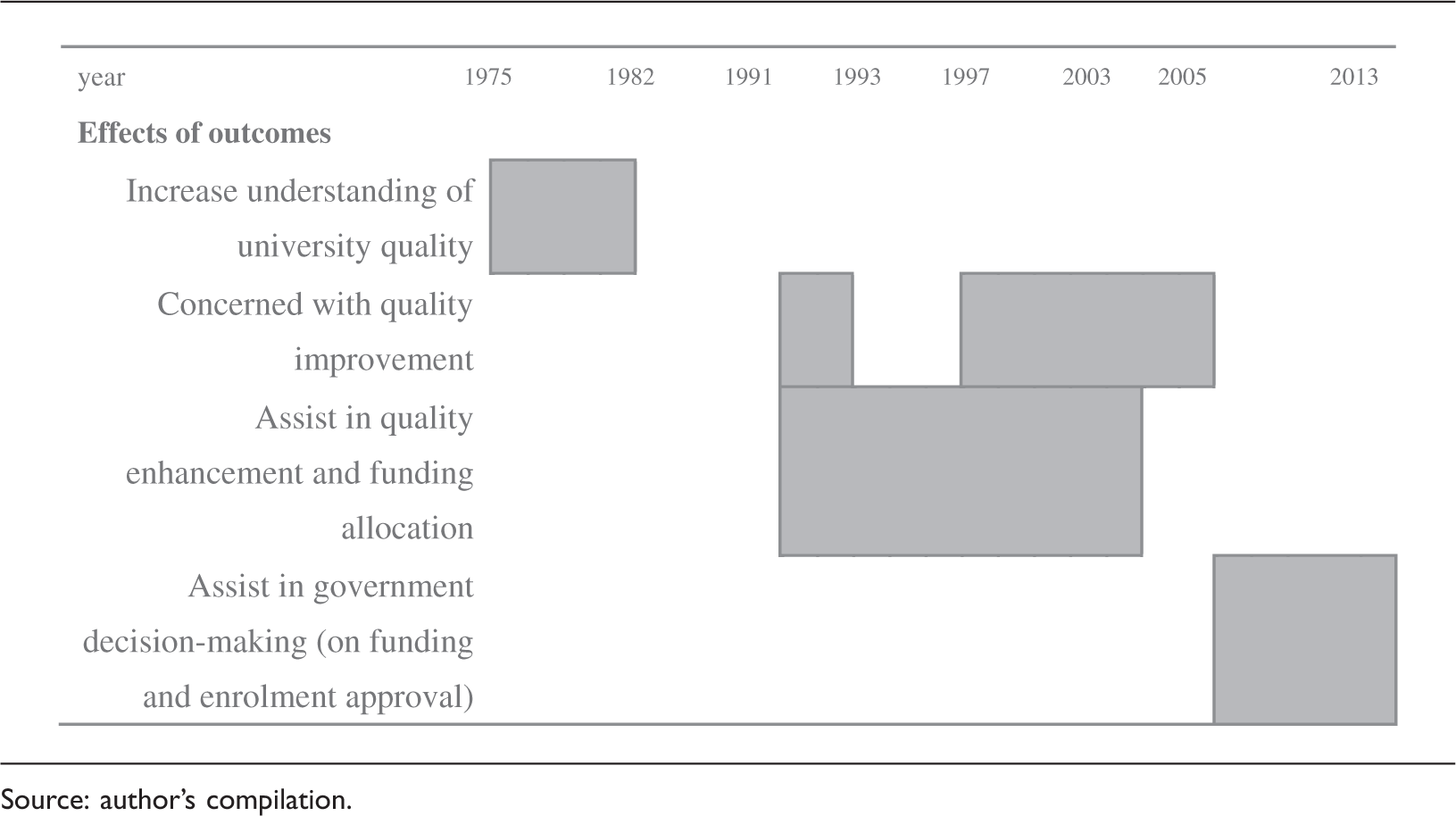
In terms of payoff rules, since 2005 a program or university that fails to pass the assessment conducted by the HEEACT is required to provide a plan for self-remediation in response to the comments provided by its visitation committee in its final report. Follow-ups, in the form of assessments, must be carried out by the HEEACT a year later. Those institutions or programs with a status of ‘conditional pass’ and ‘fail’ will be assessed again the following year, in order for the HEEACT to check whether the major problems mentioned in the final report have been addressed. However, when an institution or a program fails to pass the assessments for two consecutive years, there are direct financial consequences as well as provision for the termination of the unit’s enrollment and operation (Article 8 of the Regulations for University Evaluation).
Similar to the situation in other countries following a trend towards higher education marketization, the demand for supplying sufficient information about higher education provision in Taiwan is considered to be significant with regard to consumer protection. The relevant information also informs governmental decision-making and is of value to prospective employers of graduates. Measurable outcomes regarding student learning therefore become a crucial part of the information that has to be collected and adjudged in the process of assessment. Because the main function of the quality procedures is to issue accreditations to higher education units, evaluation results normally have to be published in forms that embody objective statements and lead to some sort of classification or permission.
In Taiwan, the policy changes reflect the assumption that quality is regarded as value in return for money. In the earlier stages of development, Taiwan’s university evaluation schemes were implemented mainly for the purpose of understanding university performance and guiding quality enhancement. That all changed in the later period, which has seen the focus of quality assurance schemes shift to performance-based evaluations. The evaluation results have increasingly been used to inform the government when it comes to funding allocation and enrolment approval. The national quality assurance schemes that have been implemented in this period are compared in Table 3.
Interpretation of Taiwan’s experience
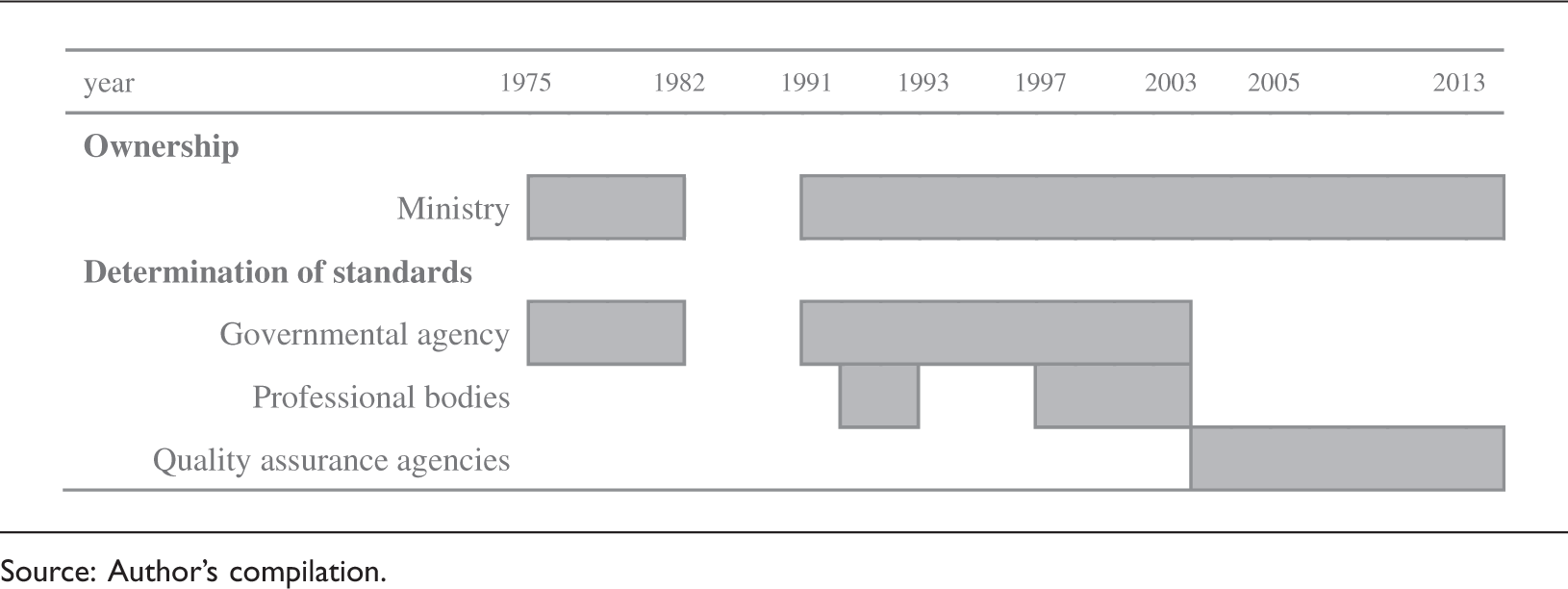
Policy change in terms of the boundary rules in Taiwan’s national quality assurance systems 1975–2013.
Source: Author’s compilation.
Policy change in terms of the information rules in Taiwan’s national quality assurance systems 1975–2013.
Source: Author’s compilation.
Policy change in terms of the payoff rules in Taiwan’s national quality assurance systems 1975–2013.
Source: author’s compilation.
The first implication is in regard to the governance model of the quality assurance system. The MoE was the key policy-maker claiming ownership and retaining control over Taiwan’s national quality assurance system in the years under investigation (see Table 4). However, the governmental control has gradually become less direct, or a case of ‘steering at a distance’, because the MoE devolved the power of self-evaluation to universities in the 2000s. More freedom has been given to the universities and the government has stopped short of setting up specific regulations for either quality standards or the composition of an evaluation panel. Correspondingly, Table 4 depicts the changes regarding who was eligible to determine evaluation procedures and standards, from the government side, through professional bodies, and finally to the quality assurance agencies. Similarly, Hou et al. (2014) emphasized the appearance of non-governmental quality assurance agencies in the process of the development of the Taiwanese university evaluation system. They believed that the formation of the HEEACT represented the establishment of a decentralized quality assurance system for the higher education intuitions.
The most recent manifestation of the quality assurance scheme provides the universities
with greater institutional autonomy, allowing them to choose which quality assurance agency
will conduct their internal evaluation procedures. Beyond that, the universities are now
eligible to pick which evaluation route to follow in order to receive governmental
recognition of their quality. More specifically, Taiwan’s university evaluation systems were
centralized before 2005, and the main policy-makers involved in determining the quality
standards and arrangements were governmental agencies. The system then moved into another
path in accordance with the Regulations for University Evaluation. The
evaluation scheme became an accreditation-oriented approach, consisting of three different
routes. The universities which meet the exemption requirements can choose from the following
options: Passing an evaluation conducted by the HEEACT; Conducting the self-evaluation procedures, the arrangements of which are formulated
by the universities themselves, subject to the condition that the quality assurance
procedures and results can be recognized by the task force grouped by the MoE; or Passing an evaluation conducted by a local or international quality assurance agency,
which has accreditation awarded by the MoE.
The new national quality assurance scheme, which consists of multiple routes for the universities achieving government quality recognition, was created in order to improve the diversity of Taiwan’s higher education institutions and assist them in the development of their own distinct features. In general, it would be appropriate to claim that in the late 2000s Taiwan’s governance vis-à-vis university quality assurance shifted from a ‘state-control model’ to a ‘state-supervisory model’.
The second lesson gleaned from Taiwan’s experience is related to the mechanism of domestic
higher education policy change in the global environment. Based on side-by-side comparisons,
the present case study found that the latest – and current – university evaluation scheme in
Taiwan is very similar to the general quality assurance model described by van Vught and Westerheijden (1994).
These authors compared related experiences in the United States, Canada and Western Europe,
and then offered a model which contains the following elements: A managerial agent that administered and conducted the evaluations; The processes of self-evaluation and peer review; Reports on evaluation results; and A linkage between the outcomes of quality reviews and the governmental funding of
higher education.
All of these features can be also identified in Taiwan’s university evaluation system. In the late 2000s, following in the footsteps of many countries that were choosing accreditation as the major quality assurance instrument (Schwarz and Westerheijden, 2004), Taiwan also turned towards accreditation as a form of public regulation of the quality of higher education.
In the case of Taiwan, however, alongside the globally convergent features noted above, divergence from the experience of other countries was also apparent. For instance, within a typical accreditation route, higher education units can receive an accreditation status when reaching certain predetermined quality thresholds. However, the model used in Taiwan, which was derived from one found in the United States, can be described as ‘voluntary’ institutional accreditation due to the emphasis on institutional autonomy in the process of self-evaluation. In contrast, countries in Europe tend to show a predisposition toward ‘national’ processes of quality review (Westerheijden et al., 2007). In Taiwan the quality assurance approach was more compulsory and national-oriented in the earlier stage; but the government later showed a willingness to delegate institutional autonomy to selected universities in order to allow them to develop their own self-evaluation schemes and standards. The universities were encouraged to obtain proof of quality from local or international quality assurance agencies, rather than being assessed by the HEEACT. The exemption requirements, included as a solution in the 2007 revision of the Regulations for University Evaluation, were aimed at highlighting the institutions’ strengths and also at balancing the conflict between international involvement, state control and institutional autonomy. Taiwan’s experience actually showed a switch from the European style to that of the USA around the middle of the 2000s. Although Taiwan’s quality assurance scheme leans more towards the accountability side, the policy change revealed the government’s effort to combine accountability with improvement-oriented practices.
The present study also found that some of the policy dimensions have experienced significant changes, as can be seen when considering ‘Determination of standards’ (in Table 4), ‘Reporting’ (in Table 5), and ‘Effects of outcomes’ (in Table 6). These changes can be associated with the mechanism of translation, which refers to the policy practices travelling from the global context to Taiwan, with certain modifications. By contrast, a few policy dimensions have remained unchanged or have persisted with only slight differences: these are related to ‘Ownership’ (in Table 4) and ‘Nature of information’ (in Table 5). The relative consistency of these dimensions reflects the mechanism of bricolage; that is, the process whereby new policy elements were created by the policy entrepreneurs recombining those local policy elements in varying degrees.
The third implication is related to Taiwan’s political status in the international community. Because Taiwan (ROC) lost its membership of the United Nations (UN) in 1971, the island country enjoys only unofficial diplomatic relations with most UN member states. The status of Cross-Strait relations seems to be a major factor influencing the government’s decisions in terms of improving the higher education system. As a small country with a peripheral political status, Taiwan’s government needs to emphasize the importance of internationalization. Indeed, the concept of internationalization has been incorporated into policy documents through the process of policy-making in the domestic higher education arena since the 1990s. The university evaluation policy was one of the alternatives that were implemented in an effort to make Taiwan’s higher education system more competitive in the global education market. Through the process of policy change, the government has been the primary policy entrepreneur leading the way with regard to introducing foreign mechanisms related to quality control strategies. It appears that adopting measures undertaken in other countries was deemed by the government to represent a solution for the country’s domestic higher education problems. This policy logic was aligned with the thinking of most of the policy stakeholders on the island, and thus the neo-liberal managerial change in the university evaluation policy was accepted without significant controversy in the course of the public debate that took place in Taiwan.
Conclusions
Globalization, in tandem with the influence of neo-liberalism, has affected the educational decision-making arena, where deference to market mechanisms has received much political support. Governance practices and administrative approaches to the regulation of higher education have therefore undergone a substantial shift. Higher education policies, within such a context, often serve as strategies for globalization. Among the various regulatory instruments in the increasingly globalized sector of higher education, quality assurance is almost ubiquitous. There are two key outcomes of the case study reported here: first, the finding that in terms of the stated role in the process of policy change the government retained significant influence on higher education quality, albeit one that has been exerted via a rather different approach; and, second, regarding the mechanism of policy change, an illustration of how a quality assurance system, which served as an instrument of accreditation, was diffused from the international context to Taiwan’s domestic arena. Although both mechanisms of bricolage and translation were identified in the process of policy development, the influence of translation is more pronounced in the third period (2004–2013) than in the previous periods.
In a rapidly globalizing world, the triggers of the evaluation system change in Taiwan converged with the factors at play in most nations. These factors include the transition from ‘elite’ to ‘mass’ higher education, limits to public budgets, an increase in demands for transparency, and a switch of governmental approaches from ex ante control to ex post justifications. In addition, Taiwan’s new national quality assurance scheme for its universities consists of a few elements similar to those found as part of the global trend, namely the involvement of non-governmental QA agencies, peer reviews, onsite visits; and links between evaluation results and governmental decision-making on issues such as funding and student enrolment.
It may be inevitable for the government of Taiwan to embrace an educational policy idea or regulatory tool which has become popular, or even dominant, around the world. It is to be expected that this will be even more difficult given that the government has accepted in full the idea that the pre-eminence of higher education can increase national economic strengths and international influence. For a country located on the periphery of international relations, foreign policy programs appear to represent a menu of policy solutions to domestic problems. However, Taiwan’s experiences indicate that the policy entrepreneurs who want to trigger policy change need to consider local context and history when attempting to import foreign alternatives and elements, even in a country that has a strong motive for internationalization in the face of globalization.
In the process of developing a ‘glonacal’ (global + national + local) quality assurance scheme, Taiwan’s model of accreditation shows a preference for granting institutional autonomy. Institutions and programs have the freedom to decide the approach they take toward earning an accreditation status. They can choose to conduct an internal quality assurance scheme developed by themselves, or to entrust a quality assurance agency accredited by the MoE with this important task. This illustrates what might be called a ‘light-touch’ approach, insofar as the government does not feel the need to steer directly the substantial process and procedures. The findings show that translation would be a more apt descriptor than bricolage for explaining the process of policy change in a peripheral country highly motivated to follow international development trends. Furthermore, higher education policy change in the global context can occur in different forms. It can be expected that the most common scenario for policy change is that some policy dimensions experience homogeneous diffusion, while others are characterized by heterogeneity.
Footnotes
Declaration of conflicting interests
The author(s) declared no potential conflicts of interest with respect to the research, authorship, and/or publication of this article.
Funding
The author(s) disclosed receipt of the following financial support for the research, authorship, and/or publication of this article: This research received funding from the Ministry of Science and Technology (MOST), Taiwan (MOST 103-2410-H-259-038).