




Abstract
This paper explores the results of the research A interiorização recente das Instituições públicas e gratuitas de ensino superior no Nordeste: efeitos e mudanças [The recent implementation of new federal universities in the Northeast of Brazil: effects and changes], performed by the Joaquim Nabuco Foundation.1 One of its main mottos is the emphasis on the official speech, which defends that the implementation of Federal University campuses in the countryside of Brazil generates opportunities for young people at the lowest levels of the income pyramid to attend higher education. In this research, we have investigated the relations between the life stories and the aspirations of the students and, here, we analyse the reality of the educational system on the countryside, where in some cities, the possibility of a young person to attend university is rated below 5%. We have identified their expectations on professional choices and their future in the labour market, the way they feel about the implementation of the campuses and the changes in their life projects according to the possibility of achieving a better place in society due to the chance of attending free public university. The theoretical–methodological line used in this research will be explained throughout this paper.
Introduction
The expansion of colleges in the countryside of Brazil is the main discussion in this paper and is based on data obtained through our field research for the study The recent implementation of new federal universities in the Northeast of Brazil: Effects and changes (2011/2013) performed by the Joaquim Nabuco Foundation.1
At the heart of our research is the students’ expectations about the changes in their life projects when given the possibility to access federal universities in the countryside of Brazil. All Brazilian federal colleges are free of charge, so the impact of their expansion is an important project to people.
The expansion of higher education in the countryside of the states is part of an effort to decrease the territorial concentration of income and provide better chances for young people from the countryside. Thus, the speeches of students on the new educational reality taking place in the countryside will be explored in this paper, especially in cities situated in the Northeast, where the lack of universities was a major issue until the decade 2000.
The research started in Pernambuco, as a pilot study, in 2011. The study focused on the analysis of the expansion of federal universities. Afterwards, the proposal was extended to other states in the Northeast region, aiming to provide a diagnosis on the first years of this expansion of free public universities in the countryside areas of Brazil and the expectations of the people involved in this process. Eight of nine Northeastern states were studied. 2 The implementation of colleges in cities where there were no higher education institutes can bring countless changes to society, especially for younger people.
In other words, it is part of possible changing of habitus, proposing yet being part of the solution for a century-old problem of educational inequalities. Although part of the countryside already had private faculties, free colleges brought by federal institutions of higher education might produce a social impact by greater openness to the low-income population, to whom it paid education was unfeasible.
Public higher education in Brazil and countryside expansion
Between 1808 and 2002, there were 148 campuses in Brazil, located in 114 cities. Around the world, some researches detach three major aspects of the history of access to higher education: (1) a period of significant expansion; (2) a great reduction in gender inequality; (3) a slight reduction in social class inequality (Reay et al., 2001; Rosado, 2006). Meanwhile, in Brazil, before the expansion policy started in 2003, the last university installed in the country dates back to the 1960s.
The creation of the Grupo Executivo de Reforma do Ensino Superior [Executive Group for Higher Education Reform], started in February 2004, was the first step to establish new guidelines for Brazilian higher education. The reasons presented by the Ministry of Education (MEC) to take action stems from the findings’ reality summarized to these points (Castro and Schwartzman, 2005): the fast and increasing expansion of private universities; the commoditization of education; the need to enable most people to attend higher education, especially those with a lower income. The reassurance of the university is as an element of reference and quality, therefore assuring its socio-political role starting from a democratic and participative management, aiming for education focused on the social aspects.
The educational reform project has aimed to establish itself as an answer for the problem caused by the concentration of students in private higher education institutions. In 2004, only 9% of the young students from age 18 to 24 were attending undergraduate schools and, out of those, 71.25% were in private institutions. The concern caused by this data is based on the assumption that the democratization of higher education is considered one of the key elements to overcome the historical inequalities that characterize the Brazilian social experience. The data of expanding of free public universities after the support program are as follows: in 2001, 3,036,113 students were attending undergraduate courses. In 2010, this number reached 6,379,299, which represents an increase of almost 110% (Education Census, 2010).
In terms of attendance of undergraduate courses by geographic areas, a decreasing in the enrolment of Southern and Southeastern regions is noticed, as both of them have lost space in the total of applications. It was a step towards reducing the Brazilian historical regional inequality: in 2001, Southern and Southeastern represented, respectively, 19.8% and 51.7% out of the applications; in 2010, the percentages were 16.4% and 48.7% out of them. The South region, which in 2001 represented the area with the second-highest rate, lost its place to Northeast in 2010. On the other hand, North, Northeast and Central-Western are had a rise: in 2001, they represented, respectively, 4.7%, 15.2% and 8.6%, going to 6.5% 19.3% and 9.1% in 2010.
In 2003, as part of the internalization of campuses of federal universities promoting by federal government, the number of cities favoured by new campuses increased from 114 to 237 until the end of 2011. Since the beginning of the expansion project, 14 new universities were built and 126 campuses were installed, enlarging the places in universities and creating new undergraduate courses. In the Northeast, 42 of these 126 campuses were set, all of them established in 28 countryside cities. 3
Research design and methodology
This paper applies the results of a research that was done in 14 new campuses of federal higher education institutes of the Brazilian Northeast. This area was the poorest and had the most to benefit from new federal units of education; the study focused the larger new campuses. The first data were collected in Pernambuco state (2011–2012) and after another seven states were covered later (2013). In the first phase data were collected in three ways: (i) interviews with key management; (ii) surveys with students, former students and lecturers; (iii) focus groups with students. In the second phase the focus groups were not carried out since the costs went beyond the budget.
Sample profile.
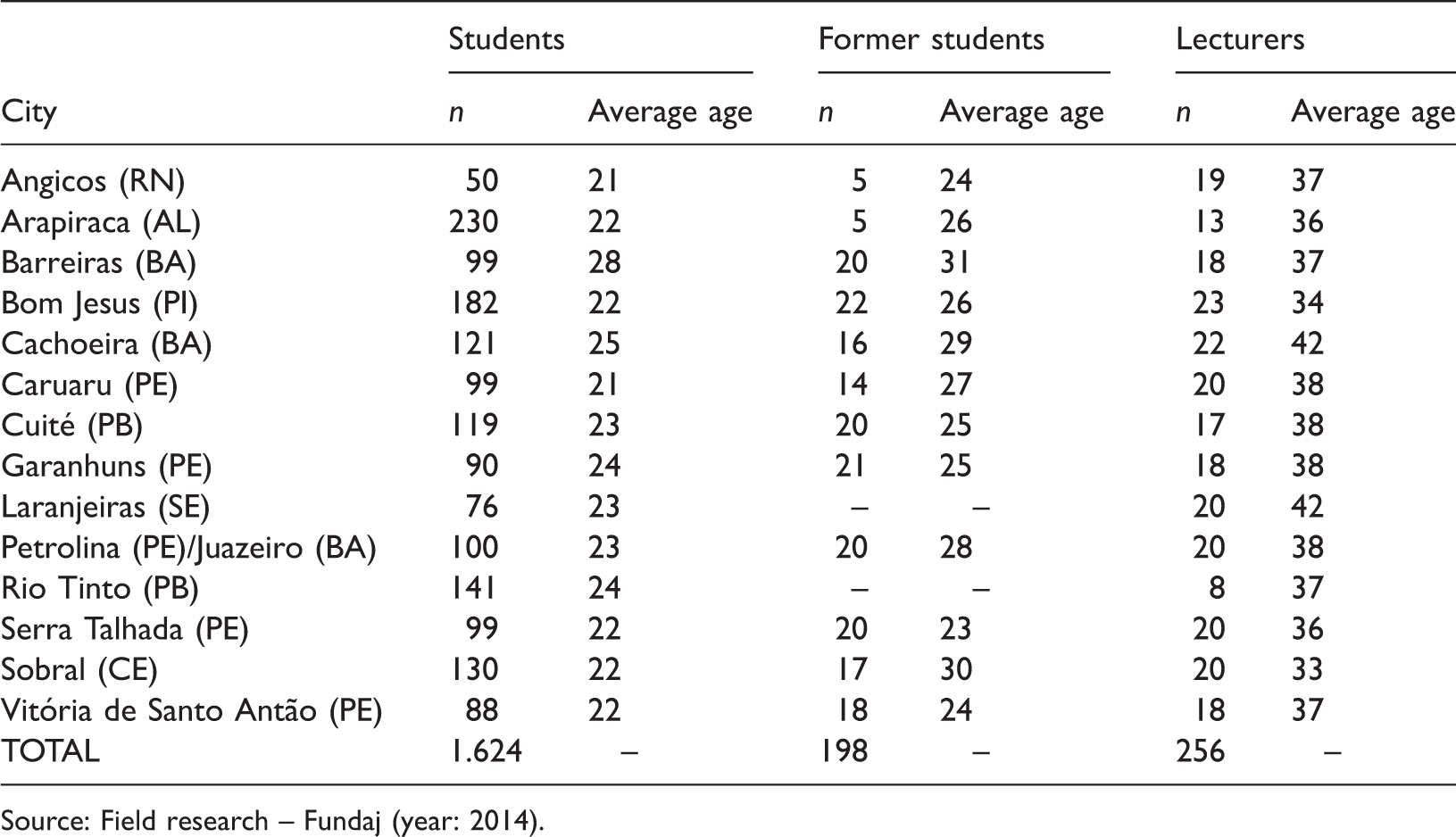
Source: Field research – Fundaj (year: 2014).
The applied research were based on a random sample which was stratified along with interviews with lecturers and current and former students, according to the record provided by the universities. For former students, the interviews have been based on the logic of quotas by the greatest efforts, along with the lists given by each unit that had former students. The survey was divided into blocks aiming to portray the interviewees in a social basis and to find out how they felt about the changes presented by the college.
Theoretical framework
The concept of habitus is used to describe the exterior practices of incorporated knowledge and of capital added to its practice (Bourdieu, 2004). The school itself is a very interesting starting point to have a better understanding on this concept. Habitus is the understanding that a group of people who was born in a given time of history were socially brought up under the same model, being “willing to maintain with their equals a relation of immediate complicity and communication” (Bourdieu, 1999: 206). Firstly, family, then, school: space of cultural consensus, place of common sense, of “common ways to approach common problems” (Bourdieu, 1999: 207).
The emphasis on the constraints and on the repertoire of possible actions in the concept of habitus leads us to think about it only as a flank of regularities or expected ways of behaving. In spite of Bourdieu suggesting a great uniformity in it, he also points out the possible change in individuals by the action of the school or others ways of socialization. As stated by Reay (2004: 434–435), “while habitus reflects the social position in which it was constructed, it also carries within it the genesis of new creative responses that are capable of transcending the social condition in which it was produced”.
Therefore, if habitus sets the course of actions, inscribing the past on the present of the individual, it also enables him to produce a breaking in his own system of dispositions. In the reverse way, if the objective conditions are changed, chances are modified and prohibitions are displaced; freedoms can be raised and potentialities can be built. This is the principal assertion of this paper: the change of habitus. Despite the stress on permanence, our paper applies the concept of habitus to understand the changes in agents' practices when objective conditions change; in other words, when a person is in contact with a new social field (Hurst, 2013; Reay, 2004).
Bourdieu’s work opens gaps in which we can propose a possible transformation of the habitus, as when he talks about an “exception radical change”, an exception made real in some students in Brazil after a new education policy that put the question “it’s not for us” in a pause condition. When Bourdieu (1999) talks about the role of the education system to the cultural and social reproductions, he indicates this system fulfils the role to keep the scheme of cultural capital distribution, leaving it on the wave of market laws. According to him, the education system is able to identify in excluded social classes any distinctive abilities in some people and so to tolerate their social mobility. However, these individual and atomistic mobilities are not enough to unset the role of maintaining the cultural capital distribution framework.
It is in school that the teachings on permanence are internalized, forming habits, preserving the order of succession – understood as the succession of the son in relation to the father, keeping the current social standing or extending beyond it. The schooling institution provides the students with the necessary formation to obtain a diploma and reinforce the heritage of children born in upper economic classes, many times, under the perspective of a merit-based system; it does not work for children from lower social classes, since it does not provide them with the skills required to enter the university world.
Meritocracy and access to free public universities
The merit-based logic criticized by Bourdieu is based on the rational comprehension that only those who possess school credits – the highest scores – must ascend to the free public higher education system in Brazil. Young people who possess the highest cultural capital legitimated by the school system are the ones who have been born in the wealthiest families.
Meritocracy can undermine the public policies that offer ways for people to overcome themselves, such as differential access to free public universities for students who are black, indigenous or have attended free public high school, policies that aim to reduce the differences of access to higher education between the social groups. Young people from upper classes are used to having their own culture as a prize because this culture is similar to the educational capital. Already, youth from excluded classes are required to work hard to reduce social distance, admitting that school success is the opportunity to ascend to better social positions. Cultural capital is overlooked as a heritage and it is seen as a natural skill; actually, cultural capital is a result of a vigorous work, yet in the upper classes, it is many times the fruit of high educational and cultural investments (Lahire, 2002).
However, everything is accepted as if universal selections (the formal exams) to access higher education were available to everyone as if they were at the same conditions, and as if these selections were capable of recognizing and canonizing the true-born habitus from young people who were born in cultivated classes, in comparison to the youth of the working class, reinforcing the sense of inferiority of these, supporting a natural justification for those from upper social classes, and this has left only exceptional opportunities to the people of working class origin who are considered as gifted (Fontainha, 2013; Rosado, 2006).
In which social context does the implementation of new campuses in the countryside emerge in Brazil? The change in the rules, offering differenced access to free public higher education, originates in a change of the conception of “attending university”. Similarly, the expanding college in the USA has changed mostly after the Second World War as a result of the US Serviceman’s Readjustment Act 1944 (known as the GI Bill of Rights). This act facilitated access to those who came back from the war, supplying them with tuition, subsistence, books and supplies, equipment and counselling services. As well as in Brazil, the discourse in the USA after the GI Bill of Rights against the influx of working class students was based on “declining standards” of higher education (Hurst, 2013: 45).
Another country that has expanded higher education is the UK. The term between 1987 and 2000 was a period of conversion from an elite to a mass system of higher education in the UK, where the aim was to enrol non-traditional students, both in terms of age and admission requirements (Reay et al., 2002). There was a similar situation in France, in the 1950s and 1960s, when the changes to the educational system started giving access to members of social categories excluded from basic and high school. The system, although considered democratic, maintained a hierarchy of educational standards: to the good students who came from the upper classes, were granted the tools to go on the academic life; the bad ones were convinced they “were not made for the positions to which the school would give (or not give) access” (Bourdieu and Champagne, 1997: 481).
The merit-based logic criticized by Bourdieu has also been approached by Souza (2012), one of the most important Bourdieu scholars set in the country, in what he calls the ideology of performance that legitimates the inequality and perceived social distinction as the recognition of those who are privileged by useful and productive jobs, even guaranteed by differential access to education.
The inventive dimension of habitus
All individuals are “scheduled” to embedding the habitus, and a group of a period of society is prone to maintain complicity of thoughts between them that share action schemes, in a certain social field. Despite this, education is tightly linked to possible social changes, since it is capable of arranging people for the required movement for changes. As quoted by Bourdieu (2004: 115), “political will can disarrange what history had done”. This seems to be true in the contemporary Brazilian college context: after the implementation of public universities in the countryside, the socioeconomic portrayal of college students presents the prominence of brown undergraduates, single, without children, aged between 20 and 25 and the prevalence of women in age until 20. The enrolled young have studied at free-of-charge public high schools, and their parents have a low schooling and a low income earning two Brazilian minimum wages.
Before the recent public policies to increase access to higher education, the younger people could only dream of achieving a better place in society, a dream that is associated with Freud, as states Bourdieu (1997). To Freud, the act of dreaming would save the individual of neurosis for the concrete impossibility of fulfilling a dream. As new insertion to habitus, studying in a free public university comes to young countryside people as a dream at the first moment, as was said by Israel Silveira, the Education Secretary from Serra Talhada city: There were two different college entrances at the first selection because at the first one the vacancies weren’t filled … lecturers of Federal Rural University of Pernambuco came here looking for candidates. I believe that people waited so much, so much, students dreamed so much with the implementation of universities in countryside, but they were set up so suddenly that people were perplexed and didn't understand the magnitude of a university. They thought it was a gift and not a step for educational incentive, and we believe people are being awake yet.
4
As a result of this statement, we define what from now on will be called individual habitus, which, bringing further explanation to Bourdieu’s original concept, incorporates from Lahirean theory – sociology at the scale of the individual – the dimension of the private aspect of human practice in everyday life, regarding consciousness and unconsciousness of each action practiced. The dimension given by Lahire (2002) to the individual scales on the dispositions of the individual contributes to make the Bourdieusian concept more malleable. Even though Bourdieu (2004: 61) criticizes early the methodological individualism (which falls upon sociology at the level of the individual from Lahire), he complains about the attitude taken by the structuralists when reducing the individual to a structural support, while highlighting, himself, the “‘creative’, active and inventive capabilities, from habitus and from individual”. He is the one who excuses us for the use of inventive creation starting from his theoretical–methodological framework.
Change of habitus: the young people from the countryside go to university
Starting from what Bourdieu stands up for, we have found an effective theoretical–methodological instrument for the study we have performed in the research. For Lahire (2012), the family environment is the main reason for the academic failure or success of individuals. Also Bourdieu emphasizes the relationship between the cultural capital inherited from the family and the process of formation of an individual, to whom the “academic capital is in fact the guaranteed product of the combined effects of cultural transmission by the family and cultural transmission by the school (the efficiency of which depends on the amount of cultural capital directly inherited from the family)” (Bourdieu, 1996: 23).
Seeing educational and cultural capital in terms of inherited and acquired capital, Bourdieu says that the way that cultural capital has been acquired is pivotal to explain the differences between people skills: it means that social background delimits cultural capital, which can be approved or not by the school. On one hand, when the cultural capital inherited is disapproved of, the student must begin another way of acquirement and legitimization of it; on the other hand, when this capital is recognized by the school, the student has a shared capital, making it easier to improve his accumulated knowledge.
As explained by Lahire (2002), some fields are subfields of others, and there is life outside the fields, a kind of interstitial space between them, and a path or a passage that fits as a link amongst them. According to Reay (2004: 437), Bourdieu’s last writings were discussing the tension between habitus and field, raising a debate about changing abilities of individuals to change their lives, and it is an assertion we explore when talking about adaptations, reactions, and struggles “to make the world a different place”.
This was exactly what can be verified, for instance, on the level of education of fathers of the students interviewed in our research. Considering being a great progress that a father who did not attend university has a son in higher education courses, it is relevant to emphasize that the fathers of 83.1% of these students never did have access to university. When analysing the level of education of mothers, 73.5% of them never had access to higher education. This makes it clear that, within one generation, almost all students attending free public federal universities are overcoming their original educational context and, so, going beyond the legacy of their parents, incorporating to their internalized practices the possibility of having a social mobility and constituting a new habitus.
How is it possible? It has been observed that, if the cultural capital inherited is small or illegitimate by educational capital, even so it is possible to maintain a most academic and least familiar relationship with culture (Bourdieu, 1996), therefore overcoming the original conditions. However, that demands the individual must have more effective disposition for studies. Although most of enrolments are of students between 20 and 25, the effective disposition for studies could be seen in our research: the implementation of universities in the Brazilian countryside also allowed significant participation of adults over than 25 years in higher education, in a similar way to what happened in UK in 1990s (Reay et al., 2002). Hence, an unexpected effect of the internalization of free federal universities was the reduction of the number of adults without undergraduation.
Lahire (2012) associates to the public policies the possibility of modifying the environment in order to obtain positive results and the implementation of free public universities in the countryside has been contributing to put into action the disposition that young people can have for academic life. Initially, the statistic data drive us to imply that implementation of new campuses are achieving a population of lower income students, and then the qualitative data confirm this assumption: 58.6% of the interviewees have a family income that does not surpass the equivalent to two Brazilian minimum wages, which means that the family income measured by minimum wage-based rates of the interviewed registered students is extremely low.
Also, the higher the family income, the lower the number of students with this status registered in free universities in the countryside, which seems to indicate that the opportunities brought by this process have directly favoured the lowest income families, while the highest ones seem to keep sending their children to study in capital cities. These numbers advised us that something was happening with the original predispositions of students from the countryside: maybe they had redrawn their own habitus after the beginning of the implementation of new campuses nearby their homes. Attending costless public university has become easier and has fomented the constitution of a preference resulting of an “adaptation of the agents to objective social conditions” (Nogueira and Pereira, 2010: 16). Under a Bourdieusian approach, they have learned to love what is near; giving up what is of difficult achievement (Bourdieu, 1996).
The dispositions to the new
For Bourdieu (1990, 1996), the individual disposition is pivotal as an “impulsive fuel” to his life history. These dispositions are suited in the individual’s habitus, the result of a socialization process that interferes in his own history and makes him “someone”, through institutional rituals in his existence's context: family, school, religion. However, it is necessary to see that, although there is some moving up into social positions, in fact there is a kind of foreignness in the way each one sees oneself (Reay, 2015).
The taste issue could be checked: is the undergraduate course choice a consequence of personal option or is it just a result of a “possible choice”? J., a student interviewed by us, has a history that seems to indicate a blend of them, adjusting the situation in his individual habitus. He was influenced by a teacher from high school, but he made his mind up according to the courses that were available at the academic centre in his city, Vitória de Santo Antão, in Pernambuco State. There were just three courses at the moment he was attending college: biology, business and nursing. As most of the master’s courses in the countryside are to prepare lecturers in many areas, most of the students want to teach, as did J., who said that he identified with the biology course, and after entering university, he saw he could be a professor: I just thought about it after I was attending college; being a teacher at school seemed enough to me. When I entered at university, I thought, “I can be a professor, I can be a graduate professor”. I saw a professor and I thought, “cool, I can be in his place, I can be better than him!”
Therefore, opening a political debate on an effective moral, homogeneous and classless restriction order in Brazilian society is relevant, beyond taste, need, lifestyle and distinction between one and other, to whom is sorted as “useless”, “unproductive”, “cheap people”, “ghetto”, although everybody very often admit the attributed value. The debate transcends the equality defended and assured by law and goes towards public policies of dignifying the other: taking him into consideration, in a dissemination policy that will ensure legal and legitimate effectiveness of the concept of equality, which is only possible if the “perception of equality in a daily basis is effectively internalized” (Souza, 2012: 168).
“Without a diploma you are nobody”
We are applying the concept of habitus as a way to realize the changes in life histories of most of interviewees, based on Bourdieu’s statement in which he discusses the genesis of habitus and field (Bourdieu, 2004: 61). The generative power of habitus is not a universal one: as stated by the concept, it is an acquired disposition. The concept carries on this feature, but it has also a creative dimension, which is not explicit in Bourdieu’s theoretical construction to some scholars. However, it is clear to us he tried to make one kind of equation to explain his thought as a way to not nullify the agents’ ability as a practical operator of objective structures, as presented with the following formula: [(habitus) (capital)] + field = practice as a result of mutual relationships of them (Bourdieu, 1996).
The interviewers have highlighted the transforming character of the implementation of federal universities in the countryside areas. Amongst the 480 students interviewed in Pernambuco, 58.8% have stated the course will have a strong impact on their income and 35.9% say that it will present a significant impact, totalling 94.7% of the students with an optimistic perception of the impact of having attended higher education on the improvement in their social status and income. 5 In this way, these college students are concerned to combine acquired knowledge and successful careers, as stated by Hurst (2013) and Reay (2011). According to Bourdieu (1996: 28), “through the educational qualification certain conditions of existence are designated – those which constitute the precondition for obtaining the qualification”. The university would be responsible for offering the chance of conquering knowledge and a space in society, as defended by Hurst (2013).
Once the sample is not probabilistic prohibits us to make some kind of generalizations to all students. Although it is not possible to generalize, there is strong narratives from them and some data can show this. Yet, some results may shed light on the analysis in this paper. In the survey with former students, we found out that 35.9% of them were working before entering college. This fraction rises to 53.3% upon the completion of higher education. Asking those who were working before if they were at the same job, only 16.9% of interviewees were in this situation. Among those who were not working during the research, 40.4% of them said that they had made job search efforts during the 30 days preceding the survey, what means a jobless rate of 18.3% among respondents. To those that were employed at that moment, 83.7% of them said the university courses were pivotal for achieving or maintaining their occupation and 61.9% of them reported that their courses are closely related to their job. Lastly, 59.6% of former students stated that college courses were crucial to achieving social and income mobility.
Habitus, taste and cultural reproduction: changes in life student
In these trajectories, we can see what Bourdieu asserts about habitus: [it] “is both the generative principle of objectively classifiable judgments and the system of classification (principium divisionis) of these practices” (Bourdieu, 1996: 170). Before entering university, J. had not what we call “refined cultural knowledge”, which means legitimated cultural capital, which was accessible to students only after being in contact with cultural activities in higher education. Actually, they think they do not have an accurate cultural taste. The circle of episodes of the first part of his life is a part of the set of acquired dispositions (Reay, 2015).
A person’s habitus is malleable yet persistent: “it is not simply a matter of socialization – that would be too easy and would not explain the persistence of taste even when people move up (or down) in class” (Hurst, 2013: 48). As Bourdieu states (1996: 170), different existence conditions build diversified habitus, becoming new social schemes: The habitus is necessity internalized and converted into a disposition that generates meaningful practices and meaning-giving perceptions; it is a general, transposable disposition which carries out a systematic, universal application – beyond the limits of what has been directly learnt – of the necessity inherent in the learning conditions.
In the second generation, the children will be born in a college-educated family from someone who is now the first college-educated: “I have critical sense, and I can do choices, I can make dreams come true. My children surely will attend university. My lifestyle is changed and it will be better in the future”. It endorses what Hurst (2013: 47) stands up for: “first-generation college students combine academic interest with a concern for their futures”. The truth is that, to some degree, any student requires that school is not linked to the job market and even real life in a strong way; they prize the knowledge for themselves and, at the same time, want their education to be useful to their professional life.
The habitus of students from worker social classes is cleaved because they need to negotiate old and new dispositions during all their lives, after they enter in higher education and they are in contact with a different cultural space. This juggling about dispositions must be done for the rest of their lives because this situation is different from the others who were born in higher social classes, which are prepared to enter in higher education since their childhood.
The meaning of free higher education for the interviewees.
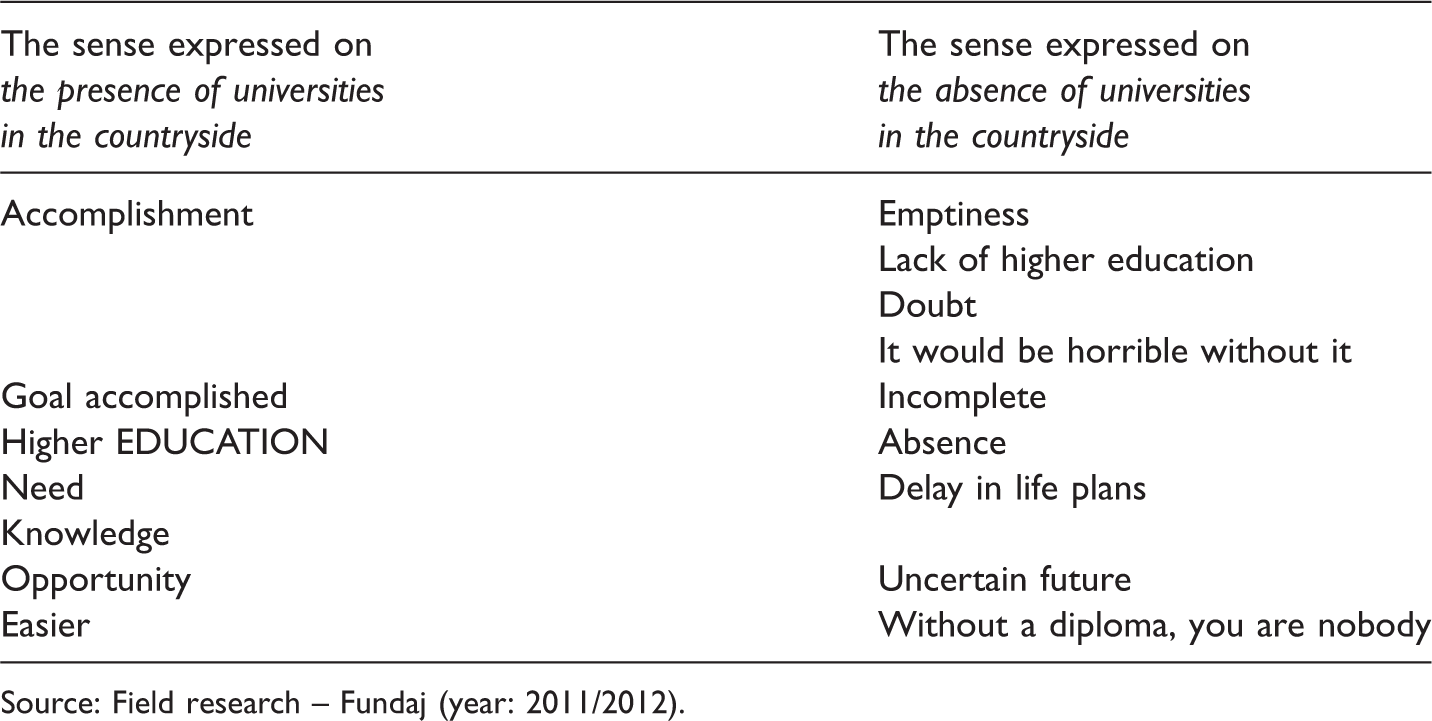
Source: Field research – Fundaj (year: 2011/2012).
Some students have pointed out the importance it had on changing the way the local citizens look at the area, bringing new perspective on development. According to the opinion of one student, “the implementation on the countryside has fit perfectly into the lives of people who, not only the ones who cannot afford, but also to the ones who can”. For the students, the influence of the implementation of universities in the countryside is clear. The units installed in the countryside supply not only the local demand, but extend the opportunity to neighbouring cities and even for students born in the capital, therefore offering a new set of possibilities for the young people who dream of attending higher education.
As we have said before, we have identified that 94.7% of the students we interviewed have an optimistic view on their future life plans, thanks to the undergraduate courses. However, more than statistical regularity, we could also identify a sort of “expression of happiness” from the students we have interviewed in the focus groups about entering university and about their ongoing projects, as stated by a student: “I see myself working where the best opportunities present themselves and, if it is right here, I will be extremely happy and I feel capable of acting here or anywhere else”.
The presence of universities in the countryside areas shows us that we cannot assume that the academic success and the fears of having new life plans are exclusively attached to the original position of the students, despite the importance given to the cultural capital inherited from family. That is, even though their families do not possess the ideal capital to stimulate their children for their academic career, there are other elements of socialization that may influence this process: The individuals incorporate only parts of the characteristics present in their family groups and, even so, they re-elaborate and mix them with other influences received from other groups and other instances of socialization. (Nogueira and Pereira, 2010: 18) Upsides and downsides of having universities in the countryside, according to students. Source: Field Research – Fundaj (year: 2011/2012).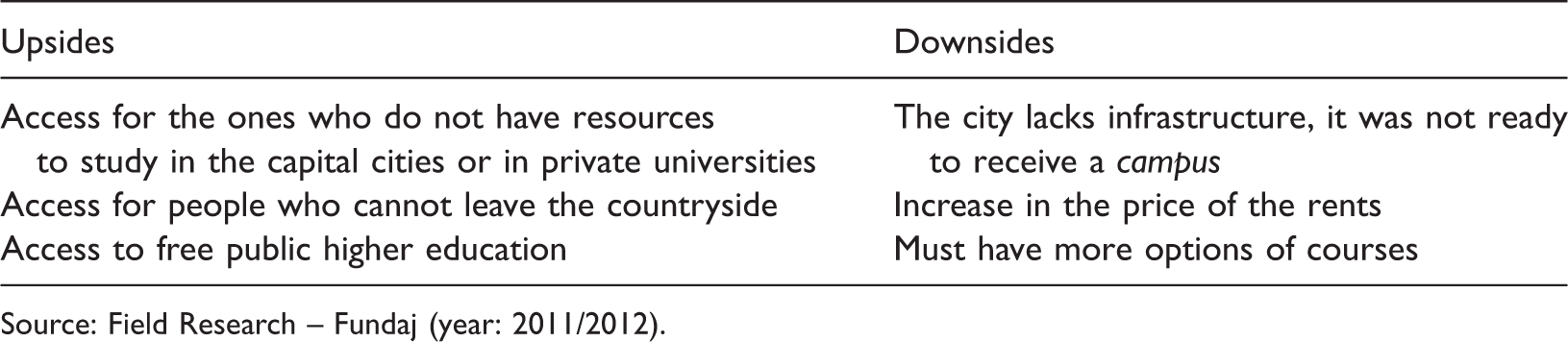
According to the opinion of the interviewees, the implementation of the university crosses the boundaries of the cities; the development these cities are going through becomes very clear when analysing the expansion of the housing market and the labour opportunities, including the creation of new centres of entertainment to provide for the demands of lecturers and students, besides the new claims of local businesses that are responsible for the employability of the undergraduates of these institutions.
The subject of being fixed in the cities is already a project for some of them, as the pedagogy student who intends, furthermore, entering postgraduate studies: “someday, I want to be a professor here”. The problems for amusement, related by them as “not many cities in the country offer great opportunities for leisure and fun”, indicate also that there are no places offering cultural options for the students, buy they are not of vital weight to push them away from the academic project, as says one of them about going to the university: “you don’t go there for fun, you go for professional growth”.
Final considerations
The choice of studying and working in their home cities or in neighbouring cities, settling in them and being able to help its development: it is a new reality to young people in countryside of Brazil that is changing their habitus, highlighting a disposition that was not known by them previously. In general, the students believe that the college implementation in the countryside seems to meet its main goal of being responsible for new opportunities for a significant number of young people, by bringing them the possibility of something that sounded impossible not long ago. More than that, the university starts being a part of the habitus of young people whose original conditions, in other circumstances, would not make it possible: entering higher education, putting their dispositions in action in order to build new life projects. Although many researchers defend that a first generation of college students in a family are committed to reach a future financial security, it is acceptable if the undergraduate is coming from a working-class family (Hurst, 2013).
Even though the change in the national scenario regarding free public higher education from 2007 until now is a fact (especially in relation to the implementation of costless public universities in countryside areas), it is still too early to confirm that there has been a consolidated change through Reuni. Nevertheless, both the statistical data and the testimonials given by the students confirm that the implementation agenda is valid. Indeed, MEC documents highlight the significance of giving opportunities to those who would never have a chance of attending higher education if it was not the internalization ensuring the importance of the process, which may lead to recognizing this new reality.
The habitus is not a natural skill, but a social one: it is lasting, but not eternal and, exposing the individuals to other situations to practice what they learn, it becomes possible for them to replace old-structured dispositions with new ones, in a creative motion directly related to individual habitus. Although Bourdieu’s logic about habitus is prone to a sense of permanence, he alerts us that his concepts are open to guide empirical studies, giving the possibility of reforming the habitus concept in a positive sense. So, it is pivotal to be concerned about the idea of an individual habitus that can be changed when in contact with new social fields; despite the changing in the idea of habitus, prioritizing its skill of displacement, the concept must preserve the Bourdieusian understanding of habitus as a tool to be applied in empirical studies to highlight practical knowledge (Reay, 2004).
In the other countries, the main reason for inequalities arising is the introduction of fees and the abolition of maintenance grants (Reay et al., 2001), and Brazil must hold with these policies unless the government wants to discontinue the good results achieved. In order for it to not become a simulacrum, the project of expanding college in Brazil must be extended as a model of quality target for basic education, so that the “choice of possible” made by young people for undervalued courses, which have fewer applicants, is reversed, giving them the opportunity of accessing any undergraduate courses they may chose.
More than the distinction, the difference between the quality of the paid private schools and free public schools in elementary and high school and the permanence of access to free public school to the “upper classes” produce a “cultural split” (Bourdieu, 1999: 219), an opposition that leads to cultural duality, which removes from the school, at any level, its unifying role in society, 7 leaving it with the barrier function that distances individuals according to the accumulation of incorporated knowledge.
In the context of our research, if the investments in the general educational system are not carried out as planned, if there is no careful policy and if these quality projects are not extended for the basic levels of education, young people from the Brazilian countryside may be led to a condition of opposites: on one side, the impotence before a diploma that becomes of lesser importance in that, universalized, it is only useful for distinguishing classes.
Although the first college-educated students from the recent implementation in the countryside process maintain a sense of exteriority with the academic knowledge – once they are not in their original environment, being different from the cultures they have been in contact with and learned in their lives – in future steps, their children will have the opportunity of entering university having a cultural capital capable of giving what they have learned as a sense of interiority, because it has already been incorporated to their habitus. In this process, it is expected that the dimension of dignity will be internalized by Brazilian society as a whole.
Footnotes
Declaration of conflicting interests
The author(s) declared no potential conflicts of interest with respect to the research, authorship, and/or publication of this article.
Funding
The author(s) received no financial support for the research, authorship, and/or publication of this article.