




Abstract
We examine exclusion and the persistence of STEM disparities for underrepresented minority (URM) students at one diverse college campus, a prestigious Minority Serving Institution (MSI). We draw on in-depth interviews with 28 class- and ethnoracially diverse children of immigrants to examine how they navigated their first year in biology. Our analysis reveals three types of students who differ in STEM capital: (1) STEM-thrivers, who inhabit a “bio-bubble”; (2) STEM-adapters, who straddle STEM-dominant and non-STEM-dominant peers; and (3) STEM-disconnected, who struggle in silence. We explain how this STEM capital typology is racially inflected, informed by both immigrant class origin and high school segregation. We call attention to social dynamics associated with STEM capital, the forms of exclusion encountered by URM students, and how universities, including MSIs, can reinforce STEM disparities that result in social reproduction.
Keywords
Despite concerted efforts to diversify STEM (science, technology, engineering, and mathematics), class, racial, and ethnic disparities remain acute. STEM degree completion rates for underrepresented minority (URM) students are half to two-thirds the rates for White and Asian students, who are disproportionately middle or upper class (National Science Foundation, National Center for Science and Engineering Statistics 2021). Scholars have identified Minority Serving Institutions (MSIs) as important for addressing STEM disparities (Gomez et al., 2018; National Academies of Sciences, Engineering, and Medicine 2019). 1 MSIs can enhance URM students’ sense of social belonging and integration; this is critical for STEM success but often unrealized at elite, White institutions. Among the fastest growing MSIs are Hispanic Serving Institutions (HSIs) and Asian American and Native American Pacific Islander-Serving Institutions (AANAPISIs), reflecting that college-age children of immigrants have increased to one-fourth of young adults in the United States today (MSI Data Project n.d.). Despite greater representation of URM students at MSIs, STEM disparities persist on these campuses. For instance, working-class students are often “culturally sidelined” by universities that cater to middle-class students (Garza 2023), with URM students regularly experiencing exclusion (Flores, Bañuelos, and Harris 2024). Like other universities, MSIs can reproduce class inequalities (Bourdieu and Passeron 1990), which are racialized in the United States (Hamilton etal. 2024).
We draw on social reproduction theory (Bourdieu and Passeron 1990) to examine how STEM disparities persist and exclusion unfolds for URM students at a prestigious MSI. We extend knowledge on how differences in STEM capital—“science-related knowledge, resources, behaviors, dispositions, and social contacts” (Moote etal. 2020:1230)—inform STEM disparities. Namely, schools reproduce class inequality, rather than promote equality and social mobility, by reinforcing and rewarding the values, norms, and expectations of the dominant class (Bourdieu and Passeron 1990). Middle-class students’ cultural capital facilitates success by allowing them to easily navigate universities, interact with authority figures (Calarco 2011; Jack 2019), and collaborate with peers (Johnson 2022; Yee 2016). In contrast, many low-income and working-class students have trouble “navigating the culture of academia” (Grineski etal. 2018), deciphering the “hidden curriculum” (i.e., unspoken university norms), leveraging college resources, seeking help, and engaging in résumé-building opportunities (Ostrove and Long 2007). Students with less dominant cultural capital are disproportionately URMs (Carter 2005).
We build on scholarship that identifies STEM as a unique field, a structured social space within which individuals or groups vie for resources, power, and status, characterized by distinct cultural and social norms that Bourdieu referred to as a “logic of practice” (Archer etal. 2015; Cooper, Cala, and Brownell 2021; Thompson and Jensen-Ryan 2018; Tilbrook and Shifrer 2022). Yet we shift focus from examining social reproduction in elite, White universities (Jack 2019; Johnson 2022) to how it unfolds at MSIs (see also Flores etal. 2024; Garza 2023), where children of immigrants constitute a significant share of the student population. In doing so, we advance knowledge on STEM capital among children of immigrants, showing how immigrant class origins converge with school segregation to inform (racially inflected) STEM capital.
To understand how exclusion unfolds within STEM, we examine students navigating their first year in biology at an MSI. We conducted in-depth interviews with 28 socioeconomically and racially/ethnically diverse students, children of immigrants, at a University of California campus (UC-MSI). Biology students are a highly selected group—top high school performers with an average GPA exceeding 4.0. Most students planned to pursue medical school or health-related careers, although URM student attrition from the major is disproportionately high. An individualistic, “cutthroat” culture permeates the major, yet strategic cooperation is necessary to excel academically and learn the norms of the field (Grace 2018; Lin etal. 2014).
We uncovered three types of students: (1) STEM-thrivers, occupying a “bio-bubble”; (2) STEM-adapters, straddling STEM-dominant and non-STEM-dominant peer groups, akin to Carter’s (2005) “cultural straddlers”; and (3) STEM-disconnected, who were struggling in silence. Building on prior cultural capital typologies within educational settings (Carter 2005; Ivemark and Ambrose 2021), we call attention to social dynamics (e.g., peer and faculty–student relations) and how STEM capital can be “used to exclude and unify people, not only lower status groups, but equals as well” (Lamont and Lareau 1988:158). Our study shows how STEM capital is racially inflected at UC-MSI: STEM-thriving students are primarily Asian, and STEM-disconnected students are mostly URMs. In this respect, class reproduction intersects with immigration. Specifically, the home country class origins of immigrant parents (i.e., “contextual attainment”; Feliciano and Lanuza 2017) converges with K–12 inequality (i.e., high school class, racial/ethnic segregation) to inform students’ STEM capital and their experiences in biology. Despite efforts to retain URM students in biology, university structural arrangements, institutionalized norms, and informal practices reinforce STEM capital disparities. Our study highlights the need to disrupt dominant norms and practices and for universities to consider the class diversity of their students and entrenched K–12 inequalities.
Background
This study departs from most social reproduction studies in higher education that examine the experience of URM students at elite, predominantly affluent, and White universities (Jack 2019; Johnson 2022). We shift focus to diverse college campuses (see also Flores etal. 2024; Garza 2023; Yee 2016), specifically MSIs, which are growing in number due to changing demographics (Fry and Cilluffo 2019). In California, the most diverse U.S. state, almost half of young adults have at least one immigrant parent (Mejia, Perez, and Johnson 2025). As such, MSIs are not only serving greater shares of URM students but also increasing numbers of children of immigrants, who are more likely than later generation students to attend an MSI (Postsecondary National Policy Institute 2024). Understanding class reproduction at MSIs requires considering how immigration and school inequalities intertwine, with particular attention to how immigrant class origins affect how immigrants navigate schools and position their children for academic success.
Children of Immigrants and Education Disparities
Immigrant origins are one basis for education disparities. Children of hyper-selected immigrant groups, who have among the highest levels of education in the United States and their home countries (e.g., Chinese, Korean, or Indian immigrants), are overrepresented in higher education, especially in STEM fields (Kang etal. 2021; Min and Jang 2015). The opposite is true for children of hypo-selected immigrant groups, whose educational levels are below average in the United States and their home country (e.g., Mexican immigrants, immigrants from some Central American countries; Lee and Zhou 2014). This is not surprising considering parents’ education is the strongest predictor of academic success, yet other factors matter. For instance, K–12 school considerations (Kim 2021; Park 2020) and ethnic ties (Krysan and Crowder 2017) strongly influence Asian immigrant families’ residential decisions. Asian families are more likely to live in neighborhoods where the average income exceeds their own, which provides better resourced schools (Joo, Reeves, and Rodrigue 2016; Kim and Kim 2023; Logan 2011; Massey and Rugh 2021) and compounds class privilege (Logan 2011). Sittingatop the achievement hierarchy, these immigrant groups are changing the academic culture in schools (Jiménez and Horowitz 2013; Warikoo 2022), and their concentration may prompt White families to leave affluent school districts (Boustan, Cai, and Tseng 2023).
By contrast, children of immigrant parents with modest educational backgrounds are more likely to attend high-poverty, racially segregated schools, which are negatively associated with academic achievement (Rendón 2019). In particular, Latino segregation across K–12 schools has increased in recent years (Orfield etal. 2016; Owens 2020). Moreover, tracking within schools advantages Asian American students (i.e., the “model minority”) by placing them in more rigorous courses, including STEM offerings, relative to Latino and African American students (Conchas and Perez 2003; Kao and Thompson 2003). Thus, K–12 inequality compounds the class disadvantage of children of immigrants.
Cultural Capital among Children of Immigrants
Social reproduction scholars have considered the link between cultural capital and race/ethnicity (Carter 2005; Jack 2019; Lareau 2011). In studying low-income Black and Latino students at an elite university, Jack (2019) found the “privileged poor,” students who attended an elite high school and acquired dominant cultural capital, easily navigated the university, whereas the “doubly-disadvantaged,” students who attended disadvantaged high schools, struggled to decipher the university’s cultural norms. Such students can be marginalized and “culturally sidelined” by universities that undermine their nondominant cultural capital. Low-income, working-class students succeed in schools when they are able to bridge or move between dominant and nondominant cultural capital (Carter 2005). These nondominant cultural assets (Yosso 2005) include helping immigrant parents adapt to the host country, translating language (Morales and Hanson 2005; Orellana, Dorner, and Pulido 2003), and brokering institutions such as schools (Katz 2014), including higher education (Ceja 2006; Delgado 2023).
Few studies examine how cultural capital factors into educational disparities for children of immigrants (but see Fernández-Kelly 2008). This is important given that class distinctions across immigrant groups are often lumped into pan-ethnic/racial categories at universities (i.e., “Latinos,” “Blacks,” “Asians”). Indeed, class origin in one’s home country helps explain the “achievement paradox,” the finding that children of immigrants outperform native-born Americans of similar socioeconomic status (Kasinitz etal. 2008; Lee and Zhou 2014; Louie 2012). Specifically, certain ethnic groups (e.g., Chinese, Vietnamese, Colombians) fare better academically, on average, than do socioeconomic status comparable African American students and other ethnic groups (e.g., Mexican, Central American). Recent research emphasizes cross-class ethnic ties as helping some groups, such as low-income Chinese, successfully navigate the U.S. educational system (Lee and Zhou 2014; Louie 2012). Feliciano and Lanuza (2017) highlight immigrants’ “contextual attainment,” that is, their class origin or social position in their home country. They explain that immigrant parents with above-average education in their home country carry a corresponding middle-class disposition that informs how they navigate schools, facilitating their children’s success despite being low income in the host country. Fernández-Kelly (2008) refers to such cultural capital as “transferable assets” (see also Louie 2012).
Stem Capital
Cultural capital disparities may be especially pronounced in STEM, a field whose “scientific forms of cultural and social capital can command a high symbolic and exchange value” (Archer etal. 2015:922). Scholars identify STEM as a field with a distinct “logic of practice,” most easily navigated by individuals with a STEM habitus (Cooper etal. 2021; Thompson and Jensen-Ryan 2018; Tilbrook and Shifrer 2022). As social reproduction scholars explain, people’s use of their capital—economic, cultural, social, or symbolic—is internalized within a habitus that informs their views, logic, and behavior “at a largely instinctive level” (Ivemark and Ambrose 2021:193). Key for our purposes is what Archer etal. (2015:929) term “science capital” or “scientific forms of cultural capital (scientific literacy; science dispositions), science-related behaviors and practices (e.g., science media consumption; visiting science museums), [and] science-related forms of social capital (e.g., parental scientific knowledge; talking to others about science)” (see also STEM capital, Moote etal. 2020). Someone with science or STEM capital has “the dispositions to think and act in ways that advance their position or trajectory in science” (Cooper etal. 2021:3). This means having “mastery over the cultural practices . . . recognized as legitimate in a certain field; it includes social and technical knowledge, perceptions, and values” (Grineski etal. 2018:285). STEM capital also includes an ability to connect with STEM faculty and collaborate with peers (Johnson 2022; Yee 2016).
Middle-class parents transmit advantages to their children through “concerted cultivation” at home (Lareau 2011), intervening at schools (Calarco 2018), and positioning their children in high-status schools (Lareau, Evans, and Yee 2016). Having a parent with a STEM background is associated with a higher likelihood of pursuing a STEM degree (Plasman etal. 2021), in part due to parents transmitting dispositions and cultural resources that reinforce a STEM identity (Tilbrook and Shifrer 2022) and promote STEM aspirations (Archer etal. 2012). Middle-class students may face uncertainty and setbacks—they too must master the rules of the game—but their parents’ norms and practices position these children for school success in ways inaccessible to working-class families.
In advancing knowledge of STEM capital, scholars have given less attention to the relational dynamics in STEM that produce exclusion. In contrast to Coleman (1988), who emphasized social capital as the basis of norms and trust, we draw on Bourdieu’s (1986:248) definition of social capital, defined as “the aggregate of the actual potential resources which are linked to possession of a durable network of more of less institutionalized relationships of mutual acquaintance or recognition.” Bourdieu’s conception of social capital accounts for not only resources in networks but also processes of exclusion in networks that result in social reproduction. As Lamont and Lareau (1988:156) note, individuals with cultural capital embody “high status cultural signals (attitudes, preferences, formal knowledge, behaviors, goods and credentials) used for social and cultural exclusion, the former referring to exclusion from jobs and resources, and the latter, to exclusion from high status groups.” As such, exclusion represents “the central dimension of cultural capital” (Lamont and Lareau 1988:159).
Exclusion can take different forms (Bourdieu and Passeron 1990). Students lacking dominant cultural capital may be excluded directly because their more endowed peers prefer to affiliate with one another or indirectly via self-elimination, such as through their unease in settings with unfamiliar norms (Lamont and Lareau 1988). In this regard, first-generation college students often feel like “outsiders” who “experience the dominant values, manners, cultural codes, language, and even sense of humor they encounter at university as foreign and at times intimidating” (Ivemark and Ambrose 2021:197). Even at MSIs, STEM faculty and staff can foment a noninclusive classroom culture and noncollaborative peer dynamics (Flores etal. 2024). Students with nondominant cultural capital may also experience exclusion through overselection or relegation. In the former, students are taxed because their cultural handicap requires more work to perform as well as others. In the latter, students make decisions too early or too late, with too little information, and end up disadvantaged. In either case, the consequence is inequality through social closure: Students with social and cultural capital support one another’s success (i.e., cumulative advantage; DiMaggio and Garip 2012), and those lacking such capital fall further behind.
Some studies have examined how cultural and social capital intertwine to reproduce inequality. Carter (2005) found that “cultural straddlers,” who bridged dominant and nondominant cultural capital, had access to a wider range of social ties that enhanced social mobility. In addition, the social class composition of high schools affects students’ access to cultural capital (Jack 2019) and their peer-seeking and help-giving strategies (Johnson 2022). As Johnson (2022) explained, students from class-advantaged high schools are familiar with collaboration and upper-middle-class culture, allowing them to integrate into a major by signaling they are “good collaborators” (see also Yee 2016).
Embedded Case Study: Biology Students At Uc-Msi
To our knowledge, this study is the first to examine how STEM capital of children of immigrants informs university STEM disparities. We conducted in-depth, semistructured interviews to examine the first-year experience of biology majors at an MSI. Our research site is UC-MSI, an R1 university with HSI and AANAPISI designations. With a median incoming GPA that exceeds 4.0, UC-MSI students were top high school performers. In fall 2019, more than 1,000 first-year students entered biology, the largest major on campus. Asian and female students were overrepresented in the major, constituting 52 percent and 69 percent of the 2019 cohort, respectively; 40 percent of students were URM, and 13 percent were White. 2 A typical incoming biology class is 50 percent first-generation and 40 percent low-income. The 28 respondents in this study were part of this cohort.
Case Selection
Our qualitative study is part of a broader project evaluating a bio-specific intervention developed to counter high attrition from the major. We strategically sampled academically comparable biology students (similar math SAT scores), some (n = 12) in the “learning community” (LC) and some who were not part of the intervention (n = 16; see the online supplement). As Table 1 shows, our case selection yielded respondents who were overwhelmingly children of immigrants (n = 27), 6 of whom were foreign-born and 2 of whom were undocumented. Half of these respondents were URM (11 Latino, 3 African American), and half were first-generation college students (n = 15), of whom 6 had parents with some college education. The average first-year GPA of our respondents matched the 3.22 GPA for all biology students but varied from 1.50 to 3.86 (see the online supplement).
Student Background Characteristics and STEM Capital Typology.
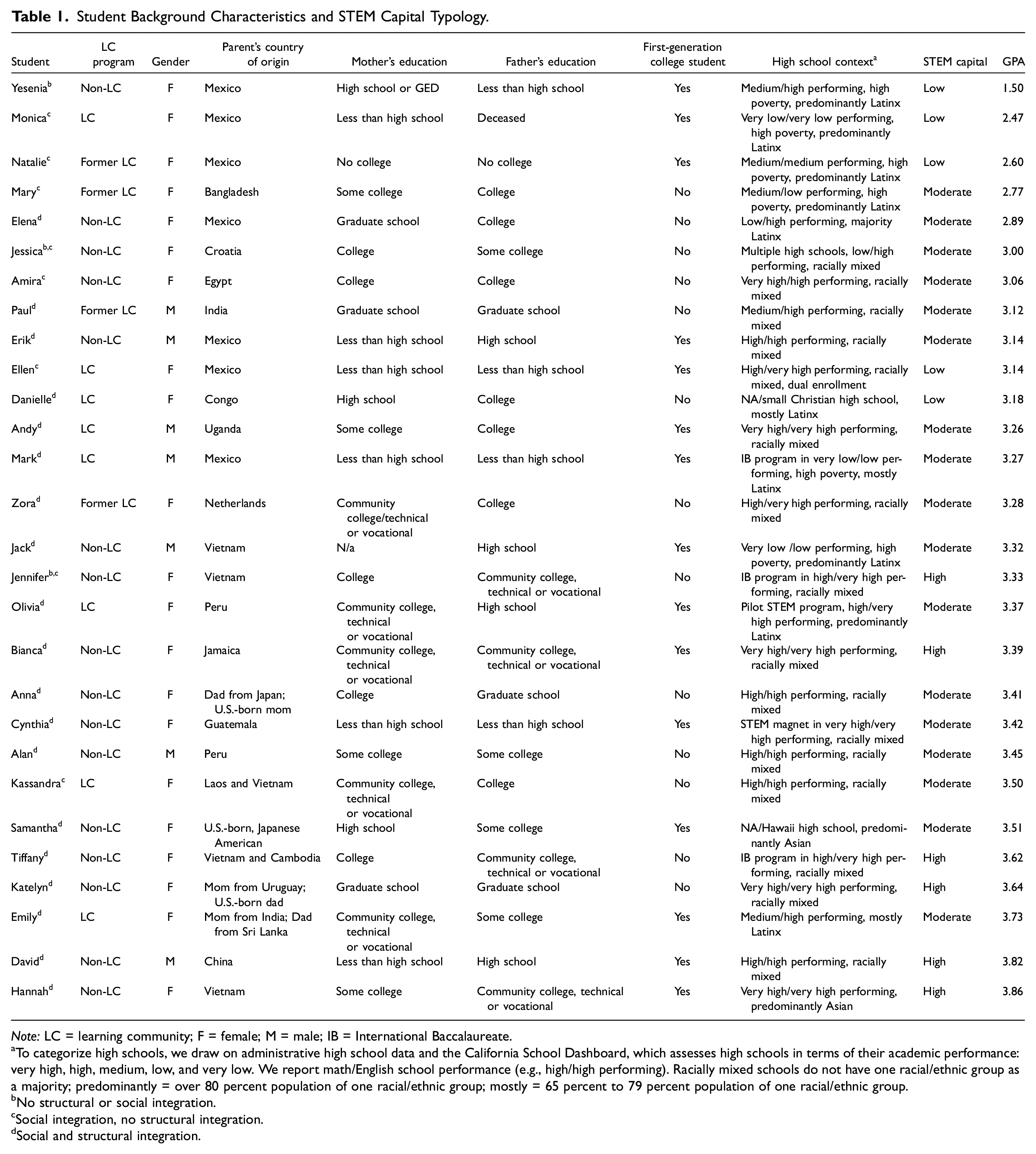
Note: LC = learning community; F = female; M = male; IB = International Baccalaureate.
To categorize high schools, we draw on administrative high school data and the California School Dashboard, which assesses high schools in terms of their academic performance: very high, high, medium, low, and very low. We report math/English school performance (e.g., high/high performing). Racially mixed schools do not have one racial/ethnic group as a majority; predominantly = over 80 percent population of one racial/ethnic group; mostly = 65 percent to 79 percent population of one racial/ethnic group.
No structural or social integration.
Social integration, no structural integration.
Social and structural integration.
Data and Analysis
Interviews were conducted in summer and fall of 2020, after students completed their first year. The interview guide broadly focused on how students adapted to the university and the major, academic challenges and strategies, institutional and peer ties, and the COVID-19 pandemic. The interview guide included questions to examine structural and social integration, key dimensions for student retention. Structurally, students are far more likely to graduate if they participate in bridge programs (Ashley etal. 2017; Stolle-McAllister 2011), receive academic support services (Batz etal. 2015), participate in clubs and organizations (Stuber 2011), and have mentors (Stanton-Salazar 2011). Socially, students who report a sense of belonging and connections to peers and mentors have more positive experiences and higher rates of academic success (Ostrove and Long 2007). We had no questions about exclusion specifically or cultural capital; these themes emerged in the data.
Interviews were transcribed and coded using the ATLAS-ti software. Drawing on these codes, we examined patterns across cases in multiple ways, arriving at themes on cultural capital and identifying three types of students. To better understand what informed this typology, we conducted within-case analysis, drawing on case reports and survey and administrative data from the broader study (which provided parental education, high school context, and university program participation). These resources included peer network data, which we triangulated with the qualitative data on respondents’ friendships.
Interviews revealed that most respondents entered as premed students with high aspirations to succeed in the major and college overall. Most students found biology to be a rigorous, competitive major and were taken aback by its demanding expectations and social context, requiring all respondents to adjust during their first year. Some students transitioned relatively smoothly, but others had more challenges, with class background and social relationships playing key roles (for more information on data collection and early analyses, see the online supplement).
Stem Capital Typology
We identified three types of biology students at UC-MSI: STEM-thrivers, who were immersed in a “bio-bubble”; STEM-adapters, who straddled STEM and non-STEM peers; and STEM-disconnected students, who were academically isolated and struggling. These three types reflect different levels of familiarity and comfort navigating the academic demands, norms, and expectations of the biology major and distinct social experiences. In the following sections, we discuss the characteristics of this typology, including its cultural and social aspects (see Archer etal. 2015). Then, we explain how immigrants’ “contextual attainment” and high school class and racial/ethnic segregation introduce a racial inflection to STEM capital. Throughout, we note how STEM capital types relate to different forms of exclusion URM students experienced. We conclude by highlighting how the university reinforced STEM disparities despite concerted institutional efforts.
STEM-Thrivers: “Not Too Different from High School”
Six respondents (none in the LC) arrived with cultivated STEM capital and easily integrated into the academic culture of the biology major. These students shared a strong chemistry background, effective study skills, and comfort seeking STEM support. They quickly formed tight-knit peer/study groups in biology, where they strategized on how to access institutional resources.
David, a Chinese American student, knew in high school that he “wanted to do research as a career pathway,” so he took “a lot of chemistry classes.” High school Advanced Placement (AP) Chemistry “turned [him] off,” but after a professor invited David to join his biology lab at UC-MSI, David became determined to attend medical school. “I feel like [biology] is my calling,” he said. David understood that “conducting and doing research” as an undergraduate would enhance his medical school application and that peers could help.David described relying on his (Asian) friends: “If it wasn’t for my group of friends in college, I don’t think I would have done as strong. . . . I’m able to study with them. . . rant my problems. . . . They have my back no matter what. They’re there for my mental health.” The university admitted David into the campuswide honors program, recognizing him as a strong student who embodied the norms of biology and set the tenor of the major.
Students in the bio-bubble were often unencumbered by major academic obstacles. Tiffany, for example, felt “pretty prepared” upon arrival at UC-MSI. Her Vietnamese parents, a mechanic and college-educated stay-at-home mother, enrolled her at a top public high school with an International Baccalaureate (IB) program. There, her STEM training included performing “her own experiments,” which she said, “really did help me in preparation for my courses.” Upon a teacher’s advice, Tiffany retook chemistry the summer before entering college as a strategy to ensure her preparedness. Hannah, a Vietnamese American student with the highest GPA in this study (3.86), similarly expressed feeling “super prepared,” finding biology at UC-MSI “similar to high school.” This was echoed by Jennifer (Vietnamese American), who found the material “familiar,” noting “the workload wasn’t too bad because the IB program had prepared me.” These students entered biology with cultivated study and time management skills that could be readily deployed. Tiffany described how she knew “to set a schedule of studying ahead of time,” which she “gradually learned in high school” and was able to “just use in college.”
STEM-thrivers easily navigated institutional resources and peer groups in biology. Jennifer found office hours “very beneficial. . . . All the people who attend are people who are successful.. . . I kinda like sitting there and listening to their questions and answers.” Hannah understood that going to professors’ office hours “was a big part of college” and required “taking initiative, separating your time, and asking questions when you need to.” These students recognized that struggling in isolation was unproductive. Bianca (Jamaican American) shared, “I don’t like to sit and struggle alone. . . . So, I’ll just go and ask somebody for help.”
Peer support was vital as well. Katelyn, who had a White U.S.-born father and Uruguayan mother, was intensely embedded in the bio-bubble. She had attended an overnight summer orientation where everyone she met “also happened to be bio majors” and then moved into an “all bio themed” dorm, where “every single person was either a bio, pharmacy science, or chemistry major.” Katelyn knew the campus included students from other majors, but she “hadn’t really met them” her first year. She described an all-encompassing social context, where (during COVID) “my friends and I did everything for that class together. We would hold Zoom sessions. . . . We’d stay up ’til 4:00 a.m. doing chem lab together. . . . We just all huddled in our rooms, under the blankets with our computers.” Such inward-facing networks within biology were important sources of academic and social support.
Well attuned to premed norms, Tiffany joined three “goal and career-oriented” organizations. Describing one, she said, “[T]hey give me a lot of advice on things like going into med school. . . they like to recommend different professors and things like that.” STEM-thrivers who had not joined organizations had plans to do so. Katelyn vowed to join premed clubs after her second year, upon ensuring her “grades were in a good place.” David focused his time and energy on the research lab, where his graduate student mentor “taught him everything he needed to know” about navigating UC-MSI. David became so well versed in medical school requirements that he was a popular source of advice among biology students in his dorm.
STEM-Adapters: “We Let Others Help Us out in This Journey”
Most respondents (n = 17) gradually adapted to the academic and cultural norms of the major over their first year. Unlike STEM-thrivers whose social groups were primarily biology students, STEM-adapters straddled bio and nonbio social worlds at the university, akin to Carter’s (2005) cultural straddlers. STEM-adapters arrived with academic strengths but encountered some challenges in the major; however, they were able to pivot by connecting with peers and seeking out institutional resources. Although not immediately integrated into the bio-bubble, they pushed themselves into the bio-orbit, integrating themselves into the major by the end of their first year. These students were positioned for the most growth at the university and within STEM.
Alan was encouraged to pursue medicine by his father, a gardener who attended college in Peru. He recalled that he “took a punch” during his first term. The AP and honors classes at his affluent high school, located outside his low-income Latino neighborhood, made him feel prepared. Yet the pace of biology and faculty teaching style caught him off guard. He initially struggled asking for help and was unsure whether to help others, being “stuck in that competitive mindset. . . . I was a solo individual, because I felt that I needed to do this by myself.” Ultimately, however, seeking support helped him connect to other students. Alan sought out summer bridge programs, where he made “strong friendships” with students he trusted, including his mentor, a fourth-year biology student who, like Alan, was undocumented. Describing her, Alan said, “She told me what I should focus on . . . gave me a heads up on the things that would be coming. . . . [S]he offered me some study tools.”
Her example ultimately prompted Alan to help other students, showing him that “helping does really make a difference.” Although self-described as shy, Alan befriended peers in biology who, like his high school friends, were “more like from Asia . . . some Chinese Americans, Indian Americans. . . . I’m better at chem, and they are better at bio. . . . I help them out . . . and they help me out.” Alan ultimately adopted STEM’s collaborative norms: “So we really don’t say, ‘Oh, I’ll do this by myself.’ We let others help us out in this journey.” When encountering challenges, Alan described tapping into a “growth mindset”: “If you fail something . . . you learn from it . . . in this major, I think that’s very useful.”
Most STEM-adapters had high school exposure to college/STEM-readiness resources and programs, including AP and honors courses, although exposure to STEM varied. Most had also attended racially diverse schools. Not all arrived with polished time management and study skills, but STEM-adapters had the capacity to adopt new skills and adjust their strategies when confronted with challenges. Andy, a Ugandan student, learned by observing his peers. He quickly discovered that his habit of cramming material alone did not work for STEM courses: “I realized . . . studying is very much like a social thing.” Studying in groups helped Andy appreciate that “I’m not alone. We’re all going through this together.” Jack, a Chinese American student, who had excelled in high school AP courses, felt “average” at UC-MSI. He explained, “Going to UC-MSI humbled me. . . . I have to study consistently and manage my time to every minute and schedule on Google calendars.” This perspective was common among STEM-adapters, who experienced significant growth in how they studied and navigated the institution.
STEM-adapters were not always comfortable seeking faculty support, which made peer networks instrumental to their integration. Mary, a Bangladashian student with college-educated parents, confessed to being “scared to go to office hours” and hesitant to raise her hand in classes because she often “did not get” course material. She had attended a predominantly Latino high school. Mary failed chemistry and was removed from the LC, but being committed to a career in the medical field, she dropped her midday naps and adopted new study modes. Mary learned to push past her discomfort with instructors and utilize them as a resource, reasoning, “[If] I want these grades, I need to ask for help. . . . So that’s when I started to go to office hours.” She attributed this change to modeling her “proactive” and “really smart” friends. Rather than being discouraged by dismissal from the LC, she took the opportunity to develop new habits with the help of peers.
STEM-Disconnected: “They’ll Think I’m Dumb. I’m Just Going to Keep It to Myself.”
Five respondents stood out for their limited academic preparation, poor time management, and lack of the needed study skills. Four of the five had been automatically enrolled in the LC. These students navigated biology unfamiliar with the practices needed to succeed. They also experienced more difficulty building STEM capital, disconnected from institutional resources and biology peers who embodied biology’s academic culture. In their first year, these students also experienced different forms of exclusion.
STEM-disconnected students were unprepared for the academic rigor and STEM study culture. Three of these students, all Mexican origin, were “doubly-disadvantaged” (Jack 2019): They were from low-income households, their parents had less than a high school education, and they attended the most underperforming high schools in the state (high poverty and predominantly Latino). College was a “wake up call” for Natalie, who considered herself a “fast learner” and top student in high school. Like other high-achieving students, Natalie challenged herself by taking high school biology instead of environmental science to get a “better science background.” Yet this was “nothing compared to the level of difficulty in college.” Having never been exposed to a rigorous STEM study culture, Natalie realized: “I don’t even know how to study!” She explained that in high school, she “never really had to develop those study skills.”
With minimal academic preparation in STEM and devoid of STEM capital, STEM-disconnected students like Yesenia felt “super, super lost” and unable to keep up with “better prepared” students in a quarter system that “went really fast.” As Yesenia said, “I feel like I’m in this really difficult major and I feel discouraged.” Monica said, “I honestly did not feel prepared for [college] at all.” Monica was so unaware of the major’s norms that she did not think she would need the textbook. She admitted, In high school, I never read a textbook . . . so I was like, why am I going to read a textbook? I don’t need to. I would just base my learning off lecture notes and the homework, which is super bad to do because obviously I did not do so good.
Two students had attended alternative high schools that would seemingly offer advantages over schools like those Monica and Yesenia attended, but they were nonetheless STEM-disconnected. Ellen, also Mexican American, observed that AP courses had been highly valuable for her peers: “A lot of people [at UC-MSI] learned in AP bio how to study. . . . We didn’t have AP classes . . . [and] general high school classes . . . didn’t really require much studying.” Her high school offered dual-enrollment courses with the local community college, but these classes had not prepared her for UC-MSI. Danielle, a Congolese student from a small private Christian school, had a similar experience: “I came into [UC-MSI] not knowing how to study whatsoever. I would never study [in high school]. So, I feel like that really hit me.” Without exposure to academically rigorous STEM courses and the culture of time management and study skills, these students felt extensively behind.
In contrast to STEM-thrivers and STEM-adapters, STEM-disconnected students pushed to achieve on their own. Yesenia, for example, explained that “it was difficult for me to ask a question when everybody else was moving ahead,” and Natalie was “scared to ask questions” and “felt like everybody knew the answers.” Faculty and even teaching assistants intimidated these students. Natalie expressed what others felt: “They’ll think I’m dumb. I’m just going to keep it to myself.” Unaware of the “hidden curriculum” that encourages visiting office hours and soliciting support, Natalie said, “I would just kind of struggle in silence.” Like Mary, she was dropped from the LC (a program she never fully understood) when she failed chemistry. Although STEM-adapters also expressed self-doubt, they were quicker and more comfortable seeking resources and connecting to peers, as Mary did after failing chemistry. By contrast, STEM-disconnected students were hard on themselves and responded like Ellen, who would tell herself: “Go study on your own, they’re expecting you guys to know this kind of thing.” Doubtful and uncomfortable in the major, these students toiled in isolation.
STEM-disconnected students were acutely aware they were positioned outside the bio-bubble and disconnected from campus resources, experiencing an acute sense of not belonging. None had joined clubs or organizations during their first year. These URM students echoed previous reports of the challenges navigating the segregated racial landscape of higher education (Johnson 2019). In a predominantly middle-class and heavily Asian context, STEM-disconnected students (mostly “doubly-disadvantaged”) felt “really different.” Ellen explained that most biology majors were Asians who largely socialized within the bio-bubble: “I don’t think it’s terrible. . . . I just think . . . finding friends is harder because a lot of people stick to people like them.” The LC helped students like Ellen find a sense of community, but these students still struggled to connect with STEM-dominant peers. Natalie felt Mexicans like her—first-generation college students from high-poverty neighborhoods and low-income families—were “hard to find,” especially in biology, even at an HSI. She found it tough to make friends with the students she met: “It’s harder to click because you don’t have anything in common.” She said that although UC-MSI is “diverse, it [is] not really diverse” because “those kids that are from different places, they just kind of click with the same people.” Unable to develop STEM-dominant peer resources, STEM-disconnected students found it more difficult to succeed in biology.
Stem Capital Among Children Of Immigrants
In line with Ivemark and Ambrose (2021), we found that family class background and high school experiences profoundly affected students’ STEM capital. Immigrant parents’ “contextual attainment” (i.e., class origins in their home country; Feliciano and Lanuza 2017) informed STEM capital indirectly and directly as parents shaped their children’s STEM aspirations, high school choices, and comfort seeking institutional resources. Furthermore, high school context, specifically, schools’ class and racial/ethnic composition, informed students’ ability to connect with STEM-dominant peers.
How Immigrant Class Origins Matter: “American Dream Moms”
A common theme among students in the bio-bubble and most STEM-adapters was having attended affluent or academically rigorous high schools. A few respondents’ families were affluent, like Katelyn (STEM-adapter), whose parents had graduate degrees and lived in “one of the wealthiest cities in the US.” Others were less wealthy but had parents with bachelor’s degrees. Tiffany’s and Jennifer’s stay-at-home mothers had college degrees, their fathers had vocational degrees, and both attended IB programs. Hannah’s mother, a nail technician with “some college,” enrolled Hannah in one of the state’s most academically rigorous “test-in” schools, with a “competitive environment.” UC-MSI had labeled Bianca (STEM-thriver) “first-generation” because her mother (a registered nurse) and father had two-year degrees from U.S. colleges despite her father’s bachelor’s degree from Jamaica. Bianca’s parents enrolled her in “a rich kid’s school.” David’s non-college-educated Chinese parents enrolled him in a high school in an affluent White and Asian community. Bianca summarized the reaction of these students to the academically rigorous STEM major as “[I]t wasn’t a big twist to go to UC-MSI.”
Similarly, STEM-adapters often had immigrant parents with middle-class dispositions who put them in good schools and influenced their STEM aspirations. Olivia was a STEM-adapter whose mother was a nanny but had an associate’s degree from Peru. She enrolled Olivia in a small, mostly Latino and Asian STEM-focused high school where Olivia took AP chemistry. Olivia looked back positively at her “medical pathway” school experience, where she “just got to grow” in her “passion in science.” Olivia credited her mother for insisting she become a doctor: “My mom is one of those American Dream moms. . . . It was like, ‘You’re going to be something big! . . .[Y]ou’re going to be a doctor.’” Olivia’s mother was “very into title schools” and only became enthusiastic about UC-MSI when Olivia showed her “actual evidence” it was one of the “best bio programs.” Despite being low-income, Olivia’s parents discouraged her from getting a job in high school or college, insisting she concentrate on her studies: “[T]hey’d rather me focus all my effort into my academics . . . instead of piling on something else.” This point of view was also common among students with low-income Vietnamese parents.
Immigrant parents who worked in the medical field transmitted strong medical school orientations to their children. Andy lived with his mother, a nurse, and his five siblings in a “good neighborhood.” Although designated first-generation by UC-MSI, he had a college-educated father who, like his mother, instilled high academic aspirations. “For a very long time,” Andy felt medical school was “forced onto him. . . . [I]n my family, the expectations of being a doctor were very much there. [And] you obey your parents, no matter what. So, either way I was going to be doing bio.” Much to his relief, Andy “ended up really falling in love with biology” after attending a UC medical-focused summer camp while in high school.
In contrast, students whose parents had a working-class habitus brought cultural assets that did not align with dominant STEM culture. Cynthia, Monica, and Yesenia arrived with “family capital” (Yosso 2005); although they felt somewhat isolated in STEM, they were close to kin they identified as their “main support system.” Nonetheless, this support did not help them navigate the university. Students like Cynthia, a first-generation undocumented Guatemalan student, were stewards of their own education. They carried “navigational capital” or skills of “maneuvering through social institutions not created with Communities of Color in mind” (Yosso 2005:80). Cynthia explained that college was “new territory” for her parents: “I’m mainly the one who makes the decision . . . since they didn’t go to college. . . . [E]ven when I filled out the financial aid application, it was me who took care of everything because I didn’t want to burden them.” The parents of STEM-disconnected students were unfamiliar with how to navigate higher education institutions.
Working-class students brokered norms and information for their parents in occasionally tense negotiations, as others have found (Ceja 2006; Delgado 2023; Katz 2014; Orellana etal. 2003). Monica’s single mother enthusiastically supported her college pursuits but initially refused to let her live in the dorms despite having received financial aid to do so. Jocelyn’s mother also did not want her to live in the dorms, but she reached a compromise in which she had to return home every weekend. Daisy expressed frustration with her parents’ “mentality,” explaining that familial norms made it “really hard . . . because they’re like, ‘Oh, you’re going to dorm, you’re going to forget about us.’ I was like, ‘no, I’m not.’” Strong familial norms conflicted with “drastic shifts” in these students’ social position, producing moments of a cleft habitus, being “divided against itself” (Ivemark and Ambrose 2021:194). While most other students focused wholeheartedly on their courses, STEM-disconnected students wrestled with competing norms, misaligned with the culture of the university and STEM.
The cultural alignment between the university and middle-class origins is evident in how students confronted academic challenges. Paul, an Indian American student, and Zora, a self-identified White-passing Hispanic (both upper-middle-class from predominantly White, affluent high schools) each failed chemistry and were dropped from the LC. Both had sub 2.0 GPAs their first quarter, but they identified as “academically strong students” by the end of the year. Paul had “laid out a plan” for his parents, who held graduate business degrees: If he struggled in biology, he would transfer to biomedical engineering, which he did, recovering with a 3.8 first-year GPA. Zora took similar steps. Her adopted parents, a Hispanic mother and Dutch father (a registered nurse), had enrolled her in a small alternative high school that did not have AP chemistry but “provided strong college preparation and emphasized skill-building for personal advocacy.” She arrived at UC-MSI with experience at a pharmaceutical company and a neurosurgeon’s office but discovered that biology and chemistry “felt like a chore.” Following an “amazing” political science course, she switched majors to public health and political science. By the end of her first year, Zora was acquiring paralegal certification and entering the field of public health law through an internship.Students like Paul and Zora from upper-middle-class families were well equipped to strategically maneuver when they struggled academically or simply discovered new professional interests.
Such examples reveal one of the pathways that doubly-disadvantaged students did not recognize. Disconnected from institutional resources, STEM-disconnected students remained unsure if and how to pivot until their low GPA put them on a path toward expulsion from biology and complicated their transition into another major. Excluded through relegation, these students ended up “in less desirable positions,” getting less out of their STEM major with a low GPA, resulting in “early, often ill-informed decisions, forced choice, and lost time” (Lamont and Lareau 1988:158).
How School Segregation Matters: “It’s Not Like I Went from a Majority African American School.”
Like Johnson (2019, 2022), we found high school class and racial/ethnic diversity provided respondents with an asset: comfort transcending class and racial/ethnic lines. Respondents who attended academically rigorous high schools often referenced the presence of Asian students in their AP or honors courses. Familiarity with diverse peers, particularly Asian students, allowed respondents who had attended such high schools to connect more easily to their predominantly Asian peers in biology regardless of their own racial/ethnic background. This prior familiarity made it easier to establish study groups and learn new ways of succeeding in the major. Students who attended hyper-segregated, low-income schools, which in California are primarily Latino, had a harder time connecting with a racially diverse peer group and navigating the university.
Most students in the bio-bubble were Asian, and most had all or mostly Asian friends in the major. These students were comfortable in the predominantly Asian major, either because they were Asian themselves or they had attended high school programs with strong Asian representation. Tiffany’s and Jennifer’s high schools were racially diverse, but Jennifer described the IB program as “mostly Korean,” and Tiffany said hers had been “not too different from UC-MSI bio” socially. Hannah and David both noted their high school classes were like the biology major: over 60 percent Asian. Katelyn said that seven of her nine friends, all STEM majors, were Asian. These students found a strong, cohesive group of biology friends—mostly Asian—with whom they studied and socialized. Indeed, Tiffany, David, and Jennifer only had Asian friends in biology. These friendships were diverse—Tiffany’s friends were Chinese, Vietnamese, Korean, and Filipino. Even though as Vietnamese Tiffany and Jennifer were not in the dominant Asian groups, they said, much as David did, that it was “easier to relate” to Asian peers “because of culture.” These students slipped into the bio-bubble among academically confident, inward-facing, premed friends who embodied the cultural norms of the major. In the process, social closure among bio-bubble students was racially inflected.
Among STEM-thrivers, only Bianca did not have primarily Asian biology friends. Bianca was one of the few Black students on campus and found most of her biology friends through a STEM-based program serving minority students (URM-STEM). She noted how some of her URM peers struggled with the racial composition at UC-MSI: “Some people, they hadn’t really had friends outside of their race. . . . My friend group was mixed with everything in high school. So, it was a lot easier for me to meet different people and just talk to different people.”
Another Black student, Andy, a STEM-adapter, also had a diverse friend group.He reported a dozen friends in biology, including several Latino and Asian peers. Like Bianca, he did not find the transition to UC-MSI difficult: “It’s not like I went from a majority African American school to a minority African American school. . . . In high school, I was a minority, then here, a minority . . . it wasn’t a big change for me.” Andy felt he “vibed with a lot of people,” successfully straddling STEM-dominant and non-STEM-dominant contexts.
URM students were well attuned to the predominantly Asian context, yet how they responded depended on their high school experience. UC-MSI felt familiar for respondents from racially mixed high school programs. This included “privileged poor” (Jack 2019) students like Cynthia (STEM-adapter), a Latina from inner-city Los Angeles. Cynthia recognized that Latinos are not well represented in the major: “[W]hen you look around, you don’t really see yourself in the classroom. You’re the only one sometimes out of like 400 people and it’s kind of crazy.” But Cynthia was unfazed by this. She reported being bussed to an academically rigorous, top-ranked, predominantly Asian and Latino math and science high school that “heavily encouraged participation in STEM-related activities.” Cynthia was “very comfortable” in STEM courses and “really liked doing the labs.” Although her family had a working-class habitus and it took her a while to adapt to the intensity, pace, and large size of her classes, Cynthia arrived with a strong STEM orientation. Prepared by her high school experience, she moved into the biology dorm and quickly integrated into premed clubs, connecting to a diverse and supportive group of friends: five Asians, four Latinos, and one African American student.
Another low-income student beating the odds was Mark, who was of Mexican origin. Mark attended a predominantly Latino high school in a district that “didn’t really care about us” (meaning high school students), but his high school had a racially diverse “health academy” and an IB program, where he was one of the few Latinos. Mark was a STEM-adapter who often felt homesick at UC-MSI, but his high school experience “made it easier.” He was a cultural straddler who identified 21 “very diverse” friends in biology and described UC-MSI “pretty much as it was in high school. There’s a mix of everything, which I really enjoy . . . African American, Latinos, Caucasians, Asians. . . . [I]t’s pretty diverse.”
By contrast, STEM-disconnected students were not just academically isolated from most biology students but also felt a sense of direct exclusion, finding it difficult to connect with peers from other backgrounds, who they experienced as inward facing. Ellen captured this sentiment: “I feel very different from them. . . . I feel like in general the bio department . . . is also very big on just having that Asian population, which I feel like sometimes is hard because . . . they don’t really include you in things.” Ellen’s friends in the LC made her college experience “more positive.” Yet her 11 biology friends were all Latinas from the LC with lower GPAs than her. She made attempts to engage Asian peers but said, “I feel like a lot of times they won’t help you . . . if you need help.It’s also the whole—it’s competitive.” Ellen was grateful for the LC, but she remained an outsider, unsure how to access the core social and cultural context in bio.
How stem programs create exclusion: “you guys should’ve learned this in ap bio.”
As an institution serving many first-generation students, UC-MSI has several programs that could benefit low-income and URM students. Institutional structures, such as themed dorms, clubs, and organizations, facilitated friendship formation, cultivated a sense of community, and opened opportunities for professional development. Yet respondents who utilized these organizations were comfortable accessing university resources and seeking support, in contrast to STEM-disconnected students, who were uncomfortable reaching out to diverse peers and felt intimidated by the STEM academic culture. As such, the university reinforced preexisting STEM capital disparities, contributing to exclusion through the institution’s norms, informal practices, and structural arrangements.
STEM-adapters like Katelyn and Cynthia signed up for the biology dorm, and Alan and Bianca sought summer bridge programs to ease their first-year transition. Bianca applied to the URM-STEM program after learning about it on a campus tour. As one of the few African American students on campus, Bianca valued the “close friends” (mostly Latino and African American) she made in URM-STEM. For Bianca, the program served as an alternative bio-bubble, with a strong sense of community and beneficial resources: “Without URM-STEM, I probably wouldn’t be as social as I am in school. I definitely wouldn’t have known a lot of my friends.”
Programs like the LC helped students develop a strong sense of community, but respondents who praised the program were typically STEM-adapters who arrived with some academic or STEM capital, which the LC reinforced. One example is Emily, whose Indian mother had a bachelor’s degree in nursing and whose Sri Lankan father had some college. Emily’s Los Angeles high school was not rigorous, and she felt the LC was “godsent.” Emily had a great experience with faculty, peer coaches, and her LC cohort. Like other STEM-adapters, she found it easy to email faculty, mentors, and counselors and had no problem studying with her peers. She described her LC mentors as among “the most important people in her life.”
Hannah (STEM-thriver) attended one of California’s most academically rigorous high schools but, given her low-income background, was able to attend summer bridge and join two first-generation scholar programs. She valued her program mentors: They’re like the adult version of my friend group where they’re always pushing me to do better . . . regain my confidence because they understand my situation. . . . “Oh, like you’re a first-gen or low-income.” . . . They offer that support, or they connect me with different resources or help me reach out to other people.
Resources such as these reinforced students’ STEM capital, which in Hannah’s case, helped her meet academic demands.
Programs designed to support biology majors with some disadvantages were valuable resources for our respondents. However, because these programs rely on crude measures, like math scores, URM, or even “first-generation status,” they absorb a wide range of students, including those who already possess STEM capital. It was clear that students most in need were the least likely to attend these programs, thereby reinforcing STEM disparities. For instance, the LC’s cohort-based design meant students were dropped from the LC if they failed chemistry. In some cases, these were upper-middle-class students like Paul and Zora, who quickly pivoted to other majors and thrived. Yet others who were dropped from the LC were doubly disadvantaged students, like Natalie, who slipped further academically, joining students like Yesenia in being disconnected from all institutional resources.
Furthermore, respondents noted that institutional actors in biology operated under the assumption that students had access to accelerated math and science courses in high school and well-honed study and time management skills. STEM-disconnected students were taken aback by such widespread assumptions. Ellen said, “My first quarter in bio, my professor would be like, ‘Oh you guys should’ve learned this in AP bio.’ I was like, ‘oh I don’t know this.’” AP biology was not a prerequisite for the course, and like Monica and Natalie, Ellen had no access to it in high school. Yesenia said, “The TA would get mad if we would ask a question. . . . Her attitude was like ‘you’re supposed to know this by now.’ . . . I just felt really dumb.” Such expectations created an intimidating context. Although faculty and teaching assistants had open office hours, students like Yesenia found professors “very different” from high school teachers and “sometimes scary.” She was uncomfortable discussing “one-on-one personal things,” feeling that some professors “are not welcoming that much,” making office hours off-putting.
Conclusions
MSIs hold great promise for reducing STEM disparities, but they fail to meet their potential (National Academies of Sciences, Engineering, and Medicine 2019) given that URM students disproportionately leave STEM majors. Our study calls attention to disparities in STEM capital among children of immigrants in their first year of biology, including why this disparity is racially inflected. The STEM capital typology we find echoes typologies observed among URM high school students (Carter 2005) and first-generation college students (Ivemark and Ambrose 2021), but our class and racially/ethnically diverse respondents allow us to examine social capital dynamics within types and how this factors into experiences of exclusion. In this way, we advance knowledge on science or STEM capital (Archer etal. 2015; Moote etal. 2020; Tilbrook and Shifrer 2022) and the interplay between cultural and social capital in STEM that results in social reproduction.
Students who arrived at UC-MSI with strong STEM capital were in sync with institutional norms and struggled the least academically, thereby setting the bar in the major. STEM-thriving students understood “the rules of the game,” quickly connected with similar peers in study groups and STEM-oriented organizations, and were comfortable seeking institutional resources. Intentional or not, these students displayed social closure organized around STEM capital (i.e., the tight-knit bio-bubble). In this way, STEM-thriving students enacted symbolic boundaries, distancing themselves from peers without STEM capital and “from cultural practices, preferences, and groups that are ‘common,’ ‘easy,’ ‘natural,’ and ‘undemanding’” (Bourdieu [1979] 1984:31). This reverberated most strongly for STEM-disconnected students, who experienced exclusion in multiple ways. STEM-disconnected students sometimes felt directly excluded by peers in the bio-bubble; other times, they self-isolated by not seeking help from peers or faculty, as social reproduction theory would suggest (Lamont and Lareau 1988), making it challenging to do well in the major (Sims etal. 2023). Respondents who participated in the LC found supportive peers and a sense of belonging, but some still felt marginalized as they struggled to adjust to the major’s academic demands and norms. At worst, STEM-disconnected students were relegated out of the LC or major altogether. By contrast, STEM-adapters (i.e., “cultural straddlers”; Carter 2005) were able to integrate into the major and largely avoid exclusion.
At UC-MSI, where STEM students are disproportionately Asian, respondents referenced Asian students as setting the academic bar in STEM courses in high school and college, which parallels how Asian immigrants are changing the academic culture of achievement (Jiménez and Horowitz 2013; Warikoo 2022). Most STEM-thrivers we observed were Asian, although of diverse ethnicities. Having sampled incoming students who were academically “middle range,” few were children of “hyper-selected” immigrants (i.e., Indian, Chinese, Korean). Nonetheless, our Asian respondents (i.e., Vietnamese, Bangladeshi) still fit the profile of the tightly networked “strong STEM Asian student” as described by respondents (Dhingra 2020). By contrast, STEM-disconnected students, who struggled the most academically and socially, were all URM, attended segregated high-poverty schools, and had parents with less than a high school education, making them “doubly-disadvantaged” (Jack 2019). Because students lacking STEM capital hailed from hyper-segregated high schools, the boundary of the bio-bubble largely fell along racial/ethnic lines, leaving these URM students feeling racially excluded (Flores etal. 2024).
STEM-adapters differed from the STEM-disconnected in the ease with which they reached across racial/ethnic boundaries, including engaging STEM-dominant Asian peers. STEM-adapters grew in STEM capital, in large part by connecting with and learning from STEM-dominant ties. Most STEM-adapters were middle class, but some were low-income, URM students who benefited from exposure to class and racial/ethnic diverse classmates in high school or STEM programs. In line with Johnson (2022), prior exposure provided these URM students greater facility interacting and developing relationships with a wide range of peers.
Our analysis of STEM-adapters brings to the forefront how immigrant “contextual attainment” may shape STEM capital and STEM disparities. Several STEM-adapters were first-generation college students, but most had immigrant parents who leveraged middle-class dispositions rooted in their home country class origins to position their children in academically rigorous high schools. These schools were sometimes affluent but always offered racial/ethnic diversity. Some of these parents also influenced their children’s STEM aspirations given their own science backgrounds (e.g., nursing, chemistry). Notably, we observed “transferable assets” (Fernández-Kelly 2008) not just among Asian (i.e., Vietnamese) families but also among children of Latino and Black immigrants. Our study is limited in that parents were not interviewed, but we make these claims drawing on administrative data, student interviews, and the existing literature on educational disparities among children of immigrants. Future research should directly study how immigrants with “contextual attainment” position their children for success in STEM and the unique barriers they face.
Our findings highlight the devastating effects of unequal K–12 schooling, specifically, how class and racial segregation compounds disadvantage (Owens 2020; Reardon 2018). Although URM students are often academically tracked into less rigorous courses in affluent and racially mixed schools (Conchas and Perez 2003; Kao and Thompson 2003), our respondents who attended such schools or STEM programs nonetheless reported greater comfort and familiarity with diverse peers, including Asian students. In the context of highly unequal schooling, this underscores the need to address entrenched patterns of school segregation and academic tracking that place URM students at great disadvantage.
We affirm Lareau etal.’ (2016:280) argument that scholars aiming to uncover how cultural capital emerges in a given social field (e.g., STEM) should “shift from looking at parents and children to also examining the ‘rules of the game.’” This means closely examining norms and practices within universities and how they incorporate URM students (or fail to do so). We echo others’ findings that diversity does not automatically transfer to equity on college campuses. This includes MSIs that often take pride in promoting social mobility of first-generation college students. These campuses can provide valuable resources, but at UC-MSI, STEM programs, interventions, and extracurricular activities were primarily accessed by students who already possessed STEM capital. To avoid “culturally sidelining” (Garza 2023) working-class students, universities could create greater flexibility in their programs, giving students the opportunity to pace STEM coursework, as opposed to imposing tight STEM tracks that only work for some students.
We caution against interventions that target students using crude categories, like first-generation or URM, that can mask subtle yet important class distinctions across students. To move the needle on STEM disparities, interventions should consider students’ high schools, which leave some students at a great disadvantage. Interventions that promote a sense of belonging in STEM (e.g., UC-MSI’s LC program) are critical to improving the experience of URM students. Yet building community among URM students alone does not address the competitive culture of STEM and practices of social closure that fall along class and racial/ethnic lines. As Jeffrey etal. (2022) warn, grouping students in LCs can promote friendships and a sense of belonging, but it can also reinforce class and racial/ethnic divides when based on academic background. To improve STEM disparities, programs must also work to bridge URM students with resources on campus and help foster relations with STEM-dominant peers. To make STEM programs inclusive requires that universities be intentional in disrupting the culture in STEM that sustains practices of social exclusion (Ovink and Veazey 2011). As our study shows, this can be done knowing that first-generation, low-income, and URM students can develop STEM capital and achieve success in STEM.
Supplemental Material
sj-docx-1-soe-10.1177_00380407251352785 – Supplemental material for Social Reproduction at a Minority Serving Institution: STEM Capital Disparities among Children of Immigrants
Supplemental material, sj-docx-1-soe-10.1177_00380407251352785 for Social Reproduction at a Minority Serving Institution: STEM Capital Disparities among Children of Immigrants by María G. Rendón, Ashley Hernandez and David R. Schaefer in Sociology of Education
Footnotes
Acknowledgements
We thank Wesley Jeffrey and Veronica Rozhenkova for thoughtful contributions to early discussions of this article and Glenda Flores, who provided feedback on later versions.
Funding
The author(s) disclosed receipt of the following financial support for the research, authorship, and/or publication of this article: This research was funded by the National Science Foundation (DRL-2028029). Any opinions, findings, and conclusions or recommendations expressed in this material are those of the authors and do not necessarily reflect the views of their institutions or the National Science Foundation.
Research Ethics
This research was approved by the university’s institutional review board, and respondents gave their informed consent prior to participation in research. The names of the university, all programs, and students are pseudonyms to protect participants’ confidentiality.

Supplemental Material
Supplemental material for this article is available online.
Notes
Author Biographies
References
Supplementary Material
Please find the following supplemental material available below.
For Open Access articles published under a Creative Commons License, all supplemental material carries the same license as the article it is associated with.
For non-Open Access articles published, all supplemental material carries a non-exclusive license, and permission requests for re-use of supplemental material or any part of supplemental material shall be sent directly to the copyright owner as specified in the copyright notice associated with the article.
