




Abstract
Innovation in education enhanced by new technologies has become a central issue in the agenda of many countries around the world. This article analyses this emergence as a dispositive installed in education and points out the need to understand how it is enacted on specific practices. As a main theoretical framework, this work employs an analytics of government, providing an understanding of the enactment of such dispositive for innovation through the analysis of concrete practices of government. In examining three practices, that is, shepherding, accountability and action at a distance, I propose a critical understanding of the role of technology as an end and as a means for the practice of government. Furthermore, I suggest that revealing a dispositive for innovation in education is not sufficient unless the analysis includes a deep reflection on technologies and their implications for the constitution of subjects.
Innovation in education has become one of the main topics in the political agendas of many countries around the world (Kozma, 2011; OECD, 2004, 2014). Several reasons have been asserted to establish the added value of innovation in the educational sector: educational innovations can improve learning outcomes and the quality of education; innovation helps to enhance equity (access) and equality (in learning outcomes); and innovation stimulates and improves the efficient provision of education as a public service. Moreover, the need to introduce the changes in education that are necessary to adapt to societal needs has been asserted (OECD, 2014).
In this regard, based on the assumption that educational change will emerge through the intensive use of technology, the role of information and communication technologies (ICT) has been a common feature in the agendas of education policies (Kozma, 2008). In fact, ICT is stated to be one of the four ‘pumps’ that should cause innovation as an instrument of production, knowledge distribution and the management of knowledge (OECD, 2004). When ICT is mentioned by international organisations, some of the common expressions used to describe it are certainly not inconsequential: ‘truly revolutionary’, ‘unprecedented possibilities’, ‘immense potential for economic change’, ‘revolutionize possibilities for learning’, or ‘profound implications for education’ (OECD, 2004, 2006, 2014).
However, when these international organisations refer to the role of ICT in education, there is an equal tendency to underline a lack, a deficiency or a low level of performance that has failed to be adequate to meet the knowledge society dynamic: ‘Schools are integrating technology at a glacial pace’ (Guthrie, 2003: 69, cit. OECD, 2004), ‘a majority of teachers are still unable to find feasible ways to use technology to support a much desired pedagogical change’, and countries ‘have yet to meet adequately the challenge of re-inventing schools through the new instructional technologies’ (OECD, 2004: 69).
To tackle this lingering deficiency, several countries in the Latin America region have been developing national systems of innovation in education –almost at a synchronised pace (OECD, 2012; Sunkel, 2006). Hence, innovation is assumed to be a matter of systems that integrate different actors and institutions that are in play. In fact, when the term ‘national systems of innovation’ was coined in the 1990s, it referred to the network of institutions that interacts within a state in order to enable knowledge flow (Nelson, 1993). Regarding educational systems, instead of looking for isolated or single-centred solutions (acquisition of technology, technology support, teacher training), these systems propose a systemic and integrated approach towards pursuing quality in education (OECD, 1997, 2012).
All these statements and assumptions deserve to be critically revised, instead of taking them for granted as if they were uncontested truths that drive the wheel of social change through education. Leaving them uncontested may increase the risk of falling into an intentional fallacy, that is, assuming that policy documents express desired intentions that need to be implemented, and reducing the analysis of the problems to issues of evidence-based policy and technical implementation (Olssen et al., 2004). This article aims at challenging established discourses around the integration of ICT for the improvement of education such as those promoted by the OECD, in which fears and hopes on innovation support a whole rationality for educational change.
The settlement of a dispositive
According to my analysis, the proliferation of those national systems for innovation in education expresses an arrangement of heterogeneous elements of different natures. In other words, a dispositive for innovation in education has been installed. From a Foucauldian stance, a dispositive (Foucault, 1978) is a network of relations that is established to join disparate and heterogeneous elements of different natures: in this case, pedagogic discourses, institutional administration, legal dispositions and technological devices. A dispositive responds to specific urgencies (Rose et al., 2006), such as those stated above, that is, the supposed inadequacy of the current educational system for the knowledge economy; or a response to the ‘systematic failure’ of educational systems, which need to reach better results on the PISA test, and which are aligned with the global influence of such international organisations (Grek, 2009).
From this point of view, national systems of innovation (hereinafter NSI) can be located as a particular node, as a set of material and discursive elements that belong to such a dispositive. In other words, given the state-centred and instrumental function, I believe that they only represent a smaller subset of such a dispositive of innovation.
Indeed, a common misunderstanding of the State assumes that it can be studied as an independent unit of analysis, with a single and continuous rationality, apart from the practices that actually constitute it. Drawing from a Foucauldian perspective, in this article I argue that it is necessary to study the practices of government itself. This means that, instead of studying the political practices of the State, it is necessary to study the State through an analysis of different political practices (Castro-Gómez, 2012). From this perspective, the State does not pre-exist the heterogeneity of the political practices that constitute it. Indeed, the State is an unstable result of a multiplicity of historical practices that must be studied in terms of their singularity (Miller and Rose, 2008).
In this regard, I consider an analysis of those NSI as necessary, but not sufficient, to understand the enactment of such a dispositive for innovation in education. As I will show below, the inclusion of an analysis of the practices that enact such a dispositive offers a deeper understanding of its rationality. First, I will describe the analytical tools used in this endeavour. Second, I will review a case of a NSI that shows the need to focus on the concrete practices of enactment through an empirical study. Finally, also from a Foucauldian stance, I will discuss the ethical implications that are beyond the analysis of policy enactment.
Technologies of government as an analytical tool
One of the most representative authors for understanding the link between technology and government is Michel Foucault (1978, 1991, 2007, 2008). In his works, government is defined as ‘an activity that undertakes to conduct individuals throughout their lives by placing them under the authority of a guide responsible for what they do and for what happens to them’ (Foucault, 1997: 98), put differently, as the conduct of conduct in order to structure the possible field of actions of others (Foucault, 2002). Thus, although Foucault did not develop a comprehensive philosophy of technology, his reflections on the role of techniques and technologies were clearly present throughout his entire work.
In an interview with Paul Rabinow, Foucault complained about the lack of a broader understanding of technology, which has been confined to the narrow meaning of ‘hard technology’. Therefore, Foucault urged the inclusion of a wider concept of technology as a practical rationality that is governed by a conscious goal. Indeed, in the same interview, he asserted that government is also a function of technology: the government of individuals, of families, and of the self by the self (Foucault, 2000). In this regard, he also described governmentality as a certain mentality that is common in many forms of modern political thought, that is, an ‘ensemble formed by institutions, procedures, analysis and reflections, the calculations and tactics, that allow the exercise of this very specific albeit complex form of power’ (Foucault, 1979: 20).
After Foucault’s death, his work was disseminated in an attempt to advance further in a deep reflection on how these technologies of government are present and how they currently work. Specifically, what have been framed as governmentality studies focus on the analysis of neoliberal technologies of government. As Dean (2010) states, the various enactments of government, that is, the ‘how’ of these technologies of government, is the main concern of this field. Indeed, these studies offer a broadened understanding of government, beyond the State-Nation relation, which is often linked to a traditional trend that identifies the State and the Government. To an equal extent, the analytics of government pays particular attention to the government of the conduct in its different facets and dispositives (institutions, agencies, forms of knowledge, techniques, etc.) (Dean, 2010).
In this regard, it is relevant to highlight that a Foucauldian approach to technology is not anthropological in the sense that it is not conceived as an instrument that is possessed by a free subject who uses it to control his own environment. Aligned with a Heideggerian perspective that challenges a humanistic conception of technology (Rayner, 2007; Sawicki, 2003), the work of Foucault struggles with the separation between the natural and the artificial or human and technological spheres (Altamirano, 2014; Barad, 2009; Dorrestijn, 2012). Although this division has lasted even in critical theory, assuming that technology affects a human nature that should be defended (Habermas, 1970; Marcuse, 1964), Foucault steps away from such moral stance (Dorrestijn, 2012).
For him, technology refers to multiple sets of strategies through which we become subjects. Thus, the study of political technologies will refer to the production of forms of existence: these technologies produce subjects, some of them by coercion or through discipline, but others operate through self-regulation of the subjects; the latter is the case for neoliberal technologies. Compared to an earlier typology of technologies analysed by Foucault (1988), that is, technologies of production, technologies of meaning, technologies of domination and technologies of the self, there is a fifth family of technologies, which he calls the technologies of government, which represents a link between the last two types. These technologies do not aim to simply determine the conduct of others, but to guide them effectively (Fournet-Betancourt et al., 1987).
From this point of view, it is not possible to study technologies in isolation. In his previous analysis, Foucault (1977, 1978, 1988) had already considered three intertwined elements: practices (manifested, positive and articulated to dispositives), rationalities (every set of practices has a rationality) and technologies (the strategic dimension of practices, the way those practices operate). Instead of locating an action within particular subjects, the study of practices locates action in networks or dispositives that support a specific rationality. Rationalities are not merely ideologies. Instead, they refer to the sort of technologies and programmes through which power is enacted. Therefore, in order to understand the modus operandi of contemporary government, it is necessary to move beyond a metaphysic of the State, ideologies and parties, and instead to analyse the specific technologies that enact those rationalities.
Drawing on Foucault’s work, and similarly in the analytics of government, it is possible to understand how any dispositive is materialised through the technologies of government that enact it. Today, such an analysis is considered attractive, because it offers a detailed account of the practices of government, which is based on empirical studies, both historical and contemporary (Rose et al., 2006). Therefore, in order to understand the dispositive for innovation in education to which I referred above, it is necessary to focus on the enactment of its technologies of government. Thus, what follows is an analysis of the particular practices of government, as well as the rationality and the specific technologies that support them.
Technology as means and end of government: an empirical study
One of the contributions of Foucault’s work is the enhanced development of historical and empirical studies regarding how concrete technologies play a role in governing subjects (Dorrestijn, 2012). Drawing on a multiple case study in Colombia, an empirical study was carried out to understand the enactment of ICT policies, given their close connection with the NSI described above, but also, beyond this State-centred effort. For that purpose, various methods – interviews, focus groups, participant observations and document analysis – were applied in a set of higher education institutions to understand how they have deployed different strategies to enact ICT policies for the enhancement of teaching and learning.
The research had two stages, which enhanced the comprehensive strategy. The first was an exploratory stage trying to understand how these institutions have deployed strategies to integrate technology for innovation in teaching and learning. A strategy that was common to all the institutions consisted of the appointment of a team to lead those strategies. For that reason, in the second stage, particular attention was paid to the practice of the leaders in these educational institutions, in which technologies became not only the aim but also the means to govern the practice of teachers. Using the lens of the analytics of government, I discovered a need to analyse ICT leadership more deeply as a practice of government.
Certainly, there were several issues related to the problem of how to govern a population that had direct responsibility for the enactment of innovation discourses and ICT. In all the cases, it was clear that the role of the State was an effect, and not the main cause, of rationalities, practices and technologies. Indeed, the government of teachers’ conduct was an issue that had emerged several years before the State initiated its first guideline or project regarding this matter. For instance, several programmes to train teachers regarding innovation with ICT were traced in the history of each institution. In the following, I describe how these enactments are illustrated in the empirical study.
At the exploratory stage, there were two key findings regarding how ICT could enhance teaching and learning to fulfil the goal of improving quality in education.
ICT policies were enacted through fields of expertise
At each institution, the founding of an ICT unit was one of the primary strategies to enact ICT policies. In almost all these units, different roles were established. These roles included areas of knowledge or fields of expertise to endorse the integration of ICT: pedagogy, IT support, communication and design, and administrative and financial support were fields of expertise allocated on these teams. Each role represented a field of knowledge. As in any discursive formation, this is an objectification, that is, a regime of production (Foucault, 2002). In this case, it was the establishment of the conditions needed to determine what would be considered innovation, how to assess such innovation and how to distinguish an innovative practice from other practices that are not considered innovative.
The integration of ICT allocated different populations
Once ICT was installed as a prevalent discourse in these institutions, all the efforts regarding teacher development were updated to include ICT skills for teaching purposes. This implied that the ICT unit –which was in charge of enacting ICT policies – readily identified faculty members who were engaged with technology and those who were reluctant to use it. Therefore, as an unintended effect on the settlement of those fields of expertise, professors in these institutions were positioned differently, according to the ‘level’, ‘competence’ or ‘skill’ they had developed in the process of appropriation.
In this regard, the problematisation of both types of populations, that is, staff who were engaged and those who were reluctant with respect to technology, consumed a substantial amount of time and effort in these units. How can enthusiasts be recruited? What sorts of variables drive reluctance? What strategies should be deployed to work with both populations?
According to these initial findings, in the second stage, it was necessary to pay more attention to the concrete practice of ICT leadership. Indeed, in the literature addressing the integration of ICT into education, there has been an increased interest in this concept (Dexter, 2011; McLeod and Richardson 2011; Vanderlinde et al., 2012). Drawing on research that evidences a gap in the understanding of how technology leaders should enact ICT integration, ICT leadership also has become also a concern in the promotion of innovation.
Conversely, according to critical approaches, leadership in the current educational field has become mainstream, or even wholly dispositive, having enough influence to be a means of achieving ideals and values in educational institutions (Gillies, 2013: 22) ‘Leadership is deemed to be a more effective way of securing desired ends.’ Two key elements define educational leadership: first, setting a vision or providing direction, and second, the capacity to influence others, so that outcomes can be achieved. From the analytics of government, this definition primarily denotes ICT leadership as a practice of government.
In the particular context that I analysed, the focus was on the government of a concrete population (faculty members) to conduct a conduct for innovation. Therefore, I was interested in how the problematisation of such conduct should be driven or governed by expert knowledge (Grek, 2009). In attending strategic meetings and interviewing leaders and their teams, I discovered some of the important issues in the work of these units. These issues were actually related to the problem of government, for instance:
How can teachers become skilful with ICT?
How can such ICT competences can be measured?
How should reluctance to use ICT be managed?
All these questions must be posed from the analytics of government: Who is going to be governed? How should they be governed? What type of techniques should be applied to govern them? In the analysis of this practice of government, I will depict different examples showing how technology became an end and a means for government. Furthermore, in the following sections, I will describe how the dispositive for innovation mentioned above was enacted in concrete practices.
Shepherding
As an end for the appropriation of ICT but also as a mean for teaching purposes, the academic staff were directed to use different technologies to enhance teaching and learning. In doing so, governing their own conduct (and students’ conduct as well) was frequently included when describing their own practice. In this regard, one of the professors mentioned: ‘In the platform, you have to design everything step by step, encouraging the student in a very specific way, so that he is not mislead regarding the task assignments, dates, assessments, the syllabus, the goals, etc.’
Primarily because I focused my analysis on ICT leadership, I preferred to highlight the practices of ICT units instead of teacher–student relations, which has been a matter of devoted discussion in the literature in recent decades. Thus, within institutions, a major field of problematisation dealt with the time that was allocated for teaching purposes. Therefore, a common technique for the government of teachers’ conduct was to manage their time through specific artefacts. For instance, in one of the institutions an index called Real Dedication Unit (RDU) was created by the unit for teaching and learning, This index assigned time and responsibilities to academic staff. In relation to this artefact, one of the leaders commented about her interactions with the leader whose role was to manage the RDU: She manages all of that stuff (RDU), I speak to her frequently, asking ‘how is it going X?’ She says ‘well, I think he should leave that project and let’s put her on it,’ ‘How many RDU?’ We call RDU for the assignment of responsibilities, and then we (the leaders of the teaching and learning unit and the ICT unit) share a spreadsheet. Then, I tell her ‘X number of RDU are needed, this is the assignment of responsibilities,’ and she is in charge, along with the academic director, of managing and distributing such time for each project.
Despite the refinement of this technique, the workload and the reluctance to regulate time was a common issue. A complaint from the team dealt with the lack of participation by the academic staff in all the activities they had proposed in the blog, the online classroom and other virtual spaces. Criticism from members of the team even arose regarding RDU as an artefact: ‘It was a device to justify time for heads of departments, but not for academic staff.’ Indeed, for the latter, the problem remained unsolved because the time allocated was never proportional to their real workload.
Perhaps one of the most common shepherding practices of ICT leadership was their frequent visits to each department to provide guidance or encouragement with respect to the use of ICT. With no exceptions, all the leaders reported this practice and the subsequent struggles with which they coped: ‘We have been to each program, closing gaps, insisting on a new methodology.’ Reluctance emerged not only in the academic staff, but even in the heads and deans. In one of the strategic meetings of the teams, when identifying failures, one of the team members confessed ‘Perhaps we have not been good sellers when in persuading them that technology is a time saver. They definitely do not see it as an investment, but as a waste of time.’
As a teacher development strategy, ICT training was a common practice for the enactment of ICT policies for innovation in all the institutions. All the efforts of the units, including their meetings, budgets, administrative procedures and decision-making, were aimed at training academic staff and certifying such knowledge. ‘We need our staff to be trained as online master teachers,’ said one of the leaders; this remained a widespread assertion of all the leaders and teams as they shepherded their populations.
Accountability as a practice of government
As I mentioned above, the RDU was an example of an administrative artefact used to manage the time allocated for academic staff. This was part of a whole set of devices that were applied extensively to follow up with this population, not only by ICT units but also by entire institutions. Therefore, practices of accountability were a common element in which various techniques were applied to produce knowledge about staff.
Overall, in every case, the main practice of accountability was enacted through strategic meetings. A committee composed of the heads of each area met on a weekly basis to follow up on tasks, the achievement of goals and project management. Most of these practices were aimed not only at reporting outcomes within the unit but also at measuring them for the vice rectories or heads of other boards to which they belonged. These meetings were the venue where knowledge and techniques were allocated to problematise and govern.
Thus, various tools were located to follow the performance of teachers and students in the development of courses. For instance, Smartsheet (a licensed software for strategic planning and collaborative project assessment), online surveys and files shared through Google Docs were common tools that were used by these units for follow-up purposes. Moreover, some of these units designed specific tools to follow teacher training processes.
As a disciplinary power, the production of knowledge about students and teachers occurred through the use of spreadsheet reports to display statistics and scatter plots. Thus, the conduct of pupils or educators became a matter of averages and deviations according to judgements made using the expertise knowledge on each team. As one of the leaders explained, in describing the rationale of the unit, there was a need to problematise, before rendering technical (Rose et al., 2006), in order to govern this population: One is the following-up on the teacher, and there is another for the student. When a deviation emerges in the indicators that we follow on a weekly basis, we implement a set of strategies. For that reason, the committee is integrated with all of the areas. Then, we identify or infer a set of possible problems in understanding the deviation of the indicators. If it is pedagogical, then this area gets involved; if it is technical, then that area undertakes it. So, if the teacher is not committed to the guidelines, we take the deviation over to formulate a strategy. (Italics added)
Governing at a distance
Another practice of government through technology deals with the notion of action at a distance, which in the analytics of government has been named as governing at a distance (Rose et al., 2006). A specific example in one of the institutions can illustrate this expression, that is, technology as a mean to conduct the conduct of a population. A national strike concerning university reform resulted in various protests led by students between 2011 and 2012. At some point, in one of the study cases, students blocked access to the university, which impeded its regular academic duties. Thus, classroom activities were suspended, and there were several implications for financial, administrative and academic issues.
Despite this situation, the rector decided not to suspend blended-learning courses (courses that involved a certain amount of online interaction) in an attempt to remediate these circumstances. After that first strike, it took several months before academic activities were normalised; the board’s first consideration was that technology could provide an opportunity to address such situations. Indeed, they realised that blended and online modalities had not been affected as much as face-to-face interactions (issues involving facilities, attendance and academic staff would not be impacted if ICT were a permanent support).
After this first event, a second strike occurred during the following year. The students sought the rector’s resignation (after 15 years in that position), but they also complained about a compulsory policy regarding English sufficiency for all students. This time, the rector did not engage in conciliation, and indeed, a contingency plan was established: among different strategies, the university offered teacher training so that academic staff could integrate ICT in their methodologies to support the courses in the institutional platform. An ICT unit was evidently appointed by the rector to lead this strategy.
The rector’s complete reliance on this unit to design training courses and support for academic staff was manifested. Many risks were taken in the adoption of this strategy, for instance, retaliation from students on the ICT unit. Certainly, students blocked the team members’ access to the university, but security protocols and other strategies were applied using technology; for example, all team members worked remotely from their homes, even holding strategic meetings online: ‘All we needed was access to the hard drive of the office […] the leader recommended that we upload all necessary data to the cloud, so everything was set up to work […] the commitment was to the university, and training teachers was the main goal.’
Throughout the duration of the strike, the institutional platform was the main channel from the rector to deploy official decisions. In one of those statements, the rector advised students who wanted to complete their courses to keep attending them, using any kind of modality, ‘including ICT’. An official resolution sent by the rector represents a clear statement regarding how technology can become an end but also a means of government.
Briefly, this document declared some legal actions to ‘normalise academic activities’ within the university. Thus, the resolution contained seven clauses considering: a) that the free will of the students to participate in classes had been disturbed, raising ‘serious problems in attendance’; b) that the student’s union had blocked classrooms; and c) that other students had asserted their own right to complete their classes, and that the university was compelled to fulfil that wish by offering ‘all means and tools that are conducive to that end’.
Among the legal dispositions to ‘normalise academic activities’, two of them were related to the use of ICT. One of them supported academic staff in continuing to carry out their work plans by offering tools and methodologies, regardless of the number of students. An explicit paragraph states: ‘ICT are an effective tool to guarantee such a goal.’ The second paragraph was a call to the academic staff to benefit from the training related to educational processes using technological mediation that was offered within the university and headed by the ICT unit. After several months, the strike was finally dissolved. However, the event was a milestone for the entire community in terms of the role that technology had played, as it never had before.
In the strategic meetings that I attended, it was clear that, through this unit, the rector was addressing many actions to cope with the demands of both students and professors. Nevertheless, forms of counter conducts were always present when power was exerted in this institution. Thus, there were many reported cases of reluctance, from both academic staff and students, during the process of integrating ICT for teaching purposes; for example, dropouts in online courses, protesting through social media. All these practices of resistance indicated that there are always alternative ways of exerting power and resistance in fluid relations – which are never stable – instead of merely states of domination.
As I have shown in these three cases, ICT leadership has become a very complex practice that intertwines technologies and a neoliberal rationality that has shaped the enactment of the dispositive for innovation described above. However, there is a risk of becoming merely descriptive at this point, unless a further discussion is undertaken about the implications of such practices of government. From my point of view, the connection between technology and ethics is the most relevant issue to discuss when analysing the implications of governing populations. In the following, I focus mainly on academic staff, as they are the main target of the dispositive for innovation.
Technology encounters ethics: the production of subjects or the ‘innovative teacher’
As was analysed above, every discursive formation implies practices of government that produces a subject. In the cases that were analysed, teaching practice was produced as ‘innovative’, according to certain scientific discourses that legitimise and assess such practices. In this analysis, it is relevant to inquire about how innovative practices were conducted. Furthermore, how they are conditioned and materialised through technologies of government.
One of the more explicit effects relates to teacher flexibility or elasticity (Watson, 2006) in the enactment of teacher development discourses. One member of the academic staff mentioned his concern about the pressure for teacher performance when he introduced technology in his classes: ‘They do not consider that you have to become everything: a designer, a good editor, a pedagogue … they simply do not understand that you have to play a whole range of roles … if I am going to integrate technology, I have to cope with all of these roles.’ Another staff member admitted the implications of enacting educational change in his practice after having his own identity as educator ‘In order to change 40 years of mere “chalk and board” teaching, and become an online teacher, there is a lot that must be done to get involved in the virtualization process.”
However, technical mediation does not always deal with ‘inescapable coercion’; in my case studies, the appropriation of ICT was more closely related to structured routines that produce a skill (Dorrestijn, 2012). Therefore, ICT is not simply used but integrated into the user’s mode of existence. In this regard, ICT leadership became a way to govern the conduct for innovation. Every practice was scrutinised from the expert knowledge, that is, pedagogy. As already described above, there were examples of follow-up assessments of teaching practices, searching for deviations that needed intervention. This expert knowledge was constantly pushing the boundaries of teaching practice. Discourses regarding ‘educational change’, ‘innovation’, and ‘ICT for learning’ underpinned the confrontation with traditional identities and the practices of teachers.
Alongside those discourses, ICT units utilised another technology for government that was initially launched by the Ministry of Education in 2008. At that time, a concrete artefact was designed to be a set of competences for ICT: technological, pedagogical and communicative. Each of these three competences was deployed as a matter of levels or grades that teachers should attain progressively. Certainly, this artefact was extensively enacted (not passively implemented) in several institutions, and it mobilised different actors, administrative regulations and technologies within the institutions.
Five years later, this artefact was updated to include two new competences, which this time formed a pentagon of ICT competences (Figure 1). This new discursive formation included research competences and management competences. The former highlighted the need for an attitude of inquiry in teaching practices, and the latter assumed the government of teaching practices by leadership discourses that emphasise the self-government. Thus, moving beyond skilfulness in technology, pedagogy and communication, research and management were added to enhance and promote a self-regulated educator. In this artefact, innovation is the last of three stages (explorer, integrative, innovator), which implies a desirable final state in a mature domain in which the use of ICT can reconfigures educational practice (NME, 2013).
ICT competences for teacher development (NME, 2013).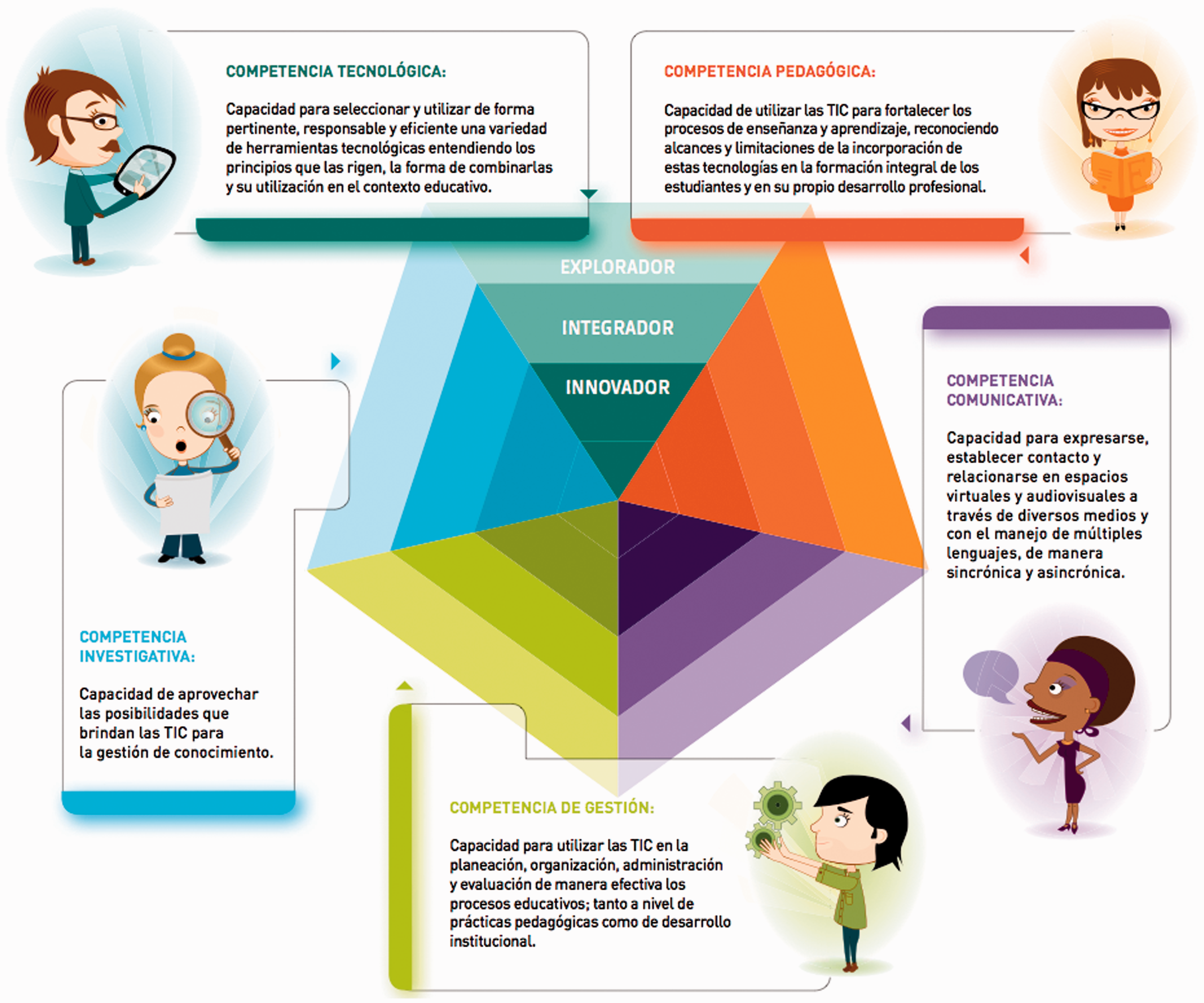
This artefact was based on the idea of self-regulation, and it promoted an attitude of inquiry in the teacher: ‘How am I positioned in the pentagon of ICT competences?’ Asserting that technological change is occurring at a high rate of speed, teachers are encouraged to engage in ongoing (endless) lifelong learning. Either through formal methods of learning, or informal learning; for example, through online tutorials or other methods of learning by themselves, ‘it is fundamental to be up-to-date’. Another set of questions stated within this rationality of self-regulation promoted self-regulation: ‘How should I choose a professional development program? How can I follow up on my own progress regarding my development of these competences?’ (NME, 2013: 50)
It is clear that this pentagon becomes an enactment of what we described above as a dispositive for innovation. Beyond the symbolic power contained in this artefact and the role of the state that deploys this device, it is necessary to highlight it as a technology of government. Thus, a rationality of government is embedded in this artefact, which depicts ‘an innovative teacher’ who is self-regulated and reflective about her own behaviour. Hence, there is modularity of subjectivity, rather than a fixed identity to achieve. Instead of ideology (a hegemonic image of the ideal professor), each educator must be positioned within the singularities, grades or levels within each competence. Put differently, this is a matter of performance, a practice that must include certain techniques to transform the self, not as a constraint, but as an open exploration. In short, rendering technical through competences that must be achieved at one’s own pace, subjects are conducted to attain the goal of being ‘innovative teachers’.
Conclusion
This work has undertaken a critical reading of both discursivities and practices that have been settled in education as promises of change and improvement. Discursivities that are now established from international organisations such as OECD reports; practices that are exerted daily on educational institutions. Instead of treating them as two different realms, from a Foucauldian stand I have analysed them as belonging to a dispositive for innovation that operates at the same time on different levels (education policies and daily practices of government). I have deployed such critique showing that nowadays the intellectual work has to be placed at the level of concrete practices, which are also intertwined with techniques and rationalities.
Consequently, in order to analyse the various enactments of government, practices such as shepherding, accountability and governing at a distance were explored as part of a dispositive for innovation. This endeavour has driven a further analysis on the nature of technologies that supersede a traditional stand. Hence, the practices analysed highlight that technologies are not only tools to be used by humans intentionally. The various cases of governing subjects (i.e., to conduct the conduct) were depicted in this work, showing that technologies had a productive effect, that is, producing subjects, as they regulate their practices.
Methodologically speaking, this article claims that, in order to understand the enactment of a dispositive, it is necessary to expand the sources in which this enactment is analysed, not because we should be ‘searching for the truth’, rather than understanding ‘the how’ of those technologies of government. Indeed, there have been multiple analyses about dispositives of power and the way they work from a Foucauldian viewpoint. However, few of them have been analysed from the concrete practices that enact such dispositives. In order words, other enactment zones have to be considered in the contemporary analysis of power.
Footnotes
Funding
This research was funded by the national department of science, technology and innovation (COLCIENCIAS), and the University of los Andes in Colombia. Another grant was received from Aalborg University in Denmark.