




Abstract
While on a national level Vietnam has achieved – and surpassed – gender parity in education, restrictive social norms that value Hmong girls primarily for their future roles as wives, daughters-in-law and mothers have largely precluded their advancement to high school. Drawing on qualitative data collected in the country’s Hmong homeland in Ha Giang province, in the remote mountains bordering China, we found evidence of the non-linear nature of change and the limits of legal reform. On the one hand, strong national and local commitment to primary education has transformed expectations in only one generation. Hmong girls are not only attending school for the first time, but despite their heavy domestic workloads, they are regularly outperforming their male peers. On the other hand, because Hmong tradition sees sons, but not daughters, as vital to the religious and economic continuity of the family, girls continue to suffer from parental under-investment. While most girls are beginning to dream of high school, and some of university or teachers college, the filial piety demanded by their elders leaves them with few opportunities to translate their dreams into action. The paper concludes that improving Hmong girls’ educational uptake will take more than educational policy and girl-power – it will necessitate broader inter-sectoral and tailored attention to the web of gender norms binding them to the past.
Every child is born with intelligence, but that intelligence depends on their access to opportunities. The boys can go out and about, so of course they can develop more, because they have more opportunities. (Youth Union key informant, Ha Giang province)
Introduction
Vietnam has made nearly unparalleled progress towards its Millennium Development Goal (MDG) targets. One of the world’s poorest countries only a few decades ago, it has more than halved its rates of extreme poverty and hunger (MDG1), achieved universal primary education (MDG2) and closed the gender gap in education (MDG3). Critical to the post-2015 agenda is addressing the reality that national progress is masking disparities between the Kinh majority and the country’s ethnic minorities. The Hmong in particular have been left behind on many socio-economic development indicators. With a population of just over 1 million, making them one of Vietnam’s largest ethnic minorities, they continue to have the country’s highest poverty rate, nearly 80%, and are the only ethnic group with a primary school gender gap in excess of 10% and a high school enrolment rate in single digits (Baulch and Dat, 2012; UNFPA, 2011; World Bank, 2012).
Situated at the crossroads of childhood and adulthood, there is a growing recognition of adolescence as a vital stage in the consolidation of any development gains made in childhood (Patton et al., 2012; UNICEF, 2011). Adolescent girls in particular, as the future mothers of the next generation, offer a unique opportunity for a double return on investment: the future well-being of their children, as well as their own well-being (UNICEF, 2011; WHO, 2013). However, the very concept of adolescence as a crucial stage in a girl’s life-cycle is relatively new in Vietnam in general and among the Hmong in particular (Jones et al., 2013, 2014; Lemoine, 2012). Largely isolated – geographically by their mountains and socially by their cultural distinctiveness – it is difficult for Hmong adolescents and their parents to imagine a shift in the gender traditions of their ethnic group, even as they become aware that their reality is markedly different from the broader Vietnamese culture. Drawing on qualitative data collected in 2012 and 2013 in Ha Giang province in northern Vietnam, this paper explores the ways and extent to which Hmong adolescent girls face entrenched gender norms that shape their perceived social value and restrict their educational trajectories.
Engaging with theoretical debates
Different from attitudes, which are individually held, social norms are patterns of behaviour in which people engage because they believe that they are expected to do so (Bicchieri, 2012; Heise, 2013; Mackie et al., 2015). They can be separated into descriptive norms, which describe what people actually do, and injunctive norms, which describe what members of a given reference group believe members ought to do (Ball Cooper and Fletcher, 2012; Paluck and Ball, 2010) (see also Figure 1). Most social norms are what Mackie and LeJeune (2009) call ‘over-determined’, held in place by an array of factors including religious tradition, local custom and political interests. While social scientists have approached norms from a variety of theoretical perspectives, none of which fully captures the messiness of real life, there is an emerging consensus that while ‘change can be rapid and abrupt or incremental and unnoticed’, it tends to be complex and non-linear, with descriptive norms often changing well in advance of injunctive norms (Marcus, 2014: 34; see also Boudet et al., 2012; Calder, 2012; Rao, 2012). There is also growing evidence that it is easier to build new norms than it is to eliminate old ones (Heise, 2013).
What is a social norm? (Source: Bicchieri, 2012).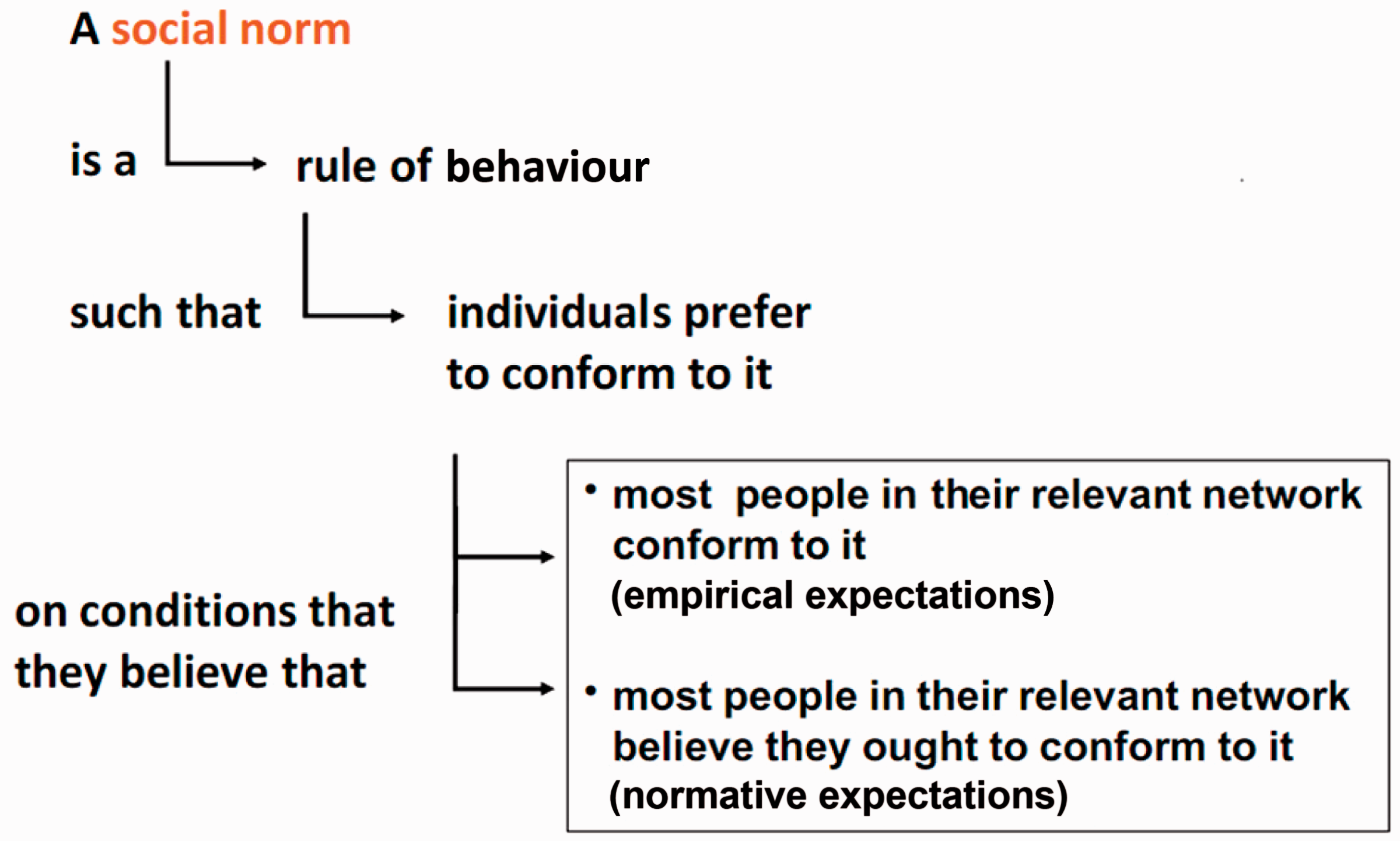
Gender norms, which encompass a broad range of social meaning surrounding what it means to be a woman versus a man or a girl versus a boy in a particular culture, tend to be especially ‘sticky’ and difficult to change (Boudet et al., 2012). Not only are they pervasive, with ‘rules’ for everything, ranging from clothing choice to chore allocation to communication patterns, but, because few of us, carefully socialised since birth, are even able to see the ways in which they shape our lives, they are often silent. Indeed, noting the centrality of gender norms to our day to day lives, Boudet et al. (2012) observe that they ‘permeate daily life and are the basis of self-regulation’ (24). Layered on top of this conceptualisation, note Kabeer et al. (2011), is the economic reality that in many places women continue to be materially dependent on male family members and lack ‘any place … in society outside of the family circle’ (33).
Much of the research and programming directed at changing restrictive gender norms is built around empowering girls and women to become their own agents and make – and act on – their own choices (Boudet et al., 2012; Marcus, 2014; Sen, 2002). Critical to the development of girls’ autonomy, however, is not only personal empowerment, but space in which to exercise agency. Indeed, Boudet et al. (2012) observe that changes in agency are not necessarily predictive of norm change ‘if the structures of opportunities and constraints are not taken into account’ (15). Understanding those structures, and opening space for girls and women to become who they would like to be, depends on the specific cultural norms which bind girls’ futures to the past (Boudet et al., 2012).
Background context
Hmong girls in Vietnam are located in a rather singular nexus. They live in a country with a one-party state that controls not only the law but also social messaging. Additionally, and also unusually, Hmong girls are growing up in an isolated and insular culture that Michaud (2011) notes is ‘tactically selective about modernity’ (2). They engage with the cash economy only enough to meet their immediate needs, they elect to give birth at home rather than at health clinics, they opt to use shamans rather than physicians, and they see formal education as fundamentally less useful to their children than learning to undertake traditional work alongside their elders (see, for example, Michaud, 2011; Ngo, 2010; Tugault-Lafleur and Turner, 2009; Turner, 2012a, 2012b; Turner and Michaud, 2009). This cultural positioning serves to not only limit girls’ contact with broader Vietnamese culture, but in many cases precludes it – despite evidence that the younger generation ‘urgently want to become modern and successful’ (Michaud, 2011: 18).
Hmong girls’ day to day lives are shaped by agrarian poverty. While ‘(e)conomic growth achievements in Vietnam stand as a spectacular success story’ (UCW, 2009: 3), minorities in general and the Hmong in particular have been left behind. Minorities account for almost half of Vietnam’s poor and almost three-fifths of its food-insecure – but only an eighth of its population (Baulch et al., 2012; Chi, 2011; World Bank, 2012). Moreover, the poverty gap between minority groups and the Kinh majority is steadily growing larger (Baulch and Dat, 2012; Dang, 2010; World Bank, 2012). From 1998 to 2008, the poverty headcount for Kinh households fell more than threefold, from 38.8% to 11.7%, while the gains for minority groups over the same period were more modest, with poverty rates dropping by less than one-third, from 75% to 52.5%. The Hmong, who primarily live in an agro-environment that limits both farming and transportation, have the country’s highest poverty rates – and lowest educational achievement (Luong and Nieke, 2013; World Bank, 2012).
Hmong girls’ day to day lives are also tightly bound by son preference. Reinforced by patrilocal residence patterns, throughout Vietnam sons are seen as crucial to continue the family line and to provide support in old age (GSO, 2011; Guilmoto, 2012; Nanda et al., 2012). Hmong traditions, however, which assign girls’ spirits to their husbands’ families at the time of marriage and place gender roles at the heart of culture, freighting them with ‘extraordinary importance’, serve to amplify national preferences (Long, 2008: 20). Girls are seen as ‘other people’s women’ from the moment of their birth (Lee and Tapp, 2010: 153) and from early childhood they are given the lion’s share of household chores, with girls tending to ‘work twice the amount of boys: caring for siblings, doing household chores, collecting wood and water, and caring for buffalo’ (DeJaeghere and Miske, 2009: 167; see also Thao, 2010). This workload restricts their mobility, precludes time for rest and socialisation and has significant impacts on their education.
The end result of this confluence of poverty and son preference is that while Hmong children overall remain disadvantaged in terms of education, with a net primary enrolment of only 72.6% (compared to 97% for Kinh children) and a net secondary enrolment of only 6.6% (compared to 61.8% for Kinh children), Hmong girls are particularly unlikely to complete their educations. Only 3.4% enrol in high school (UNFPA, 2011).
Research setting and methods
This study is part of a broader multi-country, multi-year initiative funded by the UK Department for International Development (DFID) on gender justice for adolescent girls. Our Vietnamese research took place in Ta Lung commune, in the Meo Vac district of Ha Giang province, near Vietnam’s border with China. The district, which is best characterised as a mountain desert, is recognised as the country’s Hmong homeland and is one of the poorest areas in the province. Over the past two decades, Ta Lung commune, which consists of eight villages, has received various forms of support from national poverty-alleviation programmes. However, the bulk of this programming appears to be tapering off as the government, driven by cost-savings measures, shifts from targeting all Hmong families to only those who fall below an extremely low poverty threshold.
Drawing on a purposively selected sample from four villages, two relatively central to the commune and two so remote that vehicular access remains impossible, we used a variety of qualitative and participatory research instruments, including body mappings (see Figure 2), rankings, timelines and family drawings, to capture the rich detail of girls’ lives and explore the ways in which gender norms continue to truncate their trajectories. Small group discussions with adolescents and focus group discussions with adults, in single-sex and mixed settings, allowed us to explore common views and experiences on gender, adolescence and social norms. In-depth interviews, including younger and older adolescent girls and their brothers, revealed their views on the status of girls and the opportunities and challenges they face in their natal homes, their marital homes and in the wider community. We used intergenerational pairings (involving grandparents, parents and adolescents) and marital networks to explore changes in gender roles over time and outlier case studies to examine in detail how some girls succeed in breaking the mould while others live lives that more resemble those of their grandmothers than those of their peers. Key informant interviews with community leaders and service providers provided not only a lens into available programming, but also an insider–outsider look at community need vis-à-vis adolescent girls.
Body mapping showing that a ‘good’ Hmong girl has much to do.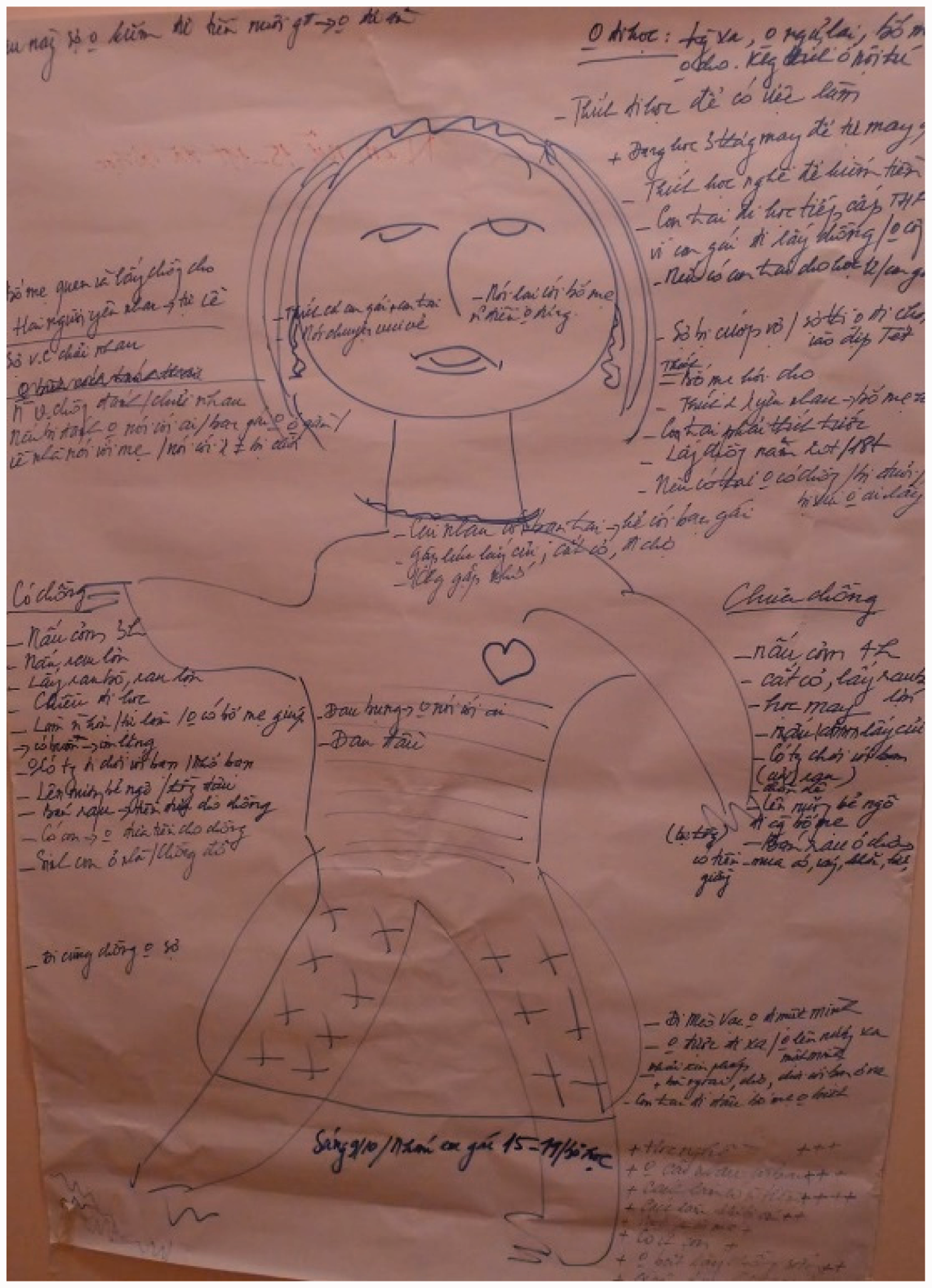
The research was co-designed by researchers from London and Vietnam. Data collection was carried out during two trips in the autumns of 2012 and 2013 by those researchers, in conjunction with a small team of local translators. At the analysis stage, an initial coding matrix based on key themes depicted in the conceptual framework was developed. That matrix was further developed after an initial read of all transcripts (translated from Hmong and Vietnamese into English and anonymised), in order to capture context specificity, and then transcripts were re-read and coded.
The educational landscape and trajectories of Meo Vac’s Hmong girls
Schooling in Meo Vac
Evidencing Heise’s (2013) conclusion that it is comparatively easy to build a positive norm, in many ways the educational landscape of today’s Hmong girls in Meo Vac district is nearly unrecognisable from that of their parents, who are almost entirely unschooled. In only one generation, policy and messaging has altered not only what girls do (descriptive norms), but what their communities and families believe they ought to do (injunctive norms). Indeed, not only are girls now overwhelmingly likely to complete 9th grade, but they are outperforming their male peers. On the other hand, with few exceptions, graduation from lower-secondary school remains the limit of what parents are willing to imagine for their daughters, who remain almost exclusively destined for marriage and motherhood. While girls themselves are beginning to dream of more, the social norms that dictate who they must become preclude high school for all but a lucky few.
The government has taken a four-pronged approach to encouraging Hmong children to complete 9th grade. First, driven by an overarching desire to foster national identity among ethnic minorities, the national government has heavily invested in educational infrastructure in minority areas. All villages in the commune have both a kindergarten and a satellite school, which educates up to a 4th grade level, and the commune itself has its own lower-secondary school for children and continuing education centre for older learners. While this still leaves nine-year-olds from more distant villages facing two hour-and-a-half long walks on treacherous mountain paths each day, it nonetheless represents remarkable progress given that even parents in their 20 s are largely illiterate because there were no schools when they were children.
Second, until recently, the national government also provided generous subsidies that rendered education up to the 9th grade essentially free for all Hmong children. While they were often asked for some small contribution to the school – such as a broom or a lock – they were not responsible for paying tuition fees or buying books. In almost all cases, they also received free school supplies such as notebooks and pencils. Unfortunately, Decree 49, implemented in the autumn of 2013, has now limited those stipends to Hmong children who are on the official poor list. This could, noted a teacher, have devastating consequences for enrolment: ‘if we ask them to pay money, the students will never go to school’. A commune level official also expressed reservations, as he believes that since the Hmong do not have a long history of educational involvement, this policy change will serve to weaken the commitment of the poor. ‘The simplest, most uniform, relevant and effective policy is that all children, rich or poor, near or far, can enjoy equal support for school – so that all of the families can see that they have equal interests in school’. While the commune is stockpiling school supplies and used textbooks to distribute for free to those who cannot afford them, local officials are unsure how long discretionary funds will hold out.
Third, local government has also invested heavily in education, choosing to couple ‘sticks’ – in the form of fines – with the ‘carrots’ provided by the national government. Ta Lung’s children are required to attend school daily unless they are ill or have another approved reason. If they are absent without permission, fines are 20,000 VND for the first day and 50,000 VND for the third day. While schools are cognisant of parents’ need for their children’s labour, and are willing to negotiate with them for planned absences, unexcused absences are met with cash fines for those who can afford them and requisite public work for those who cannot. Teachers explained that because fathers are the head of the household, it is they, and not mothers, who are made to clean the school grounds when their children are absent. These policies have not only served to reduce truancy, but have also, according to teachers, begun to have significant impact on school quality, as students who are present are consistently learning. One key informant noted that when the rules were first imposed, about a decade ago, many parents were regularly fined. Today, few fines are needed, as families are largely compliant. The key, according to our Youth Union key informants, is simple awareness. They noted, ‘Even though the parents are illiterate, they invest a lot of time in their children’s education. Even though they don’t have much money. The awareness has changed greatly’.
Finally, Ta Lung is using messaging in a deliberative manner (Heise, 2013) to convince children to invest in their own educations, juxtaposing for them the poverty of their parents with the potential salaries of commune officials. A teacher explained: We showed them examples, ‘your parents didn’t go to school in the past, so they have to work in the fields all year round, and they have only corn and cabbage to eat’. We showed them some good examples of commune officials, who had proper education and have proper jobs and salaries, and now they’re married and have a wealthy life, having rice and meat to eat every day.
Girls’ primary and lower-secondary education also enjoys broad support. Many of the adults we interviewed – mothers and fathers – made similar comments: ‘I do not discriminate between son and daughter. I will let her to go to school’. Some parents know that schooling will protect their daughters from social stigma, increase their odds of finding a job and improve their business skills. Most also believe that education will ultimately make them better wives and mothers. One mother in a women's focus group discussion, for example, explained, ‘I’d rather my daughter continue her studies than stay home and get married. She would be wiser, and have intelligence and brains to do business’. A father added that the girl who completes her education ‘will have an advantage in looking for a job’.
Girls’ ‘diligence’ and the limits thereof
There are, however, exceptions to the broad educational support enjoyed by most young girls. Specifically, even in families that clearly value education – and have let one daughter reach Grade 12 or have sent a son to university – it is sometimes the case that another daughter is completely deprived of her right to an education, irrespective of fines. For example, one girl who is in Grade 12 and planning on becoming a doctor has two sisters only a little older than her who have never been to school. Another family allowed all of its children to graduate from high school except one – a daughter, who was chosen to leave school after only Grade 5. Her brother explained: Because my parents are old, nobody cares for the family, all of us go to school far away from home, only the 12-year-old sister doesn’t go to school. I do ask my parents to send her to school, but my parents have so many children, some of my siblings are too young, at the same time all other siblings go to school, no one is there to help my parents except her.
In recent years, despite the lack of homework time, girls have translated their diligence into academic success as well. Girls, teachers and parents – and even boys – admit that girls are better students. As one mother put it, ‘Girls never drop out, but boys are playful, I can waste my money. The boys are more stubborn, but girls are more willing to go to school’. Indeed, key informants and girls agreed that it is motivation that tends to set girls and boys apart. They believe that when boys take school seriously they do so for their parents, whereas girls are inclined to excel for themselves and, given their workloads, despite their parents.
Evidencing the continued value placed on girls’ marriages, and how difficult it is to eliminate a negative norm (Heise, 2013), the end of lower-secondary school remains the absolute limit of what the vast majority of parents are willing to consider for their daughters – regardless of their academic success. A commune official noted, ‘Poor families … let [their daughters] stay at home to help parents, find and marry a good husband who will support the family and their children in the future’. An out-of-school adolescent girl added, ‘Out of 32 classmates, only one boy is continuing in school. The teacher asked me to carry on in school because I was a very good student but I said I had to help my mother’. Officials told us that no girls in the most remote hamlets had yet managed to complete upper-secondary school – and only a few were even enrolled.
Leaving school is rarely a choice that girls make. Nearly all of the out-of-school girls we interviewed wanted – in most cases desperately – to be in school. They missed learning, they missed the social opportunities school entailed and which were nearly totally absent once they left and they recognised that by leaving school they were limiting their future career options. However, as noted by a teacher, although ‘Girls always outdo boys, at the end of the 9th grade, more boys continue their studies than girls. The girls want to go to school, but their parents don’t let them, so they have to accept it’.
In some cases, the decision to leave school early was made by the mother; in most, however, it was made by the father, the family decision-maker – often despite the fact that the mother had already told her daughter that she could stay in school. ‘Mother told me to study if I want. Father said no, because we didn’t have money to pay, so I had to stay at home and work’, explained an out-of-school 17 year old girl. While most fathers were unsupportive of their daughters’ education, there were notable exceptions in the more centrally located villages. One girl, finishing Grade 12, said, ‘My father is different from other parents. My father always encouraged his children to learn’. Another girl, 16 and in Grade 10, commented that it was her mother who often did not understand why she worked so hard to stay in school: Sometimes she doesn’t understand. But I need to explain to her – I need to be in school so I don’t have a very poor life – so I can get a job and a better life – and then she understands. Father understands – he wants me to go to school – he doesn’t want me to have the same problems as my parents do.
The ‘costs’ of schooling girls
Key informants confirm that girls leave school after Grade 9 in large part for the same reason their brothers do – their labour is needed to help their family make ends meet. Farming in Ta Lung depends on very hard manual labour. Mechanisation is all but impossible given the terrain and coaxing enough food from the rocky soil to guarantee sufficient calories can be difficult if weather patterns do not cooperate: When I had finished school [Grade 9] there was no money so my parents asked me to stop and come home and work. I wanted to carry on in school but […] there would be no one to help my parents in the rice field.
The ‘need’ for adolescent girls’ (as opposed to boys’) labour is particularly strong because most – statistically speaking – will have only a few years between finishing lower-secondary school and leaving home for marriage. The Hmong have Vietnam’s highest rate of child marriage. Despite a national law which prohibits the marriage of girls under the age of 18, the average age of first marriage for Hmong women is only 18.8 years (compared to 23.1 for Kinh women) (UNFPA, 2011), and even this is a likely undercount given that Hmong marriages are often conducted by the simple expediency of moving in with one another. Because girls’ marriages effectively end their familial ties with their natal families – with not just their bodies but their ‘ghosts’ becoming part of their husbands’ families – they understand that their biggest contribution to their parents’ well-being is their own short-term labour. Driven by this knowledge, and constrained by broader norms which mandate not just obedience but subservience to one’s elders, girls in our sample almost without exception leave school when they are told to leave school and work when they are told to work. Boys, secure in the knowledge that ‘in the future they will inherit everything’ (Women’s Union key informant), appear to be far less malleable to parents’ wishes. Though many do leave school in order to come home and work alongside their parents, the fact that their own longer-term interests more closely align with those of their parents means that they rarely have to choose between their individual and family futures.
There is also broad understanding that adolescent girls must work very hard because they have a lot to learn before they can become ‘good’ daughters-in-law and wives who do not shame themselves, their parents and their in-laws (Thao, 2010). This not only requires that girls enter marriage with a panoply of domestic and agricultural skills, and are able to ‘do housework to make enough for eating and wearing’, but also that they cultivate the correct attitude. A ‘good’ daughter-in-law, for example, is able, ‘when friends visit … and her husband and parents-in-law are all drunk’ to ‘let them go to rest early’ and ‘entertain the guests’ and not ‘go to rest until all of them go home’. Indeed, a number of our respondents expressed concern that if girls were allowed to continue on to upper-secondary school they would become both lazy and mouthy, making them less suitable for marriage and motherhood. A 19-year-old unmarried girl, who left school after 9th grade, explained that because ‘those who go to the 12th grade are lazy, not hardworking’, they are less likely to be chosen as wives. A 16-year-old boy agreed with her; he said: The mother with grade 9 education is better than the mother with grade 12 education. The mother with low education works more diligently than the mother with high education. The mother with higher secondary school education works less and often scolds parents-in-law.
Pervasive son preference further restricts girls’ educational options because it means that if a family can find money to send a child to school, it is almost always a boy. One girl, unhappily out of school, commented, ‘I think that they are boys, so they are allowed to learn more. I am a girl and I have to work, so I am not allowed to learn so much’. Commune officials confirmed that when resources are tight, boys are prioritised – for two reasons. First, as was noted above, boys have economic value to their parents. As one father noted, ‘I want a son, because he will be the breadwinner of the family and will take care of his parents when we get old’. A participant in a men's focus group discussion explained how this mattered for school: ‘I will send the son to school because in the future he will find a job and help the hamlet. If the daughter is sent to school, in the future, she will get married and help another hamlet’. Second, and perhaps even more importantly, sons are vital to ancestral veneration (Lee and Tapp, 2010; Lemoine, 2012). A mother explained: Every family needs to have a son. When his parents die, he will bury them. He will burn joss papers and incense for his parents. When dead, we’re ghosts. We will look for our sons, we cannot look for our daughters.
Girls’ aspirations
Restricted, like their parents, by both these gender norms and poverty, adolescent girls in our study had highly variable educational goals and aspirations. Some, the poorest and most remote, could not imagine lives different from those of their mothers. ‘I am always busy, so I don’t think of anything. I only think that I live with my parents … and work with them’, explained one. Indeed, several girls, understanding that even if they were to finish 12th grade they would still have no options other than marriage, given that ‘migration … is not allowed’ and the Hmong lack the political and social connections with which to find local employment, refused to even entertain the idea of higher education. One mother explained that she tried to talk her daughter into attending upper-secondary school, but the daughter told her, ‘A girl after school would go home and get married anyway’.
Most, however, especially in the more central villages and despite the reality that their dreams are unlikely to be acknowledged – much less come true – were interested in completing their secondary educations and even applying to university. Some believed that higher education would help them be better mothers, and know ‘what it means to feed the children with cooked food and boiled water’. Several, however, wanted to become either doctors or teachers and move back to their hamlets in order to help their neighbours. Officials are broadly convinced that this would be a good idea and that if they can get the first generation of Hmong girls through school then the knock-on impacts on younger cohorts will cascade. One explained: Now, no one in the commune works as a teacher. I hope that the children will try to study and become people’s teachers who will wholeheartedly serve their roots. That’s the only way to touch people’s hearts, convince people and children to study and follow good examples. I saw that my cousins had stable jobs …. They get a salary at the end of every month, and their jobs are not temporary, but are long-term ones; therefore, I thought that I must be able to do the same. And now I’m trying.
The importance of social norms
The near totality of girls’ silence – and the near futility of encouraging their educational dreams without simultaneously addressing the broader social norms that keep them in their place – is best highlighted by the stories of two young women. The first is 24 years old and, after having recently put herself through extension school and graduating from 12th grade, is now paying for her husband to complete his education. The second is 16 years old and is the only girl in our sample who was able to bring herself to ask her parents a second time to let her finish high school – because she wanted to become a teacher. She explained, ‘The first time I asked, my parents said I was a girl so they wouldn’t let me go to school. After I stayed home for a while, I asked my parents one more time, but they didn’t allow me’. While she is wistful about the future that is now gone, she knows that by conforming to the norms that are expected of her, and ‘listening to my parents’, she has proved that she ‘was a good child’. The 24-year-old, the mother of two young children with dreams of a washing machine, was even blunter about breaking ‘rules’: ‘You are the first one to whom I told my dream … Unsympathetic people may say that “People like you who dare to dream, swim upstream”’. Noting the predominance of conservative views in her community, she continued, ‘I will feel humiliated, so I don’t want to tell anybody’.
Perhaps ironically, and with the significant caveat that marriage by kidnapping continues to force girls as young as 13 into marriages with boys they do not know, the area in which adolescent girls appear to enjoy the highest level of decision-making is in regard to their most traditional role: marriage. While Hmong adolescent girls accept without question the decisions that their parents make about their lives in all other regards, partner selection was a choice about which they felt fierce. For example, a 19-year-old hotly stated, ‘Children choose (partners) themselves. If I didn’t like him, I would just go away. My parents couldn’t force me’. While it remains unacceptable in Meo Vac for a girl to show any interest in a boy until he has actively pursued her for some time, at the risk of being seen as a ‘bad girl’, our study participants reported that partners are solely responsible for matrimonial choices. However, highlighting the non-linear nature of norm change (Boudet et al., 2012), the higher level of agency available to girls in regard to marriage does not uniformly work in their favour as some appear to be exercising that agency to marry years before their parents think they should. As one mother explained, ‘In the past, we got married later; now the youth gets married earlier. We didn’t get married until age 22, 23 or 24’.
Indeed, adults in our study are concerned that recent improvements in education, which have brought girls and boys together in an age-segregated environment for the first time, are encouraging adolescents to marry as soon as they leave 9th grade and are forced into the relatively solitary, comparatively boring lives of farmers. An 18-year-old boy explained, ‘In grade 9, a girl makes friend with a boy and after finishing grade 9, they will get married. One month after grade 9, boys and girls get married’. A Women’s Union key informant, however, noted that this is hardly a surprising choice as adolescents have nothing else to do: ‘After leaving school, they have only one option: that is to get married’. While both girls and boys are marrying early, sometimes as young as 14, the implications of these early marriages are starkly different for girls and boys due to both biology and custom. For boys a wife means that ‘I don’t work, the wife has to do it’ (recently married adolescent boy). For girls, however, marriage, in addition to exposing them to both the risks of pregnancy before their bodies are fully mature and high levels of alcohol-fuelled gender-based violence, leads to workloads that mean ‘They used to have to get up at about 4:30. Now that they’re married, they have to get up at a little past 3 o’clock’ (recently married adolescent boy).
Conclusion
The educational trajectories of Meo Vac’s Hmong girls demonstrate the non-linear nature of norm change and the limits of legal reform. On the one hand, today’s girls have educational options which were unheard of in the Hmong community only a few years ago. In one generation, most girls have gone from being largely unschooled to completing – and excelling in – primary and lower-secondary school. However, because thus far educational policy has generally been divorced from the larger social reality in which Hmong girls live, and has taken little notice of the fact that their futures are typically confined to matrimony on subsistence farm plots, seeking out further gains while following the current path appears unlikely.
Changing the educational landscape of Meo Vac’s Hmong girls will require concerted efforts, on the part of the Government, donors and the Hmong community, to not only establish new norms, but to eliminate the negative norms that are holding girls back from both maximising their own futures and helping improve that of the broader Hmong community. This will be a difficult task given that gender norms are both pervasive and silent and tend to be amongst the stickiest and most resistant to change (Boudet et al., 2012). This is especially the case, as Meo Vac’s Hmong girls are discovering, when those gender norms are part and parcel of cultural identity (Long, 2008; Thao, 2010), overlap across reference groups (e.g. son preference is strong in both Vietnamese and Hmong culture) and are associated with cultures that emphasise collective, rather than individual, interests.
Minority educational policy, which in Meo Vac has taken recent steps backwards due to cost-cutting, is necessary but demonstrably insufficient to helping girls transition to high school. While reducing (or eliminating) the actual costs associated with continued education will be vital through scholarships, loans or a household cash transfer, particularly given the reluctance of families to invest scarce resources in daughters, it is unlikely that doing so will be a panacea given that high school is not seen within the Hmong community as necessary for marriage and motherhood. Similarly, as evidenced by the voices of girls and teachers in our research, empowering girls to excel in school and imagine futures different from those of their mothers is necessary but insufficient. Even when girls succeed and dream they are only rarely allowed to pursue those dreams because their parents and communities are unable or unwilling to dream alongside them.
At the risk of encouraging instrumentalism, concrete programming directed at improving girls’ vocational education and local work opportunities is an important first step in demonstrating that girls have value beyond the domestic sphere – and, as a new norm, ought to be almost as straightforward to establish as was universal uptake of primary education. It may be particularly advisable for the government to invest heavily in affirmative action programmes designed to increase the number of Hmong girls who become teachers or health-care providers, as they could serve as role models for their communities and may ultimately both help break down gender barriers and improve the Government’s ‘vexed relationship’ with the Hmong community (Long, 2008: 20).
However, in order to change not just behaviour, but beliefs, it will be vital to couple concrete earnings opportunities with policies and programmes aimed more directly at altering established gender norms, using what Heise (2013) refers to as deliberative social norm change processes. For example, building off Vietnam’s Family Law, which calls for an equitable distribution of household work, the government could leverage its position vis-à-vis social messaging and develop targeted programming directed at encouraging the new masculinities that will give new femininities the space to take root. Recognising that parents have extremely limited time – and energy – for new ideas, programming might focus on the younger generations and include fostering primary-aged boys’ pride in a stronger work ethic to reduce their sisters’ workloads, and supporting adolescent boys to delay initiating marriage so that they and their future partners can invest their own human capital. While these efforts will take time, by tailoring state-sponsored messaging and aiming it at the nexus of gender and ethnicity, the next generation of Hmong children – girls and boys – may move through the community’s ‘self-image of inferiority’ (Luong and Nieke, 2013: 30) to embrace the country’s position as a regional leader in terms of women’s educational, economic and political participation.
Footnotes
Declaration of conflicting interests
The author(s) declared no potential conflicts of interest with respect to the research, authorship, and/or publication of this article.
Funding
The author(s) disclosed receipt of the following financial support for the research, authorship, and/or publication of this article: The author received funding from following source:Department for International Development 10.13039/501100000278.