




Abstract
With the tide of globalization, the external environment that schools face turns uncertain and complex. In response to the new challenges, teacher teams need to manage boundaries to maintain the sustainable development. The two studies reported in this paper, aimed to examine the boundary activities of teacher teams of middle schools in China. In order to achieve the research objective, the first study employed an inductive approach to identify a set of boundary activities that teacher teams engage in to manage the relationships with the outside. In the second study, the exploratory factor analysis and confirmatory factor analysis were conducted to build a valid and reliable scale for the boundary activities of teacher teams. Data from 332 teachers of 72 subject-based “teaching study” teams in 12 middle schools indicate a four-factor model of teacher team boundary activities includes the following subscales: scouting activities; task-coordinating activities; information filtering activities; and emotion cultivating activities. Similarities and differences between the current findings and existing literature have been discussed.
Introduction
In modern society, globalization has a major impact on many aspects, such as economics, technology, politics, culture, and education. Globalization means “time–space compression” (Harvey, 1989; Yin et al., 2014), which brings about intensive social communication and creates more opportunities of sharing ideas, policies, and experience across the different countries of the world. As one of the most irresistible forces, globalization makes the environment that organizations face become more dynamic, complicated, and uncertain. In the contemporary world, organizations have been unable to survive in a vacuum (Drach-Zahavy and Somech, 2010: 143) and be an isolated entity (Marrone, 2004; Marrone et al., 2007). In order to maintain their sustainable development, open system theory and resource dependence theory also indicate that organizational boundaries should be open or permeable to get the needed resources (Ancona and Caldwell, 1990, 1992; Scott, 1987). Also, organizations are required to establish the boundaries to prevent the negative effects from outside and protect their core technology. Boundary activities entail the tactics to span, maintain, and guard organizational boundaries (Bacharach et al., 2000). How to manage the boundary activities has attracted the interest of both researchers and practitioners (Brøde and Dietrich, 2010). Boundary activities are becoming increasingly central to organizational researchers.
Schools function as part of a larger social system. It is obvious that there exists an interdependent relationship between schools and other social groups in which they are embedded (e.g. government agencies, school districts, local community, employers, and parents). Schools do not work in a vacuum and are not free from the influence brought by globalization. Boundary activities of schools not only refer to the essential resources that are external to their function but also refer to the protection of their core values (Schlechty, 2005). For example, the process of globalization is not a really fair sharing process. A salient example in the educational field is that the educational quality is being compared internationally. More and more educational theories and practices were introduced from the Anglo-American world into other parts of the world in an uncritical way, especially the non-Western and the developing countries in Southeast Asia (Hallinger and Kantamara, 2000; Nguyen et al., 2009). In fact, educational practices are contextualized in distinctive social and cultural dimensions. In order to avoid the risk of “false universalism”, how schools manage the boundary activities to obtain the needed resources while avoiding the adverse impacts are the crux to promoting teaching quality in the process of reform.
Teacher teamwork as a crucial way to promote school improvement in modern society is neither new nor unique (Fullan and Hargreaves, 1996; Pounder, 1999; Troen and Boles, 2012). China has a long tradition of valuing collectivism, which emphasizes on strong collaboration. It thus comes as no surprise that we have many kinds of teacher teams in middle schools. The outstanding performance on the Programme for International Student Assessment of Shanghai was contributed to by the subject-based “teaching-study” teams (which are the most popular form of teacher teams in China), according to a recent OECD investigation (OECD, 2011). Also, the Chinese teacher teams can provide important lessons for teacher education in Western countries (Strauss, 2013). In order to perform the teaching assignments, teacher teams have to manage interactions across their boundaries and maintain team cohesion at the same time. Boundary activities handled in an effective way will promote the improvement of organization (Pruitt, 1995). Researches about the function of teacher teams in Chinese middle schools are rarely reported in the international research literature; thus, the operation of boundary activities of teacher teams in China middle schools is not fully understood.
There is a considerable body of literature on team boundary activities conducted in companies in the Anglo-American context. Limited empirical studies have been conducted in educational settings in the China context. From the perspective of cultural psychology theory, a team is composed of individuals, each with their own value pursuits and behavior tendencies which are influenced by the given cultural context. Culture, mentality, environment, and person are all closely connected (Bruner, 1996). Also, organizational culture, goals and operations of companies are distinct from those schools. In other words, societal and organizational cultures instill a far-reaching influence on human behavior. For example, noteworthy features of China’s traditional culture are high power distance (Hofstede et al., 1997), collectivism, and family culture; all of those are different from Western culture. Given the practical significance of boundary activities, the current study aims to explore the boundary activities of teacher teams in middle schools of China.
Review of literature
The current study focused on the boundary activities of teacher teams in middle schools of China. It explored the types of boundary activities adopted by teacher teams and explains the logic of such actions. In this section, it begins with a brief review about teacher teamwork and then focuses particular attention on the types of team boundary activities detailed in the existing literature.
Teacher teamwork
Great teaching is a team activity and teachers need to continually develop their content knowledge and pedagogical skills through collaborative practice to meet the needs of today’s learners (Fulton and Britton, 2011). Teamwork has been recognized by academics and practitioners as the most beneficial mean to improve teaching quality. Asian countries dominated by Confucian Heritage Cultures emphasize compliance and collectivism, which encourage teamwork. It is not surprising that teacher teamwork is no longer the buzzword or fashionable topic in those countries. As an example, subject-based “teaching-study” teams which consist of teachers from the same or similar disciplines in the schools are very popular in China. According to the “Middle school teaching team work rules (draft)” published by the Chinese Ministry of Education in 1957, the main activities of the subject-based “teaching-study” teams are diversified, including sharing material, communicating experience and preparing lessons jointly (He, 1997). In Japan, lesson study is the accepted kind of teacher professional development practice. It draws together groups of teachers to discuss jointly about the lessons. The process of lesson study consists of selecting instructional goals, working on study lessons, and writing lesson study reports (Fernandez, 2002). It is obvious that we have abundant experience in the function of teacher teamwork. However, few rigorous empirical studies on teacher teamwork have been conducted, especially in China. In other words, theory and research in teacher teams lag behind the practice development in the organizational research literature (Somech and Drach-Zahavy, 2007). We know little about how teacher teamwork functions. In the Anglo-American context, teachers’ autonomy is grounded in the norms of privacy (Little, 1990). Teamwork was often criticized as organizational control “in disguise”, which was perceived as leading to the deprofessionalization of teachers (Hairon and Dimmock, 2012). Also, recent studies on teacher teamwork reported that the conflicts and tensions stemming from teamwork affect satisfaction in schools. It is not surprising that teacher teamwork has been restrained to some extent.
Researches on teacher teamwork adopt the traditional model of input–process–output, which gives priority to the needed input to affect team effectiveness. Drawing on the perspective of organizational structure, Yang (2009) suggested that in order to improve school effectiveness, school reform should encourage teaching task interdependence, communication flows across team boundaries, and self-management. Li (2010) argued that shared value is the useful tactic to promote team cohesiveness, which in turn influences team effectiveness. Wang (2010) claimed that the establishment of trust is the most important factor to influence teacher teamwork. More specifically, Wang proposed four mediated variables (team psychological safety, psychological contract, citizenship behavior, and team commitment) that mediated the relationship between trust and team effectiveness. Thomsen et al. (2015) offered a more nuanced explanation of the contribution of trust in team members to organizational commitment and organizational citizenship. They concluded that trust was a predictor for desirable team outcomes and a mediator in social exchange. They also noted that procedural justice and perceived organizational support influenced trust. Conley et al. (2004) found that the higher the levels of organizational support (i.e. rewards/recognition, training sought and provided, school support, conductive physical environment, and task clarity), the more favorable would be the work design (i.e. organizational context, design features, and interpersonal processes), the healthier would be the group’s interpersonal processes (i.e. coordinating efforts, balancing inputs, inventing performance strategies, and absence of negative performance strategies), and the higher would be perceptions of team effectiveness. Zeng (2011) conducted a study of 269 middle school teachers to explore the relationship among team psychological empowerment, organizational citizenship behavior, and team performance. She found that organizational citizenship behavior is a significant predictor of team performance and team psychological empowerment mediated the relationship between organizational citizenship behavior and team performance.
To sum up, the existing literature on teacher teamwork has traditionally focused on the internal perspective and tried to explore why certain inputs can influence team effectiveness. Teamwork is an interactive social process by which teachers collect, analyse, integrate, and keep information. As the field of teaching becomes more complex in the era of globalization, team members need to engage in collaboration with organizations outside education in order to access more resources for further development. At the same time, we ‘borrow’ practices and policies from Western countries more frequently in the process of globalization. In order to avoid the negative effects that stem from different cultural contexts to their societies, teacher teams also should not neglect the defensive and filterable function of the team boundary. In this regard, internal perspectives are not enough to explain the function of teachers' teamwork.
Boundary activity typology
This study supports the idea that team boundary activities should include both external perspectives intended to loosen the team’s boundaries and internal perspectives intended to tighten them (Drach-Zahavy and Somech, 2010; Yan and Louis, 2000). Several scholars have provided compelling arguments that these two kinds of boundary activities might be complementary (Somech and Khalaili, 2014; Yan and Louis, 2000). In the literature review of the conceptual framework, we focus on the dimensions that have been widely recognized, applied, and verified.
Ancona and Caldwell (1988) were the first scholars who devised a boundary management questionnaire after long-term and in-depth researches. They conducted deep interviews, observations and questionnaires in new product teams. Data collection indicated that team members carried out 24 types of boundary activities, including coordinating, negotiating, scanning, feedback, filtering, classifying, protecting, etc. All these activities can be divided into four dimensions: ambassador activities; task-coordinator activities; scout activities; and guard activities. More specifically, ambassador activities involve a series of activities, which present the accomplishments to outsiders, especially the superiors to obtain resources for organizational development. Task-coordinating activities refer to cooperation, negotiation, communication and feedback during the interdependent activities with the ends of goal achievement. Scouting activities represent scanning for ideas or information from outside for the team, while guard activities describe the processes aimed at presenting a specific team image controlling the team’s information release and protecting the core value of the team.
Cross et al. (2000) carried out deep interviews, surveys and direct file observation in the National Cooperative Bank, in order to understand the boundary activities during the shift of the bank’s organizational functions from a functional to a team-based structure. Also, continued studies were made in software development teams in a leading information technology firm (Faraj and Yan, 2009). Consequently, the boundary management scale had been further developed, encompassing three dimensions of boundary buffering, spanning, and reinforcement. Boundary spanning represents team processes to gain needed resources from the environment for team development. Boundary buffering is a system's self-protective strategy in response to interference and excessive information load from the environment. While the boundary reinforcement, as the supplement to fill Ancona and Caldwell’s (1992) research, represents processes which aim at strengthening internal cohesion by a team’s goal, image, and identity, it extends the internal dimension of boundary management. Both of those two scales are aimed at Western companies. In terms of content, these two scales are yielded and overlapping but far from identical categories. These kinds of divergences stem from the different understandings of boundary activities. Ancona and Caldwell (1988) mainly focused on outward teams, while Cross et al. (2000) and Faraj and Yan (2009) took a more holistic view and added internal perspectives. The current study agreed with their viewpoints and admitted that both boundary-tightening and -loosening activities are important for improving team effectiveness.
The teacher team boundary activities’ construct
As noted at the outset, the primary purpose of this study was to identify the boundary activities of middle school teacher teams in China. In order to realize the goal, the sub-studies are described as follows.
Study 1: identification of boundary activities for middle school teacher teams
Procedure
Aiming to define the conceptual scope of teacher team boundary activities in China, we used the inductive approach to explore dimensions, which is similar to the method used by Farh et al. (1997). Random sampling and purposeful sampling methods were used to choose the participants. Data were collected through 16 interviews at seven middle schools with different backgrounds (i.e. gender, years of teaching, educational background, and different educational quality of schools) to get a deeper understanding about team boundary activities (at least forty minutes per person). Interviews would not be finished until information had been saturated and no new message turned up. In order to avoid the possibility of influence from the existing literature, only a basic definition of team boundary activities was introduced to the respondents. It is worth mentioning that subject-based “teaching-study” teams have been chosen as the representative of teacher teams in middle schools of China, because they are widely popular in the middle schools of China. We asked respondents to recall 5 to 10 items of team activities that happened within or outside their teams’ boundary, and that were closely associated with their team goals. In order to protect the confidentiality of participants, participants were informed about the purpose of the study in advance. Audio tapes were given pseudonyms in order to protect their participants' privacy and these pseudonyms were deleted after the tapes had been transcribed. Three doctoral students from educational administration were recruited to serve as raters.
Team boundary activity for teacher teams in China.
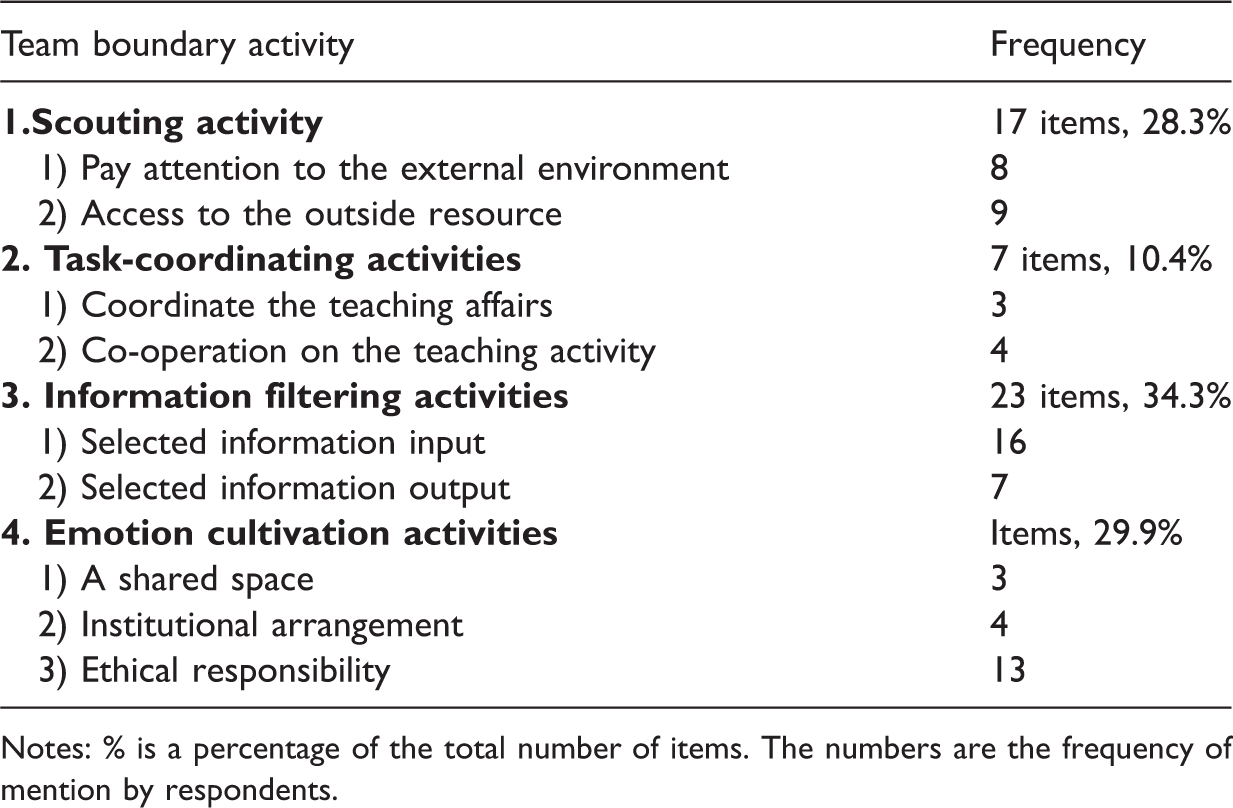
Notes: % is a percentage of the total number of items. The numbers are the frequency of mention by respondents.
Findings
Scouting activities
Based on data obtained through interviews, teachers mentioned that scouting activities played an important role intheir daily lives. Firstly, they paid heed to the changes of educational reform which were closely related to their teaching. For instance, globalization provides opportunities for sharing ideas, and experience. More and more educational reforms, structures and practices were “borrowed” from the West into China. Teachers need to upgrade their old-fashioned ideas that lag behind this social development. In China, the national curriculum reform in basic education has been initiated in the 21st century. Curriculum reform established a new curriculum structure, approaches to teaching and learning, and evaluation systems which changed the underlying assumptions of learning and the teaching process (Feng, 2006). In order to respond to these challenges, teacher teams need to scout more information from the outside to gain a better understanding of the curriculum reform. For illustration, many teachers in the interviews referred to the training programs emphasizing teachers’ professional development or the communications with peers which help them to better deal with curriculum reform. Secondly, several interviewees have noted that in order to obtain more support from outside, they need to communicate actively with superiors, parents, and other teacher teams within or outside schools to get material support or emotional support. A teaching affairs director described the main scouting activities as follows: As head of the team, it was often organize our members to observe other teachers’ classroom within or without our school. Teachers within a subject-based “teaching-study” team usually have similar experience and educational background and we will find that learning gain decreases as time passed. Learning limited within the team is not enough. You will find that we can learn much from other subject teachers. It is a common phenomenon that observing classroom across the disciplinary boundaries in our school.
Task-coordinating activities
Teaching is a complicated task that needs coordination from school leaders and other disciplinary teachers. Compared with other boundary activities, interviewees said little about the task-coordinating activities. Most of the coordinating activities referred to by the interviewees were limited to teaching affairs that happened within the schools. One physics teacher said: As a physics teacher, we have to communicate with the math teachers about the teaching schedule. Knowledges in our discipline are closely related to Mathematics. Coordination with other schools is rarely, because we have little cooperation among different schools even in the same district.
Information filtering activities
Information filtering activities in teacher teams mainly refers to the selected input and output of information exchanged between teams and the external environment. Large amount of information from outside would be absorbed selectively, according to the actual need. When more and more educational practices were introduced from Western countries in the global era, we needed to choose the practices in accordance with our values instead of ignoring the mismatch of cultural differences (Nguyen et al., 2009). Academic performance of students accounts for a high proportion in the teacher evaluation system and influences school reputation greatly in China. It is not surprising that important information related to teaching would be selectively released to outsiders in order to maintain teams’ competitiveness and positive image. A principal who also teaches English elaborated on the dilemmas about the information filtering activities: Our school is located in the rural area. Many training programs aimed specially at teachers in developed areas are not appropriate for us. Take the training programs about the flipped classroom as the example. Flipped classroom introduced from America has its roots in Western cognitive-developmental theory. Due to the different educational and cultural environment, the flipped classroom is not suitable for our school. Our classroom size is too big that teachers cannot effectively conduct discussion. So, we cannot completely emulate the practice in an uncritical way.
Emotion cultivation activities
The purpose of emotion cultivation activities is to motivate teams’ sense of belonging and strengthen team cohesiveness. Three types of emotion cultivation activities are put forward: a shared space; institutional structure and procedural arrangements; and ethical responsibility. As mentioned in the interviews, in order to enhance team cohesion, schools will provide a more convenient communication platform to teachers. Formal or informal institutions reflect the exception of team members’ behavioral norms. However, power of space and institutions is limited. Its influence is only confined to teachers’ behaviors rather than their internal values. Only when they recognize the ethical responsibility of their work and share common ideals of education will members devote themselves to their work. One teacher described the emotion cultivation in his team as follows: Our leader is always saying that we need to treat the group as our home. Teachers within the team are family members. We love each other. Everyone does their best to contribute to teams’ goals. We are encouraged to treat students as our son or daughter. Our team members are very united. The family emotion encourages us to work hard even without material incentive.
Study 2: measurement of the boundary activity for middle school teacher teams
Findings.
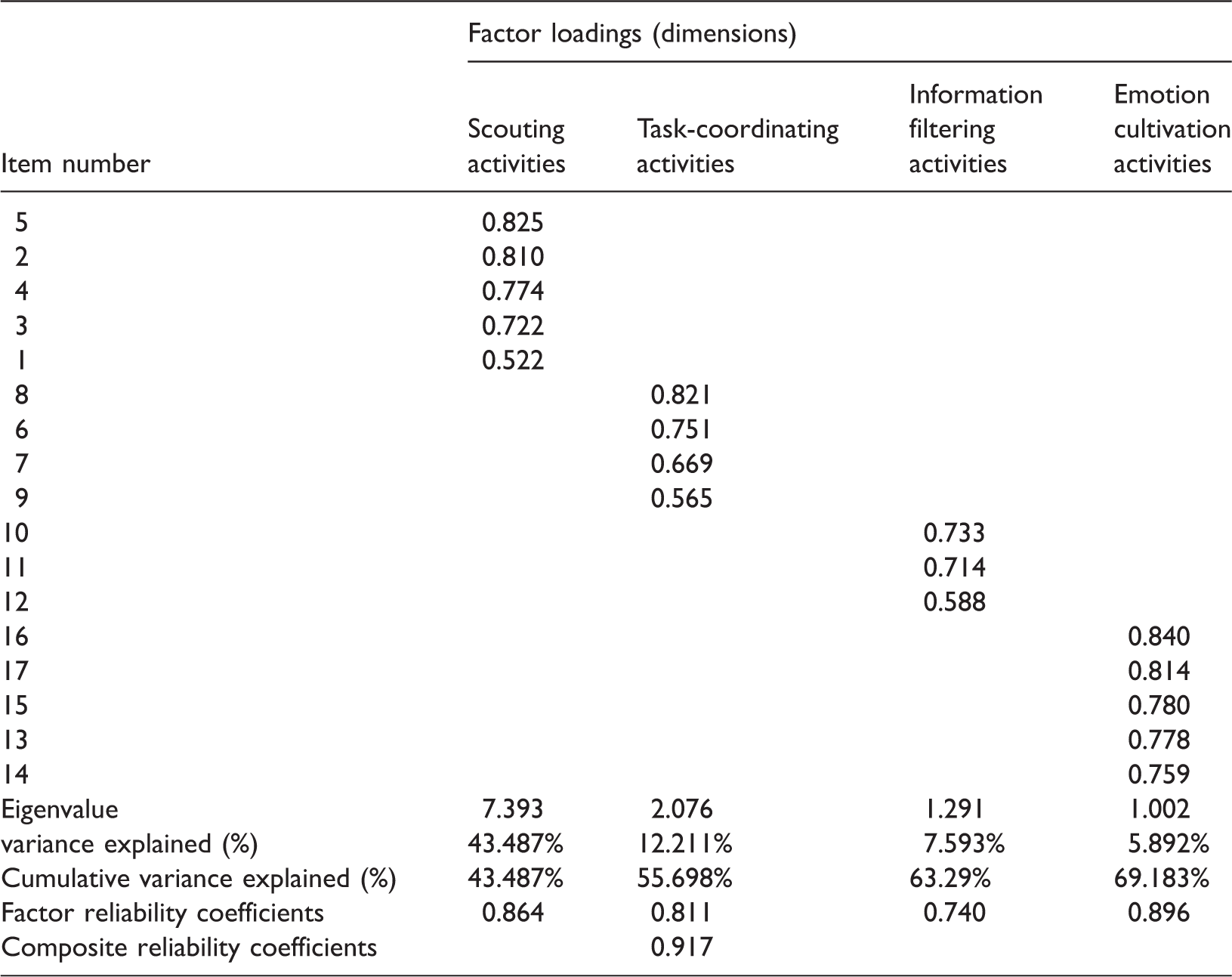
Exploratory factor analysis
Exploratory factor analysis for boundary activities of middle school teacher teams (n = 119).
Confirmatory analysis
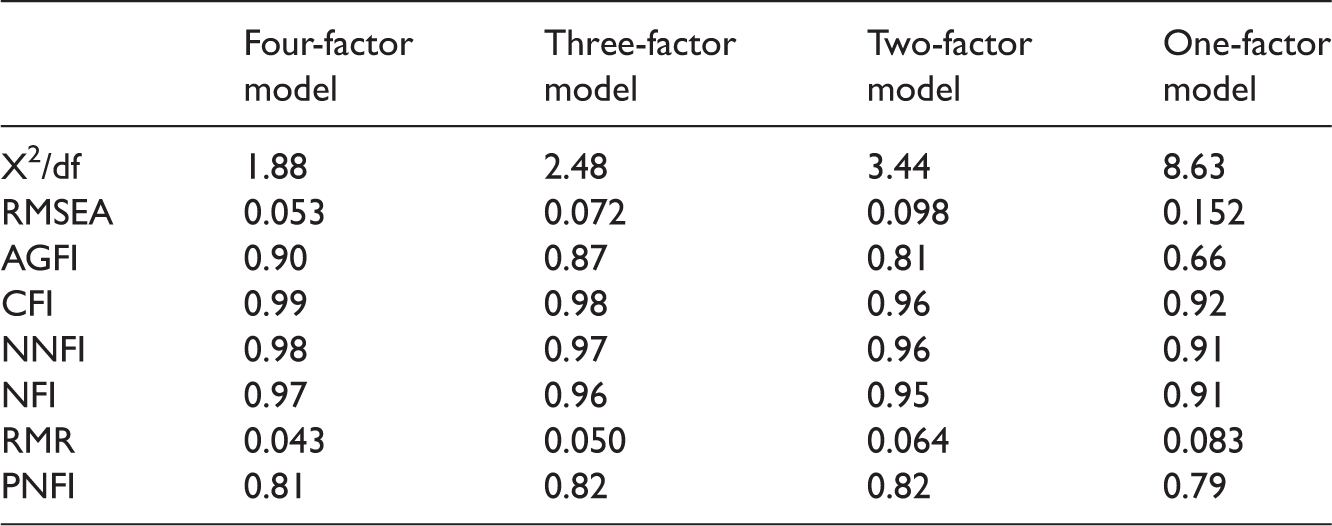
Confirmatory factor analysis was used to test the four-factor model. According to the results of CFA, teacher team boundary activity was a four-factor structure in China. However, there exists strong interrelatedness among these four factors, because the acquisition, retention, and retrieval of information are an ongoing process that is mutually associated. It is difficult to pinpoint the exact boundaries between these processes (Walsh and Ungson, 1991). Therefore, we needed to explore whether the boundary activities of teacher teams were to be described using either the unidimensional or multidimensional variable. According to the research of Faraj and Yan (2009), scouting and task-coordinating activities both related to the boundary spanning. The purposes of those activities were scouting information to support the team’s work. So, a third model (three-factor structure) was tested using a confirmatory procedure. Most of the prior researchers focus on the studies of boundary spanning activity (Aldrich and Herker, 1977; Keller et al., 1976; Leifer and Delbecq, 1978). They claimed that boundaries of organization should be permeable instead of impermeable. So, there are two kinds of properties of team boundary. Accordingly, a fourth model (two-factor structure) was formed.
Structural equation modeling software, LISREL8.7, was used. Data were taken from 332 valid questionnaires, accounting for 66.4% of 500 questionnaires originally distributed. In this study, the ratio of sample size to items was 19:1, greater than 5:1 (Comrey, 1988; Hau et al., 2005: 126), so the sample size is appropriate. Responders came from 72 subject-based “teaching-study” teams in 12 middle schools located in Shanghai, Jiangsu, Fujian, and Shandong. Although we did not select a random sample, these “teaching-study” teams included all kinds of subjects and the schools represented the entire educational quality range.
Fit indices were employed to compare the appropriateness among different models. The fit indices of minimum fit function Chi-square (χ2), degrees of freedom (df), comparative fit index (CFI), non-normed fit index (NNFI), and root mean square error of approximation (RMSEA) were mainly used to assess the appropriateness of models. Generally speaking, the value of CFI to be greater than 0.90, the value of NNFI to be greater than 0.90, and the value of RMSEA to be below 0.01 represent that the model is good fit and acceptable (Hau et al., 2005).
Comparison of fit indices of teacher team boundary activities models (n = 332).
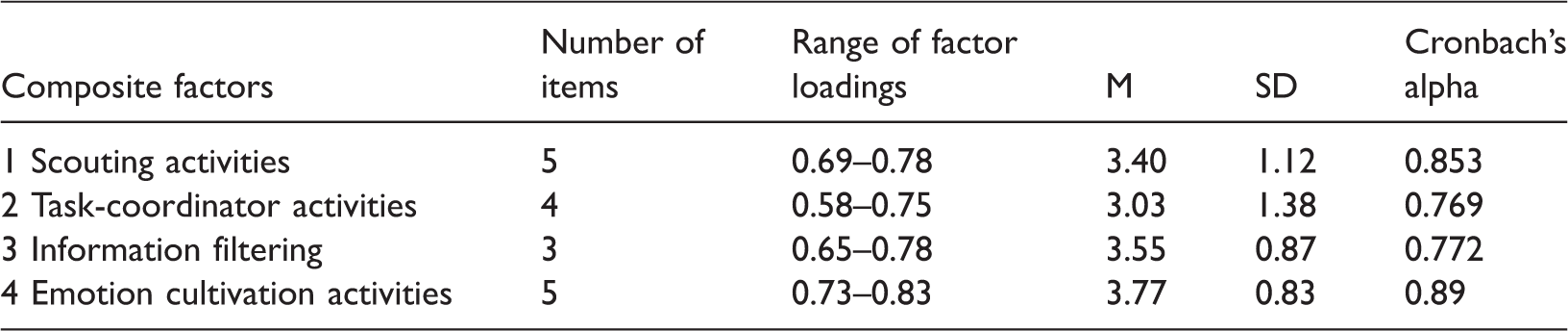
Four factors operationally defined.
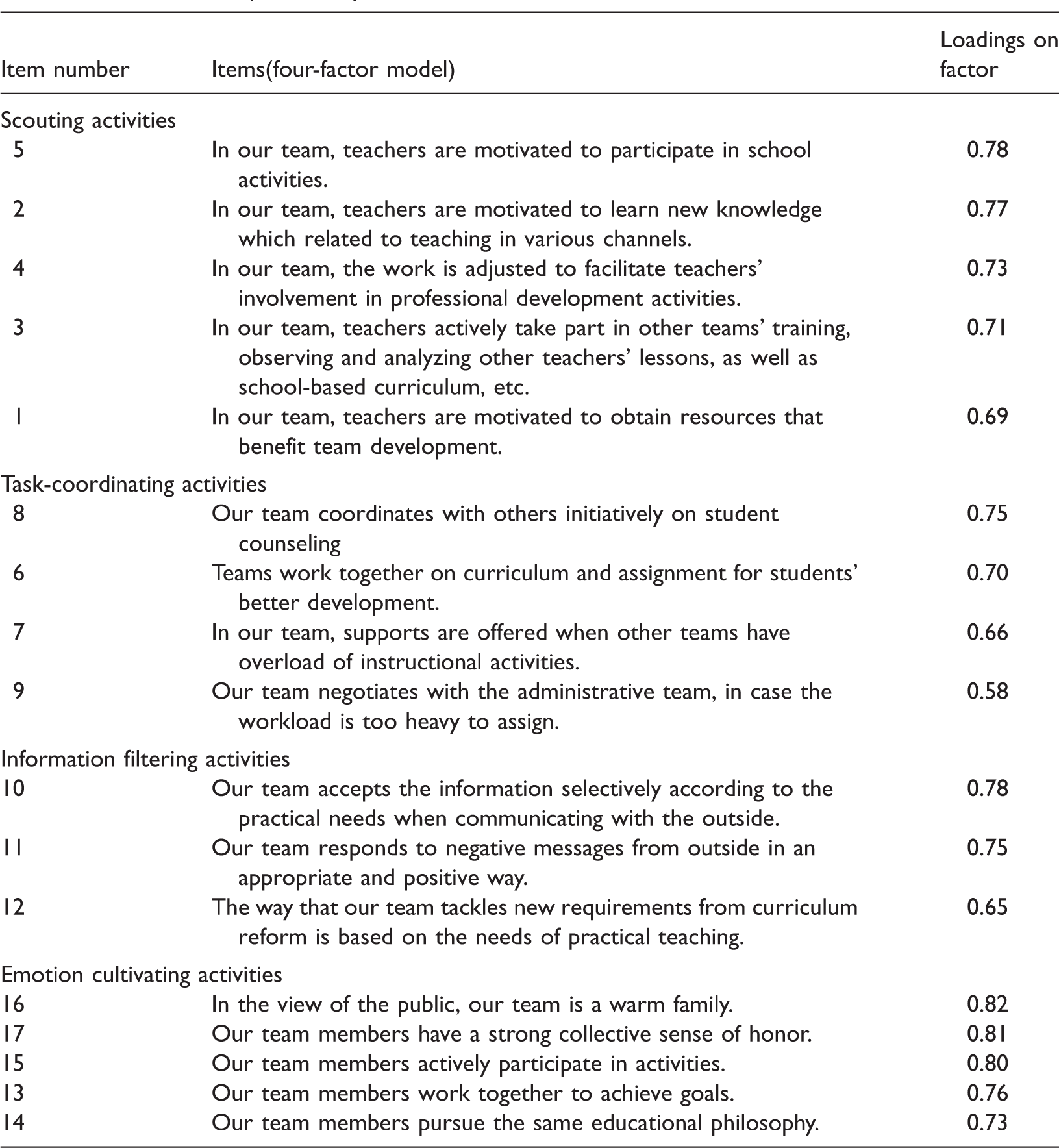
Range of factor loading, descriptive statistics, alpha coefficients for the four-factor team boundary activities
Discussion
From the inductive approach and factor analysis, a four-factor model was proposed for teacher team boundary activities in middle schools. Compared with the existing literature, we discussed the findings as follows.
Common team boundary activities' dimensions
The first common dimension refers to the scouting activities. In the process of globalization, a large-scale reform in the field of education in China has been witnessed. Educational reform has had an enormous influence on educational theory and practice, which has affect classroom teaching in China. Conflicting opinions exist regarding the relative influence of the new educational practices and the new curriculum values during the implementation of educational reform (Yin et al., 2014). This has led to a call for relevant information, guidance, and support from outside to deal with the curriculum reform. Scouting activities are especially salient under the background of education reform for teachers. However, it is worth mentioning that teacher teams pay more attention to the information closely related to subject examinations, and neglect mental health and learning issues which are beneficial for long-term development of students. We can conclude that examination orientation is still dominating basic education in China (OECD, 2011; Yin et al., 2014).
The second common dimension refers to the task-coordinating activities. Researches indicate that successful schools share characteristics such as collegiality, high academic expectation and collaborative culture (Peterson, 1994). In order to improve teaching quality, teachers not only need to learn from each other within their teams, they also have to connect with other teachers or even school leaders to co-construct knowledge about teaching and get the needed support. However, it cannot be ignored that task-coordinating activities mostly happen among similar disciplines within the school. Limited collaboration exists in different disciplines because they lack shared short-term goals. Task-coordinating activities take place between teachers and school leader teams confined to teaching affairs. In the Confucian cultural tradition, because of the high power distance (Hofstede et al., 1997), teachers tend to obey the authority of leaders, and they think that decisions should be made by the leaders (Hallinger and Kantamara, 2000). This is a possible reason that explains why teachers in China have little voice in school decision-making and take for granted the decisions that are made for them. Chinese parents value education highly; however, home–school cooperation in China is still superficial. Unlike in Britain and the USA, Chinese parents are only concerned about the academic performance of their children, instead of paying close attention to the function of school and contributing to the development of school (Feng, 2011). It thus comes as no surprise that task-coordinating activities between teacher teams and parents are rare.
The third dimension refers to the activity of selective absorption of information. In daily school life, teachers play the role of gatekeepers that adopt information according to their needs. As has already been noted, on one hand, educational practices based on Western educational philosophy may not fit neatly within the Chinese culture. On the other hand, educational resources in China are unevenly distributed. Educational practices popular in the urban schools may not be suitable for schools in the West. Also, differences exist in different schools, especially between the key schools and weak schools. Teachers should not accept the educational reforms without criticism, and need to select the appropriate information for the actual situation when teaching.
Extended team boundary activities' dimensions
A striking finding in this study is that the ethical obligation is useful to promote team cohesion. More specifically, the ethical obligation results from the ethical attribute of teachers in traditional culture. Heaven, Earth, emperor, parents, and teachers are the five categories of superior role figures in Confucianism society (Weber and Ch'ing K'un Yang, 1964). As the old saying in China states, his/her teacher should be treated as the father. Teachers play a significant role in China and high ethical expectation is endowed upon them. The role we believe we are playing will influence our behavior. Therefore, with this restraint of morality, teachers should spend more time and effort on their teamwork without considering any rewards. Also, Clan culture is supreme in China’s value system and has had the highest level of effectiveness in terms of employee morale. Chinese people tend towards the team structure and also expect to be immersed in such feelings as “family” in the team. This is a more durable inherent power, motivating members to be dedicated and loyal to the team rather than pursuing individual interest and honor.
Lacking team boundary activities' dimensions
The first lacking dimension is ambassador activities. Examples of ambassador activities included propagandizing others to support the team, lobbying for needed resources, and protecting teams from negative threats that the team may face (Ancona and Caldwell, 1990). As is well-known, unlike the production process in factories which can be supervised at any time, students’ progress is invisible and subtle. It is hard for teachers to demonstrate the progress of students exactly. In addition, the Chinese educational system is still centralized and the school budget is strictly managed by administrative departments of education. The budget allocated to each subject-based “teaching-study” team is fixed every year. So, it is hard for teachers to get extra resources through demonstrating their competencies. With regard to the negative threats from outside, most interviewees believed that they enjoyed great professional autonomy in their work and are hardly affected by outside influences. China’s social culture emphasizes respect for teachers. According to the “2013 Global Teacher Status Index” (Varkey GEMS Foundation, 2013), China ranked number one in terms of respecting their teachers. Currently, teachers in China win more esteem and trust compared with teachers in Western countries.
Boundary activities of selective information output mentioned in existing literature and our interviews were not reflected in questionnaires. According to the interview data, teachers mentioned that they were reluctant to share extremely valuable teaching resources and personal experiences with other teams in the interviews. One reason is that exam-oriented education is still dominant in China. Academic performance of students accounts for a high proportion of the teachers' evaluation system. In addition, teachers want to show a positive image to outsiders and filter out negative information. In the view of most people in China, the practice of selective information output is a kind of disgrace. Our data are collected from the self-reported study instruments, so we conclude that respondents’ reservation of opinions has caused the errors. More research is required to verify our current speculations.
The third lacking dimension is the boundary reinforcement actions through the effects of team image and team goals that are frequently mentioned in the questionnaires designed by Ancona and Caldwell (1992) and Yan and Louis (1999). In this research, teachers talked less about the team image and team goal. Why are those activities not prominent? Evidence from both the literature and further communications with teachers can explain this phenomenon. Though different subject-based “teaching-study” teams have their unique characteristics, they have some similarities about their teaching skills. More important is the development of students' results from the collaboration of all teachers. It is difficult to distinguish the images and goals from different teacher teams.
Conclusion
Effective boundary management is more important than before, since the environment and tasks that teachers face are becoming increasingly complex in the global era. To date, most scholarly work exploring teacher teams centered on the internal team processes. Boundary activities offer a more interesting and comprehensive perspective to explore the operation of the teacher team. Through the inductive study and factor analysis, we identified a four-factor model of teacher team boundary activity in China, which has enriched the researches of boundary activity in the distinctively cultural and organizational contexts. Obviously, there were a number of limitations that are needed to be noted here. First, research samples in this study were chosen from the eastern coastal region of China. Compared to other regions, the eastern coastal region is wealthier than the rest of China and its socioeconomic status and available education resources are more favorable, so this region is not representative of the rest of China. Further research is needed to verify our assumptions. Second, we need more research to test whether activities of selective information output really exist.
There are several potential directions for future research. Firstly, future research should attempt to diversify the research methods employed in the study of boundary activities. Most of the previous researches on boundary activities employed horizontal, quantitative study; however, qualitative study and longitudinal data are needed to deeply explore the logic of action of boundary activities. Secondly, according to the theories of transaction cost and social role, time costs, coordination costs, role conflict and role overload are inevitably correlated to boundary activities. However, the recent researches which mainly focus on the positive effects of boundary activity are biased and insufficient; these researches should only be considered when the costs are really worth pursuing and mental preparation has been done by the schools and teachers. Finally, the concept of boundary activity is proposed by Western scholars in the global era and numerous studies have attested to the benefits of it in the context of researching companies. Though this is not a uniquely Western practice in the context of researching companies and a few similar studies definitely exist in researching teacher teams, only limited studies have so far been conducted with regard to teaching teams. Given the different social cultures between these countries and different organizational characteristics between schools and companies, differences may exist in the preferred boundary activity and the effect of boundary activity which need to be explored in future.
Footnotes
Declaration of Conflicting Interests
The author(s) declared no potential conflicts of interest with respect to the research, authorship, and/or publication of this article.
Funding
This research received no specific grant from any funding agency in the public, commercial, or not-for-profit sectors.