



Abstract
In this article, I analyse some of the transnational ‘authoritative’ policy documents on teacher education and teacher development from a cosmopolitan perspective. The purpose is to explore the possibilities for analysing the characteristics of teacher education and the role of the teacher in transnational texts from a cosmopolitan perspective in order to explore the field of tension between an economic cosmopolitan approach and a moral cosmopolitan approach to justice. Mainly drawing on Amartya Sen and Martha Nussbaum, I argue that it is possible to go beyond a limited economic perspective in order to make an alternative approach to teacher education visible, where the possibility to revitalize and reconstruct local school activities is in focus. One conclusion is that teacher education in transnational policy texts can be understood both within a ‘reification discourse’ and within a ‘reflexivity discourse’. An important distinction between the two discourses is the understanding of critical reflections as related to evidence-based standards or to an understanding of an individual’s positionality, relationality and historicity.
Introduction
Global processes are transforming education policy around the world in complex ways, with implications for local regions and schools. Over the past few decades, a new, global neo-liberal policy paradigm has emerged, and it is important to resist its negative effects and to point to alternative ways by formulating a different and more just and democratic internationalization of education policy with a broader concept of the purpose of education (Rizvi and Lingard, 2010: 3). Instead of unilaterally responding to educational and social challenges by introducing education marketization, quality assurance and standard-based curriculum, we could instead envision teaching as cosmopolitan work, and teachers and students “as world citizens, thinkers, intellectuals, and critics” (Luke, 2004: 1430). Is it possible to find such a conception of the teacher as a cosmopolitan actor from a base in transnational policy documents that are usually regarded as an expression of the core of a neo-liberal paradigm? (c.f. Robertson, 2013). Policy documents from the Organization for Economic Co-operation (OECD) or the European Union (EU) are expressing neo-liberal policy agendas through their support for an increasing commodification of knowledge (Ball, 2007), a ‘soft’ governing by numbers (Grek, 2009), benchmarks and standards (Lawn, 2011) and a new role for knowledge in policy-making in terms of ‘scientization’ (Grek and Ozga, 2010). The two Intergovernmental Organizations (IGOs), the EU and the OECD, and several private, multinational companies with an interest in the field of education, such as McKinsey & Company or Pearson Education, are certainly acting from an economic-interest base, but the question posed in this article is: is it possible to understand the global and economic dimensions in education and in people’s lives in other terms than ‘neo-liberal’? Can we challenge the neo-liberal dominance by going back to some of its key sources and ‘re-read’ these documents with the aim of finding another characteristic of globalization; that is, a possibility to revitalize and reconstruct local institutions such as schools? (see Ozga and Lingard, 2007: 79).
Historically, the work and workplaces for teachers have been sub-nationally organized, but in current times the governing technologies are supporting a shift of sovereignty and authority away from the national and the teacher to global actors (Robertson, 2013: 93). The political projects will always be contingent, contested and open to transformation, and I will argue for a need for researchers to point out not only the risks but also the possible alternative interpretations and ‘hidden possibilities’ in an otherwise dominating neo-liberal view of the role of the teacher in education policy. By not observing the alternative interpretations and possibilities, there is a risk of overlooking vitalizing dimensions in the relationship between the global and local, and of iterating a neo-liberal terminology instead of taking a critical stance by using the vocabulary of ethics.
The purpose of this article is two-fold: first, to analyse the characteristics of teacher education and the role of the teacher in transnational authoritative 1 texts from a cosmopolitan perspective; and second, to explore the field of tension between an economic cosmopolitan approach and a moral cosmopolitan approach to justice in the transnational policy arena of teacher education. With reference to Kleingeld and Brown (2006), economic cosmopolitanism represents a striving to establish a common, global, economic market with free trade and deregulation as main features in what is mostly understood as a neo-liberal perspective. Instead, moral cosmopolitanism represents the view of having obligations to human beings in general, of providing aid and of respecting and promoting basic human rights and justice. In the following, I distinguish between economic cosmopolitanism, described above in neo-liberal terms, as a ‘human capital approach’, and an ethico-political approach to economic cosmopolitanism, in terms of equity, redistribution and living a good life (c.f. Papastephanou 2012: 231), as ‘the capabilities approach’.
In the first part of the article, I examine the relation between cosmopolitanism and the capabilities approach – a relation that is still under-developed within the field of studies of education policy. There are studies drawing on a capabilities approach to education policy without explicitly linking it to cosmopolitanism (e.g. Terzi, 2010; Unterhalter and Brighouse, 2007; Vaughan and Walker, 2012; Wahlström, 2014) and, more seldom, a cosmopolitan perspective on policy without explicitly linking it to the capabilities approach (e.g. Unterhalter, 2008). Thus, studies that explore the field of tension between cosmopolitanism and the capabilities approach within education policy are rare. The first section of this article formulates the analytical framework for the text study; the second section presents the result of the analysis of transnational policy documents on teacher education, based on a cosmopolitan perspective in terms of the capabilities approach. The third and concluding part defines and discusses the difference between the two perspectives of an economic cosmopolitan approach and a moral cosmopolitan approach to teacher education policy.
The text analysis is based on three main documents on teacher education, and a number of follow-up documents linked to each of these key documents. The key documents are produced by two different IGOs and one private multinational company: Teachers Matter (OECD, 2005); Improving the Quality of Teacher Education (European Commission, 2007a); and How the World’s Best-Performing School Systems Come out on Top (Barber and Mourshed, 2007).
Analysing educational policy documents from a cosmopolitan perspective
In recent years there has been increasing interest in discussing education from a cosmopolitan perspective among philosophers and educational researchers, albeit from sometimes very different angles. In her well-known book Cultivating Humanity (1997), and in subsequent texts, Martha Nussbaum took as her starting point in the Ancient Greek Cynic philosopher Diogenes and the Stoics when she argues for an education for ‘world citizenship’. The Stoics developed the concept of the kosmopolitēs, or world citizen, to include two communities: the local community where you are born and raised, and ‘the community of human argument and aspiration’ encompassing all human beings (Nussbaum, 1997: 52). With its starting point in classical cosmopolitanism, there is a large ongoing debate on how the question of loyalty to others can be understood (e.g. Appiah, 2005, 2007; Hansen, 2011) and from what different perspectives cosmopolitanism might contribute to education (e.g. Luke, 2004; Hansen, 2008; Pinar, 2009; Rizvi, 2009; Roth, 2011; Todd, 2007; Papastephanou, 2012, among others).
The relation between cosmopolitanism and the ‘capabilities approach’, with Amartya Sen and Martha Nussbaum as its proponents, is still somewhat ambiguous concerning the implications for education. Nussbaum (2014) claims that she distinguishes between an ethical perspective on cosmopolitanism and the capabilities approach as drawn from principles of justice. Nussbaum nevertheless seems to propose a similar three-part model for education, whether her starting point is based on the capability approach or in a cosmopolitan perspective. In her article on education and democratic citizenship in Journal of Human Development, 2 Nussbaum (2006) starts from the capabilities approach when suggesting a model for the development of young people’s capabilities through education: critical thinking, world citizenship and imaginative understanding. This is basically the same model of education in terms of self-reflection, world citizenship and the narrative imagination as she elaborated in her book Cultivating Humanity (Nussbaum, 1997) based on an ethical understanding of cosmopolitanism.
Nussbaum understands the capabilities approach as a way to formulate a basic social minimum for a life ‘that is worthy of the dignity of the human being’ and she makes a list of 10 central human capabilities. 3 She argues that education is ‘a key to all the human capabilities’, and that the ‘global sphere… can do a great deal more to promote universal primary and secondary education’. Education should not only be the provider of facts and skills, but more importantly ‘a general empowerment of the person through information, critical thinking and imagination’ (Nussbaum, 2007: 322–323). She is again building on her three-part model for education based on ethical cosmopolitanism, even when she discusses education as a principle to promote basic human capabilities as a political principle of justice. It is above all Nussbaum, and not Sen, who has shown an interest in both cosmopolitanism and the capabilities, although, she argues, not at the same time (Nussbaum, 2014). However, both Sen’s and Nussbaum’s engagement in global justice and education places them within a group of researchers with an interest in the theme of cosmopolitanism (Unterhalter and Walker, 2007: 242). The scope of the capability approach, as a philosophical work applies ‘to all human beings’ and to ‘the social ethos and to social practices’ in society (Robeyns, 2011: 18).
In sum, the capabilities approach can be viewed as a part of an ethical, economic cosmopolitanism, influenced by values from political and moral cosmopolitanism in its arguing for a bottom-up perspective on human capabilities, while acknowledging the need for institutional support (Hansen, 2011). From the two main strands in recent thinking about cosmopolitanism, as a principle of justice and as a principle of culture (Scheffler, 2001), I argue that the capabilities approach should be categorized in the strand of cosmopolitan justice, based on moral cosmopolitanism. 4 According to Amartya Sen, there is a strong case for seeing poverty as deprivation of basic capabilities and not only as a lack of income and wealth. The shift in perspective from lack of income to the deprivation of real capabilities to influence one’s life gives a ‘more directly relevant’ and important view on poverty ‘not only in the developing countries but also in the more affluent societies’ (Sen, 1999: 20). Thus, the capability approach can serve not only as an analysis of inequality in developing countries but also as a framework for policy analyses and evaluations in economically developed communities (Robeyns, 2011: 9).
Freedom and fairness as central ideas
For Sen (1999, 2009), the basic building block in his analysis of economic and social development is the freedom of individuals. To grasp the concept of freedom in a sufficiently broad way, he distinguishes between the process aspect of freedom (functioning), which allows for taking actions and decisions, and the opportunity aspect of freedom, the actual prospects that people have in a given situation (capability). The substantive individual freedom, a freedom to do the things one has reasons to value, is the critical point in Sen’s reasoning, and he regards freedom as an important function to help oneself reach one’s goals, but also to influence the rest of the world. To act as an “agent” is understood as bringing about change in one’s own life as well as being part of a public, acting as a participant in social, economic and political areas. Individual freedom is quintessentially a social product, and there is a two-way relation between (1) social arrangements to expand individual freedoms and (2) the use of individual freedoms not only to improve the respective lives but also to make the social arrangements more appropriate and effective (Sen, 1999: 31). The capacity to aspire provides an ethical horizon within which more concrete capabilities can be given meaning, substance and sustainability. Conversely, the exercise and nurture of these capabilities verifies and authorizes the capacity to aspire and moves it away from wishful thinking to thoughtful wishing. Freedom … has no lasting meaning apart from a collective, dense, and supple horizon of hopes and wants (Appadurai, 2013: 193).
Walker and Unterhalter have discussed the potential of the capabilities approach for the field of education in greater detail (2007: 2). From a capabilities approach, they criticize ideas in policy and evaluation based on the prerequisite that learning outcomes or skills sets should be formulated from what an economy needs. A central feature for the capabilities approach is that each person must be treated as an end, not as a means to economic growth or social stability. This should, as Walker and Unterhalter note, not be understood as an individualistic framework for libertarian views of self-actualization. Instead, the capabilities approach is based on ethical individualism, a normative approach claiming that individuals are the primary objects of moral concern (Walker and Unterhalter, 2007). As Robeyns (2005: 107) notes, it is important to distinguish between ethical individualism and ontological individualism; the latter embraces the idea that all social entities can be reduced to individuals and their properties, thus making claims about the nature of human beings. Ethical individualism, on the other hand, does account for social relations and societal structures by recognizing their constraints and opportunities. The individual aspect of freedom is thus related to the effect that social conditions and social arrangements have on individuals. Both Nussbaum and Sen observe the gap between formal freedoms and effective, substantive freedoms, stressing the multidimensionality of human freedom (Garnett, 2009).
A link between cosmopolitanism, capabilities approach and a moral claim for social justice
There are both similarities and differences in Nussbaum’s and Sen’s concepts of capabilities. They agree about Sen’s attempt to create a space for understanding quality of life as what people actually are able to do or to be. But only Nussbaum bases her understanding of the capabilities approach on an Aristotelian and Marxian idea of ‘truly human functioning’, and only Nussbaum explicitly relates the capabilities approach to each and every person, as ‘a list’ (Nussbaum, 2000: 13). Further, while Nussbaum emphasizes the notion of ‘human dignity’, Sen stresses the notion of ‘public reasoning’; what people have reason to value (Robeyns, 2011: 14). Viewing the approaches by Sen (1999) and Nussbaum (2006) as complementary, an analytic framework comprising the following five capabilities can be formulated:
a capacity to choose the set of functionings one has reason to value for living the kind of life one wants to lead and to be the person one wants to be (Sen, 2009; Robeyns, 2005) a capacity to act as a member of a public (Sen, 1999) a capacity to consider oneself as a citizen in a society, in a nation and in the world a capacity for critical examination of one’s own life as well as that of others a capacity to develop an imaginative understanding for other people’s lives (Nussbaum, 2006, 2007)
The terms ‘competencies’ and ‘capabilities’ are both frequently used with different meanings within the field of economic cosmopolitanism. In this article, I understand competencies in line with the EU definition: as a combination of individual knowledge, skills and attitudes appropriate to a certain (workplace) context (European Commission, 2007c), within a human capital sphere of economic cosmopolitanism. Capabilities, on the other hand, are understood here as contextualized by a broader social and economic environment with a focus on the capabilities needed to support agency and to achieve a range of outcomes (Wheelahan and Moodie, 2011). By evaluating the capabilities, and not the functionings (the outcomes), the capabilities approach has contributed to the field of social justice in education in a significant way, since it includes the substantive possibilities of agency in relation to material and social resources as well as issues of identity (Walker and Unterhalter, 2007: 7). When school is regarded as a transformative space through which students can contest or change inequalities, the focus will be on human agencies and on the removal of substantial ‘unfreedoms’ through education (c.f. Garnett, 2009: 441). In a critical response to the more general welfare-economy argument, Sen argues that we must look into the space between resources (chances) and achievement, and look at the freedom that people really have to choose the achievements they value. The issue is not about individual values as such, but about ‘capabilities that we have reason to value… after self-reflection and open debate’. Thus, the capability approach entails ‘a critical engagement with all social, cultural, and other factors that shape people’s preferences… and thus influences which choices are made from the freedom we have’ (Unterhalter, 2007: 100). In this sense, the capabilities approach serves as a critical framework for analyses in education research.
Drawing on the perspective that education is a basic need and a fundamental right for all (Nussbaum, 2000; Sen, 1999), and with Nussbaum’s words ‘the key to all the human capabilities’ (Nussbaum, 2007: 322), teacher education concerns all nations, and we can ask, from a cosmopolitan perspective, which ‘sets of capabilities’ a specific conception of teacher education promotes.
Teacher education in transnational policy text
In the following analysis of transnational policy documents from two IGOs, the EU and the OECD, and one multinational private company, McKinzey, on the theme of teacher education and teachers’ in-service training, I outline the result based on the analytic framework of the five capabilities accounted for above.
To develop a capacity to choose the set of functionings the teacher has reason to value and to be that teacher one wants to be, a main task for initial teacher education is to provide skills for reflective practice and research within the profession, alongside pedagogy related to school subjects. The ‘role model’ for the effective teacher is an active and reflective professional who continuously reflects over her or his own practice and pedagogy approaches in relation to the students’ needs, learning outcomes and achievements. According to both the OECD (2005: 14), and the EU (European Commission, 2007a: 3), one of the main policy challenges for the Member States will be to respond to the need for effective teacher development; that is, to strengthen the teachers in their roles as active and reflective professionals who analyse their own practice and their students’ outcomes in relation to (international) standards for student learning. An effective learning environment should, according to the OECD (2012: 137), be non-excluding, and the social factor is particularly emphasized as effective when it takes place in group settings, as an explicit strategy of learning in which learners collaborate. Further, it is stressed that the curriculum should develop student learning about ‘real world problems’ instead of focusing on topic coverage 7 (OECD, 2012: 138).
One main idea within the school effectiveness movement is that collaborative practices develop routines of instructional excellence in the teaching community through collective studies of what actually works in the classroom. The focus is supposed to be directed at details in instruction, not only with the purpose of improving one’s own practice but also of improving the classroom practices of all other teachers. Collaborative work is a prescribed and overall working method that enables teachers not only to take control of their own professional development, but also to take responsibility for professional norms and for all students in their school (Mourshed et al. 2010: 75).
In developing a capacity to act as a member of a public, a significant function is a sense of ‘self-respect’ and ‘self-confidence’ and this, in turn, is linked to the status of teaching education and the teaching profession in society. The human capital discourse is focused on attracting talented people to teacher education so that the teaching in schools is ensured to be of high quality. The key to developing a top-performing school system is to attract proficient teacher students. Effective selection processes and a good starting salary will help to get the ‘right’ applicants to become teachers, and this will bring status to the teaching profession and create a positive spiral for recruitment, according to a report from Mckinsey & Co (Barber and Mourshed, 2007). In other texts, the capacity for a teacher to act as a member of a public is highlighted as dependent on a basic social dialogue; that is, sharing, consultation and negotiation on issues concerning the teaching profession: educational objectives and policies, rights and responsibilities, conditions for effective teaching and learning and the like. An important prerequisite for such social dialogues is a democratic culture and respect for laws, rules and institutions that allow individuals to express themselves; for teachers, this means respect for their professional freedom and independence and opportunities to take part in discussions and decisions concerning professional issues such as curricula, pedagogy, student assessment and the like (UNESCO, 2006: 7–8). Thus having the capabilities needed for taking part in social dialogues with relevance for education is part of having the capacity to act as a member of a public.
The capacity to consider oneself as a citizen in a society, in a nation and in the world reflects the fact that the concept of citizenship is steadily broadening and changing. The concept of citizenship needs to be released from a solely legal meaning and be given a much broader meaning when used in education, where one of the main objectives ‘is to give them [the children and young people] the knowledge, values and skills they require for participation in society and to contribute to their own and society’s well-being’ (Eurydice/EU, 2005: 59). In emphasizing civic values such as democracy, human rights, equality, participation, tolerance of diversity, social justice and so on, as well as the knowledge and exercise of rights and responsibilities, the Eurydice network discusses citizenship in terms of ‘responsible citizenship’. ‘Citizenship education has to be conceived as embracing all members of a given society, regardless of their nationality, sex, or racial, social or educational background’ (Eurydice/EU, 2005: 59).
It is noted that a cosmopolitan view resonates with a present-day experience, in which many people feel a necessity to cross national borders in order to encompass their entire identity. ‘The intimate moments that make up our daily lives are inextricably bound up in a larger global narrative’ and school plays a key role in introducing students to a cosmopolitan ethic of care and to ‘encourage students to think deeply about their identity, place in the world, and responsibility to a global society’ (Hinton, 2012: 410). In a world of globalization, all members in the global society, more or less, are understood as having multiple, overlapping identities with various forms of local, national and global loyalties. Ethically based cosmopolitanism is grounded on a framework of the United Nation’s Universal Declaration of Human Rights and the Rights of the Child (Hinton, 2012: 416).
The teacher’s ability to teach well in relation to multiculturalism and diversity is very much on the agenda for the OECD and the EU. Such ability is regarded as urgent, since education is seen as the important way out of socio-economical marginalization and poverty. In a globalized world, nearly every classroom can be regarded as a place of diversity and of encounter with the other (European Commission, 2007a; OECD, 2012). In this sense, teachers need to develop a capacity for critical examination of their own life as well as that of others. ‘The skills and qualities that teachers require to teach effectively in culturally diverse settings are the same as those they will need to teach effectively in any other setting’, since teaching should respond to the unique needs and aptitudes of each individual learner (European Commission, 2007b: note 33). 8 Teacher competences therefore need to be described in a way that promotes teacher agency, reflecting the culture and context in which they will be used, and the Member States should take measures ‘to ensure that the composition of the teaching workforce fully reflects the diversity of society, and in particular remove obstacles to culture and gender balance at all levels’ (European Commission, 2007a: 15).
From a more problematizing perspective than that offered in ‘mainstream’ policy documents, Bishop (2010) argues that teacher students, facing a long-term status-quo of ethnically based educational disparities, need to examine and reflect on how they construct and understand the complex historical experiences of minority and migrant students. To gain insight into and understand their own perceptions of the situation, teacher students need to build up an imaginative understanding for other people’s lives. By taking the position of reflectivity of one’s own construction of ‘the other’ and using one’s imagination to get a more clear understanding of the other person’s educational, social and cultural experiences, relationships are placed at the centre of the educational task (Bishop, 2010: 123). A relational understanding of education implies that teachers can act, can take initiatives and can adapt their conduct; in short, that they can influence the educational relation to the students – instead of locating problems solely in the students’ home backgrounds or in the school structure.
An important factor for teaching quality and for teacher competence is a basic understanding that people can live their lives in many different ways; that is, a capacity to develop an imaginative understanding for other people’s lives. This capability is closely linked to a wider social understanding of the meaning of diversity. The OECD project Teacher Education for Diversity (TED) explores the factors underlying increasingly multicultural societies and diversity. This interest in the theme of diversity on the part of the OECD can be explained by the fact that, according to the PISA assessments of 2003 and 2006, family background, socio-economic context and migration status are the main determinants of student performance, with greater influence than the school’s activities. The basic argument in the TED project is that diversity is a complex concept that is potentially positive, for educators as well as for societies (Burns and Shadoian-Gersing, 2010: 21). 9
Transnational policy discourses on teacher education: A cosmopolitan alternative
In the genre of transnational educational policy texts, teacher education is related to the knowledge-based economy, though not necessarily in a clear and unilateral way. On the one hand, there are strong social forces for treating education as global private goods within a market environment, with superiority and subordination concerning whose knowledge, culture and history counts. On the other hand, there is always also an opportunity for teacher education and for higher education in general to develop a sense of global public goods, including knowledge dissemination, cultural understanding, global and cosmopolitan perspectives etc (see Marginson, 2007).
Despite the emerging centrality of ‘the teacher’ in transnational policy documents, the emphasis is mainly placed on teacher development or the role of the teacher in general, and to a lesser extent on teacher education. There is also a concern in international policy texts due to a persistent lack of in-service training for teachers in most of the countries. A possible explanation of the rather obscure relation to teacher education in transnational policy documents might be that the range of teacher competencies that are identified through research and students’ knowledge assessments in terms of effective teaching are personal competencies that will only become evident when the teachers are working in a school (e.g. communication skills, ability to relate to individual students, classroom management skills, etc.). The argument is that formal, measurable attributes are necessary but insufficient, and that many skills 'will be best developed once people are working as teachers rather than through pre-service education' (OECD, 2005: 101). From this starting point, it might seem logical that the policy aim is directed towards in-service training and towards the promotion of a learning environment for teachers in their everyday work.
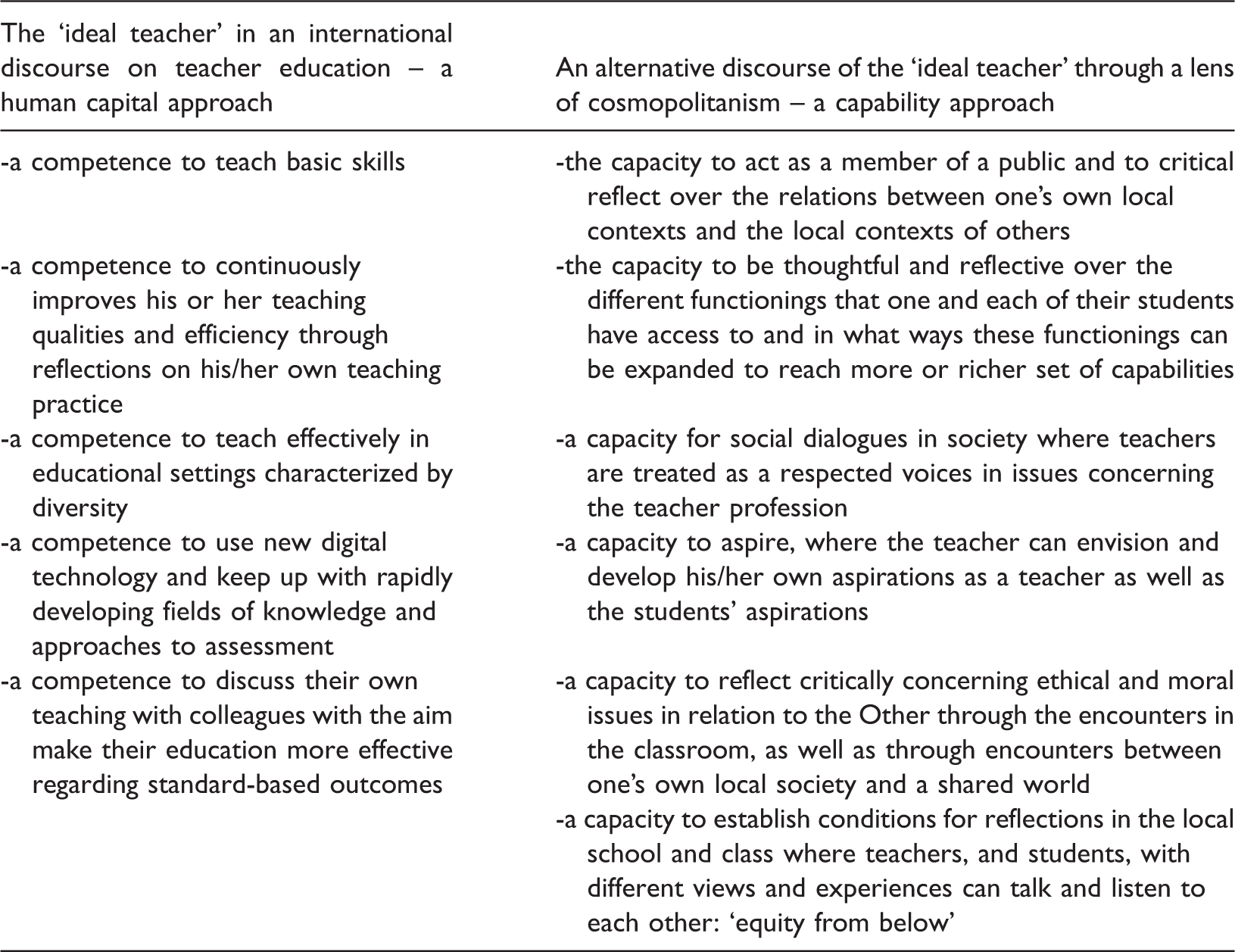
In the analyses, it is possible to note a certain convergence in the policy documents concerning a need for developing the role of the teacher. In a time of social change and transformation, the role of the teacher is also changing and becoming more complex. The ideal teacher is a person who has the capacity to teach basic skills, who continuously improves his or her teaching qualities and efficiency through reflections on his/her own teaching practice, alone or together with colleagues, and who has the capacity to teach effectively in educational settings characterized by diversity. The teacher should be able to effectively teach students with different languages and backgrounds, as well as disadvantaged students and students with learning problems. At the same time, teachers are expected to use new digital technology and to keep up with the rapidly developing fields of knowledge and approaches to assessment (Barber and Mourshed, 2007; European Commission 2007a; OECD, 2005). This discourse of economic cosmopolitanism within a human capital approach understands effective teaching as a form of ‘universal’ and decontextualized ability that can be applied worldwide. A prominent feature of this discourse is its global educational synchronization; that is, teacher students and teachers around the world are supposed to learn certain competencies necessary for ‘our’ time at the ‘same’ time, thereby neglecting the diachronic temporal perspective that also includes contextualized social and historical aspects (see Papastephanou et al., 2012).
However, as suggested earlier in this paper, economic cosmopolitanism can also be understood from ethico-political points of view concerning redistribution of wealth, responsible sustainable development and a good life for all in line with moral cosmopolitanism in terms of social justice. A conclusion from this study is that a cosmopolitan economic approach, if it is to be called cosmopolitan, needs to recognize the relational and diachronic perspective clarified within Sen’s and Nussbaum’s capabilities approach, focusing on people’s real and actual freedom to make choices of desirable functionings; that is, their effective capabilities. With this perspective, both economic and policy matters can be interpreted and understood within a relational moral cosmopolitanism, and an alternative discourse of teacher education and teachers’ curriculum work becomes visible. While teacher competence within a human capital approach emphasizes an ability to reflect over the teacher’s own teaching practice, aiming at making the teaching more effective in terms of improved test results here and now, a capability for self-reflection represents teachers’ broader moral obligations in relation to their students’ ‘real’ access to capabilities, taking historical, social and cultural aspects into consideration, and striving for the removal of hindrances within the educational environment.
The relational aspect of moral cosmopolitanism stresses the teacher’s freedom to act as a member of a public and to critically reflect over the relations between one’s own local contexts and the local contexts of other people, over one’s own life as well as that of others in an interconnected and globalized world. It requires a capacity to consider oneself as a citizen both in a local society and in the wider world, and a capacity to develop an imaginative understanding of how different relations and inferences might affect other people’s lives and ways of thinking. The capabilities needed for each student teacher and teacher within this discourse are the capabilities not only to reflect on academic outcomes, but also to relate these outcomes to moral questions of fairness and equity, going beyond the mainstream argument of ‘access to’ or ‘the same chance to’ education that is dominant in a human capital approach. Instead, it urges the teachers to be thoughtful and reflective over the different sets of capabilities that each and every one of their students has access to, and in what ways these capabilities can be expanded to reach more or richer functionings, be they improved academic results or an experience of recognition and fairness.
The positioning of the teacher within a ‘discourse of capabilities’ is, within the framework of this article, understood to be a teacher who is treated as a respected voice in issues concerning the teaching profession: educational objectives and policies, rights and responsibilities, conditions for qualitative good teaching and learning and so on. Using Appadurai’s terms, the teacher is a person who has the capacity to aspire, who can translate and give colour and shape to the possibilities of his/her own aspirations as a teacher as well as to the students’ aspirations within a specific society, thereby navigating in relation to the opportunities in ‘real life’. The critical reflections in this discourse are not limited to a defined area of academic achievements; rather, they concern ethical and moral issues in relation to the Other, through the encounters in the classroom as well as those between one’s own local society and a shared world, with the moral obligations on issues of social justice and equity that these encounters may involve (see Appiah 2007). The capacity for critical examination of one’s own life as well as that of others starts in the local society, with a potential to go beyond these boundaries. So the conditions for reflections need to be established in the local school and class, where teachers, and students, with different views and experiences can talk and listen to each other; that is, as 'equity from below' (Unterhalter, 2009: 422). Following Kant, Roth (2012: 263) argues that we have to specify together 'the highest good in the world, that is, general and not personal happiness' to make ourselves autonomous.
Two alternative views of the emphases of teacher education and teacher development in transnational policy texts: through a human capital approach and through a cosmopolitan/’capabilities’ approach.
Concluding remarks
The results of the analysis in this study show that teacher education in international policy documents is mainly discussed in terms of a ‘human capital’ discourse, based on economic concepts of promoting basic skills and competencies as well as teaching efficiency. However, by examining the policy documents from a perspective of cosmopolitanism, it is also possible to go beyond a limited economic perspective by making an alternative approach to teacher education visible. The concept of critical reflection has proved to be central for an understanding of the basic difference between the two discourses in this study.
In the first discourse, the teacher’s role in relation to inequality is understood to be that of an effective instructor working with the curriculum in accordance with ‘best practice’ in a top-down perspective; reflecting on his or her own instruction practice in relation to best practice for instruction in environments characterized by diversity. This approach to handling policy recommendations as inevitable measures in response to global processes, without leaving any room for manoeuvre or alternative actions for political agencies, or for institutions as teacher education, represents a form of reification of educational policy and of teacher education (Rizvi and Lingard, 2010: 44; Schumann, 2012). In such a ‘reification’ discourse, the critical reflections first and foremost concern the teacher’s own practice in terms of student outcomes, in relation to ‘evidence-based’ policy and teaching.
In the second discourse, where inequality is related to a more inclusive idea of capability deprivation, the teacher’s role is understood to be related to local curriculum development based on deliberative conversations and self-reflection, an awareness of power relations, and a cosmopolitan orientation from a bottom-up perspective. This approach opens up a space for a reconstruction of local school activities related to an awareness of global interconnectedness. Drawing on Beck (2006), Rönnström (2012) connects self-reflection with the self-reflexivity of the (second) modernity, in facing global risks, insecurity and unforeseen side effects of a multidimensional globalization. Within a ‘reflexivity discourse’ of teacher education, I understand reflexivity, borrowing the term from Rizvi and Lingard (2010: 69), to be the teacher’s awareness of his or her own positionality. This means that the teacher is conscious of his/her own position, values and choices of action alternatives; a recognition of relationality and interconnectivity between the local and the well known on the one hand and the foreign and the un-known on the other; and a sense of historical understanding of the teaching situation the teachers find themselves in. From a moral cosmopolitan perspective, teacher education in a reflexivity discourse directs its interest towards the gap between the students’ capabilities and functionings by recognizing and promoting the students’ capacity ‘to aspire’.
Footnotes
Funding
This research has been carried out within the research project – Teaching students to become cosmopolitan citizens? Prospects and challenges for Swedish teacher education, and is financed by the Swedish Research Council. Professor Klas Roth is the scientific leader.