




Abstract
This article concerns the development of education for young students in Sweden who do not attend regular pathways in upper secondary education, and analyses the changes of educational policy and the organizing of teaching for this group of students. The centre of interest is the upper secondary educational reform carried out in 2011. With this reform, a structure of five ‘clear educational routes’ was established for students who did not fulfil the eligibility requirements for the regular programmes. We show how, since the reform of 2011, two diverse national policies have co-existed regarding the organizing of studies for students outside the regular programmes: on the one hand a policy with imperatives of clarity, and on the other hand indistinct guidelines and with delegation. A survey of municipalities in two districts on the local organizing of the introductory programmes provides results. In this new era of ‘clear educational routes’ an increasingly differentiated, ambiguous and fragmented upper secondary school system is taking shape.
Keywords
Introduction
As opposed to many other countries, Sweden has a unified upper secondary school system, and has had this since the early 1990s. The regular structure is 3-year programmes for students 16–19 years old. These programmes – academic as well as vocational – have eligibility requirements based on the grades from compulsory school. Upper secondary school also provides ‘alternative pathways’ up to the age of 20, for students who for various reasons are not attending the regular programmes. The participation rate among Swedish 18-year-olds in education is among the highest in the world. It has been stable at between 93 and 96 per cent over the last decade (Eurostat, 2012). This can be compared with the average participation rate in Europe which, despite a rise of 10 per cent over the last decade, in 2011 had only reached 79.1 per cent.
This article concerns the development of education for young students in Sweden who do not attend regular pathways in upper secondary education, and analyses the changes in educational policy and the organizing of teaching for this group of students. The centre of interest is the upper secondary educational reform carried out in 2011. With this reform, a structure of five so-called ‘clear educational routes’ (Skolverket, 2012a: 33) was established for students who did not fulfil the eligibility requirements for the regular programmes. The reform was preceded by a rhetoric of failure that described the ambiguities of the previous way of organizing of upper secondary education in contrast to the clarity that the new policy approach was going to introduce.
We draw on results from field studies in upper secondary schools and a survey conducted about local organizing in 16 municipalities after the reform of 2011. We argue that a distinctive feature of this latest Swedish upper secondary reform is what Michael Apple calls ‘conservative modernization’ (Apple, 2004). In the Swedish example provided here, ‘conservative modernization’ implies a dominant policy discourse with imperatives of clarity, a reorienting of curriculum towards a clear focus on knowledge and results, a new grading system and tougher eligibility requirements for upper secondary education. Other Swedish educational researchers such as Sundberg and Wahlström (2012) and Lundahl et al. (2013) have given account of this, what they call, ‘neo-conservative orientation’. In Policy Futures in Education, the development with the reform of 2011 and the changing of the educational infrastructure have been analysed by Biesta and Säfström (2011) and Ringarp (2013).
A contribution of this article is to shed light on the workings of a combination of neo-liberal and neo-conservative policies in the Swedish field of education today. Such a combination is not a new international feature. As, for example, Apple has argued (2004), deregulated and market-oriented strategies (e.g. marketized ‘self-managing’ schools) are usually accompanied by neo-conservative pressures to regulate content and behaviour (through, for example, such things as national curricula, national standards, and national systems of assessment). We will show that since the reform of 2011, two diverse national policies have co-existed regarding the organizing of studies for students outside the regular programmes: on the one hand a dominant ‘policy as discourse’ (Ball, 1993), with imperatives of clarity, and on the other hand a ‘policy as text’ (Ball,1993), with indistinct guidelines and with delegation. The effect of this results in a paradox: in this new ‘era of rhetorical clarity’ with ‘clear educational routes’, an increasingly differentiated, ambiguous and fragmented upper secondary school system is taking shape.
Context, aim and outline
Sweden has a compulsory 9-year school and a unified and integrated upper secondary school system. This goes back to a decision in parliament in 1968 (Marklund, 1978; Opper, 1989), and since the early 1990s, both vocational and academic upper secondary education have been organized as 3-year programmes (Alexandersson, 2011; Lundahl, 2002). There are eligibility requirements for both the vocational and academic programmes 1 , and graduation from these indicates successful completion of 90 per cent of the courses in the respective programme. However, as already pointed out, not all students in Swedish upper secondary school attend these programmes. Instead, they are enrolled on alternative educational pathways. There are various reasons for this; the most common is that the students, upon finishing compulsory school, did not meet the eligibility requirements for the regular programmes. Other reasons are, for example, due to drop out, special educational needs or learning disabilities. During the last decade, on average 8 per cent per year of students in Swedish upper secondary school have been enrolled on such an alternative educational pathway.
Education for young students who do not attend regular pathways in upper secondary education has different terms. In the USA, ‘public alternative school’, ‘public alternative education’ or ‘alternative education’ is in use (McLaughlin et al., 2008; Young, 1990). In Europe, alternative education is more connoted with private schools or schools where pedagogy is based on alternative educational philosophies, such as Steiner, Montessori or Neill. Here, following Lamb (2011), the term ‘alternative pathways’ is used. However, this term also needs clarification. In many countries in Europe, an alternative educational pathway for a teenager would imply vocational training, as opposed to general education preparing for higher education studies (Lamb, 2011). In Sweden, as clarified above, vocational education is arranged as 3-year programmes within the integrated upper secondary school, and thus is part of the regular programmes.
The present-day model of organizing alternative pathways, the so-called introductory programmes, established with the upper secondary reform in 2011, is the focus of this article. However, the previous model, which was part of the regulation of the upper secondary education reform of 1991 and in practice until 2011, will also be described. This model was highlighted by the Minister of Education Jan Björklund as being ‘a failure’ and ‘the most unsuccessful contribution of all in the Swedish educational system’ (e.g. in the news programme Dagens Eko, 2008-03-28). This previous model had one point of entry, and the structure was one programme where all students with alternative pathways were assigned. With the reform of 2011, this programme – called the Individual programme – was restructured into five introductory programmes that would ‘give students who are not eligible for a national programme an individually adapted education, which satisfies students’ different educational needs and provides clear educational routes’ (Skolverket, 2012a: 33).The first model (1993–2011) we term ‘A myriad of arrangements within one programme’, and the second ‘Clear educational routes in five introductory programmes’ (2011–).
The overreaching aim of this article is to describe and analyse the organizing of alternative pathways in Swedish upper secondary school after the reform of 2011. The two sets of questions listed below are explored. The first set of questions focuses on the background and on the national policy and regulations of 2011. The second set of questions builds on our empirical studies with results from field studies, and a survey with data from 16 municipalities.
What is the background the five introductory programmes, how are these presented in regulating policy texts, and what is the distribution of students on a national level? What patterns of local organizing can be distinguished and how is allocation of economic resources organized?
The article is structured in two main parts and a final discussion and conclusion. The first set of questions is answered in Part I, the second set of questions in Part II.
Part I. Background and the new model of 2011
Swedish upper secondary education from 1990 to 2011
The history of the Swedish integration of academically oriented education and vocational education in 3-year programmes can be traced back to the Education Act of 1985, and the ideas of all pupils' rights to an equivalent education. Reforms of upper secondary education in the early 1990s stressed the need to provide all students with broad competences which would enable them to pursue lifelong learning, to be mobile and flexible in the labour market, and to become active and democratic citizens (Alexandersson, 2011; Lundahl et al., 2010). In 1991, 3-year vocational programmes were established, with the aim of providing all students in upper secondary education with a broadly based general education and to equip them to meet the general entrance requirements for study at university level. Thus, vocational education also included academically oriented subjects in order to provide a general qualification for university entrance.
The expressed policy of what was called ‘one school for everyone’ was connected to these reforms that came after the Education Act of 1985 and its core idea of equivalence. A parallel development during the period of the early 1990s was a strong decentralization shift in the Swedish educational sector (Alexandersson, 2011; Lund, 2008; Lundahl, 2002). In various reforms, decisions were made about lump sums to the municipalities, steering by objectives and results, and increased local responsibility and freedom at the local level. Since the reform of the early 1990s the municipalities have been responsible for funding a number of basic services including education. The funding is untargeted, which means that each municipality can decide on the allocation of resources across different sectors. As argued by Lundahl et al. (2013), this decentralization shift preceded a number of transformations in a neo-liberal direction which have taken place during the last two decades in Sweden.
Another shift at this time was to individualization and choice (Englund, 1994). The importance of offering all students (often called ‘the individual’ in national regulations) and their parents more freedom of choice and influence was emphasized. This dilemma of equivalence and choice or ‘freedom of choice’ in Swedish upper secondary education has been articulated and analysed by others (Alexandersson, 2011; Lund, 2008; Lundahl, 2005; Lundahl et al., 2010; Nylund, 2010). The development of a school market has been rapid in Sweden during the last decade, especially in upper secondary education. In 1992/1993, 2 per cent of all students attended upper secondary independent school; in 2010/2011 the total amount was 48 per cent (Lundström and Holm, 2011). However, these changes of choice have had little impact on upper secondary education for students outside the regular programmes. Students with alternative pathways have been assigned to the programme offered by the municipal public school, and therefore these groups of students have had very limited ‘freedom of choice’.
The model of 1993–2011: ‘a myriad of arrangements within one programme’
The context described above is the context of the previous Swedish model of alternative pathways, established in 1993 and in practice until 2011. It was called the Individual programme and it was based on the idea that all students who for some reason did not attend a regular programme in upper secondary school were registered in this one programme. However, as the name indicates, within this programme, there were many educational arrangements.
As Skott (2009) points out, the Individual programme was a concrete answer to the differentiation question concerning the upper secondary school, and a tool for the municipalities to make it possible to meet the needs of all their students within the upper secondary school system. This was in particular a solution for arranging education for students with difficulties. However, as also pointed out by Skott (2009), the Individual programme was originally – in line with the ideas of flexibility – also regarded as an option for students in upper secondary education who wanted to take a faster or different route in upper secondary education. The differentiation of students was arranged within the programme. This included both organizational differentiation, that is, various kinds of ability groupings, and pedagogical differentiation, that is, different teaching approaches to meet students' different needs.
The programme was a myriad of educational arrangements and local ‘packages’ serving different educational needs. Both group teaching and individual-based studies were common. There were groups for pupils with cognitive disabilities, groups for pupils with specific social needs, groups for pupils with behavioural challenges, groups for pupils who are tired of school, for pupils who do not know which programme to join, study groups for dyslectic pupils, groups or individual arrangements for pupils doing apprenticeships and part-time vocational training, individual arrangements for pupils who are or have been ill or depressed. One ‘programme within the programme’ was language introduction for newly arrived immigrant upper secondary school students. During the 2000s, on average 15 per cent of the students in the Individual programme were part of upper secondary language introduction.
Initially when the Individual programme took shape in 1993, there were no specific eligibility requirements for the national programmes (Skolverket, 2001). Students were enrolled on the basis of their grade point average and the number of places the school provided for the programme. In 1998, the eligibility requirements changed and the grade ‘Pass’ was required in three subjects, Swedish/Swedish as a second language, English, and Mathematics, in order to attend a regular national programme at upper secondary school. Following the introduction of the eligibility rules in 1998, the proportion of students attending the Individual programme rose from 5–6 per cent to 8–9 per cent.
The Education Act (SFS, 1999: 887) defined that the Individual programme ‘should primarily prepare the pupil for studies in a national programme’. However, the Individual programme could also ‘make it possible for young persons through apprenticeships to combine employment aimed at vocational training with studies in certain subjects in Upper Secondary School’ (Chapter 5, section 4b). In accordance with this, the organizing of the Individual programme with its education for students not attending regular 3-year programmes was very much a local issue.
During the 2000s, the Individual programme and its quality gradually became subject of intense criticism by politicians and in the media. Facts that were brought to light were that only 36 per cent of the students who began their studies in the Individual programme attended a national programme the following year (Skolverket, 2009). Drop-out rates were higher compared with the national programmes: 27.9 per cent compared with the overall numbers of 7.3 per cent. Less than a quarter of those who entered the Individual programme would eventually complete a regular national programme in upper secondary education.
Swedish upper secondary education after 2011
Educational quality and educational results were addressed as a key issue by the liberal-conservative parties in the election to parliament in 2006. The coalition government that came into office in 2006 examined the whole educational system and initialized rapid changes. In February 2007, a commission was initiated and the report Road to the Future – Reformation of upper secondary education (SOU, 2008) was presented in March 2008. A government bill, titled Higher requirements and quality in the new upper secondary school, largely based on the proposals in the commission report, was delivered to Parliament in May 2009 (Government bill, 2008).
In these policy texts, two major problems regarding quality were identified. One was that throughput was low. According to the commission, only 62 per cent of students achieved the goal of basic eligibility for higher education within a stipulated period of time, i.e. 3 years. It was argued that structure and regulations needed to be clarified. The second identified problem related to this first: upper secondary education was too uniform, which, accordingly, resulted in insufficient preparation both for higher education and vocational work. In the commission report it was stressed that vocational education should enhance employability and that ‘it must be clear to a student what a programme contains and where it leads.’ A new option of vocational education also came into being at the time of this reform: apprenticeship education inspired by models in central Europe and Denmark. Furthermore, a special focus was put on the number of students in the Individual programme. It was argued that throughput could be raised with a structure with clear alternatives, and that such a structure was needed for students who not would be able to meet the eligibility requirements for regular programmes.
This upper secondary reform of 2011 forms the context of the current model for alternative pathways in Swedish upper secondary education. An important change for students was that the eligibility requirements from compulsory school to upper secondary education were raised. Until 2011, the minimum eligibility requirements had been the grade ‘Pass’ in the subjects Swedish, Maths and English. With the reform of 2011, the minimum requirements to enrol in a vocational programme rose with the grade ‘Pass’ in five additional subjects. For students enrolling in academic programmes the eligibility requirements were the grade ‘Pass’ in the subjects Swedish, Maths and English, and the grade ‘Pass’ in nine additional subjects.
The reform of 2011 has been the object of study for Swedish educational researchers. Alexandersson (2011) describes the reinforced distinction of vocational programmes and academic programmes as ‘a paradigm shift’ in Swedish education policy, while Lundahl et al. (2010: 58) arrive at the conclusion that ‘…the current reform of upper secondary education first and foremost relates to the Swedish past reforms. It primarily aims to restore an older order and the contours of a new road to the future are more difficult to discern’. Forsberg (2008) investigated the consequences of the raised eligibility requirements. She concludes that the road to the future consists of stricter ‘passport regulations’ and stronger differentiation. Nylund (2010) analysed the content of future vocational programmes and raised questions of citizenship versus employability, and what role in society students will be prepared for. Nylund and Rosvall (2011) used concepts from Basil Bernstein. Their results show that the 2011reform of vocational programmes promotes strongly context-bound, skill-oriented knowledge. Berglund and Henning Loeb (2013) came to very much the same conclusion when carrying out empirical case studies of the new apprenticeship education and the introductory programme Vocational introduction, with the addition that the provision in different educational settings showed great disparities.
The model of 2011: clear educational routes in five introductory programmes
The Upper Secondary Education Commission of 2007 suggested that the Individual programme was to be ‘abolished’ (SOU, 2008: 27, 80). In a memorandum from the Ministry of Education a clearer structure with explicit alternatives for non-eligible students was proposed (U2009/5552G). The five introductory programmes were established in the new Education Act of 2010 (Education Act, SFS, 2010: 800, 17: 6) and came into force with the Upper Secondary Reform of 2011. The programmes are Preparatory education, Programme-oriented individual options, Vocational introduction, Individual alternative and Language introduction, and they have the following aims (Skolverket, 2012a: 30–33):
The aim of The aim of The aim of the The aim of the The aim of the
As these aims indicate, for example by using words such as ‘remedy’ (Preparatory education) or ‘as soon as possible’ (Programme-oriented individual options), some programmes are targeted at students who are considered as being able to attend a regular programme. Students in other programmes do not explicitly have this aim, but rather ‘the labour market’, or ‘other forms of education’.
Twelve per cent of the students who started year one in upper secondary education in 2011 did not fulfil the eligibility requirements for a regular programme (Skolverket, 2013a: 39). Thus, they were enrolled in one of the introductory programmes. Also, students who had been enrolled in the former Individual programme but had not achieved grades matching the eligibility requirements for a regular programme were enrolled in introductory programmes. As a consequence of this and of the raised eligibility requirements, a fifth of the pupils in year one in upper secondary school in 2011 were registered in an introductory programme (Skolverket, 2013a: 84).
National distribution of students in introductory programmes 2011–2012 (%).
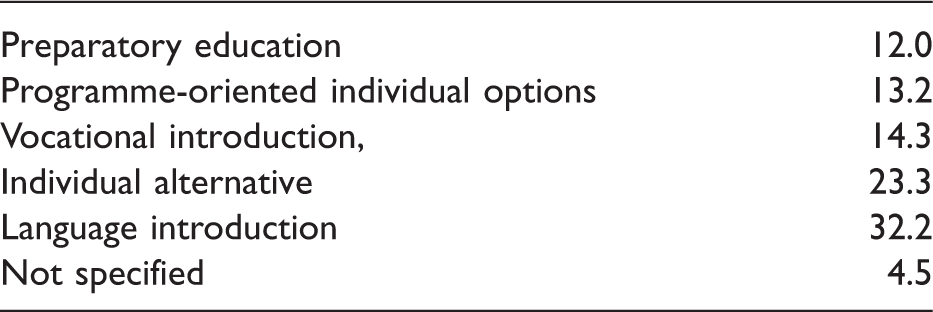
Together with the aims of each programme declared above, the table of the distribution of students in the five programmes in Table 1 might give a picture of a distinctly different way of organizing than the previous Individual programme. However, despite the political ambition of ‘clear educational routes’ and the different aims of the five programmes, introductory programmes lack a specific regulated structure and curriculum. Instead, as expressed in Upper Secondary School 2011: Education in an introductory programme should follow a plan for the education that is determined by the organiser. The plan for the education should contain the aims of the education, its length and main contents. … The school should draw up an individual study plan for each student. The individual study plan should contain information on the subjects and courses which students will study, and also, where relevant, other measures favourable to the student's development of knowledge. It should be based on students' needs and interests, and also be followed up, evaluated and revised where necessary, in consultation with the student and in certain cases with the student's guardian. (Skolverket, 2012a: 30)
Part II. Studies on local organizing of the introductory programmes
Data, method and analytical concepts
Our studies on the organizing of alternative pathways in Swedish upper secondary education were initially conducted as field studies, and have been guided by theories of organizing (Czarniawska, 2008; Czarniawska and Joerges, 1996). The main method of the specific study presented here, however, is a survey of a number of municipalities. The significance of gathering additional data to our field studies was recognized during field studies in 2011–2012, after the reform was launched. We concluded that the idea of ‘clear educational routes’ was being handled very differently, and we also became aware that the economic funding of the introductory programmes differed.
A concept that is used for analysis of the results here is translation, developed into organization studies by Czarniawska and Sevón (1996, 2005) and further described in different works by Czarniawska (e.g. Czarniawska, 2008). Translation implies that management ideas, policy, frameworks and regulations are ideas that need to be translated by actors in local practices. With this perspective, such translation processes are the basis for continuous organizing and for institutionalized actions in local settings. The concept of translation has also been central for policy analysis in the field of education, for example in the works of Ball et al. (2012), as a part of their argument of making policy into a process – a process that is ‘enacted’ and not implemented (Ball et al., 2012: 2).
The survey was online and directed towards 27 municipalities in two districts, which were the districts where we had conducted the field studies. The survey resulted in 16 responses from municipalities of different sizes, from large metropolitan regions and conurbations to small towns.
As argued by Bryman (2012: 674), an online survey may be especially appropriate while conducting research in organizations. The respondents were invited by email, with a link to a website where the questionnaire was to be found. The respondents could open the link, answer some of the questions, and return to it at a later point. By using an online survey we wanted to simplify the process of answering and obtain fast responses, minimize the risk of unanswered questions and encourage respondents to express themselves in comments and open questions (Bryman, 2012).
The questionnaire contained closed questions on the volume of students, the distribution of students among the five programmes, and the principles of the allocation of economic resources to each programme. It ended with an open question where the respondents could clarify and problematize the organizing of the five introductory programmes, and also shed light on challenges they were facing.
Results of the survey on local organizing
The results on the local organizing of the five introductory programmes are outlined in two sections below. In the first, the focus is the differences of the distribution of the students in the five programmes. In the second, we will show how the economic distributions to the five programmes also differ in different municipalities.
The distribution of students
The distribution of students in introductory programmes in four municipalities (%).
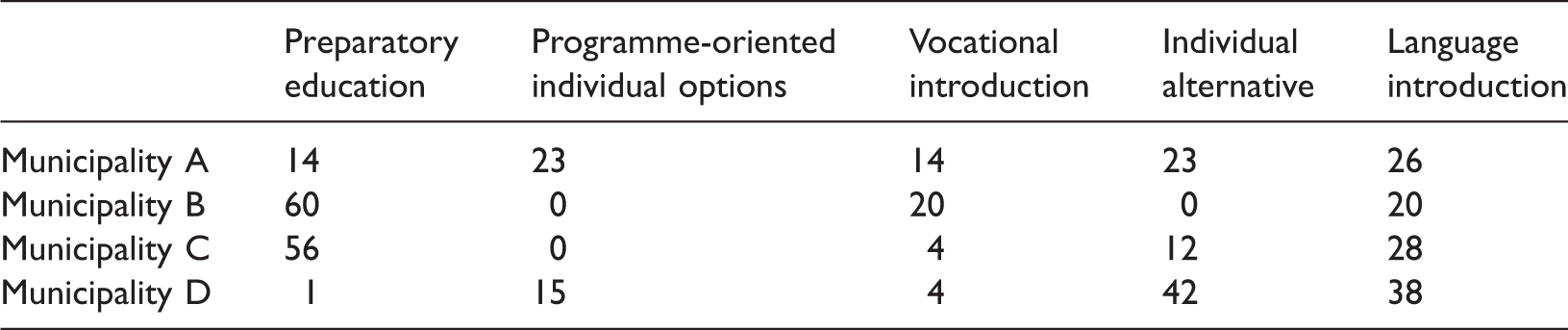
As shown in Table 2, the students attending language introduction comprise between 20 and 40 per cent of the total number of students in the introductory programmes in each municipality. Apart from that, the distribution of the students over the programmes differs, and the question is why. One explanation – a rational one – could be that there is variation because the group of non-eligible students differs in different municipalities. However, our results and analysis provide two other explanations: ‘The problem of sorting’ and ‘The problem of organizing the teaching of subjects’.
The problem of sorting
One of the representatives in a municipality reports: There are no sharp dividing lines between the different pathways. We have examples of pupils who have transferred from Vocational introduction to Individual alternative, and the opposite, as problems arise. If you read the ordinance, and if you look at it theoretically, there are great differences between the programmes. But in reality it isn't so. Young pupils are not the way the ordinance is.
The second explanation for the differences of the distribution of students we term ‘The organizing of teaching the subjects’. During our field studies, we observed that students not eligible for upper secondary programmes most often have subject classes together (Maths, Swedish, English, Social studies, etc.), no matter which introductory programme they were registered in. The five educational routes seemed to be quite uninteresting for the individual pupil, nothing that he or she cared particularly about. This might appear as a paradox with regards to the differently defined aims with the programmes. However, it can be explained by the individualized policy of text, co-existing with the imperatives of ‘clear educational routes’.
As stated above, an ‘individual study plan’ is regulated by the Education Act. This implies that students registered in different introductory programmes can have very similar pathways – the students study their subjects, participate in different activities arranged for students in the introductory programmes, and mix in different groups. In our field studies, we have observed many flexible solutions regarding how students can get a schedule that is adapted to his or her specific personal and educational needs. For the principals and the teachers, the organizing of the teaching for students with alternative pathways is that which needs to be managed and handled with regard to the budget. Thus, for teachers and for students, there are often no clear divides between the introductory programmes.
Different economic distributions to the five programmes
As mentioned initially, the funding of education in Sweden is provided by a lump sum to each municipality, which is untargeted. However, many students attend national programmes in municipalities other than their own, or attend a so-called independent school. For these, a student voucher is recommended by the government on an annually updated national ‘price list’ (‘Riksprislista’) (Erixon Arreman and Holm, 2011b). As mentioned earlier, students in introductory programmes are, with few exceptions, only offered the introductory programme in their home municipality. There is no national price list or recommendations for introductory programmes.
The results of our survey show substantial variation in funding for introductory programmes in the municipalities. An introductory programme such as Individual alternative (which hosts many students with special and often multiple needs) shows a difference of one-third of a student budget per year between municipalities geographically close to each other. The basis for funding also differs. Some municipalities provide a lump sum to schools, and the school leader or school board manages its allocation to the programmes. Some have a lump sum for the introductory programmes. Some have a ‘municipal price list’ for the respective introductory programmes.
The variation of funding to the five introductory programmes in five municipalities.
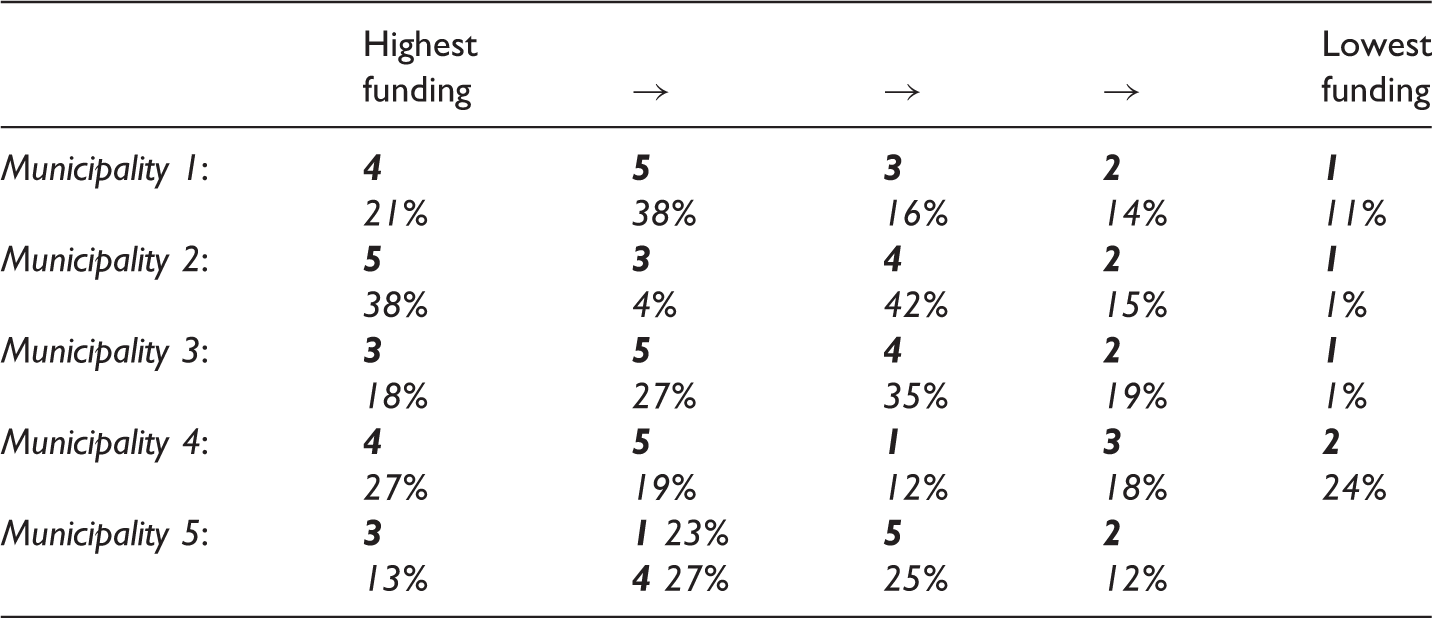
Two municipalities have the highest funding for students in Individual alternative (4), two for students in Vocational introduction (3) and one for students in Language introduction (5). The Preparatory education pathway, a pathway described as being for ‘students to prepare for a national programme’, has relatively few students and tends to also have lower funding. The Vocational introduction pathway differs widely regarding costs; in two of the municipalities it is the most expensive introductory programme, in one the second cheapest. The results of the survey also provide information about large differences across educational settings in applying for extra funding for students with special educational needs. In some municipalities there are options for applying for extra funding for students with extra special needs, while others do not have such possibilities.
Together with the indistinct guidelines in the upper secondary ordinance of the five introductory programmes, the results show how the Swedish school system of today is decentralized, and that economic decisions and decisions on operative matters are handled locally. We have shed light on an increasingly differentiated, ambiguous and fragmented upper secondary educational system, and on how the policy with the ambition of ‘clear educational routes’ co-exists with a neo-liberal policy where economic and operational matters are to be decided on and handled locally.
III. Discussion
The previous model of alternative pathways was described by the Minister of Education as ‘a failure’ and ‘the most unsuccessful contribution of all in the Swedish educational system’. Our studies provide evidence that the model of ‘Clear educational routes in five introductory programmes’ (2011–) might not be a success. The sorting of these young students in five different programmes is, as we have shown, quite problematic. The individual needs and flexibility needed for the disparate group of students in need of an alternative pathway are very much organized in the same way as in the previous model. Students take subject classes together and might not even think about which programme they are registered in. Our findings also show local differences regarding the distribution of students in the five programmes.
In accordance with the concept of translation, which we have used as a tool for analysis (Czarniawska, 2008; Czarniawska and Joerges, 1996), we find that the local differences of distribution are not surprising but a matter of local adaptation and problem-solving. We also find that it is difficult to come to a conclusion concerning the significance of the local differences of the distribution of students. Considering that legislation holds that the school should draw up an individual study plan for each student, containing information on the subjects and courses that the student will study, and that this should be based on the student's needs and interests, and thus can be formed very differently for different individuals and their needs, the character of each introductory programme is not distinct.
However, it can very well be argued that the disparities that we have found in our survey show that an increasingly fragmented school system is taking shape. A student from one municipality who compares his introductory programme with that of a student of the ‘same’ programme in another municipality may very well be quite confused. In that sense, it is difficult to speak in terms of ‘clear educational routes’.
The intent of the reform of the clear educational routes and the motive to sort students into five different introductory programmes is, in our view, an attempt to ‘regulate content and behaviour’ (Apple, 2004: 23). In this regard it is a striking example of what Apple calls conservative modernization. As Apple also points out, such attempts and approaches are often paired with neo-liberal ideals. This is in line with what we have shown: there are no changes regarding steering and delegation of the Swedish upper secondary school system. As before, there is no regulation of funding of education for those outside the regular system. The school system is decentralized, with educational funding provided as lump sums to the municipalities, and decisions on operative matters are handled locally. The situation for this group of students is much of ‘same, same but different’, with the main difference being that with the 2011 reform, local conditions very much enable and constrain the organizing of five introductory programmes, instead of one individual programme. Just as before, funding for this group of students differs between municipalities, and as opposed to the students who fulfil the eligibility requirements for the regular programmes, this group of students has very limited ‘freedom of choice’, that is, an option to choose a different educational route than the introductory programmes provided in the home municipality.
Finally, we want to pay attention to another aspect of the outcomes of the reform so far. With the new eligibility requirements and what Forsberg (2008) calls the stricter ‘passport regulations’, the numbers in the ‘waiting room’ have increased. Before the reform, 8 per cent of all students were enrolled in the Individual programme. This also included students who were qualified to attend a national programme. After the reform, only students who did not fulfil the eligibility requirements to the regular national programmes have the right to be enrolled in an introduction programme. One year after the launch of the reform, 18 per cent of all students in Swedish upper secondary education were registered on an introduction programme (Skolverket, 2013b: 9). It is also possible to discuss this development of the organizing of alternative pathways in Swedish upper secondary school after the reform of 2011 in terms of ‘a regulation of content and behaviour’.
Final conclusions
With these results on the organizing of alternative pathways in Swedish upper secondary school after the reform of 2011, the rhetoric and idea of ‘clear educational routes’ has been challenged, and it can be questioned whose interests this neo-conservative policy serves. Our conclusion is that it is doubtful if the rhetorical policy of clear educational routes does serve the students, the teachers, or the schools. As a representative from one of the municipalities put it: ‘young pupils are not the way the ordinance is’.
For schools and teachers, the sorting of students into five different programmes may well result in an improved workload with regard to accounting (Henning Loeb and Lumsden Wass, 2011). For the students, just as before the reform, the local organizing differs among schools and municipalities, and as opposed to the students in the regular programmes they have limited ‘freedom of choice’. Furthermore, there have been no changes of policy regarding targeted funding to the municipalities for these groups of students, often with special needs. Our conclusion is that the idea of clear educational routes is simple and effective, and the main interests served with this rhetoric are politicians who in an essential way formulate ideas of regulating content and behaviour, and voters who believe in the importance of such regulatory measures for bringing order into education for students who do not meet the requirements for the regular programmes.
Footnotes
Acknowledgements
The authors want to thank Professor Lyn Yates for constructive comments on an early draft of this article. The authors also want to thank the Swedish national network on education policy and the politics in education, sponsored by the Swedish research council, for many fruitful discussions.
Funding
The project was funded by The Swedish Research Council (VR) (no 2008-4722, Henning Loeb).