




Abstract
This article explores the positioning of dual qualifications (DQs) in the Finnish education policy and the education system since the late 1980s. The analysis is carried out in the context of academic-vocational divide. At the end of the 1980s, Finland questioned the functionality of the strict academic-vocational divide in post-compulsory education, and a unified upper secondary education was initiated. DQ was the result of two contradictory political discourses: the aim to make education system more equal and the 1990s’ market oriented education policy. In the 2000s, although segregation at the upper secondary level was strengthened, the DQ simultaneously became an established study route. However, in 2007 due to changes in political power, the DQ was repositioned on the periphery of education policy and academic-vocational divide became stronger. The main focus as regards the functions of DQs until the end of the 2010s was on efforts to enhance the use of educational resources and improve the possibilities for individual and flexible education choices. The aim of the current government, elected in 2019, is to strengthen cooperation at upper secondary level, which is also expected to include DQs. However, the actualisation might be mitigated by the educational reforms of the previous government.
Keywords
Introduction
Although various international organisations, such as the OECD and the EU, have shaped institutional contexts at national levels, and there is strong pressure towards convergence, societies still differ with regard to institutional practices (Mikulec, 2017; Rinne, 2008; Simola et al., 2017), and how policy ideas are received and interpreted (Ball, 1998; Ozga and Lingard, 2007). For many countries, their national education and training systems are one of the few areas where they still are able and want to maintain control (Green, 1999). The development of upper secondary education in the late 1980s and early 1990s is a good example of this. Many European countries questioned the functionality of a tracked upper secondary education, as it no longer answered the changing demands of society and working life (Green et al., 1999; Lasonen and Young, 1998). The strict academic-vocational divide in post-compulsory education was also criticised by the EU and the OECD (Lasonen and Young, 1998; Rinne et al., 2004). Thus, countries developed diverse strategies to overcome the rigorous academic-vocational divide at the end of the 1980s and early 1990s (Green et al., 1999: 152–201; Young and Raffe, 1998).
Finland made use of a ‘mutual enrichment strategy’, which provided students with the possibility to combine vocational education and training (VET) and general upper secondary (GUS) studies. Students could either include individual modules in their study plan from other schools, or complete both the VET qualification and the final exam of GUS matriculation examination, 1 and, if the students wished, the full syllabus of the GUS (Virolainen et al., 1998). The latter is the interest of this study, and will be referred to as a ‘dual qualification’ (DQ) (Ministry for Foreign Affairs, 2017; Nylund and Virolainen, 2019). The goal of this study is to explore the positioning of the DQ in the Finnish education policy and education system since the late 1980s. In the international context especially, DQ research is almost non-existent, as the focus is usually placed on the dichotomy between VET and GUS (e.g. Kilpi-Jakonen et al., 2016; Lahelma, 2009). Moreover, in the special issue on Nordic VET in this journal, DQs were discussed only briefly (Nylund and Virolainen, 2019). This study aims to fill this research gap.
In the 2010s, 40% of students after compulsory education continued on to VET and slightly over half to the more academically oriented GUS (OSF, 2020). 2 The percentage of DQ students in the 2010s was an annual 3% of the upper secondary education graduates (ESF, 2020a, 2020b). 3 Generally, DQ studies are organised within VET in cooperation with GUS, and many vocational schools have pre-planned DQ programmes based on the field of study in VET (Gyldén et al., 2009). Previously, the minimum number of GUS subjects was four, which used to be the minimum for achieving the matriculation examination. However, from the autumn semester of 2019 onwards students have had to take the matriculation examination in five subjects (Law on Matriculation Examination 12.4.2019/502). The GUS studies replace the general studies in VET when carrying out a DQ. Most students do not study the full GUS syllabus because it is more time consuming. A DQ usually takes 3–4 years, while a regular VET and GUS usually takes 3 years.
The positioning of DQs will be analysed in the context of the academic-vocational divide. In comparative research, Finland is often characterised as a country with relatively little segregation at upper secondary level (e.g. Bol and van de Werfhorst, 2013; Pfeffer, 2008). However, Finland is not an exception as regards the parity of esteem between VET and GUS. As elsewhere (Aarkrog, 2020; C Billett, 2013; Nylund and Virolainen, 2019), in Finland there is also a strong institutional and cultural differentiation between VET and GUS (Lahelma, 2009; Lappalainen et al., 2019; Nylund and Virolainen, 2019). One key point in the reform of the early 1990s was that these two school forms remained administratively separate although cooperation was enabled. Moreover, the connections to the international context, and especially to Swedish education policy, will be discussed in this paper.
Before the methodological and the empirical parts of this paper, the vocational-academic divide will be discussed theoretically, and a historical overview will be given as regards how DQs emerged in the Finnish education system and what the contributing background factors were.
Equality with more unified upper secondary education
In recent years, many researchers have made use of Bernstein’s theory on pedagogic codes when studying the academic-vocational divide (e.g. Lundahl et al., 2010; Nylund et al., 2018; Nylund and Virolainen, 2019; Wheelahan, 2007). Pedagogic codes are ‘culturally determined positioning devices’, that is, the organisation of education systems has its roots in the power relations of society (Bernstein, 1990). Thus, education systems reproduce the social order of a society, and students have differentiated access to different pedagogic codes based on their social backgrounds (e.g. Bernstein, 1990, 2000; Nylund et al., 2018; Wheelahan, 2007). In most education systems, two code modalities can be differentiated, vertical and horizontal discourses, and these two code modalities are kept separate both institutionally and culturally (e.g. Nylund et al., 2018; Nylund and Virolainen, 2019; Young and Gamble, 2006). Educational settings, which enable progress to the highest reaches of education, are usually characterised by a vertical discourse. Students are taught abstract knowledge that is transferable across contexts. In contrast, the lower reaches of the education system, such as vocational education, are characterised by a horizontal discourse. Students are taught tangible knowledge that is tied to certain contexts (Bernstein, 2000).
The differentiation between code modalities can be analysed through the concepts of classification and framing. Classification refers to the relationship between the categories, in this case the academic-vocational divide. The categories preserve their special identity and the space between them, if the insulation, the power that keeps categories apart, is not broken (Bernstein, 2000: 6–7). The strength of classification, weak or strong, depends on how differentiated these two school forms remain from each other. Framing refers to who is in control and of what, and is the internal logic of pedagogic practice. While classification sets the limits to the categories, framing regulates how the inner rules of the categories are realised (Bernstein, 2000: 12–13). Bernstein’s theory makes it possible to analyse how the organisation of education creates divisions between social groups and education settings, and how actors with differing interests aim to preserve or weaken the insulation between the different forms of education.
The question of how upper secondary education should be organised in terms of classification and framing, is highly politicised. In Finland, as elsewhere (e.g. Lundahl et al., 2010; Telhaug and Wolckmar, 1999; Young and Spours, 1998), the Left has supported a more unified upper secondary education and the Right has favoured a stronger division (Meriläinen, 2011). The left-wing parties initiated a unified upper secondary education in the wake of the comprehensive school reform in the early 1970s. The initial long-term goal was to create one unified upper secondary school that would no longer differentiate students into separate educational tracks and thus presenting students with unequal further education opportunities (Meriläinen, 2011: 17–20). Because of the strong opposition from the Right, unification was not accepted in the reform strategy. The role of the GUS as a preparatory education for university was not questioned, and the GUS was mostly left aside when planning the reform in the 1970s. The high youth unemployment in the 1970s created pressures to develop VET (Meriläinen, 2011: 68–74).
At the school level the upper secondary education reform was actualised in the 1980s, and several structural reforms were carried out in VET. However, the reforms did not actualise, as expected. As in other European countries (Green et al., 1999; Hadjar and Becker, 2009), Finland also experienced an increase in popularity of the GUS and higher education (HE) in the 1980s because of the comprehensive school reform (Kivirauma and Silvennoinen, 1992; Stenström and Virolainen, 2014). It had originally been estimated that after compulsory education the majority of students would continue on to VET. However, the academic drift was stronger, and the percentage of students continuing on to GUS after compulsory education rose to 50–60 %. Because only one third of GUS graduates succeeded in qualifying for HE, many had to apply to initial VET. Although in the upper secondary education reform VET students were also provided with limited access to HE, however, this did not make VET popular enough (Kivirauma and Silvennoinen, 1992).
Political compromise as a result of negotiations
After several decades of Left and Centre governments, in the spring 1987 the right-wing National Coalition Party won the election and formed the government with the Social Democrats. This meant a change after two decades of social-democratically oriented education policy – as the Social Democrats lost the seat of the Minister of Education. The constituency of the Minister of Education went to the liberal-centrist Swedish People’s Party of Finland (Meriläinen, 2011). In the autumn of 1987, the government appointed a committee to evaluate the previous education policies and the developmental needs of post-compulsory education. The committee suggested upper secondary education should be unified into one ‘youth school’, which would provide all students full eligibility to HE, and new vocationally oriented polytechnics should be established at the HE level (MoE, 1989). These suggestions were in line with the suggestion of the OECD in their country report on the Finnish education system in 1982 (Rinne et al., 2004; Varjo and Meriläinen, 2008).
The suggestion of the committee did not achieve unanimous agreement among political parties. The Right was especially against the idea of a ‘youth school’; according to them, the two education sectors were too different and VET especially needed to be developed before any unification. The suggested model would have meant phasing out the matriculation exam, which was too radical for the Right. One argument against the reform was that the Swedish experiences of gymnasieskola were unsatisfactory, and did not provide encouragement to following the Swedish example. (Varjo and Meriläinen, 2008: 68–69). In Sweden, upper secondary education was unified in the early 1970s (e.g. Erikson, 2017; Lundahl et al., 2010). Subsequently, the government proposed an alternative model for upper secondary education in their report on the state and the development of the education system in 1990 (MoE, 1990). In the model, students could combine studies from the local upper secondary school network based on their personal study plan. One key point in the model was that the GUS and VET would stay administratively separate (Varjo and Meriläinen, 2008: 70).
The dividing lines when discussing the new alternative model for upper secondary education were almost the same as those a year earlier. Again, the Right opposed the idea of a unified upper secondary education. In turn, the left-wing parties argued that unification would increase quality and educational equality. The model finally accepted was in line with the new suggestion of the government: GUS and VET stayed administratively separate, and as the Right demanded, the special status of the matriculation examination remained and only matriculation diploma would give full eligibility to HE (Varjo and Meriläinen, 2008: 70–72). The law on youth education and a pilot scheme for polytechnics was accepted in February 1991. In April 1991, 16 pilot units were given permission for a youth education pilot, and thus the DQ programme was enabled (Mäkinen et al., 1997).
The aim of the research
The aim of this research is to explore the positioning of dual qualifications (DQs) in the Finnish education policy and the education system since the late 1980s in terms of continuity and discontinuity. The positioning of DQs will be analysed in the broader context of the academic-vocational divide. As was discussed earlier, the academic-vocational divide very much defines how the upper secondary education system is organised. The aim is not to describe in detail how the division between VET and GUS changed in Finland during the period of the study, but to focus on the changes that have had or might have implications for the organisation of DQs.
Data and methodology
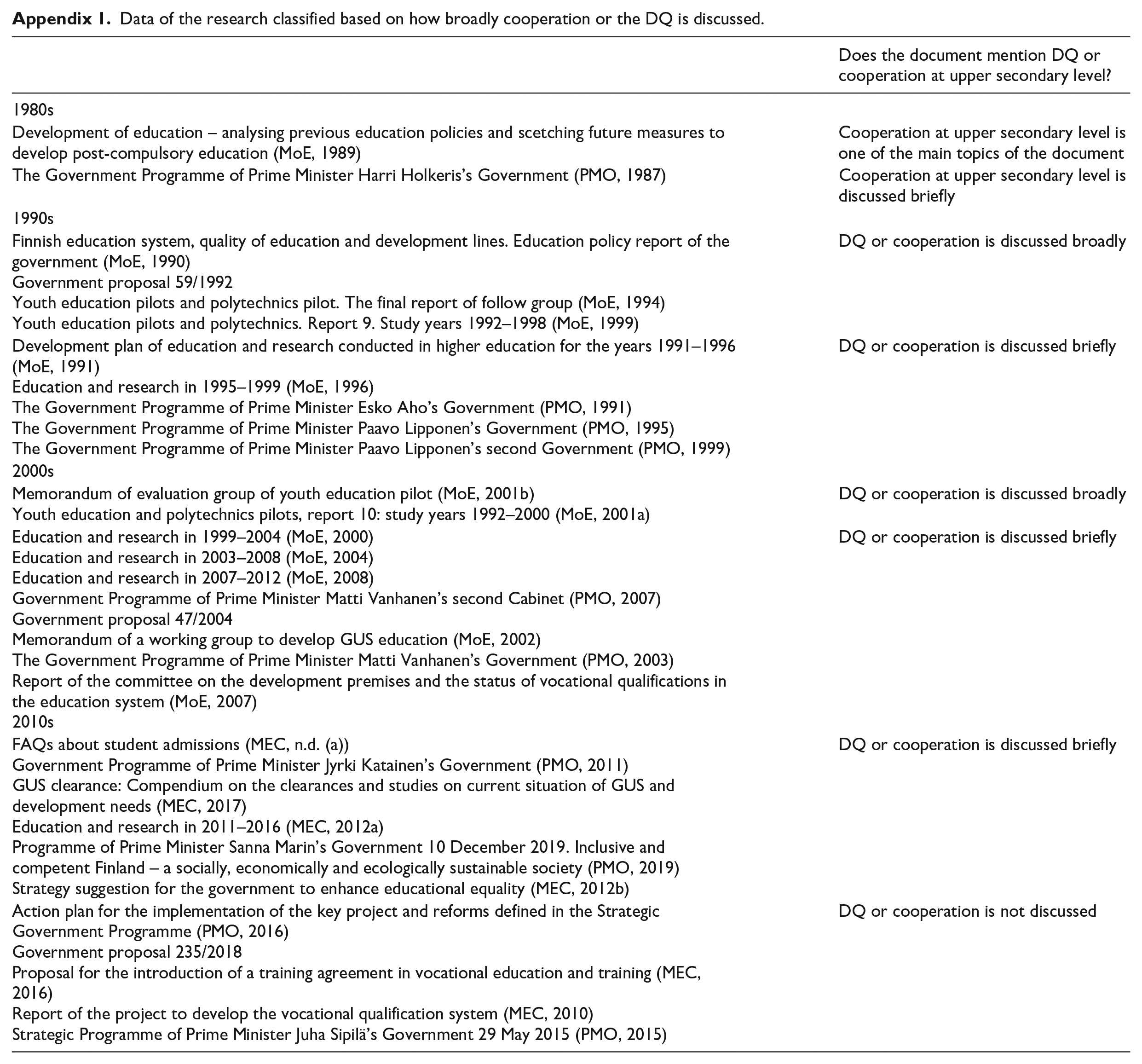
The data of this study are comprised of 32 education policy documents published by the government, the Ministry of Education (MoE), and the Ministry of Education and Culture (MEC), 4 which are about DQs, and upper secondary education, and their development from the late 1980s to the 2010s. The focus is on the development plans of the MoE and MEC. The development plans were published from 1991 every fourth year until 2011 and reflected the overall educational goals of each government. From 2015 onwards, these development plans will no longer be published; thereafter, the main goals of education will be presented in the government programmes (Tervasmäki et al., 2018: 3). Due to the large number of documents, it was not possible to include all the units of analysis that contributed to this research in the findings chapter. Most of the documents did not explicitly refer to DQs but to ‘cooperation at upper secondary level’, however, DQs are the main form of cooperation at upper secondary level, and other forms of cooperation are more marginal (e.g. Mäensivu et al., 2007; Vocational School Student Survey, 2015). 5 Moreover, in most policy documents DQs or cooperation between GUS and VET was mentioned only once or occasionally a few times, and often very briefly. In Appendix 1 the documents are classified based on how broadly these topics were discussed in the documents. Half of the documents were in Finnish. Some of the documents had an English translation available. Where the English version was available, the citations in the next chapter were from the English translations. The English and Finnish versions were compared to make sure that the documents did not differ content-wise. Otherwise, the citations were translated by the author.
The data were analysed using discourse analysis. The understanding of the documents and their role in policy making followed Simola’s (1998: 340) definition of policy documents as ‘state educational discourse’: the documents are ‘serious, authoritative verbal acts of state-guaranteed experts who speak as such and who thereby form the official “truth” of schooling’. This applies especially to Finland, where the institution of government committees has a paramount role in planning and justifying reform policies (Simola, 1998: 41; see also Aho et al., 2006). As Ball (1993) puts it, policies, or texts, are the result of compromises at different stages of political decision-making and negotiations amongst different interest groups – representing the outcome of political struggles over meaning (Taylor, 1997); thus, they are not necessarily clear, closed or complete. It is not central whether ‘the truth’ is true or false, but how it is produced, circulated, transformed and used (Simola 1998: 340).
The analysis was carried out as follows. First, the documents were read carefully through, and the relevant pieces of text were marked and classified based on whether they concerned DQs and cooperation at the upper secondary level, the relationship between VET and GUS, or both. For example, the development plans cover all the education levels; thus, relevant for this research were the chapters that concerned upper secondary education. Once the units of analysis had been thematised under these broad categories, what followed was the critical reading of the data. The central questions were: What kind of truth do the policy documents construct about upper secondary education, and how has this truth changed during the period of this study? The analytical framework that guided the reading was based on the work of Lundahl et al. (2010). In their paper, they analyse the upper secondary school reforms in Sweden between 1968 and 2009 in terms of continuity and breaks. In their analysis, they discuss the following aspects (Lundahl et al., 2010: 47):
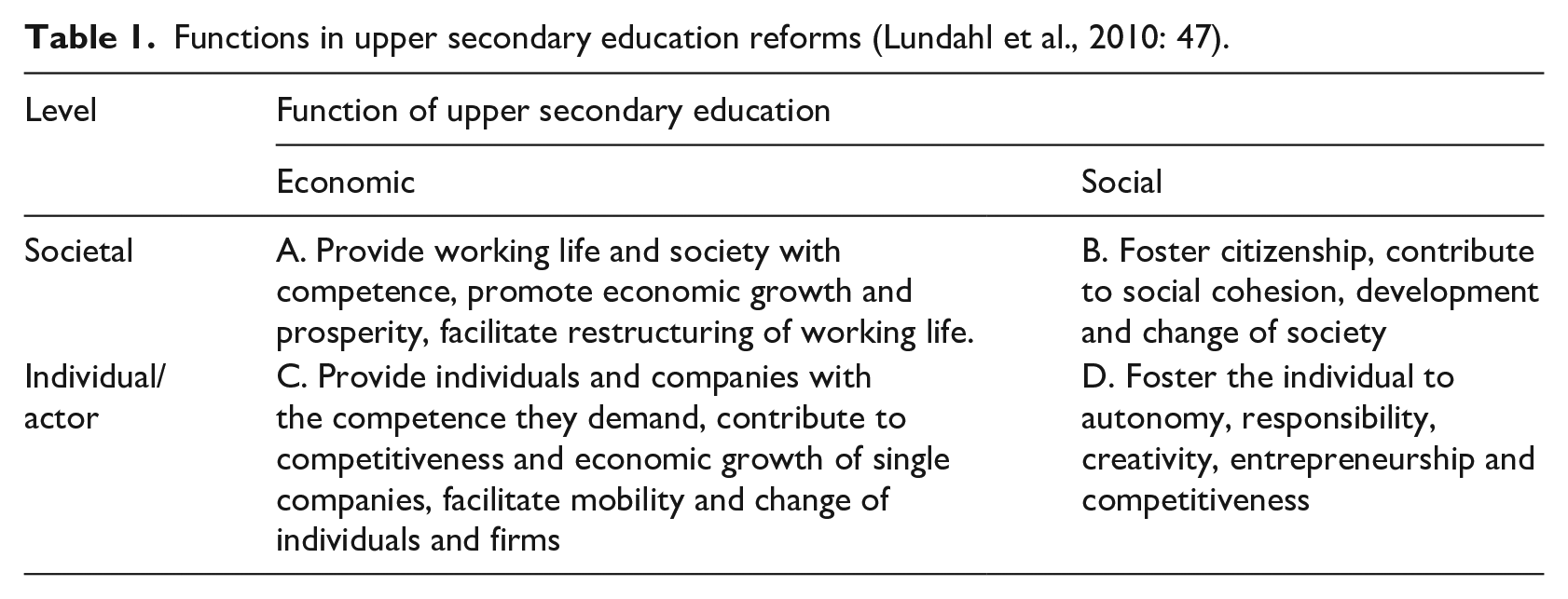
(a) Major functions of education. Lundahl et al. (2010) differentiate between economic and social functions of education at the societal and actor/individual levels, and argue that focus on the functions depends on the welfare state model. Traditional social democratic and conservative welfare states usually focus on social and economic functions at the societal level (cells A–B in Table 1), and liberal welfare states usually emphasise these two functions at the individual and actor levels (cells C–D). As a consequence, welfare models differ in regards to which knowledge, skills and attitudes are emphasised. In the analysis, this aspect was used to understand the positioning of DQs and the cooperation between VET and GUS in the education system. Special focus in the analysis was placed on what problems DQs are expected to solve.
(b) The structure and classification of the curriculum and the framing of the curriculum. The second approach in the analytical framework of Lundahl et al. (2010) is based on the two key concepts of Bernstein (2000), classification and framing. In this research these two concepts were used to analyse the relationship between VET and GUS. Classification here refers to the strength of academic-vocational divide, and framing to which actors are behind the reforms, and what forms of knowledge students have access to in VET and GUS.
Functions in upper secondary education reforms (Lundahl et al., 2010: 47).
Findings
The examination of the findings is divided into four decades. However, this does not fully reflect the important turning points during the period examined.
1980s: The dysfunctional education system needs to be reformed
In the 1980s, development of upper secondary education was strongly divided in Finland, although the initial plan of the upper secondary education reform in the early 1970s was a unified upper secondary education. In the early 1970s, it was outlined that the first year of upper secondary education would be common for all, and after that students would make a choice between general and vocational education. However, this was applied only in VET (Kivirauma and Silvennoinen, 1992). Since the 1970s until the 1990s GUS was mainly developed internally on its own terms. VET students were provided with the possibility to study for the matriculation exam but within strict terms, however, few made use of this possibility (Ahonen, 2012: 161–163).
During the years 1982–1988, 25 broad basic programmes were created in vocational education. These lines of study were divided into 250 parallel upper secondary and postsecondary specialisation lines. The objective was that after completing compulsory education students would first choose one of the basic programmes, and after that an upper secondary or postsecondary line of study. Through postsecondary education students could continue on to HE (Numminen, 2000). However, these objectives were not actualised: students did not choose one of the basic programmes before choosing the further level of their studies, the pedagogy of the common basic period for upper secondary and postsecondary programmes did not develop as expected, and programmes were not able to keep up with the needs of a rapidly developing working life (Numminen, 2000).
As was discussed earlier, the main motive for the change in the late 1980s was that the education system had not functioned as was planned. According to the working group of the Ministry of Education (MoE, 1989: 9), the education system was dysfunctional from the perspective of education policy, national economy and individuals. The education system was incapable of reacting rapidly and flexibly enough to the changes in working life and to the new educational demands of the population. The unification of upper secondary education was presented as a solution to these problems. However, as discussed earlier, due to the strong segregation at upper secondary level, the high status of the matriculation examination and changed political relations, a compromise solution won.
1990s: Youth education pilots and the first steps of dual qualification
The goal of the youth education and polytechnic pilots in the 1990s was to study whether cooperation between different school organisations could (1) raise the level of post-compulsory education; (2) answer the changing demands of society and working life; (3) create more flexible and individual study routes and diversify educational possibilities and; (4) enhance the functionality of the education system and develop the administration (e.g. MoE, 1999: 23–24). In the youth education pilot scheme, upper secondary schools formed regional cooperation units allowing students to combine studies from both VET and GUS, and complete a DQ (MoE, 1994, 1999, 2001a). Through the matriculation examination students could achieve full eligibility for entry into HE (Law on Youth Education and Polytechnics Pilot 22.2.1991/391). Following the polytechnics pilot, new vocationally oriented HE institutions were introduced at the tertiary level, later known as universities of applied sciences (UAS), which offered a viable HE route also for VET students (MoE, 1999; 2001a; see also Välimaa and Neuvonen-Rauhala, 2008).
In the 1990s, several structural changes, which strengthened the cooperation between VET and GUS, were implemented in the Finnish education system. First of all, in 1992, the government enabled cooperation between VET and GUS outside the pilot units (Government proposal 59/1992). Aligning with the goals of the development plan (MoE, 1996: 9), in 1999, new legislation came into force obligating upper secondary schools to cooperate with other upper secondary schools (Law on General Upper Secondary Education 21.8.1998/629; Law on Vocational Education 21.8.1998/630). Furthermore, the legislation expanded the length of VET studies from 2 to 3 years, resulting in more general studies being included in VET, and VET students being provided with full eligibility for HE, including science universities. Moreover, students in both GUS and VET were given more freedom of choice, which enabled students to form more individual study programmes, and the matriculation examination was renewed so that students could complete the examination more flexibly (MoE, 1999: 20–21).
Although the political climate was in the favour of the reform, from an economical perspective the timing of the pilots was far from optimal. In the early 1990s, Finland faced an economic crisis comparable to the Great Depression of the 1930s, as a consequence of an international economic recession, an overheated national economy and the collapse of the Soviet Union (Simola et al., 2017: 27–32). Major budget cuts were made in the education sector, resources for GUS studies were cut by 6% and for VET by 14% in 1991–1997 (MoE, 1999: 18–19). The large budget cuts in the education sector also had an effect on the youth education pilots, and the resources for cooperation between VET and GUS were limited in many municipalities (MoE, 2001b: 10).
The aims of the education pilots aligned also with the lifelong learning policies of the 1990s that aimed at creating citizens who have the capabilities to further educate themselves and adapt to the new tasks of a changing working life and an emerging knowledge society:
(1) Raise the status of education. The goal is for the whole youth cohort to have a chance to achieve a high-quality general and vocational qualification, which corresponds to the needs of developing society and working life and is at minimum internationally comparable to the education provided in other developed countries.
(2) Answer to the changing demands of society and working life. The goal is to prepare for new professional skills set by working life, which are a general increase in professional skills, the emergence of entirely new kinds of professional skill demands, professional mobility, and flexible use of the work force (MoE, 1999: 23, translated from Finnish).
One of the key education policy goals in the 1990s was to raise the level of Finnish education through introducing lifelong and continuous learning (e.g., MoE, 1990, 1991, 1999, 2000). The increasing impact of supra- and international organisations, especially the EU and the OECD, strengthened the status of lifelong learning in Finnish education policy (MoE, 1996; see also Antikainen, 2001; Tuomisto, 2012). In the 1980s–1990s, lifelong learning policies were predominantly shaped by the needs of the economy and the emerging knowledge society (Dehmel, 2006; Kinnari, 2020), which was visible also in Finnish education policy (MoE, 1996; PMO, 1995). Both increasing the proportion of general studies in vocational education and training and the youth education and polytechnic pilots also aligned with the OECD’s and the EU’s lifelong learning strategies. Finding new ways to organise upper secondary education was one focus area in the EU-funded Leonardo Da Vinci project (Lasonen and Young, 1998), and in 1982, the OECD had criticised Finland for its rigid segregation at the upper secondary level (Rinne, 2008).
The introduction of cooperation at upper secondary level and the emergence of DQs were the result of two contradictory discourses. On one hand, the youth education pilot was motivated by goals to make the education system more equal through providing VET students with the possibility to continue on to HE and narrowing the academic-vocational divide. On the other hand, these policies were part of the market-oriented and neoliberalist education policies of the 1990s. A business-life oriented vocabulary, such as ‘efficacy’ and ‘efficiency’, was adopted in the context of education (Simola et al., 2017; Varjo, 2007), and the function of education was increasingly seen as a means to improve national competitiveness in a global capitalist economy (Kettunen et al., 2012). Part of these policies was also the individualisation of the educational routes. Free school choice was enabled both at the compulsory level and in GUS studies, which meant that students could choose a school outside their catchment area. The number of schools offering specialised study programmes increased especially in the larger cities in the 1990s (Berisha et al., 2017). The weight in the Finnish education policy shifted from egalitarian equality to equity, or individual equity (Lappalainen et al., 2019; Simola et al., 2017). Based on the findings, DQ should be seen as part of this individualisation trend (see also Varjo and Meriläinen, 2008).
2000s: Ambiguous policy goals
In the early 2000s, Finnish upper secondary education policy took a new direction towards a stronger division. In VET working life connections were strengthened. In 2001, a minimum of half a year of on-the-job learning was required and in 2006 skills demonstration were introduced in all vocational programmes (MoE, 2004; see also Stenström, 2008). At the end of the 2000s, the VET curriculum was reformed following the principles of the EU to create common standards for a European VET (MoE, 2007; see also Mikulec, 2017; Rinne, 2008). The reform continued the development towards a more competence-based curriculum, which started in the early 1990s (Stenström and Virolainen, 2015: 15). In contrast, the main development goal for GUS studies in the development plan between 1999 and 2004 was to strengthen the GUS’s role as a form of school that provided a broad-based general education (MoE, 2000: 32). This meant that national steering of the curriculum was reinforced. The aim was to ensure that students had equal treatment in their studies and matriculation examinations (MoE, 2002; see also Turunen et al., 2011: 21–23).
In many respects the development in GUS and VET went in opposite directions. Through increasing the share of on-the-job learning in VET, the experiences of students diverged, as there are differences between fields of study in VET as to how well the on-the-job learning is organised (Rintala and Nokelainen, 2020; Virtanen and Tynjälä, 2008). Moreover, while in a competence-based approach the focus is on the relevance to working life, the focus in GUS studies is on broad-based general education that does not necessarily have any direct instrumental value (Lappalainen et al., 2019). The competence-based approach in VET has been widely criticised. The main critique is that the competence-based approach in VET fragments vocational knowledge into items of context-tied identifiable skills and undermines the role of disciplinary knowledge and the intellectual dimensions of manual tasks (e.g. Billett, 2013; Isopahkala-Bouret et al., 2014; Nylund et al., 2018; Wheelahan, 2007), and thus strengthens the academic-vocational divide (e.g. Lappalainen et al., 2019; Nylund et al., 2018).
Although the academic-vocational divide was reinforced during the 2000s, the DQ simultaneously became an established study route at upper secondary level. The number of DQ graduates doubled during the decade: in 1999–2000 there were less than 1100 DQ graduates, and by 2009–2010 the number had risen to 2300 (Kumpulainen, 2014: 81). The new legislation for upper secondary education in 1999 obligated upper secondary education providers to cooperate, making DQs accessible nationwide. The youth education pilot ended in 2001, and the results were considered promising: new innovative modes of cooperation had been developed, VET students especially made active use of the new study opportunities, the results in the matriculation examinations had not decreased, and the cooperation had provided students in both VET and GUS with skills useful in their further studies (MoE, 2001a, 2001b). In addition, the status of the UAS at HE level had become stable (Välimaa and Neuvonen-Rauhala, 2008). Furthermore, the matriculation examination was renewed in the mid-2000s so that students could choose more freely what subjects to include in their exam. It was expected that after the Government proposal (47/2004: 9) was passed this reform would make DQ more popular.
The goals for cooperation at upper secondary level in the development plan 2003–2008 did not differ much from the goals of the youth education pilot: the main goals were to improve the quality and accessibility of education, increase individual choice for students and enhance VET students’ possibilities to enter HE (MoE, 2004: 37). However, it appears that the spirit in the early 2000s was very ambitious concerning DQs. The government aimed to strengthen cooperation between the GUS and VET, and increase the number of DQ graduates:
Cooperation between general upper secondary schools and vocational institutions will be increased especially in the planning and realisation of joint provision, joint study programmes and regional education and training supply. Measures will be taken to encourage vocational students to study [general] upper secondary school syllabi and take the matriculation examination alongside their studies for vocational qualifications. The aim is to raise the number of matriculated students to 10% of those studying for vocational qualifications (MoE, 2004, 37, text in square brackets added for clarity).
The evaluation by The Finnish Education Evaluation Council (Mäensivu et al., 2007) on the cooperation at upper secondary level illustrates well the optimism of those in the school world. Representatives of those schools with longer history in cooperation believed VET and GUS would be unified in the near future. Moreover, several influential actors in Finnish education policy interviewed in the early 2000s believed the cooperation at upper secondary level would be strengthened, and in the future there would be upper secondary schools where general and vocational studies would be provided by a common administrator (Meriläinen, 2011: 235–236). However, there was a clear change in 2007, when the social-democratic party were less successful in the election results and the Centre and the right-wing National Coalition Party took the lead in the government. After this change, cooperation at upper secondary level was only mentioned briefly both in the development plan (MoE, 2008: 32) and the government programme (PMO, 2007: 29), and no quantitative goals were set for the cooperation.
2010s: Dual qualification moved to the periphery of education policy
Major budget cut-downs in all education sectors shadowed the 2010s. The govermental budget of GUS was cut by a quarter and the governmental budget of VET was cut by a fifth. These budget cuts were actualised as staff and teaching hour reductions, and larger class sizes (Lindholm, 2018). Nevertheless, these budget cuts did not hinder the government from reforming upper secondary education. In the 2010s, these two forms of education were mostly developed separately with cooperation playing a lesser role.
The VET curriculum was reformed twice in the 2010s. The curriculum taken into use in 2015 was developed along the lines of a competence-based approach (MEC, 2010, 2012a), but the overall changes were minor. The latest reform in VET started in 2015, and the new legislation came in force in January 2018 (Law on Vocational Education 11.8.2017/531). In the reform, learning in the workplace was strengthened, students were given more freedom for individualised study routes, and apprenticeship was raised as one way to tackle the drop out problem in VET (MEC, 2016; PMO, 2015: 17; PMO, 2016: 34; see also Lappalainen et al., 2019; Jørgensen et al., 2019). The new legislation for VET also includes the possibility to incorporate GUS studies in VET qualifications, however, individualised study routes in this case refer especially to the possibility to replace school based VET studies with working life experience.
In June 2018, the new legislation for GUS education was accepted, and the law came into effect in August 2019 (Law on General Upper Secondary Education 10.8.2018/714), and new curriculum was taken in use in August 2020. The goals of the reform were to ensure that all students in GUS education will receive a broad-based general education, strengthen GUS’s role as a preparatory education for HE, add study modules that exceed subject boundaries, strengthen cooperation with HE, and increase students’ freedom of choice (MEC, 2017). As part of the reform, legislation on the matriculation examination was renewed, and the obligatory number of matriculation exams was increased from four to five. This applies to those who started their GUS studies in August 2019 (Government proposal 235/2018). Many criticised the reform in the commenting round of the government proposal on the grounds that five matriculation exams may make a DQ too challenging and lengthen the study time, and in this way may make a DQ a less appealing choice (Finnish Parliament, 2018). This is a realistic worry, according to the study of Lietzén and Silvennoinen (2020), for some the possibility to study less theoretical subjects in GUS and graduate in the same time period of 3 years as in the regular VET or GUS were important reasons to choose a DQ.
Additionally, student admissions to HE were reformed so that more weight is now given to the matriculation examination diploma. This is part of the 2015–2019 government’s strategy to accelerate transitions from education to working life (PMO, 2015, 2016). The goal is that from 2020 onwards over half of the students will be admitted to university based on their matriculation examination diploma (MEC, n.d. (a), FAQs about student admissions). In UAS there are also quotas for applicants with VET qualification. However, the quotas for the VET graduates in UAS in most study programmes are half the size of the quotas for GUS graduates (Studyinfo.fi. n.d., admission requirements to study programmes, own calculations). As there are still challenges in organising DQs (Lietzén and Silvennoinen, 2018), and the number of obligatory exams in the matriculation examination has been raised, some young people may see a DQ as a burden, which may risk their possibilities to be admitted in HE.
During the 2010s, DQs and cooperation at upper secondary level became a minor matter in the broader education policy, and the function of DQs was shifted towards the individual/actor level according to the typography of Lundahl et al. (2010). The development plan during 2011–2016 illustrates this shift well. While the plan mentions that DQs ‘will be further developed on the basis of experience gained and evaluations’ and reviews will be taken on the prevailing situation of DQs (MEC, 2012a: 33), the priority is to develop GUS and VET separately. This is mentioned three times on a two-page-long chapter on the main development lines for upper secondary education, and as was the case in the earlier development plan, no quantitative goals were set. Furthermore, to the writer’s knowledge, no reviews were carried out either. Instead, the emphasis was placed on individuality and the efficient use of education resources in the rationales for cooperation at upper secondary level:
An action programme will be undertaken to improve the service capacity of and cooperation [. . .] The aim is to enhance the impact and cost-efficiency of education and training and to ensure access to educational services which respond to individual needs in both language groups and in different parts of the country (MEC, 2012a: 32).
In the reform of upper secondary school education and vocational education and training, measures will be taken to improve possibilities for students to plan flexible study tracks and to study modules which form part of other qualifications and syllabi (MEC, 2012a: 33).
Flexible qualifications and possibilities to study single modules will also reduce unnecessary multiple education and step up the use of educational resources (MEC, 2012a: 33).
An interesting deviation from the overall trend in the 2010s is the working paper of the MEC (2012b: 36) on enhancing educational equality. According to the paper, the possibility to carry out items of study across VET and GUS has the potential to decrease educational inequality. Because family background still strongly defines education choices, not all young people have the resources to make as well-informed decisions:
Sometimes it is appropriate to switch between GUS and VET in order to preserve study motivation. From this point of view, carrying out pieces of studies more broadly across VET and GUS is appropriate so that the young person gets a realistic view of the studies (MEC, 2012b: 36, translated from Finnish).
Although the leading principle in the Finnish education policy is to abolish educational dead ends, the segregation at upper secondary level is not often seen as an issue of inequality especially from the perspective of GUS. Since the 1970s, the priority for GUS has been to maintain its distinctiveness, and attempts to challenge the existing structures, such as the strong academic-vocational divide that reproduces the inequality, are almost non-existent in GUS curriculums (Lappalainen and Lahelma, 2016; Lappalainen et al., 2019).
Towards 2020s
After the elections in the spring of 2019 a new left-centre government was formed, the Social Democratic Party, the Centre Party, the Green League and The Left Alliance being the four largest parties. The Left Alliance acquired the seat of the Minister of Education. One main education goal of the present government is to raise the overall education level of the population in order to promote employability in changing labour markets:
To promote employment, we need a strong commitment to education and skills. The changing demands of work will significantly increase the need for upskilling and continuous learning. To respond to the rapidly developing needs of working life, education providers will have to become more agile. (PMO, 2019: 174).
The government aim is that by 2030 half of the young adults aged 25–35-years-old will have a HE degree (PMO, 2019: 175). In 2017, 43% of women and 28% of men in this group had a HE degree (OSF, 2018). To achieve this goal, the government aims to especially improve VET students’ possibilities to apply to HE (PMO, 2019: 182). Predictably, cooperation between VET and GUS is also presented as a means to raise the education level of the population. Although not explicitly mentioned in the citation below, the cooperation is more likely expected to especially benefit VET students:
We will investigate how the actual opportunities of upper secondary students to complete study modules in both vocational education and training and in general upper secondary education are realised. We also plan to examine how all education providers would be able to offer this opportunity, for example by developing financial incentives and reinforcing cooperation between upper secondary education providers, including in sparsely populated areas, in order to increase the number of applicants for higher education (PMO, 2019: 182).
Although education is still expected to improve national competitiveness, compared to the overall trend in the 2010s, the focus of the new government programme is more directed to wider societal change than on individual students. It is argued that the main reason for the decreased education level among young adults is the multifaceted educational inequality, and several action plans are set to overcome this inequality (PMO, 2019). In turn, in the previous government’s programme or action plan discussion on educational equality was minimal and the focus was on neoliberalist education policy measures (PMO, 2015, 2016; see Tervasmäki et al., 2018 for a more thorough analysis of the government programme).
How the plans of the current government will be implemented in practice is hard to foresee. Most of the new policies of the late 2010s will take effect in the early 2020s, and especially the increased number of obligatory matriculation examinations will likely affect the popularity and organisation of DQs. Furthermore, financial obstacles might generate difficulties, although the government has promised to raise the budget for education to the same level as it was before the budget cuts (PMO, 2019). Simultaneously, there are also multiple other ambitious development projects. At the end of 2020, it was decided that the school leaving age will be raised from 16 to 18, which will make upper secondary education free of charge (Government proposal 173/2020). 6 The government also aims to increase the number of study places in HE by 10,000 between the years 2020–2022 (MEC, 2020). A good question is, which policy goals will be prioritised.
Conclusions and discussion
Continuities and discontinuities in the positioning of dual qualification
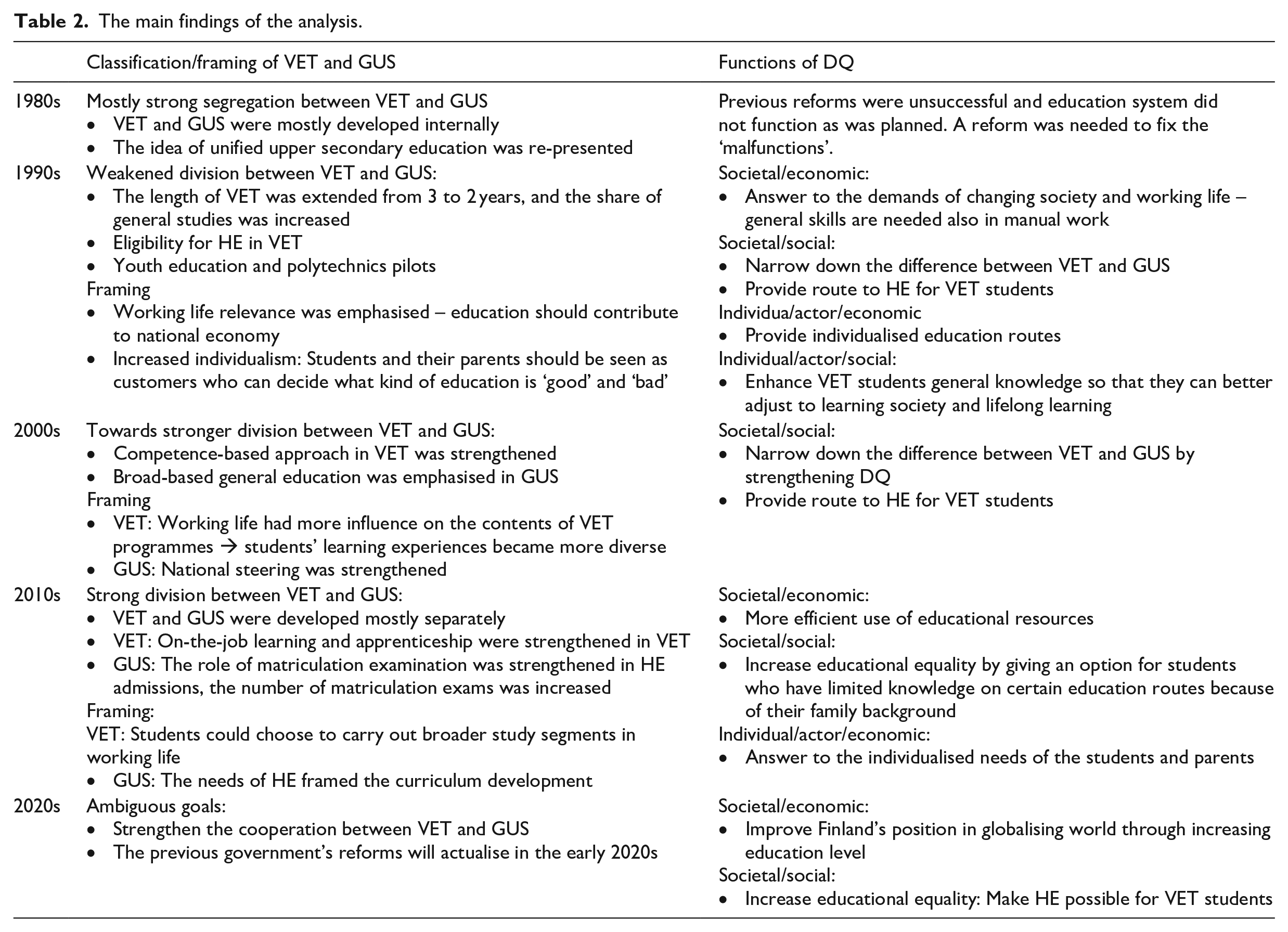
This paper has studied the positioning of DQs in the Finnish education system and its policies since the late 1980s within the framework of the academic-vocational divide. The main findings of the analysis are presented in Table 2. The emergence of DQs in the 1990s was a result of two contradictory discourses. On the one hand, the idea of a unified upper secondary education can be seen as a part of the comprehensive school project, as the left-wing parties also wanted to expand the integration policies into the upper secondary level. While, on the other hand, DQs should also be seen as part of the 1990s market-oriented neoliberalist education policy measures emphasising individuality and flexibility; the latter discourse being more dominant throughout the documents.
The main findings of the analysis.
The 2000s was an interesting phase, as simultaneously with the academic-vocational divide becoming stronger, the DQ became an established study route at upper secondary level; this was despite competence-based approach being strengthened in VET and broad-based general education being emphasised in GUS. Several changes in the education system contributed to the strengthening of DQs, with the new legislation obligating upper secondary schools to cooperate probably being the most important change. The pilot programmes in the 1990s were considered successful, and especially at the beginning of the decade ambitious quantitative goals set for the DQs indicate that the focus was on a system-level change instead of individual students.
At the end of the 2000s, as a result of the changing dynamics in political power, DQs were forced to the periphery of education policy, and from then until the end of the 2010s, the focus was on the academic-vocational divide. The focus as regards the functions of DQs was placed on the individual level, and at the societal level cooperation at upper secondary level was expected to make education more efficient. In the 2010s, several reforms which strengthened segregation at upper secondary level were launched, and discussion on the effects of these reforms on DQs was minimal. It is illustrative, that no review on the situation of DQs was carried out in the 2010s as was promised in the development plan in 2011. At the end of the 2010s, there was a shift in the political power relations, and cooperation at upper secondary level was represented as a means to achieving the government’s ambitious goal to raise the overall educational level among young adults. However, it is to be expected that previous government’s segregation policies will have an impact on the popularity of DQs, and how the current government’s aim to strengthen cooperation at upper secondary level is actualised.
Strong division between VET and GUS
The strong institutional borders have kept VET and GUS separate in Finland, and the DQ has remained as a compromise solution. Moreover, this is reinforced in policy documents; DQs or cooperation at upper secondary level is usually discussed only briefly, if at all, and the academic-vocational divide is emphasised (see Appendix 1). This discourse also has implications for how students see themselves – either as skilful with their hands or with their head, and narrows down their imagined futures (Lahelma, 2009; Lappalainen et al., 2019). According to a recent survey, almost half of the students in GUS plan to continue their studies at a Finnish university after their graduation and only 15% at a Finnish UAS (General Upper Secondary Student Survey, 2019). However, Finnish universities are very competitive and annually less than a third of the applicants are accepted (ESF, 2020c). Thus, some young people have to scale down their educational aspirations (Isopahkala-Bouret, 2020). In turn, in VET the strong emphasis on practical working life skills might strengthen the image of ‘intellectually unmotivated VET students’ especially in male dominated fields of study, which are often thought to be characterised by anti-school attitudes, and thus discourage male students in VET from applying to HE (Nylund et al., 2018).
Unification has been seen as a threat especially for the status of GUS and the matriculation examination. Unsurprisingly, throughout the documents the DQ is expected to solve the problems in VET, and compensate for the narrower general education VET provides. A DQ is expected to provide VET students with better possibilities to apply to HE, and give VET students broader general skills so that they have better skills to keep up with a rapidly changing working life. Statistics show that VET graduates with a matriculation examination diploma are more likely to be accepted in both UAS and science universities (Haltia et al., 2017). According to an evaluation by the Finnish Education Evaluation Council (Mäensivu et al., 2007), it is usually a vocational school that initiates cooperation. This is understandable, since the vocational schools also want to be seen as schools that provide a route to HE. In contrast, in GUS it is possible that cooperation is seen as an economic burden, since it does not contribute to the status of GUS as an education route to university.
Has a DQ been able to increase educational equality from this ‘compromise solution’ position? It has been argued that a DQ has made HE more accessible especially for those VET students from families with less cultural capital where they are not necessarily encouraged to apply for an academic education (Järvinen, 2000; see also Meriläinen 2011). As discussed earlier, the matriculation examination diploma does indeed provide an advantage when applying to HE. However, it seems that a DQ is not equally accessible for all young people both geographically and across social groups. DQs are more often offered in larger schools in larger cities (Hintsanen et al., 2016; Mäensivu et al., 2007). Many students also receive little information on this study route in compulsory education (Goman et al., 2020; Mehtäläinen, 2001: 40, 43; Tuijula, 2011: 130). According to a Vocational School Student Survey 2015 (Amisbarometri 2015) and the study of Lietzén and Silvennoinen (2020), similar to other specialised routes in the Finnish education system that have been shown to be more accessible to those with more cultural capital (e.g. Berisha et al., 2017), the DQ does not seem to be equally accessible to all. Due to the lack of research, there is a need for further research on the implications of the DQ and cooperation at upper secondary level on educational equality.
Comparative perspective
In comparative education research, Finland and Sweden often represent an inclusive ‘Nordic model’ (e.g. Blossfeld et al., 2016; Walther, 2006). However, the validity of the concept ‘Nordic model’ has been questioned (e.g. Antikainen, 2006; Jørgensen et al., 2019; Lundahl, 2016; Virolainen and Persson-Thunqvist, 2017). Antikainen (2006) argues that instead of just one model, there are models or patterns, and that there is a general tendency towards convergence among education systems due to globalisation. Although there have been similarities in the Finnish and Swedish responses to global education trends over the years, the solutions are national. As the reforms in the Swedish upper secondary education system were used extensively as reference points in political debates on upper secondary education reform during the 1980s and 1990s, it is worth discussing the similarities and differences in the upper secondary education policies in Finland and Sweden from the perspective of convergence and path dependency (see Maroy, 2012; Simola et al., 2017).
Unification at upper secondary level was strengthened in Sweden in the early 1990s: the duration of vocational programmes were extended from 2 to 3 years and students in vocationally oriented programmes were provided with eligibility to HE (e.g. Erikson, 2017; Lundahl et al., 2010). One key point that makes Finland different from Sweden as regards its upper secondary education policy, is the high status of GUS and the matriculation examination in Finland (Ahonen, 2012; Lappalainen et al., 2019; Vuorio-Lehti, 2007). In contrast, in Sweden the matriculation examination was phased out in the early 1970s when upper secondary education was unified (Petterson, 2010). Furthermore, the political power relations were different at the end of the 1980s in Finland and Sweden. In Finland, the government was led by the right-wing conservative party, and in Sweden the government was led by the social democrats (e.g. Lundahl et al., 2010). However, neither of these reforms were accepted unanimously. In also Sweden, throughout these years the political right opposed integration policies (e.g. Lundahl et al., 2010; Petterson, 2010). Furthermore, although the political power relations were different, the arguments for the reform of the early 1990s were quite similar. In Sweden, the reform was also dominantly framed by the needs of working life and the national economy (Erikson, 2017).
Despite the slightly different roads taken in the early 1990s, in the 2010s both Finland and Sweden have taken similar steps towards stronger division at the upper secondary level. In Sweden, in 2006, the non-socialist alliance won the election, and in 2009 a government proposal on the new curriculum was presented to the government, and the new curriculum for upper secondary education was introduced in 2011 (Lundahl et al., 2010). In the new curriculum, the influence of working life was increased in vocational programmes, and vocational students were allowed to choose apprenticeship over school based vocational training. Furthermore, the vocational programmes no longer gave automatic eligibility for HE (Nylund et al., 2018; Nylund and Virolainen, 2019). In contrast, in HE preparatory programmes the curriculum was developed to more strongly support future studies in HE (Lundahl et al., 2010). The main argument for the reform was that the upper secondary education was too uniform, and due to this, students were insufficiently prepared for labour markets and HE. In addition, many students in vocational programmes were having a difficult time finalising their studies, and VET was not able to meet the needs of working life (Lundahl et al., 2010).
Concluding remarks
This research has aimed at elucidating Dual Qualifications, a lesser studied educational route at the Finnish upper secondary education level. This paper has shown how this special study route was initiated in order to overcome the strong academic-vocational divide at the upper secondary level. However, a DQ has never become a mainstream choice. A DQ was a political compromise, and has remained as such; it fitted into the existing institutional structures without resulting in too much change to the prevailing organisation of upper secondary education. The positioning of the DQ has been examined in the broader context of the academic-vocational divide. The comparison between Sweden illustrates that the development paths that have taken place in Finland after the 1990s are not exceptional. Further development of the DQ has been overshadowed by educational reforms, both at international and national levels that have strengthened the classification between VET and GUS. The attempts to overcome the academic-vocational divide were abandoned halfway.
The future of the DQ does not only depend on national policy making as VET especially is often exposed to changes initiated by international organisations, such as the EU and the OECD (Antunes, 2016; Lappalainen et al., 2019; Rinne, 2008; Zaunstöck et al., 2021). However, the education policy discourses these organisations promote is not necessarily without contradictions. For example, two parallel contradictory EU policy discourses can be distinguished. The emphasis on the competence-based approach with strong working life connections has become the official liturgy of the EU’s VET policies (e.g. Antunes, 2016; Cort, 2008; Nylund and Virolainen, 2019; Winterton, 2012). However, simultaneously since the 1990s, the EU has emphasised the importance of enhancing lifelong learning from pre-school to HE and on to adult education. In 2006, the EU launched a European reference framework of eight key competencies for lifelong learning (EU, 2006). What is apparent, is the emphasis on generic competencies, such as literacy, language and mathematical competencies. Despite the ambitious goals to make these competencies available for all, according to Kinnari (2020: 351–352), these key competencies construct a model of a middle-class knowledge worker that is unachievable for many Europeans. In turn, Silvennoinen et al. (2021) show in their study on the application of these competences in Finnish upper secondary curriculums, that at worst, these competencies may strengthen the academic-vocational divide.
One interpretation of all this is that the future of DQs seems to depend on what value is given to the general education provided by VET. Working life has become more complex as a result of the rapidly developing technology and the increased knowledge demands of many occupations; in addition, many old occupations have vanished and new occupations have replaced the old (e.g. Harteis, 2017; OECD, 2018). What is certain in the midst of this change is that there will not be a decline in the need for general skills in future working life, as when entering the labour market, one has to be prepared to learn new skills and re-educate oneself. In light of this future prospect, emphasising vocational skills at the cost of access to general knowledge, both in the form of a DQ and a high quality general education in VET (Rosvall et al., 2017; Wheelahan, 2015), does seem counterproductive from the perspective of both society and the individual.
Footnotes
Appendix
Data of the research classified based on how broadly cooperation or the DQ is discussed.
| Does the document mention DQ or cooperation at upper secondary level? | |
|---|---|
| 1980s | |
| Development of education – analysing previous education policies and scetching future measures to develop post-compulsory education (MoE, 1989) | Cooperation at upper secondary level is one of the main topics of the document |
| The Government Programme of Prime Minister Harri Holkeris’s Government (PMO, 1987) | Cooperation at upper secondary level is discussed briefly |
| 1990s | |
| Finnish education system, quality of education and development lines. Education policy report of the government (MoE, 1990) Government proposal 59/1992 Youth education pilots and polytechnics pilot. The final report of follow group (MoE, 1994) Youth education pilots and polytechnics. Report 9. Study years 1992–1998 (MoE, 1999) |
DQ or cooperation is discussed broadly |
| Development plan of education and research conducted in higher education for the years 1991–1996 (MoE, 1991) Education and research in 1995–1999 (MoE, 1996) The Government Programme of Prime Minister Esko Aho’s Government (PMO, 1991) The Government Programme of Prime Minister Paavo Lipponen’s Government (PMO, 1995) The Government Programme of Prime Minister Paavo Lipponen’s second Government (PMO, 1999) |
DQ or cooperation is discussed briefly |
| 2000s | |
| Memorandum of evaluation group of youth education pilot (MoE, 2001b) Youth education and polytechnics pilots, report 10: study years 1992–2000 (MoE, 2001a) |
DQ or cooperation is discussed broadly |
| Education and research in 1999–2004 (MoE, 2000) Education and research in 2003–2008 (MoE, 2004) Education and research in 2007–2012 (MoE, 2008) Government Programme of Prime Minister Matti Vanhanen’s second Cabinet (PMO, 2007) Government proposal 47/2004 Memorandum of a working group to develop GUS education (MoE, 2002) The Government Programme of Prime Minister Matti Vanhanen’s Government (PMO, 2003) Report of the committee on the development premises and the status of vocational qualifications in the education system (MoE, 2007) |
DQ or cooperation is discussed briefly |
| 2010s | |
| FAQs about student admissions (MEC, n.d. (a)) Government Programme of Prime Minister Jyrki Katainen’s Government (PMO, 2011) GUS clearance: Compendium on the clearances and studies on current situation of GUS and development needs (MEC, 2017) Education and research in 2011–2016 (MEC, 2012a) Programme of Prime Minister Sanna Marin’s Government 10 December 2019. Inclusive and competent Finland – a socially, economically and ecologically sustainable society (PMO, 2019) Strategy suggestion for the government to enhance educational equality (MEC, 2012b) |
DQ or cooperation is discussed briefly |
| Action plan for the implementation of the key project and reforms defined in the Strategic Government Programme (PMO, 2016) Government proposal 235/2018 Proposal for the introduction of a training agreement in vocational education and training (MEC, 2016) Report of the project to develop the vocational qualification system (MEC, 2010) Strategic Programme of Prime Minister Juha Sipilä’s Government 29 May 2015 (PMO, 2015) |
DQ or cooperation is not discussed |
Declaration of conflicting interests
The author declared no potential conflicts of interest with respect to the research, authorship, and/or publication of this article.
Funding
The author received no financial support for the research, authorship, and/or publication of this article.
