



Abstract
Over the last three decades neoliberal government policies have spread successfully around the world with disastrous effects on the social infrastructures of many countries. Neoliberal policies move vast amounts of public money into private hands increasing the gap between rich and poor and decimating social support services for the majority of the population. Along with health and transport, government-funded education is also among the most devastated public services. Yet, in representative democracies, these policies are initially supported by the misguided self-interests of those most deleteriously affected – lecturers, teachers, students and their families, communities and institutions. This paper analyses this effect on language education through the culturometric definition of cultural identity – a concept originally inextricably bound with the teaching of languages – examining language ‘spin’ used in achieving neoliberal policy acceptance, focusing here on the current spin of ‘diversity’. By tracing western government resourcing of value changes in language education through their international change events over the last three decades we show – in contradiction to neoliberal policy documents such as the ‘Common European Framework of Reference for Languages: Learning, teaching, assessment’ – how the potential diversity for student educational outcomes of language education has shrunk under neoliberal education governance to the single option of ‘employee-ment’ – the identity of an ideal employee. We evidence how culture has been stripped from language education and replaced by training employee-ment skills to current policy compliancy standards. To recover from this disaster we then deconstruct cultural diversity in language education to deduce policy amendments to the Common European Framework that would authentically increase cultural diversity as it is valued by the international community of language educators. We conclude by extrapolating the past three decades of changes in resourcing language education towards two possible futures – a future predicated on the employee-ment values of the current common framework and a future predicted by the deduced policy amendments to the framework for authentically enhancing cultural diversity through language education.
Keywords
Introduction
This paper adds a culturometric analysis to the growing public exposure of worldwide neoliberal government policies and their destruction of national social infrastructures (Chomsky, 1999; Rapley, 2004; Saad-Filho and Johnston, 2005). Over the last three decades governments have stealthily subscribed to neoliberal doctrines, relinquishing their responsibilities for social services by paying their public funding for these services directly to private companies that drastically cut back social support services to massively increase profits. The global outcome is a widening gap between the rich who profit from these companies and the poor who now pay both their governments and the international companies for reduced services (Ball, 2009, 2010; Boas and Gans-Morse, 2009; Giroux, 2002, 2005; Hill, 2006; Hursh, 2009). Government-funded education is among the most devastated public services and yet, unwary education communities naïvely continue to endorse neoliberal principles, for example, by earnestly agreeing to continue reductive neoliberal policy foci on work-preparation curricula (Lynch, 2006; Olssen and Peters, 2005). This paper shows how neoliberal dogmas are being articulated in education policies and provides a culturometric analysis of their effects on language education. Through the culturometric definition of cultural identity – a concept inextricably bound with the original intentions of language teaching – this paper examines the language ‘spin’ used in achieving neoliberal policy acceptance, focusing on the current spin of ‘diversity’. More specifically, this paper explains how the potential diversity for student educational outcomes of language education has been devalued and resources diverted to the single option of ‘employee-ment’ – that is, the identity of an ideal employee (Laanan, 2000).
Firstly, we give a brief introduction to culturometric philosophy and its methodological processes. We then shine this culturometric spotlight on the insidious rise of neoliberal global education and expose how it subversively underpins the Common European Framework of Reference for Languages (CEFRL). By deconstructing ‘cultural diversity’ as advocated by the CEFRL, we show that the CEFRL perversely promotes neoliberal ‘cultural standardisation’. Finally, the paper contrasts two possible futures, one predicated on the CEFRL employee-ment values and the other on CEFRL amendments aimed at authentically enhancing cultural diversity through language education.
The culturometric perspective: a set of conceptual tools for researching social (educational) issues
Culturometrics has three tenets:
Definition: Operational definition of cultural identity – ‘values in context’. Assumption: The purpose of all behaviours is to affirm one’s cultural identity. Belief: Culturometrics is a humanist philosophy.
Everything in culturometrics emerges from these three tenets. For the current analysis we will only need tenet (1): the definition. However, including tenet (2), the one assumption, will help to clarify the path of analysis. The ‘definition’ is the culturometric operational definition of cultural identity. With this, we can understand the disaster that global neoliberalism has wrought on education generally, and on language learning in particular. It also allows us to clearly distinguish between ‘education’ and ‘training’ and to deconstruct ‘cultural diversity’ in language education so we can deduce policy amendments to the Common European Framework that would authentically increase cultural diversity. Basically, any framework of compliance standards, whatever its hierarchical level of incidental semantic description (the spin), reduces cultural diversity by promoting one set of values, in other words one cultural identity (Hursh, 2001). In the case of the CEFRL, the one cultural identity that its compliance standards promote is ‘employee-ment’, specifically the cultural identity of the ideal inter-cultural employee. The definition of cultural identity also enables us to analyse the language structure of ‘the spin’ that encourages stakeholders to accept neoliberal policy documents, and so, we can be less gullible in the future. Although only the definition of cultural identity is necessary for this analysis, to understand the motivations of neoliberal policy documents that directs our analysis, it is helpful to also know the one assumption of culturometrics, which is that all behaviour is intended to affirm cultural identity. Tenet (3) specifically relates the motivation for this culturometric analysis and resolution to respected academic motivations of language education through their shared humanistic intentions.
Cultural identity definition
The operational definition of cultural identity (Cid) is ‘values in context’. We have actual Cids and their ideal versions that we can strive towards. We also have public ‘face’ Cids which are not necessarily the same as our private ideal Cids. The relationships between our different Cids (for the same context) can explain our motivations for seemingly inconsistent behaviours. Figure 1 shows that ‘values in context’ is a recursive definition.
Operational definition of cultural identity: Structure and behaviour marker.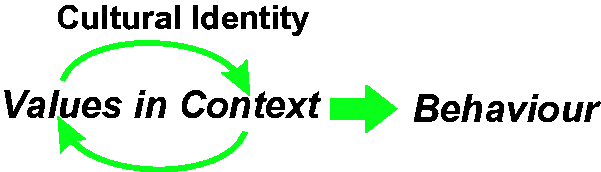
A ‘context’ is defined by a consistent set of values - values is short for ‘values, attitudes, beliefs and intentions’ (VABI): we use consistent sets of values to categorise parts of our social environment as a context. The fundamental property of a context is that its VABI are consistent. So, if you experience conflicting VABI, then you are experiencing more than one cultural identity, that is, a dissonance in ‘who’ you are at that moment, a dissonance that needs to be resolved by compartmentalisation (choosing one or the other identity) or by generalising to a higher order more inclusive identity (Boufoy-Bastick, 2013a: xxxiv–xxxv; 2014b: xxxv).
The one culturometric assumption we use here to understand motivation is: ‘The purpose of all behaviours is to affirm one’s Cid’, that is, we use behaviours only to affirm our VABI. For example, communication is a behaviour, hence the goal of communication, to self and to others, is to affirm Cid. Social affirmation of Cid is the goal of communications with others. The fundamental need is ‘to be’, to affirm one’s VABI, that is, to affirm who you are. You can no more ‘not be’ than you cannot express behaviour. This is a more fundamental expression of the neuro-linguistic programming (NLP) statement that it is impossible not to communicate, for example refusing to communicate is a communication (Dilts, 1990; Gibson, 2011; O’Connor and Seymour, 2011). Communication behaviours are chosen to express who you are in ways intended to elicit affirmation. Researching the choice of behaviour intended to represent one’s values – aligning cultural interpretation filters – is a large window for applications of culturometrics to social learning and change and to misunderstanding and social rejection.
Differences between education and training
Considering how Cids develop also allows us to distinguish between ‘education’ and ‘training’. ‘Education’ is the name given to the development of Cids, for example ‘values initiation and change’ and ‘educing culturally specific behaviours’ for communicating Cids, whereas ‘training’ accepts these values, their consistency and their representative behaviours as a given and only aims to perfect them. More specifically, ‘education’ is an enculturation process that changes Cid, for example it changes the values that define contexts, develops new values for defining new contexts and for differentiating more discriminately between similar contexts, and educes behaviours that will most appropriately communicate those values for that context in a given culture. ‘Training’, on the other hand, accepts these sets of values, the contexts that are defined by them and contain them, and the consistency of these values – ‘no questions please, just do as you are told’ – and accepts the given behaviours as authoritatively appropriately interpretive of the values. In other words, ‘training’ assumes that a behaviour chosen for training has one cultural interpretation in terms of the values it represents – a standardised ‘cultural interpretation filter’ for everyone (see Figure 10). Training then practises the precision (speed and accuracy) of context recognition and reproduction of the given appropriate behaviours. Mastery would aim at the congruency of interpretive behaviours for the whole set of values. These differences are important when differentiating between teaching practices for language education, which offer alternative potential options for the learner’s Cid – for example, by empathising with Foreign Language (FL) speakers – and teaching practices for language training – for example training in the register and grammar of English for academic purposes, where ‘academic purposes’ pre-defines the contexts, values and behaviours of the required Cid.
Identity Funnel: Structure for acceptance of Neoliberal policy documents.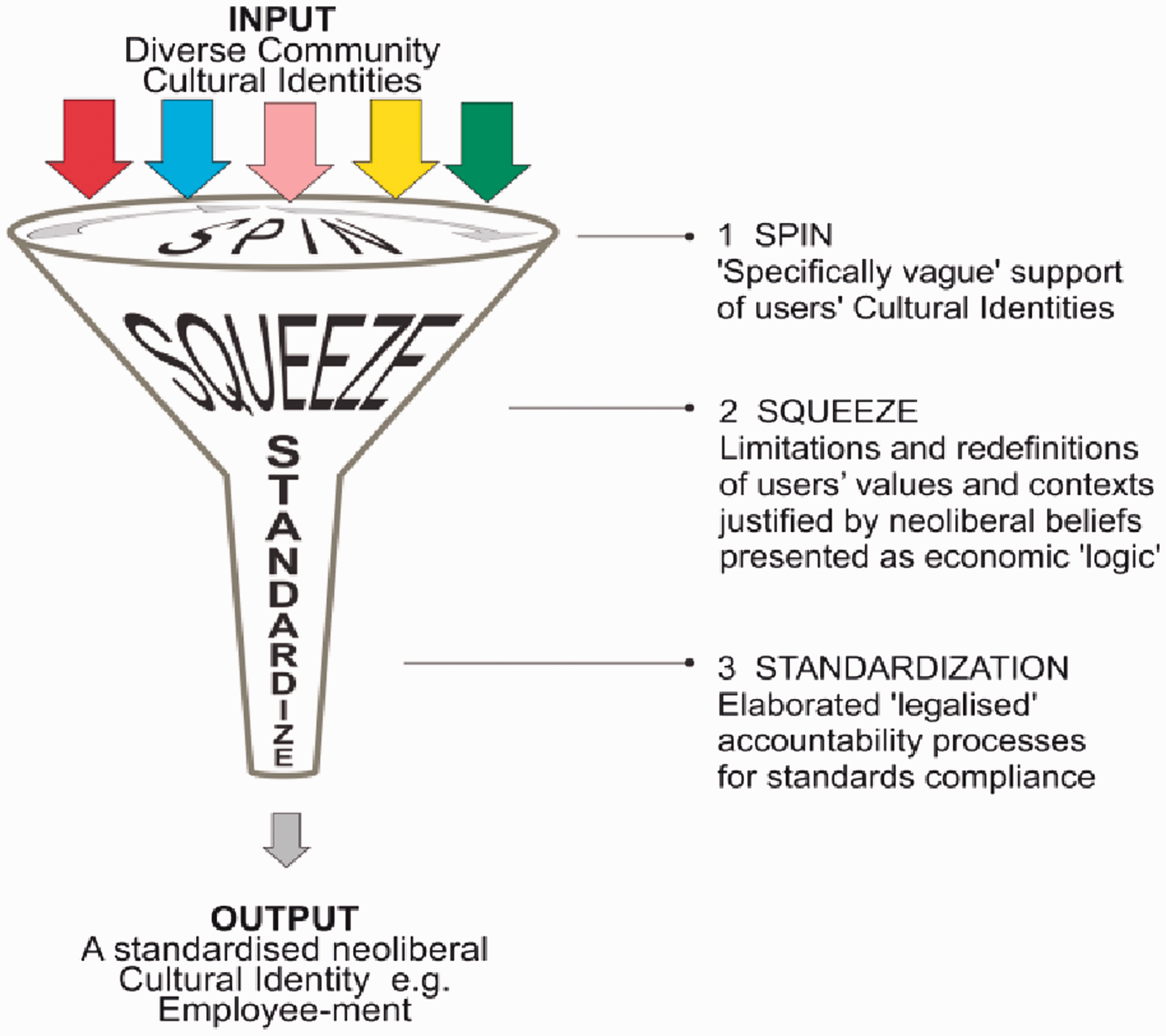
Where is the cultural diversity if education only trains everyone to be an employee?
In culturometric parlance, ‘diversity’ is the realisation of potential for informed alternative self-actualising cultural identities, that is, creating multiple options for who we could be. The relevance of the difference between ‘education’ and ‘training’ to the promotion of diversity is that education promotes diversity by offering the possibility of alternative informed self-actualising cultural identities. Self-training and other authoritative/accredited training, on the other hand, accepts a definition of a Cid and promotes that one identity. ‘Training’ aims at the perfection of the chosen identity. The danger arises when mass training replaces mass education, particularly when everyone is trained for the same identity (Harris, 2005). Under global neoliberal education policies the populations served by government mass ‘education’ are only offered training to be employees, competing with each other in a global employment market (Hyslop-Margison and Sears, 2006; Littler, 2013). In relation to language education this privileges ‘Globish’ as the international lingua franca of business and reduces other languages to the purpose of business tools (Gray, 2002; McCrum, 2010).
Criticisms of the CEFRL (Byram and Tormenter, 2012; Coste, 2007; Figueras, 2012; Jones and Saville, 2009; Nagai and Dwyer, 2011; Parmentier and Byram, 2010) as being primarily a ‘neoliberal policy document for international business’ are not unique to this paper. What is unique to this paper is the culturometric analysis evidencing:
the start and causes of this neoliberal education/training split in government-funded mass education and specifically in language education; the cultural linguistic structure of neoliberal policy documents that encourages communities to accept self-debilitating policies, specifically the CEFRL and its spin on diversity; the deconstruction of how language education promotes diversity and specifically recommended concomitant amendments to the CEFRL; and comparative predictions for the future for language education under of the current CEFRL and under the amended CEFRL.
Culturometric methods for extending and objectively measuring Cid
A major strength of culturometrics is that the rich inter-subjectivities of Cid can be objectively measured, analysed and described using the growing family of culturometric research methods (Boufoy-Bastick, 2013b: 66). So, for example, culturometrics can be used to assess the success of students’ language education (Boufoy-Bastick, 2012).
Comparison of culturometrics and traditional research
Social research aims to explicate personal subjectivity. Paradoxically traditional research designs and statistics treat the personal subjectivity it seeks to understand as bias and error. The purpose of having many questions on a questionnaire is to ‘average out’ the different subjective responses elicited by the variety of vicarious question experiences. The averages of the question responses are reported as representing a person’s true subjectivity even though the variety of their subjective responses to their discriminations between the questions is treated as random error 1 by ‘averaging it out’.
Similarly, the purpose of asking many respondents to answer the same questionnaire is to ‘average out’ personal expectations used by different respondents in answering the questions. Yet, this average is reported as representing each person’s subjective expectation with the variation of each individual, which we would really want to know, being reported again as random error. It seems contradictory to report the differences between questions, between individuals and the differences between groups as being of interest – for example, the different scores for males and for females – yet consider these same differences to be random errors when reporting aggregated averages. For example, traditional researchers seek averages for different sub-groups, such as males vs. females, yet when reporting the aggregated average for the whole group the variation between the subgroups which was originally being sought is then considered as random error.
Components to a subjective response are: different interpretation of the meaning of the question, that is, the question evokes values that categorise it as being a different context from the context that another respondent would assign (or even assigned by the same respondent at a different time or place), for example a high vs. low risk, serious vs. not serious. Other components are the personal (p) and cultural (c) expectation scales (these are two confounded comparison contexts) that the individual uses as confounded measuring scales against which to judge/measure their response. All we really want is their response based on their cultural expectation, not their personal expectation. We also need to know that their interpretation of the question is acceptable within the range of interpretations of the cultural group to which they are a member. We need to check the normality of public object responses for this and ensure that the proportion of personal values for two public objects matches the proportion of group mean values for those two public objects, for example Q2a/Q2b is close to mean Q2a/mean Q2b.
In contrast to these traditional Fisherian research methods (R-methods), culturometrics (CM) encourages the rich subjectivity of personal response 2 (e.g. anthropomorphic empathic projection) and uses Q-methods 3 for comparative analyses that uncouple personal biases from subjective judgement (Q1/Q2) and ground subjective judgements in the consensus of cultural groups and sub-groups (x average of Q2s). Further, by using relational reframing that reverses objectifying language structures, 4 culturometrics potentially extends the remit of cultural studies to the objective investigation of all social constructs (Boufoy-Bastick, 2014a).
Brief background on neoliberal education policy
General economic beliefs underlying neoliberal education are to remove economically grounded neoliberal policies, sanction the removal of government spending on services and so neoliberal governments create social climate to enable companies to offer these services. Within this perspective, neoliberal professional development programmes are designed to insidiously align the values of the education stakeholders with those of the government (Bar, 2012; Fan, 2012; Flihan et al., 2012; Haydar, 2012; Matemba and Grant, 2012; Sipitanou and Kiriatzakou, 2012; Snoek, 2012). However, some teachers cautiously voice their frustration with ‘one size fits all’ (Schaefer et al., 2012).
The language of spin: how and why it works
Historically, the most natural context for communication is face-to-face. In this situation, we share the same context and gesticulations are meaningful. For this reason, from the perspective of evolutionary psychology, people, in their communications with others, tend to infer context before they check consistency of values. Much situational comedy depends on uncovering anomalous values during miscommunication of assuming the wrong context. People also make meaning from ambiguous communication by relating it to experienced contexts that make it consistent with their values – in NLP this is referred to as ‘transderivational search’. ‘They engaged in an internal search for meaning, scanning their own experiences and constructs in order to make sense of another person’s communication’ (Tosey and Mathison, 2010: 78). This evolutionary bias and natural meaning-making is exploited by spin-doctors for policy pushing. Neoliberal education policies are now presented for acceptance in language that obfuscates the relation between behaviours and context defined values. To make meaning of the policy language, the intended users of the potential policy must search their experience to find contexts in which their values are expressed by the proposed policy behaviours, and so in their process of understanding the policy language potential users naïvely accept that the policy affirms their Cids that incorporate those experienced contexts. It is only later, when the release of policy compliance standards define more precisely the relationships between the policy behaviours and their contexts, that users realise the policy behaviours affirm not their values in their assumed contexts but the Cids of the policy-makers. Neoliberal policy documents, for garnering acceptance, delay this realisation by interspersing a middle section stating of neoliberal beliefs, presented as economic necessities that limit and redefine community meanings in terms that can be operationalised by the following compliance standards. This process is rampant in neoliberal education governance which eschews cultural diversity by promoting globally the single cultural identity of ‘employee-ment’ – the ideal values in the context of being an employee. The European Common Framework is an example in the area of language learning whose deceptive spin on diversity is illustrated in the section ‘Example of how the common framework spins diversity’.
It seems puzzling that in representative democracies the very communities of policy-users protesting against neoliberal policies were the very same communities that initially gave their welcoming support to the policy statements. We can easily understand this through the culturometric lens. The culturometric lens is that (a) cultural identity is ‘values in context’; and (b) behaviours are welcomed that are interpreted as affirming one’s cultural identity. The policy documents ‘spin’ the community’s values for acceptance in a three-part identity funnelling process – the beginning, the middle and the end: (a) the convincing introduction (or in neoliberal jargon ‘the soft sell’); (b) limiting and redefining community meanings; and (c) the compliance standards (or in neoliberal jargon ‘the bottom line’). The document is like a restricting funnel - see Figure 2 in illustration. So that the stark contrast between the two ends of the document are less noticeable they are joined by a middle section of ‘economically reasoned’ limitations. Like a restricting funnel the first ‘open’ selling part of the policy document is connected to the ‘closed’ bottom line by a middle section of neoliberal beliefs presented as inevitable, logical cost-benefit and other financial-economic ‘necessary’ limitations on the initial values, contexts and behaviours so they emerge redefined as neoliberal ‘values in context’.
The introductions to the policies use the communities’ highly acceptable value-terms (Goodman and Truss, 2004; Gounari, 2006), like ‘diversity’ in ‘specifically vague’ context descriptions. These descriptions are ‘specifically general’ policy-speak so that in order to give precise meaning to the descriptions potential policy user communities psychologically match their own acceptable contexts to the highly acceptable value-terms provided – known as ‘transderivational search’ in NLP – and so they support the policy as affirming their cultural identities. However, the compliance standards for the policy, when they become known, describe precisely the context and the behaviours that are required. These behaviours in the precise contexts of the compliance standards affirm the cultural identities of the policy-makers, not those of the communities. When the communities become aware of the behaviours required by the policy in those specific contexts they realise that the required behaviours are antagonistic to the community values in those precise policy contexts – but they have already accepted the policy.
The culturometric solution is for potential policy users to compare the policy introduction with the compliance standards before accepting the policy – as we have initiated with the CEFRL in the section ‘Standardisation: the compliance standards’. The culturometric solution of policy-makers is to delay and/or obfuscate the compliance standards when it is the time for policy acceptance – for example by disaster distraction (Klein, 2008).
The recent rise of neoliberalism and its conversion of education to employment training
The percentage occurrence of the terms ‘humanist’ and ‘neoliberal’ in the publication of books from 1900 to 2014.
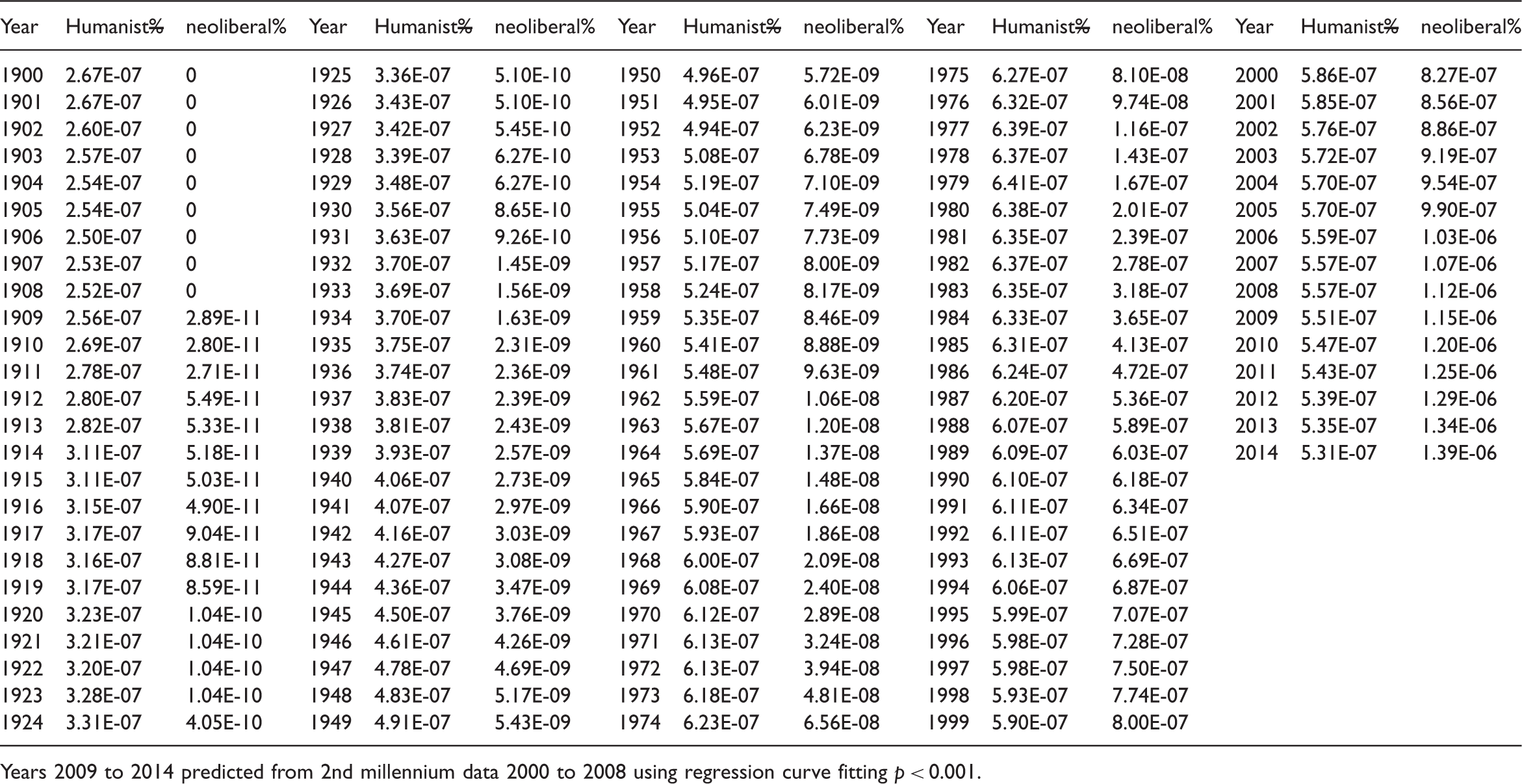
Years 2009 to 2014 predicted from 2nd millennium data 2000 to 2008 using regression curve fitting p < 0.001.
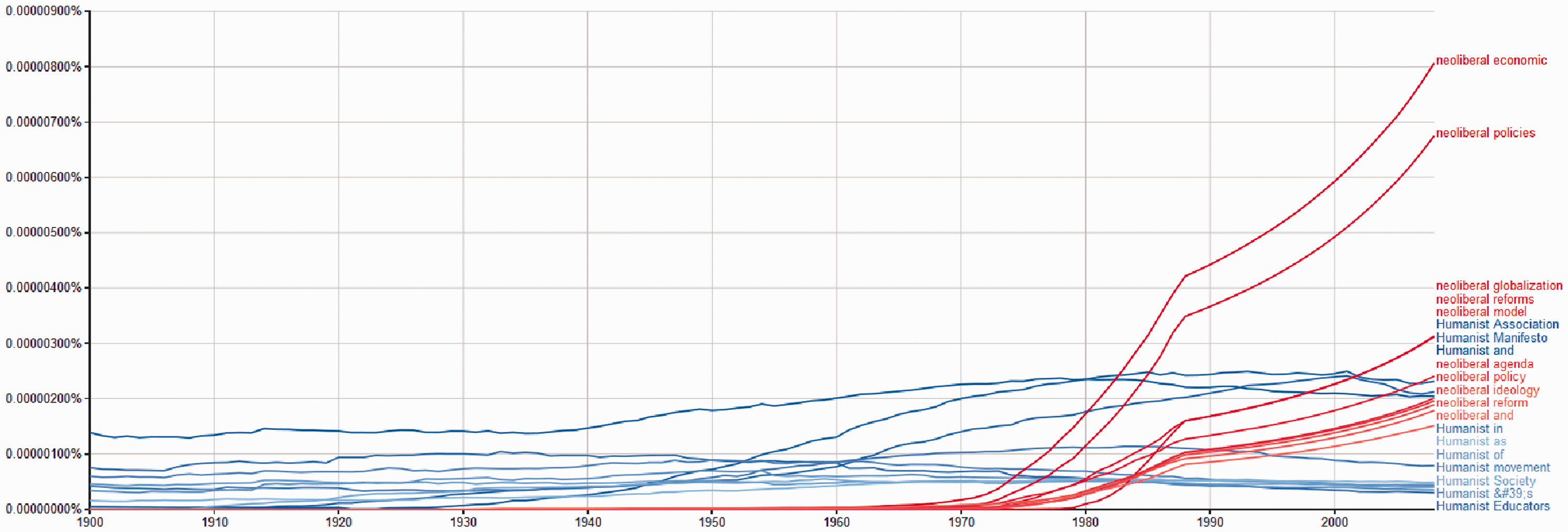
The relative trends in the published usage of the terms humanistic and neoliberal are illustrated in Figure 3.
The percentage occurrence of the terms ‘humanist’ and ‘neoliberal’ in the publication of books from 1930 to 2008.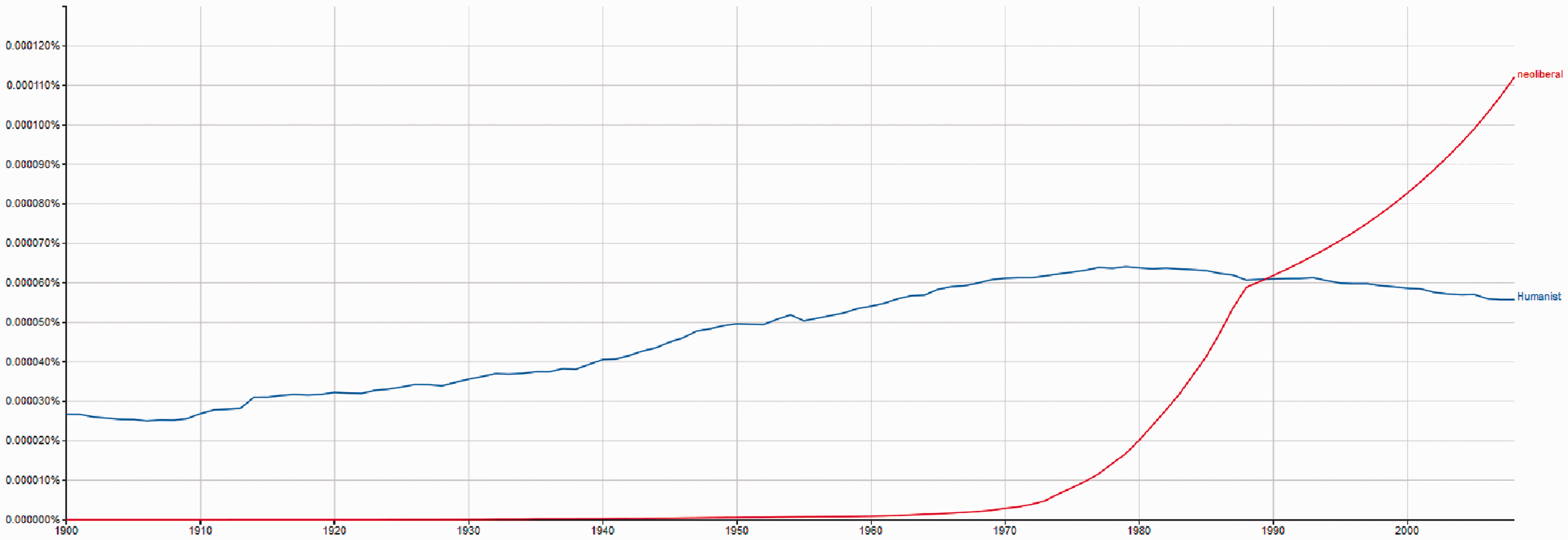
Figure 3 shows the influence of neoliberalism taking off in the late 1960s and eclipsing the influence of humanism in just three decades. The data take us to 2008 when the influence and public interest in neoliberalism was approximately double that of humanism (1.12E-06/5.57E-07 = 201%). When extrapolated to date 2014 the influence and public interest in neoliberalism is approximately 263% that of humanism (1.39E-06/5.31E-07 = 263% at p < 0.001).
Table 1 is a summary, calculated for clarity, of the trend data for the following 20 common bigram stems of humanist* and neoliberal*: [humanist and], [humanist association], [humanist manifesto], [humanist educators], [humanist in], [humanist movement], [humanist &], [humanist of], [humanist society], [humanist as], [neoliberal economic], [neoliberal policies], [neoliberal globalisation], [neoliberal reforms], [neoliberal model], [neoliberal agenda], [neoliberal policy], [neoliberal ideology], [neoliberal reform] and [neoliberal and] illustrated in Figure 4.
Similarly, we can view the changing relationship between uses of training and education over this same period, generally and in the field of language education specifically.
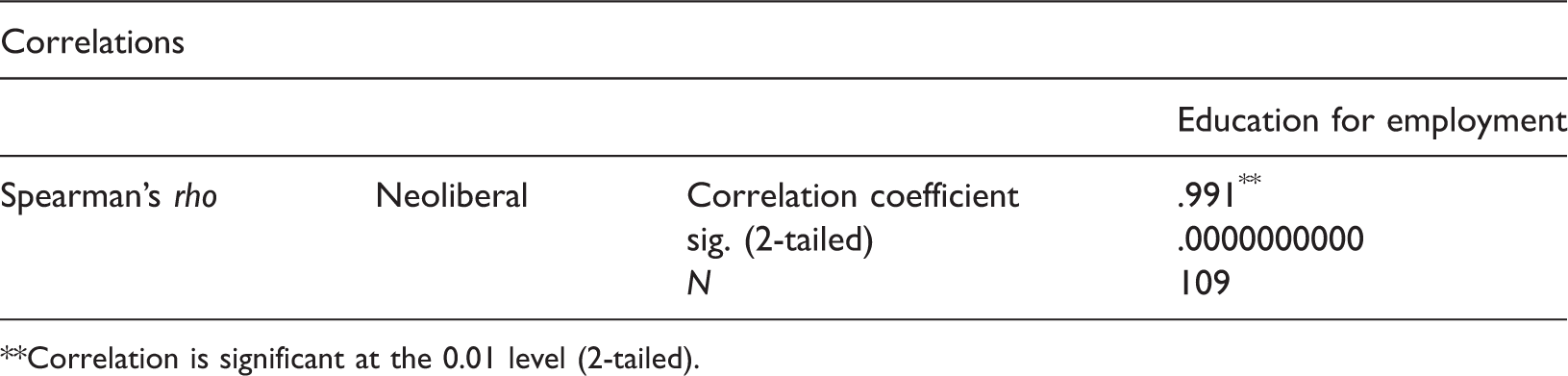
In Figure 5 we see how public interest in ‘education for employment’ started to rise at the same time the interest in neoliberalism began to rise – by comparison with Figure 3. They have continued the rise together. The correlation between the rise of ‘neoliberalism’ and the rise of ‘education for employment’ is rho = 0.991, significant at p < 0.000,001 (see Table 2). Spearman correlation is used because the Kolmogorov-Smirnov Z of 3.652 and 2.804 respectively indicates that, as would be expected from essentially monotonic growth data, the distributions are both significantly different from normal p < 0.001. N = 109 represents the correlation between the increasing use of ‘neoliberal’ and the increasing use of ‘education for employment’ number of years in the period 1900 to 2008.
The percentage occurrence of the terms ‘education for life’ and ‘education for employment’ in the publication of books from 1900 to 2008. Correlation between the increasing use of ‘neoliberal’ and the increasing use of ‘education for employment’. **Correlation is significant at the 0.01 level (2-tailed).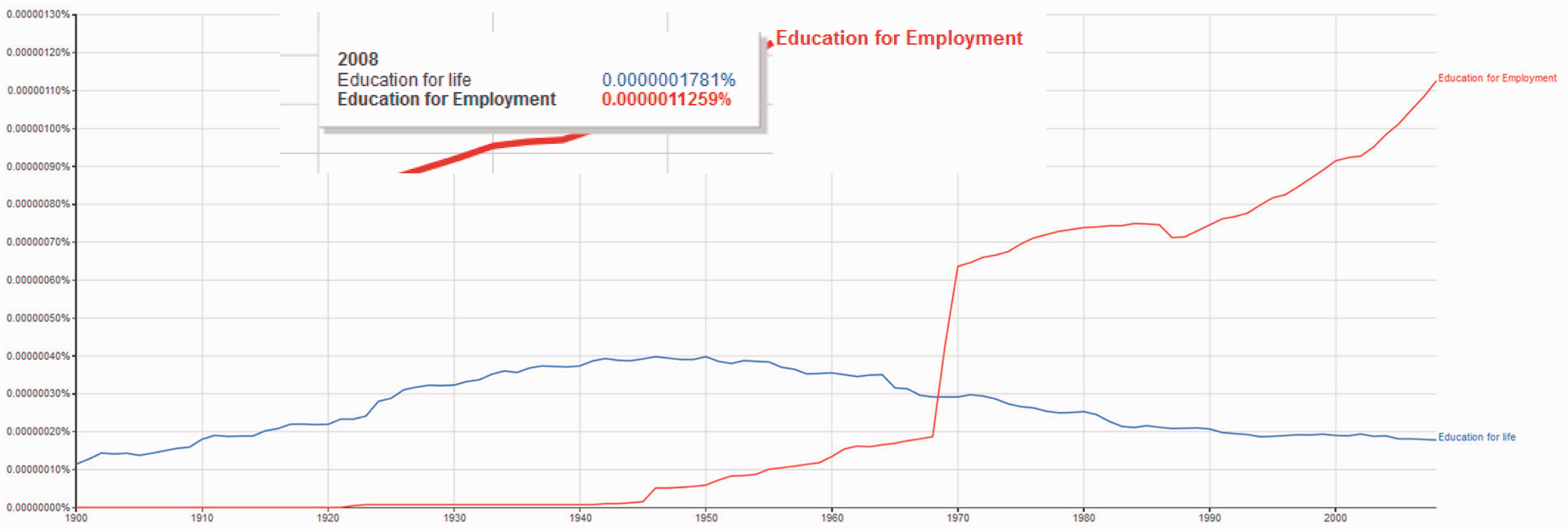
With the growth of neoliberalism, the importance of ‘education for life’ was eclipsed by ‘education for employment’ between 1967 and 1970. While relative interest in ‘education for life’ has waned by 45% from its post-war peak of 3.979E-07% to its 2008 low of 1.781E-07%, the meteoric rise in ‘neoliberalism’, continuing through 2008, has pushed ‘education for employment’ to be 632% more important than ‘education for life’ (1.1259E-06/1.781E-07 = 632%) which in 2008 was back at its 1910 developing level. We can expect that public funding follows public interest so that now (2014), fitting regression lines to the last 10 years of data (Table 1) approximately 700% more would be spent on ‘education for employment’ than is spent on ‘education for life’.
What is particularly interesting is the anomalous growth that kick-started the conversion to training in the late 1960s as shown in Figure 5. What was the most probable cause of this extremely rapid conversion to training between 1967 and 1970? The key event seems to be America’s deregulation of gold to support its dollar. The cost of the Vietnam War was pressurising a massive deflation of the dollar. President Charles de Gaulle continued to reduce French dollar reserves by selling them back to the US at their gold value ($35/ounce). Printed money was a government IOU for gold. They could print as many paper dollars as they wanted, but there was a limited supply of gold to support each dollar printed. To avoid massive international deflation of the dollar, the US broke away from the international support of currencies with gold – called the 1971 Nixon Shock (Ghizoni, 1971). To maintain the value of printed money, governments had maintained the price of gold since ‘early year’ as is shown in Figure 6. America’s uncoupling of currency from gold happened in two stages. In 1971 it went from $35 to $38/ounce and $42.22/ounce in 1973. The US totally removed this restriction on how much money they could print in October 1976. The inverse of the rising price of gold is the falling gold value of American paper money.
The removal of legal protections against unbridled avarice and the rise of neoliberalism in 1967.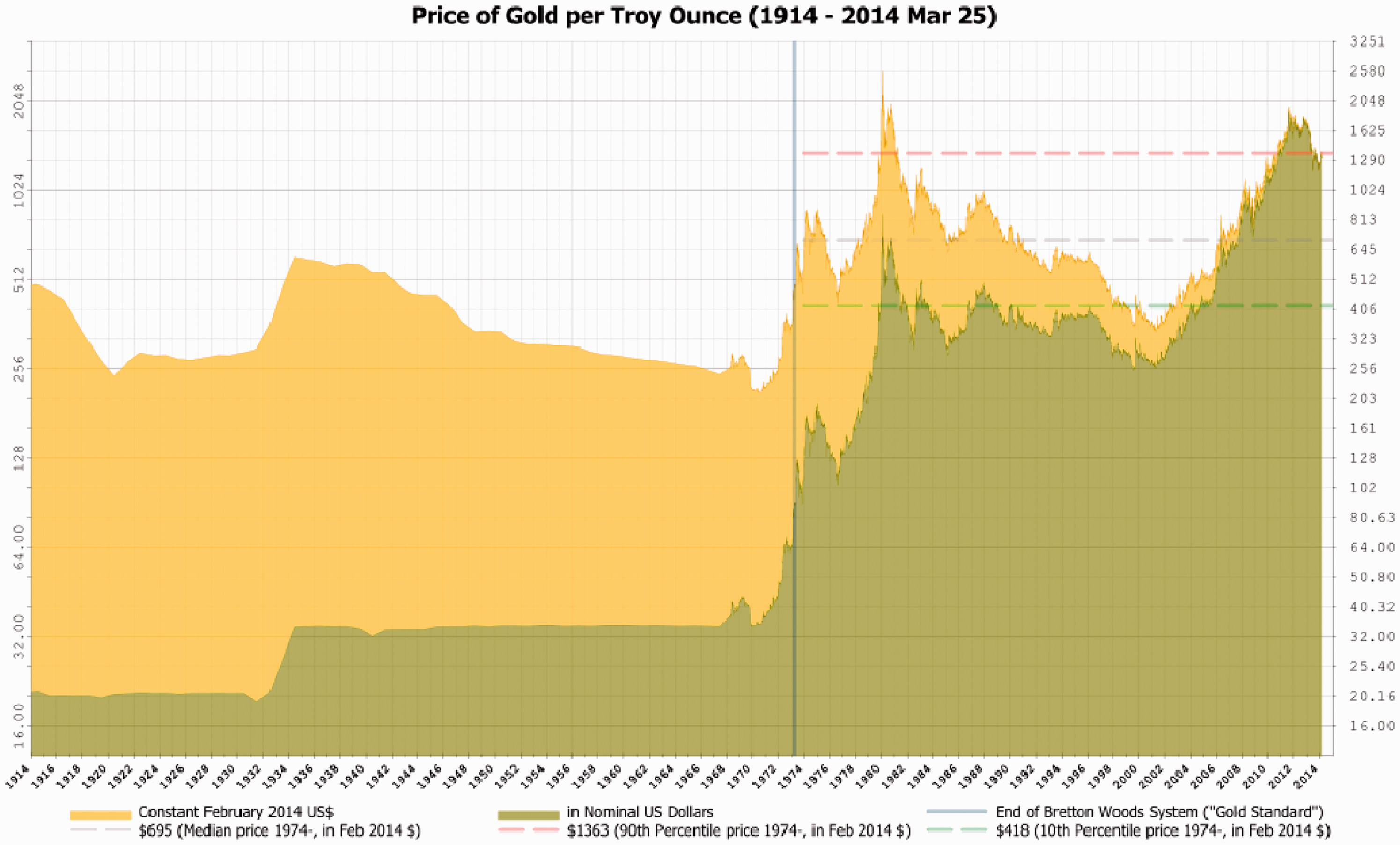
Figure 6 ostensively shows the positive rise in the value of gold after 1967 when it was no longer used to protect the value of paper dollars. The reverse of the gold price actually shows the staggering fall in the gold value of paper dollars which are being exchanged for real world resources and labour.
Other countries have followed and the race is on to exchange endlessly printable paper money for finite real resources (Siddiqui, 2012). Removing this long standing and wide reaching international protection for the value of printed money made it more acceptable to consider removal of other hard-won national legal protections of trade and labour mobility, which then followed. The blue-print for allowing lawless and rapacious global commercial assault was the Washington Consensus. Its 10 specific conditions have now been imposed through violence and cohesion on many national economies with disastrous effect to their education and other civic infrastructures (Klein, 2008). With regard to the increasing gap between rich and poor, the first nine conditions move public property into private ownership. The last condition is totally different, namely in protecting the ill-gotten gains from the first nine conditions: ‘10. Legal security for property rights’ (Williamson, 1990).
The new ‘gold standard’ that slows the inevitable spiralling inflation is the neoliberal leitmotiv of ‘maximum competition for minimum printed money’ which is facilitated by removing national protections of other countries of resources. However, when global ownership of resources has been exchanged for mountains of paper money, it will be in the interest of the new owners of those global resources to revert back to currencies that are linked to actual gold holdings whose value is currently maintained between the EU and US by the 2009 extended Washington Agreement on Gold (which the IMF did not sign) (Randow and Larkin, 2009). This would be first global version of the capitalist depression cycle.
Changing relationships between training and education
Since 1967 neoliberal global education policies have continually reduced the cultural and life-enhancing potential futures of national mass education systems to a troglodyte skill-training for a competitive international labour market. The results include Ngram views of what type of education civilisation cares about in Figures 7 and 8.
Neoliberal conversion of ‘education for life’ into ‘skills for work’. Neoliberal conversion of ‘life values’ into ‘life skills’.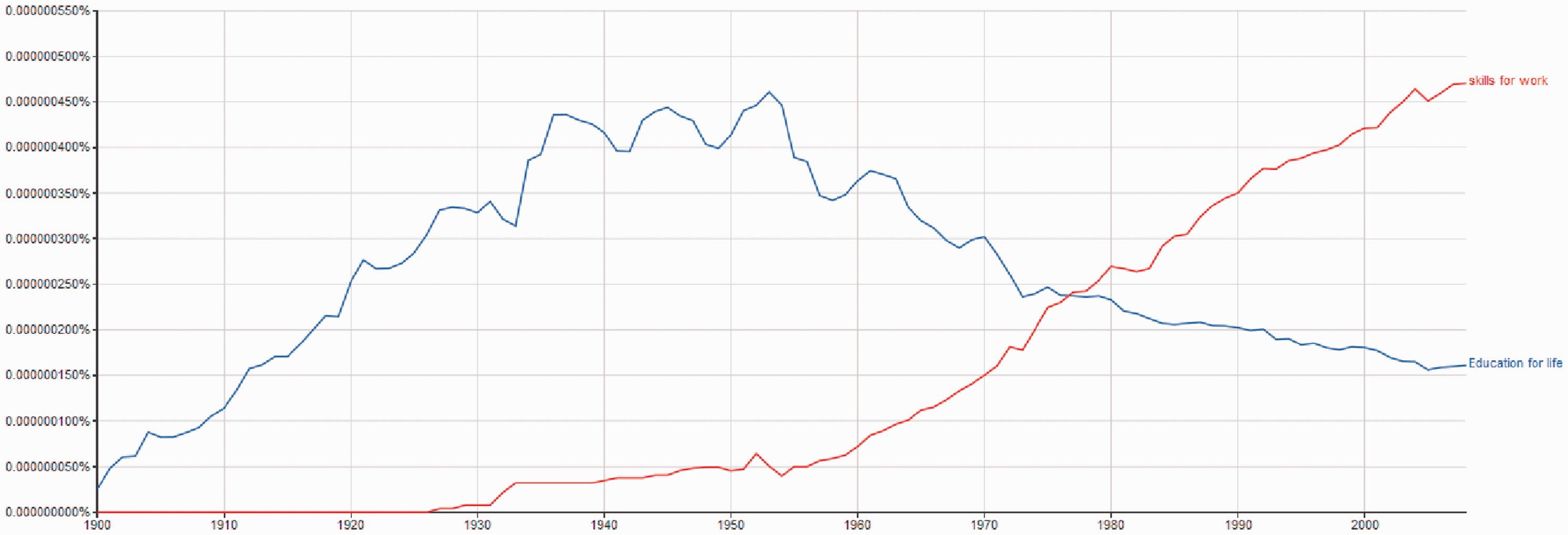
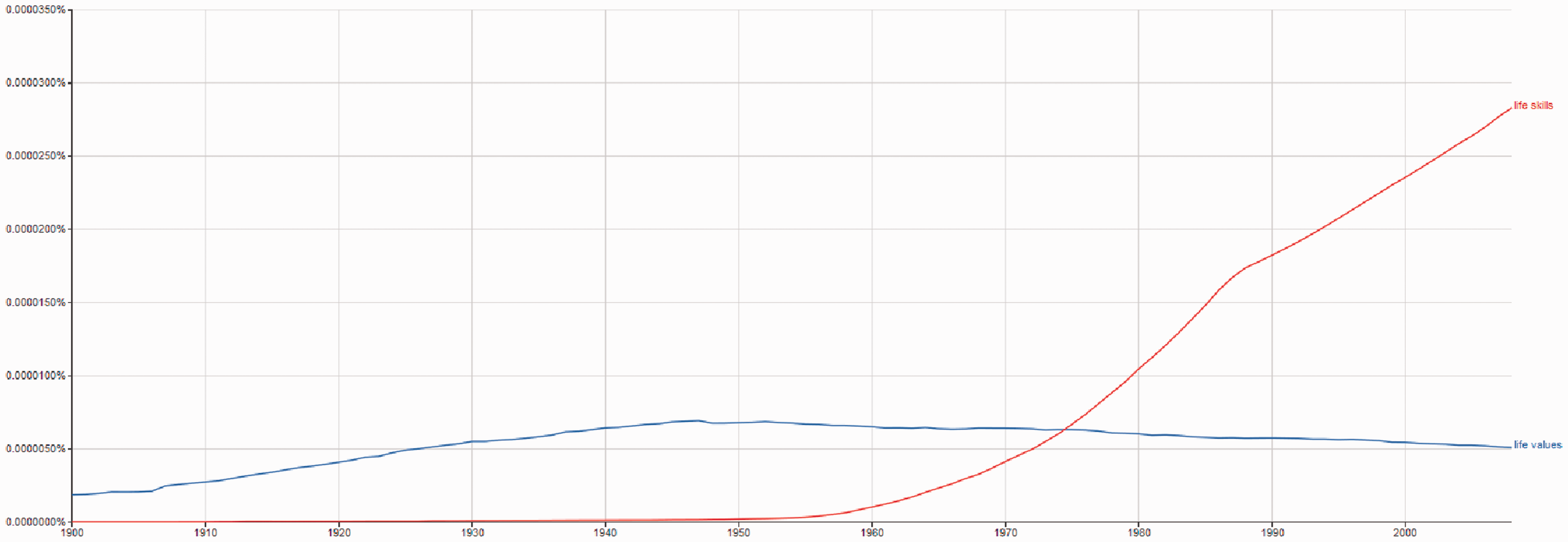
Figure 8 illustrates change from an education that offered diverse options of different cultural identities – different ‘life values’ in context’ – to an education that propagates one set of values, the values of employee-ment, and merely trains standardised ‘life skills’ supporting this limited and limiting set of values.
What we have said above now applies to all areas of education – including language education (see Figure 9), because those areas of education that could not fit the employee-ment mode, such as archaeology, anthropology or philosophy, have transmogrified or died.
The 1967 humanist/neoliberal clash over the purpose of language education.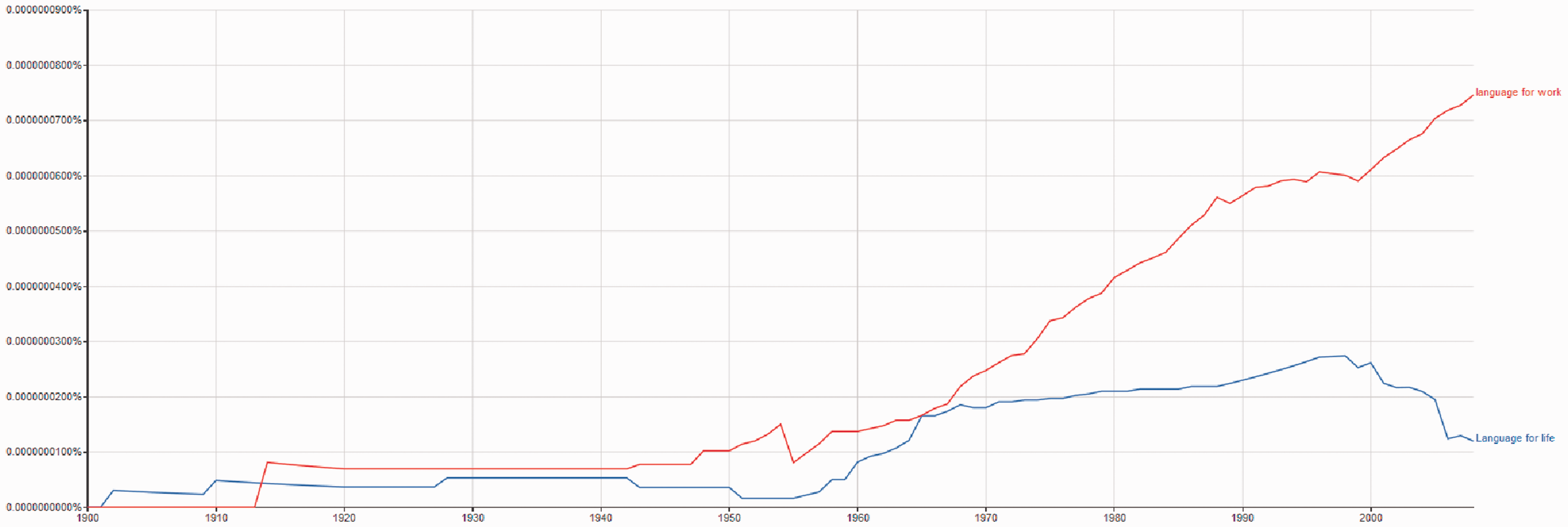
The 1960s rise in the humanistic intentions of language education should have continued to a meteoric rise and the neoliberal purpose of language for work should have continued its more modest rise in support of language for life. However, in the clash of 1967 they changed trajectories and since the 1997 Council for Cultural Cooperation’s European Language Portfolio proposals for development (precursor for the CEFRL) ‘language for work’ has received yet a further boost at the expense of the humanistic intentions of language education that have now almost withered completely in the public mind.
Example of how the common framework spins diversity
The culturometric spin analysis that uncovers the deception for acceptance of neoliberal policy documents is structurally simple. We match the three parts of the document with the three parts of the identity funnel from Figure 2 to see how they match.
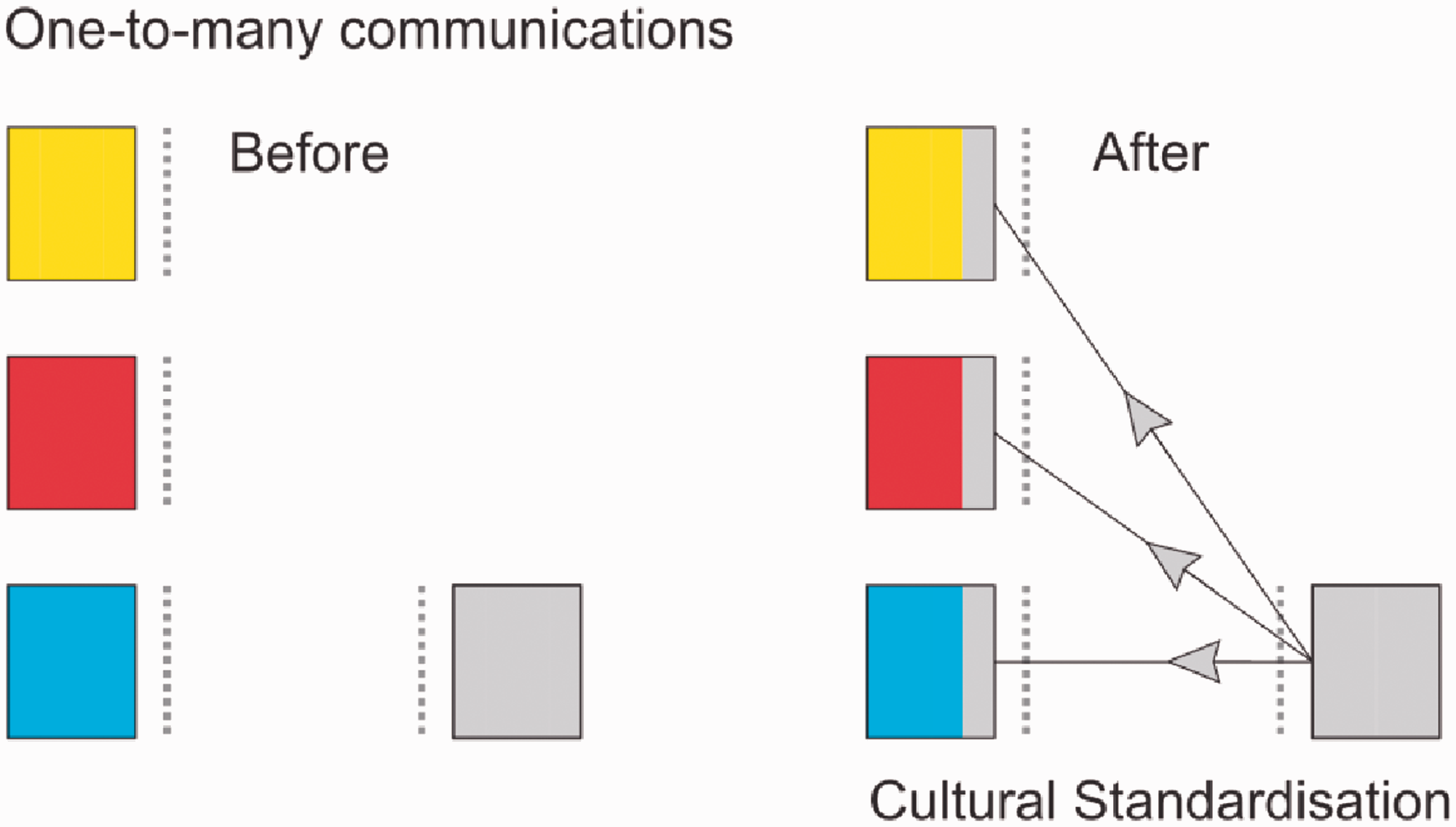
Cultural diversity results from ‘Many-to-one' communication with relevance to the learner's culture. Cultural diversity results from ‘one-to-many’ communication with relevance to the learner’s culture.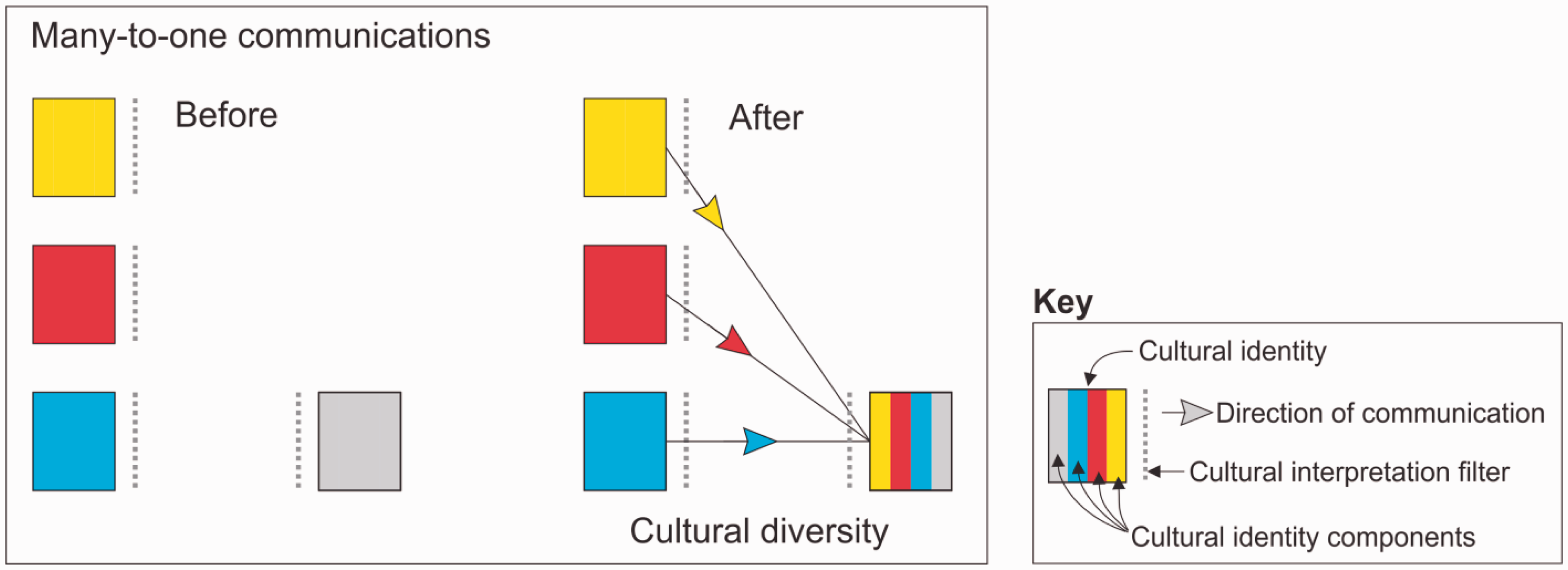
a. SPIN: the convincing introduction (or, in neoliberal jargon, ‘the soft sell’)
The European Common Framework is an example in the area of language learning. In particular, the European Framework is such a policy document seeking acceptance by spinning the VABI of ‘diversity’ – promoting language skills for the single cultural identity of employee-ment and training students in the perfection of standard behaviours for its compliance standards. In the introduction on page 5, we learn ‘Why is CEF needed?’ and are told it‘is necessary in the interests of greater… respect for identity and cultural diversity’ (CF:5/pdf: 14). This aligns with the humanistic values of language education that seeks to promote genuine cultural diversity. In Chapter 8, invitingly titled ‘Linguistic diversification and the curriculum’ we learn the first of the three main principles, ‘the overall objective of promoting plurilingualism and linguistic diversity’ (CF: 169/pdf: 178), but we also learn the gradually increasing restrictions on its operational definition as ‘Diversification within an overall concept’ (CF: 169/pdf: 178); that ‘concept’ being ‘neoliberalism’:
b. SQUEEZE: limiting and redefining community meanings
This means that the teaching and learning of any one language should also be examined in conjunction with the provision for other languages … The second principle is that this
c. STANDARDISATION: the compliance standards (or, in neoliberal jargon, ‘the bottom line’)
What are the assessment concerns in Chapter 9 of the European Common Framework?
d. OUTPUT: standardised neoliberal cultural identity of employee-ment
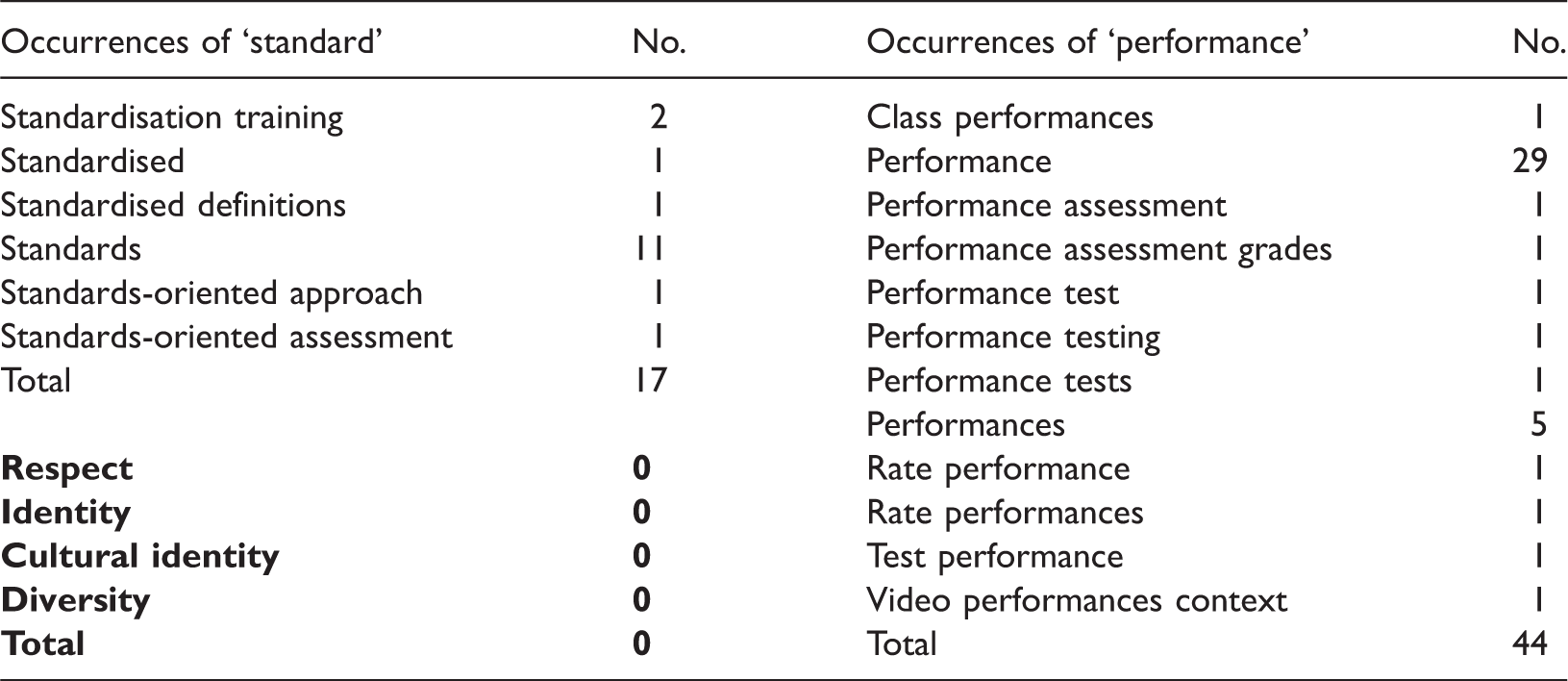
When we compare from part (a), the rationale of the framework’s ‘greater… respect for identity and cultural diversity’, the promise of ‘linguistic diversification’ and ‘the overall objective of promoting plurilingualism and linguistic diversity’ with part (b), compliance standards of how the framework’s rationale, promise and overall object is to be assessed, we find, as shown in Table 3, no mention of respect, identity, cultural identity or of diversity. Instead we find that we are to comply with 44 statements of employee-ment standards and performance. Part (c) of the framework never mentions the ‘values’ and ‘cultural identities’ that the assessed performances are intended to communicate.
This negation of diversity in the assessment of language at the end of the document contrasts markedly with the humanistic intentions of language education that seek to promote genuine cultural diversity to which lip-service is paid in part (a) of the document. Documenting this contrast is transparent culturometric demonstration of the standard neoliberal subterfuge applied in the framework. It shows how the framework seeks to misinform by spinning the high value that language educators place on cultural diversity and it exposes the CEFRL as a document for promoting the standardised neoliberal cultural identity of employee-ment.
Culturometric deconstruction of ‘learning culture’ in language education
Learning cultural diversity
The culturometric humanistic condition for cultural diversity is that: ‘Any given person or group can, not only appreciate, but also affirm many other coexistent vibrant cultures.’ We are still fortunate to live at a time where there are many linguistically based cultures: French, Russian, Spanish, Finnish, and so on. Cultural diversity happens when these cultures are brought to others, individually or in groups, so that they can affirm these different cultures. It is a ‘many-to-one’ communication – bringing many cultures to a given person or group as shown in Figure 10.
Learning cultural standardisation
What diversity means from a neoliberal perspective is diversity of market for standardised mono-cultural products. That is, the same product being marketed to different cultures. It is the opposite of culturometrics’ traditional humanistic meaning of diversity – it is actually ‘standardisation’. The problem with the CEFRL is that it is such a standardised and standardising product comprising one set of cultural values – namely neoliberal values – that are marketed by language translation to different cultural groups. It is a one-to-many cultural communication – a standardisation of culture, not a diversification of culture. This is illustrated in Figure 11 which can be contrasted with Figure 10. I would venture that it is a marketing prototype for opening linguistically diverse ‘markets’ to other mono-cultural ‘products’ and ‘processes’.
The CF is training the filters of different language based cultures to use the same interpretations for receiving and sending – employee-ment and other global market values. This is the cultural standardisation effected by the CEFRL.
Alternative options for learning cultural diversity from language education
To appreciate cultural diversity, we principally need to compare the ‘cultural interpretation filters’ of other cultures with our own filters. Firstly, we identify filters that are very different from ours. We can do this by noting what we would consider to be highly anomalous behaviours in a shared context – something ‘they’ do that is very different from what ‘we’ do. We should ask what particular ‘communication behaviours’ mean. More precisely, we should find out what values a communicator is intending to signify by his or her behaviour – linguistic and/or non-linguistic because behaviours as communications can be linguistic and/or non-linguistic communications which offer multiple modes for learning activities. Being guided by tenet (1), the definition of cultural identity, we then need to partition those values into ones that specify the context boundary for the communicator and other values more central to the communicator’s context. Key interlocutions in finding the meaning of behaviour revolve around the questions ‘Why do you do that?’ and ‘What does that mean?’
As we bring awareness of different cultural values from diverse cultures in relation to our own cultural values using many-to-one communications, we ourselves become more culturally diverse.
As an example of a purely linguistic comparison of diverse cultural values that could follow from the culturometric perspective, I would propose that contrasts between cultural values can be made apparent by loanwords, calques or loan translations as shown in Figure 12. Generally, the more words needed by the recipient culture to translate a loaned concept then the more different I would assume are the cultural values for the contexts of that word – as guided by the Sapir-Whorf hypothesis.
Loan categories simplified from a classification by Joachim (2004).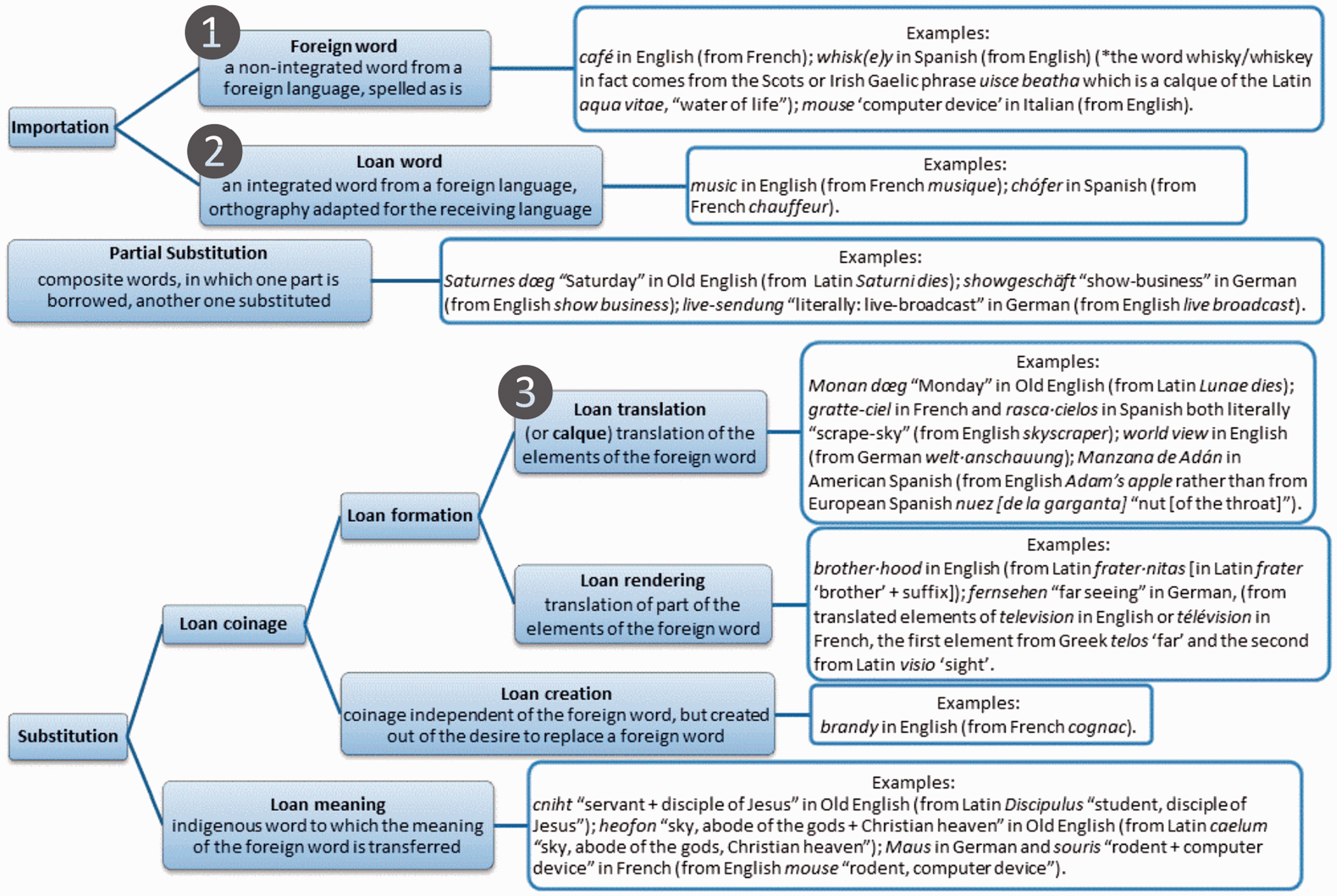
For example, the functions of the English ‘lunchbox’ serve the values of prioritising time for work above time for socialising. So it might follow that cultures that share those values import lunchbox as a loanword or as a loan creation (like the French ‘ordinateur’ for the English ‘computer’). Those cultures that are very different would use more extensive calques.
Given a sufficient number of examples ‘n’ we can test the hypothesis that ‘an extended calque indicates large differences in cultural values regarding contexts of the loanword’ using a Chi-square statistic (n ≥ 30, df = 2) by classifying the length of translations of ‘lunchbox’ for cultures that have work-driven vs. socially prioritised values – as illustrated in Table 4 for n = 4.
WC – German: Sie bereitete eine Lunchbox für ihren Mann (1)
Translation categories of ‘lunchbox’ compared for work prioritising cultures versus social prioritising cultures.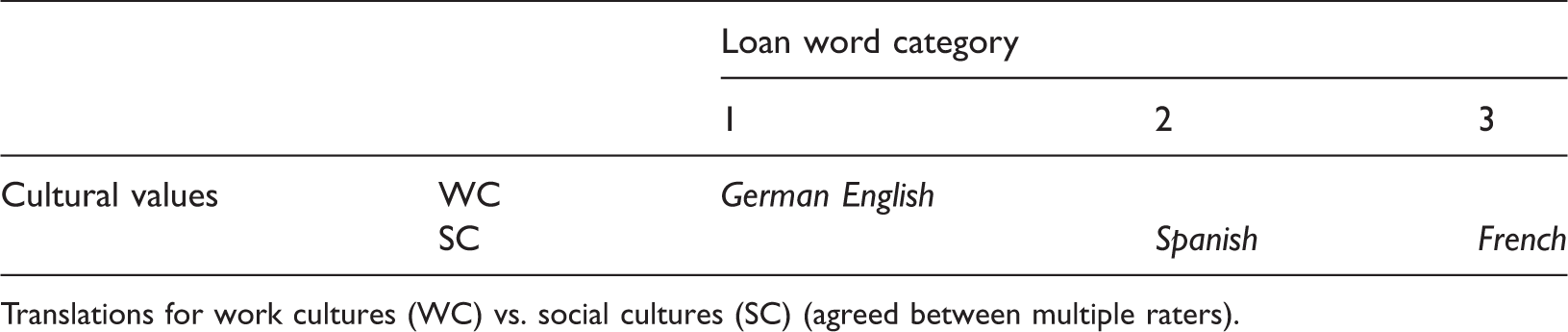
Translations for work cultures (WC) vs. social cultures (SC) (agreed between multiple raters).
WC – English: She prepared a lunchbox for her husband (1)
SC – Spanish: Ella preparó una lonchera para su marido (2)
SC – French: Elle a préparé une boîte à « lunch » pour son mari (3)
Language education resources devoted to language training and language education
In this section, we summarise the data-driven conceptual analyses above by their overarching effects of transferring resources from language education for exploration of selves and cultures to language training for a chance of being an employee. We will show the increasing resources utilised by language education and how these are being increasingly devoted only to training for the possibility of employment. We will then compare two future scenarios: a future where we do more of the same, or a future where we begin to return to the humanistic roots of language education.
Since the 1950s, resources for language education have received political and economic boosts to support specific language training and military boosts to support a wider range of languages matching the wider geography of military interests. Political change events include the thawing of the cold war which led to Russian being promoted in UK universities in the late 1960s and early 1970s. Economic change events include the rise Chinese market which leads to UK school children being taught Chinese. 5 Military funding of the Monterey Language Centre under the Vietnam War effort was intended to ‘help our boys understand the Gooks’. 6 The more modern military need to persuade defeated countries to instate pro-US, or pro-European governments, has led to change in language policies. 7 Growth in language education resources parallels overall growth the world use of resources required for education.
World use of education resources in person-years 1950–2050.
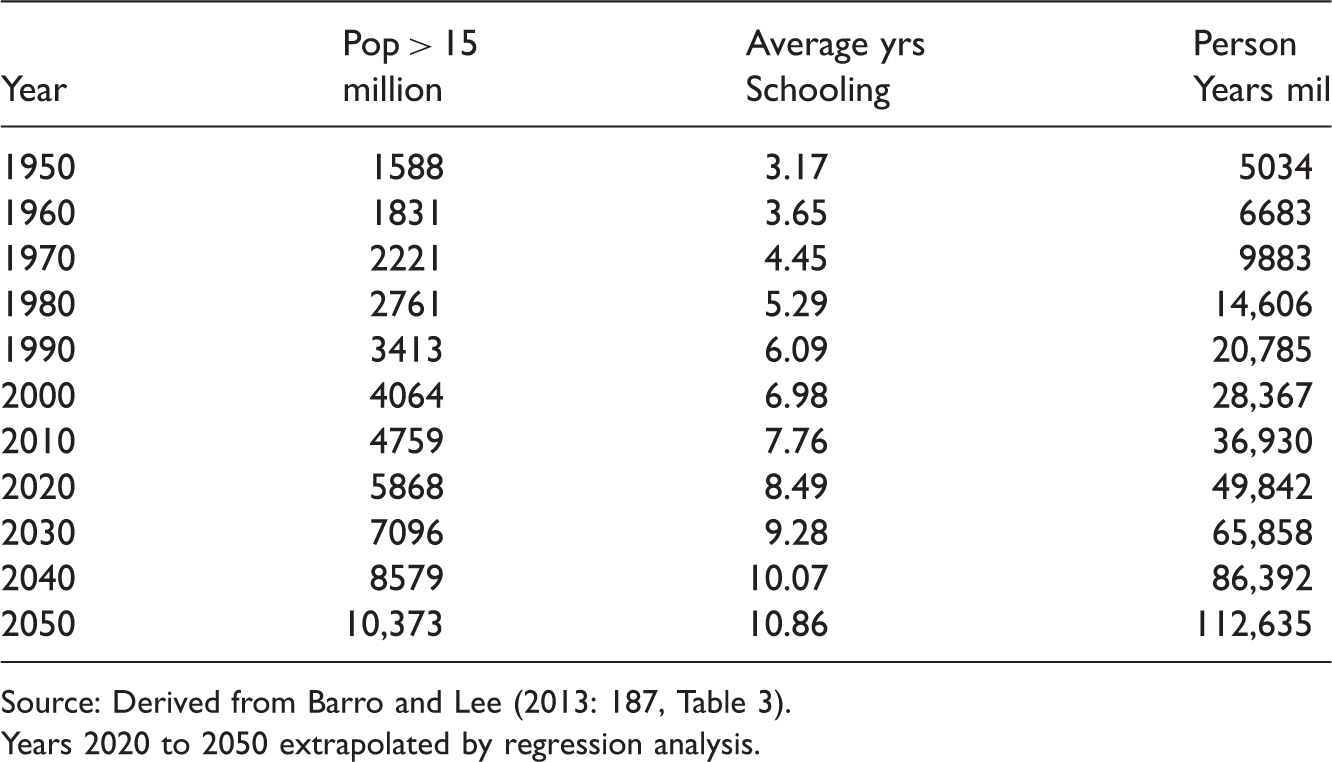
Years 2020 to 2050 extrapolated by regression analysis.
We can then visualise the changing distribution of language education resources between training and education with the aid of Figure 13, which for simplicity of conceptualisation has the growth variable temporarily controlled at its 2010 level of 36,930 million person years (see Table 5) and is anchored at the 1969 training/education break-even point (see Figure 5).
The changing distribution of language education resources between training and education.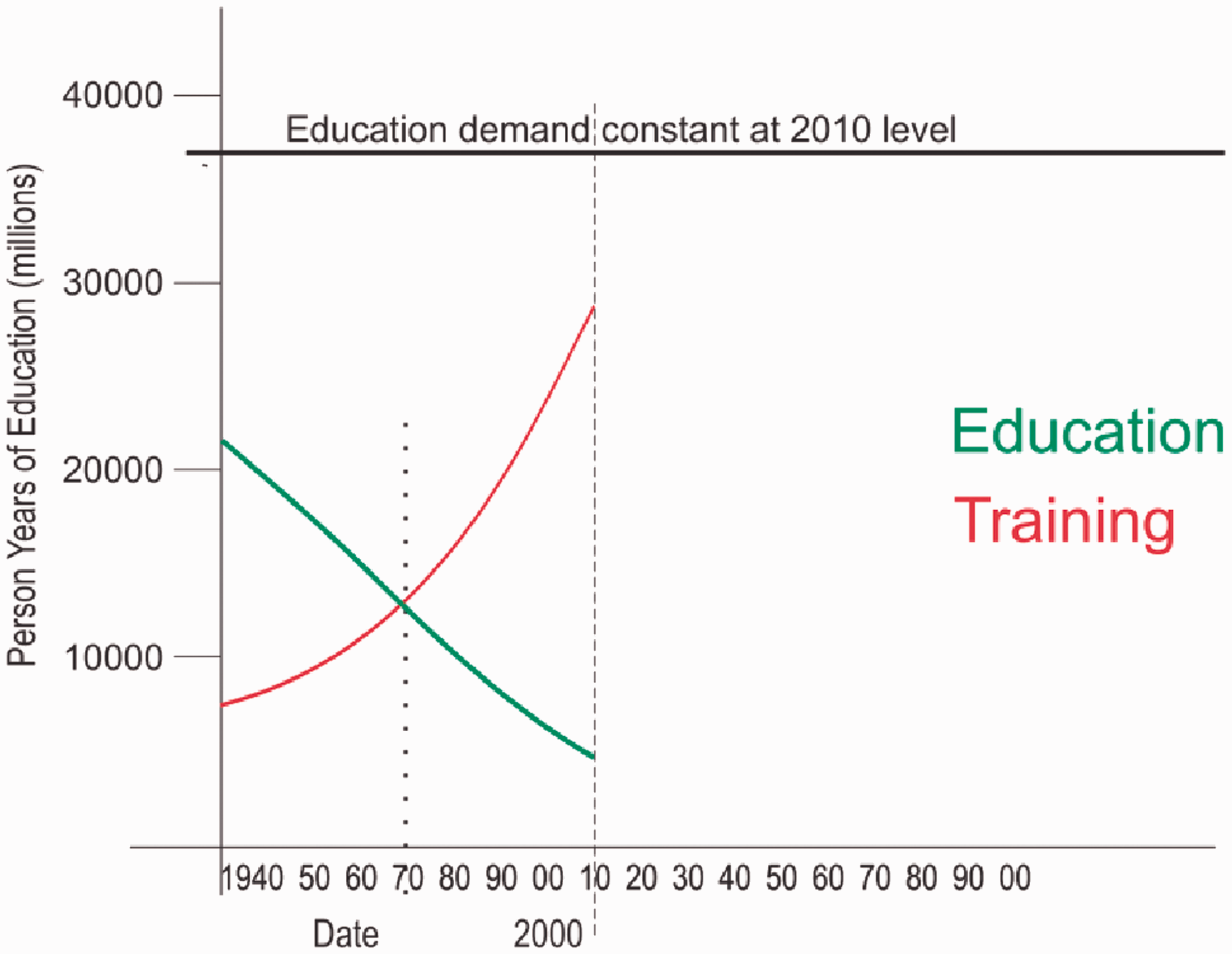
In Figure 13, we visualise the notional zero-sum portioning of language education resources between education and training given constant demand for language education at the 2010 level and summarising the Ngram data for Figures 3, 4, 6, 7, 8 and 9. We observe that as training eats up more resources less is available for education which therefore declines from the break-even point in 1967 to its low level in 2010.
The future of language education: the neoliberal language training future or the humanistic language education future
Training is necessary for languages competencies that are not directed to employment. However, these alternatives emerge from the wider purview of humanistic education. If we continue to move resources from humanistic language education to language training only for employment, as shown in Figure 14, we cannot ask who we will become. We must ask what we will become.
The neoliberal language training future.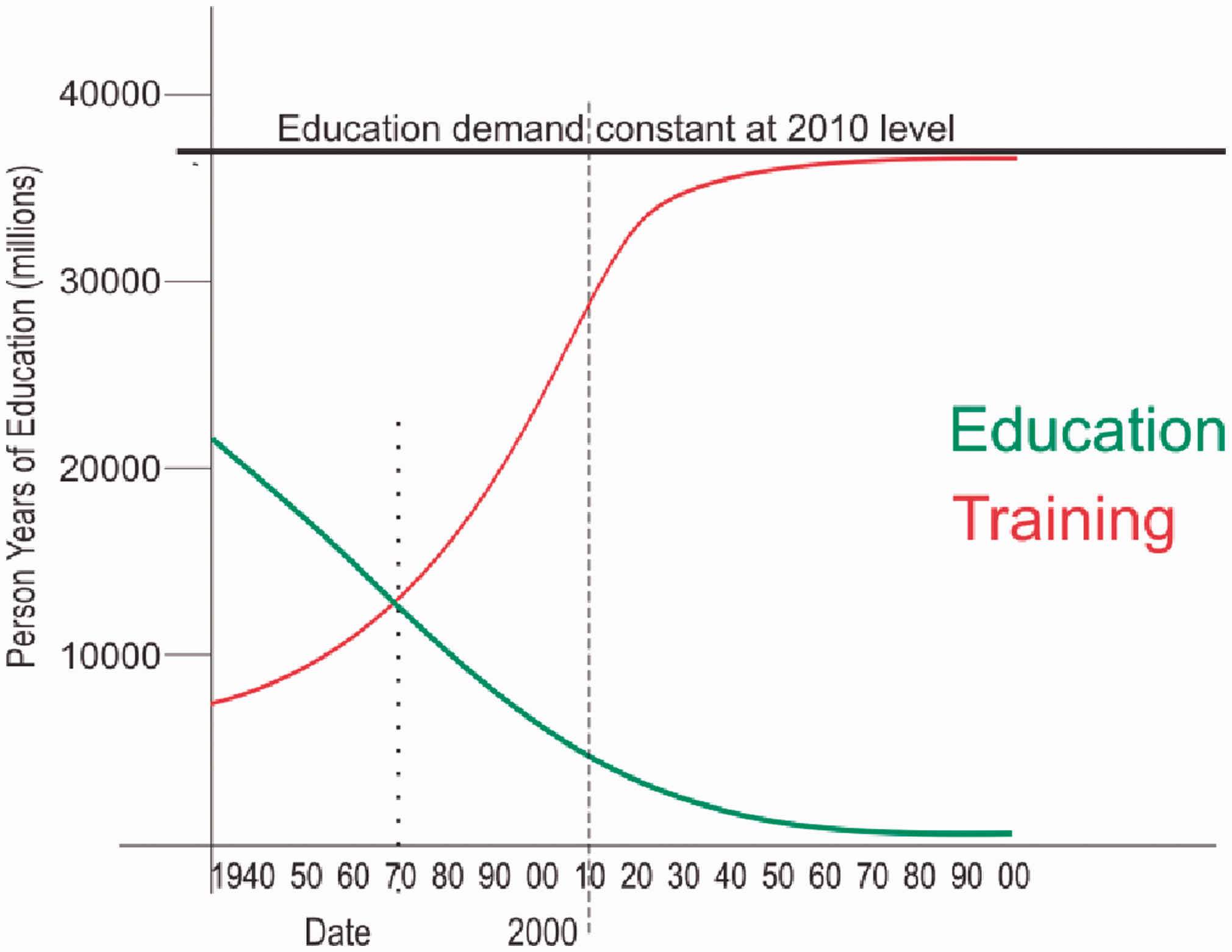
However, we have shown that there are alternatives to only training for work. From our culturometric deconstruction of how cultural diversity is learnt through language education we have seen ways we can authentically enhance cultural diversity through language education. This does not exclude an identity as an employee, but it includes the infinite possibilities of who we can be. In Figure 15 we envisage slowing and eventually reversing the current trends.
The humanist language education future.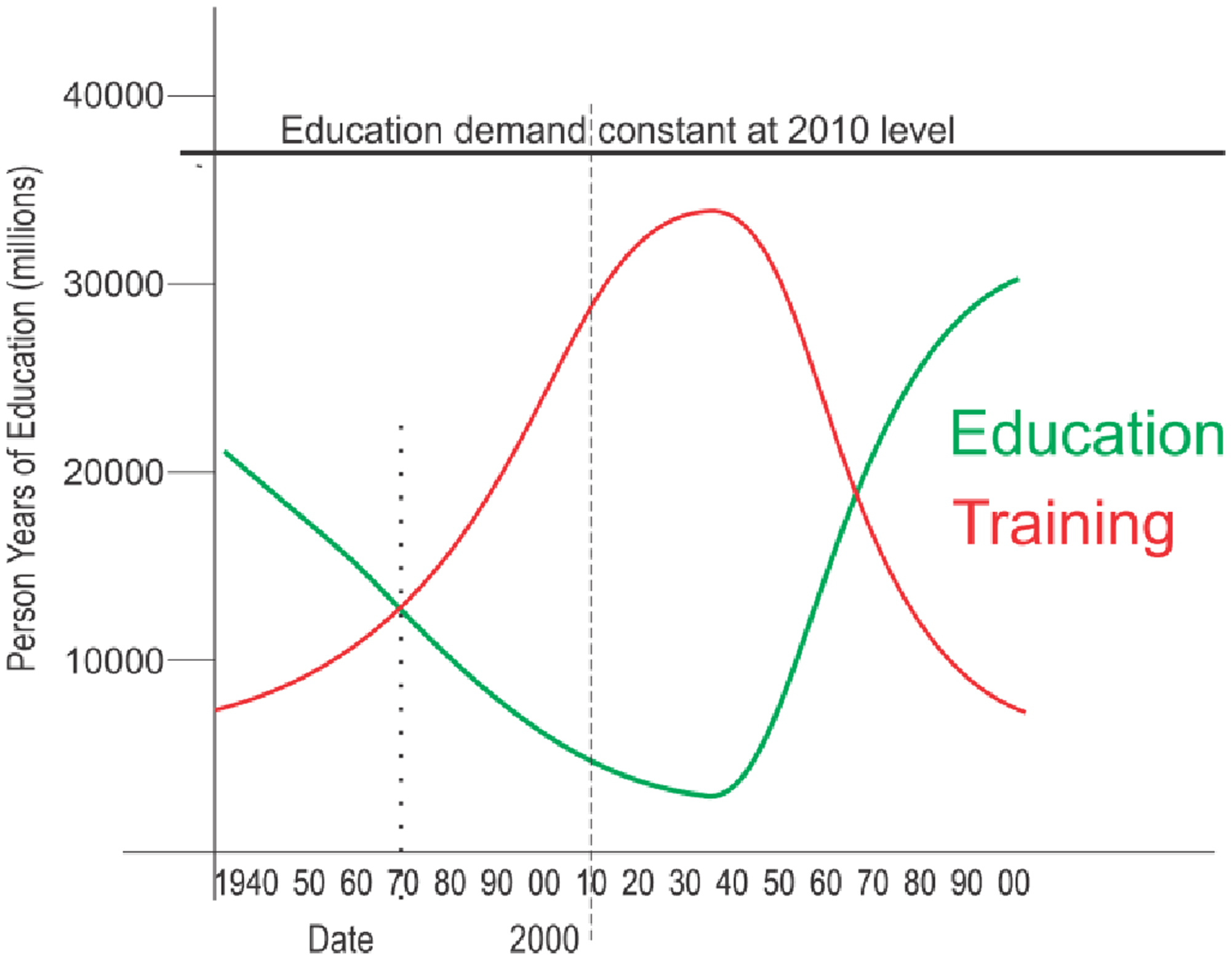
The training trend has built considerable inertia but as there will be relatively fewer jobs to be trained for the training trend will be slowed and relatively reversed as part of the growing global opposition to the economic and social disasters wrought by the self-interests of a few upon the masses of the world’s population. In contrast, the positive change in language education is not subject to any such inertia. Positive change in language education requires only that language educators free themselves from the yoke of neoliberal performativity (Boufoy-Bastick, 2014b) and return to the true motivation of their roots as academics and educators (Biesta, 2009).
Fast forwarding the future
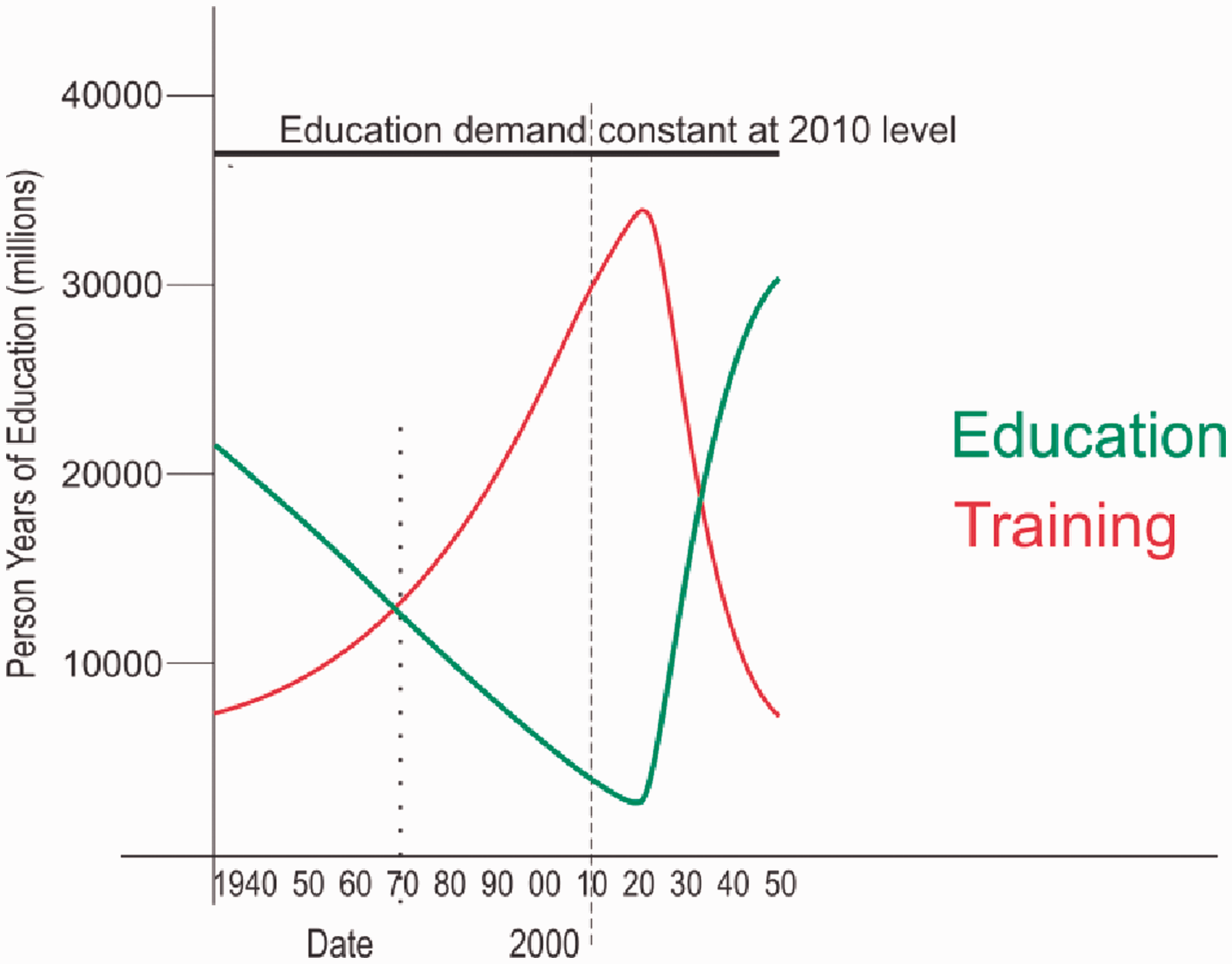
Neoliberalism is no longer an experiment. Countries have lived through these disastrous policies, and tried to escape from their yoke, for over 30 years (Klein, 2008). With increasing entrenchment, financial support and further removals of legal restraints it is likely that a neoliberal future will come upon us even faster than its past assent. However, the criticism of neoliberal policies continues to grow more vociferous with growing numbers of increasingly violent national demonstrations (Ayres, 2004; Ismi, 2013). As we now have growing wider awareness of this neoliberal disaster, we could learn from our history and as language educators effect a more rapid fast-track change to a better future for language education, so our future can unfold at a more determined rate than the development of our current situation. It is not unreasonable to expect that, even with the inertia of the system and its continued support from its few but powerful beneficiaries; we can undo in four decades a disaster that we allowed to develop over six decades. We can therefore fast forward extrapolation of the current situation to expectations of both alternative futures that Figures 13 and 14 illustrate. These are shown in Figures 16 and 17 predicting a neoliberal fast forwarded future for language education or a humanist fast forwarded future for language education respectively.
Fast-forwarded prediction of a neoliberal future for language education 1950–2050 under no-growth constraint. Fast-forwarded prediction of a humanistic future for language education 1950–2050 under no-growth constraint.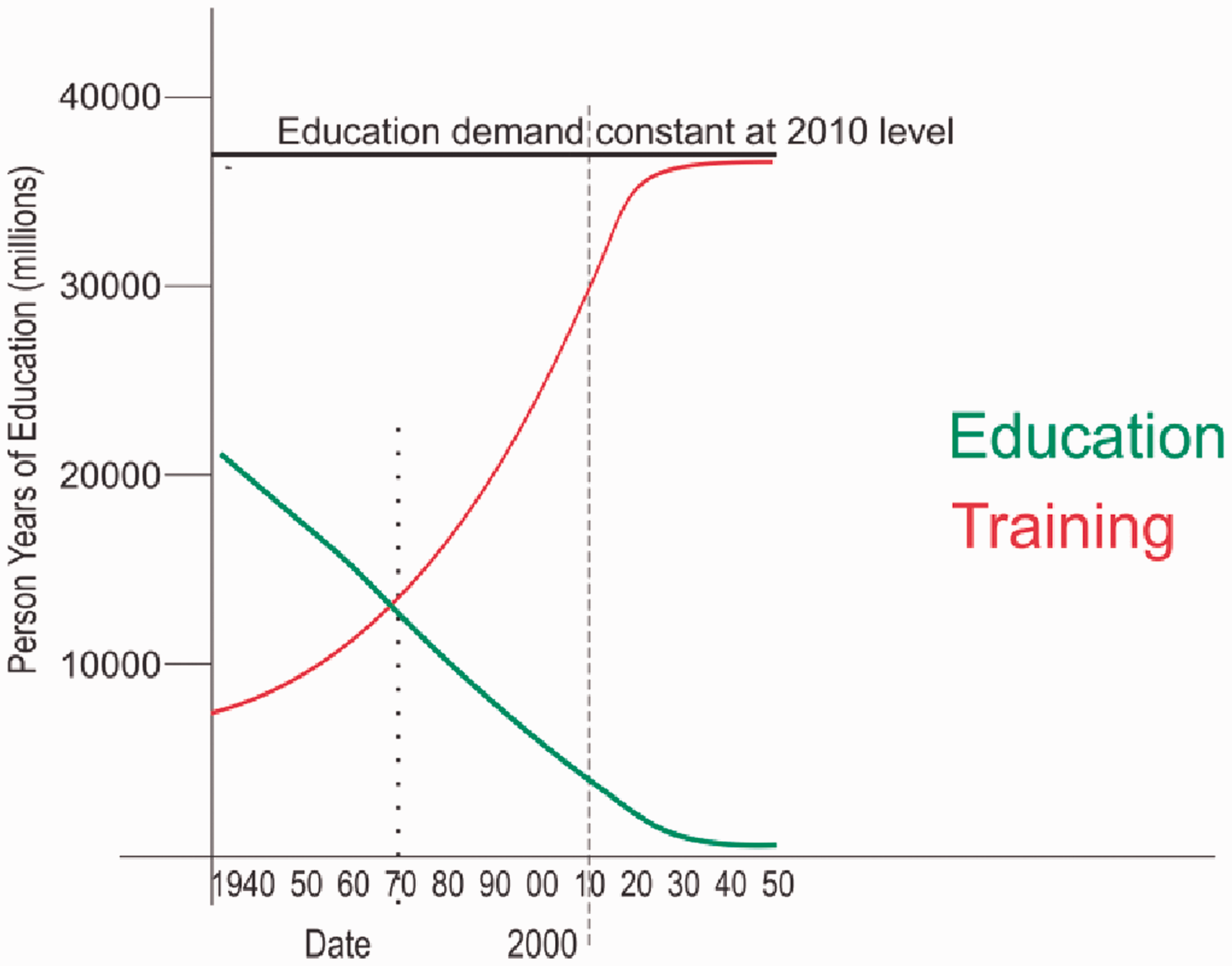
The envelope of growth
To clarify the changing relationship between training and education we have illustrated it above by holding constant education growth at the 2010 level of 36,930 millions of person-years. However, the growth variable derived from the data in Table 5 is actually exponential.
8
Table 5 showed that the size of the resource pie has been increasing exponentially with the rise of mass education around the world. Figure 18 illustrates the growth.
World use of education resources 1950–2050 (from data in Table 5).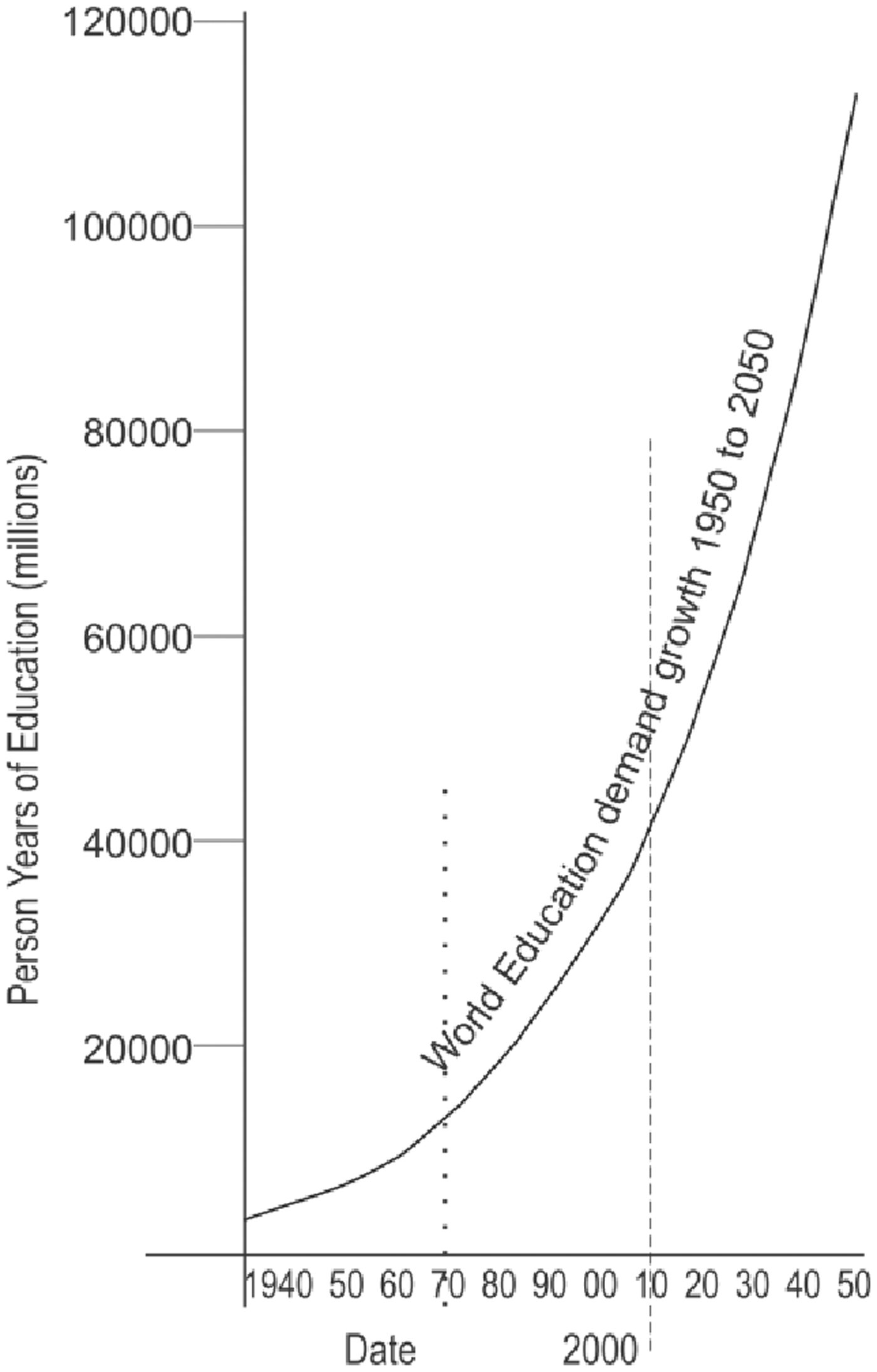
To derive the influence of the exponential growth of education on the relationships between training and education we remove the artificial constraint of no-growth that we had imposed for conceptual clarification and fit these relationships to the envelope of actual growth in education. The situation up to 2010 from Figure 13 is illustrated in Figure 19.
The changing distribution of language education resources between training and education under actual world education growth to 2010: A wake-up call for language educators.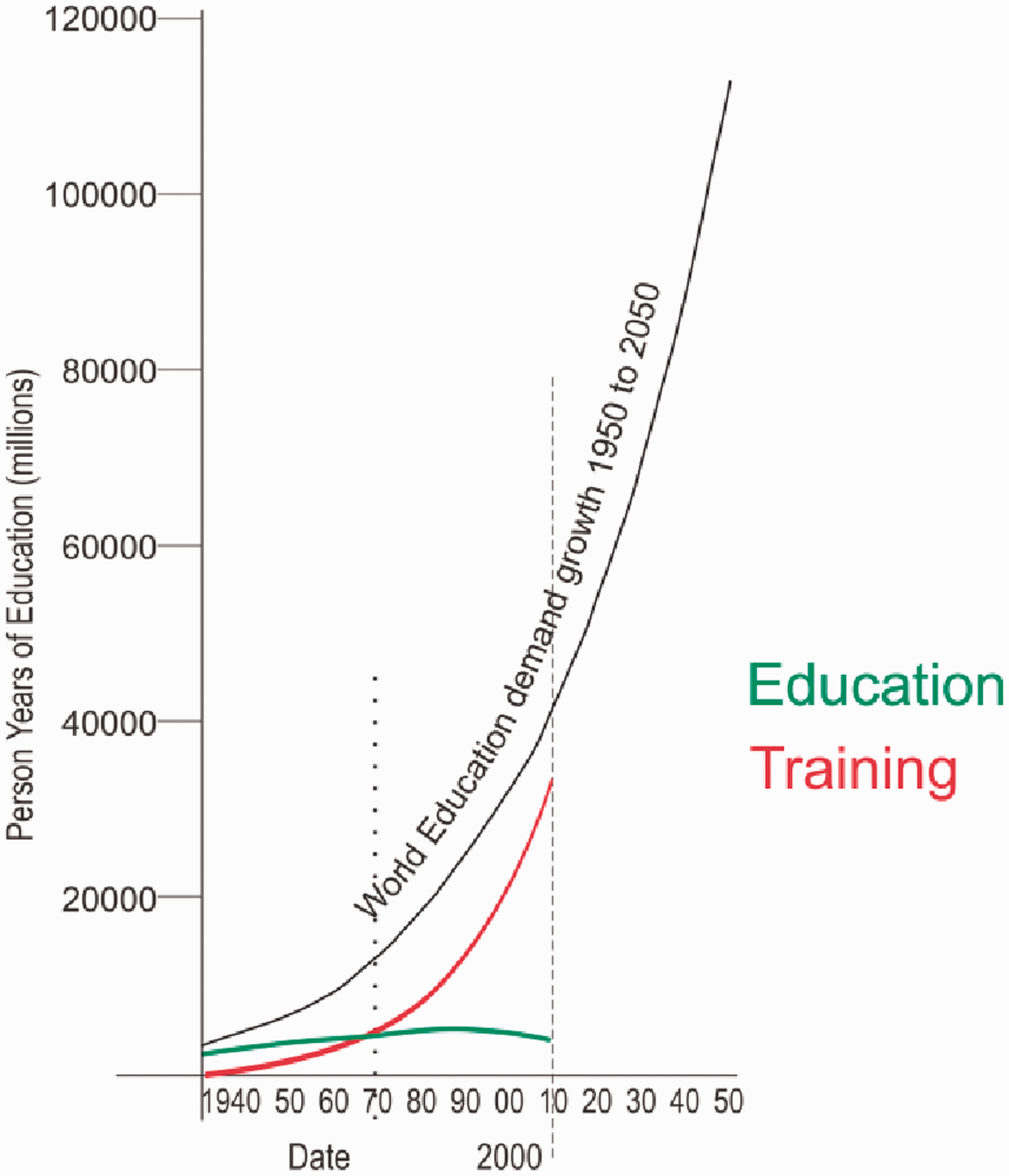
Figure 19 shows the same zero-sum relationships between training and education depicted in Figure 13. However, the restraining horizontal growth line has been replaced by the actual growth line so that the zero-sum relationships have been fitted to the exponentially increasing usage of education between 1950 and 2010. When comparing the growth and no-growth data we notice that, because the massive overall growth in education use is greater than the relative decrease in language education, compared to language training, the result has been a relatively small absolute increase in language education. This is because the massive overall growth in education use is greater than the relative decrease in language education compared to language training so the result has been a relatively small absolute increase in language education. However, we notice that the initial absolute increase in language education that lulled language educators into a sense of false security peaked and plateaued over the 1980s and 1990s and is now decreasing even in absolute terms compared with the 700% times the resource allocation to language training. This is a wake-up call for language educators.
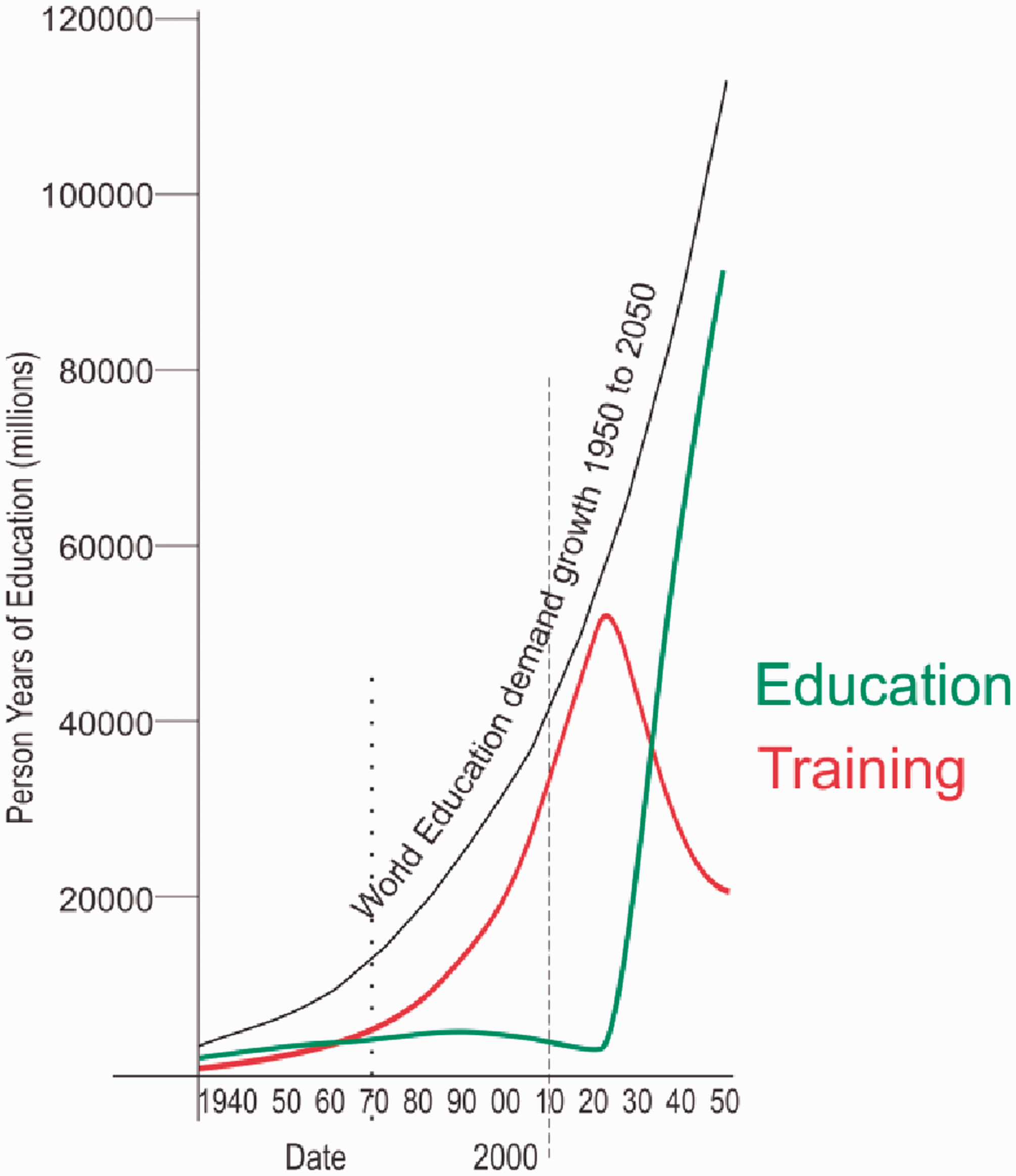
Figure 20 and Figure 21 show our two possible futures corresponding to Figure 16 and Figure 17 constant restrained growth respectively, but under the actual predicated growth in world use of language education.
Fast-forwarded prediction of a neoliberal future for language education 1950–2050 under predicted growth in world education. Fast-forwarded prediction of a humanistic future for language education 1950–2050 under predicted growth in world education.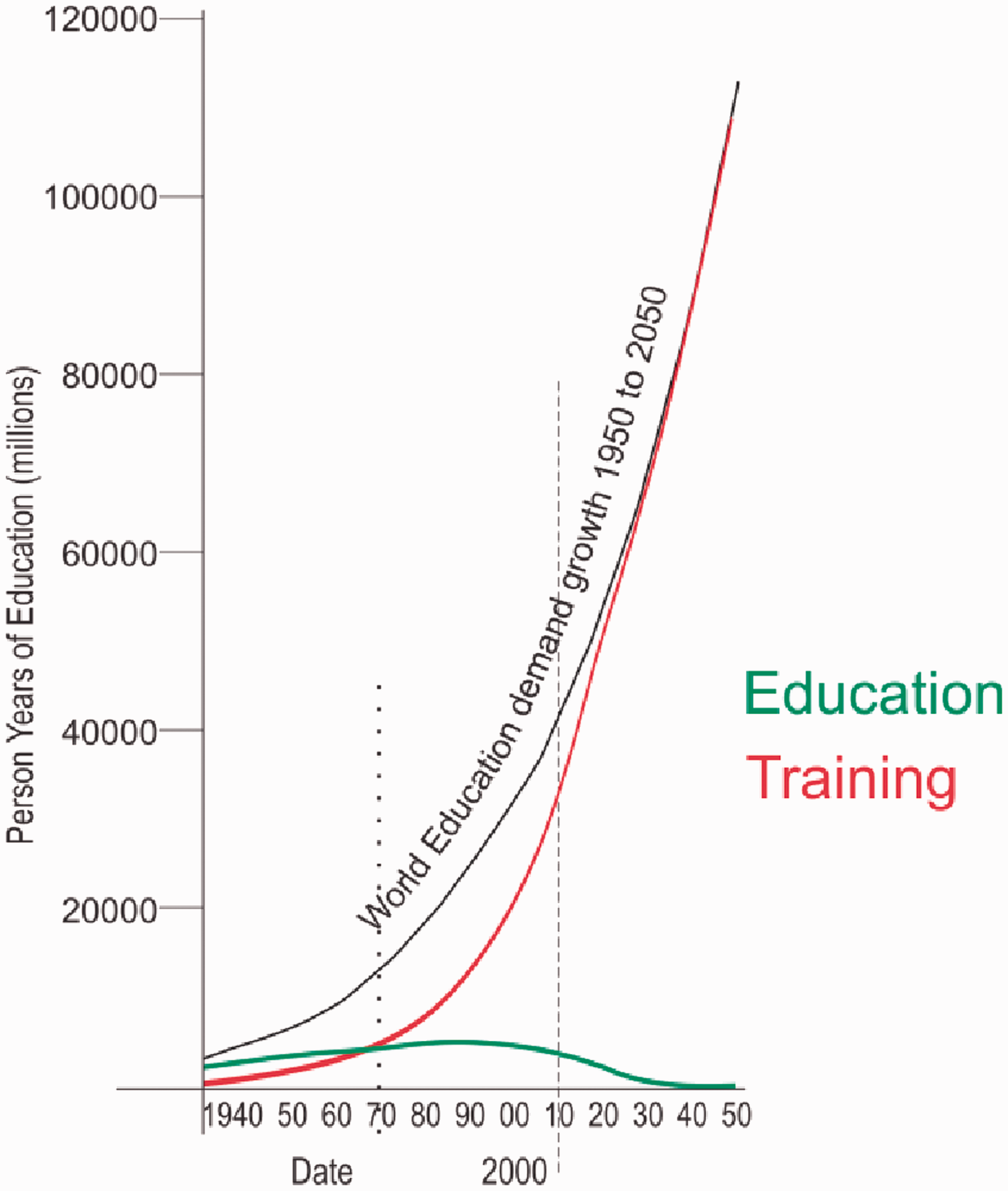
If we continue with common framework-type neoliberal policies then the stark reality of training for employment is all that will exist in mass education by 2050.
However, if we honour our roots and return to the true humanistic intention of our field, we see that language education prospers, as does the different purposes for language training that education engenders (Figure 21).
In this, ‘the best of all possible worlds’, the differences we make now should start to become noticeably effective in the 2020s and garner increasing international support from the global education community.
Footnotes
Funding
This research was conducted independently of the vested interests of any funding agency in the public, commercial, or not-for-profit sectors.