




Abstract
This paper is an attempt to reconstruct how C.V. Raman, a peripheral scientist in the early 20th century colonial India, managed to develop a research programme in physical optics from his remote colonial location. His attempts at self-training and self-education eventually led him to the discovery of the Raman Effect and to the Nobel Prize in Physics in 1930. In trying to re-construct an account of the ways in which Raman developed his research programme in optics by grasping various elements of a scientific practice from the Western scientific community, we see how a newcomer in science could be surprisingly creative in achieving new breakthroughs, and how through such efforts he or she can establish new trading zones with another established community that has the potential to develop into independent practices.
The notion of a peripheral scientific community
For some time now, science has been viewed as a kind of social knowledge, especially after the contributions of the historically minded thinkers, such as Thomas Kuhn. Accordingly, philosophers have given up their traditional modes of explaining science as a purely rational activity, and instead of seeking to justify science in terms of its rational foundations alone, they now seek to justify it by giving us detailed descriptions of its practice. Thus, a philosophical account of science might consist in showing how a particular group of scientists manipulates its mental models, how it establishes a consensus, or how it uses controversies and disagreements as its tools for transformative criticisms (Galison, 1997; Gorman, 2005). These layers of practice are now supposed to give us the solutions that formerly eluded the older, and the purely rational, accounts of science.
Behind all this lies the general worry if science is indeed objective, and what properties should a scientific community possess in order to attain to that objectivity. It has been pointed out often that the objectivity of a scientific community increases proportionally with the diversity of the group that engages in its practice (Longino, 1990). Diversity cancels out the biases that exist within a scientific community, endowing it with fresh perspectives and novel insights that can often lead to new discoveries. The need for diversity thus implies the need for inclusion of new members within a scientific community. And here arises a rather unexplored question in the philosophy of science – how does a scientific community acquire its new and diverse members? Under what circumstances do we see new practitioners entering a scientific community and creating new outcomes within its practice? What are the historical and the cognitive processes by means of which such kinds of entry can be accomplished?
These considerations about the inclusion of new members within an (established) scientific community bring us to the somewhat unfamiliar contexts of peripheral science, i.e., the entry – and the contributions – of newcomers within a settled scientific practice. In this paper, I shall use the term ‘peripheral’ to refer to those non-standard contexts when a new member makes an entry within an established practice of science without being supported by a similar expert practice at his/her home base. Such entrants might be described as the peripheral members of a central scientific community. Indeed, whenever a newcomer makes an entry within a well-established, centralized practice without being suitably trained or supported by another group of similar experts at his or her home base, that less-established member might be deemed as a peripheral member of that central scientific community. 1 Being a peripheral member of a central community thus implies holding a somewhat unusual epistemic relationship with the main group – it is to function as one of its productive members, and yet not always having the same level of epistemic authority. The question then becomes the following: how do such unequal relationships emerge into existence, and how do such newcomers – when they enter into science – contribute anything to its research programmes?
In this paper, I shall argue that situations like this show us an unfamiliar but quite important context of scientific activity. For one thing, they capture the story of how modern scientific practices arose among various non-Western contexts and cultures. The story of coming in contact with the European colonialism, and fashioning a new scientific practice out of that contact, is worth telling on its own, but it also allows us to gain new insights about how a (new) scientific practice can begin in the midst of quite adverse circumstances.
In what follows, I shall present a case study of a scientific encounter in the early 20th century colonial India when a few self-trained young Indian physicists began to make contributions in the sciences with various nationalist objectives in mind. In the course of those contributions, they managed to establish several centres of scientific practice, mostly around the city of Calcutta. This unexpected entry of a few newcomers within the settled practice of science shows us how a new scientific practice can begin under rather difficult circumstances, and how a central scientific community can sometimes gain unexpected members from a new context. The goals of those new entrants were to establish an independent scientific community at their own home base, and to gain – in that process – the ability to contribute in the sciences. The question of how they evolved their new practices under those (adverse) circumstances invites philosophical reflection, for the first thing that we notice about them is that they did not begin their work by inheriting a readymade practice from an existing group of veterans. On the contrary, they began their journey with various efforts at self-training – first, by trying to grasp a new research programme from another (central) community, but soon learning how to work with that programme so as to craft (new) solutions for existing problems.
Notice that such a process naturally leads to a cycle of iterations, for not only such a member must take up a research programme from another central community, he or she must then evolve a viable research project out of it, and finally translate that project in terms of some concrete breakthroughs. Furthermore, he or she must then sustain that interface by means of regular communications with the main scientific community, which alone has the power to confer a consensus upon the work of that newcomer. Obviously, such a process will be reiterated if it is successful, and the newcomers will grow stronger with each such iteration. Thus, the cycle of iterations initiated by some peripheral members, and the process of their entry within science by means of those iterations, can be seen as a trading zone that links two unequal groups – the newcomers and the established authorities – in one epistemic loop. 2 This leads to new outcomes in science, and perhaps also to the birth of a new scientific community (on the side of the peripheral newcomers).
In this paper, my goal will be to show how such a trading zone emerged for a while in the early 20th century India when a young Indian scientist, named C.V. Raman, put together a research programme in physical optics that led him to a new discovery, eventually bringing him the 1930 Nobel Prize in Physics. Raman’s discovery of a secondary radiation in his small Calcutta laboratory, now known as the Raman Effect, created a whole discipline called Raman spectroscopy. This unlikely success of a newcomer prompts us to ask several questions that have not been asked often – how, for example, did Raman succeed in putting together a research programme without being guided by other veterans of his community? How did he evolve the new expertise that allowed him to produce the new experimental set-ups or the research questions that took his work from one step to the next?
It might be objected here that this kind of inquiry is not important. Indeed, the emergence of a modern scientific community within a post-colonial, non-Western context has been viewed of late with some suspicion. Broadly speaking, two kinds of views can be taken on the matter. First, we can judge such science as cases of diffusion, which automatically puts them as not very high on the scale of scientific creativity. This diffusion model has indeed been the most influential model in explaining such science, and in a much-cited paper, George Basalla (1967) articulated a very famous version of this model. The spread of the Western science in its non-Western context, Basalla argued, shows three distinct but progressive phases. First, some scientific activity begins at a peripheral location due to some metropolitan or colonial venture. 3 Next follows a dependent native stage, when more local informants are added to those field efforts. Finally, if all goes well, there emerges the third (and the last) phase of national science. Thus, Basalla’s model saw the emergence of a new scientific community within a non-Western context mostly as an impact of the West upon that society, without taking note of the initiative and the agency that such newcomers must display in embracing a new research programme, which then becomes the foundation for their new practices. Indeed, the whole cognitive activity that goes into the grasping, re-interpreting, and the learning of a research programme by a set of newcomers becomes completely obscured by this model. 4
Critiques of Basalla soon became a long literature on its own, which is too numerous to discuss here (but see McLeod, 1987; Raina, 2003). Yet, despite the criticisms that were levelled at this model, one issue remained quite unresolved. For one thing, few competing models were offered to explain the genesis of a scientific community that functions on the periphery of another established one. The works of a few scholars, such as Kapil Raj (2007) did consider this problem, but those analyses were pitched at the level of knowledge-circulation and knowledge-flows, without having much to say about a particular contributing individual. No competing models were available from the side of the philosophy of science either, for few philosophers of science devoted any sustained attention to the non-Western peripheries of science, and to its new practitioners. Consequently, the energies of the philosophers remained completely focused on the Western metropolitan centres of science, leaving the area of peripheral science mostly in the hands of the historians and the sociologists of science. Meanwhile, the rise of the post-Kuhnian science studies and the Sociology of Scientific Knowledge (SSK) movements affected a sea-change in the scholarly attitudes about science. Instead of seeing science as an overall enlightened project, those new views saw science as something that could be potentially dangerous. Inspired by the image of science as a series of incommensurable paradigms, most post-modern discourses viewed science – and its spread in various non-Western contexts – as deeply implicated in different hegemonic agendas, supported either by the state or some other (similar) controlling powers. This in turn suggested that those societies must now be freed from the general burden of emulating the West. This freeing could be done by various forms of multiculturalism (Harding, 1998), or by a general defiance of the European scientific method (Uberoi, 1984). Science, the most quintessential Western product of the colonial times, should now receive an attitude of rejection, not enthusiastic welcome, and certainly no further attempts should be made to develop any more new practices in those contexts.
Between the two competing attitudes about science (and its practice in various peripheral contexts) – as a tool for enlightenment versus a set of practices that carries within it some potential for colonial subjugation – science in the non-Western world seems to be a messy topic for discussion indeed. However, in this paper I shall suggest that a new view of the whole process can be developed, provided that we approach this issue with a different – and a cognitive – point of view, and see the whole process as the formation of a (nascent) trading zone. In the analysis below therefore, I shall seek to present C.V. Raman’s entry into physical optics in the early 20th century India as an example of such the formation of such a trading zone, during the course of which Raman managed to establish a stable research interface with the European scientific community. A trading zone creates a new area of contact via the cognitive engagements of a newcomer who seeks to find a first foothold within a scientific community. To show those engagements, and how they evolved over time, I shall explore the reasonings, the experimental practices, and the other associated ways by means of which Raman (gradually) developed his trading zone while tracking the work of the European scientific community. This attempt to explore and re-construct the cognitive contents of the trading zone created by a newcomer will give us a way out of the diffusion model, showing us how such researchers apply reasoning, experimentation, analogy etc. to develop their new practices, and how in that process they often craft insightful solutions for new problems. We shall also see why such efforts often remain very fragile in character, despite their apparent initial success. Thus, a trading zone approach used in the context of peripheral science will allow us to see the cognitive–historic contents of those practices in a new light, revealing the agency and the creativity implicit in those peripheral efforts. This will also allow us to see how such new members can often be very creative contributors of a (larger) scientific community, and how they can add to the diversity and the problem-solving power of that community.
Entering into a scientific practice from the outside
In June 1907, Chandrasekhar Venkataraman, better known in the West as C.V. Raman, arrived at the British colonial city of Calcutta, as a newly appointed Accounts Officer in the Imperial Financial Service. For an Accounts Officer, Raman pursued an unusual hobby during his spare time – he performed experiments on the acoustics of musical instruments, both Indian and Western varieties, especially that of the violin. The roots of his interests can be traced back to his days at the Madras Presidency College, from which institution he had obtained an MA degree in 1905. While studying for this degree, Raman had to attend several lectures on optics and acoustics. Born in 1888, in the small southern Indian town of Tiruchirapalli, Raman came from a Brahmin family that was musically accomplished, and which emphasized accomplishments in the area of education. The new Western-style education had already reached his family – indeed, his father had taught physics and mathematics in the A.V.N. College at Vishakhapatanam, and maintained a personal library at home, which, among other items, included Herman Helmholtz’s The Sensations of Tone.
Having completed an MA degree, Raman next began looking for a job, but since a career in the sciences did not exist in India back in 1907, he had to begin his life – predictably enough – in the services of the imperial administration. But his interests in the phenomena of sound and light persisted. This seems to have arisen from a combination of intellectual curiosity, the tradition of musical accomplishments in his family 5 , all of which were reinforced further by his deep aesthetic fascination with the phenomena of sound and light. Reading his lectures on physical optics many years later, one can sense this fascination in the language that he employs to describe the optical properties of opals: ‘precious opal exhibits a striking play of colour…some specimens show numerous small glittering of colour, and others almost a continuous sheen of iridescence’ (Raman, 1951, p. 141).
Raman thus became an amateur of sorts, publishing occasional pieces in the Philosophical Magazine, a well-known physics journal of his time, but he had neither an academic appointment nor a place to conduct his research. However, a few days after arriving at Calcutta, he spotted a building called the Indian Association for the Cultivation of Sciences (IACS), and asked permission to work there. The IACS had been founded back in 1876 by M.L. Sircar, a noted physician of Calcutta, with the goal that this institution – modelled on the Royal Institution of England – would encourage the Indians in pursuing independent research in the sciences. Raman’s request was therefore quickly granted. The IACS had held some public lectures and demonstrations since its inception, but it did not have any regular researchers on its premises until Raman arrived at its doorstep. Thus began a happy association between the two which lasted until 1932, when Raman finally left for Bangalore.
Having thus secured himself a place from where he could conduct his research, Raman next began with a set of investigations on the acoustic properties of the violin and other Indian percussion instruments, such as the Tabla. He showed an early promise in designing simple yet effective experimental set-ups, modelling his work on the traditions of Lord Rayleigh, Herman Helmholtz, and Michael Faraday, with whose works he was (gradually) making himself familiar, and whose style he was consciously seeking to reproduce. Data on stringed instruments were obtained, for example, by measuring the vibrations of strings, and Raman made extensive use of photography in documenting how a vibrating system maintains itself, given an external source of energy. For studying the percussion instruments such as Tabla, he again chose a similar visual procedure, his objective there being to make the measurements of the normal modes of the ‘vibrations of a uniform circular membrane held in tension around its circumference’ (Venkataraman, 1988, p. 105). To make visible the evolution of those nodes over time Raman used the simple trick of strewing some sand on the surface before striking the instrument. The sand settled on the surface, revealing the nodes of the vibrating strings, and thus producing a striking pattern, which could then be photographed.
Between 1909 and 1919, Raman managed to publish thirty papers on his acoustic researches in the Philosophical Magazine and in Nature, as well as his home journal, the Bulletins of the Association. On the basis of this research, in 1924 he was asked to contribute to the German volume Handbuch der Physik on the topic of musical instruments and their tones. 6 Even though his interests were beginning to shift to optics by then, Raman accepted the invitation, and as the sole non-European author of that volume, contributed a quantitative analysis of different musical instruments in terms of their pitch, timbre, and loudness. He also discussed the physical properties of violin, percussion instruments, church bells, and glass bells. He omitted, however, to describe his researches on the Indian musical instruments, perhaps because of their unfamiliarity to a Western audience.
In undertaking those early musical researches however, his goal was to prepare himself for a much bigger game, for his interests were by then beginning to shift to some of the dominant research programmes that were being pursued in Europe. This led him to switch from acoustics to optics. This shift in interest had become already clear when Raman returned from England in 1921, having visited there as a participant in the Conference of the Universities of the British Empire. Raman returned from this conference with a new problem in hand. Having crossed the blue Mediterranean Sea twice during his voyage to England, he looked for an explanation of the beautiful deep blue colour of the Mediterranean Sea. The prevailing theory of Lord Rayleigh explained this colour to be the reflection of the colour of the sky in water. Against this view, Raman proposed that the blue colour is really a case of diffraction, i.e., it arises from the scattering of light by the water molecules themselves. The beautiful blue colour of the Mediterranean is thus a case of molecular diffraction. Upon his return to Calcutta, Raman therefore sought to experimentally demonstrate his views in his small laboratory. Using ordinary city water as samples – and repeatedly filtering those samples with alkali and alum, eventually using distilled water – he was able to reproduce the azure blue track of the sea in his purified samples. A quantitative measurement of the phenomenon was thus obtained. Raman reported in the Proceedings of the Royal Society (1922a) that ‘[t]he scattering power of a pure sample of water was 175 times that of dust-free air under standard conditions’.
Since Rayleigh’s standard theory of light scattering could only be applied to gases, and not to liquid media (water molecules being packed more densely together than air), Raman used the newly-proposed Einstein–Smoluchowski (E-S) equation to obtain a precise measurement of the intensity and the polarization of the scattered light in his water samples. 7 The values obtained were within the predicted ranges of the formula (160 times). ‘A layer of water 50 meters deep would scatter approximately as much light as 8 kilometers of homogeneous atmosphere, which predicts that the reflection would appear as blue as the zenith sky’ (Raman, 1922a). The presence of the 1/λ4 factor in the E-S equation assures that the blue light would be scattered more than the other parts of the visible spectrum, the whole process eventually leading to the vivid blue colour of the Mediterranean Sea.
With this discovery, Raman took his first decisive steps into the realm of physical optics, and inside the problem of molecular diffraction. Not only had he accurately grasped an important metropolitan research programme, extending Rayleigh’s earlier work on physical optics (in air) to liquid media, he had also been able to create a successful experimental demonstration. He had thus produced his first contribution to the field of physical optics. Next, he needed to extend that contribution to its successive logical step. This opportunity soon arose from the very tool that Raman had employed to calculate the magnitudes of the molecular diffractions in his water samples, i.e., the E-S equation itself, which until then was being used as the standard framework for calculating all scattering and diffusion phenomena.
In the meanwhile, Raman had made a transition from an amateur to an academic. In 1917, he was invited by Ashutosh Mukherjee, the energetic Vice-Chancellor of the Calcutta University, to fill the Palit Professorship in Physics in the newly-established University College of Sciences. The fledgling department was the idea of Mukherjee, whose goal was to build a full teaching university at Calcutta, despite its restrictive colonial framework. In the Indian context, this was the first department where the study of the sciences would be introduced on a graduate level, the whole effort being funded by a few patriotic endowments that insisted on appointing Indian professors. The job paid half of what Raman was earning as an Accounts Officer, but he was happy to make the transition, thereby gaining his first formal academic appointment. His activity in the IACS continued however, and until the end of his stay in Calcutta, Raman combined those two places under his leadership, thereby effectively making the IACS a research wing of the Calcutta University. His work on the scattering of light, which finally led him to the discovery of the Raman Effect, was done at the IACS laboratory, with the assistance of K.S. Krishnan and the other students of the Association.
Developing a research programme: discovering anomalies
Raman soon found that the results of implementing the E-S equation into the denser liquid media were not always successful. Indeed, on many occasions, this formula led him into several anomalies and incorrect results. The junior Rayleigh’s experiments had already shown that the scattering power of carbon dioxide vapour is only 102 times more than that of gas (at 21℃), whereas the E-S equation predicts it to be 855 times greater. Raman found other similar anomalies in the behaviour of liquids near their critical point 8 as well as in the scattering power of the liquid carbon dioxide.
On the basis of such findings, in 1922 Raman composed a 50-page monograph, and outlined in it his future research programme. First, he summed up the state-of-the-art knowledge in optics during his time, pointing out the main areas of controversy, and highlighting the discrepancy between his own experiments and the predictions of the E-S equation. Finally, he outlined in the last chapter how those controversies were being resolved by himself and his group. He argued that molecular diffraction can be viewed as a probe to obtain further information on the nature of light, and how light interacts with matter. His work on the colour of the blue sea, and his subsequent investigations on the scattering coefficients of numerous substances thus prepared him to see the existing anomalies in the E-S equation. Those observed anomalies – and the phenomenon of molecular scattering – had given him the reason to infer that light scattering could indeed be taken as the key by means of which one can discover how the aggregation of matter causes properties of substances, and how matter in turn interacts with light.
What were Raman’s main claims in that monograph? He began with the statement that since the whole edifice of physics is built upon the hypothesis of atomic/molecular constitution of matter, physical optics has to conform to that ultimate hypothesis. The propagation of light through the refractive media and the phenomenon of scattering thus give us a window through which we can examine how aggregation of matter gives rise to properties of substances. Thus, Raman’s interest in light scattering phenomena were not simply experimental – what he sought to gain from this was evidence for an improved theory. The need for such a theory had already been suggested by several anomalous experiences – that of his own group as well as in the junior Rayleigh’s experiments. The anomalies suggested that the Einstein–Smoluchowski formula, which until then was being used as the reliable framework for explaining all scattering and diffusion phenomena, may not be true to the facts. On the basis of this anomalous data, Raman finally articulated a most important question in his monograph: ‘does any departure from perfect regularity of the light propagation arise from the discontinuous structure of the medium?’ (Raman, 1922b, p. 39).
Deviations in simple wave propagation, and its theoretical implications, can give us a window to discover the ultimate, underlying structures of matter and how matter interacts with light. This is the thinking that lies behind the discovery of the Raman Effect, and his 1922 monograph shows us that Raman had already formulated this as his main research vision. The problem of the disagreements between his experimental data (i.e., the scattering power of different liquids and vapours) and the predictions of the E-S equation showed Raman that there lies a deep problem in the presuppositions of that formula. Since the E-S equation expresses the scattering power of the substances in terms of their refractive index and their compressibility, and since both of them presuppose Maxwell’s theory of light as well as the kinetic theory of matter, the predictions of the equation become, in effect, a test for the wave theory of light. If those predictions are not borne out by the actual observations, then this calls for a full-scale theoretical revision via new experimental investigations. Raman’s innate aesthetic response to the phenomena of colour, his perception that he had finally located an important problem within the heart of the metropolitan science where he could leave a prominent mark, his intense sense of nationalism, all combined together determined that he would enter this new area. As Rajinder Singh pointed out optics had indeed interested Raman even before his trip to Europe, but it was the aesthetic experience of the deep blue Mediterranean Sea – and his perception of a problem situated right at the heart of physical optics – that transformed this into a dominant interest (Singh, 2004). 9
Constructing a research problem in optics
The conceptual implications of Raman’s explanation of the blue colour of the sea were enormous, for this paved his way into his next cycle of research. First, there was the growing dissatisfaction with the E-S equation on the basis of his experimental data, which led him into an extensive examination of the scattering coefficients in different liquids, gases, and vapours under varying temperatures and pressures. It is this phase of work that finally led him to the discovery of the Raman Effect. Thus, his work on the blue colour of the sea formed a watershed in his career, bringing him experimentally face-to-face with the molecular nature of light, finally allowing him to discover a technique that would explore matter from a microscopic point of view.
Thus, from his peripheral vantage-point, Raman was amazingly quick to grasp an emerging research programme in the European metropolitan science solely on the grounds of its consistency, and its promise for unification. In this way, he fashioned a trading zone with the distant European metropolitan community, displaying in that process an unusual level of insight. In 1922, the consensus in the physics community in Europe was not in favour of light quanta. Planck’s formula was considered to explain only cases of emission and absorption of light, leaving the rest of the wave theory practically intact. Yet, Raman in 1922 argued that light quanta have the clear virtue of consistency from a purely philosophical point of view. According to Raman, it is not possible to hold the clearly inconsistent position that while emission and absorption of light obey discrete laws, the rest of the propagation of light will remain a continuous process. To eliminate this theoretical inconsistency, Raman suggested that there must be a re-thinking of the whole problem. Perhaps light could be viewed as composed of many smaller vortices that could exist separately within a continuous stream of energy. All this suggests however that an extensive programme of experimentation must be undertaken in the area of light scattering to seek more evidence either for or against the wave theory of light. Thus, towards the end of his monograph, Raman outlines an ambitious programme of investigation, indicating that this research was already under way in his laboratory, and that there would be a breakthrough soon. To show that this was indeed his view back in 1922, I quote Raman extensively from the Chapter IX of his monograph: If … we view the matter from a purely philosophic standpoint, Einstein’s original conception of the discontinuous nature of light has much to recommend it. It fits in with the assumed discontinuous character of the emission and absorption of energy as part of a consistent and homogeneous theory, whereas the idea that emission and absorption are discontinuous while propagation of light itself is continuous belongs to the class which Poincare has described as ‘hybrid hypotheses’. Historically, Maxwell’s theory is the embodiment of the belief of 19th century physicists in the validity of Newtonian dynamics as applied to phenomena occurring in the medium which was postulated as pervading all space. The belief in the validity of Newtonian dynamics as applied to the ultimate particles of matter has however received a rude shock from the success of the quantum theory as applied to the theory of specific heats, and there seems no particular reason why we should necessarily cling to Newtonian dynamics in constructing the mathematical framework of field-equations which form the kernel of Maxwell’s theory. Rather, to be consistent, it is necessary that the field-equations should be modified so as to introduce the concept of the quantum of action. In other words, the electrical and magnetic circuits should be conceived not as continuously distributed in the field but as discrete units each representing a quantum of action, and possessing an independent existence, somewhat in the manner of vortex rings in a perfect fluid. Interference and diffraction phenomena may then be conceived as arising from the approach or separation, i.e., crinkling of the mean ‘lines of flow’ of energy in the field. [Emphasis added]
Gathering evidence for this newly-revised theory would begin, according to Raman, by considering the non-catastrophic behaviour of light, such as the phenomenon of light scattering, which clearly is most intimately connected with the propagation of light. Scattering is, in fact, the very same process as the propagation of light. Thus, Raman sought to extend his consideration on the nature of light away from the occasional and violent occurrences such as the photoelectric effect. The phenomenon of light scattering provides in fact the ideal backdrop against which we could investigate the general nature of light. If all scattering phenomena – a most common process in the propagation of light – could be explained by using the wave theory of light, then the case against Einstein’s position becomes enormously strengthened. If, on the other hand, the wave theory of light fails to explain all observed facts of scattering, then we must revise our conceptions about the nature of light.
Raman thus suggested that the failure of the E-S equation could be explained by three factors – first, the equation may not be valid in the particular circumstances under which Rayleigh had done his investigations, secondly, the kinetic theory of matter may not be valid, and finally, and most importantly, the continuous nature of light may require revision. As Raman saw back in 1922, the discrete nature of light would indeed provide him with an answer for the observed low values of the E-S equation. To see how this could happen, let us think as follows.
Consider light to be a stream of quanta passing through a highly compressed gas. Scattering of light would therefore occur only when one of the quanta would collide with a particle according to the laws of chance, and thus gets deviated from its path by a large angle. Such encounters naturally would involve only a small number of molecules at a given time, and would thus be proportional to the number of molecules per unit volume. This suggests a low value for the scattering coefficient, precisely what both Rayleigh and Raman found in their experiments. On the other hand, if we think of light as a continuous stream of energy, then we shall expect a much higher value, for then we become committed to the position that all the molecules are scattering light all the time.
Thus, with the evidence of an anomaly in the predicted values of the E-S equation, backed by his experimental results found in the carbon dioxide vapours and in other substances, Raman formulated an ambitious research programme in physical optics. In the last two sections of his monograph he outlined two possible lines of exploration, which would settle this problem, and which he projected as two sets of crucial experiments. In the first set of experiments, Raman’s student Ramanathan was looking to confirm Rayleigh’s results for light scattering in compressed carbon dioxide – extending it to unsaturated vapours and to gases at temperatures considerably higher than that of the critical temperature. In the second set of experiments, done by Kameshwara Rao, the Brownian motion was being quantitatively studied in gases and vapours under high pressure. Raman thus had already started thinking about the scattering of light from a microscopic point of view, holding henceforth that scattering of light could take place even in molecules. The behaviour of scattered light is thus ultimately linked to the constitution of matter.
The theoretical point that Raman was seeking to establish via his proposed experiments is now clear for us to see. If the first series of experiments support Rayleigh’s lower values of diffraction coefficients, then it is clear that the E-S equation does not represent the facts, and it must be revised in favour of the quantum theory of light. The second set of experiments was aimed to find out if the energy in the molecular movements agreed with the predictions of the kinetic theory. As we know now, Raman’s first set of experiments (i.e., determining the scattering coefficients of various liquids and vapours) did indeed lead him to the discovery of a light of a different frequency (other than the incident frequency), thereby providing him with a confirmation for the quantum nature of light.
Light scattering with a changed frequency: making a new discovery
The propagation of light, its passage through a refractive media, and its subsequent scattering thus provide us with a window through which we could observe how aggregation of matter causes properties of the substances. After all, as Raman pointed out in his monograph, the whole edifice of physics stands upon the hypothesis of atomic/molecular constitution of matter and physical optics is thus directly linked to this hypothesis.
Recall that Raman had begun his 1922 monograph with the important question: ‘does any departure from perfect regularity of the light propagation arise from the discontinuous structure of the medium?’ The first proof that such departures exist came from the 1923 discovery of Arthur Holly Compton, an American physicist, who found that when an X-ray (or a gamma ray photon) interacts with matter, it loses energy, thus shifting down to a longer wavelength. 10 Raman therefore began to suspect that there might be a similar analogue of the Compton Effect in the region of the visible light. 11 Thus, in 1927, he set his small group to work to look for a secondary radiation by examining the passages of light in different liquids and vapours. Among them was his student K.S. Krishnan, who examined some sixty samples of liquids, and sighted the secondary radiation, and also maintained a 4-month long journal of his observations. What they were seeking to discover was light of a different colour in a scattering situation.
As it turned out, Raman’s group had indeed been observing light of a different colour for some time in their samples, but had been dismissing this as a case of impurity in their samples. In 1923, while looking at some vapours Ramanathan had found a ‘feeble fluorescence’ in his samples, which refused to go away despite his repeated attempts at purification. The same feeble effect was seen again in 1927, and once again it remained stubbornly persistent despite their efforts to eliminate it. Even back in 1923, Raman had felt dissatisfied with the explanation that the feeble effect came entirely from fluorescence. Meanwhile, Compton’s discovery in X-rays had alerted him about the possibility of a frequency change in the propagation of light. Thus, in late January 1928, he brought in K.S. Krishnan to look for a possible secondary radiation by examining the passages of light in various liquids and vapours.
Isolating this feeble radiation in its pre-laser days and checking for its polarization armed only with sunlight as a source of illumination, took Krishnan many hours of patient searching. 12 As usual, Raman’s experimental set-up consisted of a simple scattering set-up, the observer being seated at 90 degrees to the sample, with violet and green filters at either end of the liquid sample (see Figure 1). Observations were made not by exposing photographic plates, but visually, the reason being that a greater number of scattering substances could be studied quickly in that way. While most of the emerging track was the usual Rayleigh scattering, Krishnan found the presence of a modified scattering by using a green filter. Krishnan’s diary records that he found this ‘polarized fluorescence’ both on 7 and 8 February, and drew Raman’s attention to it. Finally, on 28 February the modified scattering was confirmed by using a direct vision spectroscope, the highly polarized character and the feebleness of the phenomenon confirming that it was indeed a true case of scattering, not simply fluorescence. Their joint note to Nature, reporting those observations, was published on 31 March. 13
Once this effect was deemed to be universal, the study was extended to vapours and gases. Spectroscopic data were obtained later as a back-up. The race towards discovery had indeed paid off this time, and with notes and communications promptly published in Nature as well as in the Indian Journal of Physics, Raman found himself two years later unanimously nominated for the 1930 Nobel Prize in Physics.
From his early days in exploring the workings of the violin, and his later work explaining the blue colour of the sea, Raman had come a long way indeed. His carefully put together research programme led him to the discovery of a new type of secondary radiation that established that light has a quantum structure, thereby also showing how molecules interact with light. Briefly speaking, the Raman Effect means that when a beam of light is incident upon a liquid (or a gas), it gets scattered by the medium instead of being absorbed, and in the process of being so scattered, the frequency of the wavelength shifts from υ to ύ. While in Rayleigh scattering there is no change in frequency, and thus no change in colour, in Raman scattering there is always a change of frequency and therefore always a change in colour. The explanation of Raman scattering thus lies in the molecular structure of the element that produces the scattering, and hence, Raman scattering could always be used to investigate matter ‘from a microscopic point of view’. 14
Raman’s research style
The extensive use of visual observation, and reasoning solely on the strength of such observation, became Raman’s signature research style, and later his trained band of spectroscopists in the Indian Institute of Science, Bangalore, continued this tradition late into the 1960s. Two Russian physicists, Leonid Mandelstam and Grigory Landsberg, had also observed the same effect in crystals within four months of Raman’s discovery, but by then Raman’s priority had been firmly established, thanks to his quick communication to his German, French, and American colleagues.
In his method of communication with his metropolitan colleagues as well as with the colleagues at home, Raman always followed a method that could be called multiple witnessing. Not only he did he like to show his results to the others, his mode of quick institutional communication by swapping the issues of the Proceedings of the IACS or the Indian Journal of Physics (later called the Proceedings of the Indian Academy of Science) in exchange for the European journals, had given his work, and the work of his group, a high visibility in the West. His style of immediate publication in the shape of short notes and communications in Nature or the Proceedings of the Royal Society had assured his priority in the discovery of the new radiation over others, finally leaving him with the undisputed possession of the 1930 Nobel Prize in Physics.
Scientific practice of a (new) scientific community
What do we see in this story of the formulation and development of a trading zone in optics by a newcomer, who started his life with a small, self-guided practice in optics and acoustics, relying mostly on his own cognitive resources and intuitions, but soon managed to push outwards, grasping new programmes, and finally making a most fundamental discovery?
There are several interesting implications in this story that allow us to see how a new scientific practice (and the development of a new scientific community) often goes hand in hand. Raman’s example makes it clear that the creation of a new scientific practice does not begin with the act of importing a research programme. Nor does a scientific practice take root – contrary to what is commonly presupposed – by diffusion alone. Instead, a new practice begins when a creative individual grasps an existing research programme from another community, and fashions with it a trading zone with that community, thereby sowing the seeds of a new practice, and perhaps also of a new scientific community. This grasping, and its subsequent development, requires considerable cognitive activity, imbuing such new practices with a creative agency. With the establishment of such nascent trading zones that can be developed out of such encounters, those nascent practices become capable of producing new outcomes and novel breakthroughs. Since this is a process that involves considerable cognitive agency, these practices should not be viewed through the lenses of the diffusion model alone. In fact, processes like this cannot be seen as the mere passive consequences of embracing of an alien research programme, which is the default view entertained by most post-colonial theorists. Thus, scientific research – in India as well as in other post-colonial contexts – arises via a kind of agency of selective choice and selective acceptance, which can be called a strategy of communicative action (Secord, 2004). Creating a research tradition in such a peripheral context calls for a kind of creative grasping, and the formation of a new trading zone, which implies agency and initiative, and thus cannot be seen as the imposition of one culture or society over another. As we just saw in Raman’s case, while developing a new research programme he displayed independent reasoning, new experimental techniques, and indeed in this game he soon found himself ahead of the others despite of his remote colonial location. Much ahead of the other European physicists, Raman grasped the possibility of the quantum nature of light and sought in it answers for his experimental anomalies. With this thinking as the background of his research, he soon discovered a method for probing matter from a molecular point of view. Thus, the new perspectives developed by peripheral newcomers can often give them an extra creative edge, allowing such persons the motivation to take up a greater risk.
And yet, clearly, developing new practices under such circumstances remains one of the most difficult games that one can play in science. Dependent upon the main community for its consensus and agreement – and its use of the peripheral researcher’s newly-discovered knowledge – such practitioners often find themselves occupying a specific niche, and while they track (and often solve) the problems of a metropolitan research community, their own brands of solutions frequently do not gain many adherents. Indeed, the very styles that they develop through their long periods of self-training and self-study might eventually land them into controversies. This happened clearly in the case of Raman when three decades after his discovery of the Raman Effect, Raman’s visual style of doing research landed him into a major controversy with the German theoretician Max Born. Their dispute centred upon the nature of the lattice crystal structures in diamonds. Raman’s great faith in his visual data, his insistence that no scientific theory, no matter how mathematical, can claim any epistemic primacy over such carefully obtained experimental data, his great love for science as an aesthetic exploration of nature, and finally his confident stance that he had finally become an authority in optics after his Nobel Prize, initiated one of the longest and the most bitter controversies with the German theoreticians in the history of Indian science. When that controversy died down, Raman had lost much of his high visibility in the West.
Thus, while we often observe the rise of productive trading zones in peripheral contexts that lead to new discoveries and original breakthroughs, we also observe a one-way dependence upon a central community and its consensus, which implies the susceptibility of such researchers to a controversy. Thus, while such peripheral practitioners are often able to form various creative trading zones, those zones also remain very fragile in character, both in their inception and in their subsequent development.
Conclusion
As Philip Kitcher pointed out in his ‘The Division of Cognitive Labor’ (1990), a diverse bag of individual strategies often make a scientific community very productive, producing optimal results at the group level. This kind of diversity arises most naturally however if there exists a diverse and heterogeneous scientific community, including in it perhaps many peripheral practitioners. In this paper, I have sought to demonstrate how the introduction of a (new) peripheral member might often bring with it the possibility of very creative breakthroughs, and introduce a diverse set of agents in science. With the inclusion of such new members, there arises the possibility of a new bag of strategies, and the possibilities of new scientific outcomes. Thus, the addition of a new peripheral member turns out to be an important context of scientific activity. Provided that we take time to understand and unpack these newly-formed practices with the appropriate sociological and cognitive tools, we can discover here some wonderful insights about the genesis of a new scientific community, and see how such a new community undertakes its own process of self- training, finally stimulating others by their example.
Raman’s experimental arrangement in the light-scattering experiment of 1928 (Credit: Venkataraman, 1988).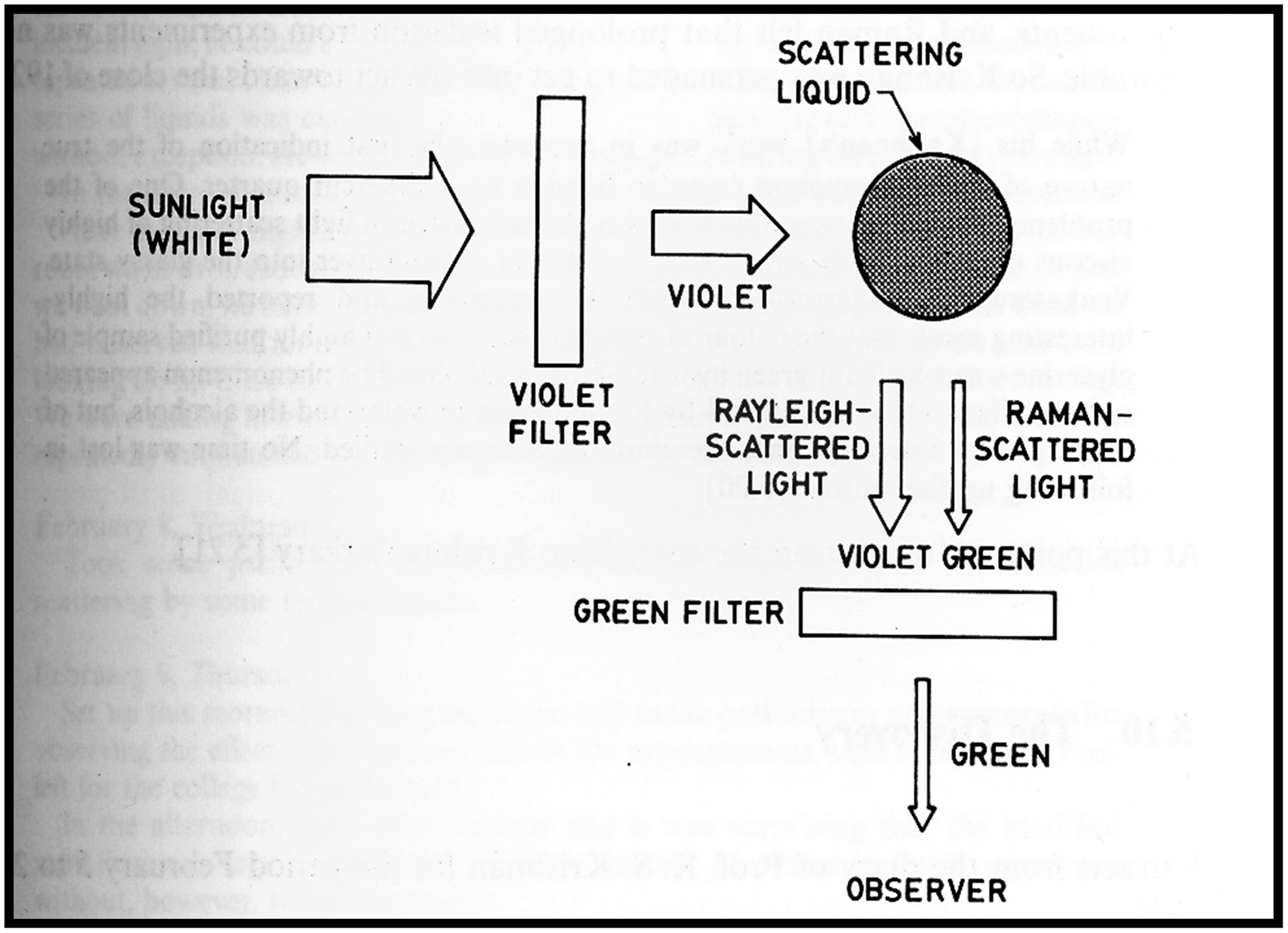
Footnotes
Acknowledgements
This article was written while I was a Postdoctoral Fellow in Philosophy at the University of South Florida (USF). I would like to thank the Office of Postdoctoral Affairs, USF for granting me a two-year position, and for generously supporting my research.