




Abstract
Recent international education trends have witnessed a widespread push for promoting Western-originating ‘learner-centred’ approaches, often without adequately considering the challenges involved in crossing cultures. Like many developing countries, India has been attempting to bring a paradigm shift from ‘teacher-centred’ to ‘learner-centred’ classrooms for years, particularly through annual in-service training, yet most Indian classrooms remain dominated by rote-learning. One potential reason is that although scholars have suggested that Indian pedagogy is grounded in deeply rooted cultural values resistant to change, research and training programmes have rarely attempted to identify and address these underlying beliefs.
To address this gap, this study explores how Indian teachers' beliefs relate to their practice, and whether there are certain prevalent beliefs that conflict with a learner-centred paradigm. The beliefs of 60 elementary teachers in three Indian states are explored through written questionnaires, semi-structured interviews, and open-ended life-narratives, while their pedagogy is analysed through classroom observations. Findings suggest several prevalent cultural beliefs that are indeed antithetical to learner-centred pedagogy. This research should generate useful insights for teacher educators and policymakers in India and other developing countries, regarding the need for engaging with teachers' beliefs, and the need for contextualizing Western-originating progressive pedagogies in keeping with local cultural contexts.
Introduction
In recent decades, learner-centred education (LCE) has been increasingly promoted around the world as the preferred model for primary education, particularly in developing nations by international aid agencies. Schweisfurth (2013) points to the powerful aura that has begun to surround LCE not only as a travelling policy, exported across contexts through the activity of transnational agencies, but also as enshrined in international agreements such as Education for All. All of these tend to unequivocally assume that improving education quality implies moving towards learner-centred approaches.
On the other hand, some scholars critique the ‘policy borrowing’ of LCE as a ‘one-size-fits-all’, decontextualized ‘best practice’, and question whether it should indeed be recommended as a policy choice worldwide. These scholars cite the apparent lack of conclusive evidence for LCE resulting in improved learning outcomes, as well as numerous stories of failure in its implementation particularly in developing countries (O’Sullivan, 2006; Schweisfurth, 2011; Tabulawa, 2003; Vavrus, 2009). They identify various constraints that may render LCE inappropriate in these contexts: limited resources, incompatible examination and curricular systems, inadequate teacher training, unrealistic policy expectations, and most fundamentally, differences in cultural beliefs that may conflict with the assumptions of LCE. However, this last barrier has been little examined thus far, particularly in India.
Like many developing countries, India has been attempting to bring a paradigm shift from ‘teacher-centred’ to ‘learner-centred’ classrooms for decades, through reform efforts such as the Sarva Shiksha Abhiyan (SSA) programme, the National Curriculum Framework (NCF) 2005, and the Right to Education Act (RTE) 2009. These policy frameworks envision a pedagogical approach that gives ‘primacy to children's experiences, their voices, and their active participation … [and] plans learning in keeping with children's psychological development and interests’ (NCF, 2005: 13).
1
In-service teacher training in particular has been promoted as a key vehicle for bringing this paradigm shift – SSA spent almost US$400 million from 2001 to 2010 to provide 20 days of annual in-service training for government teachers across India (Government of India, 2010). However, in 2010, SSA's 11th Joint Review Mission reported that despite enormous investments in quality improvement initiatives under SSA, NCF's vision was still a long way from being translated into most classrooms: The ‘chalk and talk’ or teacher instruction still dominates the classrooms … After a number of years of implementing in-service teacher training, it is not clear what type of impact such training has had on improvements in the classroom processes. (Government of India, 2010: 35--37)
There are various potential reasons why teacher training programmes in India have not had their desired impact: the quality of the training itself, whether the training methodology reflects the approach it seeks to promote, practical constraints faced in the classroom, or lack of systemic alignment around LCE. However, one crucial but largely unexplored issue is that of the prior beliefs that teachers bring to their training programmes, and the ways in which these influence teachers' classroom practice. Although scholars have suggested that Indian teachers' pedagogy is grounded in deeply rooted cultural values, research and training programmes have rarely attempted to identify and address these underlying beliefs. To address this gap, this paper presents a mixed-methods study that explores how Indian teachers' beliefs relate to their practice, and whether there are certain cultural beliefs that may be hindering a shift towards a more learner-centred paradigm. The paper presents a case for the need to address teachers' cultural beliefs within teacher education programmes in India, and presents preliminary findings from a larger research study of what are some key beliefs that may be hindering the shift towards learner-centred pedagogy, and which may need to be addressed in teacher education programmes.
The need to address teachers' cultural beliefs
There is a growing body of international research pointing to the crucial importance of taking into account teachers’ beliefs within teacher education programmes. 2 As early as 1978, Fenstermacher predicted that the study of teachers’ beliefs would become the single most important construct in the field of educational research. Thereafter this sentiment was echoed by several others, who emphasized the centrality of teachers’ beliefs to improving teacher education and teaching practices (Munby, 1982; Pajares, 1992; Richardson, 1996; Valcke et al., 2010). Research suggests that teachers arrive at teacher education programmes with deeply rooted beliefs about teaching shaped by thousands of hours spent in classrooms as students, which act as a filter in how they interpret new knowledge (Pajares, 1992). Munby (1984) points out that if teachers’ existing beliefs are at odds with the assumptions underpinning the reform effort, what results is a mismatch between the change intended by the training, and what actually gets manifested in the classroom. These and other scholars (Diviney, 2003; O’Riordan, 2006; Tatto, 1996) suggest that training programmes, educational reforms or new curricular frameworks that seek to promote new pedagogical methods will only be effective if teachers have thoroughly accepted the assumptions underlying the innovation. They seem to support Cantu's conclusion that the ‘failure to recognize the role beliefs play in practice will destine these educational initiatives to failure’ (2001: 150).
Engaging with teachers' beliefs is particularly important if one is to be true to the assumptions of the learner-centred or constructivist paradigm being promoted (Richardson, 1996, 2003; Sanger and Osguthorpe, 2011). A constructivist view holds that an effective educator must first engage with and build upon the knowledge and beliefs about the world that learners already bring with them, without which learners may fail to fully grasp new concepts, or may revert to their previous positions once they leave the classroom. It is inconsistent for teacher education programmes that claim to be teaching constructivist pedagogy to fail to acknowledge participants' prior beliefs and preconceptions within teacher education programmes.
Most of the research on teachers’ beliefs cited above has largely focused on individual teachers’ beliefs. However, there is also a growing body of literature pointing to the influence of culture on both teachers’ beliefs and practice. Bruner argued that ‘nothing is “culture free”’ (1996: 14), and that each distinctive culture has a distinctive ‘folk psychology’ – deeply ingrained culturally inherited beliefs about how the mind works and how children learn, which are difficult to override even after extensive training. Similarly, Robin Alexander's (2001) research of differences in pedagogy across five countries (India, Russia, France, UK and USA), found that teachers’ thinking and practice are strongly shaped by the culture in which teachers are embedded: Culture is so pervasive a shaper of education and educational realities that it cannot possibly be ignored … pedagogy is not just a matter of disembodied technique. It reflects and manifests values. In turn these are not merely the personal predilections of individual teachers, but the shared and/or disputed values of the wider culture. (Alexander, 2008: 19)
Thus it is insufficient to look only at individual teachers' beliefs, which is one of the limitations of much of the research on teachers' beliefs thus far. These cannot be fully understood without examining also the cultural context that shapes these beliefs. Examining the shared cultural patterns in individual teachers' beliefs is crucial for teacher education aiming to address beliefs that are dominant across a group or society. To the extent that individual beliefs are influenced by culture and constantly being reinforced by other members of this culture, they become even more entrenched and resistant to change.
Teachers' beliefs in India
Despite the increasingly loud international warnings, in India a thorough analysis of existing cultural beliefs that may impede LCE implementation has not been undertaken thus far. Although a few authors have pointed to the idea that pedagogy in India is shaped by certain broad cultural mindsets, these have been more as passing references rather than the focus of in-depth research.
For example, Dyer et al. (2004) and Clarke (2003) both found that LCE-oriented training programmes failed to have their desired impact because they failed to engage with teachers' underlying beliefs and cultural models which deeply influenced their teaching. These models prevented teachers from engaging deeply with the attempted reforms, resulting in only superficial changes in their practice, without fundamentally altering the prevailing teacher-centred paradigm. Similarly, prominent educationist Krishna Kumar has repeatedly suggested that the reason teacher-training programmes have failed to alter teachers' practice is their failure to address the culturally-rooted values in which teachers' practice is grounded: On values and attitudes, the training process makes no impact; indeed, it is not intended to. The values imbibed from the dominant worldview of society are never challenged, so the young, trained teacher does not relate to policies which require a radical shift in values and attitudes. For instance, inclusive schooling requires a totally fresh perception of intelligence and ability. The dominant Darwinian view that only a few have talent is contradictory to the policy framework, yet it prevails because schools are rooted in it. (Kumar, 2008: 40)
Several others like Clarke (2001), Rao et al. (2003), Sarangapani (2003), Gupta (2006) and Batra (2009) have pointed out that Indian teachers' traditional pedagogy is grounded in deeply rooted cultural attitudes on gender, caste, social inequality, hierarchy, knowledge transmission, etc. that make it difficult for existing practices to change.
However, to date, a strong engagement with teachers’ beliefs has not found its way into either educational research or reform efforts in India (Jha and Jhingran, 2005). Jha and Jhingran's study, which identifies teachers’ and officials’ cultural attitudes as the root of the discrimination still faced by deprived children in India, argues that if at all, these have been addressed only in short one-time training workshops in very peripheral and minimalist ways, hardly adequate for breaking deeply entrenched social values and practices. Deshkal Society's study of discrimination in schools similarly concludes that ‘we have only scratched the surface of a far more complex and deep-rooted problem’ (2010: 27).
Unless Indian teacher education programmes begin to address not only skills but also the deeper cultural beliefs in which teachers' practice is grounded, they will not be successful in transforming teaching practices. Indian teacher educators and policymakers have continued to struggle with these obstacles, but with little empirical research evidence on the role teachers' beliefs play in shaping teachers' practice, which specific beliefs may be restricting a shift towards LCE, and what factors can contribute to change in these beliefs. It is this gap in the literature that this study seeks to address.
Research questions and methodology
My own interest in this topic was fuelled by the three years that I consulted to India's Ministry of Education for the SSA programme. Interactions at various levels with policymakers, government administrators, teacher educators, teachers and other educationists, reinforced insights put forth by the literature – that change will not happen unless teachers' beliefs are addressed, but that people are unsure how to address them. Four questions emerged from this experience, which underpin this research: what beliefs held by Indian teachers conflict with the LCE assumptions of policy documents; what is the relationship between teachers' beliefs and practice; what factors shape the formation of teachers' beliefs and their enactment into practice; and how teacher education can contribute to change in these beliefs. This paper presents preliminary findings from the first three questions.
While the methodology used for exploring teachers' beliefs has changed over time, from positivist pencil-and-paper tests to more qualitative approaches, several researchers have highlighted the disadvantages of using any one method exclusively, concluding that a mixed-methods approach is the most appropriate means of revealing the complexities of beliefs and strengthening validity and triangulation of findings (Chan and Elliott, 2004; Fang, 1996; Pajares, 1992; Richardson, 1996). Robson (2002) too suggests that a mixed-methods approach enables a broader picture of participants and their context, a balance between researcher-driven and participant-driven perspectives, more nuanced explanations, triangulation and increased validity and generalizability. For these reasons, this study employs a mixed-methods approach to exploring the above research questions, combining survey questionnaires, interviews, classroom observations, and analysis of secondary literature.
First, based on literature review, informal conversations with educationists, and my own experiences working in SSA, certain key belief dimensions were identified as potential beliefs that may conflict with a learner-centred paradigm, warranting further exploration in this study: beliefs about equality, democracy, diversity, knowledge, purpose, work, success and progress. Based on these, a mixed-methods study was conducted of 60 teachers from 12 schools in three states. Teachers’ beliefs were explored through a combination of written survey questionnaires and semi-structured interviews with these 60 teachers, and open-ended life-narrative interviews with nine of these teachers. To enable comparison, teachers were assigned a low, mid or high ‘LCE belief score’, based on the extent to which their beliefs align with the assumptions of LCE as defined in NCF 2005. To analyse teachers’ pedagogy, semi-structured classroom observations were conducted for these 60 teachers, based on which teachers were assigned a low, mid or high ‘LCE pedagogy score’, with high indicating more learner-centred practice. Learner-centred pedagogy was assessed based on 10 indicators gleaned from NCF 2005 and RTE 2009 (the two guiding frameworks for Indian education reform): (1) holistic learning outcomes; (2) contextualized learning; (3) variety of learning materials; (4) students’ active participation; (5) building on prior knowledge; (6) cognitive engagement; (7) critical questioning; (8) fear-free emotional environment; (9) democratic and inclusive for all; and (10) formative assessment.
Schools were drawn from three states: Bihar, Maharashtra and Kerala, to provide diversity in socio-economic status and cultural context, and since they are at different levels of educational progress and pedagogical reform, affording greater insight into how teachers' beliefs play out in a range of contexts. Three cities were chosen of relatively comparable size and level of development within their state (Patna, Pune and Kochi). A purposive sample of 12 government primary schools was selected (four in each state: two urban and two rural), of relatively similar size (having roughly seven to 12 primary teachers), with five primary teachers selected in each school. Where possible, in each school one teacher was selected per grade level from Grades 1 to 5, and an attempt was made to have some variety in gender and age in the sample, as well as in the choice of subjects being taught during observation. Although the study uses mixed methods, since the sample size is small and selected as a purposive rather than representative sample, the results may not be generalized to the entire population of teachers in these states.
Findings: key beliefs that present a difference
Summary of teachers' beliefs vs. pedagogy scores.

State differences seem to be by far the strongest variable in predicting both pedagogy and belief scores. As evident in Figure 1, most of the teachers in Bihar and Maharashtra scored low to mid scores for both pedagogy and beliefs (Maharashtra having slightly higher scores than Bihar for both). In contrast, most Kerala teachers scored high in both pedagogy and belief scores. Kerala teachers obtained significantly higher scores than both Bihar and Maharashtra teachers in both pedagogy and survey scores, while Bihar teachers were significantly higher than Maharashtra's in their survey scores, though not in pedagogy scores (p ≤ 0.001).
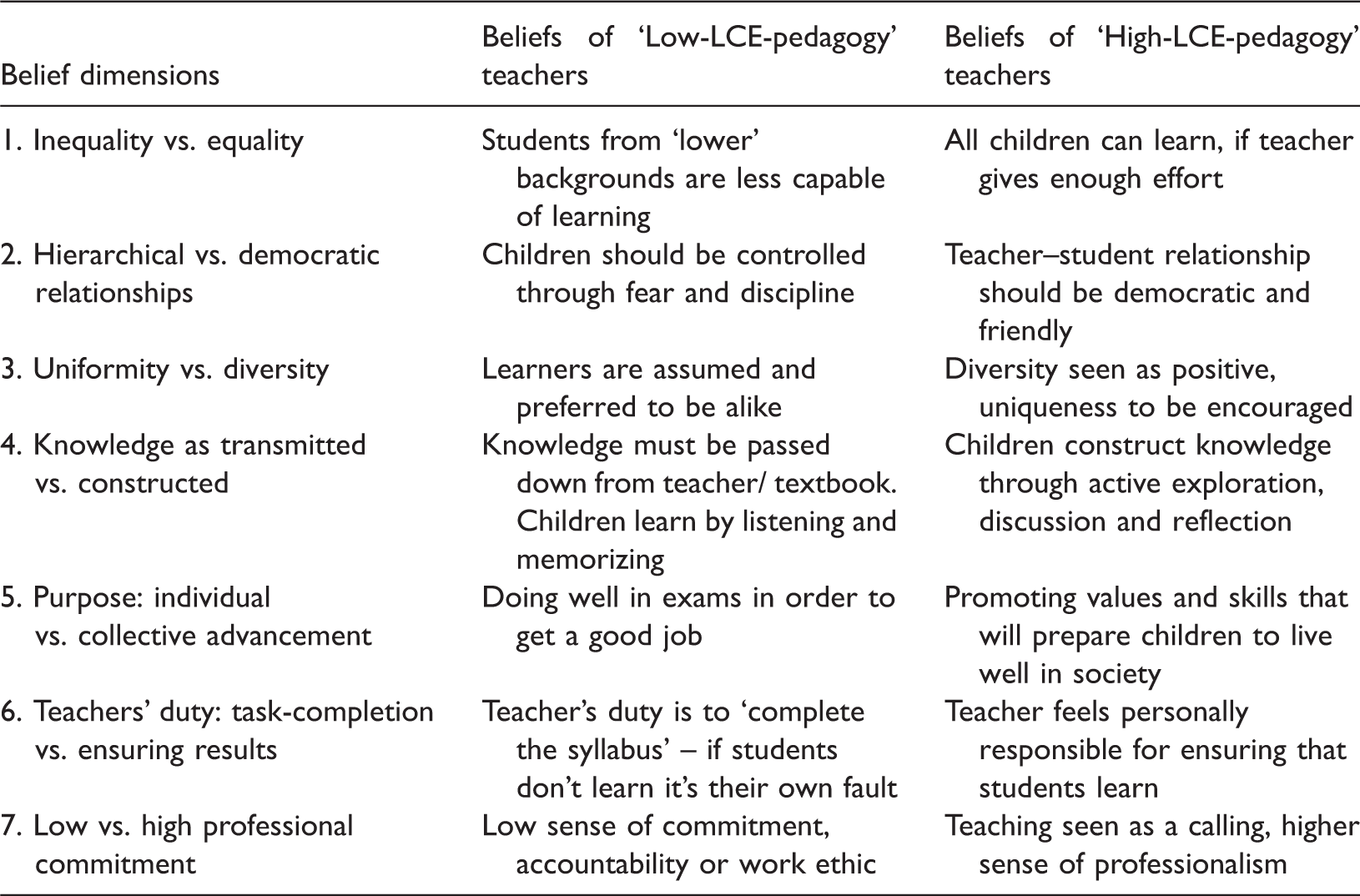
Significant differences are evident between the survey scores of teachers with low-LCE and high-LCE pedagogy (p ≤ 0.001). In order to identify the key beliefs associated with a difference in teachers' practice and which may need to be addressed in teacher education, the differences in beliefs of high-LCE-pedagogy vs. low-LCE-pedagogy teachers have been analysed, and are summarized below.
Inequality vs. equality
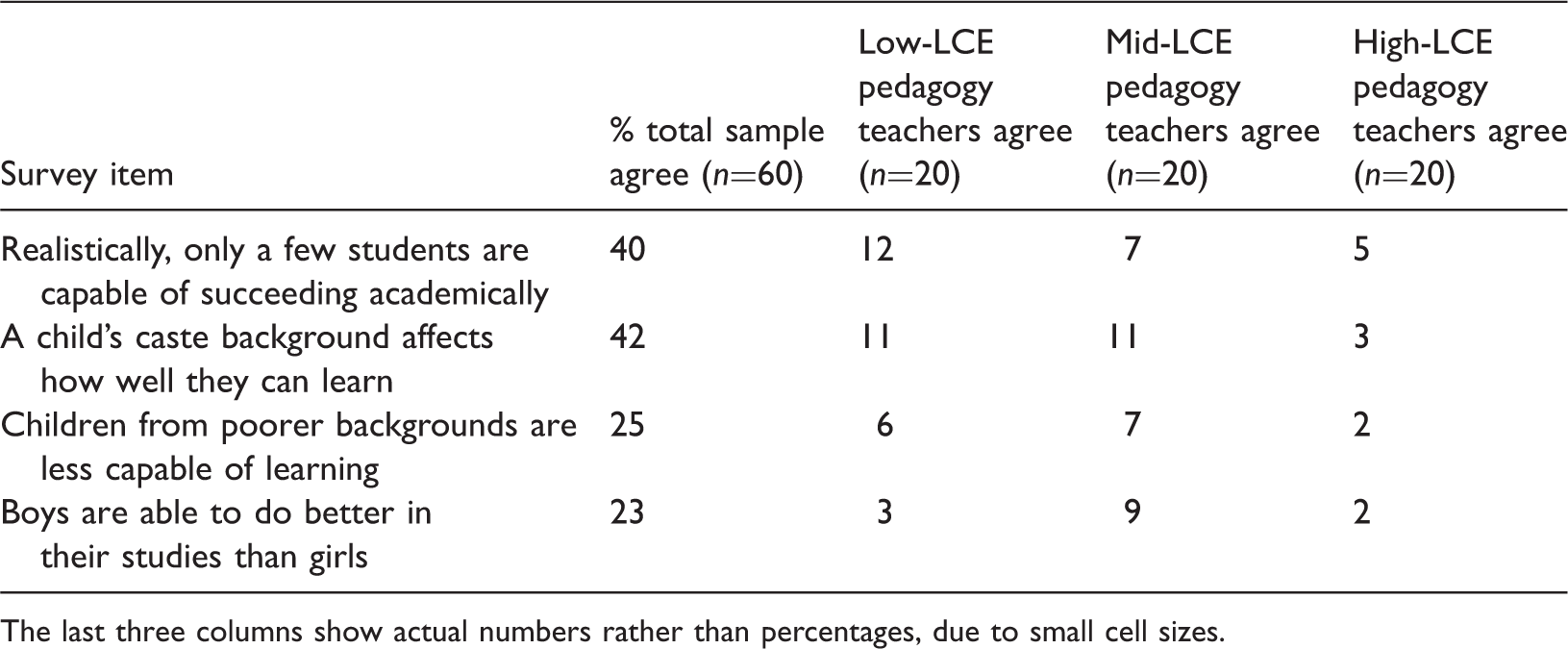
NCF 2005 upholds values of ‘equality, social justice and respect for diversity’ as the ‘foundation of school practice’ (p.81), believing that ‘all children have the ability and the right to learn’ (p.14). However, a common belief among teachers in this study is that some students are simply not capable of learning – particularly students from lower socio-economic or caste backgrounds. Of the 60 teachers interviewed, only 18 believe that all children have an equal potential to learn (most having high-LCE-pedagogy scores); 23 believe that some children are simply incapable of learning; while 17 believe that some are ‘slow learners’ or can only learn less than others (mostly low-LCE-pedagogy teachers). When asked whether students’ backgrounds affect their ability to learn, 27 felt that students’ backgrounds negatively affect learning and that students from ‘lower’ backgrounds are less capable of learning, either because poor children are less intelligent, or because they have bad habits or negative home environments that adversely affect their learning. For example, in describing her students, Farida (B4-L)
3
explains: They come from the lower socio economic classes. Labourers or stall owners – their children. How much ever you teach them they do not understand, you ask them questions they cannot answer, how much ever you do they do not learn.
Equality beliefs: percentage/number of teachers who agree with statements below.
The last three columns show actual numbers rather than percentages, due to small cell sizes.
Hierarchical vs. democratic relationships
NCF 2005 stresses that not only classrooms but also schools and education systems must nurture a ‘democratic, flexible and accepting culture’ with relationships ‘informed by equality and mutual respect’ (p.98). Teachers varied widely on this belief, with many expressing a preference for hierarchical rather than democratic relationships – particularly teacher–student and adult–child relationships. Many low-LCE-pedagogy teachers believe that students should remain disciplined and silent in an atmosphere of respect and fear; 47% of teachers agree that ‘a teacher should not befriend students and must keep his/her distance’. Similarly, 41% agree that ‘If a teacher tries to become “friends” with students, they will stop respecting him/her’, while 44% agree that ‘students should follow the teacher's instructions without raising any questions’ (mostly with low/mid-LCE pedagogy). Friendliness and discipline are held to be somewhat mutually exclusive, as seen in Anil's (M4-L) comments: When we are teaching we should be a teacher, like a disciplinarian; we have to maintain the discipline in the class. After the teaching we can share like a friend … I have made this a strategy, that when I go into class I show that I am angry and the children get scared. If you don't say ‘hi, hello’ in the beginning, they get scared.
Thus maintaining an environment of fear is seen as necessary for maintaining the teacher's position of authority, and friendliness is seen as an impediment towards maintaining this rightful hierarchy, marked by classroom discipline. When asked how they manage their classrooms, 27 teachers express a preference for using fear-based discipline methods in order to control students, such as shouting, hitting, threatening, etc. (mostly low or mid LCE-pedagogy teachers).
In contrast, most high-LCE-pedagogy teachers value a more democratic relationship between teacher and students, and the use of positive strategies such as love, respect and engagement to keep students on task: I don't even like to use the word ‘Teacher’, because it's not a democratic word. If I am your teacher, it means I am an authority and you are not. So I prefer to say facilitator. A teacher should love children, enter into the thoughts of children, understand their issues. (Lalita, K4-H)
Valuing of uniformity vs. diversity
NCF 2005 values diversity among students as an important resource for learning, believing that when students of mixed backgrounds, cultures and abilities study together, the classroom ethos and quality of learning are enriched. In contrast, there seems to be a tendency among low-LCE-pedagogy teachers to value uniformity more than diversity among learners, preferring classrooms with children of similar ages, backgrounds, abilities and learning pace. As one Kerala Trainer put it, ‘teachers think that all children should be the same. They generally do not agree that children are unique and each has different qualities – they want every child to be the same.’ Indeed, 32% of all teachers expressed that they prefer a class where all students come from a similar background (language, culture, social status); 62% felt that only children of the same age should study in the same class; while 43% said that it's better when children learn at the same pace as the rest of the class. In contrast, several high-LCE-pedagogy teachers emphasize that students are different and have unique talents or strengths, and that they should be encouraged and nurtured in that direction. In fact they feel one of the main reasons for children to go to school is to meet other children from diverse socio-religious backgrounds, which they see as important for children's socialization.
The preference for uniformity vs. diversity also extends to teachers’ choice of careers, whether for themselves or for their children: 53% of teachers surveyed responded that they ‘would like [their] own children to go into one of the more established professions (e.g. medicine, engineering, IT, business)’. Indeed, when asked about what career they would like their children to pursue, 17 teachers (all low–medium LCE-pedagogy) already had in mind what career they wanted for their children: engineer, doctor or government officer. In contrast, all 20 of the high-performing teachers asserted that children should decide their careers for themselves rather than parents deciding for them.
Knowledge as transmitted vs. constructed
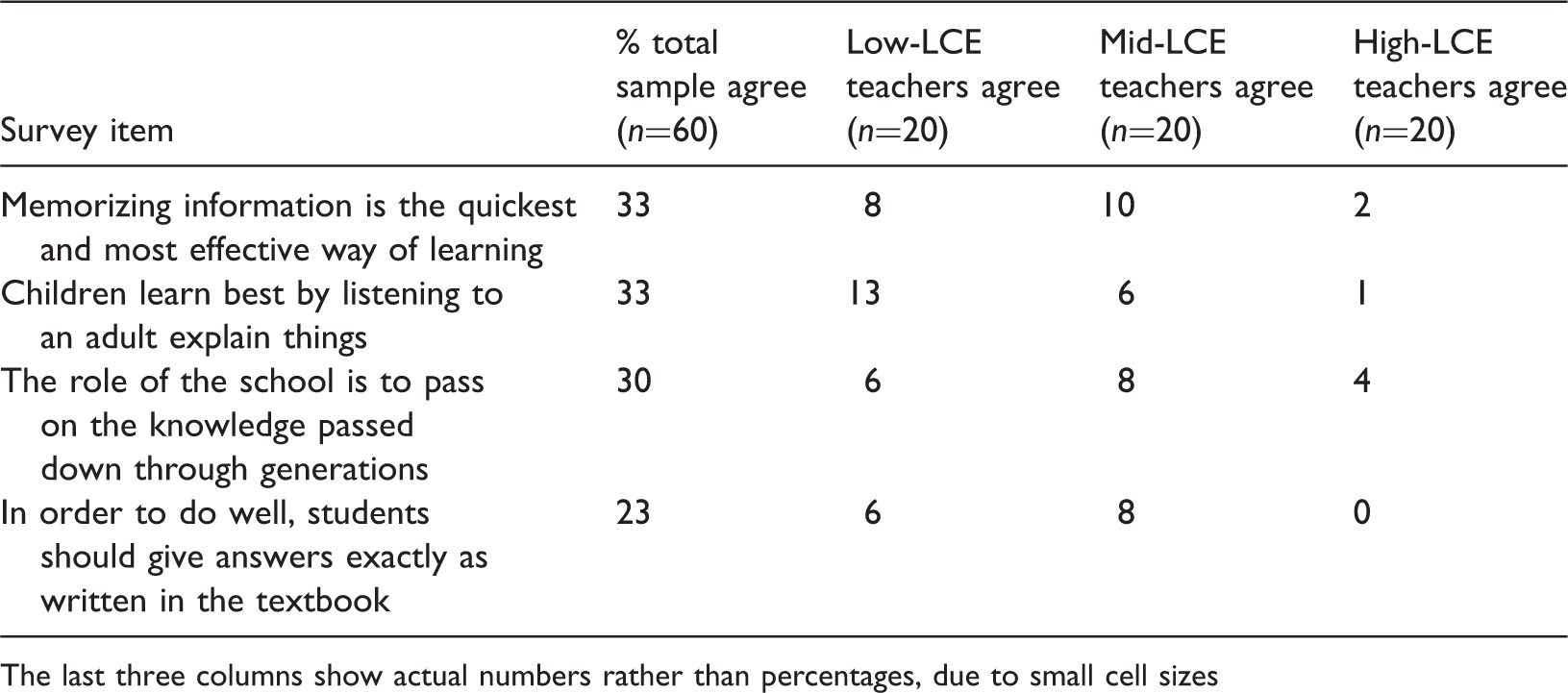
Teachers' beliefs relating to knowledge as transmitted vs. constructed.
The last three columns show actual numbers rather than percentages, due to small cell sizes
As evident above, about a third of teachers (mostly low/mid-LCE) believe that learning involves receiving pre-packaged knowledge, and that children learn best by listening quietly to adults, rather than by asking questions, trying and making mistakes, discussing or exploring for themselves. Of the teachers interviewed, 11 (eight with low/mid-LCE-pedagogy scores) displayed a view of knowledge as transmitted or needing to be ‘given’ by the teacher to the student. For example, Neena (B1-L) feels that, a teacher's duty is that whatever we're teaching should go into the mind of the student. My purpose as a teacher is to be able to impart knowledge properly.
Even some teacher trainers seem to subscribe to this transmission view of knowledge: for example a Maharashtra trainer held that ‘whatever knowledge the teacher has, they should be able to pass it on to the students effectively’.
In contrast, 19 teachers (all mid/high LCE-pedagogy) displayed a view of knowledge as constructed or discovered by children themselves through asking questions or from their experiences, with the teacher's role being more like that of a facilitator or guide in that process. Sonia (K1-H) explains: Teachers don't know everything – the point is to facilitate knowledge acquisition by the child so that one day they may become more knowledgeable than the teacher. If we only give what the teacher knows, then the child can never go beyond the teacher.
Purpose of education: individual vs. collective advancement
The NCF articulates the central purpose of education as ‘preparing [all] citizens for a meaningful and productive life’ (p.71), building a commitment to Constitutional values and thereby serving as ‘an instrument of social transformation’ towards ‘an egalitarian social order’ (p.7). In comparison, teachers in this study expressed a variety of beliefs regarding what they value as the chief purpose of education and of life in general. The four chief values expressed can broadly be categorized as: socio-economic mobility, discipline, individual development, and the collective good.
There was clear association between teachers’ pedagogy and their purpose beliefs. In general low-LCE-pedagogy teachers emphasized values like socio-economic mobility, discipline, and a few spoke of acquiring knowledge or values, but very few spoke of education's role or their own role in terms of contributing to societal change. Approximately half the teachers emphasized either socio-economic mobility or discipline not only as a primary purpose for going to school, but also for their own work and lives (mostly with low/mid-LCE-pedagogy). For example, several teachers’ dream for their own children is for them to ‘achieve the highest post’ (Vishal, B1-M), so that they can ‘live their life comfortably’ (Ajay, B1-L): Everybody wants [their children] to get higher posts … If you go into a service job, you can have a good life. If you do farming, you cannot get that good life. He'll have to go fetch water in the sun. But if he's in a job, he'll be in a room with AC. (Rohit, B1-M)
In contrast, almost all the high-LCE teachers spoke of things such as children's overall development and preparation for life, acquiring values, and the collective social good, while very few high-LCE teachers mentioned socio-economic mobility or discipline as a central purpose of education. These teachers tend to see the most important thing in life as becoming ‘a good human being’, and see education as central in instilling positive values, preparing children to live in a diverse society, or preparing them to serve or lead the country in positive social change – which a few see as the purpose of their own life and work as teachers.
Duty as teacher: task-completion vs. responsibility for student learning
According to NCF 2005, ‘children do not fail, they only indicate failure of the school’ (p.84) – it is the responsibility of teachers and the system to ensure all children receive the support they require for successful learning. Yet many teachers do not feel such a sense of responsibility for ensuring learning outcomes: they see their main duty as to ‘teach’ – i.e. to ‘complete’ the syllabus while maintaining discipline – regardless of whether students actually learn. In fact several of the trainers interviewed point to this as a key barrier to change: that teachers feel it's fine if they don't teach as long as they finish their assigned work; ‘they say they came, taught and finished their job – whether the child understands or not’ they ‘want to do their duty mechanically – there is no inner drive’. When asked what is a teacher's most important duty, 21 teachers mentioned maintaining or instilling discipline and punctuality, and 27 mentioned ‘teaching’ or completing the syllabus (mostly low-/mid LCE-pedagogy). Only 13 teachers said ensuring that students actually learn or understand (mostly mid/high LCE-pedagogy).
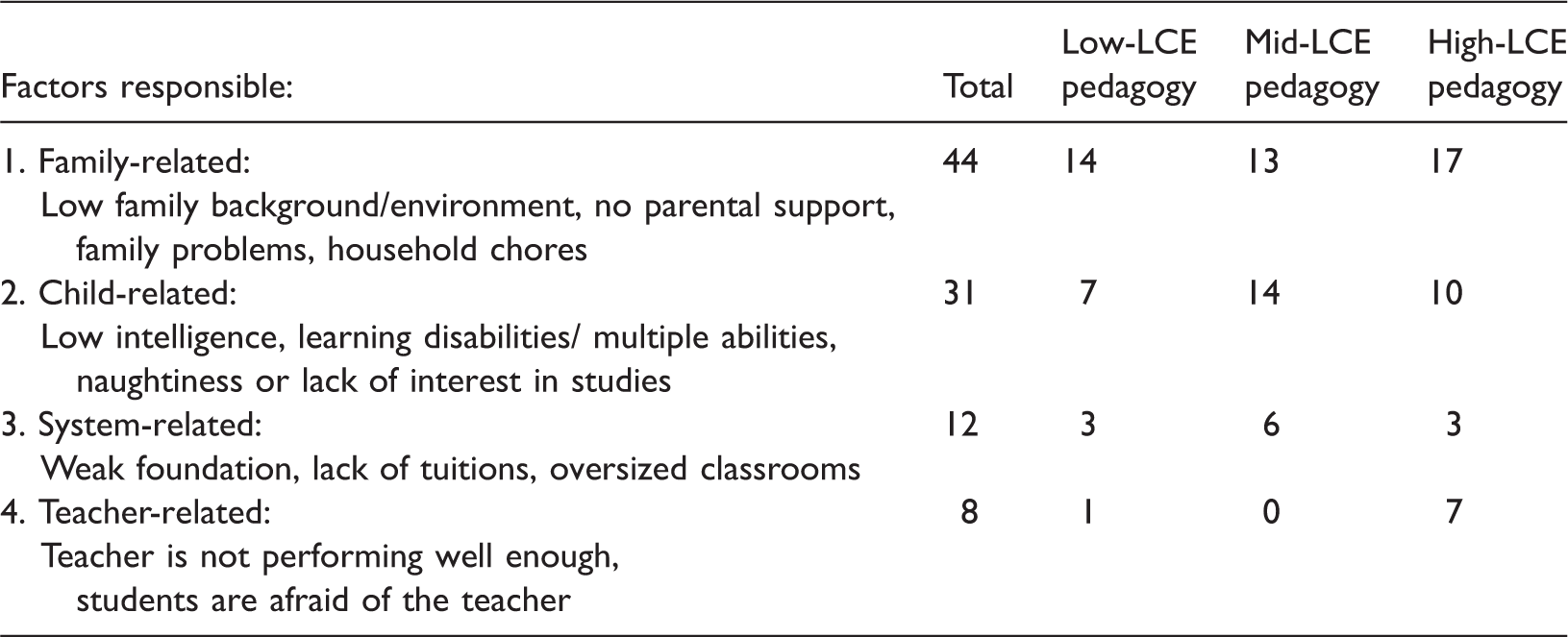
Teachers' beliefs about why some students do badly or fail to learn.
Low vs. high professional commitment
A significant variation was seen among low vs. high LCE-pedagogy teachers in their professional identity as teachers, their original motivations for choosing teaching as a career, and their level of commitment to teaching as a calling to serve society. In fact, two trainers link teachers' original driving incentives in choosing the teaching profession with their subsequent level of performance, motivation, and openness to new pedagogies: A good commitment to their job is what motivates teachers to teach their students well. If you came into this job willingly, without any social pressures, you would regard the job as more of a calling than just a profession … these teachers are motivated to teach their students well. (Kerala Trainer)
When asked why they became a teacher, 36 of the 60 teachers said that teaching was not their first choice or that it was not their decision to go into teaching, but that they became teachers because they couldn't get any other job (15), due to financial need (12), it was their family's decision (11) or because it was a suitable job for a woman (9). The 24 teachers who did say teaching was their first choice, mostly chose teaching because they liked children, had family members who were teachers, or were inspired by one of their own teachers. Remarkably, only three teachers mentioned a desire to contribute to the larger societal good.
Ten trainers spoke about teachers' low motivation and commitment to their job as a major factor impeding their openness to new pedagogies. Indeed, 47% of all teachers felt that if they could get a higher-paying job they would stop being teachers and 49% agreed that it's no use trying to be a really good teacher since they don't get any reward or appreciation for doing a good job. All nine teachers who displayed low professional commitment in their interview responses also tended to have low/mid-LCE scores. In contrast, about a third of teachers do mention seeing their work as a calling of some kind, aware of their role in contributing to students' lives or to society, most of whom have high LCE-pedagogy.
Discussion: changing practice through changing beliefs?
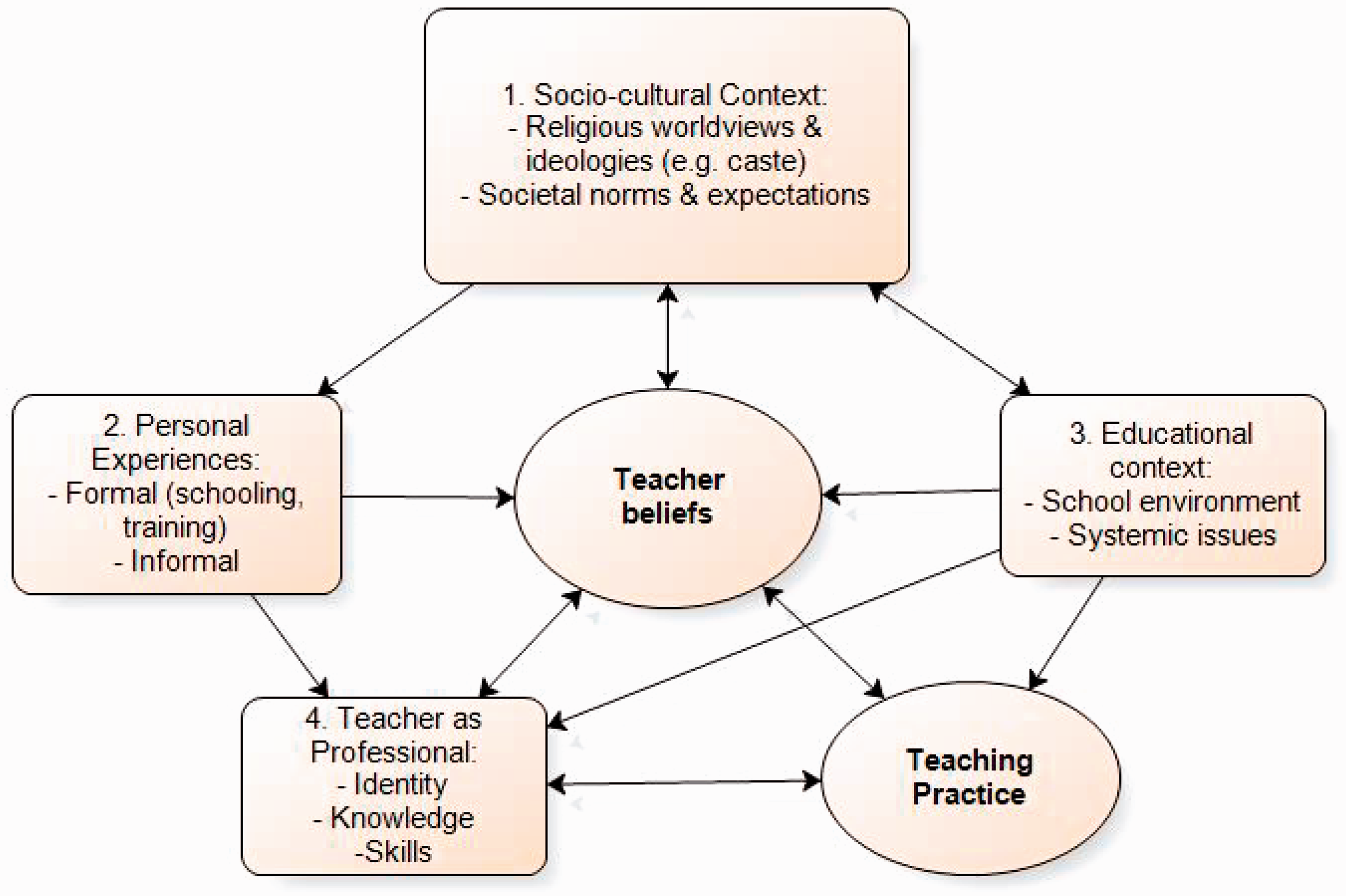
The research found five major factors that influence teachers' beliefs. Two of these also shape the relationship between beliefs and practice: in some cases even when teachers did have more learner-centred beliefs, they failed to be translated into learner-centred practice when these mediating factors did not support this shift. These five factors are shown in Figure 2 and discussed briefly below.
First, perhaps the strongest factor shaping teachers' beliefs is their larger socio-cultural context. This is reflected in the fact that State seems to make the biggest difference in influencing both beliefs and pedagogy scores, with Kerala teachers displaying the highest scores in both beliefs and pedagogy. Indeed, many have attributed Kerala's success to socio-cultural factors, such as the historical influence of socio-religious reform movements, the educational and medical work among marginalized communities by Christian missionaries and other religious-minority-led voluntary organizations, and various political movements and left-leaning governments (George and Sunaina, 2005; Tharakan, 2007; Dreze and Sen, 1995 in Tharakan, 2007).
Second, a teacher's personal experiences also shape her beliefs: both her previous schooling and training received, as well as her informal family and daily life experiences, all of which reinforce certain values and thereby perpetuate certain pedagogical practices. Third, beliefs are also shaped by the educational context of the teacher, both at the school level and in the larger system. Many of the above beliefs can be seen not only among teachers, but also at almost every level of the government education system, including in the way teachers themselves are treated by those above them. This factor also mediates the relationship between beliefs and practice: a teacher may have highly learner-centred beliefs, but if the class size, examination system, textbooks, school head, etc. are not supportive of LCE-pedagogy, she will have a hard time implementing her beliefs. Fourth, a teacher may have highly learner-centred beliefs, but if she does not have the professional autonomy, foundational knowledge or practical skills to implement these beliefs, this will also adversely affect her practice. Finally, practice itself can precipitate change in beliefs: once a teacher experiences success in an LCE classroom, and finds that students learn better or enjoy learning more, this may also help change her beliefs.
Thus while ‘teacher beliefs’ is a crucial but largely unexplored factor in Indian educational reform requiring much greater attention, it is clearly not enough to only target teachers’ beliefs to bring change. There also need to be accompanying institutional changes in teacher education programmes, the school and systemic context, as well as in teachers’ professional identity and autonomy, in order to support teachers’ transformed beliefs to become enacted into practice. Indeed, teachers’ agency and professional autonomy have also been cited as a key missing piece in Indian educational reforms (Batra, 2005; Dyer et al., 2004; Ramachandran et al., 2008). These authors argue that at present, teacher education programmes view teachers as technicians who must passively implement pre-designed ideas from outside ‘experts’, rather than empowering teachers as reflective practitioners to think for themselves in improving their own practice. While these authors also touch on the idea of teachers’ beliefs restricting change, they do not examine in depth the need for targeting teachers’ beliefs. The two issues are interrelated, in that teacher educators must have faith in teachers’ intellectual capacity and professional agency in order to encourage them to question and reflect on their own beliefs and practices and to come up with their own solutions, a process which further enhances their professional agency.
The above discussion also raises certain ethical questions of whether we are justified in changing teachers’ beliefs in the first place, particularly those grounded in cultural traditions, as well as who should determine which beliefs need to be changed, and which are the ‘desirable’ beliefs that teacher education programmes should promote. This is particularly in light of certain postcolonial critics like Tabulawa (2003) who go to the extreme of labelling LCE a ‘colonizing’, ‘domesticating’ pedagogy being pushed by international aid agencies for political and ideological rather than educational reasons. Tabulawa argues that LCE is part of a design by aid agencies aimed at eroding traditional authoritarian structures and promoting social values associated with liberal democracy, ultimately intended to facilitate the penetration of capitalist ideology in developing nations under the guise of democratization.
Schweisfurth (2011: 429) aptly questions whether a postcolonial perspective implies that LCE should be ‘rejected as a form of imperialism, or embraced as a potential liberator?’, and whether LCE should give way to traditional cultures or whether LCE itself can be used to question and shape prevailing cultural attitudes. Tabulawa seems to uncritically reject LCE's emphasis on values such as open-mindedness and tolerance simply because they are associated with democratic systems, and thus inherently Western and warranting rejection – which is an unsubstantiated line of reasoning. The complicated history of colonization means that there is no easy way to delineate what elements of culture and pedagogy are ‘indigenous’ and ‘foreign’. Postcolonial theory blurs this line between local and colonial, reminding us that indigenous culture is not a static closed system but is itself heterogeneous, embroiled in modernist discourses, and infused by relations of power and inequality (Andrade, 2007).
Indigenous cultural beliefs cannot be blindly condoned in the rejection of anything Western, particularly if they are being used to perpetuate the oppression of marginalized communities. ‘Cultural values’ themselves must be analysed in light of larger ideological and hegemonic forces operating within Indian society. Ideology refers to values promoted by a particular social group in order to further their own power and privileges, supporting certain unequal power relations (Olsen et al., 1992). These beliefs become taken-for-granted common-sense assumptions collectively and often subconsciously shared across a group, sometimes internalized by the very groups being oppressed by these beliefs – a process known as hegemony. Indeed, many of the beliefs found in this study (e.g. inequality, hierarchy, knowledge transmission) are rooted in larger hegemonic ideologies in Indian society related to caste and Brahminism, which for centuries have served to benefit certain (upper caste) groups while oppressing others, thereby perpetuating their dominance and resistance to change. Rather than blindly rejecting one or the other, both traditional cultures as well as Western-originating progressive pedagogies need to be critically examined in order to determine what pedagogical approaches are most appropriate for challenging oppressive forces within Indian society.
Raths (2001) and Stuart and Thurlow (2000) highlight another important rationale for targeting teachers’ beliefs: certain teachers’ beliefs may contribute to the perpetuation of a pedagogical status quo that has proven counterproductive to students’ learning and development – turning them into ‘victims, one might say, of teacher belief systems’ (Raths, 2001: 2). The urgency of addressing such detrimental beliefs becomes even more stark in the context of the recently passed Right to Education Act (GoI, 2009), which now constitutionally guarantees to every Indian child the right to learn in a child-friendly learning environment that reflects Constitutional values of equality and justice, free from fear, discrimination, physical or mental harassment. If there are indeed certain beliefs that are impeding teachers from providing this kind of learning environment to children, it becomes of fundamental importance that these beliefs be successfully identified and addressed – indeed this should become a central goal of teacher education.
A useful basis for rethinking both learner-centred education and teacher education could be Freire's vision of a democratic education that views students as subjects who can engage in recreating their social world, through dialogue, reflection and action (praxis) (Freire, 1970). Freire does not prescribe a fixed set of pedagogical best practices, but rather advocates a particular ethical and political orientation towards the world, human beings, and education (Roberts, 2000). Whether specific practices (including LCE) will prove to be liberating or oppressive ‘depends on who uses them, in favour of what or whom, and for what purpose’ (Freire, 1993: 93). The ‘best’ methods must be decided in context, through praxis: The progressive educator must always be moving out on his or her own, continually reinventing me and reinventing what it means to be democratic in his or her own specific cultural and historical context. (Freire, 1997: 308)
This research suggests that in the implementation of LCE, rather than imposing a fixed predefined (often ‘Western’) model of LCE practices on Indian teachers, perhaps we need to re-invent LCE in each new context. Rather than training teachers to mindlessly comply with a set of external ‘learner-centred’ practices, it is more important that teachers themselves develop a commitment to a core set of learner-centred beliefs, based on which they can then bring changes in their own practice in alignment with these beliefs. One cannot force teachers to adopt certain beliefs, but one can through teacher education create an environment where teachers become aware of their existing (and potentially oppressive) beliefs, can begin to question these beliefs, and choose what kind of beliefs they wish to stand for. In terms of LCE, O’Sullivan (2004) makes a useful suggestion of moving beyond ‘learner-centred’ education to ‘learning-centred’ education. This may involve Indian teachers themselves working from their transformed beliefs, and experimenting to see what practices best promote successful learning and emancipation of marginalized learners within their context – which may look different in different contexts.
Conclusion
Key differences in beliefs of low-LCE and high-LCE teachers.
The next step would be to analyse further what factors contribute to change in teachers' beliefs, and how these can be successfully addressed in teacher education programmes. It is hoped that the findings of this research will generate useful insights for teacher educators, administrators and policymakers in India, to better understand how to facilitate shifts in teachers' beliefs and practice towards a learner-centred paradigm. The findings also have broader implications for education reform in other countries, particularly in the global South, in terms of highlighting the importance of both engaging with and critiquing local cultural beliefs that shape teachers' pedagogy. It also highlights the importance of addressing these beliefs within teacher education programmes to ensure teachers buy in to the foundational beliefs underlying reform attempts, and the need for questioning and contextualizing Western-originating pedagogies in keeping with local contexts, in order to ensure the success and sustainability of these reform efforts.
State-wise differences in LCE pedagogy and belief scores. Factors shaping teachers' beliefs.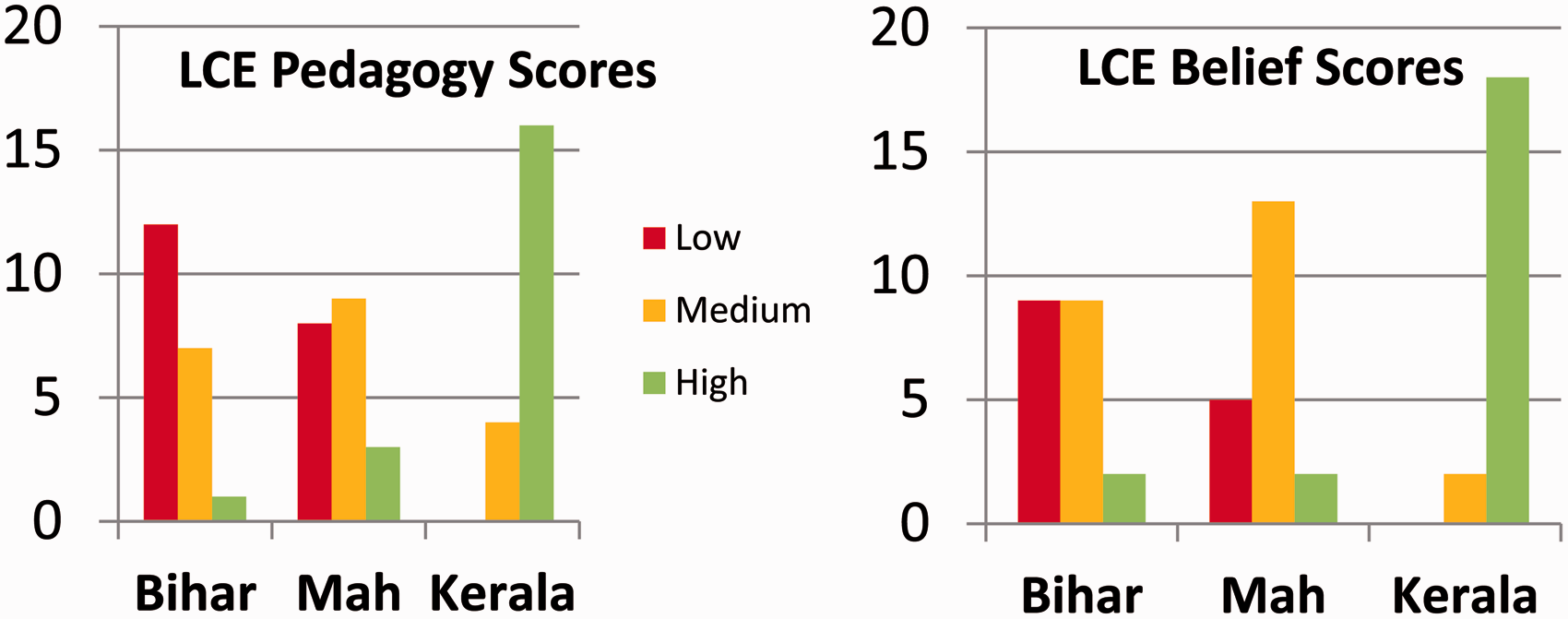
Footnotes
Funding
This research received an initial grant from the ICICI Centre for Elementary Education during the data collection phase.