




Abstract
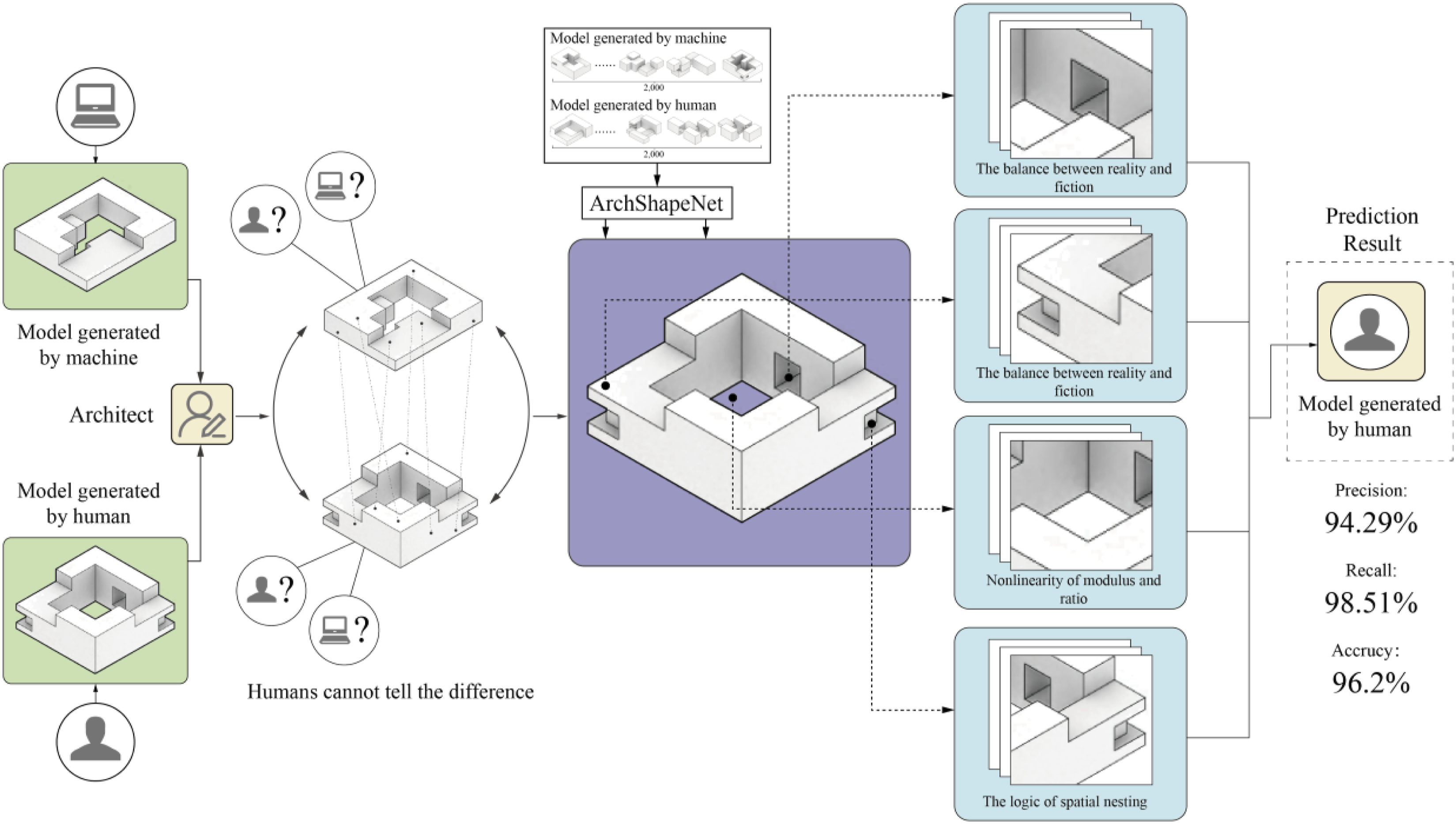
In contemporary architectural design, the increasing complexity and diversity of design demands have made generative plugin tools indispensable for rapidly generating preliminary design concepts and exploring innovative 3D building forms. However, the quality differences between human-designed and machine-generated 3D forms remain challenging to analyze and interpret objectively. This challenge hinders the clear identification of the advantages of human-designed forms over machine-generated ones and limits the further optimization and application of generative tools in architectural design. To address this issue: (1) We developed ArchForms-4000, a dataset comprising 2,000 3D forms designed by professional architects and 2,000 forms generated using Evomass, which is a generative plugin tool. (2) We introduced ArchShapeNet, a 3D convolutional neural network (3D-CNN) designed for the classification and analysis of 3D form data. To align with architectural design requirements, we integrated a 3D saliency feature analysis module, which visually highlights the key form regions that the model prioritizes, offering data-driven insights for design optimization. (3) Comparative experiments demonstrate that our model surpasses professional architects in distinguishing between human-designed and machine-generated forms, achieving a classification accuracy of 94.29%, a precision of 96.2%, and a recall of 98.51%. Moreover, our approach effectively elucidates the differences between generative plugin-generated and architect-designed forms. By examining these differences, we gain deeper insights into architects’ decision-making processes in form design and identify potential limitations in generative plugin tools. This study not only highlights the distinctive advantages of human-designed forms in spatial organization, proportional harmony, and detail refinement but also provides valuable insights for enhancing generative design tools in the future.
Keywords
Get full access to this article
View all access options for this article.