




Abstract
Computational design and optimization methods play a crucial role in early stage design by allowing the incorporation of reclaimed components, fostering resource reuse, and minimizing waste. However, to advance the field of computer-aided material reuse and support its integration into circular construction practices, there is a pressing need for a comprehensive overview of the available methods and their applications. We address this gap by conducting a systematic review of the literature on the role of computational design in facilitating the reuse of building elements, followed by analyzing the interrelationships between optimization methods, materials, and geometric dimensions of reclaimed materials. We then synthesize the identified approaches, offering guidelines that assist stakeholders in selecting suitable computational methodologies for integrating non-standard materials into design processes. Our findings highlight current knowledge gaps in algorithm scalability, performance integration, and the advancement of hybrid computational methods needed to unlock the full potential of computational design for a circular built environment.
Introduction
The growing interest in circular practices in the Architecture, Engineering, and Construction (AEC) sector has led to a surge of interest in designing with non-standard, reclaimed materials. Design becomes a strategic tool for closing material loops by integrating material availability into the building process, 1 optimizing resource use, minimizing waste, and extending the life cycle of materials. Early-stage design decisions dictate the entire life cycle of materials and products, impacting their potential for disassembly, repair, reuse, and recycling. Unlike traditional linear construction, where the material is specified to fit a predetermined design, working with existing materials requires adapting the design to what is available. 2 This creates the need for iterative adjustments between design and available resources, 3 shifting the paradigm from “form follows function” to “form follows availability”. 4
Computational design and optimization methods can play a critical role in this shift by automating the design process with non-standard reclaimed materials, which is otherwise time-intensive and too complex for cost-effective, widespread application. Parametric and generative design tools, coupled with optimization algorithms, can process information from material databases and generate design solutions that optimally allocate the available inventory. The objectives typically involve minimizing waste, 5 maximizing material utilization, 6 optimizing structural performance, 7 or exploring aesthetic possibilities based on material availability. 8
Despite growing interest, there remains a gap in systematically synthesizing and correlating the various computational approaches that aid material reuse. Fragmented knowledge does not provide sufficient guidance for stakeholders on effective circularity practices, particularly in identifying which computational design and optimization methods are best suited to each design problem. This study fills this gap by analyzing and categorizing the different computational methods that contribute to the effective reuse of materials, identifying their benefits and challenges.
The objective is to help practitioners and researchers choose appropriate computationally-assisted reuse strategies while also identifying knowledge gaps and suggesting directions for future research.
While this paper establishes a broad framework for leveraging computational methods in circular construction, it is essential to recognize from the outset that no single approach can universally address the diverse challenges of reusing non-standard materials. The practical application of these methods involves navigating complexities that go beyond mere computational issues. These include ensuring structural integrity, complying with diverse building codes, managing labor-intensive disassembly processes, and adapting to regional variations in reuse infrastructure. Thus, while our work attempts to generalize the trends encountered, it is important to understand that these trends represent general guidelines rather than definitive solutions. Each project may require a tailored approach to effectively meet its unique requirements and constraints.
This review begins with a background section, followed by an overview of the research design of the paper. The categorization of computational methods is then detailed in the section Analysis of Design and Optimization Methods, and the categorization of contextual 1 parameters is presented in the section Analysis of the Reuse and Application Context. The study then synthesizes the correlations between these methods and the practical challenges they address in the Synthesis section. The remainder of the paper discusses the findings and their applicability, trends, advantages, and potential limitations in the Discussion section. The concluding remarks in the Conclusion section reflect on the broader implications of the findings and the evolution of circular construction norms. In general, this study provides strategic insight into the barriers and opportunities of computational methods for reuse, contributing to the advancement of a circular built environment.
Background
Principles of circular construction
The construction industry operates on a linear “Take-Make-Waste” model 9 and accounts for approximately 37% of fuel-related CO2 emissions. 10 With rapid urbanization that requires 30 billion square meters of new buildings in the next 40 years, equivalent to adding a New York City every 40 days, a paradigm shift in construction methods is urgently needed. Circular construction emerges as a fundamental strategy, potentially reducing 75% of embodied emissions from the built environment while creating significant economic value. 10 In this study, we focus on the foundational circular construction principle of reuse, which consists of integrating pre-existing, reclaimed materials into the design instead of using new ones.
This integration of pre-existing, non-standard components into construction poses significant challenges. Lack of detailed documentation, such as specific material properties and dimensions typically available with new materials, complicates design processes and compliance with building regulations. In addition, the inherent variability of the material properties of reclaimed materials can impact structural integrity. 11 This makes it difficult to rely on traditional structural analysis methods. 12 Furthermore, their non-uniform geometries often require innovative connection designs, potentially increasing costs and affecting aesthetics. 13 Combining non-standard elements with standardized building systems also requires careful detailing and adjustment to downstream construction tasks. 14
These challenges require a departure from traditional design methods, which rely on standardized components and mass production, toward more adaptive design and fabrication approaches that accommodate the idiosyncrasies of reclaimed materials. 3 In this context, computational design emerges as a pivotal tool. Mass customization enabled by computational design can facilitate repurposing geometrically non-standard elements in an optimal and efficient way.
Computational design in architecture
Computational design involves the use of computation to create architectural designs, employing methodologies such as parametric design, where parameters define sets of designs; algorithmic design, which generates alternatives through algorithms; and generative design, where algorithms automatically produce multiple solutions based on defined goals and constraints. 15 As computational design and numerical simulations are increasingly integrated into design workflows, optimization has become a key component, 16 driven by the need to identify the most effective solutions that balance functional and aesthetic requirements. These methodologies, enabled by advances in computing power and software, have evolved from early explorations in the mid-20th century to becoming integral components of modern architectural practice. This shift has facilitated new ways to rethink material efficiency, sustainability, and performance criteria, and optimize designs in ways previously unimaginable.
In the context of circularity, computational design tools can optimize the use of reclaimed materials by maximizing material inventories while meeting geometric and performance requirements. These tools also provide real-time feedback on the environmental impacts of design decisions, enabling early-stage optimization. 17 The real-time graphical representation of results within the computational environment allows architects to quickly evaluate and compare various design options.18,19 This interactive feedback enhances design flexibility and expands architects’ ability to address the aesthetic challenges of using non-standard materials. 20 Furthermore, data from digital models can directly control computer-aided manufacturing tools and robots, allowing the precise fabrication of custom components that accommodate the irregular geometries of reclaimed materials.21-23 This demonstrates the potential to materialize complex forms while adapting to the inherent variability of reused materials. 24
Combinatorial optimization
Conventional optimization of architectural forms typically assumes the manufacturability of all elements of the system to the required dimensions. In contrast, the stock-constrained design with reused elements imposes constraints, as it requires adherence to the dimensions of existing elements. This is inherently a combinatorial optimization problem as it involves selecting the optimal design variants from a limited and non-standard stock.
Combinatorial optimization seeks the best solution from a vast set of discrete possibilities while satisfying specific constraints. It addresses problems that optimize objectives such as cost, time or resource usage, using variables such as integers, subsets, permutations, or graph structures. 25 It is prevalent in various disciplines such as operations research,26,27 computer science, 28 and mathematics, 29 where it addresses diverse challenges such as job scheduling and resource allocation. 30
Notable examples of combinatorial optimization include the following. The assignment problem focuses on finding the optimal one-to-one pairing between two sets of objects, considering the cost or benefit associated with each pairing. 30 It can be used to determine the best match between available reclaimed elements and the required components of a new structure considering factors such as element length, cross section, and material properties.13,31 The cutting stock problem32,33 focus on minimizing material waste when cutting smaller pieces from larger stock materials. It involves determining optimal cutting patterns to meet the demand for smaller pieces with minimal leftover material.34,35 Lastly, bin-packing problem 36 involves fitting objects of different sizes and shapes in a limited space (containers or bins). The goal is to minimize the number of containers used or maximize the value of the packed objects. 37
Although certain combinatorial optimization problems can be efficiently solved in polynomial time with algorithms whose running time grows polynomially with input size, many problems are NP-hard to solve to optimality, 37 and no polynomial-time algorithm is currently known to solve them. 38 Therefore, globally optimal methods for solving these problems may require exponential computation time in the worst-case scenario, making them impractical. Consequently, numerous approaches have been proposed, including linear programming techniques, heuristics, and metaheuristic methods. 34 These are essential for computational design with reclaimed materials because they balance optimal solutions with manageable computational complexity.
Research design
To address the research questions described in the Introduction section, we conducted a systematic review of the literature summarized in Figure 1. We analyzed publications from 2000 to 2024, including 92 papers and 4 book chapters focused on computational design for circular construction using reclaimed materials. An overview of the included literature can be found in Table 2 in the Appendix A. In the following sections, we describe the steps of the systematic literature review. These steps include the search, the selection of the literature, the identification of the main dimensions of analysis, the analysis and finally the synthesis, where we consolidate the findings to provide insights on the reviewed literature. Graphical outline of the workflow and methodology followed in the current review. The research design follows the process of Step 1: search through a systematic review of literature, Step 2: selection of relevant literature, Step 3: Identification of dimensions through a three-step coding method, Step 4: analysis of optimization methods (Section 5) and context parameters (Section 6), and Step 5: synthesis of interrelationships between analyzed dimensions (Section 7).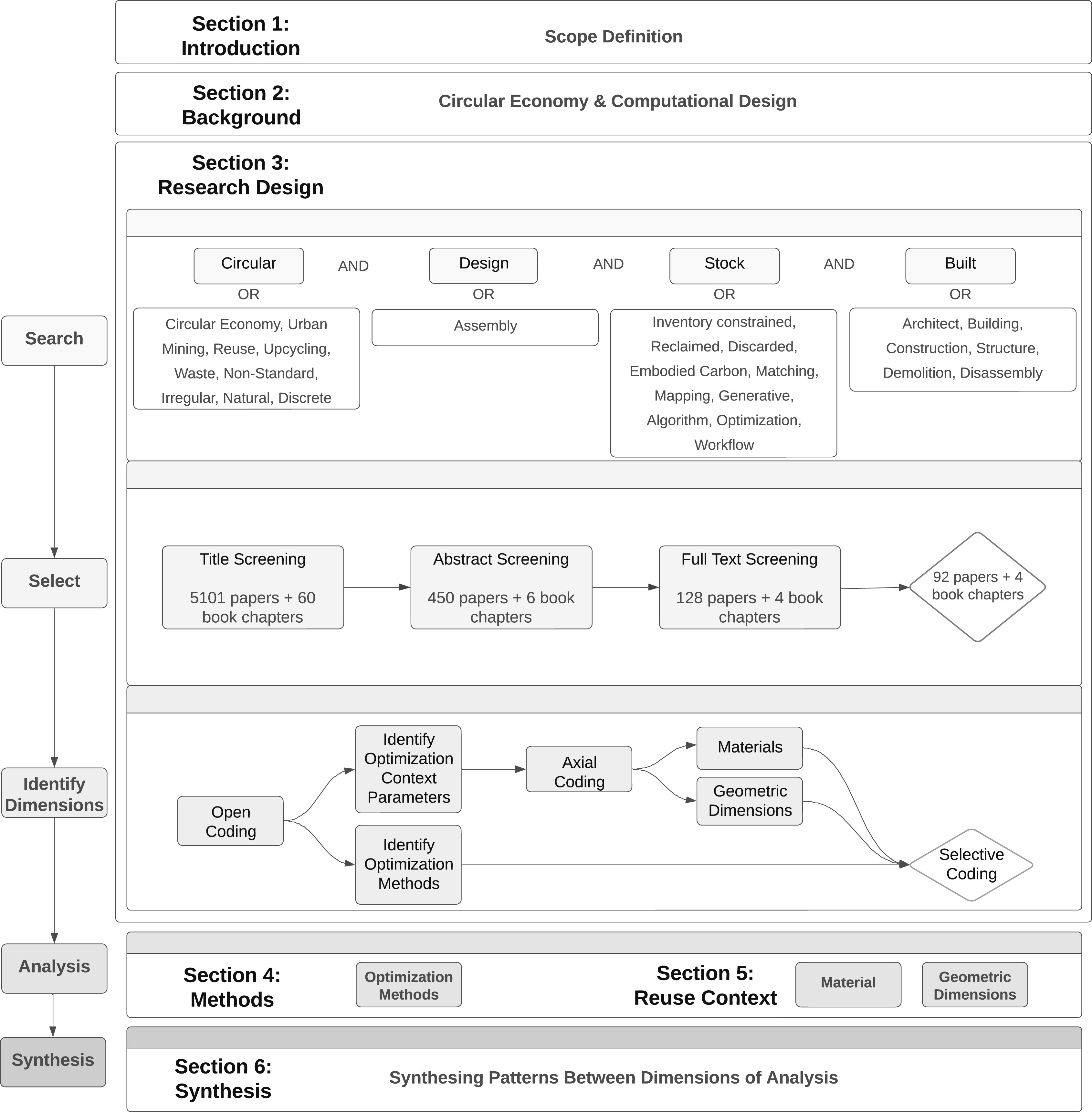
Search
The initial phase of the methodology was a literature search to identify relevant literature through targeted keyword searches within major academic databases:
Definition of search engines
Scopus was selected over Web of Science and Google Scholar because of its relevance and currency. 39 An initial search in Scopus revealed that conference publications predominate journal publications in this research area. Consequently, the search was extended to include conference proceedings and book publications. Therefore, the databases of CumInCAD, the International Association for Shell and Spatial Structure Symposium (IASS), Advances in Architectural Geometry (AAG), and SpringerLink were included.
Keywords selection
The selection of keywords for the matching algorithms followed the categorization approach taken by Tomczak et al., 11 which groups related terms to improve the comprehensiveness of the search. The keywords were organized into the following categories: Circularity, Design, Stock, and Built. The complete set of keywords in these categories can be seen in Figure 1. Navigating the evolving terminology in circular design research, particularly regarding the design with reclaimed, waste, or non-standard materials, is a challenge. Computational design studies from the past years, not initially labeled with terms like “circular” or “reuse”, are still relevant due to their focus on developing design strategies with a constrained stock of non-standard materials. In an attempt to also cover these sources, words such as “natural”, “irregular”, and “non-standard” were included in the query. The exact query strings used in the search engines can be found in the Appendix A.
Literature retrieval
In February 2024, a structured search query was executed across the indicated databases, based on the procedure described above. The initial query on Scopus, SpringerLink, and CuminCAD returned 4611 papers and 60 book chapters. The conference proceedings of IASS and AAG, which were queried from their individual databases, included 490 additional papers. The authors limited the search to papers written in English and from fields related to architecture, engineering, circular economy, and computer science.
Select
An initial screening of the titles of the papers and their keywords was used to exclude duplicates and out-of-scope papers. This led to 450 papers and 6 book chapters selected as relevant. A more detailed round of review reading the full abstracts narrowed the list down to 128 papers and 4 book chapters. An additional number of 29 publications were identified through the reference lists of key publications11,13,35 and the suggestions of Scopus. The authors reviewed the full texts, resulting in a final selection of 20 journal papers, 72 conference papers, and 4 book chapters.
The exclusion criteria established by the authors were based on relevance to the core themes, the credibility of the research, and its contribution to the advancement of computational methods for circular construction. The relevance of each paper was assessed through its focus, methodology, findings, and novelty. Research that focused on using an infinite stock of raw materials, standardized materials, or a reclaimed but identical material stock was excluded from the selection as the focus was a constrained set of non-standard materials. In addition, projects dealing with the small-scale or product design scale were excluded, as the current review focuses on the architectural scale. A detailed diagram showcasing the steps of the systematic review process can be found in Figure 11 in the Appendix. Furthermore, all papers that are part of the final selection are listed in Table 2 in the Appendix. Figure 2 illustrates the distribution of the selected literature by publication year, highlighting the growing interest and technological advancements in design and optimization with reclaimed materials. Reviewed publications per year per publication type. The colouring indicates publication category.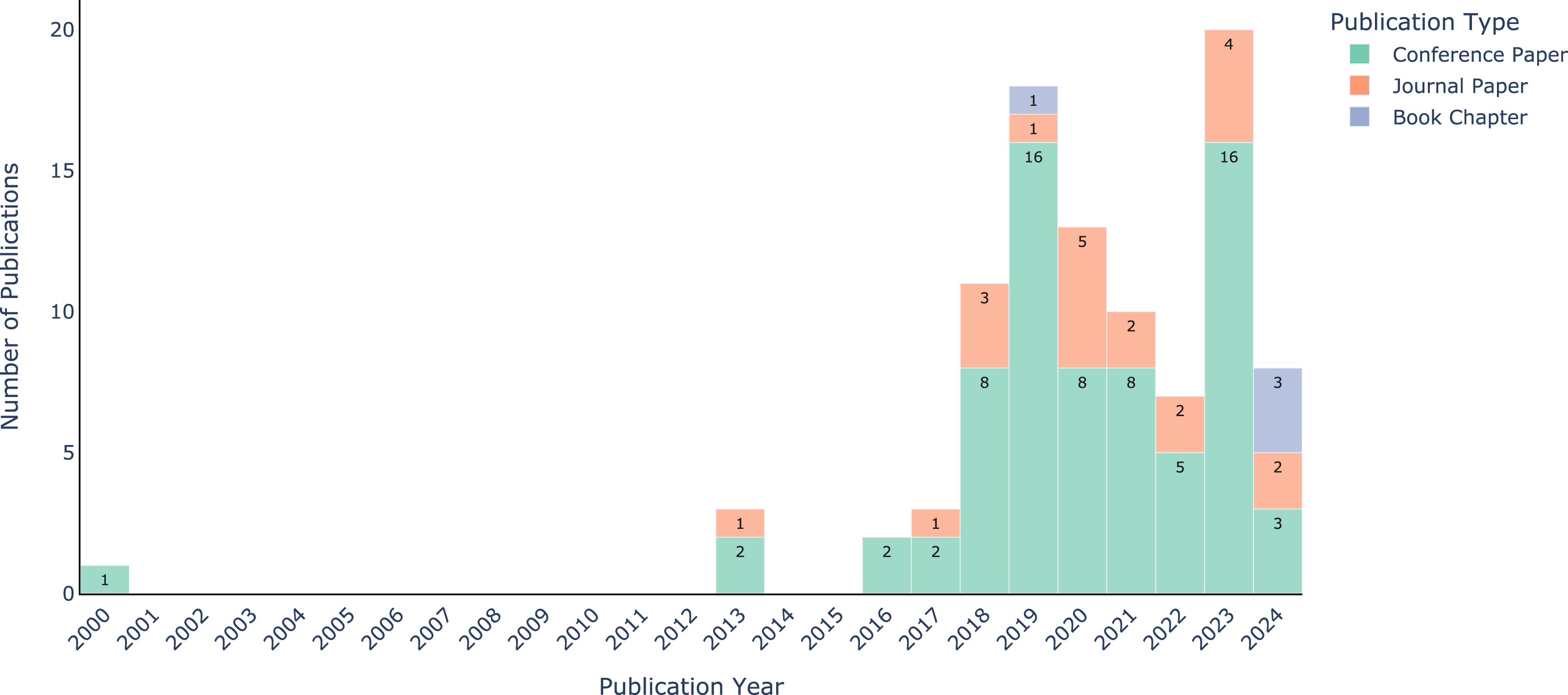
Identify dimensions of analysis
Identification of analysis dimensions was approached through a three-step coding process adapted from grounded theory. 40 This process involved different phases of coding illustrated in Figure 1 and further described below.
The initial phase of open coding involved an exhaustive review of the selected papers, focusing on the specific computational methods used. This resulted in the core category of optimization methods (consult Optimization methods). Subsequently, axial coding was employed to refine the categorization. At this stage, it became apparent that additional contextual parameters - specifically the type of materials and the geometric dimensionality of the matching problem - were crucial to position the analysis within the broader circularity context (consult Context categories). We note that in this work “context” refers to the circular economy framework, i.e. identified paramaters of material and dimensionality (Analysis of the Reuse and Application Context) that influence design decisions for reuse, and not geographical or socioeconomic considerations. In the final selective coding stage, all the literature was categorized by both optimization methods and contextual parameters. After this stage, no new insights or mutually exclusive categories emerged from the analysis, reaching saturation for the scope of this review.
Optimization methods
The type of computational method was used as the main dimension of the analysis (Analysis of the Reuse and Application Context). We followed the categorization proposed by Huang et al.
13
and extended it to incorporate the categories outlined by Wortmann et al.,
41
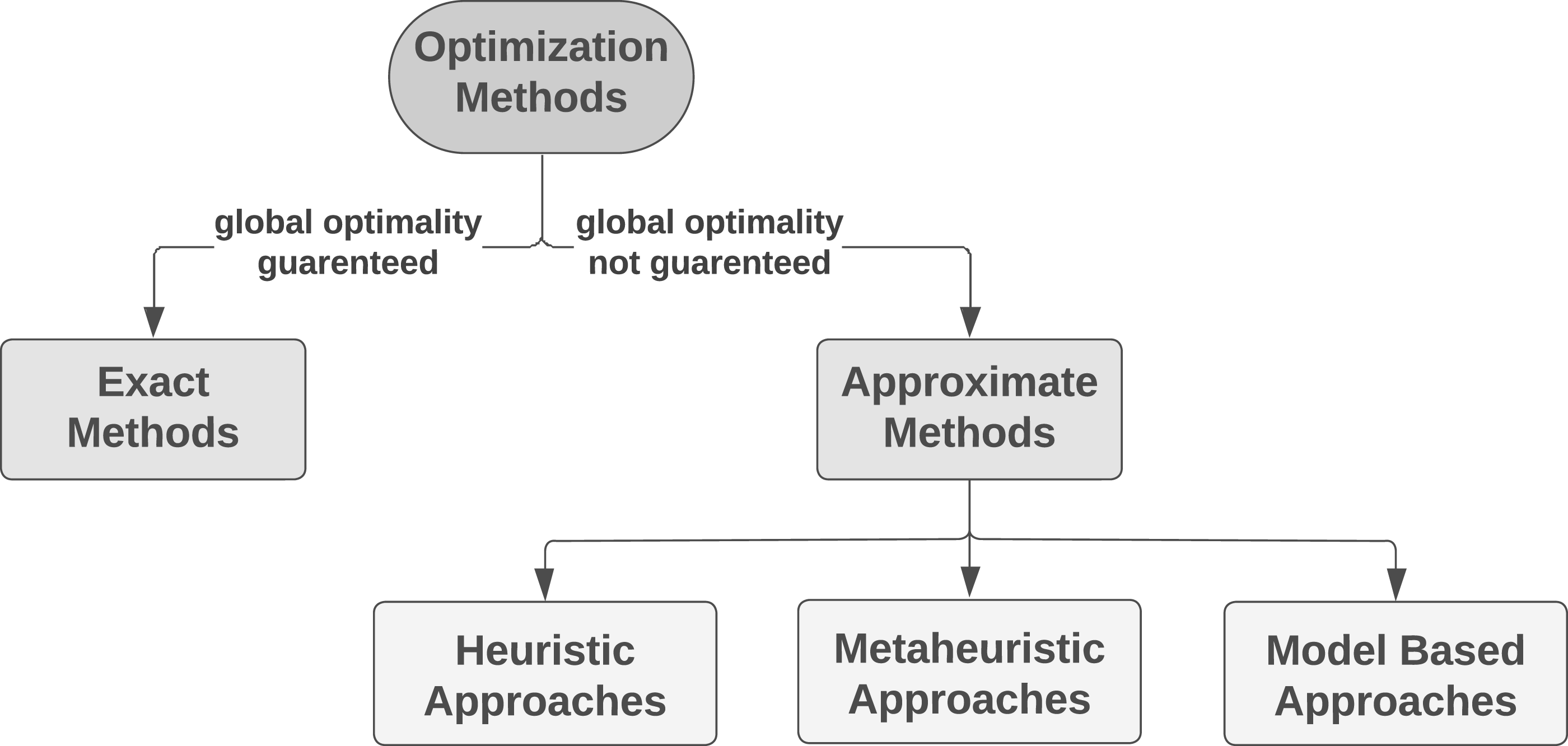
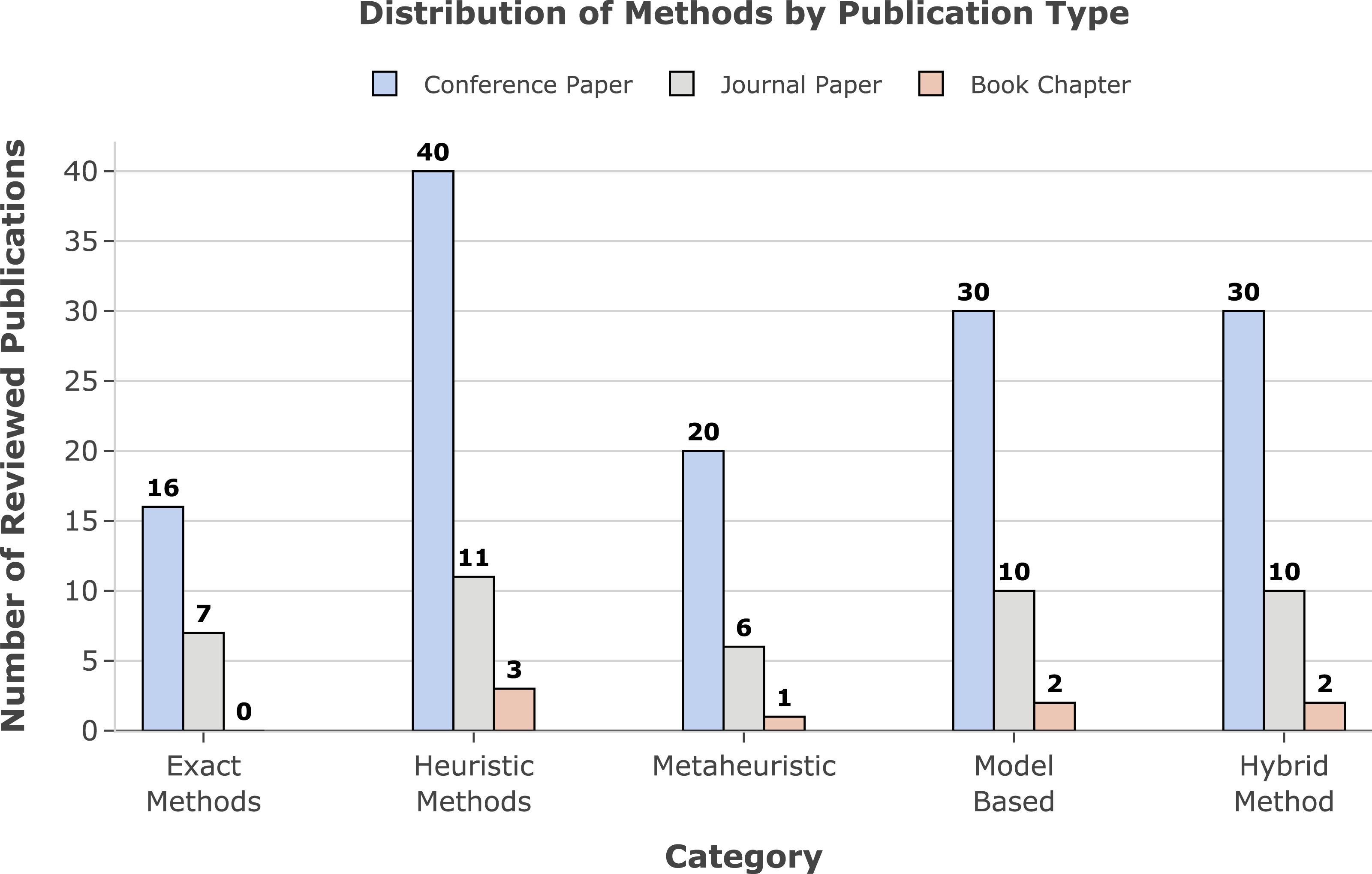
resulting in the following categories of computational optimization methods (Figure 3). • Exact Methods: These involve deterministic algorithms that guarantee optimal solutions. • Approximate Methods: These find near-optimal solutions efficiently and are especially suited for complex or large-scale problems where exact solutions are computationally impractical. This category is subdivided into: – Heuristic Methods: These are simpler and faster approaches that provide satisfactory solutions by making locally optimal decisions based on a set of rules (heuristics). – Metaheuristic Methods: These are advanced strategic algorithms that guide and improve heuristic methods. – Model-Based Methods: These use surrogate models or simulations to approximate complex real-world problems, allowing for the evaluation of potential solutions without directly solving the original problem. • Hybrid Methods: These strategically integrate various optimization approaches to capitalize on their distinct advantages. Distribution of optimization categories across publication types, noting that some publications may be categorized multiple times if they address more than one category, resulting in a total count that exceeds the number of publications reviewed.
Context categories
Since optimization methods should then be evaluated in the context of reused non-standard reclaimed materials, we identified by systematic tagging of relevant dimensions the context categories of materials and dimensionality. The material categorization reflects the types of material discussed and is divided into timber, steel, bamboo, concrete, stone, other, and material-agnostic. It helps identify trends in material reuse and how the properties of the material inform the approach for computational design strategies. Dimensionality categorization identifies how geometric data are utilized in studies to assign, map, nest, or pack reclaimed elements in new designs. The classification is based on the geometric dimensions in which the algorithms were implemented: 1D, 2D, and 3D.
Analysis of design and optimization methods
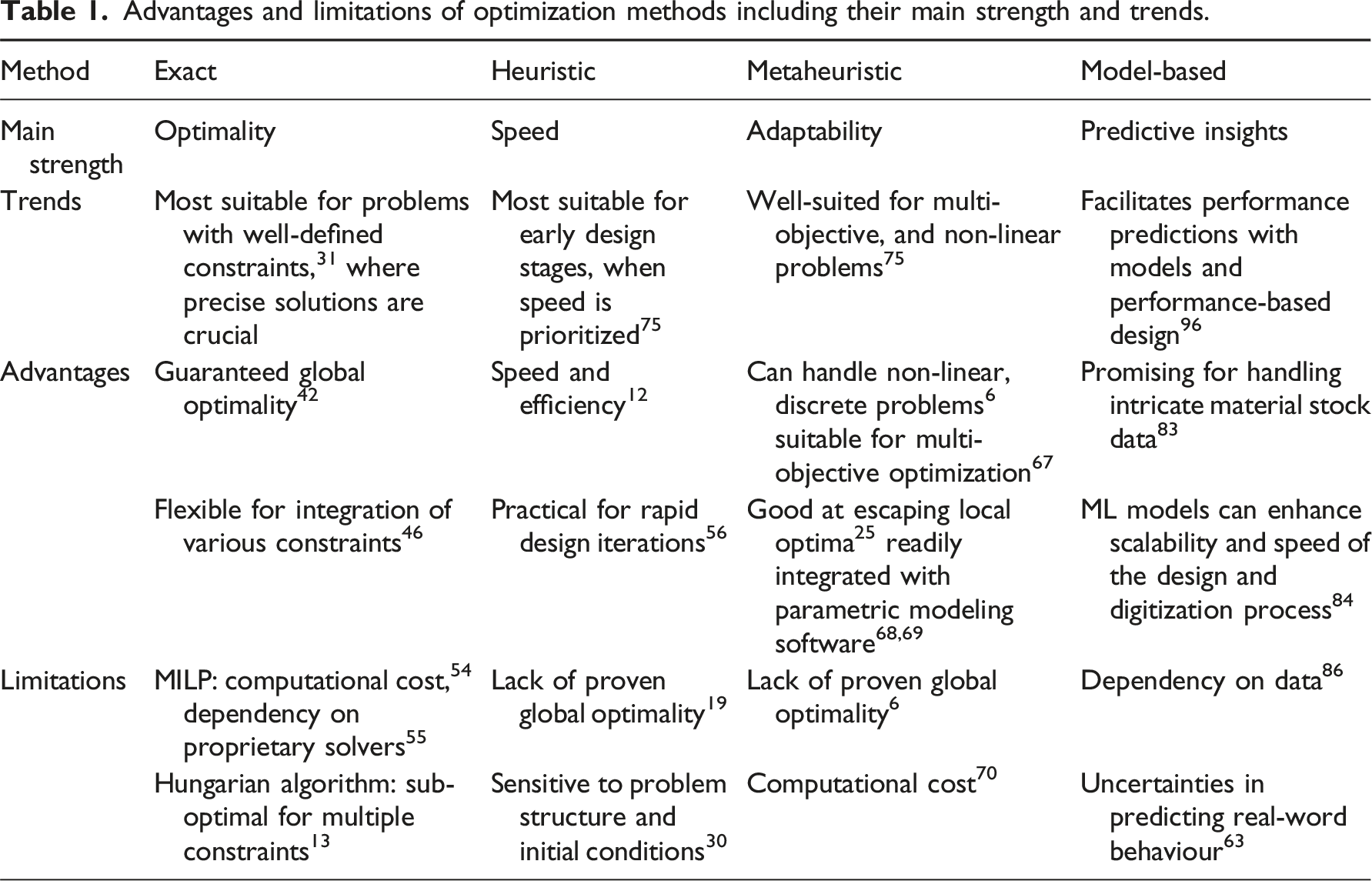
This section dives into the different optimization methods identified in the reviewed literature, which constitute the primary category of analysis. The distribution of optimization methods for each type of publication can be seen in Figure 4, and their advantages and limitations are summarized in Table 1. Distribution of material categories across publication types. Note: certain publications may be categorized multiple times if they address more than one category, potentially resulting in a total count that exceeds the number of publications reviewed. Advantages and limitations of optimization methods including their main strength and trends.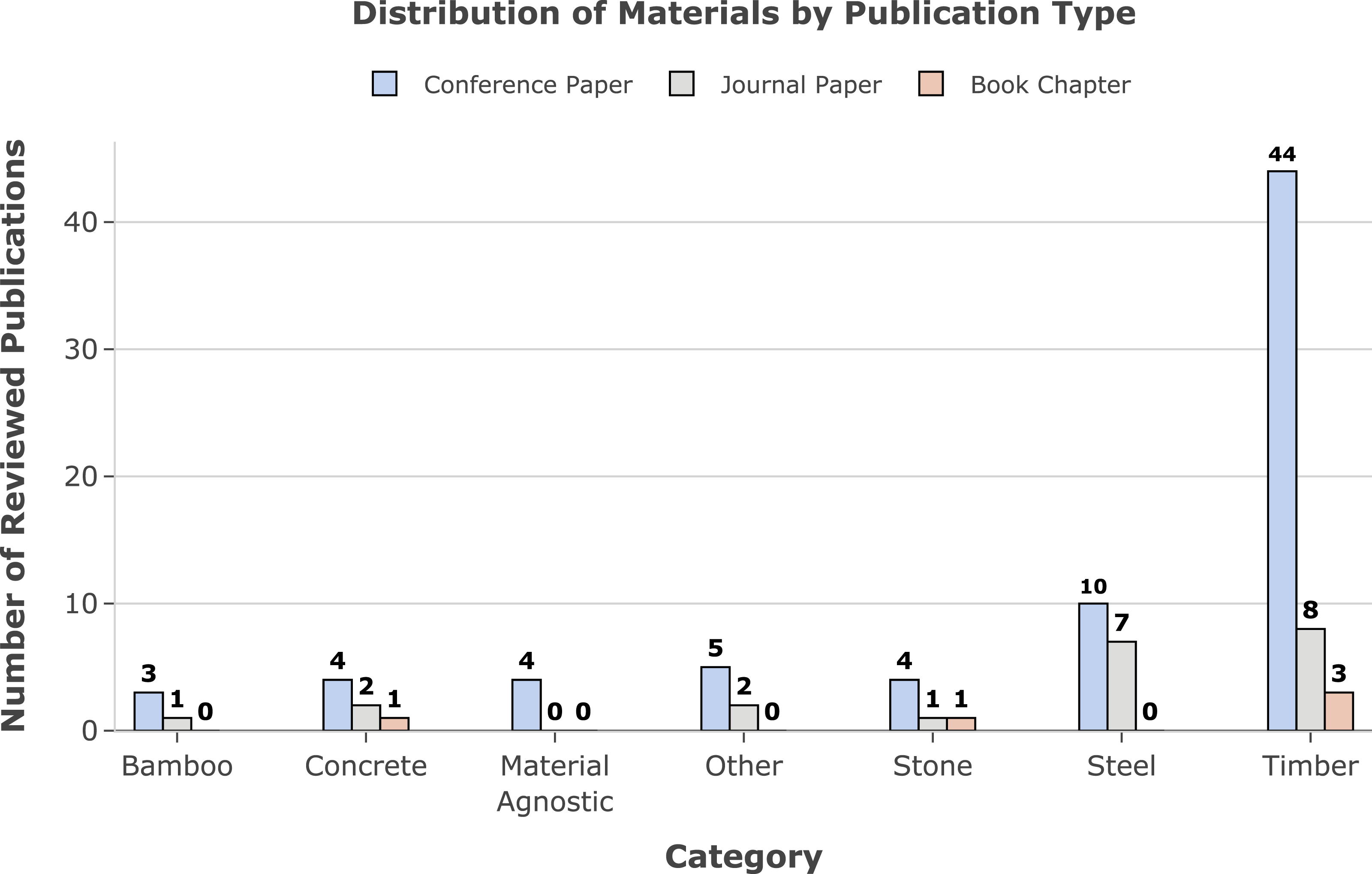
Note on the methodology counting approach
Hybrid methods combine two or more methodologies, typically in a sequential manner. When a hybrid method is used, it is counted both as a hybrid and as its individual components. Consequently, some papers may contribute three or more counts to the total methodology tally, leading to a higher number of methodologies than papers.
Exact methods
Definition of exact methods
A total of 23 reviewed publications use exact optimization methods (Figure 4). These guarantee finding the optimal solution by exhaustively or strategically exploring the entire feasible solution space and systematically eliminating suboptimal options. These methods ensure the best possible outcome without approximation. They are often used when polynomial-time solutions to the specific combinatorial optimization problem are available.
Notable examples of exact methods
Mixed-integer linear programming (MILP)
A prominent exact method for optimizing the assignment of reclaimed elements is the MILP. It is known for solving optimization problems where the objective function and the constraints are linear and the variables consist of or include integer values. A MILP problem can be solved to global optimality by employing combinatorial optimization techniques such as branch-and-cut methods, 42 which makes it instrumental in discrete sizing and topology optimization.43,44 The flexibility of MILP is particularly notable in its ability to integrate additional constraints related to structural mechanics (e.g., ultimate and serviceability limit states, equilibrium, compatibility), material availability (stock size, element lengths), Life Cycle Assessment (LCA) and other design criteria.4,35,45,46 Brütting et al. 47 employed MILP for truss assignment and topology optimization, focusing on ultimate and serviceability limit states while considering the availability of stock element cross sections and lengths to minimize the structure’s embodied energy. In their subsequent studies, Brütting et al. 7 advanced this approach by introducing a two-step optimization process that first minimizes structural weight and then optimizes geometry for more complex design problems.
Hungarian algorithm
Another prevalent exact method for designing with reuse is the Hungarian Algorithm. It provides a polynomial-time exact solution for solving assignment problems to find the best one-to-one matching between two sets of objects, minimizing cost or maximizing benefit. The algorithm determines the optimal pairing of the available reclaimed elements with the components in a new design.13,22,48 While the Hungarian Algorithm was first introduced in 1955, 49 its application to material reuse emerged later. Early examples include the work of Fujitani and Fujii, 50 who employed a separate genetic algorithm to match inventory with structural mechanics in frame structures. 13 Multiple researchers have adapted the Hungarian Algorithm to address specific challenges in component matching tailored to the requirements of each design problem.22,48,51 Following such case-specific approaches, Cousin et al. 52 proposed a material-agnostic design method for various inventories using the Hungarian Algorithm. A recurring theme in these works is the integration of performance metrics in optimization, such as structural analysis 11 and LCA. 46
Advantages of exact methods
Unlike approximate methods that can converge to local optima, exact methods guarantee globally optimal stock utilization solutions. These methods can achieve the global optimum, ensuring the most efficient use of reclaimed materials according to the defined objective function. 42 This is particularly useful in later design stages, where precise solutions are needed. In addition, exact methods can be flexible to incorporate various constraints, 46 including structural limitations, material properties, and environmental impact considerations.11,53 These methods can be applied to complex scenarios, such as cutting stock problems35,45 and are highly effective for cases where the constraints and objective function are well defined and can be modeled with linear equations and inequalities. 31
Challenges of exact methods
Overcoming the exponential complexity of global optimality in MILP can be difficult, especially for large-scale problems. 54 This can hinder interactive design exploration, 55 which is especially needed in the early stages of conceptualization. 56 In particular, the Hungarian Algorithm may struggle with large-scale and multi-objective optimization scenarios13,19,45 and in handling dynamic or uncertain costs. 46 To facilitate multi-objective optimization, the hard constraints in MILP formulations can be relaxed, transforming the problem into a linear assignment problem solvable by the Hungarian Algorithm. However, encoding additional constraints and objectives as penalties in the objective function rather than as hard constraints can lead to suboptimal solutions when optimizing multiple objectives compared to MILP. 13 Lastly, these methods often rely on commercial solvers like Gurobi,35,46 potentially limiting accessibility for some users due to licensing costs. 55
Approximate methods
Approximate methods can manage complex optimization tasks where exact algorithms are too computationally intensive or cannot be applied. These methods, which are classified into heuristic (Approximate methods I - heuristics) metaheuristic (Approximate methods II - metaheuristics) and model-based approaches (Approximate methods III - model-based) are designed to provide near-optimal solutions, making them indispensable in scenarios characterized by large problem spaces and inherent uncertainties. Unlike exact algorithms, which are designed to find the optimal solution and prove its optimality, they aim to provide good enough solutions within a reasonable timeframe, often without any guarantee of optimality. Approximate methods excel in balancing solution quality with computational expediency, offering a pragmatic alternative when precision is less critical. 16 They are often used for NP-hard combinatorial optimization problems to find near-optimal solutions more efficiently.
Approximate methods I - heuristics
Definition of heuristic methods
Heuristics are rules of thumb that guide the search process towards promising areas of the search space. They are particularly useful in scenarios where the search space is vast or when the problem is NP-hard, meaning that the time required to solve the problem exactly grows exponentially with the size of the input. For this reason, the use of heuristic methods to design for reuse constitutes a major trend among the category of optimization methods with 54 publications, as illustrated in Figure 4.
Notable examples of heuristic methods
Rule based and greedy heuristics: In this category, studies primarily focus on two main types of heuristics: rule-based heuristics and greedy heuristics. Rule-based heuristics employ predefined rules based on design constraints and material properties to guide the selection and placement of reclaimed elements. Greedy heuristics make locally optimal choices at each step of the design process, aiming for a globally feasible and efficient solution. 18 Examples such as Best-Fit algorithms prioritize the assignment of reclaimed elements that best match the requirements of the new design, often considering factors such as element length, cross section, and material properties.11,57 For example, Bukauskas et al. 12 examined First-Fit and Best-Fit heuristics with reclaimed steel and unsawn timber to optimize material usage and minimize waste. Although early research relied heavily on rule-based heuristics and simple greedy algorithms for geometric compatibility, the field has evolved to incorporate structural and environmental impact considerations. 54 The Phoenix3D tool by Warmuth et al. 56 uses a Best-Fit heuristic to simplify the design and consider the environmental impact of material reuse.
Heuristic machine learning (ML) algorithms: Additionally, edge clustering ML algorithms such as k-Means and Density-Based Spatial Clustering of Applications with Noise (DBSCAN) have been explored to sort diverse inventories of non-standard materials by grouping similar items based on geometric dimensions. Both algorithms optimize clustering based on different heuristics: k-Means optimizes centroid positions to minimize variance within clusters, while DBSCAN uses local point density to identify clusters. For example, several studies57-59 implemented k-Means clustering to organize reclaimed materials into groups based on similarity in length. Similarly, Gaudreault et al. 58 also used the DBSCAN algorithm to refine the clusters by removing outlier values. These grouping strategies based on the similarity of dimensions help minimize the differences between the dimensions of inventory items and the target geometries, reducing the complexity associated with handling various types of material. 34
Advantages of heuristic methods
Heuristics use simplified rules or prioritize locally optimal choices, resulting in faster computation times than complex optimization methods such as MILP. 28 As a result, they excel at providing quick solutions, making them ideal for interactive design exploration in real time, particularly in the early stages of design that require exploration and iteration.12,54
Challenges of heuristic methods
Heuristics converge on solutions that are only optimal within a limited scope (local optima), rather than the absolute best solution across all possibilities (global optima). Their emphasis on speed and simplified decision-making rules might not always guarantee finding the most environmentally sound or structurally efficient design. 19 Additionally, heuristics’ efficacy depends on the problem and initial arrangement. Therefore, it is important to carefully select heuristics based on the design context and possibly explore multiple heuristic approaches to better assess design options. Handcrafting a heuristic often requires expert knowledge to exploit problem structure, as experts often refine algorithm parameters based on “unwritten intuition” and a deep understanding of optimization tasks. 28 Heuristics tend to be sensitive to the problem instance, making previously developed ones unsuitable with minor changes. 30
Approximate methods II - metaheuristics
Definition of metaheuristic methods
Metaheuristic methods are the second most common approach in the reviewed literature, with 27 publications (Figure 4). They effectively address complex, multi-objective, and non-linear optimization problems involving both discrete and continuous variables by using techniques such as randomization, mutation, and local search. These algorithms efficiently explore vast solution spaces without relying on gradient information, excel at escaping local optima, and iteratively improve solution quality. Often, they are employed as a second step to refine initial matching solutions. Several types of metaheuristic algorithms are used in the literature, such as Genetic Algorithms, Evolutionary Algorithms, Ant Colony Optimization (ACO), Particle Swarm Optimization, and Strength Pareto Evolutionary Algorithm 2 (SPEA2).
Notable examples of metaheuristic
Evolutionary algorithms and strength pareto evolutionary algorithm 2 (SPEA2): Evolutionary Algorithms represent the most recognized class of metaheuristics that emulate the natural evolutionary process to improve initial solutions over successive generations. 60 An example of their usage is the project Digital Rubble by Wibranek et al., 61 which uses Evolutionary Algorithms to form-find a compression-only arch. from stones with 3D-printed connectors. Similarly, to determine the optimal placement of reclaimed elements within a structurally sound form, Mollica et al. 62 employed Evolutionary Algorithms and Simulated Annealing to integrate natural tree crotches in the design. Rahbek et al. 63 use an SPEA2 to optimize the placement of reclaimed wood logs in a gridshell structure.
Genetic algorithms: Genetic Algorithms, a subset of Evolutionary Algorithms, are search heuristics derived from natural evolution that employ selection, crossover, and mutation processes to progressively refine solutions toward near-optimal results. They are used in multi-objective optimization to address issues such as embodied carbon, cost, and structural efficiency, effectively balancing complex trade-offs. 64 Van Marcke et al. 6 highlight that discrete design variables in nonlinear objective functions require stochastic optimizers like Genetic Algorithms, which adeptly manage multiple objectives and constraints for reuse. Research is shifting from the assignment of reclaimed elements to predefined structural layouts toward the integration of form-finding and stock optimization based on available materials.65,66
Advantages of metaheuristic methods
Genetic Algorithms and Simulated Annealing are effective in navigating the challenges of designing with reclaimed materials.3,62 These algorithms can explore large solution spaces 65 and escape local optima. 25 They efficiently handle complex, discrete, and non-linear problems, 6 which are intrinsic to the design process with reclaimed element libraries. Moreover, metaheuristics are ideal for generating multiple design options, unlike exact methods that often find a single solution. 67 Furthermore, many metaheuristic algorithms can optimize multiple competing objectives, 67 allowing designers to find balanced solutions considering material waste, structural efficiency, and environmental impact. Finally, many metaheuristic algorithms are readily integrated with parametric modeling software,68,69 making them more accessible.
Challenges of metaheuristic methods
As these methods explore the design space rather randomly or through optimization procedures, they have the downside that for complex objectives, a very large number of design solutions need to be generated until a good solution — or a set thereof — may be found. In such cases, the computational demands on metaheuristic algorithms can increase significantly due to the potentially large number of iterations required. 70 Additionally, metaheuristic algorithms generally do not guarantee finding the global optimal solution.6,35 Finally, the performance of metaheuristic algorithms can be sensitive to the choice of parameters, such as population size, mutation rate, and crossover operators. 60 Selecting appropriate parameters might require experimentation and fine-tuning.
Approximate methods III - model-based
Definition of model-based methods
Building on Wortmann’s 41 definition of surrogate modeling as model-based methods, this study expands this definition to include simulation models for dynamic modeling and ML models for predictive analysis. In this context, they are referred as techniques that approximate complex systems using models to emulate physical processes and system dynamics. These methods focus on iterative adjustments based on model output, which are essential for validating structural integrity and simulating physical behavior under various conditions. As shown in Figure 4, 42 reviewed papers used model-based methods according to this definition. Based on the review, it was found that although surrogate modeling has significant potential for simulation-based problems, it remains unexplored in circular computational design.
In the reviewed literature, simulations, including structural form finding, dynamic relaxation, particle spring systems, and finite element analysis, are used to calculate constraints such as structural equilibrium and are integrated into optimization frameworks to evaluate design alternatives using reclaimed materials. Additionally, graphic statics is employed as a geometry-based approach to link the form of a structure from reclaimed materials to the distribution of its internal forces. Hybrid approaches that combine simulations, predictive models, and multi-objective optimization tools, such as genetic algorithms, are prevalent in this category.63,71
Notable examples of model-based methods
Dynamic relaxation models: Dynamic relaxation simulations are used mainly to find equilibrium states in structures made from reclaimed materials65,72-78). For example, Von Buelow et al. 65 combined dynamic relaxation with finite element analysis for form-finding of a compression shell, optimizing the placement of natural tree crotches. Similarly, Baber et al.74,75 developed particle spring systems combined with a dynamic relaxation solver that integrates heuristics for part assignment into the funicular form-finding process for structures from sawn timber waste.
Graphic statics models: Graphic statics models have also been explored to connect form and forces when dealing with irregular or reclaimed materials. Several studies54,57,61 have applied graphic statics to explore various form-finding solutions that adapt to the limitations imposed by available reclaimed components. The key purpose here is to enable the user to manually explore different forms that can be constructed from a given inventory of reclaimed components. Wibranek et al. 61 explored the application of graphic statics to compression-only structures built from irregular stones. The authors highlight the potential of extending this approach to more complex shapes, such as shells, using advanced graphic statics techniques, such as 3D thrust networks. Lastly, Brütting et al. 54 used the Combinatorial Equilibrium Modeling (CEM) approach to explore a wide variety of diverse structure layouts in a user-interactive way to reuse steel profiles.
ML models: Existing studies on the application of ML methods for computational design with reclaimed materials remain limited but promising. Wu et al. 79 explored the use of deep learning for the robotic manipulation of irregular objects, employing convolutional neural networks to assist in the robotic assembly of wood structures. The authors also identified Reinforcement Learning (RL) as a promising method for developing a more robust robotic assembly of natural materials. Apellániz et al. 80 dive deeper into the application of RL through the development of a new Grasshopper plugin, “Pug”, 81 to optimize the assignment of bamboo poles in construction. Another approach has been studied by Moussavi et al. 3 who developed an ML-based search algorithm for the selection of reclaimed metal sheets to approximate a corrugated target structure. The authors used the Accord library 82 to simplify the selection and arrangement of pieces within a design grid. This ML-based data processing library facilitates the efficient search for matching sheet metal pieces to overcome the limitations of brute search methods. 3 These few examples highlight the growing importance of ML in reducing the computational complexity associated with non-standard materials.
Advantages of model-based methods
Model-based methods such as form finding simulations excel in incorporating detailed information about reclaimed material stocks, including variations and imperfections in geometry, material, and dimensions.75,83 This is particularly beneficial when working with non-standardized materials, where traditional design methods may struggle to manage such variability. Furthermore, ML-based methods can improve the scalability and speed of design processes and the digitization of material inventory. 84
Challenges of model-based methods
Using simulations and ML models for predictive purposes relies on accurate and comprehensive data. 85 This includes geometric information, material properties, and information about defects or imperfections. 86 Gathering and processing this data can be time-consuming and requires specialized tools, such as 3D scanning. This suggests that while simulations are powerful, their effectiveness is limited by the fidelity of the digital representation of the material stock. Inaccuracies or inconsistencies in the data can significantly affect the reliability and feasibility of the designs generated.59,72,87 Furthermore, simulation models are simplifications of reality. Factors such as material variability, connection performance, and the influence of previous loading history on reclaimed elements can be difficult to accurately model and can lead to discrepancies between simulated and actual performance.63,86
Hybrid methods
Definition of hybrid methods
Hybrid methods strategically combine different optimization approaches to take advantage of the unique strengths of each to address the multifaceted challenges of material reuse. Among the reviewed literature, 42 papers employed these methods (consult Figure 4). Their adaptability allows hybrid methods to excel in situations where a single optimization technique may fall short, providing a robust framework to address complex performance objectives.
Notable examples of hybrid methods
Metaheuristics and model-based methods
Hybrid methods, which combine simulation models with multi-objective optimization tools, are prevalent in the intersection of metaheuristics and model-based categories. These methods effectively incorporate structural and environmental performance metrics into the design process. For example, studies often employ genetic algorithms alongside simulation models to navigate the complexities of using waste materials efficiently.63,65,66
Metaheuristics and exact methods
Given the inherent limitations of metaheuristics in achieving global optimality, some studies have explored the combination of these with exact methods to harness the broad search capabilities with precision. A notable example includes Marshall et al., 48 who combined the Hungarian Algorithm with Evolutionary Algorithms to simultaneously optimize material matching and target geometry. Similarly, Huang et al. 13 paired a multi-objective optimization tool with the Hungarian Algorithm, allowing for design adjustments based on evolving project priorities. This approach highlights the hybrid method’s ability to balance structural capacity and stock-length constraints, which can be encoded as penalties.
Metaheuristics and heuristic methods
Further extending the capabilities of hybrid methods, Warmuth et al. 56 combined Best-Fit heuristics with a genetic algorithm to enable interactive real-time truss design from a specified stock of reused structural elements. This strategy exemplifies how hybrid methods can provide a rapid initial assignment of stock elements through heuristics, subsequently utilizing metaheuristics to expand and refine the solution space.
Advantages of hybrid methods
Hybrid methods combine the strengths of each method: optimality of exact methods, speed of heuristics, adaptability of metaheuristics, and predictive insights of model-based methods - leading to a more efficient and effective optimization process. Additionally, they can adapt to diverse constraints and provide robust solutions that can accommodate changes in project requirements or material availability.
Challenges of hybrid methods
While combining methods can improve the quality of the solution, it also adds complexity to the optimization process. Careful management and integration of different methods are required to ensure coherence and effectiveness. Moreover, the use of multiple methods, especially computationally intensive ones such as ML and metaheuristics, requires significant computational resources. Balancing the depth of exploration with the available computational capacity is crucial.
Analysis of the reuse and application context
This section provides insights into the circularity reuse context parameters that were identified as material and dimensionality within the literature (for more information consult Context categories).
Material
The distribution of materials in the reviewed research includes timber, steel, bamboo, concrete, stone, other and material-agnostic. The material category ‘other’ includes papers that focus on uncommon materials, such as glass, cardboard, sheet metal, magazines, skis, and polyethylene, which do not conform to the main categories and are considered one-off approaches. Meanwhile, the ‘material-agnostic’ category includes papers that develop general approaches to the reuse of elements without specifying the type of material.
As illustrated in Figure 5, the predominant focus lies on timber, with 55 papers, followed by steel with 17 papers. Fewer studies have concentrated on concrete, rock, and other materials, indicating a potential research gap. This is likely related to the abundance and ease of processing materials such as timber and steel, which are inherently easier to reuse due to their modularity and component-based nature, which allows disassembly and reassembly with minimal processing. In contrast, as a composite material, concrete often exists in monolithic forms that pose challenges for reuse, requiring labor intensive cutting or drilling to extract elements suitable for reconstruction. Although precast concrete components offer some potential for reuse due to their modular properties, they remain underexplored in the reviewed literature, highlighting an opportunity for future research. Distribution of dimensionality categories across publication types. Note: certain publications may be categorized multiple times if they address more than one category, potentially resulting in a total count that exceeds the number of publications reviewed.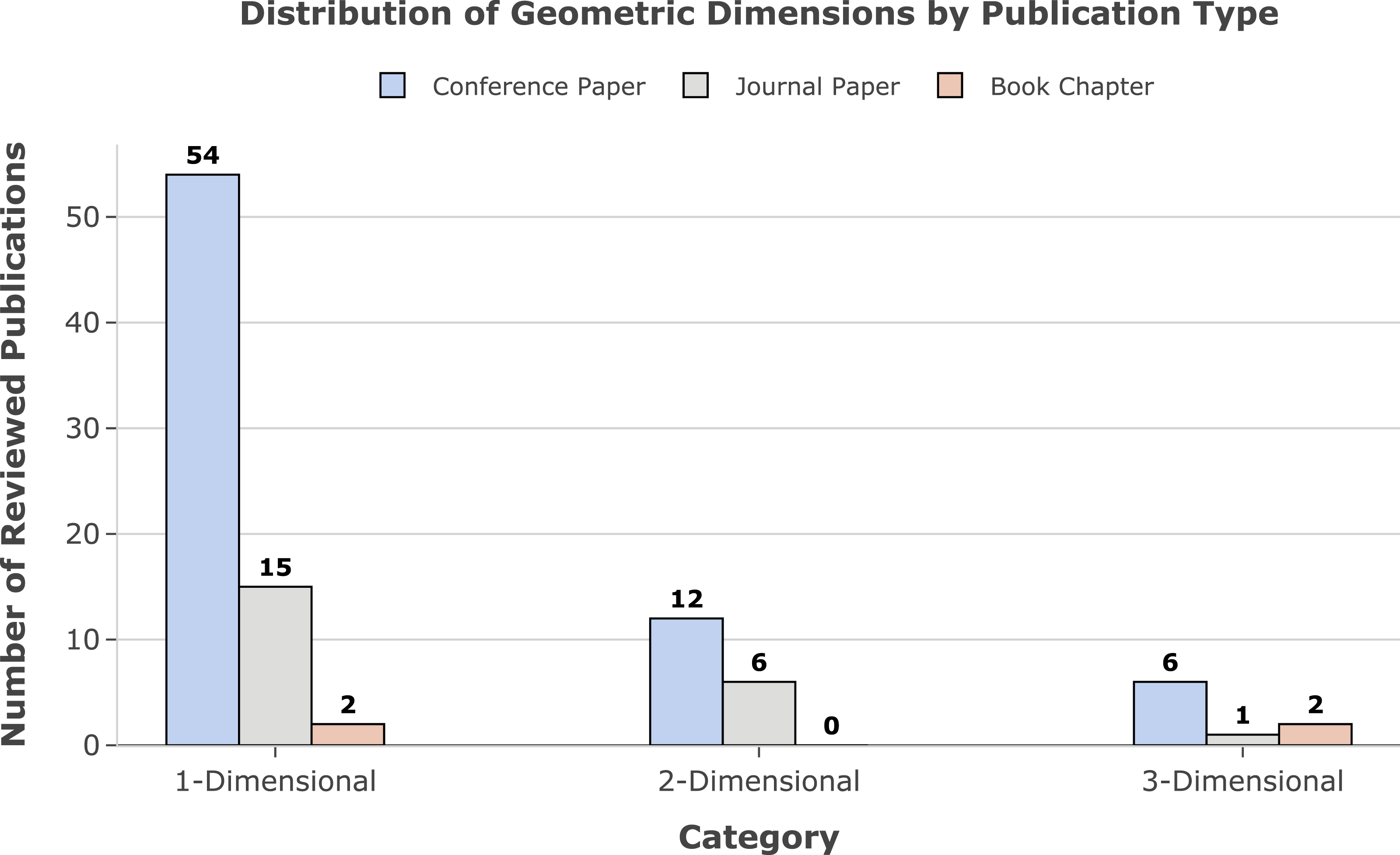
Timber, often highlighted for its sustainability, is frequently studied in irregular and natural forms such as tree forks, logs, and barks. This irregularity necessitates computational methods capable of: • Form-finding: Adapting structural forms to the inherent geometry of the material, allowing the material to dictate the design rather than imposing a predefined form.
71
• Irregular geometry matching: Optimizing the placement of irregular elements within a design.18,74 • Grain orientation: Taking into account the anisotropic properties of timber considering the grain direction.76,88
Steel, often found in standardized sections, lends itself to computational methods focused on: • Cutting stock optimization: Algorithms that can optimize the cutting of stock lengths into required sizes for new structures. This minimizes waste and maximizes material utilization.6,12,34 • Standardized element assignment: Use of combinatorial optimization and assignment algorithms to efficiently utilize existing steel members in new structural layouts.34,35,56
Limited research on other materials, such as bamboo, stone and concrete, suggests a potential area for further exploration, particularly in adapting computational methods to their unique properties and reuse scenarios. The literature reveals few studies on material-agnostic computational approaches,20,52,57,89 indicating an interest in generalizable methods applicable to various reclaimed materials.
Dimensionality
The second context categorization aims to examine the use of geometric data in studies to map, nest, or pack architectural components. The literature was classified according to the geometric dimensions of the reuse case: 1D, 2D, and 3D.
One-dimensional (1D)
Research that primarily focuses on linear structures, such as beams or columns, is classified as 1D. This classification holds even if 3D scanning technologies are used. For example, studies that 3D scan tree forks but primarily abstract and utilize linear dimensions (length) in their applications are categorized as 1D, as the primary geometric information utilized in the mapping process pertains to length. 1D data are commonly used to optimize material use for structures assembled from linear elements. For example, studies discuss assigning reclaimed timber elements,13,14,75 steel sections,31,53 and bamboo internodes 90 to a structural design based on length matching.
Two-dimensional (2D)
Papers that involve nesting or stacking surface elements, such as sheets or panels, are classified as 2D. This classification applies even when the elements are three-dimensional, provided the methods emphasize nesting within a surface, planar relationships, and surface area optimization. Several studies describe the capture of 2D information from planar elements such as reclaimed cardboard sheets, 91 glass panels, 92 concrete rubble, 93 and stones 8 to inform the generation of paneling, wall, facade, or other surface elements. Furthermore, 2D representations are used for initial form-finding and optimization of structures where the primary concern is the layout of members in a plane.
Three-dimensional (3D)
Studies that involve the packing or arrangement of elements within a volumetric space are classified as 3D. This category is reserved for research where the primary focus is on utilizing and optimizing within a three-dimensional space. These include volumetric packing problems, where the spatial relationships and interaction between multiple non-standard 3D shapes are considered. 3D data becomes essential when dealing with irregular materials such as reclaimed rubble stone8,94 and material-agnostic volumetric elements. 20 This often involves 3D scanning to capture complex geometries, followed by categorization and positioning of the elements within a volumetric form.
The analysis of geometric dimensions in the reviewed literature reveals a predominant focus on 1D geometric mapping based on the length of the elements with 71 sources, in contrast to 18 sources focusing on 2D, and only 9 sources focusing on 3D (Figure 6). The research gap in the use of higher-dimensional geometric data likely stems from the associated computational complexity. Handling linear geometries that enable 1D mapping is inherently simpler than higher dimensions. 2D and especially 3D scenarios, on the other hand, require a balance between design objectives, computational resources, and the precision required in reuse. Alluvial diagram that shows all the studies included in this review for each methodology, material, and dimensionality, colored by methodology. The sizes are not normalized and illustrate the number of publications present in each category.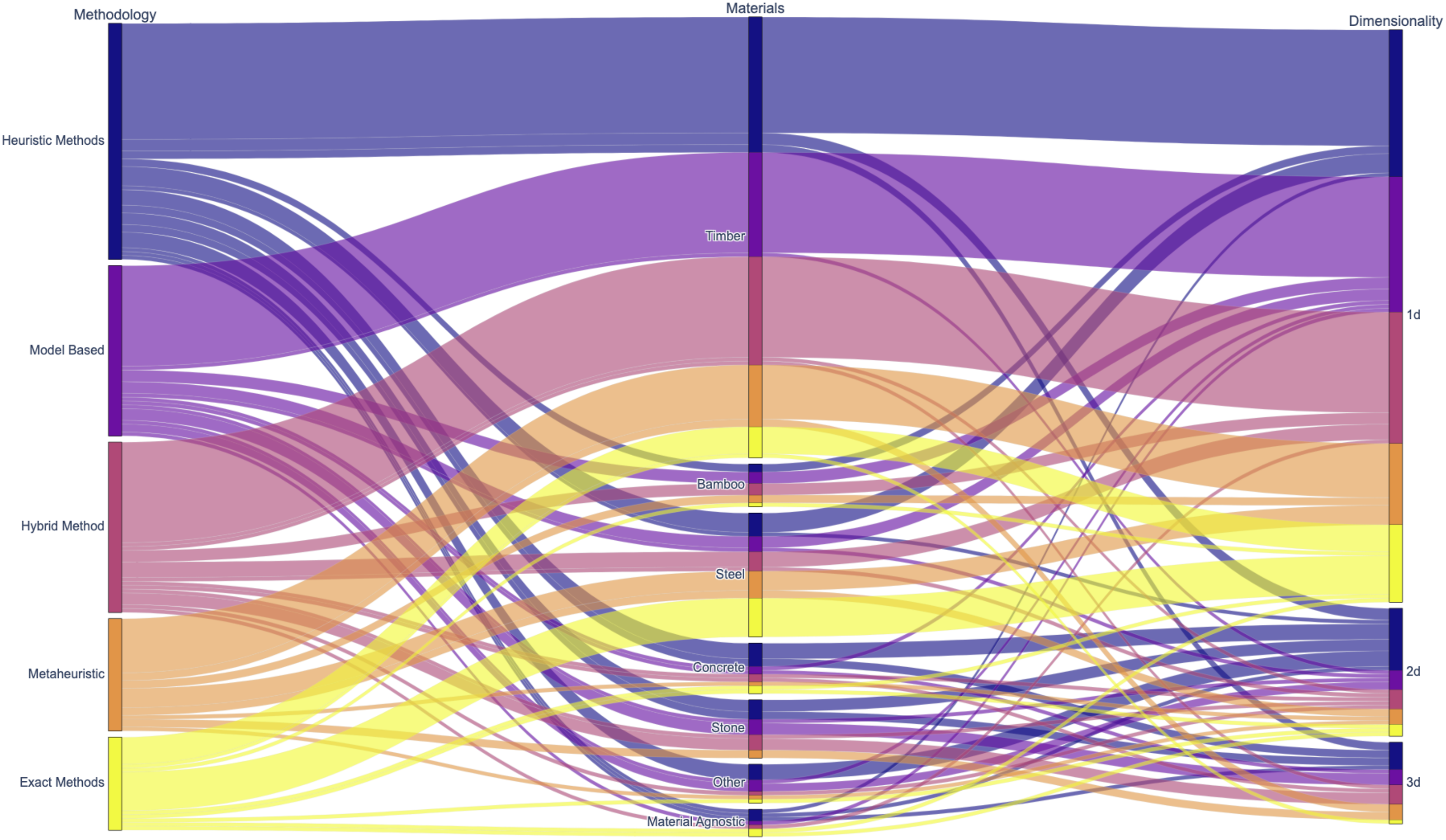
Synthesis
We synthesize the review findings to highlight emerging patterns and the prevailing computational strategies. The following illustrations aid in understanding this synthesis, with interactive versions available in the supplementary material repository. 95
Alluvial diagrams
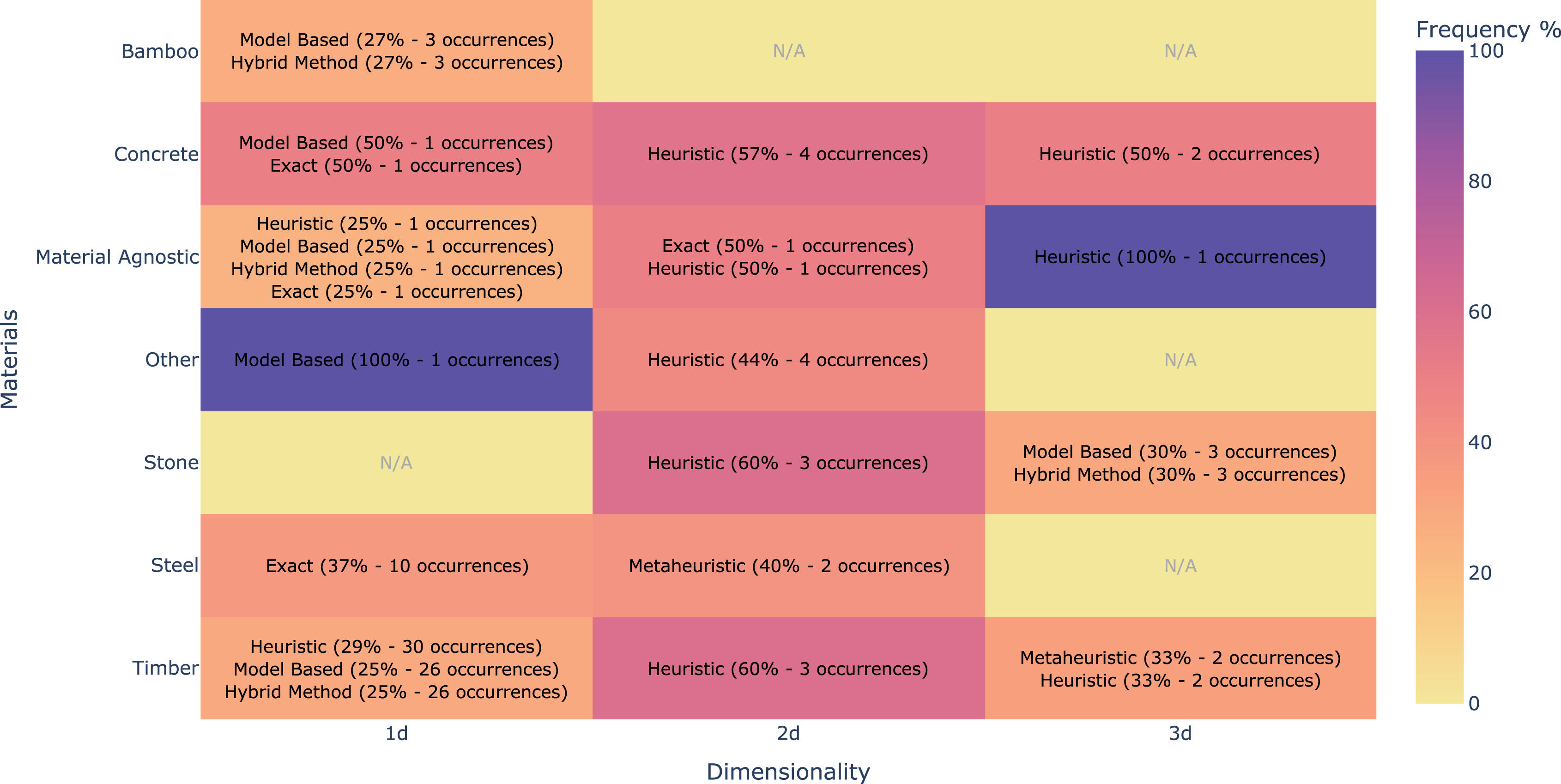
The alluvial diagram (consult Figure 7), provides a granular view of how different optimization methods are used with material types and geometric dimensionality. This diagram shows all studies included in this review for each methodology, material, and dimensionality, colored by methodology. Although informative, the dominance of papers on timber and steel, as well as 1D geometry, may obscure trends in other materials and dimensions. For example, timber appears prevalent across methods; however, this is mainly due to the higher number of timber-focused studies compared to those on stone or concrete. To present a more comprehensive picture, we also include the normalized version of the alluvial diagram, once normalized by material (Figure 8(a)) and once by dimensionality (Figure 8(b)). We do not include an alluvial diagram normalized per method, since the methods are more evenly distributed than the materials and dimensions, and such a diagram would not differ significantly from Figure 7. It is recommended to consult Figure 8(a) for material tendencies and Figure 8(b) for matters concerning dimensionality. Alluvial diagrams colored and normalized by (a) material and (b) by dimensionality. The occurrence matrix summarizes the predominant trends of which method tends to be used for each material and dimension. The term “N/A” (Not Applicable) appears in cells where none of the studies were focused on the specific material-dimension combination. The colors of each box show the frequency with which the most used method appears in each material-dimension combination, and the absolute number of occurrences is also noted.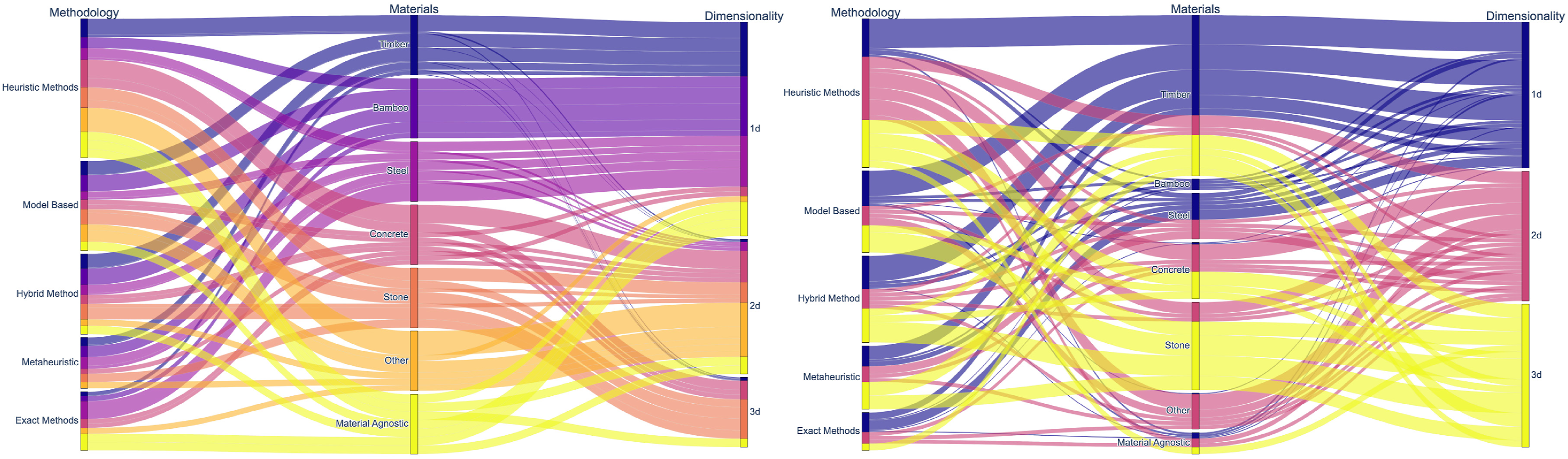
Occurrence matrix
The occurrence matrix (Figure 9) summarizes the predominant trends of the method to be used for each material and dimension. This can serve as a preliminary decision support tool, illustrating the most common optimization methods used in the literature for a specific material and dimension. We acknowledge that there is no one-size-fits-all solution and that such a simplified illustration only conveys the main trends. To construct this matrix, we first counted the frequency of each method used for every material and dimension combination. We then calculated the percentage of occurrence (o) for each method by dividing its frequency by the total frequency of all methods for that material and dimension. Next, we identified the method with the highest percentage of occurrence (omax) and included in each cell all the methods that have: o ≥ 0.8 ⋅ omax. The threshold of 0.8, determined through sensitivity analysis, ensured a comprehensive result. Slightly lowering this threshold further did not significantly alter the outcomes. The term “N/A” (Not Applicable) appears in cells where none of the studies focused on the specific material-dimension combination. The absolute number of occurrences is also noted, to give an understanding of how common each scenario has been in the reviewed literature. The code for generating the occurrence matrix is available in the supplementary material repository.
95
Impact assessment matrix summarizing the trade-offs of computational efficiency, solution optimality, ability to incorporate complex constraints, scalability, and flexibility for the different computational methods. Red denotes negative relation, gray denotes neutral relation, and green denotes positive relation.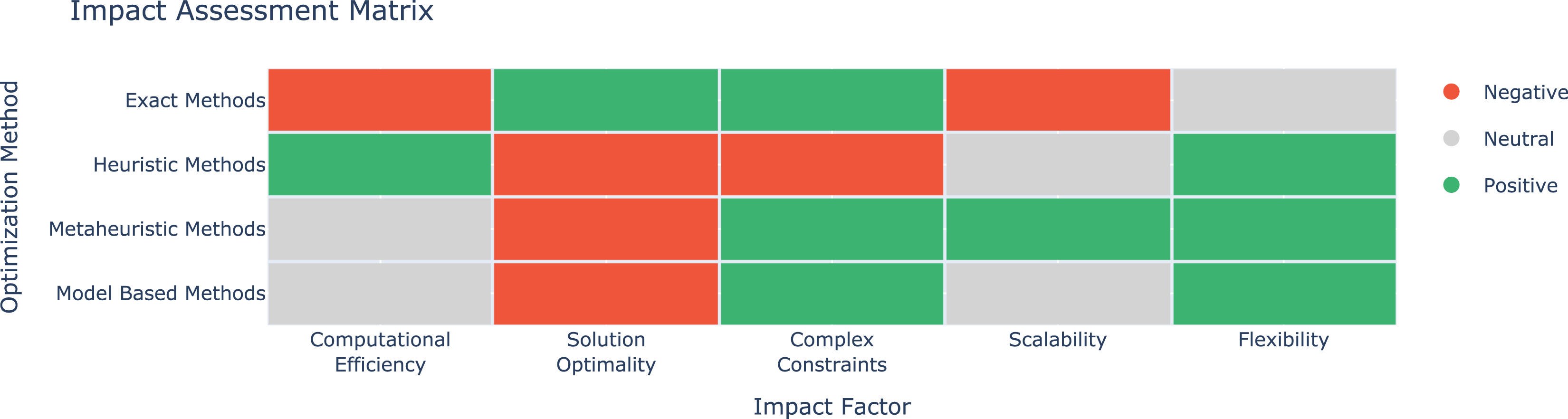
Exact methods
Exact methods (see Exact methods) are particularly useful in scenarios defined by linear equations requiring high precision, such as structural engineering calculations with stringent safety standards. However, they are limited in handling large-scale or complexly constrained problems. Exact methods are the least commonly encountered method in this review, likely due to their computational intensity, scalability issues, and lack of flexibility in relation to approximate methods.
Aspects of material
Figure 8(a) depicts that steel is most commonly addressed by exact methods, closely followed by material-agnostic scenarios. Steel is a costly material often used in large-scale and more structurally demanding constructions, where precision and optimality may be more important than computational efficiency during design. This strong association of steel with exact methods is largely attributed to the ability of the methods to ensure global optimality (consult Table 1).
Aspects of dimensionality
Figure 8(b) shows that exact methods are primarily used in
Heuristic methods
The present review reveals that heuristic methods (see Approximate methods I - heuristics) have a wide range of applications in different categories and are the most frequently used method. This demonstrates a preference for methodologies that offer satisfactory solutions with minimal computational burden, particularly advantageous in the initial stages of design or when rapidly investigating several design possibilities.
Aspects of material
Figure 8(a) illustrates that all material categories have been considered using heuristic methods, with concrete being the most common category, closely followed by other and material-agnostic. The preference of heuristics for these material categories may reflect the need for simpler optimization processes where there is a greater tolerance for variability. Given that concrete as well as “other” and material-agnostic categories are commonly used with 2D and 3D packing algorithms, heuristic methods are preferred in these scenarios due to their efficiency and adaptability, prioritizing computational speed over precision.
Aspects of dimensionality
Parallel to the material dimension, heuristic methods have also tackled all categories of dimensionality, with 2D scenarios being the dimension most frequently addressed by these methods. This may be attributed to the efficacy of heuristic methods in breaking down complex problems into more manageable parts, which is essential in 2D scenarios involving layout optimization, nesting, and tiling. Such scenarios often require efficient planar shape arrangements where heuristics can quickly generate good-enough solutions (consult Table 1).
Metaheuristic methods
Metaheuristics (see Approximate methods II - metaheuristics) are well suited to address complex, non-linear, multi-objective optimization tasks involving various environmental, economic and structural factors. Although their usage is less prevalent compared to heuristic approaches, they are nonetheless employed in a wide range of contexts.
Aspects of material
The most prevalent material in metaheuristic methods is steel, closely followed by bamboo. This preference is likely due to steel structure optimization problems often existing in multi-parameter spaces with many design variables and constraints. Metaheuristics are designed to handle such multi-parameter optimization problems efficiently.
Aspects of dimensionality
The reviewed literature has shown that metaheuristic algorithms are equally effective in handling all dimensionalities (1D, 2D, and 3D), with a slight preference for 3D (consult Figure 8(b)). This could be attributed due to 3D problems introducing non-linear behaviors and non-convex domains that pose difficulties for gradient-based or linear programming techniques. Therefore, metaheuristics are well-suited for 3D problems as they do not require gradient information, effectively handling non-convexities.
Model-based methods
Model-based methods (see Approximate methods III - model-based) are well suited to address complex materials and requirements, particularly when detailed simulations and predictive modeling are necessary to analyze material and structural behavior (Table 1). They rank as the second most frequently utilized method in the reviewed literature, appearing in various materials and dimensional contexts.
Aspects of material
Figure 8(a) demonstrates that model-based approaches are predominant in the material categories of other, followed by stone, and bamboo. This trend is due to the efficacy of model-based methods in predicting and optimizing the behavior of complex or irregular materials through high-fidelity simulations. The other category, which encompasses unconventional building materials such as skis, cardboard, and paper, benefits from the precision of these methods in simulating material properties. For stone, model-based approaches facilitate the integration of simulations crucial for complex form-finding processes in 3D configurations. Bamboo’s prominence in model-based approaches probably stems from its inherent flexibility, which necessitates detailed modeling techniques to accurately predict and optimize for this particular behavior.
Aspects of dimensionality
Figure 8(b) details that model-based methods have been applied in all dimensionality categories, with the 1D category being slightly more prominent. However, this does not imply that these are solely suited for 1D problems; on the contrary, these methods excel in integrating multi-dimensional data into cohesive design strategies that consider spatial and structural complexities.
Hybrid methods
Hybrid methods (consult Analysis of design and optimization methods - Hybrid methods), which integrate several techniques where the output of one method is used as the input for the next, can be highly efficient by capitalizing on the unique strengths of each method during the optimization process to achieve optimal results. This approach is the third most prevalent among the reviewed literature.
Aspects of material
Figure Figure 8(a) illustrates the application of hybrid methods in various material contexts, with a notable prevalence in stone and bamboo applications. This prominence likely stems from the integration of model-based strategies within hybrid frameworks, which are particularly effective for these materials. Hybrid methods synergize predictive modeling and simulations with heuristic or metaheuristic optimization techniques, facilitating efficient exploration of design alternatives, balancing the precision of accurate simulations with the breadth of explorative optimization.
Aspects of dimensionality
Figure 8(b) details that hybrid methods are predominantly applied to
General observations
Correlation between context parameters and the selection of methodology
This analysis reveals a nuanced landscape where the choice of optimization method is closely related to the properties of the material and the geometric complexity of the design challenge. In order to evaluate the relative significance of material or dimensionality in influencing the selection of methodology, we conducted two complementary analyses: (i) conditional entropy and (ii) the chi-square test of independence. The findings on conditional entropy indicate that the uncertainty associated with the choice of methodology is somewhat diminished when dimensionality is established (H(Y|X) = 0.029) in contrast to when the material is identified (H(Y|X) = 0.064), suggesting that dimensionality serves as a more informative factor in directing the selection of methodology. However, the results of the chi-square test indicate that the associations between these parameters and methodology are not statistically significant both for material versus methodology (p = .352) and for dimensionality versus methodology (p = .260). Although these findings suggest that dimensionality has a slightly stronger influence than material, the overall weak associations imply that neither parameter alone is strongly predictive of the chosen methodology. Therefore, other contextual and confounding factors, such as researchers’ preferences, prior knowledge, or other domain-specific considerations, likely play a significant role in determining which methodology is used.
Optimization strategy based on material and dimensionality
The selection of optimization methodologies is closely related to the complexities introduced by the material and dimensionality context parameters. In general, materials with isotropic properties and regular shapes typically align with simpler computational approaches because of their predictable behavior and straightforward processing. In contrast, materials characterized by unique physical properties and variability require advanced methods to accurately predict and manage their behavior in structural applications. For problems involving materials and dimensionalities of lower complexity, exact methods are often sufficient and effective. However, with increasing material complexity and dimensionality, approximate methods such as heuristic, metaheuristic, and model-based approaches become increasingly suitable. Thus, the complexity of materials and the associated dimensional requirements directly inform the choice of computational strategies.
Discussion
When designing with optimization strategies for reclaimed materials, the relationship between discrete and continuous variables differs from the use of new materials, as the achievable form (a continuous variable) is restricted by the dimensions and properties of the reclaimed materials (discrete variables). This requires a careful selection of optimization techniques that balance computational efficiency, solution quality, and adaptability to diverse objectives that are further discussed in the following.
Choices for optimization approaches in circular construction
For optimization problems that match inventory elements with target elements, selecting the appropriate method requires considering several factors. Figure 10 summarizes each method’s trade-offs, examining the following parameters; computational efficiency, solution optimality, ability to incorporate complex constraints, scalability, and flexibility. Although trade-offs vary by context, the figure offers a simplified overview of the main considerations.
Computational efficiency
In computational design with reclaimed materials, a stock-constrained design problem, computational demand is unavoidable due to the NP-Hard nature of combinatorial optimization. Heuristic methods, which require less computational power, are preferable for quick iterations, especially in early design phases. The complexity of optimization also depends on material irregularity; for example, stone requires more sophisticated algorithms than standardized steel sections.
Solution optimality
Achieving optimal designs with reclaimed materials extends beyond material efficiency and cost reduction to encompass the goals of circular construction. Exact methods like MILP and the Hungarian Algorithm can deliver globally optimal solutions, while approximate methods offer good enough results with lower computational demands. Given these trade-offs, a balanced approach might use exact methods for critical components and approximate methods to reduce computational load where feasible.
Complex constraints
Designing for circularity requires balancing multiple objectives, such as minimizing environmental impact, maximizing structural performance, and optimizing material reuse. These objectives may be linearly correlated or present trade-offs that necessitate careful consideration. To navigate these complex decision-making landscapes, effective algorithms must identify optimal or near-optimal reuse solutions. Metaheuristic algorithms, especially those inspired by evolutionary principles, excel at exploring extensive design spaces with multiple objectives, generating diverse solution sets, enabling designers to evaluate various trade-offs and make informed decisions. Furthermore, model-based methods, such as surrogate models, are valuable as they approximate complex objective functions, accelerating the optimization process and reducing computational demands compared to metaheuristics. 96 These allow us to rapidly evaluate potential solutions and efficiently explore the Pareto front where multiple optimal solutions balance the objectives differently.
Scalability
Scalability is a key constraint in combinatorial optimization and is necessary when dealing with large-scale projects that involve substantial amounts of material stock. In large-scale reuse design, the computational cost of exact methods like MILP grows exponentially, making them impractical. Metaheuristic methods, like Genetic Algorithms and Simulated Annealing, offer scalable solutions. As noted by Amstberg et al., 22 a larger database or inventory enhances the likelihood of finding good solutions by providing more options for a perfect fit. Conversely, limited inventory can reduce the effectiveness of optimization approaches, as even the optimal solution within the available inventory may not be well-suited for a specific design. Therefore, algorithms that can efficiently handle larger databases have a significant advantage in delivering more effective design solutions.
Flexibility
Flexibility in optimization is a crucial metric in circular construction, where design needs and material availability often vary. This metric evaluates each method’s capacity to adjust to diverse problem specifics, constraints, and changes in design requirements, to provide robust solutions even as project requirements or available materials change. Exact methods, while globally optimal, often display limited flexibility due to their strict algorithmic structures, which are tailored to specific problem types and include predetermined hard constraints. 13 In contrast, heuristic methods exhibit greater flexibility, allowing for rapid adaptation to various design constraints and objectives. Metaheuristic methods enhance this flexibility by effectively addressing complex, non-linear problems that involve multiple, often competing objectives. Their ability to explore broad solution spaces makes them ideal for evolving design conditions. 25 Model-based methods also demonstrate significant flexibility, especially when they integrate algorithms capable of learning from new data, such as ML algorithms. Overall, flexibility is crucial when dealing with non-standard materials whose properties may not be fully documented or predictable.
Challenges and future needs
As a future perspective, this review identifies several challenges that need to be addressed to advance computational design methods with reclaimed materials and thus promote circularity in construction.
Flexible and scalable optimization algorithms
As discussed above, upscaling often introduces challenges in maintaining computational efficiency, especially when striving for global optimality. A potential solution to this might come from the ongoing advances in AI and the implementation of ML models for clustering,57-59 for segmentation, 97 and for edge matching, 98 which can enhance the scalability of optimization processes. ML models can be trained on large datasets and reused in different design problems to significantly reduce the computational load for new tasks. 99 Moreover, neural networks have recently demonstrated superior performance in combinatorial optimization, 100 demonstrating their potential for solving assignment problems. In terms of flexibility, material-agnostic algorithms offer solutions that are not limited to specific types of reclaimed materials, improving their applicability in various scenarios. A key challenge in applying material-agnostic methods is aligning the physical characteristics of the material with their digital counterpart, which can be partially mitigated with AI. 84
Incorporation of performance-based design approaches
Optimization in circular construction must go beyond geometric fitting and aesthetics to include performance objectives such as structural safety, durability, and environmental impact. Currently, many studies focus solely on the geometric fitting of elements to predefined forms without addressing these critical performance criteria to reduce computational time. 54 Although single-objective approaches are more time efficient, they fail to consider all the performance metrics that are important in circular construction. Since a primary goal of circular construction is minimizing environmental impact, performance metrics such as minimizing waste, maximizing material utilization, and reducing embodied energy should become direct objectives of optimization processes. In addition, given the ongoing development of building codes and regulations pertaining to reuse, it will become imperative to integrate these standards as performance criteria into design workflows. Surrogate models, such as neural networks, regression models, or support vector machines, allow designers to quickly explore approximations of the solution space. However, despite their potential, there is a lack of studies employing surrogate models in the optimization of circular construction processes. This gap in the literature highlights an opportunity for future research to explore how surrogate models can effectively address the complex trade-offs between multiple performance objectives in circular construction. Once trained, these models can predict the results for new inputs, enabling rapid design iterations. 96 Unlike metaheuristics, which treat the design space as a black box, surrogate models offer more informed and guided exploration, improving understanding of trade-offs between performance objectives.
Rethinking structural optimization for circular reuse
Traditional optimization methods such as weight minimization often overlook key goals such as waste reduction, material utilization, and embodied energy. Weight-focused strategies typically favor smaller cross sections, leading to significant material waste and under-use of available stock elements. For example, if the optimization algorithm prioritizes small cross sections of the available stock to minimize weight, it could require cutting much larger elements, resulting in substantial leftover material and a lower overall material utilization rate. 34 Conversely, designing exclusively with reclaimed structural components can result in oversized structures due to the limited availability of optimally sized sections. 47 Current research suggests that the lowest environmental impact is achieved by strategically combining reused and new materials, 45 highlighting the need for customized optimization strategies beyond conventional approaches.
Underexplored combinations of context parameters
This review has shown that computational reuse methods are increasingly tailored to the unique properties of materials and the complexities of design tasks. However, the uneven application of these methods across the context parameters highlights opportunities for future research. For instance, Figure 8(b) shows that timber, bamboo, and steel are predominantly categorized in the 1D dimension, as their geometries are best represented by lines. This suggests that current computational strategies may not fully take advantage of the potential of timber in more complex geometrical forms. Similarly, the tensile properties and flexibility of bamboo, which is largely confined to 1D applications, indicate missed opportunities for its use in 2D or 3D contexts, where its elasticity and strength could be better exploited. Furthermore, despite extensive research on the reuse of linear materials such as steel and timber, there is limited investigation into reusing reclaimed cuboidal objects such as masonry blocks, facade panels, or concrete and stone off-cuts. 101 Future research should aim to refine existing computational methods to better accommodate the unique characteristics and design requirements of diverse materials.
Hybrid methods
The analysis shows that no single method can fully address the challenges of material reuse. Instead, the optimal strategy often involves combining multiple methods in different categories. For instance, heuristics or ML can generate and refine initial solutions, followed by metaheuristics for multi-objective optimization. Hybrid strategies take advantage of the strengths of each method at various stages of the optimization process, thereby tackling multifaceted challenges more efficiently. Sequential integration, where the output of one method serves as the input of the next, allows for a funneling process from broad initial solutions to precise optimization. Additionally, parallel feedback loops enable iterative enhancements, where insights from one method, such as metaheuristic algorithms, can refine another stage, such as predictive models in ML, continuously improving overall solution quality. The expansion of the use of hybrid methods can facilitate the integration of various techniques to meet the varying demands of different materials and design parameters, driving notable advancements in circular design practices.
Conclusion
This paper makes several contributions to the field of computational design for circular construction. Firstly, it highlights a pronounced focus on timber and steel within the reviewed literature, signaling a notable research gap in the application of computational methods to other materials. The prevalent use of 1D geometric mapping, primarily due to its simplicity, underscores the need for more sophisticated methods capable of handling the complexities of 2D and 3D scenarios common in the reuse of irregular materials.
By visualizing the interdependencies between optimization methods, materials, and geometric dimensions, this paper facilitates rapid understanding and identification of patterns and trends in the existing literature. We introduced an occurrence matrix as a starting point for selecting suitable optimization methods based on the most frequently used combinations of methods, materials, and dimensionality in the literature, helping practitioners and researchers make informed decisions about method selection. Although this reflects the current state-of-the-art and may not represent the optimal solution, it provides a valuable foundation for future research.
This review highlights the promise of computational design in scaling and automating reuse with non-standard materials. Existing methods offer robust frameworks for designing with reclaimed materials; however, there is a significant need for improvements in scalability and flexibility. As the diversity of materials and the scope of projects continue to expand, the computational efficiency of these algorithms becomes increasingly critical. The adoption of surrogate modeling, along with data-driven and ML-based approaches, has been identified as a promising direction to help address these challenges.
In addition, the literature predominantly focuses on the geometric aspects of the problem, often overlooking project-specific factors such as cost constraints, structural safety, durability, environmental impact, and compliance with building codes for reuse. This oversight presents a significant opportunity for future research to integrate these critical factors into the design process, ensuring that computational approaches not only meet geometric requirements but also adhere to performance objectives.
In conclusion, while no one-size-fits-all solution emerges from the reviewed literature, hybrid methods that integrate various computational strategies present a promising path forward. These methods have the potential to bridge identified gaps and offer robust and adaptable solutions to the multifaceted challenges of circular construction.
This study reaffirms the essential role of computational design in the advancement of circular construction practices by addressing the unique design and material challenges posed by both standard and free-form architecture. 101 Continued progress in scalability, the inclusion of performance objectives, and the development of hybrid approaches will enable a more efficient use of reclaimed materials, pushing the construction industry toward sustainable and circular practices.
Footnotes
Author contributions
Beril Önalan: Conceptualization, Methodology, Investigation, Formal analysis, Visualization, Writing - original draft Ioanna Mitropoulou: Conceptualization, Methodology, Formal analysis, Visualization, Writing - original draft Eleftherios Triantafyllidis: Conceptualization, Methodology, Visualization, Writing - original draft Jens Hunhevicz: Conceptualization, Methodology, Writing - original draft Catherine De Wolf: Supervision, Funding acquisition, Methodology Refinement, Writing—review & editing, Management
Declaration of conflicting interests
The author(s) declared no potential conflicts of interest with respect to the research, authorship, and/or publication of this article.
Funding
Eleftherios Triantafyllidis is supported by the Albert Lück Stiftung (ALS) via the ETH Zürich Foundation for the project “Extended Reality for Inspection, Assembly, Operations for Net-Zero Carbon Infrastructure”. The research reported in this publication was supported by funding from NCCR Digital Fabrication (Agreement No. 51NF40-205604) and by Bouygues construction R&D and Innovation Department. 102
