




Abstract
The kiosk K67 is a known example of mass-produced modular architecture designed in the 60s. Although these modules allow many design solutions, the designer Saša Mächtig did not guide the generation of such designs so that the final composition of elements could fit a specific design purpose. This study has two aims. The first is the development of a shape grammar for the kiosk K67, which enables a deep analysis and synthesis of this paradigmatic design. The study’s second aim is to combine the kiosk K67 shape grammar with design principles to guide the generation of design solutions. To do so, the Vitruvian triad dimensions – firmitas, utilitas and venustas – are combined with the developed kiosk K67 shape grammar to generate design solutions based on specific design briefs. The study identifies how each dimension of the triad can impact architecture and then correlates these impacts with the kiosk K67 shape rules. Finally, shape grammar and design alternatives are presented. Each Vitruvian dimension is taken with different priorities in the design alternatives to test the concept. Such an approach enables us not just to analyse the design of Mächtig but also to use the developed shape grammar in a pedagogical way to explore how balancing design principles and constraints impact design outcomes.
Introduction
In modular architecture, modularity enables architects to create numerous variations that offer diverse functions and features. Saša Mächtig’s kiosk K67 is a standout example, renowned for its versatility and adaptability. The conceptualisation of the kiosk K67 by Saša Mächtig was a responsive solution to the demand for meticulously crafted, technically advanced, and aesthetically pleasing facilities to foster the evolution of street vending and related services (Figure 1). Although some academics have written about this genius design and artists have documented it, there is a lack of in-depth analysis of the design language of the K67 Kiosk.1,2 Antlej
2
brought this iconic architectural design to the public via digital documentation and presentation using 3D repositories. Before, the artists and authors such as Martin Bricelj Baraga, Markus Schlaffke, Aleksandra Jevtovic, Robert Žvokelj, Matthew Selnick, Qendrim Hoti have documented and developed several interpretations of the K67.
2
Example of a single unit kiosk K67 in the Museum of Architecture and Design, Ljubljana (photo credit: the first author (2023)).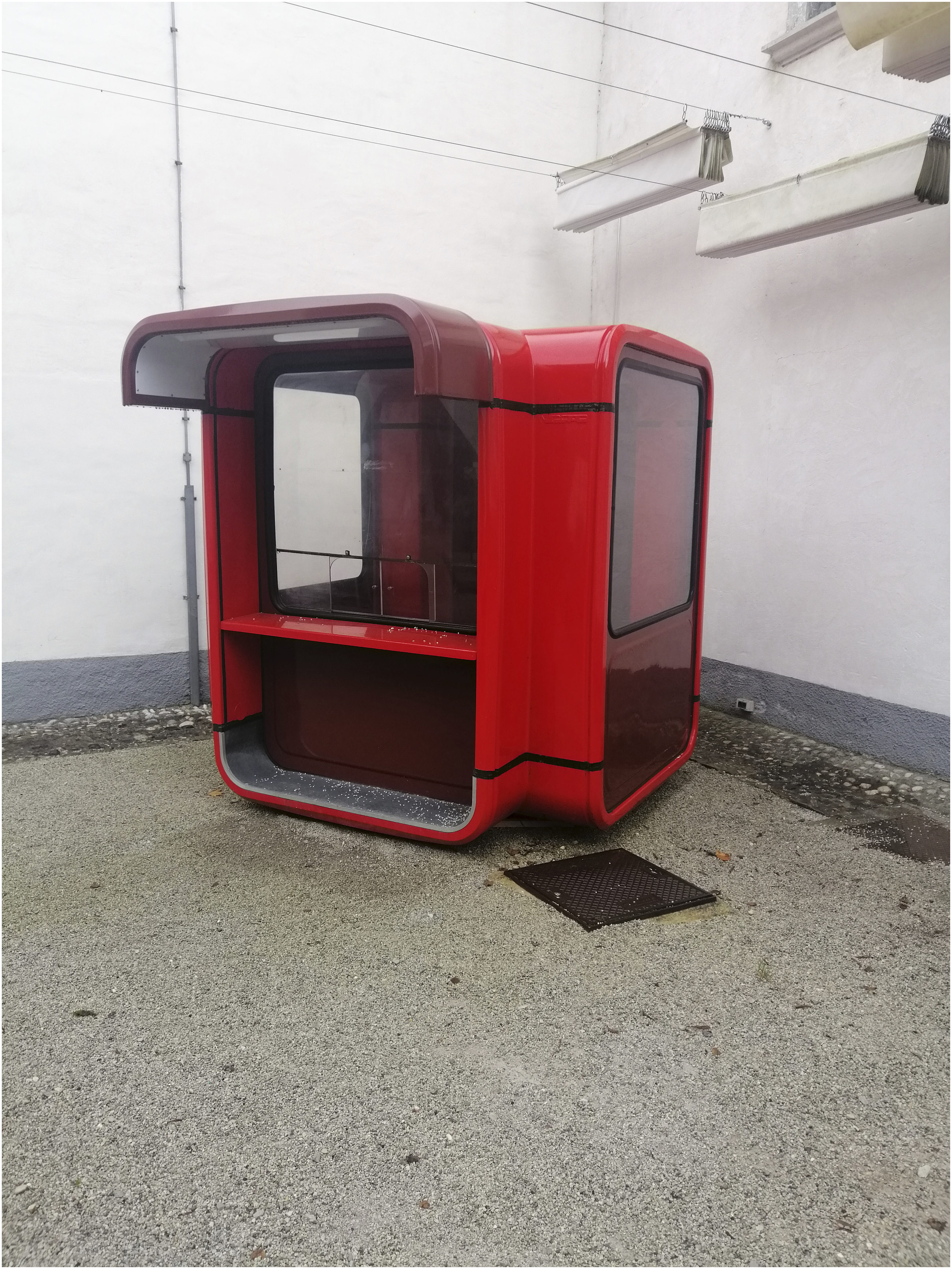
The first aim of this study is to deepen the existing analysis of the K67 by developing a shape grammar for the design language of this design solution. The emergence of shape grammar as a design methodology has provided architects with a systematic approach to generating architectural forms, offering a rule-based framework to explore design variations within predefined constraints and requirements. 3
The second aim of this study is to develop the K67 shape grammar so that the design solutions are generated by departing from design aims. Architectural design processes have long been influenced by various principles and methodologies aimed at achieving harmonious and functional built environments. Among these, the Vitruvian triad is a cornerstone, encapsulating the fundamental principles of structural integrity, functionality, and aesthetics. 4 To achieve the second aim of this study, we use the Vitruvian triad as a heuristic that guides the generation of design solutions using the K67 shape grammar. By doing so, the study explores how the generation of architectural designs through a shape grammar can be influenced by heuristics derived from the Vitruvian principles and how these criteria can be applied within architectural-driven shape grammars.
The methodology followed in this study encompasses four steps further explained in the section Research Methodology: (i) analysis of the corpus of K67 design; (ii) development of the K67 shape grammar; (iii) implementation of Vitruvius Triad criteria in the K67 shape grammar; (iv) testing of design solutions.
After this introduction, the paper is followed by a section introducing the framework of this study covering modular architecture and mass customisation, sustainability, the Vitruvian triad, the K67 kiosk, and the usage of shape grammar. The third section outlines the methodology used, the analysis of the K67’s design and the development of the K67 shape grammar. With the K67 grammar established, the aim is to derive design alternatives aligned with specific dimensions of the Vitruvian triad, considering factors such as unit count and user capacity. This process involves classifying K67 elements, integrating them into shape rules, and exploring how design principles influence different solutions. This is done in the fourth section where the K67 shape grammar is combined with Vitruvian Triad criteria. Additionally, this section showcases examples of K67 design alternatives based on the Vitruvian principles. The paper follows with a section on Discussion and Conclusions.
Framework
The kiosk K67
Rooted in a structural design emanating from the intersection of two pipes, the kiosk K67 yielded a cross-shaped system unit. The K67 system, comprising five modular spatial elements, including the cross-shaped unit, corridor link pieces, and triangular units, was conceived for extension, complementation, and diverse spatial configurations.
The main elements of the system were augmented by secondary, tertiary, and quaternary components, which included facade fillings, canopy, and interior furnishings. The first generation of these components had a unique and smooth monolithic appearance and used a double-shell sandwich construction that was reinforced with polyester and intermediate insulation. These components were manufactured by the Imgrad company in Ljutomer and were first introduced in 1969. They received international recognition after an article was published in the English journal Design and were subsequently placed in the Museum of Modern Art (MoMA) in New York in 1970.
The second generation of the product was characterised by technological advancements and an optimised production process. This version introduced a novel load-bearing shell that was slightly convex, which set it apart from the original flat monolithic structure. The new design featured basic elements such as ceiling and floor shells, four corner posts, and side fillers like vending machines, windows, doors, and blind facade elements. The product’s commercial success was evident through increased production and international exports, highlighting its flexibility and adaptability in diverse contexts.
After 1976, the K67 system was customised extensively. It was used as stand-alone units or assembled in different spatial configurations for various purposes, such as newsstands, workshops, shelters, reporter cabins, sanitary units, translucent triangular units for the police, and technically demanding food kiosks.
Mächtig, in evaluating the urban-planning paradigm, highlighted the kiosk’s role as a programmatic and designed contribution to the developed urban environment. He emphasised a departure from perceiving kiosks as mere commonplace entities, asserting their integral role in organised micro-locations. The K67 system’s evolution led to the introduction of a versatile universal prefabricated design, highlighted by adaptability within a programmatic cluster. Eurokiosk 2000, unveiled in 1981, aimed to serve as multi-functional spatial elements for various purposes. The subsequent K21 project represents a forward-looking modular urban infrastructure. Inspired by nature, it integrates information panels and solar cells for energy independence. 1
Modular architecture and mass customisation
Historically, modular construction has gone through different phases, with the Industrial Revolution significantly influencing its development. Modular construction originated in the 17th century when houses were built in England and shipped to the fishing villages of Cape Ann, today’s Massachusetts, USA.5,6 Nowadays, modular architecture has gained popularity worldwide due to its efficiency, sustainability, and adaptability.7–9
Modular systems consist of components and units designed for easy detachment and reconfiguration, enhancing efficiency and sustainability in construction. 10 Modular design in architecture focuses on creating prefabricated building products or entire buildings from physically separable units. This approach supports rapid product development, simplifies assembly and maintenance, and facilitates reuse and recycling, aligning with various product lifecycle goals. 10 Transporting modular systems or individual elements from production facilities and their assembly on-site represents an additional specificity. 8 Therefore, modular buildings reflect the identical design intent and specification as site-built buildings. They can be interpreted as various typologies of the building stock, meaning residential buildings, hotels, schools, hospitals, offices, student residences, and other types of buildings where repetitive units are preferred. 10
Modular architecture is currently being researched, coupled with design strategies to increase customisation for mass design. Examples such as the mass modular housing design by Wang et al., 11 apply shape grammars to devise a large set of modular design solutions that fit specific demands. Teribele and Turkienicz also devised a design process based on generative design for modular volumetric architecture. 12
Shape grammars for architecture design
Modular architecture like the one by Saša Mächtig for the K67 kiosk use often implicit rules that are not always formalised as a set of design rules. The K67 is one of such cases. As mentioned before, Mächtig devised a modular system to conceive kiosks that, by assembly a certain number of different pieces, would allow diverse design variations, all identified as belonging to the same language of design.
Analytical shape grammars have been widely used in architecture to describe design languages. By offering a structured and rule-based approach that supports the scalability, flexibility, and coherence required in modular architecture, shape grammars constitute a relevant tool for architecture design and analysis. Shape grammars constitute a good analysis method for architecture by facilitating the decomposition of complexity, pattern recognition, generative exploration, ensuring consistency, enabling parametric analysis, and aiding in historical and cultural analysis. Additionally, shape grammars have been used as original design tools in order to devise new languages of design and explore a multitude of consistent design solutions in a same language of design.
One of the first seminal papers of George Stiny was a study on definition of design languages, which used the modules of the Froebel’s building gifts as an illustration of the case. 3 With the Froebel’s block, just like with the K67 units, one can produce an immensity of enumerations of possible combinations of elements, i.e. final designs. Within modular architecture, the wood frame grammar presented of Sass 13 is one original grammar that uses shape grammar to define an efficient system to use plywood sheets for modular housing design. Stylistic studies such as the ones about the Palladio villas, 14 and Malagueira houses 15 showed how shape grammars could be used to describe design languages and generate design solutions that follow that language. These and other shape grammars aim at deliver designs in a language that satisfy specified criteria, so that design problems can be “formulated as problems of searching discrete (or partially discrete) state-spaces”. 16 Typically, these criteria are articulated through constraints, objective functions, and heuristics. Various methods, such as heuristics, are employed to oversee the search process, ensuring the generation of satisfactory results while managing computational resources judiciously. Examples of criteria can be limits of floor area and costs, number of rooms and adjacencies.15,17 Heuristics might be based on quality requirements such as environmental comfort, safety, functionality, and customisation. Mitchell mentions that difficulties related to the use of criteria and heuristics are the actual definition of the constraints and objective functions, the intractability of the search problems and finally a third one related to the formulation of the grammars in terms of discrete elements. 16
Vitruvian triad
Marcus Vitruvius Pollio wrote the book De Architectura libri decem around 10 BC, where he laid out the principles for developing architectural quality. This book is considered the foundation of European architectural tradition and covers theoretical and practical explanations in different areas such as town planning, construction, public and private houses, architectural orders, and technical infrastructure. In the book Ten Books on Architecture, Vitruvius suggested two sets of principles for architecture. 4 The first set is less commonly used in theoretical practice, but Vitruvius emphasised its importance. The second set, known as the Vitruvian triad, consists of three principles: firmitas (firmness), utilitas (commodity), and venustas (delight). Vitruvius mentions this set in a rather marginal way, and paradoxically, the triad took primacy over the first set.
Firmitas relates to stability and the building’s durability. It also means stiffness, which is based on Vitruvius’s description of the importance of having solid foundations and selecting good materials that are suited for the purpose. Nowadays, in the expanded concept of the Vitruvian triad, firmitas represents the static feature of a building, related to its resistance to physical forces such as gravity, live loads, induced vibrations, as well as environmental factors like wind, earthquake, temperature loading and humidity. This dimension has undergone a long process of adaptation and transformation following construction requirements, the evolution of construction materials and social needs, such as shelter, advocacy, defense, manufacturing, warehousing, etc. 18 Utilitas addresses the importance of functionality and purpose in architecture. These two aspects of a building are derived from basic and secondary human needs, according to Maslow’s hierarchy of needs. In the current context of the Vitruvian triad, it addresses the ability of a building to properly react to the needs of the users and community. Utilitas answers questions about end-users’ needs, the way of arrangement and organisation for an efficient framework, as well as current ideals of “the good life.” Venustas represent architectural beauty or a building’s ability to mimic natural cosmic order, which is based on Vitruvius’s classical background. It implies a visual quality in architecture that arouses the emotion of love, and expresses the aesthetic, artistic, symbolic, and poetic architectural dimension. Since Vitruvius considered nature as an expression of the cosmic order that manifests universal laws, architecture can achieve this feature if it mimics that rule. In a contemporary context, venustas addresses the aesthetics of buildings expressed through proportions, forms, ornaments, facade, color, the relationship between light and shadow, the contrasts between heaviness and lightness, texture, patterns, and rhythm.
Authors such as Zotic and Alexandru discuss the presence of the Vitruvian Triad in current architecture and advocate its maintenance. 19
Research design
Research methodology
As mentioned before, this study aims to explore how the use of the Vitruvius Triad criteria as a form generator can impact the final design of the K67 kiosk. For doing that the methodology followed in this study encompassed four steps: i) analysis of the corpus of design of K67; ii) development of the K67 shape grammar; iii) implementation of Vitruvius Triad criteria in the K67 shape grammar; iv) test of design solutions.
In the first step the design of K67 is extensively analysed using publish material, photographs, online content, and museums assets. This step is described in Section 3.2. The second step, described in 3.3, includes the development of the shape grammar by inferring and testing the shape rules as explained in Eloy and Duarte. 20
After the definition of the K67 grammar, our aim is to obtain design alternatives for K67 that fit specific design dimensions (venustas, firmitas, utilitas) along with other design requirements (e.g. number of units, number of users, type of windows). In order to obtain those design alternatives, in the third step, we start by classifying the elements of the K67 regarding how they respond to each of the three dimensions and later reflect that classification in the shape rules available for application (Section 4.1). This alignment aims to explore how the resulting design solutions are influenced by various heuristics, specifically in the application of firmitas, utilitas, and venustas design dimensions. Finally, in the fourth step, demonstrate examples of K67 design alternatives generated by using heuristics based on the three design dimensions (Section 4.2).
Analysing the corpus of design and vocabulary of shapes
As mentioned before the K67 was used extensively in cities for several purposes such as newspaper kiosks, market stands, shelter booths, student cafes, and lottery stands. Although not much built examples exist nowadays, we can still encounter numerous photos of different combinations of kiosks on the internet and some publications such as the catalogue “Saša J. Mächtig: Systems, Structures, Strategies” and numerous websites such as K67 Berlin 1 , ArchDaily 2 , Widewalls 3 and Bubblemania 4 which showcase several uses of the kiosk.
The catalogue “Saša J. Mächtig: Systems, Structures, Strategies”
1
presents the designs that were part of the 1st and 2nd generation of K67 and from them the vocabulary of shapes presented in Figure 2 was deduced. Drawing on Alexander’s Pattern Language
21
as a foundational framework for systematically organizing the K67’s elements and shapes, the corpus is divided into two core categories: spatial and closing elements. The spatial elements are the ones which create usable indoor space (A, B, C1, C2, C3, E, F (1st generation) and D1 and D2 (2nd generation), while the closing elements are those which close the tops of the special elements such as door, windows (sale windows S1a and S1b, shop windows S2, S3, and canopy (1st generation) and skylight and windows (S4, S5, S6, and S7), 2nd generation. Vocabulary of shapes used for the K67 shape grammar. Units E and F are not part of the considered vocabulary (Created by the first author (2024)).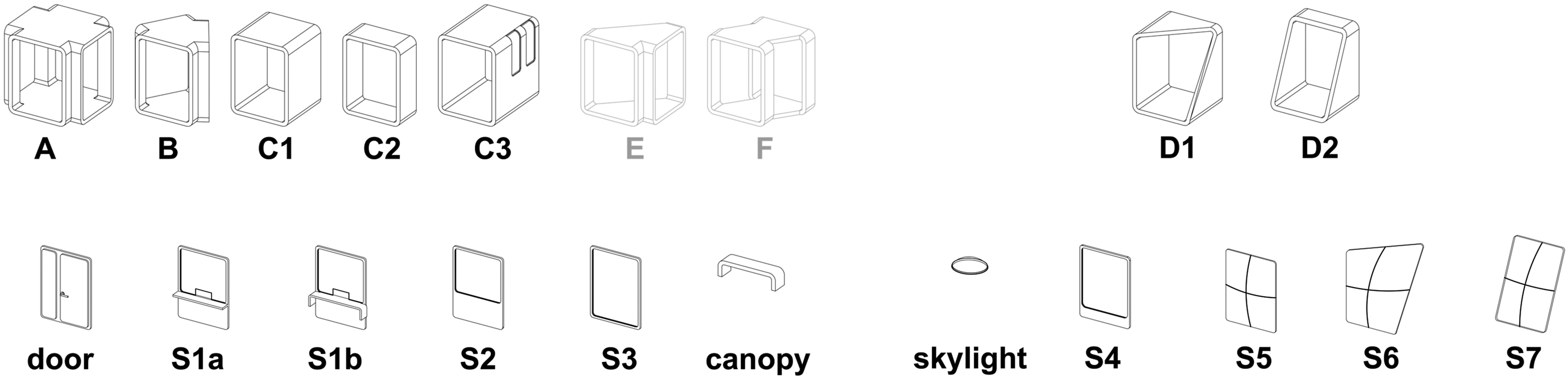
The corpus of design used to define the K67 grammar is therefore composed of the published diagrams by the architect of the 1st and 2nd generation of K67 as well as the available photos that follow the logic of those diagrams. This corpus includes dozens of examples that, according to the authors opinion, cover all the possibilities of assembly of the K67 elements found in literature related to the 1st and 2nd generation. There are several 3D models, new diagrams, and later photos of K67 sets that introduce slight variations in some elements that were not part of the original drawings of the architect. Those variations were not incorporated in the now presented grammar. Also, a sketch and a model building found on the internet present a K67 set that includes a second floor. Because there is no evidence that such a composition was ever built and there is no stair element designed, we also did not consider a composition in two floors. Besides this second floor, another published diagram shows two different spatial units, E and F from 1st generation (see Figure 2), that were not encountered in any photo available which made the authors assume that it was not built. Therefore, also these two spatial units were not incorporated in the grammar.
K67 grammar shape rules
The vocabulary of shapes that are part of the K67 is often presented in publications with diagrams that show how the assembly of the different pieces was done. Such diagrams complemented by the numerous photos of different compositions of the Kiosk 67 enabled us to infer the shape grammar here presented. The shape grammar of the K67 is devised for the PhD work of the first author which is in progress.
The presented K67 shape grammar is an analytical grammar that uses three-dimensional volumes in algebra U33 (for shapes) and V03 (for labels). Labels add information not provided by shapes. In the proposed K67 shape grammar, the algebra U33 is combined with labels in the algebra V03, in which label points are used to define where a rule may be applied. These labels are “where” labels because they specify which shape(s) a rule may be applied to and because their location in relation to the associated shapes is essential to their function. These labels solely describe the shapes without modifying their symmetries, so they do not limit the sub-shapes that the rule can be used on, nor do they constrain the Euclidean transformation under which it can be applied. 22 K67 grammar does not enable emergence since no new properties or structures, not immediately obvious from the original shapes, arise from the application of shape rules. 23
The shape grammar is composed of 14 shape rules divided into three parts (see Appendix 1): 1. Introducing the initial shape (rule 1) 2. Placing spatial elements (rule 2 to 6) 3. Placing closing elements (rule 7 to 13) 4. Erasing the labels (rule 14)
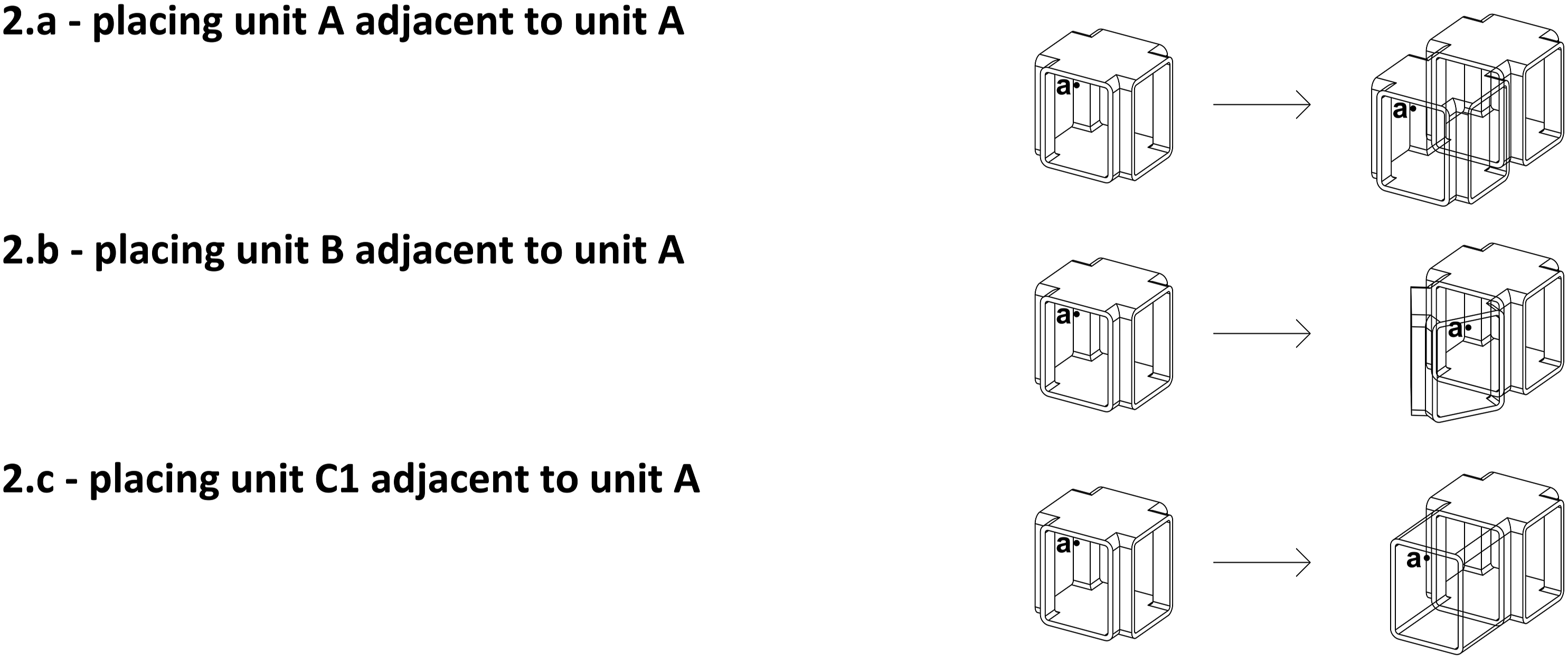
The generation starts with the introduction of the initial shape which can be unit A (rule 1a) or unit B (rule 1b) (see Figure 3). The group of shape rules 2 to 6, are used for placing spatial elements, namely units A, B, C1, C2, and C3. Since there is a wide variety of units, each main rule has eight sub-rules to accommodate all possibilities of adjacency (see Figure 4). Shape rules 7 to 13 aim at introducing the closing elements in the composition and are the last group of shape rules to be applied (see Figure 5). Here seven types of closing elements are used - door, sale window (S1), shop window (S2 to S5), canopy, skylight, and windows S6 and S7. Depending on the possibilities of use each rule includes more sub-rules. Rules 1a and 1b for introducing the initial shape (Created by the first author (2024)). Example of rules for introducing spatial elements adjacent to unit A (Created by the first author (2024)). Example of rules for introducing closing elements (Created by the first author (2024)).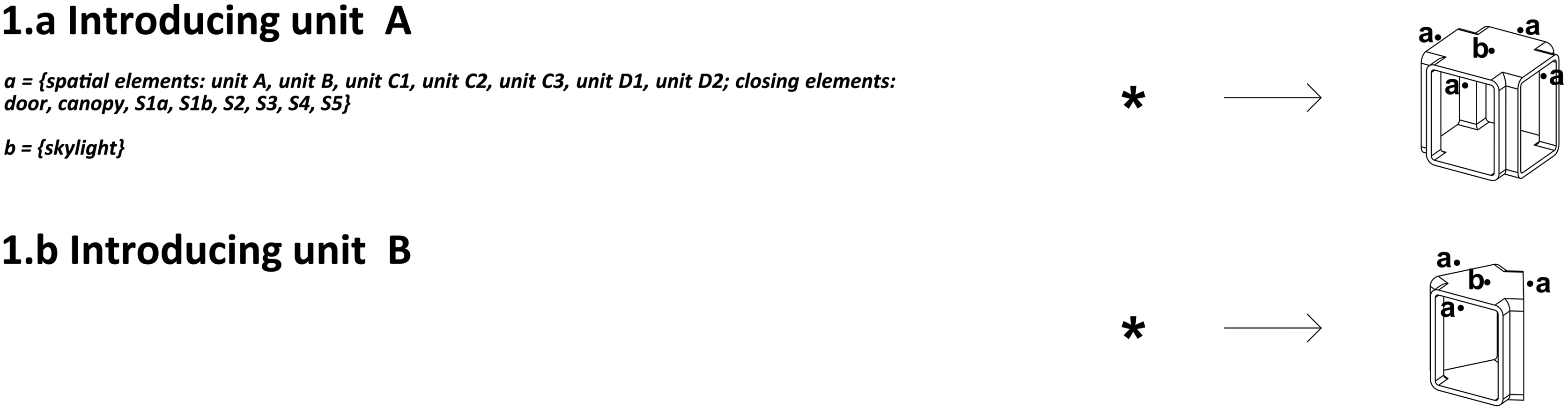
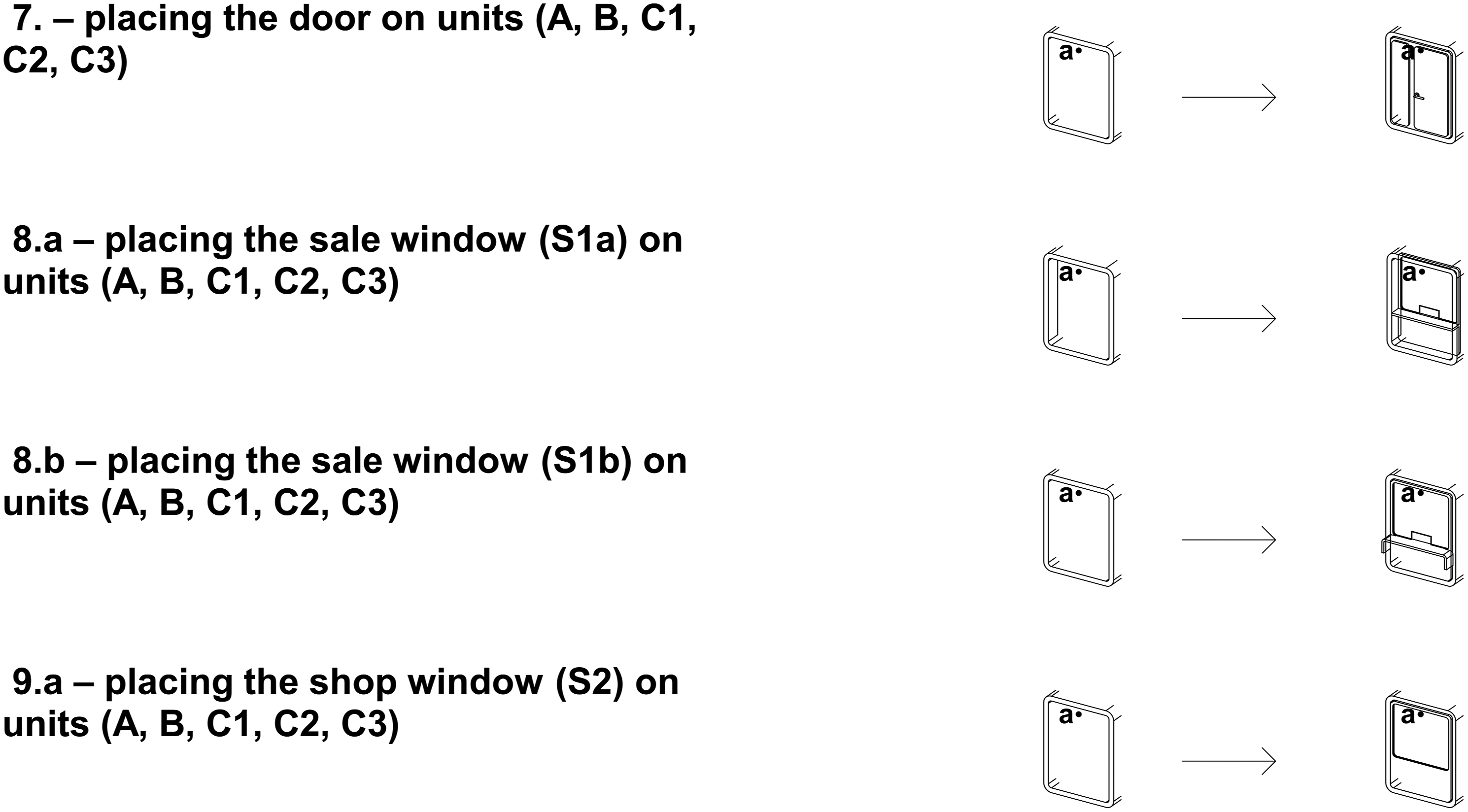
Although the use of the elements that compose K67 and the way to assemble them was defined by Mächtig, the architect did not define a maximum number of elements in a set or limitations to use any of the elements. This situation was never mentioned as a problem since users used common sense to define the size of the developed sets. Nevertheless, when devising a shape grammar and due to the fact that it is a computational approach such limits such be incorporated otherwise the generation might be infinite. The authors of this study decided not to include conditions to stop the generation of the K67 as designed by Mächtig. Since the generation of such a kiosk will always be devised to respond to a design brief, the generation stops when the design brief is responded.
Vitruvian triad applied to K67 grammar
K67 grammar shape rules and firmitas, utilitas and venustas dimensions
Using shape grammar in architecture, fosters design coherence and consistency through a systematic and rule-based approach. In this paper we present the K67 shape grammar rules which describe a family of design solutions such as shape grammars typically do. Using the K67 shape grammar to generate new kiosk design solutions enables to create a large variety of solutions that couldn’t be easily generated by hand. Although the grammar represents a powerful engine of generation this generation will be too broad since the K67 original design was one of modules that could be freely assembled and not of final design solutions responding to specific design briefs. In order to generate kiosk solutions that better fit the aim of different kiosk requirements we used the dimensions of firmitas, utilitas and venustas as explained in Section 2.3. These dimensions were incorporated into the K67 language, collectively defining a multilanguage grammar. This grammar enables the creation of original designs by Saša Mächtig and others, guided by varying emphases on the three architectural qualities defined by Vitruvius.
Our aim is to apply an heuristic to the K67 grammar presented in Section 3.3 that enables to generate kiosk solutions which rank more in firmitas when durability is the main requirement, rank more in utilitas when functionality is above all other requirements and ranks more in venustas when the aim is an unified and visually harmonious architectural language.
Although the K67 is an architectural design and entails all the ‘nontrivial’ design tasks as mentioned by Mitchell, 16 the elements variation is limited so as the combination possibilities. Such characteristics allow us to associate each element to a classification of how it responds to each of firmitas, utilitas, and venustas principles.
Matrix that relates the grammar shapes with the three Vitruvian dimensions firmitas, utilitas and venustas (Created by the first author (2024)).
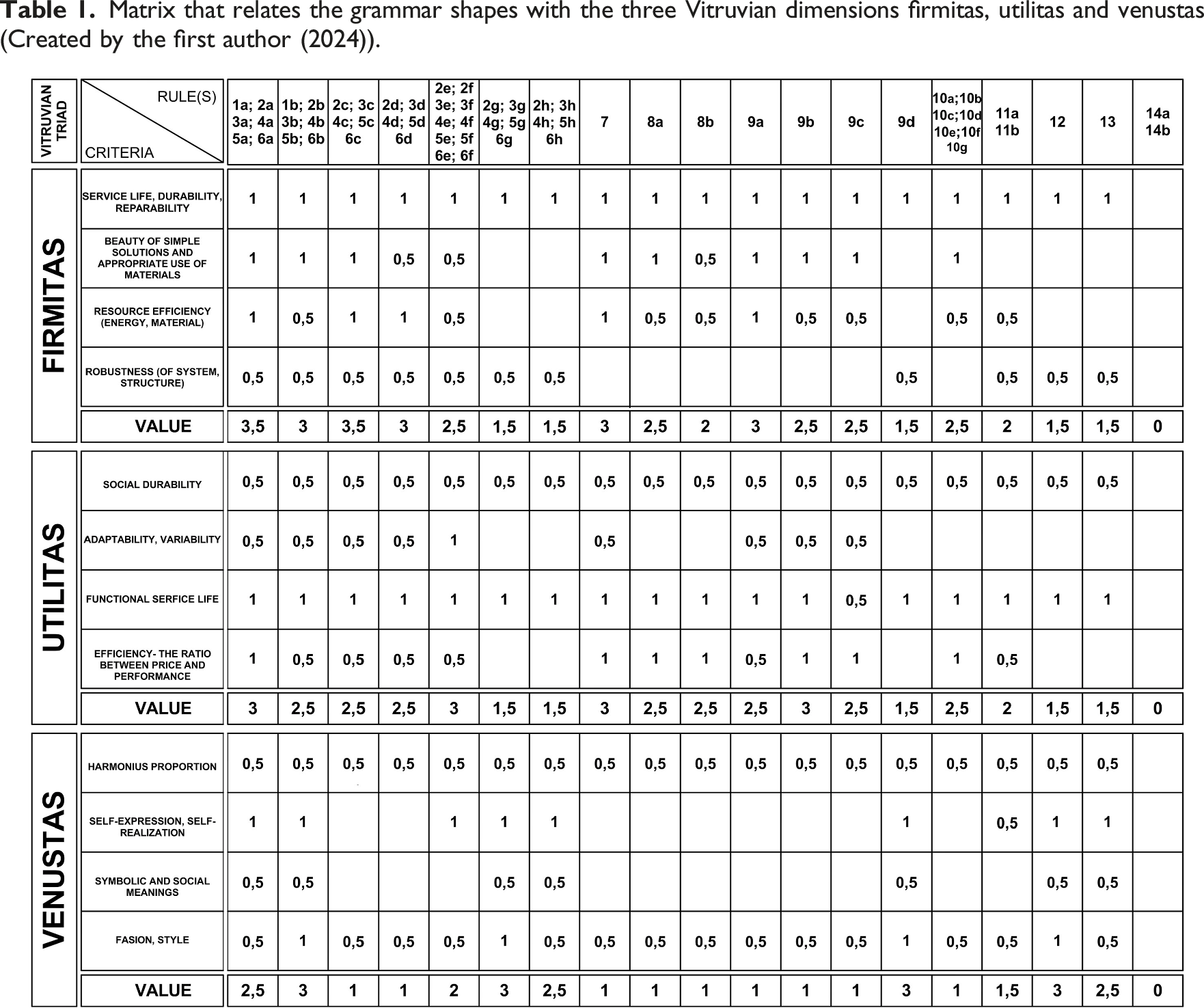
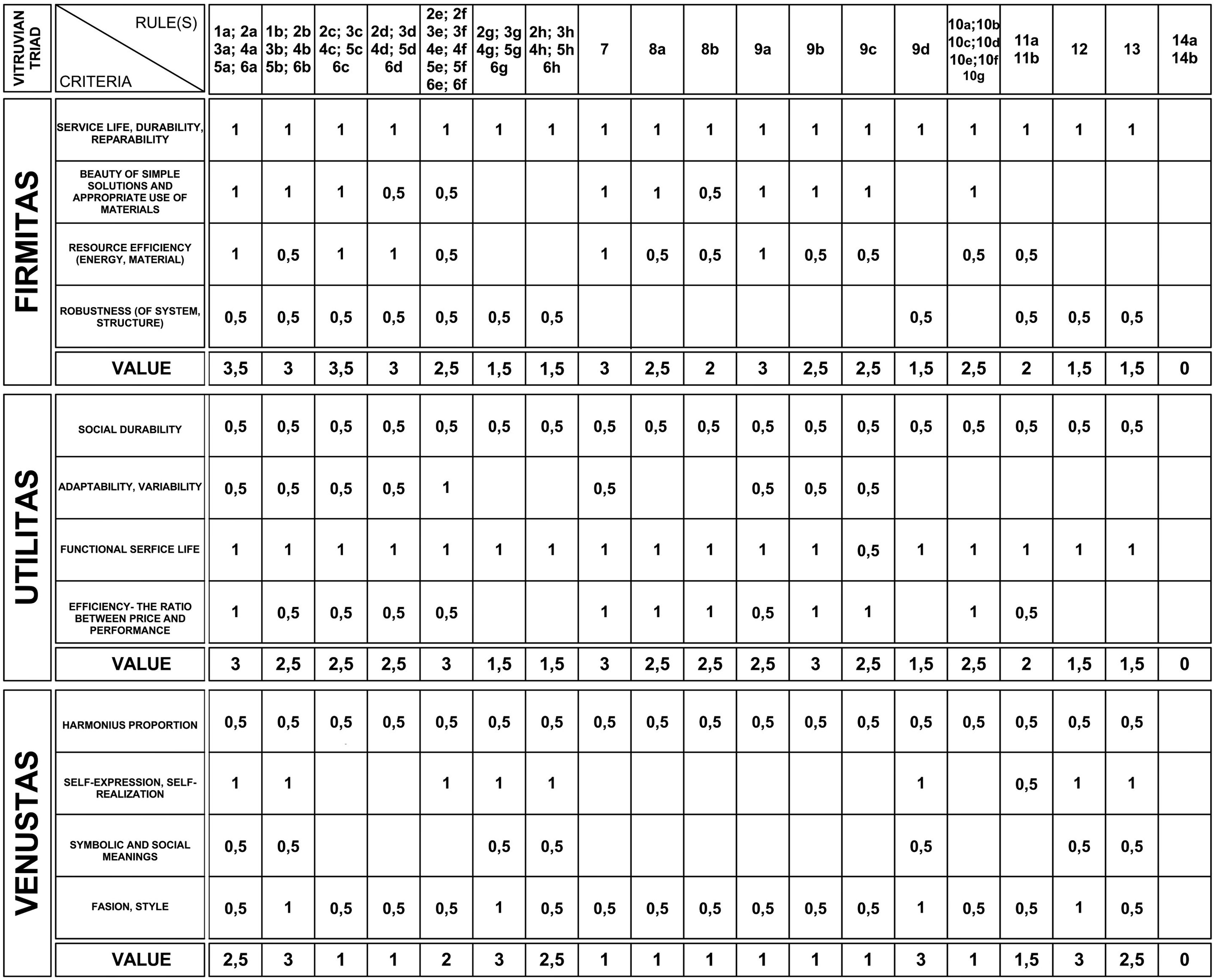
Thresholds in the range of values from 0 to 4, where the degree of relevance is assessed (0, 0.5, 1, 1.5, 2, 2.5, 3, 3.5, 4) were defined. Such classification allows a strategic use of shape rules during a design generation aligned with the aims of the design. If a rule reaches a threshold value, it cannot be applied unless the preceding rule has been applied.
In a scenario where firmitas is the most aimed dimension, shape rules that include elements with the highest score should be preferred. Therefore, in such a scenario, shape rules with a threshold of 3.5 (A, C1) are used for volumetry generation, while the threshold value of 3 is used for closing elements (door, S2). Otherwise, the grammar user can define different threshold to use. In a scenario where utilitas is the most aimed dimension, the threshold is set at 3 for both volumetric units and closing elements, resulting in ensembles that include units A and C3, and closing elements door and S3. In the case of a design scenario focused on venustas, the threshold for volumetric units is 3 (B and D1), while the threshold for closing elements is 3, including S5 and S6. Although the door element does not exceed the threshold, this rule is included (See Appendix 1).
Generation sequences and demonstration
To demonstrate the use of the triad heuristic we apply it to three scenarios that we present in this section.
The first scenario is a brief for a kiosk to be implemented in an historical city center to be used as a temporary exhibition of photography. The kiosk should be beautifully design to fit the historic center. A small number of visitors should be able to enter the kiosk which should be around 12 m2 (4 units). For the generation of this kiosk the dimension of venustas is taken as the most relevant (Figure 6). Therefore, as explained before we used spatial elements rules that have a threshold of 3 in this dimension and closing elements rules with a threshold value of 3 (see Table 1 and Table A1). Generation of some solutions for the Photography Exhibition kiosk based on the dimension of venustas. All presented solutions cover an area of around 12 m2. For each solution, cumulative values of Vitruvian dimensions are calculated. The figure contains types of spatial units and closing elements that generate the solution. (Created by the first author (2024)).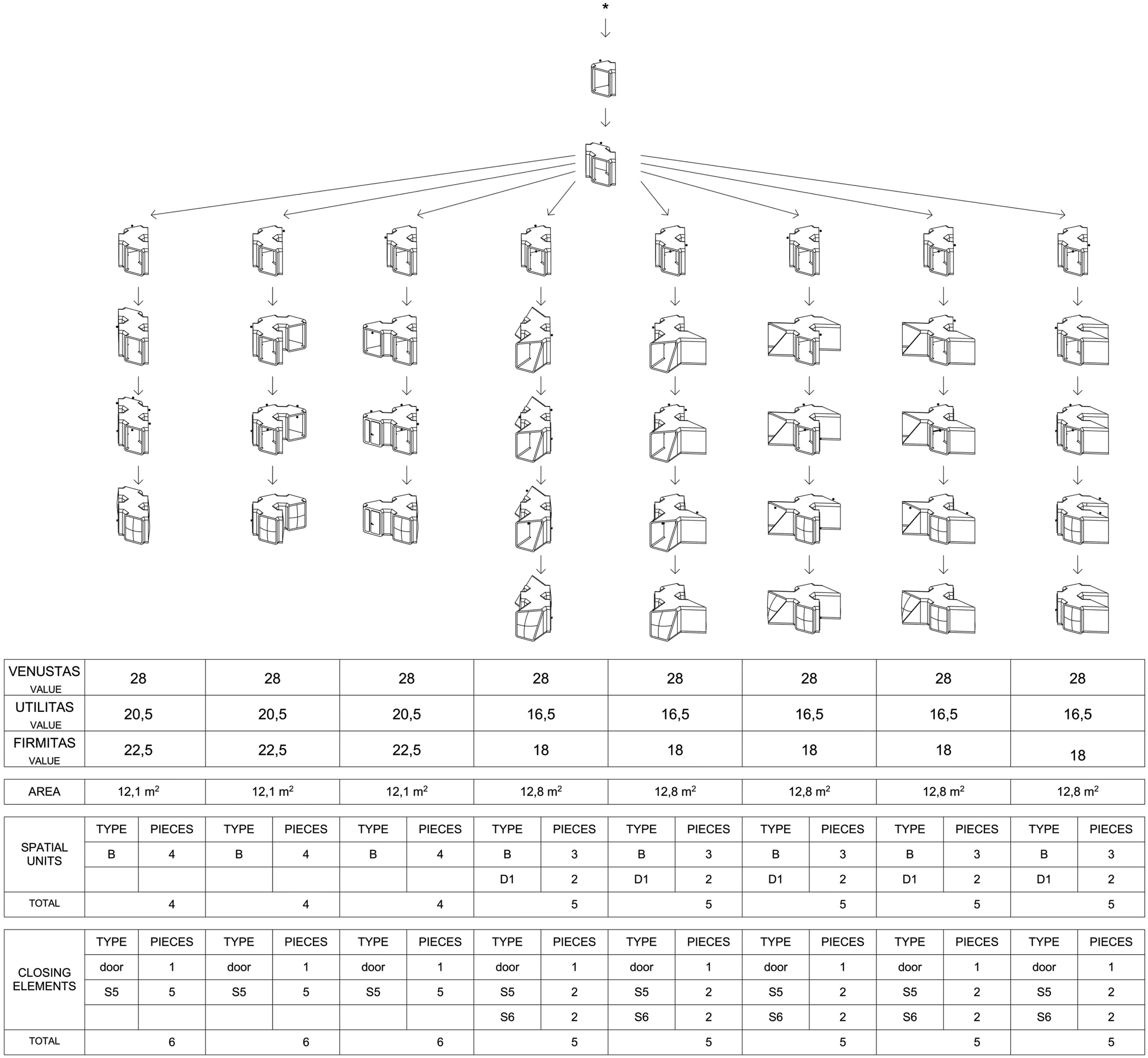
By using such rules, all the design solutions generated ranked more on the dimension of venustas as seen in Figure 6.
The second scenario is a brief for a kiosk to be implemented in a ski resort in Switzerland to store all skiing equipment. The kiosk should be strong and durable. The size should be around 21 m2 (4 units) and two visitors can enter each time to dress their equipment. For the generation of this kiosk the dimension of firmitas is the most relevant (Figure 7). Therefore, as explained before we used spatial elements rules that have a threshold of 3.5 in this dimension and closing elements rules with a threshold value of 3 (see Table 1 and Table A1). By using such rules, all the design solutions generated ranked more on the dimension of firmitas as seen in Figure 7. Generation of some solutions for the Sky Resort kiosk based on the dimension of firmitas. All presented solutions cover an area ranging from 15,2 m2 to 21,6 m2. For each solution, cumulative values of Vitruvian dimensions are calculated. The figure contains types of spatial units and closing elements that generate the solution (Created by the first author (2024)).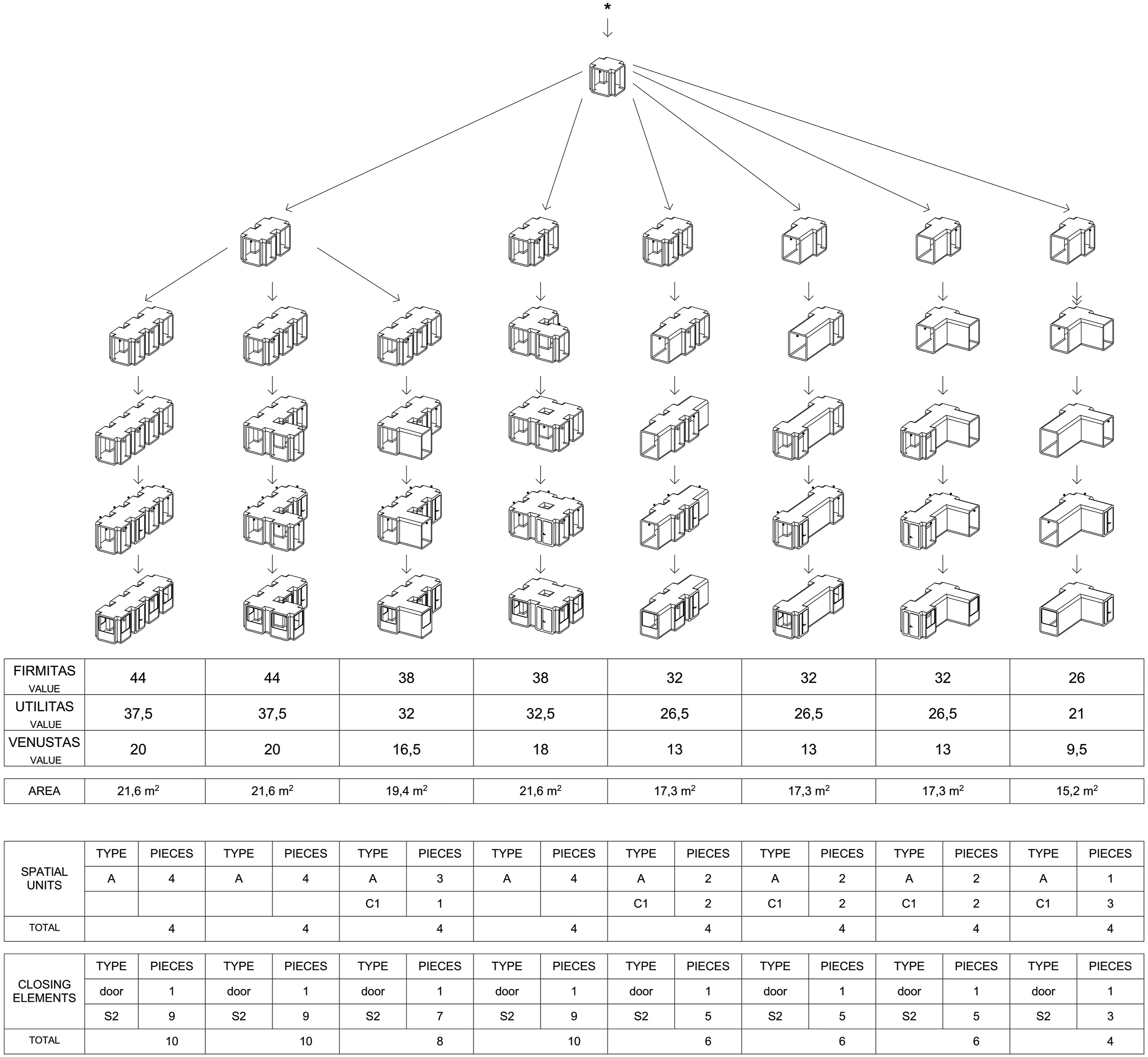
The third scenario is a kiosk to be implemented temporarily in several villages to bring a traveling library. The kiosk should have space to install books inside as well as some seating places. The size should be around 21 m2 (4 units) and enable one person working there and three other people reading inside. For the generation of this kiosk the dimension utilitas is the most relevant (Figure 8). Therefore, as explained before we used spatial elements rules that have a threshold of 3 in this dimension and closing elements rules with a threshold value of 3 (see Table 1 and Table A1). Generation of solutions for the Traveling Library kiosk based on the dimension of utilitas. All presented solutions cover an area ranging from 18,4 m2 to 21,6 m2. For each solution, cumulative values of Vitruvian dimensions are calculated. The figure contains types of spatial units and closing elements that generate the solution (Created by the first author (2024)).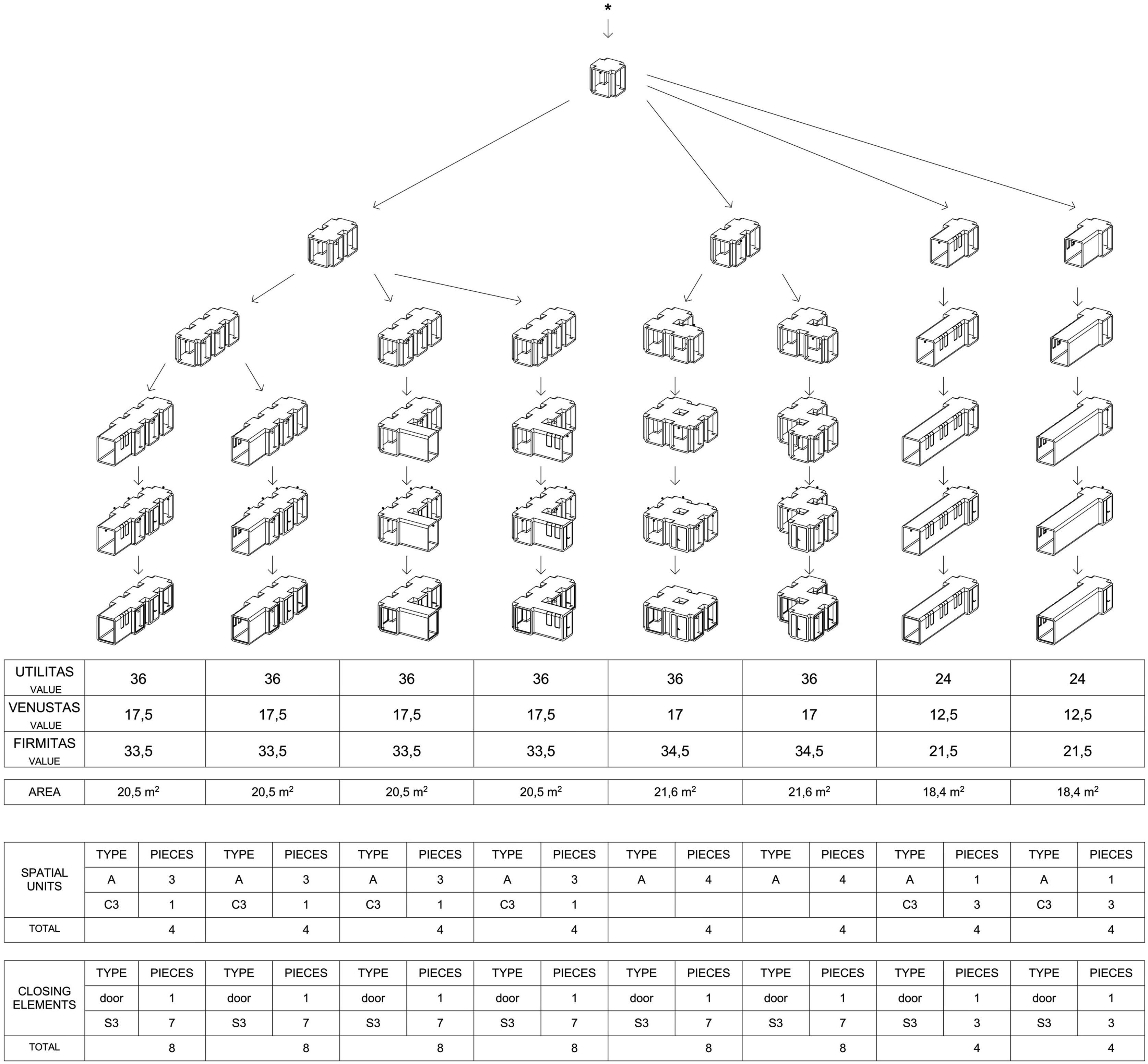
By using such rules, all the design solutions generated ranked more on the dimension of utiltas as seen in Figure 8.
Analysing the solutions generated enables us to identify differences among the alternatives aligned with the dimensions we aimed to include in the Vitruvian triad heuristic applied to the K67 shape grammar. Indeed, the solutions generated for the kiosk based on the dimension of venustas (Photography Exhibition kiosk) are the ones that use more dynamic units and arrive at more complex geometries, creating beautiful and innovative designs. Both the kiosk based on the dimension of firmitas (Sky Resort kiosk) and the one based on the dimension of utilitas (Library kiosk) solutions reinforce orthogonality and simple juxtaposition of similar elements.
Discussion and conclusions
In this study we present a shape grammar for the design language of the Kiosk K67, a modular architectural structure designed by Saša Mächtig and an heuristic based on the Vitruvian triad that, when applied to the grammar, enables the generation of design solution that fit specific design briefs.
A defining characteristic of the K67 vocabulary is its rich assortment of spatial units and closing elements, showcasing a spectrum of diversification mirroring intra-traditional classification. This classification, aligned with Vitruvian dimensions, aids decision-making across varied spatial contexts and requirements. The adaptability of K67 elements is exemplified in Section 4.2, where, through design scenarios, the grammar is applied, and optimal thresholds are chosen to highlight distinctiveness among ensemble properties. The adaptability of K67’s elements is thus evident, where they seamlessly adjust to different scenarios. By setting thresholds for the highest values, unique ensemble properties are accentuated. This methodological approach not only enables diverse combinatorial possibilities but also establishes clear criteria for ensemble generation and defines ensemble generation thresholds. For instance, in scenario 1, emphasising the venustas dimension with a threshold of 2.5 would yield additional variations encompassing spatial units A and D2, alongside closing element S7.
The contribution of this paper is twofold. Firstly, as a study on the work of Kiosk 67 by Saša Mächtig and its design logic that can be used in an educational manner to understand and experiment with the K67 language. Secondly as research on how two principles of design (in this case the K67 design language and the Vitruvian triad design principles) can be combined to generate a language of design that incorporates richer information to lead the design solutions that the one provided by Mächtig drawings. This study aims to show how the prevailing dimension of the Vitruvian triad determines different solutions within the same architectural language while fitting specific design briefs.
Moreover, this shape grammar type allows for the incorporation of previously overlooked architectural features. Classifying rules based on firmitas, utilitas and venustas establishes a novel discourse in ensemble generation through shape grammar. In K67, all grammar rules, originally delineated by Mächtig, undergo scrutiny against specified threshold values derived from the intra-traditional scheme, ensuring adherence to essential shape grammar rules.
As a representative of modular architecture, K67 underscores how a single system can fulfil myriad needs, driven by a diverse array of elements embodying both sustainability and Vitruvian principles. Its transformative nature underscores the adaptability and metamorphosis inherent in its design philosophy, illustrating its capacity to seamlessly transition across multivarious contexts and demands. This adaptability, anchored in a broad spectrum of elements, underscores K67’s capacity to evolve and meet the evolving demands of architectural design and spatial utilisation.
The paper demonstrates how the findings can be applied to various situations, offering several benefits: i) Studying the work of the architect provides valuable historical and pedagogical insights on the evolution and application of modular design principles; ii) The kiosk’s ability to be used in multiple ways illustrates its practical versatility, making it an ideal solution for a range of needs; iii) Integrating complementary criteria into an existing architectural language can generate more tailored and effective solutions while using the same architectural vocabulary. This approach showcases how the predominant dimension of the Vitruvian triad influences different solutions within the same architectural language; iv) This approach can serve as a model or framework for developing new architectural languages, particularly within modular architecture, that create flexible solutions to meet diverse needs across different architectural contexts. By applying the principles demonstrated in the K67 case study, architects can better address varied demands and innovate their design approach.
This approach highlights the potential of modular architecture within the context of sustainability, showcasing its versatility within a unified architectural language that achieves diverse qualities according to different demands, as seen in the case of the Kiosk K67. Modular architecture focuses on assembling and disassembling components, adhering to the principle that buildings are dynamic, evolving structures. Exemplified by projects like K67, modular buildings are designed with flexibility and reversibility, enabling continuous space, needs, and function adaptation.
Footnotes
Declaration of conflicting interests
The author(s) declared no potential conflicts of interest with respect to the research, authorship, and/or publication of this article.
Funding
The author(s) received no financial support for the research, authorship, and/or publication of this article.

Notes
Appendix
Shape rules of the K67 shape grammar. The rules used in the derivations (Figures 6–8) presented in Section 4.2 are identified with an ‘X‘.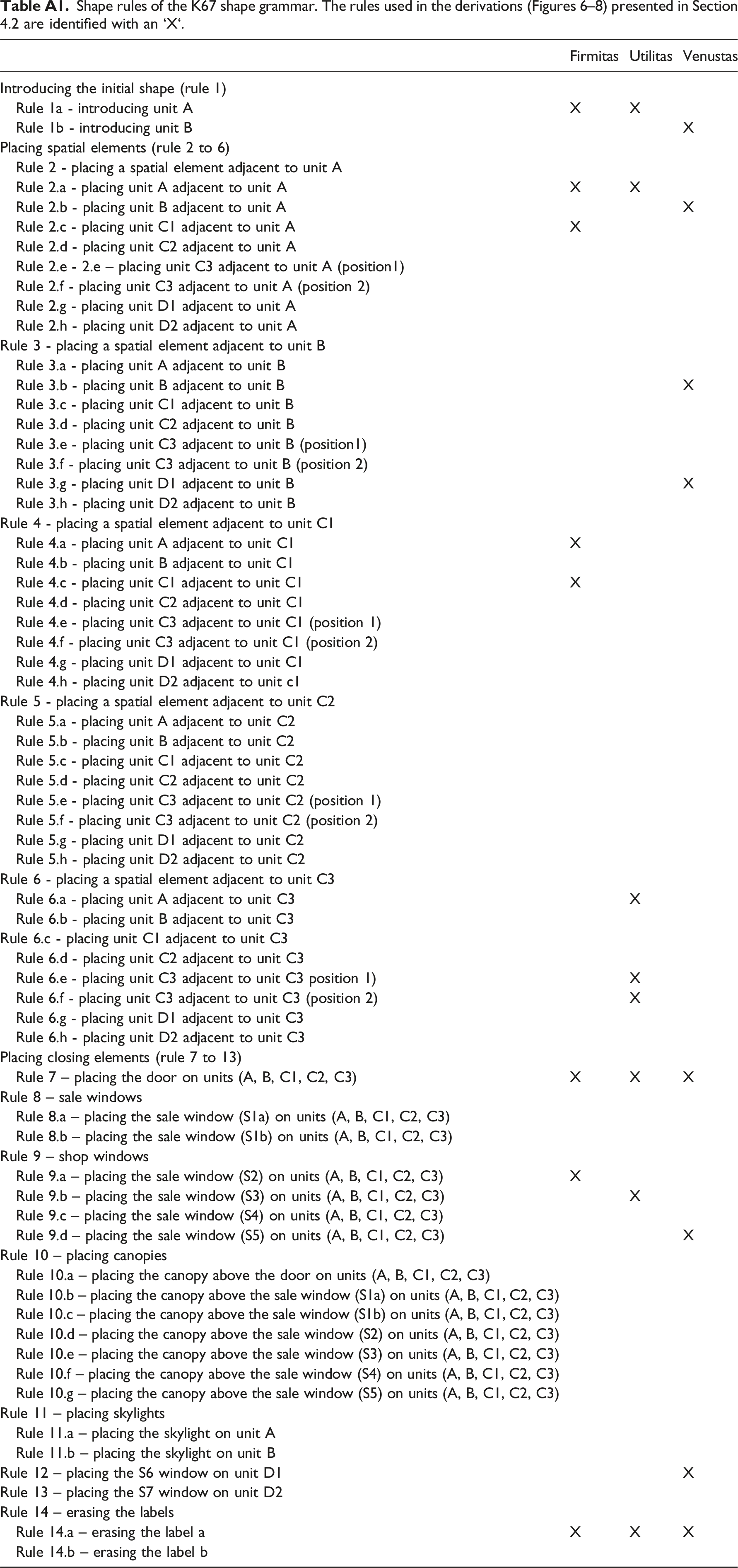
Firmitas
Utilitas
Venustas
Introducing the initial shape (rule 1)
Rule 1a - introducing unit A
X
X
Rule 1b - introducing unit B
X
Placing spatial elements (rule 2 to 6)
Rule 2 - placing a spatial element adjacent to unit A
Rule 2.a - placing unit A adjacent to unit A
X
X
Rule 2.b - placing unit B adjacent to unit A
X
Rule 2.c - placing unit C1 adjacent to unit A
X
Rule 2.d - placing unit C2 adjacent to unit A
Rule 2.e - 2.e – placing unit C3 adjacent to unit A (position1)
Rule 2.f - placing unit C3 adjacent to unit A (position 2)
Rule 2.g - placing unit D1 adjacent to unit A
Rule 2.h - placing unit D2 adjacent to unit A
Rule 3 - placing a spatial element adjacent to unit B
Rule 3.a - placing unit A adjacent to unit B
Rule 3.b - placing unit B adjacent to unit B
X
Rule 3.c - placing unit C1 adjacent to unit B
Rule 3.d - placing unit C2 adjacent to unit B
Rule 3.e - placing unit C3 adjacent to unit B (position1)
Rule 3.f - placing unit C3 adjacent to unit B (position 2)
Rule 3.g - placing unit D1 adjacent to unit B
X
Rule 3.h - placing unit D2 adjacent to unit B
Rule 4 - placing a spatial element adjacent to unit C1
Rule 4.a - placing unit A adjacent to unit C1
X
Rule 4.b - placing unit B adjacent to unit C1
Rule 4.c - placing unit C1 adjacent to unit C1
X
Rule 4.d - placing unit C2 adjacent to unit C1
Rule 4.e - placing unit C3 adjacent to unit C1 (position 1)
Rule 4.f - placing unit C3 adjacent to unit C1 (position 2)
Rule 4.g - placing unit D1 adjacent to unit C1
Rule 4.h - placing unit D2 adjacent to unit c1
Rule 5 - placing a spatial element adjacent to unit C2
Rule 5.a - placing unit A adjacent to unit C2
Rule 5.b - placing unit B adjacent to unit C2
Rule 5.c - placing unit C1 adjacent to unit C2
Rule 5.d - placing unit C2 adjacent to unit C2
Rule 5.e - placing unit C3 adjacent to unit C2 (position 1)
Rule 5.f - placing unit C3 adjacent to unit C2 (position 2)
Rule 5.g - placing unit D1 adjacent to unit C2
Rule 5.h - placing unit D2 adjacent to unit C2
Rule 6 - placing a spatial element adjacent to unit C3
Rule 6.a - placing unit A adjacent to unit C3
X
Rule 6.b - placing unit B adjacent to unit C3
Rule 6.c - placing unit C1 adjacent to unit C3
Rule 6.d - placing unit C2 adjacent to unit C3
Rule 6.e - placing unit C3 adjacent to unit C3 position 1)
X
Rule 6.f - placing unit C3 adjacent to unit C3 (position 2)
X
Rule 6.g - placing unit D1 adjacent to unit C3
Rule 6.h - placing unit D2 adjacent to unit C3
Placing closing elements (rule 7 to 13)
Rule 7 – placing the door on units (A, B, C1, C2, C3)
X
X
X
Rule 8 – sale windows
Rule 8.a – placing the sale window (S1a) on units (A, B, C1, C2, C3)
Rule 8.b – placing the sale window (S1b) on units (A, B, C1, C2, C3)
Rule 9 – shop windows
Rule 9.a – placing the sale window (S2) on units (A, B, C1, C2, C3)
X
Rule 9.b – placing the sale window (S3) on units (A, B, C1, C2, C3)
X
Rule 9.c – placing the sale window (S4) on units (A, B, C1, C2, C3)
Rule 9.d – placing the sale window (S5) on units (A, B, C1, C2, C3)
X
Rule 10 – placing canopies
Rule 10.a – placing the canopy above the door on units (A, B, C1, C2, C3)
Rule 10.b – placing the canopy above the sale window (S1a) on units (A, B, C1, C2, C3)
Rule 10.c – placing the canopy above the sale window (S1b) on units (A, B, C1, C2, C3)
Rule 10.d – placing the canopy above the sale window (S2) on units (A, B, C1, C2, C3)
Rule 10.e – placing the canopy above the sale window (S3) on units (A, B, C1, C2, C3)
Rule 10.f – placing the canopy above the sale window (S4) on units (A, B, C1, C2, C3)
Rule 10.g – placing the canopy above the sale window (S5) on units (A, B, C1, C2, C3)
Rule 11 – placing skylights
Rule 11.a – placing the skylight on unit A
Rule 11.b – placing the skylight on unit B
Rule 12 – placing the S6 window on unit D1
X
Rule 13 – placing the S7 window on unit D2
Rule 14 – erasing the labels
Rule 14.a – erasing the label a
X
X
X
Rule 14.b – erasing the label b